Cambridge A Level Business (for first examination in 2016) 9609 — 2017 Oct/Nov Paper 1 · Variant 2
9609/12/O/N/17 · 40 marks · ≈45 min
The question paper and its mark scheme, free to read here and free to download. This is Cambridge’s own paper, exactly as it was sat.
Question paper4 pages


Mark scheme10 pages
Answers below. Sit the paper first if you are practising.
Paper as text
Question paper, page 1
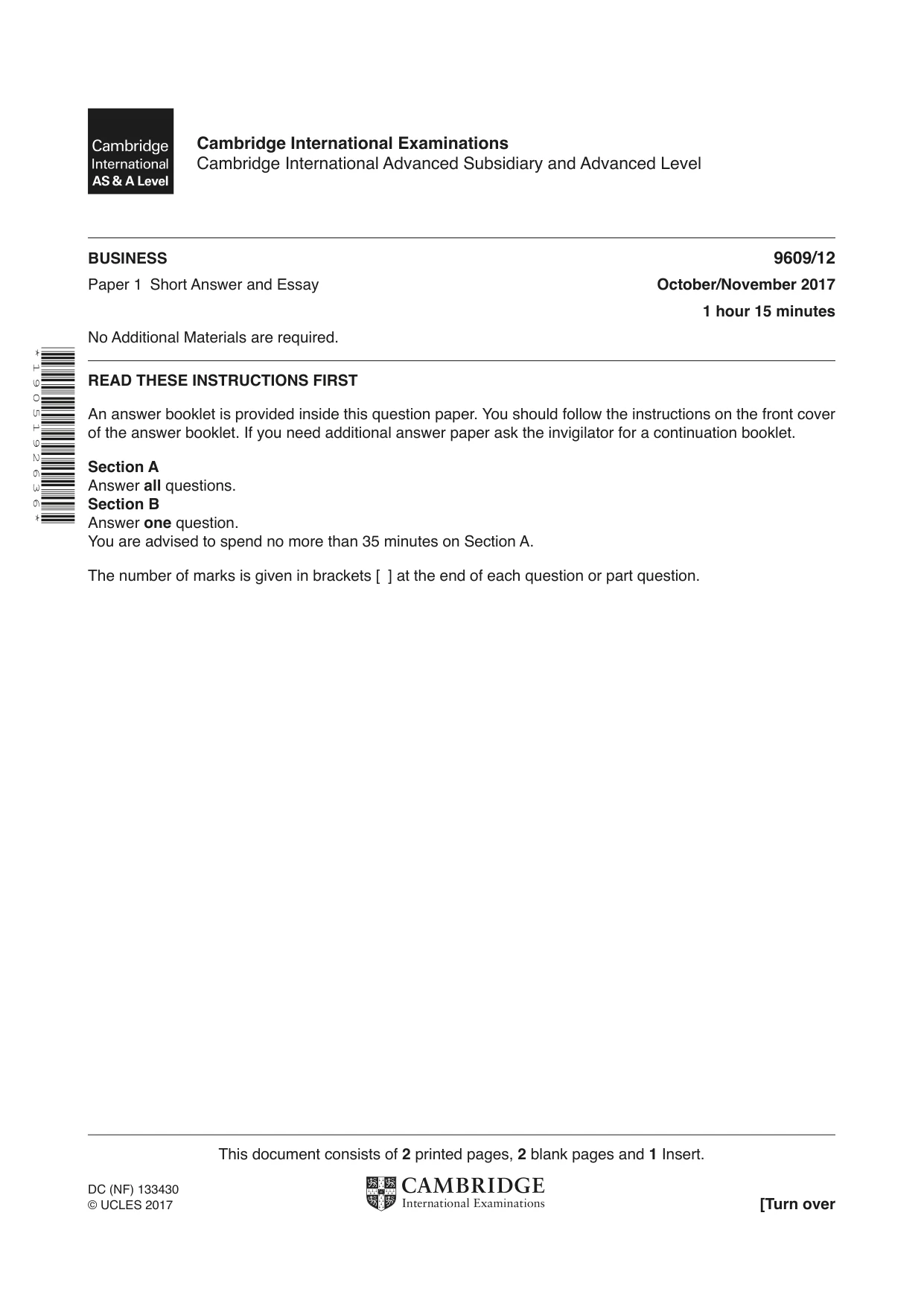
This document consists of 2 printed pages, 2 blank pages and 1 Insert. DC (NF) 133430 © UCLES 2017 [Turn over Cambridge International Examinations Cambridge International Advanced Subsidiary and Advanced Level * 1 9 0 5 1 9 2 6 3 6 * BUSINESS 9609/12 Paper 1 Short Answer and Essay October/November 2017 1 hour 15 minutes No Additional Materials are required. READ THESE INSTRUCTIONS FIRST An answer booklet is provided inside this question paper. You should follow the instructions on the front cover of the answer booklet. If you need additional answer paper ask the invigilator for a continuation booklet. Section A Answer all questions. Section B Answer one question. You are advised to spend no more than 35 minutes on Section A. The number of marks is given in brackets [ ] at the end of each question or part question.
Question paper, page 2
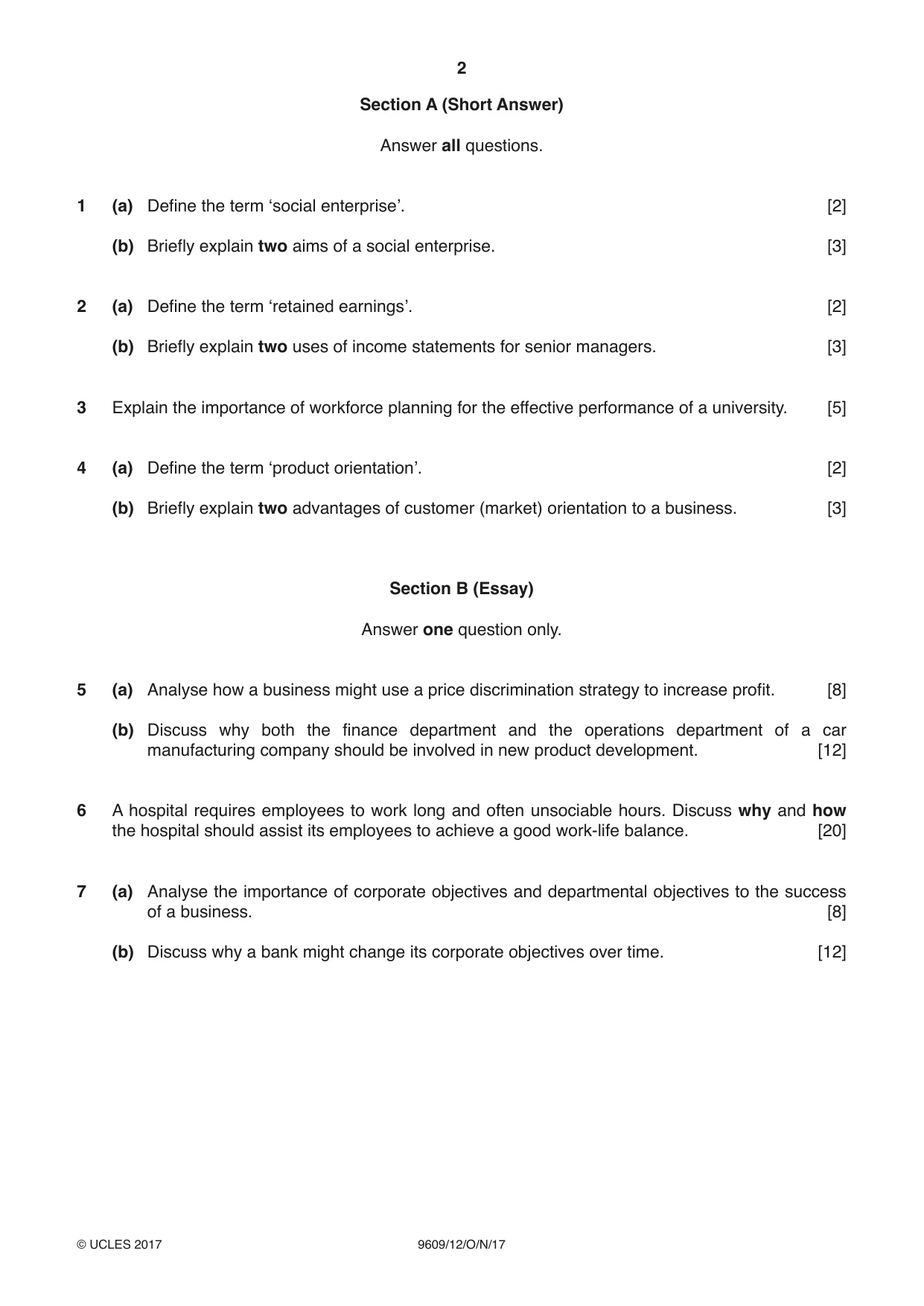
2 9609/12/O/N/17 © UCLES 2017 Section A (Short Answer) Answer all questions. 1 (a) Define the term ‘social enterprise’. [2] (b) Briefly explain two aims of a social enterprise. [3] 2 (a) Define the term ‘retained earnings’. [2] (b) Briefly explain two uses of income statements for senior managers. [3] 3 Explain the importance of workforce planning for the effective performance of a university. [5] 4 (a) Define the term ‘product orientation’. [2] (b) Briefly explain two advantages of customer (market) orientation to a business. [3] Section B (Essay) Answer one question only. 5 (a) Analyse how a business might use a price discrimination strategy to increase profit. [8] (b) Discuss why both the finance department and the operations department of a car manufacturing company should be involved in new product development. [12] 6 A hospital requires employees to work long and often unsociable hours. Discuss why and how the hospital should assist its employees to achieve a good work-life balance. [20] 7 (a) Analyse the importance of corporate objectives and departmental objectives to the success of a business. [8] (b) Discuss why a bank might change its corporate objectives over time. [12]
Question paper, page 3
3 9609/12/O/N/17 © UCLES 2017 BLANK PAGE
Question paper, page 4
4 9609/12/O/N/17 © UCLES 2017 BLANK PAGE Permission to reproduce items where third-party owned material protected by copyright is included has been sought and cleared where possible. Every reasonable effort has been made by the publisher (UCLES) to trace copyright holders, but if any items requiring clearance have unwittingly been included, the publisher will be pleased to make amends at the earliest possible opportunity. To avoid the issue of disclosure of answer-related information to candidates, all copyright acknowledgements are reproduced online in the Cambridge International Examinations Copyright Acknowledgements Booklet. This is produced for each series of examinations and is freely available to download at www.cie.org.uk after the live examination series. Cambridge International Examinations is part of the Cambridge Assessment Group. Cambridge Assessment is the brand name of University of Cambridge Local Examinations Syndicate (UCLES), which is itself a department of the University of Cambridge.
Mark scheme, page 1
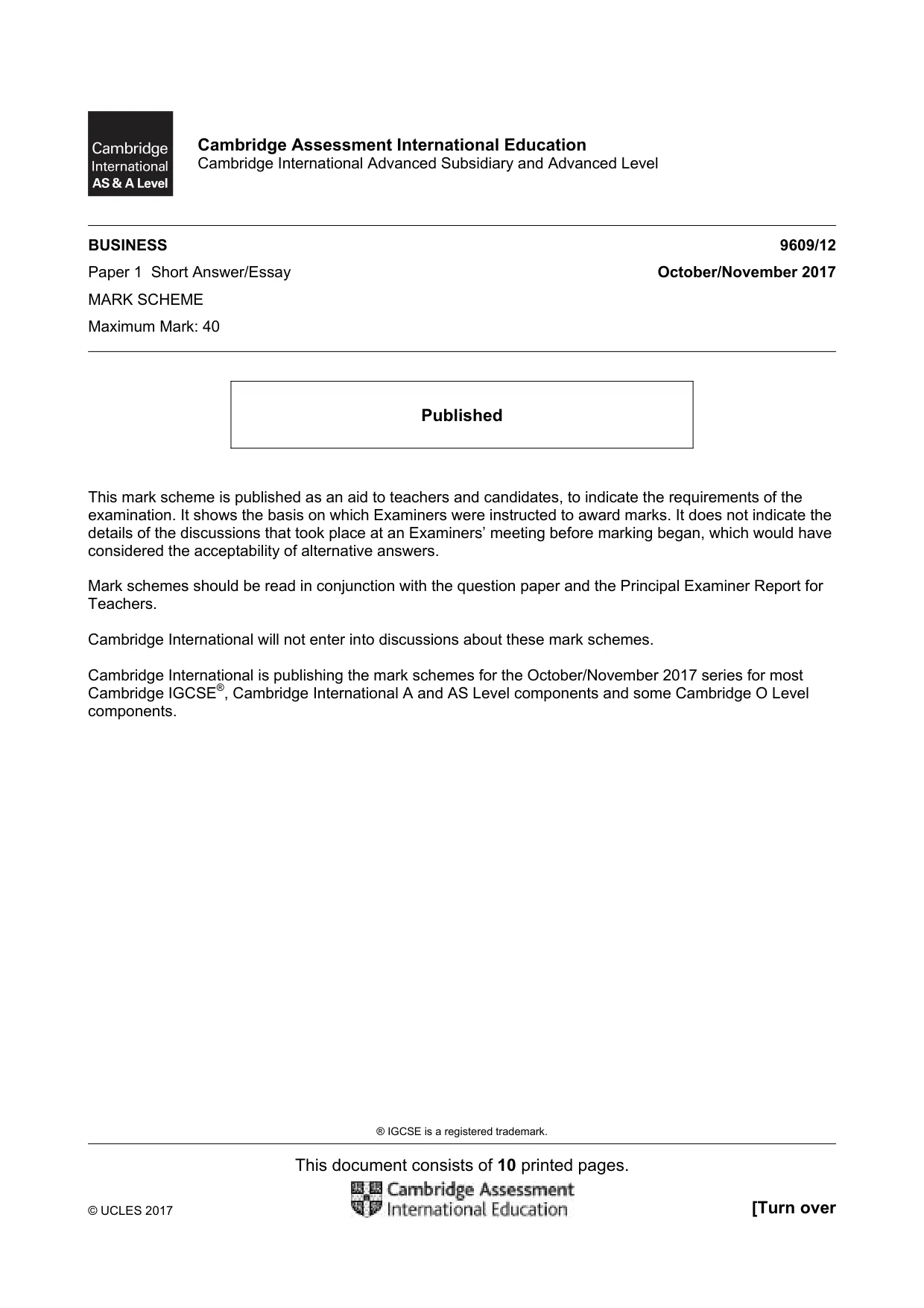
® IGCSE is a registered trademark. This document consists of 10 printed pages. © UCLES 2017 [Turn over Cambridge Assessment International Education Cambridge International Advanced Subsidiary and Advanced Level BUSINESS 9609/12 Paper 1 Short Answer/Essay October/November 2017 MARK SCHEME Maximum Mark: 40 Published This mark scheme is published as an aid to teachers and candidates, to indicate the requirements of the examination. It shows the basis on which Examiners were instructed to award marks. It does not indicate the details of the discussions that took place at an Examiners’ meeting before marking began, which would have considered the acceptability of alternative answers. Mark schemes should be read in conjunction with the question paper and the Principal Examiner Report for Teachers. Cambridge International will not enter into discussions about these mark schemes. Cambridge International is publishing the mark schemes for the October/November 2017 series for most Cambridge IGCSE®, Cambridge International A and AS Level components and some Cambridge O Level components.
Mark scheme, page 2
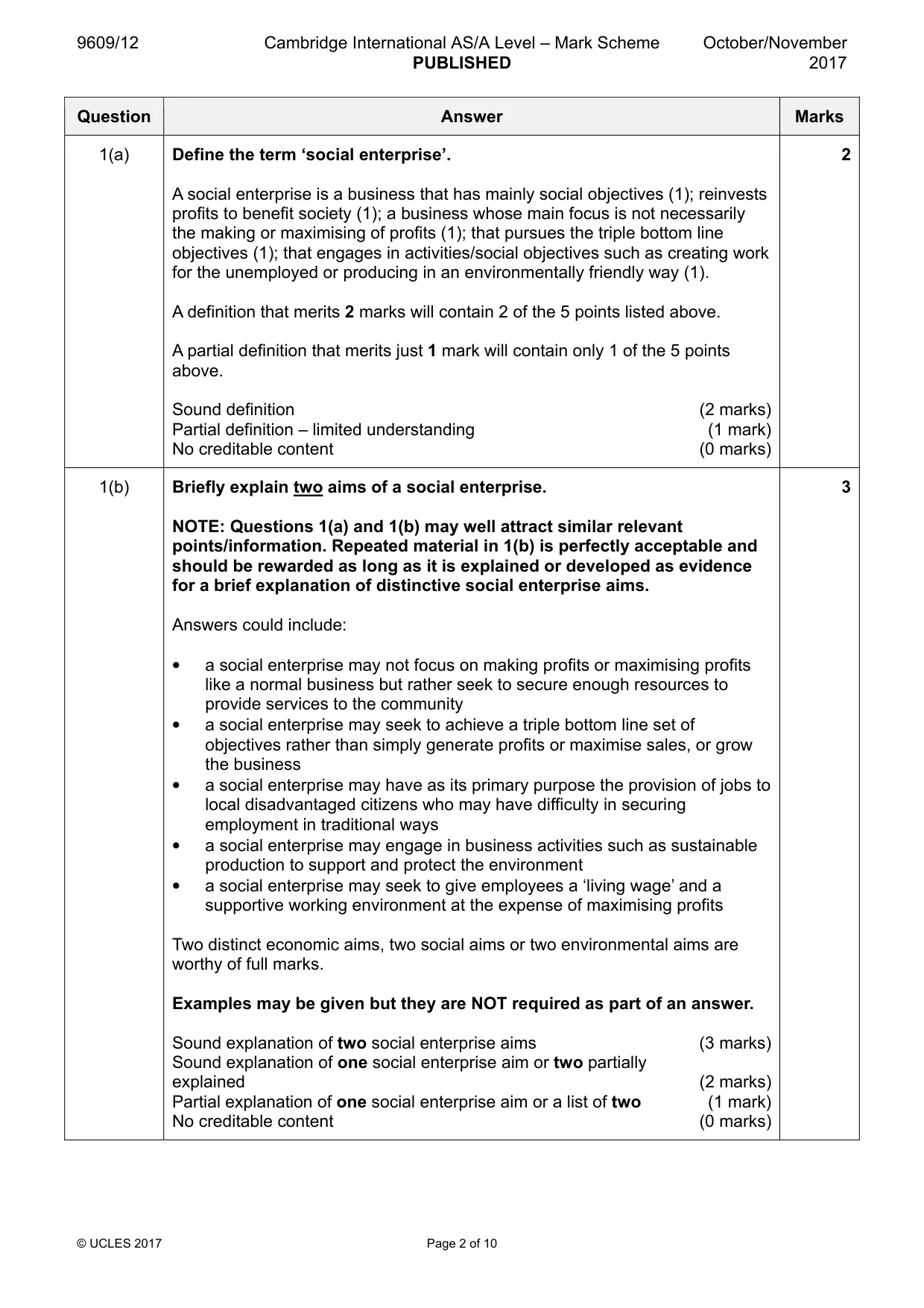
9609/12 Cambridge International AS/A Level – Mark Scheme PUBLISHED October/November 2017 © UCLES 2017 Page 2 of 10 Question Answer Marks 1(a) Define the term ‘social enterprise’. A social enterprise is a business that has mainly social objectives (1); reinvests profits to benefit society (1); a business whose main focus is not necessarily the making or maximising of profits (1); that pursues the triple bottom line objectives (1); that engages in activities/social objectives such as creating work for the unemployed or producing in an environmentally friendly way (1). A definition that merits 2 marks will contain 2 of the 5 points listed above. A partial definition that merits just 1 mark will contain only 1 of the 5 points above. Sound definition (2 marks) Partial definition – limited understanding (1 mark) No creditable content (0 marks) 2 1(b) Briefly explain two aims of a social enterprise. NOTE: Questions 1(a) and 1(b) may well attract similar relevant points/information. Repeated material in 1(b) is perfectly acceptable and should be rewarded as long as it is explained or developed as evidence for a brief explanation of distinctive social enterprise aims. Answers could include: • a social enterprise may not focus on making profits or maximising profits like a normal business but rather seek to secure enough resources to provide services to the community • a social enterprise may seek to achieve a triple bottom line set of objectives rather than simply generate profits or maximise sales, or grow the business • a social enterprise may have as its primary purpose the provision of jobs to local disadvantaged citizens who may have difficulty in securing employment in traditional ways • a social enterprise may engage in business activities such as sustainable production to support and protect the environment • a social enterprise may seek to give employees a ‘living wage’ and a supportive working environment at the expense of maximising profits Two distinct economic aims, two social aims or two environmental aims are worthy of full marks. Examples may be given but they are NOT required as part of an answer. Sound explanation of two social enterprise aims (3 marks) Sound explanation of one social enterprise aim or two partially explained (2 marks) Partial explanation of one social enterprise aim or a list of two (1 mark) No creditable content (0 marks) 3
Mark scheme, page 3
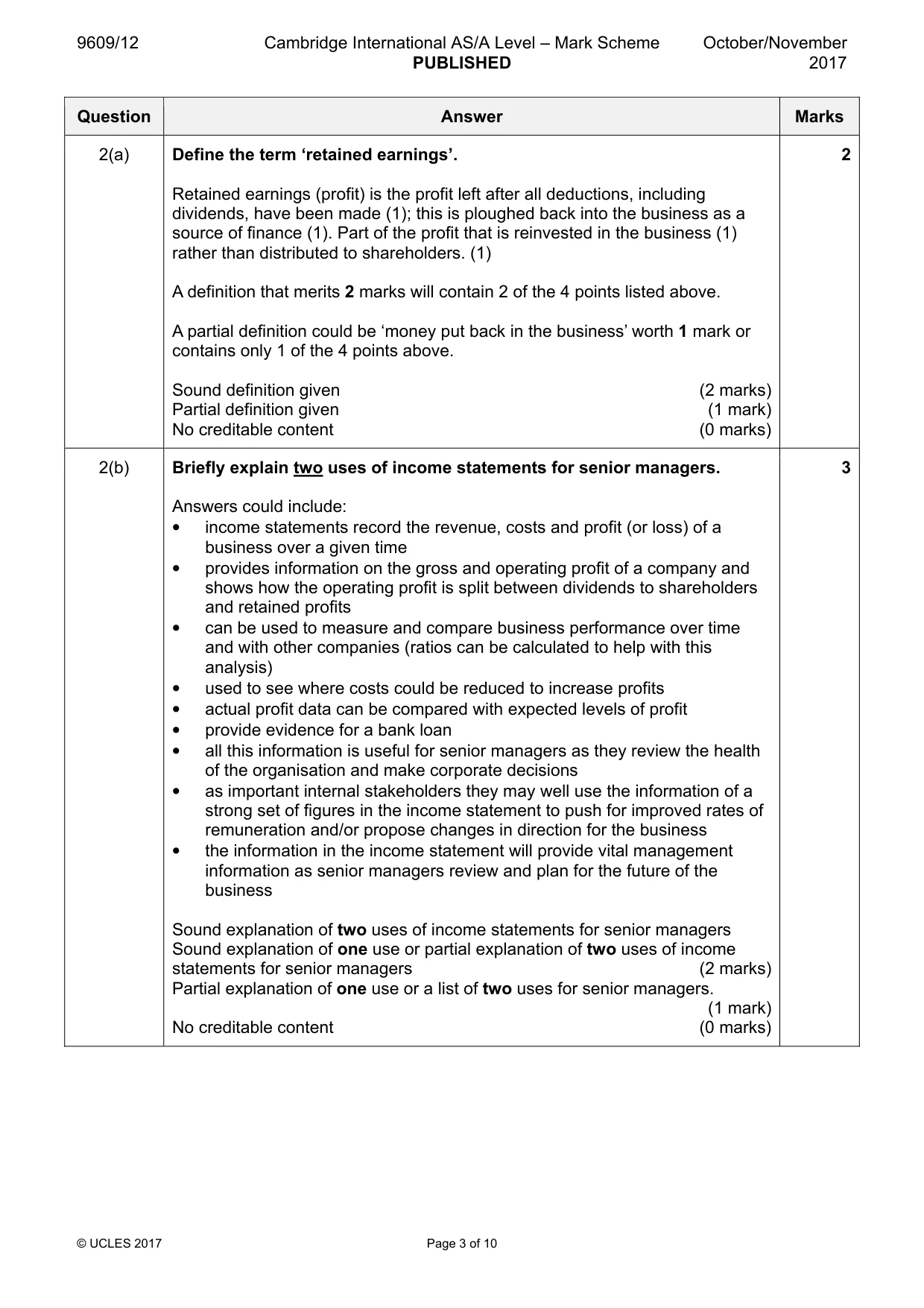
9609/12 Cambridge International AS/A Level – Mark Scheme PUBLISHED October/November 2017 © UCLES 2017 Page 3 of 10 Question Answer Marks 2(a) Define the term ‘retained earnings’. Retained earnings (profit) is the profit left after all deductions, including dividends, have been made (1); this is ploughed back into the business as a source of finance (1). Part of the profit that is reinvested in the business (1) rather than distributed to shareholders. (1) A definition that merits 2 marks will contain 2 of the 4 points listed above. A partial definition could be ‘money put back in the business’ worth 1 mark or contains only 1 of the 4 points above. Sound definition given (2 marks) Partial definition given (1 mark) No creditable content (0 marks) 2 2(b) Briefly explain two uses of income statements for senior managers. Answers could include: • income statements record the revenue, costs and profit (or loss) of a business over a given time • provides information on the gross and operating profit of a company and shows how the operating profit is split between dividends to shareholders and retained profits • can be used to measure and compare business performance over time and with other companies (ratios can be calculated to help with this analysis) • used to see where costs could be reduced to increase profits • actual profit data can be compared with expected levels of profit • provide evidence for a bank loan • all this information is useful for senior managers as they review the health of the organisation and make corporate decisions • as important internal stakeholders they may well use the information of a strong set of figures in the income statement to push for improved rates of remuneration and/or propose changes in direction for the business • the information in the income statement will provide vital management information as senior managers review and plan for the future of the business Sound explanation of two uses of income statements for senior managers Sound explanation of one use or partial explanation of two uses of income statements for senior managers (2 marks) Partial explanation of one use or a list of two uses for senior managers. (1 mark) No creditable content (0 marks) 3
Mark scheme, page 4
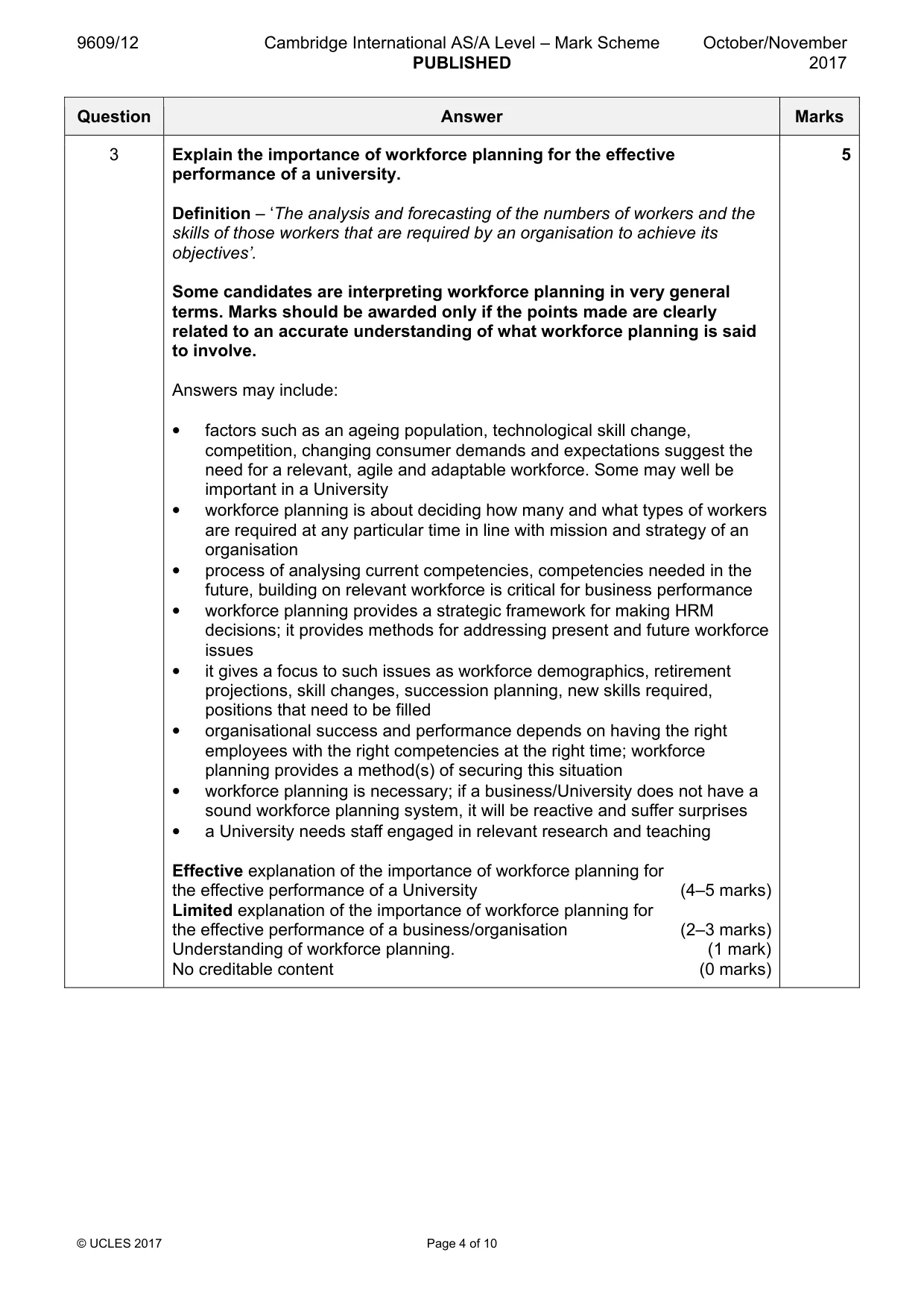
9609/12 Cambridge International AS/A Level – Mark Scheme PUBLISHED October/November 2017 © UCLES 2017 Page 4 of 10 Question Answer Marks 3 Explain the importance of workforce planning for the effective performance of a university. Definition – ‘The analysis and forecasting of the numbers of workers and the skills of those workers that are required by an organisation to achieve its objectives’. Some candidates are interpreting workforce planning in very general terms. Marks should be awarded only if the points made are clearly related to an accurate understanding of what workforce planning is said to involve. Answers may include: • factors such as an ageing population, technological skill change, competition, changing consumer demands and expectations suggest the need for a relevant, agile and adaptable workforce. Some may well be important in a University • workforce planning is about deciding how many and what types of workers are required at any particular time in line with mission and strategy of an organisation • process of analysing current competencies, competencies needed in the future, building on relevant workforce is critical for business performance • workforce planning provides a strategic framework for making HRM decisions; it provides methods for addressing present and future workforce issues • it gives a focus to such issues as workforce demographics, retirement projections, skill changes, succession planning, new skills required, positions that need to be filled • organisational success and performance depends on having the right employees with the right competencies at the right time; workforce planning provides a method(s) of securing this situation • workforce planning is necessary; if a business/University does not have a sound workforce planning system, it will be reactive and suffer surprises • a University needs staff engaged in relevant research and teaching Effective explanation of the importance of workforce planning for the effective performance of a University (4–5 marks) Limited explanation of the importance of workforce planning for the effective performance of a business/organisation (2–3 marks) Understanding of workforce planning. (1 mark) No creditable content (0 marks) 5
Mark scheme, page 5
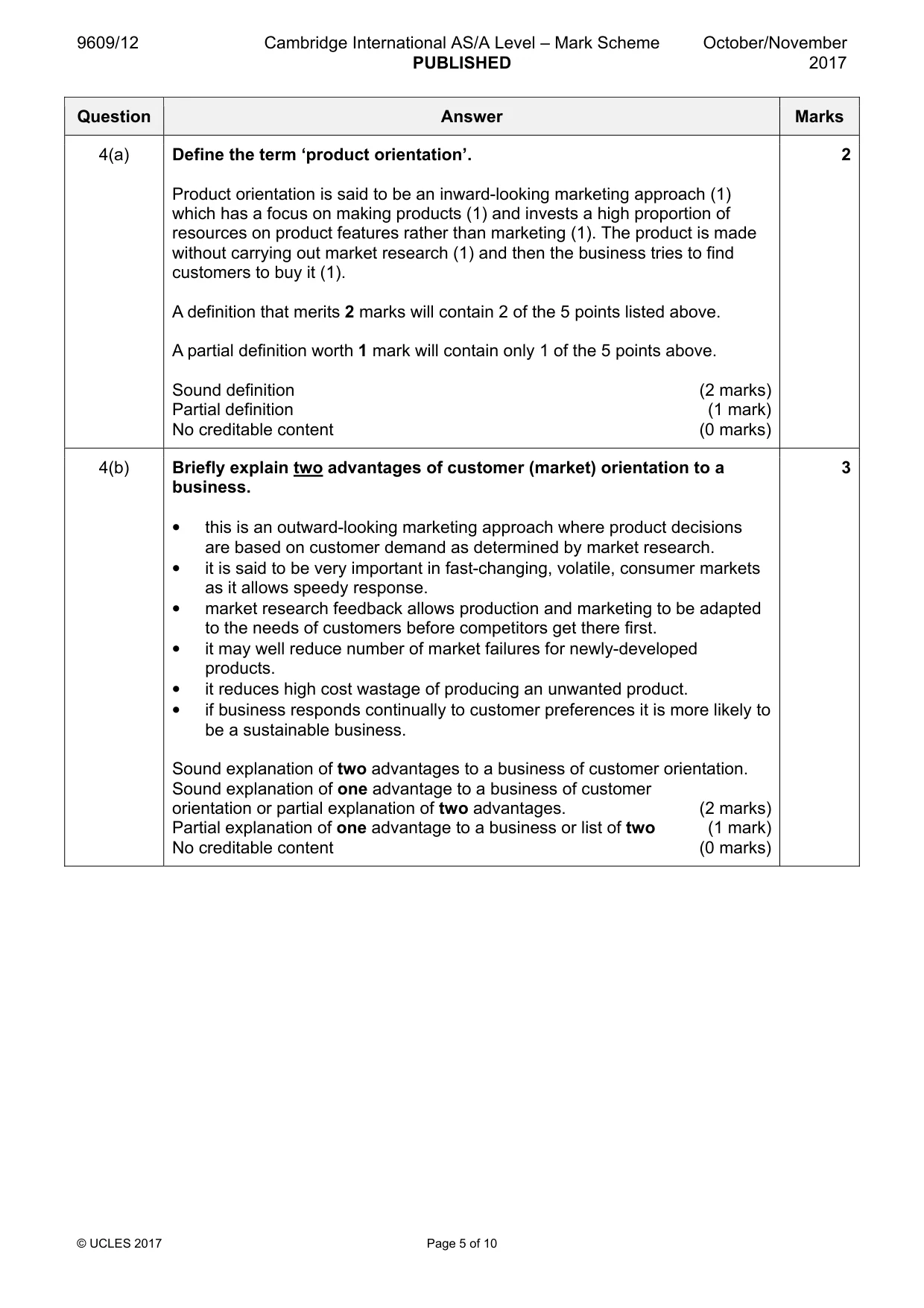
9609/12 Cambridge International AS/A Level – Mark Scheme PUBLISHED October/November 2017 © UCLES 2017 Page 5 of 10 Question Answer Marks 4(a) Define the term ‘product orientation’. Product orientation is said to be an inward-looking marketing approach (1) which has a focus on making products (1) and invests a high proportion of resources on product features rather than marketing (1). The product is made without carrying out market research (1) and then the business tries to find customers to buy it (1). A definition that merits 2 marks will contain 2 of the 5 points listed above. A partial definition worth 1 mark will contain only 1 of the 5 points above. Sound definition (2 marks) Partial definition (1 mark) No creditable content (0 marks) 2 4(b) Briefly explain two advantages of customer (market) orientation to a business. • this is an outward-looking marketing approach where product decisions are based on customer demand as determined by market research. • it is said to be very important in fast-changing, volatile, consumer markets as it allows speedy response. • market research feedback allows production and marketing to be adapted to the needs of customers before competitors get there first. • it may well reduce number of market failures for newly-developed products. • it reduces high cost wastage of producing an unwanted product. • if business responds continually to customer preferences it is more likely to be a sustainable business. Sound explanation of two advantages to a business of customer orientation. Sound explanation of one advantage to a business of customer orientation or partial explanation of two advantages. (2 marks) Partial explanation of one advantage to a business or list of two (1 mark) No creditable content (0 marks) 3
Mark scheme, page 6
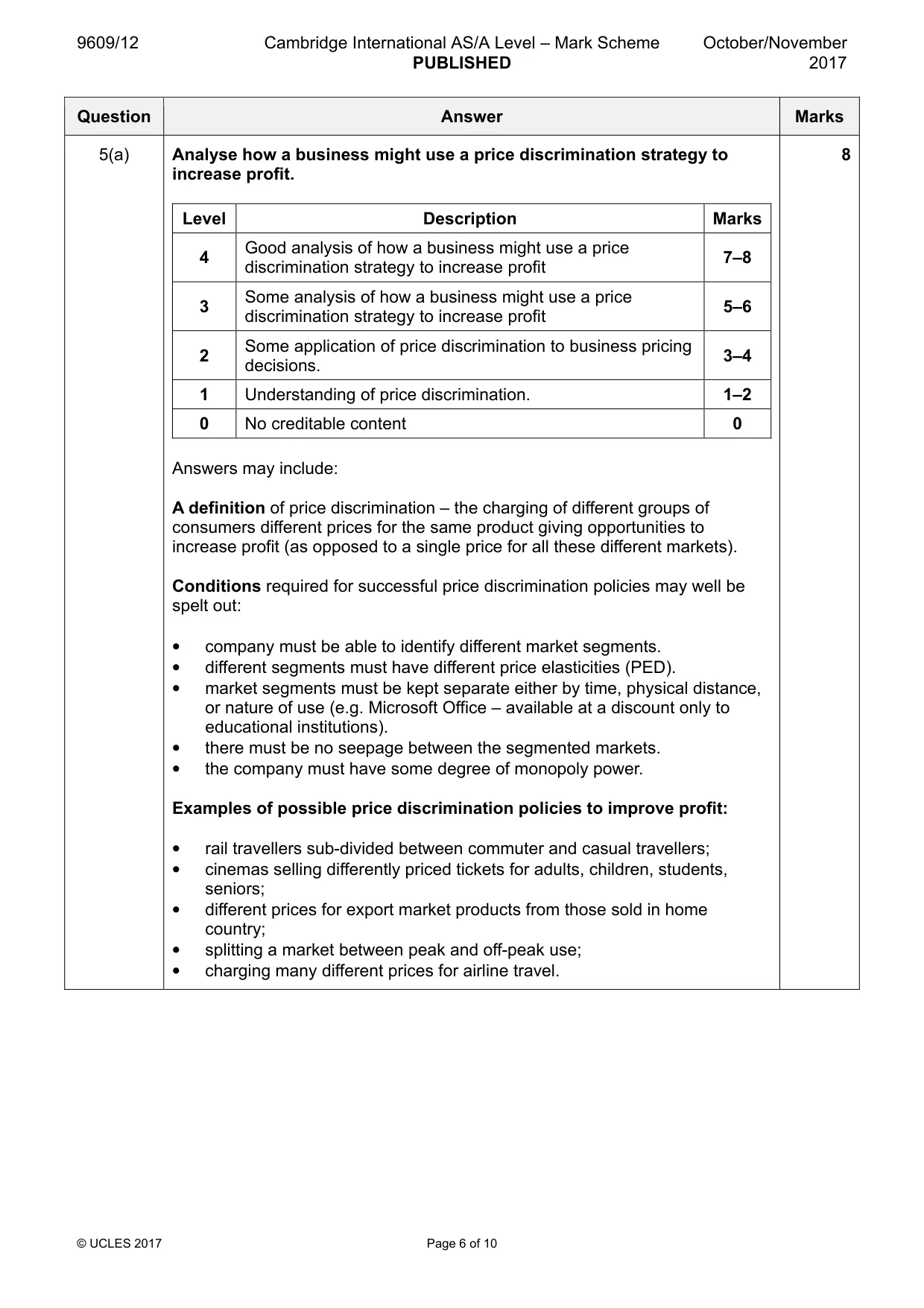
9609/12 Cambridge International AS/A Level – Mark Scheme PUBLISHED October/November 2017 © UCLES 2017 Page 6 of 10 Question Answer Marks 5(a) Analyse how a business might use a price discrimination strategy to increase profit. Level Description Marks 4 Good analysis of how a business might use a price discrimination strategy to increase profit 7–8 3 Some analysis of how a business might use a price discrimination strategy to increase profit 5–6 2 Some application of price discrimination to business pricing decisions. 3–4 1 Understanding of price discrimination. 1–2 0 No creditable content 0 Answers may include: A definition of price discrimination – the charging of different groups of consumers different prices for the same product giving opportunities to increase profit (as opposed to a single price for all these different markets). Conditions required for successful price discrimination policies may well be spelt out: • company must be able to identify different market segments. • different segments must have different price elasticities (PED). • market segments must be kept separate either by time, physical distance, or nature of use (e.g. Microsoft Office – available at a discount only to educational institutions). • there must be no seepage between the segmented markets. • the company must have some degree of monopoly power. Examples of possible price discrimination policies to improve profit: • rail travellers sub-divided between commuter and casual travellers; • cinemas selling differently priced tickets for adults, children, students, seniors; • different prices for export market products from those sold in home country; • splitting a market between peak and off-peak use; • charging many different prices for airline travel. 8
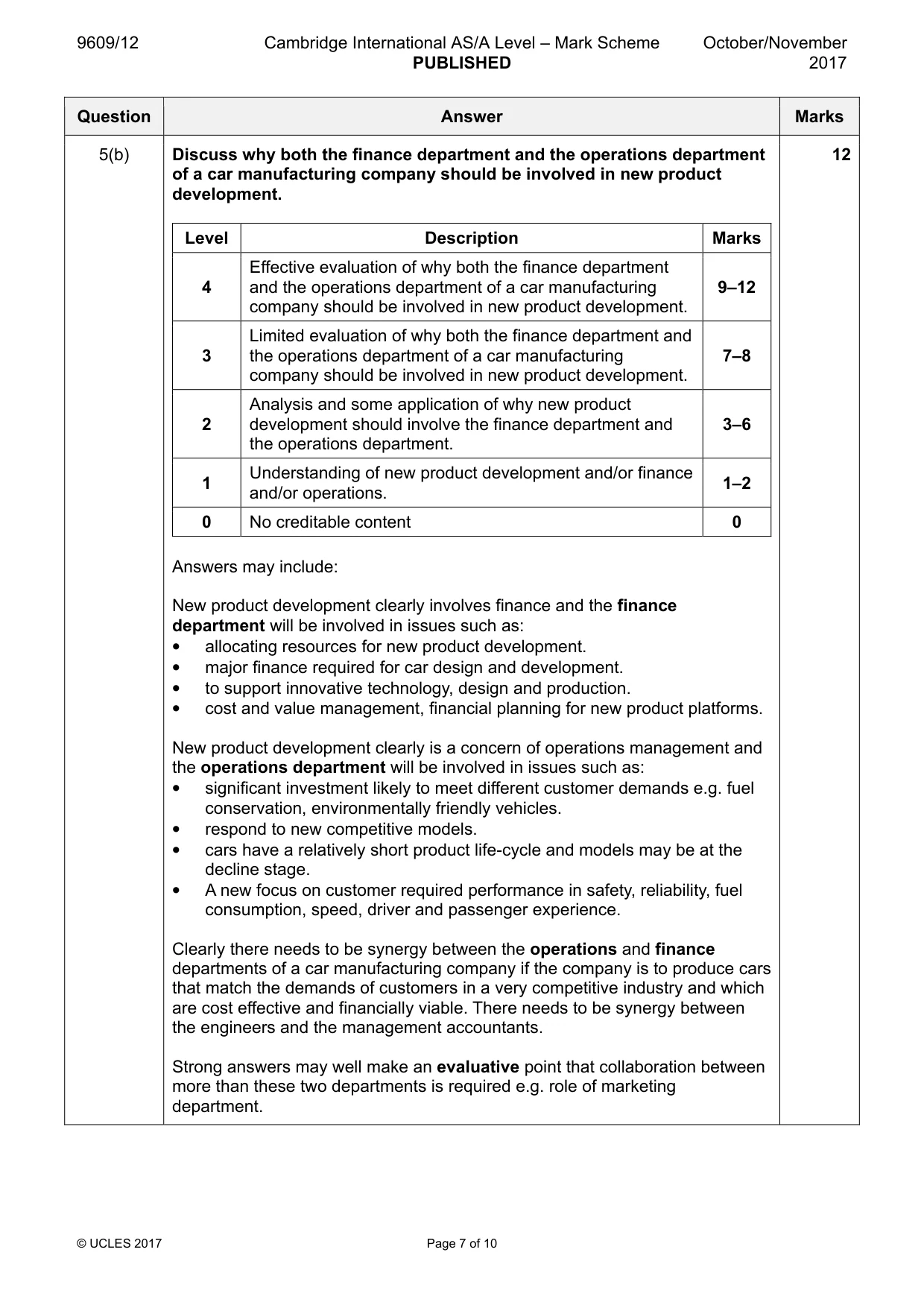
Mark scheme, page 7
9609/12 Cambridge International AS/A Level – Mark Scheme PUBLISHED October/November 2017 © UCLES 2017 Page 7 of 10 Question Answer Marks 5(b) Discuss why both the finance department and the operations department of a car manufacturing company should be involved in new product development. Level Description Marks 4 Effective evaluation of why both the finance department and the operations department of a car manufacturing company should be involved in new product development. 9–12 3 Limited evaluation of why both the finance department and the operations department of a car manufacturing company should be involved in new product development. 7–8 2 Analysis and some application of why new product development should involve the finance department and the operations department. 3–6 1 Understanding of new product development and/or finance and/or operations. 1–2 0 No creditable content 0 Answers may include: New product development clearly involves finance and the finance department will be involved in issues such as: • allocating resources for new product development. • major finance required for car design and development. • to support innovative technology, design and production. • cost and value management, financial planning for new product platforms. New product development clearly is a concern of operations management and the operations department will be involved in issues such as: • significant investment likely to meet different customer demands e.g. fuel conservation, environmentally friendly vehicles. • respond to new competitive models. • cars have a relatively short product life-cycle and models may be at the decline stage. • A new focus on customer required performance in safety, reliability, fuel consumption, speed, driver and passenger experience. Clearly there needs to be synergy between the operations and finance departments of a car manufacturing company if the company is to produce cars that match the demands of customers in a very competitive industry and which are cost effective and financially viable. There needs to be synergy between the engineers and the management accountants. Strong answers may well make an evaluative point that collaboration between more than these two departments is required e.g. role of marketing department. 12
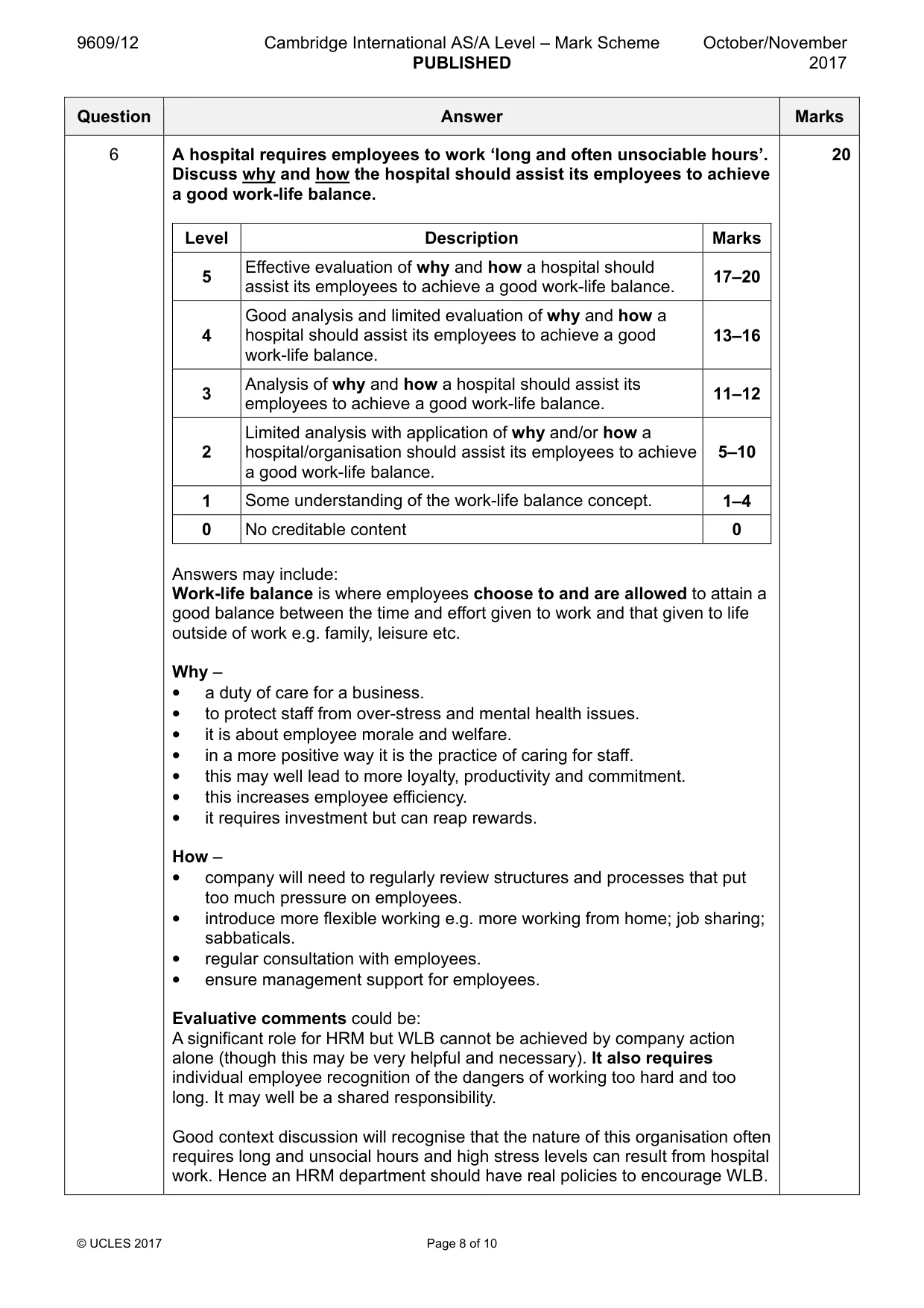
Mark scheme, page 8
9609/12 Cambridge International AS/A Level – Mark Scheme PUBLISHED October/November 2017 © UCLES 2017 Page 8 of 10 Question Answer Marks 6 A hospital requires employees to work ‘long and often unsociable hours’. Discuss why and how the hospital should assist its employees to achieve a good work-life balance. Level Description Marks 5 Effective evaluation of why and how a hospital should assist its employees to achieve a good work-life balance. 17–20 4 Good analysis and limited evaluation of why and how a hospital should assist its employees to achieve a good work-life balance. 13–16 3 Analysis of why and how a hospital should assist its employees to achieve a good work-life balance. 11–12 2 Limited analysis with application of why and/or how a hospital/organisation should assist its employees to achieve a good work-life balance. 5–10 1 Some understanding of the work-life balance concept. 1–4 0 No creditable content 0 Answers may include: Work-life balance is where employees choose to and are allowed to attain a good balance between the time and effort given to work and that given to life outside of work e.g. family, leisure etc. Why – • a duty of care for a business. • to protect staff from over-stress and mental health issues. • it is about employee morale and welfare. • in a more positive way it is the practice of caring for staff. • this may well lead to more loyalty, productivity and commitment. • this increases employee efficiency. • it requires investment but can reap rewards. How – • company will need to regularly review structures and processes that put too much pressure on employees. • introduce more flexible working e.g. more working from home; job sharing; sabbaticals. • regular consultation with employees. • ensure management support for employees. Evaluative comments could be: A significant role for HRM but WLB cannot be achieved by company action alone (though this may be very helpful and necessary). It also requires individual employee recognition of the dangers of working too hard and too long. It may well be a shared responsibility. Good context discussion will recognise that the nature of this organisation often requires long and unsocial hours and high stress levels can result from hospital work. Hence an HRM department should have real policies to encourage WLB. 20
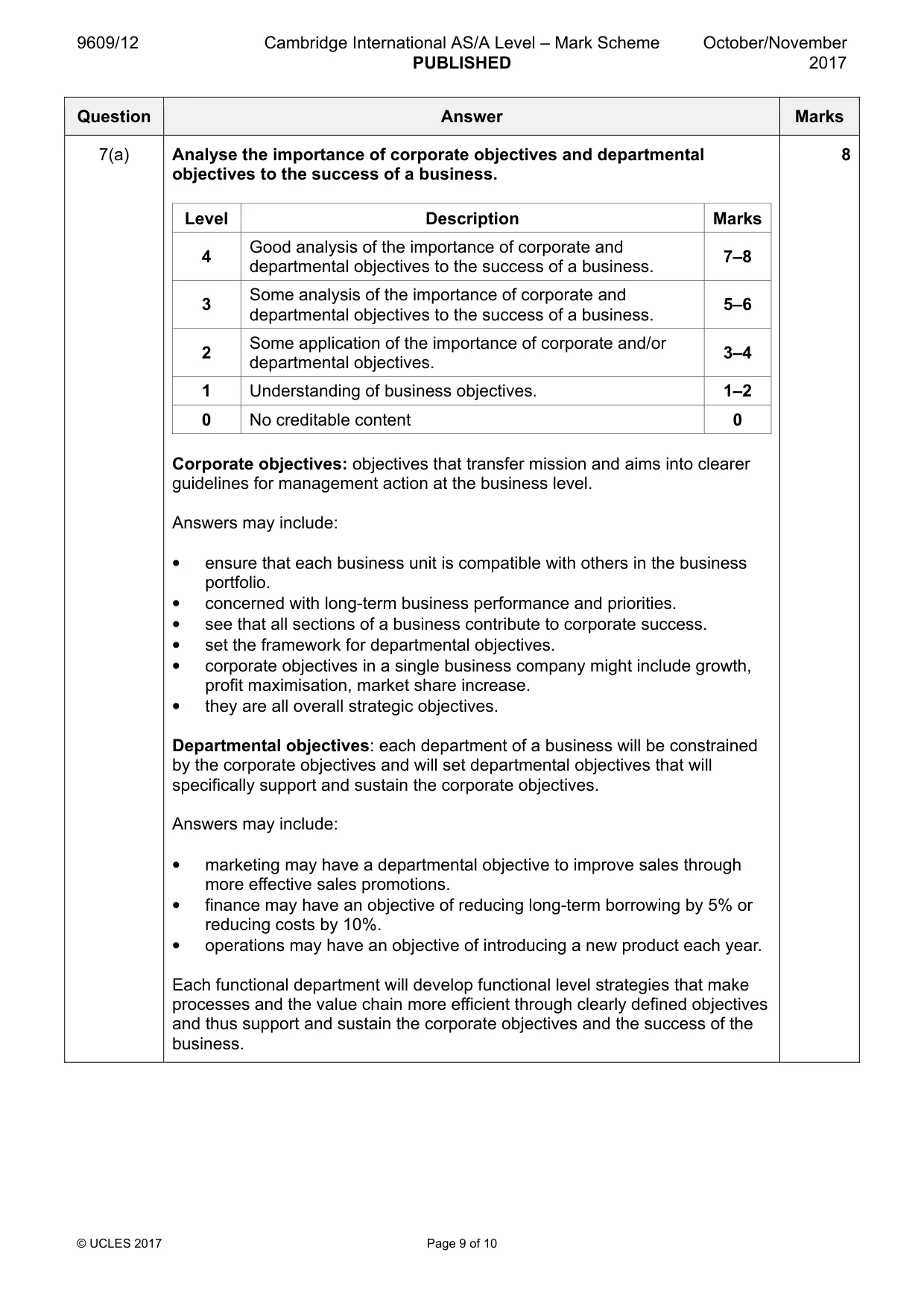
Mark scheme, page 9
9609/12 Cambridge International AS/A Level – Mark Scheme PUBLISHED October/November 2017 © UCLES 2017 Page 9 of 10 Question Answer Marks 7(a) Analyse the importance of corporate objectives and departmental objectives to the success of a business. Level Description Marks 4 Good analysis of the importance of corporate and departmental objectives to the success of a business. 7–8 3 Some analysis of the importance of corporate and departmental objectives to the success of a business. 5–6 2 Some application of the importance of corporate and/or departmental objectives. 3–4 1 Understanding of business objectives. 1–2 0 No creditable content 0 Corporate objectives: objectives that transfer mission and aims into clearer guidelines for management action at the business level. Answers may include: • ensure that each business unit is compatible with others in the business portfolio. • concerned with long-term business performance and priorities. • see that all sections of a business contribute to corporate success. • set the framework for departmental objectives. • corporate objectives in a single business company might include growth, profit maximisation, market share increase. • they are all overall strategic objectives. Departmental objectives: each department of a business will be constrained by the corporate objectives and will set departmental objectives that will specifically support and sustain the corporate objectives. Answers may include: • marketing may have a departmental objective to improve sales through more effective sales promotions. • finance may have an objective of reducing long-term borrowing by 5% or reducing costs by 10%. • operations may have an objective of introducing a new product each year. Each functional department will develop functional level strategies that make processes and the value chain more efficient through clearly defined objectives and thus support and sustain the corporate objectives and the success of the business. 8
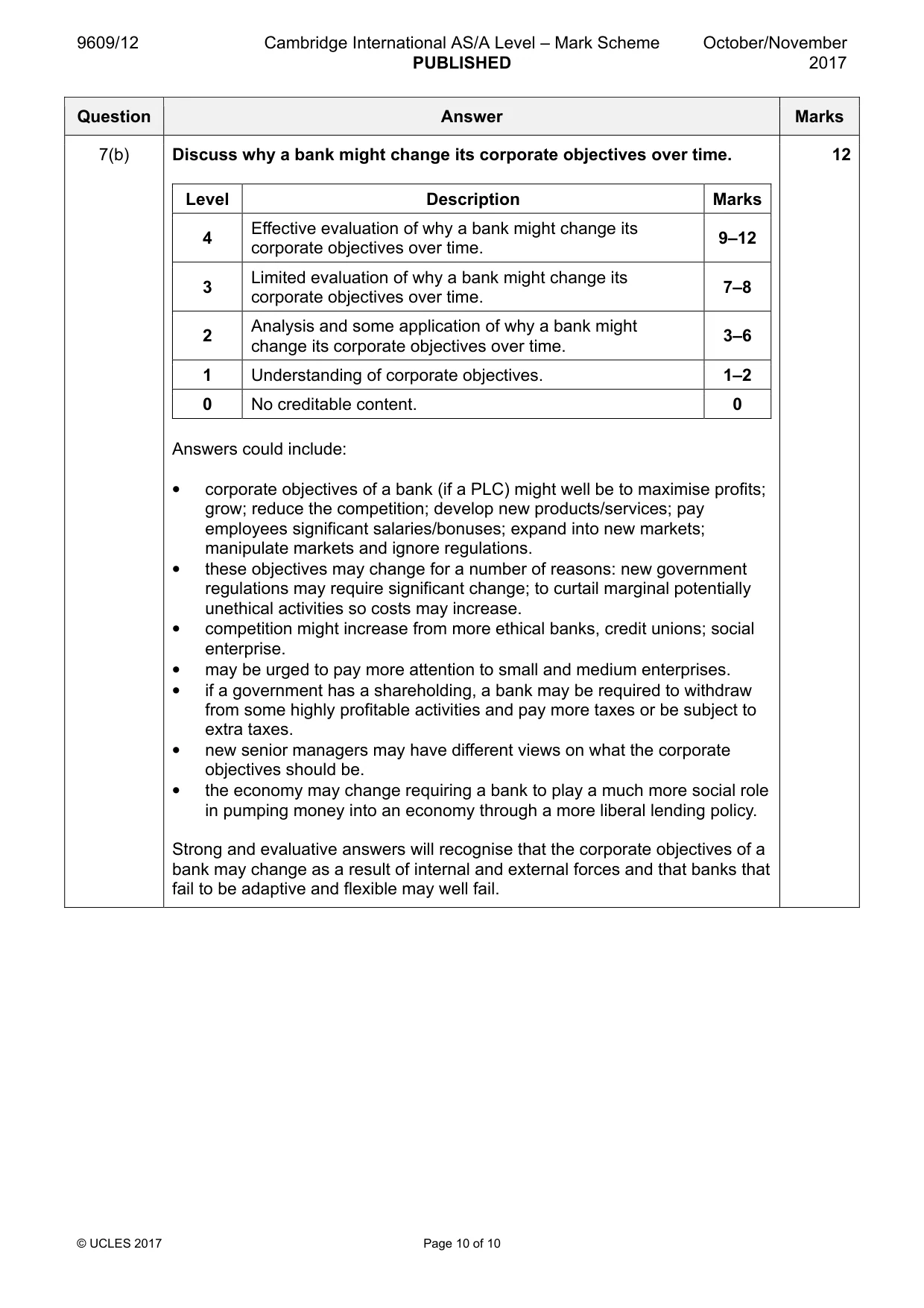
Mark scheme, page 10
9609/12 Cambridge International AS/A Level – Mark Scheme PUBLISHED October/November 2017 © UCLES 2017 Page 10 of 10 Question Answer Marks 7(b) Discuss why a bank might change its corporate objectives over time. Level Description Marks 4 Effective evaluation of why a bank might change its corporate objectives over time. 9–12 3 Limited evaluation of why a bank might change its corporate objectives over time. 7–8 2 Analysis and some application of why a bank might change its corporate objectives over time. 3–6 1 Understanding of corporate objectives. 1–2 0 No creditable content. 0 Answers could include: • corporate objectives of a bank (if a PLC) might well be to maximise profits; grow; reduce the competition; develop new products/services; pay employees significant salaries/bonuses; expand into new markets; manipulate markets and ignore regulations. • these objectives may change for a number of reasons: new government regulations may require significant change; to curtail marginal potentially unethical activities so costs may increase. • competition might increase from more ethical banks, credit unions; social enterprise. • may be urged to pay more attention to small and medium enterprises. • if a government has a shareholding, a bank may be required to withdraw from some highly profitable activities and pay more taxes or be subject to extra taxes. • new senior managers may have different views on what the corporate objectives should be. • the economy may change requiring a bank to play a much more social role in pumping money into an economy through a more liberal lending policy. Strong and evaluative answers will recognise that the corporate objectives of a bank may change as a result of internal and external forces and that banks that fail to be adaptive and flexible may well fail. 12
What you needed in this session
Cambridge’s own grade thresholds for 2017 Oct/Nov, Paper 1 · Variant 2. A higher threshold means an easier paper — the bar moves with how the cohort did.