Cambridge A Level Business (for first examination in 2016) 9609 — 2017 Oct/Nov Paper 1 · Variant 3
9609/13/O/N/17 · 40 marks · ≈45 min
The question paper and its mark scheme, free to read here and free to download. This is Cambridge’s own paper, exactly as it was sat.
Question paper4 pages


Mark scheme11 pages
Answers below. Sit the paper first if you are practising.

Paper as text
Question paper, page 1
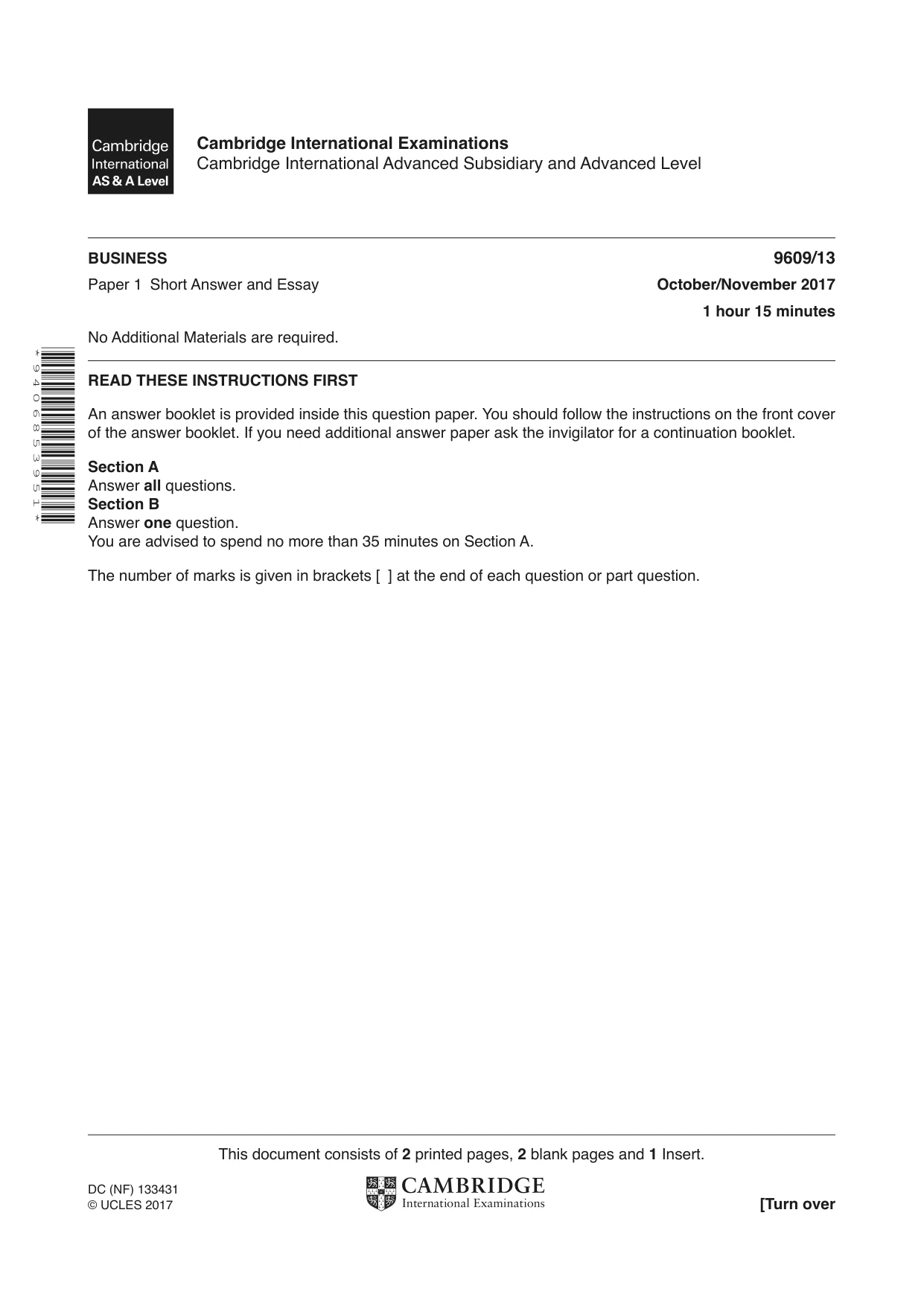
This document consists of 2 printed pages, 2 blank pages and 1 Insert. DC (NF) 133431 © UCLES 2017 [Turn over Cambridge International Examinations Cambridge International Advanced Subsidiary and Advanced Level * 9 4 0 6 8 5 3 9 5 1 * BUSINESS 9609/13 Paper 1 Short Answer and Essay October/November 2017 1 hour 15 minutes No Additional Materials are required. READ THESE INSTRUCTIONS FIRST An answer booklet is provided inside this question paper. You should follow the instructions on the front cover of the answer booklet. If you need additional answer paper ask the invigilator for a continuation booklet. Section A Answer all questions. Section B Answer one question. You are advised to spend no more than 35 minutes on Section A. The number of marks is given in brackets [ ] at the end of each question or part question.
Question paper, page 2
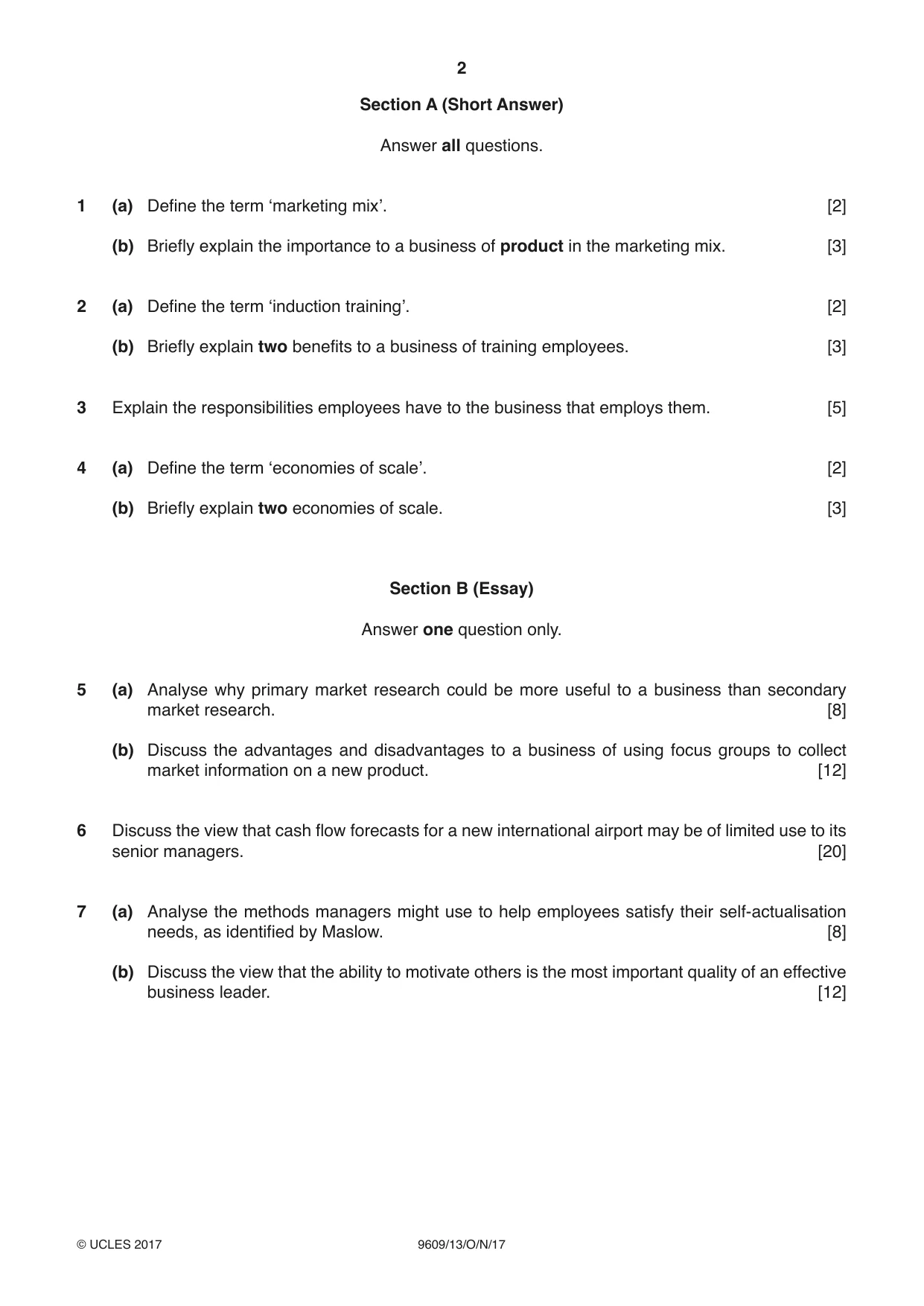
2 9609/13/O/N/17 © UCLES 2017 Section A (Short Answer) Answer all questions. 1 (a) Define the term ‘marketing mix’. [2] (b) Briefly explain the importance to a business of product in the marketing mix. [3] 2 (a) Define the term ‘induction training’. [2] (b) Briefly explain two benefits to a business of training employees. [3] 3 Explain the responsibilities employees have to the business that employs them. [5] 4 (a) Define the term ‘economies of scale’. [2] (b) Briefly explain two economies of scale. [3] Section B (Essay) Answer one question only. 5 (a) Analyse why primary market research could be more useful to a business than secondary market research. [8] (b) Discuss the advantages and disadvantages to a business of using focus groups to collect market information on a new product. [12] 6 Discuss the view that cash flow forecasts for a new international airport may be of limited use to its senior managers. [20] 7 (a) Analyse the methods managers might use to help employees satisfy their self-actualisation needs, as identified by Maslow. [8] (b) Discuss the view that the ability to motivate others is the most important quality of an effective business leader. [12]
Question paper, page 3
3 9609/13/O/N/17 © UCLES 2017 BLANK PAGE
Question paper, page 4
4 9609/13/O/N/17 © UCLES 2017 BLANK PAGE Permission to reproduce items where third-party owned material protected by copyright is included has been sought and cleared where possible. Every reasonable effort has been made by the publisher (UCLES) to trace copyright holders, but if any items requiring clearance have unwittingly been included, the publisher will be pleased to make amends at the earliest possible opportunity. To avoid the issue of disclosure of answer-related information to candidates, all copyright acknowledgements are reproduced online in the Cambridge International Examinations Copyright Acknowledgements Booklet. This is produced for each series of examinations and is freely available to download at www.cie.org.uk after the live examination series. Cambridge International Examinations is part of the Cambridge Assessment Group. Cambridge Assessment is the brand name of University of Cambridge Local Examinations Syndicate (UCLES), which is itself a department of the University of Cambridge.
Mark scheme, page 1
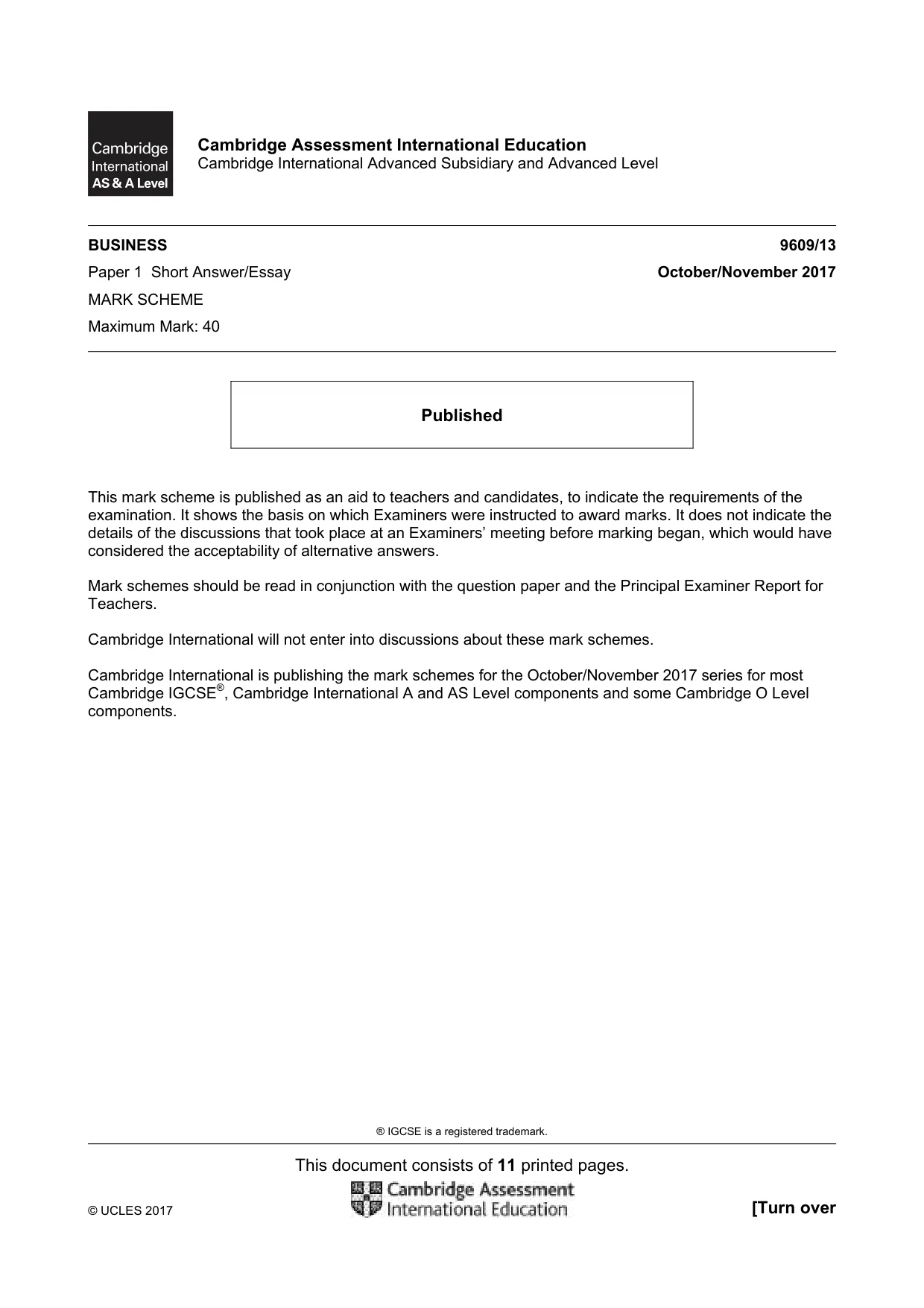
® IGCSE is a registered trademark. This document consists of 11 printed pages. © UCLES 2017 [Turn over Cambridge Assessment International Education Cambridge International Advanced Subsidiary and Advanced Level BUSINESS 9609/13 Paper 1 Short Answer/Essay October/November 2017 MARK SCHEME Maximum Mark: 40 Published This mark scheme is published as an aid to teachers and candidates, to indicate the requirements of the examination. It shows the basis on which Examiners were instructed to award marks. It does not indicate the details of the discussions that took place at an Examiners’ meeting before marking began, which would have considered the acceptability of alternative answers. Mark schemes should be read in conjunction with the question paper and the Principal Examiner Report for Teachers. Cambridge International will not enter into discussions about these mark schemes. Cambridge International is publishing the mark schemes for the October/November 2017 series for most Cambridge IGCSE®, Cambridge International A and AS Level components and some Cambridge O Level components.
Mark scheme, page 2
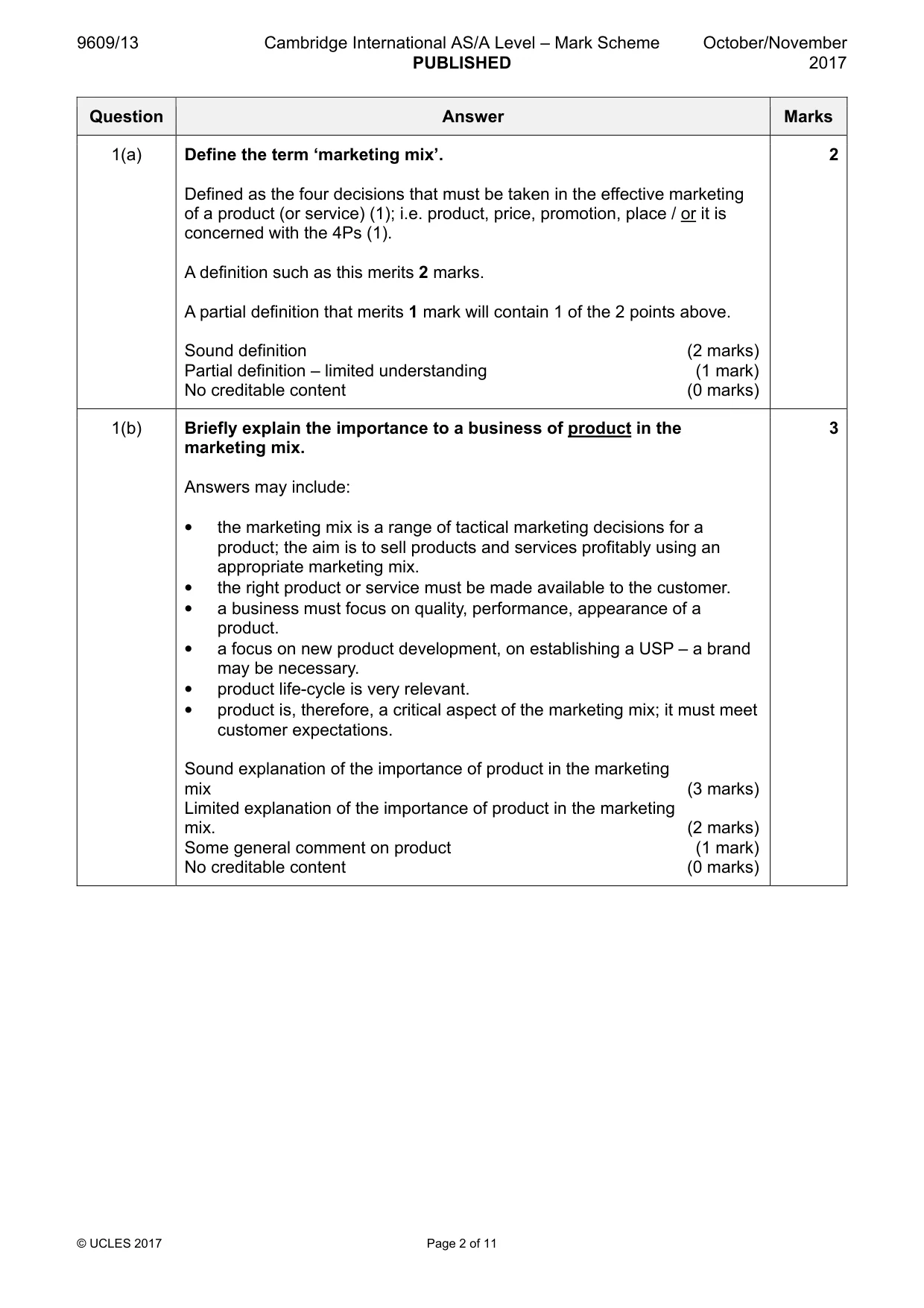
9609/13 Cambridge International AS/A Level – Mark Scheme PUBLISHED October/November 2017 © UCLES 2017 Page 2 of 11 Question Answer Marks 1(a) Define the term ‘marketing mix’. Defined as the four decisions that must be taken in the effective marketing of a product (or service) (1); i.e. product, price, promotion, place / or it is concerned with the 4Ps (1). A definition such as this merits 2 marks. A partial definition that merits 1 mark will contain 1 of the 2 points above. Sound definition (2 marks) Partial definition – limited understanding (1 mark) No creditable content (0 marks) 2 1(b) Briefly explain the importance to a business of product in the marketing mix. Answers may include: • the marketing mix is a range of tactical marketing decisions for a product; the aim is to sell products and services profitably using an appropriate marketing mix. • the right product or service must be made available to the customer. • a business must focus on quality, performance, appearance of a product. • a focus on new product development, on establishing a USP – a brand may be necessary. • product life-cycle is very relevant. • product is, therefore, a critical aspect of the marketing mix; it must meet customer expectations. Sound explanation of the importance of product in the marketing mix (3 marks) Limited explanation of the importance of product in the marketing mix. (2 marks) Some general comment on product (1 mark) No creditable content (0 marks) 3
Mark scheme, page 3
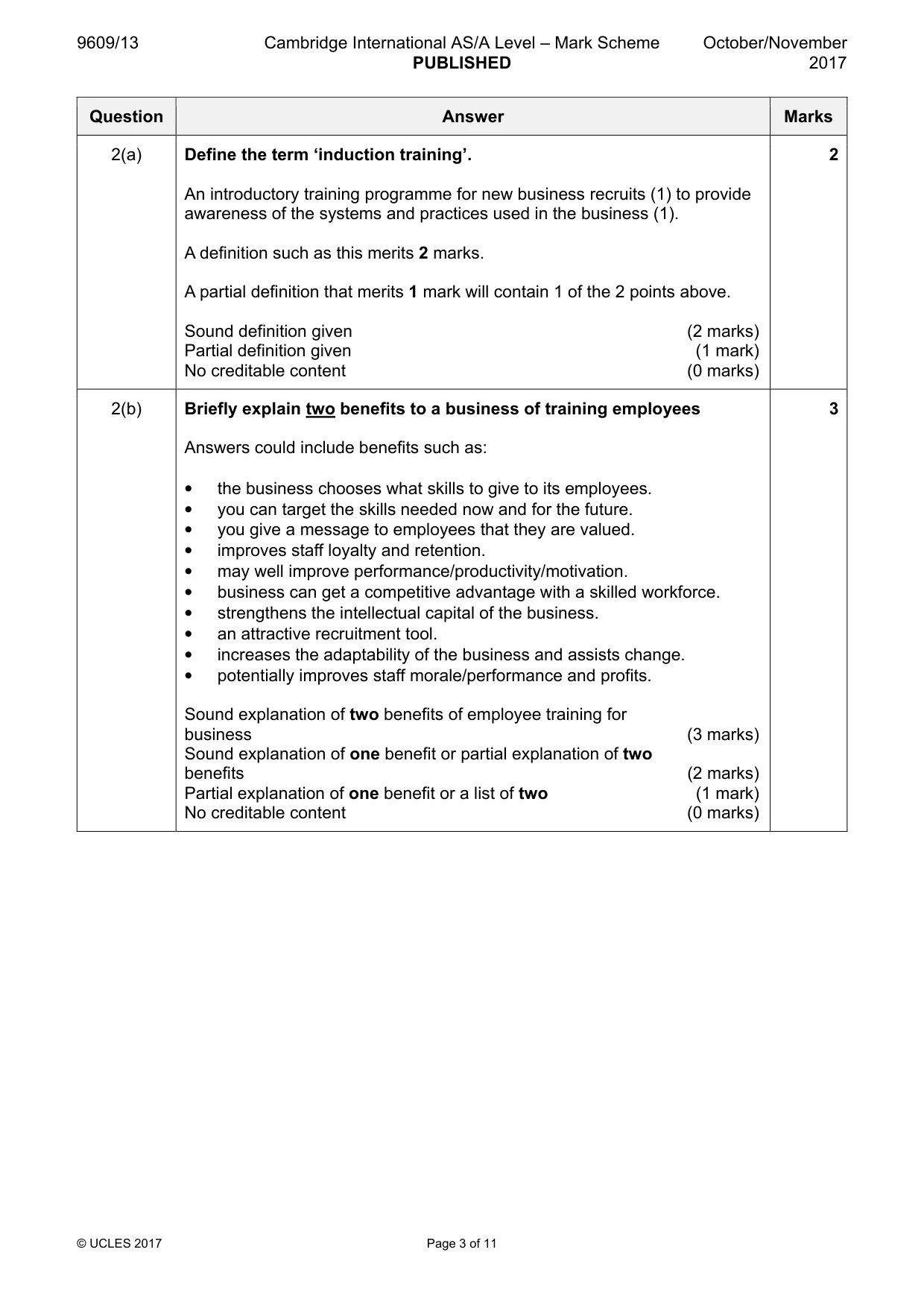
9609/13 Cambridge International AS/A Level – Mark Scheme PUBLISHED October/November 2017 © UCLES 2017 Page 3 of 11 Question Answer Marks 2(a) Define the term ‘induction training’. An introductory training programme for new business recruits (1) to provide awareness of the systems and practices used in the business (1). A definition such as this merits 2 marks. A partial definition that merits 1 mark will contain 1 of the 2 points above. Sound definition given (2 marks) Partial definition given (1 mark) No creditable content (0 marks) 2 2(b) Briefly explain two benefits to a business of training employees Answers could include benefits such as: • the business chooses what skills to give to its employees. • you can target the skills needed now and for the future. • you give a message to employees that they are valued. • improves staff loyalty and retention. • may well improve performance/productivity/motivation. • business can get a competitive advantage with a skilled workforce. • strengthens the intellectual capital of the business. • an attractive recruitment tool. • increases the adaptability of the business and assists change. • potentially improves staff morale/performance and profits. Sound explanation of two benefits of employee training for business (3 marks) Sound explanation of one benefit or partial explanation of two benefits (2 marks) Partial explanation of one benefit or a list of two (1 mark) No creditable content (0 marks) 3
Mark scheme, page 4
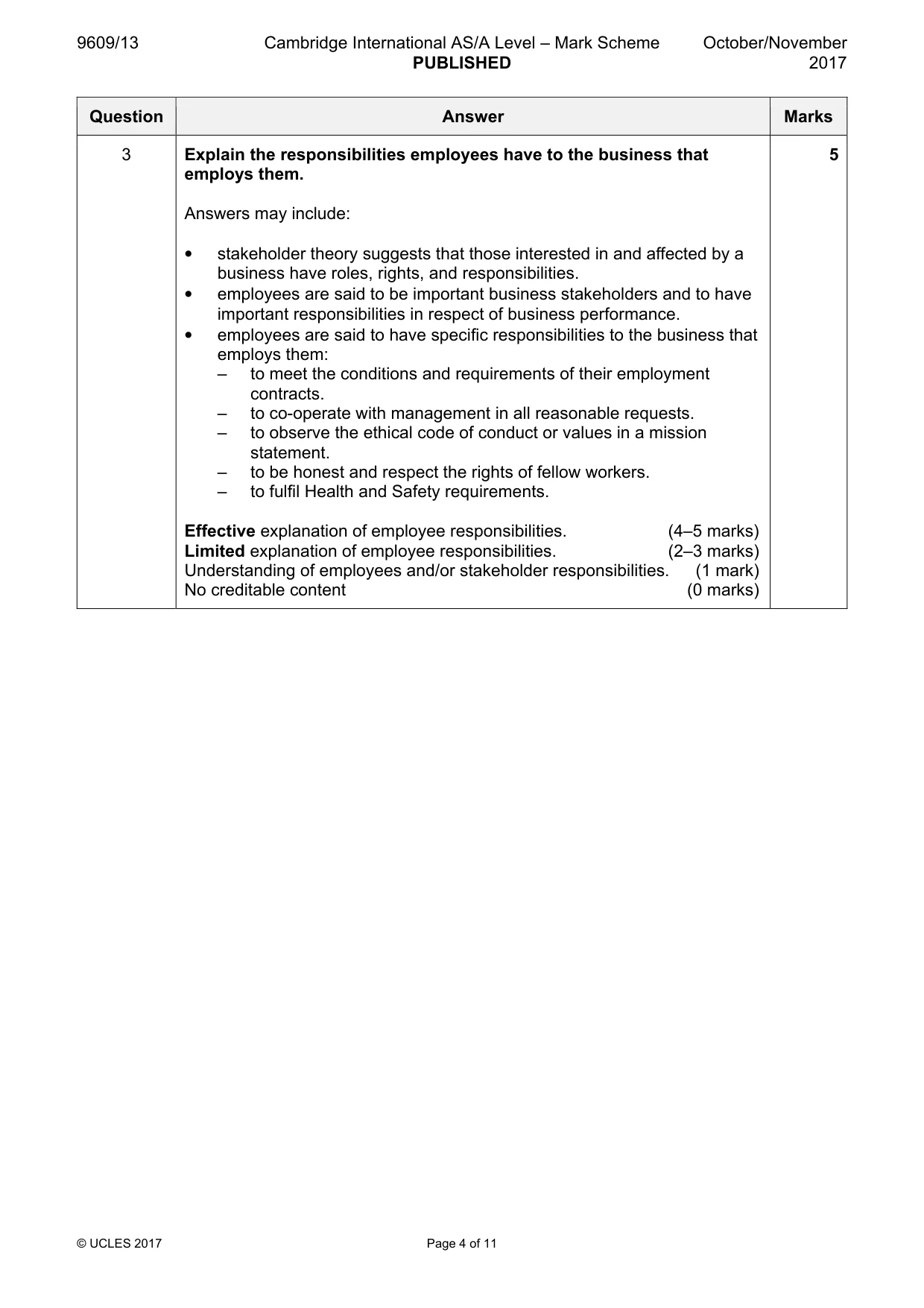
9609/13 Cambridge International AS/A Level – Mark Scheme PUBLISHED October/November 2017 © UCLES 2017 Page 4 of 11 Question Answer Marks 3 Explain the responsibilities employees have to the business that employs them. Answers may include: • stakeholder theory suggests that those interested in and affected by a business have roles, rights, and responsibilities. • employees are said to be important business stakeholders and to have important responsibilities in respect of business performance. • employees are said to have specific responsibilities to the business that employs them: – to meet the conditions and requirements of their employment contracts. – to co-operate with management in all reasonable requests. – to observe the ethical code of conduct or values in a mission statement. – to be honest and respect the rights of fellow workers. – to fulfil Health and Safety requirements. Effective explanation of employee responsibilities. (4–5 marks) Limited explanation of employee responsibilities. (2–3 marks) Understanding of employees and/or stakeholder responsibilities. (1 mark) No creditable content (0 marks) 5
Mark scheme, page 5
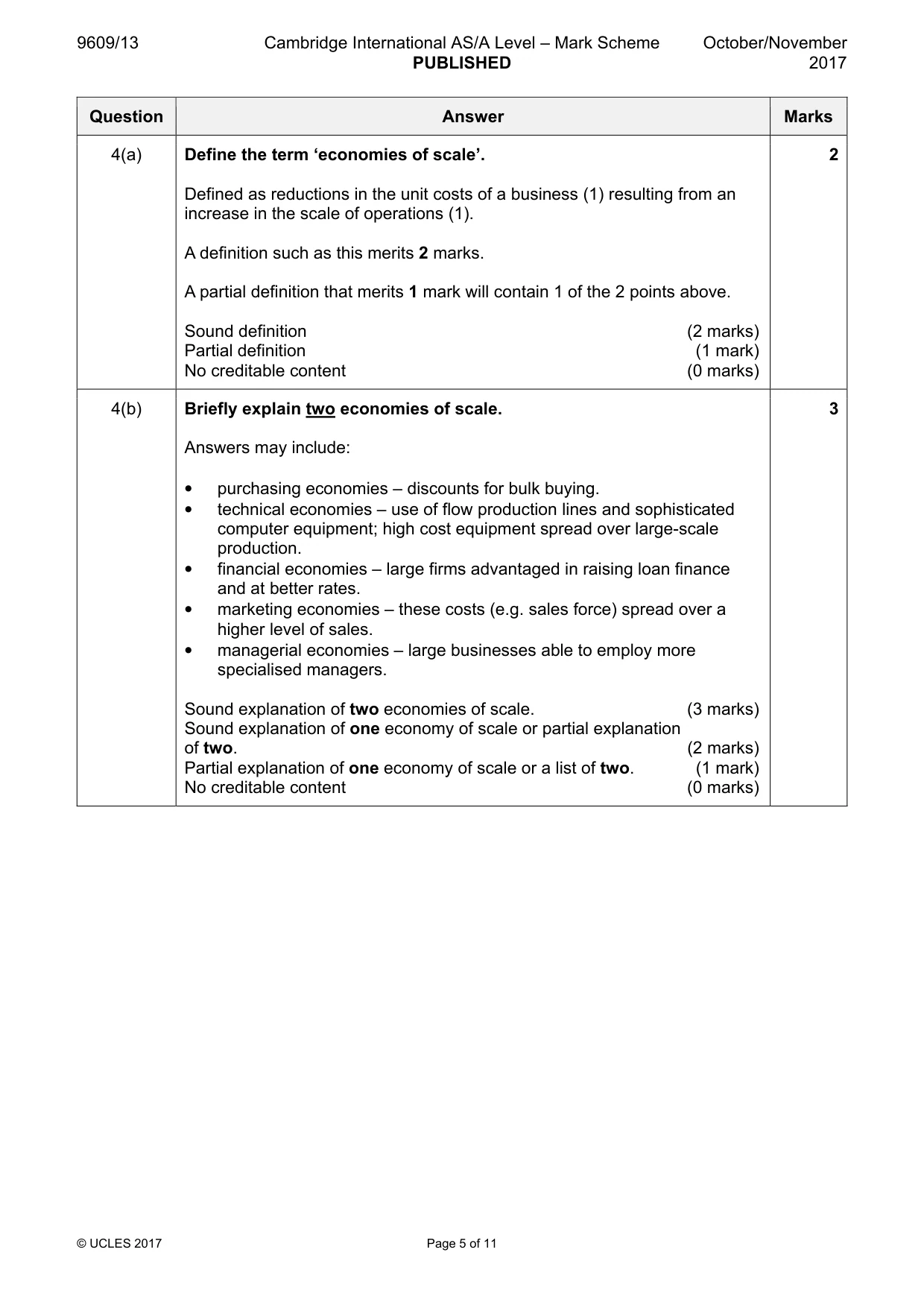
9609/13 Cambridge International AS/A Level – Mark Scheme PUBLISHED October/November 2017 © UCLES 2017 Page 5 of 11 Question Answer Marks 4(a) Define the term ‘economies of scale’. Defined as reductions in the unit costs of a business (1) resulting from an increase in the scale of operations (1). A definition such as this merits 2 marks. A partial definition that merits 1 mark will contain 1 of the 2 points above. Sound definition (2 marks) Partial definition (1 mark) No creditable content (0 marks) 2 4(b) Briefly explain two economies of scale. Answers may include: • purchasing economies – discounts for bulk buying. • technical economies – use of flow production lines and sophisticated computer equipment; high cost equipment spread over large-scale production. • financial economies – large firms advantaged in raising loan finance and at better rates. • marketing economies – these costs (e.g. sales force) spread over a higher level of sales. • managerial economies – large businesses able to employ more specialised managers. Sound explanation of two economies of scale. (3 marks) Sound explanation of one economy of scale or partial explanation of two. (2 marks) Partial explanation of one economy of scale or a list of two. (1 mark) No creditable content (0 marks) 3
Mark scheme, page 6
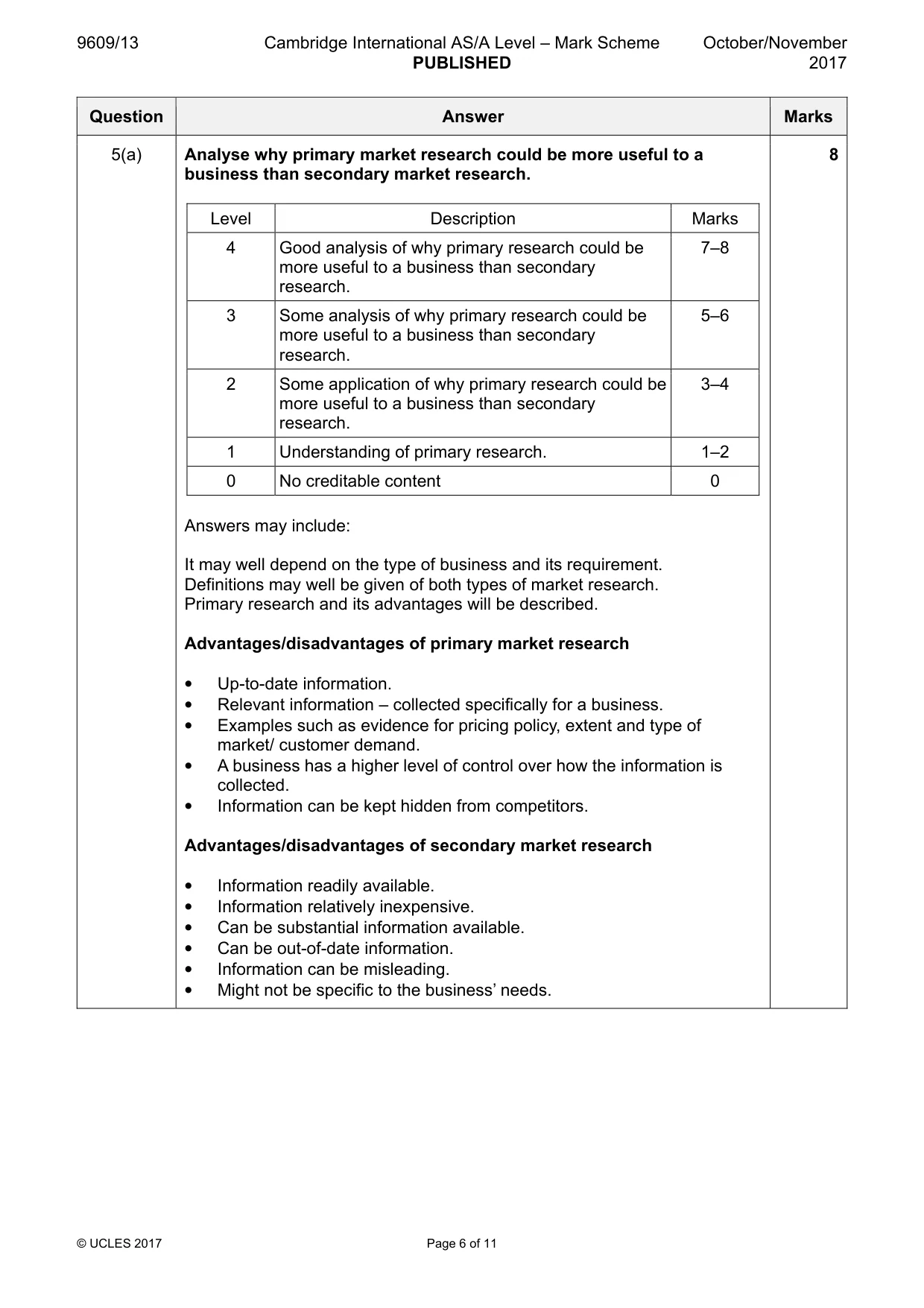
9609/13 Cambridge International AS/A Level – Mark Scheme PUBLISHED October/November 2017 © UCLES 2017 Page 6 of 11 Question Answer Marks 5(a) Analyse why primary market research could be more useful to a business than secondary market research. Level Description Marks 4 Good analysis of why primary research could be more useful to a business than secondary research. 7–8 3 Some analysis of why primary research could be more useful to a business than secondary research. 5–6 2 Some application of why primary research could be more useful to a business than secondary research. 3–4 1 Understanding of primary research. 1–2 0 No creditable content 0 Answers may include: It may well depend on the type of business and its requirement. Definitions may well be given of both types of market research. Primary research and its advantages will be described. Advantages/disadvantages of primary market research • Up-to-date information. • Relevant information – collected specifically for a business. • Examples such as evidence for pricing policy, extent and type of market/ customer demand. • A business has a higher level of control over how the information is collected. • Information can be kept hidden from competitors. Advantages/disadvantages of secondary market research • Information readily available. • Information relatively inexpensive. • Can be substantial information available. • Can be out-of-date information. • Information can be misleading. • Might not be specific to the business’ needs. 8
Mark scheme, page 7
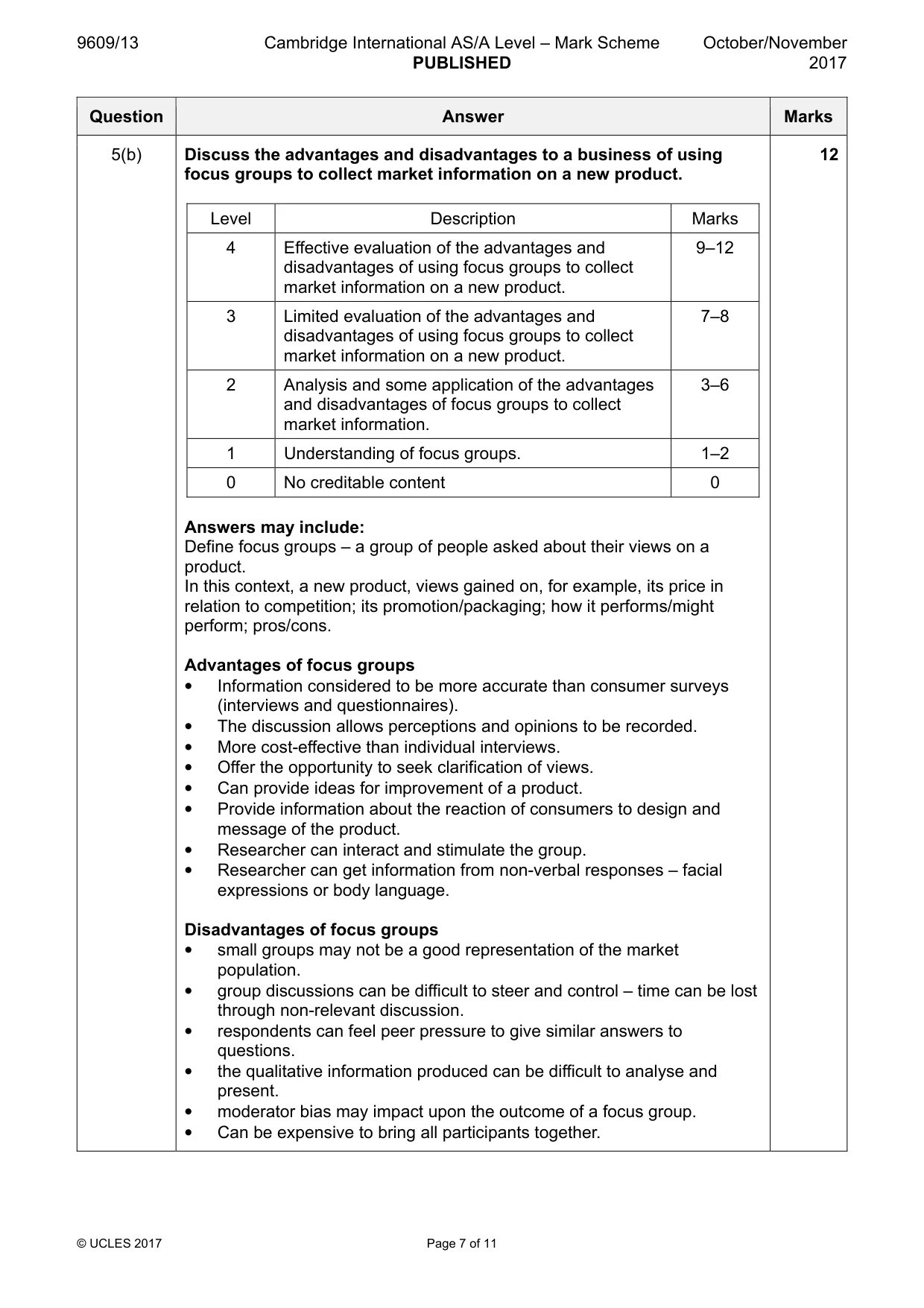
9609/13 Cambridge International AS/A Level – Mark Scheme PUBLISHED October/November 2017 © UCLES 2017 Page 7 of 11 Question Answer Marks 5(b) Discuss the advantages and disadvantages to a business of using focus groups to collect market information on a new product. Level Description Marks 4 Effective evaluation of the advantages and disadvantages of using focus groups to collect market information on a new product. 9–12 3 Limited evaluation of the advantages and disadvantages of using focus groups to collect market information on a new product. 7–8 2 Analysis and some application of the advantages and disadvantages of focus groups to collect market information. 3–6 1 Understanding of focus groups. 1–2 0 No creditable content 0 Answers may include: Define focus groups – a group of people asked about their views on a product. In this context, a new product, views gained on, for example, its price in relation to competition; its promotion/packaging; how it performs/might perform; pros/cons. Advantages of focus groups • Information considered to be more accurate than consumer surveys (interviews and questionnaires). • The discussion allows perceptions and opinions to be recorded. • More cost-effective than individual interviews. • Offer the opportunity to seek clarification of views. • Can provide ideas for improvement of a product. • Provide information about the reaction of consumers to design and message of the product. • Researcher can interact and stimulate the group. • Researcher can get information from non-verbal responses – facial expressions or body language. Disadvantages of focus groups • small groups may not be a good representation of the market population. • group discussions can be difficult to steer and control – time can be lost through non-relevant discussion. • respondents can feel peer pressure to give similar answers to questions. • the qualitative information produced can be difficult to analyse and present. • moderator bias may impact upon the outcome of a focus group. • Can be expensive to bring all participants together. 12
Mark scheme, page 8
9609/13 Cambridge International AS/A Level – Mark Scheme PUBLISHED October/November 2017 © UCLES 2017 Page 8 of 11 Question Answer Marks 5(b) Focus groups likely to be used in conjunction with other qualitative / quantitative methods but clearly do offer opportunities to gain important market information on a new product. However, there are limitations and potential disadvantages.
Mark scheme, page 9
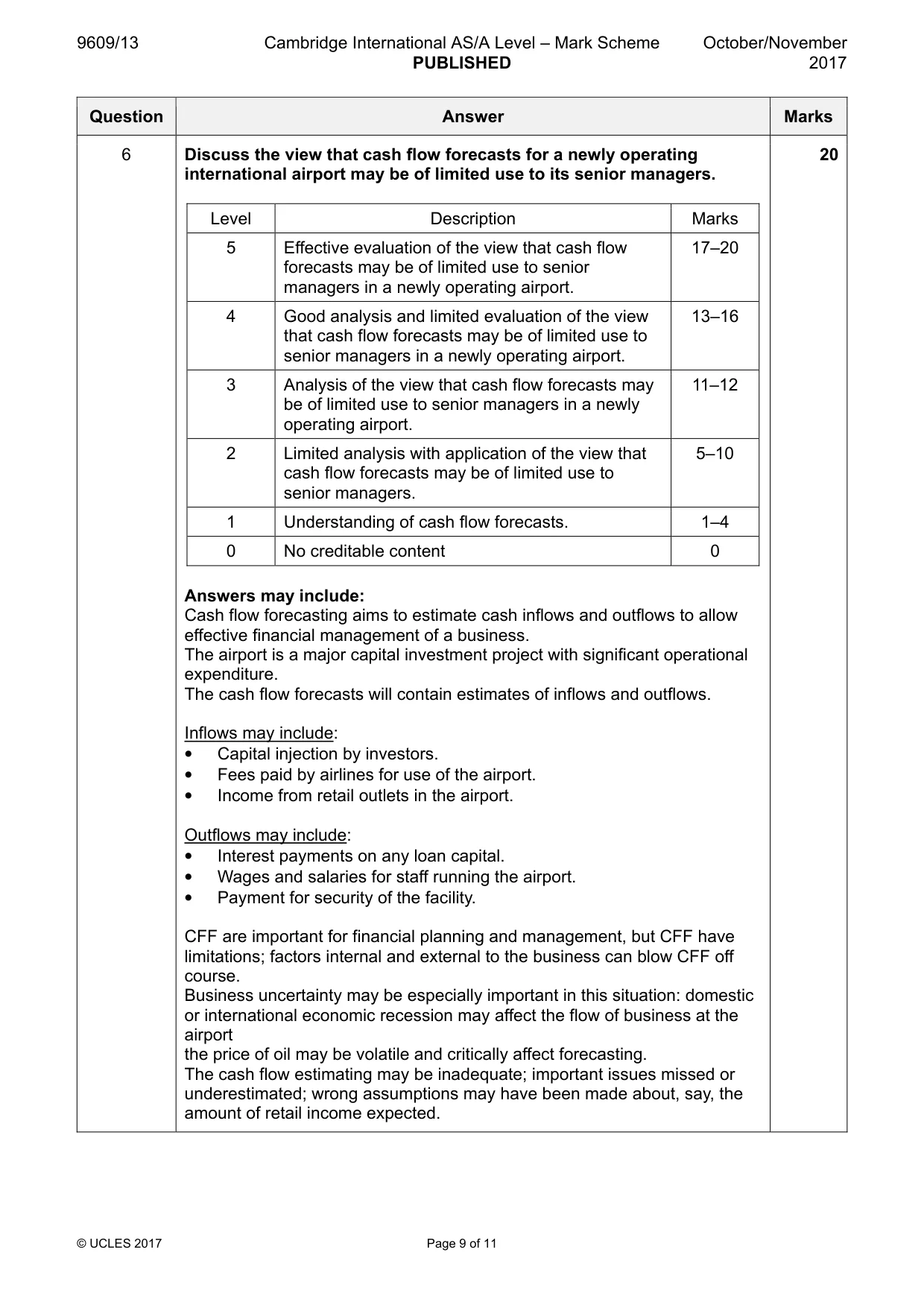
9609/13 Cambridge International AS/A Level – Mark Scheme PUBLISHED October/November 2017 © UCLES 2017 Page 9 of 11 Question Answer Marks 6 Discuss the view that cash flow forecasts for a newly operating international airport may be of limited use to its senior managers. Level Description Marks 5 Effective evaluation of the view that cash flow forecasts may be of limited use to senior managers in a newly operating airport. 17–20 4 Good analysis and limited evaluation of the view that cash flow forecasts may be of limited use to senior managers in a newly operating airport. 13–16 3 Analysis of the view that cash flow forecasts may be of limited use to senior managers in a newly operating airport. 11–12 2 Limited analysis with application of the view that cash flow forecasts may be of limited use to senior managers. 5–10 1 Understanding of cash flow forecasts. 1–4 0 No creditable content 0 Answers may include: Cash flow forecasting aims to estimate cash inflows and outflows to allow effective financial management of a business. The airport is a major capital investment project with significant operational expenditure. The cash flow forecasts will contain estimates of inflows and outflows. Inflows may include: • Capital injection by investors. • Fees paid by airlines for use of the airport. • Income from retail outlets in the airport. Outflows may include: • Interest payments on any loan capital. • Wages and salaries for staff running the airport. • Payment for security of the facility. CFF are important for financial planning and management, but CFF have limitations; factors internal and external to the business can blow CFF off course. Business uncertainty may be especially important in this situation: domestic or international economic recession may affect the flow of business at the airport the price of oil may be volatile and critically affect forecasting. The cash flow estimating may be inadequate; important issues missed or underestimated; wrong assumptions may have been made about, say, the amount of retail income expected. 20
Mark scheme, page 10
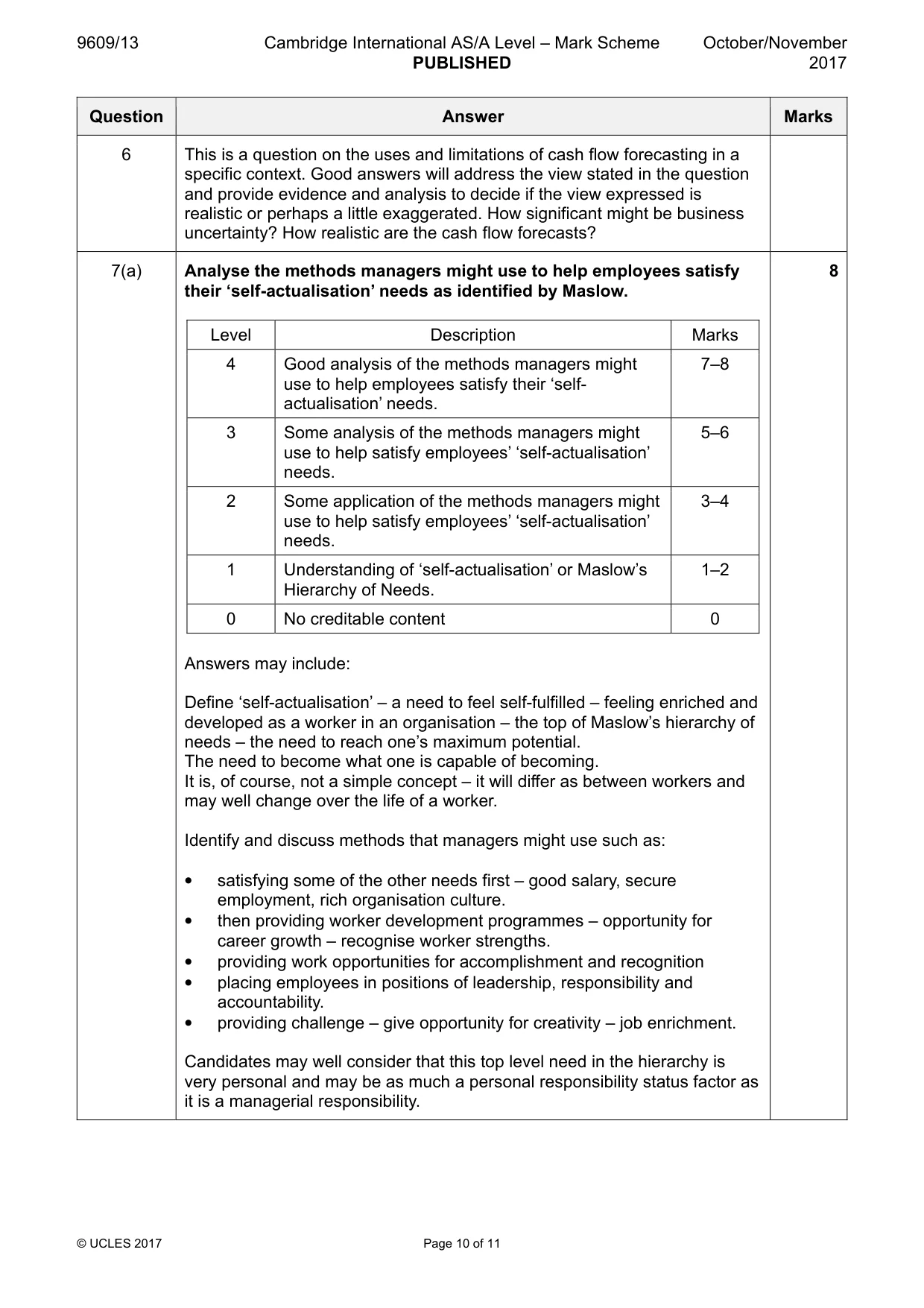
9609/13 Cambridge International AS/A Level – Mark Scheme PUBLISHED October/November 2017 © UCLES 2017 Page 10 of 11 Question Answer Marks 6 This is a question on the uses and limitations of cash flow forecasting in a specific context. Good answers will address the view stated in the question and provide evidence and analysis to decide if the view expressed is realistic or perhaps a little exaggerated. How significant might be business uncertainty? How realistic are the cash flow forecasts? 7(a) Analyse the methods managers might use to help employees satisfy their ‘self-actualisation’ needs as identified by Maslow. Level Description Marks 4 Good analysis of the methods managers might use to help employees satisfy their ‘self- actualisation’ needs. 7–8 3 Some analysis of the methods managers might use to help satisfy employees’ ‘self-actualisation’ needs. 5–6 2 Some application of the methods managers might use to help satisfy employees’ ‘self-actualisation’ needs. 3–4 1 Understanding of ‘self-actualisation’ or Maslow’s Hierarchy of Needs. 1–2 0 No creditable content 0 Answers may include: Define ‘self-actualisation’ – a need to feel self-fulfilled – feeling enriched and developed as a worker in an organisation – the top of Maslow’s hierarchy of needs – the need to reach one’s maximum potential. The need to become what one is capable of becoming. It is, of course, not a simple concept – it will differ as between workers and may well change over the life of a worker. Identify and discuss methods that managers might use such as: • satisfying some of the other needs first – good salary, secure employment, rich organisation culture. • then providing worker development programmes – opportunity for career growth – recognise worker strengths. • providing work opportunities for accomplishment and recognition • placing employees in positions of leadership, responsibility and accountability. • providing challenge – give opportunity for creativity – job enrichment. Candidates may well consider that this top level need in the hierarchy is very personal and may be as much a personal responsibility status factor as it is a managerial responsibility. 8
Mark scheme, page 11
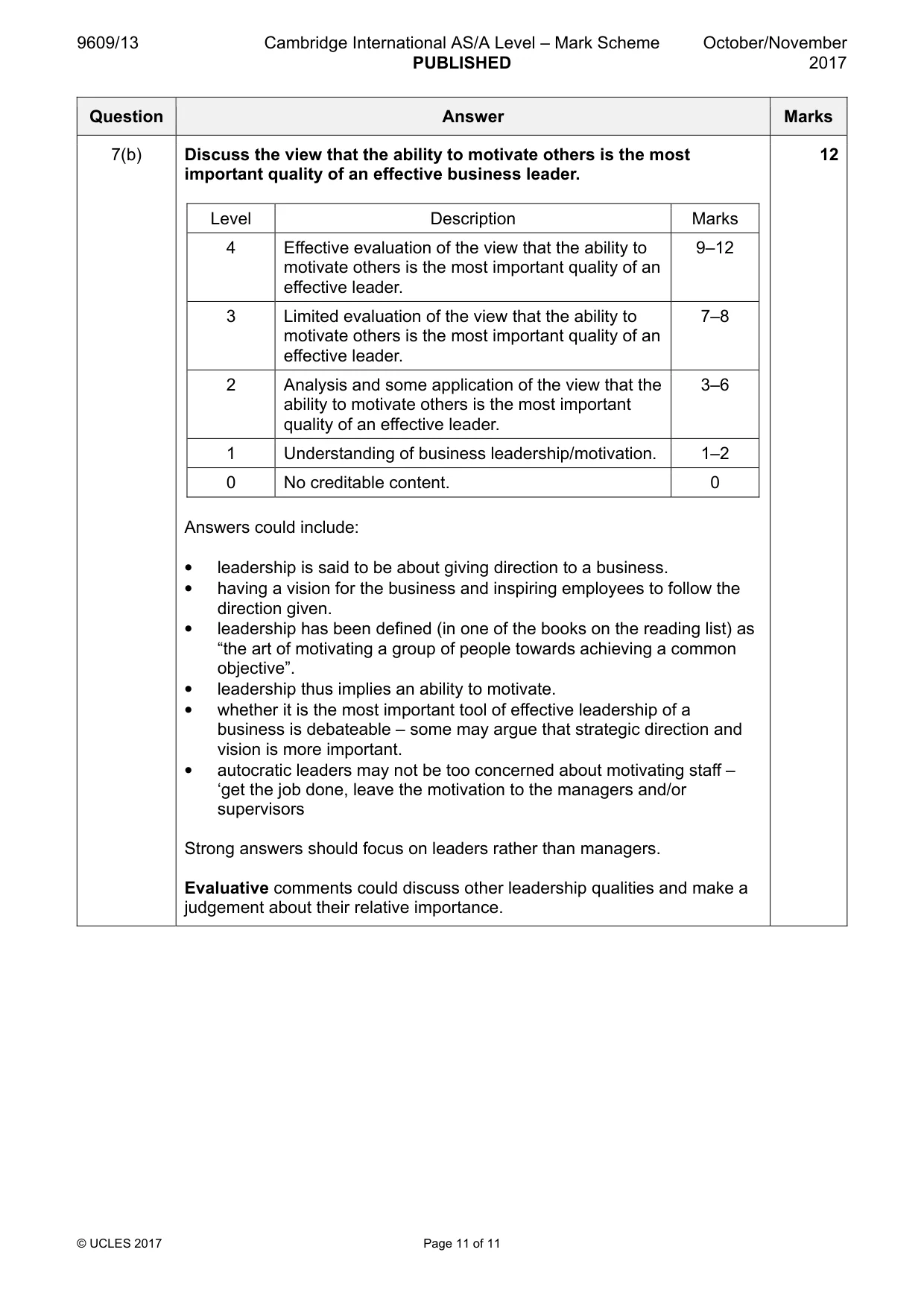
9609/13 Cambridge International AS/A Level – Mark Scheme PUBLISHED October/November 2017 © UCLES 2017 Page 11 of 11 Question Answer Marks 7(b) Discuss the view that the ability to motivate others is the most important quality of an effective business leader. Level Description Marks 4 Effective evaluation of the view that the ability to motivate others is the most important quality of an effective leader. 9–12 3 Limited evaluation of the view that the ability to motivate others is the most important quality of an effective leader. 7–8 2 Analysis and some application of the view that the ability to motivate others is the most important quality of an effective leader. 3–6 1 Understanding of business leadership/motivation. 1–2 0 No creditable content. 0 Answers could include: • leadership is said to be about giving direction to a business. • having a vision for the business and inspiring employees to follow the direction given. • leadership has been defined (in one of the books on the reading list) as “the art of motivating a group of people towards achieving a common objective”. • leadership thus implies an ability to motivate. • whether it is the most important tool of effective leadership of a business is debateable – some may argue that strategic direction and vision is more important. • autocratic leaders may not be too concerned about motivating staff – ‘get the job done, leave the motivation to the managers and/or supervisors Strong answers should focus on leaders rather than managers. Evaluative comments could discuss other leadership qualities and make a judgement about their relative importance. 12
What you needed in this session
Cambridge’s own grade thresholds for 2017 Oct/Nov, Paper 1 · Variant 3. A higher threshold means an easier paper — the bar moves with how the cohort did.