Cambridge A Level Business (for first examination in 2016) 9609 — 2017 Oct/Nov Paper 1 · Variant 1
9609/11/O/N/17 · 40 marks · ≈45 min
The question paper and its mark scheme, free to read here and free to download. This is Cambridge’s own paper, exactly as it was sat.
Question paper4 pages


Mark scheme10 pages
Answers below. Sit the paper first if you are practising.
Paper as text
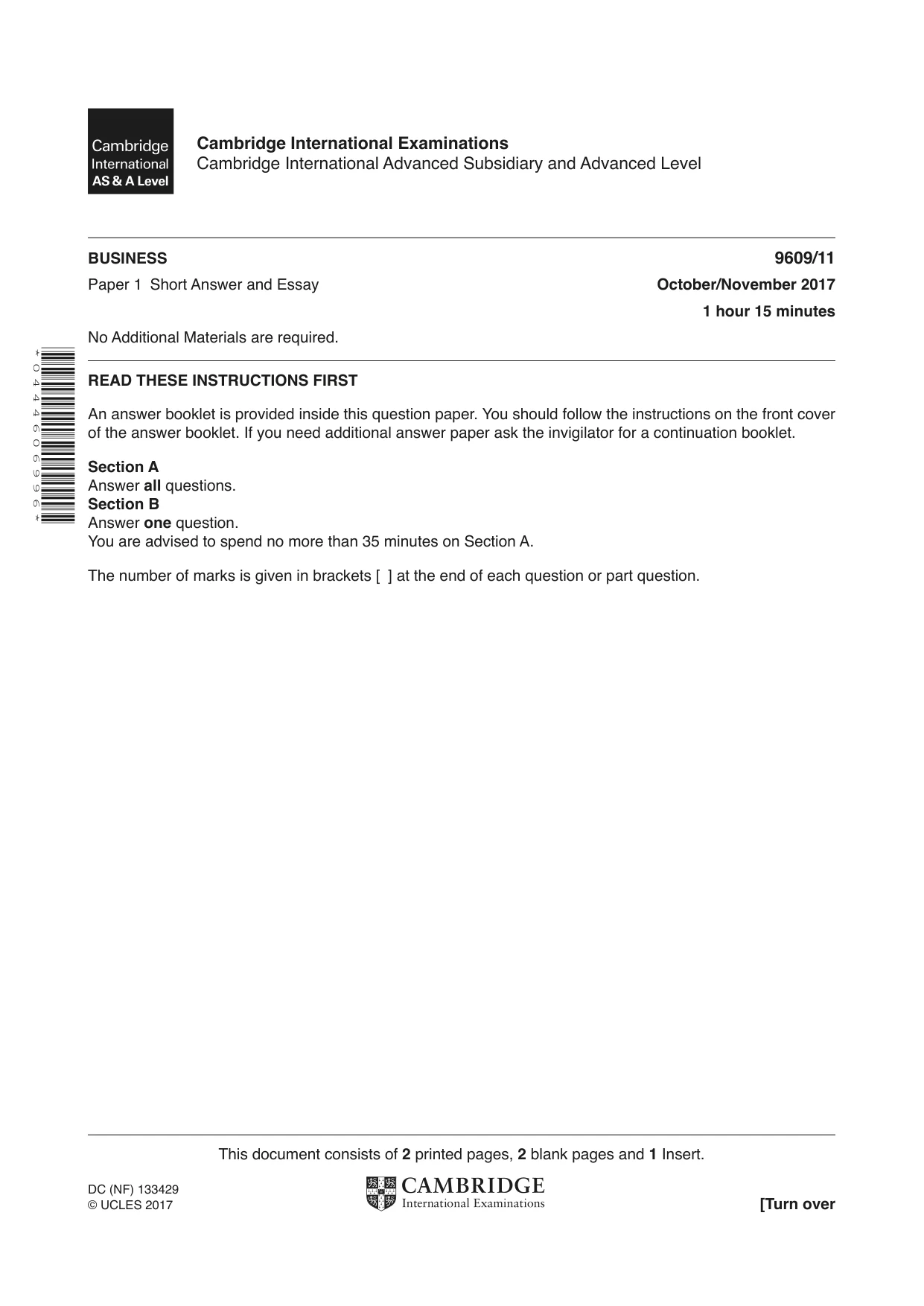
Question paper, page 1
This document consists of 2 printed pages, 2 blank pages and 1 Insert. DC (NF) 133429 © UCLES 2017 [Turn over Cambridge International Examinations Cambridge International Advanced Subsidiary and Advanced Level * 0 4 4 4 6 0 6 9 9 6 * BUSINESS 9609/11 Paper 1 Short Answer and Essay October/November 2017 1 hour 15 minutes No Additional Materials are required. READ THESE INSTRUCTIONS FIRST An answer booklet is provided inside this question paper. You should follow the instructions on the front cover of the answer booklet. If you need additional answer paper ask the invigilator for a continuation booklet. Section A Answer all questions. Section B Answer one question. You are advised to spend no more than 35 minutes on Section A. The number of marks is given in brackets [ ] at the end of each question or part question.
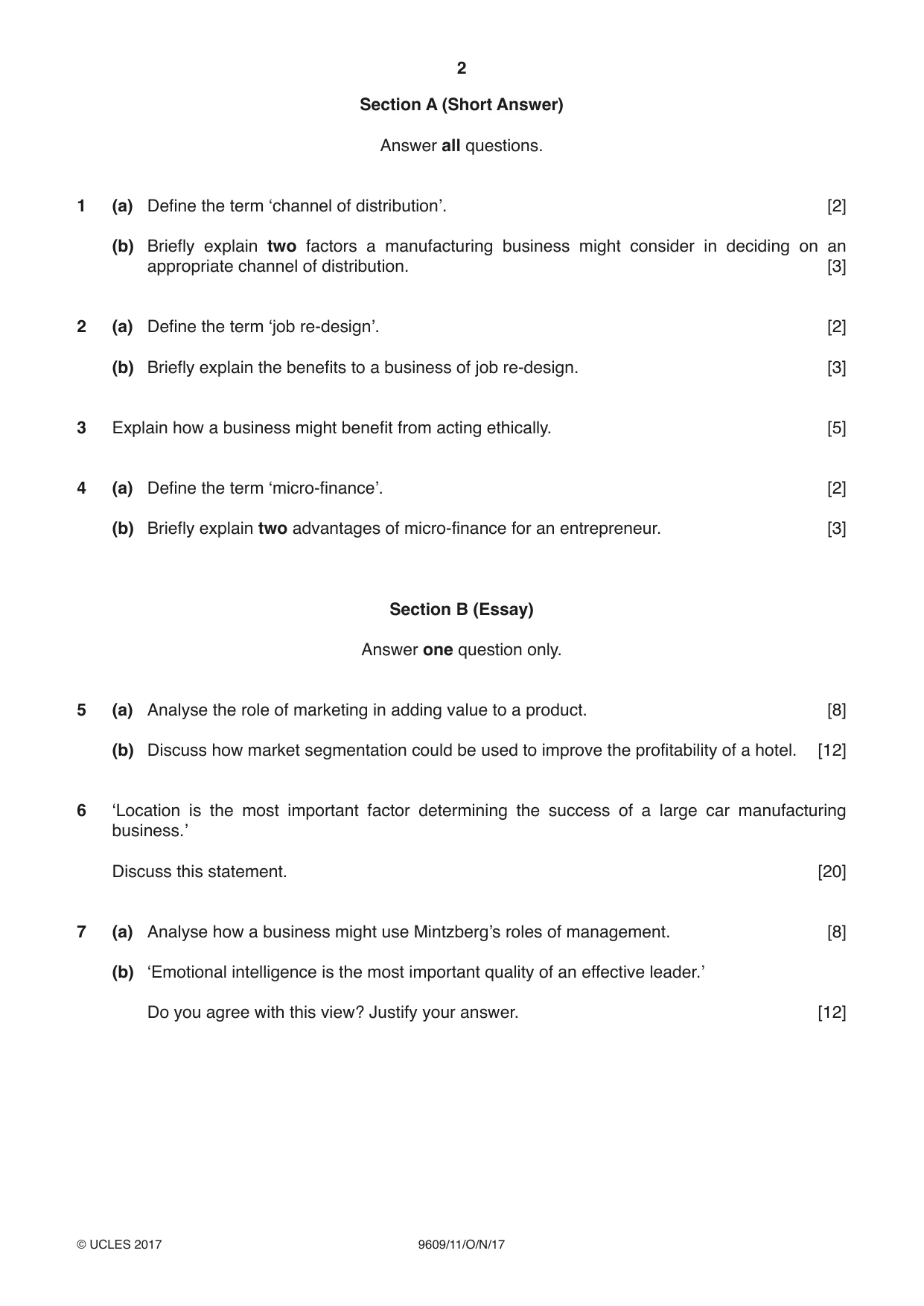
Question paper, page 2
2 9609/11/O/N/17 © UCLES 2017 Section A (Short Answer) Answer all questions. 1 (a) Define the term ‘channel of distribution’. [2] (b) Briefly explain two factors a manufacturing business might consider in deciding on an appropriate channel of distribution. [3] 2 (a) Define the term ‘job re-design’. [2] (b) Briefly explain the benefits to a business of job re-design. [3] 3 Explain how a business might benefit from acting ethically. [5] 4 (a) Define the term ‘micro-finance’. [2] (b) Briefly explain two advantages of micro-finance for an entrepreneur. [3] Section B (Essay) Answer one question only. 5 (a) Analyse the role of marketing in adding value to a product. [8] (b) Discuss how market segmentation could be used to improve the profitability of a hotel. [12] 6 ‘Location is the most important factor determining the success of a large car manufacturing business.’ Discuss this statement. [20] 7 (a) Analyse how a business might use Mintzberg’s roles of management. [8] (b) ‘Emotional intelligence is the most important quality of an effective leader.’ Do you agree with this view? Justify your answer. [12]
Question paper, page 3
3 9609/11/O/N/17 © UCLES 2017 BLANK PAGE
Question paper, page 4
4 9609/11/O/N/17 © UCLES 2017 BLANK PAGE Permission to reproduce items where third-party owned material protected by copyright is included has been sought and cleared where possible. Every reasonable effort has been made by the publisher (UCLES) to trace copyright holders, but if any items requiring clearance have unwittingly been included, the publisher will be pleased to make amends at the earliest possible opportunity. To avoid the issue of disclosure of answer-related information to candidates, all copyright acknowledgements are reproduced online in the Cambridge International Examinations Copyright Acknowledgements Booklet. This is produced for each series of examinations and is freely available to download at www.cie.org.uk after the live examination series. Cambridge International Examinations is part of the Cambridge Assessment Group. Cambridge Assessment is the brand name of University of Cambridge Local Examinations Syndicate (UCLES), which is itself a department of the University of Cambridge.
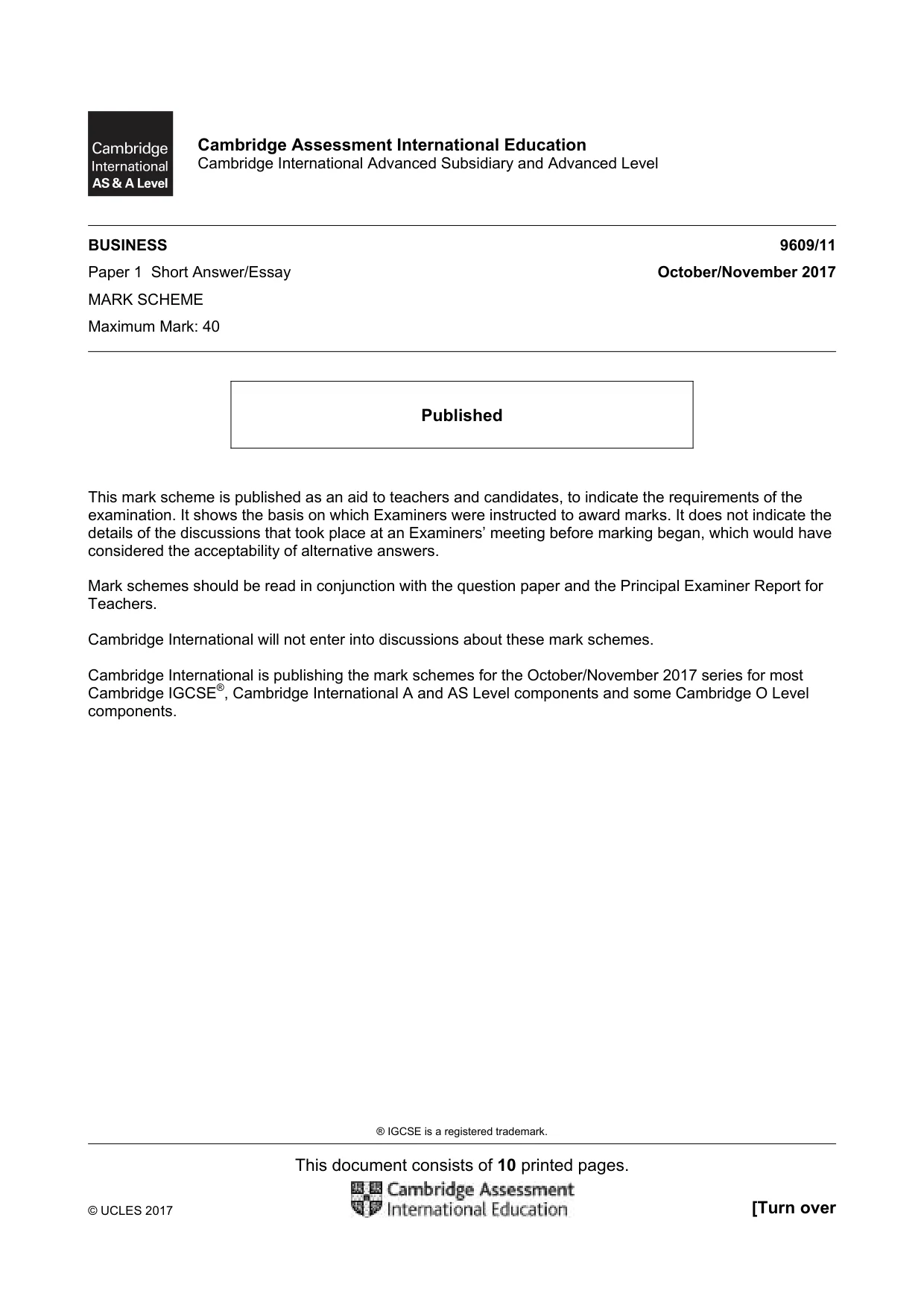
Mark scheme, page 1
® IGCSE is a registered trademark. This document consists of 10 printed pages. © UCLES 2017 [Turn over Cambridge Assessment International Education Cambridge International Advanced Subsidiary and Advanced Level BUSINESS 9609/11 Paper 1 Short Answer/Essay October/November 2017 MARK SCHEME Maximum Mark: 40 Published This mark scheme is published as an aid to teachers and candidates, to indicate the requirements of the examination. It shows the basis on which Examiners were instructed to award marks. It does not indicate the details of the discussions that took place at an Examiners’ meeting before marking began, which would have considered the acceptability of alternative answers. Mark schemes should be read in conjunction with the question paper and the Principal Examiner Report for Teachers. Cambridge International will not enter into discussions about these mark schemes. Cambridge International is publishing the mark schemes for the October/November 2017 series for most Cambridge IGCSE®, Cambridge International A and AS Level components and some Cambridge O Level components.
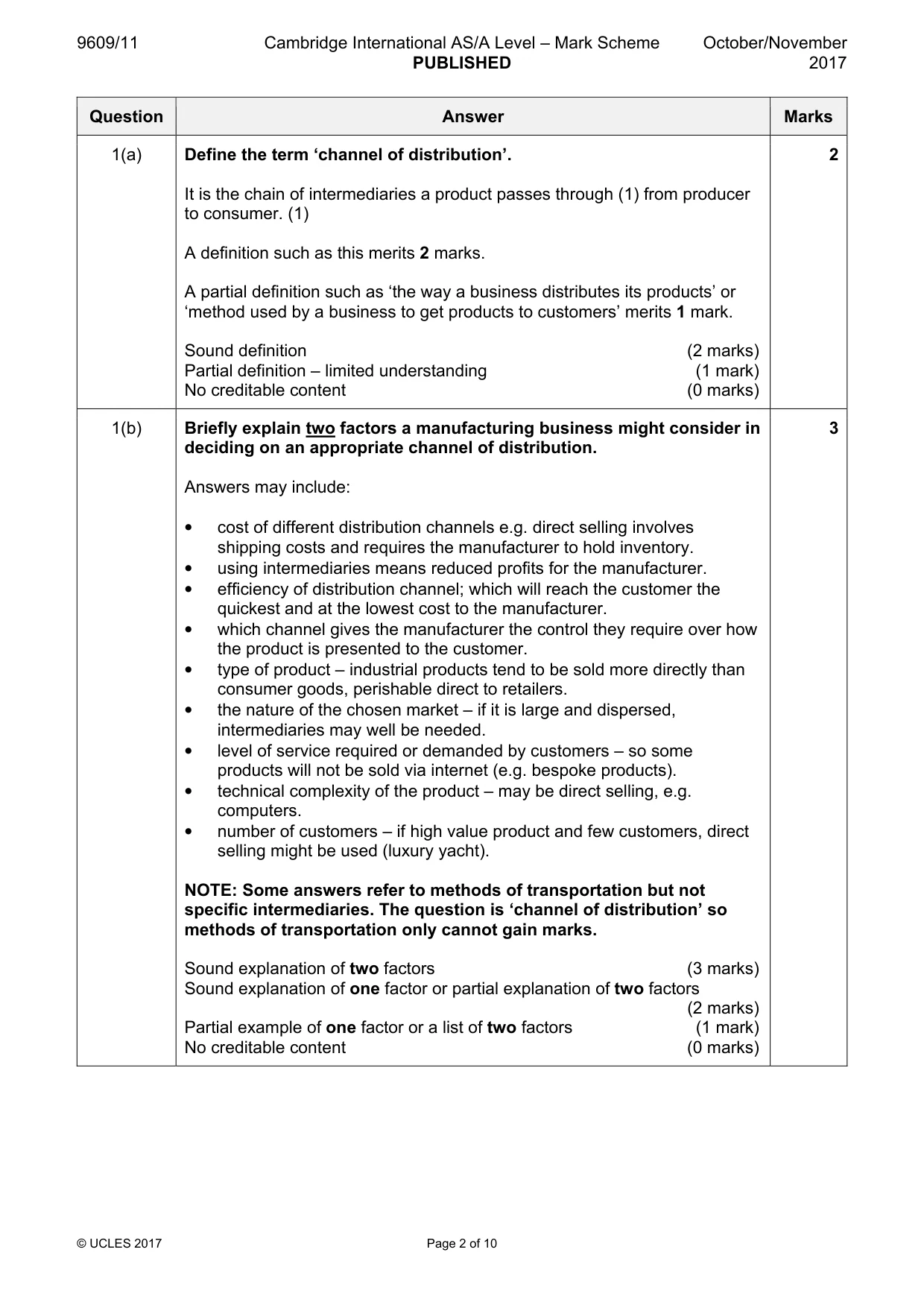
Mark scheme, page 2
9609/11 Cambridge International AS/A Level – Mark Scheme PUBLISHED October/November 2017 © UCLES 2017 Page 2 of 10 Question Answer Marks 1(a) Define the term ‘channel of distribution’. It is the chain of intermediaries a product passes through (1) from producer to consumer. (1) A definition such as this merits 2 marks. A partial definition such as ‘the way a business distributes its products’ or ‘method used by a business to get products to customers’ merits 1 mark. Sound definition (2 marks) Partial definition – limited understanding (1 mark) No creditable content (0 marks) 2 1(b) Briefly explain two factors a manufacturing business might consider in deciding on an appropriate channel of distribution. Answers may include: • cost of different distribution channels e.g. direct selling involves shipping costs and requires the manufacturer to hold inventory. • using intermediaries means reduced profits for the manufacturer. • efficiency of distribution channel; which will reach the customer the quickest and at the lowest cost to the manufacturer. • which channel gives the manufacturer the control they require over how the product is presented to the customer. • type of product – industrial products tend to be sold more directly than consumer goods, perishable direct to retailers. • the nature of the chosen market – if it is large and dispersed, intermediaries may well be needed. • level of service required or demanded by customers – so some products will not be sold via internet (e.g. bespoke products). • technical complexity of the product – may be direct selling, e.g. computers. • number of customers – if high value product and few customers, direct selling might be used (luxury yacht). NOTE: Some answers refer to methods of transportation but not specific intermediaries. The question is ‘channel of distribution’ so methods of transportation only cannot gain marks. Sound explanation of two factors (3 marks) Sound explanation of one factor or partial explanation of two factors (2 marks) Partial example of one factor or a list of two factors (1 mark) No creditable content (0 marks) 3
Mark scheme, page 3
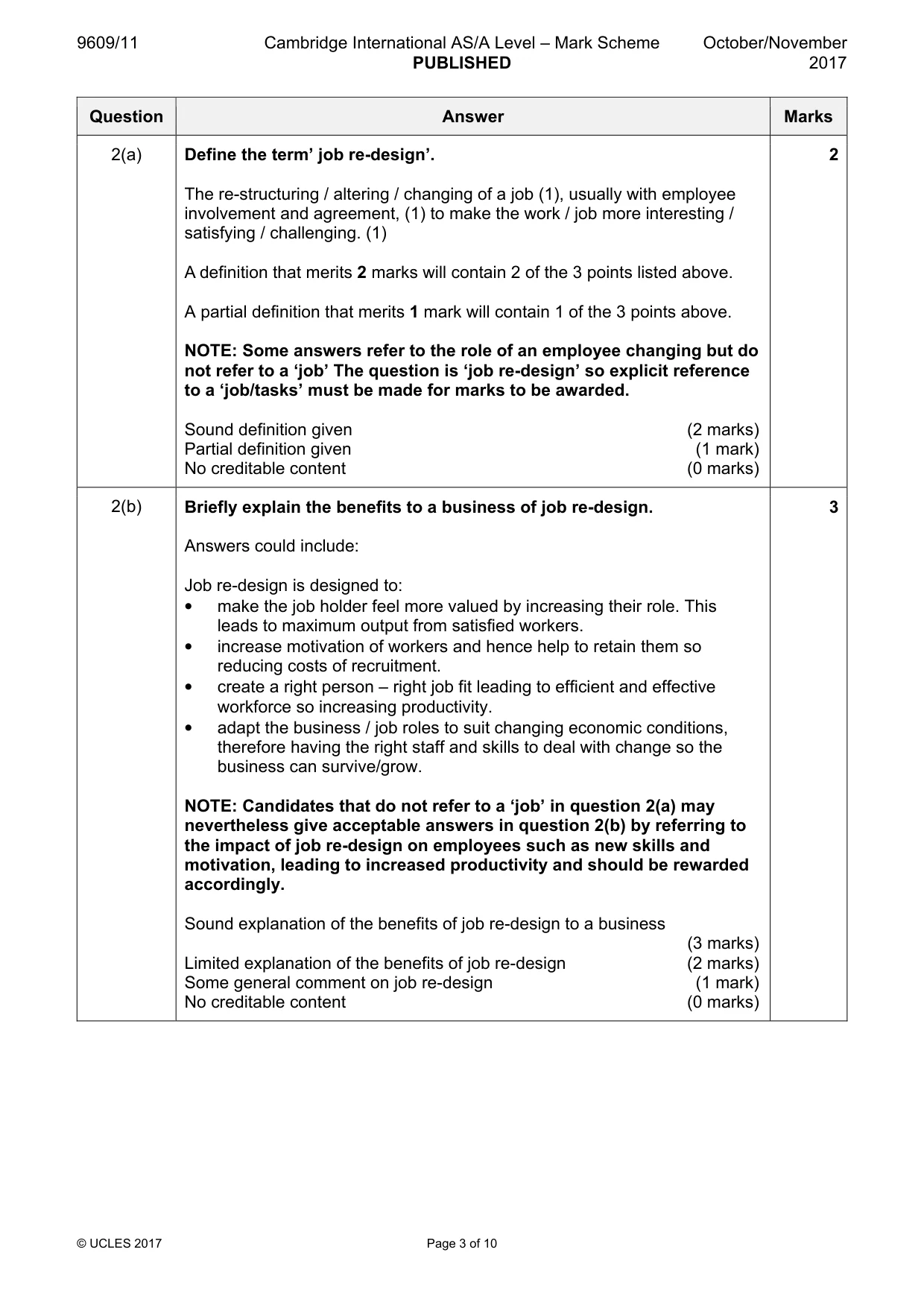
9609/11 Cambridge International AS/A Level – Mark Scheme PUBLISHED October/November 2017 © UCLES 2017 Page 3 of 10 Question Answer Marks 2(a) Define the term’ job re-design’. The re-structuring / altering / changing of a job (1), usually with employee involvement and agreement, (1) to make the work / job more interesting / satisfying / challenging. (1) A definition that merits 2 marks will contain 2 of the 3 points listed above. A partial definition that merits 1 mark will contain 1 of the 3 points above. NOTE: Some answers refer to the role of an employee changing but do not refer to a ‘job’ The question is ‘job re-design’ so explicit reference to a ‘job/tasks’ must be made for marks to be awarded. Sound definition given (2 marks) Partial definition given (1 mark) No creditable content (0 marks) 2 2(b) Briefly explain the benefits to a business of job re-design. Answers could include: Job re-design is designed to: • make the job holder feel more valued by increasing their role. This leads to maximum output from satisfied workers. • increase motivation of workers and hence help to retain them so reducing costs of recruitment. • create a right person – right job fit leading to efficient and effective workforce so increasing productivity. • adapt the business / job roles to suit changing economic conditions, therefore having the right staff and skills to deal with change so the business can survive/grow. NOTE: Candidates that do not refer to a ‘job’ in question 2(a) may nevertheless give acceptable answers in question 2(b) by referring to the impact of job re-design on employees such as new skills and motivation, leading to increased productivity and should be rewarded accordingly. Sound explanation of the benefits of job re-design to a business (3 marks) Limited explanation of the benefits of job re-design (2 marks) Some general comment on job re-design (1 mark) No creditable content (0 marks) 3
Mark scheme, page 4
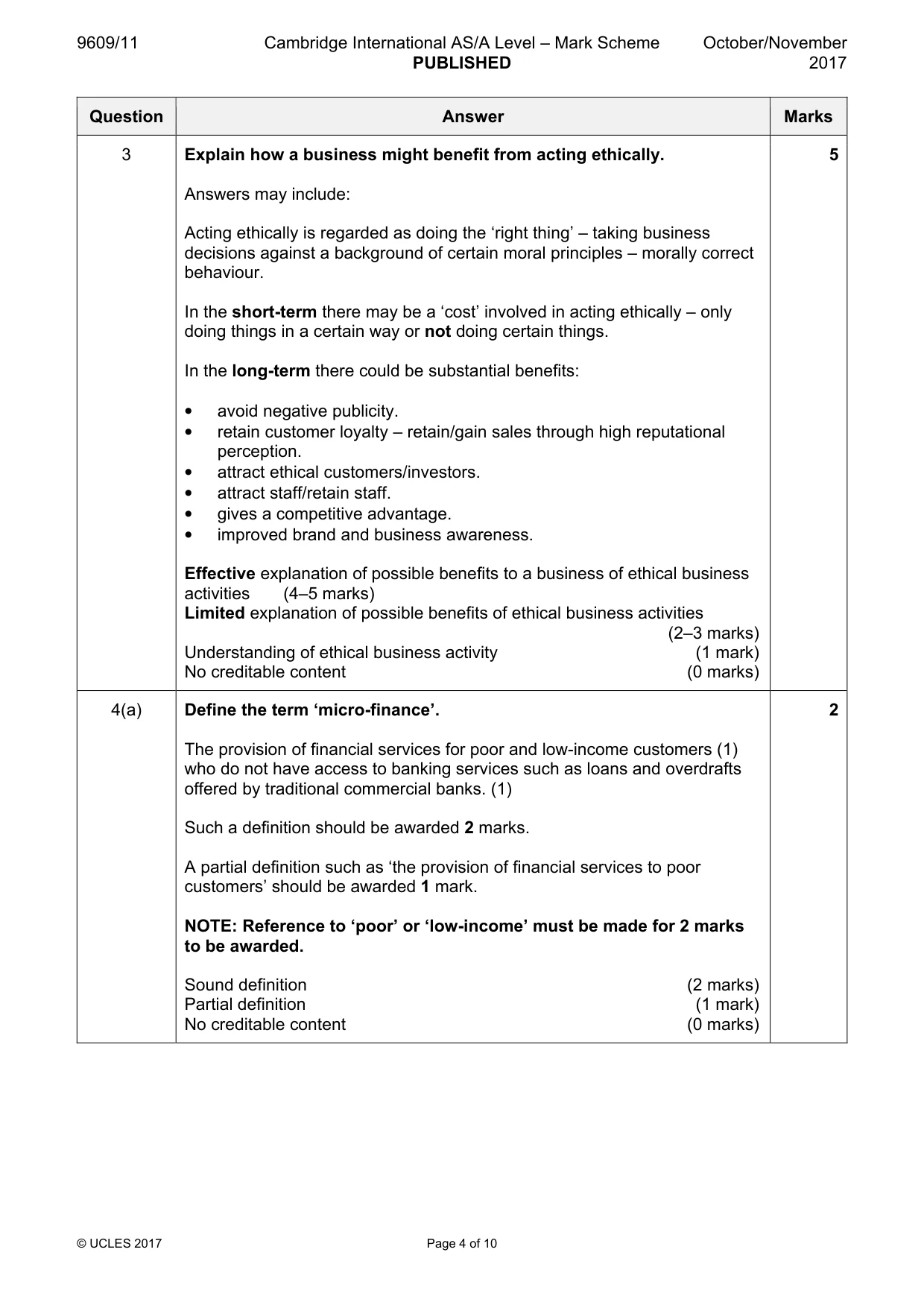
9609/11 Cambridge International AS/A Level – Mark Scheme PUBLISHED October/November 2017 © UCLES 2017 Page 4 of 10 Question Answer Marks 3 Explain how a business might benefit from acting ethically. Answers may include: Acting ethically is regarded as doing the ‘right thing’ – taking business decisions against a background of certain moral principles – morally correct behaviour. In the short-term there may be a ‘cost’ involved in acting ethically – only doing things in a certain way or not doing certain things. In the long-term there could be substantial benefits: • avoid negative publicity. • retain customer loyalty – retain/gain sales through high reputational perception. • attract ethical customers/investors. • attract staff/retain staff. • gives a competitive advantage. • improved brand and business awareness. Effective explanation of possible benefits to a business of ethical business activities (4–5 marks) Limited explanation of possible benefits of ethical business activities (2–3 marks) Understanding of ethical business activity (1 mark) No creditable content (0 marks) 5 4(a) Define the term ‘micro-finance’. The provision of financial services for poor and low-income customers (1) who do not have access to banking services such as loans and overdrafts offered by traditional commercial banks. (1) Such a definition should be awarded 2 marks. A partial definition such as ‘the provision of financial services to poor customers’ should be awarded 1 mark. NOTE: Reference to ‘poor’ or ‘low-income’ must be made for 2 marks to be awarded. Sound definition (2 marks) Partial definition (1 mark) No creditable content (0 marks) 2
Mark scheme, page 5
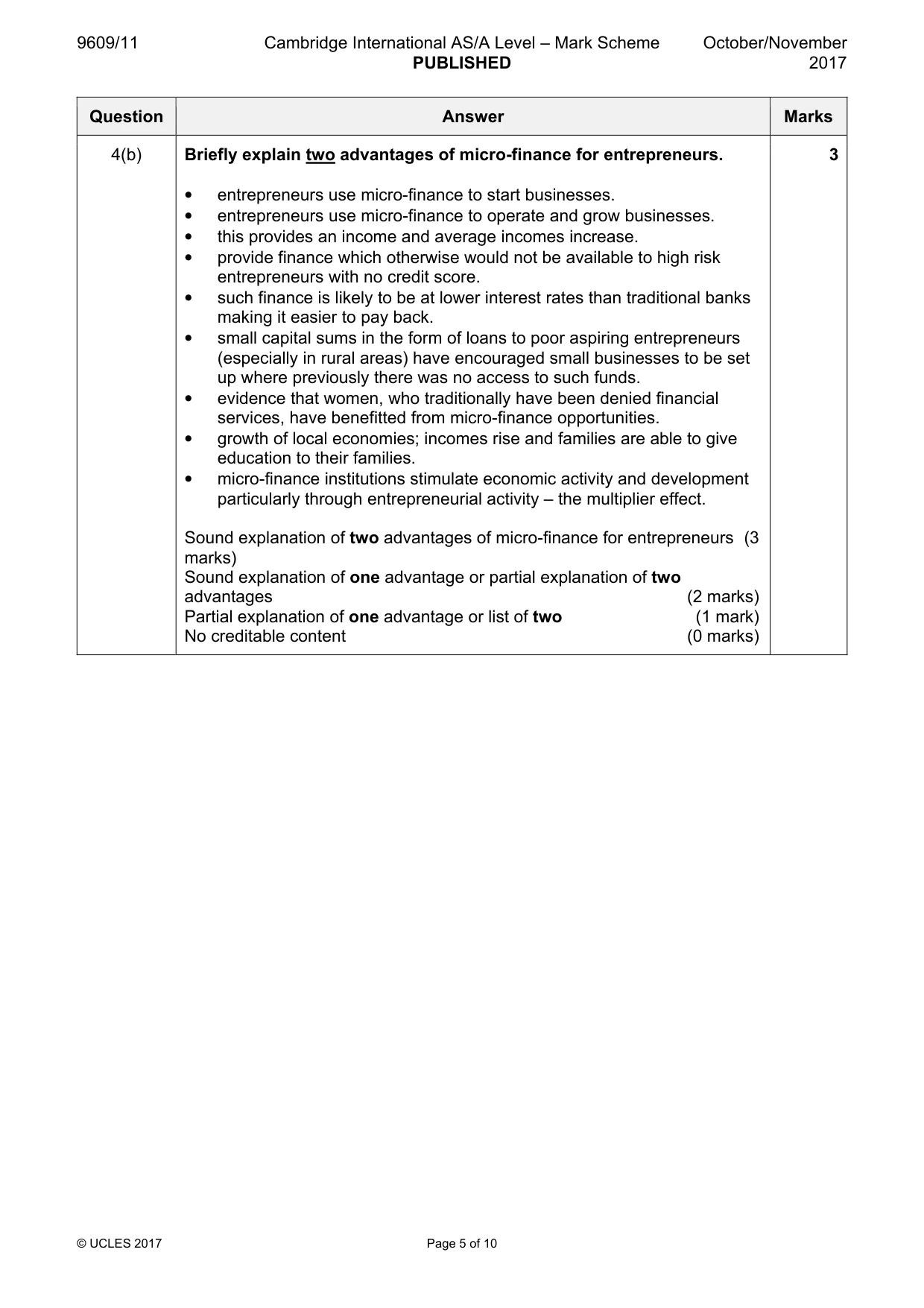
9609/11 Cambridge International AS/A Level – Mark Scheme PUBLISHED October/November 2017 © UCLES 2017 Page 5 of 10 Question Answer Marks 4(b) Briefly explain two advantages of micro-finance for entrepreneurs. • entrepreneurs use micro-finance to start businesses. • entrepreneurs use micro-finance to operate and grow businesses. • this provides an income and average incomes increase. • provide finance which otherwise would not be available to high risk entrepreneurs with no credit score. • such finance is likely to be at lower interest rates than traditional banks making it easier to pay back. • small capital sums in the form of loans to poor aspiring entrepreneurs (especially in rural areas) have encouraged small businesses to be set up where previously there was no access to such funds. • evidence that women, who traditionally have been denied financial services, have benefitted from micro-finance opportunities. • growth of local economies; incomes rise and families are able to give education to their families. • micro-finance institutions stimulate economic activity and development particularly through entrepreneurial activity – the multiplier effect. Sound explanation of two advantages of micro-finance for entrepreneurs (3 marks) Sound explanation of one advantage or partial explanation of two advantages (2 marks) Partial explanation of one advantage or list of two (1 mark) No creditable content (0 marks) 3
Mark scheme, page 6
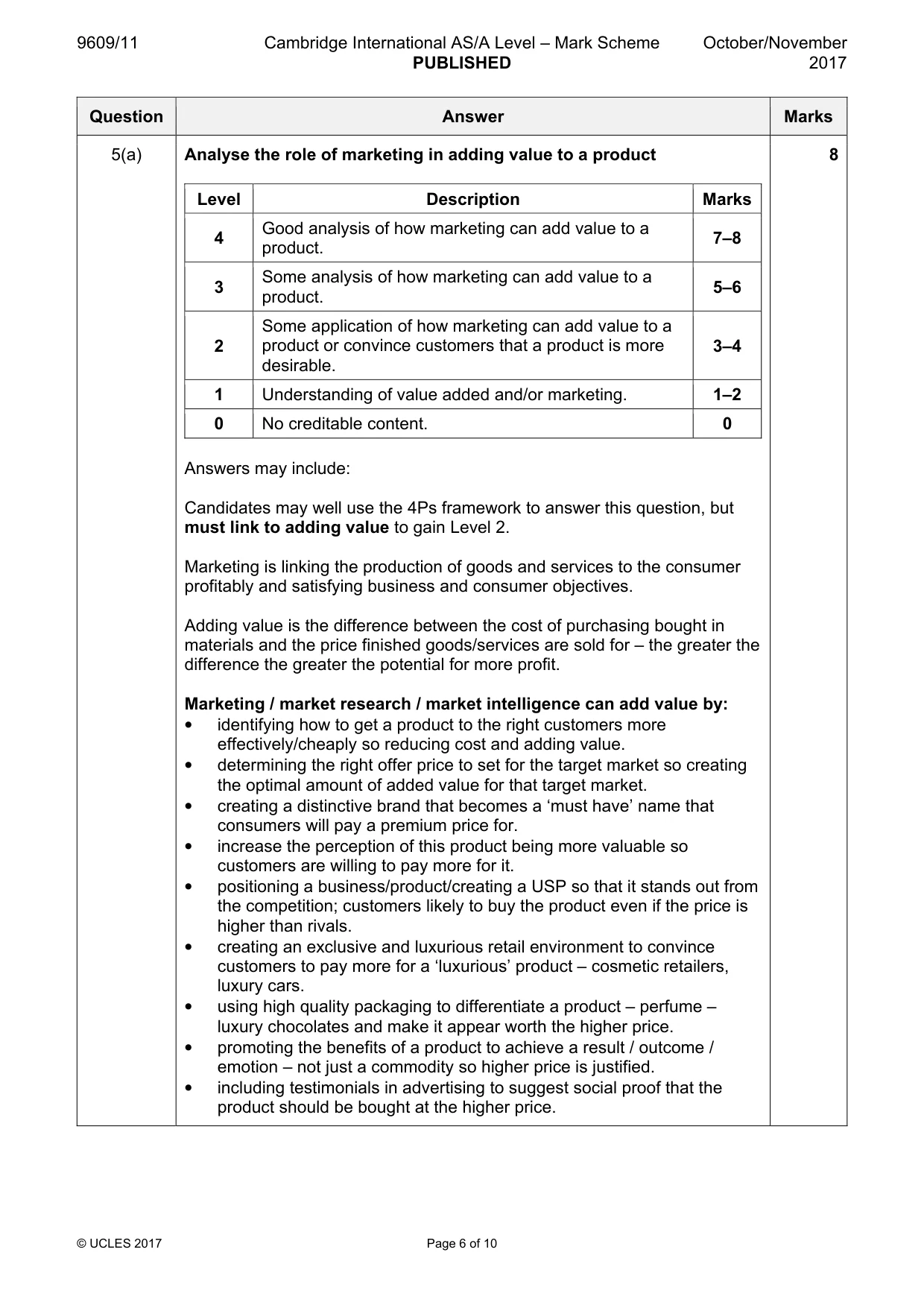
9609/11 Cambridge International AS/A Level – Mark Scheme PUBLISHED October/November 2017 © UCLES 2017 Page 6 of 10 Question Answer Marks 5(a) Analyse the role of marketing in adding value to a product Level Description Marks 4 Good analysis of how marketing can add value to a product. 7–8 3 Some analysis of how marketing can add value to a product. 5–6 2 Some application of how marketing can add value to a product or convince customers that a product is more desirable. 3–4 1 Understanding of value added and/or marketing. 1–2 0 No creditable content. 0 Answers may include: Candidates may well use the 4Ps framework to answer this question, but must link to adding value to gain Level 2. Marketing is linking the production of goods and services to the consumer profitably and satisfying business and consumer objectives. Adding value is the difference between the cost of purchasing bought in materials and the price finished goods/services are sold for – the greater the difference the greater the potential for more profit. Marketing / market research / market intelligence can add value by: • identifying how to get a product to the right customers more effectively/cheaply so reducing cost and adding value. • determining the right offer price to set for the target market so creating the optimal amount of added value for that target market. • creating a distinctive brand that becomes a ‘must have’ name that consumers will pay a premium price for. • increase the perception of this product being more valuable so customers are willing to pay more for it. • positioning a business/product/creating a USP so that it stands out from the competition; customers likely to buy the product even if the price is higher than rivals. • creating an exclusive and luxurious retail environment to convince customers to pay more for a ‘luxurious’ product – cosmetic retailers, luxury cars. • using high quality packaging to differentiate a product – perfume – luxury chocolates and make it appear worth the higher price. • promoting the benefits of a product to achieve a result / outcome / emotion – not just a commodity so higher price is justified. • including testimonials in advertising to suggest social proof that the product should be bought at the higher price. 8
Mark scheme, page 7
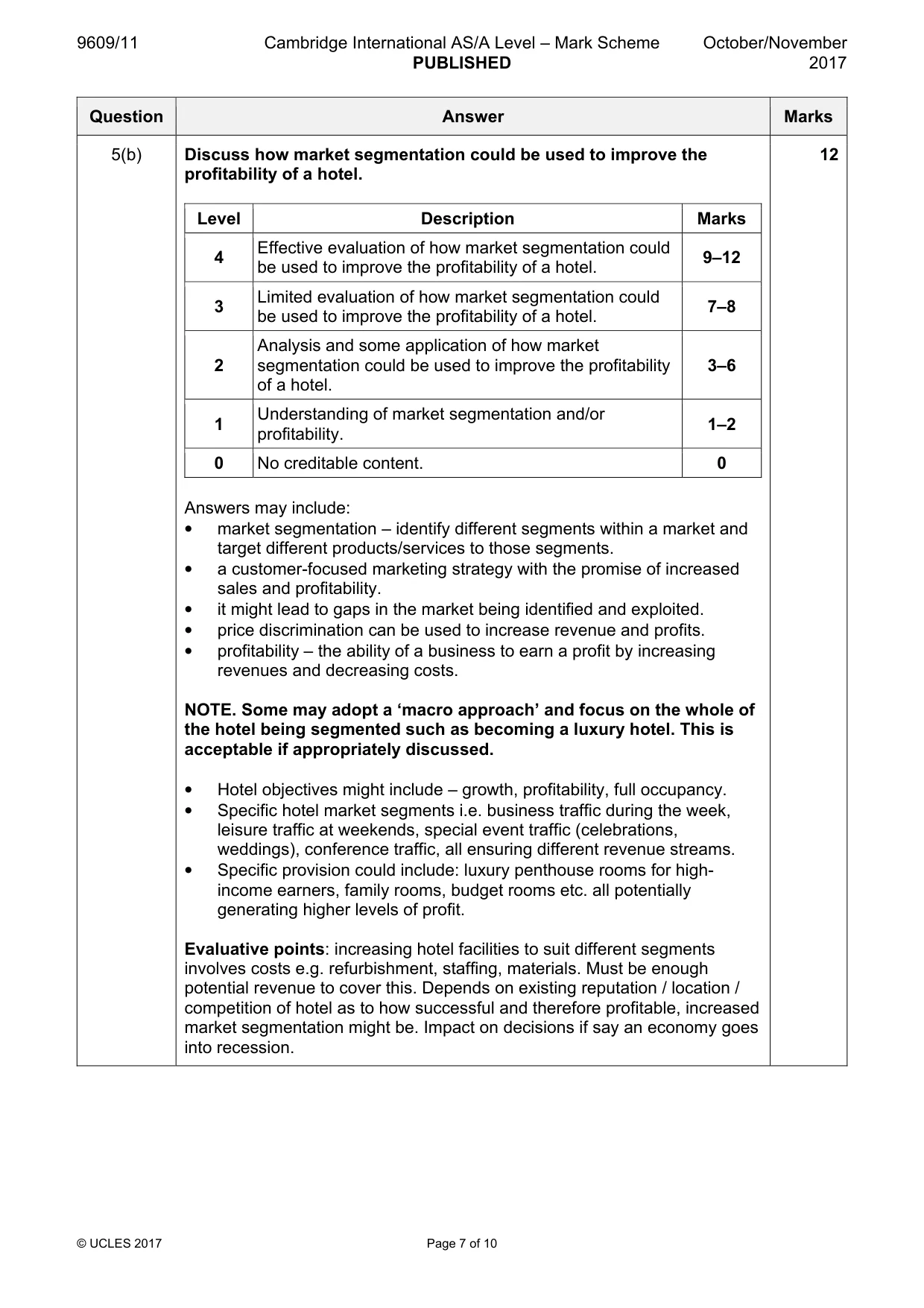
9609/11 Cambridge International AS/A Level – Mark Scheme PUBLISHED October/November 2017 © UCLES 2017 Page 7 of 10 Question Answer Marks 5(b) Discuss how market segmentation could be used to improve the profitability of a hotel. Level Description Marks 4 Effective evaluation of how market segmentation could be used to improve the profitability of a hotel. 9–12 3 Limited evaluation of how market segmentation could be used to improve the profitability of a hotel. 7–8 2 Analysis and some application of how market segmentation could be used to improve the profitability of a hotel. 3–6 1 Understanding of market segmentation and/or profitability. 1–2 0 No creditable content. 0 Answers may include: • market segmentation – identify different segments within a market and target different products/services to those segments. • a customer-focused marketing strategy with the promise of increased sales and profitability. • it might lead to gaps in the market being identified and exploited. • price discrimination can be used to increase revenue and profits. • profitability – the ability of a business to earn a profit by increasing revenues and decreasing costs. NOTE. Some may adopt a ‘macro approach’ and focus on the whole of the hotel being segmented such as becoming a luxury hotel. This is acceptable if appropriately discussed. • Hotel objectives might include – growth, profitability, full occupancy. • Specific hotel market segments i.e. business traffic during the week, leisure traffic at weekends, special event traffic (celebrations, weddings), conference traffic, all ensuring different revenue streams. • Specific provision could include: luxury penthouse rooms for high- income earners, family rooms, budget rooms etc. all potentially generating higher levels of profit. Evaluative points: increasing hotel facilities to suit different segments involves costs e.g. refurbishment, staffing, materials. Must be enough potential revenue to cover this. Depends on existing reputation / location / competition of hotel as to how successful and therefore profitable, increased market segmentation might be. Impact on decisions if say an economy goes into recession. 12
Mark scheme, page 8
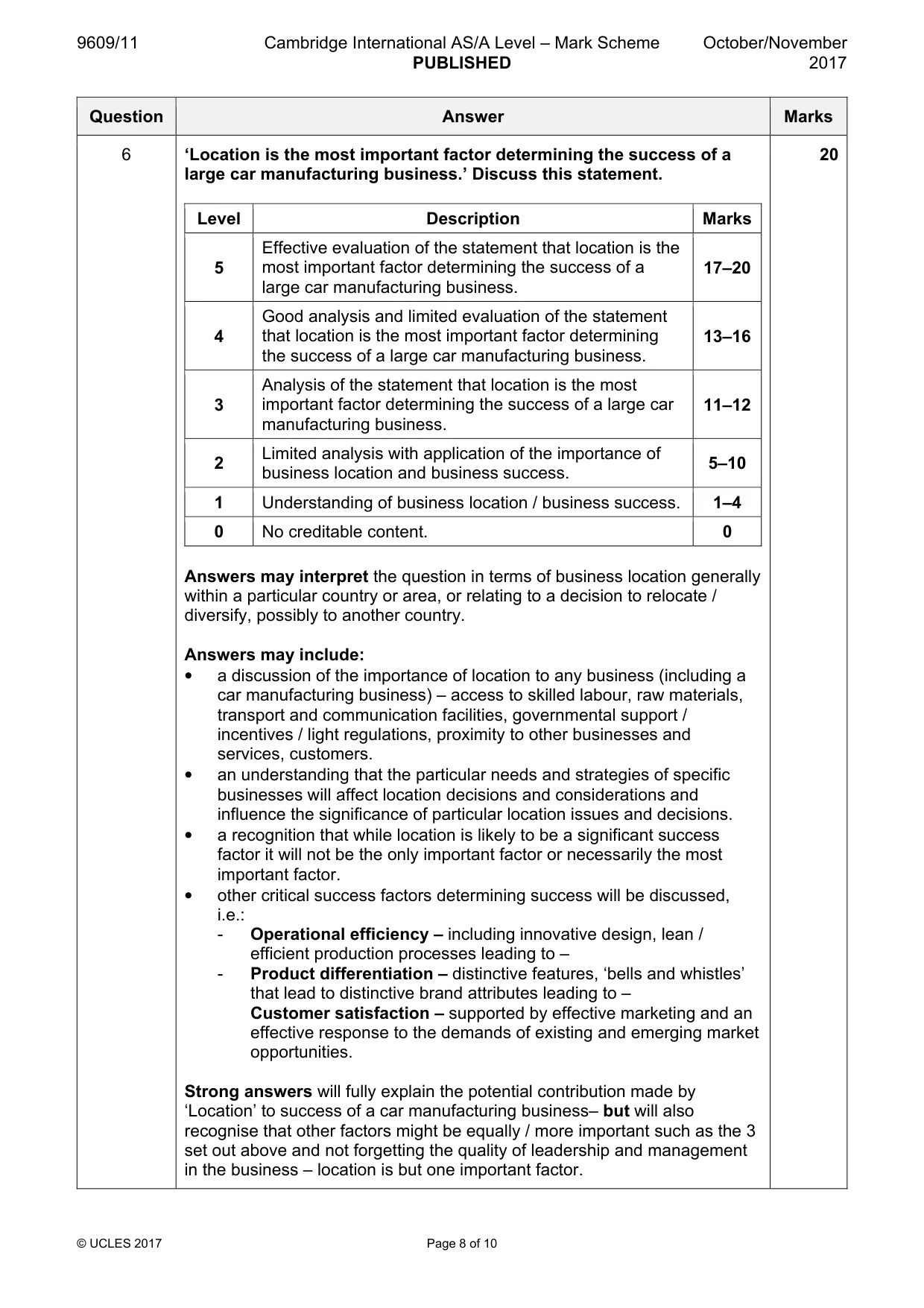
9609/11 Cambridge International AS/A Level – Mark Scheme PUBLISHED October/November 2017 © UCLES 2017 Page 8 of 10 Question Answer Marks 6 ‘Location is the most important factor determining the success of a large car manufacturing business.’ Discuss this statement. Level Description Marks 5 Effective evaluation of the statement that location is the most important factor determining the success of a large car manufacturing business. 17–20 4 Good analysis and limited evaluation of the statement that location is the most important factor determining the success of a large car manufacturing business. 13–16 3 Analysis of the statement that location is the most important factor determining the success of a large car manufacturing business. 11–12 2 Limited analysis with application of the importance of business location and business success. 5–10 1 Understanding of business location / business success. 1–4 0 No creditable content. 0 Answers may interpret the question in terms of business location generally within a particular country or area, or relating to a decision to relocate / diversify, possibly to another country. Answers may include: • a discussion of the importance of location to any business (including a car manufacturing business) – access to skilled labour, raw materials, transport and communication facilities, governmental support / incentives / light regulations, proximity to other businesses and services, customers. • an understanding that the particular needs and strategies of specific businesses will affect location decisions and considerations and influence the significance of particular location issues and decisions. • a recognition that while location is likely to be a significant success factor it will not be the only important factor or necessarily the most important factor. • other critical success factors determining success will be discussed, i.e.: - Operational efficiency – including innovative design, lean / efficient production processes leading to – - Product differentiation – distinctive features, ‘bells and whistles’ that lead to distinctive brand attributes leading to – Customer satisfaction – supported by effective marketing and an effective response to the demands of existing and emerging market opportunities. Strong answers will fully explain the potential contribution made by ‘Location’ to success of a car manufacturing business– but will also recognise that other factors might be equally / more important such as the 3 set out above and not forgetting the quality of leadership and management in the business – location is but one important factor. 20
Mark scheme, page 9
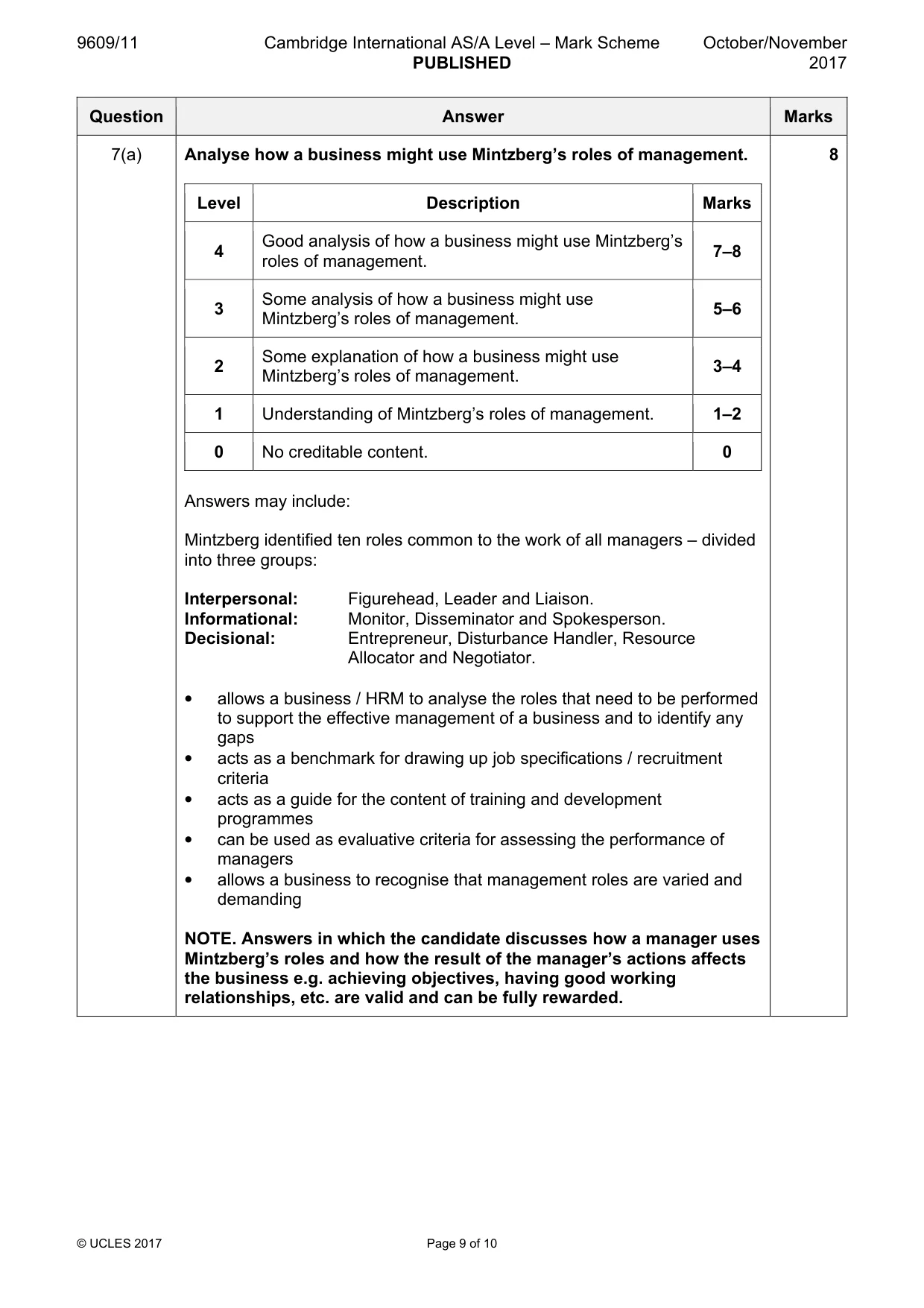
9609/11 Cambridge International AS/A Level – Mark Scheme PUBLISHED October/November 2017 © UCLES 2017 Page 9 of 10 Question Answer Marks 7(a) Analyse how a business might use Mintzberg’s roles of management. Level Description Marks 4 Good analysis of how a business might use Mintzberg’s roles of management. 7–8 3 Some analysis of how a business might use Mintzberg’s roles of management. 5–6 2 Some explanation of how a business might use Mintzberg’s roles of management. 3–4 1 Understanding of Mintzberg’s roles of management. 1–2 0 No creditable content. 0 Answers may include: Mintzberg identified ten roles common to the work of all managers – divided into three groups: Interpersonal: Figurehead, Leader and Liaison. Informational: Monitor, Disseminator and Spokesperson. Decisional: Entrepreneur, Disturbance Handler, Resource Allocator and Negotiator. • allows a business / HRM to analyse the roles that need to be performed to support the effective management of a business and to identify any gaps • acts as a benchmark for drawing up job specifications / recruitment criteria • acts as a guide for the content of training and development programmes • can be used as evaluative criteria for assessing the performance of managers • allows a business to recognise that management roles are varied and demanding NOTE. Answers in which the candidate discusses how a manager uses Mintzberg’s roles and how the result of the manager’s actions affects the business e.g. achieving objectives, having good working relationships, etc. are valid and can be fully rewarded. 8
Mark scheme, page 10
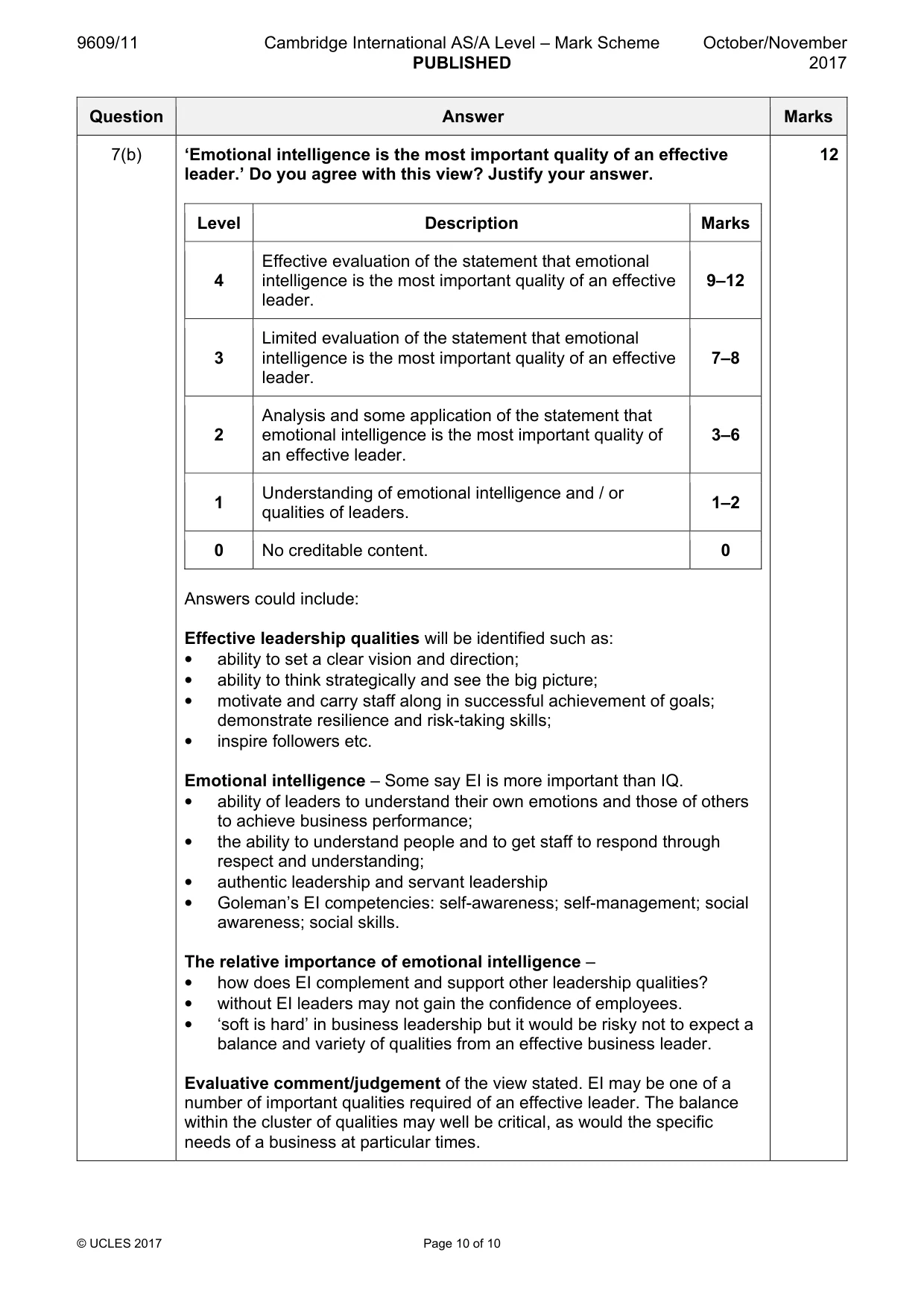
9609/11 Cambridge International AS/A Level – Mark Scheme PUBLISHED October/November 2017 © UCLES 2017 Page 10 of 10 Question Answer Marks 7(b) ‘Emotional intelligence is the most important quality of an effective leader.’ Do you agree with this view? Justify your answer. Level Description Marks 4 Effective evaluation of the statement that emotional intelligence is the most important quality of an effective leader. 9–12 3 Limited evaluation of the statement that emotional intelligence is the most important quality of an effective leader. 7–8 2 Analysis and some application of the statement that emotional intelligence is the most important quality of an effective leader. 3–6 1 Understanding of emotional intelligence and / or qualities of leaders. 1–2 0 No creditable content. 0 Answers could include: Effective leadership qualities will be identified such as: • ability to set a clear vision and direction; • ability to think strategically and see the big picture; • motivate and carry staff along in successful achievement of goals; demonstrate resilience and risk-taking skills; • inspire followers etc. Emotional intelligence – Some say EI is more important than IQ. • ability of leaders to understand their own emotions and those of others to achieve business performance; • the ability to understand people and to get staff to respond through respect and understanding; • authentic leadership and servant leadership • Goleman’s EI competencies: self-awareness; self-management; social awareness; social skills. The relative importance of emotional intelligence – • how does EI complement and support other leadership qualities? • without EI leaders may not gain the confidence of employees. • ‘soft is hard’ in business leadership but it would be risky not to expect a balance and variety of qualities from an effective business leader. Evaluative comment/judgement of the view stated. EI may be one of a number of important qualities required of an effective leader. The balance within the cluster of qualities may well be critical, as would the specific needs of a business at particular times. 12
What you needed in this session
Cambridge’s own grade thresholds for 2017 Oct/Nov, Paper 1 · Variant 1. A higher threshold means an easier paper — the bar moves with how the cohort did.