Cambridge A Level Business (for first examination in 2016) 9609 — 2017 May/June Paper 1 · Variant 2
9609/12/M/J/17
The question paper and its mark scheme, free to read here and free to download. This is Cambridge’s own paper, exactly as it was sat.
Question paper4 pages


Mark scheme11 pages
Answers below. Sit the paper first if you are practising.

Paper as text
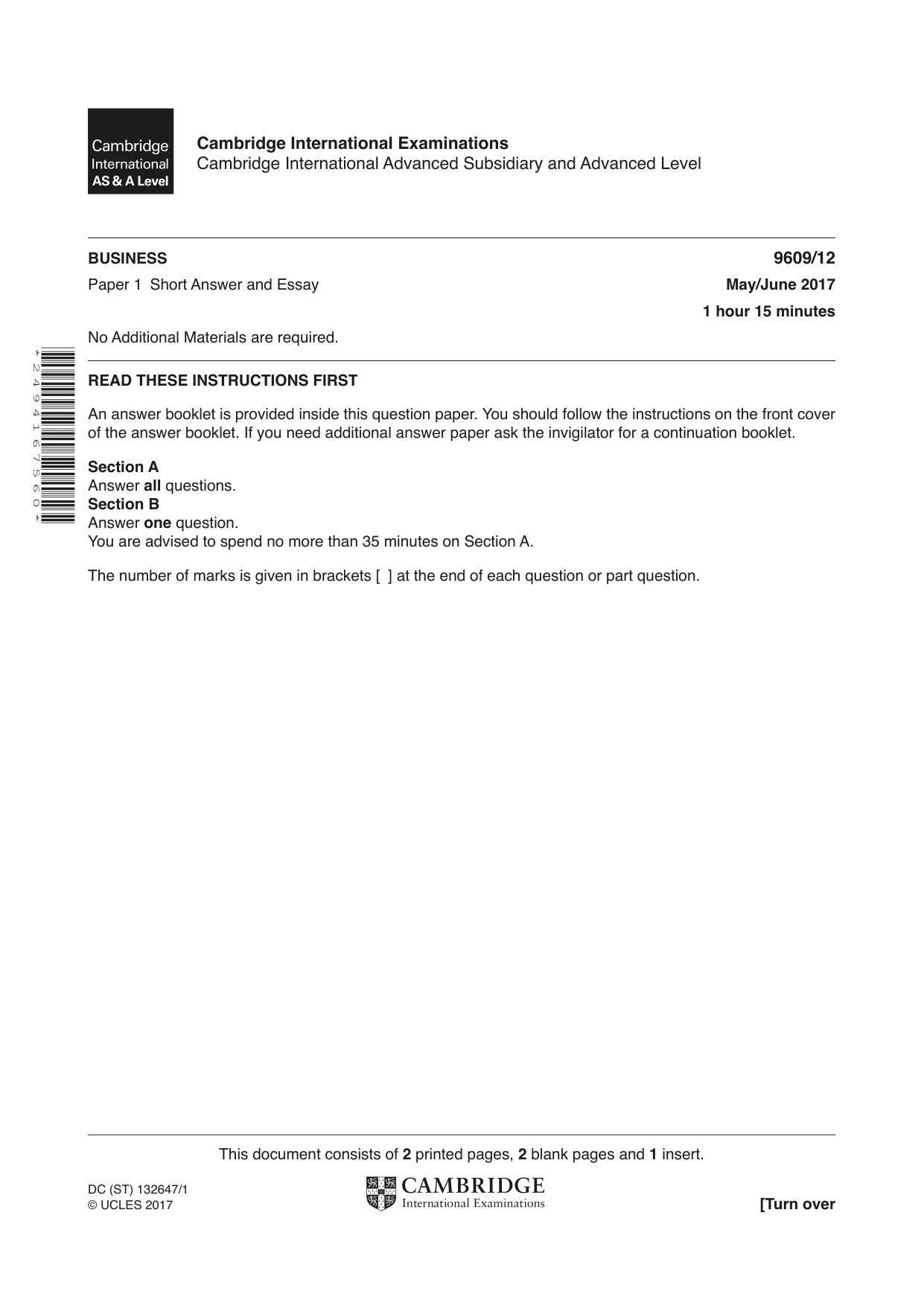
Question paper, page 1
This document consists of 2 printed pages, 2 blank pages and 1 insert. DC (ST) 132647/1 © UCLES 2017 [Turn over Cambridge International Examinations Cambridge International Advanced Subsidiary and Advanced Level * 2 4 9 4 1 6 7 5 6 0 * BUSINESS 9609/12 Paper 1 Short Answer and Essay May/June 2017 1 hour 15 minutes No Additional Materials are required. READ THESE INSTRUCTIONS FIRST An answer booklet is provided inside this question paper. You should follow the instructions on the front cover of the answer booklet. If you need additional answer paper ask the invigilator for a continuation booklet. Section A Answer all questions. Section B Answer one question. You are advised to spend no more than 35 minutes on Section A. The number of marks is given in brackets [ ] at the end of each question or part question.
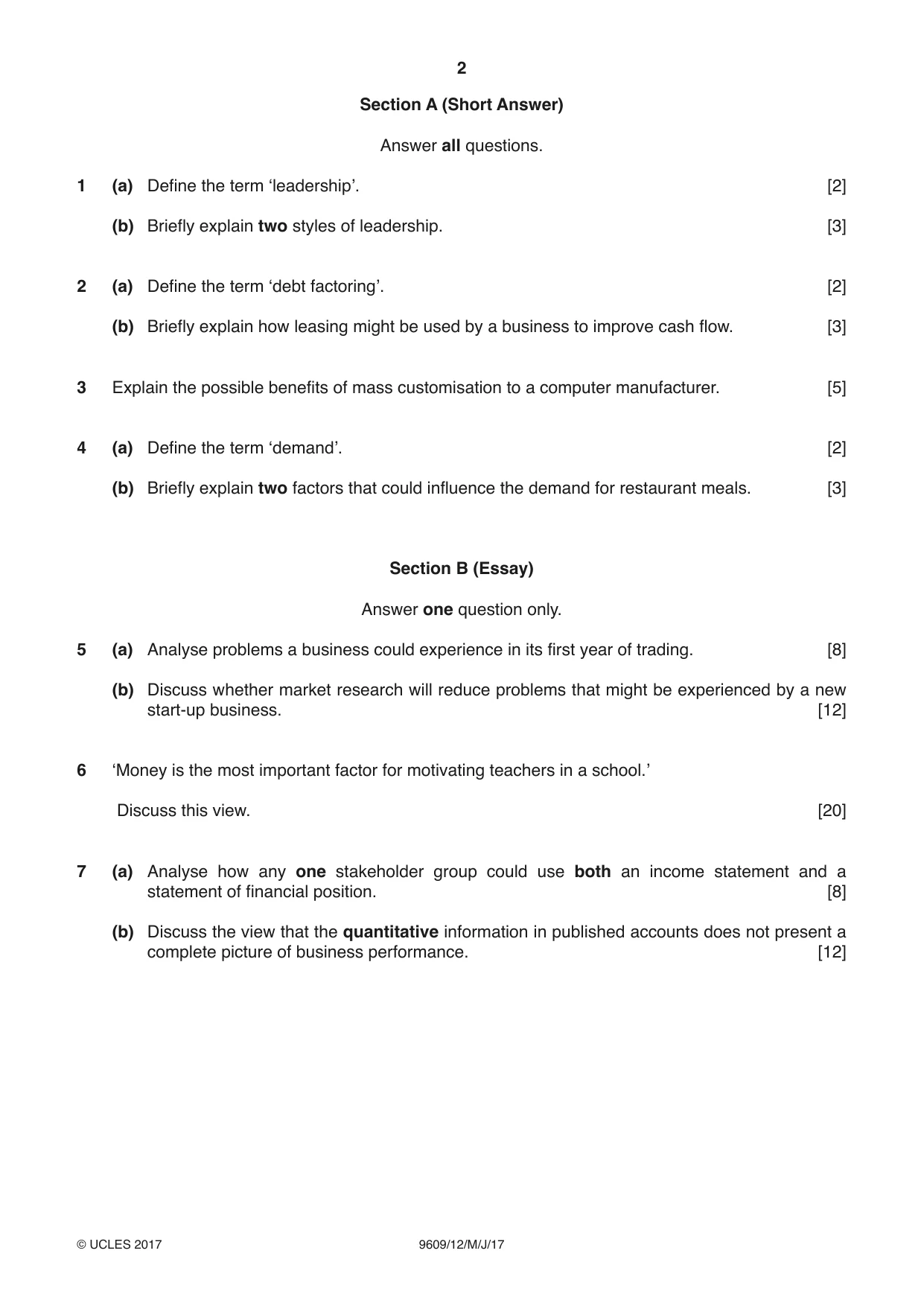
Question paper, page 2
2 9609/12/M/J/17 © UCLES 2017 Section A (Short Answer) Answer all questions. 1 (a) Define the term ‘leadership’. [2] (b) Briefly explain two styles of leadership. [3] 2 (a) Define the term ‘debt factoring’. [2] (b) Briefly explain how leasing might be used by a business to improve cash flow. [3] 3 Explain the possible benefits of mass customisation to a computer manufacturer. [5] 4 (a) Define the term ‘demand’. [2] (b) Briefly explain two factors that could influence the demand for restaurant meals. [3] Section B (Essay) Answer one question only. 5 (a) Analyse problems a business could experience in its first year of trading. [8] (b) Discuss whether market research will reduce problems that might be experienced by a new start-up business. [12] 6 ‘Money is the most important factor for motivating teachers in a school.’ Discuss this view. [20] 7 (a) Analyse how any one stakeholder group could use both an income statement and a statement of financial position. [8] (b) Discuss the view that the quantitative information in published accounts does not present a complete picture of business performance. [12]
Question paper, page 3
3 9609/12/M/J/17 © UCLES 2017 BLANK PAGE
Question paper, page 4
4 9609/12/M/J/17 © UCLES 2017 Permission to reproduce items where third-party owned material protected by copyright is included has been sought and cleared where possible. Every reasonable effort has been made by the publisher (UCLES) to trace copyright holders, but if any items requiring clearance have unwittingly been included, the publisher will be pleased to make amends at the earliest possible opportunity. To avoid the issue of disclosure of answer-related information to candidates, all copyright acknowledgements are reproduced online in the Cambridge International Examinations Copyright Acknowledgements Booklet. This is produced for each series of examinations and is freely available to download at www.cie.org.uk after the live examination series. Cambridge International Examinations is part of the Cambridge Assessment Group. Cambridge Assessment is the brand name of University of Cambridge Local Examinations Syndicate (UCLES), which is itself a department of the University of Cambridge. BLANK PAGE
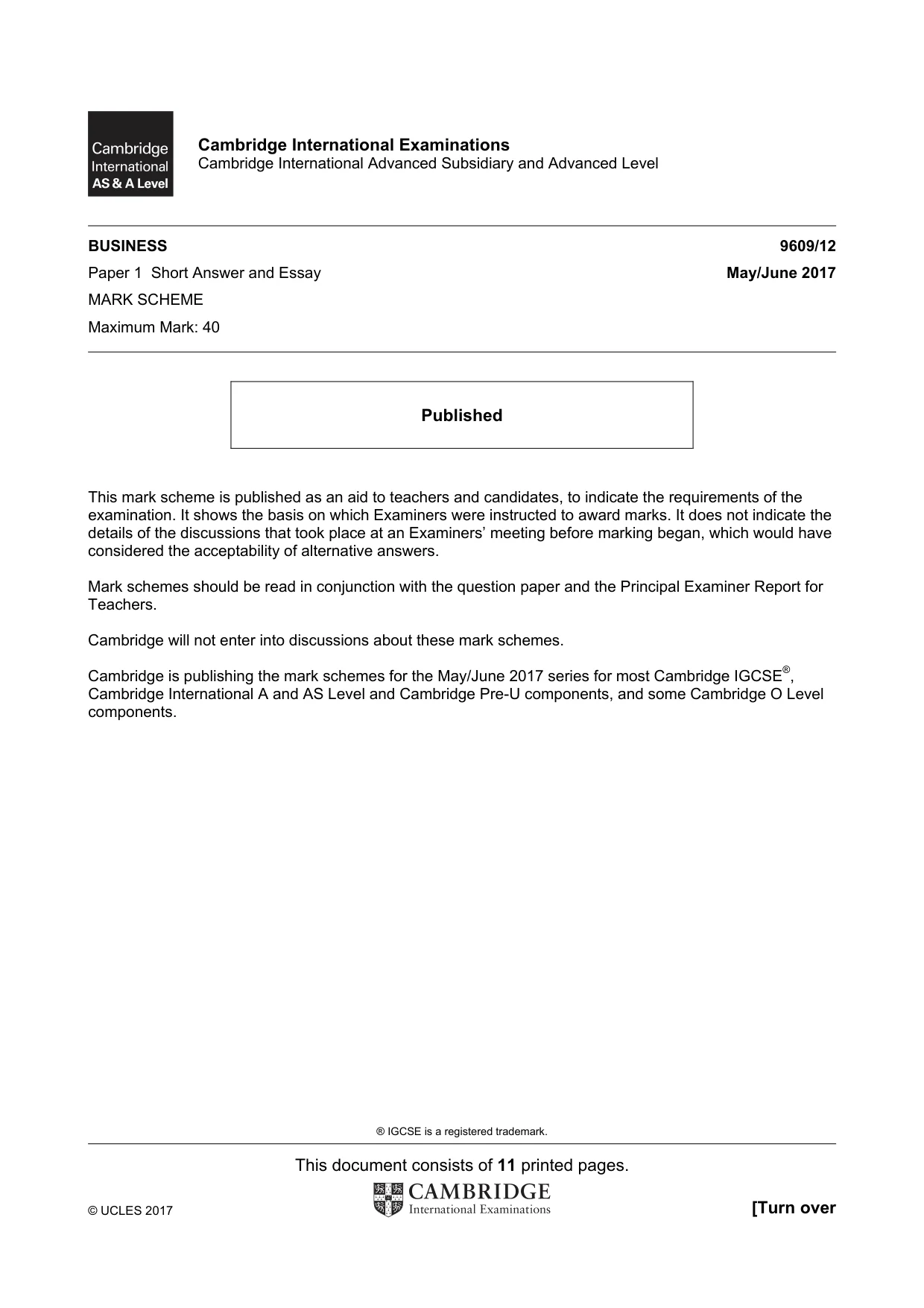
Mark scheme, page 1
® IGCSE is a registered trademark. This document consists of 11 printed pages. © UCLES 2017 [Turn over Cambridge International Examinations Cambridge International Advanced Subsidiary and Advanced Level BUSINESS 9609/12 Paper 1 Short Answer and Essay May/June 2017 MARK SCHEME Maximum Mark: 40 Published This mark scheme is published as an aid to teachers and candidates, to indicate the requirements of the examination. It shows the basis on which Examiners were instructed to award marks. It does not indicate the details of the discussions that took place at an Examiners’ meeting before marking began, which would have considered the acceptability of alternative answers. Mark schemes should be read in conjunction with the question paper and the Principal Examiner Report for Teachers. Cambridge will not enter into discussions about these mark schemes. Cambridge is publishing the mark schemes for the May/June 2017 series for most Cambridge IGCSE®, Cambridge International A and AS Level and Cambridge Pre-U components, and some Cambridge O Level components.
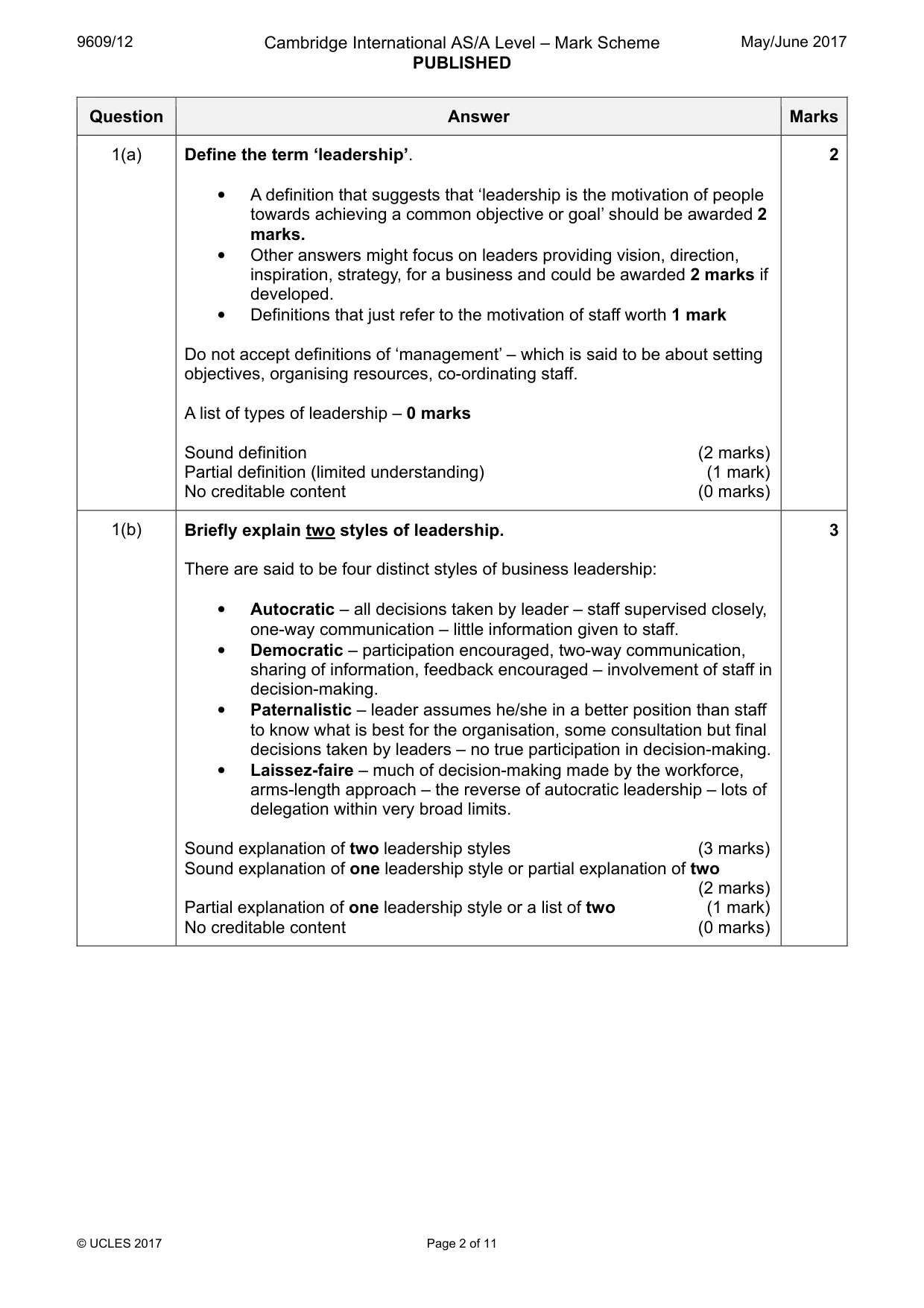
Mark scheme, page 2
9609/12 Cambridge International AS/A Level – Mark Scheme PUBLISHED May/June 2017 © UCLES 2017 Page 2 of 11 Question Answer Marks 1(a) Define the term ‘leadership’. • A definition that suggests that ‘leadership is the motivation of people towards achieving a common objective or goal’ should be awarded 2 marks. • Other answers might focus on leaders providing vision, direction, inspiration, strategy, for a business and could be awarded 2 marks if developed. • Definitions that just refer to the motivation of staff worth 1 mark Do not accept definitions of ‘management’ – which is said to be about setting objectives, organising resources, co-ordinating staff. A list of types of leadership – 0 marks Sound definition (2 marks) Partial definition (limited understanding) (1 mark) No creditable content (0 marks) 2 1(b) Briefly explain two styles of leadership. There are said to be four distinct styles of business leadership: • Autocratic – all decisions taken by leader – staff supervised closely, one-way communication – little information given to staff. • Democratic – participation encouraged, two-way communication, sharing of information, feedback encouraged – involvement of staff in decision-making. • Paternalistic – leader assumes he/she in a better position than staff to know what is best for the organisation, some consultation but final decisions taken by leaders – no true participation in decision-making. • Laissez-faire – much of decision-making made by the workforce, arms-length approach – the reverse of autocratic leadership – lots of delegation within very broad limits. Sound explanation of two leadership styles (3 marks) Sound explanation of one leadership style or partial explanation of two (2 marks) Partial explanation of one leadership style or a list of two (1 mark) No creditable content (0 marks) 3
Mark scheme, page 3
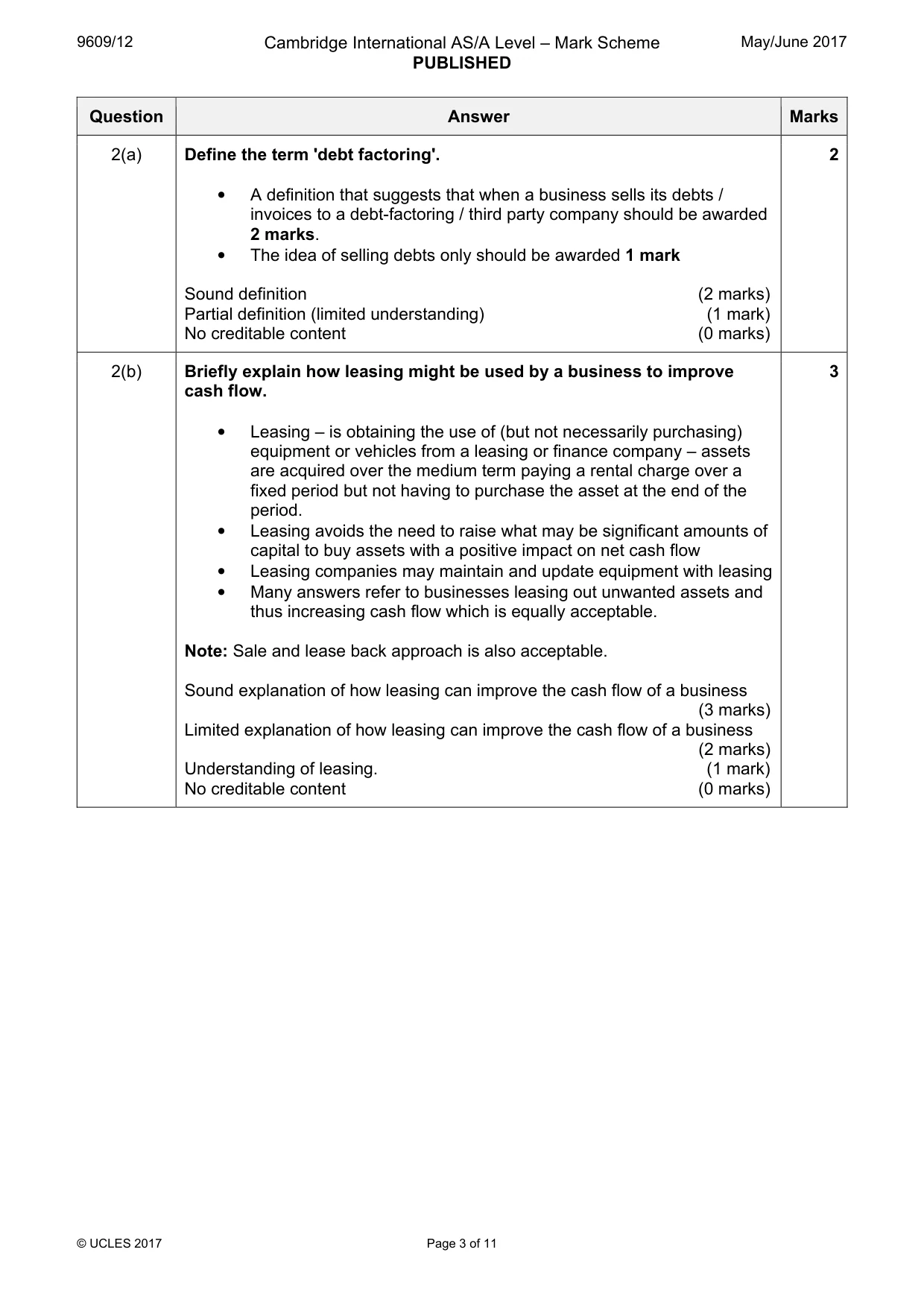
9609/12 Cambridge International AS/A Level – Mark Scheme PUBLISHED May/June 2017 © UCLES 2017 Page 3 of 11 Question Answer Marks 2(a) Define the term 'debt factoring'. • A definition that suggests that when a business sells its debts / invoices to a debt-factoring / third party company should be awarded 2 marks. • The idea of selling debts only should be awarded 1 mark Sound definition (2 marks) Partial definition (limited understanding) (1 mark) No creditable content (0 marks) 2 2(b) Briefly explain how leasing might be used by a business to improve cash flow. • Leasing – is obtaining the use of (but not necessarily purchasing) equipment or vehicles from a leasing or finance company – assets are acquired over the medium term paying a rental charge over a fixed period but not having to purchase the asset at the end of the period. • Leasing avoids the need to raise what may be significant amounts of capital to buy assets with a positive impact on net cash flow • Leasing companies may maintain and update equipment with leasing • Many answers refer to businesses leasing out unwanted assets and thus increasing cash flow which is equally acceptable. Note: Sale and lease back approach is also acceptable. Sound explanation of how leasing can improve the cash flow of a business (3 marks) Limited explanation of how leasing can improve the cash flow of a business (2 marks) Understanding of leasing. (1 mark) No creditable content (0 marks) 3
Mark scheme, page 4
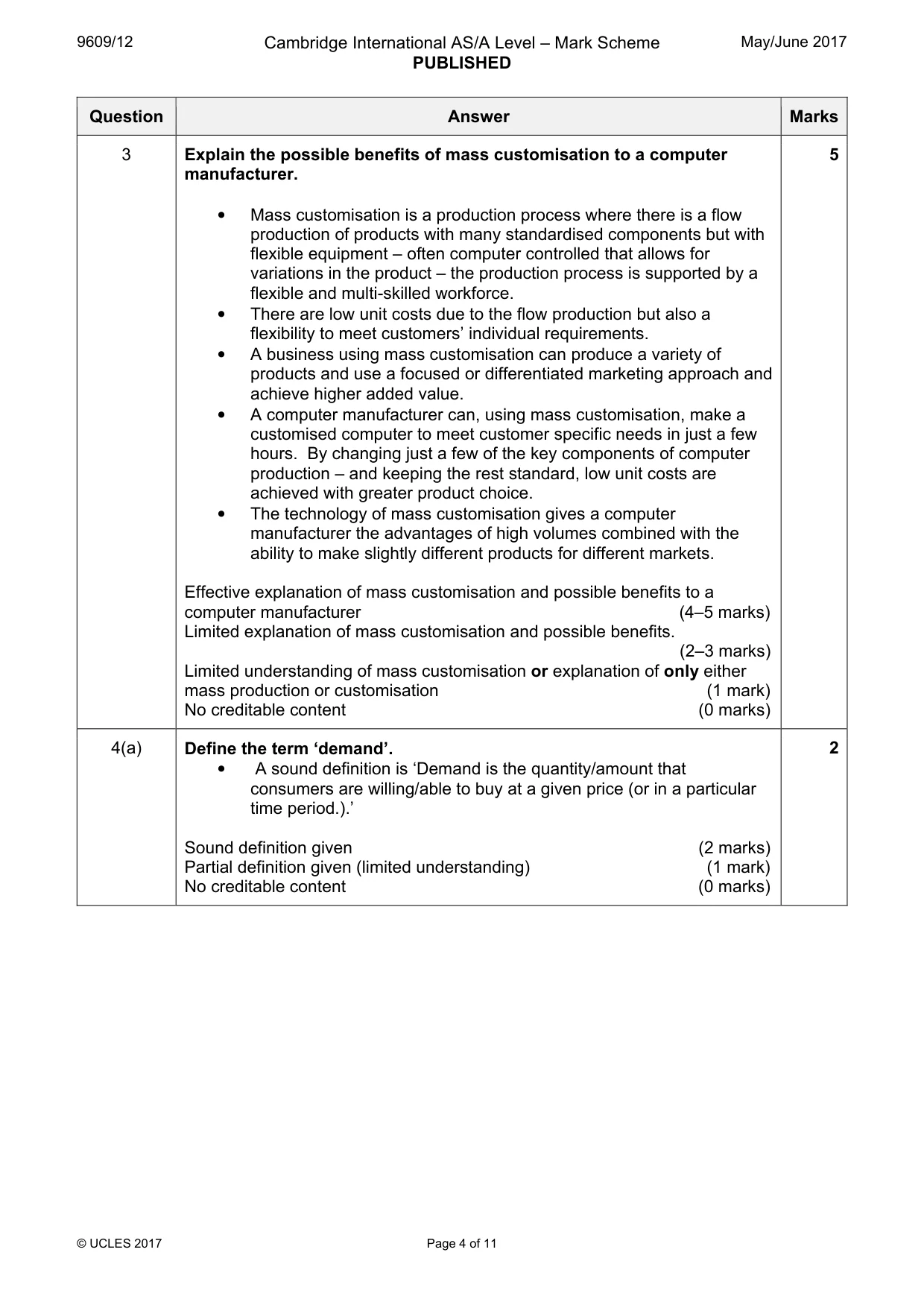
9609/12 Cambridge International AS/A Level – Mark Scheme PUBLISHED May/June 2017 © UCLES 2017 Page 4 of 11 Question Answer Marks 3 Explain the possible benefits of mass customisation to a computer manufacturer. • Mass customisation is a production process where there is a flow production of products with many standardised components but with flexible equipment – often computer controlled that allows for variations in the product – the production process is supported by a flexible and multi-skilled workforce. • There are low unit costs due to the flow production but also a flexibility to meet customers’ individual requirements. • A business using mass customisation can produce a variety of products and use a focused or differentiated marketing approach and achieve higher added value. • A computer manufacturer can, using mass customisation, make a customised computer to meet customer specific needs in just a few hours. By changing just a few of the key components of computer production – and keeping the rest standard, low unit costs are achieved with greater product choice. • The technology of mass customisation gives a computer manufacturer the advantages of high volumes combined with the ability to make slightly different products for different markets. Effective explanation of mass customisation and possible benefits to a computer manufacturer (4–5 marks) Limited explanation of mass customisation and possible benefits. (2–3 marks) Limited understanding of mass customisation or explanation of only either mass production or customisation (1 mark) No creditable content (0 marks) 5 4(a) Define the term ‘demand’. • A sound definition is ‘Demand is the quantity/amount that consumers are willing/able to buy at a given price (or in a particular time period.).’ Sound definition given (2 marks) Partial definition given (limited understanding) (1 mark) No creditable content (0 marks) 2
Mark scheme, page 5
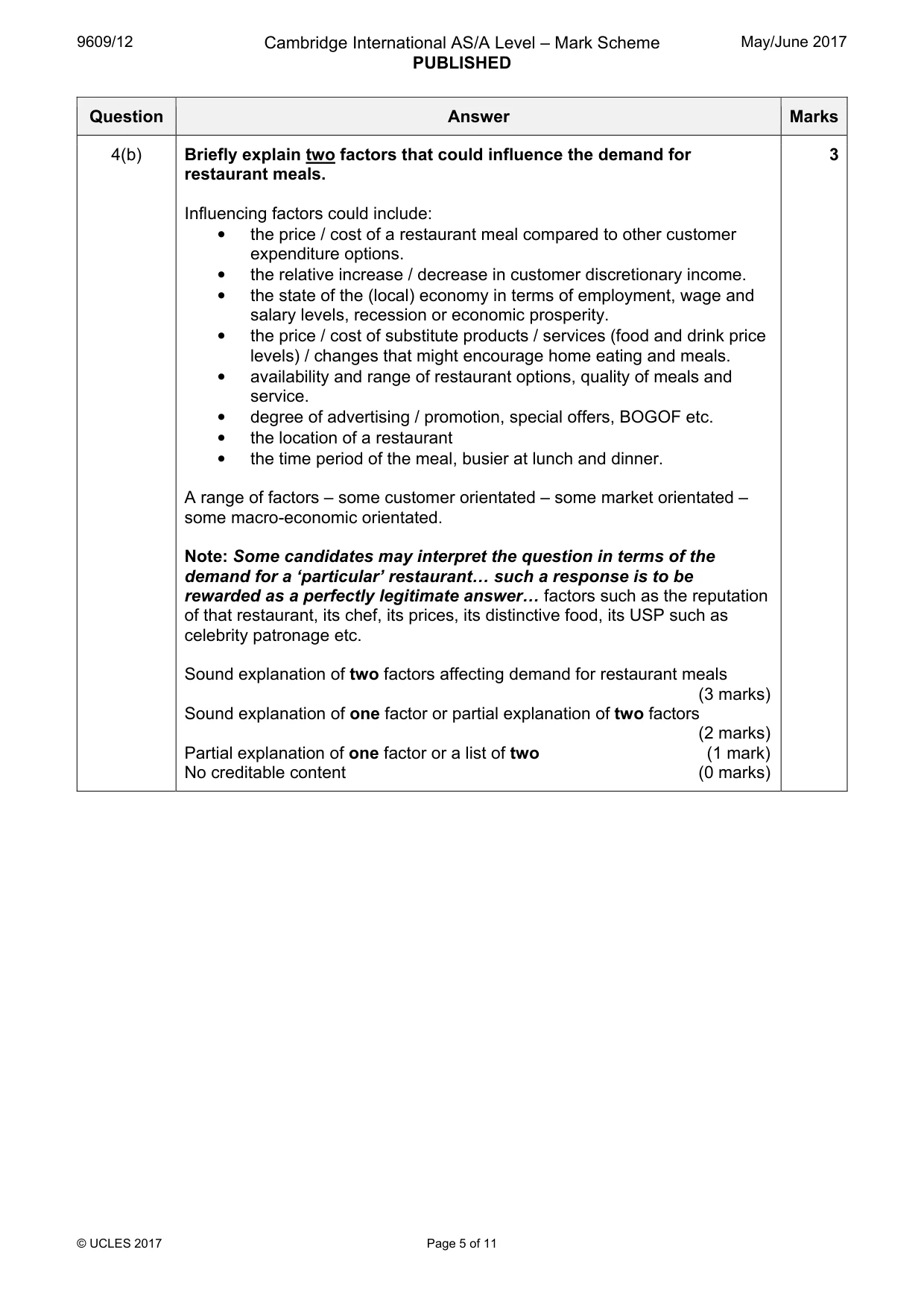
9609/12 Cambridge International AS/A Level – Mark Scheme PUBLISHED May/June 2017 © UCLES 2017 Page 5 of 11 Question Answer Marks 4(b) Briefly explain two factors that could influence the demand for restaurant meals. Influencing factors could include: • the price / cost of a restaurant meal compared to other customer expenditure options. • the relative increase / decrease in customer discretionary income. • the state of the (local) economy in terms of employment, wage and salary levels, recession or economic prosperity. • the price / cost of substitute products / services (food and drink price levels) / changes that might encourage home eating and meals. • availability and range of restaurant options, quality of meals and service. • degree of advertising / promotion, special offers, BOGOF etc. • the location of a restaurant • the time period of the meal, busier at lunch and dinner. A range of factors – some customer orientated – some market orientated – some macro-economic orientated. Note: Some candidates may interpret the question in terms of the demand for a ‘particular’ restaurant« such a response is to be rewarded as a perfectly legitimate answer« factors such as the reputation of that restaurant, its chef, its prices, its distinctive food, its USP such as celebrity patronage etc. Sound explanation of two factors affecting demand for restaurant meals (3 marks) Sound explanation of one factor or partial explanation of two factors (2 marks) Partial explanation of one factor or a list of two (1 mark) No creditable content (0 marks) 3
Mark scheme, page 6
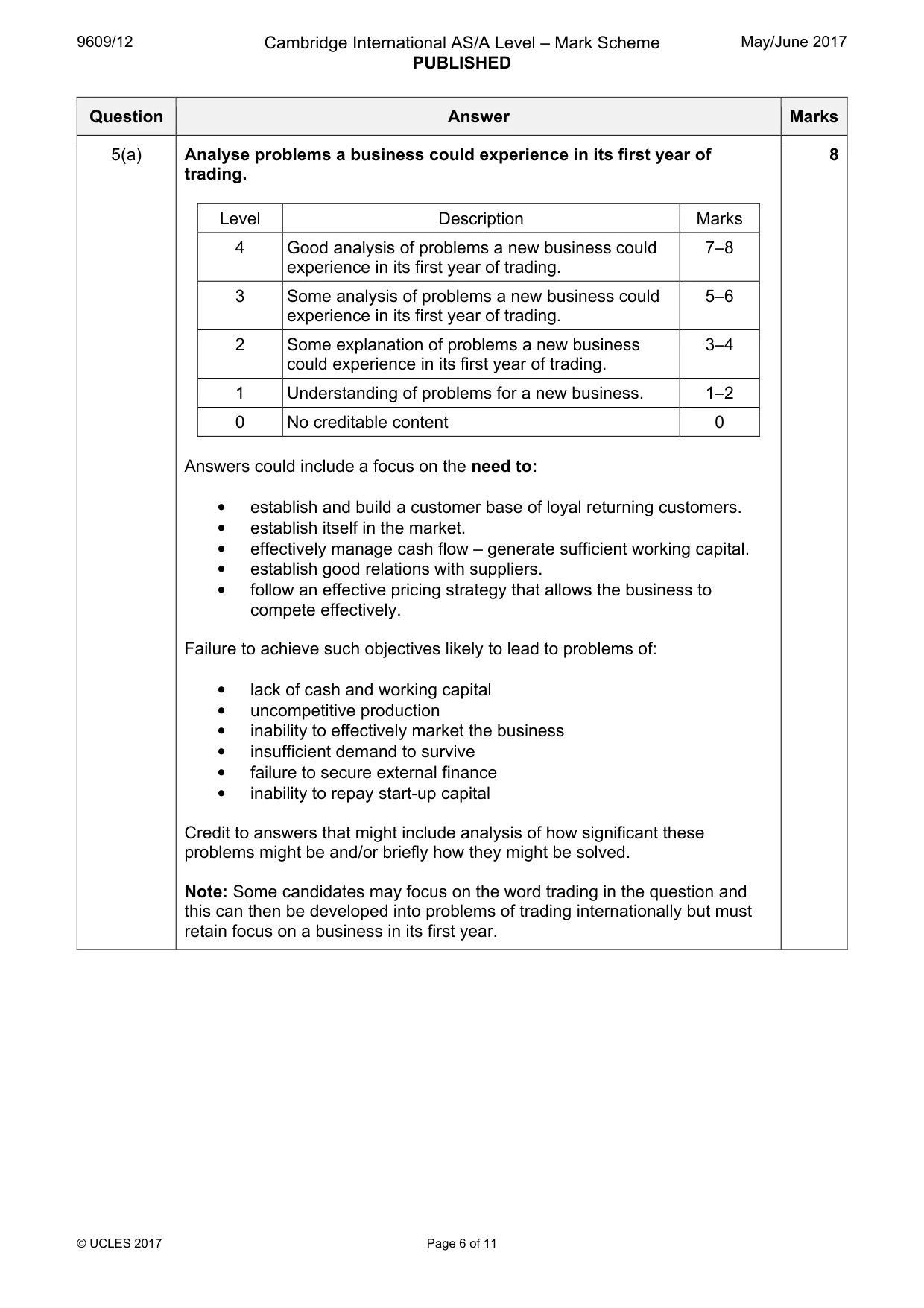
9609/12 Cambridge International AS/A Level – Mark Scheme PUBLISHED May/June 2017 © UCLES 2017 Page 6 of 11 Question Answer Marks 5(a) Analyse problems a business could experience in its first year of trading. Level Description Marks 4 Good analysis of problems a new business could experience in its first year of trading. 7–8 3 Some analysis of problems a new business could experience in its first year of trading. 5–6 2 Some explanation of problems a new business could experience in its first year of trading. 3–4 1 Understanding of problems for a new business. 1–2 0 No creditable content 0 Answers could include a focus on the need to: • establish and build a customer base of loyal returning customers. • establish itself in the market. • effectively manage cash flow – generate sufficient working capital. • establish good relations with suppliers. • follow an effective pricing strategy that allows the business to compete effectively. Failure to achieve such objectives likely to lead to problems of: • lack of cash and working capital • uncompetitive production • inability to effectively market the business • insufficient demand to survive • failure to secure external finance • inability to repay start-up capital Credit to answers that might include analysis of how significant these problems might be and/or briefly how they might be solved. Note: Some candidates may focus on the word trading in the question and this can then be developed into problems of trading internationally but must retain focus on a business in its first year. 8
Mark scheme, page 7
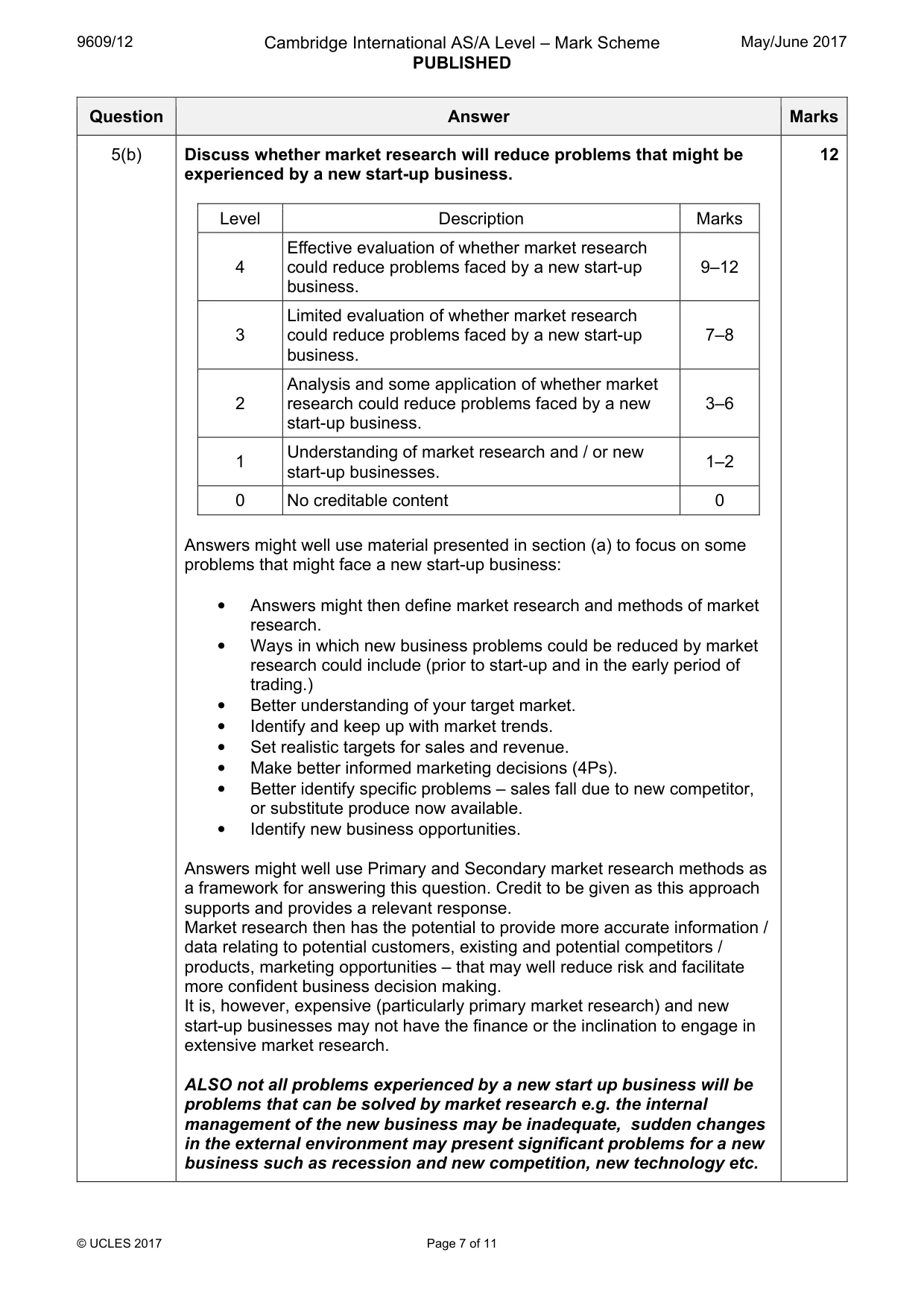
9609/12 Cambridge International AS/A Level – Mark Scheme PUBLISHED May/June 2017 © UCLES 2017 Page 7 of 11 Question Answer Marks 5(b) Discuss whether market research will reduce problems that might be experienced by a new start-up business. Level Description Marks 4 Effective evaluation of whether market research could reduce problems faced by a new start-up business. 9–12 3 Limited evaluation of whether market research could reduce problems faced by a new start-up business. 7–8 2 Analysis and some application of whether market research could reduce problems faced by a new start-up business. 3–6 1 Understanding of market research and / or new start-up businesses. 1–2 0 No creditable content 0 Answers might well use material presented in section (a) to focus on some problems that might face a new start-up business: • Answers might then define market research and methods of market research. • Ways in which new business problems could be reduced by market research could include (prior to start-up and in the early period of trading.) • Better understanding of your target market. • Identify and keep up with market trends. • Set realistic targets for sales and revenue. • Make better informed marketing decisions (4Ps). • Better identify specific problems – sales fall due to new competitor, or substitute produce now available. • Identify new business opportunities. Answers might well use Primary and Secondary market research methods as a framework for answering this question. Credit to be given as this approach supports and provides a relevant response. Market research then has the potential to provide more accurate information / data relating to potential customers, existing and potential competitors / products, marketing opportunities – that may well reduce risk and facilitate more confident business decision making. It is, however, expensive (particularly primary market research) and new start-up businesses may not have the finance or the inclination to engage in extensive market research. ALSO not all problems experienced by a new start up business will be problems that can be solved by market research e.g. the internal management of the new business may be inadequate, sudden changes in the external environment may present significant problems for a new business such as recession and new competition, new technology etc. 12
Mark scheme, page 8
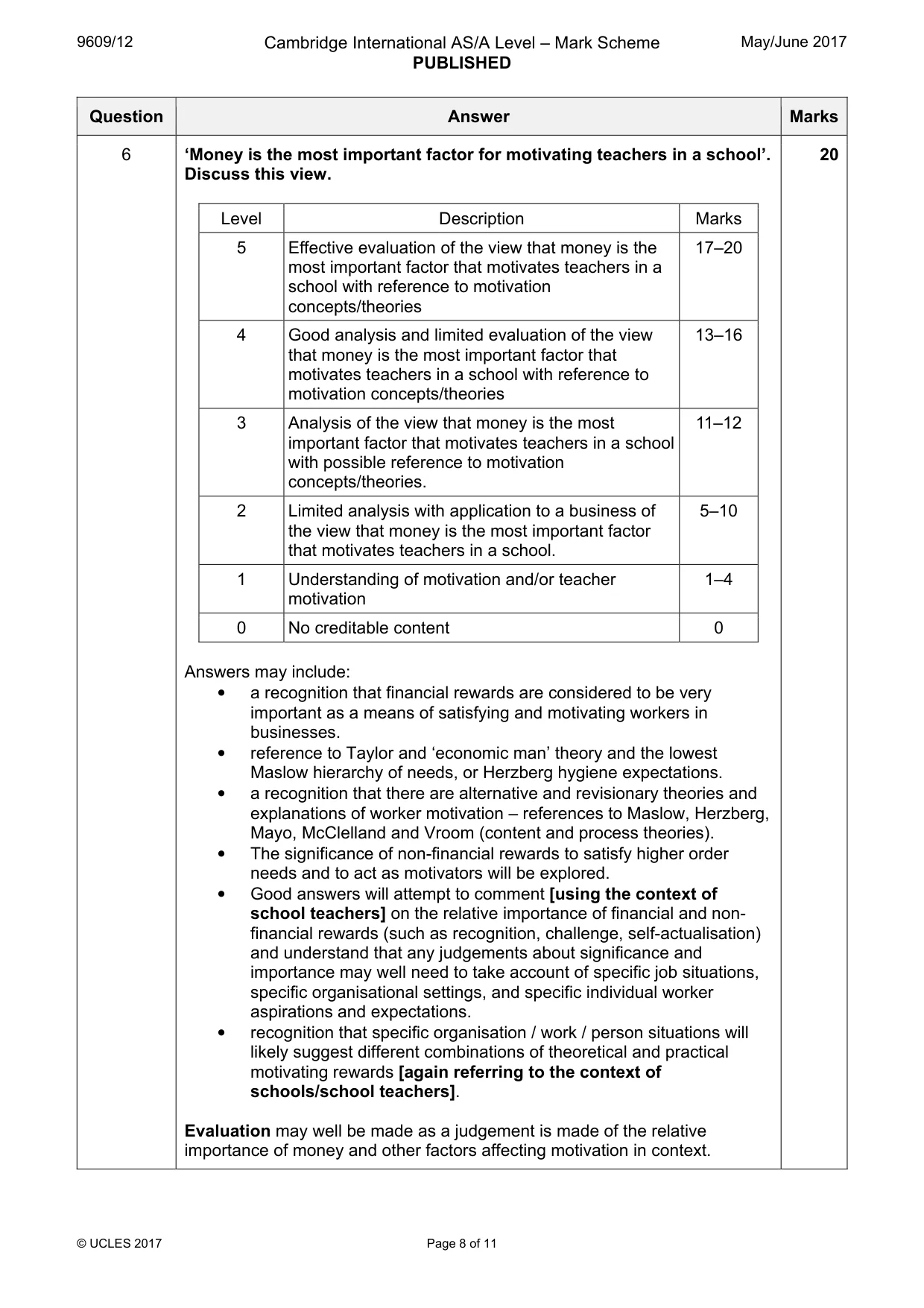
9609/12 Cambridge International AS/A Level – Mark Scheme PUBLISHED May/June 2017 © UCLES 2017 Page 8 of 11 Question Answer Marks 6 ‘Money is the most important factor for motivating teachers in a school’. Discuss this view. Level Description Marks 5 Effective evaluation of the view that money is the most important factor that motivates teachers in a school with reference to motivation concepts/theories 17–20 4 Good analysis and limited evaluation of the view that money is the most important factor that motivates teachers in a school with reference to motivation concepts/theories 13–16 3 Analysis of the view that money is the most important factor that motivates teachers in a school with possible reference to motivation concepts/theories. 11–12 2 Limited analysis with application to a business of the view that money is the most important factor that motivates teachers in a school. 5–10 1 Understanding of motivation and/or teacher motivation 1–4 0 No creditable content 0 Answers may include: • a recognition that financial rewards are considered to be very important as a means of satisfying and motivating workers in businesses. • reference to Taylor and ‘economic man’ theory and the lowest Maslow hierarchy of needs, or Herzberg hygiene expectations. • a recognition that there are alternative and revisionary theories and explanations of worker motivation – references to Maslow, Herzberg, Mayo, McClelland and Vroom (content and process theories). • The significance of non-financial rewards to satisfy higher order needs and to act as motivators will be explored. • Good answers will attempt to comment [using the context of school teachers] on the relative importance of financial and non- financial rewards (such as recognition, challenge, self-actualisation) and understand that any judgements about significance and importance may well need to take account of specific job situations, specific organisational settings, and specific individual worker aspirations and expectations. • recognition that specific organisation / work / person situations will likely suggest different combinations of theoretical and practical motivating rewards [again referring to the context of schools/school teachers]. Evaluation may well be made as a judgement is made of the relative importance of money and other factors affecting motivation in context. 20
Mark scheme, page 9
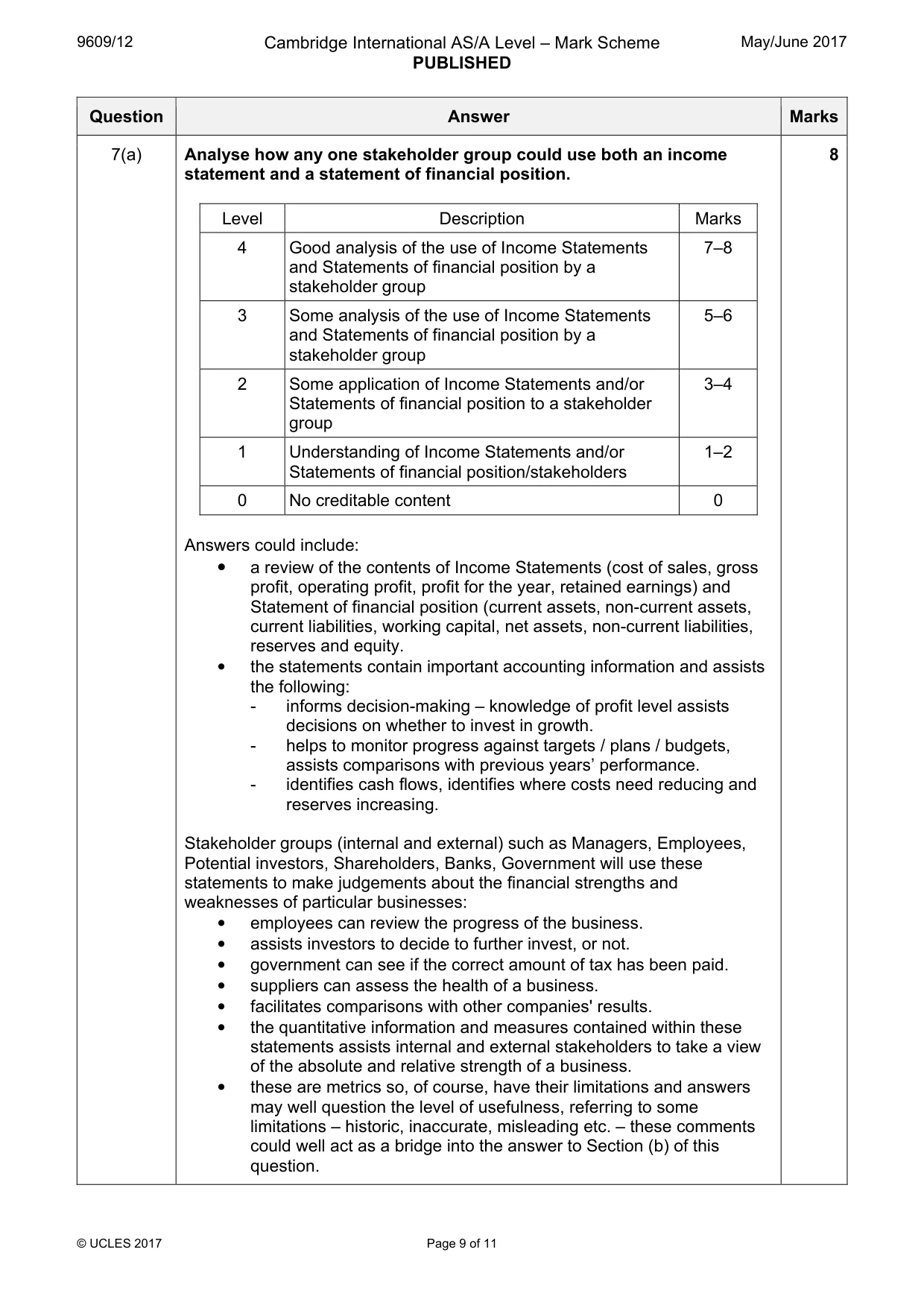
9609/12 Cambridge International AS/A Level – Mark Scheme PUBLISHED May/June 2017 © UCLES 2017 Page 9 of 11 Question Answer Marks 7(a) Analyse how any one stakeholder group could use both an income statement and a statement of financial position. Level Description Marks 4 Good analysis of the use of Income Statements and Statements of financial position by a stakeholder group 7–8 3 Some analysis of the use of Income Statements and Statements of financial position by a stakeholder group 5–6 2 Some application of Income Statements and/or Statements of financial position to a stakeholder group 3–4 1 Understanding of Income Statements and/or Statements of financial position/stakeholders 1–2 0 No creditable content 0 Answers could include: • a review of the contents of Income Statements (cost of sales, gross profit, operating profit, profit for the year, retained earnings) and Statement of financial position (current assets, non-current assets, current liabilities, working capital, net assets, non-current liabilities, reserves and equity. • the statements contain important accounting information and assists the following: - informs decision-making – knowledge of profit level assists decisions on whether to invest in growth. - helps to monitor progress against targets / plans / budgets, assists comparisons with previous years’ performance. - identifies cash flows, identifies where costs need reducing and reserves increasing. Stakeholder groups (internal and external) such as Managers, Employees, Potential investors, Shareholders, Banks, Government will use these statements to make judgements about the financial strengths and weaknesses of particular businesses: • employees can review the progress of the business. • assists investors to decide to further invest, or not. • government can see if the correct amount of tax has been paid. • suppliers can assess the health of a business. • facilitates comparisons with other companies' results. • the quantitative information and measures contained within these statements assists internal and external stakeholders to take a view of the absolute and relative strength of a business. • these are metrics so, of course, have their limitations and answers may well question the level of usefulness, referring to some limitations – historic, inaccurate, misleading etc. – these comments could well act as a bridge into the answer to Section (b) of this question. 8
Mark scheme, page 10
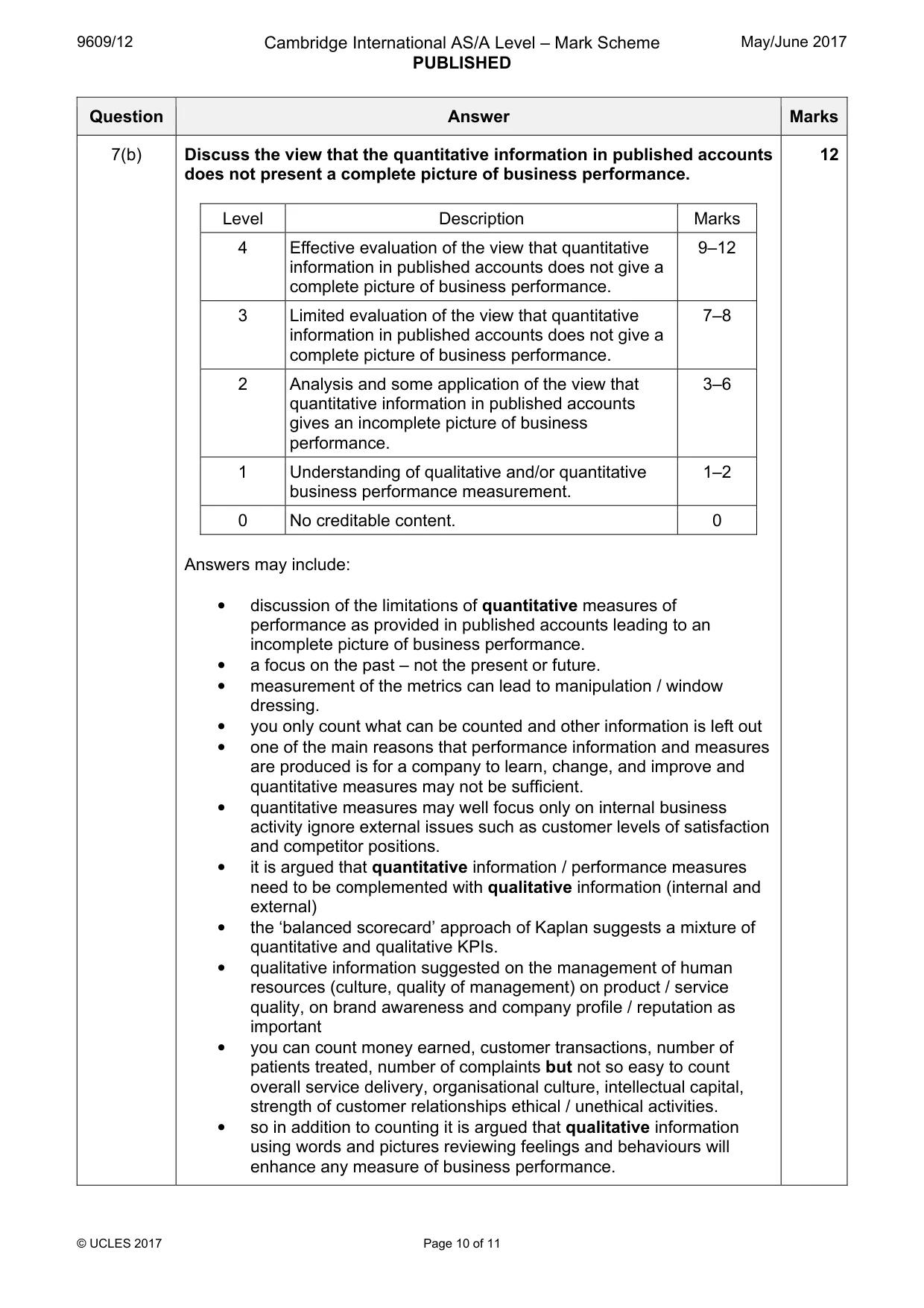
9609/12 Cambridge International AS/A Level – Mark Scheme PUBLISHED May/June 2017 © UCLES 2017 Page 10 of 11 Question Answer Marks 7(b) Discuss the view that the quantitative information in published accounts does not present a complete picture of business performance. Level Description Marks 4 Effective evaluation of the view that quantitative information in published accounts does not give a complete picture of business performance. 9–12 3 Limited evaluation of the view that quantitative information in published accounts does not give a complete picture of business performance. 7–8 2 Analysis and some application of the view that quantitative information in published accounts gives an incomplete picture of business performance. 3–6 1 Understanding of qualitative and/or quantitative business performance measurement. 1–2 0 No creditable content. 0 Answers may include: • discussion of the limitations of quantitative measures of performance as provided in published accounts leading to an incomplete picture of business performance. • a focus on the past – not the present or future. • measurement of the metrics can lead to manipulation / window dressing. • you only count what can be counted and other information is left out • one of the main reasons that performance information and measures are produced is for a company to learn, change, and improve and quantitative measures may not be sufficient. • quantitative measures may well focus only on internal business activity ignore external issues such as customer levels of satisfaction and competitor positions. • it is argued that quantitative information / performance measures need to be complemented with qualitative information (internal and external) • the ‘balanced scorecard’ approach of Kaplan suggests a mixture of quantitative and qualitative KPIs. • qualitative information suggested on the management of human resources (culture, quality of management) on product / service quality, on brand awareness and company profile / reputation as important • you can count money earned, customer transactions, number of patients treated, number of complaints but not so easy to count overall service delivery, organisational culture, intellectual capital, strength of customer relationships ethical / unethical activities. • so in addition to counting it is argued that qualitative information using words and pictures reviewing feelings and behaviours will enhance any measure of business performance. 12
Mark scheme, page 11
9609/12 Cambridge International AS/A Level – Mark Scheme PUBLISHED May/June 2017 © UCLES 2017 Page 11 of 11 Question Answer Marks • quantitative information and performance measures are important but over-reliance on these can skew any assessment of business performance and give only a partial view.