Cambridge A Level Business (for first examination in 2016) 9609 — 2017 May/June Paper 1 · Variant 1
9609/11/M/J/17
The question paper and its mark scheme, free to read here and free to download. This is Cambridge’s own paper, exactly as it was sat.
Question paper4 pages


Mark scheme10 pages
Answers below. Sit the paper first if you are practising.
Paper as text
Question paper, page 1
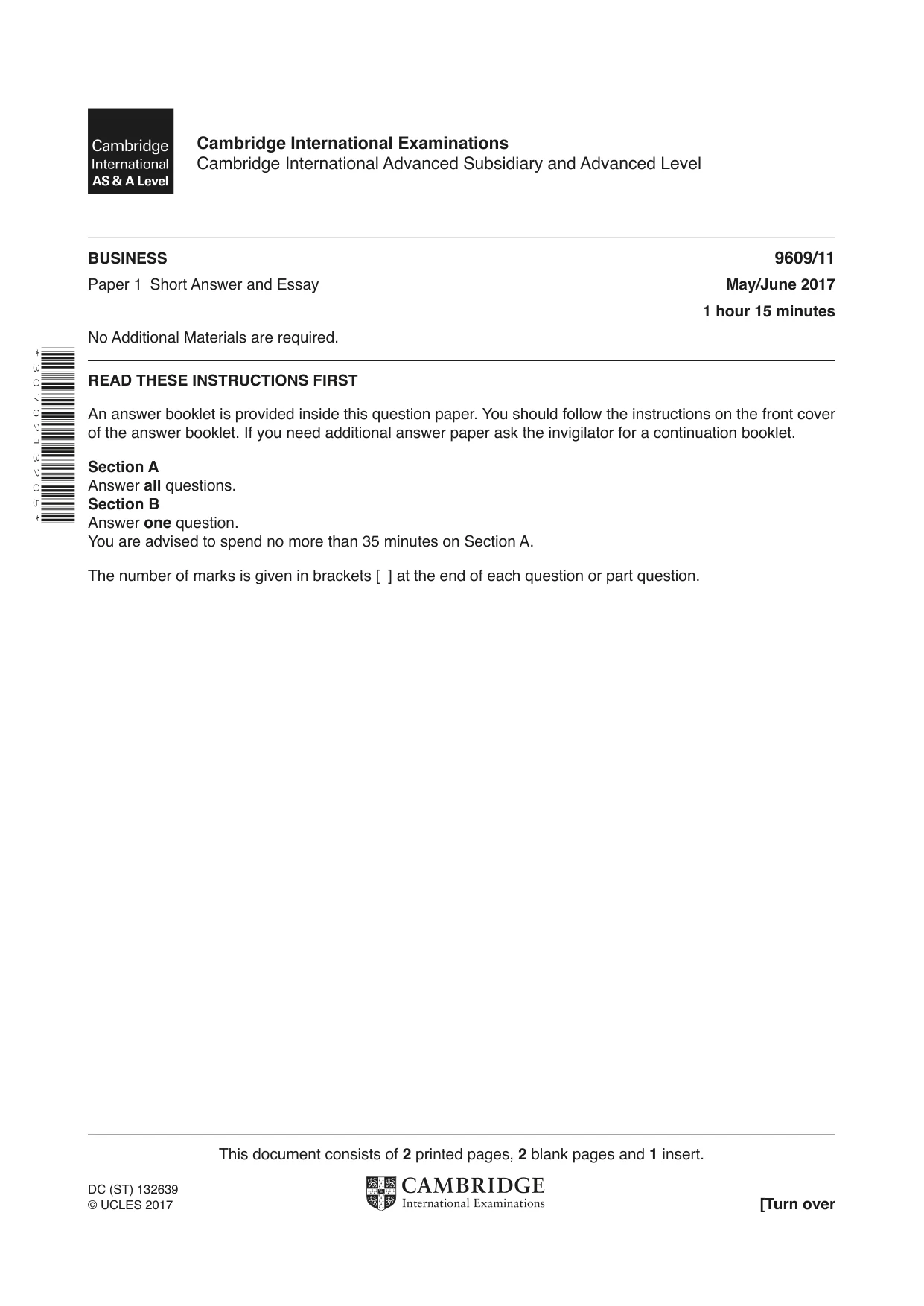
This document consists of 2 printed pages, 2 blank pages and 1 insert. DC (ST) 132639 © UCLES 2017 [Turn over Cambridge International Examinations Cambridge International Advanced Subsidiary and Advanced Level * 3 0 7 0 2 1 3 2 0 5 * BUSINESS 9609/11 Paper 1 Short Answer and Essay May/June 2017 1 hour 15 minutes No Additional Materials are required. READ THESE INSTRUCTIONS FIRST An answer booklet is provided inside this question paper. You should follow the instructions on the front cover of the answer booklet. If you need additional answer paper ask the invigilator for a continuation booklet. Section A Answer all questions. Section B Answer one question. You are advised to spend no more than 35 minutes on Section A. The number of marks is given in brackets [ ] at the end of each question or part question.
Question paper, page 2
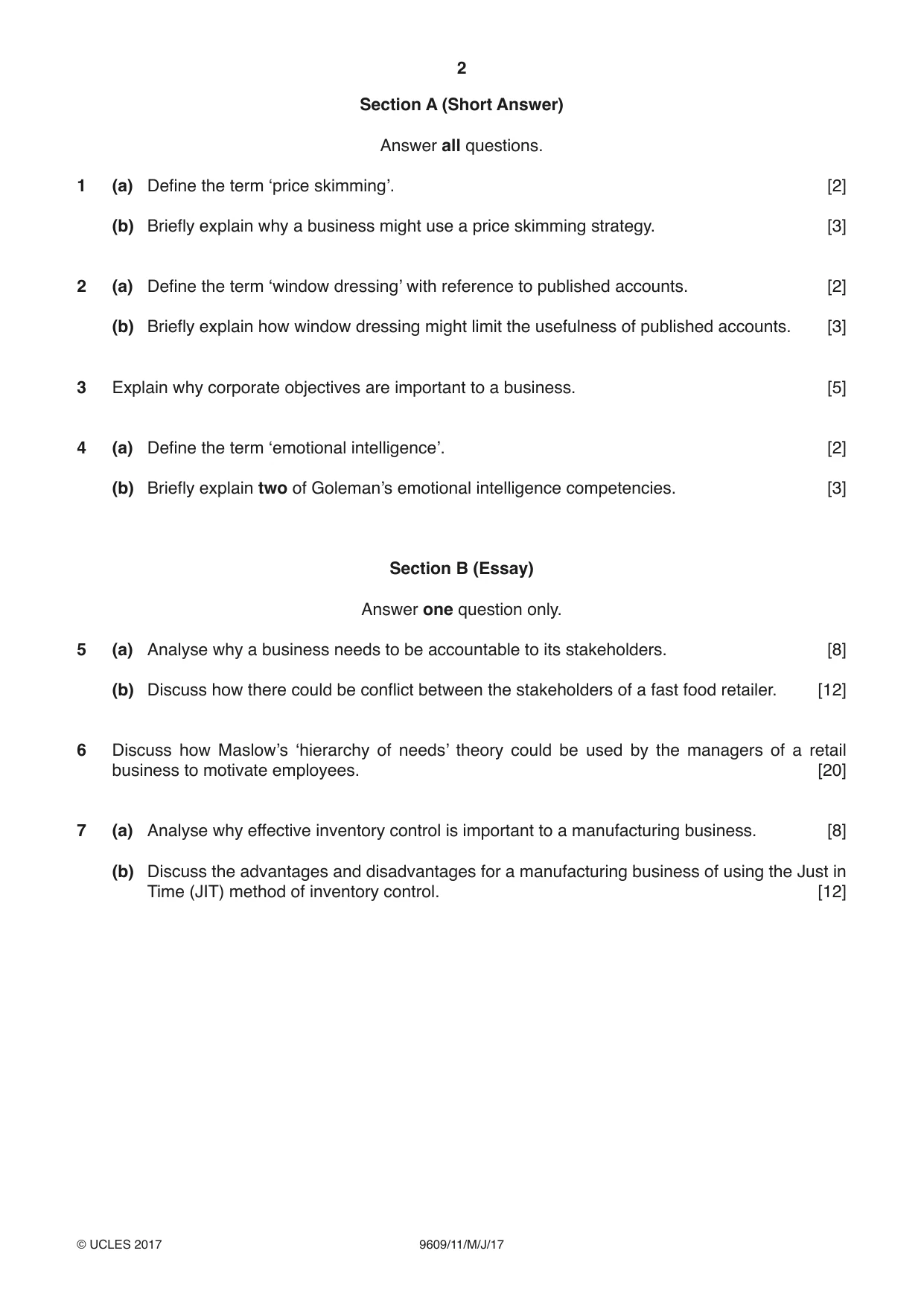
2 9609/11/M/J/17 © UCLES 2017 Section A (Short Answer) Answer all questions. 1 (a) Define the term ‘price skimming’. [2] (b) Briefly explain why a business might use a price skimming strategy. [3] 2 (a) Define the term ‘window dressing’ with reference to published accounts. [2] (b) Briefly explain how window dressing might limit the usefulness of published accounts. [3] 3 Explain why corporate objectives are important to a business. [5] 4 (a) Define the term ‘emotional intelligence’. [2] (b) Briefly explain two of Goleman’s emotional intelligence competencies. [3] Section B (Essay) Answer one question only. 5 (a) Analyse why a business needs to be accountable to its stakeholders. [8] (b) Discuss how there could be conflict between the stakeholders of a fast food retailer. [12] 6 Discuss how Maslow’s ‘hierarchy of needs’ theory could be used by the managers of a retail business to motivate employees. [20] 7 (a) Analyse why effective inventory control is important to a manufacturing business. [8] (b) Discuss the advantages and disadvantages for a manufacturing business of using the Just in Time (JIT) method of inventory control. [12]
Question paper, page 3
3 9609/11/M/J/17 © UCLES 2017 BLANK PAGE
Question paper, page 4
4 9609/11/M/J/17 © UCLES 2017 Permission to reproduce items where third-party owned material protected by copyright is included has been sought and cleared where possible. Every reasonable effort has been made by the publisher (UCLES) to trace copyright holders, but if any items requiring clearance have unwittingly been included, the publisher will be pleased to make amends at the earliest possible opportunity. To avoid the issue of disclosure of answer-related information to candidates, all copyright acknowledgements are reproduced online in the Cambridge International Examinations Copyright Acknowledgements Booklet. This is produced for each series of examinations and is freely available to download at www.cie.org.uk after the live examination series. Cambridge International Examinations is part of the Cambridge Assessment Group. Cambridge Assessment is the brand name of University of Cambridge Local Examinations Syndicate (UCLES), which is itself a department of the University of Cambridge. BLANK PAGE
Mark scheme, page 1
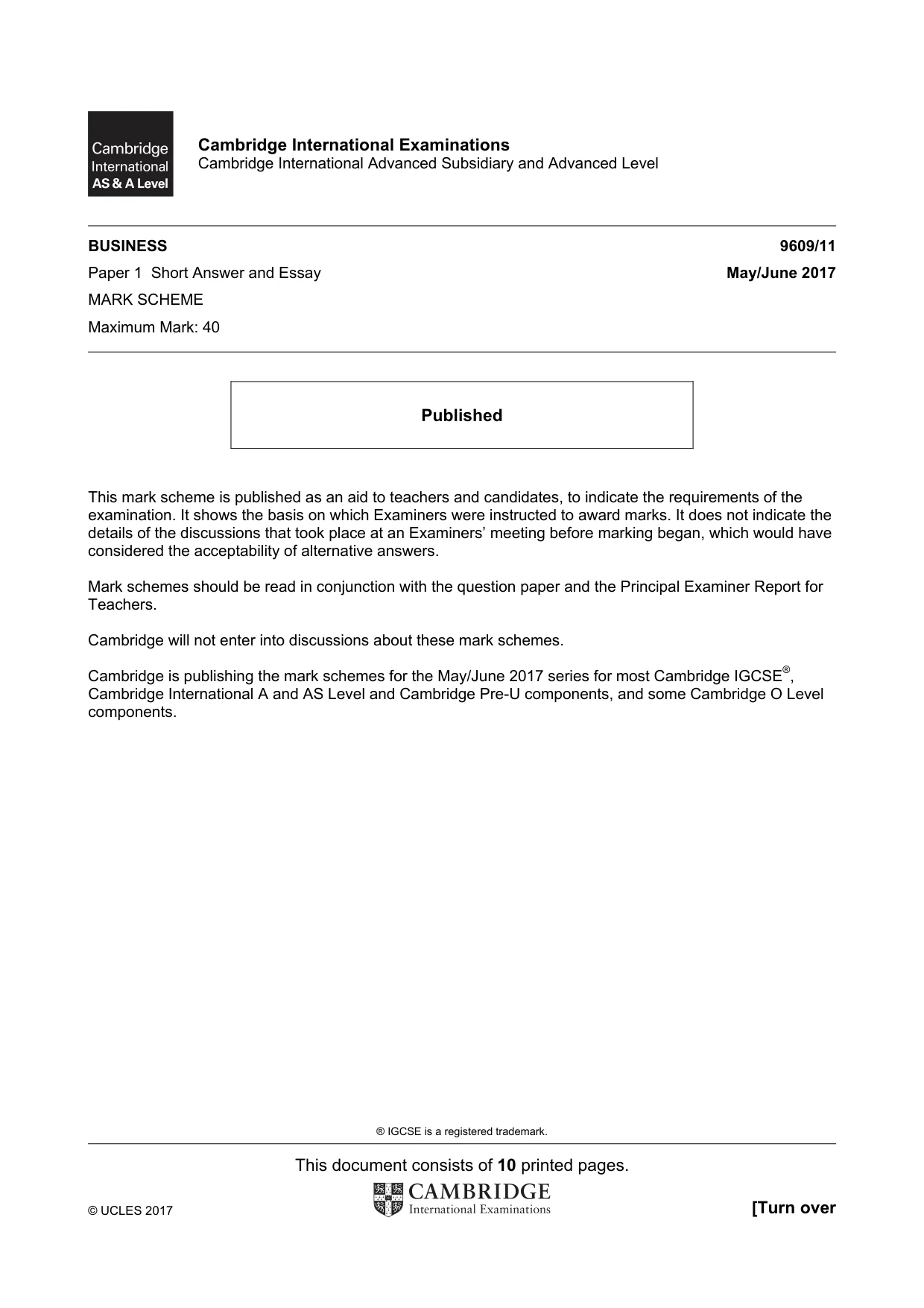
® IGCSE is a registered trademark. This document consists of 10 printed pages. © UCLES 2017 [Turn over Cambridge International Examinations Cambridge International Advanced Subsidiary and Advanced Level BUSINESS 9609/11 Paper 1 Short Answer and Essay May/June 2017 MARK SCHEME Maximum Mark: 40 Published This mark scheme is published as an aid to teachers and candidates, to indicate the requirements of the examination. It shows the basis on which Examiners were instructed to award marks. It does not indicate the details of the discussions that took place at an Examiners’ meeting before marking began, which would have considered the acceptability of alternative answers. Mark schemes should be read in conjunction with the question paper and the Principal Examiner Report for Teachers. Cambridge will not enter into discussions about these mark schemes. Cambridge is publishing the mark schemes for the May/June 2017 series for most Cambridge IGCSE®, Cambridge International A and AS Level and Cambridge Pre-U components, and some Cambridge O Level components.
Mark scheme, page 2
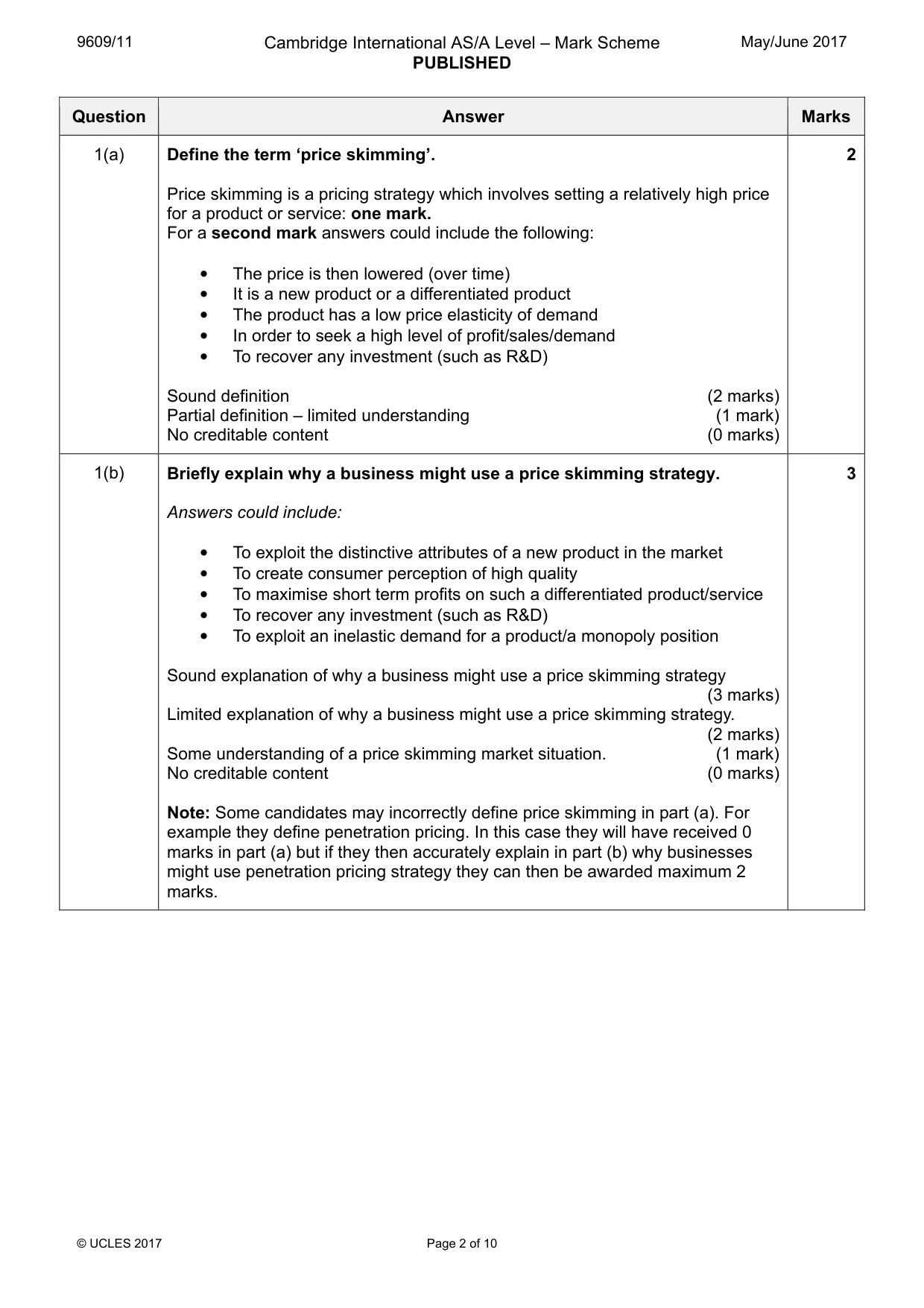
9609/11 Cambridge International AS/A Level – Mark Scheme PUBLISHED May/June 2017 © UCLES 2017 Page 2 of 10 Question Answer Marks 1(a) Define the term ‘price skimming’. Price skimming is a pricing strategy which involves setting a relatively high price for a product or service: one mark. For a second mark answers could include the following: • The price is then lowered (over time) • It is a new product or a differentiated product • The product has a low price elasticity of demand • In order to seek a high level of profit/sales/demand • To recover any investment (such as R&D) Sound definition (2 marks) Partial definition – limited understanding (1 mark) No creditable content (0 marks) 2 1(b) Briefly explain why a business might use a price skimming strategy. Answers could include: • To exploit the distinctive attributes of a new product in the market • To create consumer perception of high quality • To maximise short term profits on such a differentiated product/service • To recover any investment (such as R&D) • To exploit an inelastic demand for a product/a monopoly position Sound explanation of why a business might use a price skimming strategy (3 marks) Limited explanation of why a business might use a price skimming strategy. (2 marks) Some understanding of a price skimming market situation. (1 mark) No creditable content (0 marks) Note: Some candidates may incorrectly define price skimming in part (a). For example they define penetration pricing. In this case they will have received 0 marks in part (a) but if they then accurately explain in part (b) why businesses might use penetration pricing strategy they can then be awarded maximum 2 marks. 3
Mark scheme, page 3
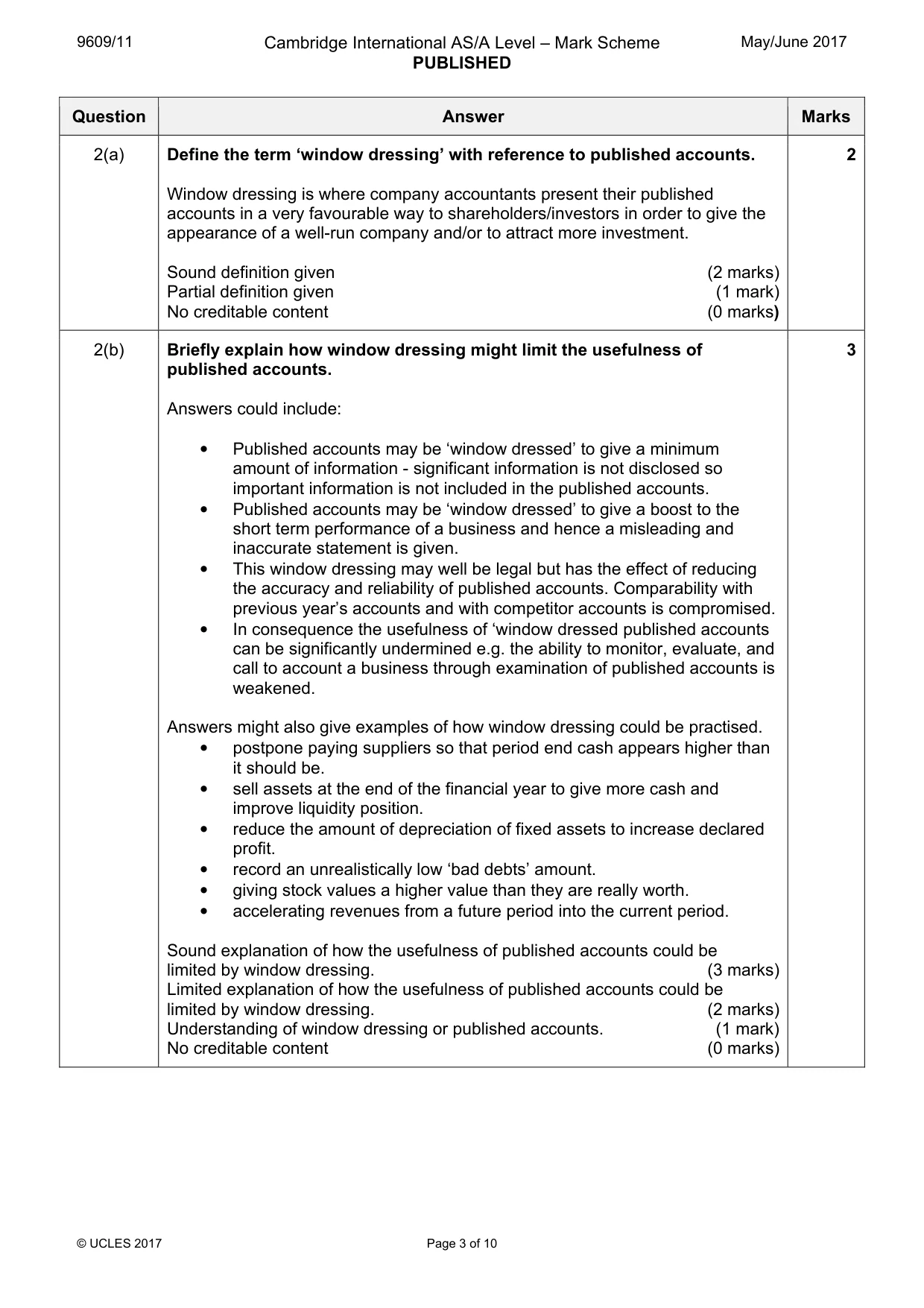
9609/11 Cambridge International AS/A Level – Mark Scheme PUBLISHED May/June 2017 © UCLES 2017 Page 3 of 10 Question Answer Marks 2(a) Define the term ‘window dressing’ with reference to published accounts. Window dressing is where company accountants present their published accounts in a very favourable way to shareholders/investors in order to give the appearance of a well-run company and/or to attract more investment. Sound definition given (2 marks) Partial definition given (1 mark) No creditable content (0 marks) 2 2(b) Briefly explain how window dressing might limit the usefulness of published accounts. Answers could include: • Published accounts may be ‘window dressed’ to give a minimum amount of information - significant information is not disclosed so important information is not included in the published accounts. • Published accounts may be ‘window dressed’ to give a boost to the short term performance of a business and hence a misleading and inaccurate statement is given. • This window dressing may well be legal but has the effect of reducing the accuracy and reliability of published accounts. Comparability with previous year’s accounts and with competitor accounts is compromised. • In consequence the usefulness of ‘window dressed published accounts can be significantly undermined e.g. the ability to monitor, evaluate, and call to account a business through examination of published accounts is weakened. Answers might also give examples of how window dressing could be practised. • postpone paying suppliers so that period end cash appears higher than it should be. • sell assets at the end of the financial year to give more cash and improve liquidity position. • reduce the amount of depreciation of fixed assets to increase declared profit. • record an unrealistically low ‘bad debts’ amount. • giving stock values a higher value than they are really worth. • accelerating revenues from a future period into the current period. Sound explanation of how the usefulness of published accounts could be limited by window dressing. (3 marks) Limited explanation of how the usefulness of published accounts could be limited by window dressing. (2 marks) Understanding of window dressing or published accounts. (1 mark) No creditable content (0 marks) 3
Mark scheme, page 4
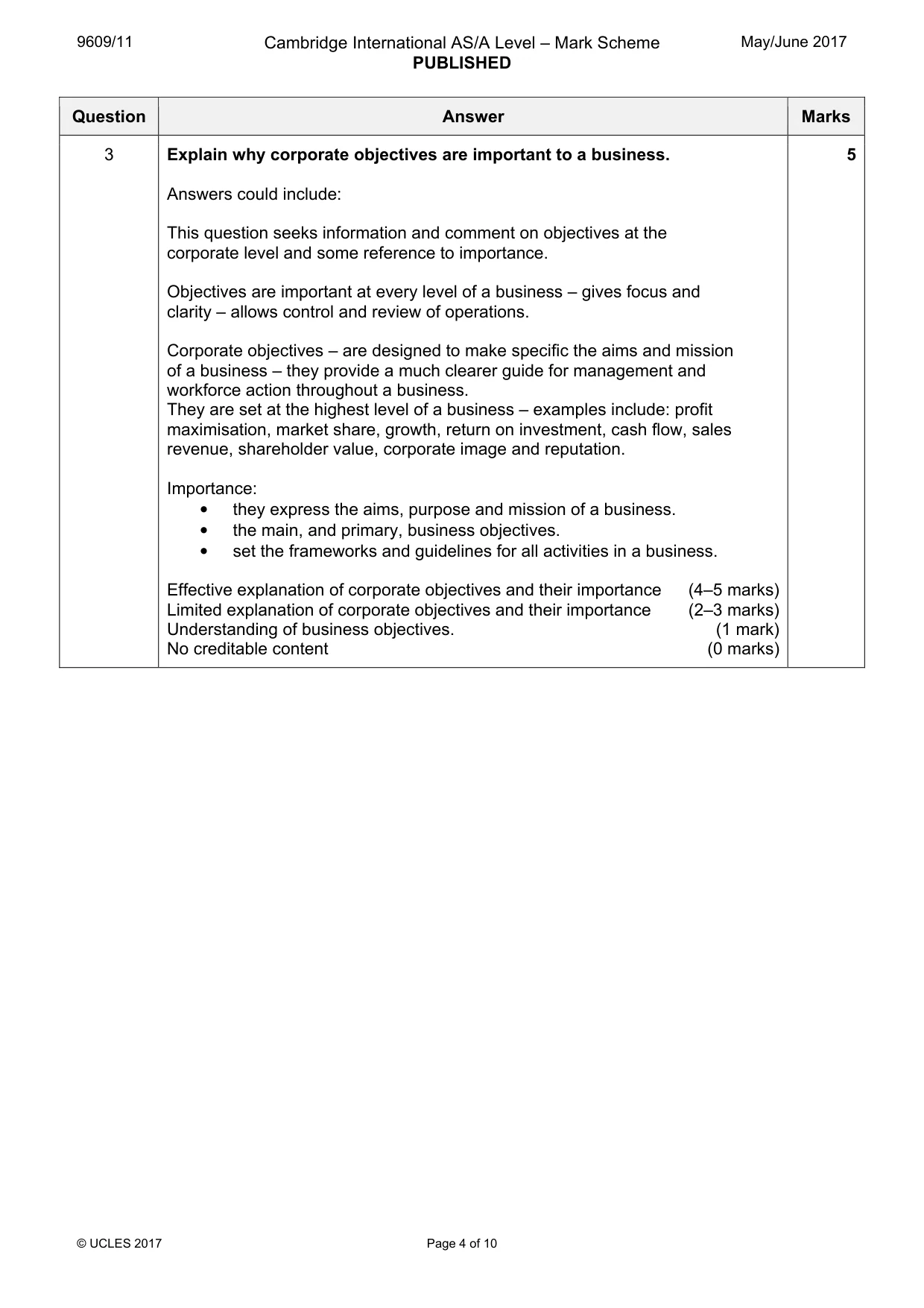
9609/11 Cambridge International AS/A Level – Mark Scheme PUBLISHED May/June 2017 © UCLES 2017 Page 4 of 10 Question Answer Marks 3 Explain why corporate objectives are important to a business. Answers could include: This question seeks information and comment on objectives at the corporate level and some reference to importance. Objectives are important at every level of a business – gives focus and clarity – allows control and review of operations. Corporate objectives – are designed to make specific the aims and mission of a business – they provide a much clearer guide for management and workforce action throughout a business. They are set at the highest level of a business – examples include: profit maximisation, market share, growth, return on investment, cash flow, sales revenue, shareholder value, corporate image and reputation. Importance: • they express the aims, purpose and mission of a business. • the main, and primary, business objectives. • set the frameworks and guidelines for all activities in a business. Effective explanation of corporate objectives and their importance (4–5 marks) Limited explanation of corporate objectives and their importance (2–3 marks) Understanding of business objectives. (1 mark) No creditable content (0 marks) 5
Mark scheme, page 5
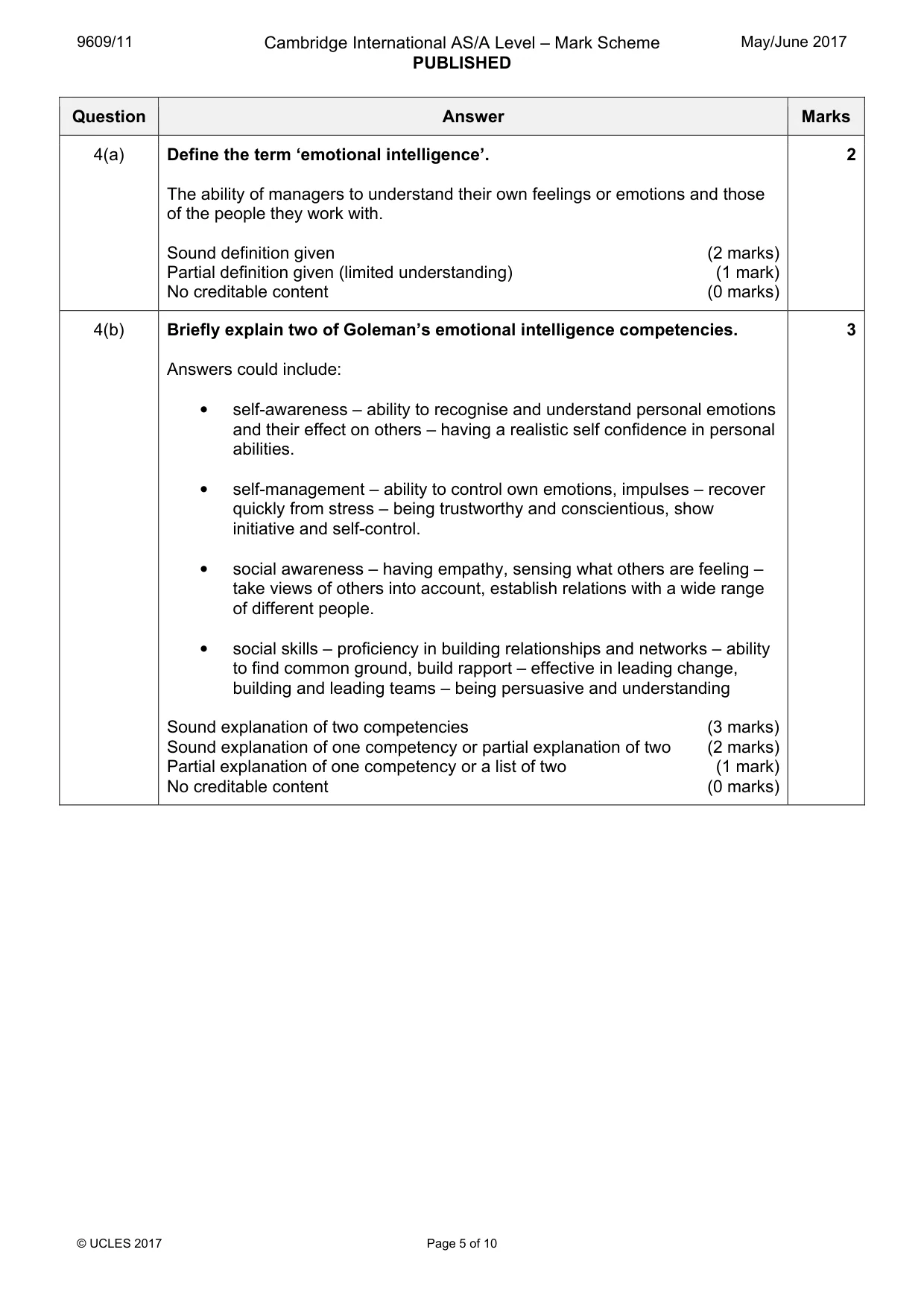
9609/11 Cambridge International AS/A Level – Mark Scheme PUBLISHED May/June 2017 © UCLES 2017 Page 5 of 10 Question Answer Marks 4(a) Define the term ‘emotional intelligence’. The ability of managers to understand their own feelings or emotions and those of the people they work with. Sound definition given (2 marks) Partial definition given (limited understanding) (1 mark) No creditable content (0 marks) 2 4(b) Briefly explain two of Goleman’s emotional intelligence competencies. Answers could include: • self-awareness – ability to recognise and understand personal emotions and their effect on others – having a realistic self confidence in personal abilities. • self-management – ability to control own emotions, impulses – recover quickly from stress – being trustworthy and conscientious, show initiative and self-control. • social awareness – having empathy, sensing what others are feeling – take views of others into account, establish relations with a wide range of different people. • social skills – proficiency in building relationships and networks – ability to find common ground, build rapport – effective in leading change, building and leading teams – being persuasive and understanding Sound explanation of two competencies (3 marks) Sound explanation of one competency or partial explanation of two (2 marks) Partial explanation of one competency or a list of two (1 mark) No creditable content (0 marks) 3
Mark scheme, page 6
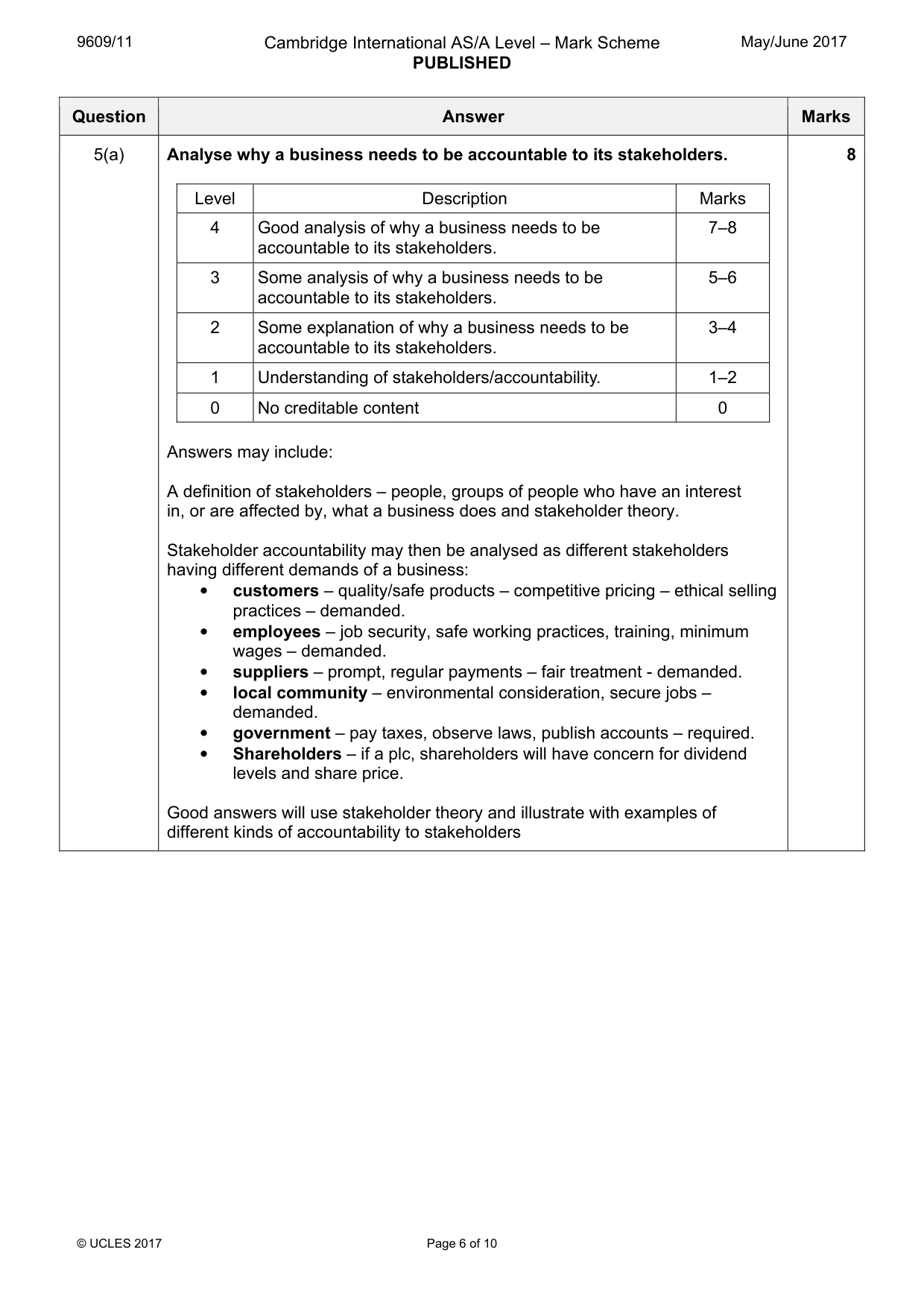
9609/11 Cambridge International AS/A Level – Mark Scheme PUBLISHED May/June 2017 © UCLES 2017 Page 6 of 10 Question Answer Marks 5(a) Analyse why a business needs to be accountable to its stakeholders. Level Description Marks 4 Good analysis of why a business needs to be accountable to its stakeholders. 7–8 3 Some analysis of why a business needs to be accountable to its stakeholders. 5–6 2 Some explanation of why a business needs to be accountable to its stakeholders. 3–4 1 Understanding of stakeholders/accountability. 1–2 0 No creditable content 0 Answers may include: A definition of stakeholders – people, groups of people who have an interest in, or are affected by, what a business does and stakeholder theory. Stakeholder accountability may then be analysed as different stakeholders having different demands of a business: • customers – quality/safe products – competitive pricing – ethical selling practices – demanded. • employees – job security, safe working practices, training, minimum wages – demanded. • suppliers – prompt, regular payments – fair treatment - demanded. • local community – environmental consideration, secure jobs – demanded. • government – pay taxes, observe laws, publish accounts – required. • Shareholders – if a plc, shareholders will have concern for dividend levels and share price. Good answers will use stakeholder theory and illustrate with examples of different kinds of accountability to stakeholders 8
Mark scheme, page 7
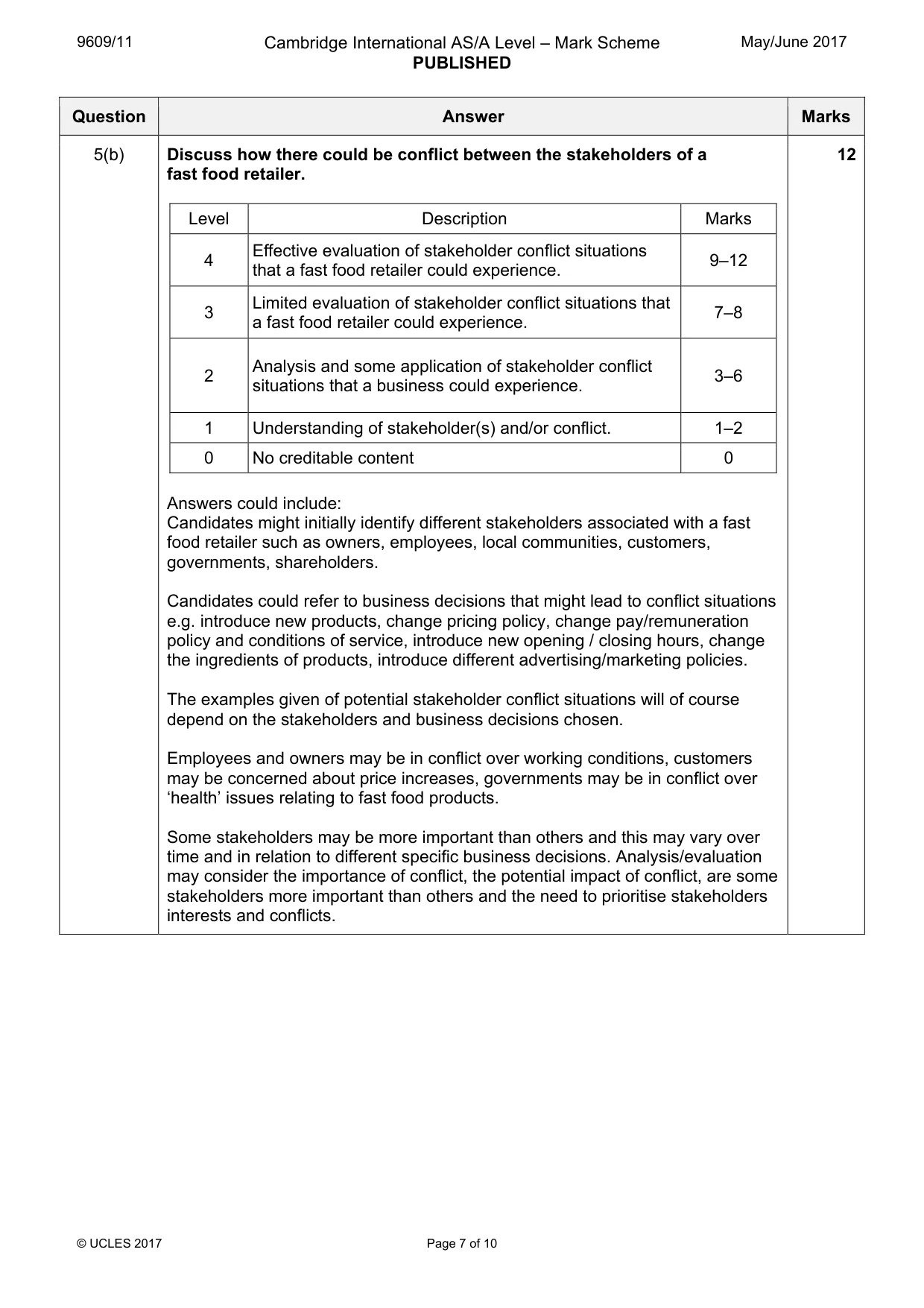
9609/11 Cambridge International AS/A Level – Mark Scheme PUBLISHED May/June 2017 © UCLES 2017 Page 7 of 10 Question Answer Marks 5(b) Discuss how there could be conflict between the stakeholders of a fast food retailer. Level Description Marks 4 Effective evaluation of stakeholder conflict situations that a fast food retailer could experience. 9–12 3 Limited evaluation of stakeholder conflict situations that a fast food retailer could experience. 7–8 2 Analysis and some application of stakeholder conflict situations that a business could experience. 3–6 1 Understanding of stakeholder(s) and/or conflict. 1–2 0 No creditable content 0 Answers could include: Candidates might initially identify different stakeholders associated with a fast food retailer such as owners, employees, local communities, customers, governments, shareholders. Candidates could refer to business decisions that might lead to conflict situations e.g. introduce new products, change pricing policy, change pay/remuneration policy and conditions of service, introduce new opening / closing hours, change the ingredients of products, introduce different advertising/marketing policies. The examples given of potential stakeholder conflict situations will of course depend on the stakeholders and business decisions chosen. Employees and owners may be in conflict over working conditions, customers may be concerned about price increases, governments may be in conflict over ‘health’ issues relating to fast food products. Some stakeholders may be more important than others and this may vary over time and in relation to different specific business decisions. Analysis/evaluation may consider the importance of conflict, the potential impact of conflict, are some stakeholders more important than others and the need to prioritise stakeholders interests and conflicts. 12
Mark scheme, page 8
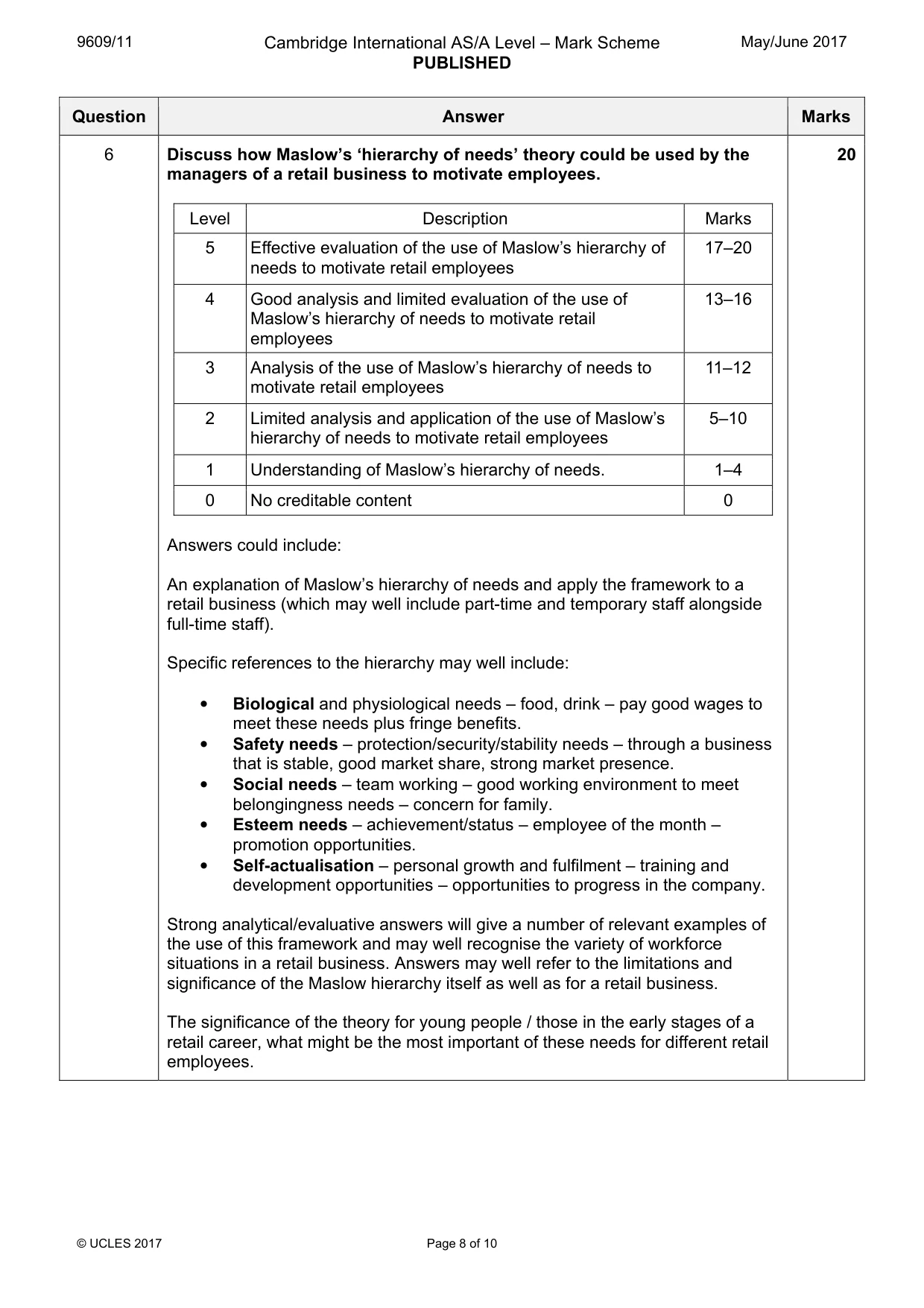
9609/11 Cambridge International AS/A Level – Mark Scheme PUBLISHED May/June 2017 © UCLES 2017 Page 8 of 10 Question Answer Marks 6 Discuss how Maslow’s ‘hierarchy of needs’ theory could be used by the managers of a retail business to motivate employees. Level Description Marks 5 Effective evaluation of the use of Maslow’s hierarchy of needs to motivate retail employees 17–20 4 Good analysis and limited evaluation of the use of Maslow’s hierarchy of needs to motivate retail employees 13–16 3 Analysis of the use of Maslow’s hierarchy of needs to motivate retail employees 11–12 2 Limited analysis and application of the use of Maslow’s hierarchy of needs to motivate retail employees 5–10 1 Understanding of Maslow’s hierarchy of needs. 1–4 0 No creditable content 0 Answers could include: An explanation of Maslow’s hierarchy of needs and apply the framework to a retail business (which may well include part-time and temporary staff alongside full-time staff). Specific references to the hierarchy may well include: • Biological and physiological needs – food, drink – pay good wages to meet these needs plus fringe benefits. • Safety needs – protection/security/stability needs – through a business that is stable, good market share, strong market presence. • Social needs – team working – good working environment to meet belongingness needs – concern for family. • Esteem needs – achievement/status – employee of the month – promotion opportunities. • Self-actualisation – personal growth and fulfilment – training and development opportunities – opportunities to progress in the company. Strong analytical/evaluative answers will give a number of relevant examples of the use of this framework and may well recognise the variety of workforce situations in a retail business. Answers may well refer to the limitations and significance of the Maslow hierarchy itself as well as for a retail business. The significance of the theory for young people / those in the early stages of a retail career, what might be the most important of these needs for different retail employees. 20
Mark scheme, page 9
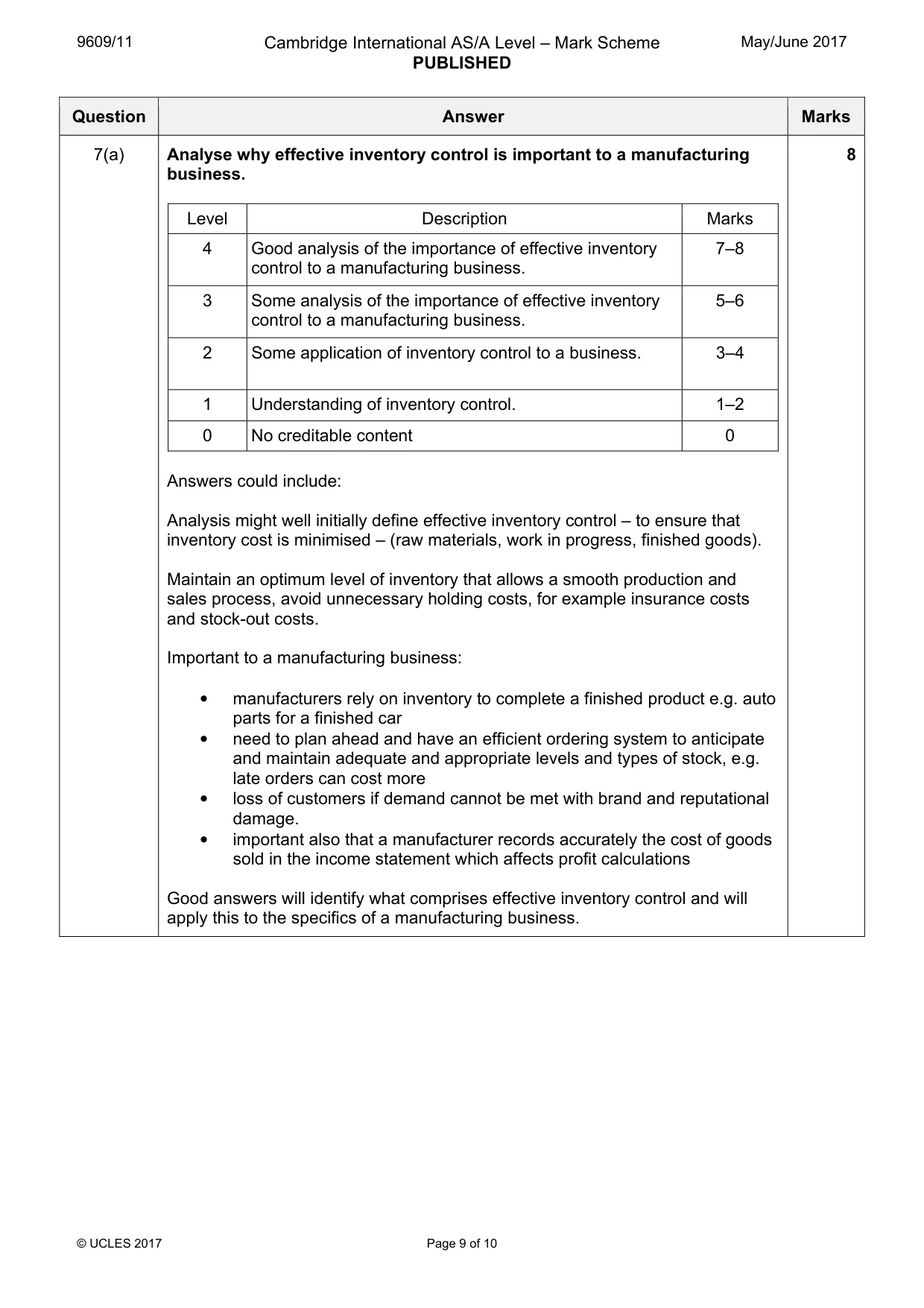
9609/11 Cambridge International AS/A Level – Mark Scheme PUBLISHED May/June 2017 © UCLES 2017 Page 9 of 10 Question Answer Marks 7(a) Analyse why effective inventory control is important to a manufacturing business. Level Description Marks 4 Good analysis of the importance of effective inventory control to a manufacturing business. 7–8 3 Some analysis of the importance of effective inventory control to a manufacturing business. 5–6 2 Some application of inventory control to a business. 3–4 1 Understanding of inventory control. 1–2 0 No creditable content 0 Answers could include: Analysis might well initially define effective inventory control – to ensure that inventory cost is minimised – (raw materials, work in progress, finished goods). Maintain an optimum level of inventory that allows a smooth production and sales process, avoid unnecessary holding costs, for example insurance costs and stock-out costs. Important to a manufacturing business: • manufacturers rely on inventory to complete a finished product e.g. auto parts for a finished car • need to plan ahead and have an efficient ordering system to anticipate and maintain adequate and appropriate levels and types of stock, e.g. late orders can cost more • loss of customers if demand cannot be met with brand and reputational damage. • important also that a manufacturer records accurately the cost of goods sold in the income statement which affects profit calculations Good answers will identify what comprises effective inventory control and will apply this to the specifics of a manufacturing business. 8
Mark scheme, page 10
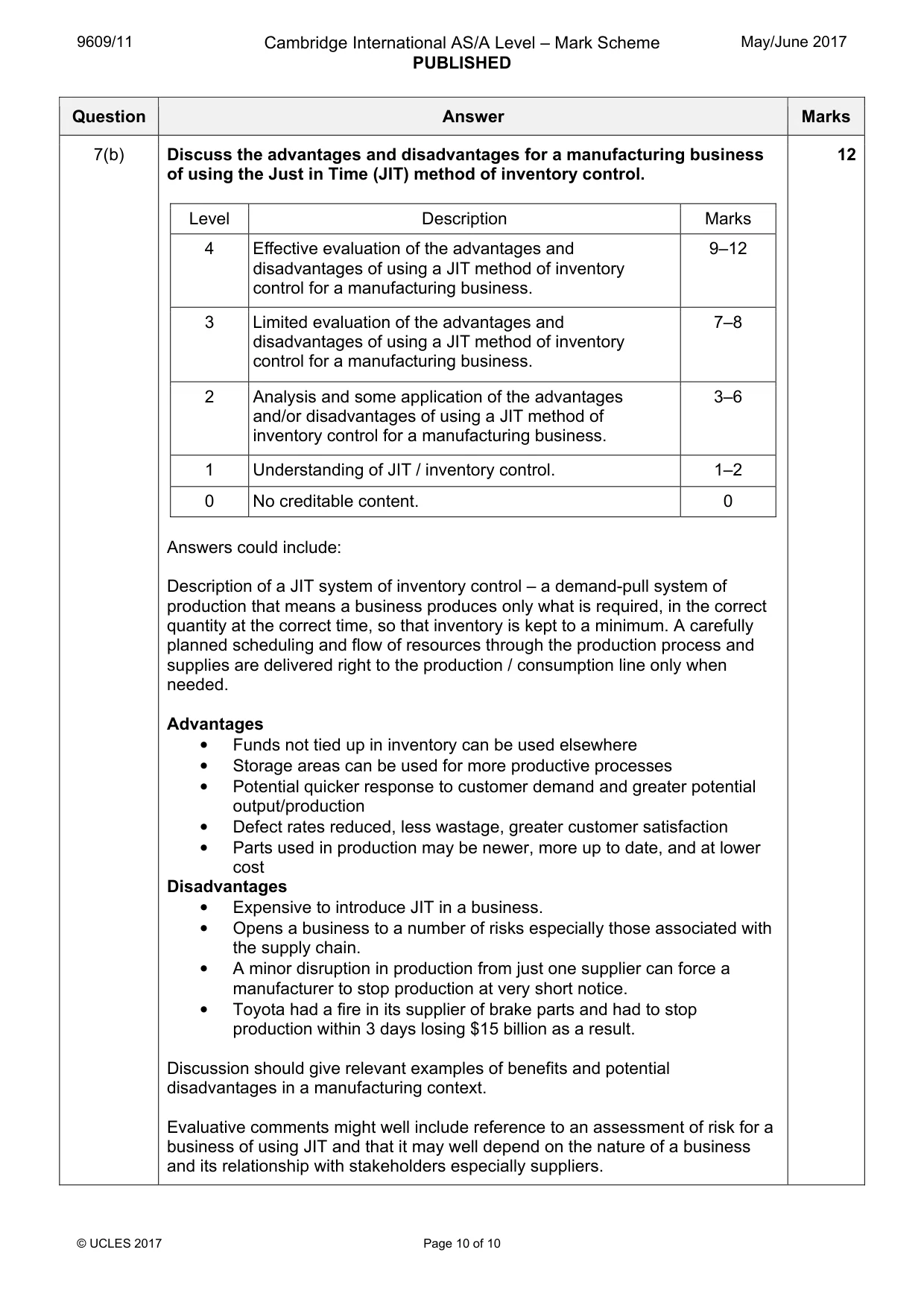
9609/11 Cambridge International AS/A Level – Mark Scheme PUBLISHED May/June 2017 © UCLES 2017 Page 10 of 10 Question Answer Marks 7(b) Discuss the advantages and disadvantages for a manufacturing business of using the Just in Time (JIT) method of inventory control. Level Description Marks 4 Effective evaluation of the advantages and disadvantages of using a JIT method of inventory control for a manufacturing business. 9–12 3 Limited evaluation of the advantages and disadvantages of using a JIT method of inventory control for a manufacturing business. 7–8 2 Analysis and some application of the advantages and/or disadvantages of using a JIT method of inventory control for a manufacturing business. 3–6 1 Understanding of JIT / inventory control. 1–2 0 No creditable content. 0 Answers could include: Description of a JIT system of inventory control – a demand-pull system of production that means a business produces only what is required, in the correct quantity at the correct time, so that inventory is kept to a minimum. A carefully planned scheduling and flow of resources through the production process and supplies are delivered right to the production / consumption line only when needed. Advantages • Funds not tied up in inventory can be used elsewhere • Storage areas can be used for more productive processes • Potential quicker response to customer demand and greater potential output/production • Defect rates reduced, less wastage, greater customer satisfaction • Parts used in production may be newer, more up to date, and at lower cost Disadvantages • Expensive to introduce JIT in a business. • Opens a business to a number of risks especially those associated with the supply chain. • A minor disruption in production from just one supplier can force a manufacturer to stop production at very short notice. • Toyota had a fire in its supplier of brake parts and had to stop production within 3 days losing $15 billion as a result. Discussion should give relevant examples of benefits and potential disadvantages in a manufacturing context. Evaluative comments might well include reference to an assessment of risk for a business of using JIT and that it may well depend on the nature of a business and its relationship with stakeholders especially suppliers. 12