Cambridge A Level Business (for first examination in 2016) 9609 — 2017 May/June Paper 1 · Variant 3
9609/13/M/J/17
The question paper and its mark scheme, free to read here and free to download. This is Cambridge’s own paper, exactly as it was sat.
Question paper4 pages


Mark scheme10 pages
Answers below. Sit the paper first if you are practising.
Paper as text
Question paper, page 1
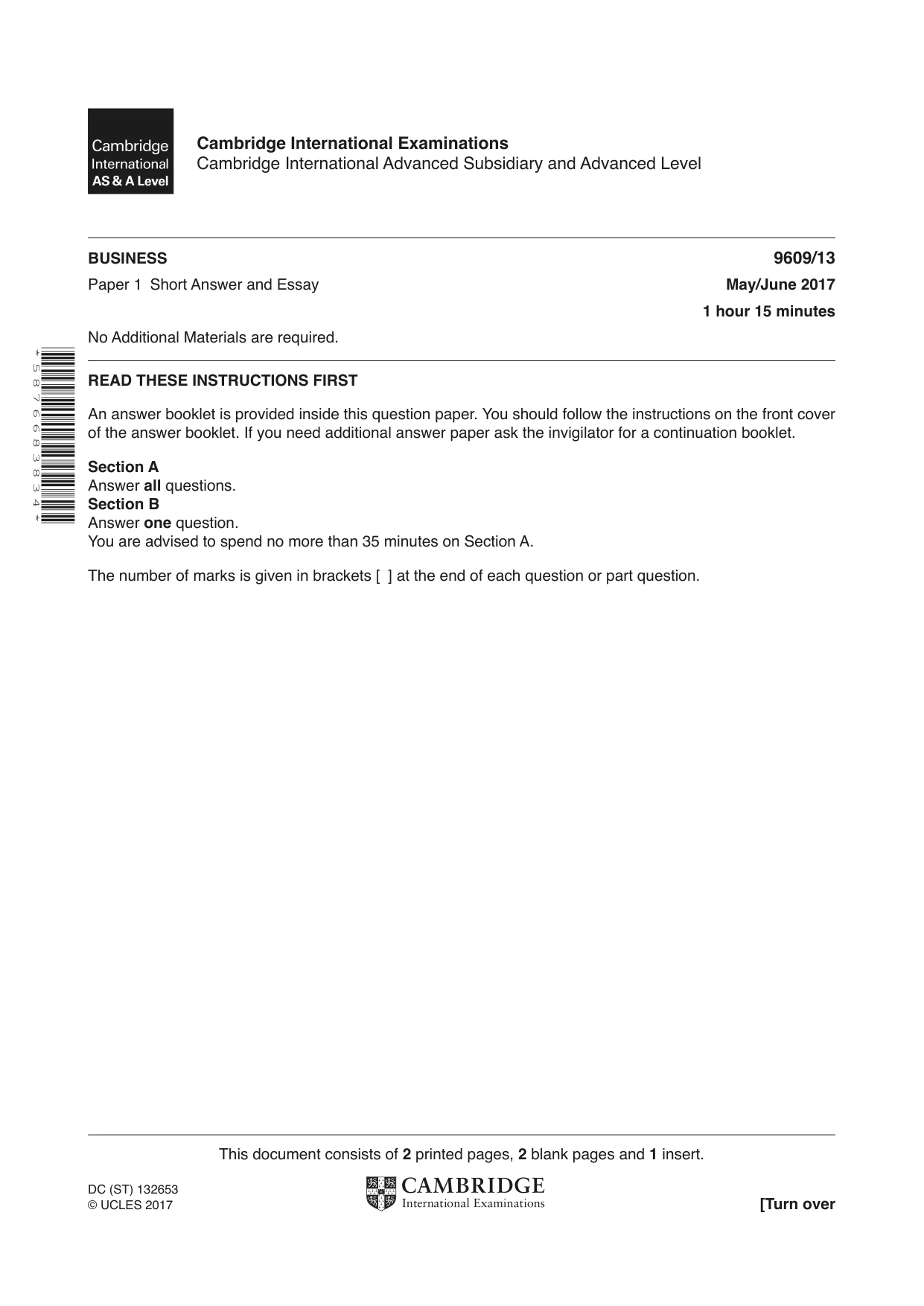
This document consists of 2 printed pages, 2 blank pages and 1 insert. DC (ST) 132653 © UCLES 2017 [Turn over Cambridge International Examinations Cambridge International Advanced Subsidiary and Advanced Level * 5 8 7 6 6 8 3 8 3 4 * BUSINESS 9609/13 Paper 1 Short Answer and Essay May/June 2017 1 hour 15 minutes No Additional Materials are required. READ THESE INSTRUCTIONS FIRST An answer booklet is provided inside this question paper. You should follow the instructions on the front cover of the answer booklet. If you need additional answer paper ask the invigilator for a continuation booklet. Section A Answer all questions. Section B Answer one question. You are advised to spend no more than 35 minutes on Section A. The number of marks is given in brackets [ ] at the end of each question or part question.
Question paper, page 2
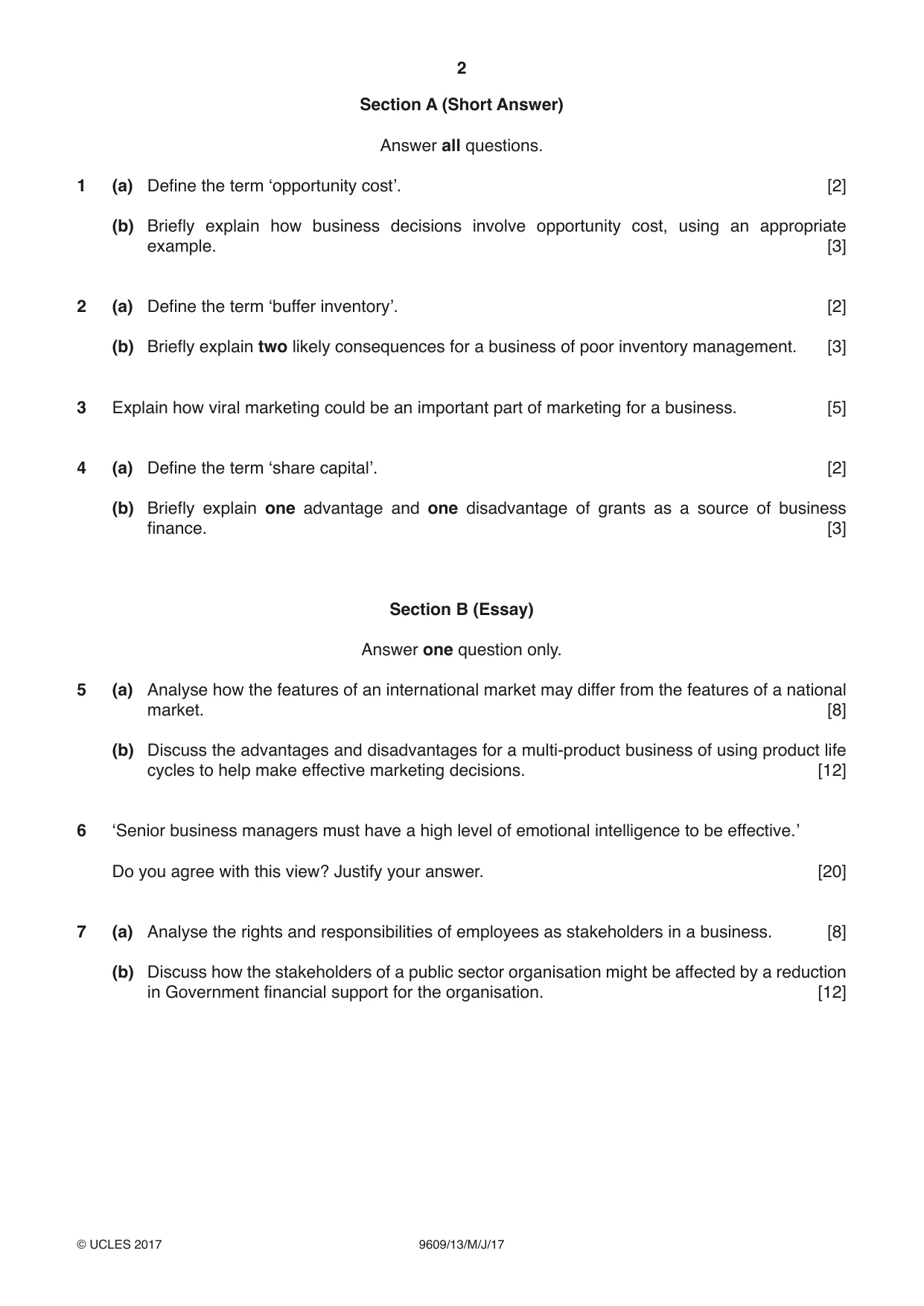
2 9609/13/M/J/17 © UCLES 2017 Section A (Short Answer) Answer all questions. 1 (a) Define the term ‘opportunity cost’. [2] (b) Briefly explain how business decisions involve opportunity cost, using an appropriate example. [3] 2 (a) Define the term ‘buffer inventory’. [2] (b) Briefly explain two likely consequences for a business of poor inventory management. [3] 3 Explain how viral marketing could be an important part of marketing for a business. [5] 4 (a) Define the term ‘share capital’. [2] (b) Briefly explain one advantage and one disadvantage of grants as a source of business finance. [3] Section B (Essay) Answer one question only. 5 (a) Analyse how the features of an international market may differ from the features of a national market. [8] (b) Discuss the advantages and disadvantages for a multi-product business of using product life cycles to help make effective marketing decisions. [12] 6 ‘Senior business managers must have a high level of emotional intelligence to be effective.’ Do you agree with this view? Justify your answer. [20] 7 (a) Analyse the rights and responsibilities of employees as stakeholders in a business. [8] (b) Discuss how the stakeholders of a public sector organisation might be affected by a reduction in Government financial support for the organisation. [12]
Question paper, page 3
3 9609/13/M/J/17 © UCLES 2017 BLANK PAGE
Question paper, page 4
4 9609/13/M/J/17 © UCLES 2017 Permission to reproduce items where third-party owned material protected by copyright is included has been sought and cleared where possible. Every reasonable effort has been made by the publisher (UCLES) to trace copyright holders, but if any items requiring clearance have unwittingly been included, the publisher will be pleased to make amends at the earliest possible opportunity. To avoid the issue of disclosure of answer-related information to candidates, all copyright acknowledgements are reproduced online in the Cambridge International Examinations Copyright Acknowledgements Booklet. This is produced for each series of examinations and is freely available to download at www.cie.org.uk after the live examination series. Cambridge International Examinations is part of the Cambridge Assessment Group. Cambridge Assessment is the brand name of University of Cambridge Local Examinations Syndicate (UCLES), which is itself a department of the University of Cambridge. BLANK PAGE
Mark scheme, page 1
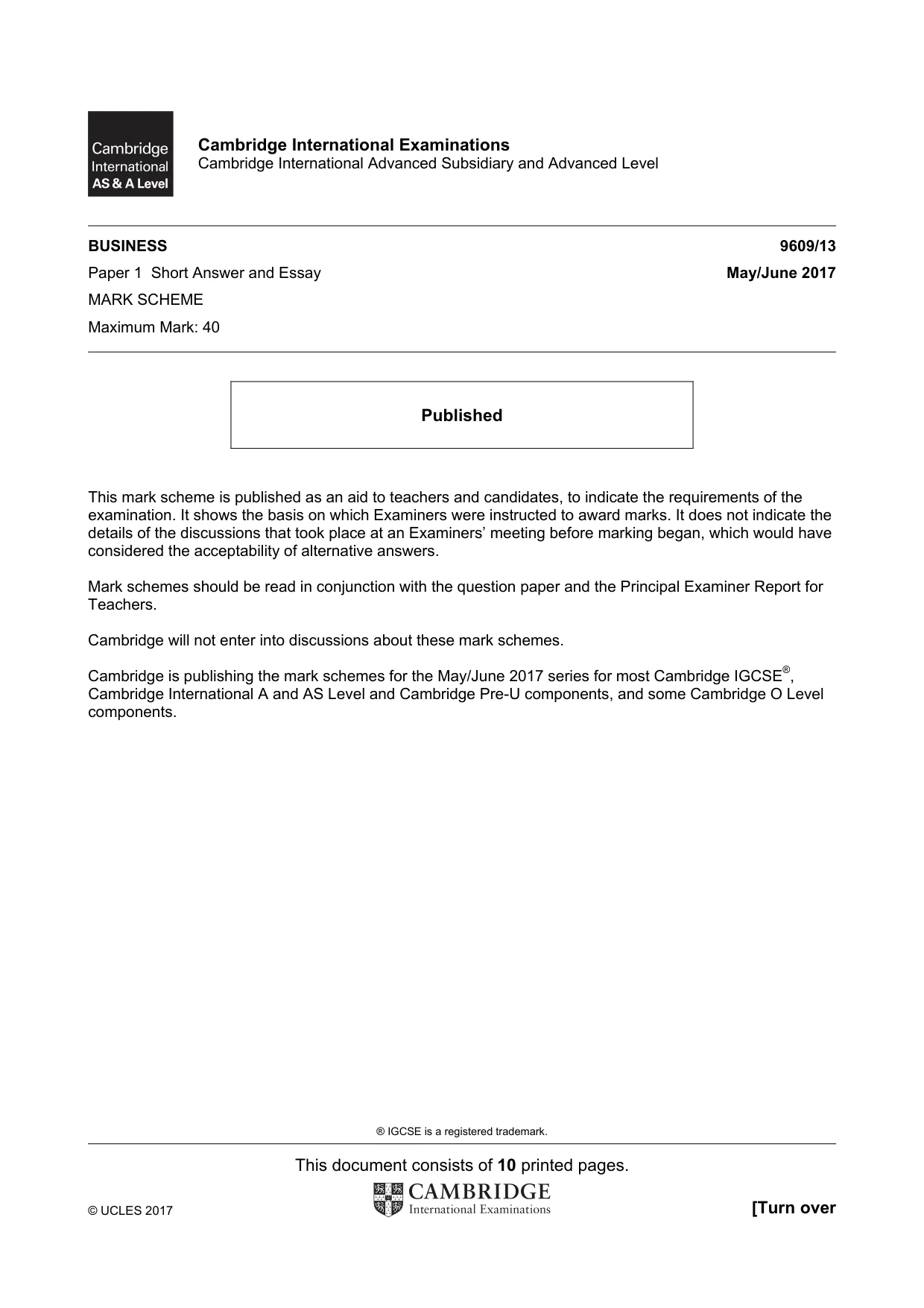
® IGCSE is a registered trademark. This document consists of 10 printed pages. © UCLES 2017 [Turn over Cambridge International Examinations Cambridge International Advanced Subsidiary and Advanced Level BUSINESS 9609/13 Paper 1 Short Answer and Essay May/June 2017 MARK SCHEME Maximum Mark: 40 Published This mark scheme is published as an aid to teachers and candidates, to indicate the requirements of the examination. It shows the basis on which Examiners were instructed to award marks. It does not indicate the details of the discussions that took place at an Examiners’ meeting before marking began, which would have considered the acceptability of alternative answers. Mark schemes should be read in conjunction with the question paper and the Principal Examiner Report for Teachers. Cambridge will not enter into discussions about these mark schemes. Cambridge is publishing the mark schemes for the May/June 2017 series for most Cambridge IGCSE®, Cambridge International A and AS Level and Cambridge Pre-U components, and some Cambridge O Level components.
Mark scheme, page 2
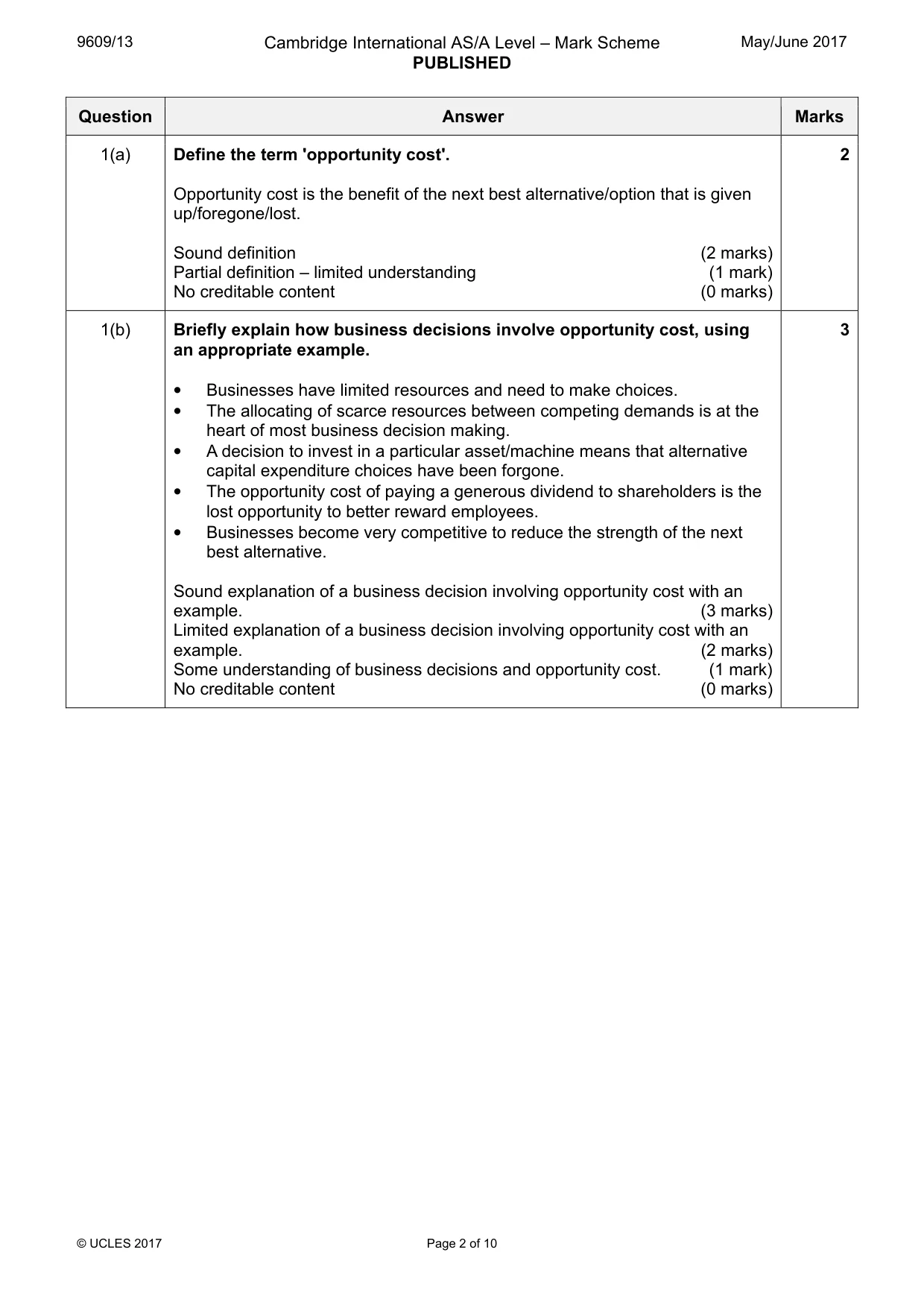
9609/13 Cambridge International AS/A Level – Mark Scheme PUBLISHED May/June 2017 © UCLES 2017 Page 2 of 10 Question Answer Marks 1(a) Define the term 'opportunity cost'. Opportunity cost is the benefit of the next best alternative/option that is given up/foregone/lost. Sound definition (2 marks) Partial definition – limited understanding (1 mark) No creditable content (0 marks) 2 1(b) Briefly explain how business decisions involve opportunity cost, using an appropriate example. • Businesses have limited resources and need to make choices. • The allocating of scarce resources between competing demands is at the heart of most business decision making. • A decision to invest in a particular asset/machine means that alternative capital expenditure choices have been forgone. • The opportunity cost of paying a generous dividend to shareholders is the lost opportunity to better reward employees. • Businesses become very competitive to reduce the strength of the next best alternative. Sound explanation of a business decision involving opportunity cost with an example. (3 marks) Limited explanation of a business decision involving opportunity cost with an example. (2 marks) Some understanding of business decisions and opportunity cost. (1 mark) No creditable content (0 marks) 3
Mark scheme, page 3
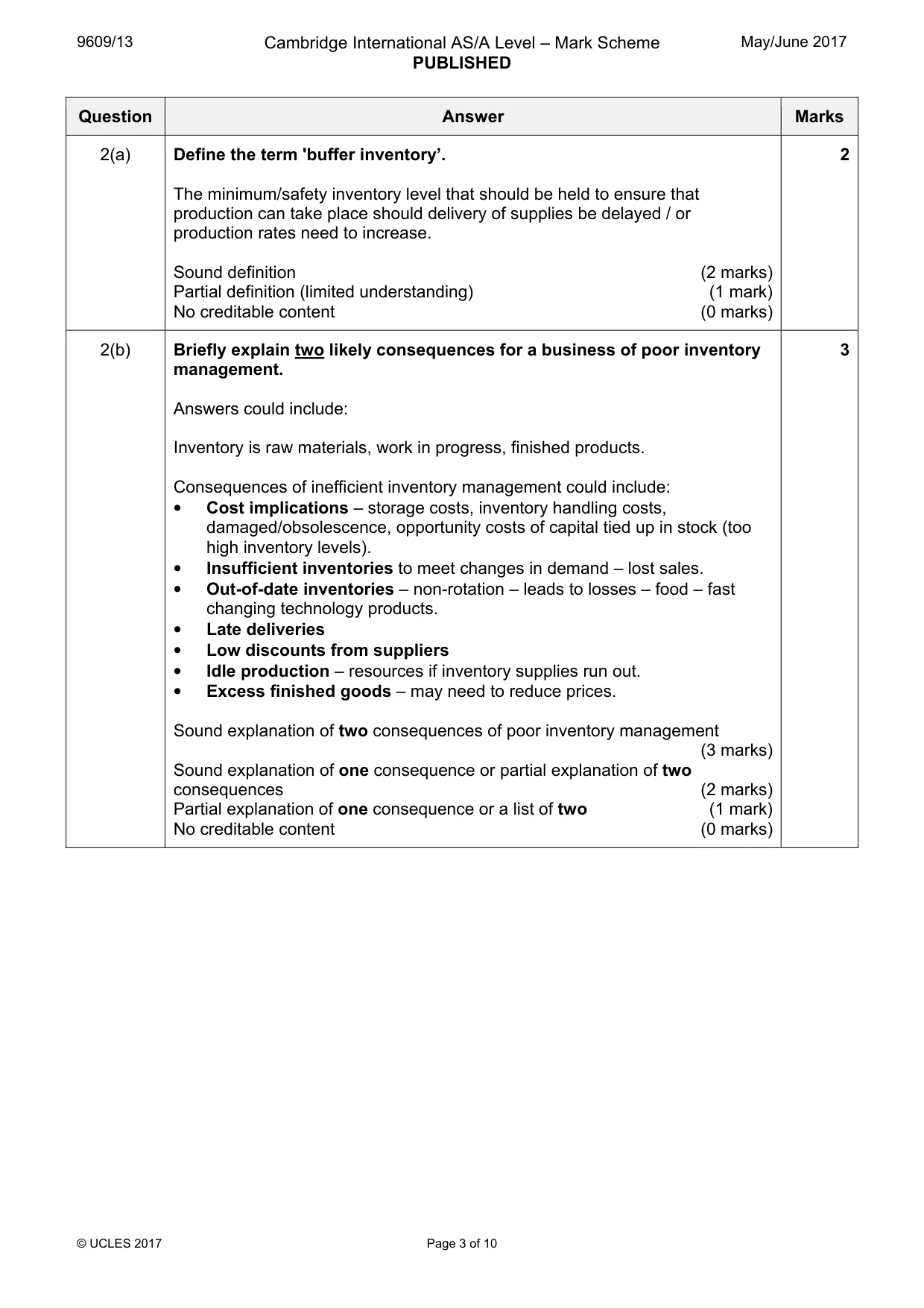
9609/13 Cambridge International AS/A Level – Mark Scheme PUBLISHED May/June 2017 © UCLES 2017 Page 3 of 10 Question Answer Marks 2(a) Define the term 'buffer inventory’. The minimum/safety inventory level that should be held to ensure that production can take place should delivery of supplies be delayed / or production rates need to increase. Sound definition (2 marks) Partial definition (limited understanding) (1 mark) No creditable content (0 marks) 2 2(b) Briefly explain two likely consequences for a business of poor inventory management. Answers could include: Inventory is raw materials, work in progress, finished products. Consequences of inefficient inventory management could include: • Cost implications – storage costs, inventory handling costs, damaged/obsolescence, opportunity costs of capital tied up in stock (too high inventory levels). • Insufficient inventories to meet changes in demand – lost sales. • Out-of-date inventories – non-rotation – leads to losses – food – fast changing technology products. • Late deliveries • Low discounts from suppliers • Idle production – resources if inventory supplies run out. • Excess finished goods – may need to reduce prices. Sound explanation of two consequences of poor inventory management (3 marks) Sound explanation of one consequence or partial explanation of two consequences (2 marks) Partial explanation of one consequence or a list of two (1 mark) No creditable content (0 marks) 3
Mark scheme, page 4
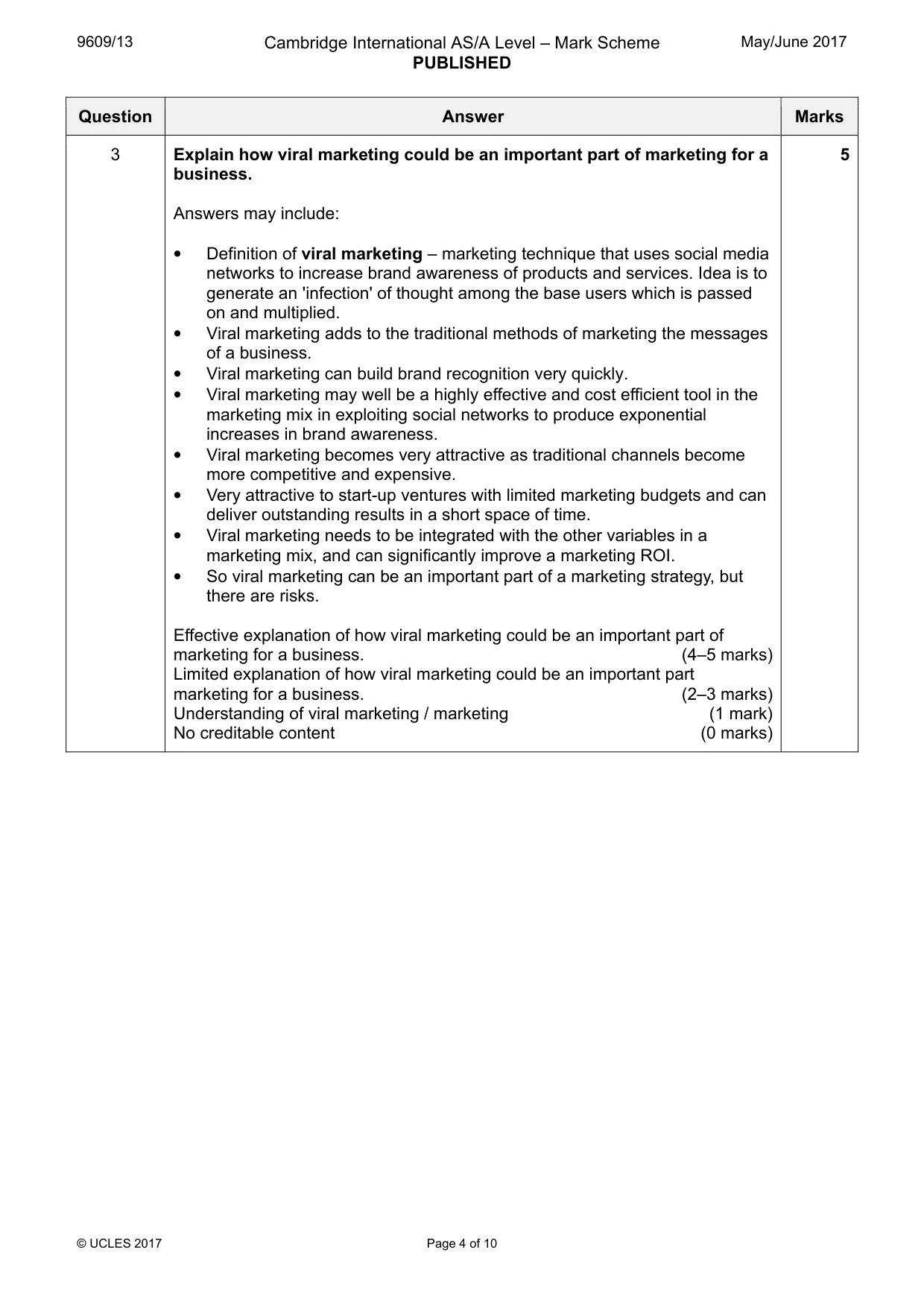
9609/13 Cambridge International AS/A Level – Mark Scheme PUBLISHED May/June 2017 © UCLES 2017 Page 4 of 10 Question Answer Marks 3 Explain how viral marketing could be an important part of marketing for a business. Answers may include: • Definition of viral marketing – marketing technique that uses social media networks to increase brand awareness of products and services. Idea is to generate an 'infection' of thought among the base users which is passed on and multiplied. • Viral marketing adds to the traditional methods of marketing the messages of a business. • Viral marketing can build brand recognition very quickly. • Viral marketing may well be a highly effective and cost efficient tool in the marketing mix in exploiting social networks to produce exponential increases in brand awareness. • Viral marketing becomes very attractive as traditional channels become more competitive and expensive. • Very attractive to start-up ventures with limited marketing budgets and can deliver outstanding results in a short space of time. • Viral marketing needs to be integrated with the other variables in a marketing mix, and can significantly improve a marketing ROI. • So viral marketing can be an important part of a marketing strategy, but there are risks. Effective explanation of how viral marketing could be an important part of marketing for a business. (4–5 marks) Limited explanation of how viral marketing could be an important part marketing for a business. (2–3 marks) Understanding of viral marketing / marketing (1 mark) No creditable content (0 marks) 5
Mark scheme, page 5
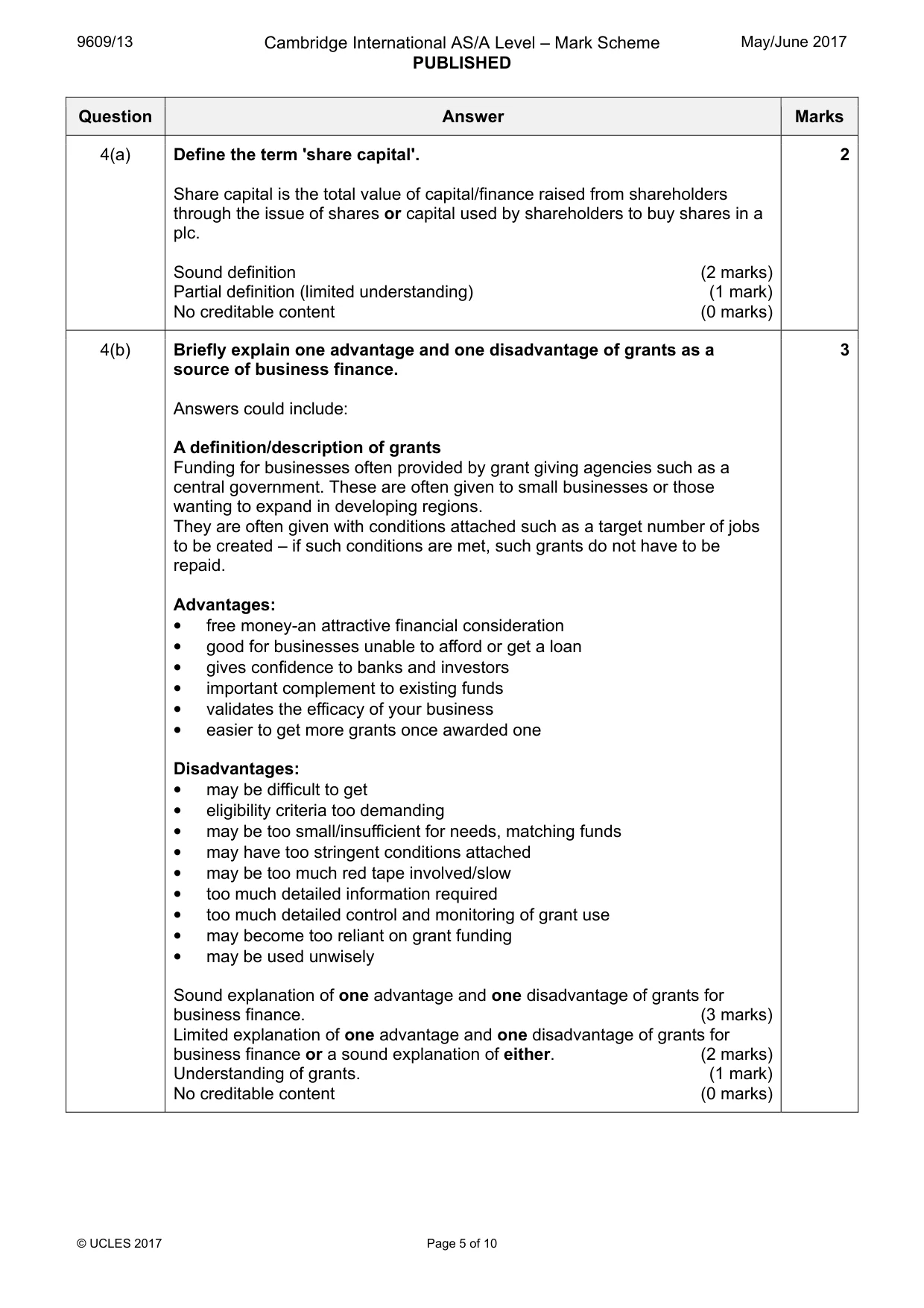
9609/13 Cambridge International AS/A Level – Mark Scheme PUBLISHED May/June 2017 © UCLES 2017 Page 5 of 10 Question Answer Marks 4(a) Define the term 'share capital'. Share capital is the total value of capital/finance raised from shareholders through the issue of shares or capital used by shareholders to buy shares in a plc. Sound definition (2 marks) Partial definition (limited understanding) (1 mark) No creditable content (0 marks) 2 4(b) Briefly explain one advantage and one disadvantage of grants as a source of business finance. Answers could include: A definition/description of grants Funding for businesses often provided by grant giving agencies such as a central government. These are often given to small businesses or those wanting to expand in developing regions. They are often given with conditions attached such as a target number of jobs to be created – if such conditions are met, such grants do not have to be repaid. Advantages: • free money-an attractive financial consideration • good for businesses unable to afford or get a loan • gives confidence to banks and investors • important complement to existing funds • validates the efficacy of your business • easier to get more grants once awarded one Disadvantages: • may be difficult to get • eligibility criteria too demanding • may be too small/insufficient for needs, matching funds • may have too stringent conditions attached • may be too much red tape involved/slow • too much detailed information required • too much detailed control and monitoring of grant use • may become too reliant on grant funding • may be used unwisely Sound explanation of one advantage and one disadvantage of grants for business finance. (3 marks) Limited explanation of one advantage and one disadvantage of grants for business finance or a sound explanation of either. (2 marks) Understanding of grants. (1 mark) No creditable content (0 marks) 3
Mark scheme, page 6
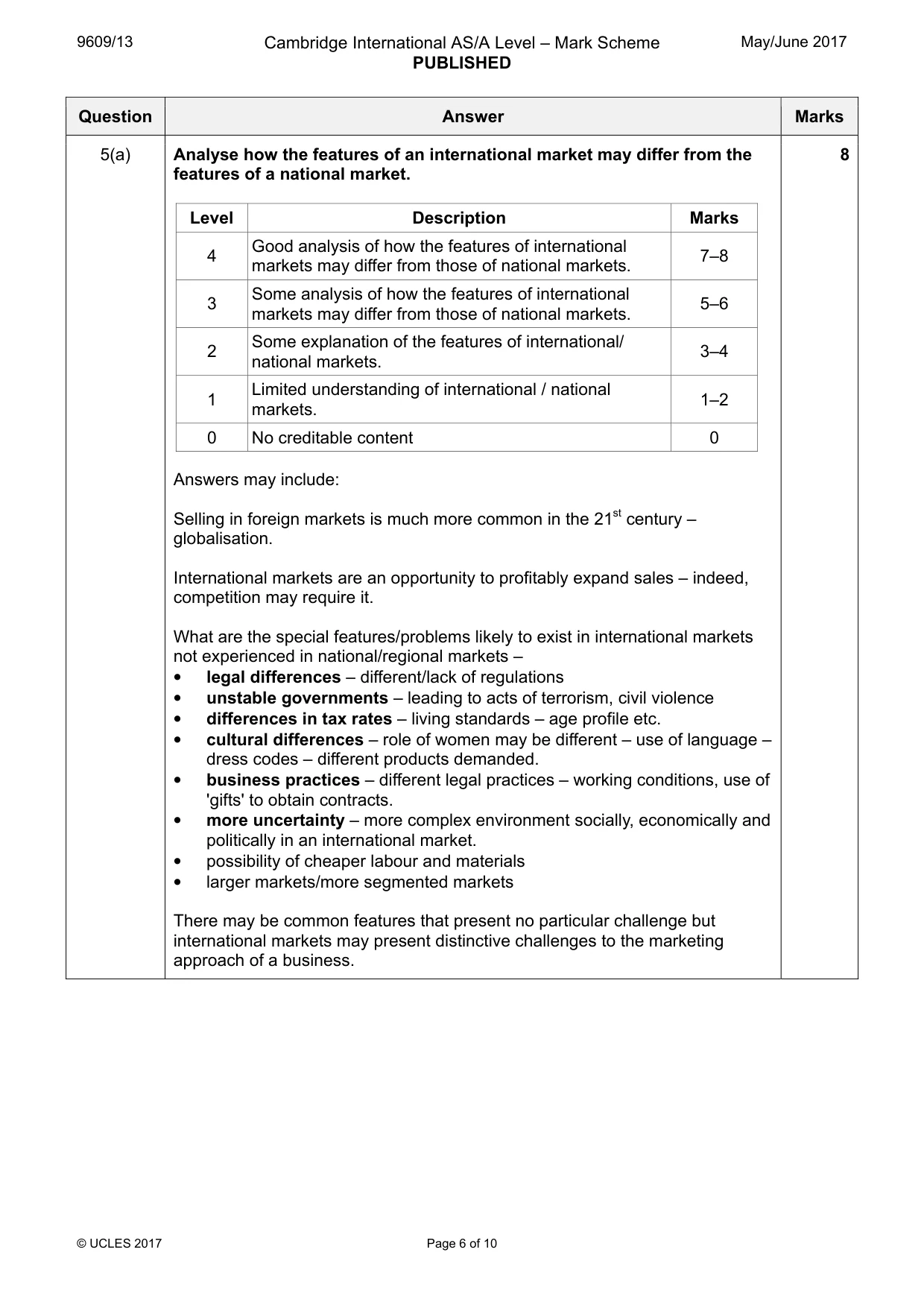
9609/13 Cambridge International AS/A Level – Mark Scheme PUBLISHED May/June 2017 © UCLES 2017 Page 6 of 10 Question Answer Marks 5(a) Analyse how the features of an international market may differ from the features of a national market. Level Description Marks 4 Good analysis of how the features of international markets may differ from those of national markets. 7–8 3 Some analysis of how the features of international markets may differ from those of national markets. 5–6 2 Some explanation of the features of international/ national markets. 3–4 1 Limited understanding of international / national markets. 1–2 0 No creditable content 0 Answers may include: Selling in foreign markets is much more common in the 21st century – globalisation. International markets are an opportunity to profitably expand sales – indeed, competition may require it. What are the special features/problems likely to exist in international markets not experienced in national/regional markets – • legal differences – different/lack of regulations • unstable governments – leading to acts of terrorism, civil violence • differences in tax rates – living standards – age profile etc. • cultural differences – role of women may be different – use of language – dress codes – different products demanded. • business practices – different legal practices – working conditions, use of 'gifts' to obtain contracts. • more uncertainty – more complex environment socially, economically and politically in an international market. • possibility of cheaper labour and materials • larger markets/more segmented markets There may be common features that present no particular challenge but international markets may present distinctive challenges to the marketing approach of a business. 8
Mark scheme, page 7
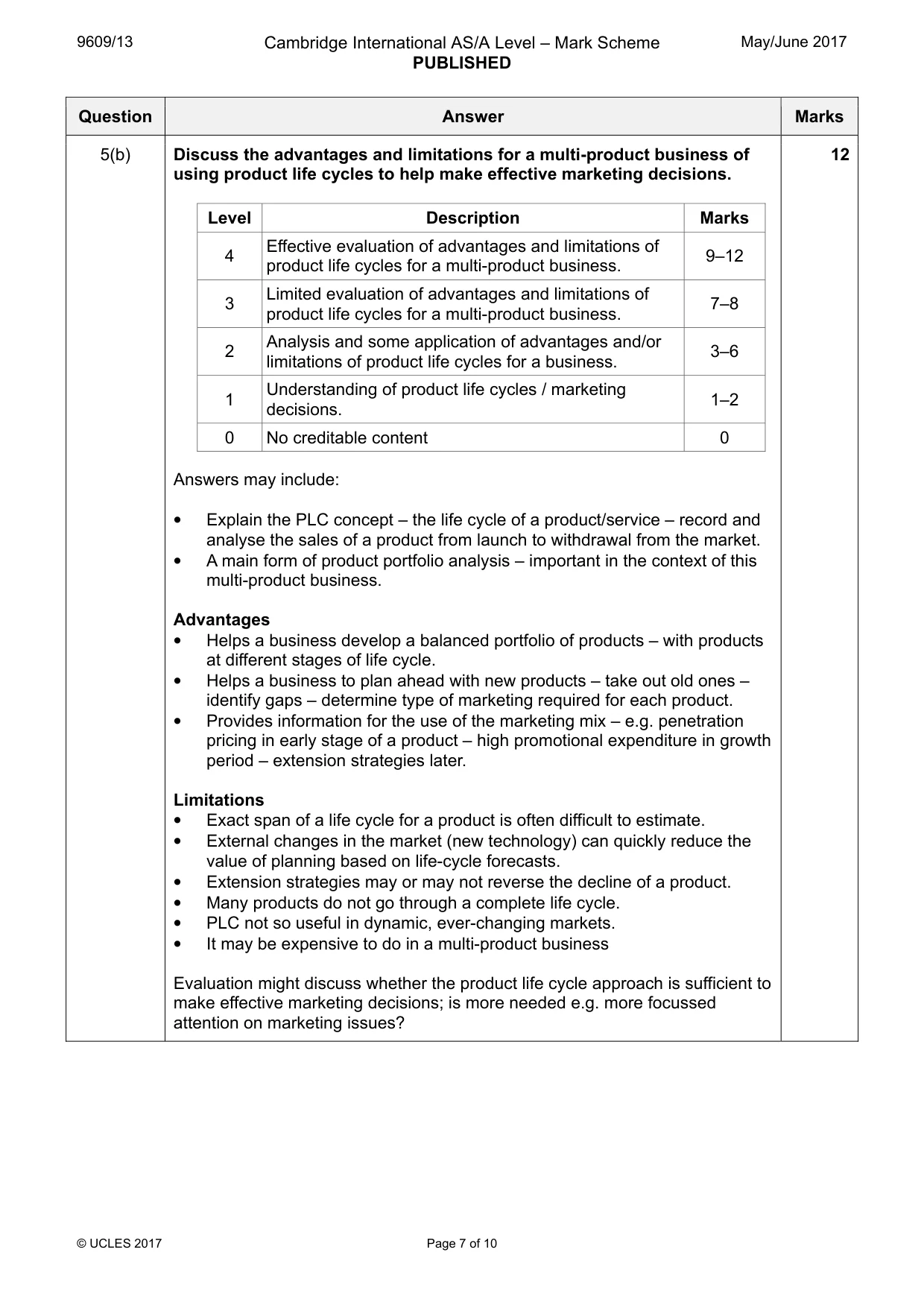
9609/13 Cambridge International AS/A Level – Mark Scheme PUBLISHED May/June 2017 © UCLES 2017 Page 7 of 10 Question Answer Marks 5(b) Discuss the advantages and limitations for a multi-product business of using product life cycles to help make effective marketing decisions. Level Description Marks 4 Effective evaluation of advantages and limitations of product life cycles for a multi-product business. 9–12 3 Limited evaluation of advantages and limitations of product life cycles for a multi-product business. 7–8 2 Analysis and some application of advantages and/or limitations of product life cycles for a business. 3–6 1 Understanding of product life cycles / marketing decisions. 1–2 0 No creditable content 0 Answers may include: • Explain the PLC concept – the life cycle of a product/service – record and analyse the sales of a product from launch to withdrawal from the market. • A main form of product portfolio analysis – important in the context of this multi-product business. Advantages • Helps a business develop a balanced portfolio of products – with products at different stages of life cycle. • Helps a business to plan ahead with new products – take out old ones – identify gaps – determine type of marketing required for each product. • Provides information for the use of the marketing mix – e.g. penetration pricing in early stage of a product – high promotional expenditure in growth period – extension strategies later. Limitations • Exact span of a life cycle for a product is often difficult to estimate. • External changes in the market (new technology) can quickly reduce the value of planning based on life-cycle forecasts. • Extension strategies may or may not reverse the decline of a product. • Many products do not go through a complete life cycle. • PLC not so useful in dynamic, ever-changing markets. • It may be expensive to do in a multi-product business Evaluation might discuss whether the product life cycle approach is sufficient to make effective marketing decisions; is more needed e.g. more focussed attention on marketing issues? 12
Mark scheme, page 8
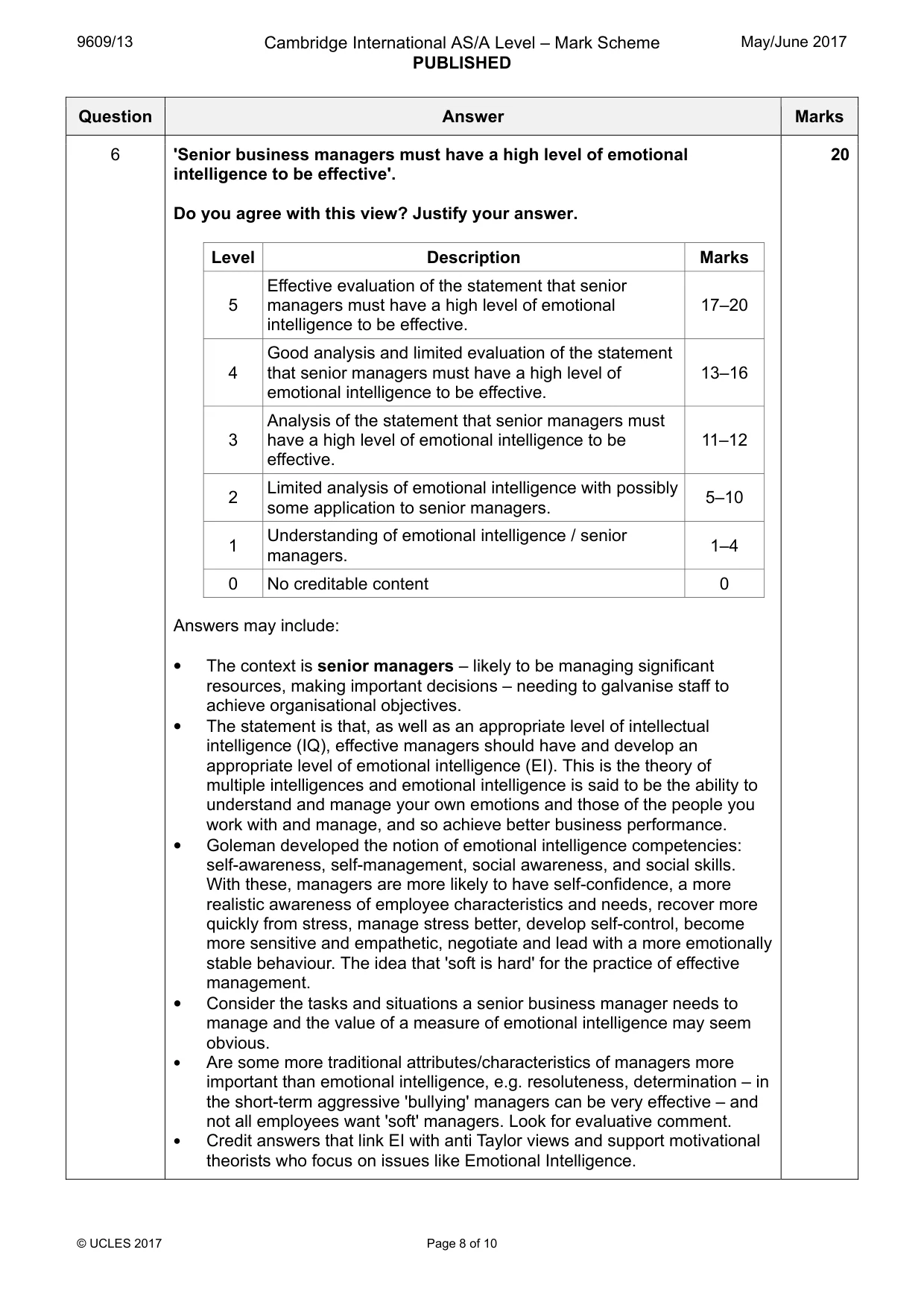
9609/13 Cambridge International AS/A Level – Mark Scheme PUBLISHED May/June 2017 © UCLES 2017 Page 8 of 10 Question Answer Marks 6 'Senior business managers must have a high level of emotional intelligence to be effective'. Do you agree with this view? Justify your answer. Level Description Marks 5 Effective evaluation of the statement that senior managers must have a high level of emotional intelligence to be effective. 17–20 4 Good analysis and limited evaluation of the statement that senior managers must have a high level of emotional intelligence to be effective. 13–16 3 Analysis of the statement that senior managers must have a high level of emotional intelligence to be effective. 11–12 2 Limited analysis of emotional intelligence with possibly some application to senior managers. 5–10 1 Understanding of emotional intelligence / senior managers. 1–4 0 No creditable content 0 Answers may include: • The context is senior managers – likely to be managing significant resources, making important decisions – needing to galvanise staff to achieve organisational objectives. • The statement is that, as well as an appropriate level of intellectual intelligence (IQ), effective managers should have and develop an appropriate level of emotional intelligence (EI). This is the theory of multiple intelligences and emotional intelligence is said to be the ability to understand and manage your own emotions and those of the people you work with and manage, and so achieve better business performance. • Goleman developed the notion of emotional intelligence competencies: self-awareness, self-management, social awareness, and social skills. With these, managers are more likely to have self-confidence, a more realistic awareness of employee characteristics and needs, recover more quickly from stress, manage stress better, develop self-control, become more sensitive and empathetic, negotiate and lead with a more emotionally stable behaviour. The idea that 'soft is hard' for the practice of effective management. • Consider the tasks and situations a senior business manager needs to manage and the value of a measure of emotional intelligence may seem obvious. • Are some more traditional attributes/characteristics of managers more important than emotional intelligence, e.g. resoluteness, determination – in the short-term aggressive 'bullying' managers can be very effective – and not all employees want 'soft' managers. Look for evaluative comment. • Credit answers that link EI with anti Taylor views and support motivational theorists who focus on issues like Emotional Intelligence. 20
Mark scheme, page 9
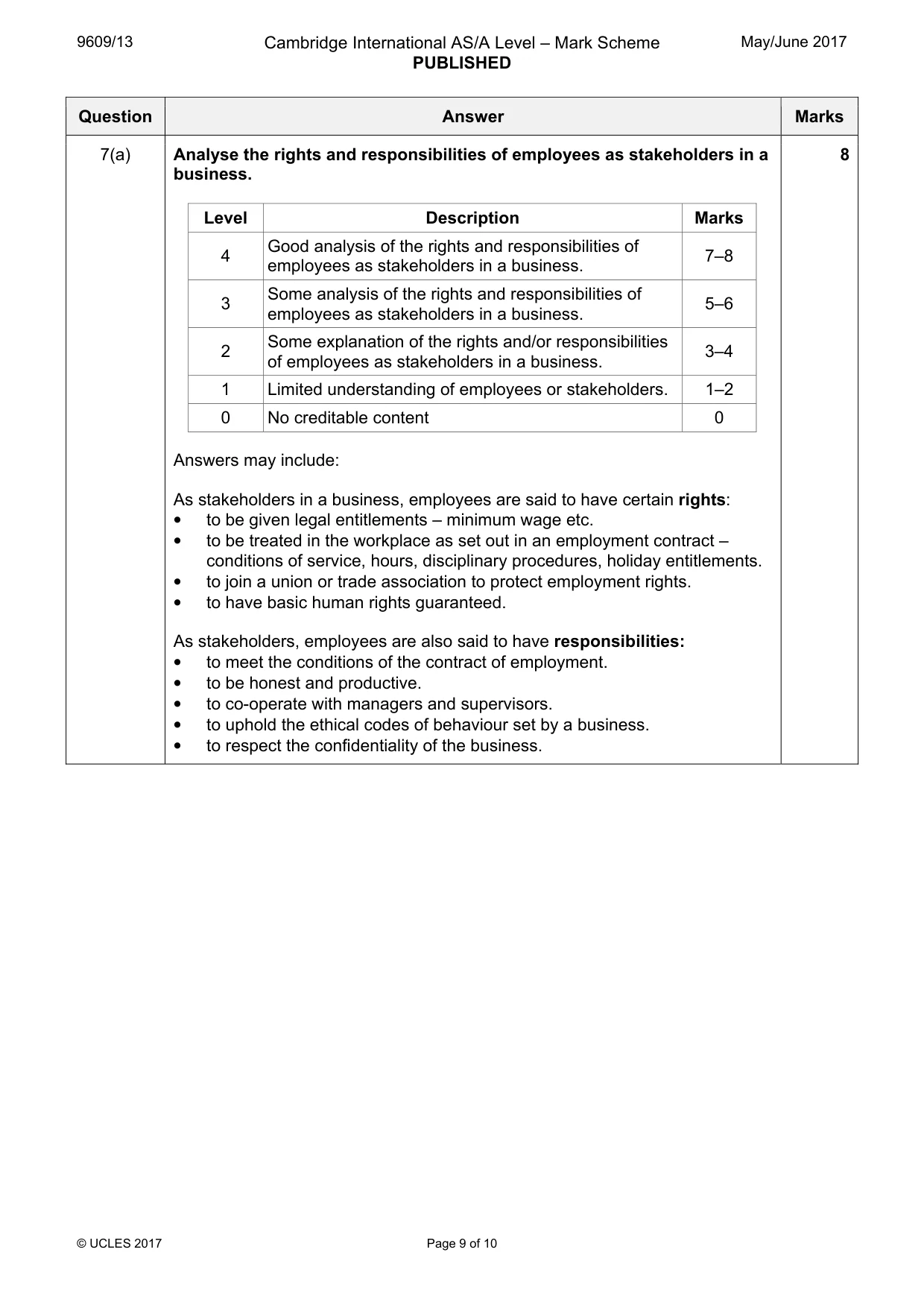
9609/13 Cambridge International AS/A Level – Mark Scheme PUBLISHED May/June 2017 © UCLES 2017 Page 9 of 10 Question Answer Marks 7(a) Analyse the rights and responsibilities of employees as stakeholders in a business. Level Description Marks 4 Good analysis of the rights and responsibilities of employees as stakeholders in a business. 7–8 3 Some analysis of the rights and responsibilities of employees as stakeholders in a business. 5–6 2 Some explanation of the rights and/or responsibilities of employees as stakeholders in a business. 3–4 1 Limited understanding of employees or stakeholders. 1–2 0 No creditable content 0 Answers may include: As stakeholders in a business, employees are said to have certain rights: • to be given legal entitlements – minimum wage etc. • to be treated in the workplace as set out in an employment contract – conditions of service, hours, disciplinary procedures, holiday entitlements. • to join a union or trade association to protect employment rights. • to have basic human rights guaranteed. As stakeholders, employees are also said to have responsibilities: • to meet the conditions of the contract of employment. • to be honest and productive. • to co-operate with managers and supervisors. • to uphold the ethical codes of behaviour set by a business. • to respect the confidentiality of the business. 8
Mark scheme, page 10
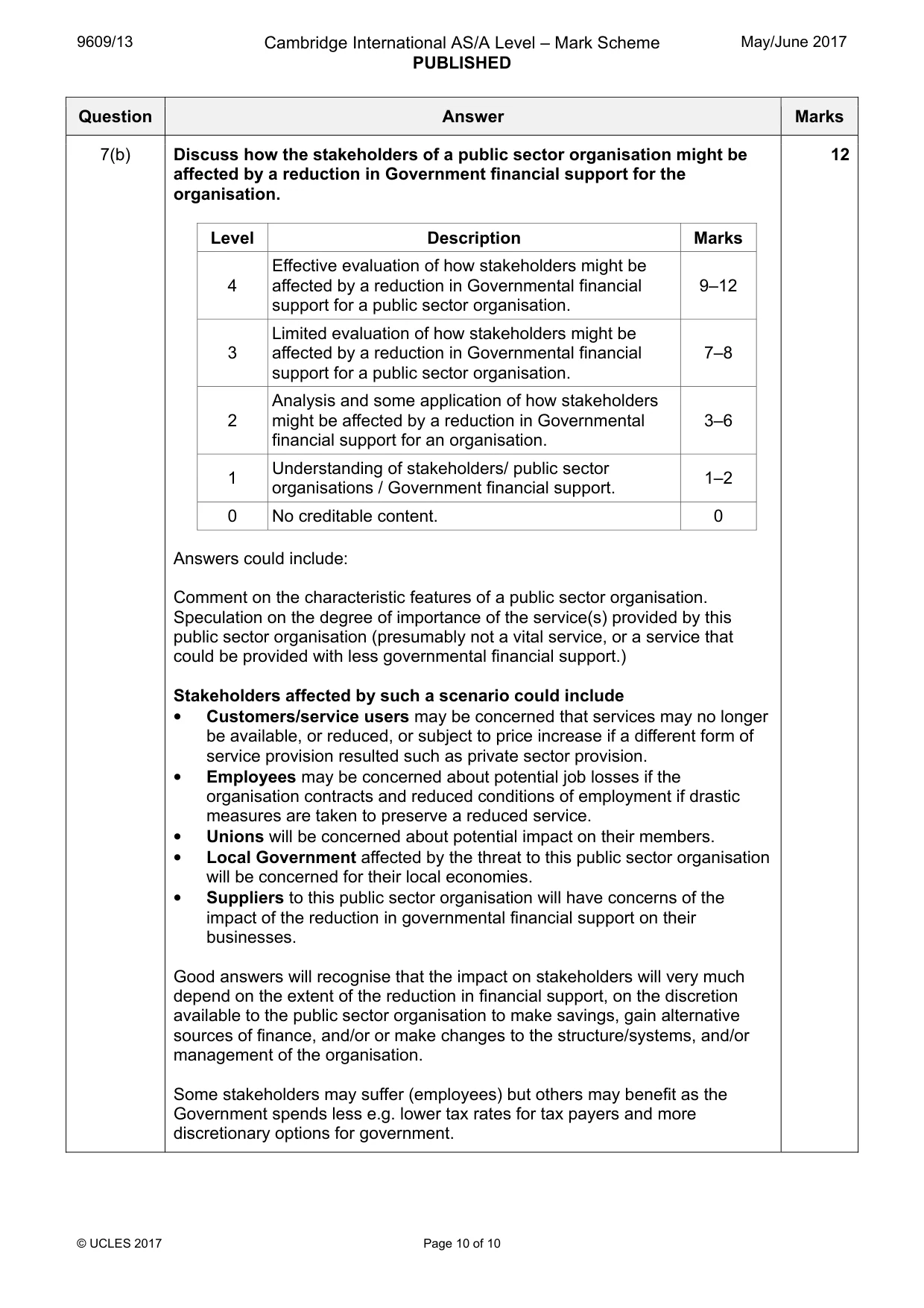
9609/13 Cambridge International AS/A Level – Mark Scheme PUBLISHED May/June 2017 © UCLES 2017 Page 10 of 10 Question Answer Marks 7(b) Discuss how the stakeholders of a public sector organisation might be affected by a reduction in Government financial support for the organisation. Level Description Marks 4 Effective evaluation of how stakeholders might be affected by a reduction in Governmental financial support for a public sector organisation. 9–12 3 Limited evaluation of how stakeholders might be affected by a reduction in Governmental financial support for a public sector organisation. 7–8 2 Analysis and some application of how stakeholders might be affected by a reduction in Governmental financial support for an organisation. 3–6 1 Understanding of stakeholders/ public sector organisations / Government financial support. 1–2 0 No creditable content. 0 Answers could include: Comment on the characteristic features of a public sector organisation. Speculation on the degree of importance of the service(s) provided by this public sector organisation (presumably not a vital service, or a service that could be provided with less governmental financial support.) Stakeholders affected by such a scenario could include • Customers/service users may be concerned that services may no longer be available, or reduced, or subject to price increase if a different form of service provision resulted such as private sector provision. • Employees may be concerned about potential job losses if the organisation contracts and reduced conditions of employment if drastic measures are taken to preserve a reduced service. • Unions will be concerned about potential impact on their members. • Local Government affected by the threat to this public sector organisation will be concerned for their local economies. • Suppliers to this public sector organisation will have concerns of the impact of the reduction in governmental financial support on their businesses. Good answers will recognise that the impact on stakeholders will very much depend on the extent of the reduction in financial support, on the discretion available to the public sector organisation to make savings, gain alternative sources of finance, and/or or make changes to the structure/systems, and/or management of the organisation. Some stakeholders may suffer (employees) but others may benefit as the Government spends less e.g. lower tax rates for tax payers and more discretionary options for government. 12