Cambridge A Level Business (for first examination in 2016) 9609 — 2017 Feb/March Paper 2 · Variant 2
9609/22/F/M/17 · 2 questions · 60 marks · ≈68 min
The question paper and its mark scheme, free to read here and free to download. This is Cambridge’s own paper, exactly as it was sat.
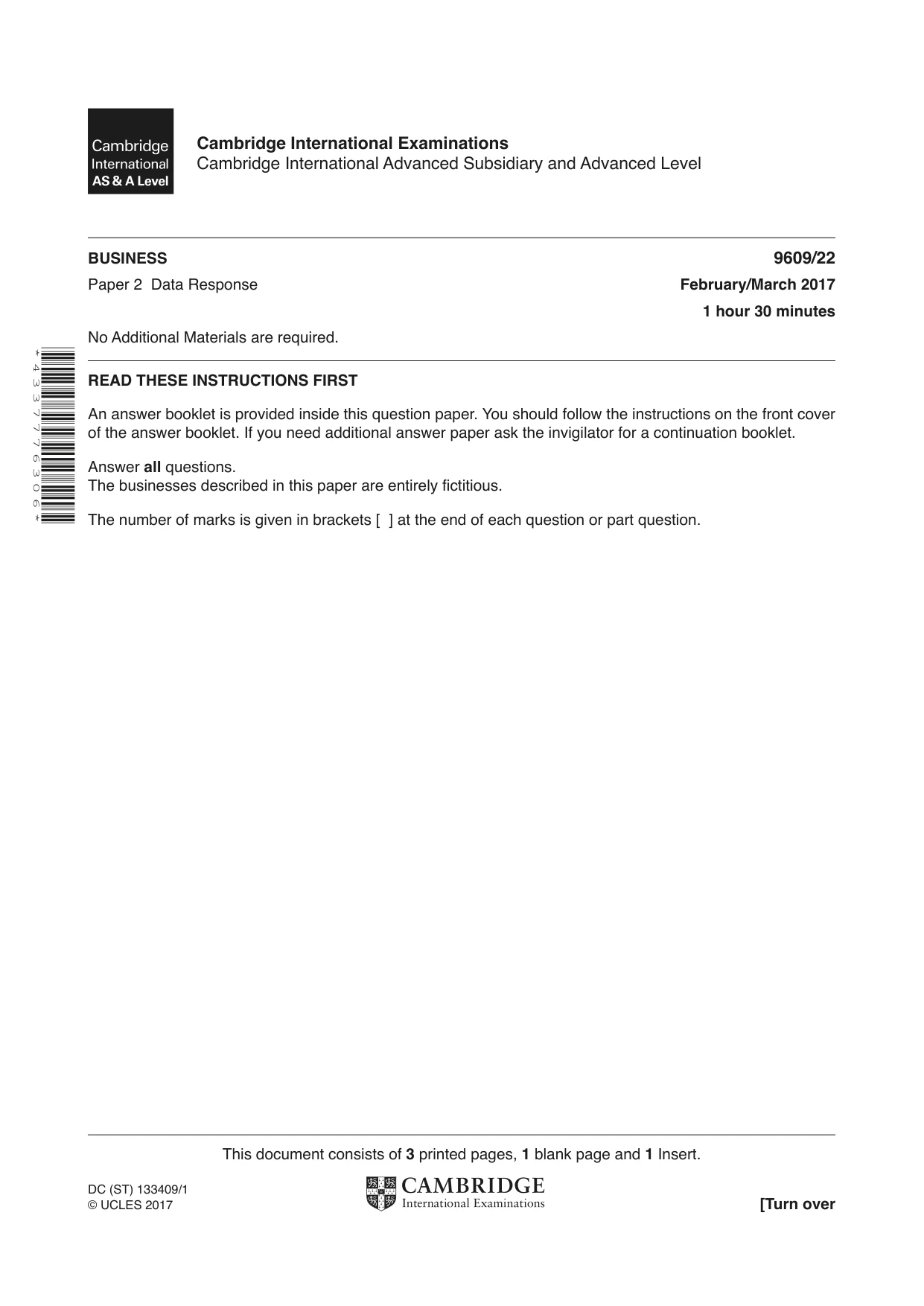
Question paper4 pages

Mark scheme11 pages
Answers below. Sit the paper first if you are practising.
Questions as text
Q1 · Gourmet Ices (GI) GI is a partnership owned by Tom and Amy Smith
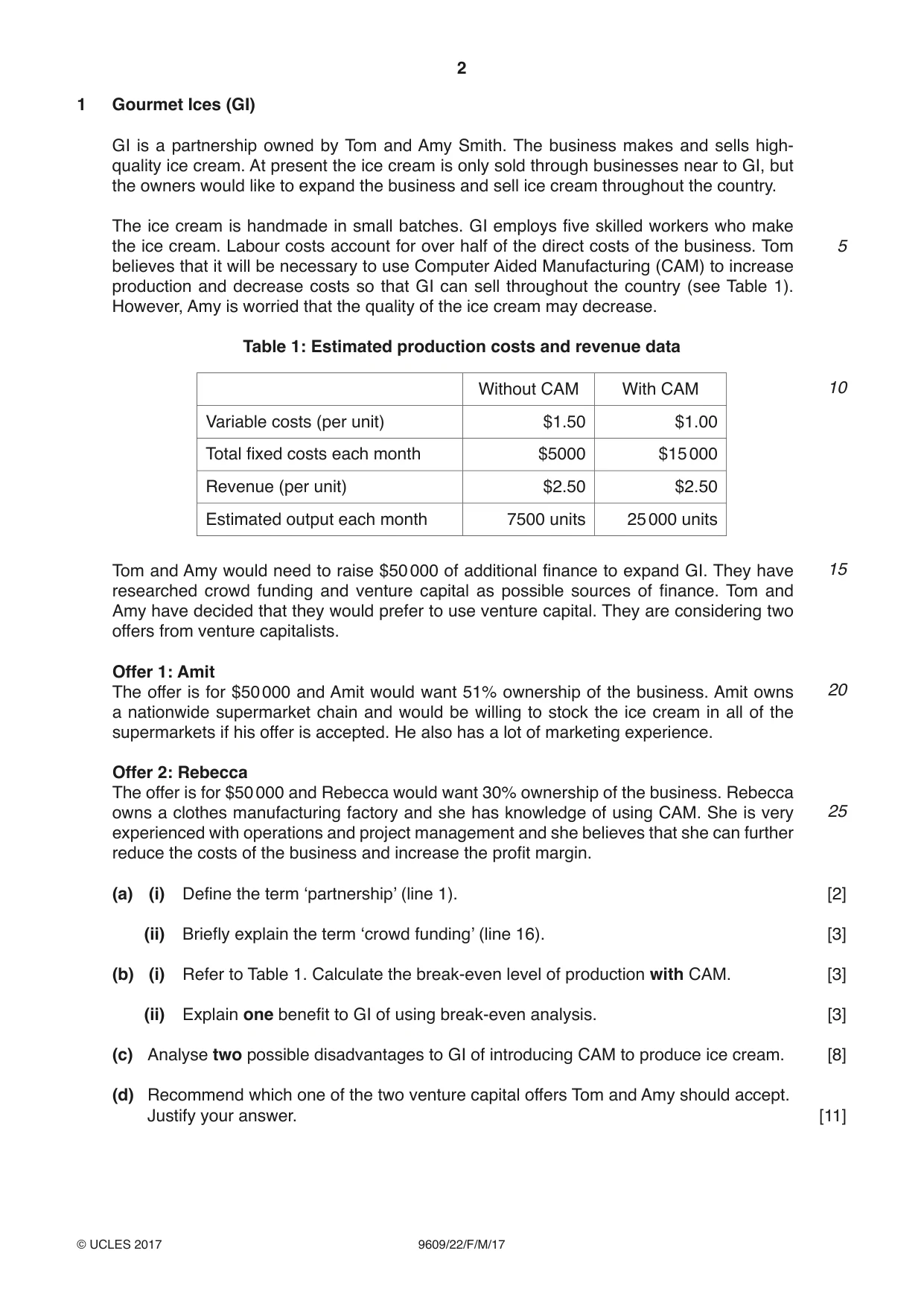
1 Gourmet Ices (GI) GI is a partnership owned by Tom and Amy Smith. The business makes and sells high- quality ice cream. At present the ice cream is only sold through businesses near to GI, but the owners would like to expand the business and sell ice cream throughout the country. The ice cream is handmade in small batches. GI employs five skilled workers who make the ice cream. Labour costs account for over half of the direct costs of the business. Tom 5 believes that it will be necessary to use Computer Aided Manufacturing (CAM) to increase production and decrease costs so that GI can sell throughout the country (see Table 1). However, Amy is worried that the quality of the ice cream may decrease. Table 1: Estimated production costs and revenue data Without CAM With CAM 10 Variable costs (per unit) $1.50 $1.00 Total fixed costs each month $5000 $15 000 Revenue (per unit) $2.50 $2.50 Estimated output each month 7500 units 25 000 units Tom and Amy would need to raise $50 000 of additional finance to expand GI. They have 15 researched crowd funding and venture capital as possible sources of finance. Tom and Amy have decided that they would prefer to use venture capital. They are considering two offers from venture capitalists. Offer 1: Amit The offer is for $50 000 and Amit would want 51% ownership of the business. Amit owns 20 a nationwide supermarket chain and would be willing to stock the ice cream in all of the supermarkets if his offer is accepted. He also has a lot of marketing experience. Offer 2: Rebecca The offer is for $50 000 and Rebecca would want 30% ownership of the business. Rebecca owns a clothes manufacturing factory and she has knowledge of using CAM. She is very 25 experienced with operations and project management and she believes that she can further reduce the costs of the business and increase the profit margin. (a) (i) Define the term ‘partnership’ (line 1). [2] (ii) Briefly explain the term ‘crowd funding’ (line 16). [3] (b) (i) Refer to Table 1. Calculate the break-even level of production with CAM. [3] (ii) Explain one benefit to GI of using break-even analysis. [3] (c) Analyse two possible disadvantages to GI of introducing CAM to produce ice cream. [8] (d) Recommend which one of the two venture capital offers Tom and Amy should accept. Justify your answer. [11]
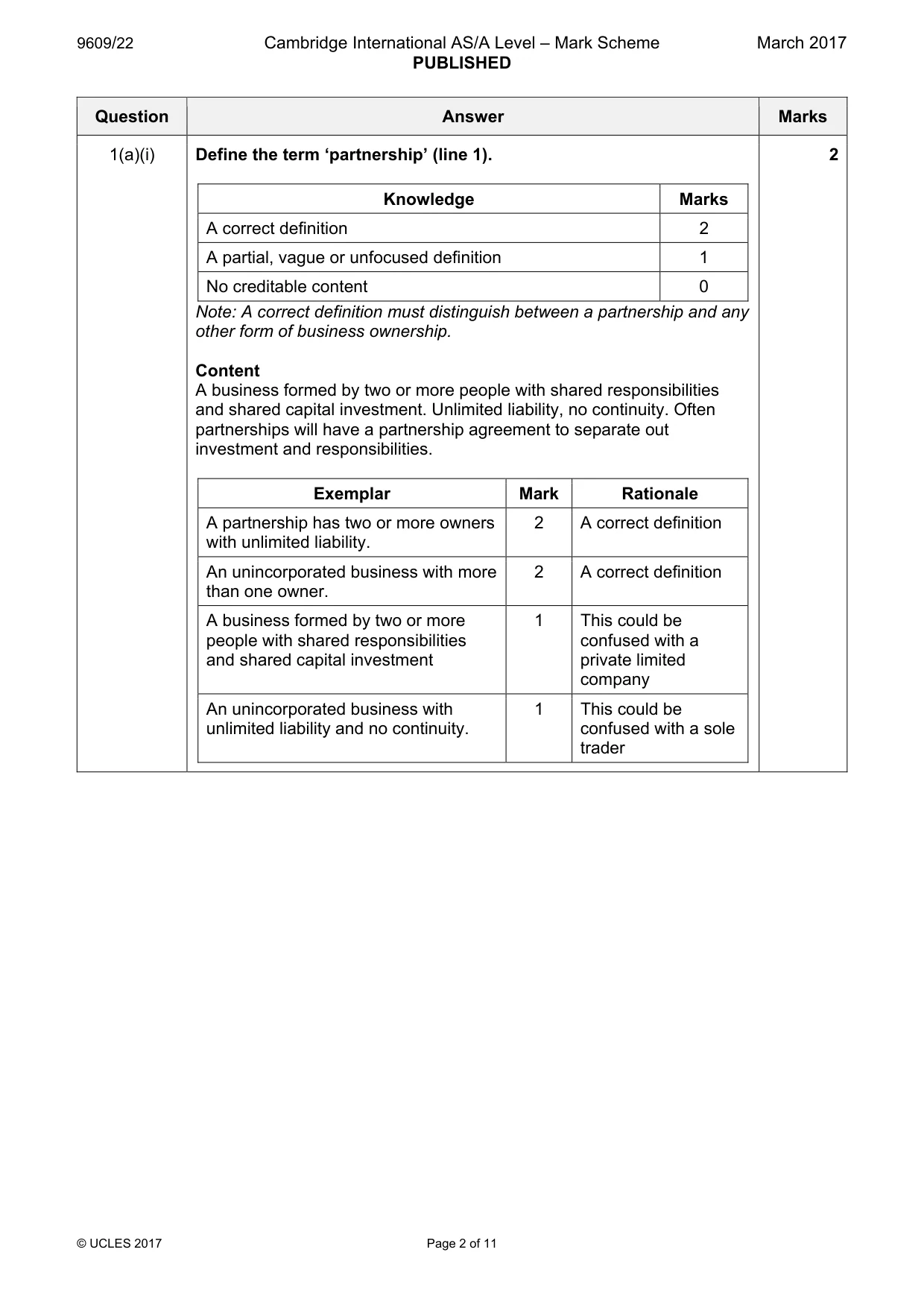
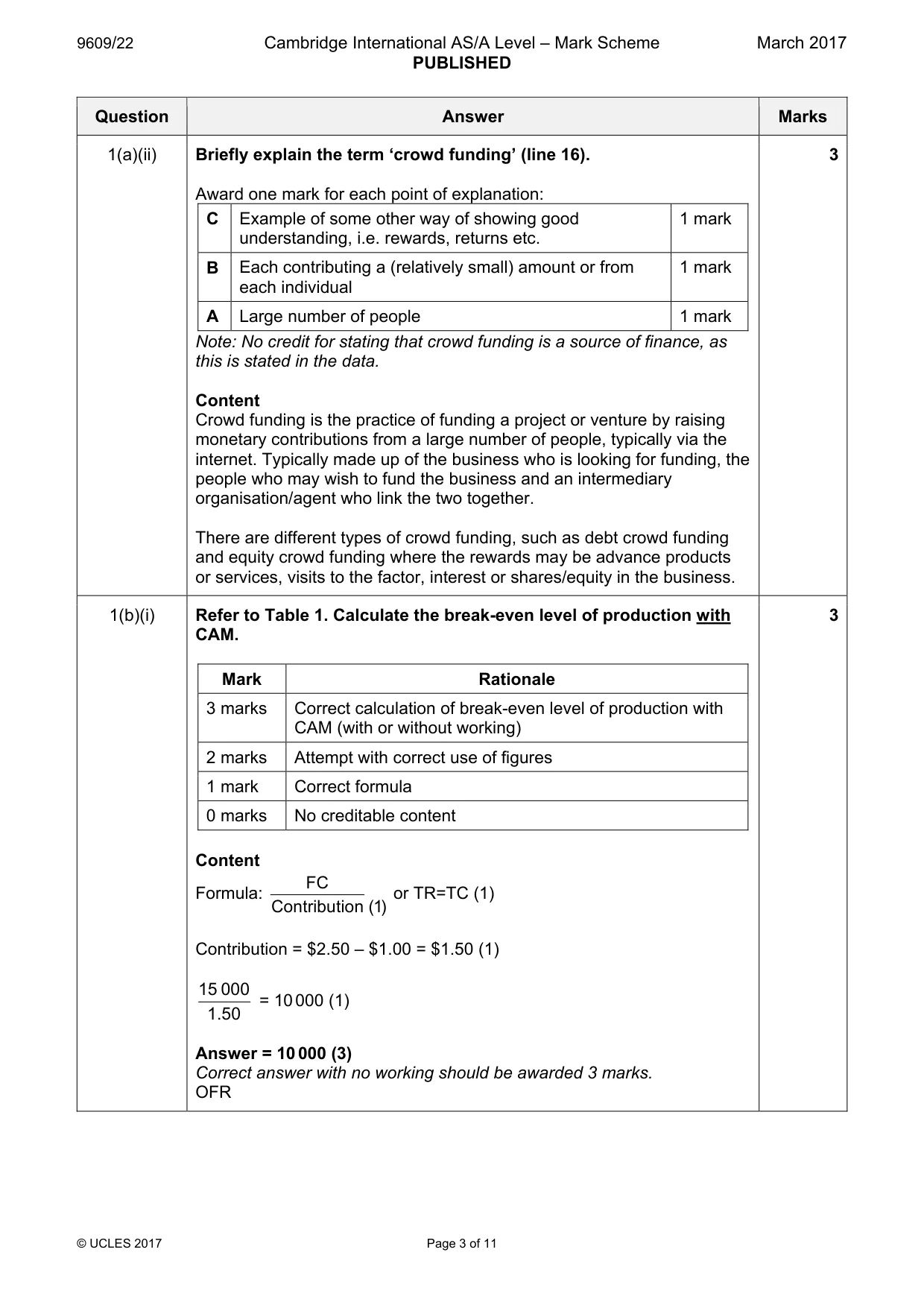
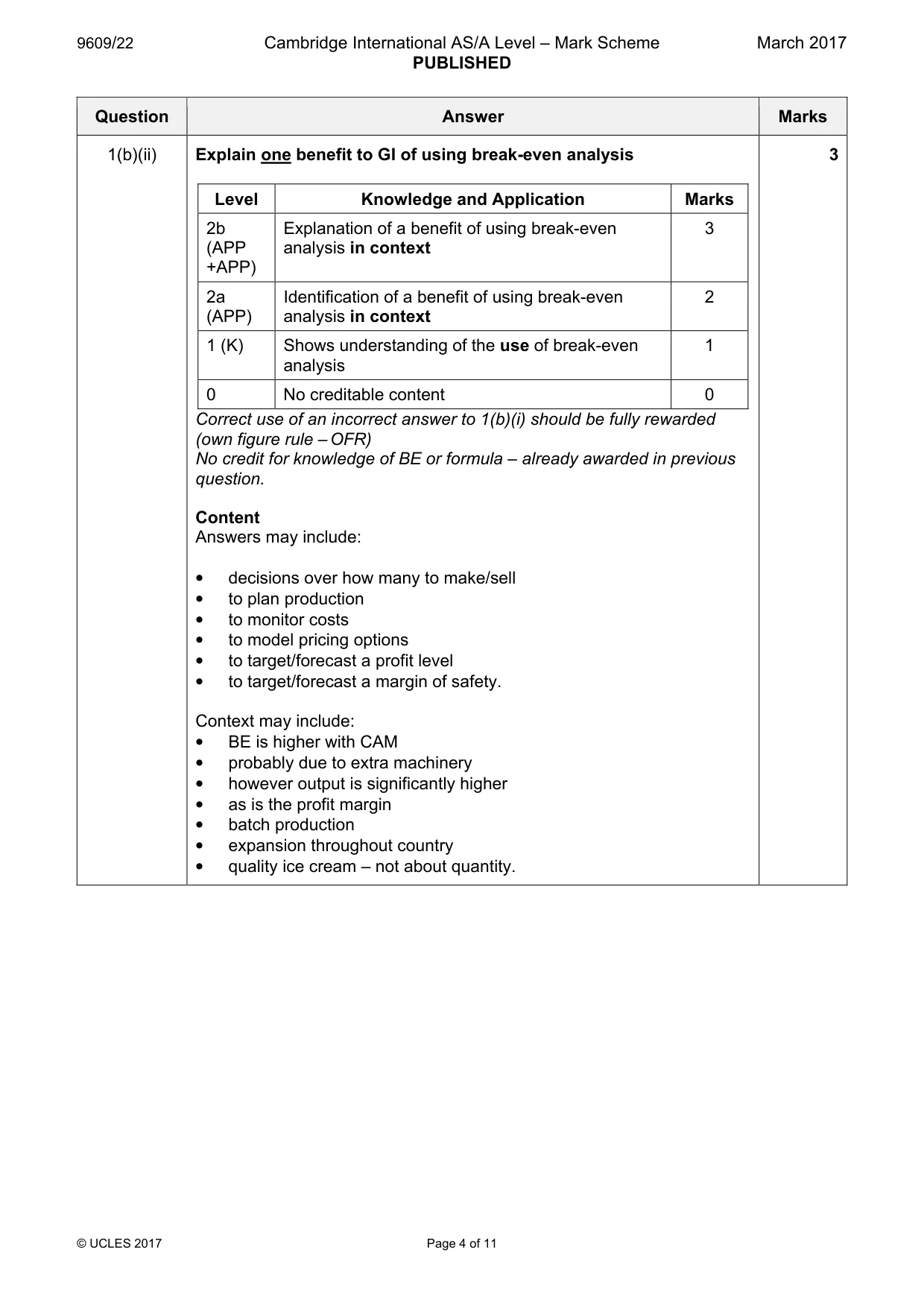
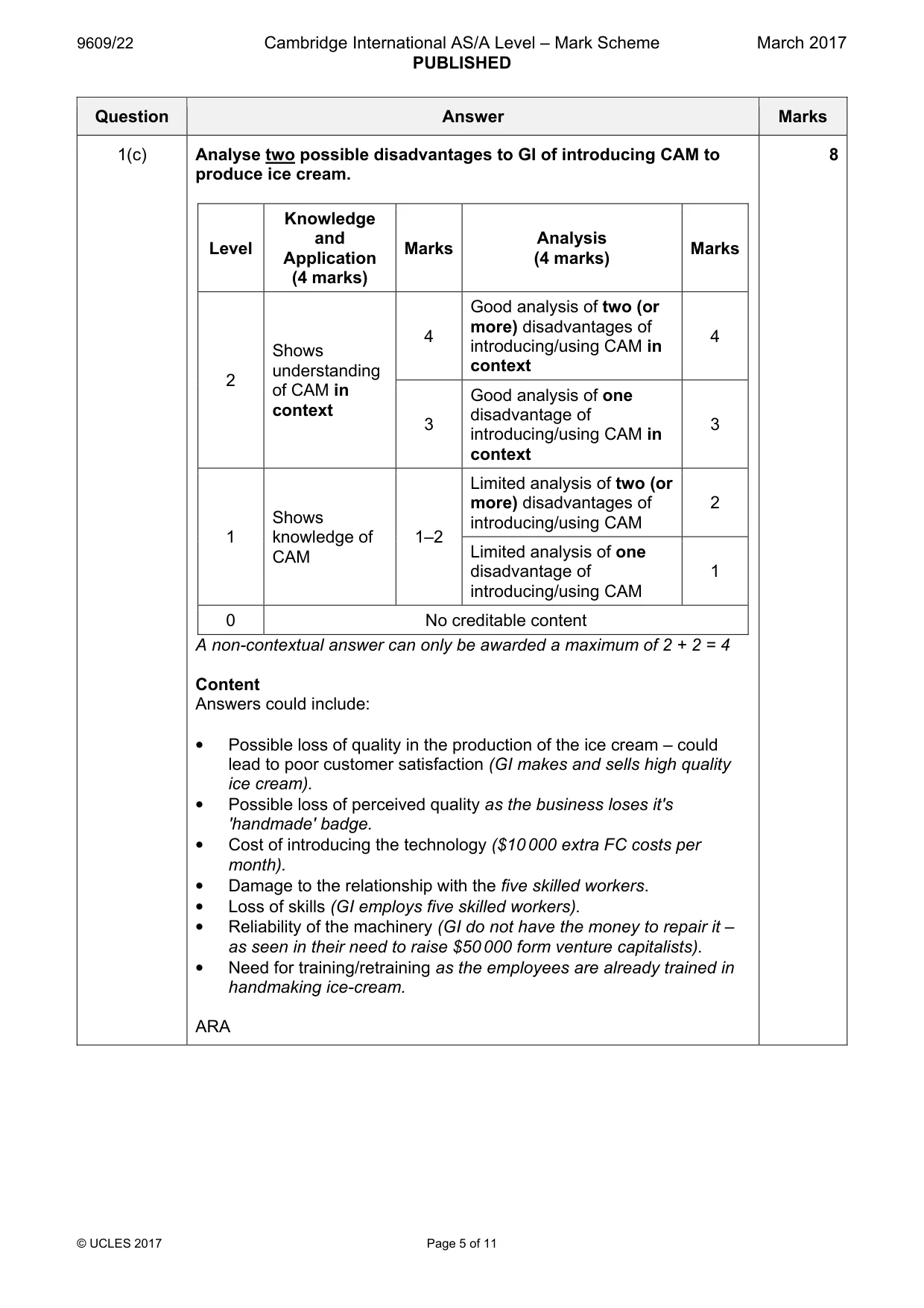
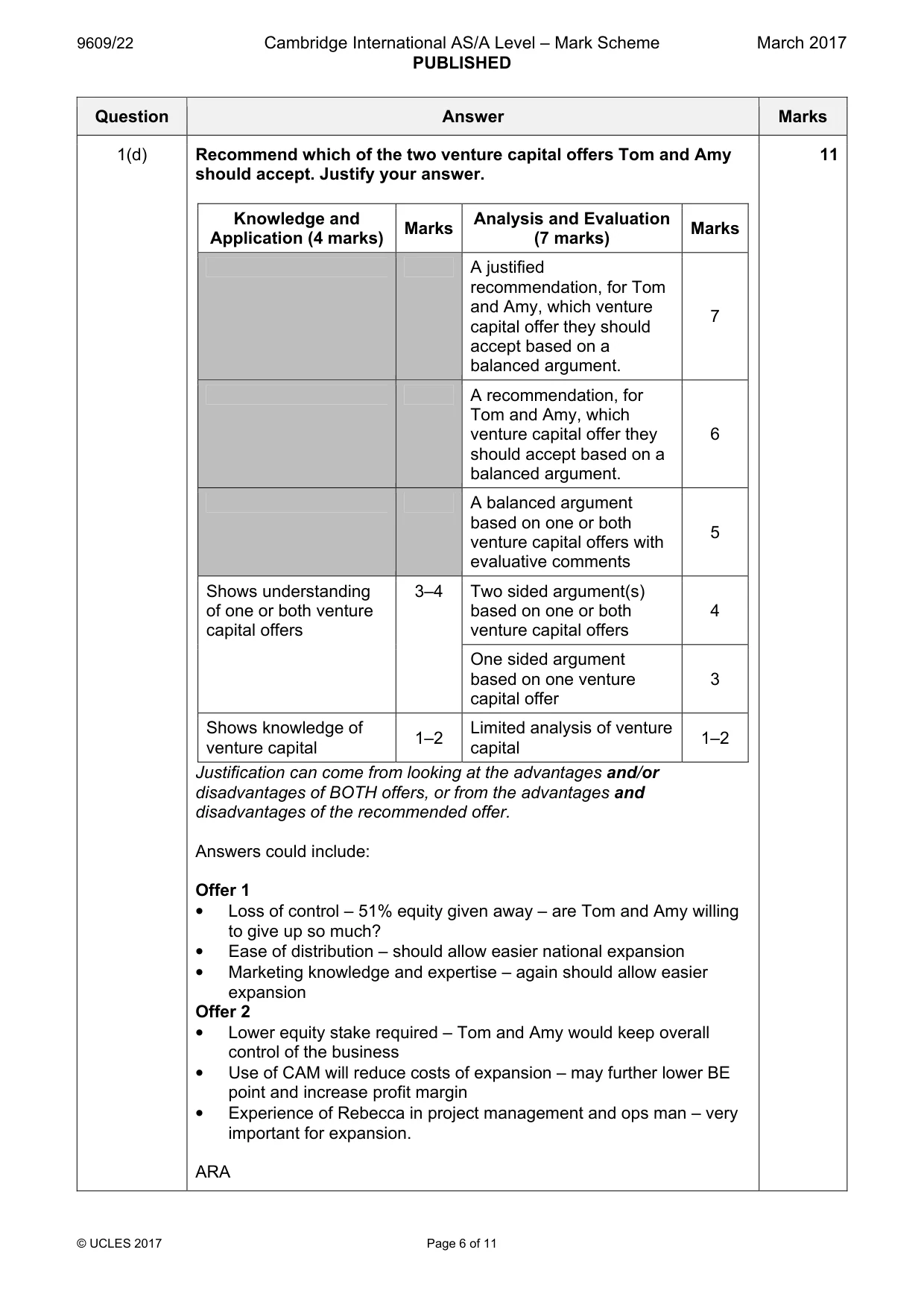
Mark scheme: Question Answer Marks 1(a)(i) Define the term ‘partnership’ (line 1). 2 Knowledge Marks A correct definition 2 A partial, vague or unfocused definition 1 No creditable content 0 Note: A correct definition must distinguish between a partnership and any other form of business ownership. Content A business formed by two or more people with shared responsibilities and shared capital investment. Unlimited liability, no continuity. Often partnerships will have a partnership agreement to separate out investment and responsibilities. Exemplar Mark Rationale A partnership has two or more owners 2 A correct definition with unlimited liability. An unincorporated business with more 2 A correct definition than one owner. A business formed by two or more 1 This could be people with shared responsibilities confused with a and shared capital investment private limited company An unincorporated business with 1 This could be unlimited liability and no continuity. confused with a sole trader 1(a)(ii) Briefly explain the term ‘crowd funding’ (line 16). 3 Award one mark for each point of explanation: C Example of some other way of showing good 1 mark understanding, i.e. rewards, returns etc. B Each contributing a (relatively small) amount or from 1 mark each individual A Large number of people 1 mark Note: No credit for stating that crowd funding is a source of finance, as this is stated in the data. Content Crowd funding is the practice of funding a project or venture by raising monetary contributions from a large number of people, typically via the internet. Typically made up of the business who is looking for funding, the people who may wish to fund the business and an intermediary organisation/agent who link the two together. There are different types of crowd funding, such as debt crowd funding and equity crowd funding where the rewards may be advance products or services, visits to the factor, interest or shares/equity in the business. 1(b)(i) Refer to Table 1. Calculate the break-even level of production with 3 CAM. Mark Rationale 3 marks Correct calculation of break-even level of production with CAM (with or without working) 2 marks Attempt with correct use of figures 1 mark Correct formula 0 marks No creditable content Content FC Formula: or TR=TC (1) Contribution (1) Contribution = $2.50 – $1.00 = $1.50 (1) 15 000 = 10 000 (1) 1.50 Answer = 10 000 (3) Correct answer with no working should be awarded 3 marks. OFR 1(b)(ii) Explain one benefit to GI of using break-even analysis 3 Level Knowledge and Application Marks 2b Explanation of a benefit of using break-even 3 (APP analysis in context +APP) 2a Identification of a benefit of using break-even 2 (APP) analysis in context 1 (K) Shows understanding of the use of break-even 1 analysis 0 No creditable content 0 Correct use of an incorrect answer to 1(b)(i) should be fully rewarded (own figure rule – OFR) No credit for knowledge of BE or formula – already awarded in previous question. Content Answers may include: • decisions over how many to make/sell • to plan production • to monitor costs • to model pricing options • to target/forecast a profit level • to target/forecast a margin of safety. Context may include: • BE is higher with CAM • probably due to extra machinery • however output is significantly higher • as is the profit margin • batch production • expansion throughout country • quality ice cream – not about quantity. 1(c) Analyse two possible disadvantages to GI of introducing CAM to 8 produce ice cream. Knowledge and Analysis Level Marks Marks Application (4 marks) (4 marks) Good analysis of two (or more) disadvantages of 4 4 introducing/using CAM in Shows context understanding 2 of CAM in Good analysis of one context disadvantage of 3 3 introducing/using CAM in context Limited analysis of two (or more) disadvantages of 2 Shows introducing/using CAM 1 knowledge of 1–2 Limited analysis of one CAM disadvantage of 1 introducing/using CAM 0 No creditable content A non-contextual answer can only be awarded a maximum of 2 + 2 = 4 Content Answers could include: • Possible loss of quality in the production of the ice cream – could lead to poor customer satisfaction (GI makes and sells high quality ice cream). • Possible loss of perceived quality as the business loses it's 'handmade' badge. • Cost of introducing the technology ($10 000 extra FC costs per month). • Damage to the relationship with the five skilled workers. • Loss of skills (GI employs five skilled workers). • Reliability of the machinery (GI do not have the money to repair it – as seen in their need to raise $50 000 form venture capitalists). • Need for training/retraining as the employees are already trained in handmaking ice-cream. ARA 1(d) Recommend which of the two venture capital offers Tom and Amy 11 should accept. Justify your answer. Knowledge and Analysis and Evaluation Marks Marks Application (4 marks) (7 marks) A justified recommendation, for Tom and Amy, which venture 7 capital offer they should accept based on a balanced argument. A recommendation, for Tom and Amy, which venture capital offer they 6 should accept based on a balanced argument. A balanced argument based on one or both 5 venture capital offers with evaluative comments Shows understanding 3–4 Two sided argument(s) of one or both venture based on one or both 4 capital offers venture capital offers One sided argument based on one venture 3 capital offer Shows knowledge of Limited analysis of venture 1–2 1–2 venture capital capital Justification can come from looking at the advantages and/or disadvantages of BOTH offers, or from the advantages and disadvantages of the recommended offer. Answers could include: Offer 1 • Loss of control – 51% equity given away – are Tom and Amy willing to give up so much? • Ease of distribution – should allow easier national expansion • Marketing knowledge and expertise – again should allow easier expansion Offer 2 • Lower equity stake required – Tom and Amy would keep overall control of the business • Use of CAM will reduce costs of expansion – may further lower BE point and increase profit margin • Experience of Rebecca in project management and ops man – very important for expansion. ARA
Q2 · Clean and Tidy (CT) CT is an employee-owned business that specialises in cleaning homes
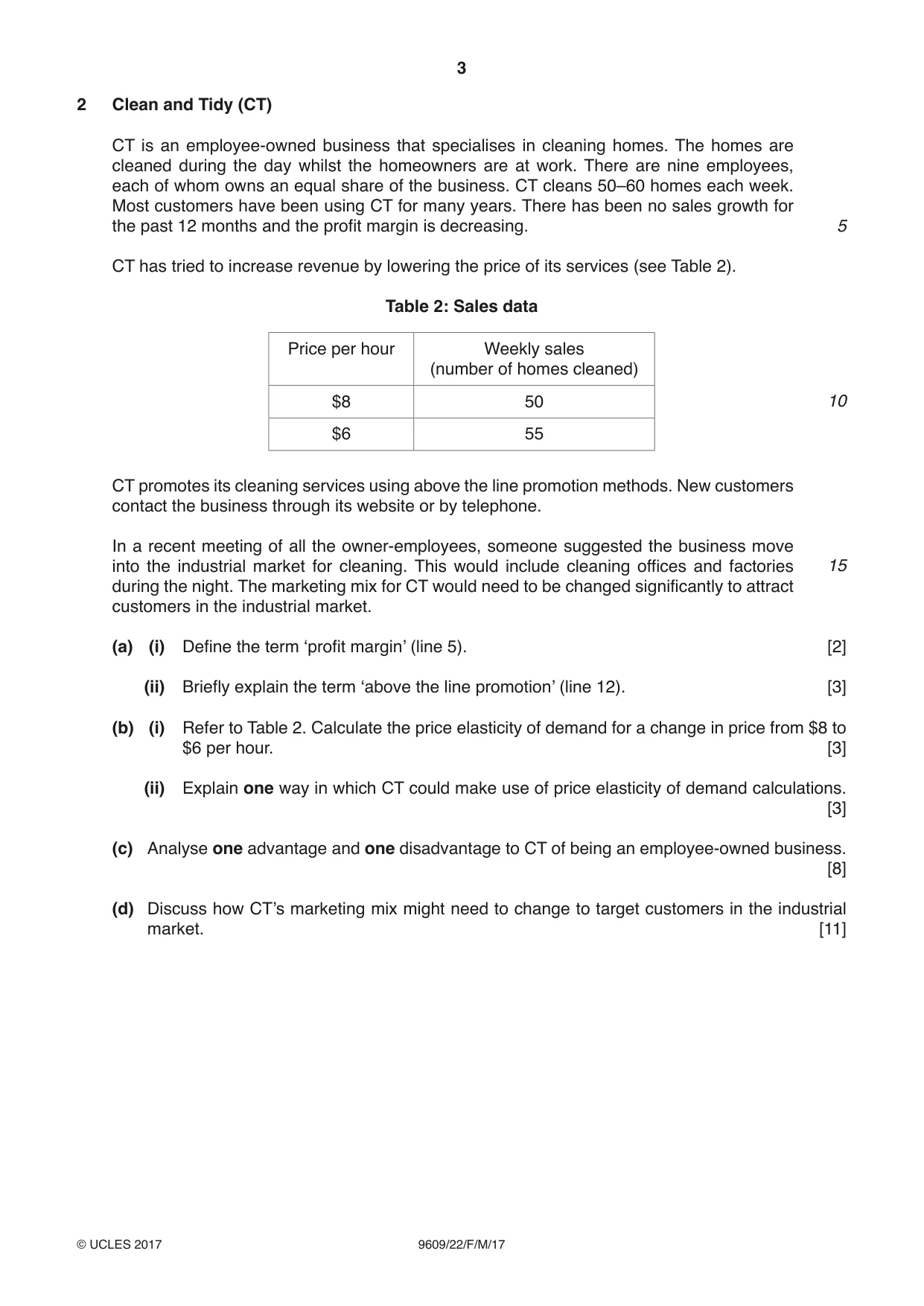
2 Clean and Tidy (CT) CT is an employee-owned business that specialises in cleaning homes. The homes are cleaned during the day whilst the homeowners are at work. There are nine employees, each of whom owns an equal share of the business. CT cleans 50–60 homes each week. Most customers have been using CT for many years. There has been no sales growth for the past 12 months and the profit margin is decreasing. 5 CT has tried to increase revenue by lowering the price of its services (see Table 2). Table 2: Sales data Price per hour Weekly sales (number of homes cleaned) $8 50 10 $6 55 CT promotes its cleaning services using above the line promotion methods. New customers contact the business through its website or by telephone. In a recent meeting of all the owner-employees, someone suggested the business move into the industrial market for cleaning. This would include cleaning offices and factories 15 during the night. The marketing mix for CT would need to be changed significantly to attract customers in the industrial market. (a) (i) Define the term ‘profit margin’ (line 5). [2] (ii) Briefly explain the term ‘above the line promotion’ (line 12). [3] (b) (i) Refer to Table 2. Calculate the price elasticity of demand for a change in price from $8 to $6 per hour. [3] (ii) Explain one way in which CT could make use of price elasticity of demand calculations. [3] (c) Analyse one advantage and one disadvantage to CT of being an employee-owned business. [8] (d) Discuss how CT’s marketing mix might need to change to target customers in the industrial market. [11]
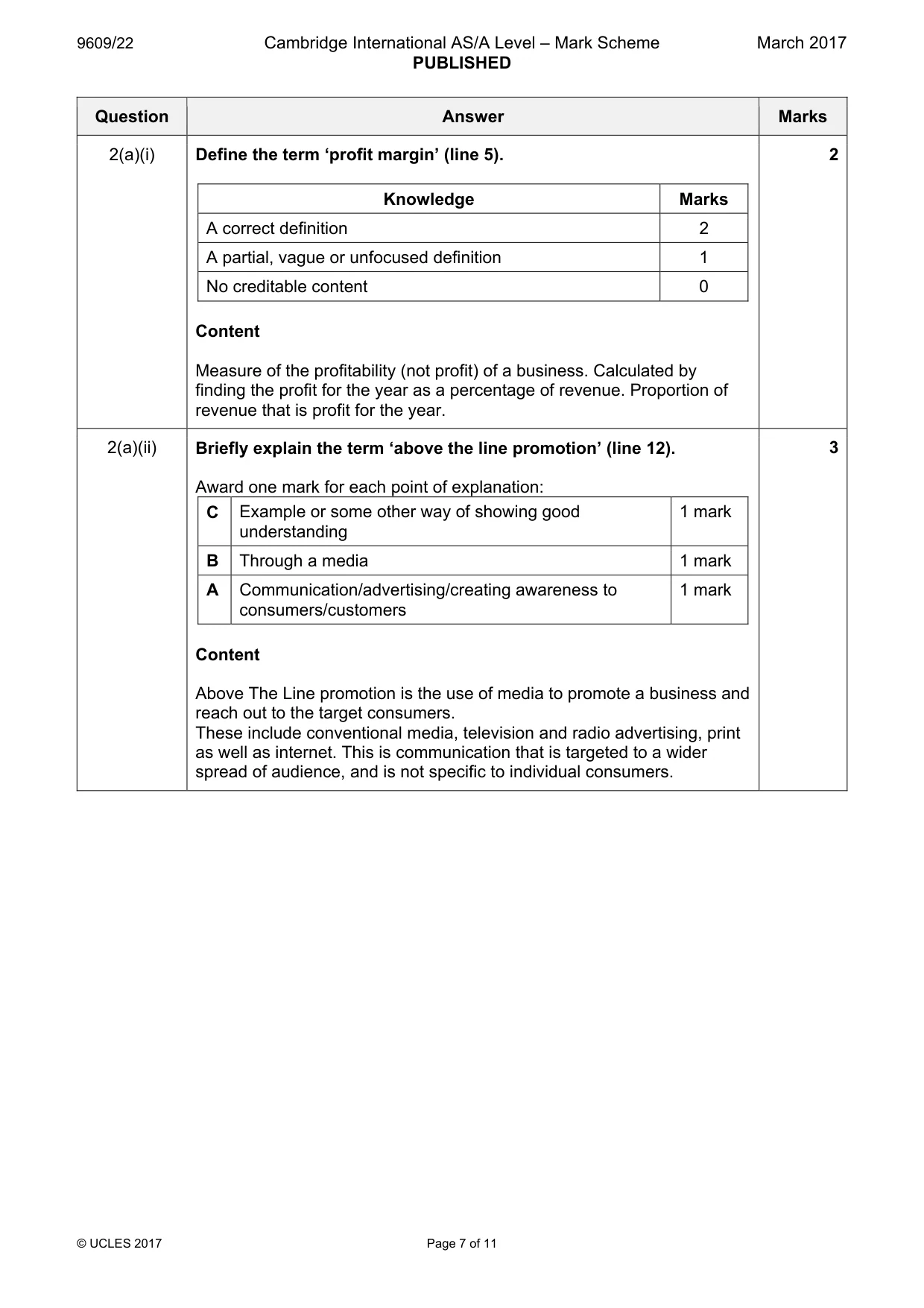
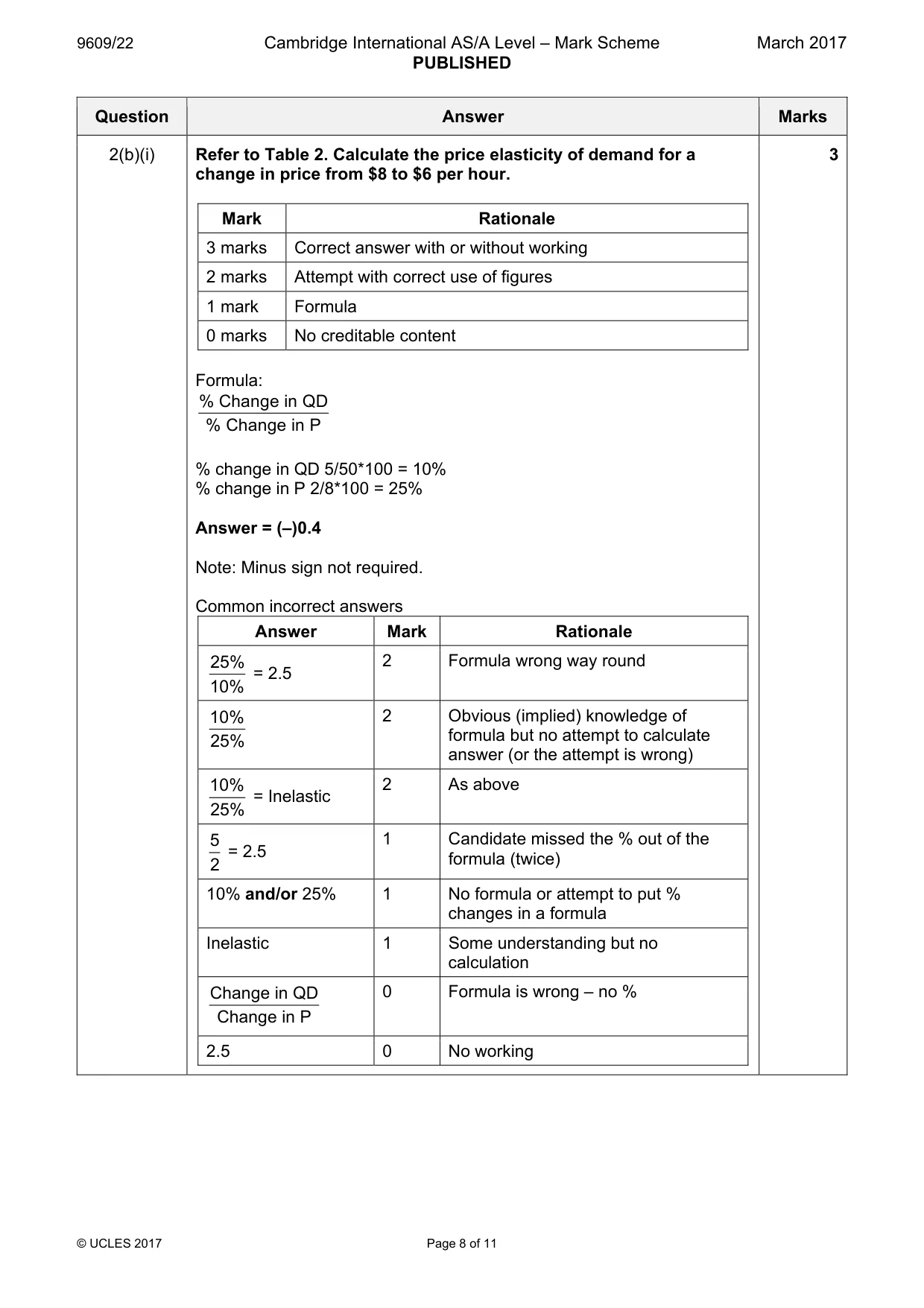
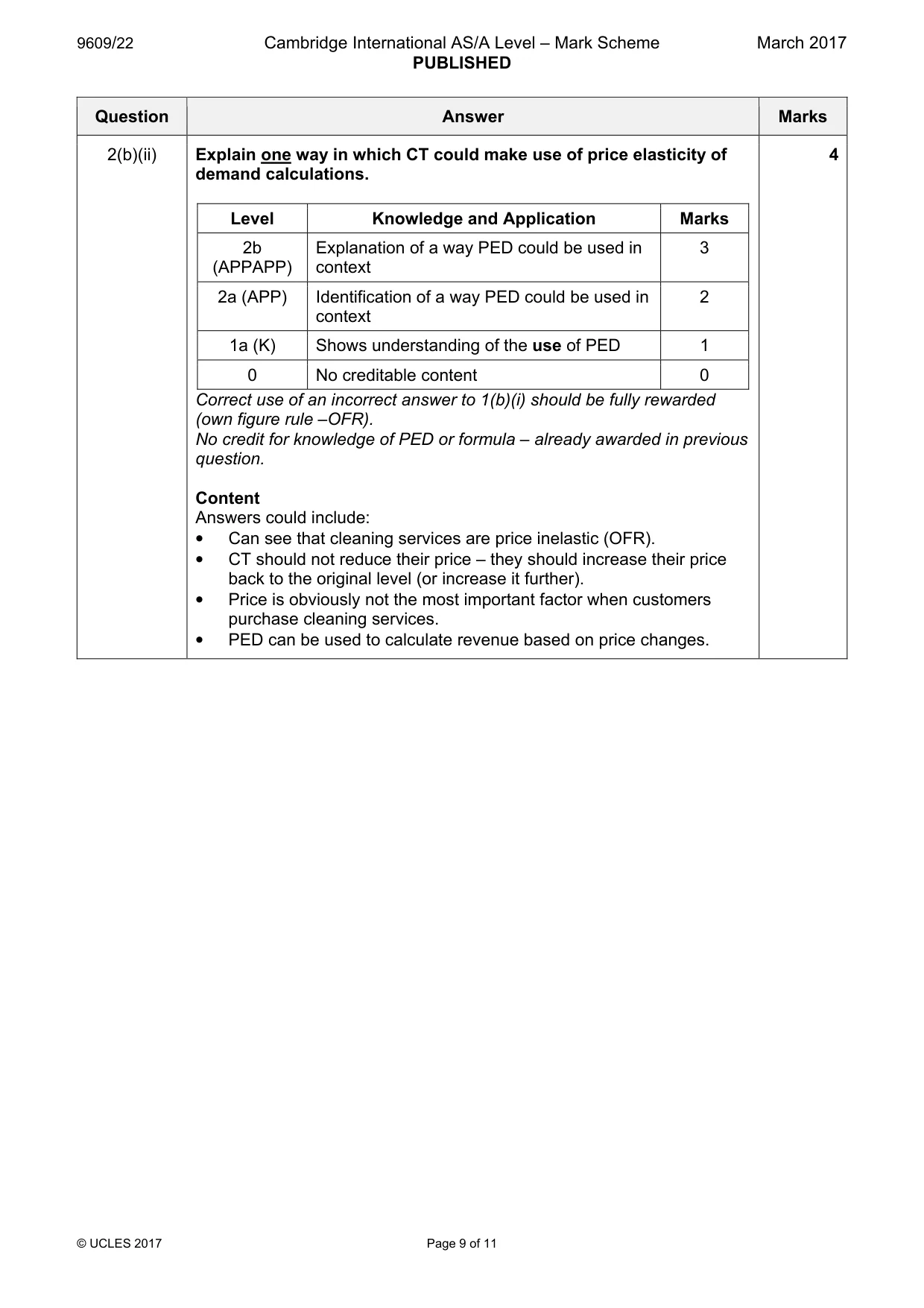
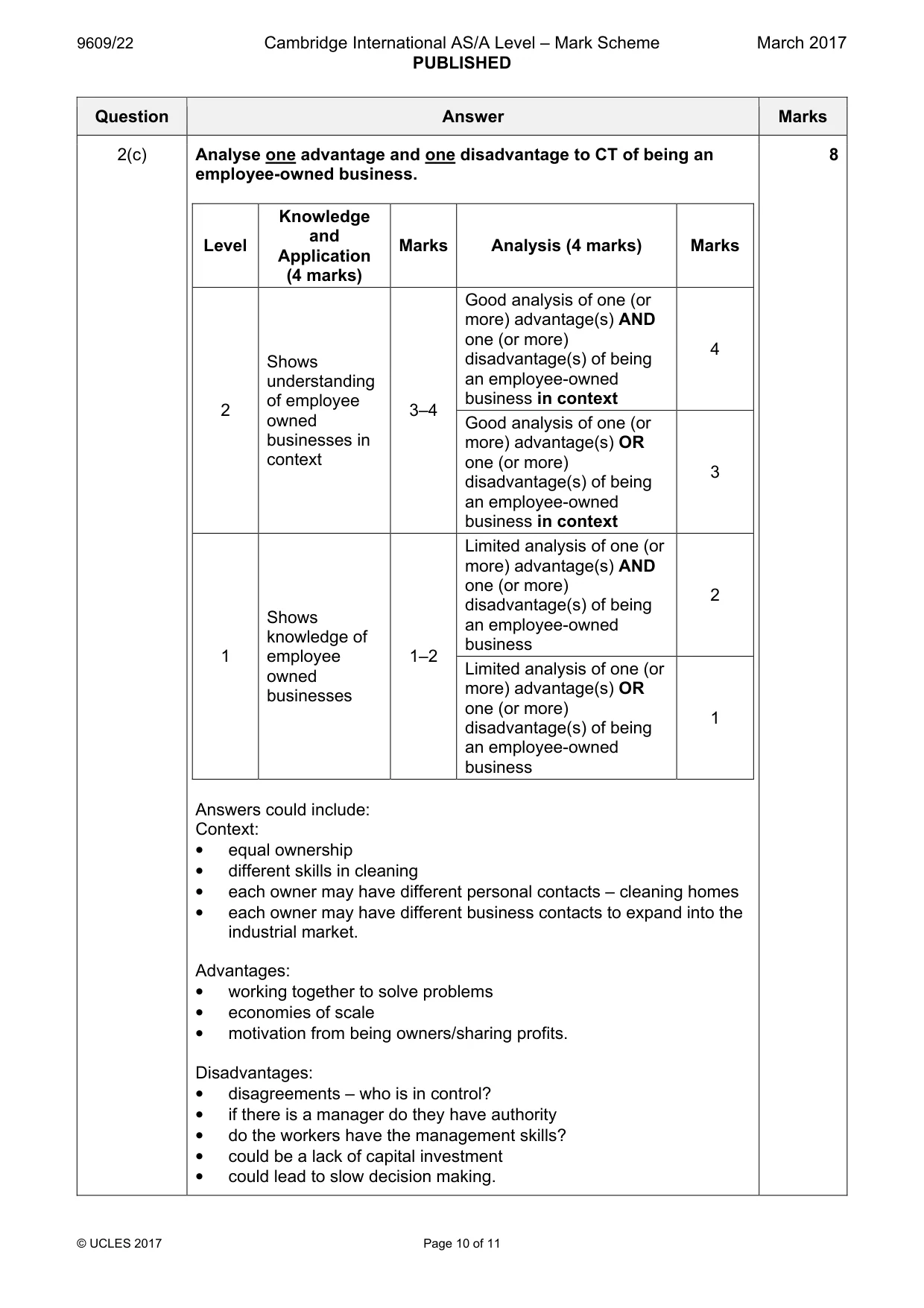
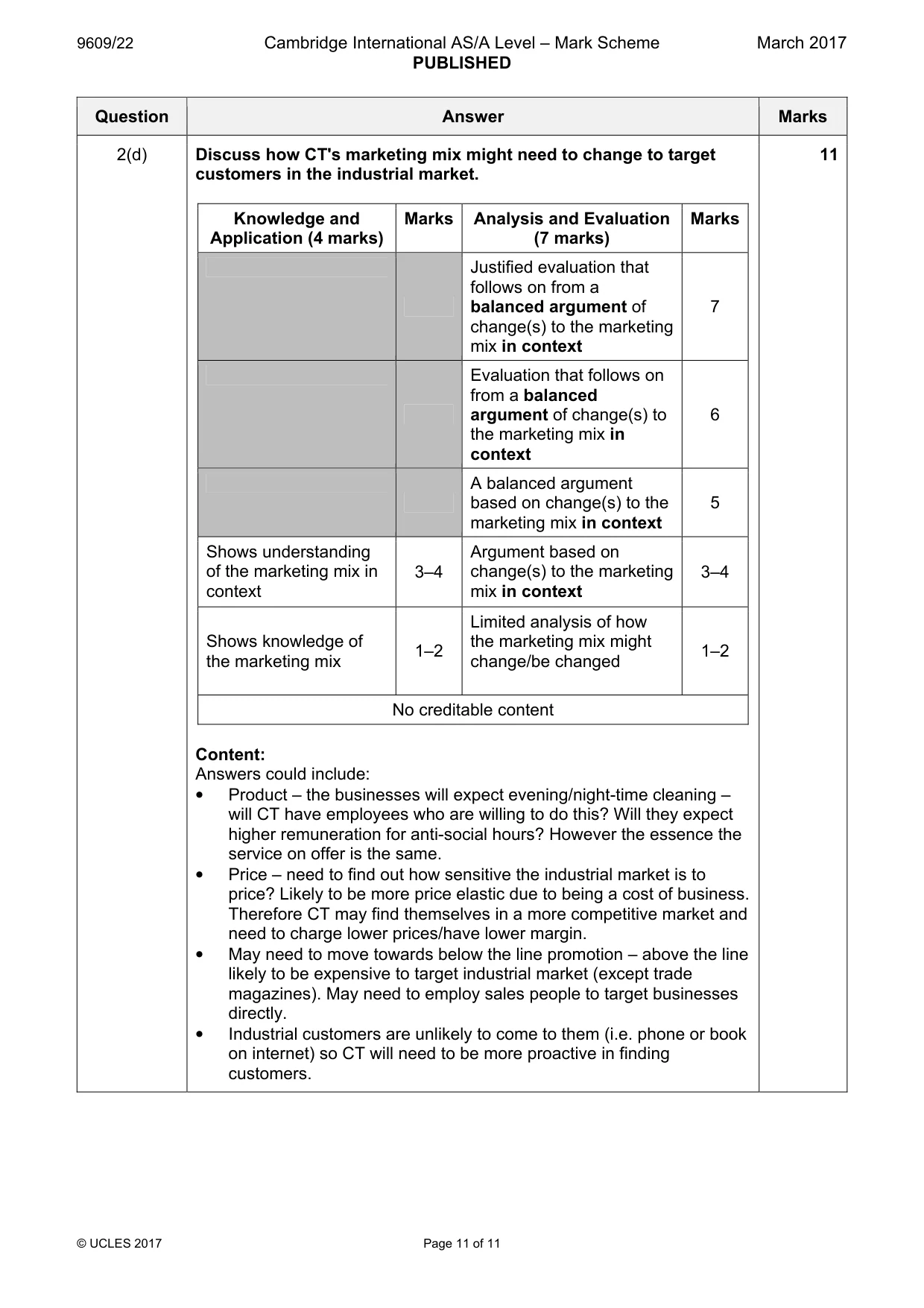
Mark scheme: 2(a)(i) Define the term ‘profit margin’ (line 5). 2 Knowledge Marks A correct definition 2 A partial, vague or unfocused definition 1 No creditable content 0 Content Measure of the profitability (not profit) of a business. Calculated by finding the profit for the year as a percentage of revenue. Proportion of revenue that is profit for the year. 2(a)(ii) Briefly explain the term ‘above the line promotion’ (line 12). 3 Award one mark for each point of explanation: C Example or some other way of showing good 1 mark understanding B Through a media 1 mark A Communication/advertising/creating awareness to 1 mark consumers/customers Content Above The Line promotion is the use of media to promote a business and reach out to the target consumers. These include conventional media, television and radio advertising, print as well as internet. This is communication that is targeted to a wider spread of audience, and is not specific to individual consumers. 2(b)(i) Refer to Table 2. Calculate the price elasticity of demand for a 3 change in price from $8 to $6 per hour. Mark Rationale 3 marks Correct answer with or without working 2 marks Attempt with correct use of figures 1 mark Formula 0 marks No creditable content Formula: % Change in QD % Change in P % change in QD 5/50*100 = 10% % change in P 2/8*100 = 25% Answer = (–)0.4 Note: Minus sign not required. Common incorrect answers Answer Mark Rationale 25% 2 Formula wrong way round = 2.5 10% 10% 2 Obvious (implied) knowledge of formula but no attempt to calculate 25% answer (or the attempt is wrong) 10% 2 As above = Inelastic 25% 5 1 Candidate missed the % out of the = 2.5 formula (twice) 2 10% and/or 25% 1 No formula or attempt to put % changes in a formula Inelastic 1 Some understanding but no calculation Change in QD 0 Formula is wrong – no % Change in P 2.5 0 No working 2(b)(ii) Explain one way in which CT could make use of price elasticity of 4 demand calculations. Level Knowledge and Application Marks 2b Explanation of a way PED could be used in 3 (APPAPP) context 2a (APP) Identification of a way PED could be used in 2 context 1a (K) Shows understanding of the use of PED 1 0 No creditable content 0 Correct use of an incorrect answer to 1(b)(i) should be fully rewarded (own figure rule –OFR). No credit for knowledge of PED or formula – already awarded in previous question. Content Answers could include: • Can see that cleaning services are price inelastic (OFR). • CT should not reduce their price – they should increase their price back to the original level (or increase it further). • Price is obviously not the most important factor when customers purchase cleaning services. • PED can be used to calculate revenue based on price changes. 2(c) Analyse one advantage and one disadvantage to CT of being an 8 employee-owned business. Knowledge and Level Marks Analysis (4 marks) Marks Application (4 marks) Good analysis of one (or more) advantage(s) AND one (or more) 4 Shows disadvantage(s) of being understanding an employee-owned of employee business in context 2 3–4 owned Good analysis of one (or businesses in more) advantage(s) OR context one (or more) 3 disadvantage(s) of being an employee-owned business in context Limited analysis of one (or more) advantage(s) AND one (or more) 2 disadvantage(s) of being Shows an employee-owned knowledge of business 1 employee 1–2 Limited analysis of one (or owned more) advantage(s) OR businesses one (or more) 1 disadvantage(s) of being an employee-owned business Answers could include: Context: • equal ownership • different skills in cleaning • each owner may have different personal contacts – cleaning homes • each owner may have different business contacts to expand into the industrial market. Advantages: • working together to solve problems • economies of scale • motivation from being owners/sharing profits. Disadvantages: • disagreements – who is in control? • if there is a manager do they have authority • do the workers have the management skills? • could be a lack of capital investment • could lead to slow decision making. 2(d) Discuss how CT's marketing mix might need to change to target 11 customers in the industrial market. Knowledge and Marks Analysis and Evaluation Marks Application (4 marks) (7 marks) Justified evaluation that follows on from a balanced argument of 7 change(s) to the marketing mix in context Evaluation that follows on from a balanced argument of change(s) to 6 the marketing mix in context A balanced argument based on change(s) to the 5 marketing mix in context Shows understanding Argument based on of the marketing mix in 3–4 change(s) to the marketing 3–4 context mix in context Limited analysis of how Shows knowledge of the marketing mix might 1–2 1–2 the marketing mix change/be changed No creditable content Content: Answers could include: • Product – the businesses will expect evening/night-time cleaning – will CT have employees who are willing to do this? Will they expect higher remuneration for anti-social hours? However the essence the service on offer is the same. • Price – need to find out how sensitive the industrial market is to price? Likely to be more price elastic due to being a cost of business. Therefore CT may find themselves in a more competitive market and need to charge lower prices/have lower margin. • May need to move towards below the line promotion – above the line likely to be expensive to target industrial market (except trade magazines). May need to employ sales people to target businesses directly. • Industrial customers are unlikely to come to them (i.e. phone or book on internet) so CT will need to be more proactive in finding customers.
What was in this paper
The subtopics covered by these 2 questions, and how many questions each got. Open one in a new tab to see every Cambridge question on it.
What you needed in this session
Cambridge’s own grade thresholds for 2017 Feb/March, Paper 2 · Variant 2. A higher threshold means an easier paper — the bar moves with how the cohort did.