Cambridge A Level Business (for first examination in 2016) 9609 — 2016 Oct/Nov Paper 2 · Variant 2
9609/22/O/N/16 · 60 marks · ≈68 min
The question paper and its mark scheme, free to read here and free to download. This is Cambridge’s own paper, exactly as it was sat.
Question paper4 pages

Mark scheme13 pages
Answers below. Sit the paper first if you are practising.
Paper as text
Question paper, page 1
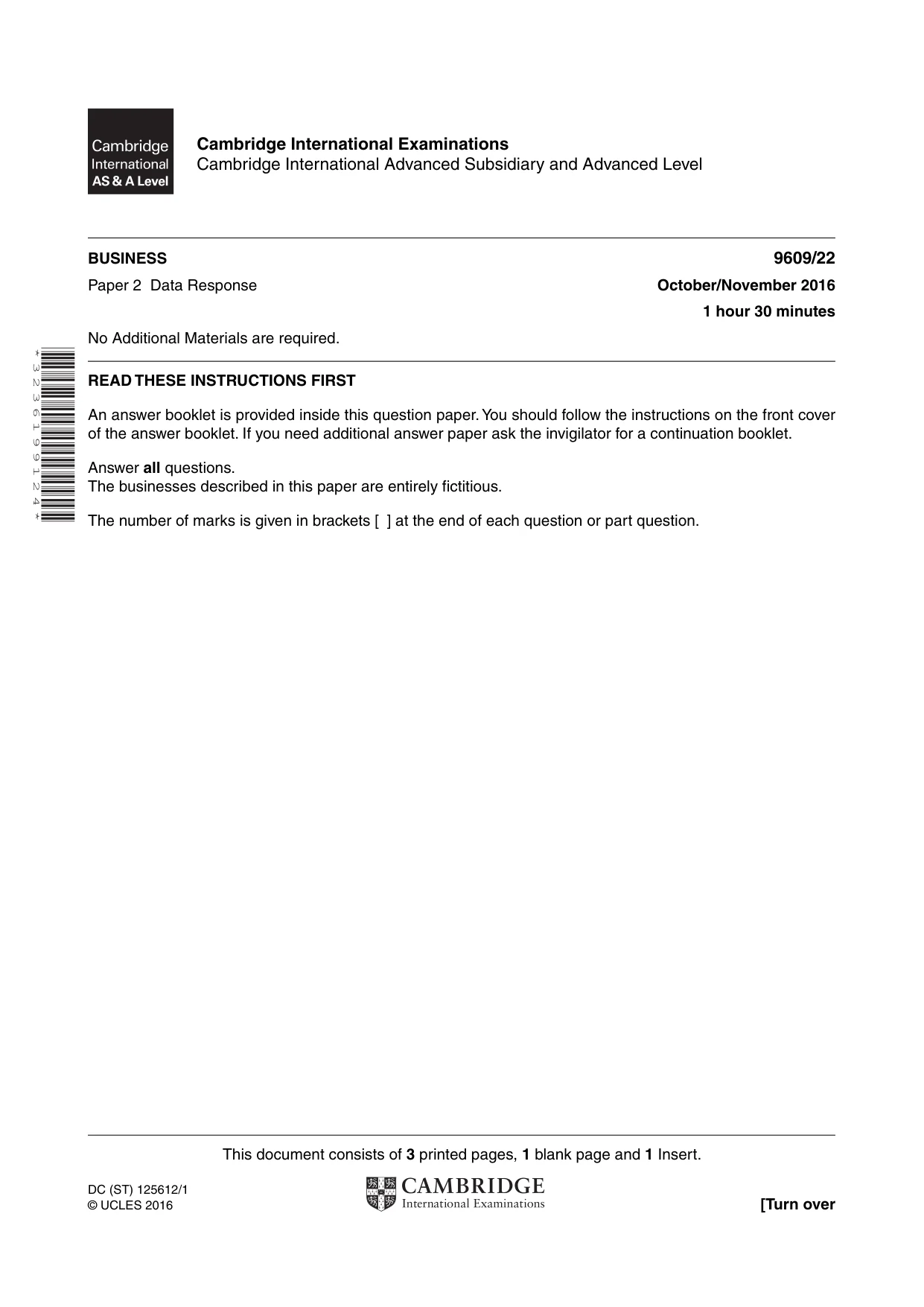
This document consists of 3 printed pages, 1 blank page and 1 Insert. DC (ST) 125612/1 © UCLES 2016 [Turn over Cambridge International Examinations Cambridge International Advanced Subsidiary and Advanced Level * 3 2 3 6 1 9 9 1 2 4 * BUSINESS 9609/22 Paper 2 Data Response October/November 2016 1 hour 30 minutes No Additional Materials are required. READ THESE INSTRUCTIONS FIRST An answer booklet is provided inside this question paper. You should follow the instructions on the front cover of the answer booklet. If you need additional answer paper ask the invigilator for a continuation booklet. Answer all questions. The businesses described in this paper are entirely fictitious. The number of marks is given in brackets [ ] at the end of each question or part question.
Question paper, page 2
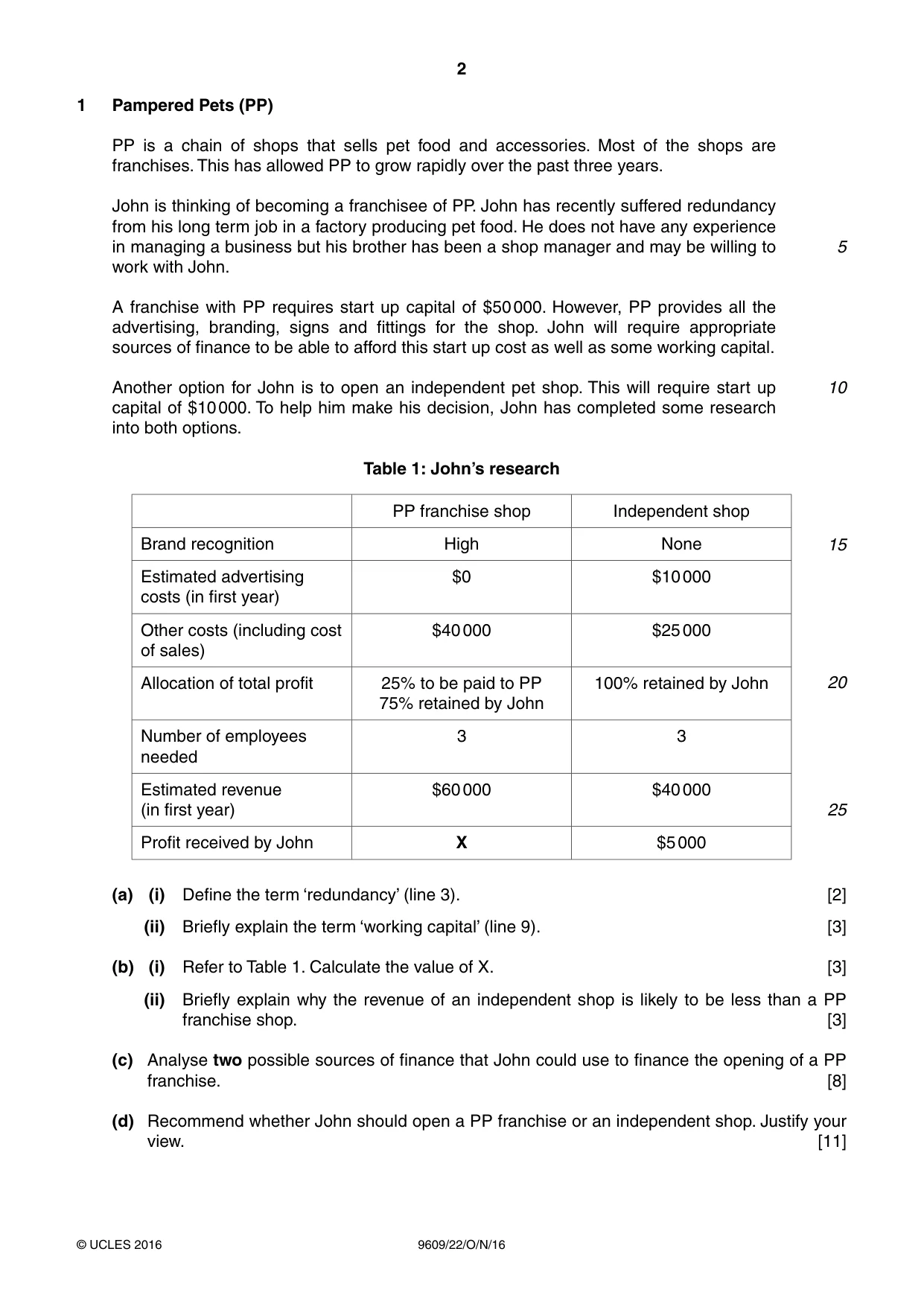
2 9609/22/O/N/16 © UCLES 2016 1 Pampered Pets (PP) PP is a chain of shops that sells pet food and accessories. Most of the shops are franchises. This has allowed PP to grow rapidly over the past three years. John is thinking of becoming a franchisee of PP. John has recently suffered redundancy from his long term job in a factory producing pet food. He does not have any experience in managing a business but his brother has been a shop manager and may be willing to work with John. A franchise with PP requires start up capital of $50 000. However, PP provides all the advertising, branding, signs and fittings for the shop. John will require appropriate sources of finance to be able to afford this start up cost as well as some working capital. Another option for John is to open an independent pet shop. This will require start up capital of $10 000. To help him make his decision, John has completed some research into both options. Table 1: John’s research PP franchise shop Independent shop Brand recognition High None Estimated advertising costs (in first year) $0 $10 000 Other costs (including cost of sales) $40 000 $25 000 Allocation of total profit 25% to be paid to PP 75% retained by John 100% retained by John Number of employees needed 3 3 Estimated revenue (in first year) $60 000 $40 000 Profit received by John X $5 000 (a) (i) Define the term ‘redundancy’ (line 3). [2] (ii) Briefly explain the term ‘working capital’ (line 9). [3] (b) (i) Refer to Table 1. Calculate the value of X. [3] (ii) Briefly explain why the revenue of an independent shop is likely to be less than a PP franchise shop. [3] (c) Analyse two possible sources of finance that John could use to finance the opening of a PP franchise. [8] (d) Recommend whether John should open a PP franchise or an independent shop. Justify your view. [11] 5 10 15 20 25
Question paper, page 3
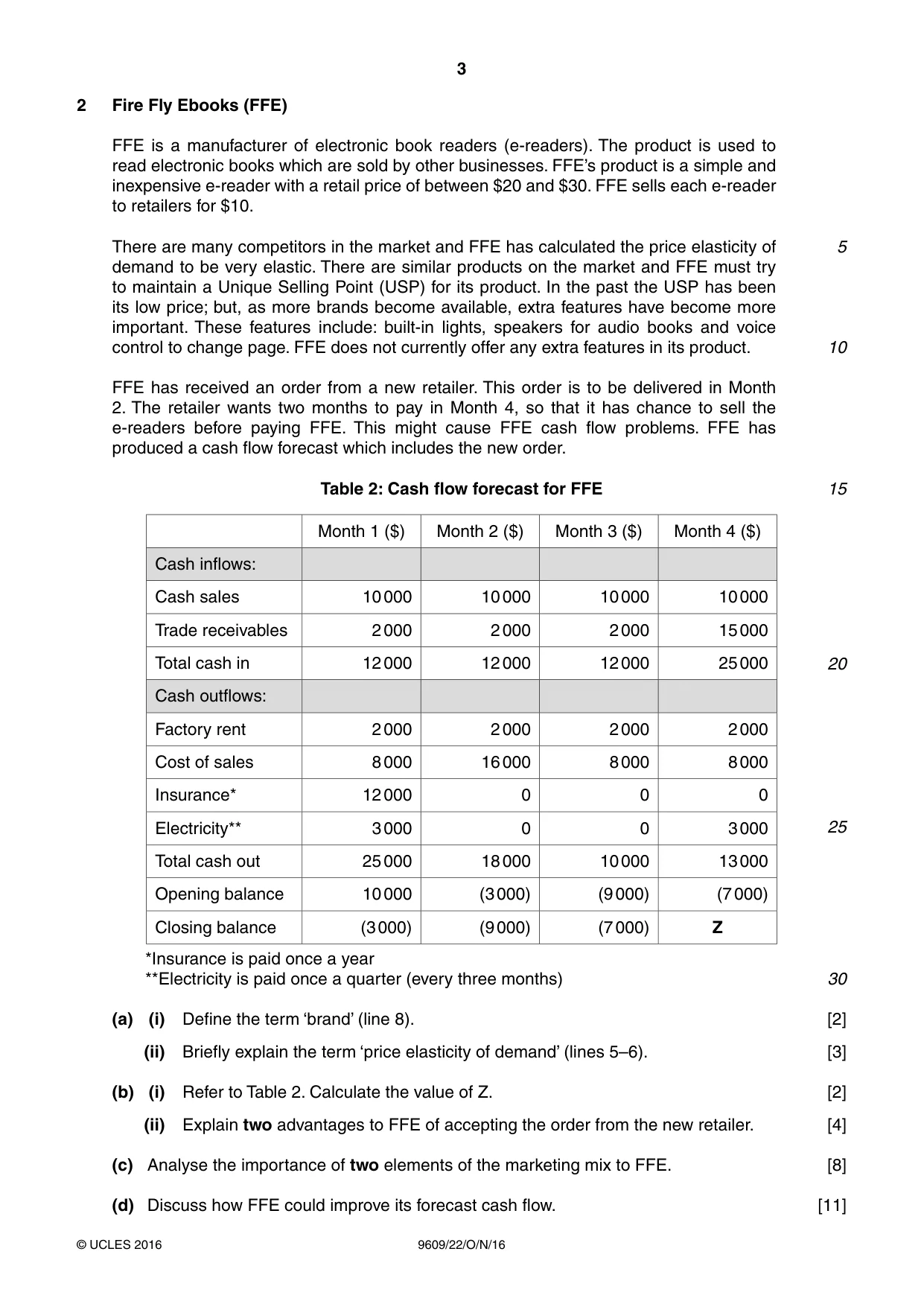
3 9609/22/O/N/16 © UCLES 2016 2 Fire Fly Ebooks (FFE) FFE is a manufacturer of electronic book readers (e-readers). The product is used to read electronic books which are sold by other businesses. FFE’s product is a simple and inexpensive e-reader with a retail price of between $20 and $30. FFE sells each e-reader to retailers for $10. There are many competitors in the market and FFE has calculated the price elasticity of demand to be very elastic. There are similar products on the market and FFE must try to maintain a Unique Selling Point (USP) for its product. In the past the USP has been its low price; but, as more brands become available, extra features have become more important. These features include: built-in lights, speakers for audio books and voice control to change page. FFE does not currently offer any extra features in its product. FFE has received an order from a new retailer. This order is to be delivered in Month 2. The retailer wants two months to pay in Month 4, so that it has chance to sell the e-readers before paying FFE. This might cause FFE cash flow problems. FFE has produced a cash flow forecast which includes the new order. Table 2: Cash flow forecast for FFE Month 1 ($) Month 2 ($) Month 3 ($) Month 4 ($) Cash inflows: Cash sales 10 000 10 000 10 000 10 000 Trade receivables 2 000 2 000 2 000 15 000 Total cash in 12 000 12 000 12 000 25 000 Cash outflows: Factory rent 2 000 2 000 2 000 2 000 Cost of sales 8 000 16 000 8 000 8 000 Insurance* 12 000 0 0 0 Electricity** 3 000 0 0 3 000 Total cash out 25 000 18 000 10 000 13 000 Opening balance 10 000 (3 000) (9 000) (7 000) Closing balance (3 000) (9 000) (7 000) Z *Insurance is paid once a year **Electricity is paid once a quarter (every three months) (a) (i) Define the term ‘brand’ (line 8). [2] (ii) Briefly explain the term ‘price elasticity of demand’ (lines 5–6). [3] (b) (i) Refer to Table 2. Calculate the value of Z. [2] (ii) Explain two advantages to FFE of accepting the order from the new retailer. [4] (c) Analyse the importance of two elements of the marketing mix to FFE. [8] (d) Discuss how FFE could improve its forecast cash flow. [11] 5 10 15 20 25 30
Question paper, page 4
4 9609/22/O/N/16 © UCLES 2016 BLANK PAGE Permission to reproduce items where third-party owned material protected by copyright is included has been sought and cleared where possible. Every reasonable effort has been made by the publisher (UCLES) to trace copyright holders, but if any items requiring clearance have unwittingly been included, the publisher will be pleased to make amends at the earliest possible opportunity. To avoid the issue of disclosure of answer-related information to candidates, all copyright acknowledgements are reproduced online in the Cambridge International Examinations Copyright Acknowledgements Booklet. This is produced for each series of examinations and is freely available to download at www.cie.org.uk after the live examination series. Cambridge International Examinations is part of the Cambridge Assessment Group. Cambridge Assessment is the brand name of University of Cambridge Local Examinations Syndicate (UCLES), which is itself a department of the University of Cambridge.
Mark scheme, page 1
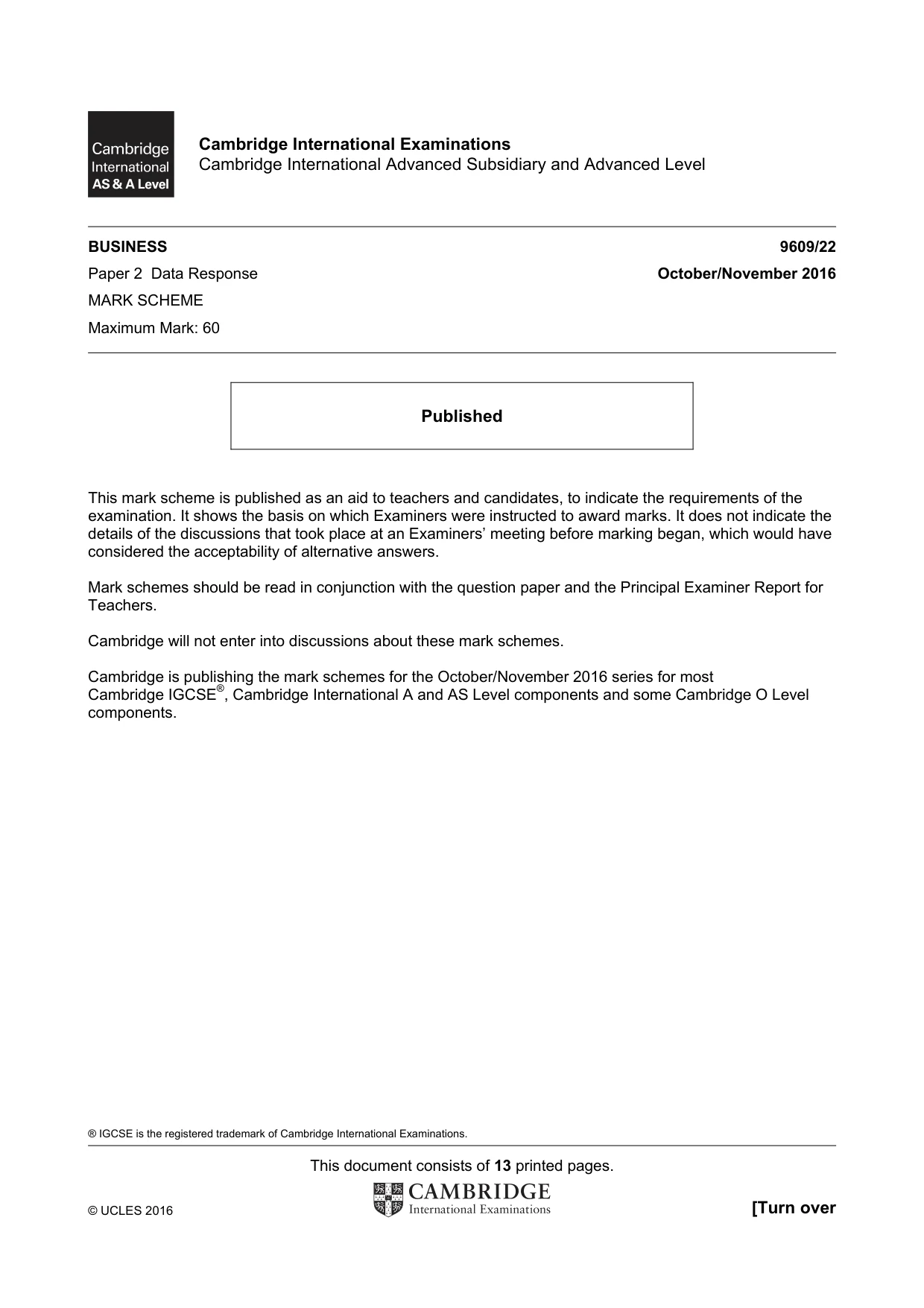
® IGCSE is the registered trademark of Cambridge International Examinations. This document consists of 13 printed pages. © UCLES 2016 [Turn over Cambridge International Examinations Cambridge International Advanced Subsidiary and Advanced Level BUSINESS 9609/22 Paper 2 Data Response October/November 2016 MARK SCHEME Maximum Mark: 60 Published This mark scheme is published as an aid to teachers and candidates, to indicate the requirements of the examination. It shows the basis on which Examiners were instructed to award marks. It does not indicate the details of the discussions that took place at an Examiners’ meeting before marking began, which would have considered the acceptability of alternative answers. Mark schemes should be read in conjunction with the question paper and the Principal Examiner Report for Teachers. Cambridge will not enter into discussions about these mark schemes. Cambridge is publishing the mark schemes for the October/November 2016 series for most Cambridge IGCSE®, Cambridge International A and AS Level components and some Cambridge O Level components.
Mark scheme, page 2
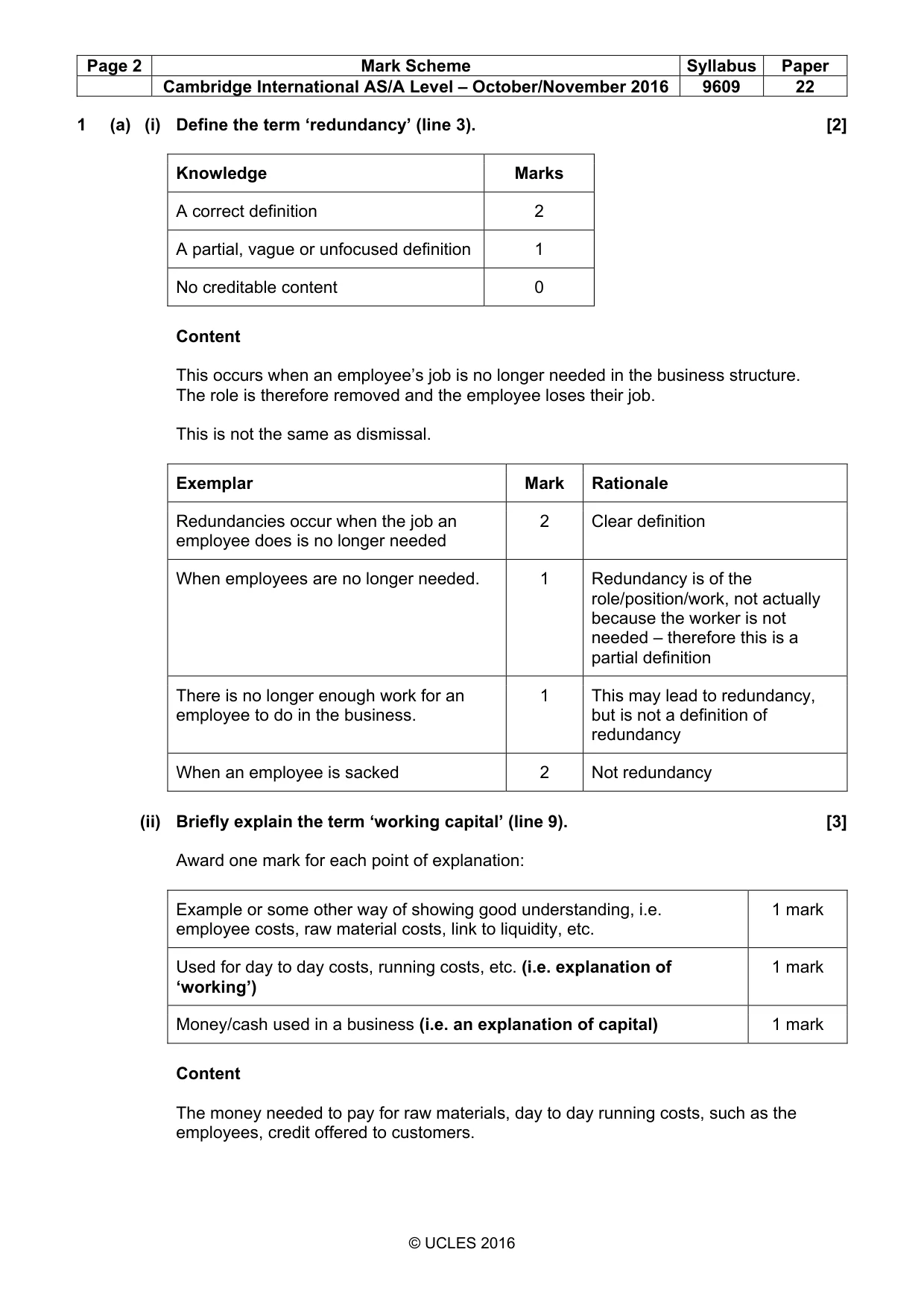
Page 2 Mark Scheme Syllabus Paper Cambridge International AS/A Level – October/November 2016 9609 22 © UCLES 2016 1 (a) (i) Define the term ‘redundancy’ (line 3). [2] Knowledge Marks A correct definition 2 A partial, vague or unfocused definition 1 No creditable content 0 Content This occurs when an employee’s job is no longer needed in the business structure. The role is therefore removed and the employee loses their job. This is not the same as dismissal. Exemplar Mark Rationale Redundancies occur when the job an employee does is no longer needed 2 Clear definition When employees are no longer needed. 1 Redundancy is of the role/position/work, not actually because the worker is not needed – therefore this is a partial definition There is no longer enough work for an employee to do in the business. 1 This may lead to redundancy, but is not a definition of redundancy When an employee is sacked 2 Not redundancy (ii) Briefly explain the term ‘working capital’ (line 9). [3] Award one mark for each point of explanation: Example or some other way of showing good understanding, i.e. employee costs, raw material costs, link to liquidity, etc. 1 mark Used for day to day costs, running costs, etc. (i.e. explanation of ‘working’) 1 mark Money/cash used in a business (i.e. an explanation of capital) 1 mark Content The money needed to pay for raw materials, day to day running costs, such as the employees, credit offered to customers.
Mark scheme, page 3
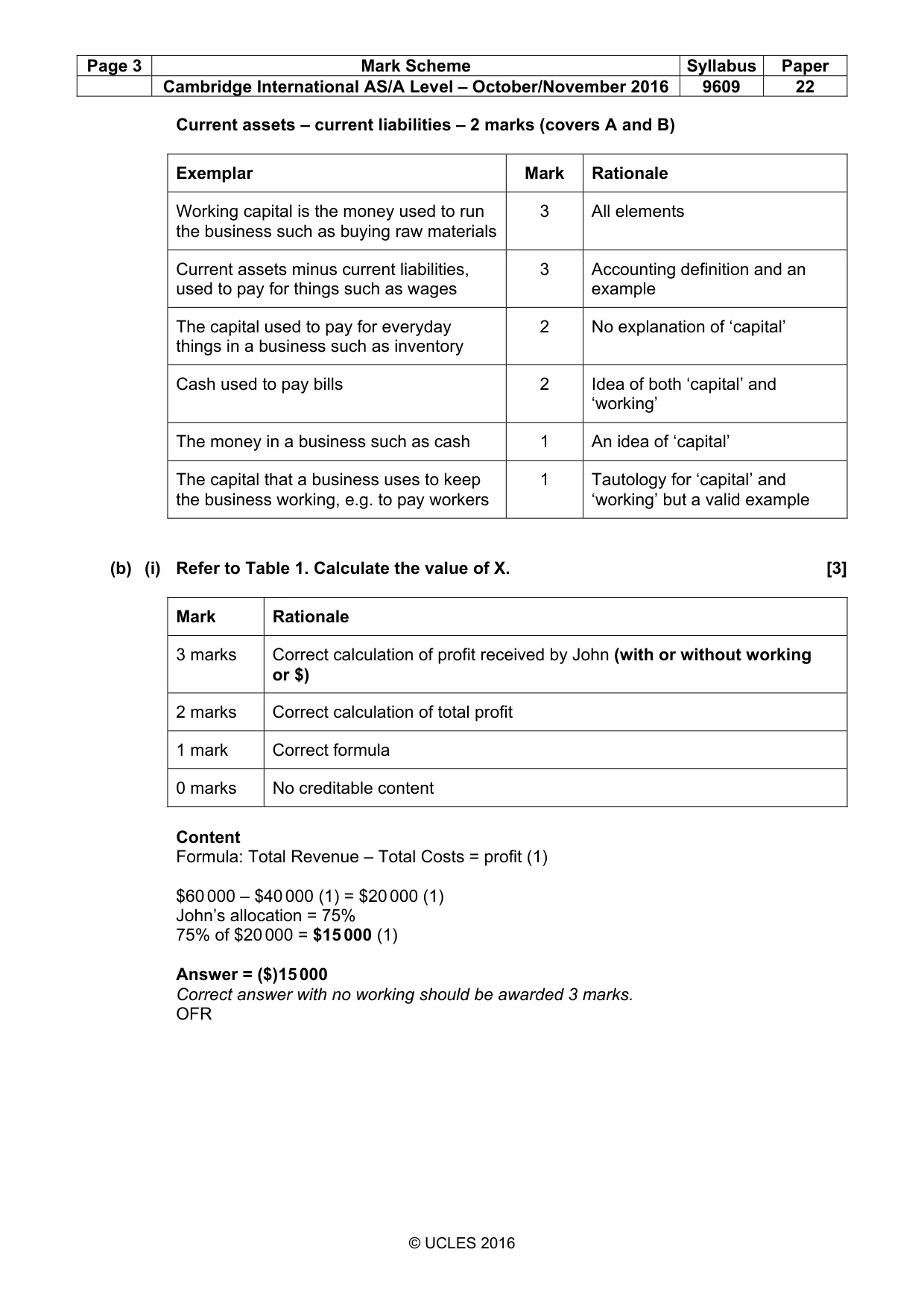
Page 3 Mark Scheme Syllabus Paper Cambridge International AS/A Level – October/November 2016 9609 22 © UCLES 2016 Current assets – current liabilities – 2 marks (covers A and B) Exemplar Mark Rationale Working capital is the money used to run the business such as buying raw materials 3 All elements Current assets minus current liabilities, used to pay for things such as wages 3 Accounting definition and an example The capital used to pay for everyday things in a business such as inventory 2 No explanation of ‘capital’ Cash used to pay bills 2 Idea of both ‘capital’ and ‘working’ The money in a business such as cash 1 An idea of ‘capital’ The capital that a business uses to keep the business working, e.g. to pay workers 1 Tautology for ‘capital’ and ‘working’ but a valid example (b) (i) Refer to Table 1. Calculate the value of X. [3] Mark Rationale 3 marks Correct calculation of profit received by John (with or without working or $) 2 marks Correct calculation of total profit 1 mark Correct formula 0 marks No creditable content Content Formula: Total Revenue – Total Costs = profit (1) $60 000 – $40 000 (1) = $20 000 (1) John’s allocation = 75% 75% of $20 000 = $15 000 (1) Answer = ($)15 000 Correct answer with no working should be awarded 3 marks. OFR
Mark scheme, page 4
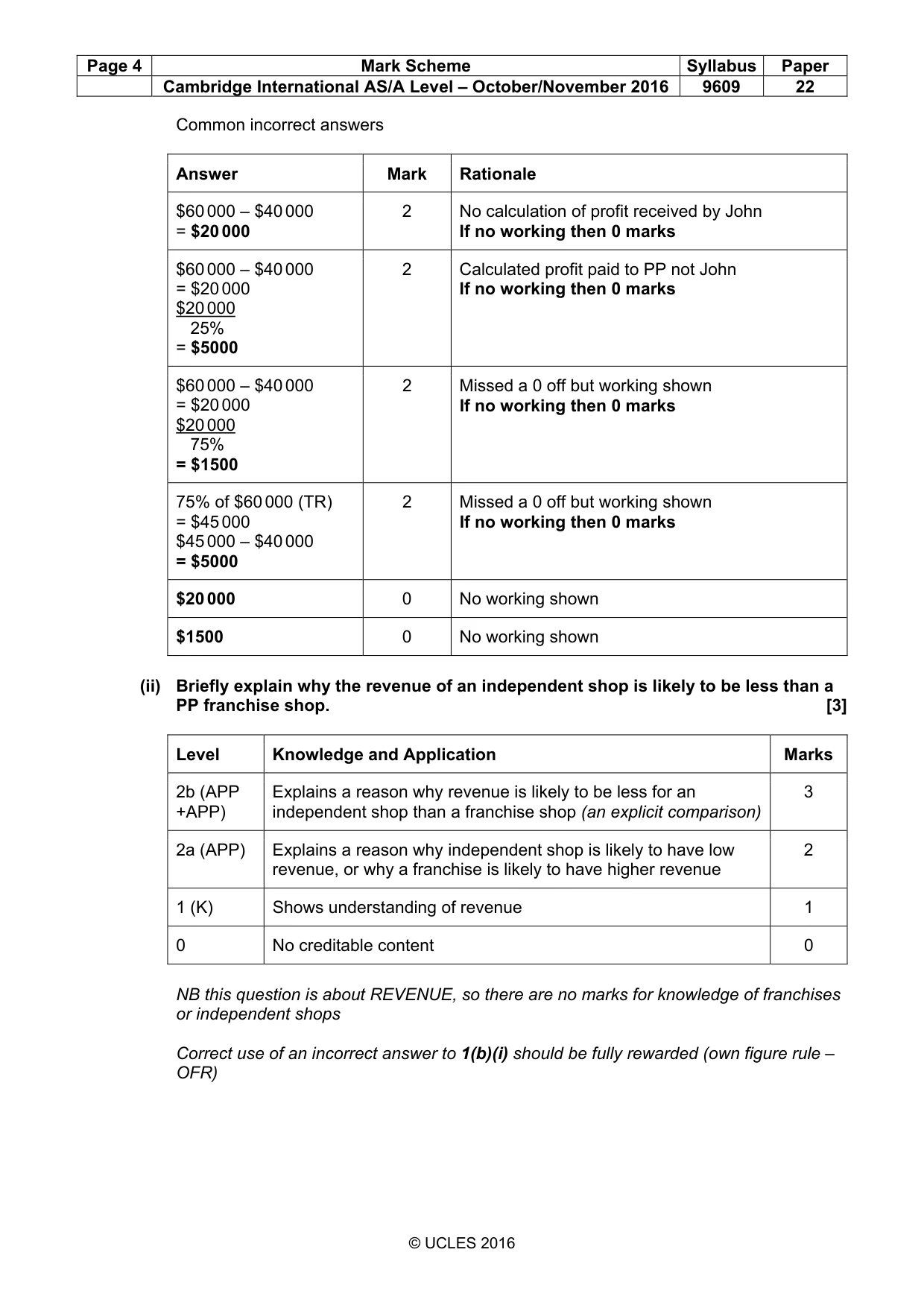
Page 4 Mark Scheme Syllabus Paper Cambridge International AS/A Level – October/November 2016 9609 22 © UCLES 2016 Common incorrect answers Answer Mark Rationale $60 000 – $40 000 = $20 000 2 No calculation of profit received by John If no working then 0 marks $60 000 – $40 000 = $20 000 $20 000 25% = $5000 2 Calculated profit paid to PP not John If no working then 0 marks $60 000 – $40 000 = $20 000 $20 000 75% = $1500 2 Missed a 0 off but working shown If no working then 0 marks 75% of $60 000 (TR) = $45 000 $45 000 – $40 000 = $5000 2 Missed a 0 off but working shown If no working then 0 marks $20 000 0 No working shown $1500 0 No working shown (ii) Briefly explain why the revenue of an independent shop is likely to be less than a PP franchise shop. [3] Level Knowledge and Application Marks 2b (APP +APP) Explains a reason why revenue is likely to be less for an independent shop than a franchise shop (an explicit comparison) 3 2a (APP) Explains a reason why independent shop is likely to have low revenue, or why a franchise is likely to have higher revenue 2 1 (K) Shows understanding of revenue 1 0 No creditable content 0 NB this question is about REVENUE, so there are no marks for knowledge of franchises or independent shops Correct use of an incorrect answer to 1(b)(i) should be fully rewarded (own figure rule – OFR)
Mark scheme, page 5
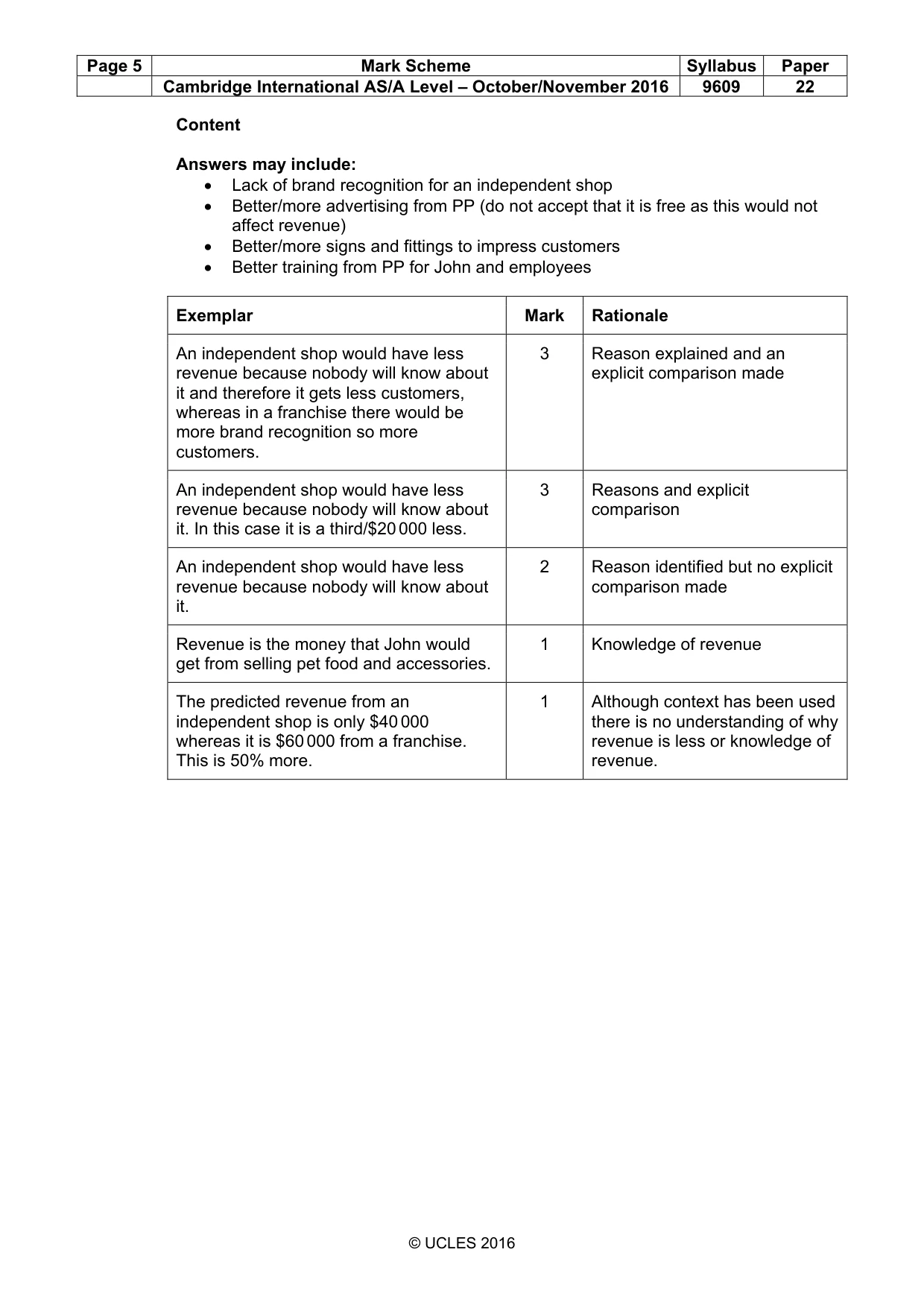
Page 5 Mark Scheme Syllabus Paper Cambridge International AS/A Level – October/November 2016 9609 22 © UCLES 2016 Content Answers may include: • Lack of brand recognition for an independent shop • Better/more advertising from PP (do not accept that it is free as this would not affect revenue) • Better/more signs and fittings to impress customers • Better training from PP for John and employees Exemplar Mark Rationale An independent shop would have less revenue because nobody will know about it and therefore it gets less customers, whereas in a franchise there would be more brand recognition so more customers. 3 Reason explained and an explicit comparison made An independent shop would have less revenue because nobody will know about it. In this case it is a third/$20 000 less. 3 Reasons and explicit comparison An independent shop would have less revenue because nobody will know about it. 2 Reason identified but no explicit comparison made Revenue is the money that John would get from selling pet food and accessories. 1 Knowledge of revenue The predicted revenue from an independent shop is only $40 000 whereas it is $60 000 from a franchise. This is 50% more. 1 Although context has been used there is no understanding of why revenue is less or knowledge of revenue.
Mark scheme, page 6
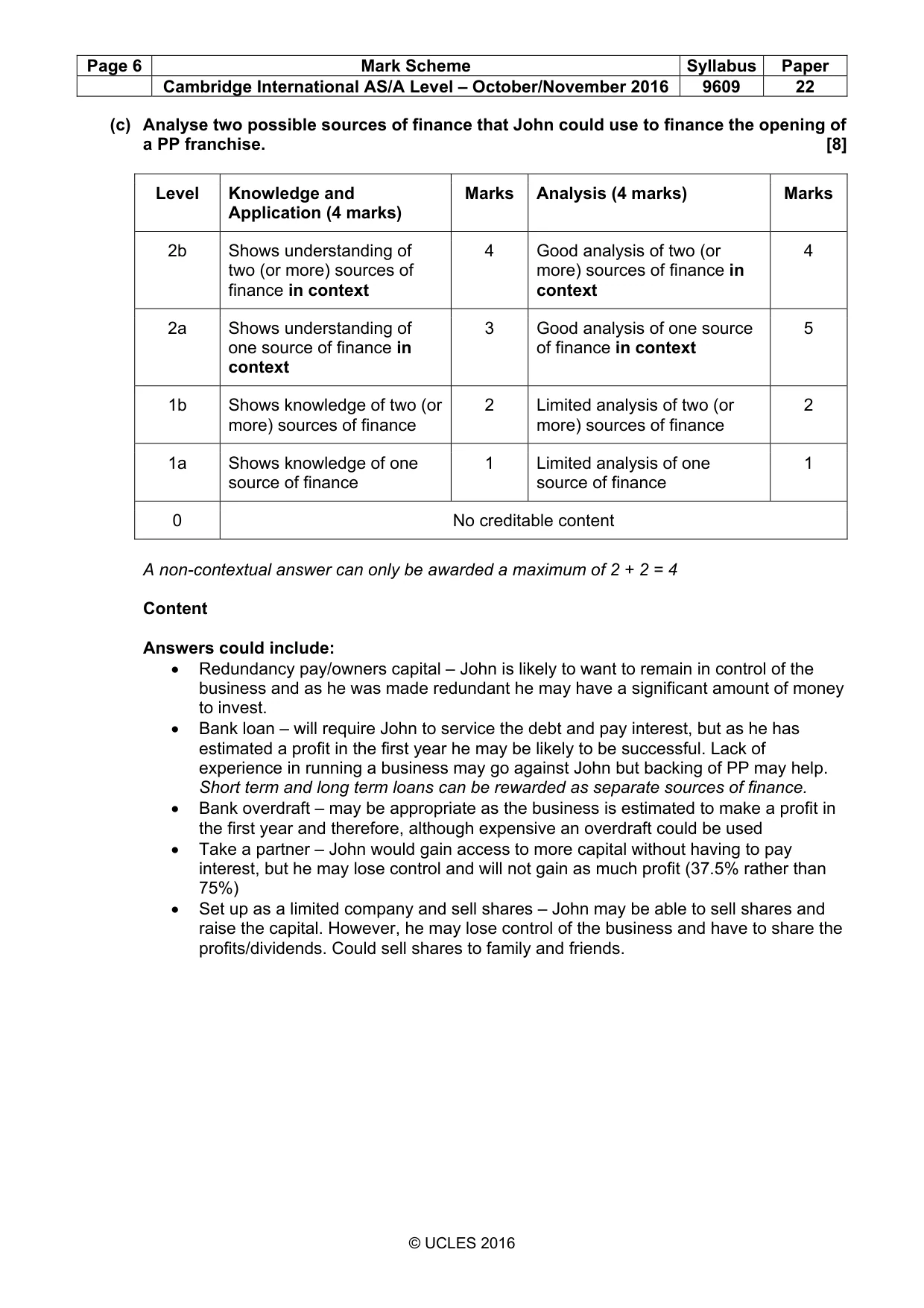
Page 6 Mark Scheme Syllabus Paper Cambridge International AS/A Level – October/November 2016 9609 22 © UCLES 2016 (c) Analyse two possible sources of finance that John could use to finance the opening of a PP franchise. [8] Level Knowledge and Application (4 marks) Marks Analysis (4 marks) Marks 2b Shows understanding of two (or more) sources of finance in context 4 Good analysis of two (or more) sources of finance in context 4 2a Shows understanding of one source of finance in context 3 Good analysis of one source of finance in context 5 1b Shows knowledge of two (or more) sources of finance 2 Limited analysis of two (or more) sources of finance 2 1a Shows knowledge of one source of finance 1 Limited analysis of one source of finance 1 0 No creditable content A non-contextual answer can only be awarded a maximum of 2 + 2 = 4 Content Answers could include: • Redundancy pay/owners capital – John is likely to want to remain in control of the business and as he was made redundant he may have a significant amount of money to invest. • Bank loan – will require John to service the debt and pay interest, but as he has estimated a profit in the first year he may be likely to be successful. Lack of experience in running a business may go against John but backing of PP may help. Short term and long term loans can be rewarded as separate sources of finance. • Bank overdraft – may be appropriate as the business is estimated to make a profit in the first year and therefore, although expensive an overdraft could be used • Take a partner – John would gain access to more capital without having to pay interest, but he may lose control and will not gain as much profit (37.5% rather than 75%) • Set up as a limited company and sell shares – John may be able to sell shares and raise the capital. However, he may lose control of the business and have to share the profits/dividends. Could sell shares to family and friends.
Mark scheme, page 7
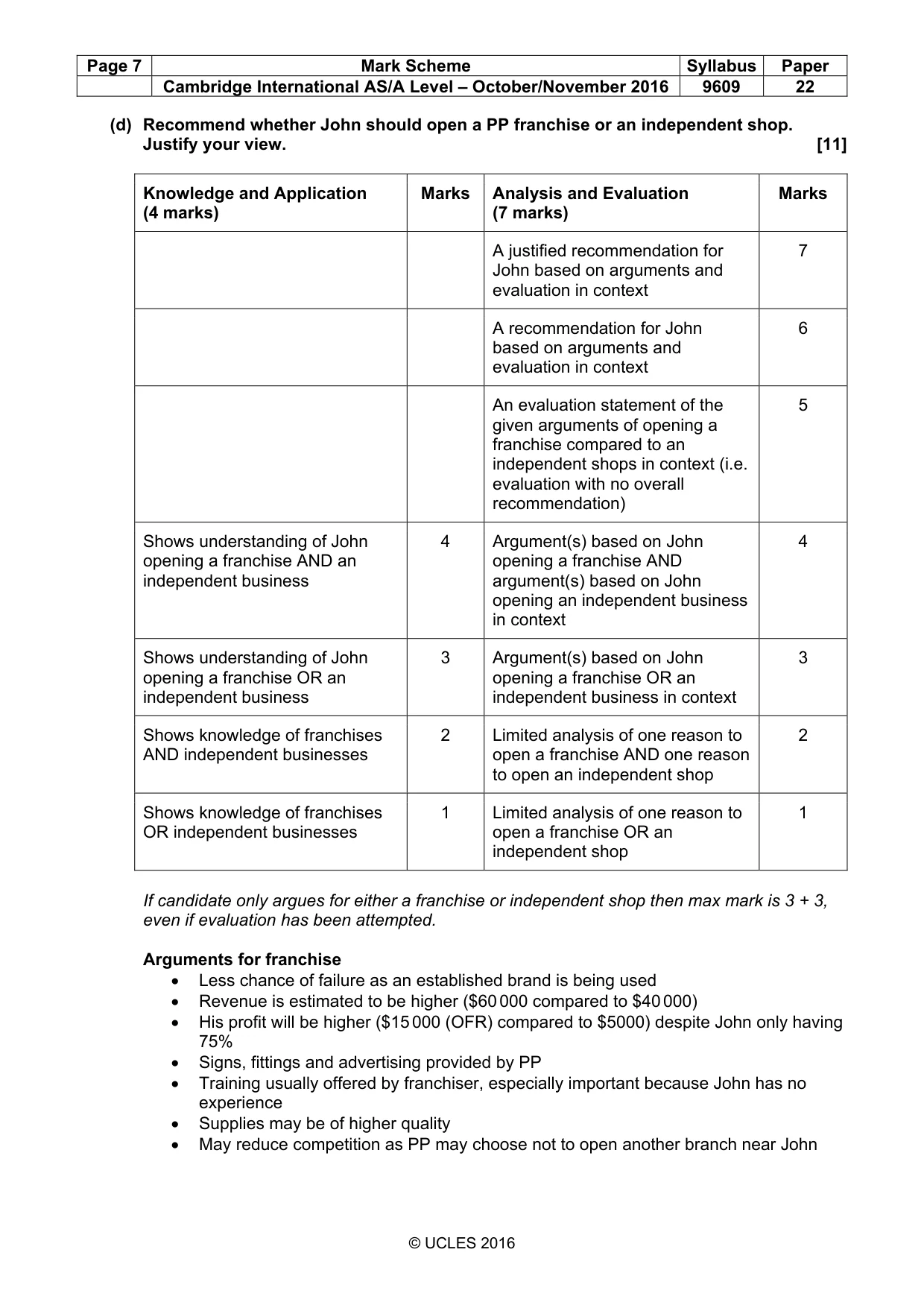
Page 7 Mark Scheme Syllabus Paper Cambridge International AS/A Level – October/November 2016 9609 22 © UCLES 2016 (d) Recommend whether John should open a PP franchise or an independent shop. Justify your view. [11] Knowledge and Application (4 marks) Marks Analysis and Evaluation (7 marks) Marks A justified recommendation for John based on arguments and evaluation in context 7 A recommendation for John based on arguments and evaluation in context 6 An evaluation statement of the given arguments of opening a franchise compared to an independent shops in context (i.e. evaluation with no overall recommendation) 5 Shows understanding of John opening a franchise AND an independent business 4 Argument(s) based on John opening a franchise AND argument(s) based on John opening an independent business in context 4 Shows understanding of John opening a franchise OR an independent business 3 Argument(s) based on John opening a franchise OR an independent business in context 3 Shows knowledge of franchises AND independent businesses 2 Limited analysis of one reason to open a franchise AND one reason to open an independent shop 2 Shows knowledge of franchises OR independent businesses 1 Limited analysis of one reason to open a franchise OR an independent shop 1 If candidate only argues for either a franchise or independent shop then max mark is 3 + 3, even if evaluation has been attempted. Arguments for franchise • Less chance of failure as an established brand is being used • Revenue is estimated to be higher ($60 000 compared to $40 000) • His profit will be higher ($15 000 (OFR) compared to $5000) despite John only having 75% • Signs, fittings and advertising provided by PP • Training usually offered by franchiser, especially important because John has no experience • Supplies may be of higher quality • May reduce competition as PP may choose not to open another branch near John
Mark scheme, page 8
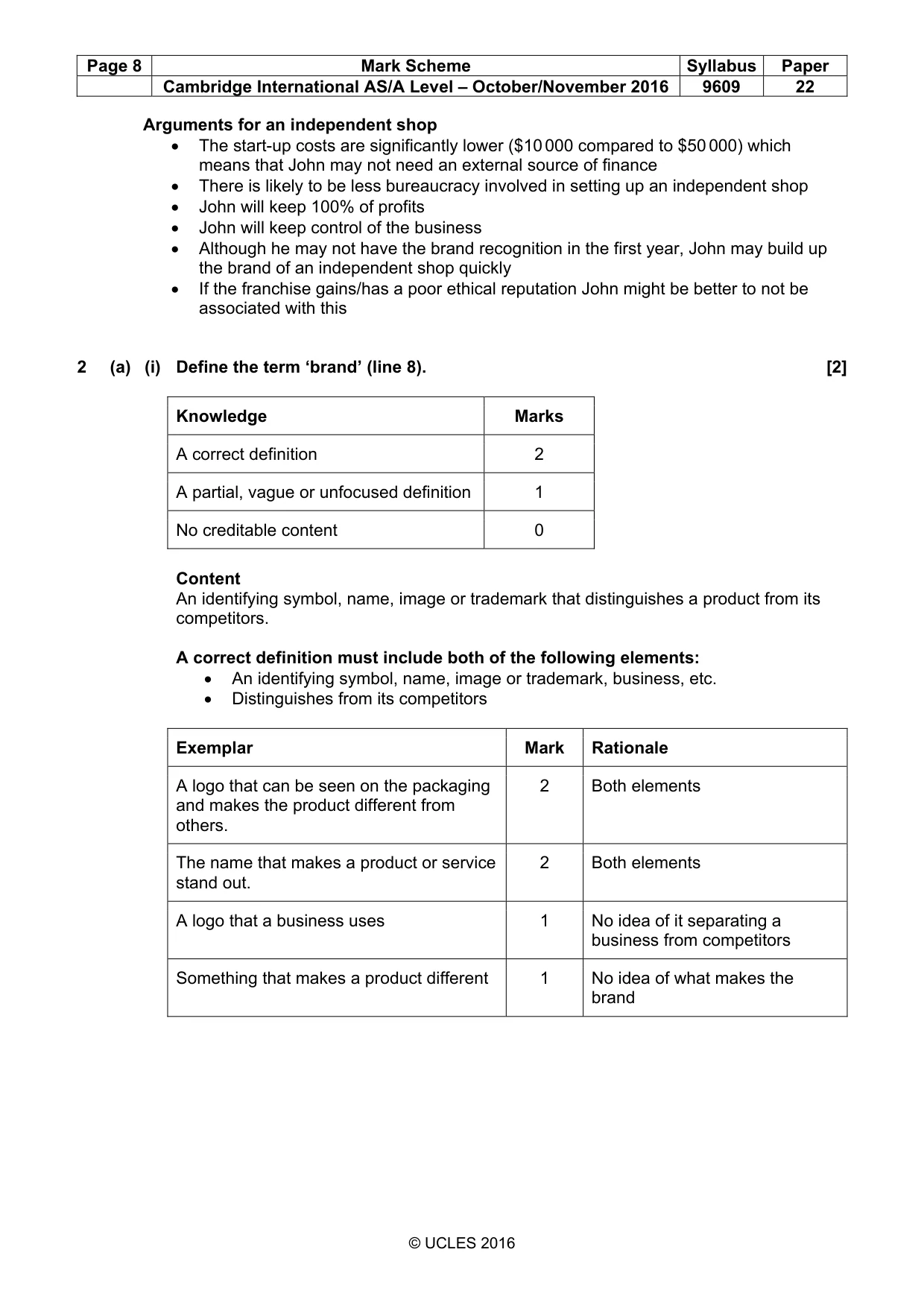
Page 8 Mark Scheme Syllabus Paper Cambridge International AS/A Level – October/November 2016 9609 22 © UCLES 2016 Arguments for an independent shop • The start-up costs are significantly lower ($10 000 compared to $50 000) which means that John may not need an external source of finance • There is likely to be less bureaucracy involved in setting up an independent shop • John will keep 100% of profits • John will keep control of the business • Although he may not have the brand recognition in the first year, John may build up the brand of an independent shop quickly • If the franchise gains/has a poor ethical reputation John might be better to not be associated with this 2 (a) (i) Define the term ‘brand’ (line 8). [2] Knowledge Marks A correct definition 2 A partial, vague or unfocused definition 1 No creditable content 0 Content An identifying symbol, name, image or trademark that distinguishes a product from its competitors. A correct definition must include both of the following elements: • An identifying symbol, name, image or trademark, business, etc. • Distinguishes from its competitors Exemplar Mark Rationale A logo that can be seen on the packaging and makes the product different from others. 2 Both elements The name that makes a product or service stand out. 2 Both elements A logo that a business uses 1 No idea of it separating a business from competitors Something that makes a product different 1 No idea of what makes the brand
Mark scheme, page 9
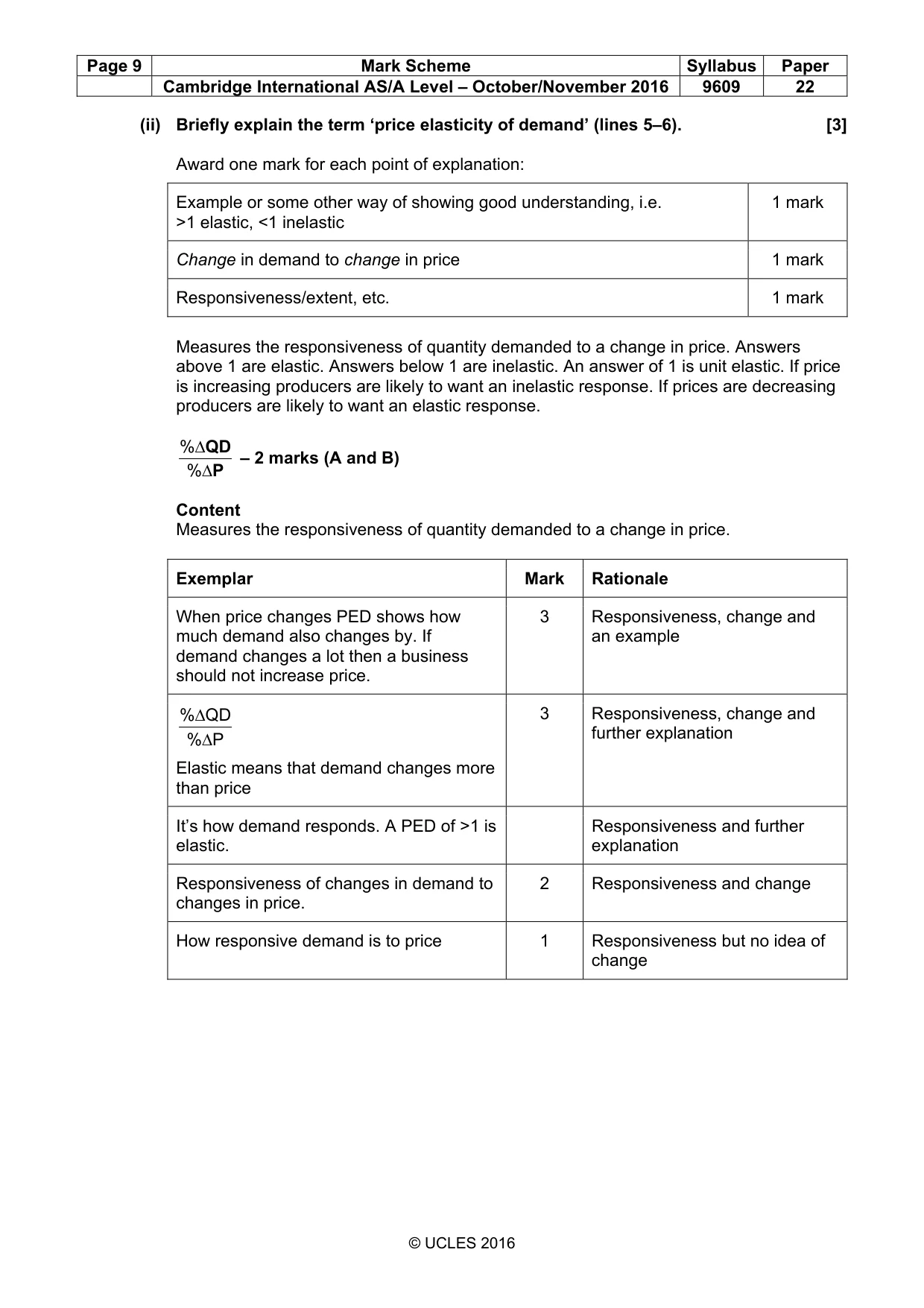
Page 9 Mark Scheme Syllabus Paper Cambridge International AS/A Level – October/November 2016 9609 22 © UCLES 2016 (ii) Briefly explain the term ‘price elasticity of demand’ (lines 5–6). [3] Award one mark for each point of explanation: Example or some other way of showing good understanding, i.e. >1 elastic, <1 inelastic 1 mark Change in demand to change in price 1 mark Responsiveness/extent, etc. 1 mark Measures the responsiveness of quantity demanded to a change in price. Answers above 1 are elastic. Answers below 1 are inelastic. An answer of 1 is unit elastic. If price is increasing producers are likely to want an inelastic response. If prices are decreasing producers are likely to want an elastic response. ∆ ∆ QD P % % – 2 marks (A and B) Content Measures the responsiveness of quantity demanded to a change in price. Exemplar Mark Rationale When price changes PED shows how much demand also changes by. If demand changes a lot then a business should not increase price. 3 Responsiveness, change and an example ∆ ∆ % QD % P Elastic means that demand changes more than price 3 Responsiveness, change and further explanation It’s how demand responds. A PED of >1 is elastic. Responsiveness and further explanation Responsiveness of changes in demand to changes in price. 2 Responsiveness and change How responsive demand is to price 1 Responsiveness but no idea of change
Mark scheme, page 10
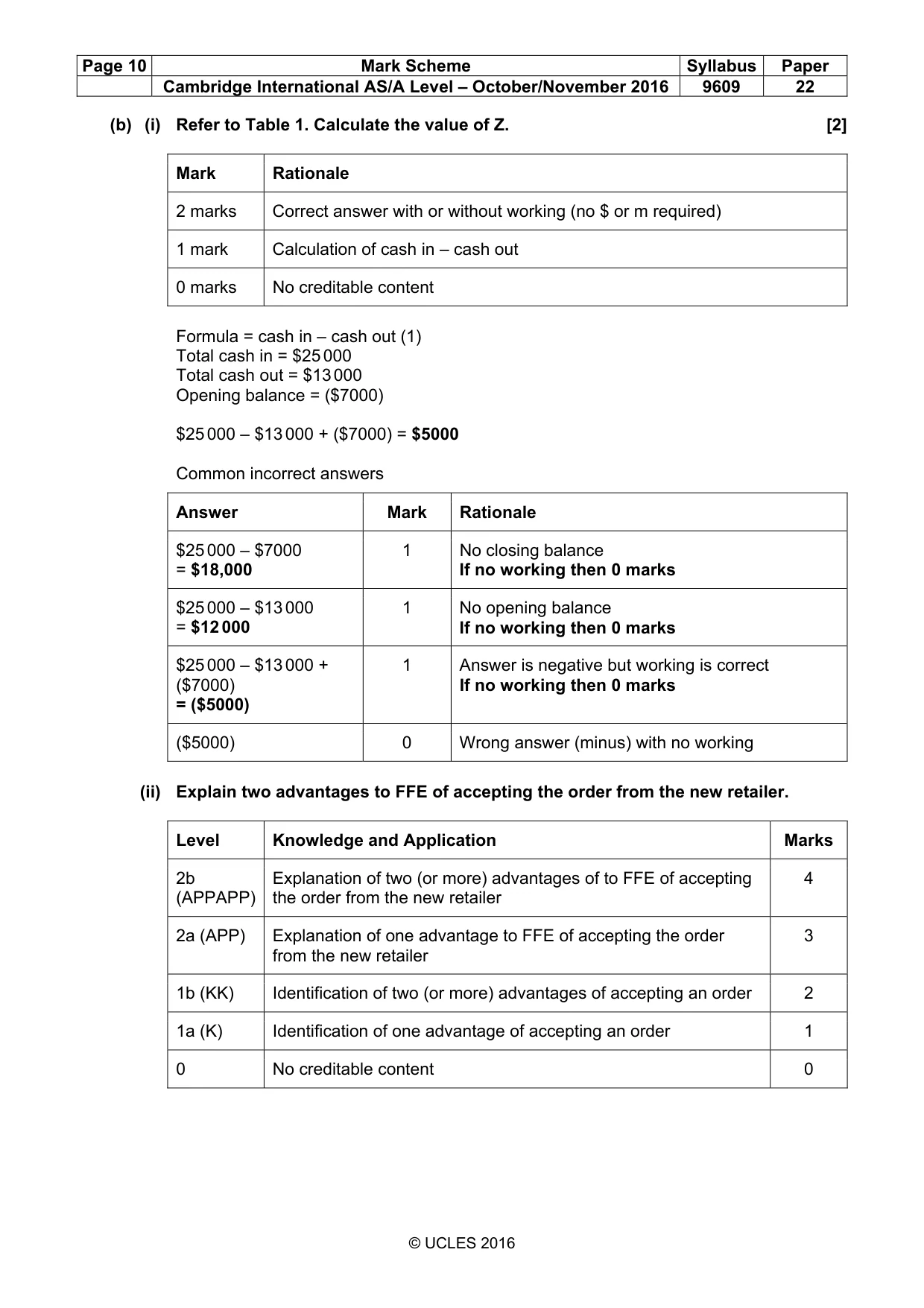
Page 10 Mark Scheme Syllabus Paper Cambridge International AS/A Level – October/November 2016 9609 22 © UCLES 2016 (b) (i) Refer to Table 1. Calculate the value of Z. [2] Mark Rationale 2 marks Correct answer with or without working (no $ or m required) 1 mark Calculation of cash in – cash out 0 marks No creditable content Formula = cash in – cash out (1) Total cash in = $25 000 Total cash out = $13 000 Opening balance = ($7000) $25 000 – $13 000 + ($7000) = $5000 Common incorrect answers Answer Mark Rationale $25 000 – $7000 = $18,000 1 No closing balance If no working then 0 marks $25 000 – $13 000 = $12 000 1 No opening balance If no working then 0 marks $25 000 – $13 000 + ($7000) = ($5000) 1 Answer is negative but working is correct If no working then 0 marks ($5000) 0 Wrong answer (minus) with no working (ii) Explain two advantages to FFE of accepting the order from the new retailer. Level Knowledge and Application Marks 2b (APPAPP) Explanation of two (or more) advantages of to FFE of accepting the order from the new retailer 4 2a (APP) Explanation of one advantage to FFE of accepting the order from the new retailer 3 1b (KK) Identification of two (or more) advantages of accepting an order 2 1a (K) Identification of one advantage of accepting an order 1 0 No creditable content 0
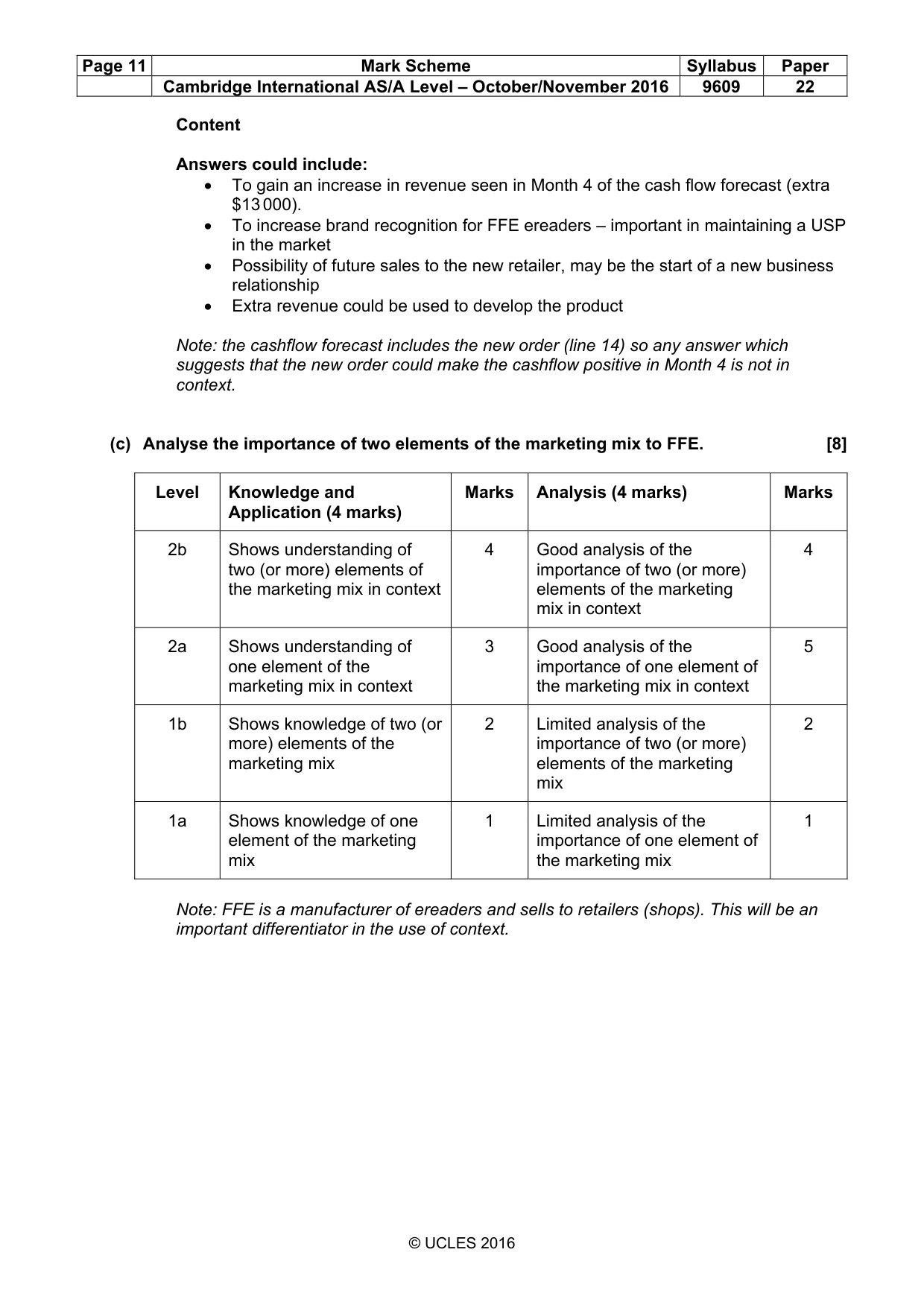
Mark scheme, page 11
Page 11 Mark Scheme Syllabus Paper Cambridge International AS/A Level – October/November 2016 9609 22 © UCLES 2016 Content Answers could include: • To gain an increase in revenue seen in Month 4 of the cash flow forecast (extra $13 000). • To increase brand recognition for FFE ereaders – important in maintaining a USP in the market • Possibility of future sales to the new retailer, may be the start of a new business relationship • Extra revenue could be used to develop the product Note: the cashflow forecast includes the new order (line 14) so any answer which suggests that the new order could make the cashflow positive in Month 4 is not in context. (c) Analyse the importance of two elements of the marketing mix to FFE. [8] Level Knowledge and Application (4 marks) Marks Analysis (4 marks) Marks 2b Shows understanding of two (or more) elements of the marketing mix in context 4 Good analysis of the importance of two (or more) elements of the marketing mix in context 4 2a Shows understanding of one element of the marketing mix in context 3 Good analysis of the importance of one element of the marketing mix in context 5 1b Shows knowledge of two (or more) elements of the marketing mix 2 Limited analysis of the importance of two (or more) elements of the marketing mix 2 1a Shows knowledge of one element of the marketing mix 1 Limited analysis of the importance of one element of the marketing mix 1 Note: FFE is a manufacturer of ereaders and sells to retailers (shops). This will be an important differentiator in the use of context.
Mark scheme, page 12
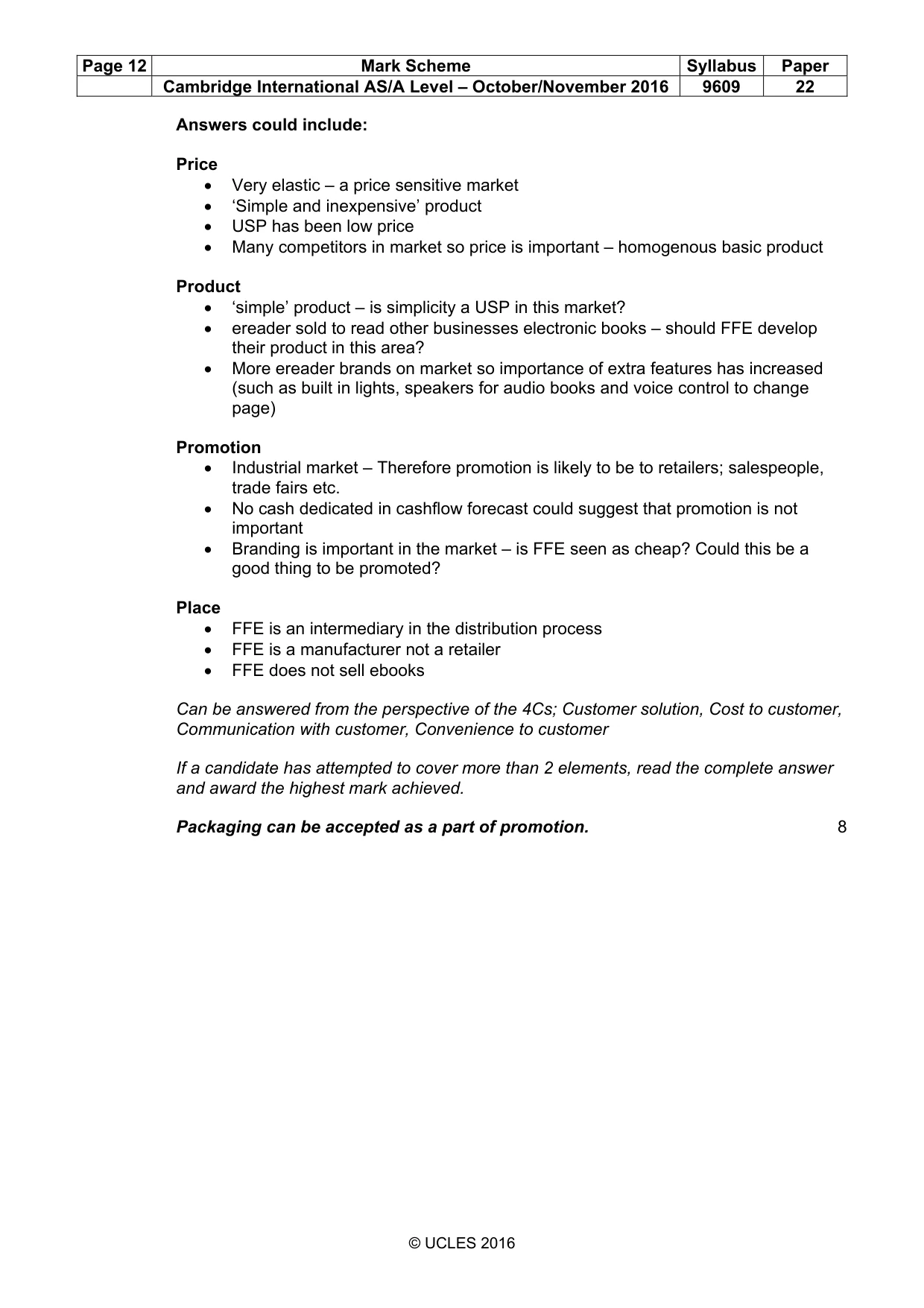
Page 12 Mark Scheme Syllabus Paper Cambridge International AS/A Level – October/November 2016 9609 22 © UCLES 2016 Answers could include: Price • Very elastic – a price sensitive market • ‘Simple and inexpensive’ product • USP has been low price • Many competitors in market so price is important – homogenous basic product Product • ‘simple’ product – is simplicity a USP in this market? • ereader sold to read other businesses electronic books – should FFE develop their product in this area? • More ereader brands on market so importance of extra features has increased (such as built in lights, speakers for audio books and voice control to change page) Promotion • Industrial market – Therefore promotion is likely to be to retailers; salespeople, trade fairs etc. • No cash dedicated in cashflow forecast could suggest that promotion is not important • Branding is important in the market – is FFE seen as cheap? Could this be a good thing to be promoted? Place • FFE is an intermediary in the distribution process • FFE is a manufacturer not a retailer • FFE does not sell ebooks Can be answered from the perspective of the 4Cs; Customer solution, Cost to customer, Communication with customer, Convenience to customer If a candidate has attempted to cover more than 2 elements, read the complete answer and award the highest mark achieved. Packaging can be accepted as a part of promotion. 8
Mark scheme, page 13
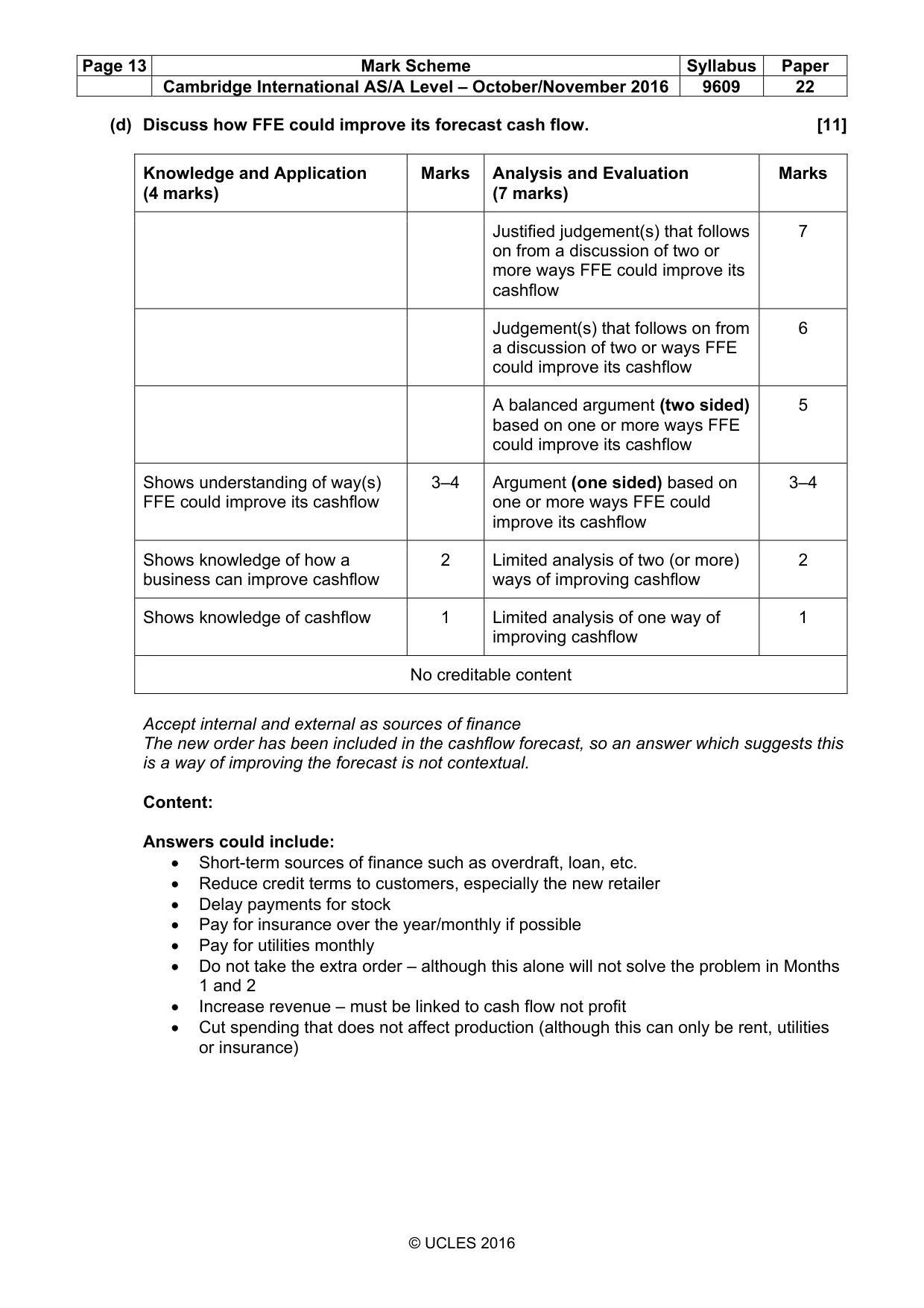
Page 13 Mark Scheme Syllabus Paper Cambridge International AS/A Level – October/November 2016 9609 22 © UCLES 2016 (d) Discuss how FFE could improve its forecast cash flow. [11] Knowledge and Application (4 marks) Marks Analysis and Evaluation (7 marks) Marks Justified judgement(s) that follows on from a discussion of two or more ways FFE could improve its cashflow 7 Judgement(s) that follows on from a discussion of two or ways FFE could improve its cashflow 6 A balanced argument (two sided) based on one or more ways FFE could improve its cashflow 5 Shows understanding of way(s) FFE could improve its cashflow 3–4 Argument (one sided) based on one or more ways FFE could improve its cashflow 3–4 Shows knowledge of how a business can improve cashflow 2 Limited analysis of two (or more) ways of improving cashflow 2 Shows knowledge of cashflow 1 Limited analysis of one way of improving cashflow 1 No creditable content Accept internal and external as sources of finance The new order has been included in the cashflow forecast, so an answer which suggests this is a way of improving the forecast is not contextual. Content: Answers could include: • Short-term sources of finance such as overdraft, loan, etc. • Reduce credit terms to customers, especially the new retailer • Delay payments for stock • Pay for insurance over the year/monthly if possible • Pay for utilities monthly • Do not take the extra order – although this alone will not solve the problem in Months 1 and 2 • Increase revenue – must be linked to cash flow not profit • Cut spending that does not affect production (although this can only be rent, utilities or insurance)
What you needed in this session
Cambridge’s own grade thresholds for 2016 Oct/Nov, Paper 2 · Variant 2. A higher threshold means an easier paper — the bar moves with how the cohort did.