Cambridge A Level Business (for first examination in 2016) 9609 — 2016 Oct/Nov Paper 1 · Variant 2
9609/12/O/N/16 · 40 marks · ≈45 min
The question paper and its mark scheme, free to read here and free to download. This is Cambridge’s own paper, exactly as it was sat.
Question paper4 pages


Mark scheme9 pages
Answers below. Sit the paper first if you are practising.
Paper as text
Question paper, page 1
This document consists of 2 printed pages, 2 blank pages and 1 Insert. DC (ST) 118110/2 © UCLES 2016 [Turn over Cambridge International Examinations Cambridge International Advanced Subsidiary and Advanced Level * 9 5 3 7 5 4 9 8 9 4 * BUSINESS 9609/12 Paper 1 Short Answer and Essay October/November 2016 1 hour 15 minutes No Additional Materials are required. READ THESE INSTRUCTIONS FIRST An answer booklet is provided inside this question paper. You should follow the instructions on the front cover of the answer booklet. If you need additional answer paper ask the invigilator for a continuation booklet. Section A Answer all questions. Section B Answer one question. You are advised to spend no more than 35 minutes on Section A. The number of marks is given in brackets [ ] at the end of each question or part question.
Question paper, page 2
2 9609/12/O/N/16 © UCLES 2016 Section A (Short Answer) Answer all questions. 1 (a) Define ‘joint venture’. [2] (b) Briefly explain two advantages of joint ventures to the businesses involved. [3] 2 (a) Define ‘leadership’. [2] (b) Briefly explain two advantages of autocratic leadership. [3] 3 Explain why cost information is important for business decision-making. [5] 4 (a) Define ‘secondary market research’. [2] (b) Briefly explain two advantages of using ‘focus groups’ as a method of market research. [3] Section B (Essay) Answer one question only. 5 (a) Analyse, using examples, why packaging could be important in the marketing mix. [8] (b) Discuss factors that could determine the success of a business that has decided to set up an online shop to sell beauty products. [12] 6 Discuss ways in which the operations management department of a car manufacturing company could help the business survive during an economic recession. [20] 7 (a) Analyse the advantages and disadvantages to an employer of using performance related pay. [8] (b) Discuss the importance for a large hotel of staff development and training. [12]
Question paper, page 3
3 9609/12/O/N/16 © UCLES 2016 BLANK PAGE
Question paper, page 4
4 9609/12/O/N/16 © UCLES 2016 Permission to reproduce items where third-party owned material protected by copyright is included has been sought and cleared where possible. Every reasonable effort has been made by the publisher (UCLES) to trace copyright holders, but if any items requiring clearance have unwittingly been included, the publisher will be pleased to make amends at the earliest possible opportunity. To avoid the issue of disclosure of answer-related information to candidates, all copyright acknowledgements are reproduced online in the Cambridge International Examinations Copyright Acknowledgements Booklet. This is produced for each series of examinations and is freely available to download at www.cie.org.uk after the live examination series. Cambridge International Examinations is part of the Cambridge Assessment Group. Cambridge Assessment is the brand name of University of Cambridge Local Examinations Syndicate (UCLES), which is itself a department of the University of Cambridge. BLANK PAGE
Mark scheme, page 1
® IGCSE is the registered trademark of Cambridge International Examinations. This document consists of 9 printed pages. © UCLES 2016 [Turn over Cambridge International Examinations Cambridge International Advanced Subsidiary and Advanced Level BUSINESS 9609/12 Paper 1 Short Answer/Essay October/November 2016 MARK SCHEME Maximum Mark: 40 Published This mark scheme is published as an aid to teachers and candidates, to indicate the requirements of the examination. It shows the basis on which Examiners were instructed to award marks. It does not indicate the details of the discussions that took place at an Examiners’ meeting before marking began, which would have considered the acceptability of alternative answers. Mark schemes should be read in conjunction with the question paper and the Principal Examiner Report for Teachers. Cambridge will not enter into discussions about these mark schemes. Cambridge is publishing the mark schemes for the October/November 2016 series for most Cambridge IGCSE®, Cambridge International A and AS Level components and some Cambridge O Level components.
Mark scheme, page 2
Page 2 Mark Scheme Syllabus Paper Cambridge International AS/A Level – October/November 2016 9609 12 © UCLES 2016 1 (a) Define joint venture [2] Two or more businesses/people agree to work together (1 mark) on a particular project/product or business enterprise (1 mark) (A distinct business unit/division may be set up or just informal collaborative arrangements). Sound definition given (2 marks) Partial definition (limited understanding) (1 mark) (b) Briefly explain two advantages of joint ventures to the businesses involved. [3] Advantages may include: • Share strengths, minimise risk and increases opportunity for competitive advantage in business ventures. • Given access to new resources, markets, or distribution channels. • Particularly useful for small businesses wanting to spread risks – e.g. joint advertising, marketing, R&D. • Popular way of entering new, emerging markets. • May be used by large businesses to shut out the competition. • Loyal customers of both companies are likely to purchase the new product or service and the customer base is therefore widened. NB: do not accept economies of scale as an advantage unless it is linked to a new project/service coming out of the new venture. Two advantages for joint ventures soundly explained (3 marks) One advantage soundly explained or two partially explained (2 marks) One advantage partially explained or a list of two (1 mark)
Mark scheme, page 3
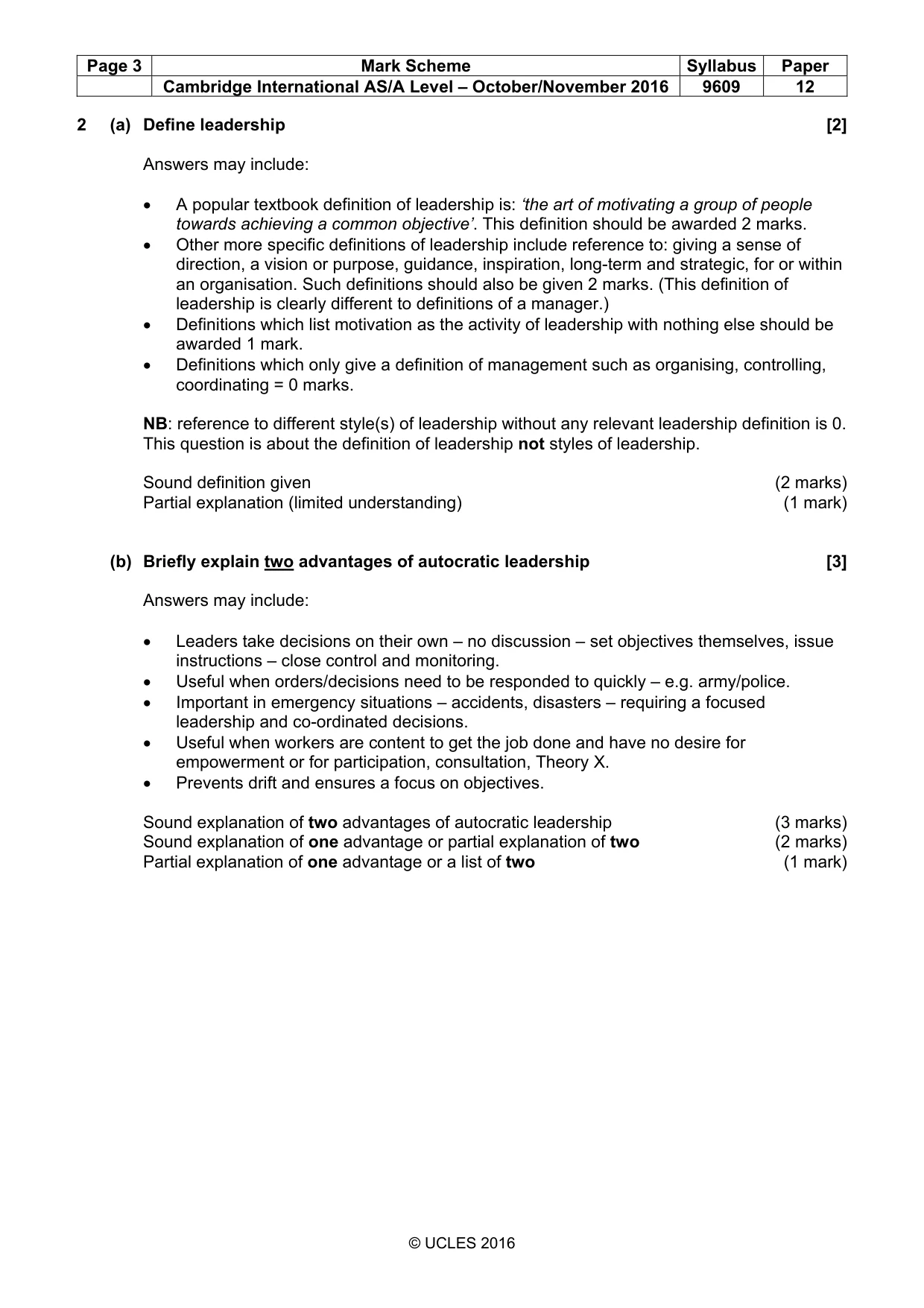
Page 3 Mark Scheme Syllabus Paper Cambridge International AS/A Level – October/November 2016 9609 12 © UCLES 2016 2 (a) Define leadership [2] Answers may include: • A popular textbook definition of leadership is: ‘the art of motivating a group of people towards achieving a common objective’. This definition should be awarded 2 marks. • Other more specific definitions of leadership include reference to: giving a sense of direction, a vision or purpose, guidance, inspiration, long-term and strategic, for or within an organisation. Such definitions should also be given 2 marks. (This definition of leadership is clearly different to definitions of a manager.) • Definitions which list motivation as the activity of leadership with nothing else should be awarded 1 mark. • Definitions which only give a definition of management such as organising, controlling, coordinating = 0 marks. NB: reference to different style(s) of leadership without any relevant leadership definition is 0. This question is about the definition of leadership not styles of leadership. Sound definition given (2 marks) Partial explanation (limited understanding) (1 mark) (b) Briefly explain two advantages of autocratic leadership [3] Answers may include: • Leaders take decisions on their own – no discussion – set objectives themselves, issue instructions – close control and monitoring. • Useful when orders/decisions need to be responded to quickly – e.g. army/police. • Important in emergency situations – accidents, disasters – requiring a focused leadership and co-ordinated decisions. • Useful when workers are content to get the job done and have no desire for empowerment or for participation, consultation, Theory X. • Prevents drift and ensures a focus on objectives. Sound explanation of two advantages of autocratic leadership (3 marks) Sound explanation of one advantage or partial explanation of two (2 marks) Partial explanation of one advantage or a list of two (1 mark)
Mark scheme, page 4
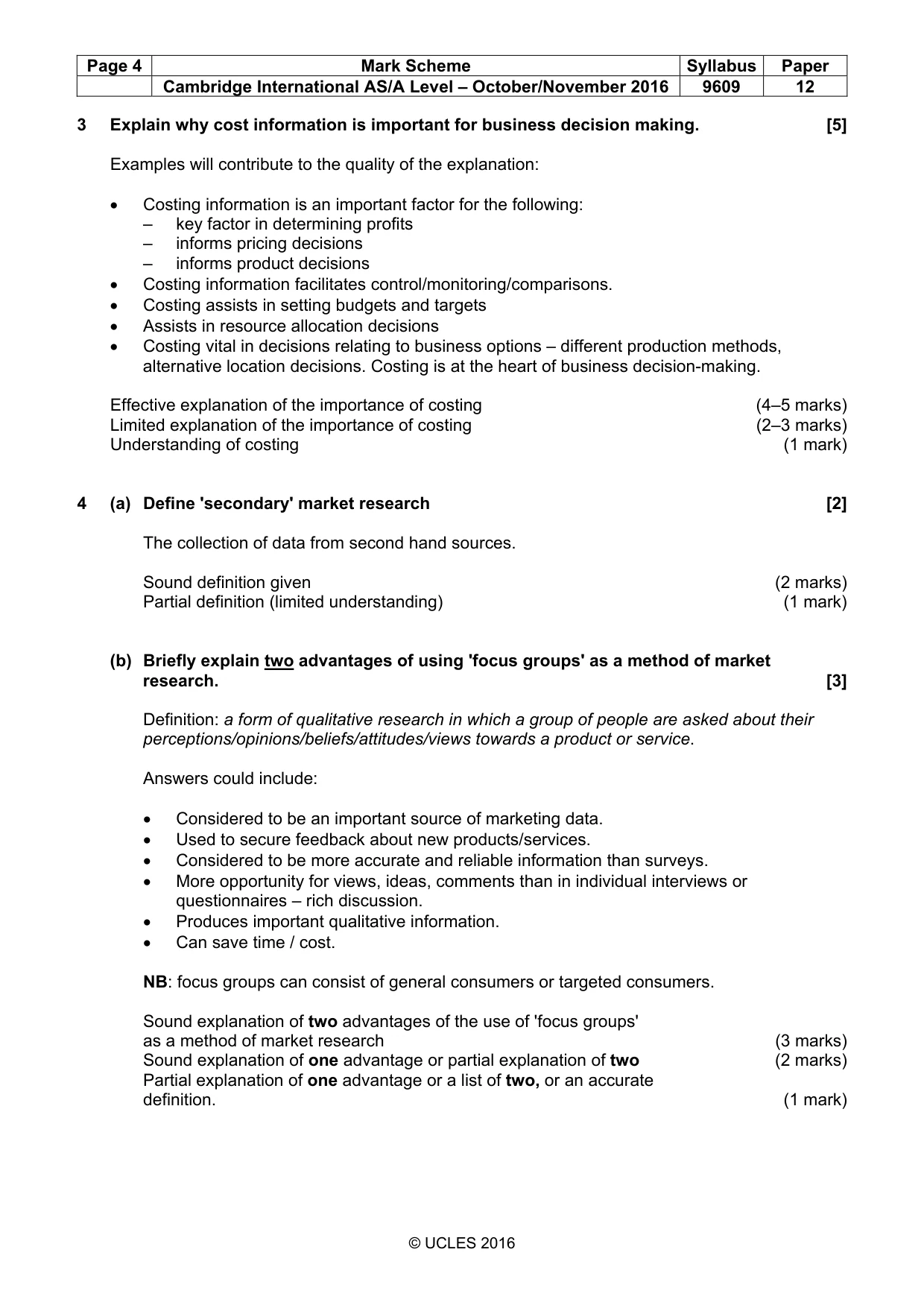
Page 4 Mark Scheme Syllabus Paper Cambridge International AS/A Level – October/November 2016 9609 12 © UCLES 2016 3 Explain why cost information is important for business decision making. [5] Examples will contribute to the quality of the explanation: • Costing information is an important factor for the following: – key factor in determining profits – informs pricing decisions – informs product decisions • Costing information facilitates control/monitoring/comparisons. • Costing assists in setting budgets and targets • Assists in resource allocation decisions • Costing vital in decisions relating to business options – different production methods, alternative location decisions. Costing is at the heart of business decision-making. Effective explanation of the importance of costing (4–5 marks) Limited explanation of the importance of costing (2–3 marks) Understanding of costing (1 mark) 4 (a) Define 'secondary' market research [2] The collection of data from second hand sources. Sound definition given (2 marks) Partial definition (limited understanding) (1 mark) (b) Briefly explain two advantages of using 'focus groups' as a method of market research. [3] Definition: a form of qualitative research in which a group of people are asked about their perceptions/opinions/beliefs/attitudes/views towards a product or service. Answers could include: • Considered to be an important source of marketing data. • Used to secure feedback about new products/services. • Considered to be more accurate and reliable information than surveys. • More opportunity for views, ideas, comments than in individual interviews or questionnaires – rich discussion. • Produces important qualitative information. • Can save time / cost. NB: focus groups can consist of general consumers or targeted consumers. Sound explanation of two advantages of the use of 'focus groups' as a method of market research (3 marks) Sound explanation of one advantage or partial explanation of two (2 marks) Partial explanation of one advantage or a list of two, or an accurate definition. (1 mark)
Mark scheme, page 5
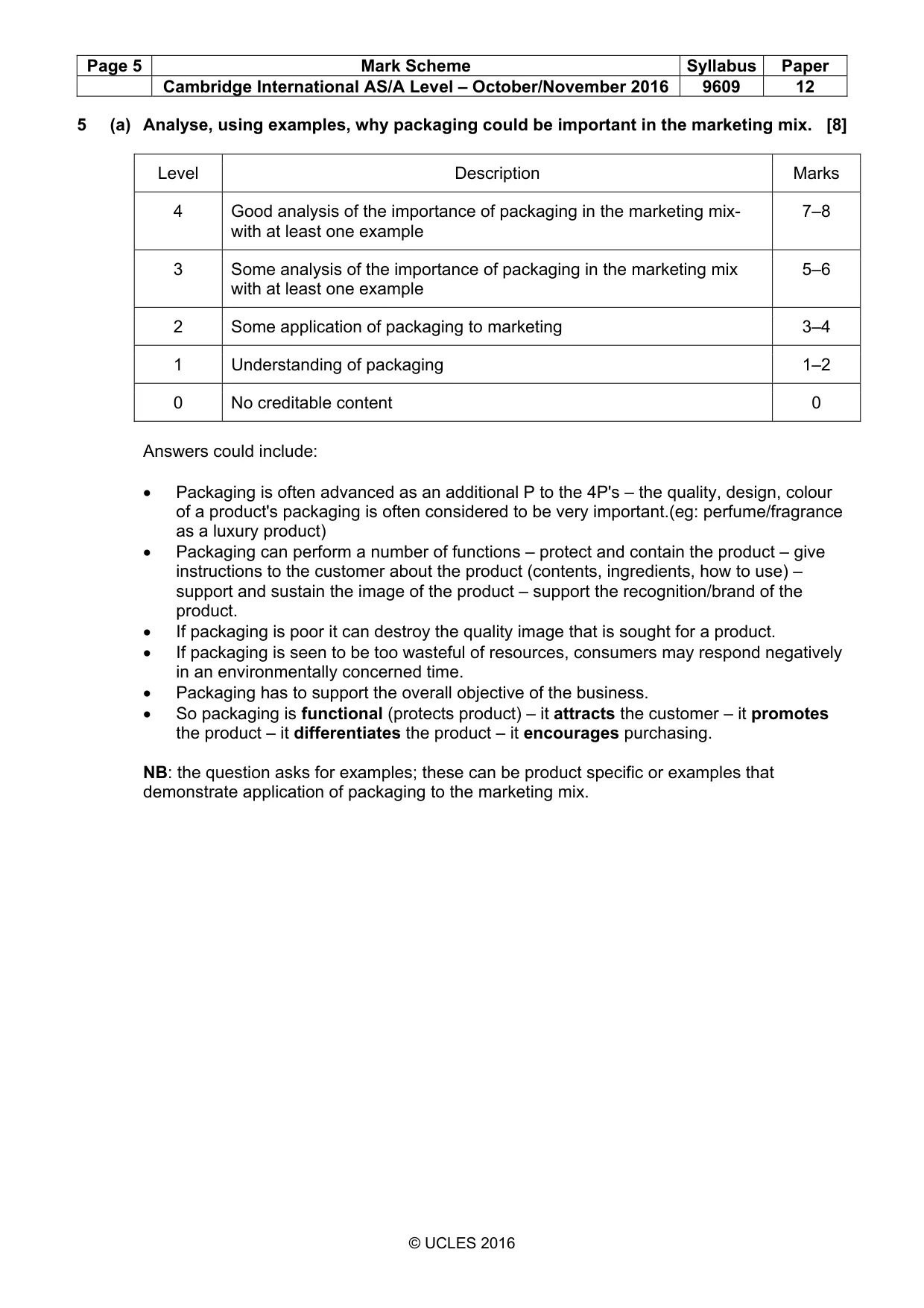
Page 5 Mark Scheme Syllabus Paper Cambridge International AS/A Level – October/November 2016 9609 12 © UCLES 2016 5 (a) Analyse, using examples, why packaging could be important in the marketing mix. [8] Level Description Marks 4 Good analysis of the importance of packaging in the marketing mix- with at least one example 7–8 3 Some analysis of the importance of packaging in the marketing mix with at least one example 5–6 2 Some application of packaging to marketing 3–4 1 Understanding of packaging 1–2 0 No creditable content 0 Answers could include: • Packaging is often advanced as an additional P to the 4P's – the quality, design, colour of a product's packaging is often considered to be very important.(eg: perfume/fragrance as a luxury product) • Packaging can perform a number of functions – protect and contain the product – give instructions to the customer about the product (contents, ingredients, how to use) – support and sustain the image of the product – support the recognition/brand of the product. • If packaging is poor it can destroy the quality image that is sought for a product. • If packaging is seen to be too wasteful of resources, consumers may respond negatively in an environmentally concerned time. • Packaging has to support the overall objective of the business. • So packaging is functional (protects product) – it attracts the customer – it promotes the product – it differentiates the product – it encourages purchasing. NB: the question asks for examples; these can be product specific or examples that demonstrate application of packaging to the marketing mix.
Mark scheme, page 6
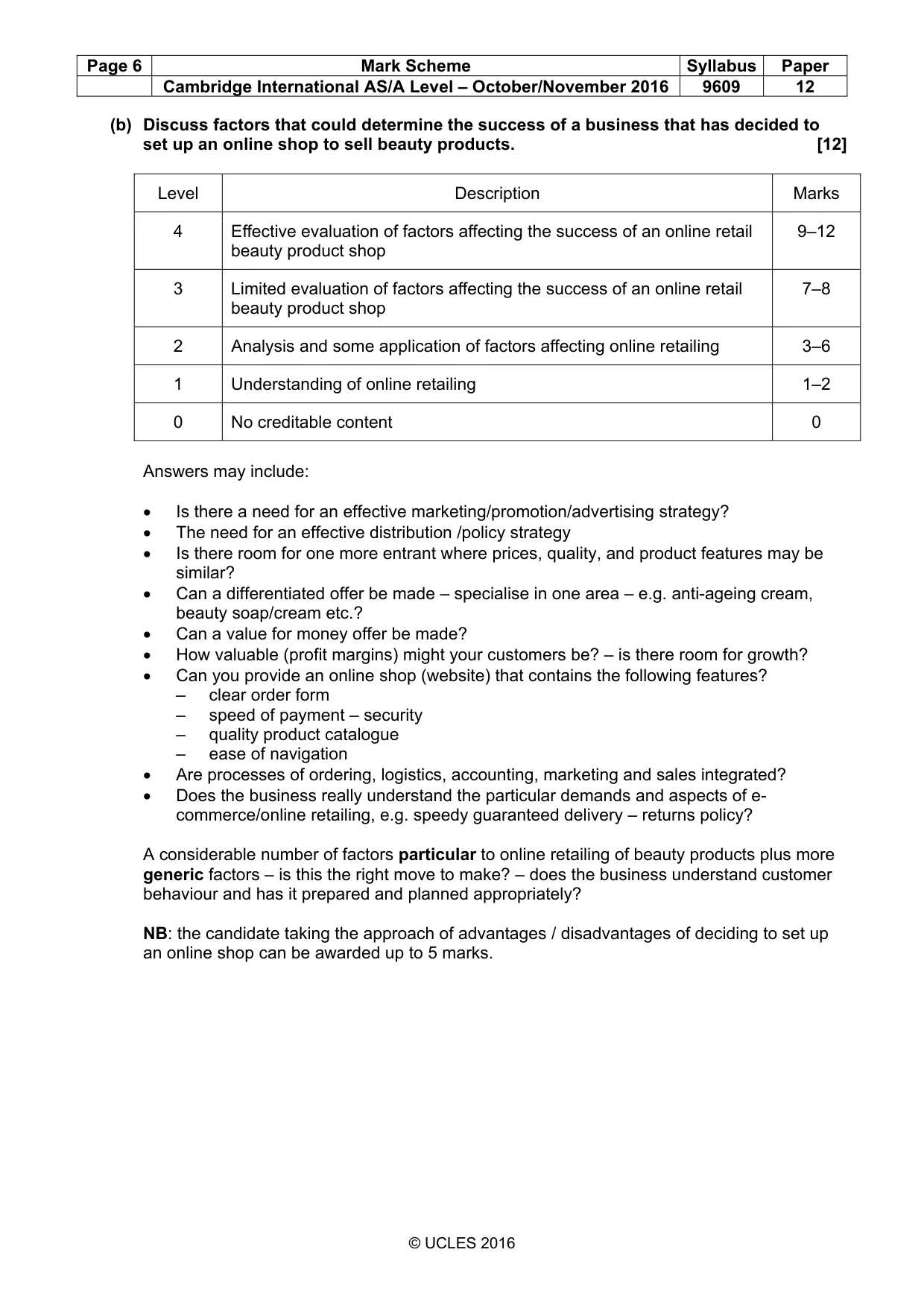
Page 6 Mark Scheme Syllabus Paper Cambridge International AS/A Level – October/November 2016 9609 12 © UCLES 2016 (b) Discuss factors that could determine the success of a business that has decided to set up an online shop to sell beauty products. [12] Level Description Marks 4 Effective evaluation of factors affecting the success of an online retail beauty product shop 9–12 3 Limited evaluation of factors affecting the success of an online retail beauty product shop 7–8 2 Analysis and some application of factors affecting online retailing 3–6 1 Understanding of online retailing 1–2 0 No creditable content 0 Answers may include: • Is there a need for an effective marketing/promotion/advertising strategy? • The need for an effective distribution /policy strategy • Is there room for one more entrant where prices, quality, and product features may be similar? • Can a differentiated offer be made – specialise in one area – e.g. anti-ageing cream, beauty soap/cream etc.? • Can a value for money offer be made? • How valuable (profit margins) might your customers be? – is there room for growth? • Can you provide an online shop (website) that contains the following features? – clear order form – speed of payment – security – quality product catalogue – ease of navigation • Are processes of ordering, logistics, accounting, marketing and sales integrated? • Does the business really understand the particular demands and aspects of e- commerce/online retailing, e.g. speedy guaranteed delivery – returns policy? A considerable number of factors particular to online retailing of beauty products plus more generic factors – is this the right move to make? – does the business understand customer behaviour and has it prepared and planned appropriately? NB: the candidate taking the approach of advantages / disadvantages of deciding to set up an online shop can be awarded up to 5 marks.
Mark scheme, page 7
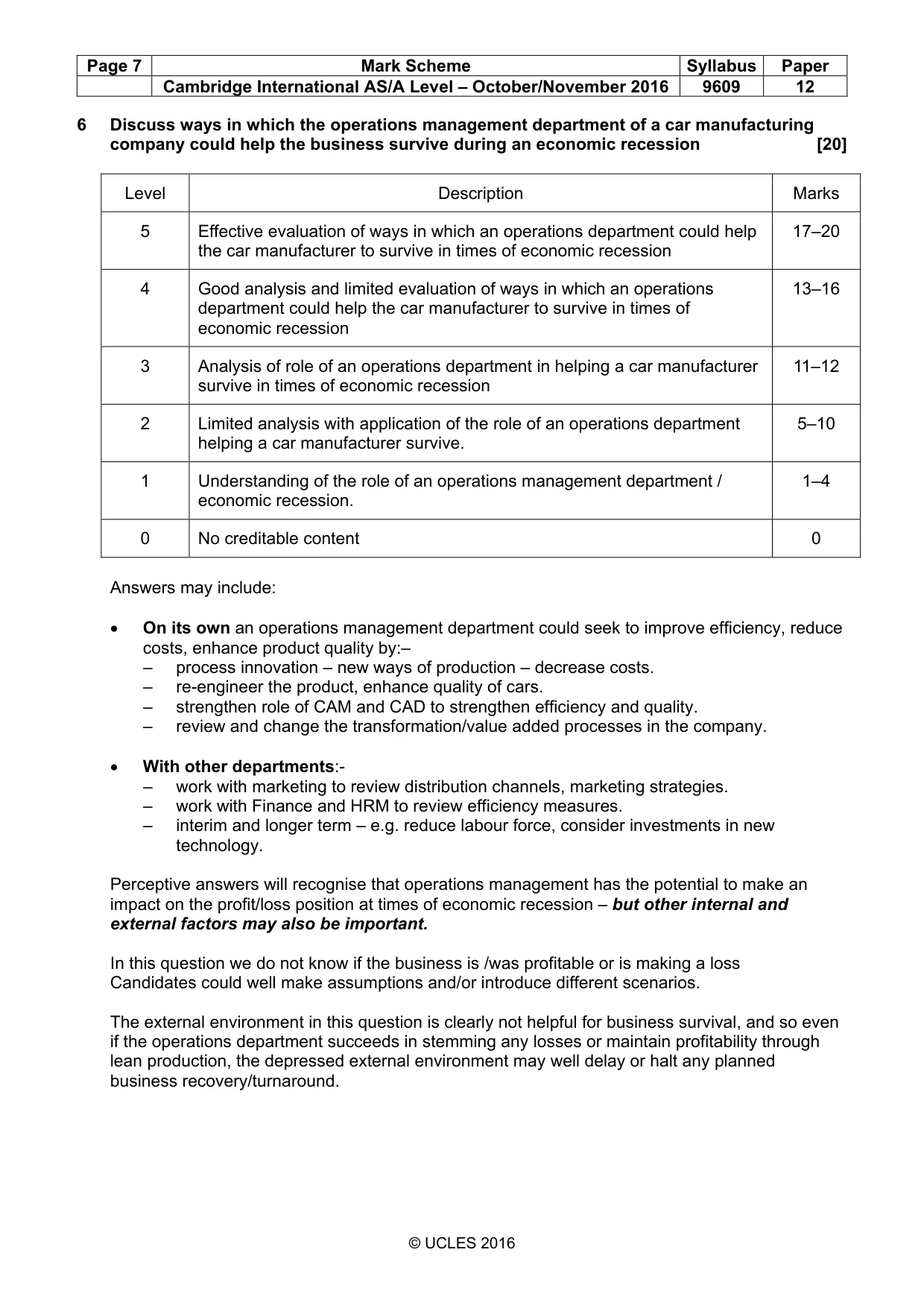
Page 7 Mark Scheme Syllabus Paper Cambridge International AS/A Level – October/November 2016 9609 12 © UCLES 2016 6 Discuss ways in which the operations management department of a car manufacturing company could help the business survive during an economic recession [20] Level Description Marks 5 Effective evaluation of ways in which an operations department could help the car manufacturer to survive in times of economic recession 17–20 4 Good analysis and limited evaluation of ways in which an operations department could help the car manufacturer to survive in times of economic recession 13–16 3 Analysis of role of an operations department in helping a car manufacturer survive in times of economic recession 11–12 2 Limited analysis with application of the role of an operations department helping a car manufacturer survive. 5–10 1 Understanding of the role of an operations management department / economic recession. 1–4 0 No creditable content 0 Answers may include: • On its own an operations management department could seek to improve efficiency, reduce costs, enhance product quality by:– – process innovation – new ways of production – decrease costs. – re-engineer the product, enhance quality of cars. – strengthen role of CAM and CAD to strengthen efficiency and quality. – review and change the transformation/value added processes in the company. • With other departments:- – work with marketing to review distribution channels, marketing strategies. – work with Finance and HRM to review efficiency measures. – interim and longer term – e.g. reduce labour force, consider investments in new technology. Perceptive answers will recognise that operations management has the potential to make an impact on the profit/loss position at times of economic recession – but other internal and external factors may also be important. In this question we do not know if the business is /was profitable or is making a loss Candidates could well make assumptions and/or introduce different scenarios. The external environment in this question is clearly not helpful for business survival, and so even if the operations department succeeds in stemming any losses or maintain profitability through lean production, the depressed external environment may well delay or halt any planned business recovery/turnaround.
Mark scheme, page 8
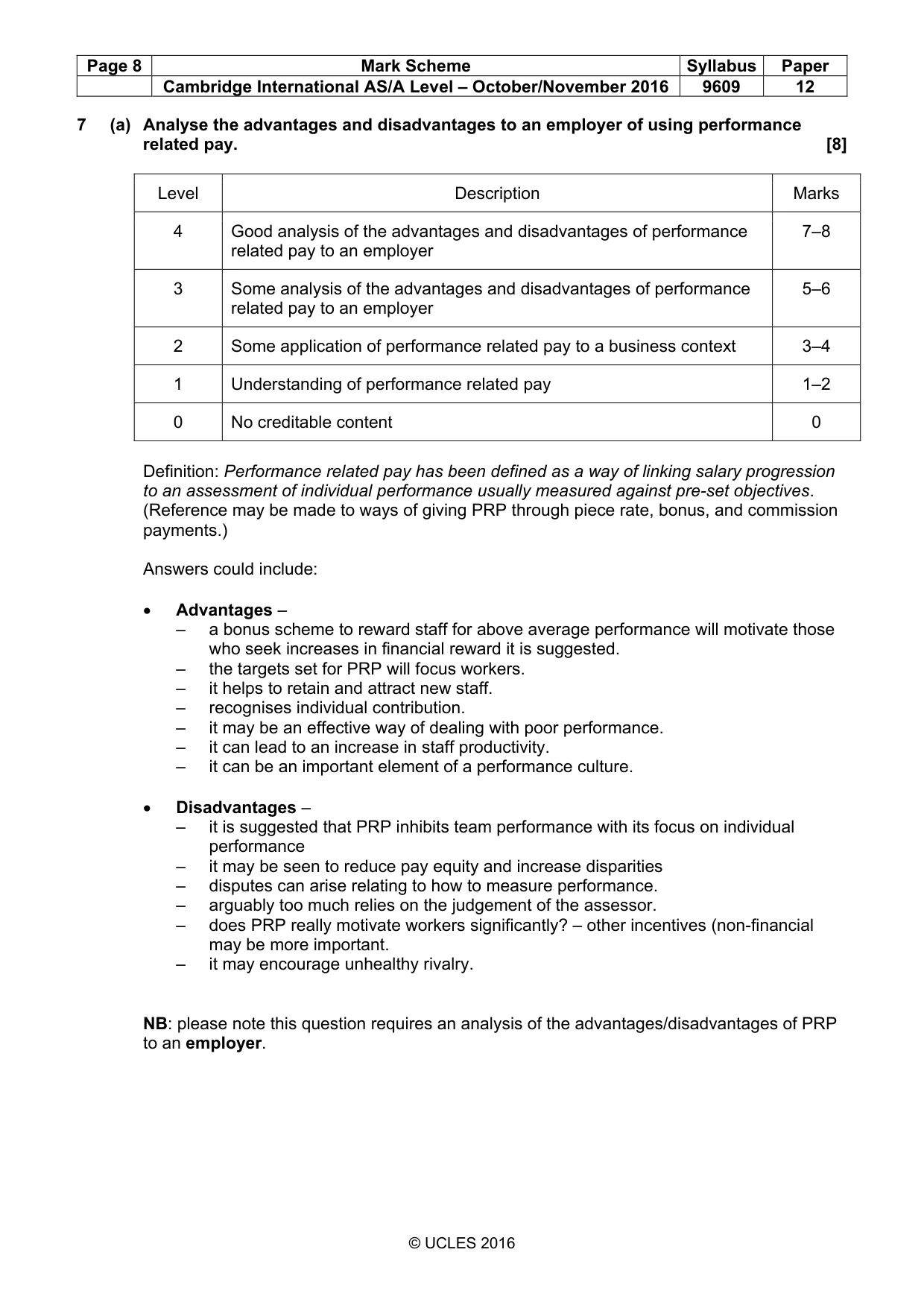
Page 8 Mark Scheme Syllabus Paper Cambridge International AS/A Level – October/November 2016 9609 12 © UCLES 2016 7 (a) Analyse the advantages and disadvantages to an employer of using performance related pay. [8] Level Description Marks 4 Good analysis of the advantages and disadvantages of performance related pay to an employer 7–8 3 Some analysis of the advantages and disadvantages of performance related pay to an employer 5–6 2 Some application of performance related pay to a business context 3–4 1 Understanding of performance related pay 1–2 0 No creditable content 0 Definition: Performance related pay has been defined as a way of linking salary progression to an assessment of individual performance usually measured against pre-set objectives. (Reference may be made to ways of giving PRP through piece rate, bonus, and commission payments.) Answers could include: • Advantages – – a bonus scheme to reward staff for above average performance will motivate those who seek increases in financial reward it is suggested. – the targets set for PRP will focus workers. – it helps to retain and attract new staff. – recognises individual contribution. – it may be an effective way of dealing with poor performance. – it can lead to an increase in staff productivity. – it can be an important element of a performance culture. • Disadvantages – – it is suggested that PRP inhibits team performance with its focus on individual performance – it may be seen to reduce pay equity and increase disparities – disputes can arise relating to how to measure performance. – arguably too much relies on the judgement of the assessor. – does PRP really motivate workers significantly? – other incentives (non-financial may be more important. – it may encourage unhealthy rivalry. NB: please note this question requires an analysis of the advantages/disadvantages of PRP to an employer.
Mark scheme, page 9
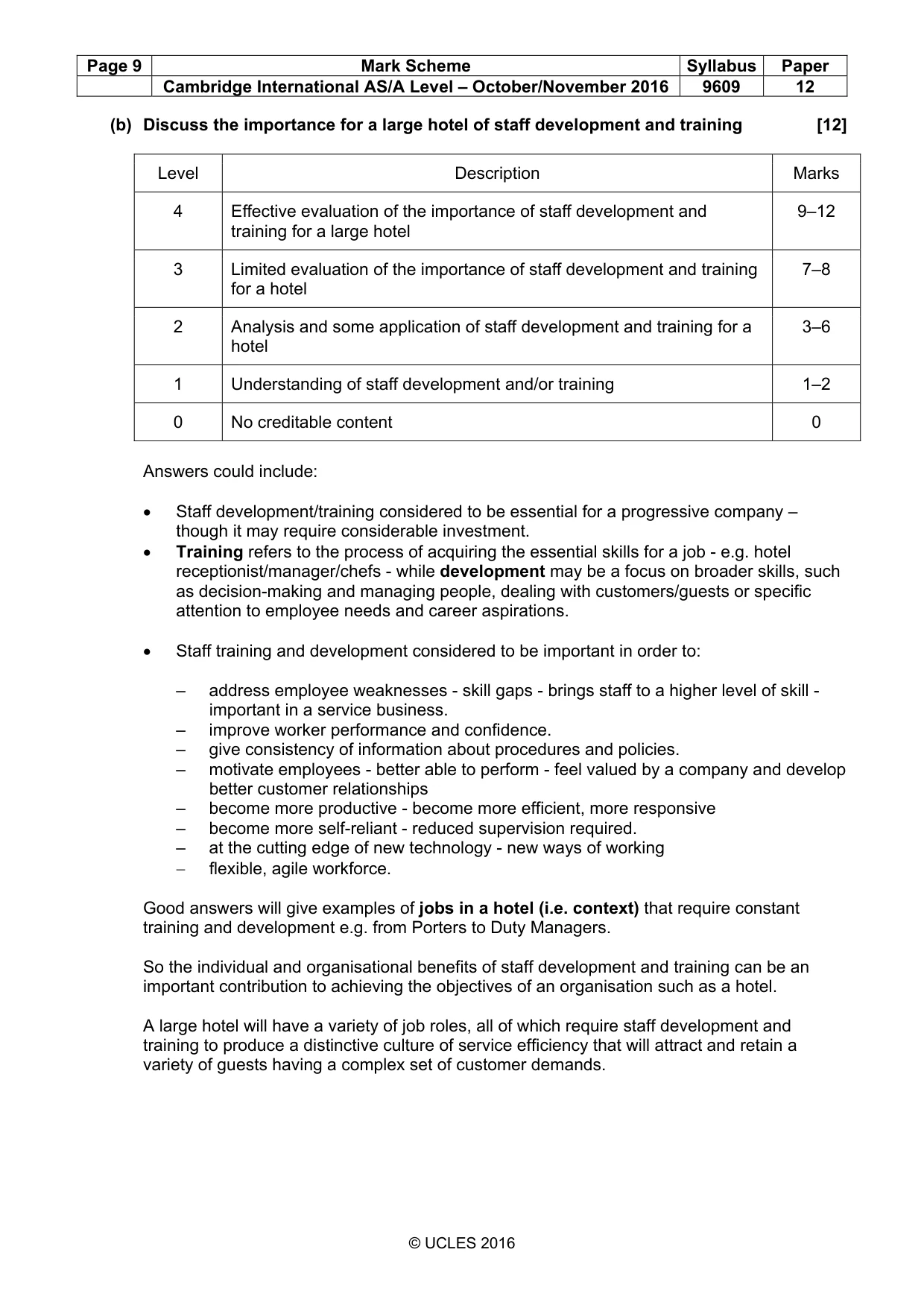
Page 9 Mark Scheme Syllabus Paper Cambridge International AS/A Level – October/November 2016 9609 12 © UCLES 2016 (b) Discuss the importance for a large hotel of staff development and training [12] Level Description Marks 4 Effective evaluation of the importance of staff development and training for a large hotel 9–12 3 Limited evaluation of the importance of staff development and training for a hotel 7–8 2 Analysis and some application of staff development and training for a hotel 3–6 1 Understanding of staff development and/or training 1–2 0 No creditable content 0 Answers could include: • Staff development/training considered to be essential for a progressive company – though it may require considerable investment. • Training refers to the process of acquiring the essential skills for a job - e.g. hotel receptionist/manager/chefs - while development may be a focus on broader skills, such as decision-making and managing people, dealing with customers/guests or specific attention to employee needs and career aspirations. • Staff training and development considered to be important in order to: – address employee weaknesses - skill gaps - brings staff to a higher level of skill - important in a service business. – improve worker performance and confidence. – give consistency of information about procedures and policies. – motivate employees - better able to perform - feel valued by a company and develop better customer relationships – become more productive - become more efficient, more responsive – become more self-reliant - reduced supervision required. – at the cutting edge of new technology - new ways of working − flexible, agile workforce. Good answers will give examples of jobs in a hotel (i.e. context) that require constant training and development e.g. from Porters to Duty Managers. So the individual and organisational benefits of staff development and training can be an important contribution to achieving the objectives of an organisation such as a hotel. A large hotel will have a variety of job roles, all of which require staff development and training to produce a distinctive culture of service efficiency that will attract and retain a variety of guests having a complex set of customer demands.
What you needed in this session
Cambridge’s own grade thresholds for 2016 Oct/Nov, Paper 1 · Variant 2. A higher threshold means an easier paper — the bar moves with how the cohort did.