Cambridge A Level Business (for first examination in 2016) 9609 — 2016 Oct/Nov Paper 1 · Variant 3
9609/13/O/N/16 · 40 marks · ≈45 min
The question paper and its mark scheme, free to read here and free to download. This is Cambridge’s own paper, exactly as it was sat.
Question paper4 pages


Mark scheme7 pages
Answers below. Sit the paper first if you are practising.
Paper as text
Question paper, page 1
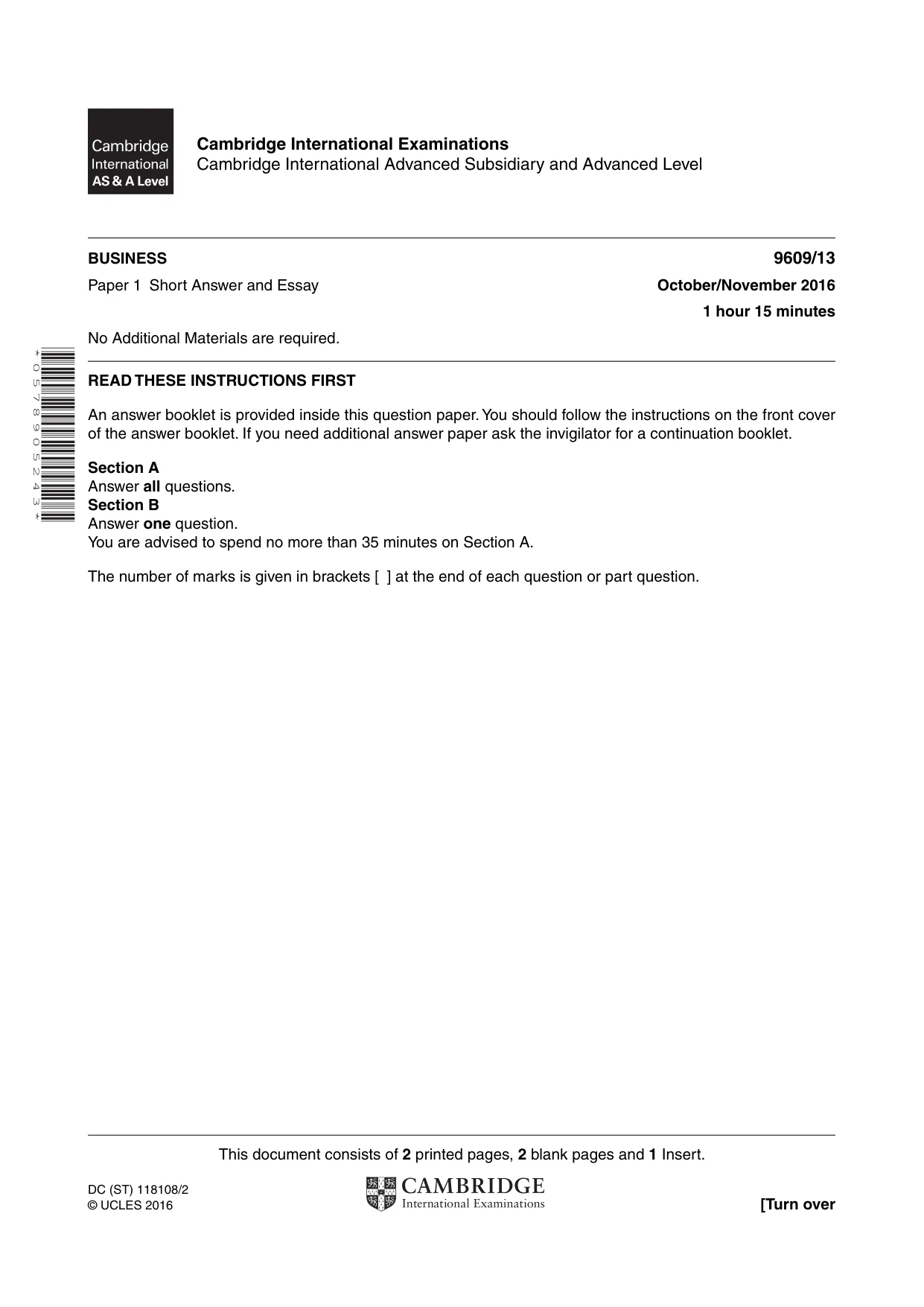
This document consists of 2 printed pages, 2 blank pages and 1 Insert. DC (ST) 118108/2 © UCLES 2016 [Turn over Cambridge International Examinations Cambridge International Advanced Subsidiary and Advanced Level * 0 5 7 8 9 0 5 2 4 3 * BUSINESS 9609/13 Paper 1 Short Answer and Essay October/November 2016 1 hour 15 minutes No Additional Materials are required. READ THESE INSTRUCTIONS FIRST An answer booklet is provided inside this question paper. You should follow the instructions on the front cover of the answer booklet. If you need additional answer paper ask the invigilator for a continuation booklet. Section A Answer all questions. Section B Answer one question. You are advised to spend no more than 35 minutes on Section A. The number of marks is given in brackets [ ] at the end of each question or part question.
Question paper, page 2
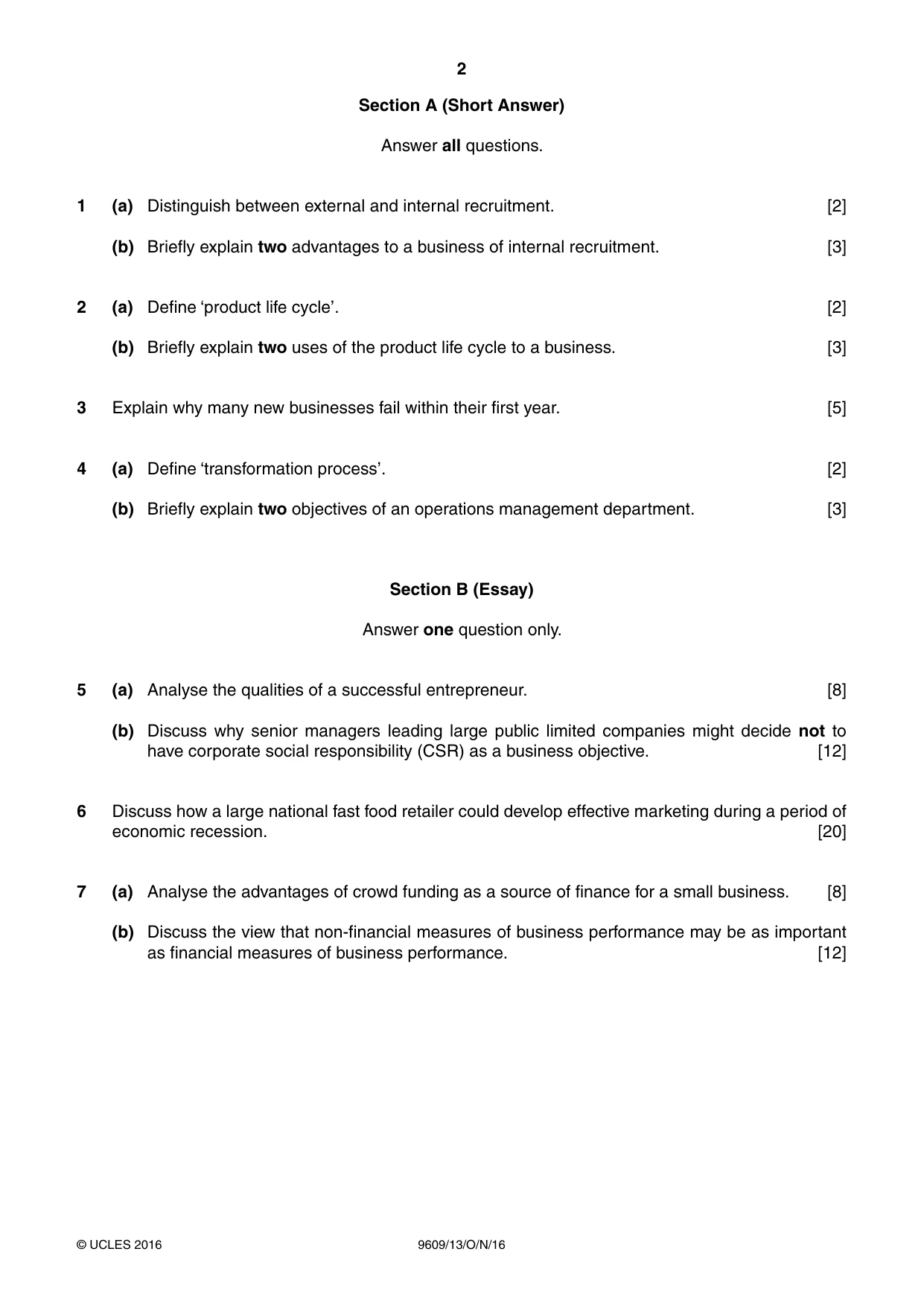
2 9609/13/O/N/16 © UCLES 2016 Section A (Short Answer) Answer all questions. 1 (a) Distinguish between external and internal recruitment. [2] (b) Briefly explain two advantages to a business of internal recruitment. [3] 2 (a) Define ‘product life cycle’. [2] (b) Briefly explain two uses of the product life cycle to a business. [3] 3 Explain why many new businesses fail within their first year. [5] 4 (a) Define ‘transformation process’. [2] (b) Briefly explain two objectives of an operations management department. [3] Section B (Essay) Answer one question only. 5 (a) Analyse the qualities of a successful entrepreneur. [8] (b) Discuss why senior managers leading large public limited companies might decide not to have corporate social responsibility (CSR) as a business objective. [12] 6 Discuss how a large national fast food retailer could develop effective marketing during a period of economic recession. [20] 7 (a) Analyse the advantages of crowd funding as a source of finance for a small business. [8] (b) Discuss the view that non-financial measures of business performance may be as important as financial measures of business performance. [12]
Question paper, page 3
3 9609/13/O/N/16 © UCLES 2016 BLANK PAGE
Question paper, page 4
4 9609/13/O/N/16 © UCLES 2016 Permission to reproduce items where third-party owned material protected by copyright is included has been sought and cleared where possible. Every reasonable effort has been made by the publisher (UCLES) to trace copyright holders, but if any items requiring clearance have unwittingly been included, the publisher will be pleased to make amends at the earliest possible opportunity. To avoid the issue of disclosure of answer-related information to candidates, all copyright acknowledgements are reproduced online in the Cambridge International Examinations Copyright Acknowledgements Booklet. This is produced for each series of examinations and is freely available to download at www.cie.org.uk after the live examination series. Cambridge International Examinations is part of the Cambridge Assessment Group. Cambridge Assessment is the brand name of University of Cambridge Local Examinations Syndicate (UCLES), which is itself a department of the University of Cambridge. BLANK PAGE
Mark scheme, page 1
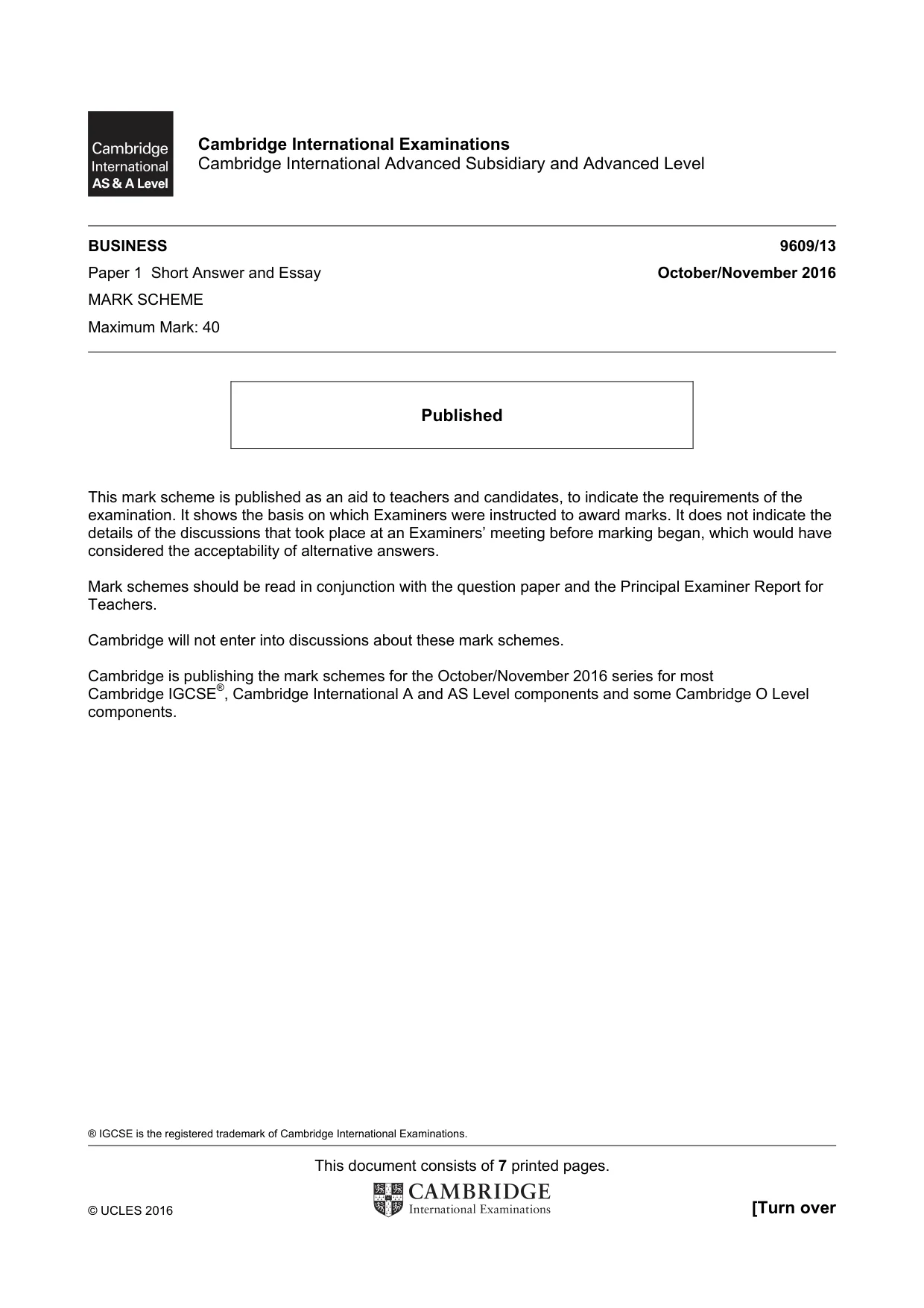
® IGCSE is the registered trademark of Cambridge International Examinations. This document consists of 7 printed pages. © UCLES 2016 [Turn over Cambridge International Examinations Cambridge International Advanced Subsidiary and Advanced Level BUSINESS 9609/13 Paper 1 Short Answer and Essay October/November 2016 MARK SCHEME Maximum Mark: 40 Published This mark scheme is published as an aid to teachers and candidates, to indicate the requirements of the examination. It shows the basis on which Examiners were instructed to award marks. It does not indicate the details of the discussions that took place at an Examiners’ meeting before marking began, which would have considered the acceptability of alternative answers. Mark schemes should be read in conjunction with the question paper and the Principal Examiner Report for Teachers. Cambridge will not enter into discussions about these mark schemes. Cambridge is publishing the mark schemes for the October/November 2016 series for most Cambridge IGCSE®, Cambridge International A and AS Level components and some Cambridge O Level components.
Mark scheme, page 2
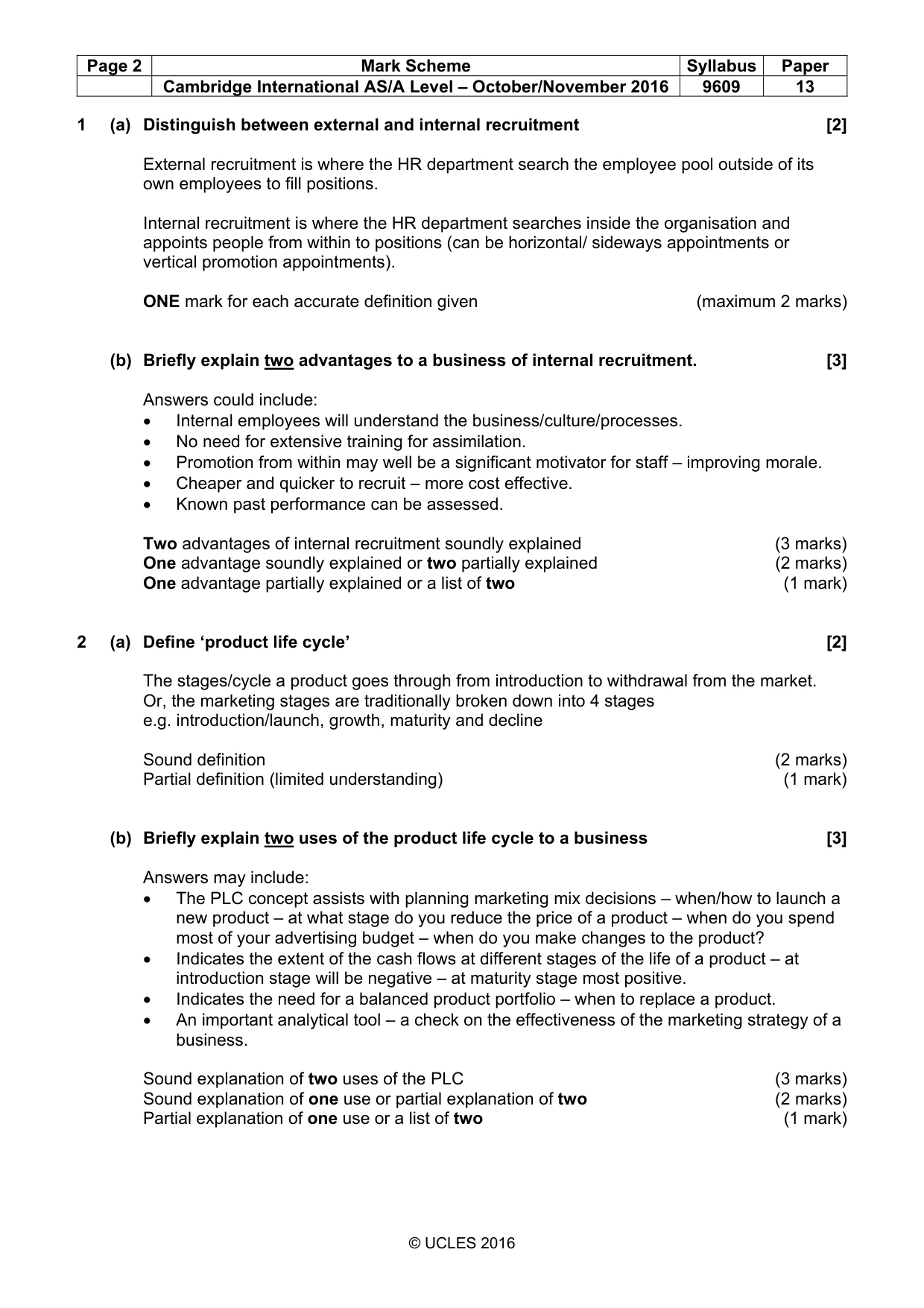
Page 2 Mark Scheme Syllabus Paper Cambridge International AS/A Level – October/November 2016 9609 13 © UCLES 2016 1 (a) Distinguish between external and internal recruitment [2] External recruitment is where the HR department search the employee pool outside of its own employees to fill positions. Internal recruitment is where the HR department searches inside the organisation and appoints people from within to positions (can be horizontal/ sideways appointments or vertical promotion appointments). ONE mark for each accurate definition given (maximum 2 marks) (b) Briefly explain two advantages to a business of internal recruitment. [3] Answers could include: • Internal employees will understand the business/culture/processes. • No need for extensive training for assimilation. • Promotion from within may well be a significant motivator for staff – improving morale. • Cheaper and quicker to recruit – more cost effective. • Known past performance can be assessed. Two advantages of internal recruitment soundly explained (3 marks) One advantage soundly explained or two partially explained (2 marks) One advantage partially explained or a list of two (1 mark) 2 (a) Define ‘product life cycle’ [2] The stages/cycle a product goes through from introduction to withdrawal from the market. Or, the marketing stages are traditionally broken down into 4 stages e.g. introduction/launch, growth, maturity and decline Sound definition (2 marks) Partial definition (limited understanding) (1 mark) (b) Briefly explain two uses of the product life cycle to a business [3] Answers may include: • The PLC concept assists with planning marketing mix decisions – when/how to launch a new product – at what stage do you reduce the price of a product – when do you spend most of your advertising budget – when do you make changes to the product? • Indicates the extent of the cash flows at different stages of the life of a product – at introduction stage will be negative – at maturity stage most positive. • Indicates the need for a balanced product portfolio – when to replace a product. • An important analytical tool – a check on the effectiveness of the marketing strategy of a business. Sound explanation of two uses of the PLC (3 marks) Sound explanation of one use or partial explanation of two (2 marks) Partial explanation of one use or a list of two (1 mark)
Mark scheme, page 3
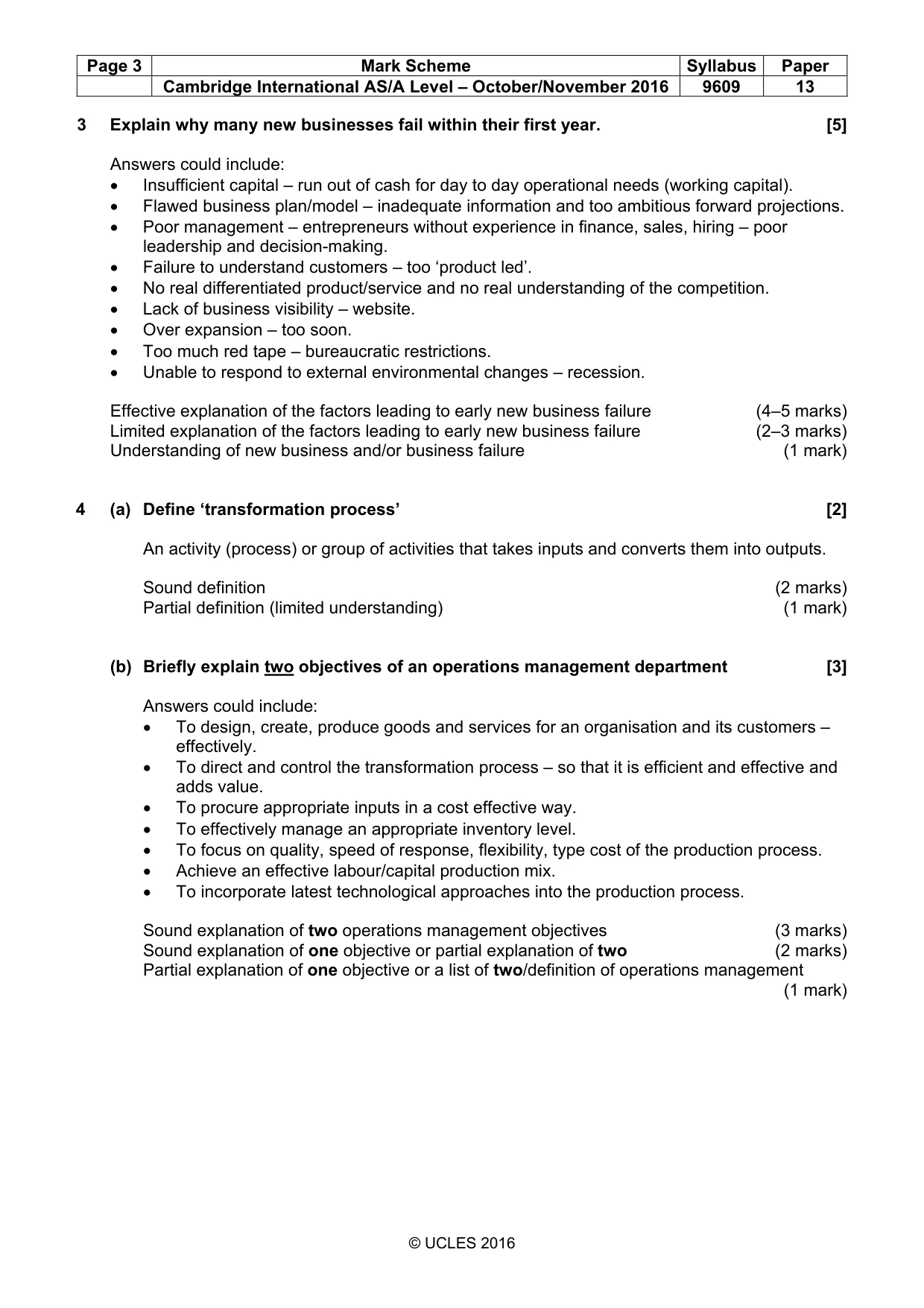
Page 3 Mark Scheme Syllabus Paper Cambridge International AS/A Level – October/November 2016 9609 13 © UCLES 2016 3 Explain why many new businesses fail within their first year. [5] Answers could include: • Insufficient capital – run out of cash for day to day operational needs (working capital). • Flawed business plan/model – inadequate information and too ambitious forward projections. • Poor management – entrepreneurs without experience in finance, sales, hiring – poor leadership and decision-making. • Failure to understand customers – too ‘product led’. • No real differentiated product/service and no real understanding of the competition. • Lack of business visibility – website. • Over expansion – too soon. • Too much red tape – bureaucratic restrictions. • Unable to respond to external environmental changes – recession. Effective explanation of the factors leading to early new business failure (4–5 marks) Limited explanation of the factors leading to early new business failure (2–3 marks) Understanding of new business and/or business failure (1 mark) 4 (a) Define ‘transformation process’ [2] An activity (process) or group of activities that takes inputs and converts them into outputs. Sound definition (2 marks) Partial definition (limited understanding) (1 mark) (b) Briefly explain two objectives of an operations management department [3] Answers could include: • To design, create, produce goods and services for an organisation and its customers – effectively. • To direct and control the transformation process – so that it is efficient and effective and adds value. • To procure appropriate inputs in a cost effective way. • To effectively manage an appropriate inventory level. • To focus on quality, speed of response, flexibility, type cost of the production process. • Achieve an effective labour/capital production mix. • To incorporate latest technological approaches into the production process. Sound explanation of two operations management objectives (3 marks) Sound explanation of one objective or partial explanation of two (2 marks) Partial explanation of one objective or a list of two/definition of operations management (1 mark)
Mark scheme, page 4
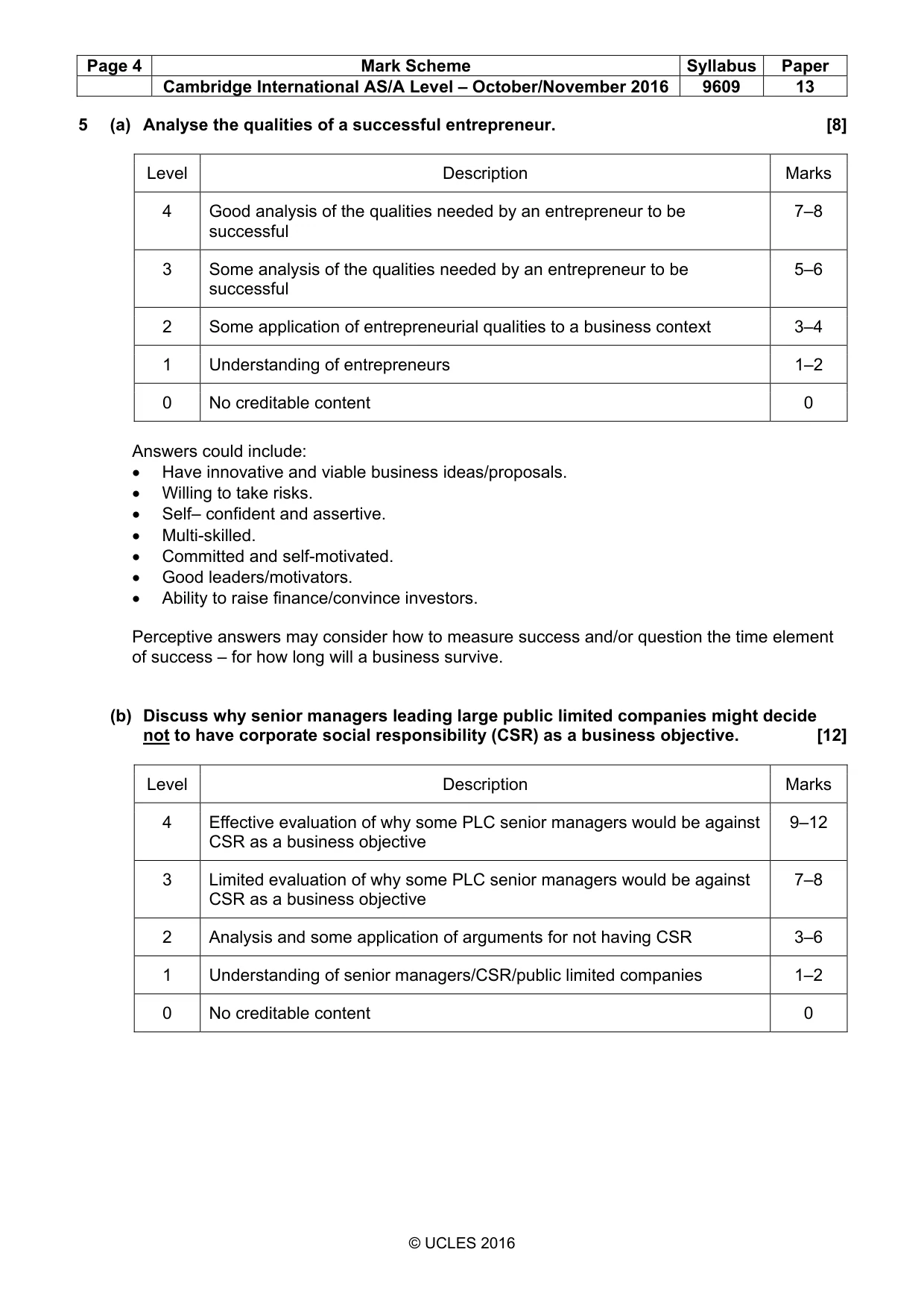
Page 4 Mark Scheme Syllabus Paper Cambridge International AS/A Level – October/November 2016 9609 13 © UCLES 2016 5 (a) Analyse the qualities of a successful entrepreneur. [8] Level Description Marks 4 Good analysis of the qualities needed by an entrepreneur to be successful 7–8 3 Some analysis of the qualities needed by an entrepreneur to be successful 5–6 2 Some application of entrepreneurial qualities to a business context 3–4 1 Understanding of entrepreneurs 1–2 0 No creditable content 0 Answers could include: • Have innovative and viable business ideas/proposals. • Willing to take risks. • Self– confident and assertive. • Multi-skilled. • Committed and self-motivated. • Good leaders/motivators. • Ability to raise finance/convince investors. Perceptive answers may consider how to measure success and/or question the time element of success – for how long will a business survive. (b) Discuss why senior managers leading large public limited companies might decide not to have corporate social responsibility (CSR) as a business objective. [12] Level Description Marks 4 Effective evaluation of why some PLC senior managers would be against CSR as a business objective 9–12 3 Limited evaluation of why some PLC senior managers would be against CSR as a business objective 7–8 2 Analysis and some application of arguments for not having CSR 3–6 1 Understanding of senior managers/CSR/public limited companies 1–2 0 No creditable content 0
Mark scheme, page 5
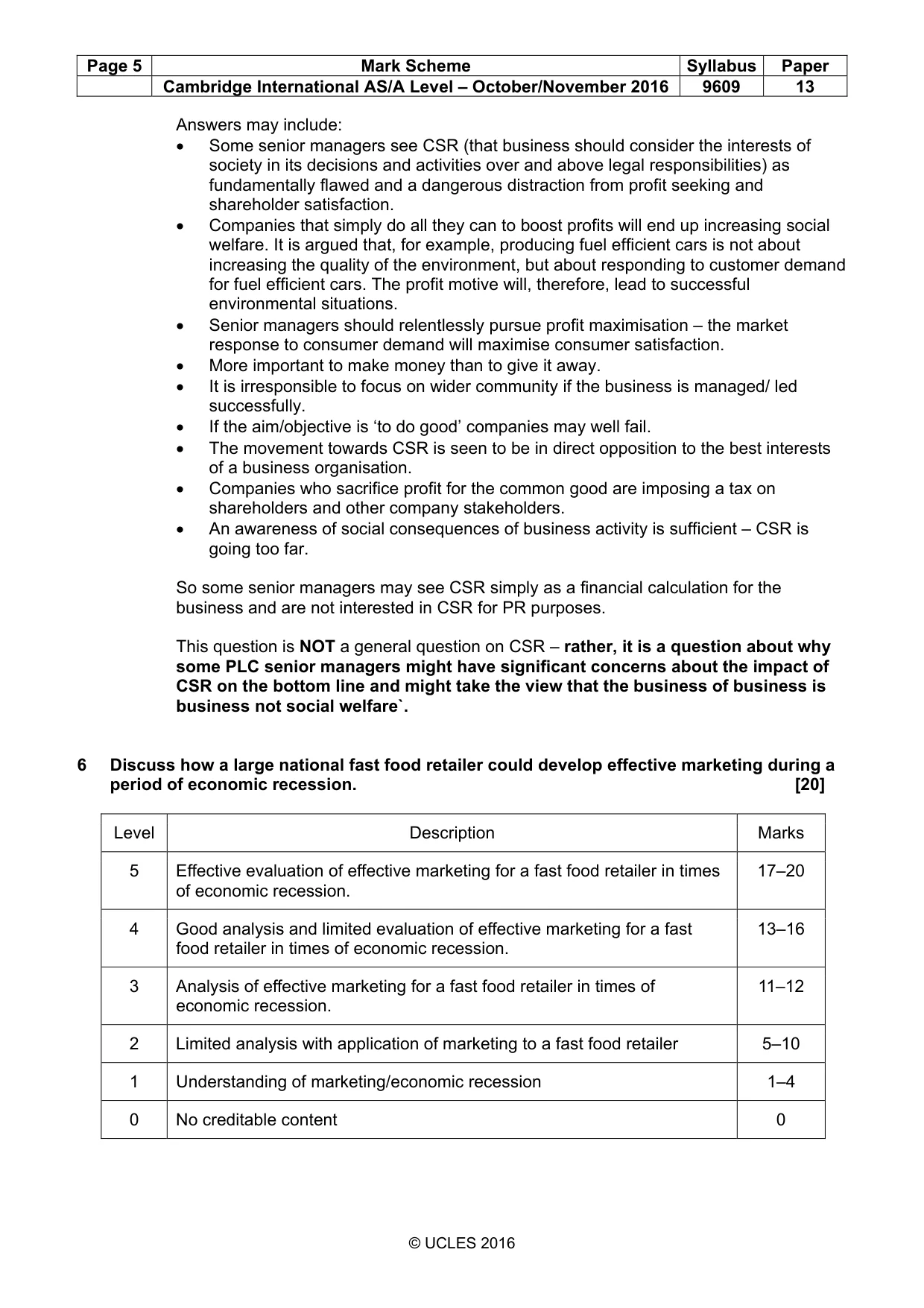
Page 5 Mark Scheme Syllabus Paper Cambridge International AS/A Level – October/November 2016 9609 13 © UCLES 2016 Answers may include: • Some senior managers see CSR (that business should consider the interests of society in its decisions and activities over and above legal responsibilities) as fundamentally flawed and a dangerous distraction from profit seeking and shareholder satisfaction. • Companies that simply do all they can to boost profits will end up increasing social welfare. It is argued that, for example, producing fuel efficient cars is not about increasing the quality of the environment, but about responding to customer demand for fuel efficient cars. The profit motive will, therefore, lead to successful environmental situations. • Senior managers should relentlessly pursue profit maximisation – the market response to consumer demand will maximise consumer satisfaction. • More important to make money than to give it away. • It is irresponsible to focus on wider community if the business is managed/ led successfully. • If the aim/objective is ‘to do good’ companies may well fail. • The movement towards CSR is seen to be in direct opposition to the best interests of a business organisation. • Companies who sacrifice profit for the common good are imposing a tax on shareholders and other company stakeholders. • An awareness of social consequences of business activity is sufficient – CSR is going too far. So some senior managers may see CSR simply as a financial calculation for the business and are not interested in CSR for PR purposes. This question is NOT a general question on CSR – rather, it is a question about why some PLC senior managers might have significant concerns about the impact of CSR on the bottom line and might take the view that the business of business is business not social welfare`. 6 Discuss how a large national fast food retailer could develop effective marketing during a period of economic recession. [20] Level Description Marks 5 Effective evaluation of effective marketing for a fast food retailer in times of economic recession. 17–20 4 Good analysis and limited evaluation of effective marketing for a fast food retailer in times of economic recession. 13–16 3 Analysis of effective marketing for a fast food retailer in times of economic recession. 11–12 2 Limited analysis with application of marketing to a fast food retailer 5–10 1 Understanding of marketing/economic recession 1–4 0 No creditable content 0
Mark scheme, page 6
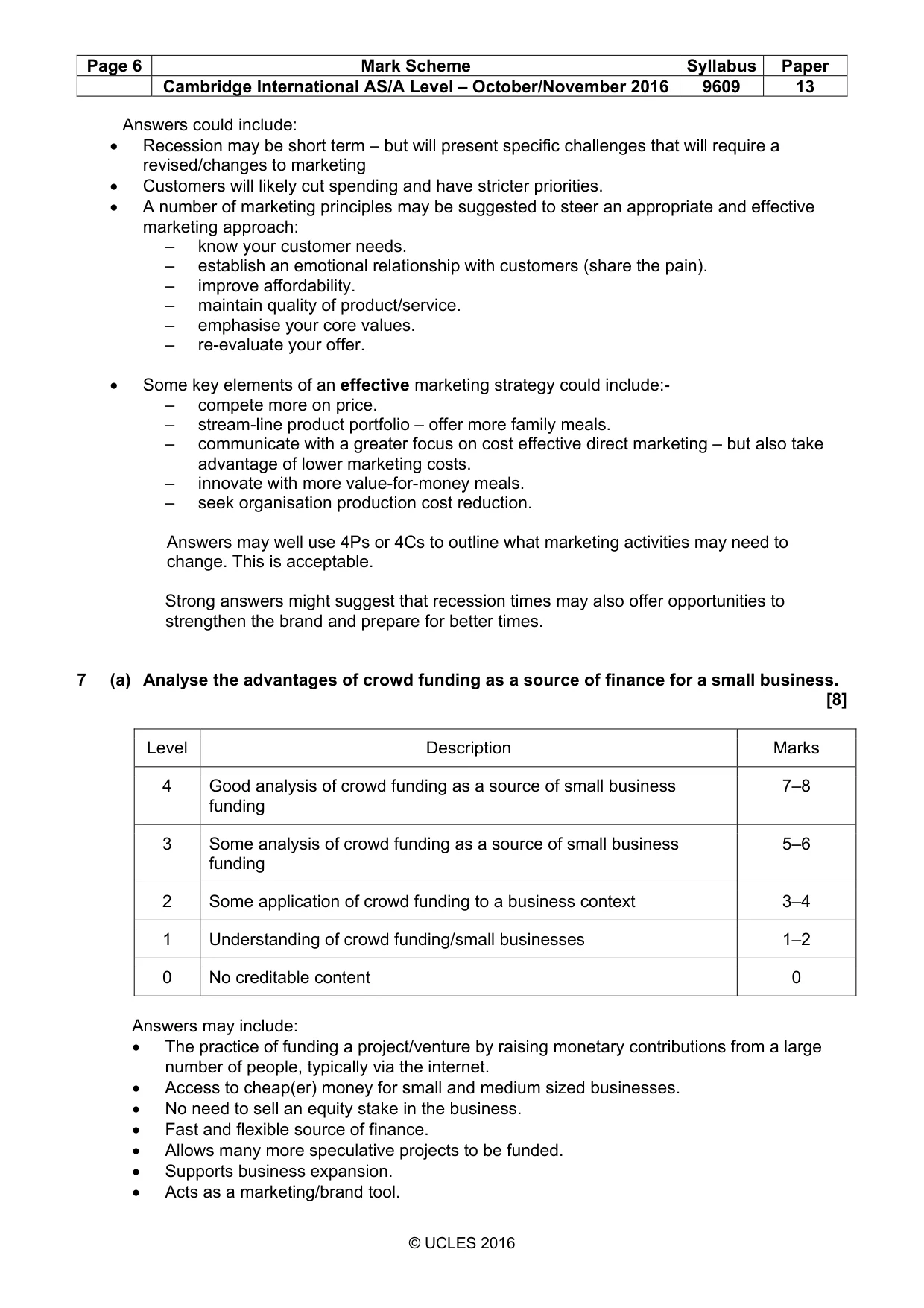
Page 6 Mark Scheme Syllabus Paper Cambridge International AS/A Level – October/November 2016 9609 13 © UCLES 2016 Answers could include: • Recession may be short term – but will present specific challenges that will require a revised/changes to marketing • Customers will likely cut spending and have stricter priorities. • A number of marketing principles may be suggested to steer an appropriate and effective marketing approach: – know your customer needs. – establish an emotional relationship with customers (share the pain). – improve affordability. – maintain quality of product/service. – emphasise your core values. – re-evaluate your offer. • Some key elements of an effective marketing strategy could include:- – compete more on price. – stream-line product portfolio – offer more family meals. – communicate with a greater focus on cost effective direct marketing – but also take advantage of lower marketing costs. – innovate with more value-for-money meals. – seek organisation production cost reduction. Answers may well use 4Ps or 4Cs to outline what marketing activities may need to change. This is acceptable. Strong answers might suggest that recession times may also offer opportunities to strengthen the brand and prepare for better times. 7 (a) Analyse the advantages of crowd funding as a source of finance for a small business. [8] Level Description Marks 4 Good analysis of crowd funding as a source of small business funding 7–8 3 Some analysis of crowd funding as a source of small business funding 5–6 2 Some application of crowd funding to a business context 3–4 1 Understanding of crowd funding/small businesses 1–2 0 No creditable content 0 Answers may include: • The practice of funding a project/venture by raising monetary contributions from a large number of people, typically via the internet. • Access to cheap(er) money for small and medium sized businesses. • No need to sell an equity stake in the business. • Fast and flexible source of finance. • Allows many more speculative projects to be funded. • Supports business expansion. • Acts as a marketing/brand tool.
Mark scheme, page 7
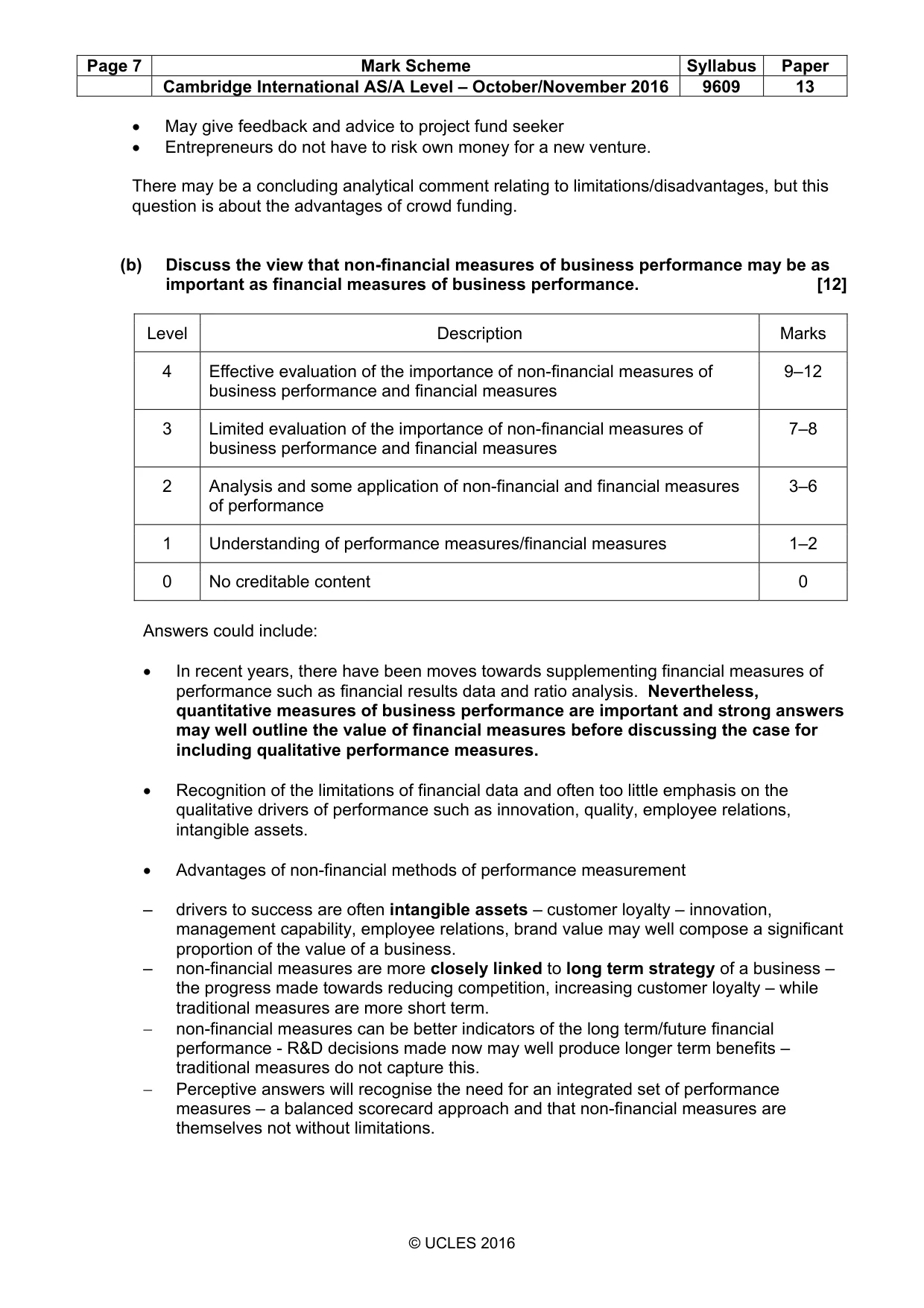
Page 7 Mark Scheme Syllabus Paper Cambridge International AS/A Level – October/November 2016 9609 13 © UCLES 2016 • May give feedback and advice to project fund seeker • Entrepreneurs do not have to risk own money for a new venture. There may be a concluding analytical comment relating to limitations/disadvantages, but this question is about the advantages of crowd funding. (b) Discuss the view that non-financial measures of business performance may be as important as financial measures of business performance. [12] Level Description Marks 4 Effective evaluation of the importance of non-financial measures of business performance and financial measures 9–12 3 Limited evaluation of the importance of non-financial measures of business performance and financial measures 7–8 2 Analysis and some application of non-financial and financial measures of performance 3–6 1 Understanding of performance measures/financial measures 1–2 0 No creditable content 0 Answers could include: • In recent years, there have been moves towards supplementing financial measures of performance such as financial results data and ratio analysis. Nevertheless, quantitative measures of business performance are important and strong answers may well outline the value of financial measures before discussing the case for including qualitative performance measures. • Recognition of the limitations of financial data and often too little emphasis on the qualitative drivers of performance such as innovation, quality, employee relations, intangible assets. • Advantages of non-financial methods of performance measurement – drivers to success are often intangible assets – customer loyalty – innovation, management capability, employee relations, brand value may well compose a significant proportion of the value of a business. – non-financial measures are more closely linked to long term strategy of a business – the progress made towards reducing competition, increasing customer loyalty – while traditional measures are more short term. − non-financial measures can be better indicators of the long term/future financial performance - R&D decisions made now may well produce longer term benefits – traditional measures do not capture this. − Perceptive answers will recognise the need for an integrated set of performance measures – a balanced scorecard approach and that non-financial measures are themselves not without limitations.
What you needed in this session
Cambridge’s own grade thresholds for 2016 Oct/Nov, Paper 1 · Variant 3. A higher threshold means an easier paper — the bar moves with how the cohort did.