Cambridge A Level Business (for first examination in 2016) 9609 — 2016 Oct/Nov Paper 1 · Variant 1
9609/11/O/N/16 · 40 marks · ≈45 min
The question paper and its mark scheme, free to read here and free to download. This is Cambridge’s own paper, exactly as it was sat.
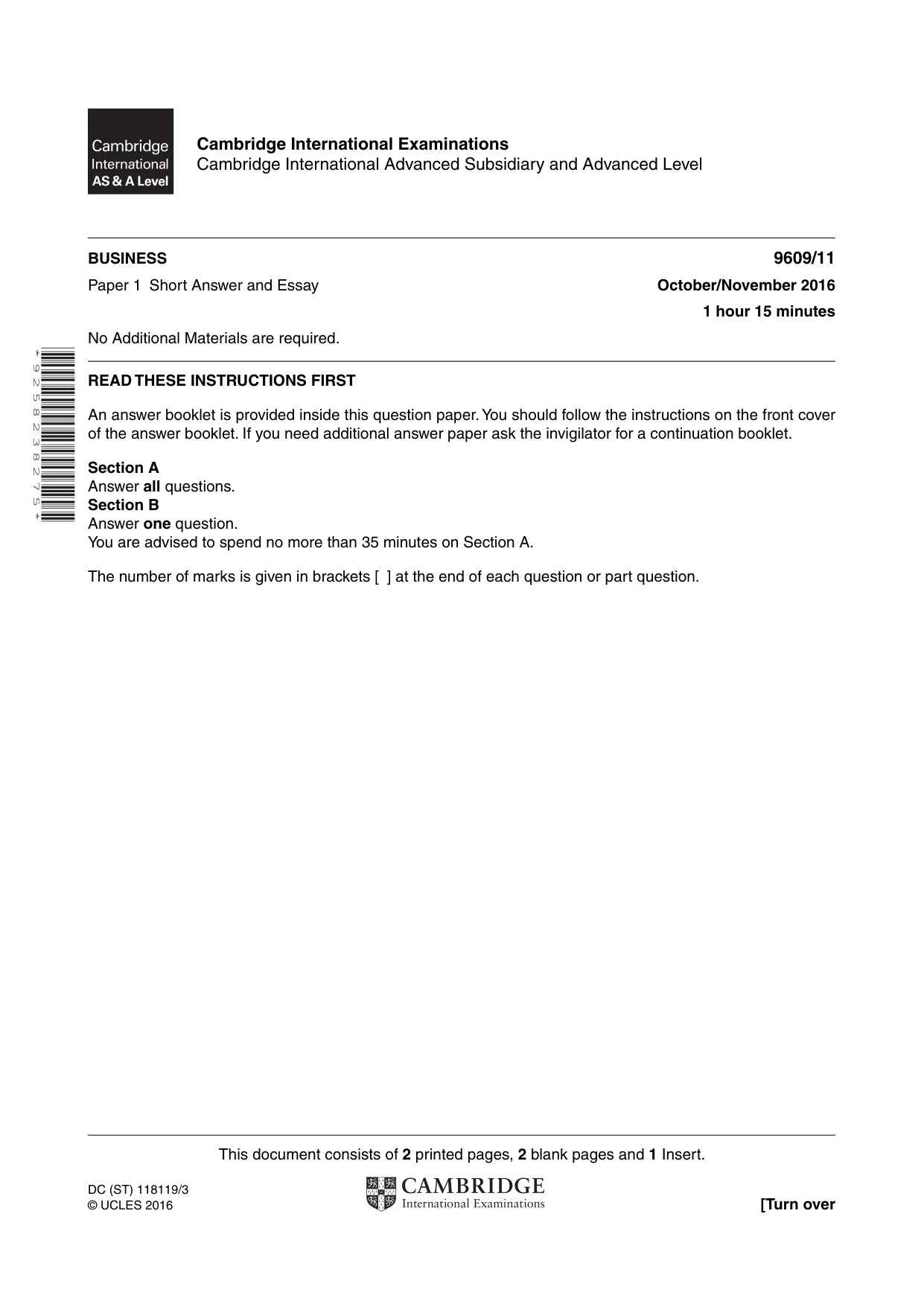
Question paper4 pages
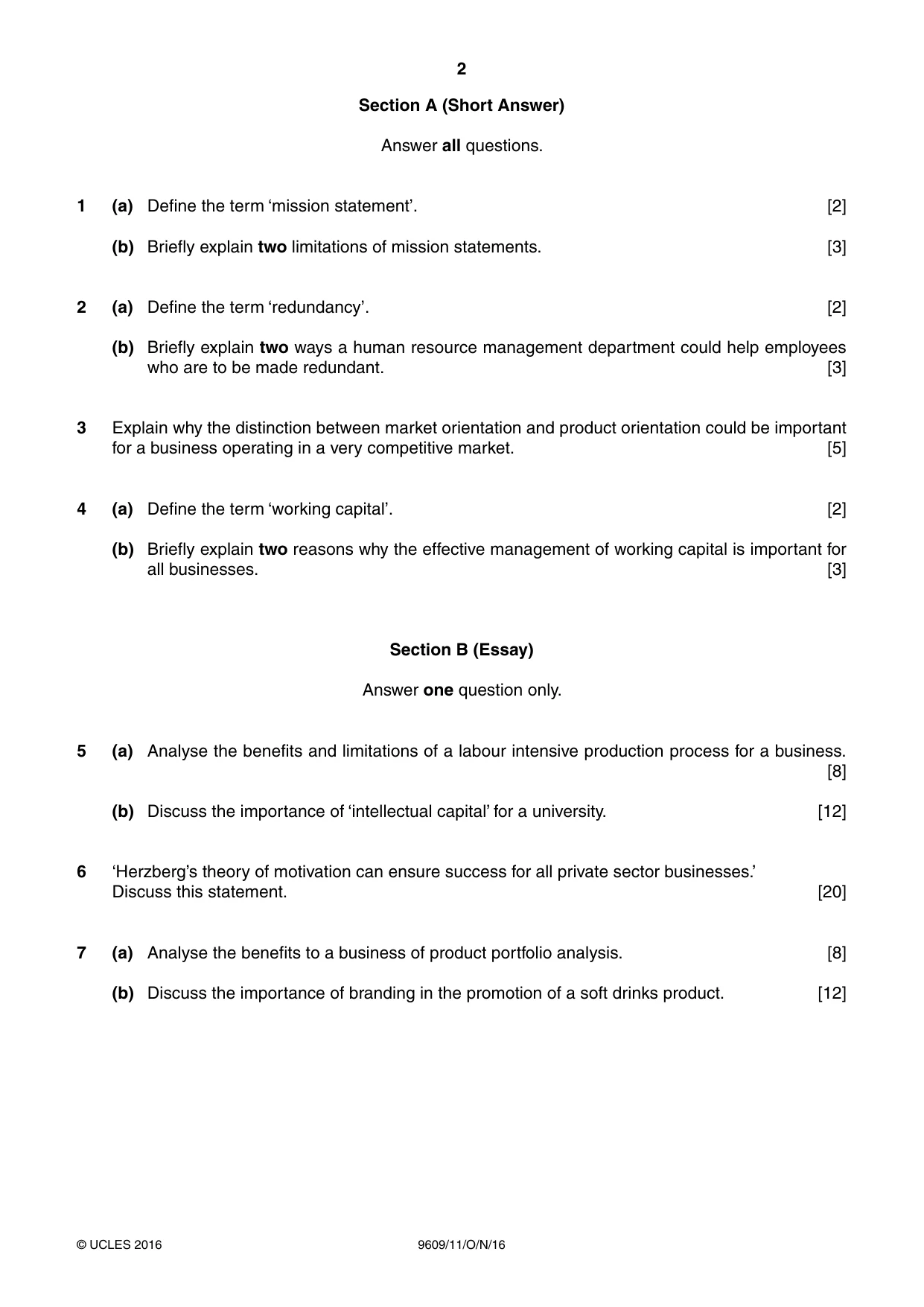


Mark scheme8 pages
Answers below. Sit the paper first if you are practising.
Paper as text
Question paper, page 1
This document consists of 2 printed pages, 2 blank pages and 1 Insert. DC (ST) 118119/3 © UCLES 2016 [Turn over Cambridge International Examinations Cambridge International Advanced Subsidiary and Advanced Level * 9 2 5 8 2 3 8 2 7 5 * BUSINESS 9609/11 Paper 1 Short Answer and Essay October/November 2016 1 hour 15 minutes No Additional Materials are required. READ THESE INSTRUCTIONS FIRST An answer booklet is provided inside this question paper. You should follow the instructions on the front cover of the answer booklet. If you need additional answer paper ask the invigilator for a continuation booklet. Section A Answer all questions. Section B Answer one question. You are advised to spend no more than 35 minutes on Section A. The number of marks is given in brackets [ ] at the end of each question or part question.
Question paper, page 2
2 9609/11/O/N/16 © UCLES 2016 Section A (Short Answer) Answer all questions. 1 (a) Define the term ‘mission statement’. [2] (b) Briefly explain two limitations of mission statements. [3] 2 (a) Define the term ‘redundancy’. [2] (b) Briefly explain two ways a human resource management department could help employees who are to be made redundant. [3] 3 Explain why the distinction between market orientation and product orientation could be important for a business operating in a very competitive market. [5] 4 (a) Define the term ‘working capital’. [2] (b) Briefly explain two reasons why the effective management of working capital is important for all businesses. [3] Section B (Essay) Answer one question only. 5 (a) Analyse the benefits and limitations of a labour intensive production process for a business. [8] (b) Discuss the importance of ‘intellectual capital’ for a university. [12] 6 ‘Herzberg’s theory of motivation can ensure success for all private sector businesses.’ Discuss this statement. [20] 7 (a) Analyse the benefits to a business of product portfolio analysis. [8] (b) Discuss the importance of branding in the promotion of a soft drinks product. [12]
Question paper, page 3
3 9609/11/O/N/16 © UCLES 2016 BLANK PAGE
Question paper, page 4
4 9609/11/O/N/16 © UCLES 2016 Permission to reproduce items where third-party owned material protected by copyright is included has been sought and cleared where possible. Every reasonable effort has been made by the publisher (UCLES) to trace copyright holders, but if any items requiring clearance have unwittingly been included, the publisher will be pleased to make amends at the earliest possible opportunity. To avoid the issue of disclosure of answer-related information to candidates, all copyright acknowledgements are reproduced online in the Cambridge International Examinations Copyright Acknowledgements Booklet. This is produced for each series of examinations and is freely available to download at www.cie.org.uk after the live examination series. Cambridge International Examinations is part of the Cambridge Assessment Group. Cambridge Assessment is the brand name of University of Cambridge Local Examinations Syndicate (UCLES), which is itself a department of the University of Cambridge. BLANK PAGE
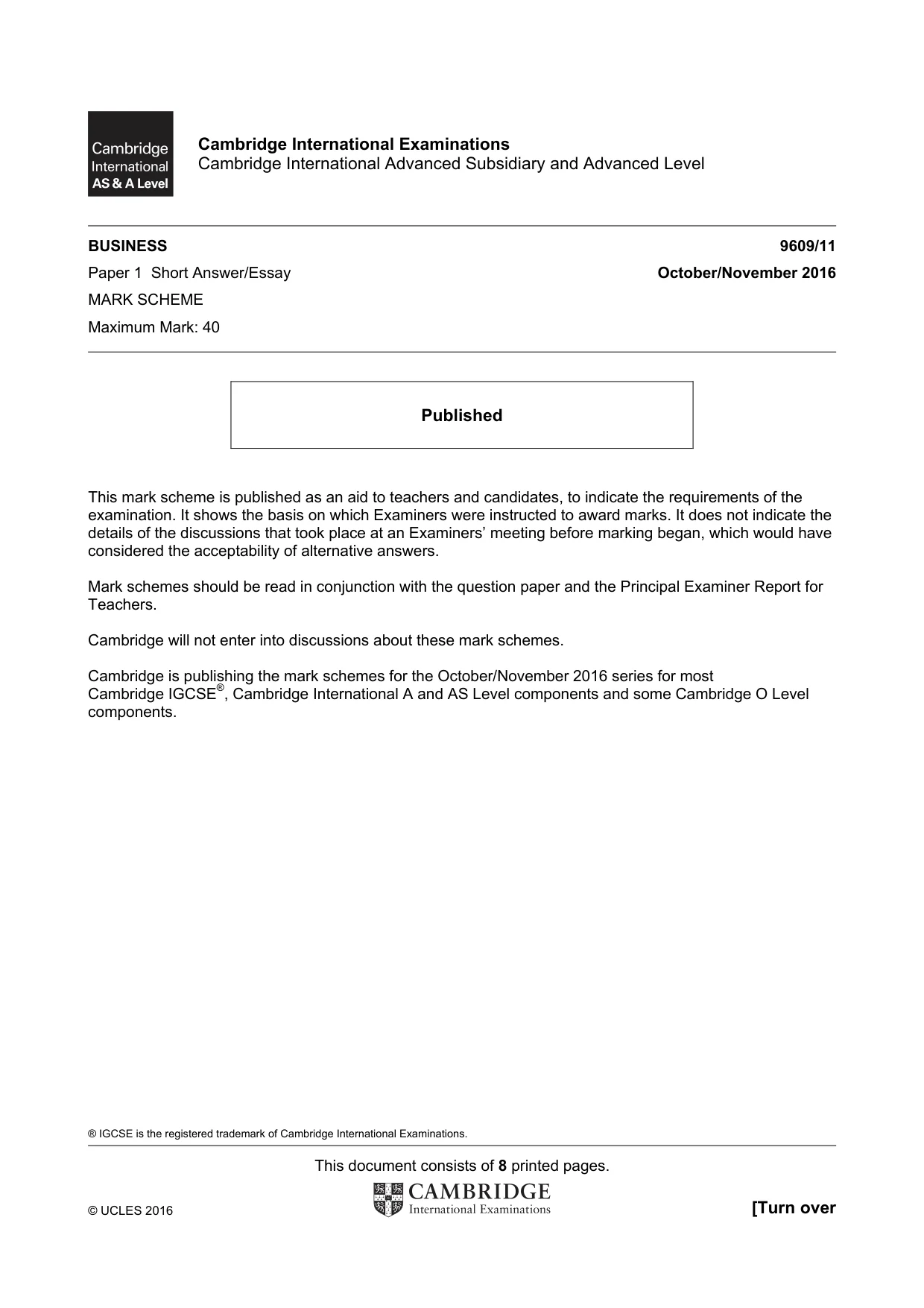
Mark scheme, page 1
® IGCSE is the registered trademark of Cambridge International Examinations. This document consists of 8 printed pages. © UCLES 2016 [Turn over Cambridge International Examinations Cambridge International Advanced Subsidiary and Advanced Level BUSINESS 9609/11 Paper 1 Short Answer/Essay October/November 2016 MARK SCHEME Maximum Mark: 40 Published This mark scheme is published as an aid to teachers and candidates, to indicate the requirements of the examination. It shows the basis on which Examiners were instructed to award marks. It does not indicate the details of the discussions that took place at an Examiners’ meeting before marking began, which would have considered the acceptability of alternative answers. Mark schemes should be read in conjunction with the question paper and the Principal Examiner Report for Teachers. Cambridge will not enter into discussions about these mark schemes. Cambridge is publishing the mark schemes for the October/November 2016 series for most Cambridge IGCSE®, Cambridge International A and AS Level components and some Cambridge O Level components.
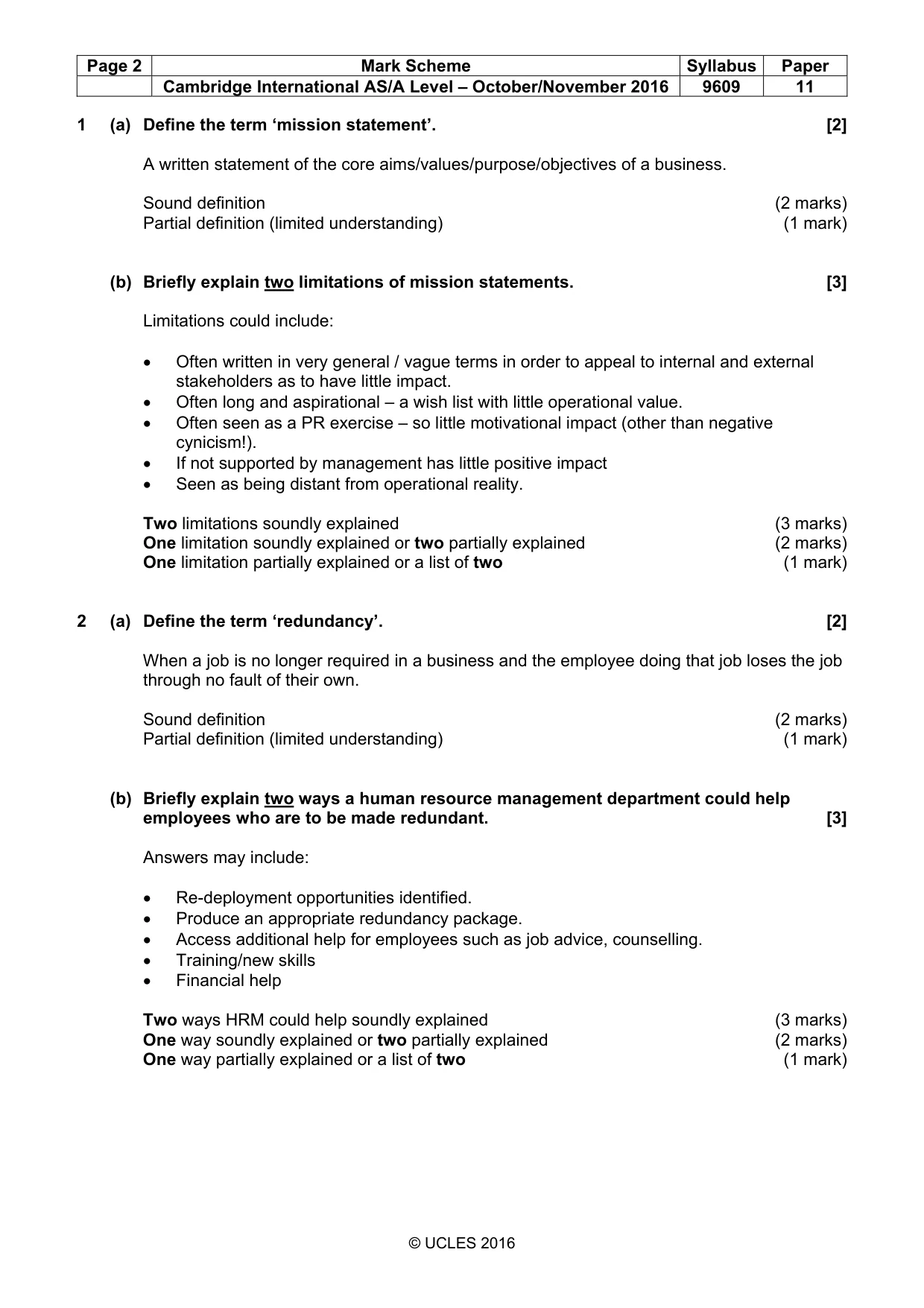
Mark scheme, page 2
Page 2 Mark Scheme Syllabus Paper Cambridge International AS/A Level – October/November 2016 9609 11 © UCLES 2016 1 (a) Define the term ‘mission statement’. [2] A written statement of the core aims/values/purpose/objectives of a business. Sound definition (2 marks) Partial definition (limited understanding) (1 mark) (b) Briefly explain two limitations of mission statements. [3] Limitations could include: • Often written in very general / vague terms in order to appeal to internal and external stakeholders as to have little impact. • Often long and aspirational – a wish list with little operational value. • Often seen as a PR exercise – so little motivational impact (other than negative cynicism!). • If not supported by management has little positive impact • Seen as being distant from operational reality. Two limitations soundly explained (3 marks) One limitation soundly explained or two partially explained (2 marks) One limitation partially explained or a list of two (1 mark) 2 (a) Define the term ‘redundancy’. [2] When a job is no longer required in a business and the employee doing that job loses the job through no fault of their own. Sound definition (2 marks) Partial definition (limited understanding) (1 mark) (b) Briefly explain two ways a human resource management department could help employees who are to be made redundant. [3] Answers may include: • Re-deployment opportunities identified. • Produce an appropriate redundancy package. • Access additional help for employees such as job advice, counselling. • Training/new skills • Financial help Two ways HRM could help soundly explained (3 marks) One way soundly explained or two partially explained (2 marks) One way partially explained or a list of two (1 mark)
Mark scheme, page 3
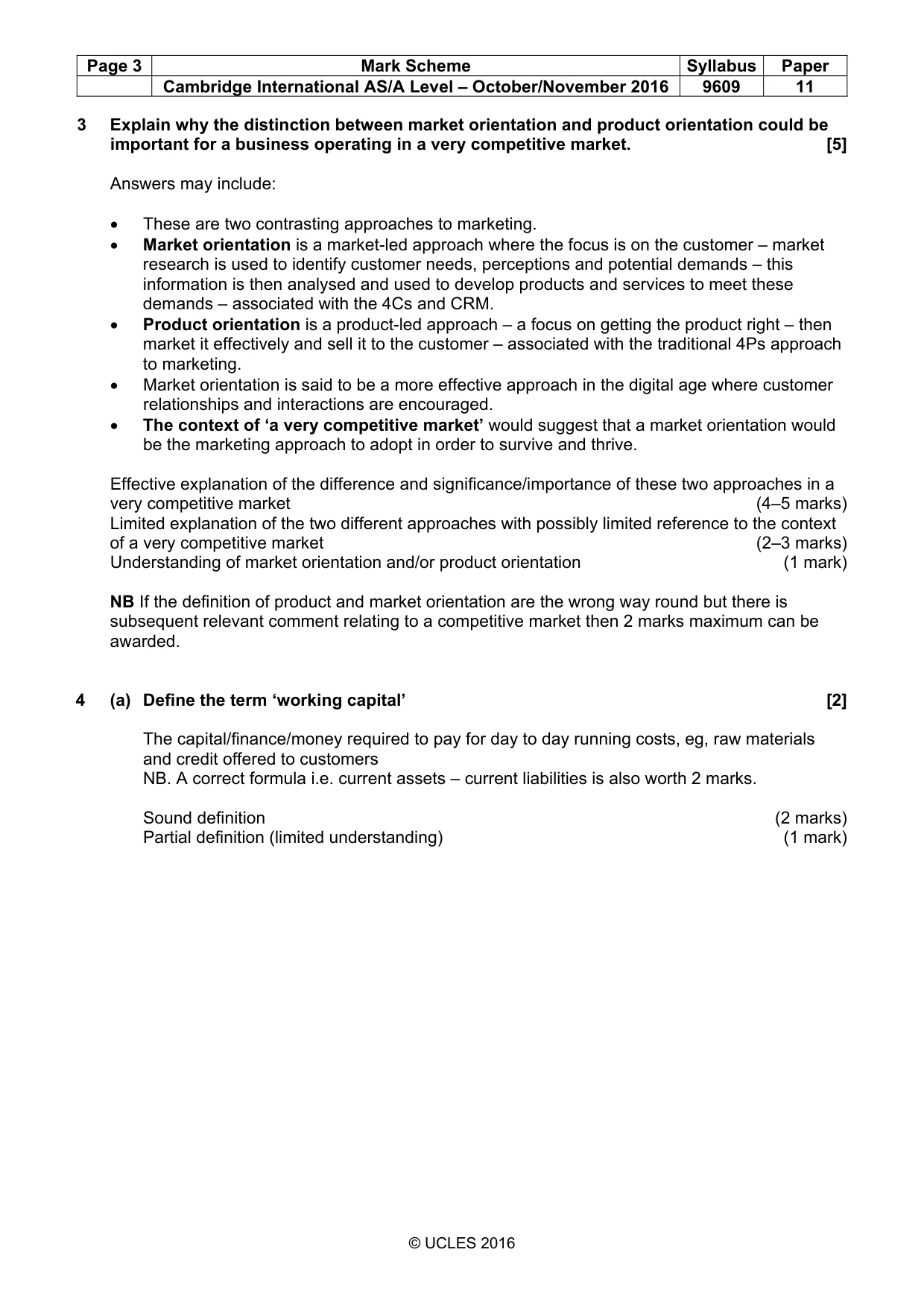
Page 3 Mark Scheme Syllabus Paper Cambridge International AS/A Level – October/November 2016 9609 11 © UCLES 2016 3 Explain why the distinction between market orientation and product orientation could be important for a business operating in a very competitive market. [5] Answers may include: • These are two contrasting approaches to marketing. • Market orientation is a market-led approach where the focus is on the customer – market research is used to identify customer needs, perceptions and potential demands – this information is then analysed and used to develop products and services to meet these demands – associated with the 4Cs and CRM. • Product orientation is a product-led approach – a focus on getting the product right – then market it effectively and sell it to the customer – associated with the traditional 4Ps approach to marketing. • Market orientation is said to be a more effective approach in the digital age where customer relationships and interactions are encouraged. • The context of ‘a very competitive market’ would suggest that a market orientation would be the marketing approach to adopt in order to survive and thrive. Effective explanation of the difference and significance/importance of these two approaches in a very competitive market (4–5 marks) Limited explanation of the two different approaches with possibly limited reference to the context of a very competitive market (2–3 marks) Understanding of market orientation and/or product orientation (1 mark) NB If the definition of product and market orientation are the wrong way round but there is subsequent relevant comment relating to a competitive market then 2 marks maximum can be awarded. 4 (a) Define the term ‘working capital’ [2] The capital/finance/money required to pay for day to day running costs, eg, raw materials and credit offered to customers NB. A correct formula i.e. current assets – current liabilities is also worth 2 marks. Sound definition (2 marks) Partial definition (limited understanding) (1 mark)
Mark scheme, page 4
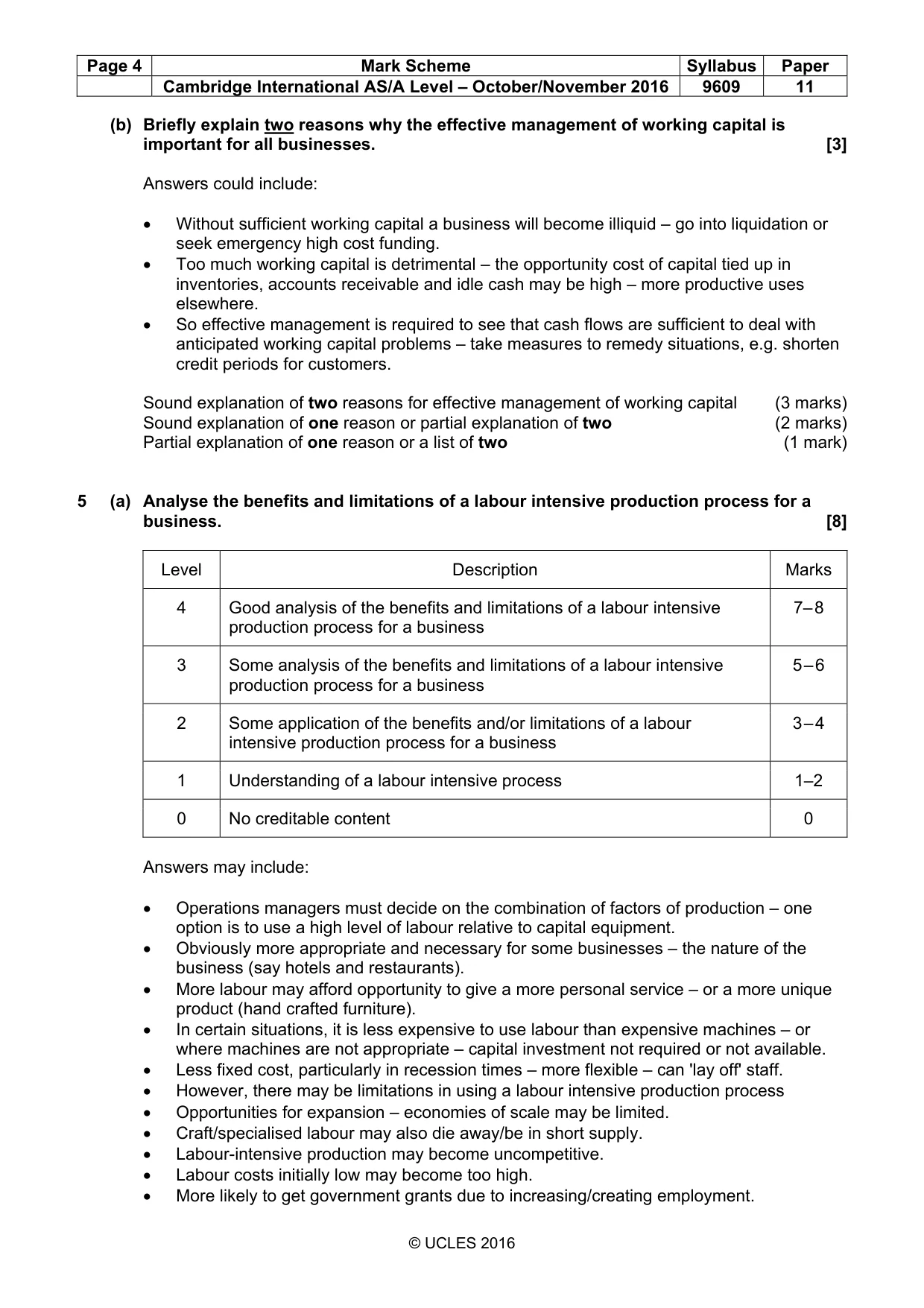
Page 4 Mark Scheme Syllabus Paper Cambridge International AS/A Level – October/November 2016 9609 11 © UCLES 2016 (b) Briefly explain two reasons why the effective management of working capital is important for all businesses. [3] Answers could include: • Without sufficient working capital a business will become illiquid – go into liquidation or seek emergency high cost funding. • Too much working capital is detrimental – the opportunity cost of capital tied up in inventories, accounts receivable and idle cash may be high – more productive uses elsewhere. • So effective management is required to see that cash flows are sufficient to deal with anticipated working capital problems – take measures to remedy situations, e.g. shorten credit periods for customers. Sound explanation of two reasons for effective management of working capital (3 marks) Sound explanation of one reason or partial explanation of two (2 marks) Partial explanation of one reason or a list of two (1 mark) 5 (a) Analyse the benefits and limitations of a labour intensive production process for a business. [8] Level Description Marks 4 Good analysis of the benefits and limitations of a labour intensive production process for a business 7– 8 3 Some analysis of the benefits and limitations of a labour intensive production process for a business 5 – 6 2 Some application of the benefits and/or limitations of a labour intensive production process for a business 3 – 4 1 Understanding of a labour intensive process 1–2 0 No creditable content 0 Answers may include: • Operations managers must decide on the combination of factors of production – one option is to use a high level of labour relative to capital equipment. • Obviously more appropriate and necessary for some businesses – the nature of the business (say hotels and restaurants). • More labour may afford opportunity to give a more personal service – or a more unique product (hand crafted furniture). • In certain situations, it is less expensive to use labour than expensive machines – or where machines are not appropriate – capital investment not required or not available. • Less fixed cost, particularly in recession times – more flexible – can 'lay off' staff. • However, there may be limitations in using a labour intensive production process • Opportunities for expansion – economies of scale may be limited. • Craft/specialised labour may also die away/be in short supply. • Labour-intensive production may become uncompetitive. • Labour costs initially low may become too high. • More likely to get government grants due to increasing/creating employment.
Mark scheme, page 5
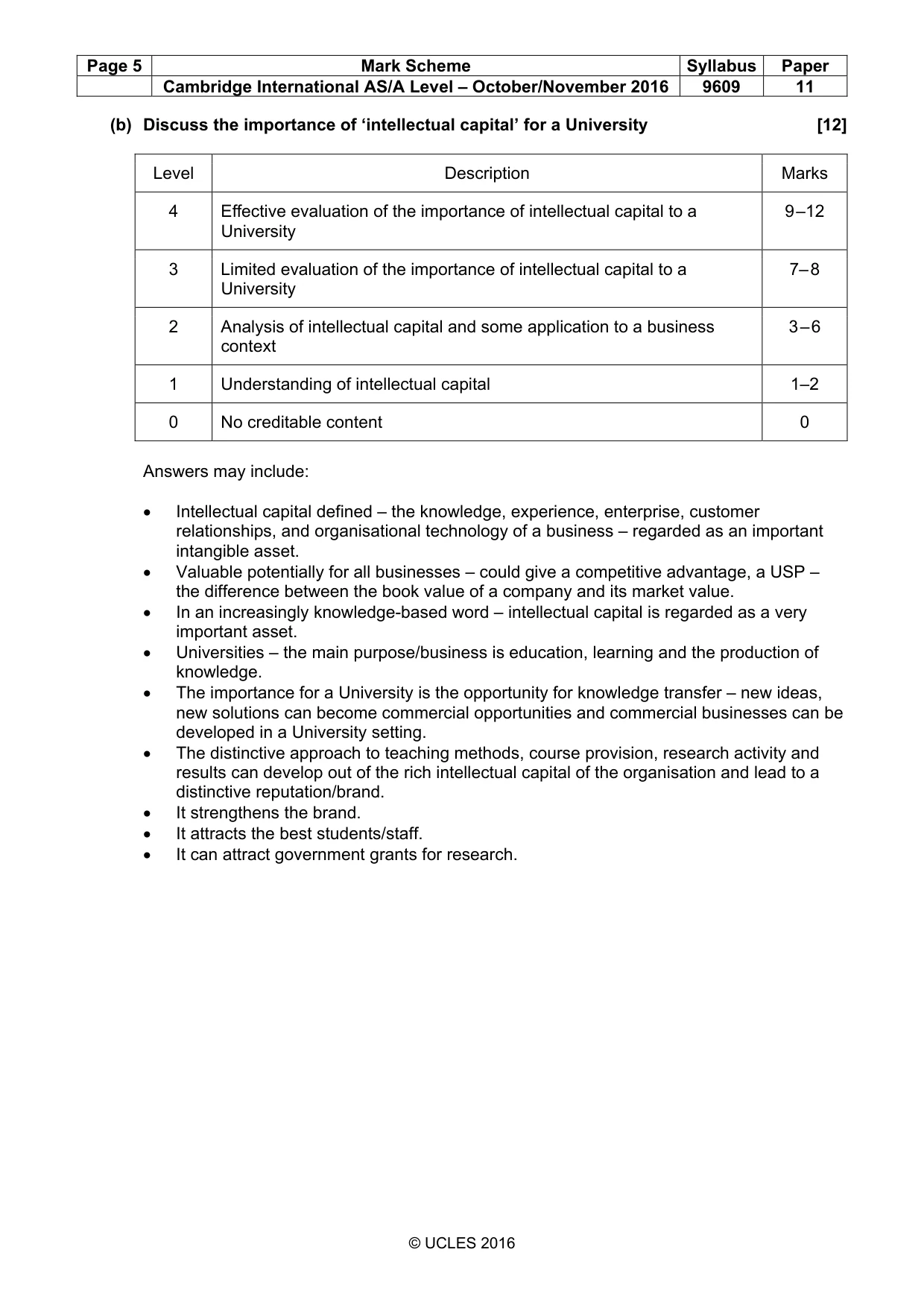
Page 5 Mark Scheme Syllabus Paper Cambridge International AS/A Level – October/November 2016 9609 11 © UCLES 2016 (b) Discuss the importance of ‘intellectual capital’ for a University [12] Level Description Marks 4 Effective evaluation of the importance of intellectual capital to a University 9 –12 3 Limited evaluation of the importance of intellectual capital to a University 7– 8 2 Analysis of intellectual capital and some application to a business context 3 – 6 1 Understanding of intellectual capital 1–2 0 No creditable content 0 Answers may include: • Intellectual capital defined – the knowledge, experience, enterprise, customer relationships, and organisational technology of a business – regarded as an important intangible asset. • Valuable potentially for all businesses – could give a competitive advantage, a USP – the difference between the book value of a company and its market value. • In an increasingly knowledge-based word – intellectual capital is regarded as a very important asset. • Universities – the main purpose/business is education, learning and the production of knowledge. • The importance for a University is the opportunity for knowledge transfer – new ideas, new solutions can become commercial opportunities and commercial businesses can be developed in a University setting. • The distinctive approach to teaching methods, course provision, research activity and results can develop out of the rich intellectual capital of the organisation and lead to a distinctive reputation/brand. • It strengthens the brand. • It attracts the best students/staff. • It can attract government grants for research.
Mark scheme, page 6
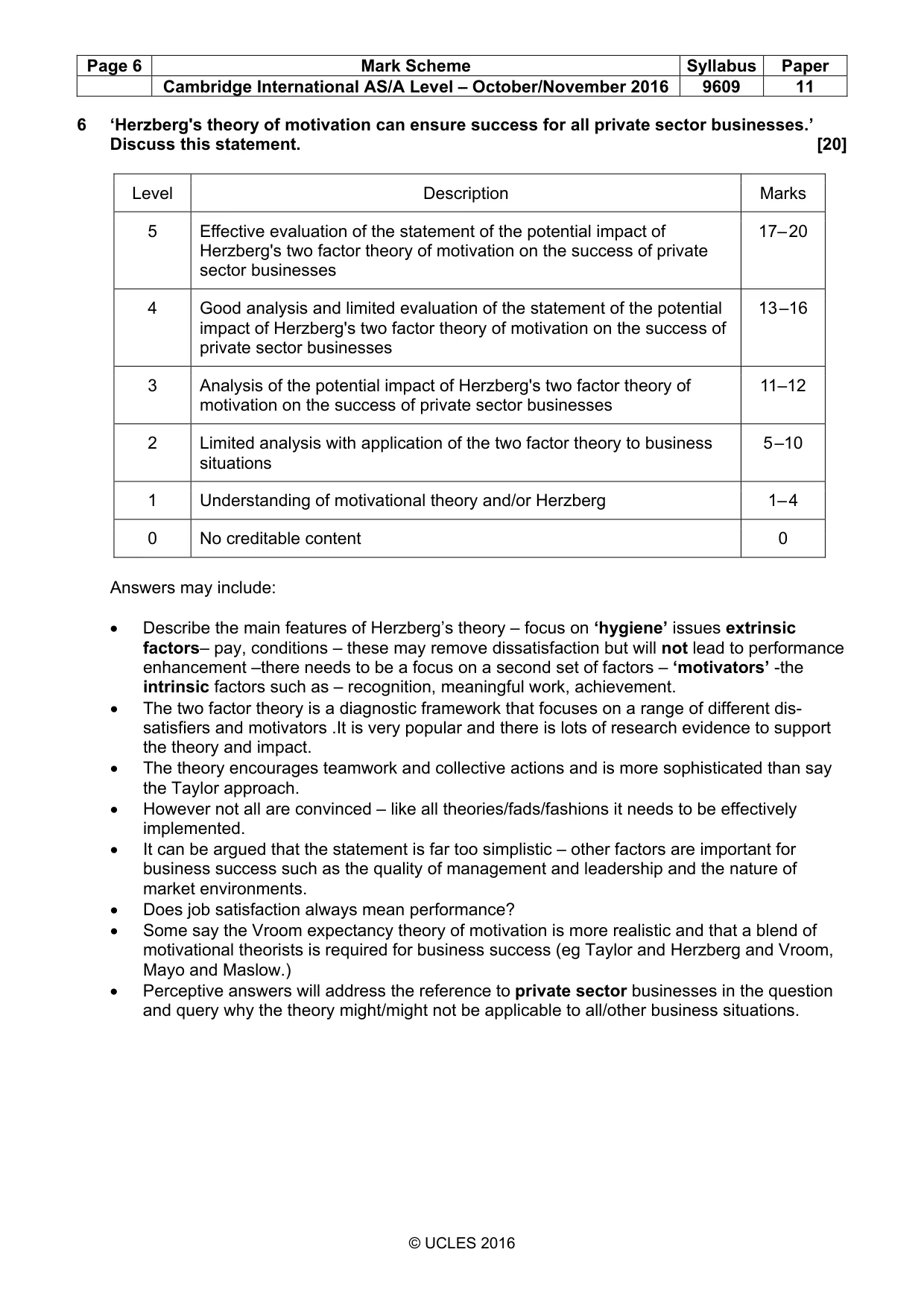
Page 6 Mark Scheme Syllabus Paper Cambridge International AS/A Level – October/November 2016 9609 11 © UCLES 2016 6 ‘Herzberg's theory of motivation can ensure success for all private sector businesses.’ Discuss this statement. [20] Level Description Marks 5 Effective evaluation of the statement of the potential impact of Herzberg's two factor theory of motivation on the success of private sector businesses 17– 20 4 Good analysis and limited evaluation of the statement of the potential impact of Herzberg's two factor theory of motivation on the success of private sector businesses 13 –16 3 Analysis of the potential impact of Herzberg's two factor theory of motivation on the success of private sector businesses 11–12 2 Limited analysis with application of the two factor theory to business situations 5 –10 1 Understanding of motivational theory and/or Herzberg 1– 4 0 No creditable content 0 Answers may include: • Describe the main features of Herzberg’s theory – focus on ‘hygiene’ issues extrinsic factors– pay, conditions – these may remove dissatisfaction but will not lead to performance enhancement –there needs to be a focus on a second set of factors – ‘motivators’ -the intrinsic factors such as – recognition, meaningful work, achievement. • The two factor theory is a diagnostic framework that focuses on a range of different dis- satisfiers and motivators .It is very popular and there is lots of research evidence to support the theory and impact. • The theory encourages teamwork and collective actions and is more sophisticated than say the Taylor approach. • However not all are convinced – like all theories/fads/fashions it needs to be effectively implemented. • It can be argued that the statement is far too simplistic – other factors are important for business success such as the quality of management and leadership and the nature of market environments. • Does job satisfaction always mean performance? • Some say the Vroom expectancy theory of motivation is more realistic and that a blend of motivational theorists is required for business success (eg Taylor and Herzberg and Vroom, Mayo and Maslow.) • Perceptive answers will address the reference to private sector businesses in the question and query why the theory might/might not be applicable to all/other business situations.
Mark scheme, page 7
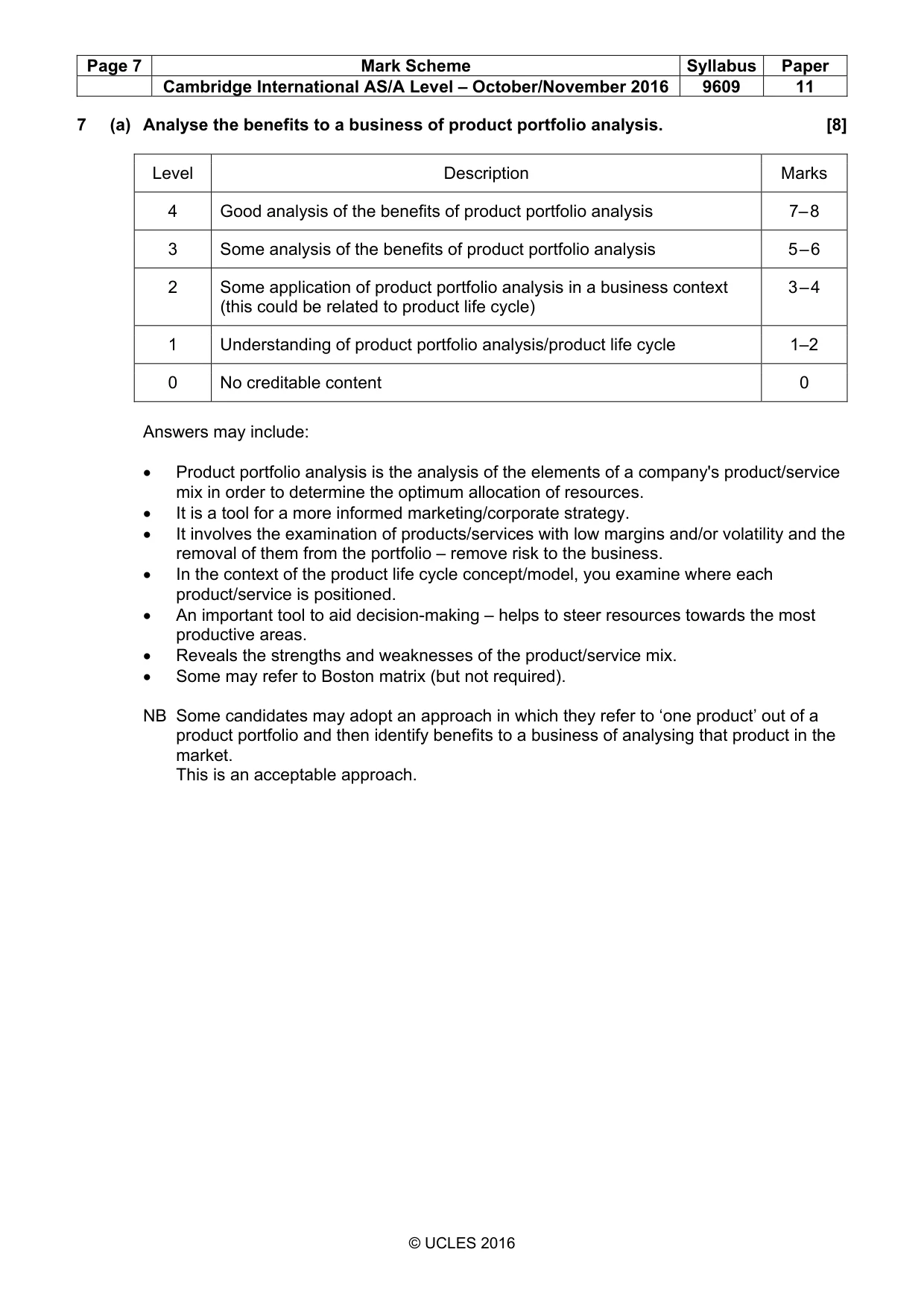
Page 7 Mark Scheme Syllabus Paper Cambridge International AS/A Level – October/November 2016 9609 11 © UCLES 2016 7 (a) Analyse the benefits to a business of product portfolio analysis. [8] Level Description Marks 4 Good analysis of the benefits of product portfolio analysis 7– 8 3 Some analysis of the benefits of product portfolio analysis 5 – 6 2 Some application of product portfolio analysis in a business context (this could be related to product life cycle) 3 – 4 1 Understanding of product portfolio analysis/product life cycle 1–2 0 No creditable content 0 Answers may include: • Product portfolio analysis is the analysis of the elements of a company's product/service mix in order to determine the optimum allocation of resources. • It is a tool for a more informed marketing/corporate strategy. • It involves the examination of products/services with low margins and/or volatility and the removal of them from the portfolio – remove risk to the business. • In the context of the product life cycle concept/model, you examine where each product/service is positioned. • An important tool to aid decision-making – helps to steer resources towards the most productive areas. • Reveals the strengths and weaknesses of the product/service mix. • Some may refer to Boston matrix (but not required). NB Some candidates may adopt an approach in which they refer to ‘one product’ out of a product portfolio and then identify benefits to a business of analysing that product in the market. This is an acceptable approach.
Mark scheme, page 8
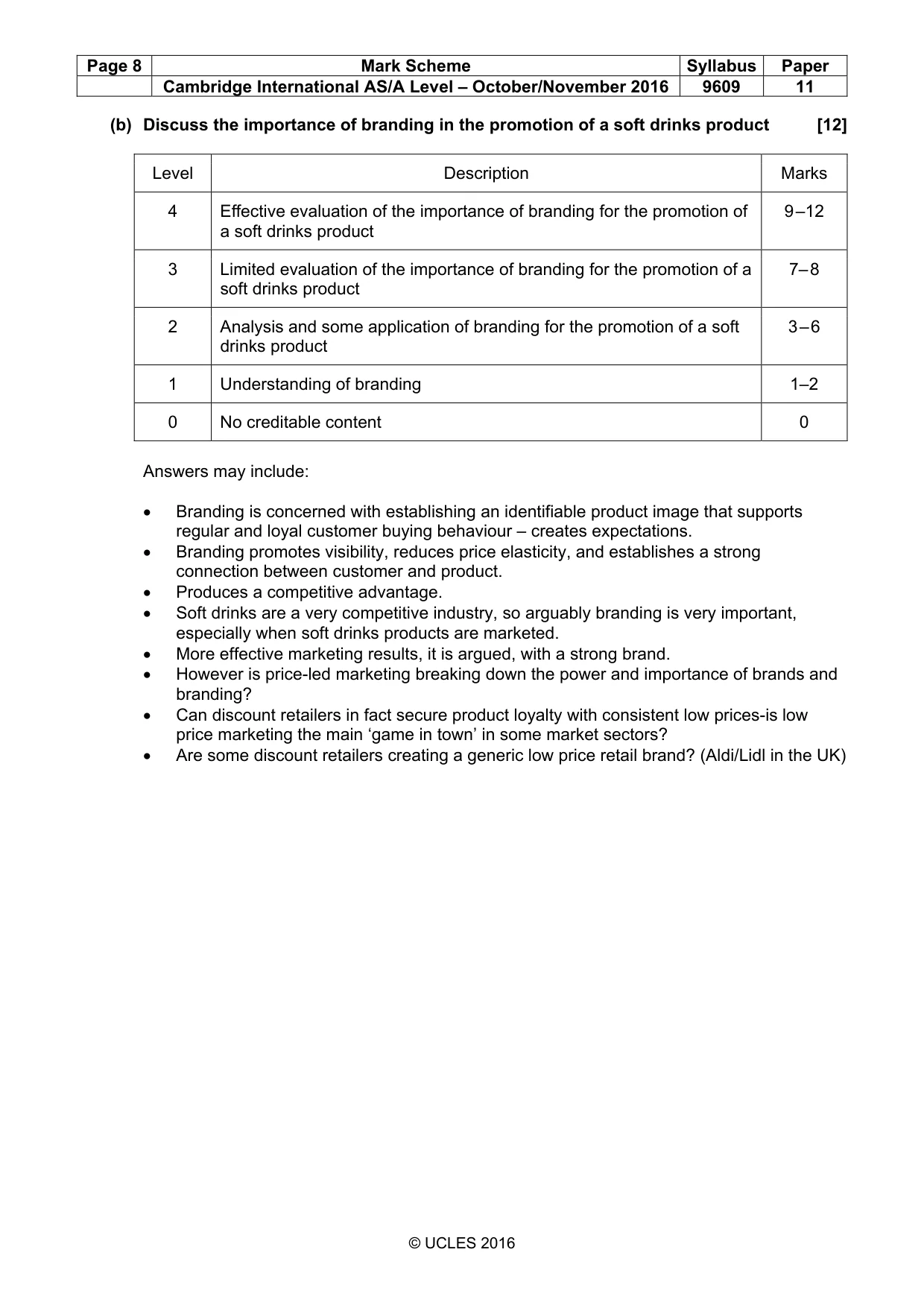
Page 8 Mark Scheme Syllabus Paper Cambridge International AS/A Level – October/November 2016 9609 11 © UCLES 2016 (b) Discuss the importance of branding in the promotion of a soft drinks product [12] Level Description Marks 4 Effective evaluation of the importance of branding for the promotion of a soft drinks product 9 –12 3 Limited evaluation of the importance of branding for the promotion of a soft drinks product 7– 8 2 Analysis and some application of branding for the promotion of a soft drinks product 3 – 6 1 Understanding of branding 1–2 0 No creditable content 0 Answers may include: • Branding is concerned with establishing an identifiable product image that supports regular and loyal customer buying behaviour – creates expectations. • Branding promotes visibility, reduces price elasticity, and establishes a strong connection between customer and product. • Produces a competitive advantage. • Soft drinks are a very competitive industry, so arguably branding is very important, especially when soft drinks products are marketed. • More effective marketing results, it is argued, with a strong brand. • However is price-led marketing breaking down the power and importance of brands and branding? • Can discount retailers in fact secure product loyalty with consistent low prices-is low price marketing the main ‘game in town’ in some market sectors? • Are some discount retailers creating a generic low price retail brand? (Aldi/Lidl in the UK)
What you needed in this session
Cambridge’s own grade thresholds for 2016 Oct/Nov, Paper 1 · Variant 1. A higher threshold means an easier paper — the bar moves with how the cohort did.