Cambridge A Level Business (for first examination in 2016) 9609 — 2016 May/June Paper 1 · Variant 2
9609/12/M/J/16 · 40 marks · ≈45 min
The question paper and its mark scheme, free to read here and free to download. This is Cambridge’s own paper, exactly as it was sat.
Question paper4 pages


Mark scheme10 pages
Answers below. Sit the paper first if you are practising.
Paper as text
Question paper, page 1
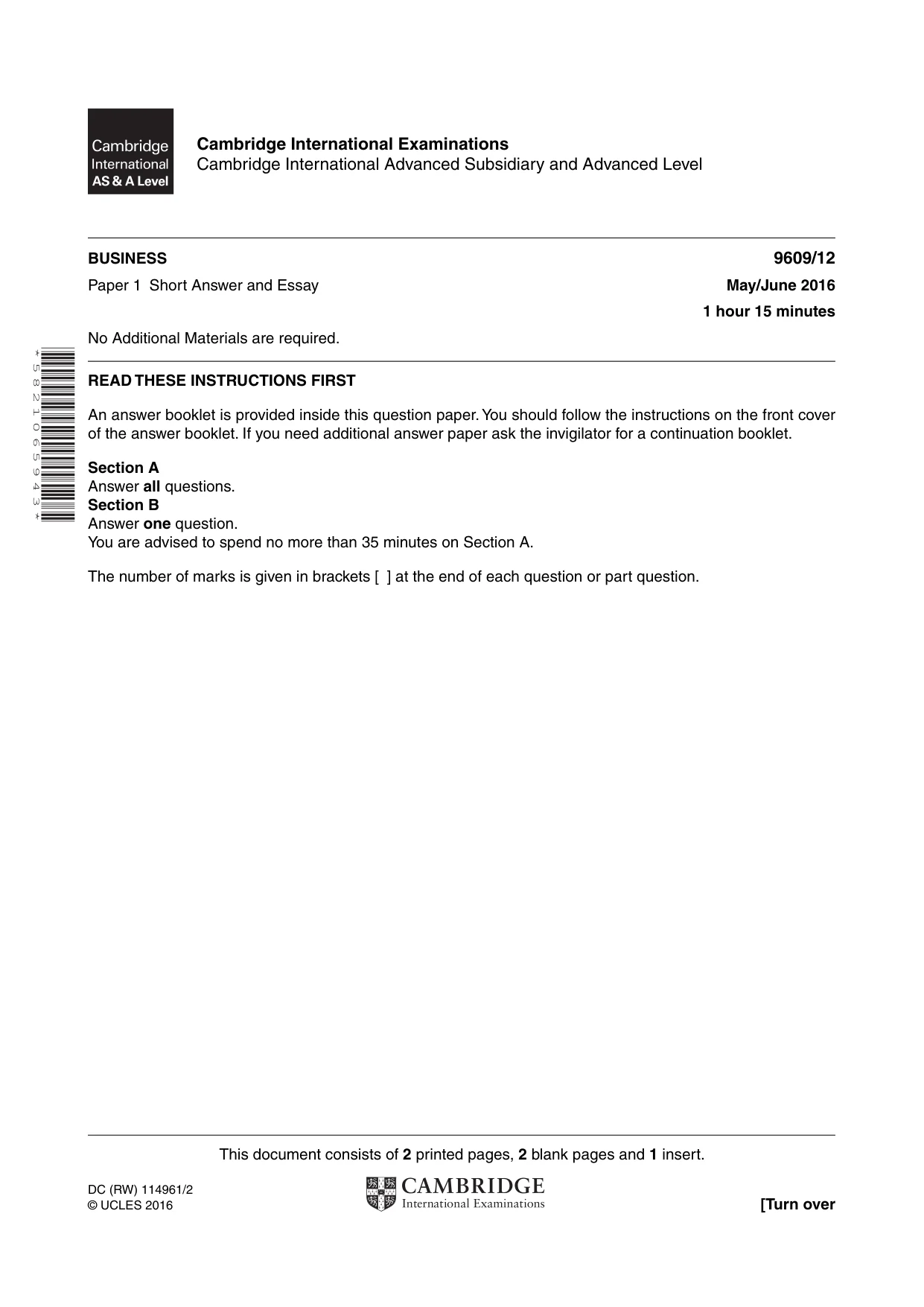
This document consists of 2 printed pages, 2 blank pages and 1 insert. DC (RW) 114961/2 © UCLES 2016 [Turn over Cambridge International Examinations Cambridge International Advanced Subsidiary and Advanced Level * 5 8 2 1 0 6 5 9 4 3 * BUSINESS 9609/12 Paper 1 Short Answer and Essay May/June 2016 1 hour 15 minutes No Additional Materials are required. READ THESE INSTRUCTIONS FIRST An answer booklet is provided inside this question paper. You should follow the instructions on the front cover of the answer booklet. If you need additional answer paper ask the invigilator for a continuation booklet. Section A Answer all questions. Section B Answer one question. You are advised to spend no more than 35 minutes on Section A. The number of marks is given in brackets [ ] at the end of each question or part question.
Question paper, page 2
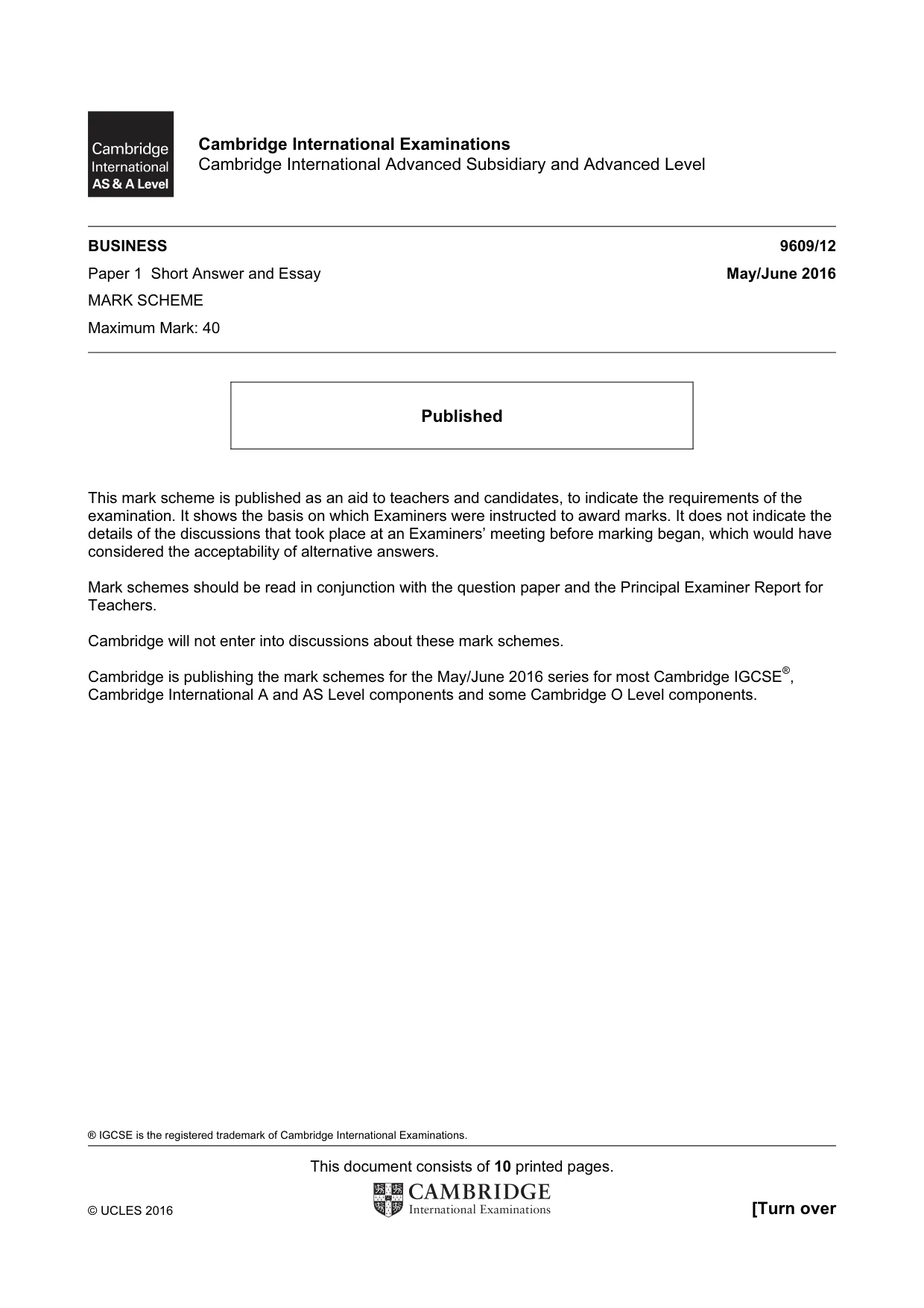
2 9609/12/M/J/16 © UCLES 2016 Section A (Short Answer) Answer all questions. 1 (a) Define the term ‘entrepreneur’. [2] (b) Briefly explain two reasons why new businesses often fail. [3] 2 (a) Distinguish between random sampling and quota sampling. [2] (b) Briefly explain two limitations of market research sampling. [3] 3 Explain the costs and benefits to a business of a decision to hold low levels of inventory. [5] 4 (a) Distinguish between a ‘job description’ and a ‘person specification’. [2] (b) Briefly explain two ways in which employees can participate in business decision making. [3] Section B (Essay) Answer one question only. 5 (a) Analyse the importance for a business of distinguishing between revenue expenditure and capital expenditure. [8] (b) Discuss the benefits and drawbacks to a business of using only internal sources of finance to fund expansion. [12] 6 ‘The 4Cs marketing model is more useful for a retail business than the 4Ps marketing model.’ Do you agree with this statement? Justify your view. [20] 7 (a) Analyse the importance to a large business of setting corporate objectives. [8] (b) Discuss how a large food retailer, with many shops, could effectively communicate corporate objectives to its workforce. [12]
Question paper, page 3
3 9609/12/M/J/16 © UCLES 2016 BLANK PAGE
Question paper, page 4
4 9609/12/M/J/16 © UCLES 2016 BLANK PAGE Permission to reproduce items where third-party owned material protected by copyright is included has been sought and cleared where possible. Every reasonable effort has been made by the publisher (UCLES) to trace copyright holders, but if any items requiring clearance have unwittingly been included, the publisher will be pleased to make amends at the earliest possible opportunity. To avoid the issue of disclosure of answer-related information to candidates, all copyright acknowledgements are reproduced online in the Cambridge International Examinations Copyright Acknowledgements Booklet. This is produced for each series of examinations and is freely available to download at www.cie.org.uk after the live examination series. Cambridge International Examinations is part of the Cambridge Assessment Group. Cambridge Assessment is the brand name of University of Cambridge Local Examinations Syndicate (UCLES), which is itself a department of the University of Cambridge.
Mark scheme, page 1
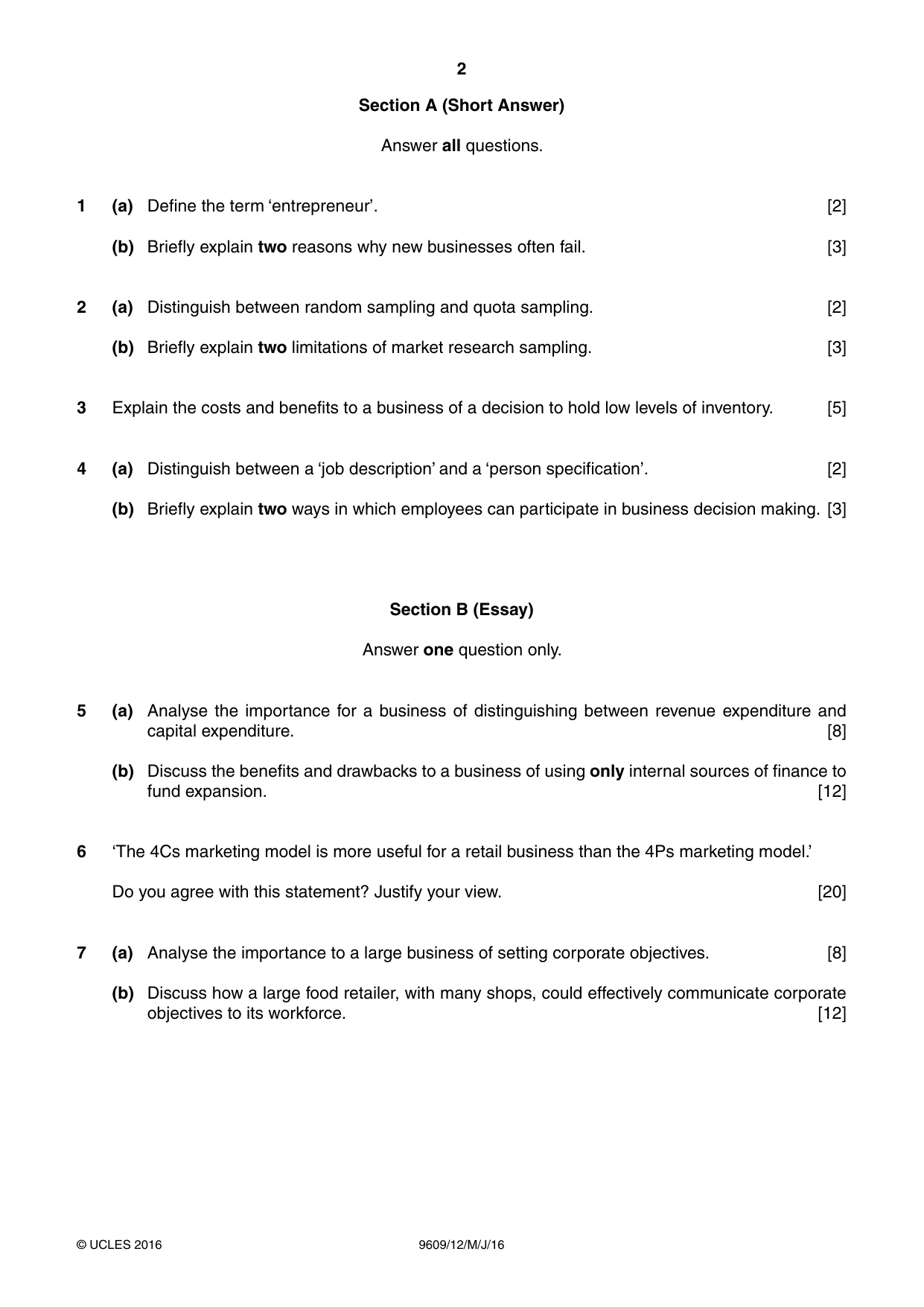
® IGCSE is the registered trademark of Cambridge International Examinations. This document consists of 10 printed pages. © UCLES 2016 [Turn over Cambridge International Examinations Cambridge International Advanced Subsidiary and Advanced Level BUSINESS 9609/12 Paper 1 Short Answer and Essay May/June 2016 MARK SCHEME Maximum Mark: 40 Published This mark scheme is published as an aid to teachers and candidates, to indicate the requirements of the examination. It shows the basis on which Examiners were instructed to award marks. It does not indicate the details of the discussions that took place at an Examiners’ meeting before marking began, which would have considered the acceptability of alternative answers. Mark schemes should be read in conjunction with the question paper and the Principal Examiner Report for Teachers. Cambridge will not enter into discussions about these mark schemes. Cambridge is publishing the mark schemes for the May/June 2016 series for most Cambridge IGCSE®, Cambridge International A and AS Level components and some Cambridge O Level components.
Mark scheme, page 2
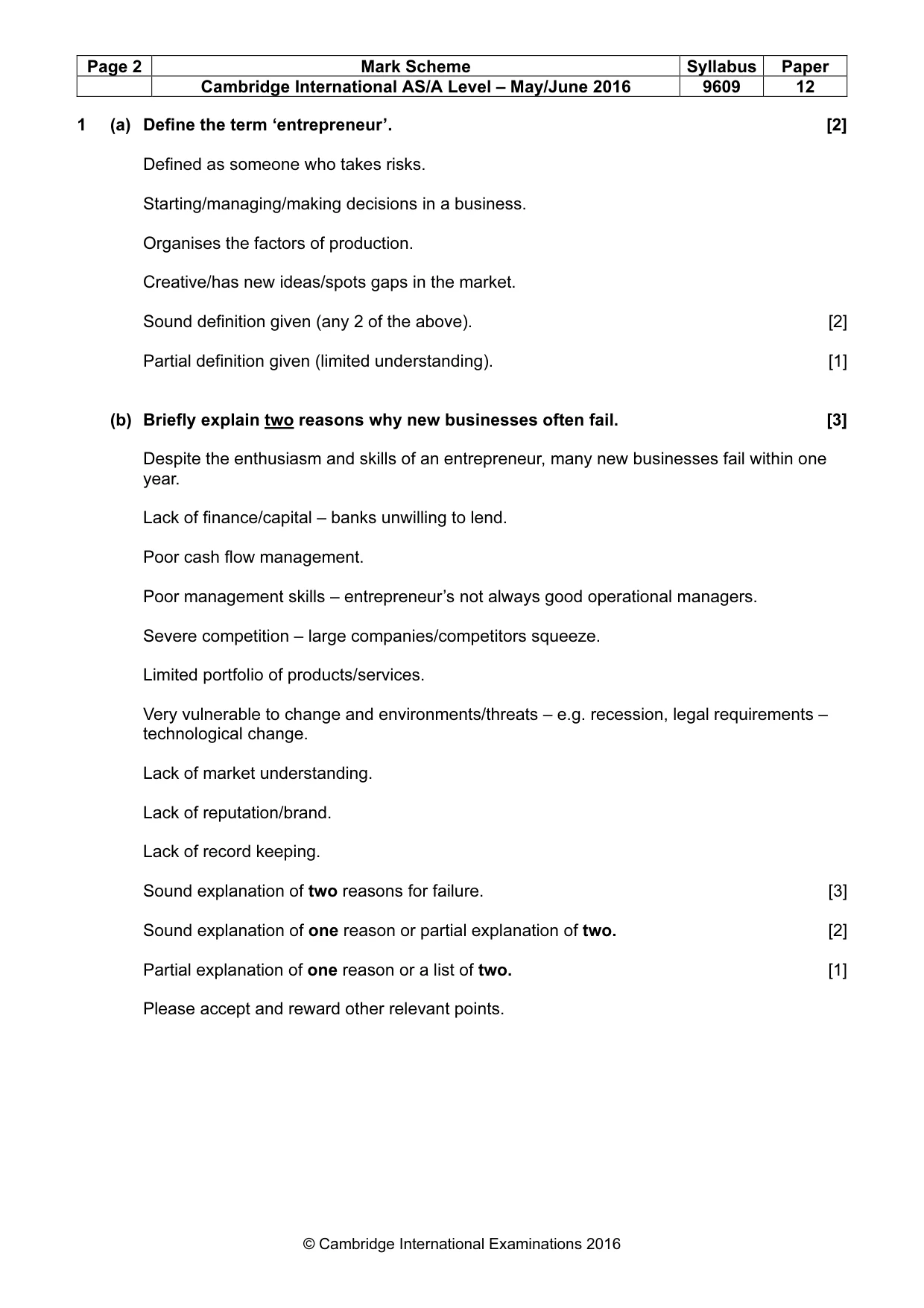
Page 2 Mark Scheme Syllabus Paper Cambridge International AS/A Level – May/June 2016 9609 12 © Cambridge International Examinations 2016 1 (a) Define the term ‘entrepreneur’. [2] Defined as someone who takes risks. Starting/managing/making decisions in a business. Organises the factors of production. Creative/has new ideas/spots gaps in the market. Sound definition given (any 2 of the above). [2] Partial definition given (limited understanding). [1] (b) Briefly explain two reasons why new businesses often fail. [3] Despite the enthusiasm and skills of an entrepreneur, many new businesses fail within one year. Lack of finance/capital – banks unwilling to lend. Poor cash flow management. Poor management skills – entrepreneur’s not always good operational managers. Severe competition – large companies/competitors squeeze. Limited portfolio of products/services. Very vulnerable to change and environments/threats – e.g. recession, legal requirements – technological change. Lack of market understanding. Lack of reputation/brand. Lack of record keeping. Sound explanation of two reasons for failure. [3] Sound explanation of one reason or partial explanation of two. [2] Partial explanation of one reason or a list of two. [1] Please accept and reward other relevant points.
Mark scheme, page 3
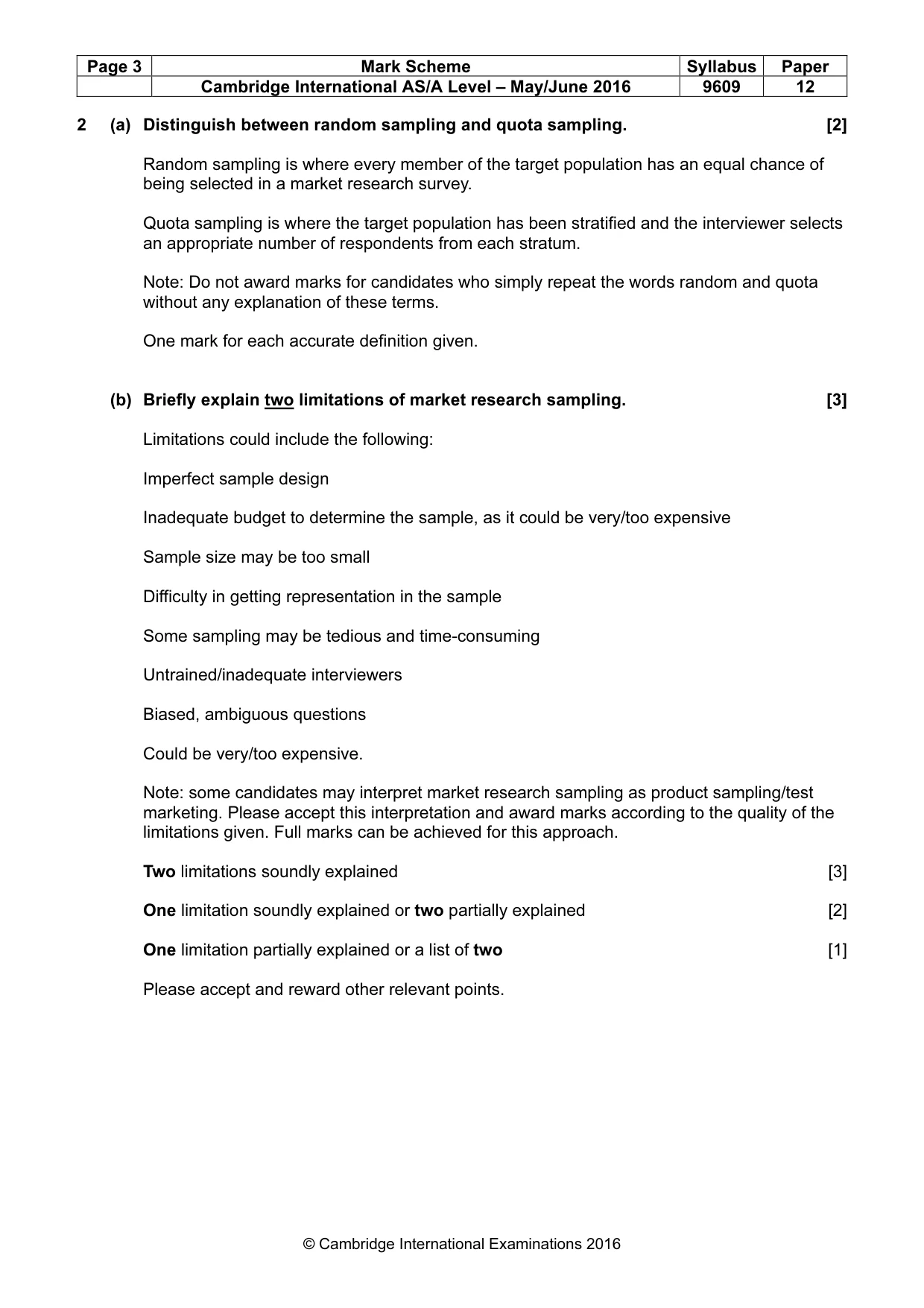
Page 3 Mark Scheme Syllabus Paper Cambridge International AS/A Level – May/June 2016 9609 12 © Cambridge International Examinations 2016 2 (a) Distinguish between random sampling and quota sampling. [2] Random sampling is where every member of the target population has an equal chance of being selected in a market research survey. Quota sampling is where the target population has been stratified and the interviewer selects an appropriate number of respondents from each stratum. Note: Do not award marks for candidates who simply repeat the words random and quota without any explanation of these terms. One mark for each accurate definition given. (b) Briefly explain two limitations of market research sampling. [3] Limitations could include the following: Imperfect sample design Inadequate budget to determine the sample, as it could be very/too expensive Sample size may be too small Difficulty in getting representation in the sample Some sampling may be tedious and time-consuming Untrained/inadequate interviewers Biased, ambiguous questions Could be very/too expensive. Note: some candidates may interpret market research sampling as product sampling/test marketing. Please accept this interpretation and award marks according to the quality of the limitations given. Full marks can be achieved for this approach. Two limitations soundly explained [3] One limitation soundly explained or two partially explained [2] One limitation partially explained or a list of two [1] Please accept and reward other relevant points.
Mark scheme, page 4
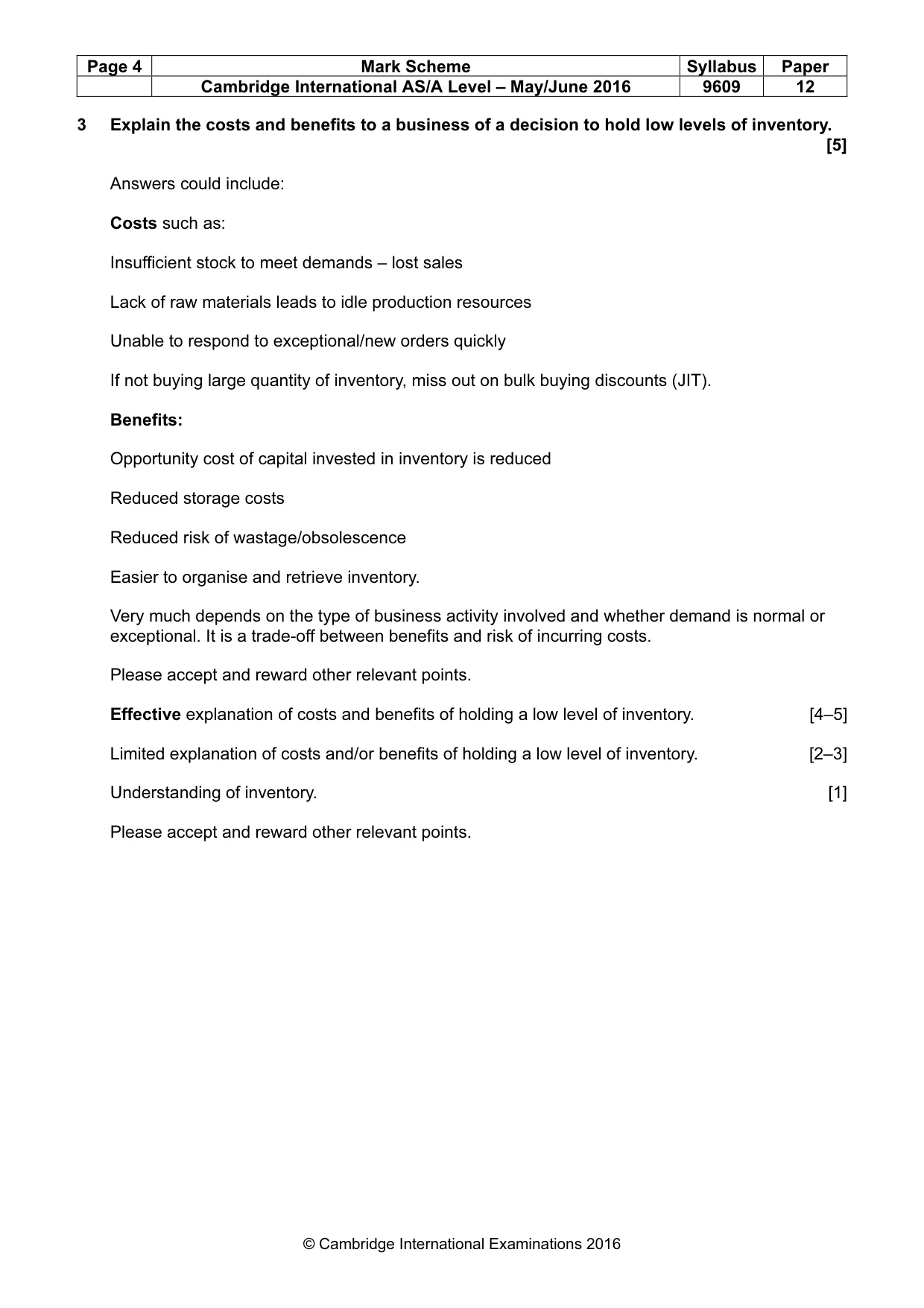
Page 4 Mark Scheme Syllabus Paper Cambridge International AS/A Level – May/June 2016 9609 12 © Cambridge International Examinations 2016 3 Explain the costs and benefits to a business of a decision to hold low levels of inventory. [5] Answers could include: Costs such as: Insufficient stock to meet demands – lost sales Lack of raw materials leads to idle production resources Unable to respond to exceptional/new orders quickly If not buying large quantity of inventory, miss out on bulk buying discounts (JIT). Benefits: Opportunity cost of capital invested in inventory is reduced Reduced storage costs Reduced risk of wastage/obsolescence Easier to organise and retrieve inventory. Very much depends on the type of business activity involved and whether demand is normal or exceptional. It is a trade-off between benefits and risk of incurring costs. Please accept and reward other relevant points. Effective explanation of costs and benefits of holding a low level of inventory. [4–5] Limited explanation of costs and/or benefits of holding a low level of inventory. [2–3] Understanding of inventory. [1] Please accept and reward other relevant points.
Mark scheme, page 5
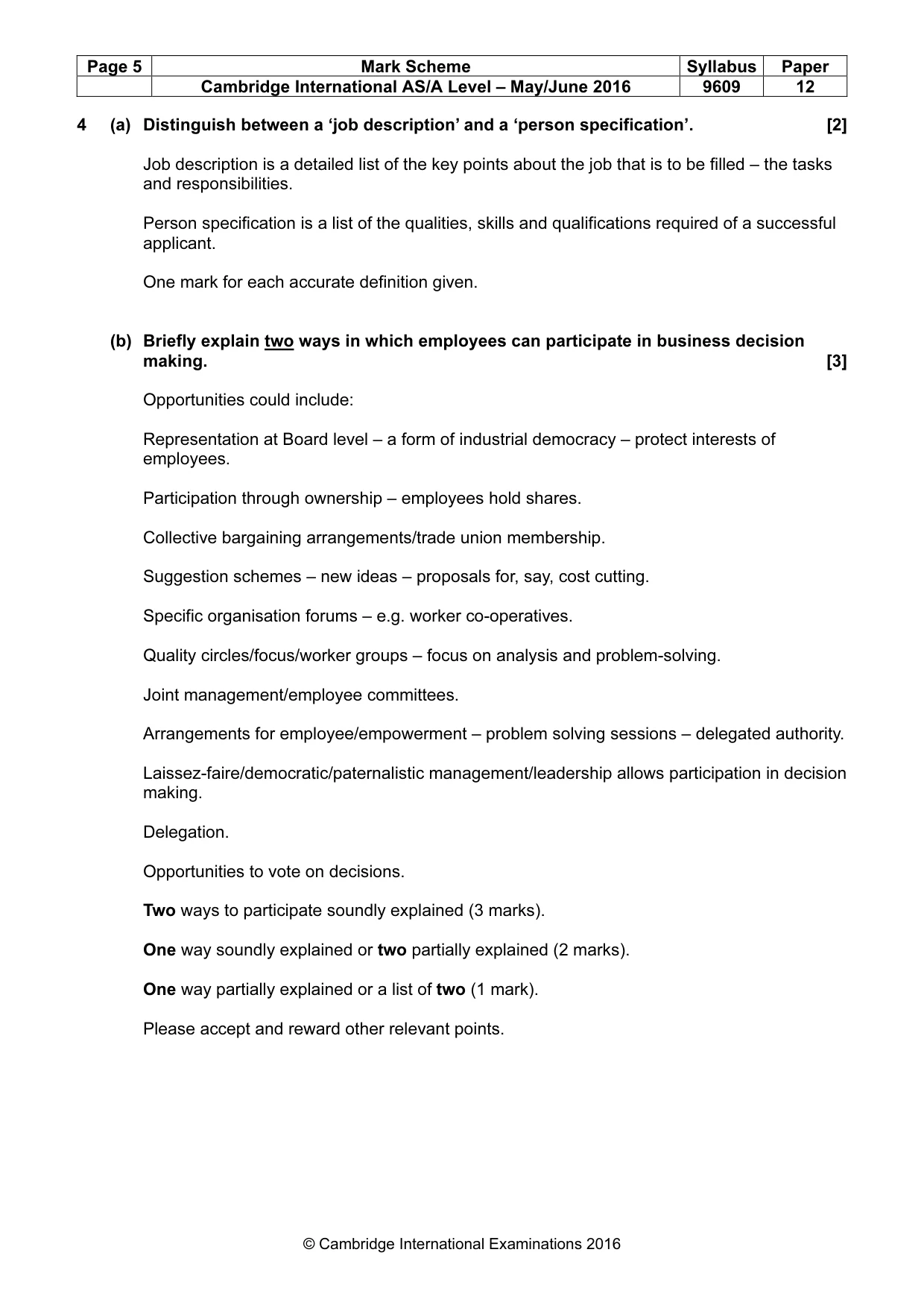
Page 5 Mark Scheme Syllabus Paper Cambridge International AS/A Level – May/June 2016 9609 12 © Cambridge International Examinations 2016 4 (a) Distinguish between a ‘job description’ and a ‘person specification’. [2] Job description is a detailed list of the key points about the job that is to be filled – the tasks and responsibilities. Person specification is a list of the qualities, skills and qualifications required of a successful applicant. One mark for each accurate definition given. (b) Briefly explain two ways in which employees can participate in business decision making. [3] Opportunities could include: Representation at Board level – a form of industrial democracy – protect interests of employees. Participation through ownership – employees hold shares. Collective bargaining arrangements/trade union membership. Suggestion schemes – new ideas – proposals for, say, cost cutting. Specific organisation forums – e.g. worker co-operatives. Quality circles/focus/worker groups – focus on analysis and problem-solving. Joint management/employee committees. Arrangements for employee/empowerment – problem solving sessions – delegated authority. Laissez-faire/democratic/paternalistic management/leadership allows participation in decision making. Delegation. Opportunities to vote on decisions. Two ways to participate soundly explained (3 marks). One way soundly explained or two partially explained (2 marks). One way partially explained or a list of two (1 mark). Please accept and reward other relevant points.
Mark scheme, page 6
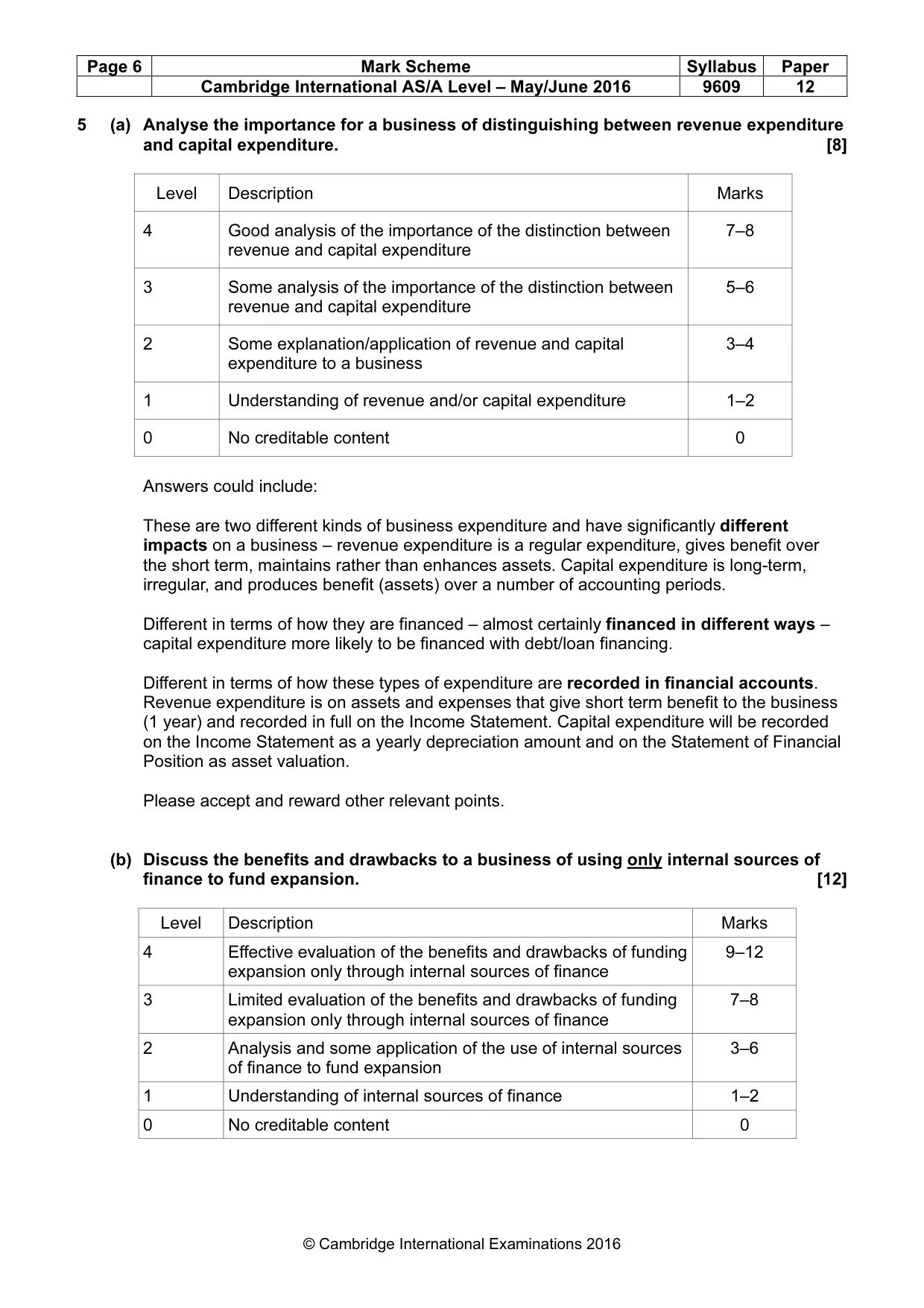
Page 6 Mark Scheme Syllabus Paper Cambridge International AS/A Level – May/June 2016 9609 12 © Cambridge International Examinations 2016 5 (a) Analyse the importance for a business of distinguishing between revenue expenditure and capital expenditure. [8] Level Description Marks 4 Good analysis of the importance of the distinction between revenue and capital expenditure 7–8 3 Some analysis of the importance of the distinction between revenue and capital expenditure 5–6 2 Some explanation/application of revenue and capital expenditure to a business 3–4 1 Understanding of revenue and/or capital expenditure 1–2 0 No creditable content 0 Answers could include: These are two different kinds of business expenditure and have significantly different impacts on a business – revenue expenditure is a regular expenditure, gives benefit over the short term, maintains rather than enhances assets. Capital expenditure is long-term, irregular, and produces benefit (assets) over a number of accounting periods. Different in terms of how they are financed – almost certainly financed in different ways – capital expenditure more likely to be financed with debt/loan financing. Different in terms of how these types of expenditure are recorded in financial accounts. Revenue expenditure is on assets and expenses that give short term benefit to the business (1 year) and recorded in full on the Income Statement. Capital expenditure will be recorded on the Income Statement as a yearly depreciation amount and on the Statement of Financial Position as asset valuation. Please accept and reward other relevant points. (b) Discuss the benefits and drawbacks to a business of using only internal sources of finance to fund expansion. [12] Level Description Marks 4 Effective evaluation of the benefits and drawbacks of funding expansion only through internal sources of finance 9–12 3 Limited evaluation of the benefits and drawbacks of funding expansion only through internal sources of finance 7–8 2 Analysis and some application of the use of internal sources of finance to fund expansion 3–6 1 Understanding of internal sources of finance 1–2 0 No creditable content 0
Mark scheme, page 7
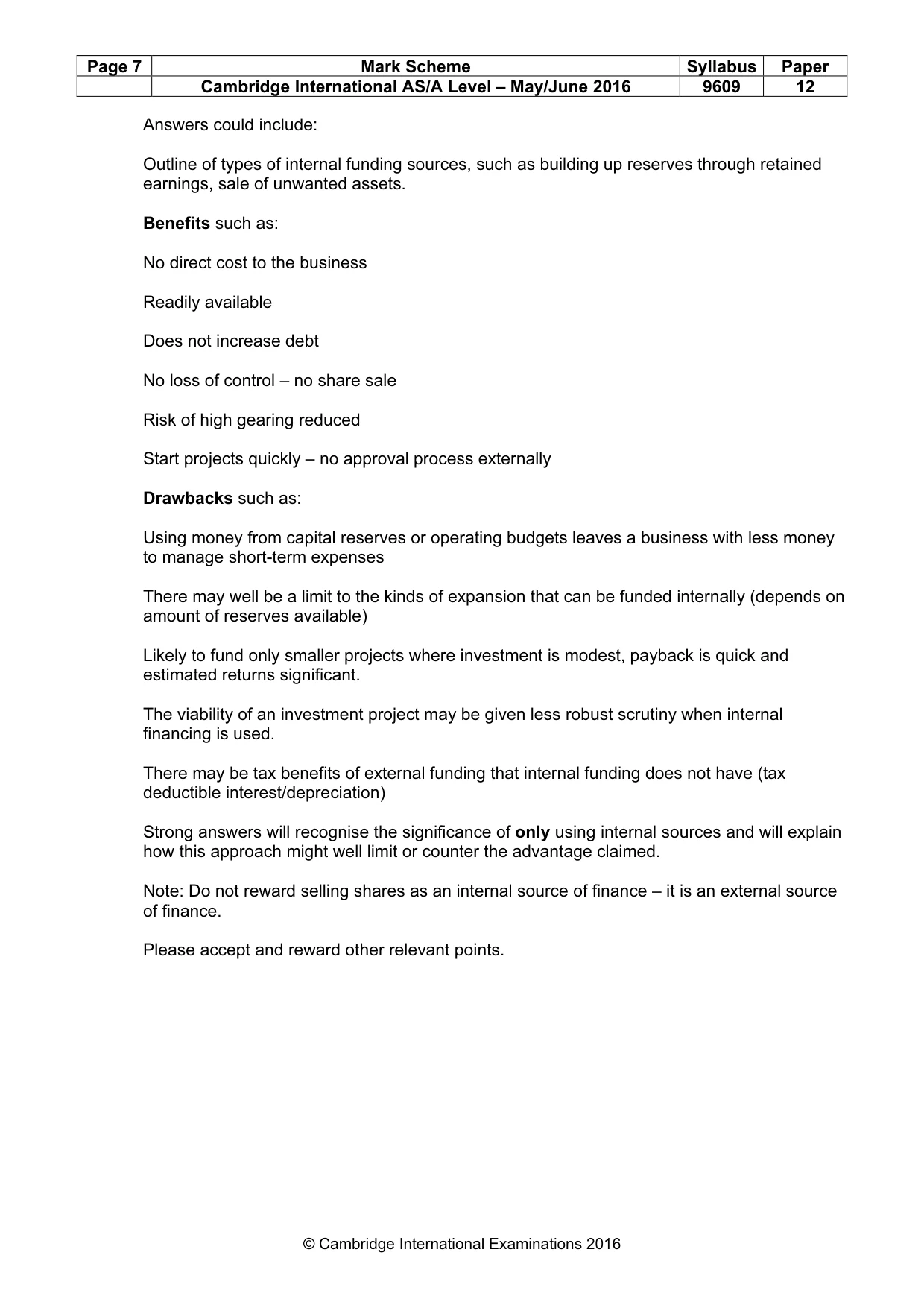
Page 7 Mark Scheme Syllabus Paper Cambridge International AS/A Level – May/June 2016 9609 12 © Cambridge International Examinations 2016 Answers could include: Outline of types of internal funding sources, such as building up reserves through retained earnings, sale of unwanted assets. Benefits such as: No direct cost to the business Readily available Does not increase debt No loss of control – no share sale Risk of high gearing reduced Start projects quickly – no approval process externally Drawbacks such as: Using money from capital reserves or operating budgets leaves a business with less money to manage short-term expenses There may well be a limit to the kinds of expansion that can be funded internally (depends on amount of reserves available) Likely to fund only smaller projects where investment is modest, payback is quick and estimated returns significant. The viability of an investment project may be given less robust scrutiny when internal financing is used. There may be tax benefits of external funding that internal funding does not have (tax deductible interest/depreciation) Strong answers will recognise the significance of only using internal sources and will explain how this approach might well limit or counter the advantage claimed. Note: Do not reward selling shares as an internal source of finance – it is an external source of finance. Please accept and reward other relevant points.
Mark scheme, page 8
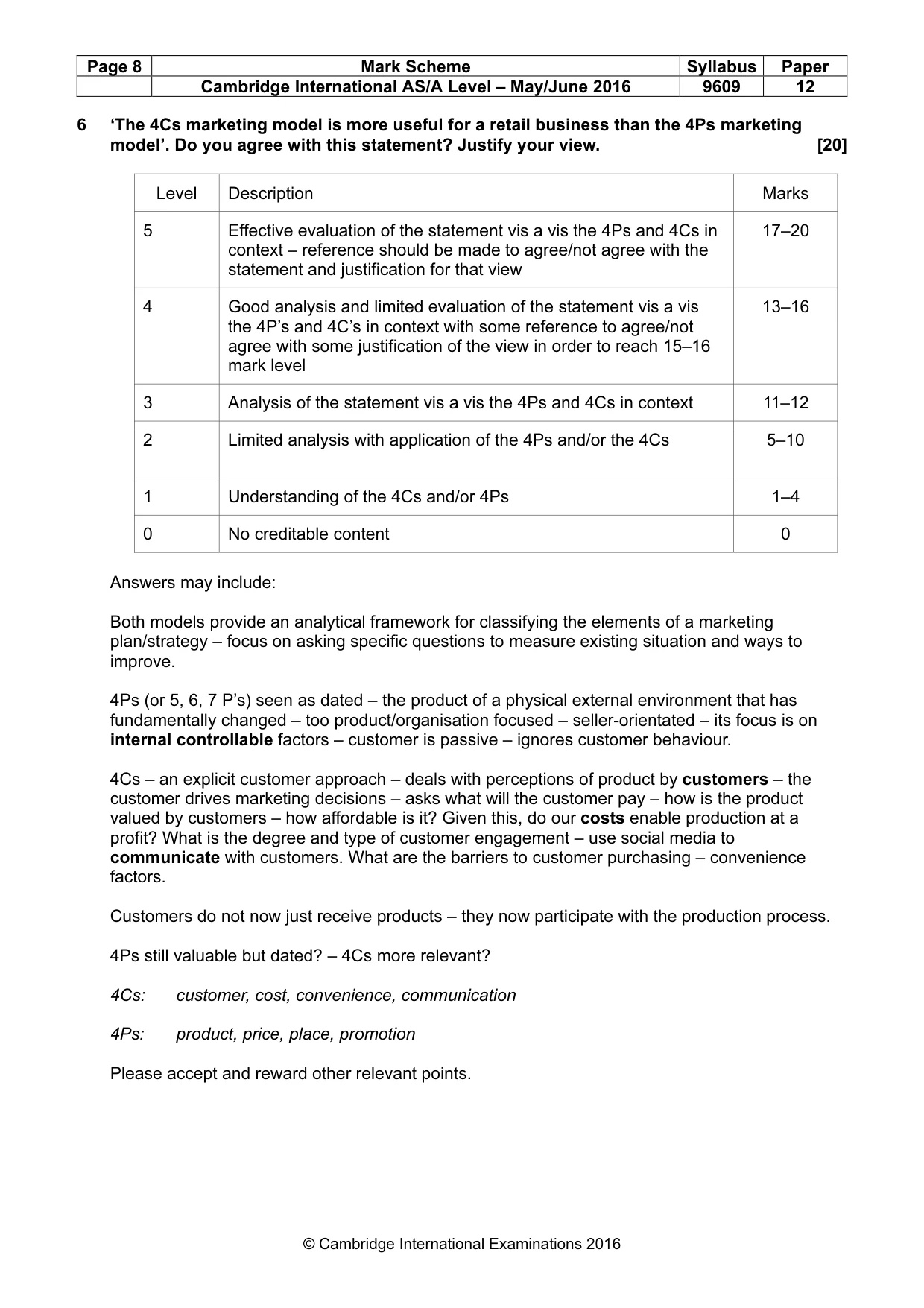
Page 8 Mark Scheme Syllabus Paper Cambridge International AS/A Level – May/June 2016 9609 12 © Cambridge International Examinations 2016 6 ‘The 4Cs marketing model is more useful for a retail business than the 4Ps marketing model’. Do you agree with this statement? Justify your view. [20] Level Description Marks 5 Effective evaluation of the statement vis a vis the 4Ps and 4Cs in context – reference should be made to agree/not agree with the statement and justification for that view 17–20 4 Good analysis and limited evaluation of the statement vis a vis the 4P’s and 4C’s in context with some reference to agree/not agree with some justification of the view in order to reach 15–16 mark level 13–16 3 Analysis of the statement vis a vis the 4Ps and 4Cs in context 11–12 2 Limited analysis with application of the 4Ps and/or the 4Cs 5–10 1 Understanding of the 4Cs and/or 4Ps 1–4 0 No creditable content 0 Answers may include: Both models provide an analytical framework for classifying the elements of a marketing plan/strategy – focus on asking specific questions to measure existing situation and ways to improve. 4Ps (or 5, 6, 7 P’s) seen as dated – the product of a physical external environment that has fundamentally changed – too product/organisation focused – seller-orientated – its focus is on internal controllable factors – customer is passive – ignores customer behaviour. 4Cs – an explicit customer approach – deals with perceptions of product by customers – the customer drives marketing decisions – asks what will the customer pay – how is the product valued by customers – how affordable is it? Given this, do our costs enable production at a profit? What is the degree and type of customer engagement – use social media to communicate with customers. What are the barriers to customer purchasing – convenience factors. Customers do not now just receive products – they now participate with the production process. 4Ps still valuable but dated? – 4Cs more relevant? 4Cs: customer, cost, convenience, communication 4Ps: product, price, place, promotion Please accept and reward other relevant points.
Mark scheme, page 9
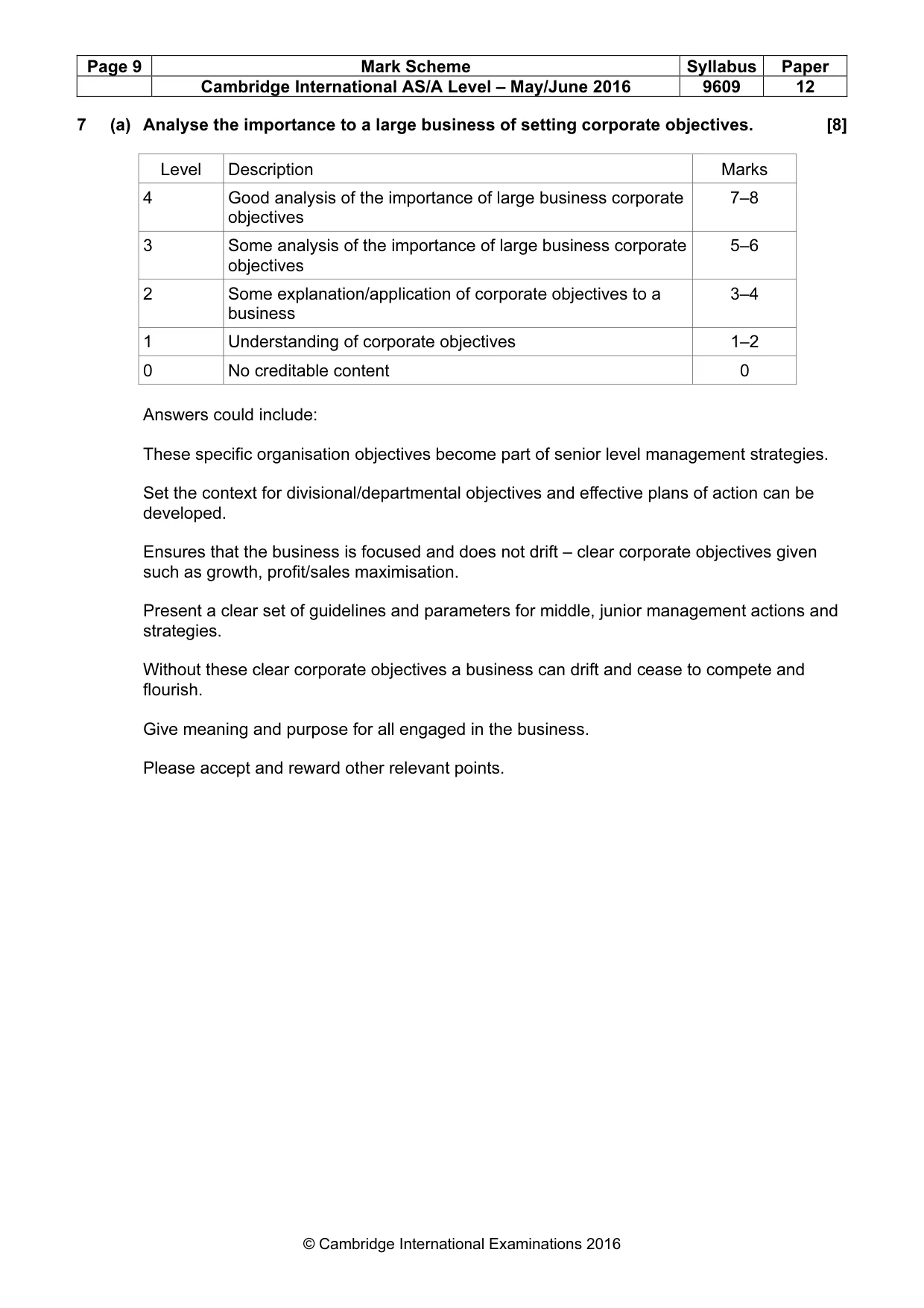
Page 9 Mark Scheme Syllabus Paper Cambridge International AS/A Level – May/June 2016 9609 12 © Cambridge International Examinations 2016 7 (a) Analyse the importance to a large business of setting corporate objectives. [8] Level Description Marks 4 Good analysis of the importance of large business corporate objectives 7–8 3 Some analysis of the importance of large business corporate objectives 5–6 2 Some explanation/application of corporate objectives to a business 3–4 1 Understanding of corporate objectives 1–2 0 No creditable content 0 Answers could include: These specific organisation objectives become part of senior level management strategies. Set the context for divisional/departmental objectives and effective plans of action can be developed. Ensures that the business is focused and does not drift – clear corporate objectives given such as growth, profit/sales maximisation. Present a clear set of guidelines and parameters for middle, junior management actions and strategies. Without these clear corporate objectives a business can drift and cease to compete and flourish. Give meaning and purpose for all engaged in the business. Please accept and reward other relevant points.
Mark scheme, page 10
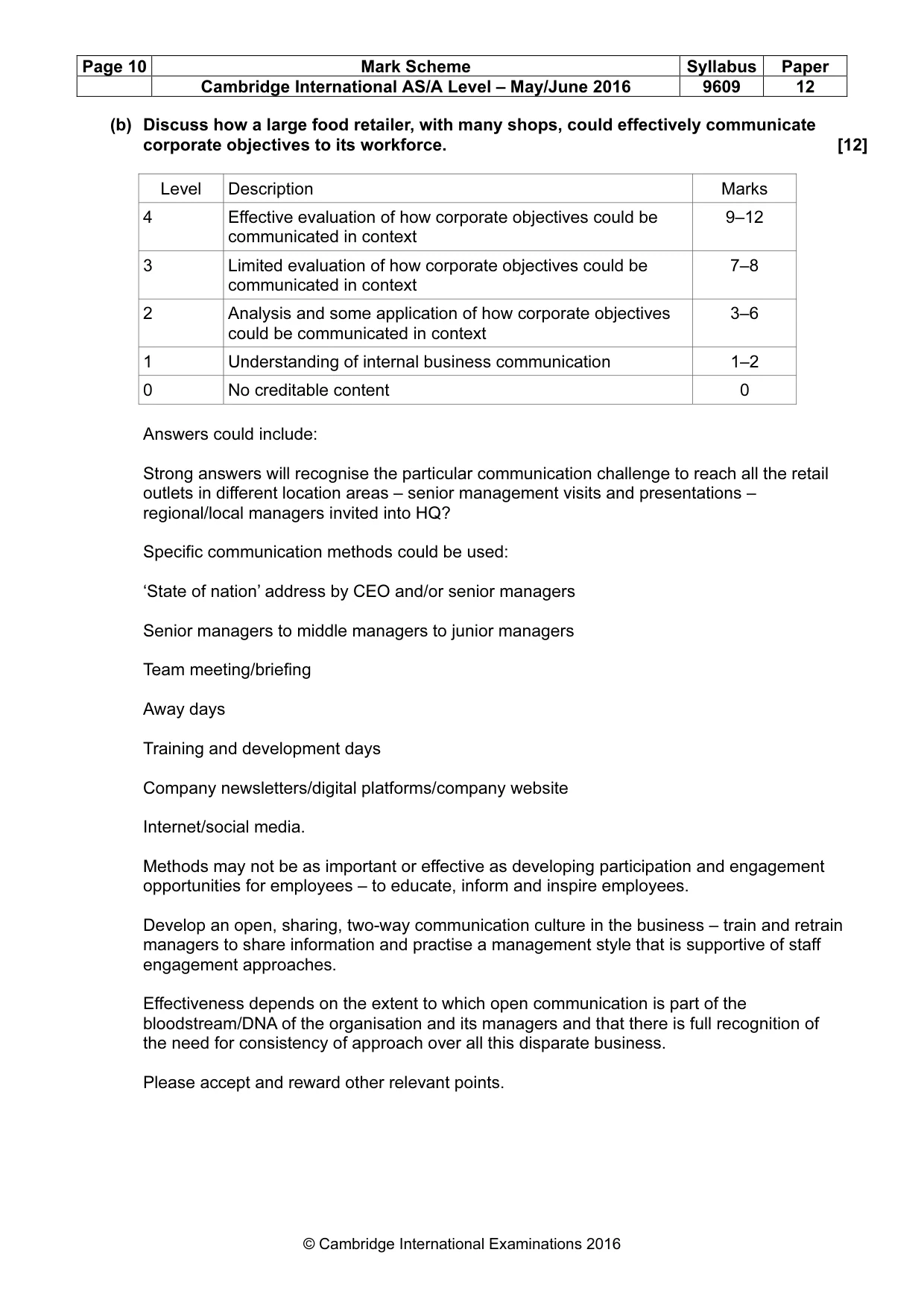
Page 10 Mark Scheme Syllabus Paper Cambridge International AS/A Level – May/June 2016 9609 12 © Cambridge International Examinations 2016 (b) Discuss how a large food retailer, with many shops, could effectively communicate corporate objectives to its workforce. [12] Level Description Marks 4 Effective evaluation of how corporate objectives could be communicated in context 9–12 3 Limited evaluation of how corporate objectives could be communicated in context 7–8 2 Analysis and some application of how corporate objectives could be communicated in context 3–6 1 Understanding of internal business communication 1–2 0 No creditable content 0 Answers could include: Strong answers will recognise the particular communication challenge to reach all the retail outlets in different location areas – senior management visits and presentations – regional/local managers invited into HQ? Specific communication methods could be used: ‘State of nation’ address by CEO and/or senior managers Senior managers to middle managers to junior managers Team meeting/briefing Away days Training and development days Company newsletters/digital platforms/company website Internet/social media. Methods may not be as important or effective as developing participation and engagement opportunities for employees – to educate, inform and inspire employees. Develop an open, sharing, two-way communication culture in the business – train and retrain managers to share information and practise a management style that is supportive of staff engagement approaches. Effectiveness depends on the extent to which open communication is part of the bloodstream/DNA of the organisation and its managers and that there is full recognition of the need for consistency of approach over all this disparate business. Please accept and reward other relevant points.
What you needed in this session
Cambridge’s own grade thresholds for 2016 May/June, Paper 1 · Variant 2. A higher threshold means an easier paper — the bar moves with how the cohort did.