Cambridge A Level Business (for first examination in 2016) 9609 — 2016 May/June Paper 1 · Variant 1
9609/11/M/J/16 · 40 marks · ≈45 min
The question paper and its mark scheme, free to read here and free to download. This is Cambridge’s own paper, exactly as it was sat.
Question paper4 pages


Mark scheme10 pages
Answers below. Sit the paper first if you are practising.
Paper as text
Question paper, page 1
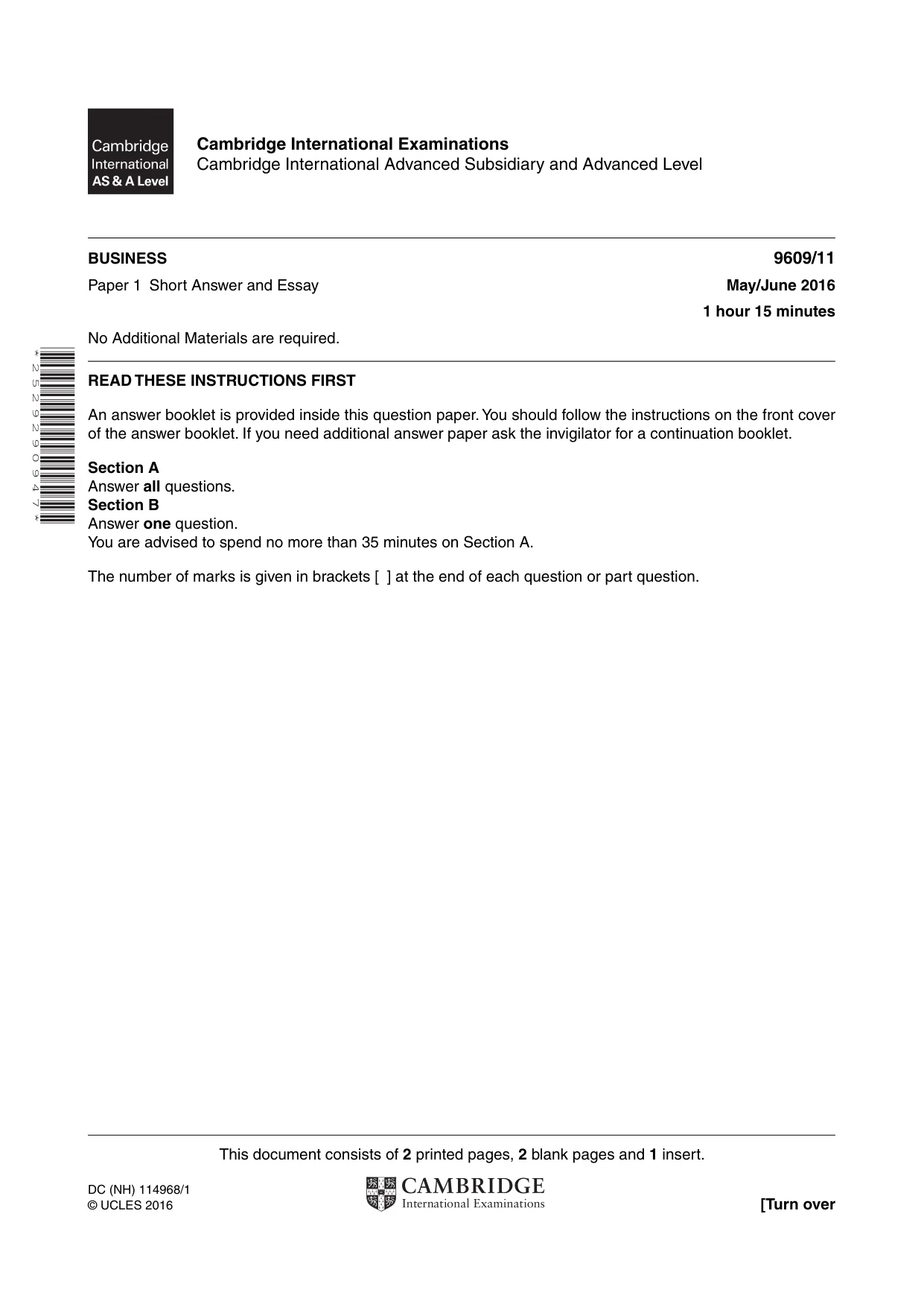
This document consists of 2 printed pages, 2 blank pages and 1 insert. DC (NH) 114968/1 © UCLES 2016 [Turn over * 2 5 2 9 2 9 0 9 4 7 * BUSINESS 9609/11 Paper 1 Short Answer and Essay May/June 2016 1 hour 15 minutes No Additional Materials are required. READ THESE INSTRUCTIONS FIRST An answer booklet is provided inside this question paper. You should follow the instructions on the front cover of the answer booklet. If you need additional answer paper ask the invigilator for a continuation booklet. Section A Answer all questions. Section B Answer one question. You are advised to spend no more than 35 minutes on Section A. The number of marks is given in brackets [ ] at the end of each question or part question. Cambridge International Examinations Cambridge International Advanced Subsidiary and Advanced Level
Question paper, page 2
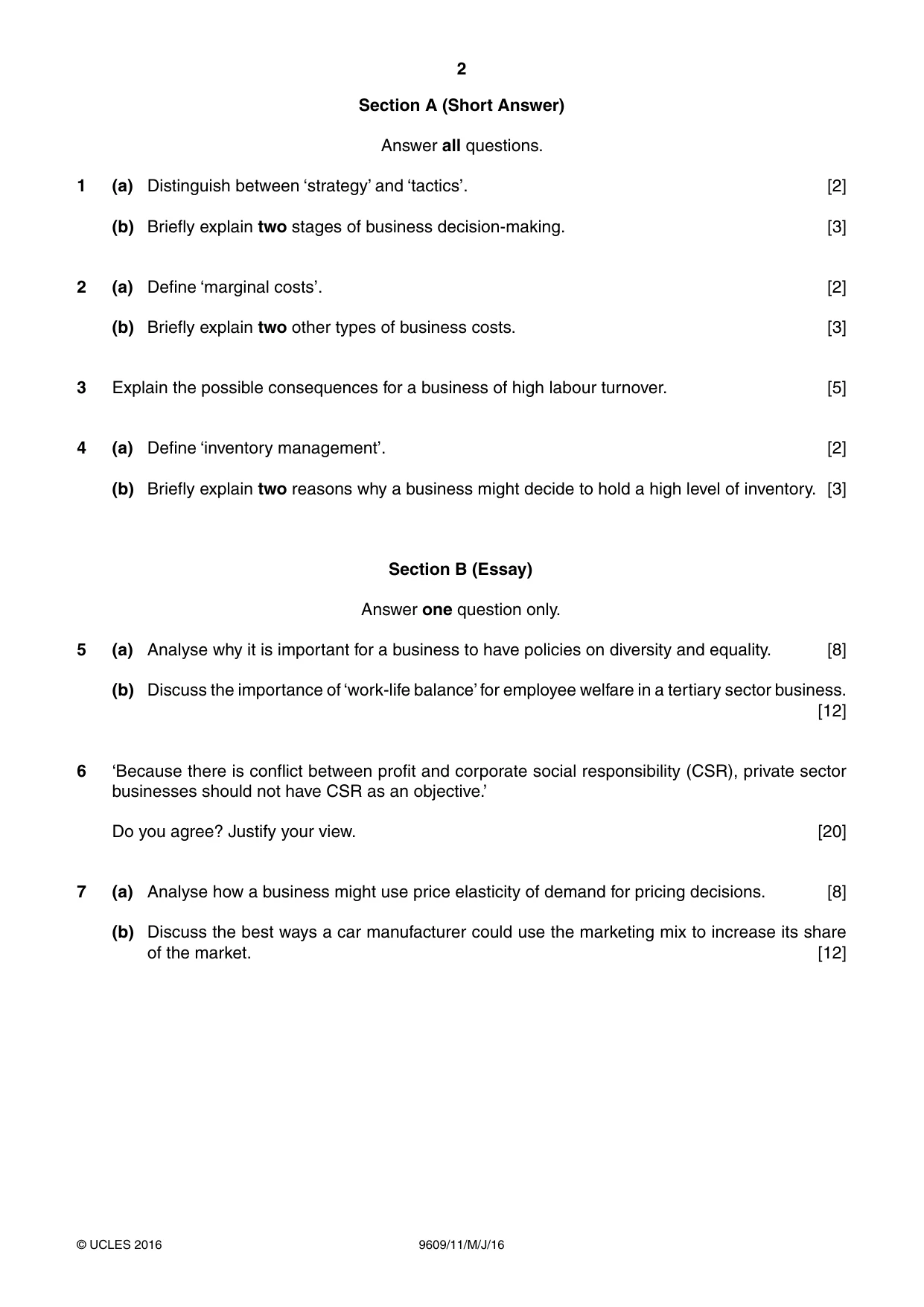
2 9609/11/M/J/16 © UCLES 2016 Section A (Short Answer) Answer all questions. 1 (a) Distinguish between ‘strategy’ and ‘tactics’. [2] (b) Briefly explain two stages of business decision-making. [3] 2 (a) Define ‘marginal costs’. [2] (b) Briefly explain two other types of business costs. [3] 3 Explain the possible consequences for a business of high labour turnover. [5] 4 (a) Define ‘inventory management’. [2] (b) Briefly explain two reasons why a business might decide to hold a high level of inventory. [3] Section B (Essay) Answer one question only. 5 (a) Analyse why it is important for a business to have policies on diversity and equality. [8] (b) Discuss the importance of ‘work-life balance’ for employee welfare in a tertiary sector business. [12] 6 ‘Because there is conflict between profit and corporate social responsibility (CSR), private sector businesses should not have CSR as an objective.’ Do you agree? Justify your view. [20] 7 (a) Analyse how a business might use price elasticity of demand for pricing decisions. [8] (b) Discuss the best ways a car manufacturer could use the marketing mix to increase its share of the market. [12]
Question paper, page 3
3 9609/11/M/J/16 © UCLES 2016 BLANK PAGE
Question paper, page 4
4 9609/11/M/J/16 © UCLES 2016 BLANK PAGE Permission to reproduce items where third-party owned material protected by copyright is included has been sought and cleared where possible. Every reasonable effort has been made by the publisher (UCLES) to trace copyright holders, but if any items requiring clearance have unwittingly been included, the publisher will be pleased to make amends at the earliest possible opportunity. To avoid the issue of disclosure of answer-related information to candidates, all copyright acknowledgements are reproduced online in the Cambridge International Examinations Copyright Acknowledgements Booklet. This is produced for each series of examinations and is freely available to download at www.cie.org.uk after the live examination series. Cambridge International Examinations is part of the Cambridge Assessment Group. Cambridge Assessment is the brand name of University of Cambridge Local Examinations Syndicate (UCLES), which is itself a department of the University of Cambridge.
Mark scheme, page 1
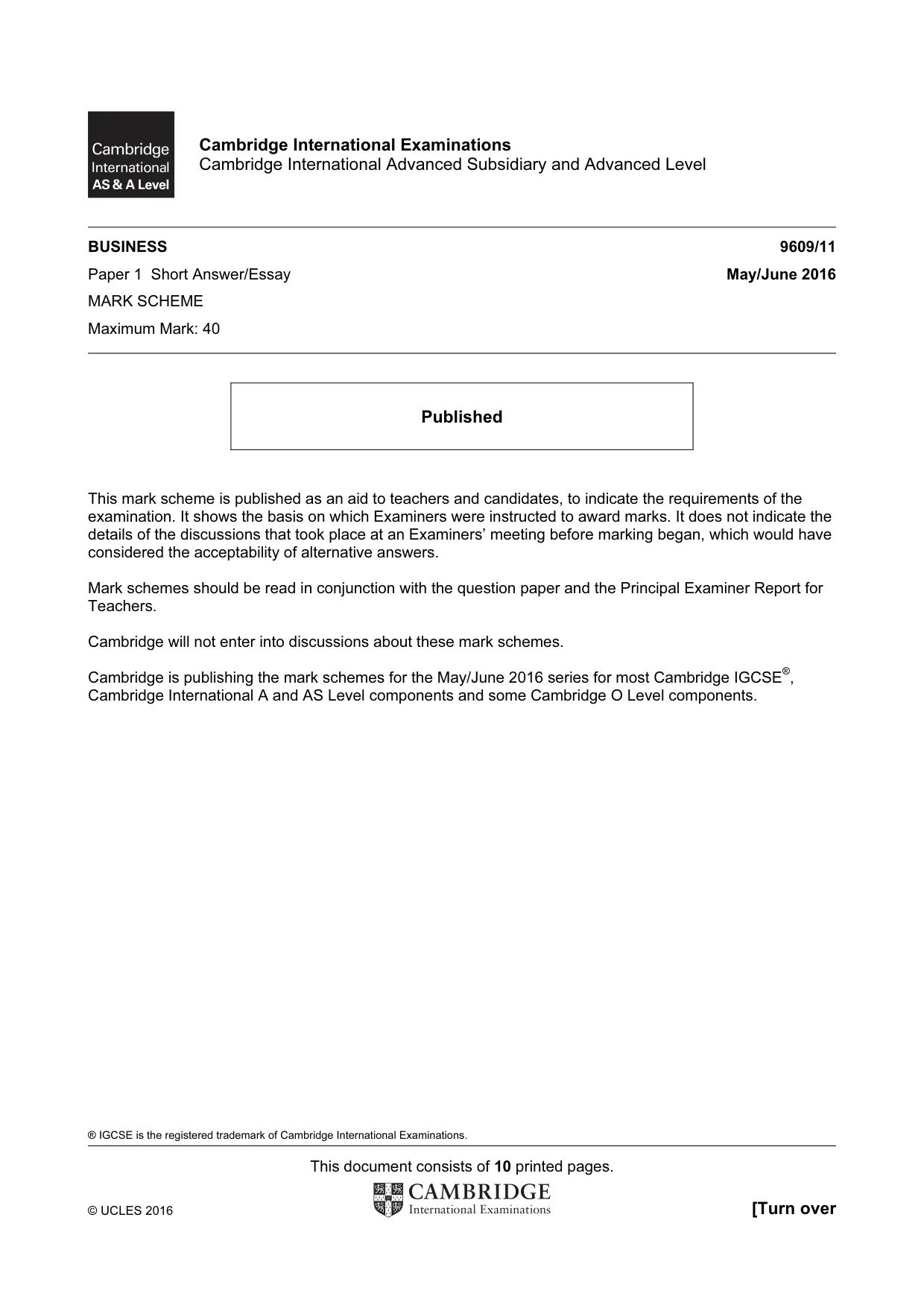
® IGCSE is the registered trademark of Cambridge International Examinations. This document consists of 10 printed pages. © UCLES 2016 [Turn over Cambridge International Examinations Cambridge International Advanced Subsidiary and Advanced Level BUSINESS 9609/11 Paper 1 Short Answer/Essay May/June 2016 MARK SCHEME Maximum Mark: 40 Published This mark scheme is published as an aid to teachers and candidates, to indicate the requirements of the examination. It shows the basis on which Examiners were instructed to award marks. It does not indicate the details of the discussions that took place at an Examiners’ meeting before marking began, which would have considered the acceptability of alternative answers. Mark schemes should be read in conjunction with the question paper and the Principal Examiner Report for Teachers. Cambridge will not enter into discussions about these mark schemes. Cambridge is publishing the mark schemes for the May/June 2016 series for most Cambridge IGCSE®, Cambridge International A and AS Level components and some Cambridge O Level components.
Mark scheme, page 2
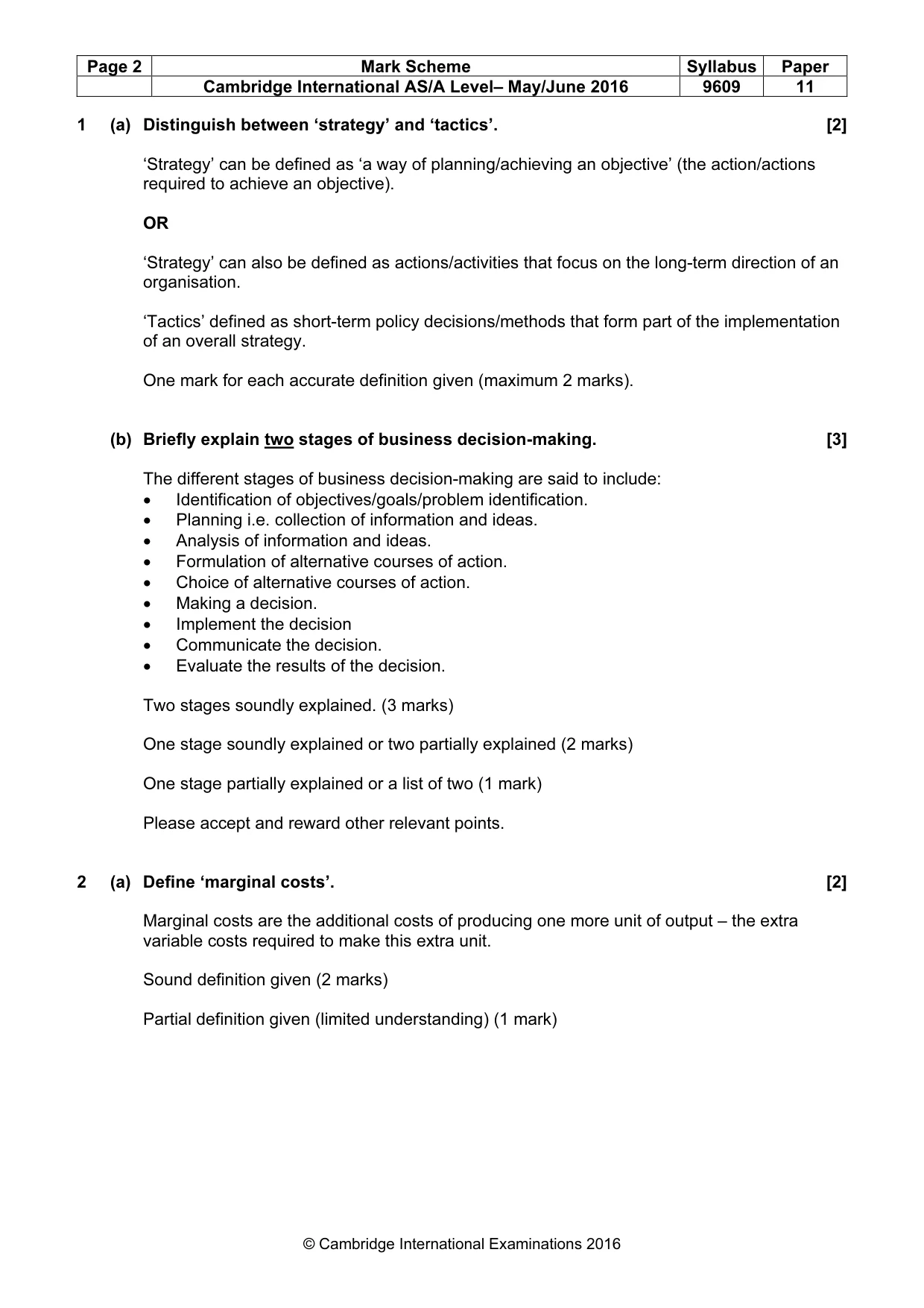
Page 2 Mark Scheme Syllabus Paper Cambridge International AS/A Level– May/June 2016 9609 11 © Cambridge International Examinations 2016 1 (a) Distinguish between ‘strategy’ and ‘tactics’. [2] ‘Strategy’ can be defined as ‘a way of planning/achieving an objective’ (the action/actions required to achieve an objective). OR ‘Strategy’ can also be defined as actions/activities that focus on the long-term direction of an organisation. ‘Tactics’ defined as short-term policy decisions/methods that form part of the implementation of an overall strategy. One mark for each accurate definition given (maximum 2 marks). (b) Briefly explain two stages of business decision-making. [3] The different stages of business decision-making are said to include: • Identification of objectives/goals/problem identification. • Planning i.e. collection of information and ideas. • Analysis of information and ideas. • Formulation of alternative courses of action. • Choice of alternative courses of action. • Making a decision. • Implement the decision • Communicate the decision. • Evaluate the results of the decision. Two stages soundly explained. (3 marks) One stage soundly explained or two partially explained (2 marks) One stage partially explained or a list of two (1 mark) Please accept and reward other relevant points. 2 (a) Define ‘marginal costs’. [2] Marginal costs are the additional costs of producing one more unit of output – the extra variable costs required to make this extra unit. Sound definition given (2 marks) Partial definition given (limited understanding) (1 mark)
Mark scheme, page 3
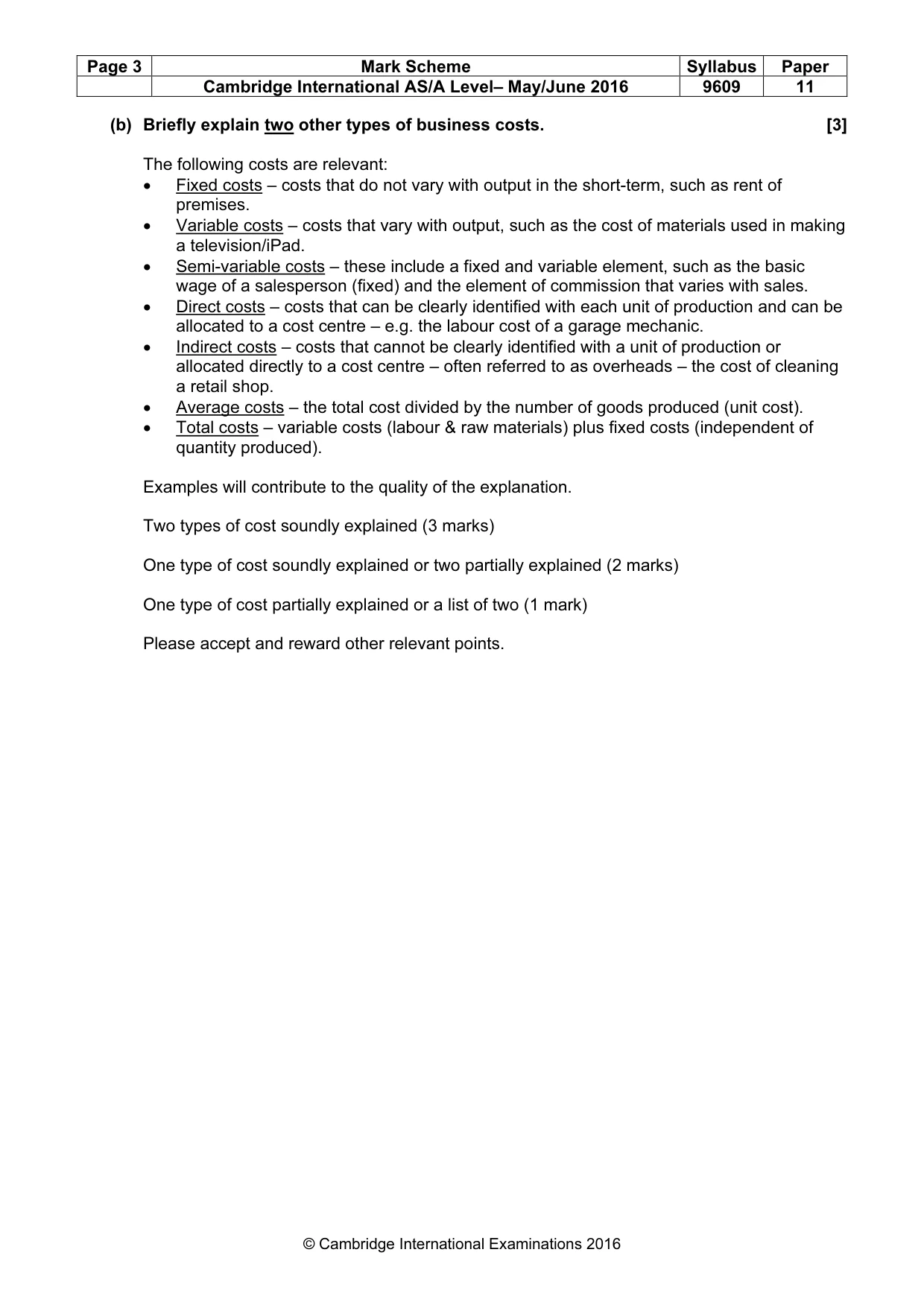
Page 3 Mark Scheme Syllabus Paper Cambridge International AS/A Level– May/June 2016 9609 11 © Cambridge International Examinations 2016 (b) Briefly explain two other types of business costs. [3] The following costs are relevant: • Fixed costs – costs that do not vary with output in the short-term, such as rent of premises. • Variable costs – costs that vary with output, such as the cost of materials used in making a television/iPad. • Semi-variable costs – these include a fixed and variable element, such as the basic wage of a salesperson (fixed) and the element of commission that varies with sales. • Direct costs – costs that can be clearly identified with each unit of production and can be allocated to a cost centre – e.g. the labour cost of a garage mechanic. • Indirect costs – costs that cannot be clearly identified with a unit of production or allocated directly to a cost centre – often referred to as overheads – the cost of cleaning a retail shop. • Average costs – the total cost divided by the number of goods produced (unit cost). • Total costs – variable costs (labour & raw materials) plus fixed costs (independent of quantity produced). Examples will contribute to the quality of the explanation. Two types of cost soundly explained (3 marks) One type of cost soundly explained or two partially explained (2 marks) One type of cost partially explained or a list of two (1 mark) Please accept and reward other relevant points.
Mark scheme, page 4
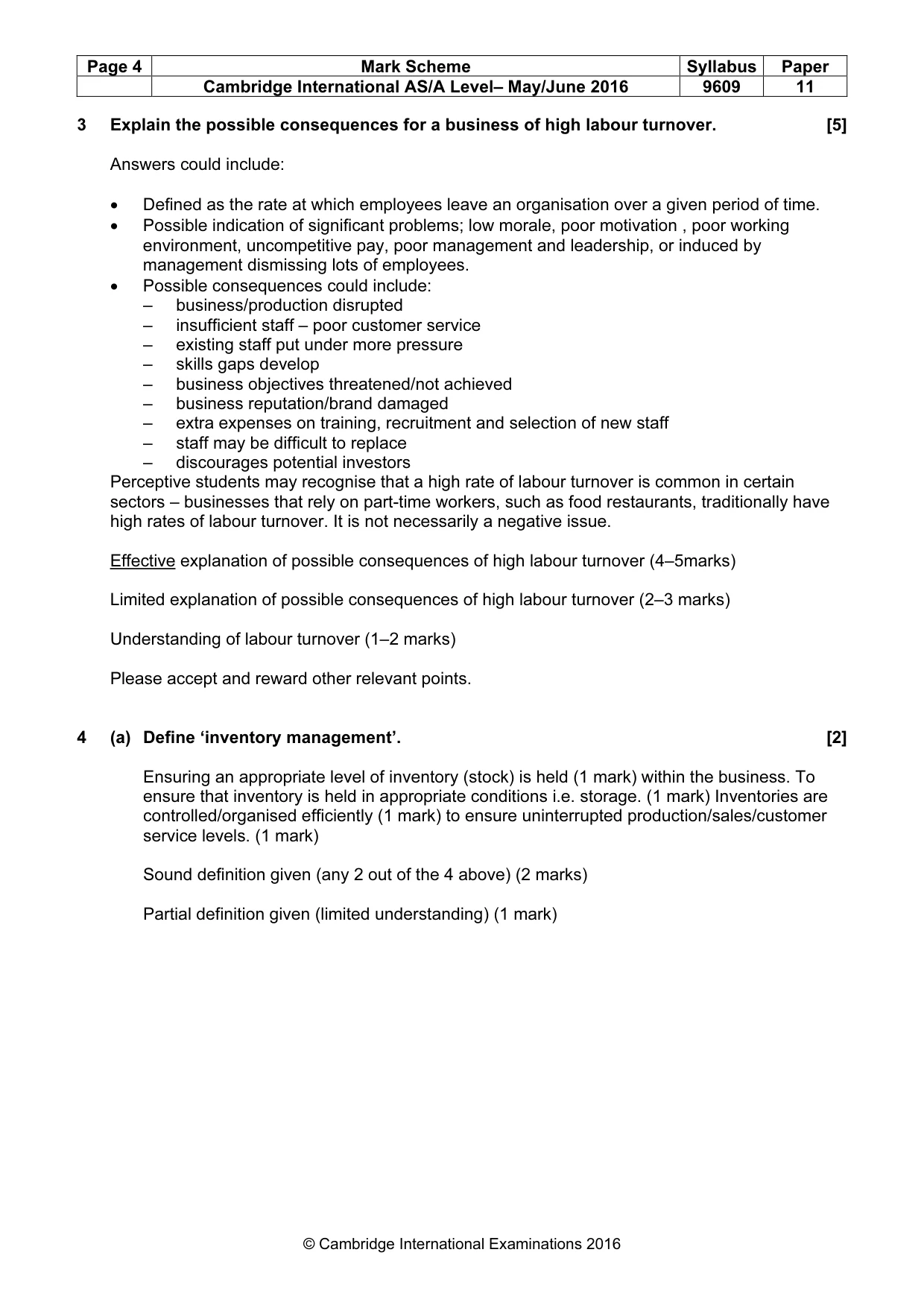
Page 4 Mark Scheme Syllabus Paper Cambridge International AS/A Level– May/June 2016 9609 11 © Cambridge International Examinations 2016 3 Explain the possible consequences for a business of high labour turnover. [5] Answers could include: • Defined as the rate at which employees leave an organisation over a given period of time. • Possible indication of significant problems; low morale, poor motivation , poor working environment, uncompetitive pay, poor management and leadership, or induced by management dismissing lots of employees. • Possible consequences could include: – business/production disrupted – insufficient staff – poor customer service – existing staff put under more pressure – skills gaps develop – business objectives threatened/not achieved – business reputation/brand damaged – extra expenses on training, recruitment and selection of new staff – staff may be difficult to replace – discourages potential investors Perceptive students may recognise that a high rate of labour turnover is common in certain sectors – businesses that rely on part-time workers, such as food restaurants, traditionally have high rates of labour turnover. It is not necessarily a negative issue. Effective explanation of possible consequences of high labour turnover (4–5marks) Limited explanation of possible consequences of high labour turnover (2–3 marks) Understanding of labour turnover (1–2 marks) Please accept and reward other relevant points. 4 (a) Define ‘inventory management’. [2] Ensuring an appropriate level of inventory (stock) is held (1 mark) within the business. To ensure that inventory is held in appropriate conditions i.e. storage. (1 mark) Inventories are controlled/organised efficiently (1 mark) to ensure uninterrupted production/sales/customer service levels. (1 mark) Sound definition given (any 2 out of the 4 above) (2 marks) Partial definition given (limited understanding) (1 mark)
Mark scheme, page 5
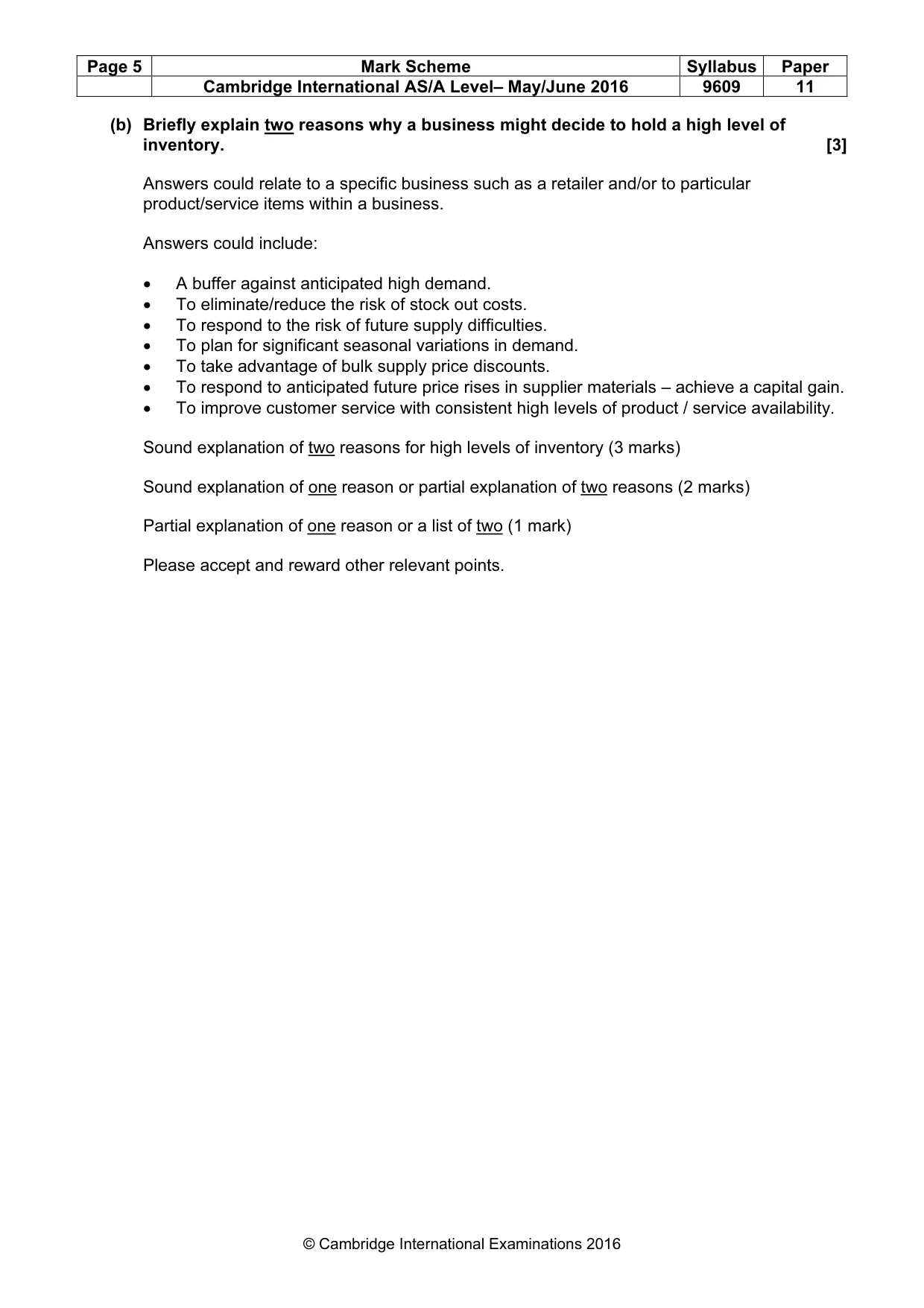
Page 5 Mark Scheme Syllabus Paper Cambridge International AS/A Level– May/June 2016 9609 11 © Cambridge International Examinations 2016 (b) Briefly explain two reasons why a business might decide to hold a high level of inventory. [3] Answers could relate to a specific business such as a retailer and/or to particular product/service items within a business. Answers could include: • A buffer against anticipated high demand. • To eliminate/reduce the risk of stock out costs. • To respond to the risk of future supply difficulties. • To plan for significant seasonal variations in demand. • To take advantage of bulk supply price discounts. • To respond to anticipated future price rises in supplier materials – achieve a capital gain. • To improve customer service with consistent high levels of product / service availability. Sound explanation of two reasons for high levels of inventory (3 marks) Sound explanation of one reason or partial explanation of two reasons (2 marks) Partial explanation of one reason or a list of two (1 mark) Please accept and reward other relevant points.
Mark scheme, page 6
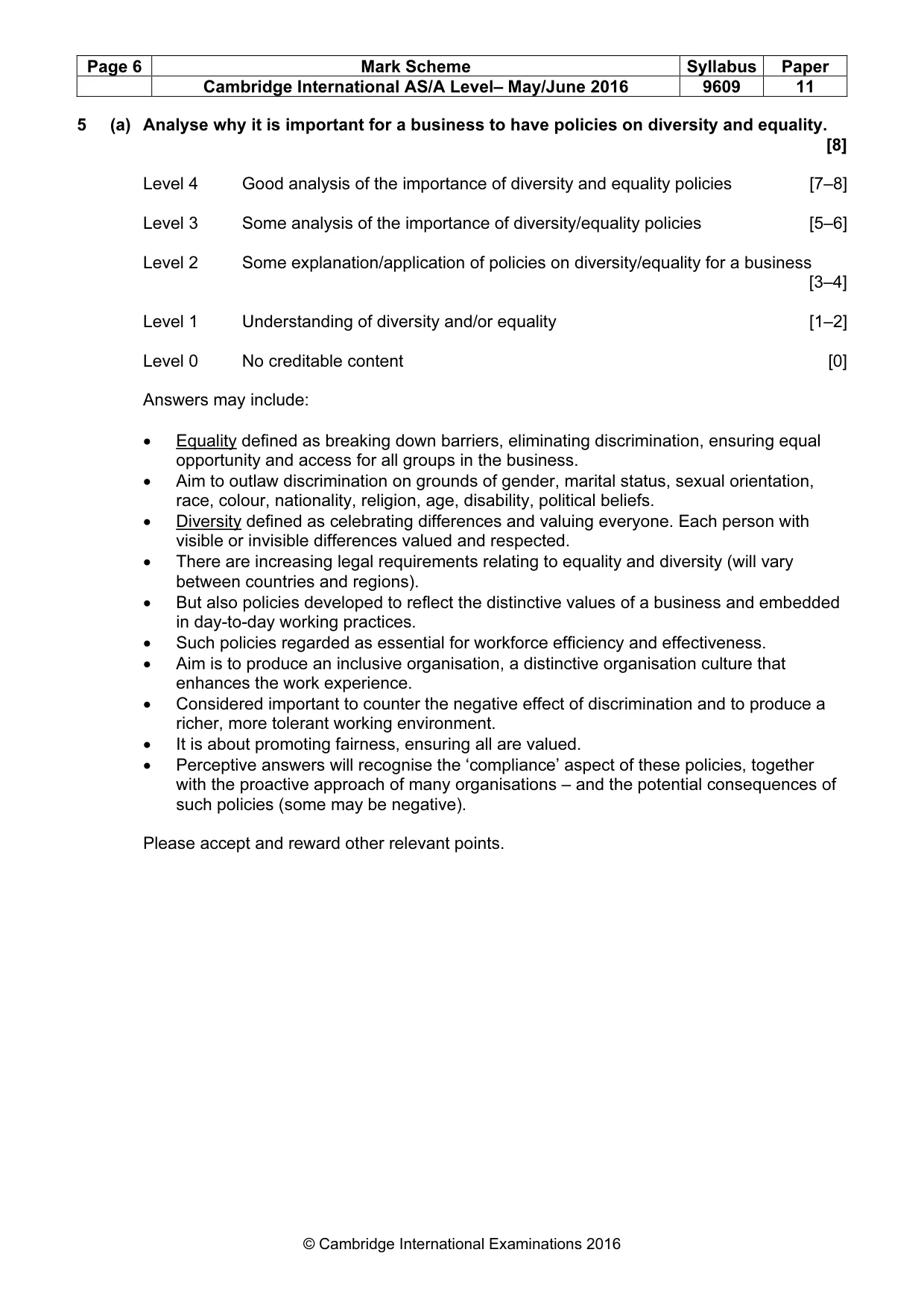
Page 6 Mark Scheme Syllabus Paper Cambridge International AS/A Level– May/June 2016 9609 11 © Cambridge International Examinations 2016 5 (a) Analyse why it is important for a business to have policies on diversity and equality. [8] Level 4 Good analysis of the importance of diversity and equality policies [7–8] Level 3 Some analysis of the importance of diversity/equality policies [5–6] Level 2 Some explanation/application of policies on diversity/equality for a business [3–4] Level 1 Understanding of diversity and/or equality [1–2] Level 0 No creditable content [0] Answers may include: • Equality defined as breaking down barriers, eliminating discrimination, ensuring equal opportunity and access for all groups in the business. • Aim to outlaw discrimination on grounds of gender, marital status, sexual orientation, race, colour, nationality, religion, age, disability, political beliefs. • Diversity defined as celebrating differences and valuing everyone. Each person with visible or invisible differences valued and respected. • There are increasing legal requirements relating to equality and diversity (will vary between countries and regions). • But also policies developed to reflect the distinctive values of a business and embedded in day-to-day working practices. • Such policies regarded as essential for workforce efficiency and effectiveness. • Aim is to produce an inclusive organisation, a distinctive organisation culture that enhances the work experience. • Considered important to counter the negative effect of discrimination and to produce a richer, more tolerant working environment. • It is about promoting fairness, ensuring all are valued. • Perceptive answers will recognise the ‘compliance’ aspect of these policies, together with the proactive approach of many organisations – and the potential consequences of such policies (some may be negative). Please accept and reward other relevant points.
Mark scheme, page 7
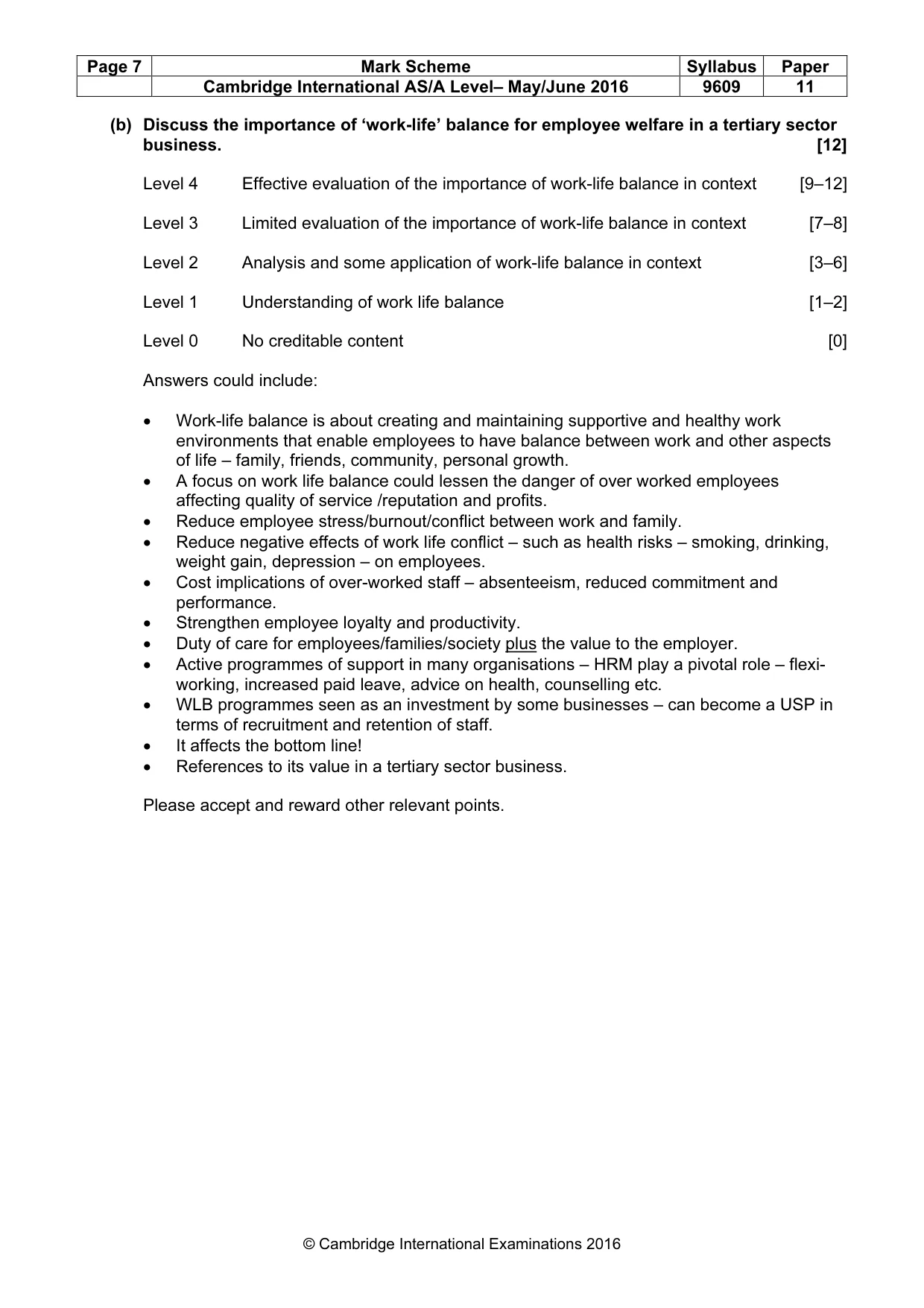
Page 7 Mark Scheme Syllabus Paper Cambridge International AS/A Level– May/June 2016 9609 11 © Cambridge International Examinations 2016 (b) Discuss the importance of ‘work-life’ balance for employee welfare in a tertiary sector business. [12] Level 4 Effective evaluation of the importance of work-life balance in context [9–12] Level 3 Limited evaluation of the importance of work-life balance in context [7–8] Level 2 Analysis and some application of work-life balance in context [3–6] Level 1 Understanding of work life balance [1–2] Level 0 No creditable content [0] Answers could include: • Work-life balance is about creating and maintaining supportive and healthy work environments that enable employees to have balance between work and other aspects of life – family, friends, community, personal growth. • A focus on work life balance could lessen the danger of over worked employees affecting quality of service /reputation and profits. • Reduce employee stress/burnout/conflict between work and family. • Reduce negative effects of work life conflict – such as health risks – smoking, drinking, weight gain, depression – on employees. • Cost implications of over-worked staff – absenteeism, reduced commitment and performance. • Strengthen employee loyalty and productivity. • Duty of care for employees/families/society plus the value to the employer. • Active programmes of support in many organisations – HRM play a pivotal role – flexi- working, increased paid leave, advice on health, counselling etc. • WLB programmes seen as an investment by some businesses – can become a USP in terms of recruitment and retention of staff. • It affects the bottom line! • References to its value in a tertiary sector business. Please accept and reward other relevant points.
Mark scheme, page 8
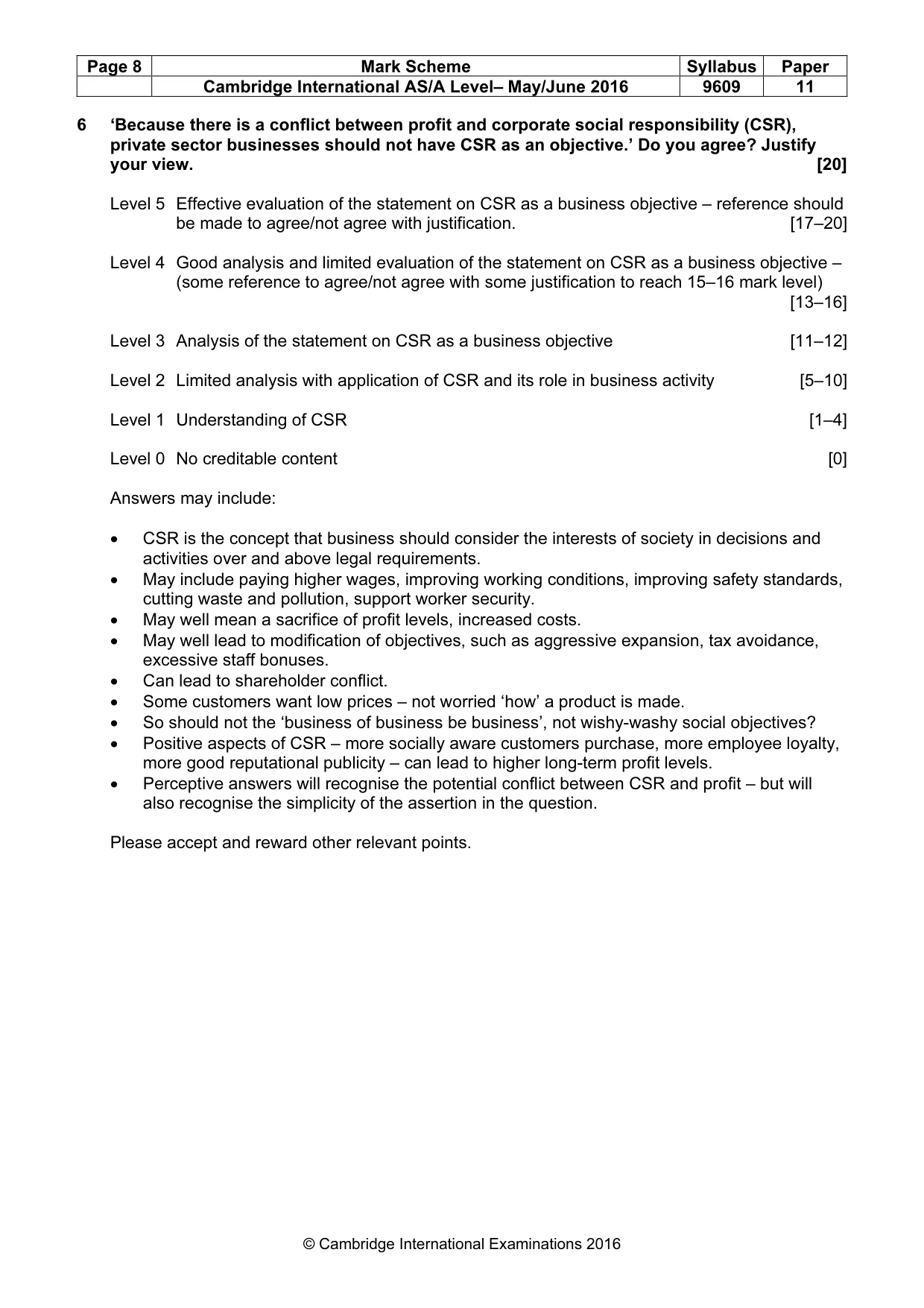
Page 8 Mark Scheme Syllabus Paper Cambridge International AS/A Level– May/June 2016 9609 11 © Cambridge International Examinations 2016 6 ‘Because there is a conflict between profit and corporate social responsibility (CSR), private sector businesses should not have CSR as an objective.’ Do you agree? Justify your view. [20] Level 5 Effective evaluation of the statement on CSR as a business objective – reference should be made to agree/not agree with justification. [17–20] Level 4 Good analysis and limited evaluation of the statement on CSR as a business objective – (some reference to agree/not agree with some justification to reach 15–16 mark level) [13–16] Level 3 Analysis of the statement on CSR as a business objective [11–12] Level 2 Limited analysis with application of CSR and its role in business activity [5–10] Level 1 Understanding of CSR [1–4] Level 0 No creditable content [0] Answers may include: • CSR is the concept that business should consider the interests of society in decisions and activities over and above legal requirements. • May include paying higher wages, improving working conditions, improving safety standards, cutting waste and pollution, support worker security. • May well mean a sacrifice of profit levels, increased costs. • May well lead to modification of objectives, such as aggressive expansion, tax avoidance, excessive staff bonuses. • Can lead to shareholder conflict. • Some customers want low prices – not worried ‘how’ a product is made. • So should not the ‘business of business be business’, not wishy-washy social objectives? • Positive aspects of CSR – more socially aware customers purchase, more employee loyalty, more good reputational publicity – can lead to higher long-term profit levels. • Perceptive answers will recognise the potential conflict between CSR and profit – but will also recognise the simplicity of the assertion in the question. Please accept and reward other relevant points.
Mark scheme, page 9
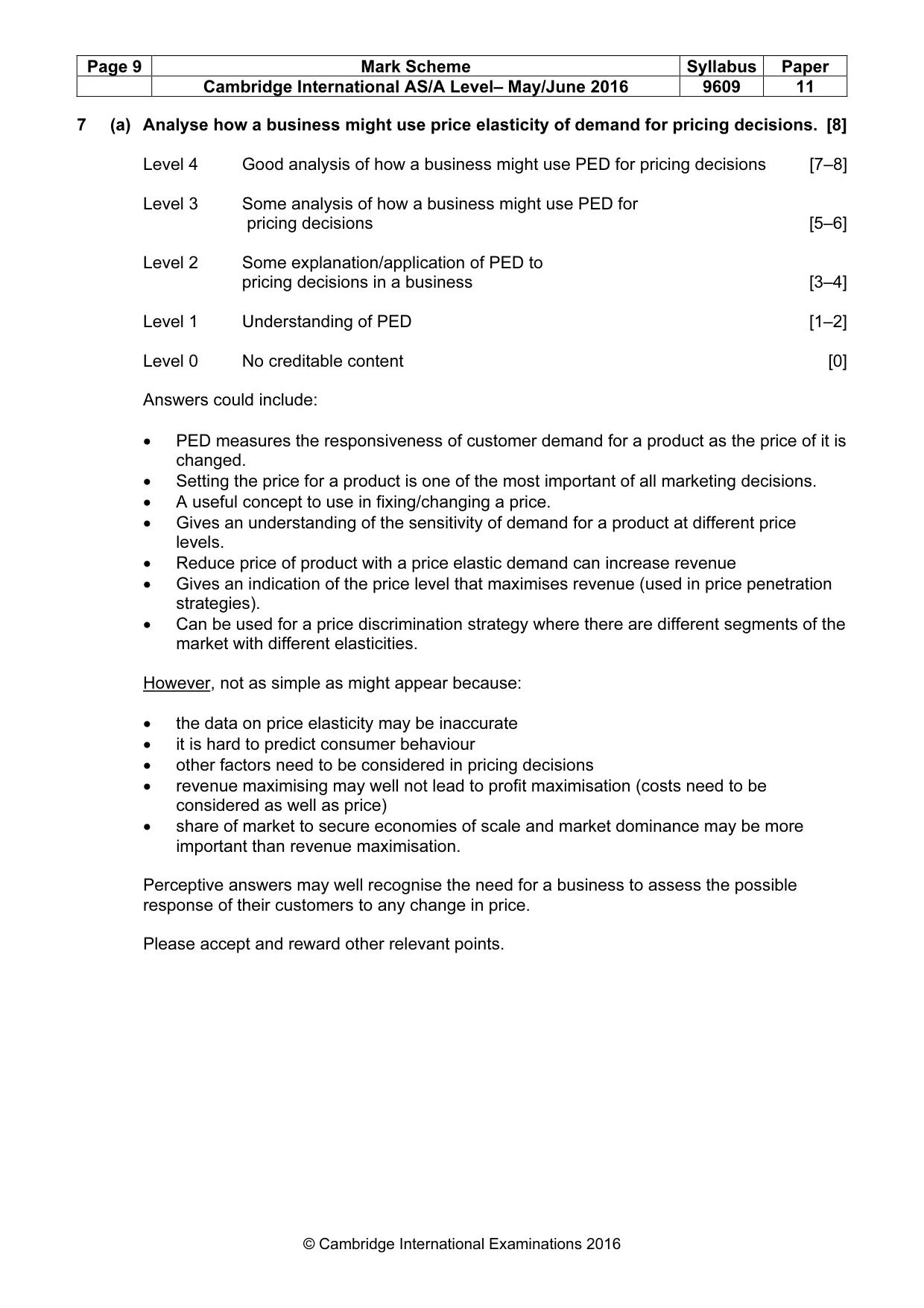
Page 9 Mark Scheme Syllabus Paper Cambridge International AS/A Level– May/June 2016 9609 11 © Cambridge International Examinations 2016 7 (a) Analyse how a business might use price elasticity of demand for pricing decisions. [8] Level 4 Good analysis of how a business might use PED for pricing decisions [7–8] Level 3 Some analysis of how a business might use PED for pricing decisions [5–6] Level 2 Some explanation/application of PED to pricing decisions in a business [3–4] Level 1 Understanding of PED [1–2] Level 0 No creditable content [0] Answers could include: • PED measures the responsiveness of customer demand for a product as the price of it is changed. • Setting the price for a product is one of the most important of all marketing decisions. • A useful concept to use in fixing/changing a price. • Gives an understanding of the sensitivity of demand for a product at different price levels. • Reduce price of product with a price elastic demand can increase revenue • Gives an indication of the price level that maximises revenue (used in price penetration strategies). • Can be used for a price discrimination strategy where there are different segments of the market with different elasticities. However, not as simple as might appear because: • the data on price elasticity may be inaccurate • it is hard to predict consumer behaviour • other factors need to be considered in pricing decisions • revenue maximising may well not lead to profit maximisation (costs need to be considered as well as price) • share of market to secure economies of scale and market dominance may be more important than revenue maximisation. Perceptive answers may well recognise the need for a business to assess the possible response of their customers to any change in price. Please accept and reward other relevant points.
Mark scheme, page 10
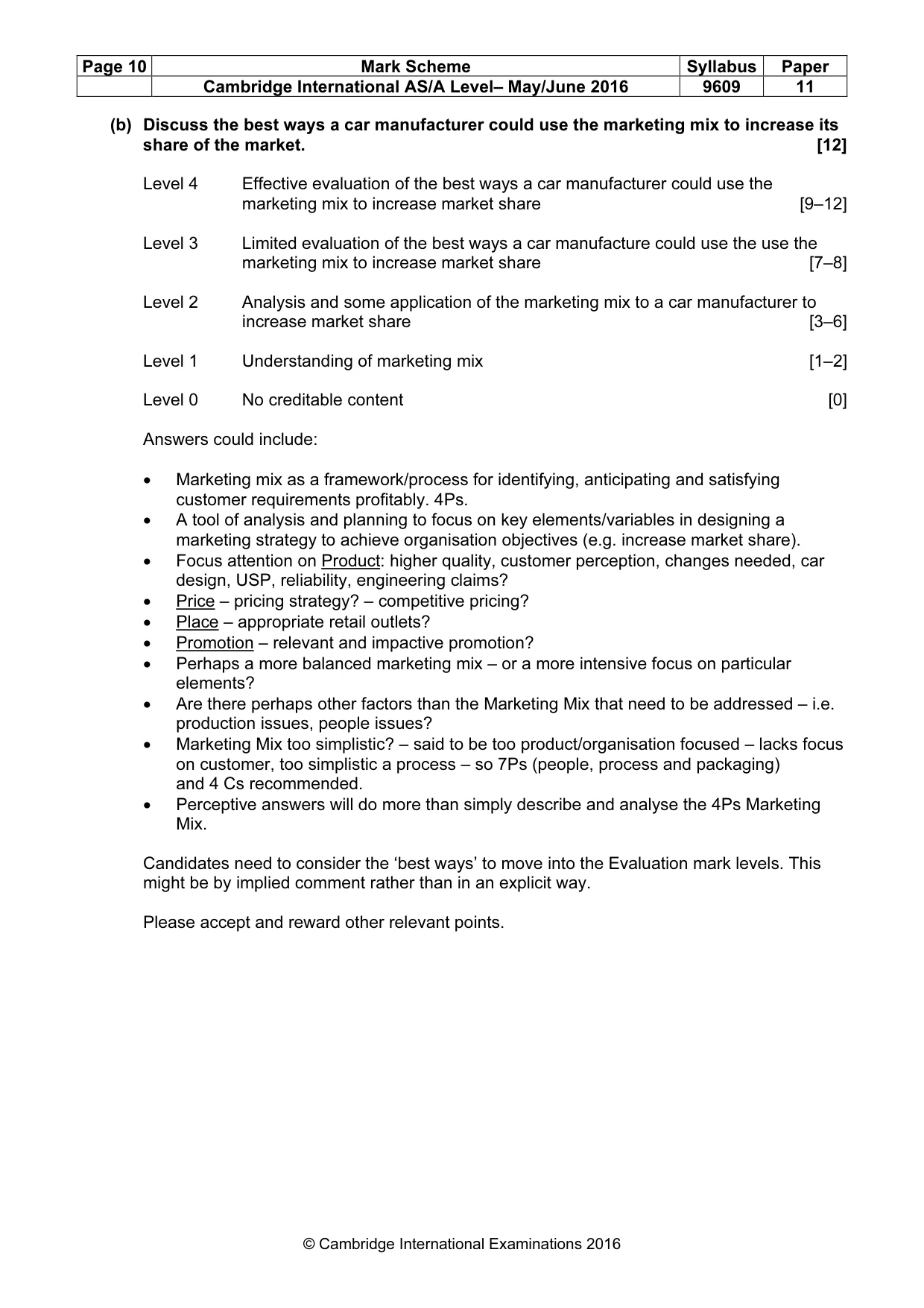
Page 10 Mark Scheme Syllabus Paper Cambridge International AS/A Level– May/June 2016 9609 11 © Cambridge International Examinations 2016 (b) Discuss the best ways a car manufacturer could use the marketing mix to increase its share of the market. [12] Level 4 Effective evaluation of the best ways a car manufacturer could use the marketing mix to increase market share [9–12] Level 3 Limited evaluation of the best ways a car manufacture could use the use the marketing mix to increase market share [7–8] Level 2 Analysis and some application of the marketing mix to a car manufacturer to increase market share [3–6] Level 1 Understanding of marketing mix [1–2] Level 0 No creditable content [0] Answers could include: • Marketing mix as a framework/process for identifying, anticipating and satisfying customer requirements profitably. 4Ps. • A tool of analysis and planning to focus on key elements/variables in designing a marketing strategy to achieve organisation objectives (e.g. increase market share). • Focus attention on Product: higher quality, customer perception, changes needed, car design, USP, reliability, engineering claims? • Price – pricing strategy? – competitive pricing? • Place – appropriate retail outlets? • Promotion – relevant and impactive promotion? • Perhaps a more balanced marketing mix – or a more intensive focus on particular elements? • Are there perhaps other factors than the Marketing Mix that need to be addressed – i.e. production issues, people issues? • Marketing Mix too simplistic? – said to be too product/organisation focused – lacks focus on customer, too simplistic a process – so 7Ps (people, process and packaging) and 4 Cs recommended. • Perceptive answers will do more than simply describe and analyse the 4Ps Marketing Mix. Candidates need to consider the ‘best ways’ to move into the Evaluation mark levels. This might be by implied comment rather than in an explicit way. Please accept and reward other relevant points.
What you needed in this session
Cambridge’s own grade thresholds for 2016 May/June, Paper 1 · Variant 1. A higher threshold means an easier paper — the bar moves with how the cohort did.