Cambridge A Level Business (for first examination in 2016) 9609 — 2016 May/June Paper 1 · Variant 3
9609/13/M/J/16 · 40 marks · ≈45 min
The question paper and its mark scheme, free to read here and free to download. This is Cambridge’s own paper, exactly as it was sat.
Question paper4 pages


Mark scheme9 pages
Answers below. Sit the paper first if you are practising.
Paper as text
Question paper, page 1
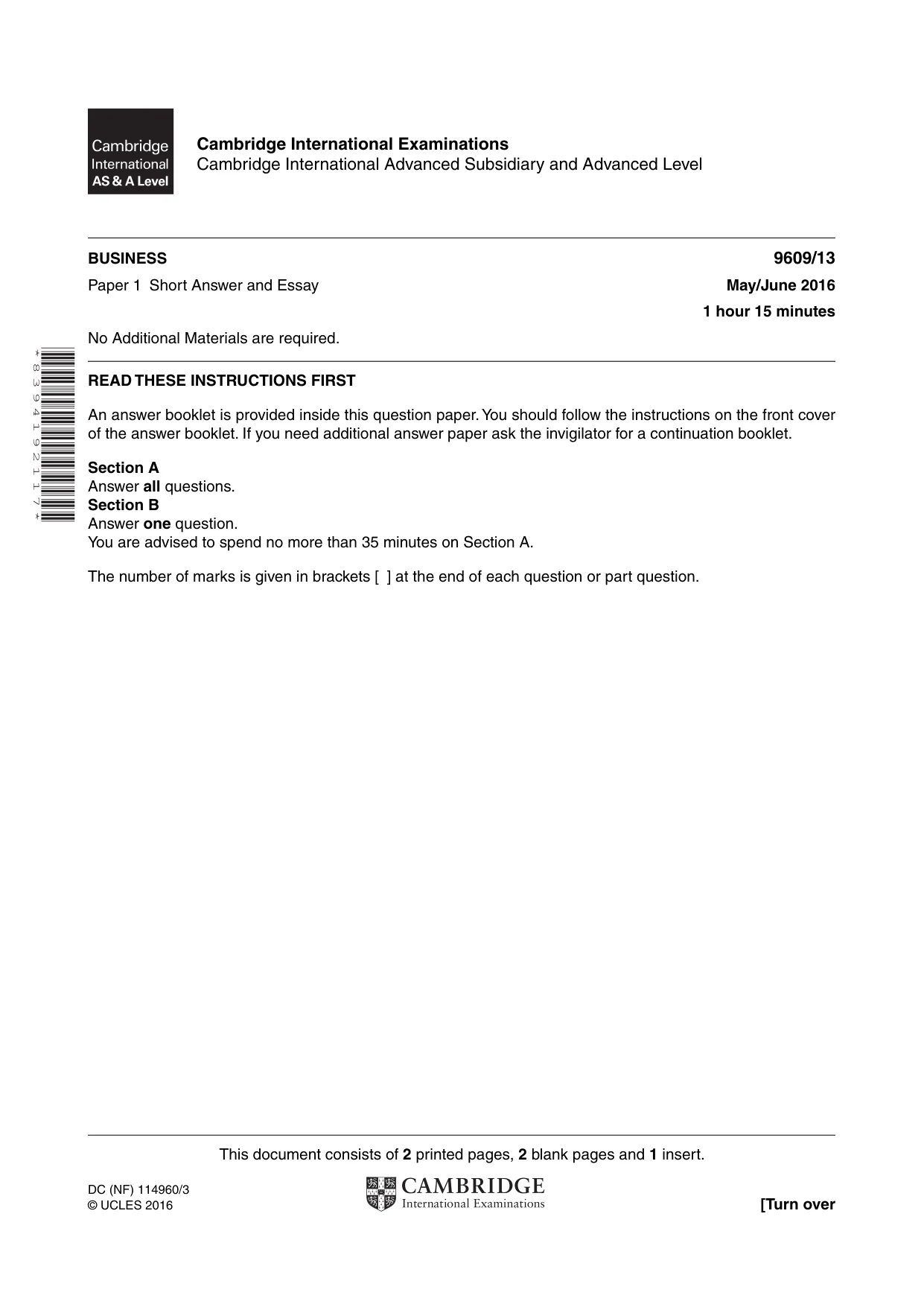
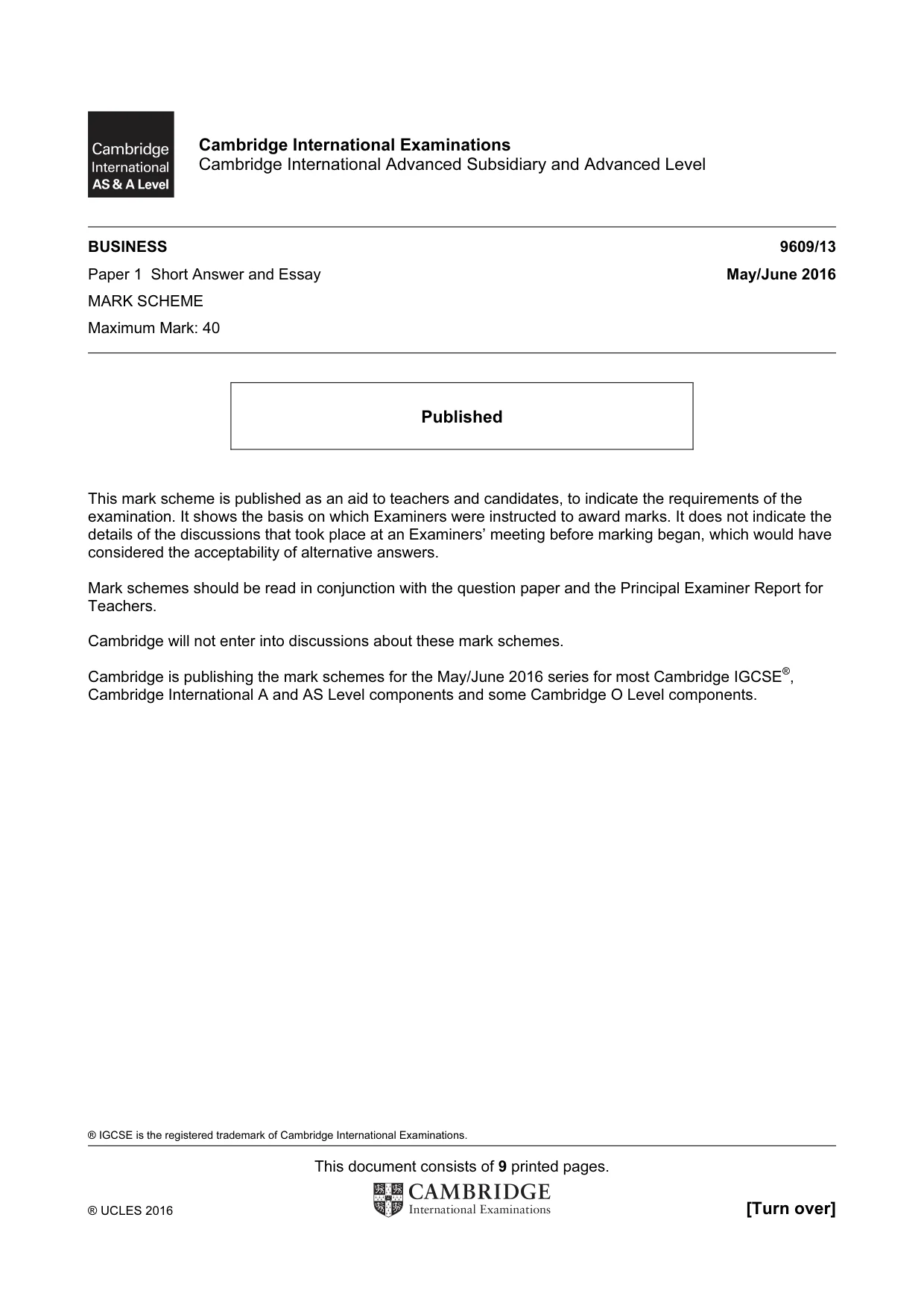
This document consists of 2 printed pages, 2 blank pages and 1 insert. DC (NF) 114960/3 © UCLES 2016 [Turn over Cambridge International Examinations Cambridge International Advanced Subsidiary and Advanced Level * 8 3 9 4 1 9 2 1 1 7 * BUSINESS 9609/13 Paper 1 Short Answer and Essay May/June 2016 1 hour 15 minutes No Additional Materials are required. READ THESE INSTRUCTIONS FIRST An answer booklet is provided inside this question paper. You should follow the instructions on the front cover of the answer booklet. If you need additional answer paper ask the invigilator for a continuation booklet. Section A Answer all questions. Section B Answer one question. You are advised to spend no more than 35 minutes on Section A. The number of marks is given in brackets [ ] at the end of each question or part question.
Question paper, page 2
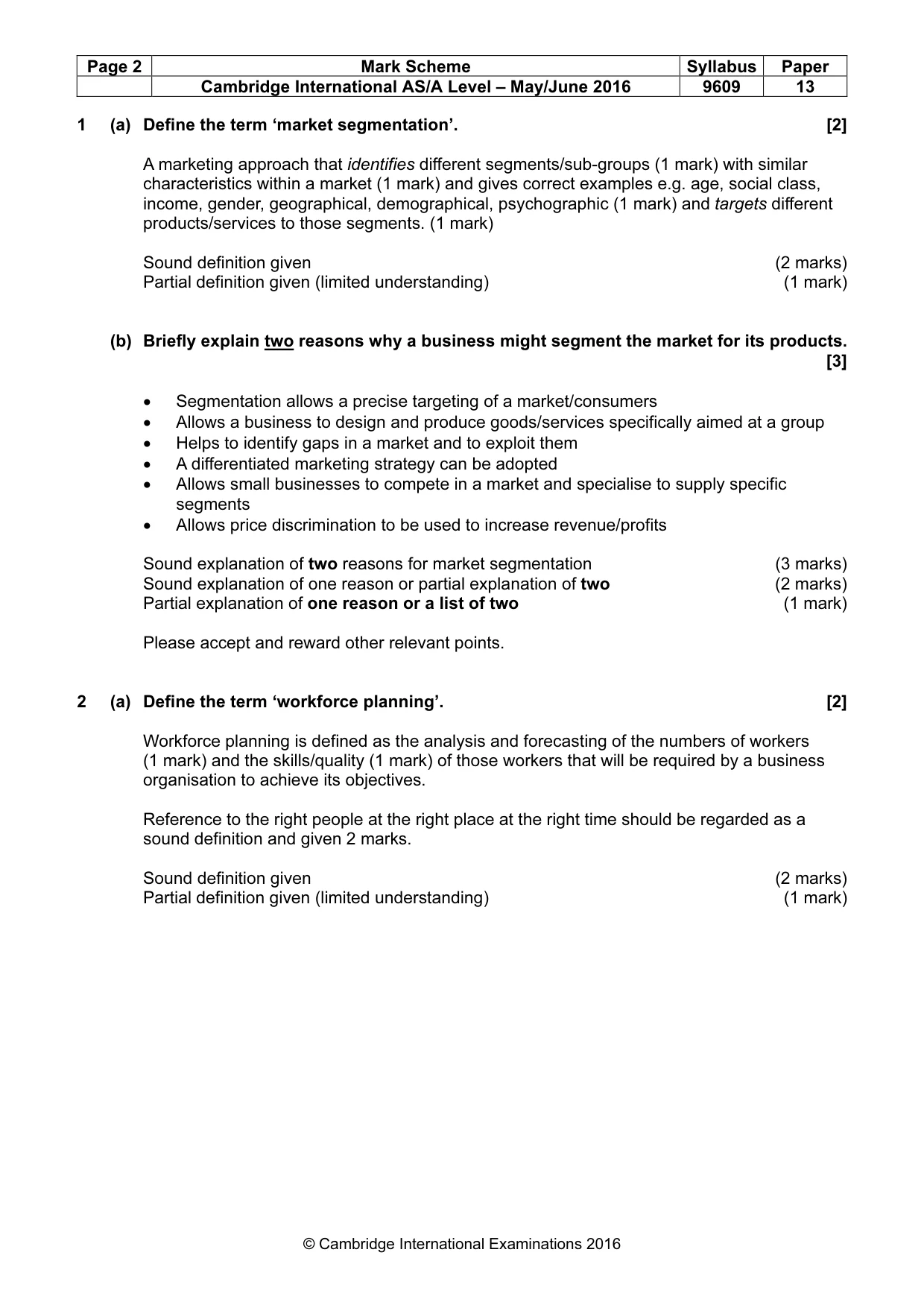
2 9609/13/M/J/16 © UCLES 2016 Section A (Short Answer) Answer all questions. 1 (a) Define the term ‘market segmentation’. [2] (b) Briefly explain two reasons why a business might segment the market for its products. [3] 2 (a) Define the term ‘workforce planning’. [2] (b) Briefly explain two benefits to a business of workforce planning. [3] 3 Explain why efficiency is important to a manufacturing business. [5] 4 (a) Define the term ‘start-up capital’. [2] (b) Briefly explain two sources of start-up capital. [3] Section B (Essay) Answer one question only. 5 (a) Analyse the advantages of a co-operative as a legal form of business. [8] (b) Discuss the factors that could influence the success of a small business manufacturing fashion clothing for children. [12] 6 ‘The most effective way to realise human potential in a manufacturing business is to give high rates of financial rewards to the workforce.’ Do you agree? Justify your view. [20] 7 (a) Analyse how profitability ratios could be useful for any two business stakeholders. [8] (b) Discuss the view that the limitations of published accounts significantly weaken their usefulness for business stakeholders. [12]
Question paper, page 3
3 9609/13/M/J/16 © UCLES 2016 BLANK PAGE
Question paper, page 4
4 9609/13/M/J/16 © UCLES 2016 BLANK PAGE Permission to reproduce items where third-party owned material protected by copyright is included has been sought and cleared where possible. Every reasonable effort has been made by the publisher (UCLES) to trace copyright holders, but if any items requiring clearance have unwittingly been included, the publisher will be pleased to make amends at the earliest possible opportunity. To avoid the issue of disclosure of answer-related information to candidates, all copyright acknowledgements are reproduced online in the Cambridge International Examinations Copyright Acknowledgements Booklet. This is produced for each series of examinations and is freely available to download at www.cie.org.uk after the live examination series. Cambridge International Examinations is part of the Cambridge Assessment Group. Cambridge Assessment is the brand name of University of Cambridge Local Examinations Syndicate (UCLES), which is itself a department of the University of Cambridge.
Mark scheme, page 1
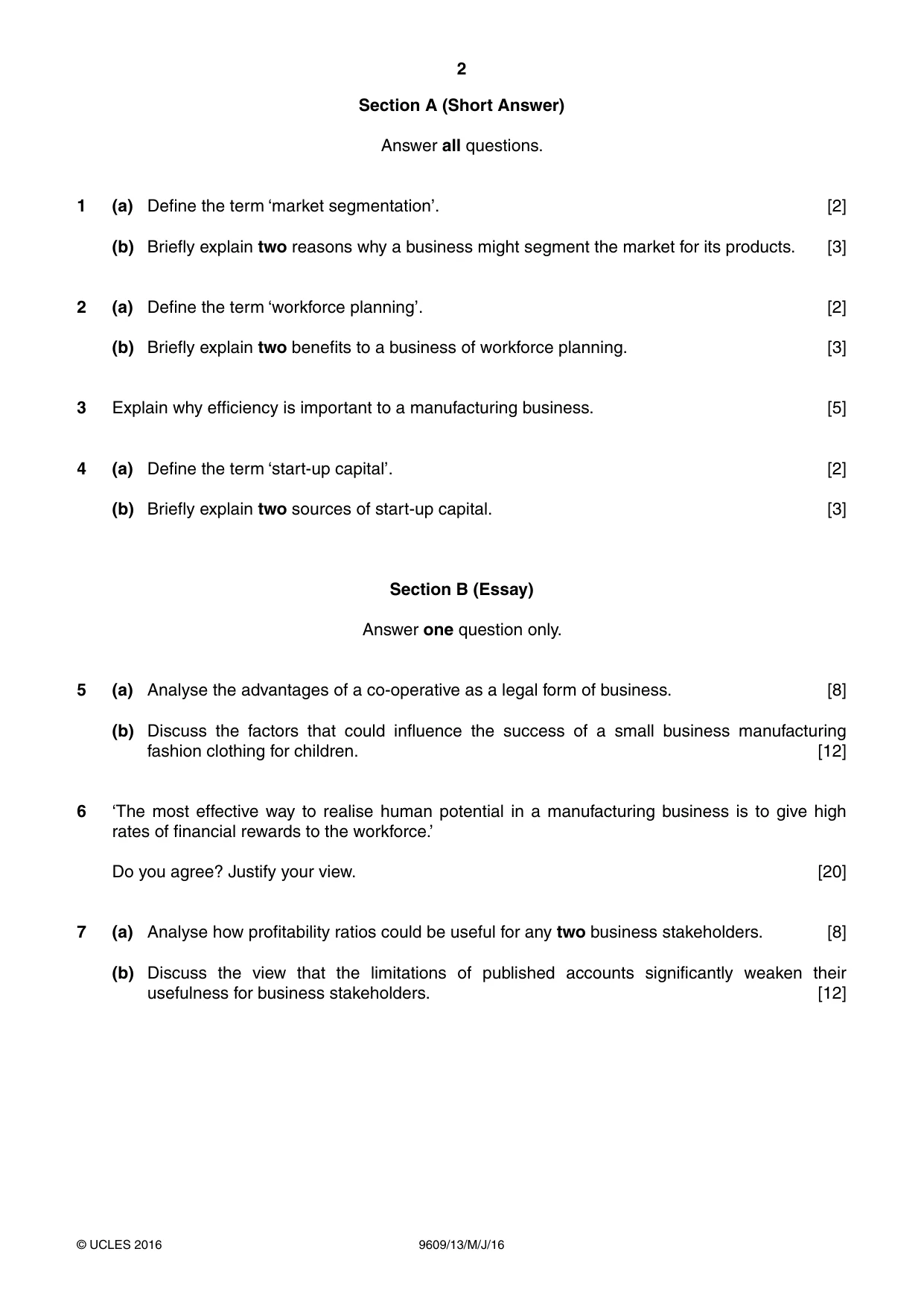
® IGCSE is the registered trademark of Cambridge International Examinations. This document consists of 9 printed pages. ® UCLES 2016 [Turn over] Cambridge International Examinations Cambridge International Advanced Subsidiary and Advanced Level BUSINESS 9609/13 Paper 1 Short Answer and Essay May/June 2016 MARK SCHEME Maximum Mark: 40 Published This mark scheme is published as an aid to teachers and candidates, to indicate the requirements of the examination. It shows the basis on which Examiners were instructed to award marks. It does not indicate the details of the discussions that took place at an Examiners’ meeting before marking began, which would have considered the acceptability of alternative answers. Mark schemes should be read in conjunction with the question paper and the Principal Examiner Report for Teachers. Cambridge will not enter into discussions about these mark schemes. Cambridge is publishing the mark schemes for the May/June 2016 series for most Cambridge IGCSE®, Cambridge International A and AS Level components and some Cambridge O Level components.
Mark scheme, page 2
Page 2 Mark Scheme Syllabus Paper Cambridge International AS/A Level – May/June 2016 9609 13 © Cambridge International Examinations 2016 1 (a) Define the term ‘market segmentation’. [2] A marketing approach that identifies different segments/sub-groups (1 mark) with similar characteristics within a market (1 mark) and gives correct examples e.g. age, social class, income, gender, geographical, demographical, psychographic (1 mark) and targets different products/services to those segments. (1 mark) Sound definition given (2 marks) Partial definition given (limited understanding) (1 mark) (b) Briefly explain two reasons why a business might segment the market for its products. [3] • Segmentation allows a precise targeting of a market/consumers • Allows a business to design and produce goods/services specifically aimed at a group • Helps to identify gaps in a market and to exploit them • A differentiated marketing strategy can be adopted • Allows small businesses to compete in a market and specialise to supply specific segments • Allows price discrimination to be used to increase revenue/profits Sound explanation of two reasons for market segmentation (3 marks) Sound explanation of one reason or partial explanation of two (2 marks) Partial explanation of one reason or a list of two (1 mark) Please accept and reward other relevant points. 2 (a) Define the term ‘workforce planning’. [2] Workforce planning is defined as the analysis and forecasting of the numbers of workers (1 mark) and the skills/quality (1 mark) of those workers that will be required by a business organisation to achieve its objectives. Reference to the right people at the right place at the right time should be regarded as a sound definition and given 2 marks. Sound definition given (2 marks) Partial definition given (limited understanding) (1 mark)
Mark scheme, page 3
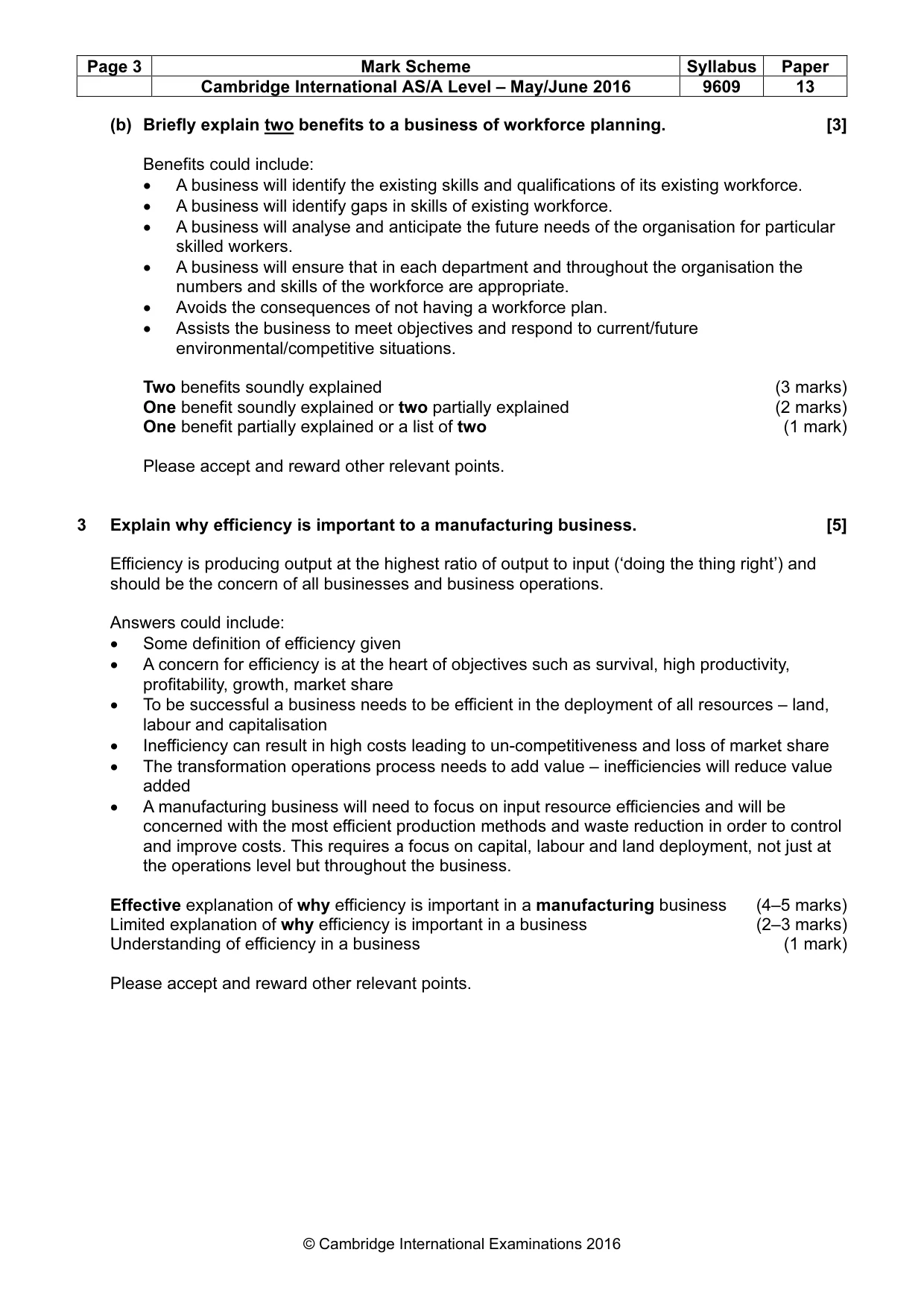
Page 3 Mark Scheme Syllabus Paper Cambridge International AS/A Level – May/June 2016 9609 13 © Cambridge International Examinations 2016 (b) Briefly explain two benefits to a business of workforce planning. [3] Benefits could include: • A business will identify the existing skills and qualifications of its existing workforce. • A business will identify gaps in skills of existing workforce. • A business will analyse and anticipate the future needs of the organisation for particular skilled workers. • A business will ensure that in each department and throughout the organisation the numbers and skills of the workforce are appropriate. • Avoids the consequences of not having a workforce plan. • Assists the business to meet objectives and respond to current/future environmental/competitive situations. Two benefits soundly explained (3 marks) One benefit soundly explained or two partially explained (2 marks) One benefit partially explained or a list of two (1 mark) Please accept and reward other relevant points. 3 Explain why efficiency is important to a manufacturing business. [5] Efficiency is producing output at the highest ratio of output to input (‘doing the thing right’) and should be the concern of all businesses and business operations. Answers could include: • Some definition of efficiency given • A concern for efficiency is at the heart of objectives such as survival, high productivity, profitability, growth, market share • To be successful a business needs to be efficient in the deployment of all resources – land, labour and capitalisation • Inefficiency can result in high costs leading to un-competitiveness and loss of market share • The transformation operations process needs to add value – inefficiencies will reduce value added • A manufacturing business will need to focus on input resource efficiencies and will be concerned with the most efficient production methods and waste reduction in order to control and improve costs. This requires a focus on capital, labour and land deployment, not just at the operations level but throughout the business. Effective explanation of why efficiency is important in a manufacturing business (4–5 marks) Limited explanation of why efficiency is important in a business (2–3 marks) Understanding of efficiency in a business (1 mark) Please accept and reward other relevant points.
Mark scheme, page 4
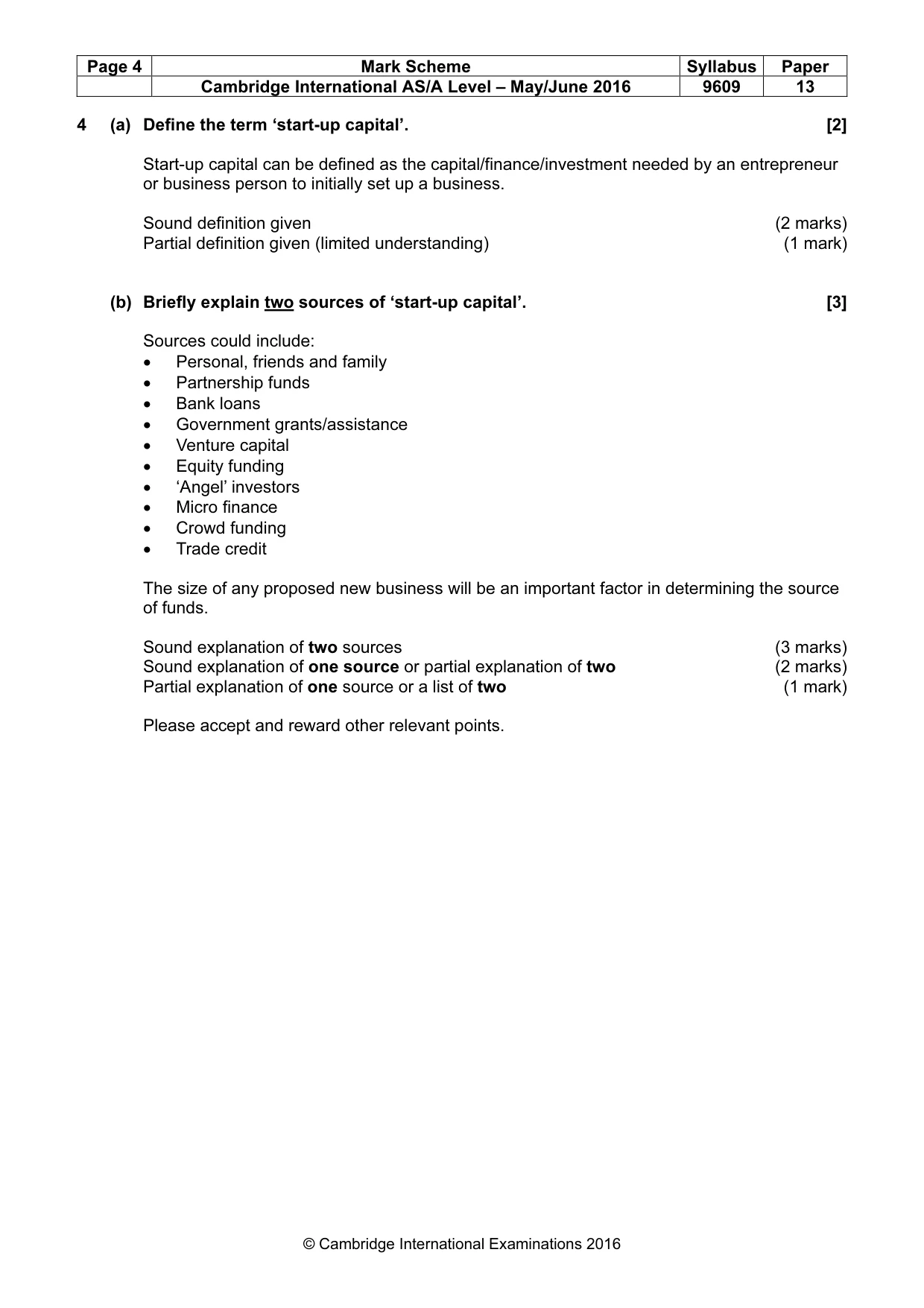
Page 4 Mark Scheme Syllabus Paper Cambridge International AS/A Level – May/June 2016 9609 13 © Cambridge International Examinations 2016 4 (a) Define the term ‘start-up capital’. [2] Start-up capital can be defined as the capital/finance/investment needed by an entrepreneur or business person to initially set up a business. Sound definition given (2 marks) Partial definition given (limited understanding) (1 mark) (b) Briefly explain two sources of ‘start-up capital’. [3] Sources could include: • Personal, friends and family • Partnership funds • Bank loans • Government grants/assistance • Venture capital • Equity funding • ‘Angel’ investors • Micro finance • Crowd funding • Trade credit The size of any proposed new business will be an important factor in determining the source of funds. Sound explanation of two sources (3 marks) Sound explanation of one source or partial explanation of two (2 marks) Partial explanation of one source or a list of two (1 mark) Please accept and reward other relevant points.
Mark scheme, page 5
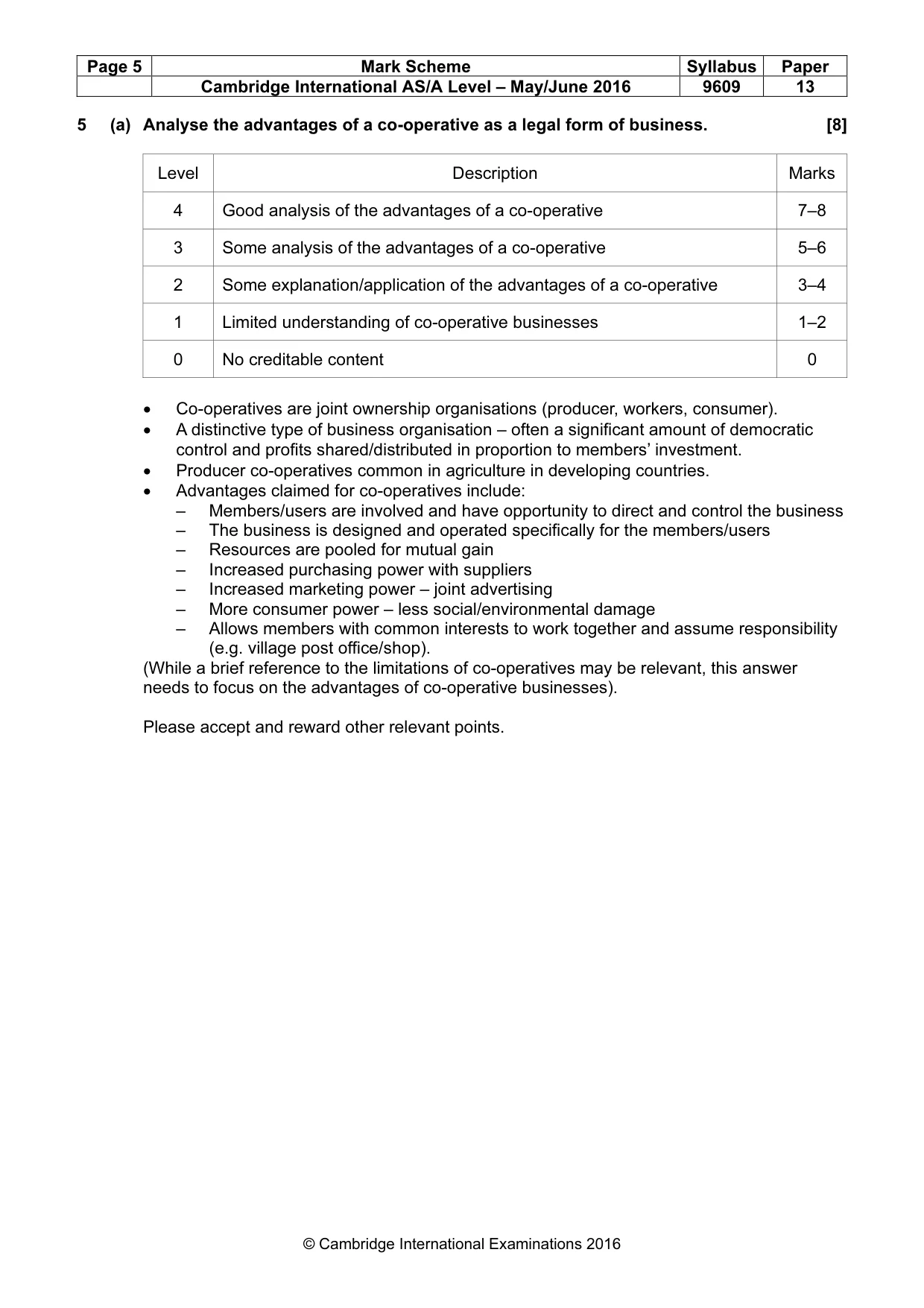
Page 5 Mark Scheme Syllabus Paper Cambridge International AS/A Level – May/June 2016 9609 13 © Cambridge International Examinations 2016 5 (a) Analyse the advantages of a co-operative as a legal form of business. [8] Level Description Marks 4 Good analysis of the advantages of a co-operative 7–8 3 Some analysis of the advantages of a co-operative 5–6 2 Some explanation/application of the advantages of a co-operative 3–4 1 Limited understanding of co-operative businesses 1–2 0 No creditable content 0 • Co-operatives are joint ownership organisations (producer, workers, consumer). • A distinctive type of business organisation – often a significant amount of democratic control and profits shared/distributed in proportion to members’ investment. • Producer co-operatives common in agriculture in developing countries. • Advantages claimed for co-operatives include: – Members/users are involved and have opportunity to direct and control the business – The business is designed and operated specifically for the members/users – Resources are pooled for mutual gain – Increased purchasing power with suppliers – Increased marketing power – joint advertising – More consumer power – less social/environmental damage – Allows members with common interests to work together and assume responsibility (e.g. village post office/shop). (While a brief reference to the limitations of co-operatives may be relevant, this answer needs to focus on the advantages of co-operative businesses). Please accept and reward other relevant points.
Mark scheme, page 6
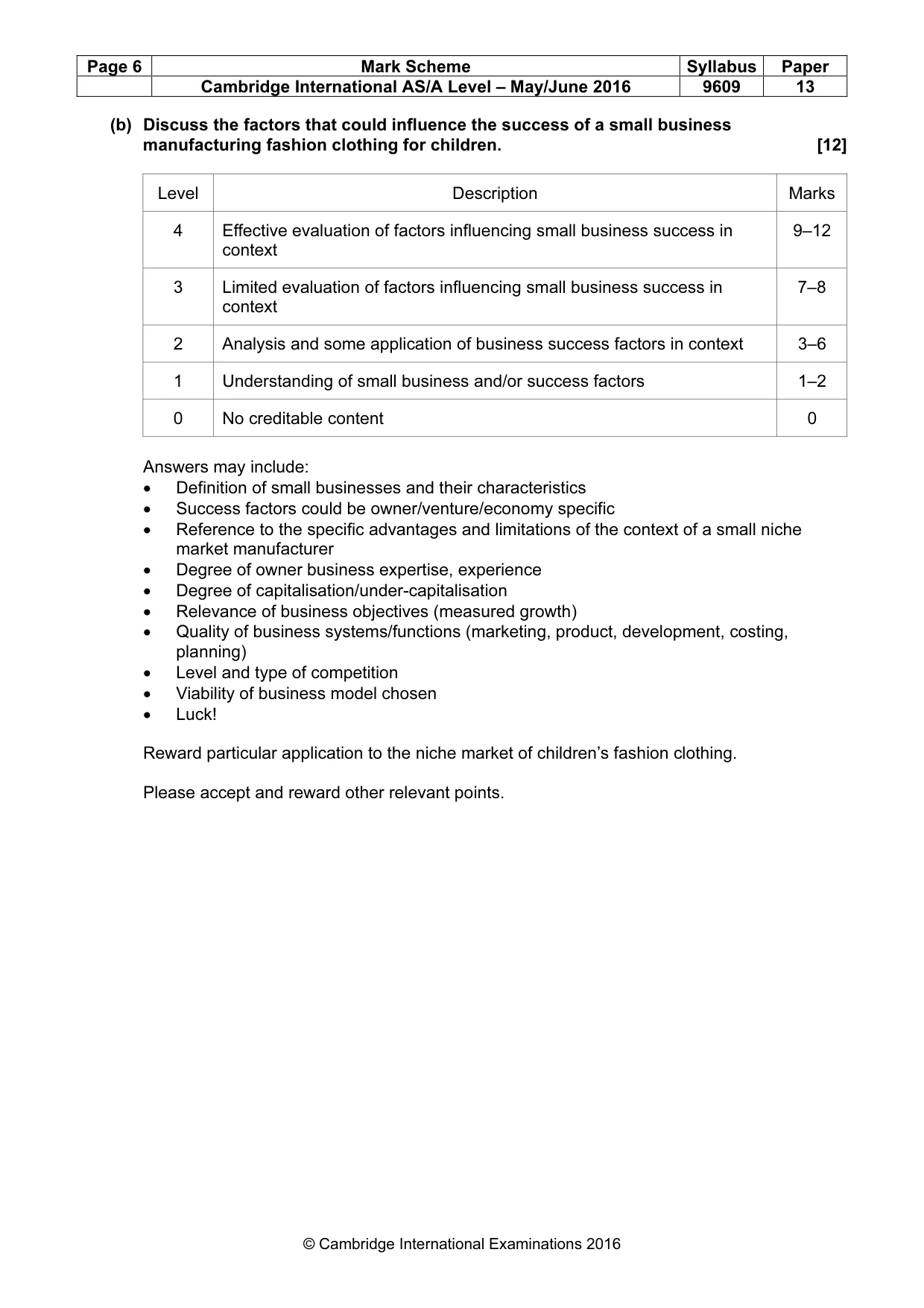
Page 6 Mark Scheme Syllabus Paper Cambridge International AS/A Level – May/June 2016 9609 13 © Cambridge International Examinations 2016 (b) Discuss the factors that could influence the success of a small business manufacturing fashion clothing for children. [12] Level Description Marks 4 Effective evaluation of factors influencing small business success in context 9–12 3 Limited evaluation of factors influencing small business success in context 7–8 2 Analysis and some application of business success factors in context 3–6 1 Understanding of small business and/or success factors 1–2 0 No creditable content 0 Answers may include: • Definition of small businesses and their characteristics • Success factors could be owner/venture/economy specific • Reference to the specific advantages and limitations of the context of a small niche market manufacturer • Degree of owner business expertise, experience • Degree of capitalisation/under-capitalisation • Relevance of business objectives (measured growth) • Quality of business systems/functions (marketing, product, development, costing, planning) • Level and type of competition • Viability of business model chosen • Luck! Reward particular application to the niche market of children’s fashion clothing. Please accept and reward other relevant points.
Mark scheme, page 7
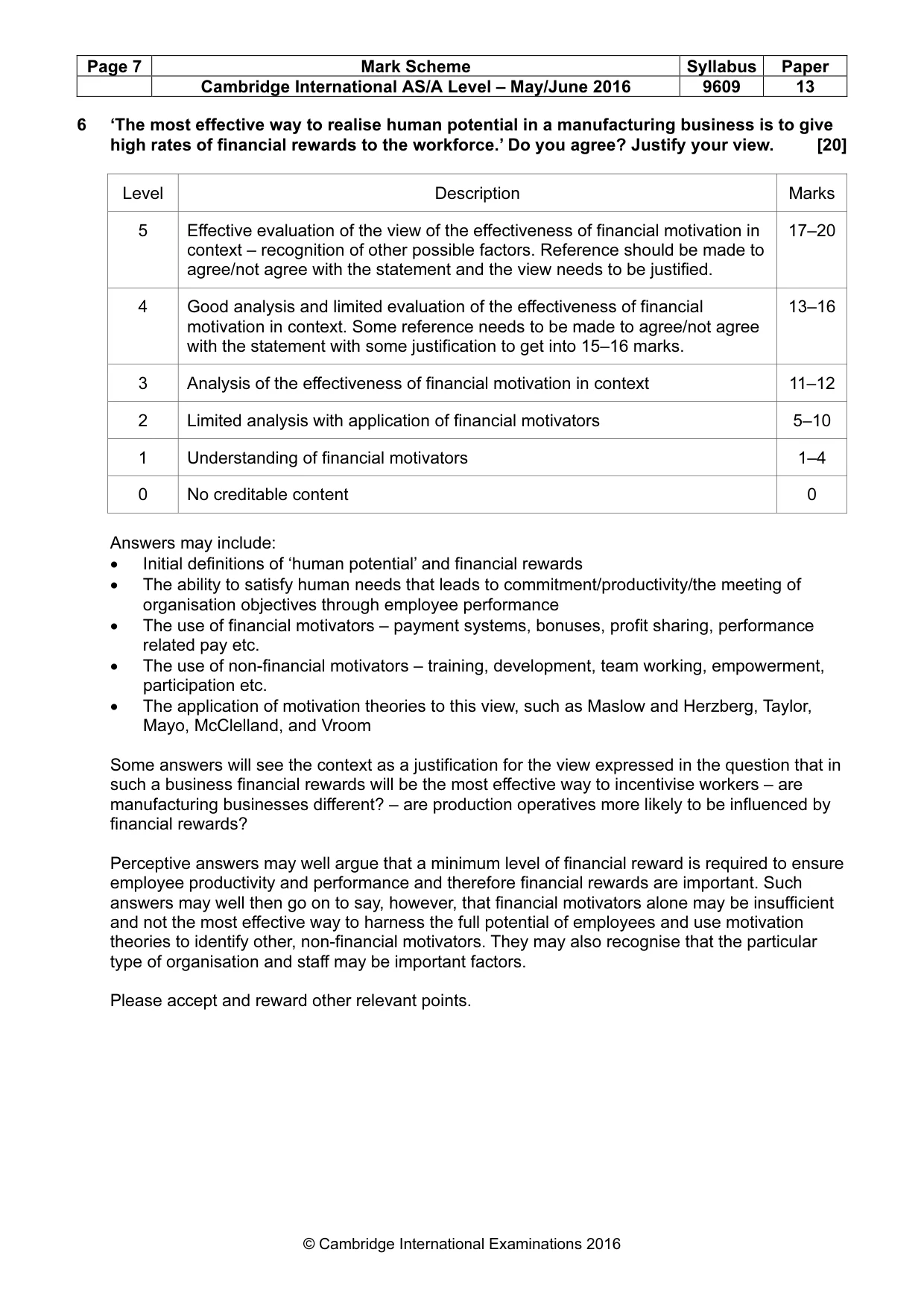
Page 7 Mark Scheme Syllabus Paper Cambridge International AS/A Level – May/June 2016 9609 13 © Cambridge International Examinations 2016 6 ‘The most effective way to realise human potential in a manufacturing business is to give high rates of financial rewards to the workforce.’ Do you agree? Justify your view. [20] Level Description Marks 5 Effective evaluation of the view of the effectiveness of financial motivation in context – recognition of other possible factors. Reference should be made to agree/not agree with the statement and the view needs to be justified. 17–20 4 Good analysis and limited evaluation of the effectiveness of financial motivation in context. Some reference needs to be made to agree/not agree with the statement with some justification to get into 15–16 marks. 13–16 3 Analysis of the effectiveness of financial motivation in context 11–12 2 Limited analysis with application of financial motivators 5–10 1 Understanding of financial motivators 1–4 0 No creditable content 0 Answers may include: • Initial definitions of ‘human potential’ and financial rewards • The ability to satisfy human needs that leads to commitment/productivity/the meeting of organisation objectives through employee performance • The use of financial motivators – payment systems, bonuses, profit sharing, performance related pay etc. • The use of non-financial motivators – training, development, team working, empowerment, participation etc. • The application of motivation theories to this view, such as Maslow and Herzberg, Taylor, Mayo, McClelland, and Vroom Some answers will see the context as a justification for the view expressed in the question that in such a business financial rewards will be the most effective way to incentivise workers – are manufacturing businesses different? – are production operatives more likely to be influenced by financial rewards? Perceptive answers may well argue that a minimum level of financial reward is required to ensure employee productivity and performance and therefore financial rewards are important. Such answers may well then go on to say, however, that financial motivators alone may be insufficient and not the most effective way to harness the full potential of employees and use motivation theories to identify other, non-financial motivators. They may also recognise that the particular type of organisation and staff may be important factors. Please accept and reward other relevant points.
Mark scheme, page 8
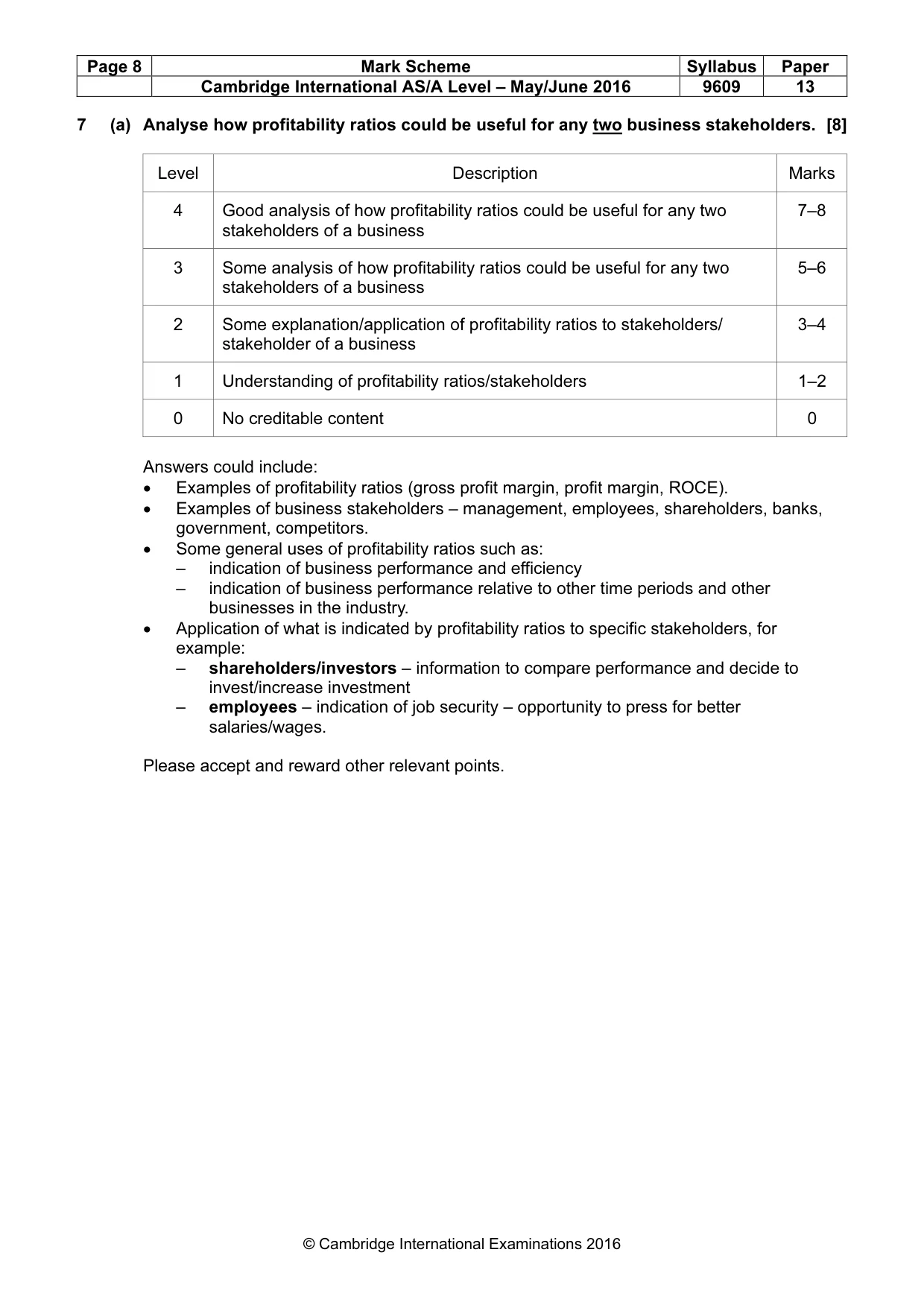
Page 8 Mark Scheme Syllabus Paper Cambridge International AS/A Level – May/June 2016 9609 13 © Cambridge International Examinations 2016 7 (a) Analyse how profitability ratios could be useful for any two business stakeholders. [8] Level Description Marks 4 Good analysis of how profitability ratios could be useful for any two stakeholders of a business 7–8 3 Some analysis of how profitability ratios could be useful for any two stakeholders of a business 5–6 2 Some explanation/application of profitability ratios to stakeholders/ stakeholder of a business 3–4 1 Understanding of profitability ratios/stakeholders 1–2 0 No creditable content 0 Answers could include: • Examples of profitability ratios (gross profit margin, profit margin, ROCE). • Examples of business stakeholders – management, employees, shareholders, banks, government, competitors. • Some general uses of profitability ratios such as: – indication of business performance and efficiency – indication of business performance relative to other time periods and other businesses in the industry. • Application of what is indicated by profitability ratios to specific stakeholders, for example: – shareholders/investors – information to compare performance and decide to invest/increase investment – employees – indication of job security – opportunity to press for better salaries/wages. Please accept and reward other relevant points.
Mark scheme, page 9
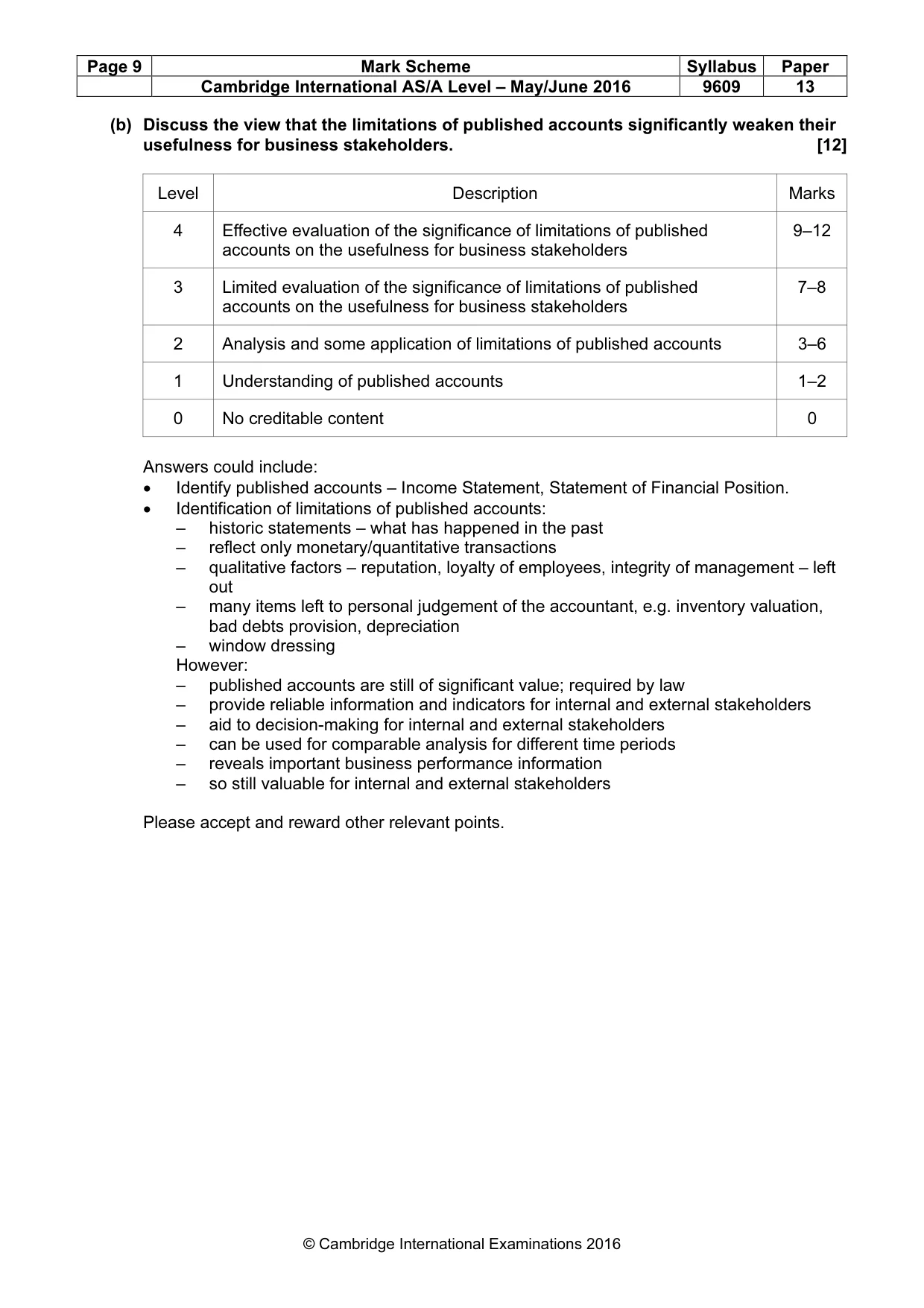
Page 9 Mark Scheme Syllabus Paper Cambridge International AS/A Level – May/June 2016 9609 13 © Cambridge International Examinations 2016 (b) Discuss the view that the limitations of published accounts significantly weaken their usefulness for business stakeholders. [12] Level Description Marks 4 Effective evaluation of the significance of limitations of published accounts on the usefulness for business stakeholders 9–12 3 Limited evaluation of the significance of limitations of published accounts on the usefulness for business stakeholders 7–8 2 Analysis and some application of limitations of published accounts 3–6 1 Understanding of published accounts 1–2 0 No creditable content 0 Answers could include: • Identify published accounts – Income Statement, Statement of Financial Position. • Identification of limitations of published accounts: – historic statements – what has happened in the past – reflect only monetary/quantitative transactions – qualitative factors – reputation, loyalty of employees, integrity of management – left out – many items left to personal judgement of the accountant, e.g. inventory valuation, bad debts provision, depreciation – window dressing However: – published accounts are still of significant value; required by law – provide reliable information and indicators for internal and external stakeholders – aid to decision-making for internal and external stakeholders – can be used for comparable analysis for different time periods – reveals important business performance information – so still valuable for internal and external stakeholders Please accept and reward other relevant points.
What you needed in this session
Cambridge’s own grade thresholds for 2016 May/June, Paper 1 · Variant 3. A higher threshold means an easier paper — the bar moves with how the cohort did.