Cambridge A Level Business (for first examination in 2016) 9609 — 2016 Feb/March Paper 2 · Variant 2
9609/22/F/M/16 · 60 marks · ≈68 min
The question paper and its mark scheme, free to read here and free to download. This is Cambridge’s own paper, exactly as it was sat.
Question paper4 pages

Mark scheme12 pages
Answers below. Sit the paper first if you are practising.
Paper as text
Question paper, page 1
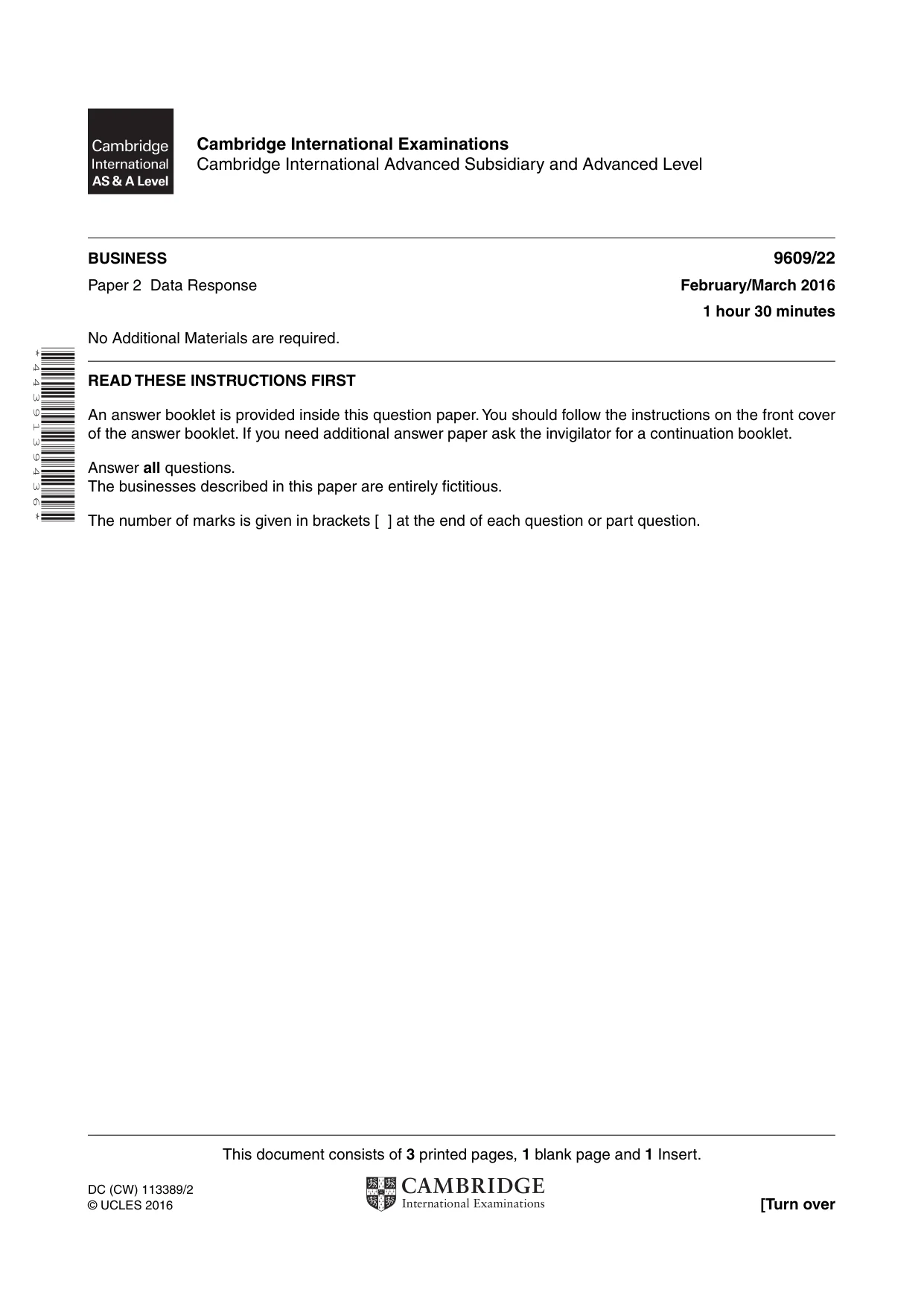
This document consists of 3 printed pages, 1 blank page and 1 Insert. DC (CW) 113389/2 © UCLES 2016 [Turn over Cambridge International Examinations Cambridge International Advanced Subsidiary and Advanced Level * 4 4 3 9 1 3 9 4 3 6 * BUSINESS 9609/22 Paper 2 Data Response February/March 2016 1 hour 30 minutes No Additional Materials are required. READ THESE INSTRUCTIONS FIRST An answer booklet is provided inside this question paper. You should follow the instructions on the front cover of the answer booklet. If you need additional answer paper ask the invigilator for a continuation booklet. Answer all questions. The businesses described in this paper are entirely fictitious. The number of marks is given in brackets [ ] at the end of each question or part question.
Question paper, page 2
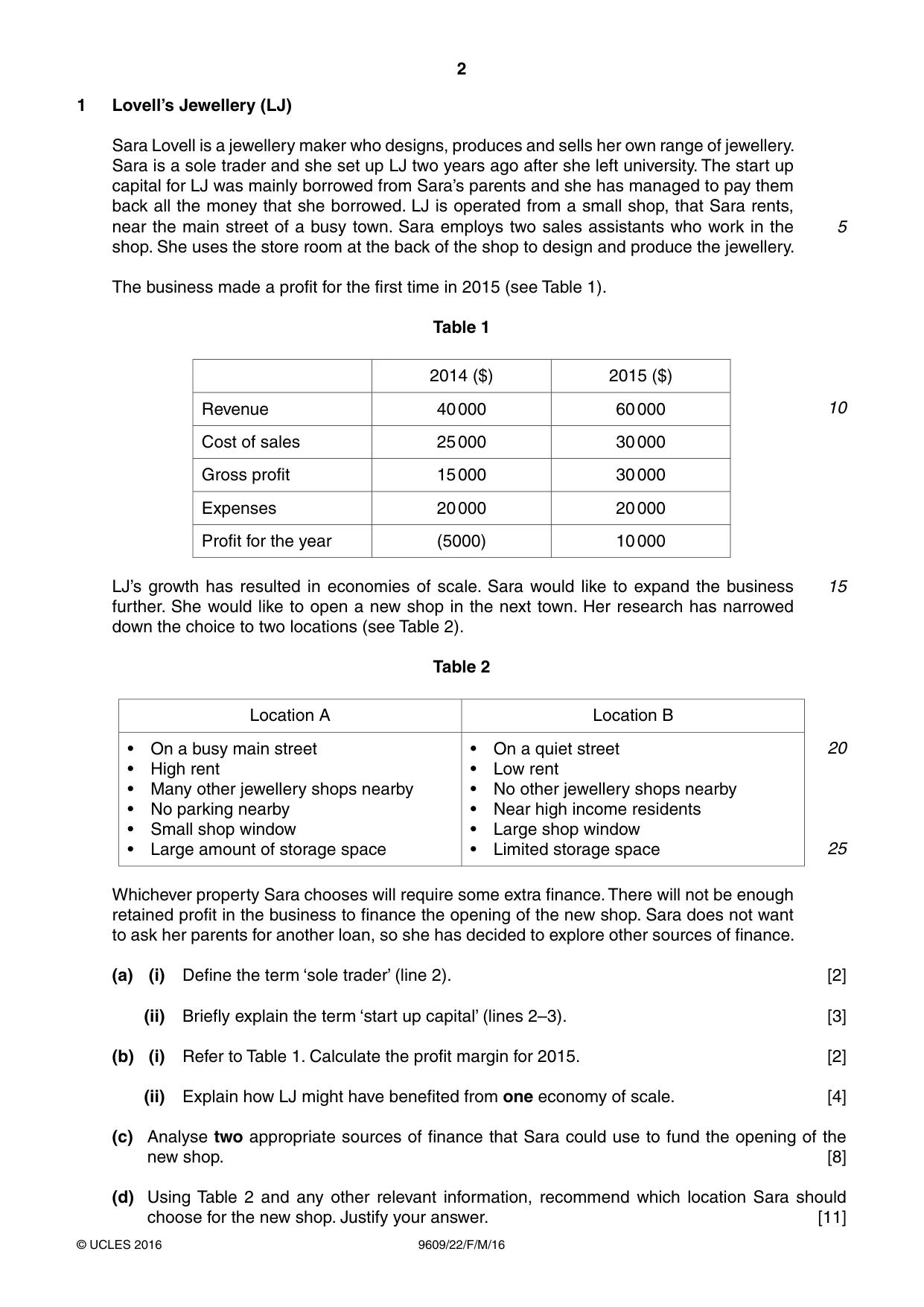
2 9609/22/F/M/16 © UCLES 2016 1 Lovell’s Jewellery (LJ) Sara Lovell is a jewellery maker who designs, produces and sells her own range of jewellery. Sara is a sole trader and she set up LJ two years ago after she left university. The start up capital for LJ was mainly borrowed from Sara’s parents and she has managed to pay them back all the money that she borrowed. LJ is operated from a small shop, that Sara rents, near the main street of a busy town. Sara employs two sales assistants who work in the shop. She uses the store room at the back of the shop to design and produce the jewellery. The business made a profit for the first time in 2015 (see Table 1). Table 1 2014 ($) 2015 ($) Revenue 40 000 60 000 Cost of sales 25 000 30 000 Gross profit 15 000 30 000 Expenses 20 000 20 000 Profit for the year (5000) 10 000 LJ’s growth has resulted in economies of scale. Sara would like to expand the business further. She would like to open a new shop in the next town. Her research has narrowed down the choice to two locations (see Table 2). Table 2 Location A Location B • On a busy main street • High rent • Many other jewellery shops nearby • No parking nearby • Small shop window • Large amount of storage space • On a quiet street • Low rent • No other jewellery shops nearby • Near high income residents • Large shop window • Limited storage space Whichever property Sara chooses will require some extra finance. There will not be enough retained profit in the business to finance the opening of the new shop. Sara does not want to ask her parents for another loan, so she has decided to explore other sources of finance. (a) (i) Define the term ‘sole trader’ (line 2). [2] (ii) Briefly explain the term ‘start up capital’ (lines 2–3). [3] (b) (i) Refer to Table 1. Calculate the profit margin for 2015. [2] (ii) Explain how LJ might have benefited from one economy of scale. [4] (c) Analyse two appropriate sources of finance that Sara could use to fund the opening of the new shop. [8] (d) Using Table 2 and any other relevant information, recommend which location Sara should choose for the new shop. Justify your answer. [11] 5 10 15 20 25
Question paper, page 3
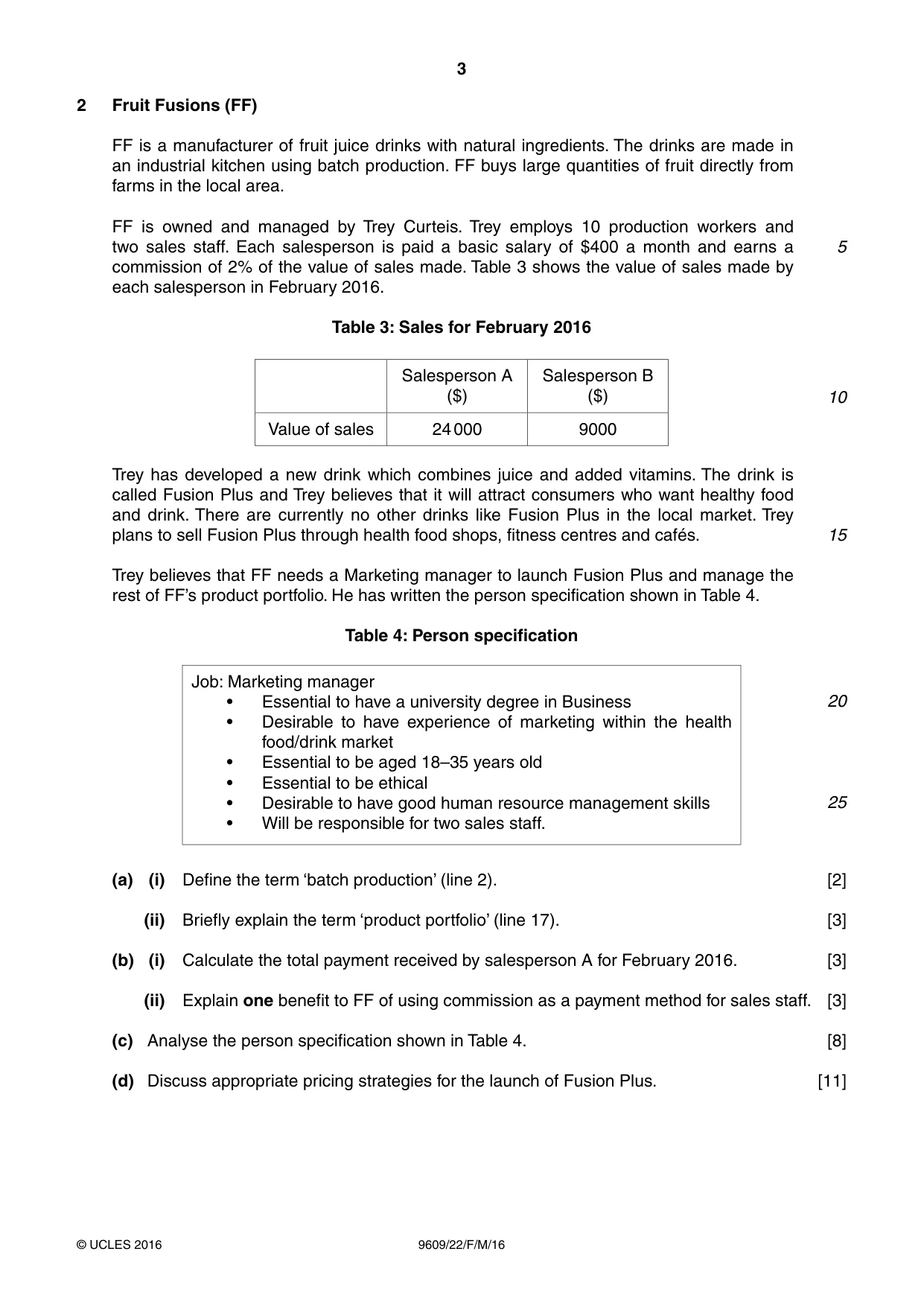
3 9609/22/F/M/16 © UCLES 2016 2 Fruit Fusions (FF) FF is a manufacturer of fruit juice drinks with natural ingredients. The drinks are made in an industrial kitchen using batch production. FF buys large quantities of fruit directly from farms in the local area. FF is owned and managed by Trey Curteis. Trey employs 10 production workers and two sales staff. Each salesperson is paid a basic salary of $400 a month and earns a commission of 2% of the value of sales made. Table 3 shows the value of sales made by each salesperson in February 2016. Table 3: Sales for February 2016 Salesperson A ($) Salesperson B ($) Value of sales 24 000 9000 Trey has developed a new drink which combines juice and added vitamins. The drink is called Fusion Plus and Trey believes that it will attract consumers who want healthy food and drink. There are currently no other drinks like Fusion Plus in the local market. Trey plans to sell Fusion Plus through health food shops, fitness centres and cafés. Trey believes that FF needs a Marketing manager to launch Fusion Plus and manage the rest of FF’s product portfolio. He has written the person specification shown in Table 4. Table 4: Person specification Job: Marketing manager • Essential to have a university degree in Business • Desirable to have experience of marketing within the health food/drink market • Essential to be aged 18–35 years old • Essential to be ethical • Desirable to have good human resource management skills • Will be responsible for two sales staff. (a) (i) Define the term ‘batch production’ (line 2). [2] (ii) Briefly explain the term ‘product portfolio’ (line 17). [3] (b) (i) Calculate the total payment received by salesperson A for February 2016. [3] (ii) Explain one benefit to FF of using commission as a payment method for sales staff. [3] (c) Analyse the person specification shown in Table 4. [8] (d) Discuss appropriate pricing strategies for the launch of Fusion Plus. [11] 5 10 15 20 25
Question paper, page 4
4 9609/22/F/M/16 © UCLES 2016 BLANK PAGE Permission to reproduce items where third-party owned material protected by copyright is included has been sought and cleared where possible. Every reasonable effort has been made by the publisher (UCLES) to trace copyright holders, but if any items requiring clearance have unwittingly been included, the publisher will be pleased to make amends at the earliest possible opportunity. To avoid the issue of disclosure of answer-related information to candidates, all copyright acknowledgements are reproduced online in the Cambridge International Examinations Copyright Acknowledgements Booklet. This is produced for each series of examinations and is freely available to download at www.cie.org.uk after the live examination series. Cambridge International Examinations is part of the Cambridge Assessment Group. Cambridge Assessment is the brand name of University of Cambridge Local Examinations Syndicate (UCLES), which is itself a department of the University of Cambridge.
Mark scheme, page 1
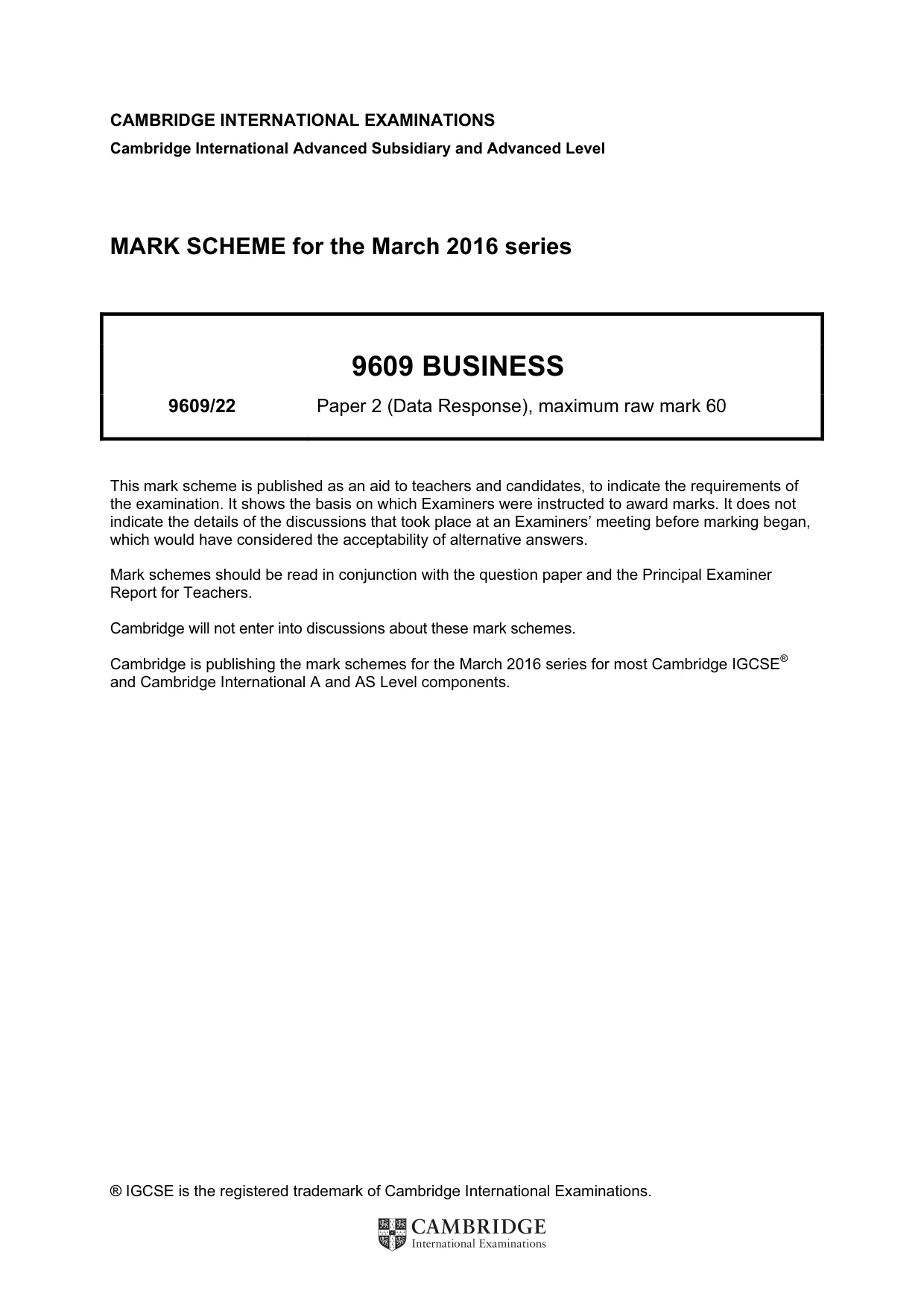
® IGCSE is the registered trademark of Cambridge International Examinations. CAMBRIDGE INTERNATIONAL EXAMINATIONS Cambridge International Advanced Subsidiary and Advanced Level MARK SCHEME for the March 2016 series 9609 BUSINESS 9609/22 Paper 2 (Data Response), maximum raw mark 60 This mark scheme is published as an aid to teachers and candidates, to indicate the requirements of the examination. It shows the basis on which Examiners were instructed to award marks. It does not indicate the details of the discussions that took place at an Examiners’ meeting before marking began, which would have considered the acceptability of alternative answers. Mark schemes should be read in conjunction with the question paper and the Principal Examiner Report for Teachers. Cambridge will not enter into discussions about these mark schemes. Cambridge is publishing the mark schemes for the March 2016 series for most Cambridge IGCSE® and Cambridge International A and AS Level components.
Mark scheme, page 2
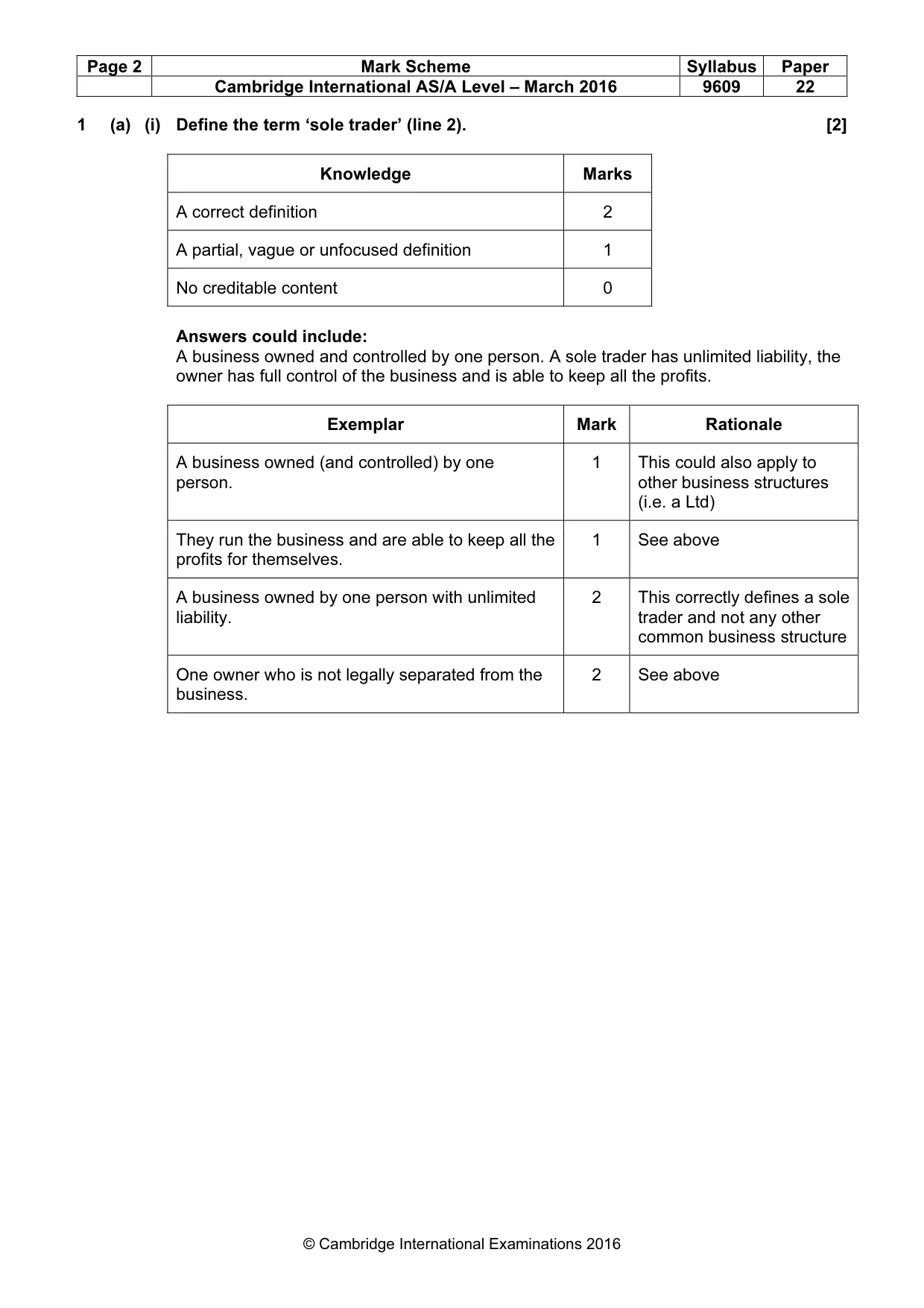
Page 2 Mark Scheme Syllabus Paper Cambridge International AS/A Level – March 2016 9609 22 © Cambridge International Examinations 2016 1 (a) (i) Define the term ‘sole trader’ (line 2). [2] Knowledge Marks A correct definition 2 A partial, vague or unfocused definition 1 No creditable content 0 Answers could include: A business owned and controlled by one person. A sole trader has unlimited liability, the owner has full control of the business and is able to keep all the profits. Exemplar Mark Rationale A business owned (and controlled) by one person. 1 This could also apply to other business structures (i.e. a Ltd) They run the business and are able to keep all the profits for themselves. 1 See above A business owned by one person with unlimited liability. 2 This correctly defines a sole trader and not any other common business structure One owner who is not legally separated from the business. 2 See above
Mark scheme, page 3
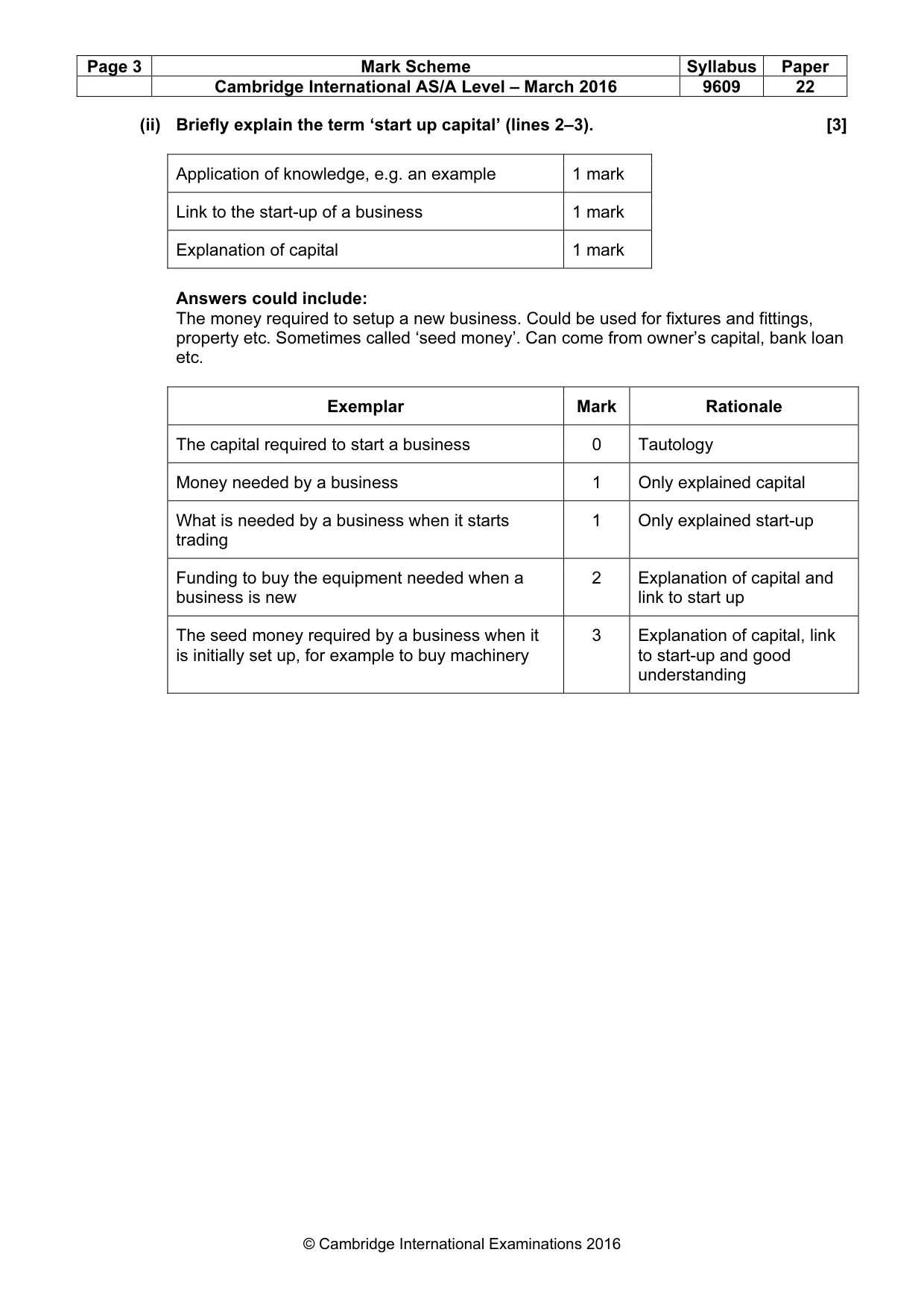
Page 3 Mark Scheme Syllabus Paper Cambridge International AS/A Level – March 2016 9609 22 © Cambridge International Examinations 2016 (ii) Briefly explain the term ‘start up capital’ (lines 2–3). [3] Application of knowledge, e.g. an example 1 mark Link to the start-up of a business 1 mark Explanation of capital 1 mark Answers could include: The money required to setup a new business. Could be used for fixtures and fittings, property etc. Sometimes called ‘seed money’. Can come from owner’s capital, bank loan etc. Exemplar Mark Rationale The capital required to start a business 0 Tautology Money needed by a business 1 Only explained capital What is needed by a business when it starts trading 1 Only explained start-up Funding to buy the equipment needed when a business is new 2 Explanation of capital and link to start up The seed money required by a business when it is initially set up, for example to buy machinery 3 Explanation of capital, link to start-up and good understanding
Mark scheme, page 4
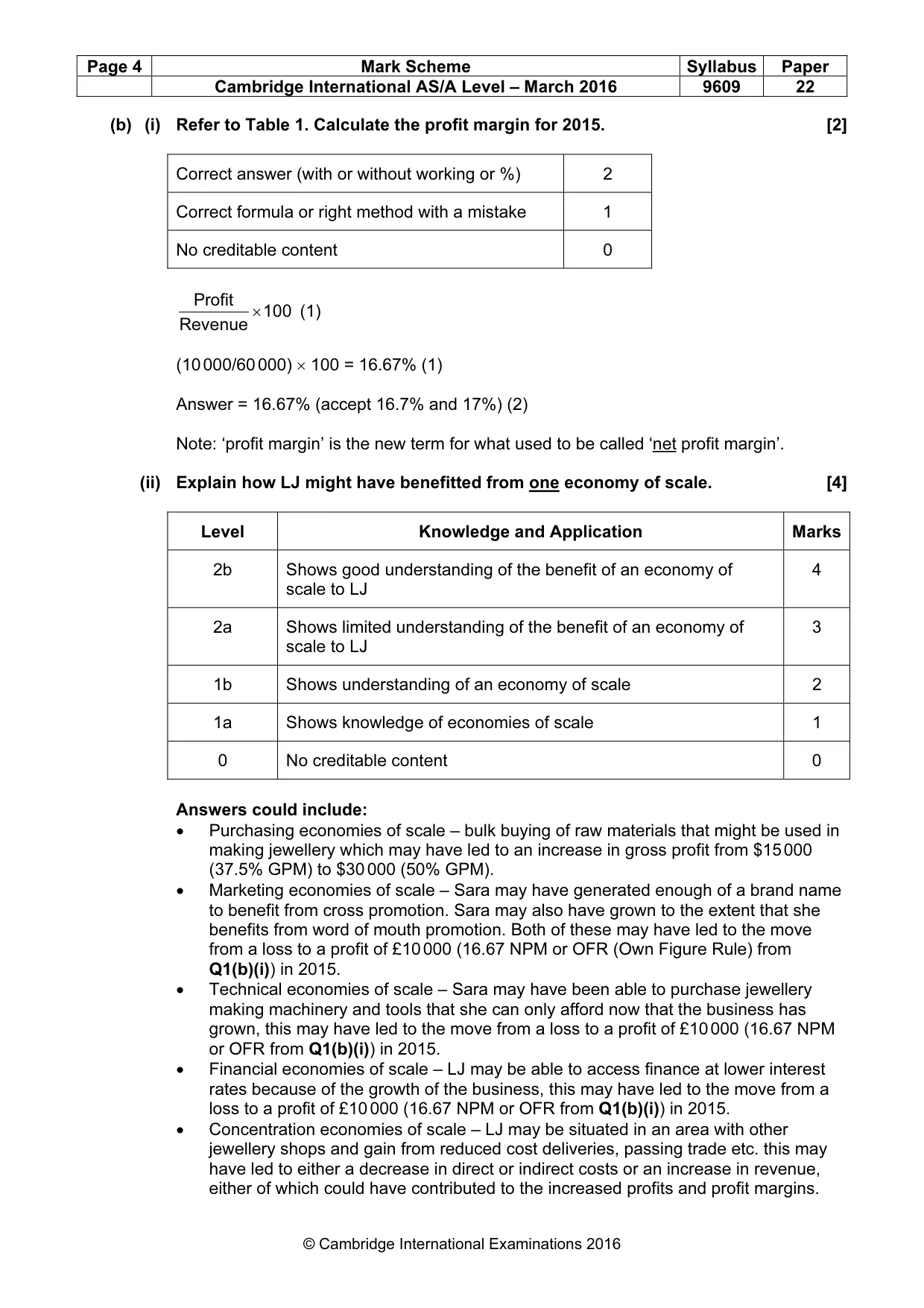
Page 4 Mark Scheme Syllabus Paper Cambridge International AS/A Level – March 2016 9609 22 © Cambridge International Examinations 2016 (b) (i) Refer to Table 1. Calculate the profit margin for 2015. [2] Correct answer (with or without working or %) 2 Correct formula or right method with a mistake 1 No creditable content 0 Profit 100 Revenue × (1) (10 000/60 000) × 100 = 16.67% (1) Answer = 16.67% (accept 16.7% and 17%) (2) Note: ‘profit margin’ is the new term for what used to be called ‘net profit margin’. (ii) Explain how LJ might have benefitted from one economy of scale. [4] Level Knowledge and Application Marks 2b Shows good understanding of the benefit of an economy of scale to LJ 4 2a Shows limited understanding of the benefit of an economy of scale to LJ 3 1b Shows understanding of an economy of scale 2 1a Shows knowledge of economies of scale 1 0 No creditable content 0 Answers could include: • Purchasing economies of scale – bulk buying of raw materials that might be used in making jewellery which may have led to an increase in gross profit from $15 000 (37.5% GPM) to $30 000 (50% GPM). • Marketing economies of scale – Sara may have generated enough of a brand name to benefit from cross promotion. Sara may also have grown to the extent that she benefits from word of mouth promotion. Both of these may have led to the move from a loss to a profit of £10 000 (16.67 NPM or OFR (Own Figure Rule) from Q1(b)(i)) in 2015. • Technical economies of scale – Sara may have been able to purchase jewellery making machinery and tools that she can only afford now that the business has grown, this may have led to the move from a loss to a profit of £10 000 (16.67 NPM or OFR from Q1(b)(i)) in 2015. • Financial economies of scale – LJ may be able to access finance at lower interest rates because of the growth of the business, this may have led to the move from a loss to a profit of £10 000 (16.67 NPM or OFR from Q1(b)(i)) in 2015. • Concentration economies of scale – LJ may be situated in an area with other jewellery shops and gain from reduced cost deliveries, passing trade etc. this may have led to either a decrease in direct or indirect costs or an increase in revenue, either of which could have contributed to the increased profits and profit margins.
Mark scheme, page 5
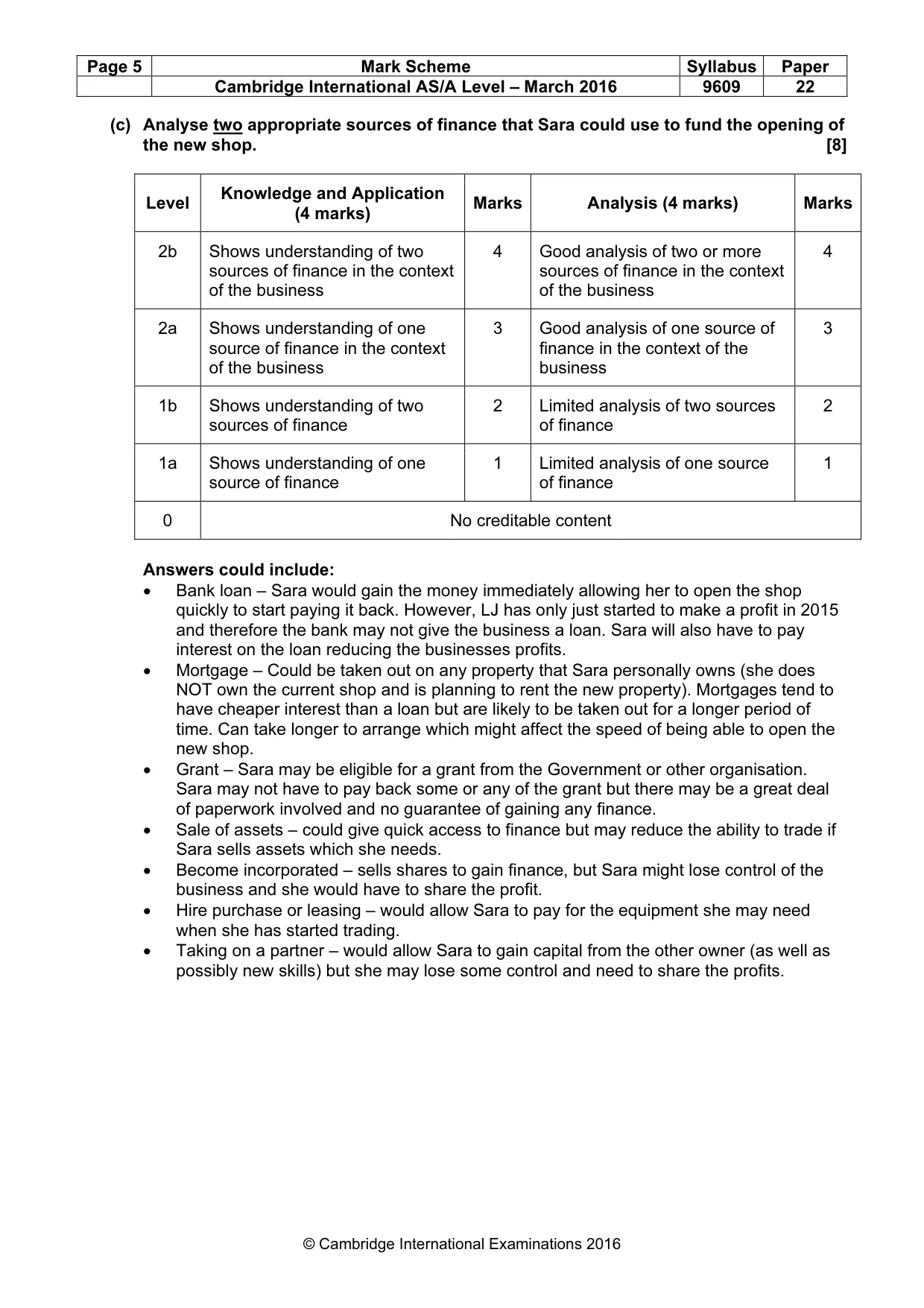
Page 5 Mark Scheme Syllabus Paper Cambridge International AS/A Level – March 2016 9609 22 © Cambridge International Examinations 2016 (c) Analyse two appropriate sources of finance that Sara could use to fund the opening of the new shop. [8] Level Knowledge and Application (4 marks) Marks Analysis (4 marks) Marks 2b Shows understanding of two sources of finance in the context of the business 4 Good analysis of two or more sources of finance in the context of the business 4 2a Shows understanding of one source of finance in the context of the business 3 Good analysis of one source of finance in the context of the business 3 1b Shows understanding of two sources of finance 2 Limited analysis of two sources of finance 2 1a Shows understanding of one source of finance 1 Limited analysis of one source of finance 1 0 No creditable content Answers could include: • Bank loan – Sara would gain the money immediately allowing her to open the shop quickly to start paying it back. However, LJ has only just started to make a profit in 2015 and therefore the bank may not give the business a loan. Sara will also have to pay interest on the loan reducing the businesses profits. • Mortgage – Could be taken out on any property that Sara personally owns (she does NOT own the current shop and is planning to rent the new property). Mortgages tend to have cheaper interest than a loan but are likely to be taken out for a longer period of time. Can take longer to arrange which might affect the speed of being able to open the new shop. • Grant – Sara may be eligible for a grant from the Government or other organisation. Sara may not have to pay back some or any of the grant but there may be a great deal of paperwork involved and no guarantee of gaining any finance. • Sale of assets – could give quick access to finance but may reduce the ability to trade if Sara sells assets which she needs. • Become incorporated – sells shares to gain finance, but Sara might lose control of the business and she would have to share the profit. • Hire purchase or leasing – would allow Sara to pay for the equipment she may need when she has started trading. • Taking on a partner – would allow Sara to gain capital from the other owner (as well as possibly new skills) but she may lose some control and need to share the profits.
Mark scheme, page 6
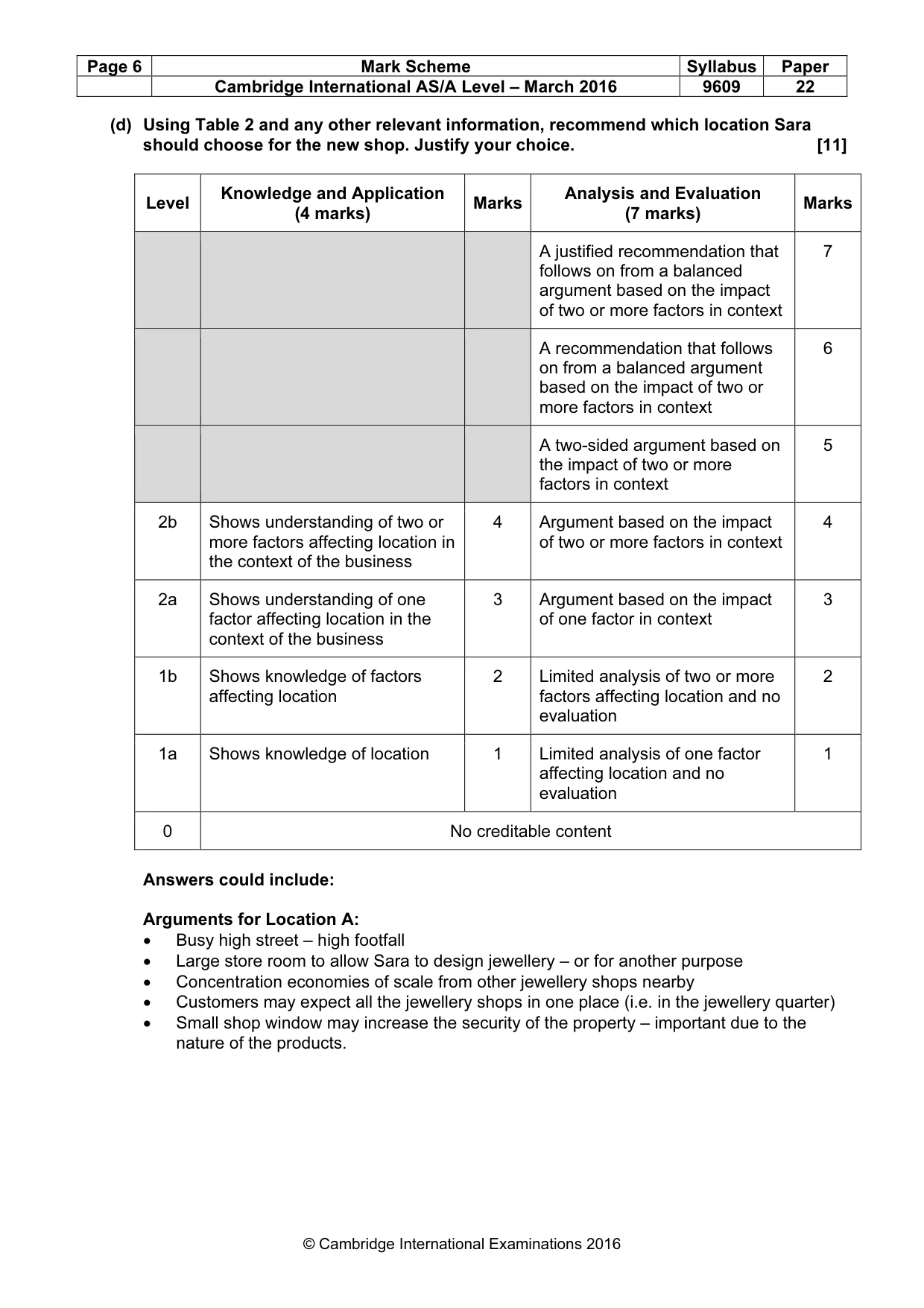
Page 6 Mark Scheme Syllabus Paper Cambridge International AS/A Level – March 2016 9609 22 © Cambridge International Examinations 2016 (d) Using Table 2 and any other relevant information, recommend which location Sara should choose for the new shop. Justify your choice. [11] Level Knowledge and Application (4 marks) Marks Analysis and Evaluation (7 marks) Marks A justified recommendation that follows on from a balanced argument based on the impact of two or more factors in context 7 A recommendation that follows on from a balanced argument based on the impact of two or more factors in context 6 A two-sided argument based on the impact of two or more factors in context 5 2b Shows understanding of two or more factors affecting location in the context of the business 4 Argument based on the impact of two or more factors in context 4 2a Shows understanding of one factor affecting location in the context of the business 3 Argument based on the impact of one factor in context 3 1b Shows knowledge of factors affecting location 2 Limited analysis of two or more factors affecting location and no evaluation 2 1a Shows knowledge of location 1 Limited analysis of one factor affecting location and no evaluation 1 0 No creditable content Answers could include: Arguments for Location A: • Busy high street – high footfall • Large store room to allow Sara to design jewellery – or for another purpose • Concentration economies of scale from other jewellery shops nearby • Customers may expect all the jewellery shops in one place (i.e. in the jewellery quarter) • Small shop window may increase the security of the property – important due to the nature of the products.
Mark scheme, page 7
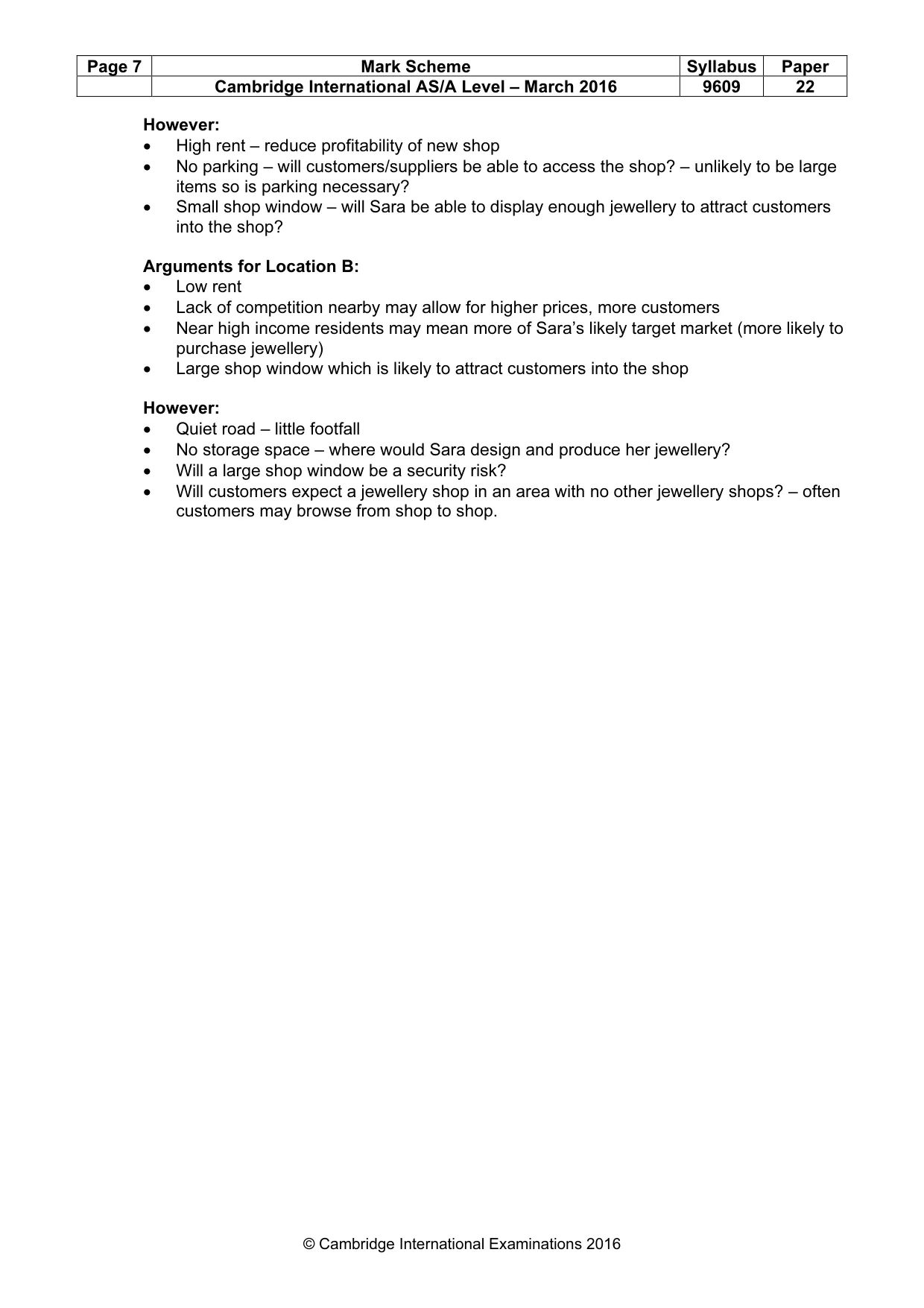
Page 7 Mark Scheme Syllabus Paper Cambridge International AS/A Level – March 2016 9609 22 © Cambridge International Examinations 2016 However: • High rent – reduce profitability of new shop • No parking – will customers/suppliers be able to access the shop? – unlikely to be large items so is parking necessary? • Small shop window – will Sara be able to display enough jewellery to attract customers into the shop? Arguments for Location B: • Low rent • Lack of competition nearby may allow for higher prices, more customers • Near high income residents may mean more of Sara’s likely target market (more likely to purchase jewellery) • Large shop window which is likely to attract customers into the shop However: • Quiet road – little footfall • No storage space – where would Sara design and produce her jewellery? • Will a large shop window be a security risk? • Will customers expect a jewellery shop in an area with no other jewellery shops? – often customers may browse from shop to shop.
Mark scheme, page 8
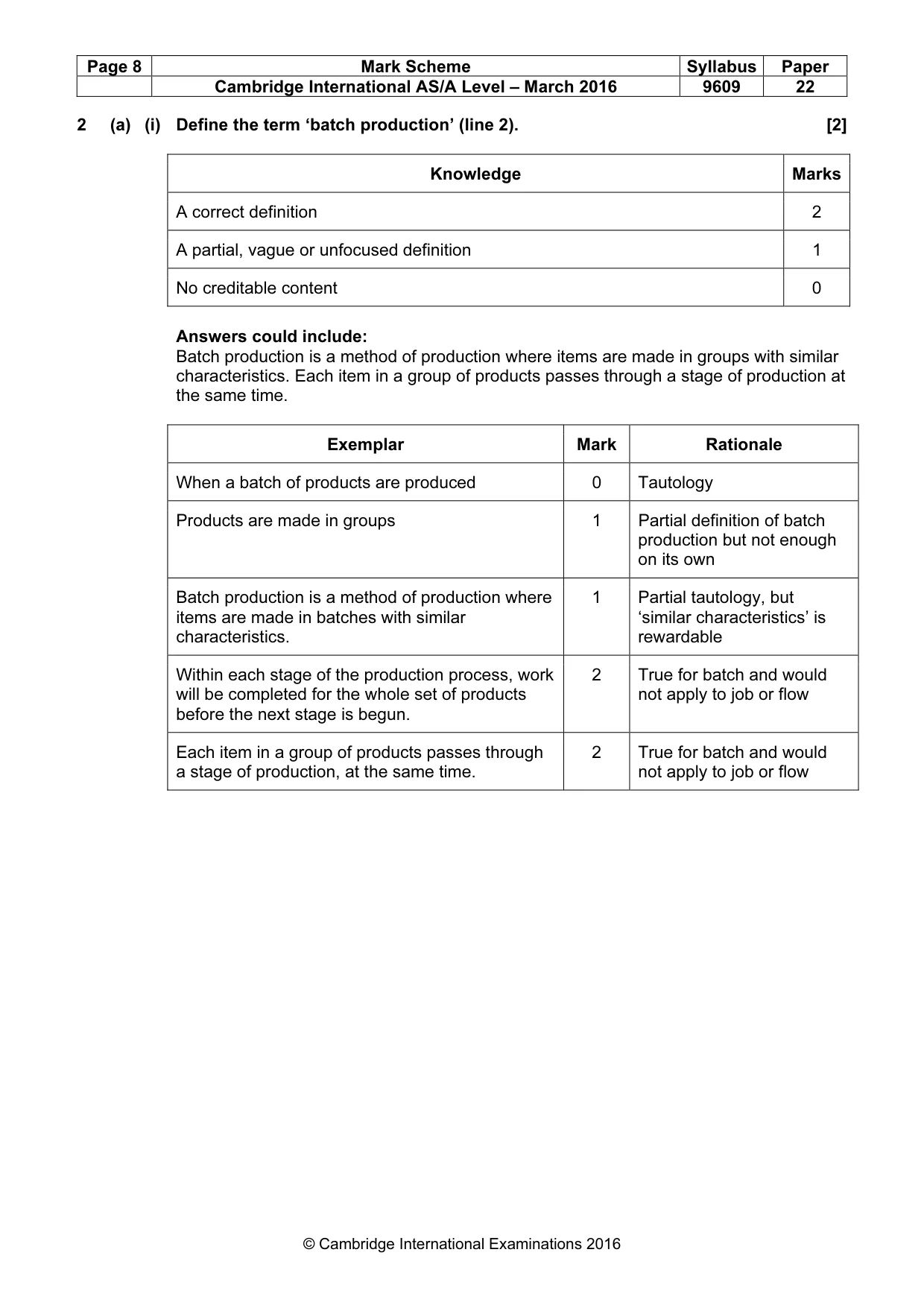
Page 8 Mark Scheme Syllabus Paper Cambridge International AS/A Level – March 2016 9609 22 © Cambridge International Examinations 2016 2 (a) (i) Define the term ‘batch production’ (line 2). [2] Knowledge Marks A correct definition 2 A partial, vague or unfocused definition 1 No creditable content 0 Answers could include: Batch production is a method of production where items are made in groups with similar characteristics. Each item in a group of products passes through a stage of production at the same time. Exemplar Mark Rationale When a batch of products are produced 0 Tautology Products are made in groups 1 Partial definition of batch production but not enough on its own Batch production is a method of production where items are made in batches with similar characteristics. 1 Partial tautology, but ‘similar characteristics’ is rewardable Within each stage of the production process, work will be completed for the whole set of products before the next stage is begun. 2 True for batch and would not apply to job or flow Each item in a group of products passes through a stage of production, at the same time. 2 True for batch and would not apply to job or flow
Mark scheme, page 9
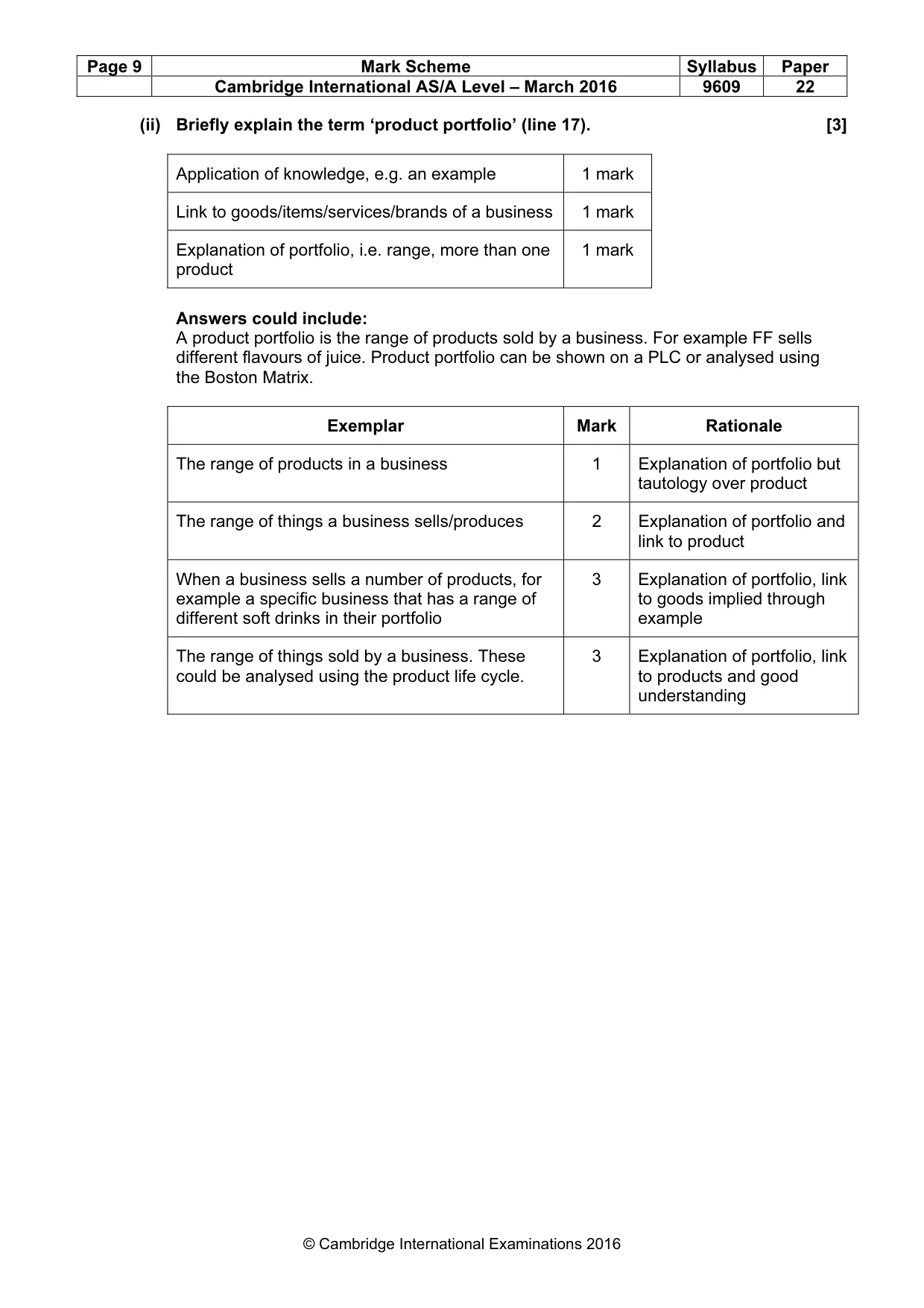
Page 9 Mark Scheme Syllabus Paper Cambridge International AS/A Level – March 2016 9609 22 © Cambridge International Examinations 2016 (ii) Briefly explain the term ‘product portfolio’ (line 17). [3] Application of knowledge, e.g. an example 1 mark Link to goods/items/services/brands of a business 1 mark Explanation of portfolio, i.e. range, more than one product 1 mark Answers could include: A product portfolio is the range of products sold by a business. For example FF sells different flavours of juice. Product portfolio can be shown on a PLC or analysed using the Boston Matrix. Exemplar Mark Rationale The range of products in a business 1 Explanation of portfolio but tautology over product The range of things a business sells/produces 2 Explanation of portfolio and link to product When a business sells a number of products, for example a specific business that has a range of different soft drinks in their portfolio 3 Explanation of portfolio, link to goods implied through example The range of things sold by a business. These could be analysed using the product life cycle. 3 Explanation of portfolio, link to products and good understanding
Mark scheme, page 10
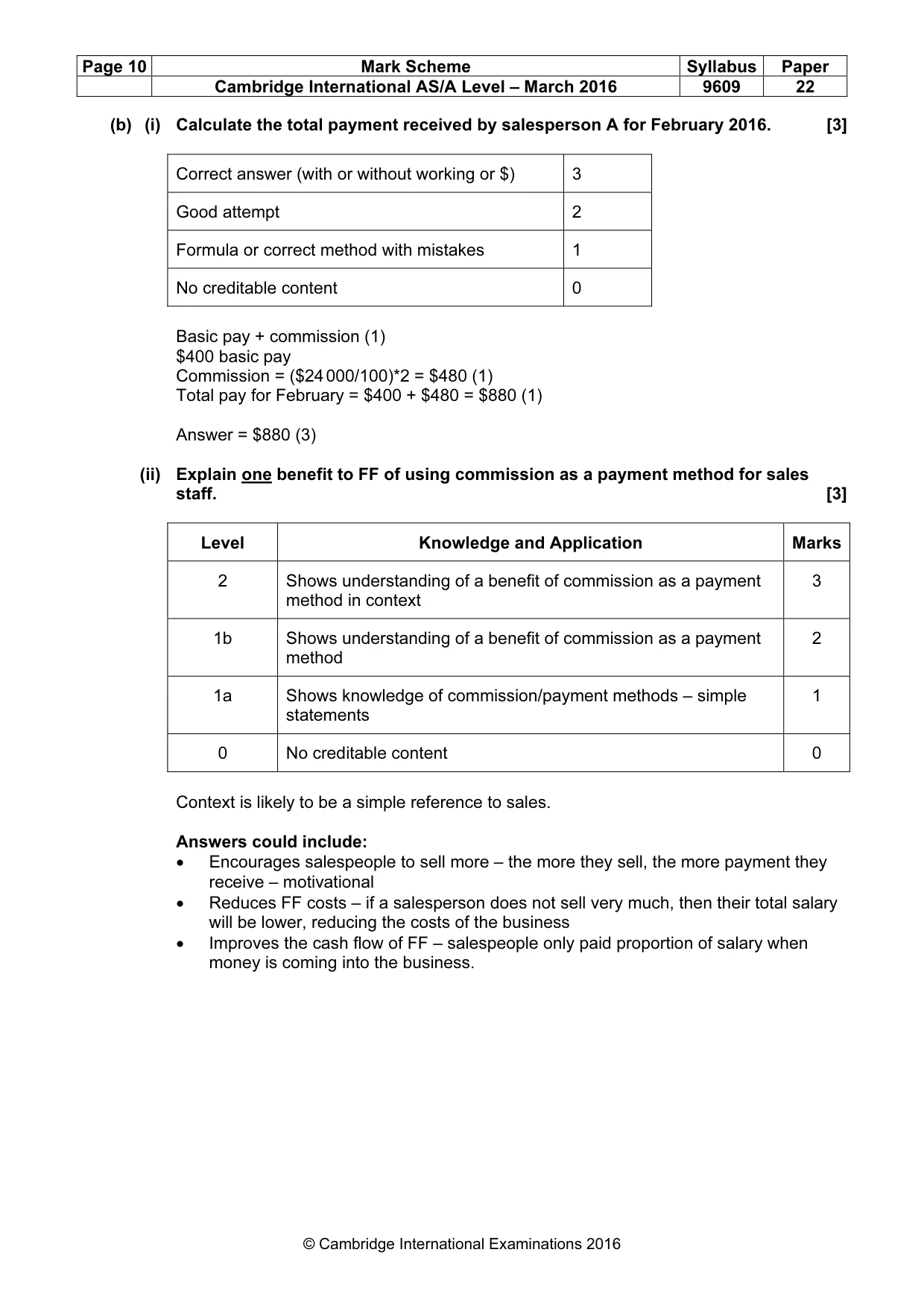
Page 10 Mark Scheme Syllabus Paper Cambridge International AS/A Level – March 2016 9609 22 © Cambridge International Examinations 2016 (b) (i) Calculate the total payment received by salesperson A for February 2016. [3] Correct answer (with or without working or $) 3 Good attempt 2 Formula or correct method with mistakes 1 No creditable content 0 Basic pay + commission (1) $400 basic pay Commission = ($24 000/100)*2 = $480 (1) Total pay for February = $400 + $480 = $880 (1) Answer = $880 (3) (ii) Explain one benefit to FF of using commission as a payment method for sales staff. [3] Level Knowledge and Application Marks 2 Shows understanding of a benefit of commission as a payment method in context 3 1b Shows understanding of a benefit of commission as a payment method 2 1a Shows knowledge of commission/payment methods – simple statements 1 0 No creditable content 0 Context is likely to be a simple reference to sales. Answers could include: • Encourages salespeople to sell more – the more they sell, the more payment they receive – motivational • Reduces FF costs – if a salesperson does not sell very much, then their total salary will be lower, reducing the costs of the business • Improves the cash flow of FF – salespeople only paid proportion of salary when money is coming into the business.
Mark scheme, page 11
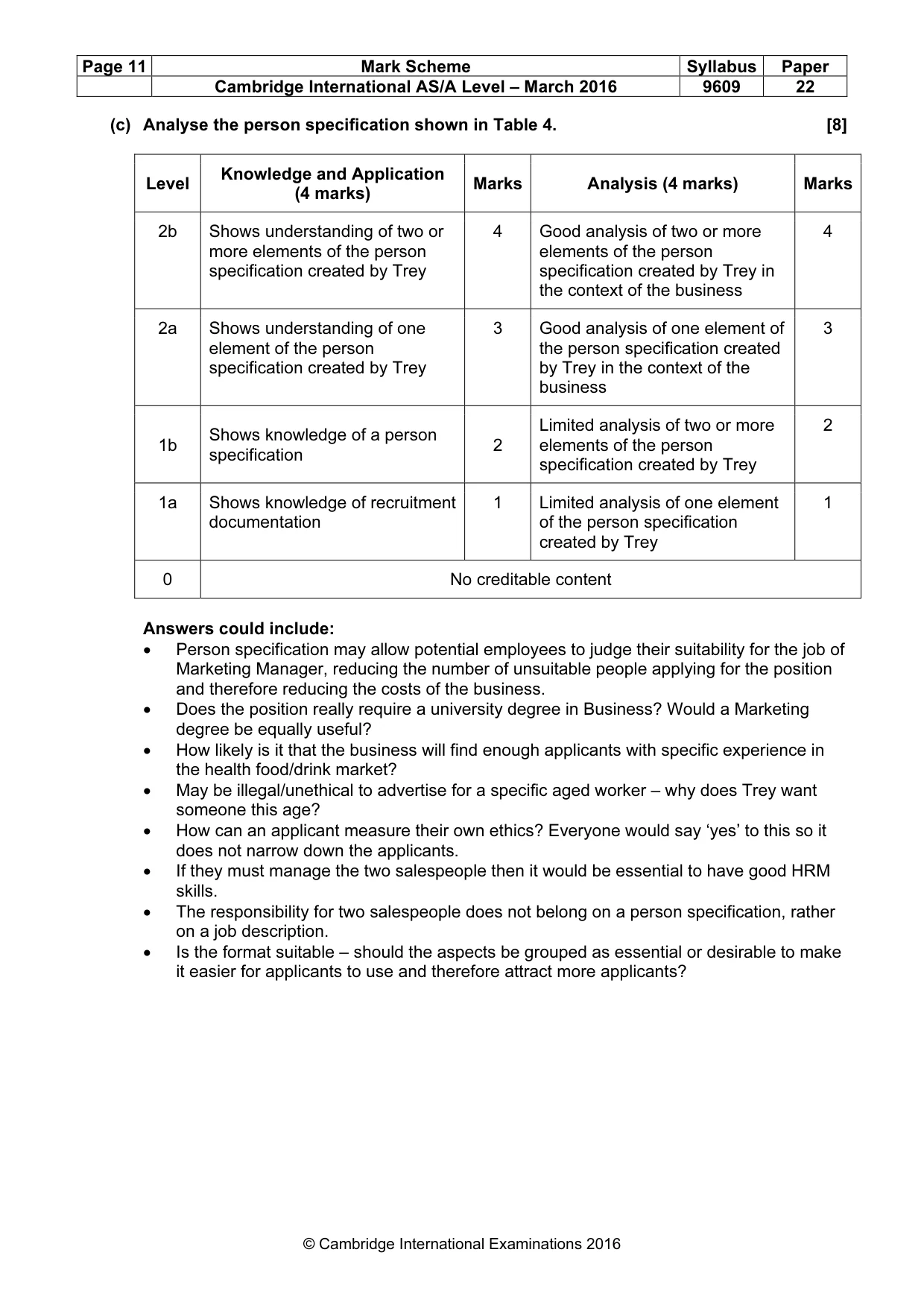
Page 11 Mark Scheme Syllabus Paper Cambridge International AS/A Level – March 2016 9609 22 © Cambridge International Examinations 2016 (c) Analyse the person specification shown in Table 4. [8] Level Knowledge and Application (4 marks) Marks Analysis (4 marks) Marks 2b Shows understanding of two or more elements of the person specification created by Trey 4 Good analysis of two or more elements of the person specification created by Trey in the context of the business 4 2a Shows understanding of one element of the person specification created by Trey 3 Good analysis of one element of the person specification created by Trey in the context of the business 3 1b Shows knowledge of a person specification 2 Limited analysis of two or more elements of the person specification created by Trey 2 1a Shows knowledge of recruitment documentation 1 Limited analysis of one element of the person specification created by Trey 1 0 No creditable content Answers could include: • Person specification may allow potential employees to judge their suitability for the job of Marketing Manager, reducing the number of unsuitable people applying for the position and therefore reducing the costs of the business. • Does the position really require a university degree in Business? Would a Marketing degree be equally useful? • How likely is it that the business will find enough applicants with specific experience in the health food/drink market? • May be illegal/unethical to advertise for a specific aged worker – why does Trey want someone this age? • How can an applicant measure their own ethics? Everyone would say ‘yes’ to this so it does not narrow down the applicants. • If they must manage the two salespeople then it would be essential to have good HRM skills. • The responsibility for two salespeople does not belong on a person specification, rather on a job description. • Is the format suitable – should the aspects be grouped as essential or desirable to make it easier for applicants to use and therefore attract more applicants?
Mark scheme, page 12
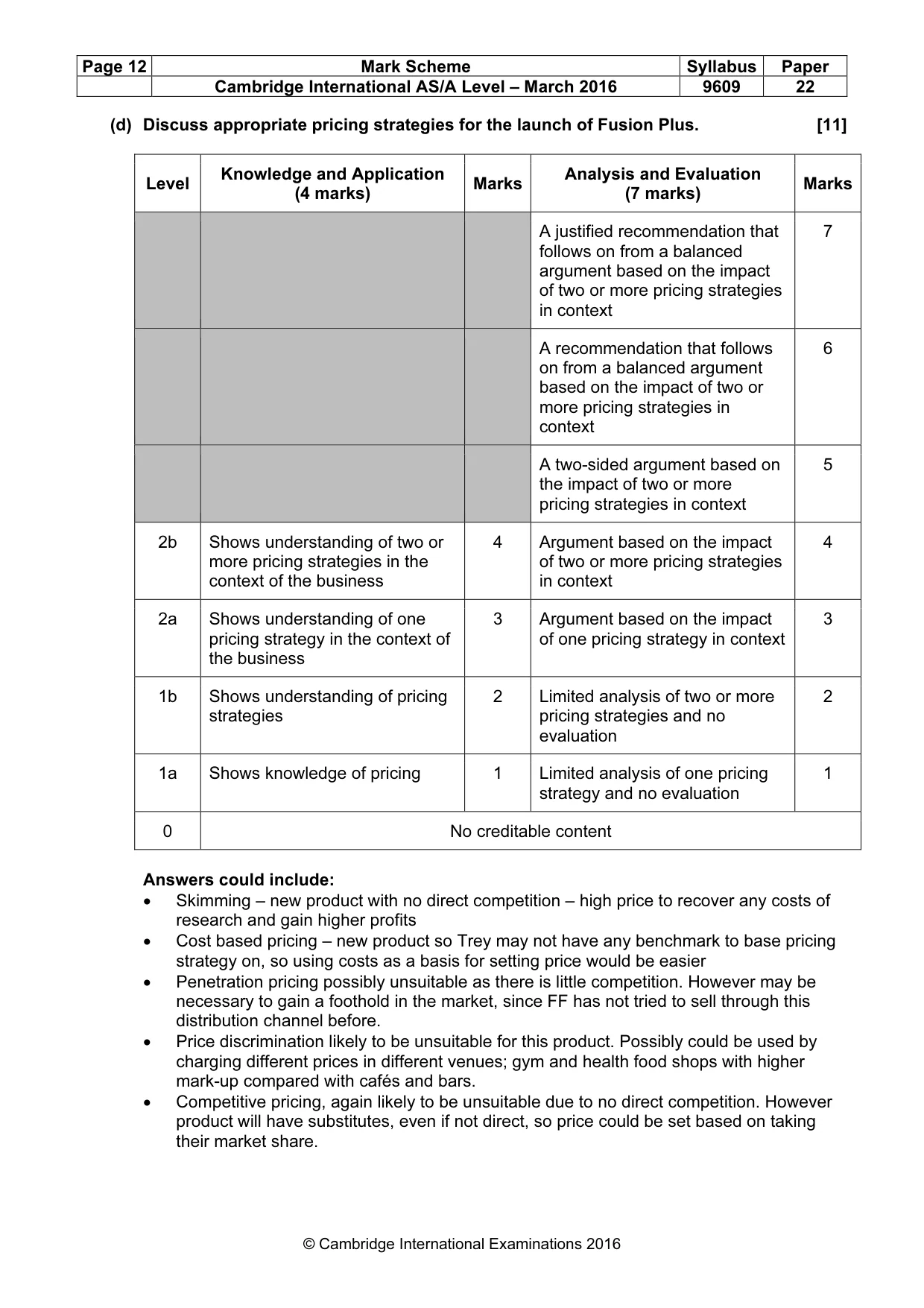
Page 12 Mark Scheme Syllabus Paper Cambridge International AS/A Level – March 2016 9609 22 © Cambridge International Examinations 2016 (d) Discuss appropriate pricing strategies for the launch of Fusion Plus. [11] Level Knowledge and Application (4 marks) Marks Analysis and Evaluation (7 marks) Marks A justified recommendation that follows on from a balanced argument based on the impact of two or more pricing strategies in context 7 A recommendation that follows on from a balanced argument based on the impact of two or more pricing strategies in context 6 A two-sided argument based on the impact of two or more pricing strategies in context 5 2b Shows understanding of two or more pricing strategies in the context of the business 4 Argument based on the impact of two or more pricing strategies in context 4 2a Shows understanding of one pricing strategy in the context of the business 3 Argument based on the impact of one pricing strategy in context 3 1b Shows understanding of pricing strategies 2 Limited analysis of two or more pricing strategies and no evaluation 2 1a Shows knowledge of pricing 1 Limited analysis of one pricing strategy and no evaluation 1 0 No creditable content Answers could include: • Skimming – new product with no direct competition – high price to recover any costs of research and gain higher profits • Cost based pricing – new product so Trey may not have any benchmark to base pricing strategy on, so using costs as a basis for setting price would be easier • Penetration pricing possibly unsuitable as there is little competition. However may be necessary to gain a foothold in the market, since FF has not tried to sell through this distribution channel before. • Price discrimination likely to be unsuitable for this product. Possibly could be used by charging different prices in different venues; gym and health food shops with higher mark-up compared with cafés and bars. • Competitive pricing, again likely to be unsuitable due to no direct competition. However product will have substitutes, even if not direct, so price could be set based on taking their market share.
What you needed in this session
Cambridge’s own grade thresholds for 2016 Feb/March, Paper 2 · Variant 2. A higher threshold means an easier paper — the bar moves with how the cohort did.