Cambridge A Level Biology 9700 — 2020 Feb/March Paper 5 · Variant 2
9700/52/F/M/20 · 2 questions · 30 marks · ≈34 min
The question paper and its mark scheme, free to read here and free to download. This is Cambridge’s own paper, exactly as it was sat.
Question paper12 pages


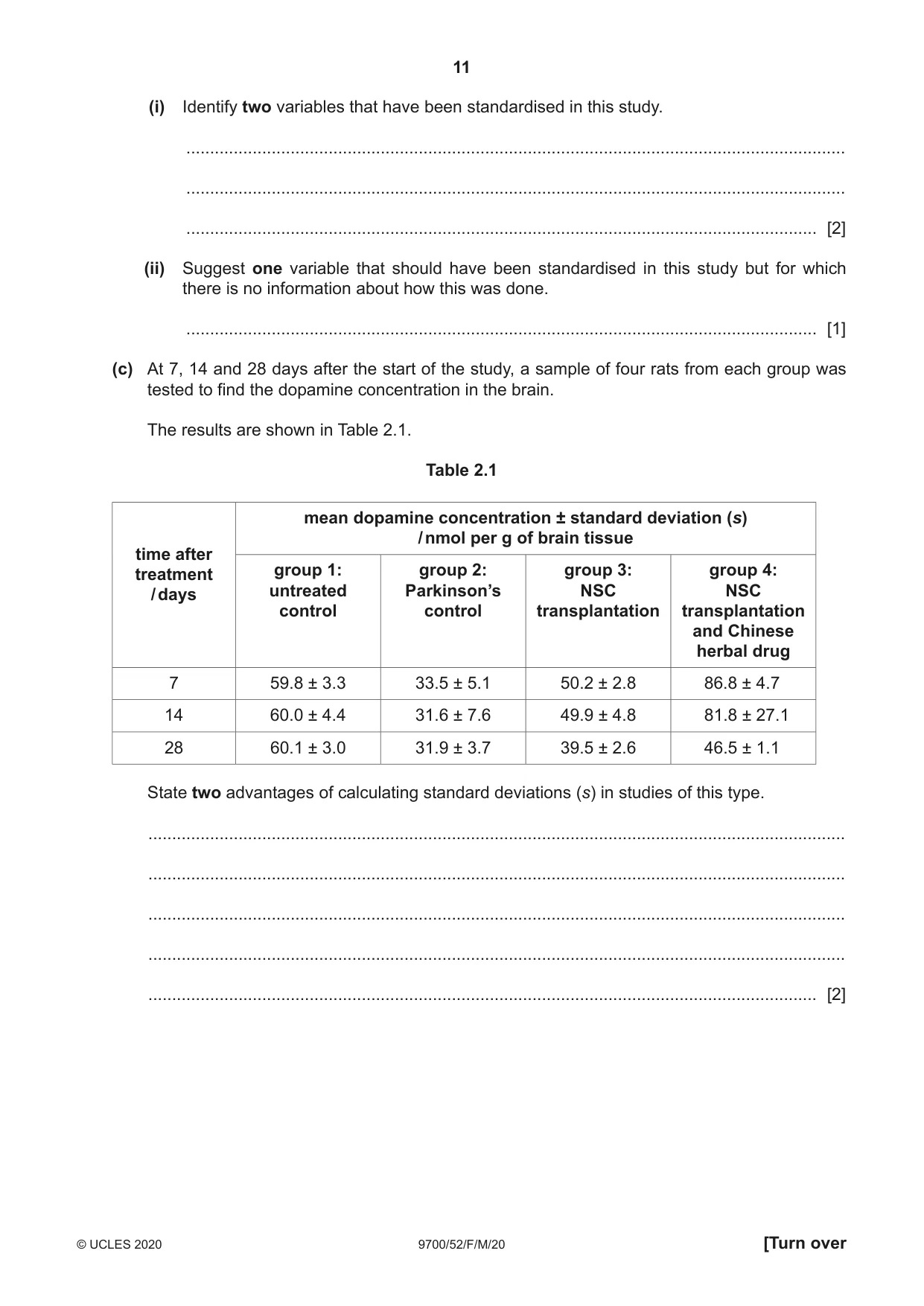
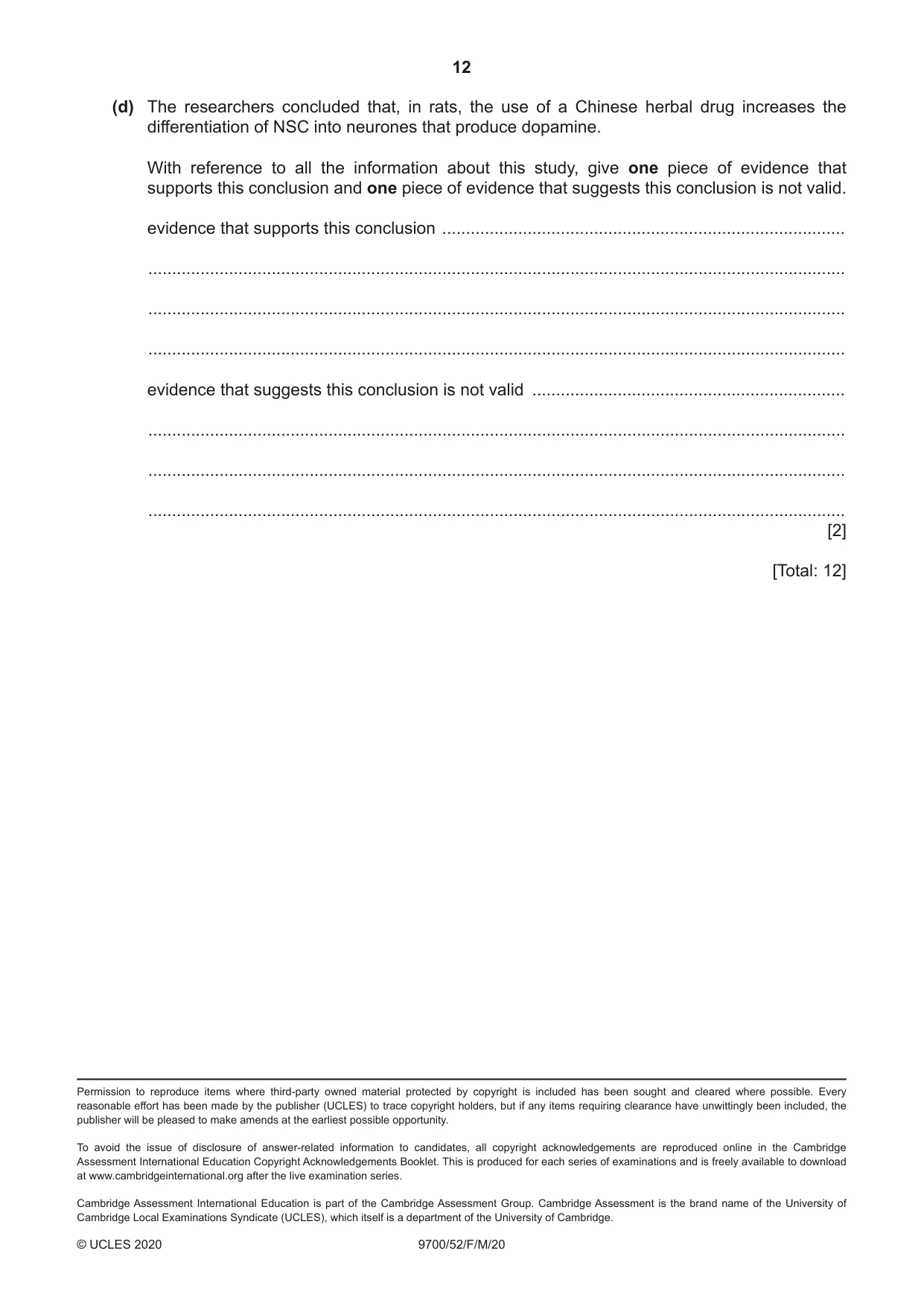
Mark scheme11 pages
Answers below. Sit the paper first if you are practising.

Questions as text
Q1 · Seaweeds are photosynthetic multicellular organisms found on the coast of many parts of…
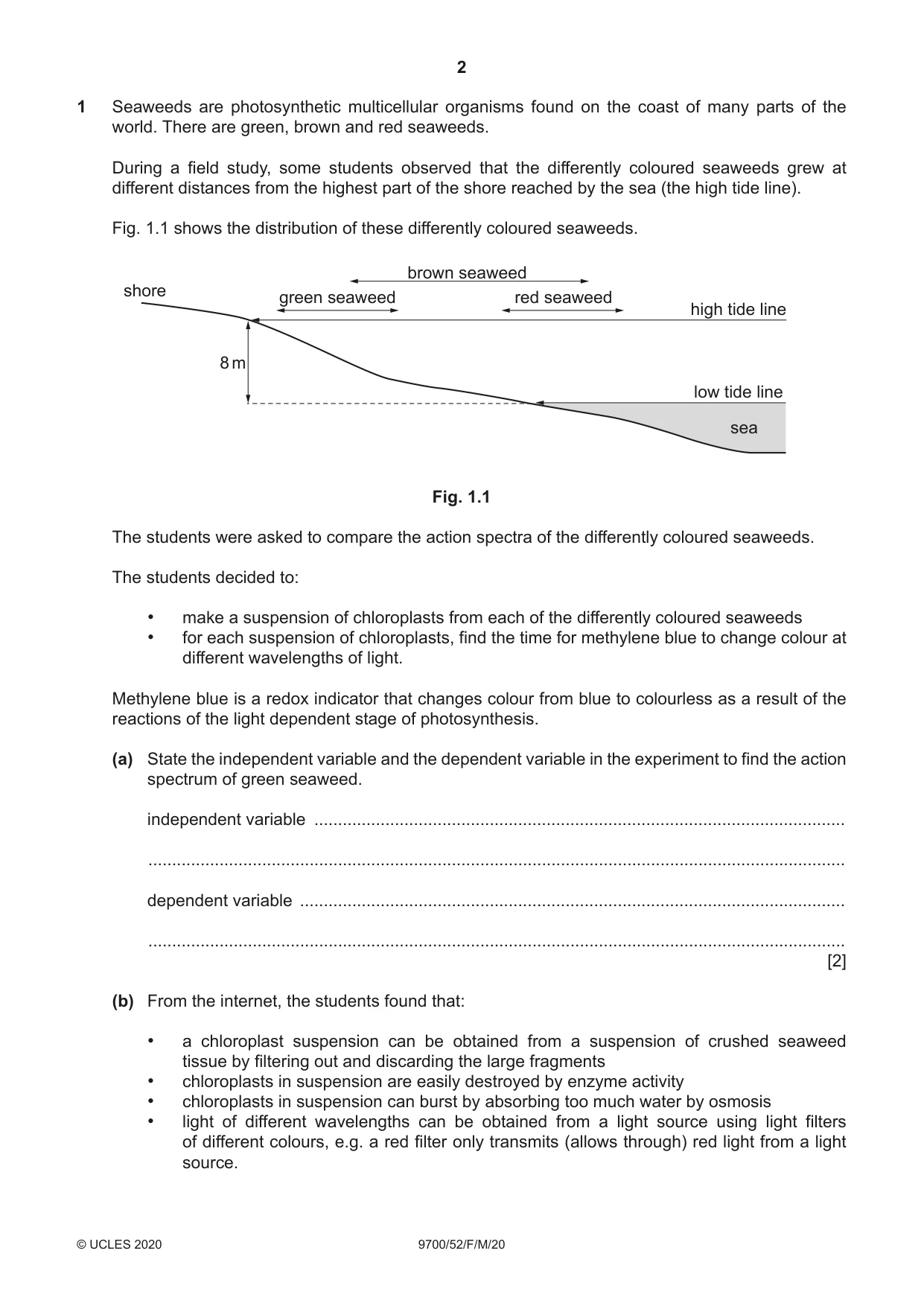
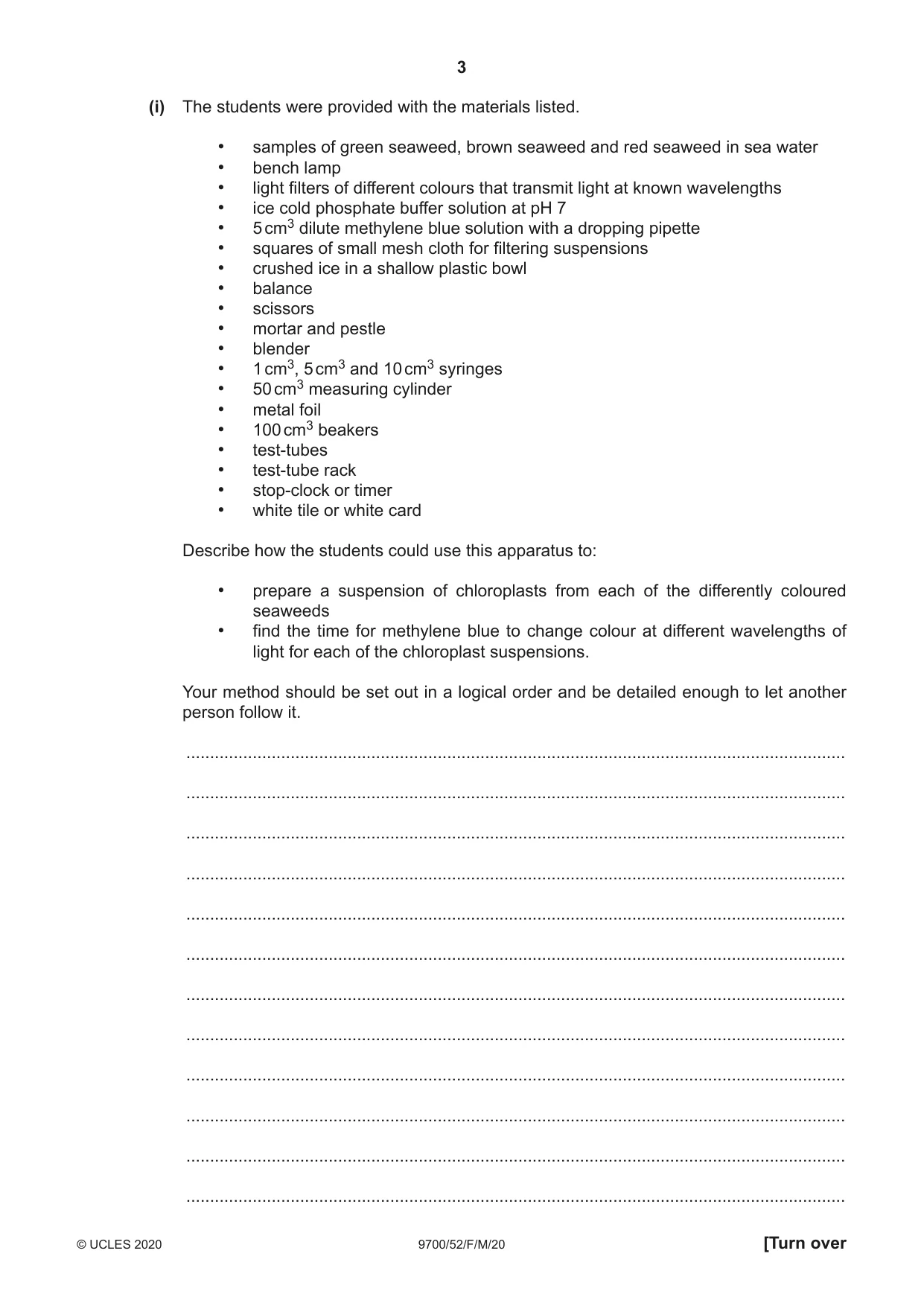
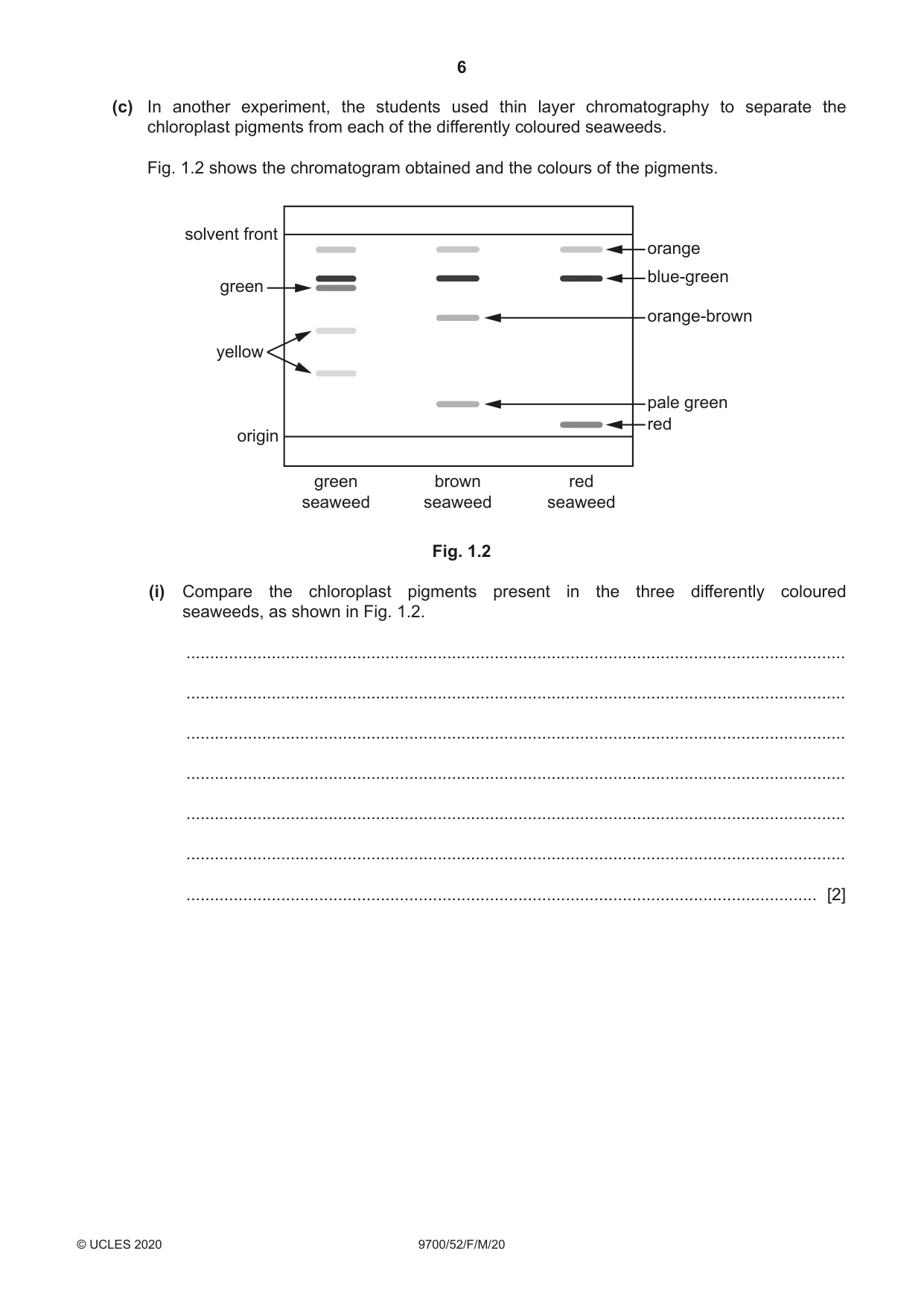
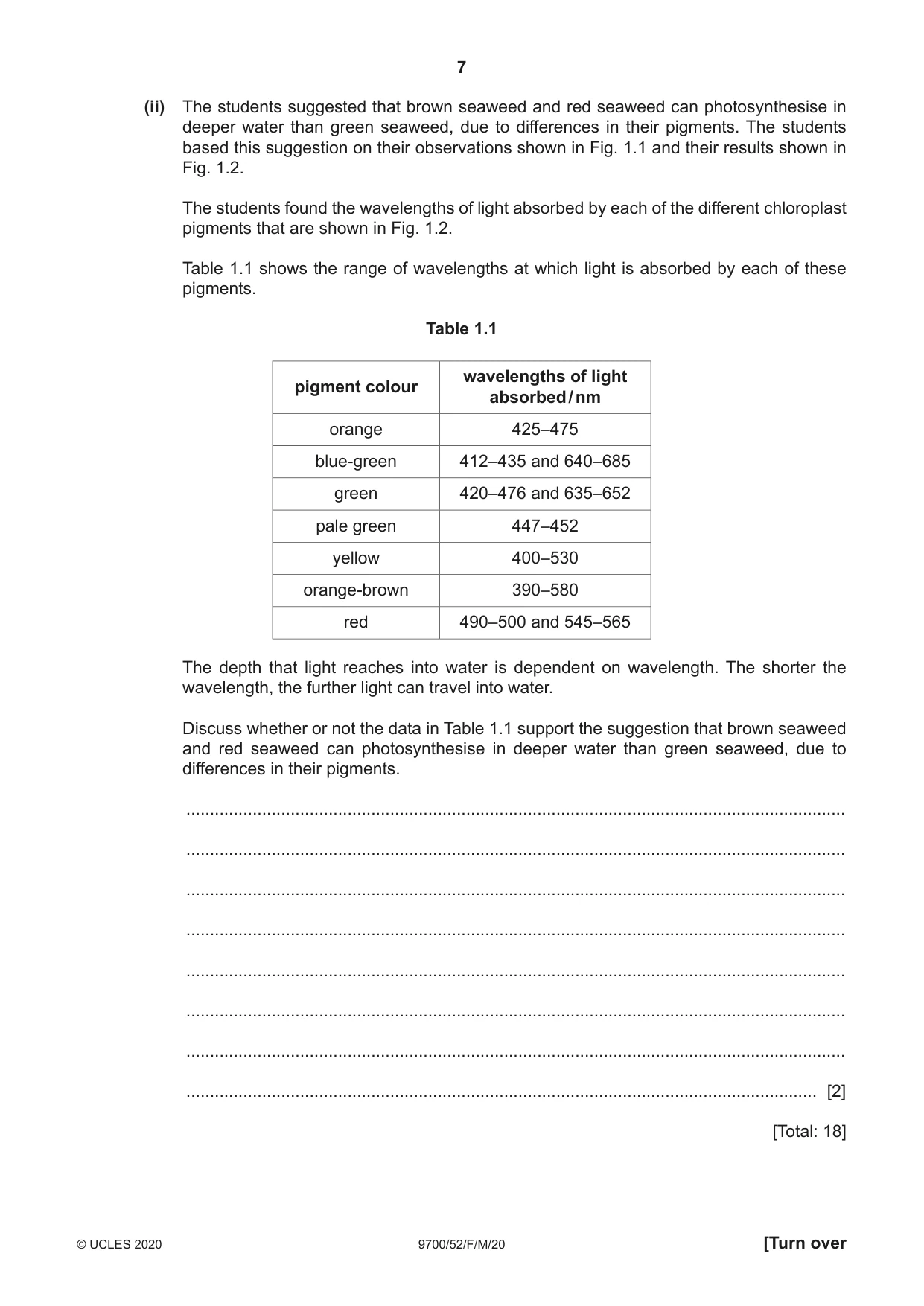
1 Seaweeds are photosynthetic multicellular organisms found on the coast of many parts of the world. There are green, brown and red seaweeds. During a field study, some students observed that the differently coloured seaweeds grew at different distances from the highest part of the shore reached by the sea (the high tide line). Fig. 1.1 shows the distribution of these differently coloured seaweeds. brown seaweed shore green seaweed red seaweed high tide line 8 m low tide line sea Fig. 1.1 The students were asked to compare the action spectra of the differently coloured seaweeds. The students decided to: • make a suspension of chloroplasts from each of the differently coloured seaweeds • for each suspension of chloroplasts, find the time for methylene blue to change colour at different wavelengths of light. Methylene blue is a redox indicator that changes colour from blue to colourless as a result of the reactions of the light dependent stage of photosynthesis. (a) State the independent variable and the dependent variable in the experiment to find the action spectrum of green seaweed. independent variable ................................................................................................................ ................................................................................................................................................... dependent variable ................................................................................................................... ................................................................................................................................................... [2] (b) From the internet, the students found that: • a chloroplast suspension can be obtained from a suspension of crushed seaweed tissue by filtering out and discarding the large fragments • chloroplasts in suspension are easily destroyed by enzyme activity • chloroplasts in suspension can burst by absorbing too much water by osmosis • light of different wavelengths can be obtained from a light source using light filters of different colours, e.g. a red filter only transmits (allows through) red light from a light source. (i) The students were provided with the materials listed. • samples of green seaweed, brown seaweed and red seaweed in sea water • bench lamp • light filters of different colours that transmit light at known wavelengths • ice cold phosphate buffer solution at pH 7 • 5 cm3 dilute methylene blue solution with a dropping pipette • squares of small mesh cloth for filtering suspensions • crushed ice in a shallow plastic bowl • balance • scissors • mortar and pestle • blender • 1 cm3, 5 cm3 and 10 cm3 syringes • 50 cm3 measuring cylinder • metal foil • 100 cm3 beakers • test-tubes • test-tube rack • stop-clock or timer • white tile or white card Describe how the students could use this apparatus to: • prepare a suspension of chloroplasts from each of the differently coloured seaweeds • find the time for methylene blue to change colour at different wavelengths of light for each of the chloroplast suspensions. Your method should be set out in a logical order and be detailed enough to let another person follow it. ........................................................................................................................................... ........................................................................................................................................... ........................................................................................................................................... ........................................................................................................................................... ........................................................................................................................................... ........................................................................................................................................... ........................................................................................................................................... ........................................................................................................................................... ........................................................................................................................................... ........................................................................................................................................... ........................................................................................................................................... ........................................................................................................................................... ........................................................................................................................................... ........................................................................................................................................... ........................................................................................................................................... ........................................................................................................................................... ........................................................................................................................................... ........................................................................................................................................... ........................................................................................................................................... ........................................................................................................................................... ........................................................................................................................................... ........................................................................................................................................... ........................................................................................................................................... ........................................................................................................................................... ........................................................................................................................................... ........................................................................................................................................... ........................................................................................................................................... ........................................................................................................................................... ........................................................................................................................................... ........................................................................................................................................... ........................................................................................................................................... ........................................................................................................................................... ........................................................................................................................................... ........................................................................................................................................... ........................................................................................................................................... ........................................................................................................................................... ........................................................................................................................................... ........................................................................................................................................... ........................................................................................................................................... ................................................................................................................................... [10] (ii) Describe how the students could use their results to find the action spectrum for each of the differently coloured seaweeds. ........................................................................................................................................... ........................................................................................................................................... ........................................................................................................................................... ........................................................................................................................................... ........................................................................................................................................... ..................................................................................................................................... [2] (c) In another experiment, the students used thin layer chromatography to separate the chloroplast pigments from each of the differently coloured seaweeds. Fig. 1.2 shows the chromatogram obtained and the colours of the pigments. solvent front orange blue-green green orange-brown yellow pale green red origin green brown red seaweed seaweed seaweed Fig. 1.2 (i) Compare the chloroplast pigments present in the three differently coloured seaweeds, as shown in Fig. 1.2. ........................................................................................................................................... ........................................................................................................................................... ........................................................................................................................................... ........................................................................................................................................... ........................................................................................................................................... ........................................................................................................................................... ..................................................................................................................................... [2] (ii) The students suggested that brown seaweed and red seaweed can photosynthesise in deeper water than green seaweed, due to differences in their pigments. The students based this suggestion on their observations shown in Fig. 1.1 and their results shown in Fig. 1.2. The students found the wavelengths of light absorbed by each of the different chloroplast pigments that are shown in Fig. 1.2. Table 1.1 shows the range of wavelengths at which light is absorbed by each of these pigments. Table 1.1 wavelengths of light pigment colour absorbed / nm orange 425–475 blue-green 412–435 and 640–685 green 420–476 and 635–652 pale green 447–452 yellow 400–530 orange-brown 390–580 red 490–500 and 545–565 The depth that light reaches into water is dependent on wavelength. The shorter the wavelength, the further light can travel into water. Discuss whether or not the data in Table 1.1 support the suggestion that brown seaweed and red seaweed can photosynthesise in deeper water than green seaweed, due to differences in their pigments. ........................................................................................................................................... ........................................................................................................................................... ........................................................................................................................................... ........................................................................................................................................... ........................................................................................................................................... ........................................................................................................................................... ........................................................................................................................................... ..................................................................................................................................... [2] [Total: 18]
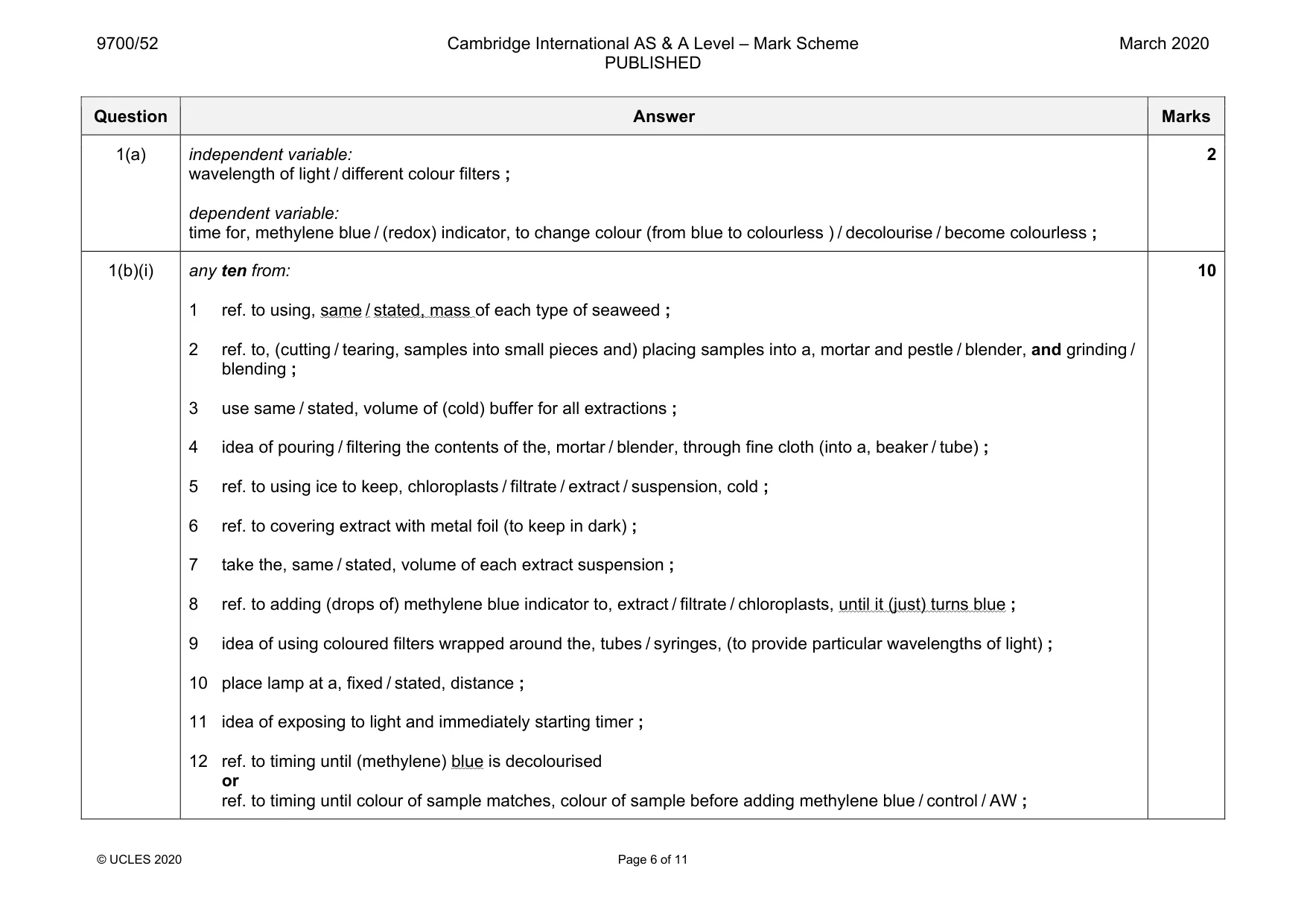
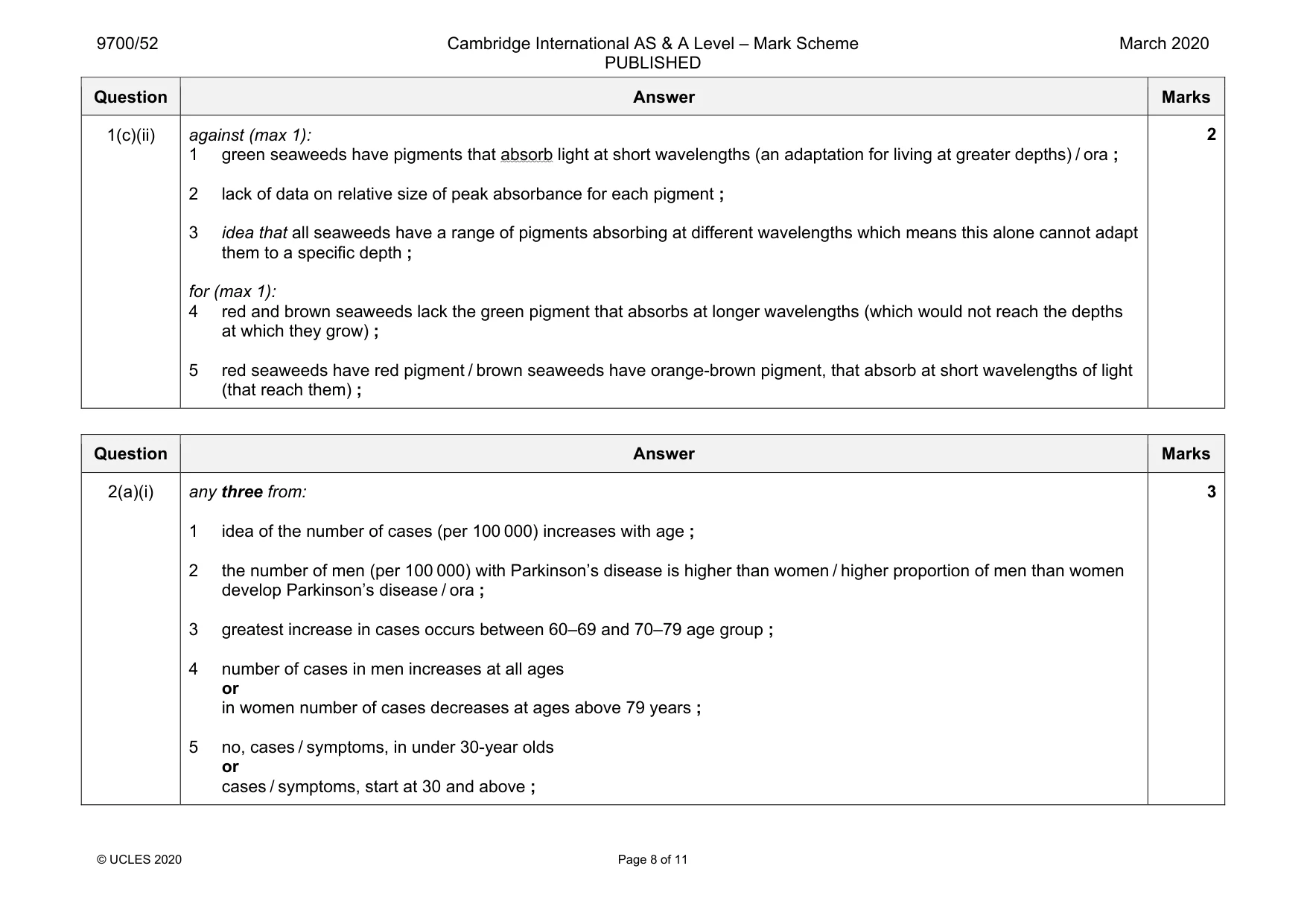
Mark scheme: 1(a) independent variable: wavelength of light / different colour filters ; dependent variable: time for, methylene blue / (redox) indicator, to change colour (from blue to colourless ) / decolourise / become colourless ; 2 1(b)(i) any ten from: 1 ref. to using, same / stated, mass of each type of seaweed ; 2 ref. to, (cutting / tearing, samples into small pieces and) placing samples into a, mortar and pestle / blender, and grinding / blending ; 3 use same / stated, volume of (cold) buffer for all extractions ; 4 idea of pouring / filtering the contents of the, mortar / blender, through fine cloth (into a, beaker / tube) ; 5 ref. to using ice to keep, chloroplasts / filtrate / extract / suspension, cold ; 6 ref. to covering extract with metal foil (to keep in dark) ; 7 take the, same / stated, volume of each extract suspension ; 8 ref. to adding (drops of) methylene blue indicator to, extract / filtrate / chloroplasts, until it (just) turns blue ; 9 idea of using coloured filters wrapped around the, tubes / syringes, (to provide particular wavelengths of light) ; 10 place lamp at a, fixed / stated, distance ; 11 idea of exposing to light and immediately starting timer ; 12 ref. to timing until (methylene) blue is decolourised or ref. to timing until colour of sample matches, colour of sample before adding methylene blue / control / AW ; 10 Question Answer Marks 1(b)(i) 13 use, white tile / white card, as background to judge colour change / AW ; 14 idea that the procedure is repeated for each seaweed and for each, coloured filter / wavelength ; 15 ref. to three measurements for each procedure and taking a mean (time) ; 16 ref. to low risk ; 1(b)(ii) 1 idea of (finding) rate / ref. to 1 / t (at each wavelength / colour) ; 2 plot a graph of rate (of photosynthesis / of change of colour) against wavelength, of light ; 2 1(c)(i) any two from: 1 all the seaweeds have blue-green and orange pigments ; 2 only green seaweed has, yellow / green, pigment / ora ; 3 only brown seaweed has, orange-brown / pale green, pigment / ora ; 4 only red seaweed has red pigment / ora ; 5 correct comment on comparison of number of pigments between different seaweeds ; 6 ref. to comparisons of solubility between pigments ; e.g. red pigment least soluble / orange pigment most soluble ; 2 Question Answer Marks 1(c)(ii) against (max 1): 1 green seaweeds have pigments that absorb light at short wavelengths (an adaptation for living at greater depths) / ora ; 2 lack of data on relative size of peak absorbance for each pigment ; 3 idea that all seaweeds have a range of pigments absorbing at different wavelengths which means this alone cannot adapt them to a specific depth ; for (max 1): 4 red and brown seaweeds lack the green pigment that absorbs at longer wavelengths (which would not reach the depths at which they grow) ; 5 red seaweeds have red pigment / brown seaweeds have orange-brown pigment, that absorb at short wavelengths of light (that reach them) ; 2
Q2 · Parkinson’s disease occurs when nerve cells in part of the brain die, resulting in less…
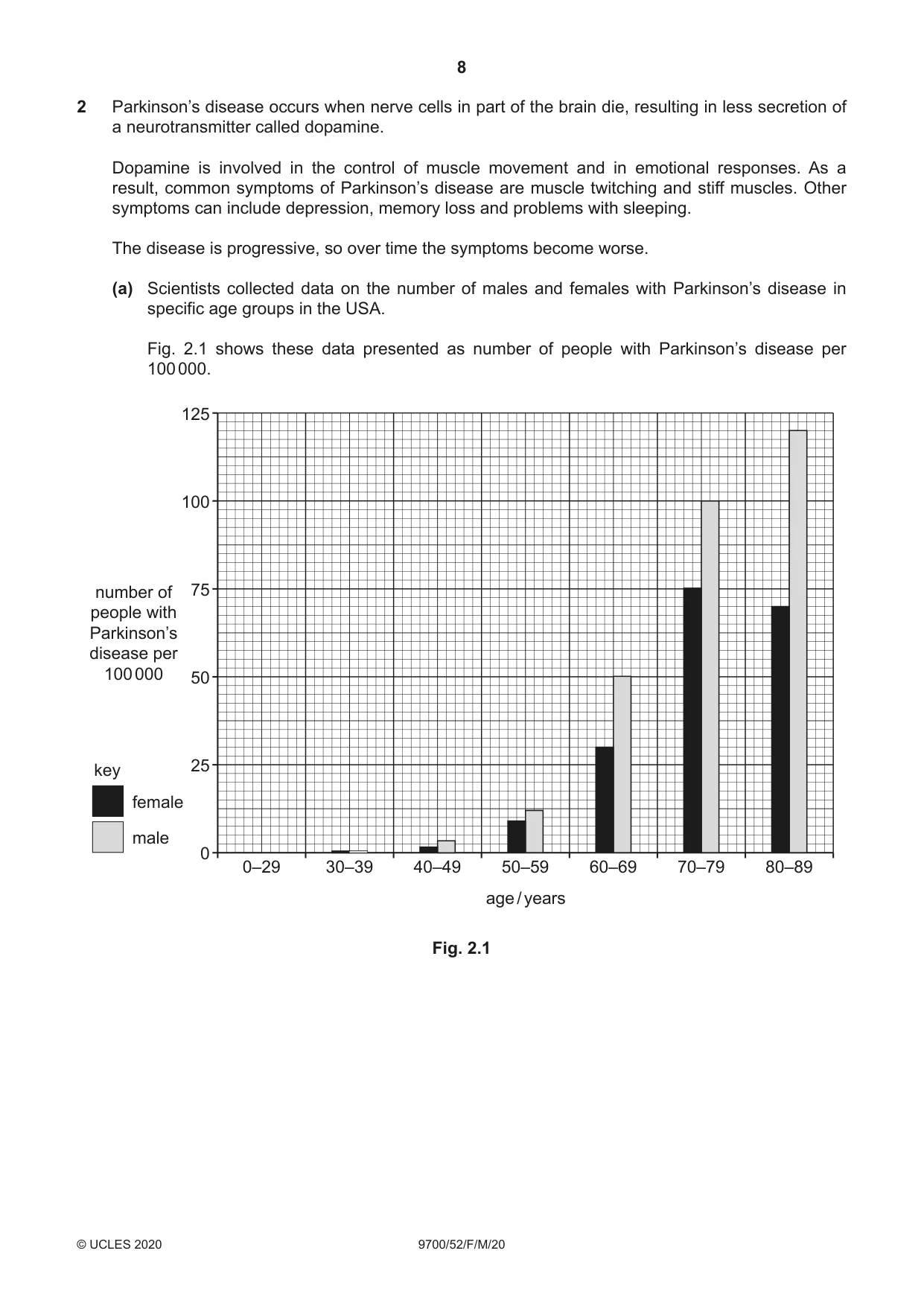
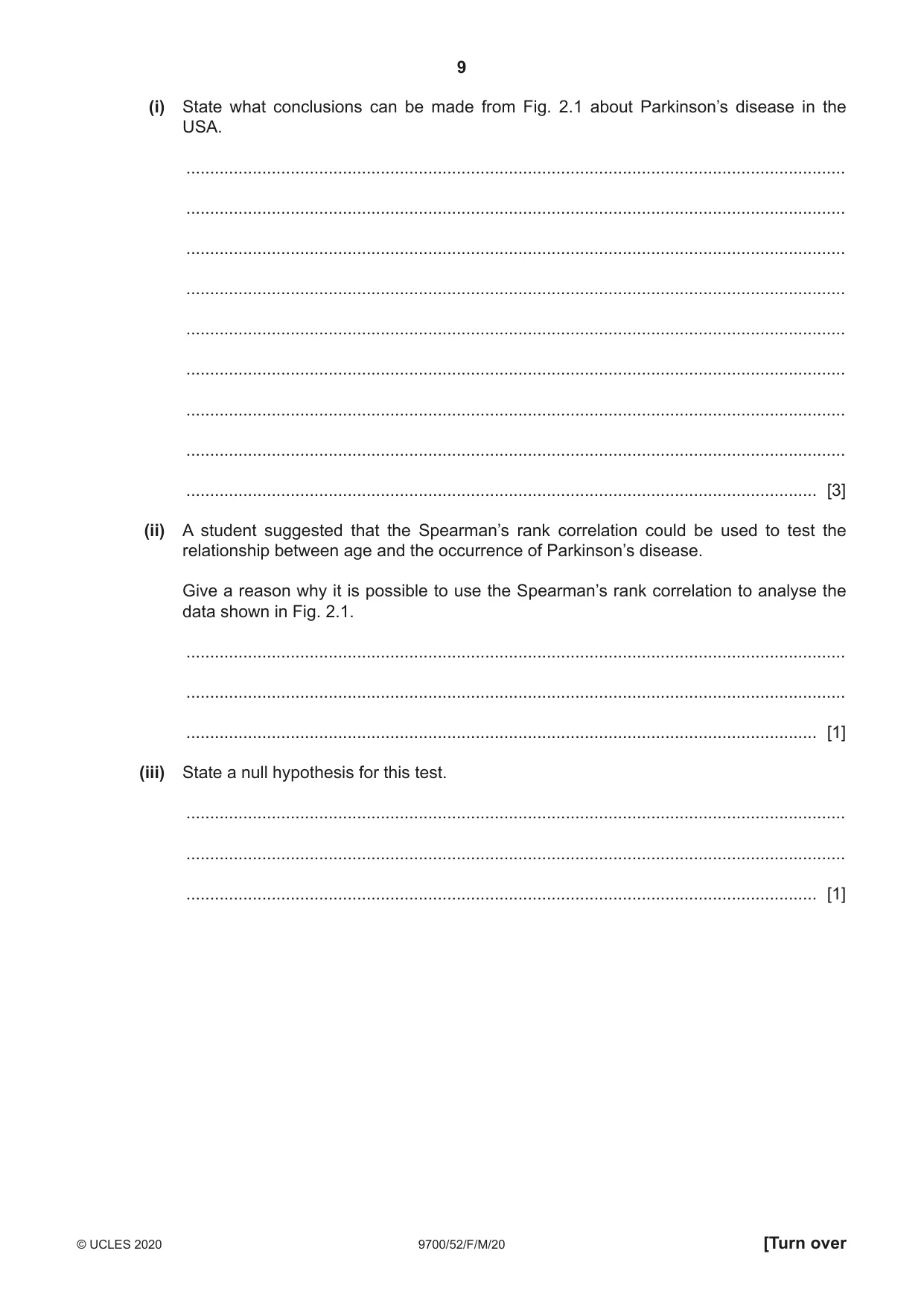
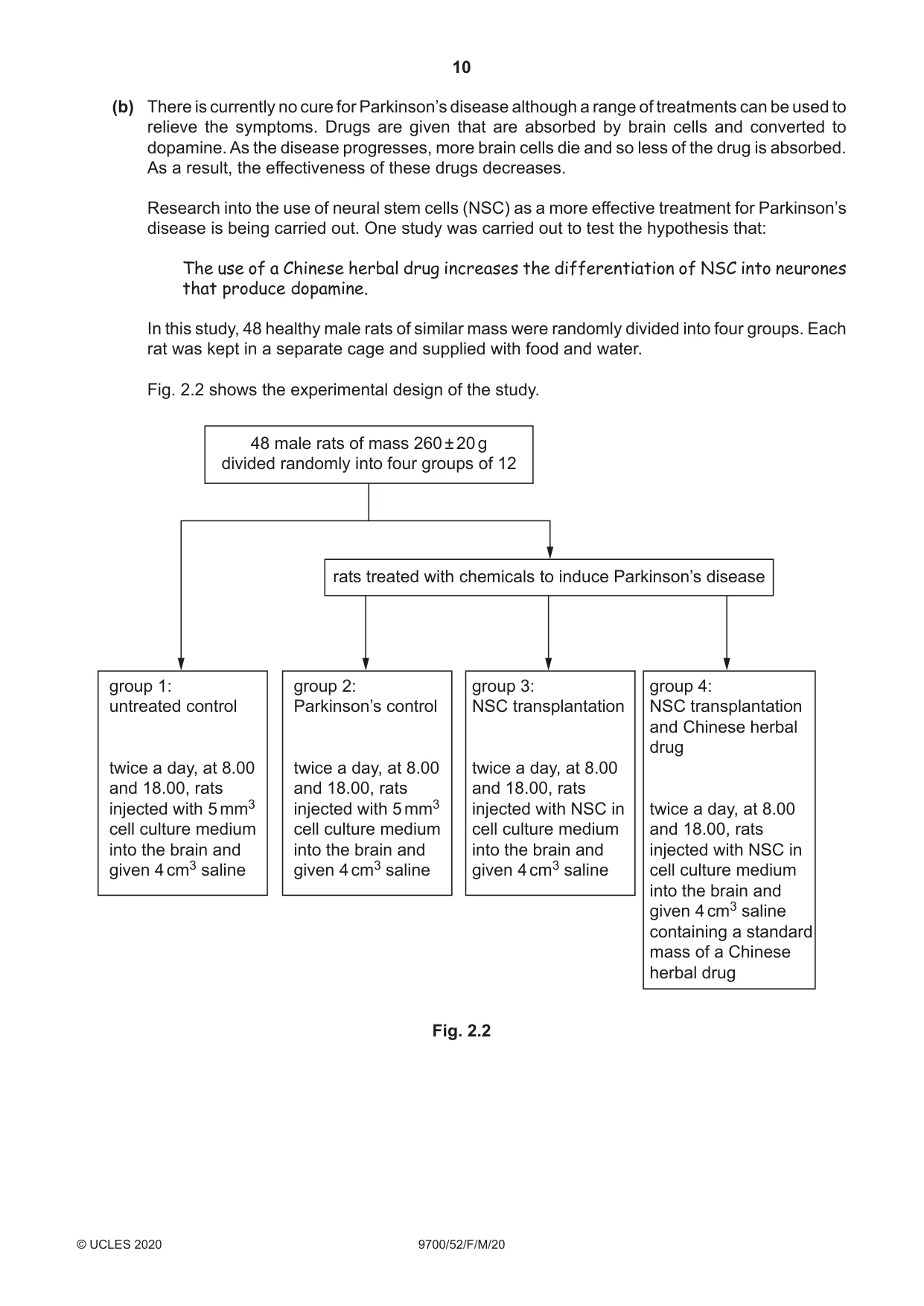
2 Parkinson’s disease occurs when nerve cells in part of the brain die, resulting in less secretion of a neurotransmitter called dopamine. Dopamine is involved in the control of muscle movement and in emotional responses. As a result, common symptoms of Parkinson’s disease are muscle twitching and stiff muscles. Other symptoms can include depression, memory loss and problems with sleeping. The disease is progressive, so over time the symptoms become worse. (a) Scientists collected data on the number of males and females with Parkinson’s disease in specific age groups in the USA. Fig. 2.1 shows these data presented as number of people with Parkinson’s disease per 100 000. 125 100 number of 75 people with Parkinson’s disease per 100 000 50 key 25 female male 0 0–29 30–39 40–49 50–59 60–69 70–79 80–89 age / years Fig. 2.1 (i) State what conclusions can be made from Fig. 2.1 about Parkinson’s disease in the USA. ........................................................................................................................................... ........................................................................................................................................... ........................................................................................................................................... ........................................................................................................................................... ........................................................................................................................................... ........................................................................................................................................... ........................................................................................................................................... ........................................................................................................................................... ..................................................................................................................................... [3] (ii) A student suggested that the Spearman’s rank correlation could be used to test the relationship between age and the occurrence of Parkinson’s disease. Give a reason why it is possible to use the Spearman’s rank correlation to analyse the data shown in Fig. 2.1. ........................................................................................................................................... ........................................................................................................................................... ..................................................................................................................................... [1] (iii) State a null hypothesis for this test. ........................................................................................................................................... ........................................................................................................................................... ..................................................................................................................................... [1] (b) There is currently no cure for Parkinson’s disease although a range of treatments can be used to relieve the symptoms. Drugs are given that are absorbed by brain cells and converted to dopamine. As the disease progresses, more brain cells die and so less of the drug is absorbed. As a result, the effectiveness of these drugs decreases. Research into the use of neural stem cells (NSC) as a more effective treatment for Parkinson’s disease is being carried out. One study was carried out to test the hypothesis that: The use of a Chinese herbal drug increases the differentiation of NSC into neurones that produce dopamine. In this study, 48 healthy male rats of similar mass were randomly divided into four groups. Each rat was kept in a separate cage and supplied with food and water. Fig. 2.2 shows the experimental design of the study. 48 male rats of mass 260 ± 20 g divided randomly into four groups of 12 rats treated with chemicals to induce Parkinson’s disease group 1: group 2: group 3: group 4: untreated control Parkinson’s control NSC transplantation NSC transplantation and Chinese herbal drug twice a day, at 8.00 twice a day, at 8.00 twice a day, at 8.00 and 18.00, rats and 18.00, rats and 18.00, rats injected with 5 mm3 injected with 5 mm3 injected with NSC in twice a day, at 8.00 cell culture medium cell culture medium cell culture medium and 18.00, rats into the brain and into the brain and into the brain and injected with NSC in given 4 cm3 saline given 4 cm3 saline given 4 cm3 saline cell culture medium into the brain and given 4 cm3 saline containing a standard mass of a Chinese herbal drug Fig. 2.2
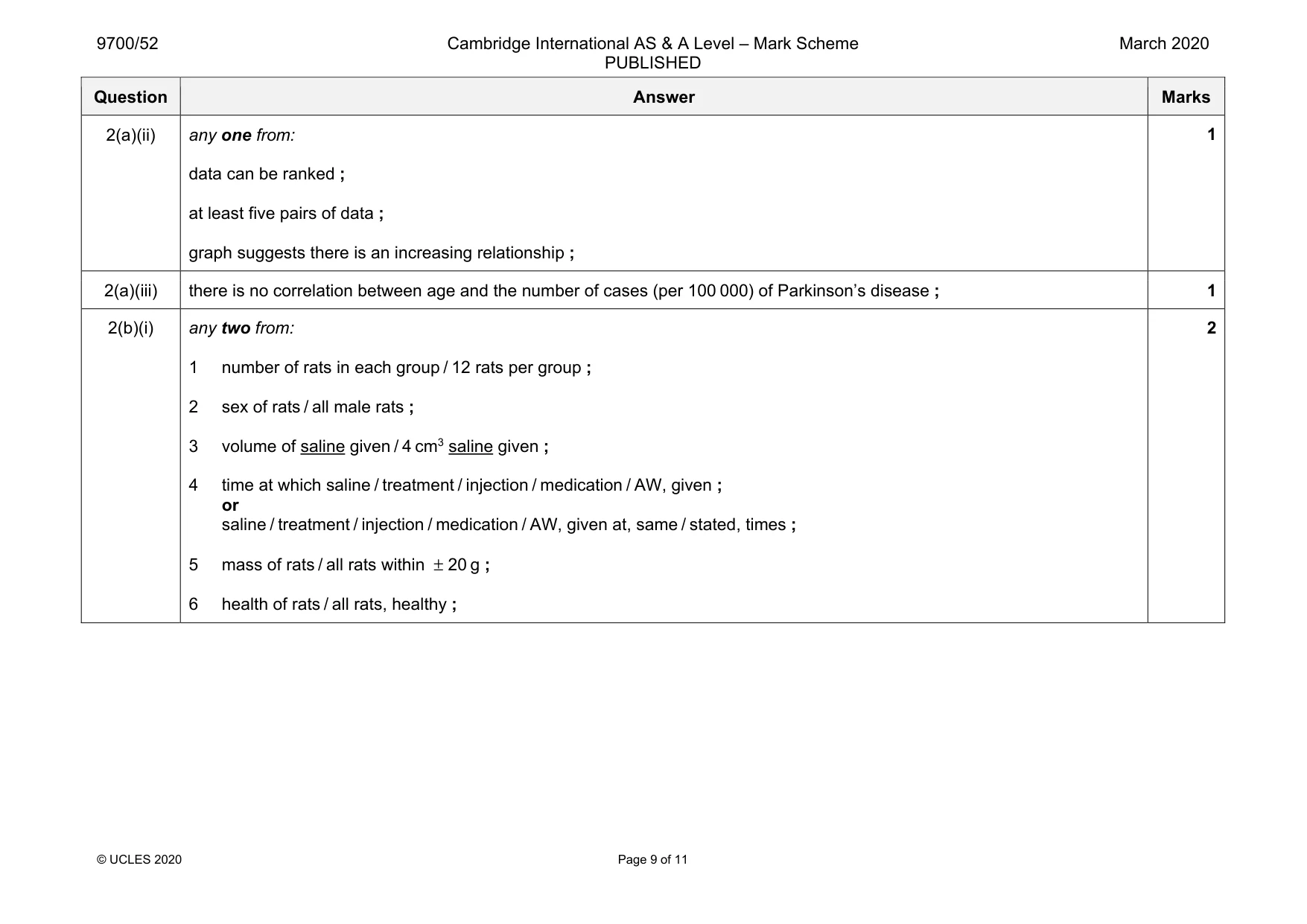
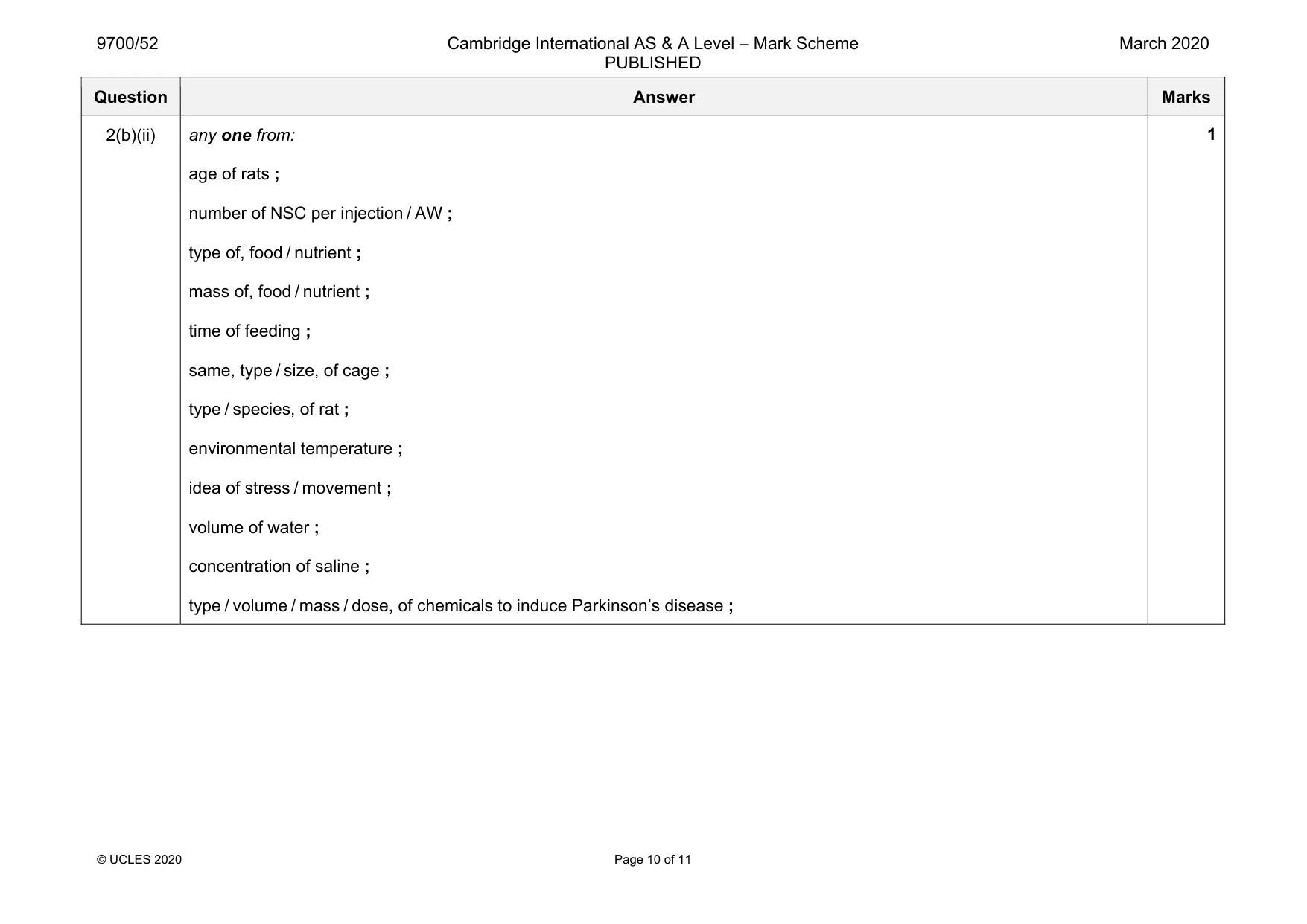
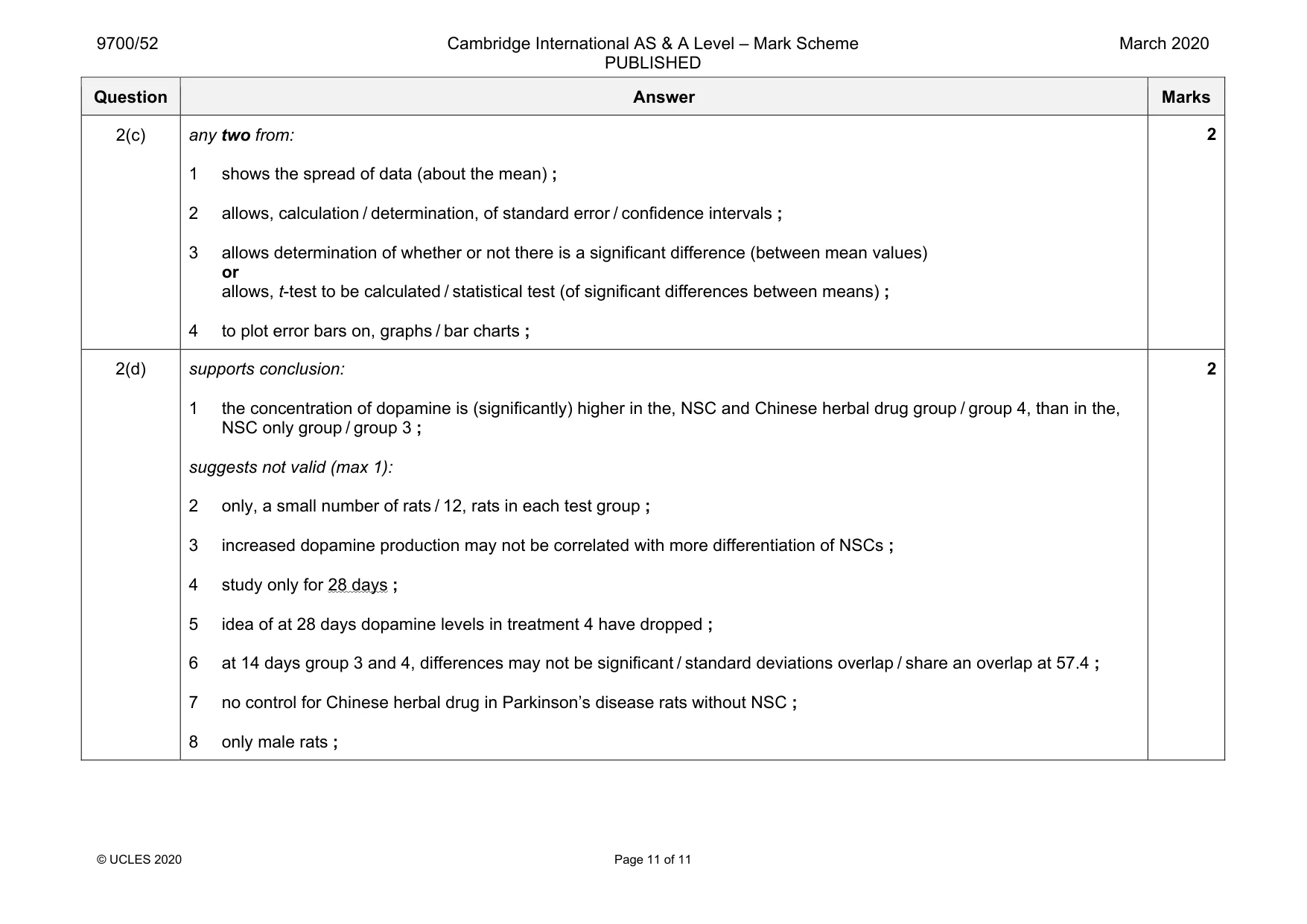
Mark scheme: 2(a)(i) any three from: 1 idea of the number of cases (per 100 000) increases with age ; 2 the number of men (per 100 000) with Parkinson’s disease is higher than women / higher proportion of men than women develop Parkinson’s disease / ora ; 3 greatest increase in cases occurs between 60–69 and 70–79 age group ; 4 number of cases in men increases at all ages or in women number of cases decreases at ages above 79 years ; 5 no, cases / symptoms, in under 30-year olds or cases / symptoms, start at 30 and above ; Question Answer Marks 2(a)(ii) any one from: data can be ranked ; at least five pairs of data ; graph suggests there is an increasing relationship ; 1 2(a)(iii) there is no correlation between age and the number of cases (per 100 000) of Parkinson’s disease ; 1 2(b)(i) any two from: 1 number of rats in each group / 12 rats per group ; 2 sex of rats / all male rats ; 3 volume of saline given / 4 cm3 saline given ; 4 time at which saline / treatment / injection / medication / AW, given ; or saline / treatment / injection / medication / AW, given at, same / stated, times ; 5 mass of rats / all rats within ± 20 g ; 6 health of rats / all rats, healthy ; 2 Question Answer Marks 2(b)(ii) any one from: age of rats ; number of NSC per injection / AW ; type of, food / nutrient ; mass of, food / nutrient ; time of feeding ; same, type / size, of cage ; type / species, of rat ; environmental temperature ; idea of stress / movement ; volume of water ; concentration of saline ; type / volume / mass / dose, of chemicals to induce Parkinson’s disease ; 1 Question Answer Marks 2(c) any two from: 1 shows the spread of data (about the mean) ; 2 allows, calculation / determination, of standard error / confidence intervals ; 3 allows determination of whether or not there is a significant difference (between mean values) or allows, t-test to be calculated / statistical test (of significant differences between means) ; 4 to plot error bars on, graphs / bar charts ; 2 2(d) supports conclusion: 1 the concentration of dopamine is (significantly) higher in the, NSC and Chinese herbal drug group / group 4, than in the, NSC only group / group 3 ; suggests not valid (max 1): 2 only, a small number of rats / 12, rats in each test group ; 3 increased dopamine production may not be correlated with more differentiation of NSCs ; 4 study only for 28 days ; 5 idea of at 28 days dopamine levels in treatment 4 have dropped ; 6 at 14 days group 3 and 4, differences may not be significant / standard deviations overlap / share an overlap at 57.4 ; 7 no control for Chinese herbal drug in Parkinson’s disease rats without NSC ; 8 only male rats ; 2
What was in this paper
The subtopics covered by these 2 questions, and how many questions each got. Open one in a new tab to see every Cambridge question on it.
What you needed in this session
Cambridge’s own grade thresholds for 2020 Feb/March, Paper 5 · Variant 2. A higher threshold means an easier paper — the bar moves with how the cohort did.