Cambridge A Level Biology 9700 — 2016 Oct/Nov Paper 3 · Variant 4
9700/34/O/N/16 · 40 marks · ≈45 min
The question paper and its mark scheme, free to read here and free to download. This is Cambridge’s own paper, exactly as it was sat.
Question paper16 pages




Mark scheme6 pages
Answers below. Sit the paper first if you are practising.
Paper as text
Question paper, page 1
This document consists of 12 printed pages and 4 blank pages. DC (LK/FD) 116086/2 © UCLES 2016 [Turn over Cambridge International Examinations Cambridge International Advanced Subsidiary and Advanced Level * 3 8 4 2 0 9 5 5 7 9 * BIOLOGY 9700/34 Paper 3 Advanced Practical Skills 2 October/November 2016 2 hours Candidates answer on the Question Paper. Additional Materials: As listed in the Confidential Instructions. READ THESE INSTRUCTIONS FIRST Write your Centre number, candidate number and name on all the work you hand in. Write in dark blue or black pen. You may use an HB pencil for any diagrams or graphs. Do not use staples, paperclips, glue or correction fluid. DO NOT WRITE IN ANY BARCODES. Answer all questions. Electronic calculators may be used. You may lose marks if you do not show your working or if you do not use appropriate units. At the end of the examination, fasten all your work securely together. The number of marks is given in brackets [ ] at the end of each question or part question. For Examiner’s Use 1 2 Total
Question paper, page 2
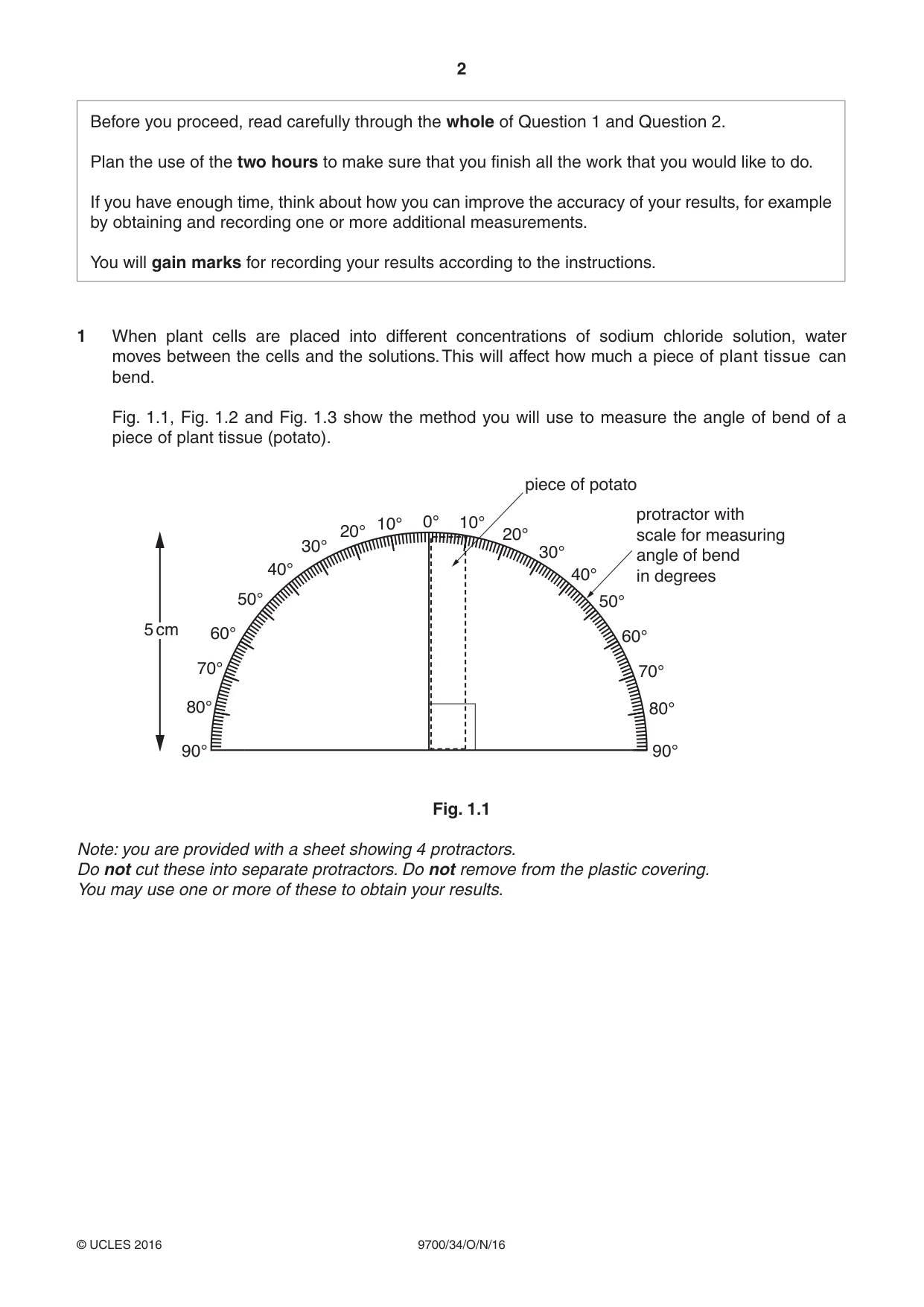
2 9700/34/O/N/16 © UCLES 2016 Before you proceed, read carefully through the whole of Question 1 and Question 2. Plan the use of the two hours to make sure that you finish all the work that you would like to do. If you have enough time, think about how you can improve the accuracy of your results, for example by obtaining and recording one or more additional measurements. You will gain marks for recording your results according to the instructions. 1 When plant cells are placed into different concentrations of sodium chloride solution, water moves between the cells and the solutions. This will affect how much a piece of plant tissue can bend. Fig. 1.1, Fig. 1.2 and Fig. 1.3 show the method you will use to measure the angle of bend of a piece of plant tissue (potato). 90° 90° 80° 80° 70° 70° 60° 60° 50° 50° 40° 40° 30° 30° 20° 20° piece of potato protractor with scale for measuring angle of bend in degrees 10° 10° 0° 5 cm Fig. 1.1 Note: you are provided with a sheet showing 4 protractors. Do not cut these into separate protractors. Do not remove from the plastic covering. You may use one or more of these to obtain your results.
Question paper, page 3
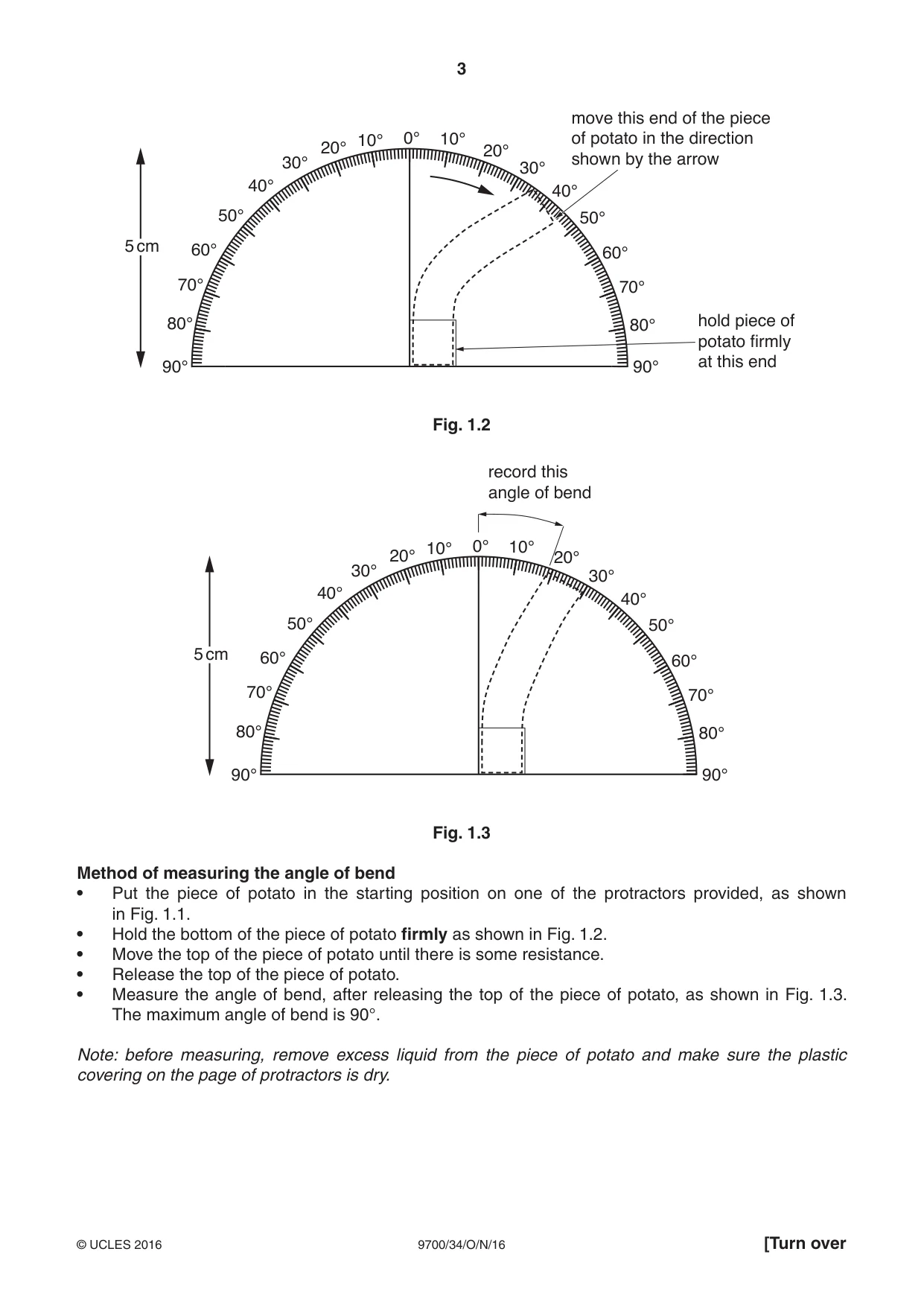
3 9700/34/O/N/16 © UCLES 2016 [Turn over move this end of the piece of potato in the direction shown by the arrow 90° 90° 80° 80° 70° 70° 60° 60° 50° 50° 40° 40° 30° 30° 20° 20° 10° 10° 0° 5 cm hold piece of potato firmly at this end Fig. 1.2 record this angle of bend 90° 90° 80° 80° 70° 70° 60° 60° 50° 50° 40° 40° 30° 30° 20° 20° 10° 10° 0° 5 cm Fig. 1.3 Method of measuring the angle of bend • Put the piece of potato in the starting position on one of the protractors provided, as shown in Fig. 1.1. • Hold the bottom of the piece of potato firmly as shown in Fig. 1.2. • Move the top of the piece of potato until there is some resistance. • Release the top of the piece of potato. • Measure the angle of bend, after releasing the top of the piece of potato, as shown in Fig. 1.3. The maximum angle of bend is 90°. Note: before measuring, remove excess liquid from the piece of potato and make sure the plastic covering on the page of protractors is dry.
Question paper, page 4
4 9700/34/O/N/16 © UCLES 2016 BLANK PAGE
Question paper, page 5
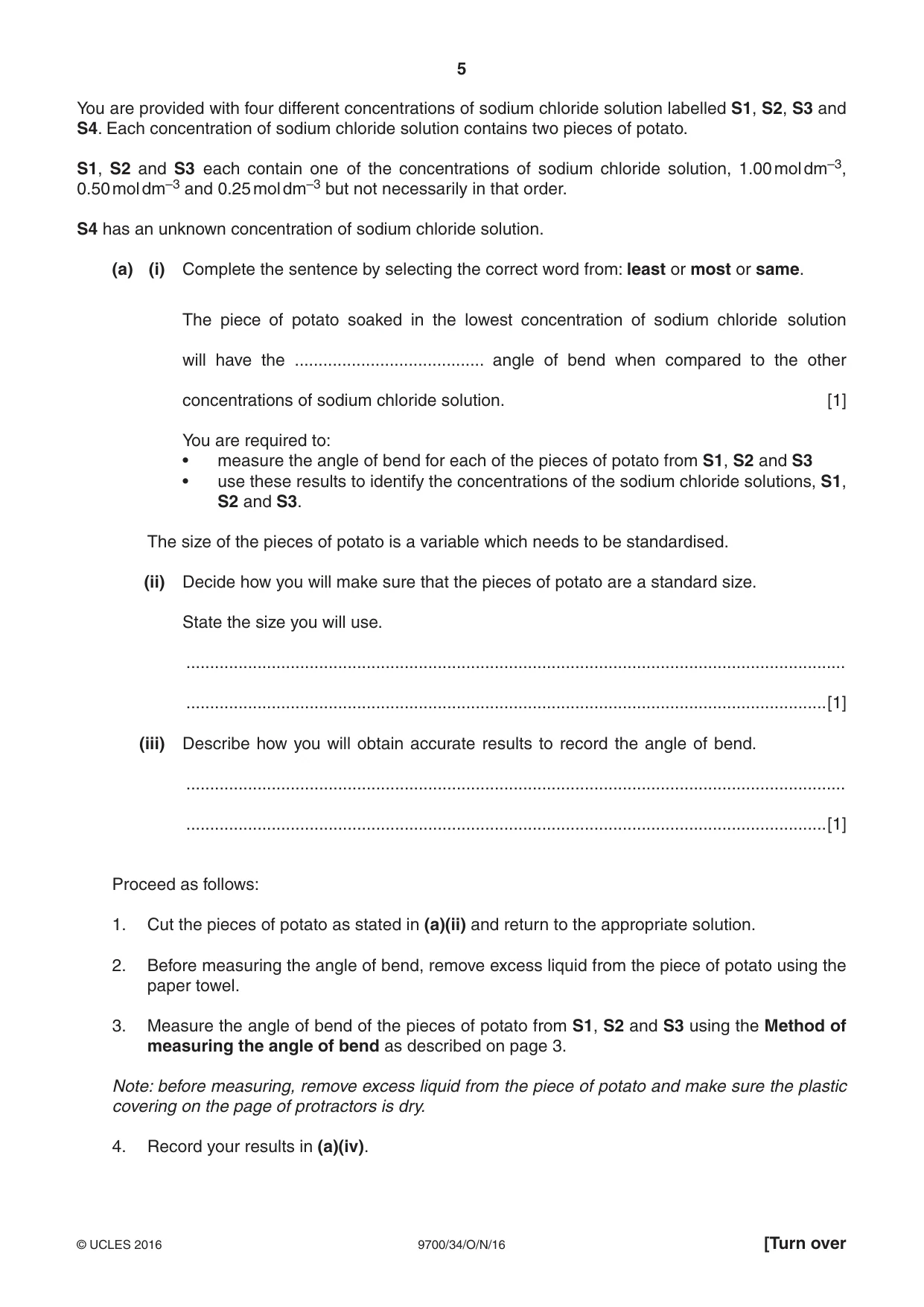
5 9700/34/O/N/16 © UCLES 2016 [Turn over You are provided with four different concentrations of sodium chloride solution labelled S1, S2, S3 and S4. Each concentration of sodium chloride solution contains two pieces of potato. S1, S2 and S3 each contain one of the concentrations of sodium chloride solution, 1.00 mol dm–3, 0.50 mol dm–3 and 0.25 mol dm–3 but not necessarily in that order. S4 has an unknown concentration of sodium chloride solution. (a) (i) Complete the sentence by selecting the correct word from: least or most or same. The piece of potato soaked in the lowest concentration of sodium chloride solution will have the … angle of bend when compared to the other concentrations of sodium chloride solution. [1] You are required to: • measure the angle of bend for each of the pieces of potato from S1, S2 and S3 • use these results to identify the concentrations of the sodium chloride solutions, S1, S2 and S3. The size of the pieces of potato is a variable which needs to be standardised. (ii) Decide how you will make sure that the pieces of potato are a standard size. State the size you will use. … …[1] (iii) Describe how you will obtain accurate results to record the angle of bend. … …[1] Proceed as follows: 1. Cut the pieces of potato as stated in (a)(ii) and return to the appropriate solution. 2. Before measuring the angle of bend, remove excess liquid from the piece of potato using the paper towel. 3. Measure the angle of bend of the pieces of potato from S1, S2 and S3 using the Method of measuring the angle of bend as described on page 3. Note: before measuring, remove excess liquid from the piece of potato and make sure the plastic covering on the page of protractors is dry. 4. Record your results in (a)(iv).
Question paper, page 6
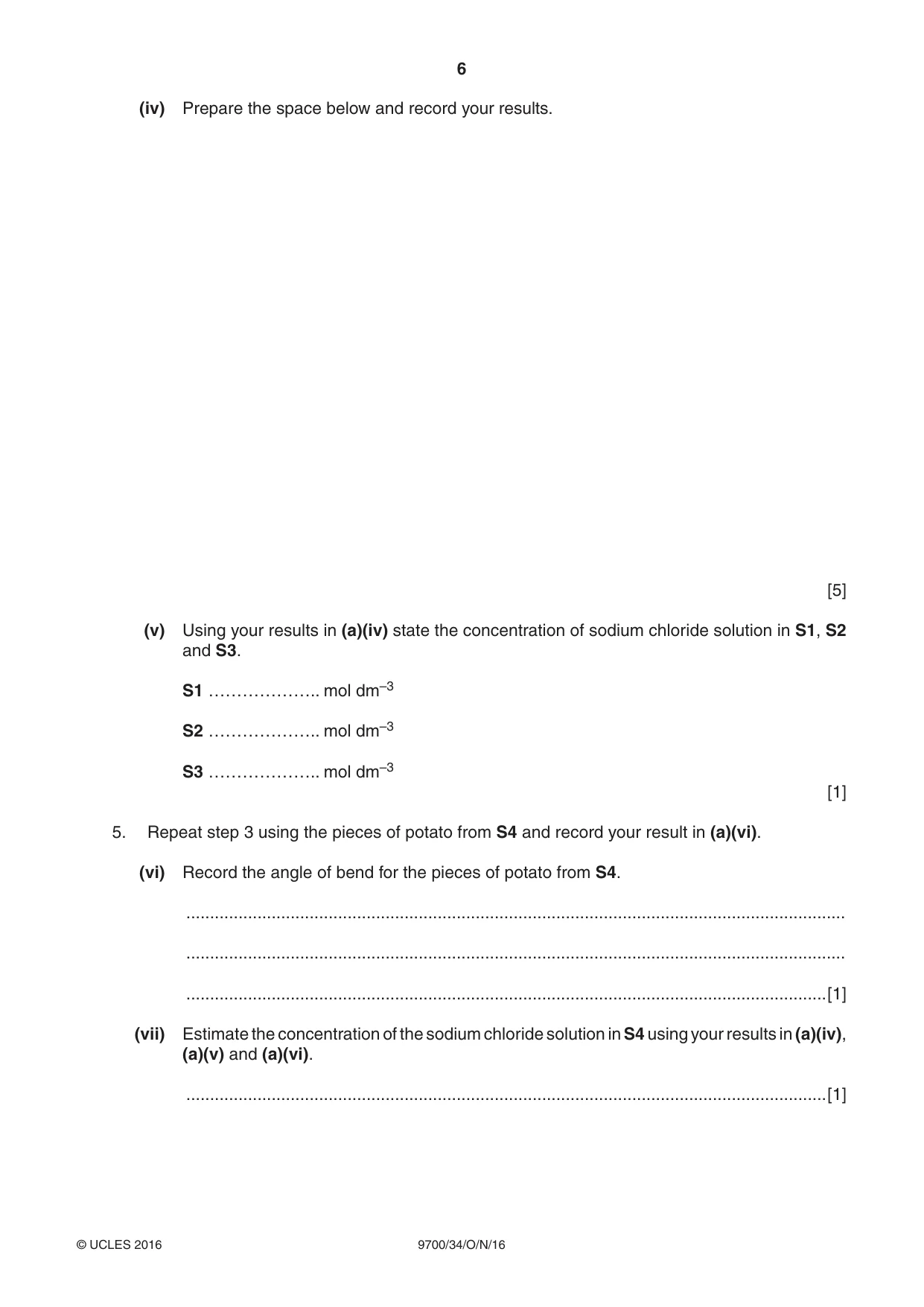
6 9700/34/O/N/16 © UCLES 2016 (iv) Prepare the space below and record your results. [5] (v) Using your results in (a)(iv) state the concentration of sodium chloride solution in S1, S2 and S3. S1 ……………….. mol dm–3 S2 ……………….. mol dm–3 S3 ……………….. mol dm–3 [1] 5. Repeat step 3 using the pieces of potato from S4 and record your result in (a)(vi). (vi) Record the angle of bend for the pieces of potato from S4. … … …[1] (vii) Estimate the concentration of the sodium chloride solution in S4 using your results in (a)(iv), (a)(v) and (a)(vi). …[1]
Question paper, page 7
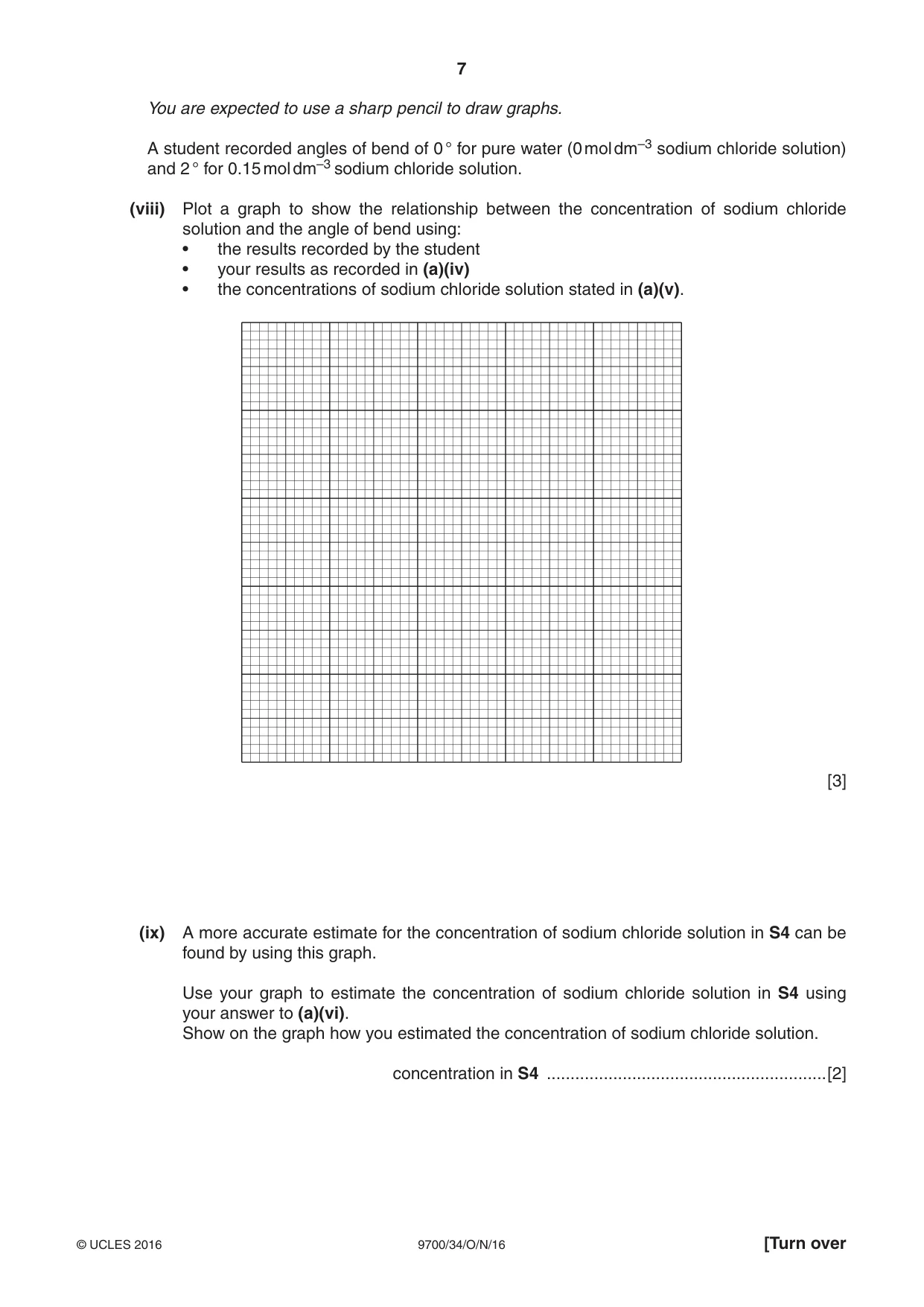
7 9700/34/O/N/16 © UCLES 2016 [Turn over You are expected to use a sharp pencil to draw graphs. A student recorded angles of bend of 0 ° for pure water (0 mol dm–3 sodium chloride solution) and 2 ° for 0.15 mol dm–3 sodium chloride solution. (viii) Plot a graph to show the relationship between the concentration of sodium chloride solution and the angle of bend using: • the results recorded by the student • your results as recorded in (a)(iv) • the concentrations of sodium chloride solution stated in (a)(v). [3] (ix) A more accurate estimate for the concentration of sodium chloride solution in S4 can be found by using this graph. Use yo ur graph to estimate the concentration of sodium chloride solution in S4 using your answer to (a)(vi). Show on the graph how you estimated the concentration of sodium chloride solution. concentration in S4 …[2]
Question paper, page 8
8 9700/34/O/N/16 © UCLES 2016 (b) Suggest how you would improve this procedure to have more confidence in your estimate of S4. … … … … …[3] (c) A student puts a piece of the potato from S1 into water. Explain, in terms of water potential, the effect this would have on the potato cells. … … … … …[2] [Total: 21]
Question paper, page 9
9 9700/34/O/N/16 © UCLES 2016 [Turn over Question 2 starts on page 10
Question paper, page 10
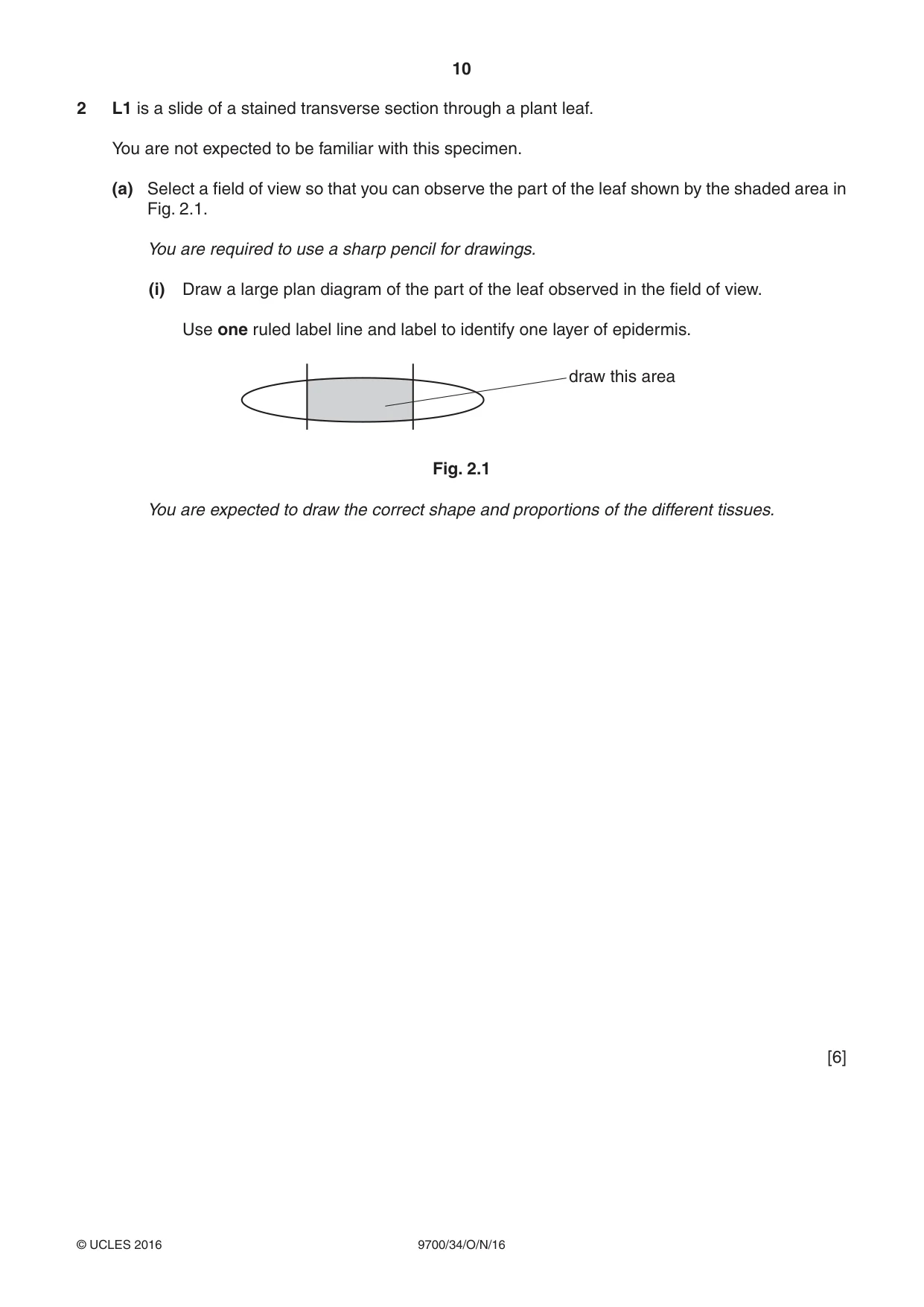
10 9700/34/O/N/16 © UCLES 2016 2 L1 is a slide of a stained transverse section through a plant leaf. You are not expected to be familiar with this specimen. (a) Select a field of view so that you can observe the part of the leaf shown by the shaded area in Fig. 2.1. You are required to use a sharp pencil for drawings. (i) Draw a large plan diagram of the part of the leaf observed in the field of view. Use one ruled label line and label to identify one layer of epidermis. draw this area Fig. 2.1 You are expected to draw the correct shape and proportions of the different tissues. [6]
Question paper, page 11
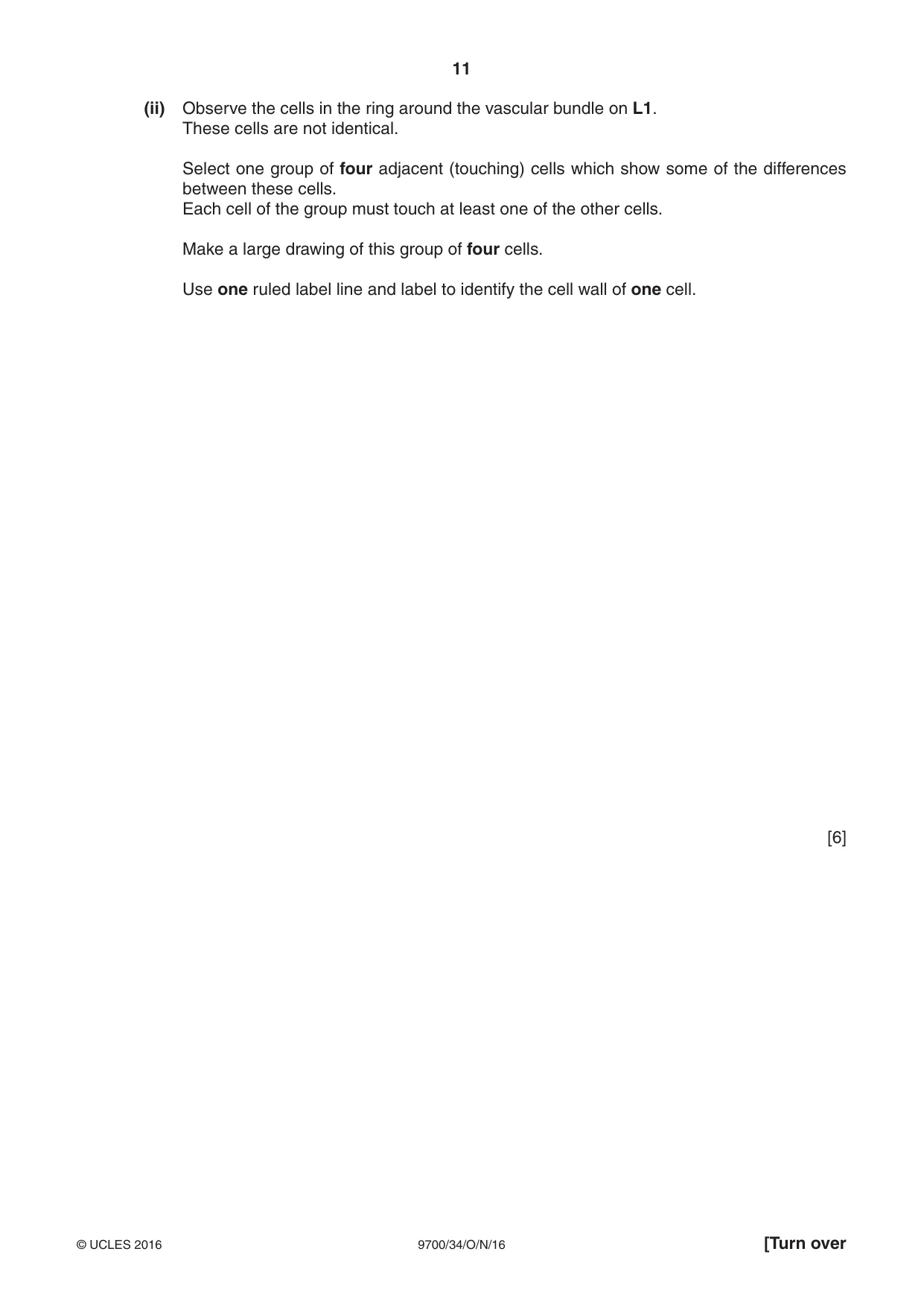
11 9700/34/O/N/16 © UCLES 2016 [Turn over (ii) Observe the cells in the ring around the vascular bundle on L1. These cells are not identical. Select one group of four adjacent (touching) cells which show some of the differences between these cells. Each cell of the group must touch at least one of the other cells. Make a large drawing of this group of four cells. Use one ruled label line and label to identify the cell wall of one cell. [6]
Question paper, page 12
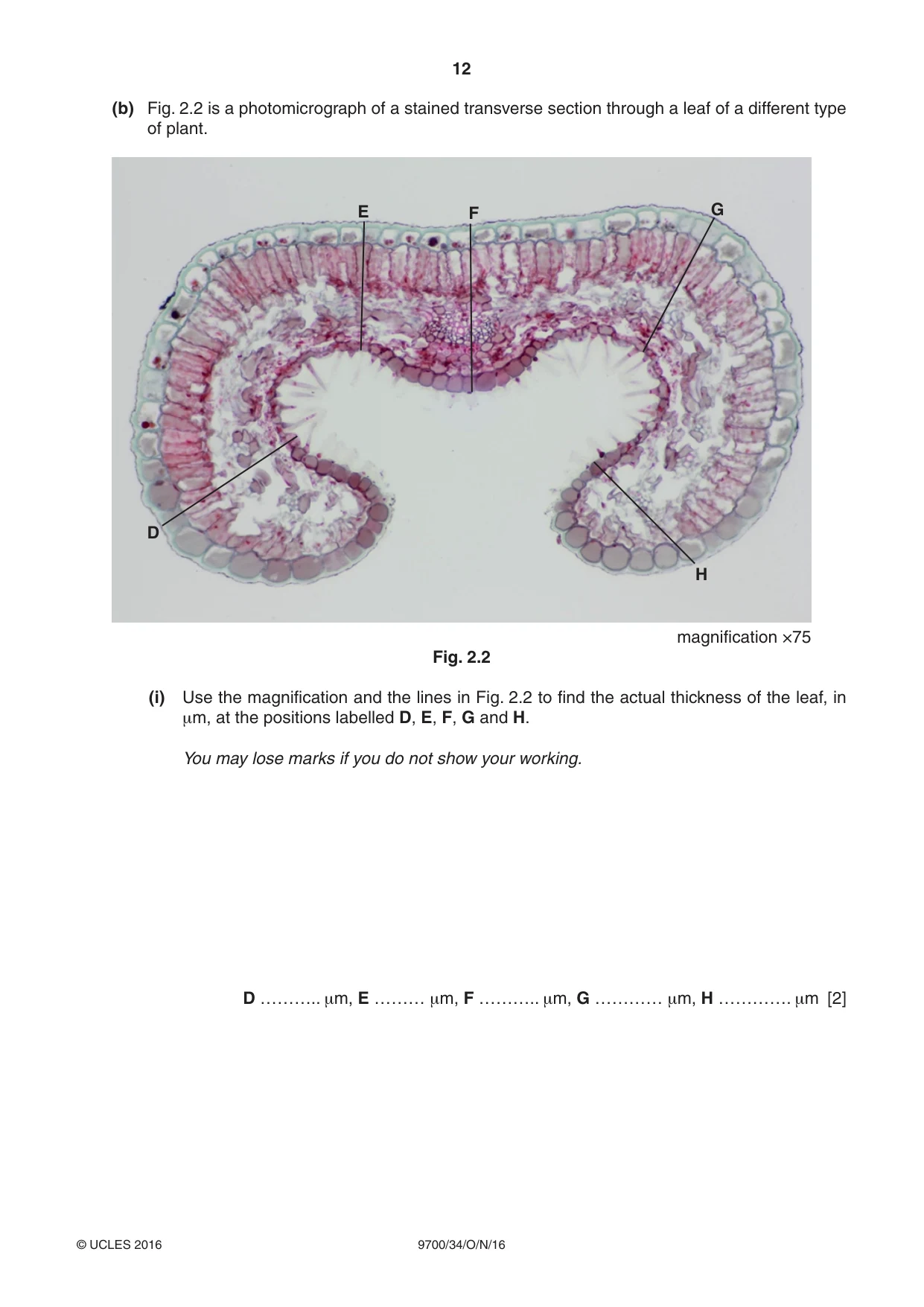
12 9700/34/O/N/16 © UCLES 2016 (b) Fig. 2.2 is a photomicrograph of a stained transverse section through a leaf of a different type of plant. D E F G H magnification ×75 Fig. 2.2 (i) Use the magnification and the lines in Fig. 2.2 to find the actual thickness of the leaf, in μm, at the positions labelled D, E, F, G and H. You may lose marks if you do not show your working. D ……….. μm, E ……… μm, F ……….. μm, G ………… μm, H …………. μm [2]
Question paper, page 13
13 9700/34/O/N/16 © UCLES 2016 (ii) Using the actual thicknesses calculated in (b)(i), calculate the mean actual thickness of the leaf. You may lose marks if you do not show your working or if you do not use appropriate units. mean actual thickness …[2] (c) The leaf on slide L1 and the leaf in Fig 2.2 are adapted to living in dry conditions. Prepare the space below so that it is suitable for you to record observable differences in xerophytic adaptations between these two specimens. Record your observations in the space you have prepared. [3] [Total: 19]
Question paper, page 14
14 9700/34/O/N/16 © UCLES 2016 BLANK PAGE
Question paper, page 15
15 9700/34/O/N/16 © UCLES 2016 BLANK PAGE
Question paper, page 16
16 9700/34/O/N/16 © UCLES 2016 Permission to reproduce items where third-party owned material protected by copyright is included has been sought and cleared where possible. Every reasonable effort has been made by the publisher (UCLES) to trace copyright holders, but if any items requiring clearance have unwittingly been included, the publisher will be pleased to make amends at the earliest possible opportunity. To avoid the issue of disclosure of answer-related information to candidates, all copyright acknowledgements are reproduced online in the Cambridge International Examinations Copyright Acknowledgements Booklet. This is produced for each series of examinations and is freely available to download at www.cie.org.uk after the live examination series. Cambridge International Examinations is part of the Cambridge Assessment Group. Cambridge Assessment is the brand name of University of Cambridge Local Examinations Syndicate (UCLES), which is itself a department of the University of Cambridge. BLANK PAGE
Mark scheme, page 1
® IGCSE is the registered trademark of Cambridge International Examinations. This document consists of 6 printed pages. © UCLES 2016 [Turn over Cambridge International Examinations Cambridge International Advanced Subsidiary and Advanced Level BIOLOGY 9700/34 Paper 3 Advanced Practical Skills 2 October/November 2016 MARK SCHEME Maximum Mark: 40 Published This mark scheme is published as an aid to teachers and candidates, to indicate the requirements of the examination. It shows the basis on which Examiners were instructed to award marks. It does not indicate the details of the discussions that took place at an Examiners’ meeting before marking began, which would have considered the acceptability of alternative answers. Mark schemes should be read in conjunction with the question paper and the Principal Examiner Report for Teachers. Cambridge will not enter into discussions about these mark schemes. Cambridge is publishing the mark schemes for the October/November 2016 series for most Cambridge IGCSE®, Cambridge International A and AS Level components and some Cambridge O Level components.
Mark scheme, page 2
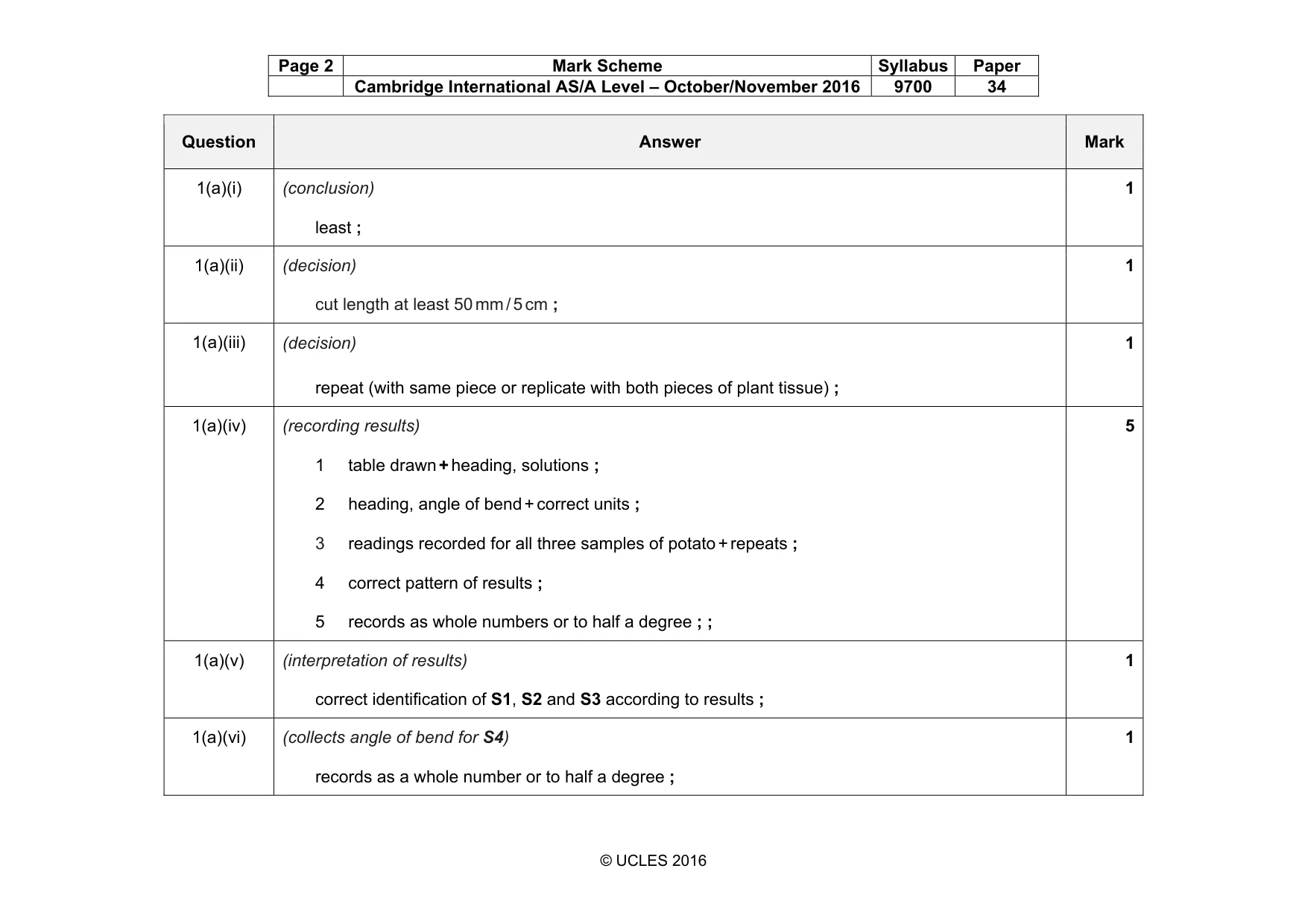
Page 2 Mark Scheme Syllabus Paper Cambridge International AS/A Level – October/November 2016 9700 34 © UCLES 2016 Question Answer Mark 1(a)(i) (conclusion) least ; 1 1(a)(ii) (decision) cut length at least 50 mm / 5 cm ; 1 1(a)(iii) (decision) repeat (with same piece or replicate with both pieces of plant tissue) ; 1 1(a)(iv) (recording results) 1 table drawn + heading, solutions ; 2 heading, angle of bend + correct units ; 3 readings recorded for all three samples of potato + repeats ; 4 correct pattern of results ; 5 records as whole numbers or to half a degree ; ; 5 1(a)(v) (interpretation of results) correct identification of S1, S2 and S3 according to results ; 1 1(a)(vi) (collects angle of bend for S4) records as a whole number or to half a degree ; 1
Mark scheme, page 3
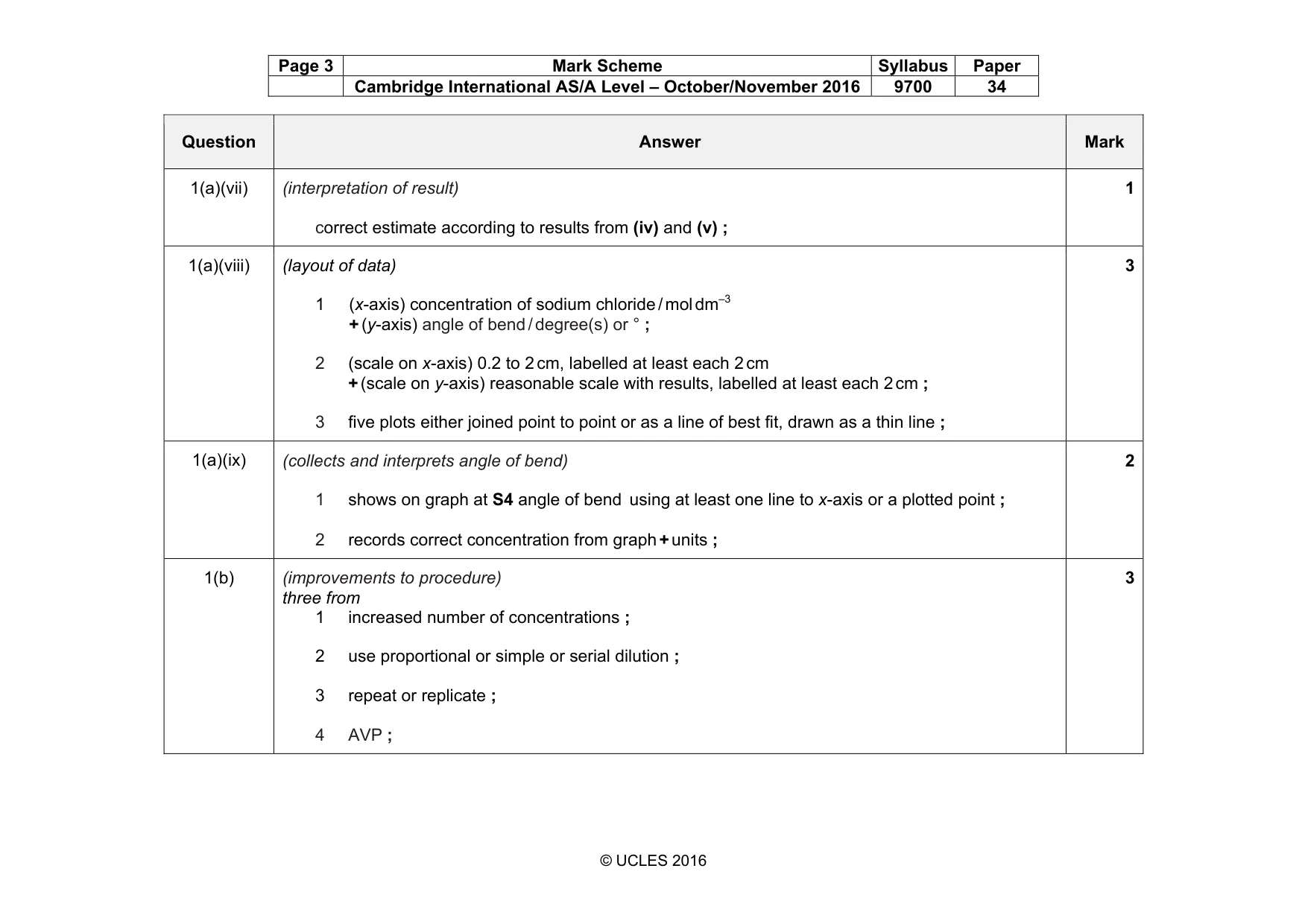
Page 3 Mark Scheme Syllabus Paper Cambridge International AS/A Level – October/November 2016 9700 34 © UCLES 2016 Question Answer Mark 1(a)(vii) (interpretation of result) correct estimate according to results from (iv) and (v) ; 1 1(a)(viii) (layout of data) 1 (x-axis) concentration of sodium chloride / mol dm–3 + (y-axis) angle of bend / degree(s) or ° ; 2 (scale on x-axis) 0.2 to 2 cm, labelled at least each 2 cm + (scale on y-axis) reasonable scale with results, labelled at least each 2 cm ; 3 five plots either joined point to point or as a line of best fit, drawn as a thin line ; 3 1(a)(ix) (collects and interprets angle of bend) 1 shows on graph at S4 angle of bend using at least one line to x-axis or a plotted point ; 2 records correct concentration from graph + units ; 2 1(b) (improvements to procedure) three from 1 increased number of concentrations ; 2 use proportional or simple or serial dilution ; 3 repeat or replicate ; 4 AVP ; 3
Mark scheme, page 4
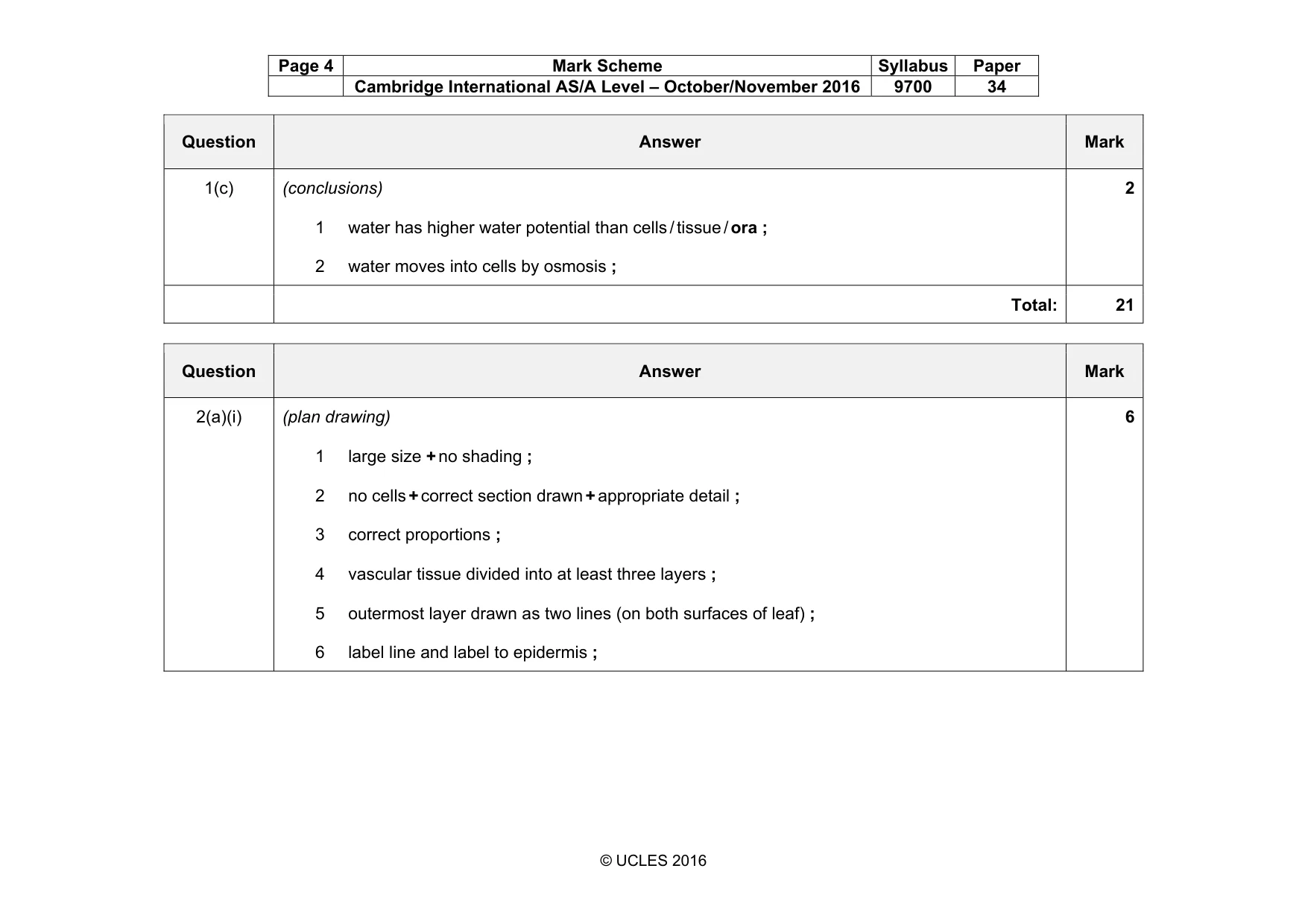
Page 4 Mark Scheme Syllabus Paper Cambridge International AS/A Level – October/November 2016 9700 34 © UCLES 2016 Question Answer Mark 1(c) (conclusions) 1 water has higher water potential than cells / tissue / ora ; 2 water moves into cells by osmosis ; 2 Total: 21 Question Answer Mark 2(a)(i) (plan drawing) 1 large size + no shading ; 2 no cells + correct section drawn + appropriate detail ; 3 correct proportions ; 4 vascular tissue divided into at least three layers ; 5 outermost layer drawn as two lines (on both surfaces of leaf) ; 6 label line and label to epidermis ; 6
Mark scheme, page 5
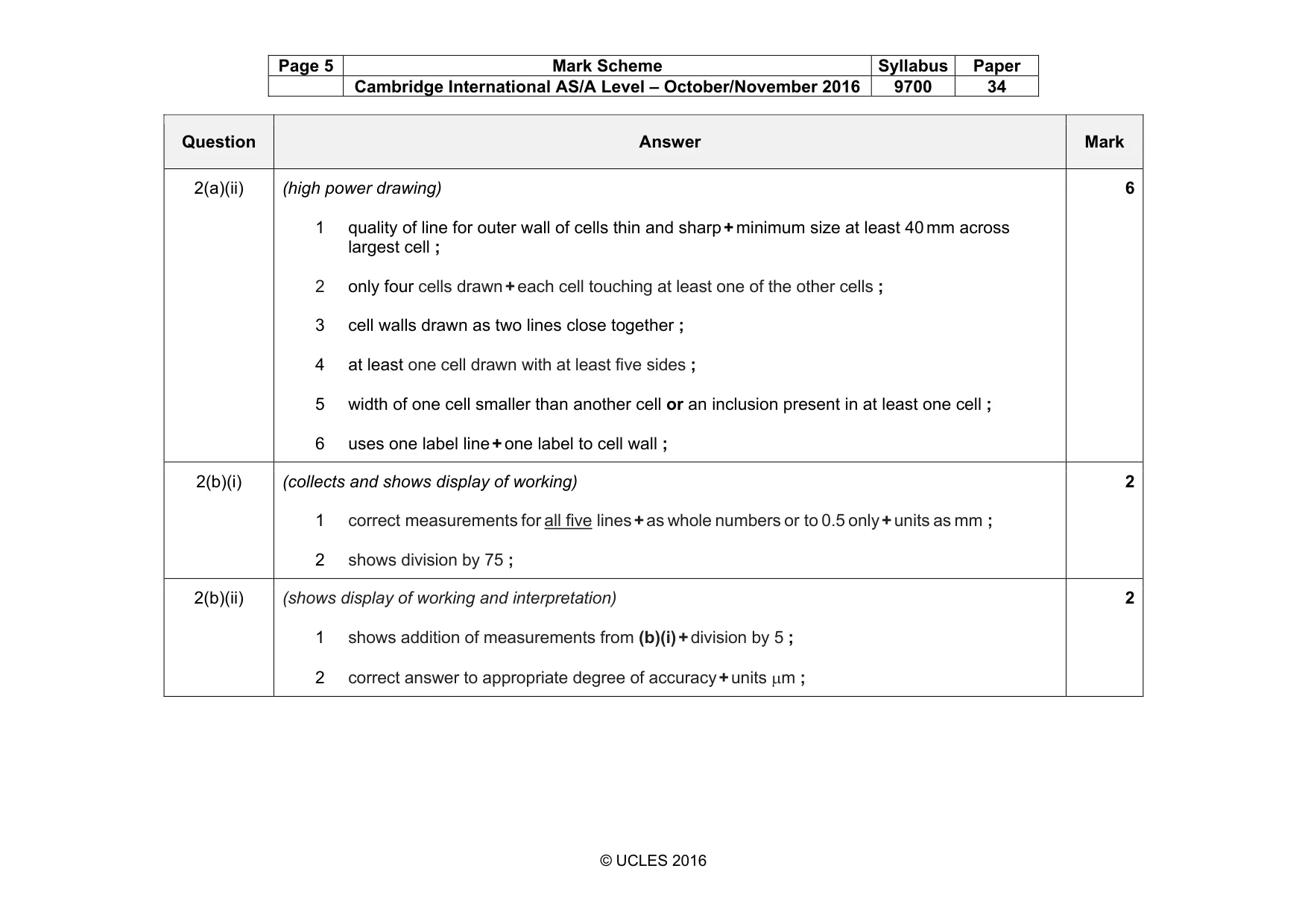
Page 5 Mark Scheme Syllabus Paper Cambridge International AS/A Level – October/November 2016 9700 34 © UCLES 2016 Question Answer Mark 2(a)(ii) (high power drawing) 1 quality of line for outer wall of cells thin and sharp + minimum size at least 40 mm across largest cell ; 2 only four cells drawn + each cell touching at least one of the other cells ; 3 cell walls drawn as two lines close together ; 4 at least one cell drawn with at least five sides ; 5 width of one cell smaller than another cell or an inclusion present in at least one cell ; 6 uses one label line + one label to cell wall ; 6 2(b)(i) (collects and shows display of working) 1 correct measurements for all five lines + as whole numbers or to 0.5 only + units as mm ; 2 shows division by 75 ; 2 2(b)(ii) (shows display of working and interpretation) 1 shows addition of measurements from (b)(i) + division by 5 ; 2 correct answer to appropriate degree of accuracy + units µm ; 2
Mark scheme, page 6
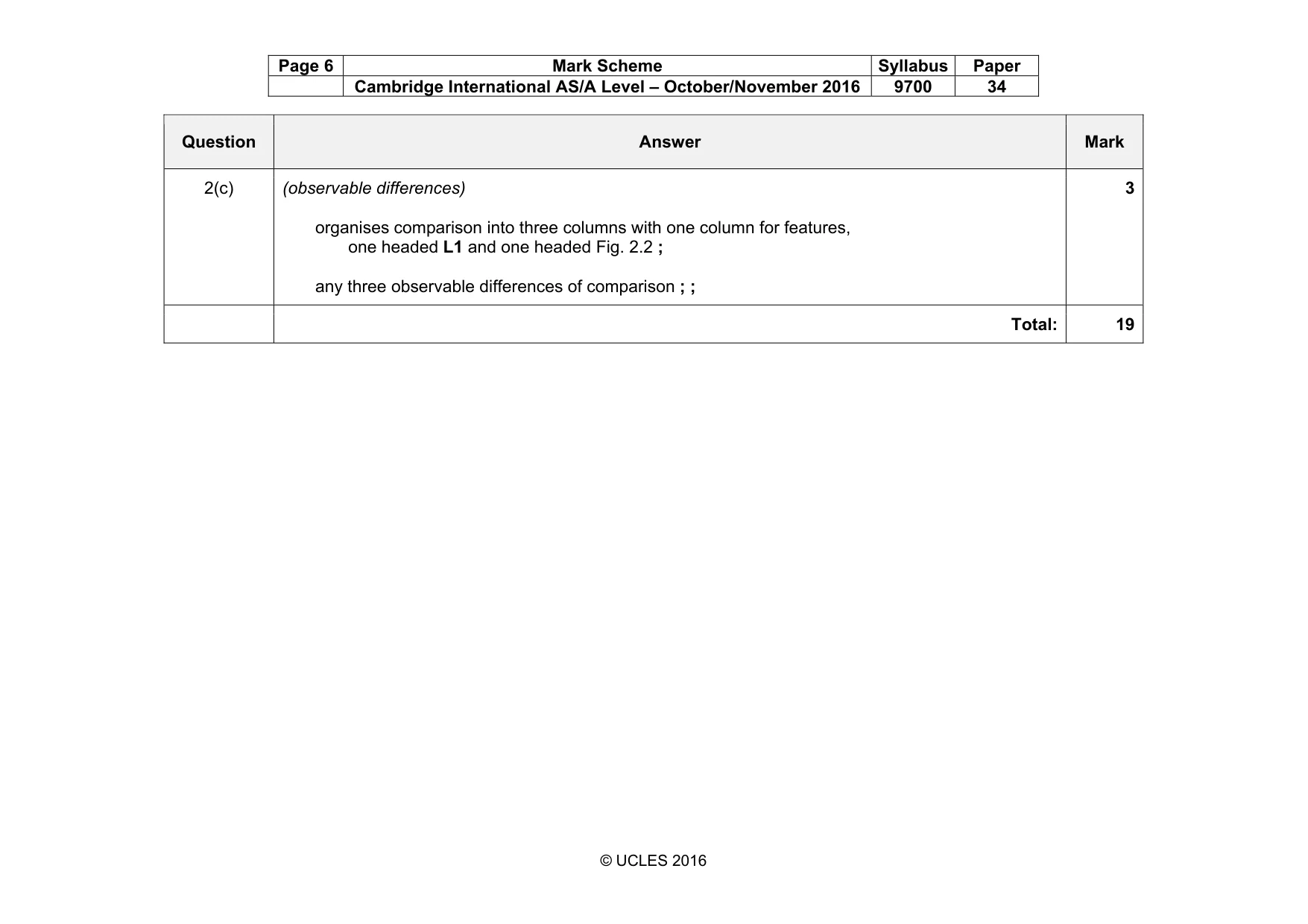
Page 6 Mark Scheme Syllabus Paper Cambridge International AS/A Level – October/November 2016 9700 34 © UCLES 2016 Question Answer Mark 2(c) (observable differences) organises comparison into three columns with one column for features, one headed L1 and one headed Fig. 2.2 ; any three observable differences of comparison ; ; 3 Total: 19
What you needed in this session
Cambridge’s own grade thresholds for 2016 Oct/Nov, Paper 3 · Variant 4. A higher threshold means an easier paper — the bar moves with how the cohort did.