Cambridge A Level Biology 9700 — 2016 May/June Paper 3 · Variant 2
9700/32/M/J/16 · 40 marks · ≈45 min
The question paper and its mark scheme, free to read here and free to download. This is Cambridge’s own paper, exactly as it was sat.
Question paper12 pages

Mark scheme
No mark scheme is in the library for this paper.
Paper as text
Question paper, page 1
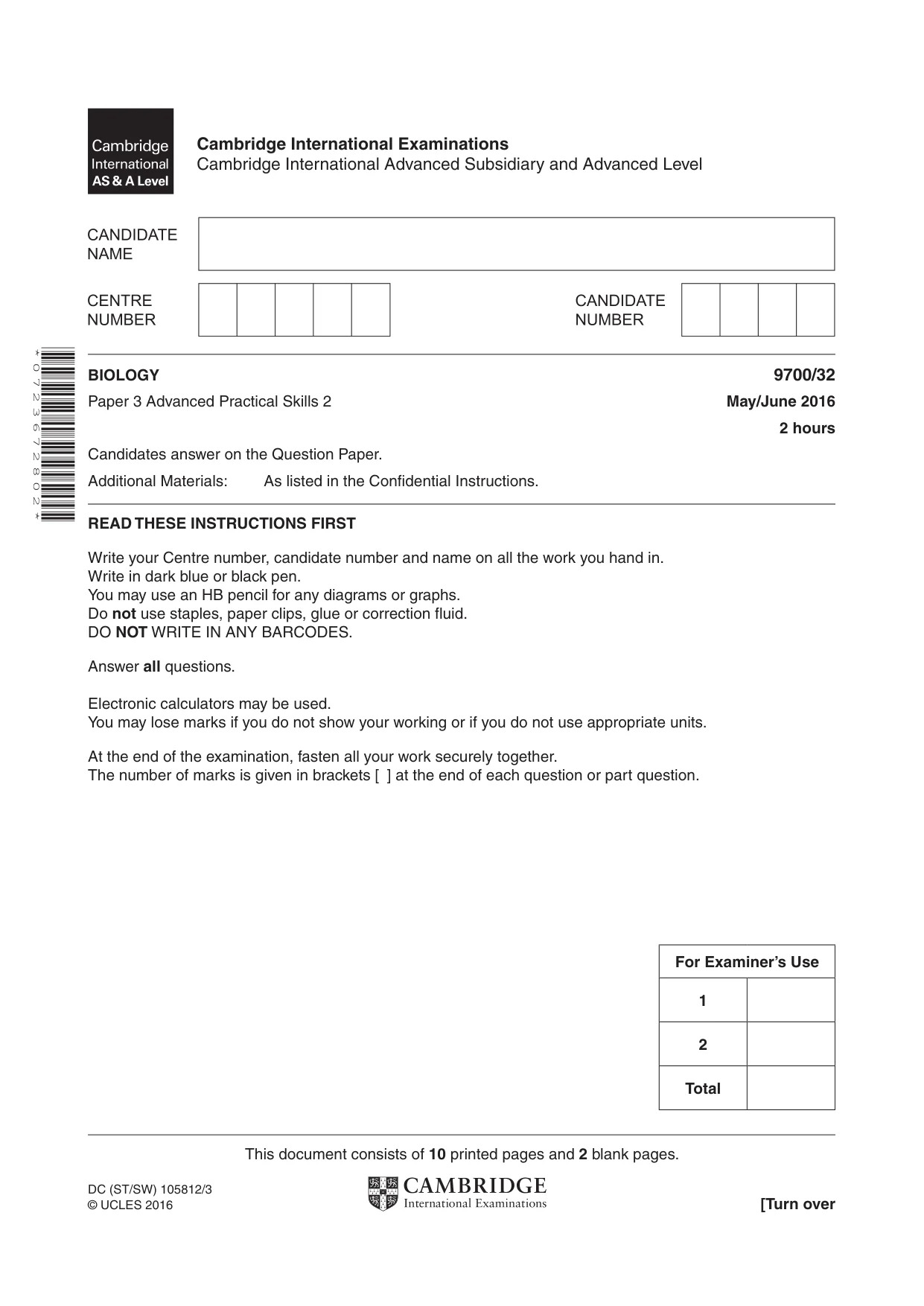
This document consists of 10 printed pages and 2 blank pages. DC (ST/SW) 105812/3 © UCLES 2016 [Turn over Cambridge International Examinations Cambridge International Advanced Subsidiary and Advanced Level * 0 7 2 3 6 7 2 8 0 2 * BIOLOGY 9700/32 Paper 3 Advanced Practical Skills 2 May/June 2016 2 hours Candidates answer on the Question Paper. Additional Materials: As listed in the Confidential Instructions. READ THESE INSTRUCTIONS FIRST Write your Centre number, candidate number and name on all the work you hand in. Write in dark blue or black pen. You may use an HB pencil for any diagrams or graphs. Do not use staples, paper clips, glue or correction fluid. DO NOT WRITE IN ANY BARCODES. Answer all questions. Electronic calculators may be used. You may lose marks if you do not show your working or if you do not use appropriate units. At the end of the examination, fasten all your work securely together. The number of marks is given in brackets [ ] at the end of each question or part question. For Examiner’s Use 1 2 Total
Question paper, page 2
2 9700/32/M/J/16 © UCLES 2016 BLANK PAGE
Question paper, page 3
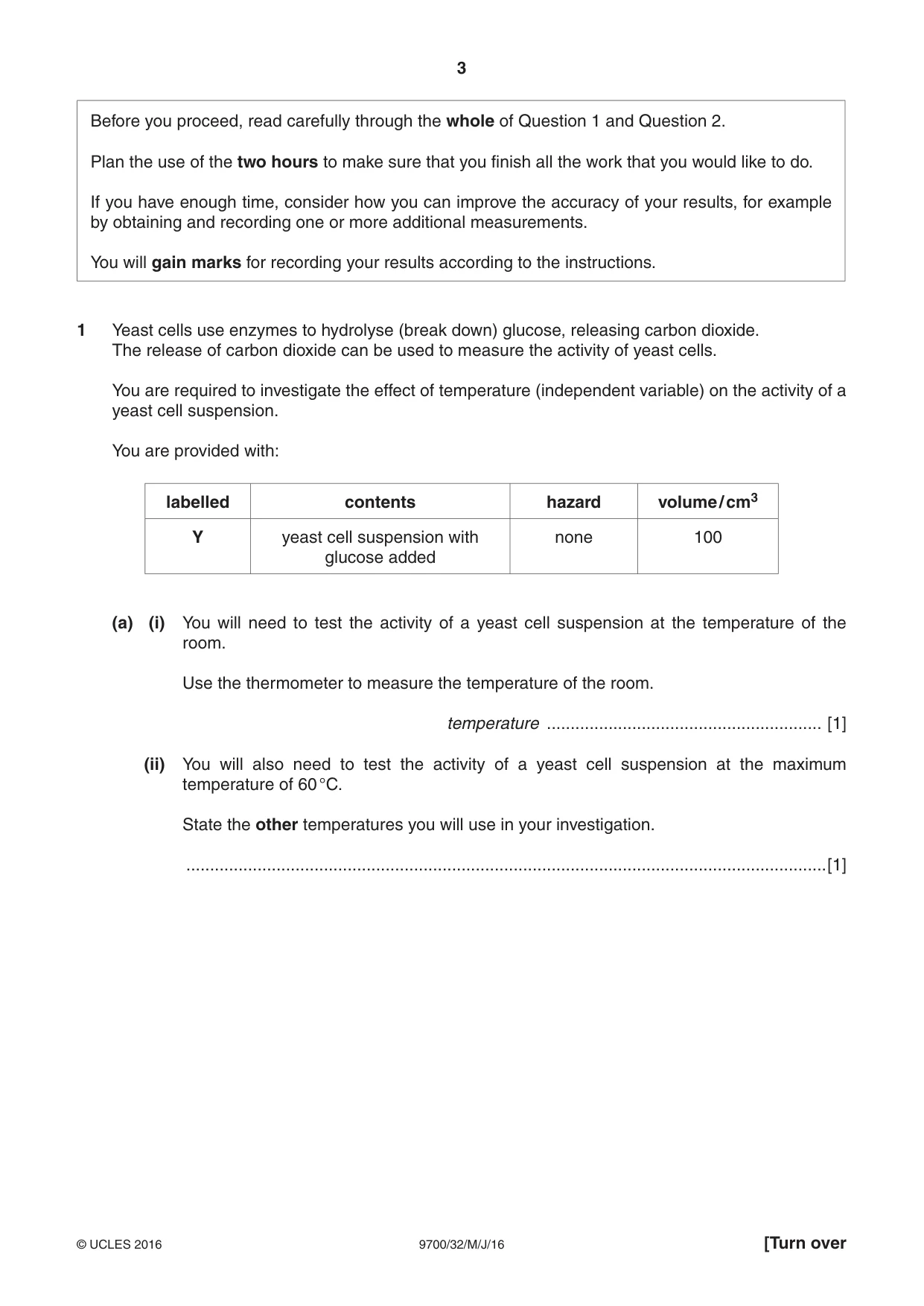
3 9700/32/M/J/16 © UCLES 2016 [Turn over Before you proceed, read carefully through the whole of Question 1 and Question 2. Plan the use of the two hours to make sure that you finish all the work that you would like to do. If you have enough time, consider how you can improve the accuracy of your results, for example by obtaining and recording one or more additional measurements. You will gain marks for recording your results according to the instructions. 1 Yeast cells use enzymes to hydrolyse (break down) glucose, releasing carbon dioxide. The release of carbon dioxide can be used to measure the activity of yeast cells. You are required to investigate the effect of temperature (independent variable) on the activity of a yeast cell suspension. You are provided with: labelled contents hazard volume / cm3 Y yeast cell suspension with glucose added none 100 (a) (i) You will need to test the activity of a yeast cell suspension at the temperature of the room. Use the thermometer to measure the temperature of the room. temperature … [1] (ii) You will also need to test the activity of a yeast cell suspension at the maximum temperature of 60 °C. State the other temperatures you will use in your investigation. …[1]
Question paper, page 4
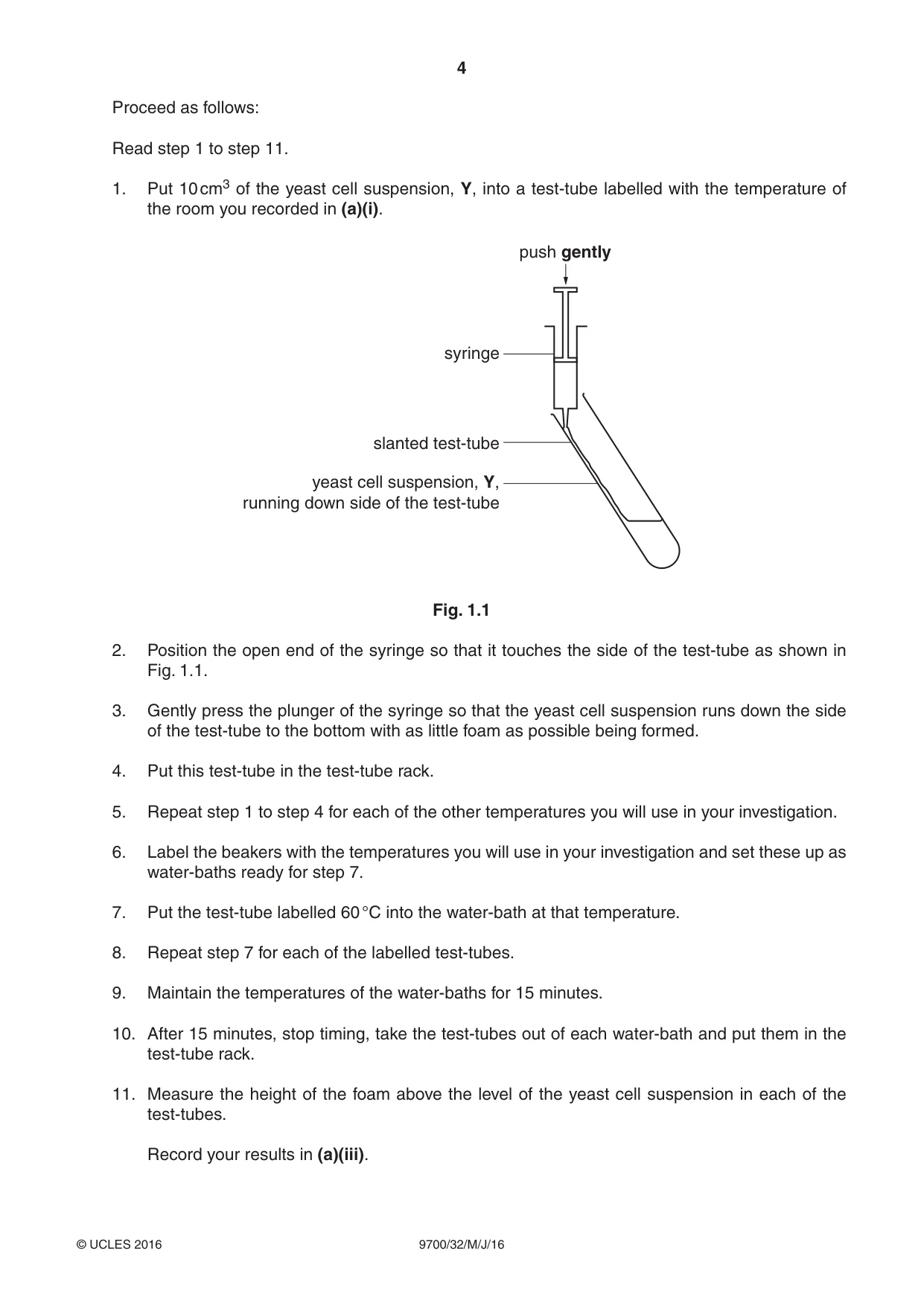
4 9700/32/M/J/16 © UCLES 2016 Proceed as follows: Read step 1 to step 11. 1. Put 10 cm3 of the yeast cell suspension, Y, into a test-tube labelled with the temperature of the room you recorded in (a)(i). syringe push gently slanted test-tube yeast cell suspension, Y, running down side of the test-tube Fig. 1.1 2. Position the open end of the syringe so that it touches the side of the test-tube as shown in Fig. 1.1. 3. Gently press the plunger of the syringe so that the yeast cell suspension runs down the side of the test-tube to the bottom with as little foam as possible being formed. 4. Put this test-tube in the test-tube rack. 5. Repeat step 1 to step 4 for each of the other temperatures you will use in your investigation. 6. Label the beakers with the temperatures you will use in your investigation and set these up as water-baths ready for step 7. 7. Put the test-tube labelled 60 °C into the water-bath at that temperature. 8. Repeat step 7 for each of the labelled test-tubes. 9. Maintain the temperatures of the water-baths for 15 minutes. 10. After 15 minutes, stop timing, take the test-tubes out of each water-bath and put them in the test-tube rack. 11. Measure the height of the foam above the level of the yeast cell suspension in each of the test-tubes. Record your results in (a)(iii).
Question paper, page 5
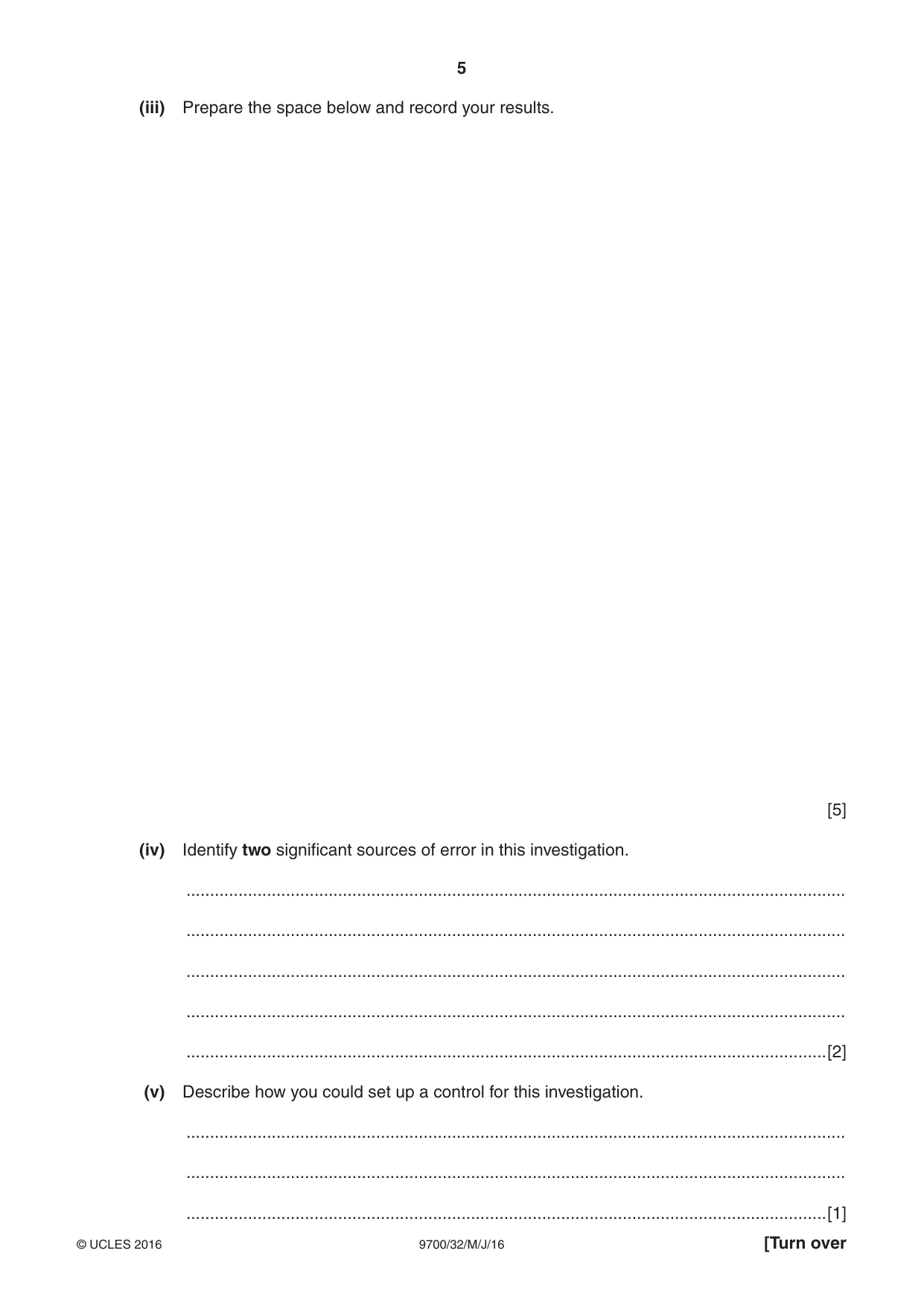
5 9700/32/M/J/16 © UCLES 2016 [Turn over (iii) Prepare the space below and record your results. [5] (iv) Identify two significant sources of error in this investigation. … … … … …[2] (v) Describe how you could set up a control for this investigation. … … …[1]
Question paper, page 6
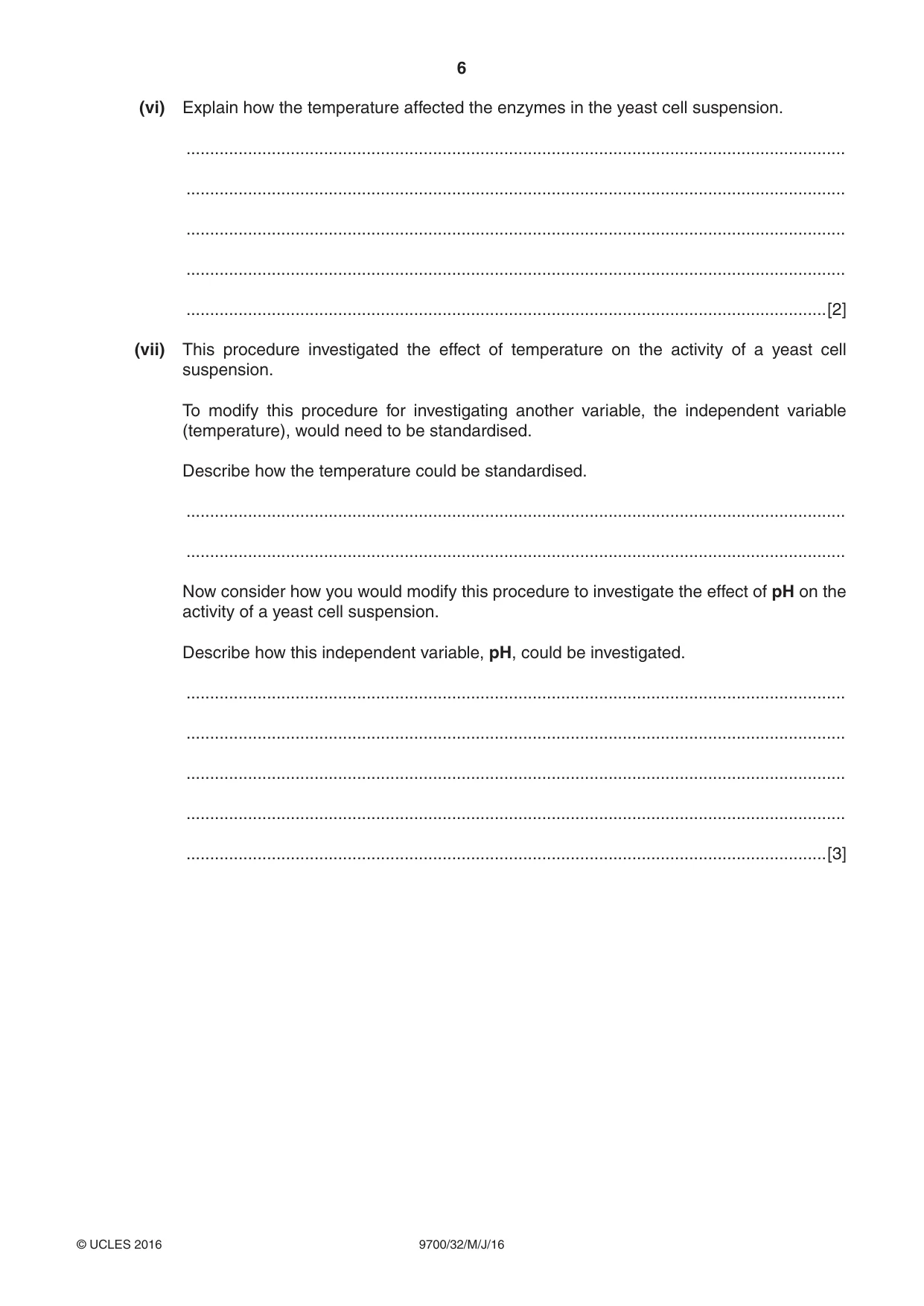
6 9700/32/M/J/16 © UCLES 2016 (vi) Explain how the temperature affected the enzymes in the yeast cell suspension. … … … … …[2] (vii) This procedure investigated the effect of temperature on the activity of a yeast cell suspension. To modify this procedure for investigating another variable, the independent variable (temperature), would need to be standardised. Describe how the temperature could be standardised. … … Now consider how you would modify this procedure to investigate the effect of pH on the activity of a yeast cell suspension. Describe how this independent variable, pH, could be investigated. … … … … …[3]
Question paper, page 7
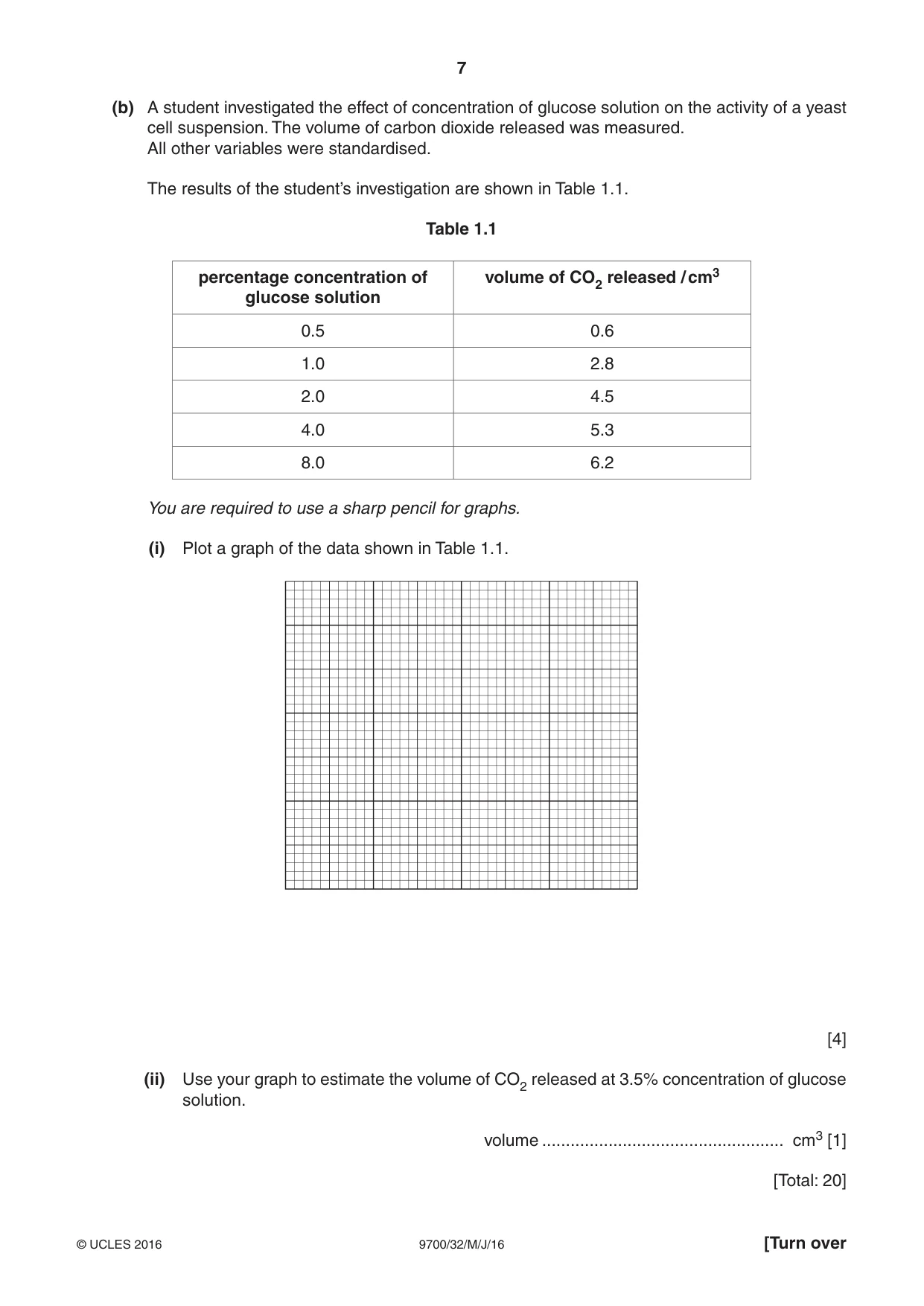
7 9700/32/M/J/16 © UCLES 2016 [Turn over (b) A student investigated the effect of concentration of glucose solution on the activity of a yeast cell suspension. The volume of carbon dioxide released was measured. All other variables were standardised. The results of the student’s investigation are shown in Table 1.1. Table 1.1 percentage concentration of glucose solution volume of CO2 released / cm3 0.5 0.6 1.0 2.8 2.0 4.5 4.0 5.3 8.0 6.2 You are required to use a sharp pencil for graphs. (i) Plot a graph of the data shown in Table 1.1. [4] (ii) Use your graph to estimate the volume of CO2 released at 3.5% concentration of glucose solution. volume … cm3 [1] [Total: 20]
Question paper, page 8
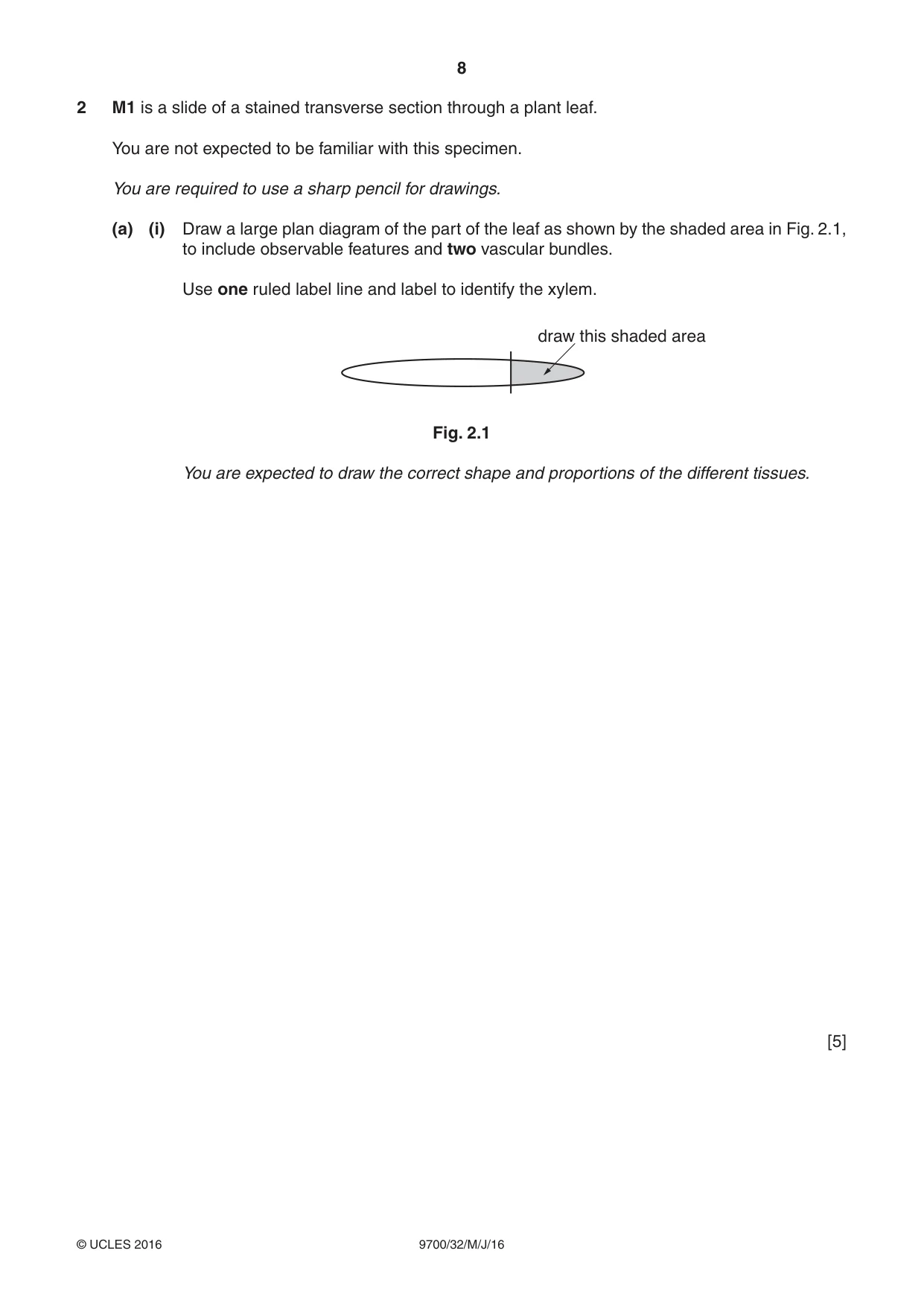
8 9700/32/M/J/16 © UCLES 2016 2 M1 is a slide of a stained transverse section through a plant leaf. You are not expected to be familiar with this specimen. You are required to use a sharp pencil for drawings. (a) (i) Draw a large plan diagram of the part of the leaf as shown by the shaded area in Fig. 2.1, to include observable features and two vascular bundles. Use one ruled label line and label to identify the xylem. draw this shaded area Fig. 2.1 You are expected to draw the correct shape and proportions of the different tissues. [5]
Question paper, page 9
9 9700/32/M/J/16 © UCLES 2016 [Turn over (ii) Within this leaf on M1 canals are situated between the vascular bundles. The canals are each made up of a circular group of cells surrounding a lumen. Select one canal and observe the innermost ring of cells surrounding the lumen. Select one group of four adjacent (touching) cells. Each cell of the group must touch at least one other cell. Make a large drawing of this group of four cells. Use one ruled label line and label to identify the cell wall of one cell. [5]
Question paper, page 10
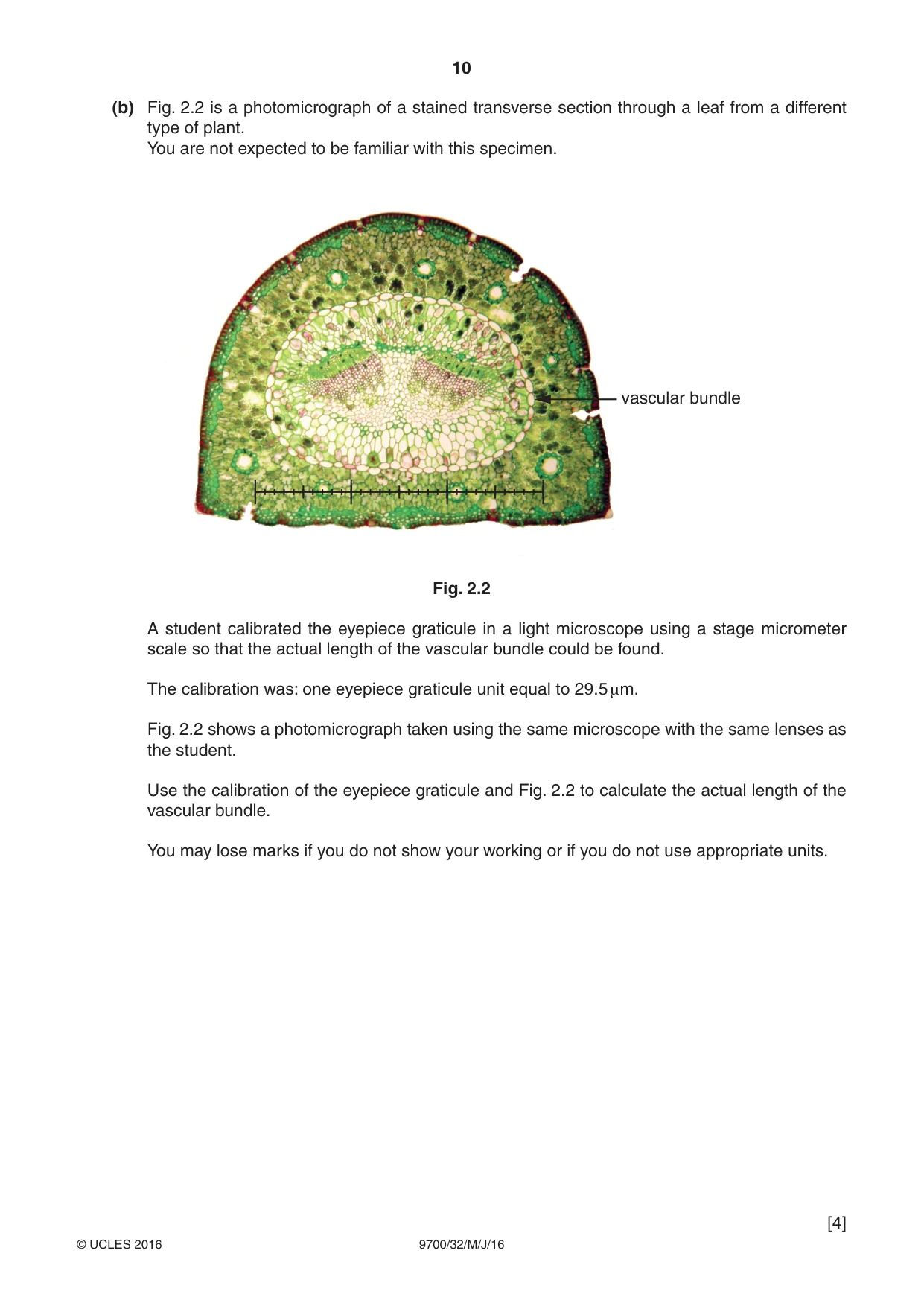
10 9700/32/M/J/16 © UCLES 2016 (b) Fig. 2.2 is a photomicrograph of a stained transverse section through a leaf from a different type of plant. You are not expected to be familiar with this specimen. vascular bundle Fig. 2.2 A student calibrated the eyepiece graticule in a light microscope using a stage micrometer scale so that the actual length of the vascular bundle could be found. The calibration was: one eyepiece graticule unit equal to 29.5 μm. Fig. 2.2 shows a photomicrograph taken using the same microscope with the same lenses as the student. Use the calibration of the eyepiece graticule and Fig. 2.2 to calculate the actual length of the vascular bundle. You may lose marks if you do not show your working or if you do not use appropriate units. [4]
Question paper, page 11
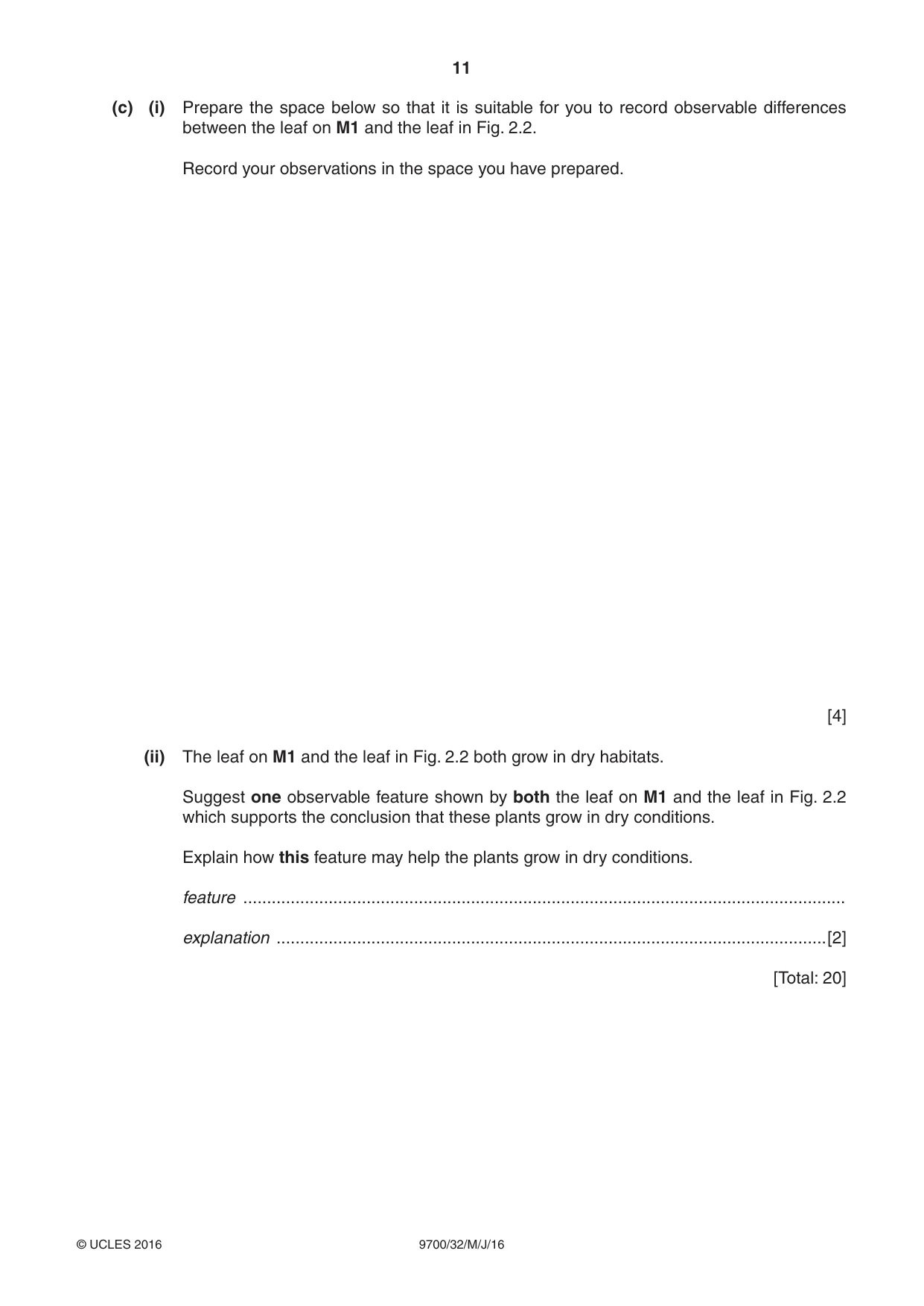
11 9700/32/M/J/16 © UCLES 2016 (c) (i) Prepare the space below so that it is suitable for you to record observable differences between the leaf on M1 and the leaf in Fig. 2.2. Record your observations in the space you have prepared. [4] (ii) The leaf on M1 and the leaf in Fig. 2.2 both grow in dry habitats. Suggest one observable feature shown by both the leaf on M1 and the leaf in Fig. 2.2 which supports the conclusion that these plants grow in dry conditions. Explain how this feature may help the plants grow in dry conditions. feature … explanation …[2] [Total: 20]
Question paper, page 12
12 9700/32/M/J/16 © UCLES 2016 BLANK PAGE Permission to reproduce items where third-party owned material protected by copyright is included has been sought and cleared where possible. Every reasonable effort has been made by the publisher (UCLES) to trace copyright holders, but if any items requiring clearance have unwittingly been included, the publisher will be pleased to make amends at the earliest possible opportunity. To avoid the issue of disclosure of answer-related information to candidates, all copyright acknowledgements are reproduced online in the Cambridge International Examinations Copyright Acknowledgements Booklet. This is produced for each series of examinations and is freely available to download at www.cie.org.uk after the live examination series. Cambridge International Examinations is part of the Cambridge Assessment Group. Cambridge Assessment is the brand name of University of Cambridge Local Examinations Syndicate (UCLES), which is itself a department of the University of Cambridge.
What you needed in this session
Cambridge’s own grade thresholds for 2016 May/June, Paper 3 · Variant 2. A higher threshold means an easier paper — the bar moves with how the cohort did.