Cambridge A Level Biology 9700 — 2012 May/June Paper 3 · Variant 2
9700/32/M/J/12 · 40 marks · ≈45 min
The question paper and its mark scheme, free to read here and free to download. This is Cambridge’s own paper, exactly as it was sat.
Question paper16 pages

Mark scheme12 pages
Answers below. Sit the paper first if you are practising.
Paper as text
Question paper, page 1
This document consists of 13 printed pages and 3 blank pages. DC (NF/CGW) 37130/8 © UCLES 2012 [Turn over UNIVERSITY OF CAMBRIDGE INTERNATIONAL EXAMINATIONS General Certificate of Education Advanced Subsidiary Level and Advanced Level * 7 7 0 1 6 6 7 3 7 7 * BIOLOGY 9700/32 Advanced Practical Skills 2 May/June 2012 2 hours Candidates answer on the Question Paper. Additional Materials: As listed in the Confidential Instructions. READ THESE INSTRUCTIONS FIRST Write your Centre number, candidate number and name on all the work you hand in. Write in dark blue or black ink. You may use a pencil for any diagrams, graphs or rough working. Do not use red ink, staples, paper clips, highlighters, glue or correction fluid. DO NOT WRITE IN ANY BARCODES. Answer all questions. You may lose marks if you do not show your working or if you do not use appropriate units. At the end of the examination, fasten all your work securely together. The number of marks is given in brackets [ ] at the end of each question or part question. For Examiner’s Use 1 2 Total
Question paper, page 2
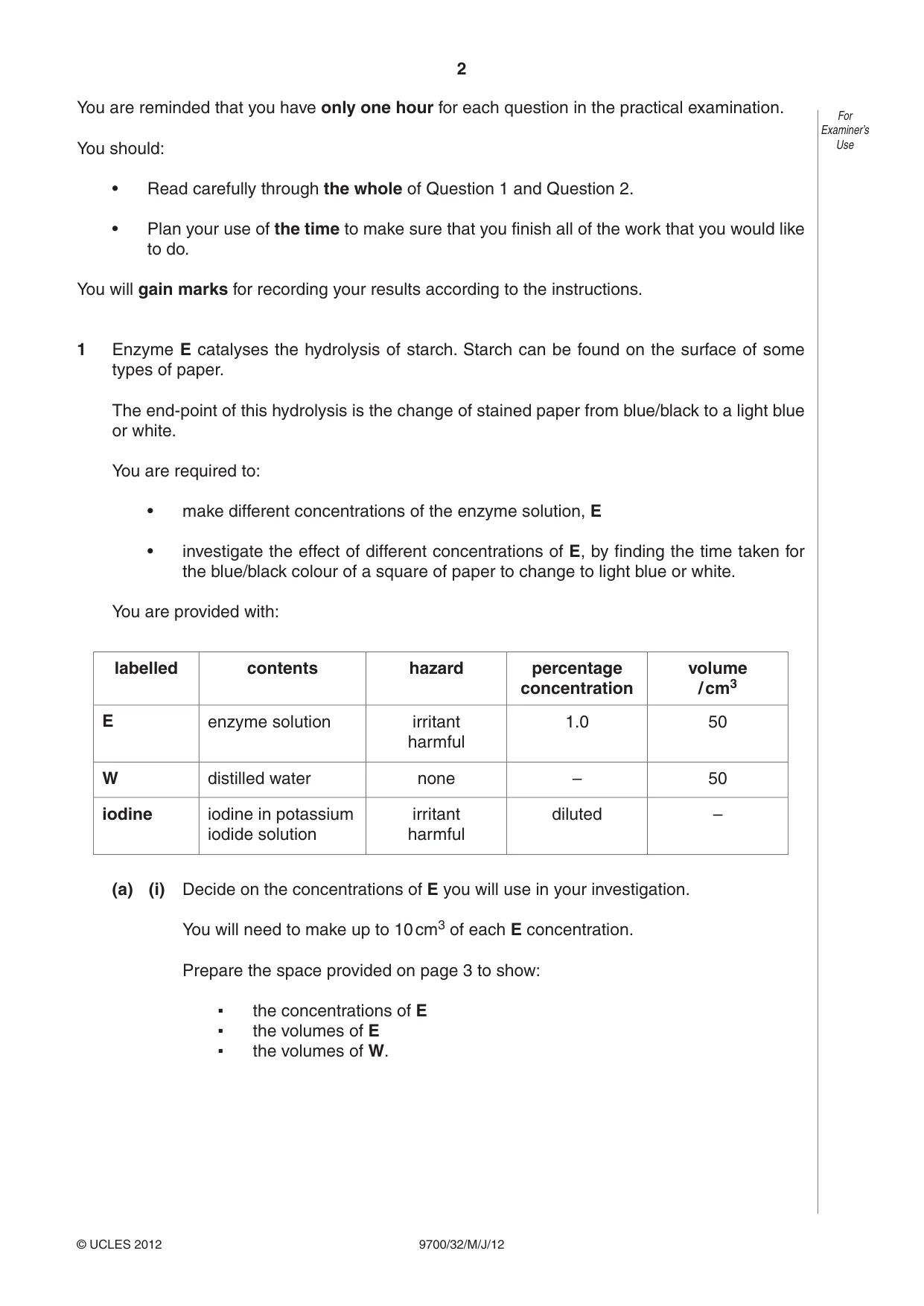
2 9700/32/M/J/12 © UCLES 2012 For Examiner’s Use You are reminded that you have only one hour for each question in the practical examination. You should: • Read carefully through the whole of Question 1 and Question 2. • Plan your use of the time to make sure that you finish all of the work that you would like to do. You will gain marks for recording your results according to the instructions. 1 Enzyme E catalyses the hydrolysis of starch. Starch can be found on the surface of some types of paper. The end-point of this hydrolysis is the change of stained paper from blue/black to a light blue or white. You are required to: • make different concentrations of the enzyme solution, E • investigate the effect of different concentrations of E, by finding the time taken for the blue/black colour of a square of paper to change to light blue or white. You are provided with: labelled contents hazard percentage concentration volume / cm3 E enzyme solution irritant harmful 1.0 50 W distilled water none – 50 iodine iodine in potassium iodide solution irritant harmful diluted – (a) (i) Decide on the concentrations of E you will use in your investigation. You will need to make up to 10 cm3 of each E concentration. Prepare the space provided on page 3 to show: ▪ the concentrations of E ▪ the volumes of E ▪ the volumes of W.
Question paper, page 3
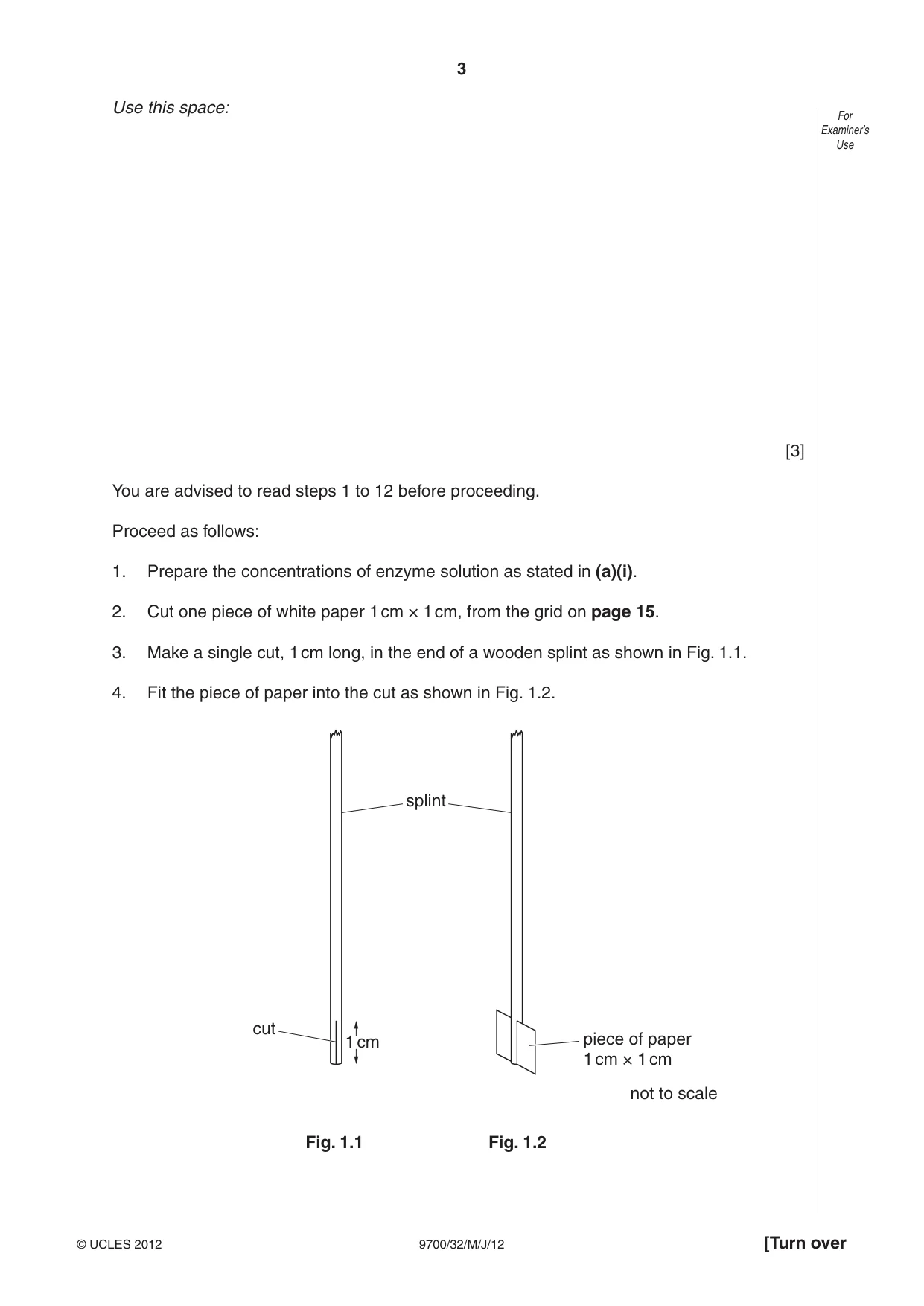
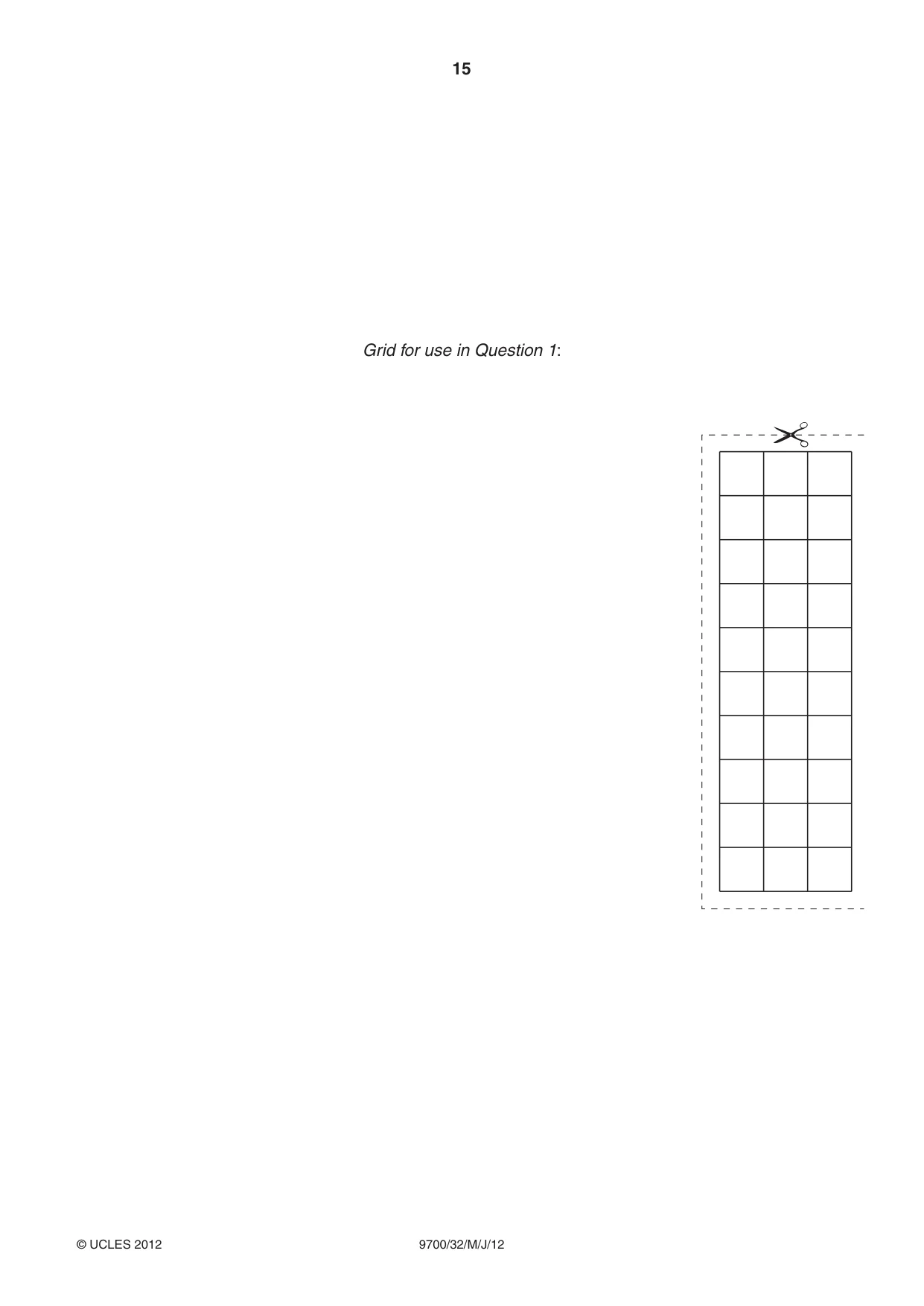
3 9700/32/M/J/12 © UCLES 2012 [Turn over For Examiner’s Use Use this space: [3] You are advised to read steps 1 to 12 before proceeding. Proceed as follows: 1. Prepare the concentrations of enzyme solution as stated in (a)(i). 2. Cut one piece of white paper 1 cm × 1 cm, from the grid on page 15. 3. Make a single cut, 1 cm long, in the end of a wooden splint as shown in Fig. 1.1. 4. Fit the piece of paper into the cut as shown in Fig. 1.2. 1 cm cut piece of paper 1 cm × 1 cm not to scale splint Fig. 1.1 Fig. 1.2
Question paper, page 4
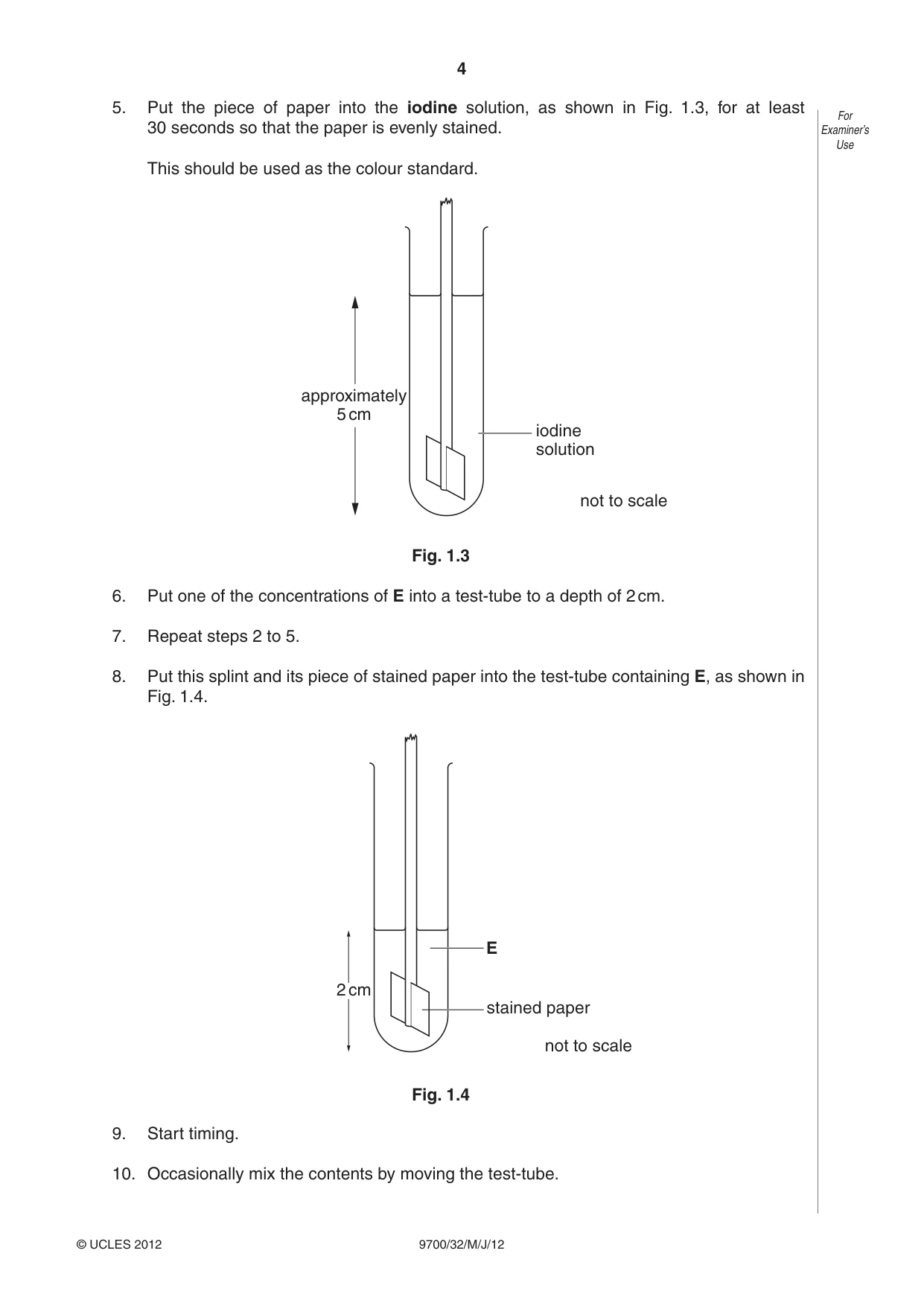
4 9700/32/M/J/12 © UCLES 2012 For Examiner’s Use 5. Put the piece of paper into the iodine solution, as shown in Fig. 1.3, for at least 30 seconds so that the paper is evenly stained. This should be used as the colour standard. not to scale iodine solution approximately 5 cm Fig. 1.3 6. Put one of the concentrations of E into a test-tube to a depth of 2 cm. 7. Repeat steps 2 to 5. 8. Put this splint and its piece of stained paper into the test-tube containing E, as shown in Fig. 1.4. stained paper E 2 cm not to scale Fig. 1.4 9. Start timing. 10. Occasionally mix the contents by moving the test-tube.
Question paper, page 5
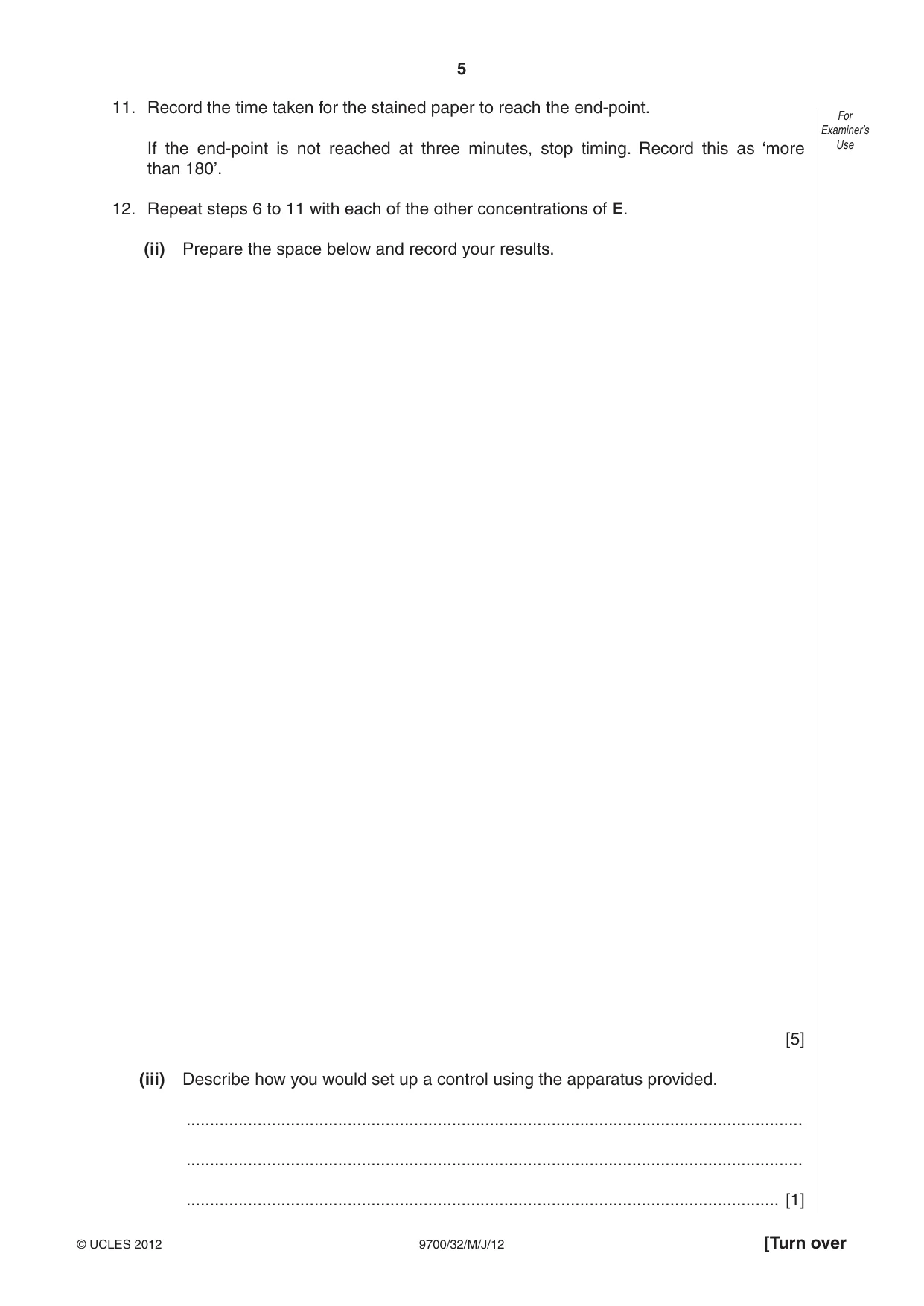
5 9700/32/M/J/12 © UCLES 2012 [Turn over For Examiner’s Use 11. Record the time taken for the stained paper to reach the end-point. If the end-point is not reached at three minutes, stop timing. Record this as ‘more than 180’. 12. Repeat steps 6 to 11 with each of the other concentrations of E. (ii) Prepare the space below and record your results. [5] (iii) Describe how you would set up a control using the apparatus provided. … … … [1]
Question paper, page 6
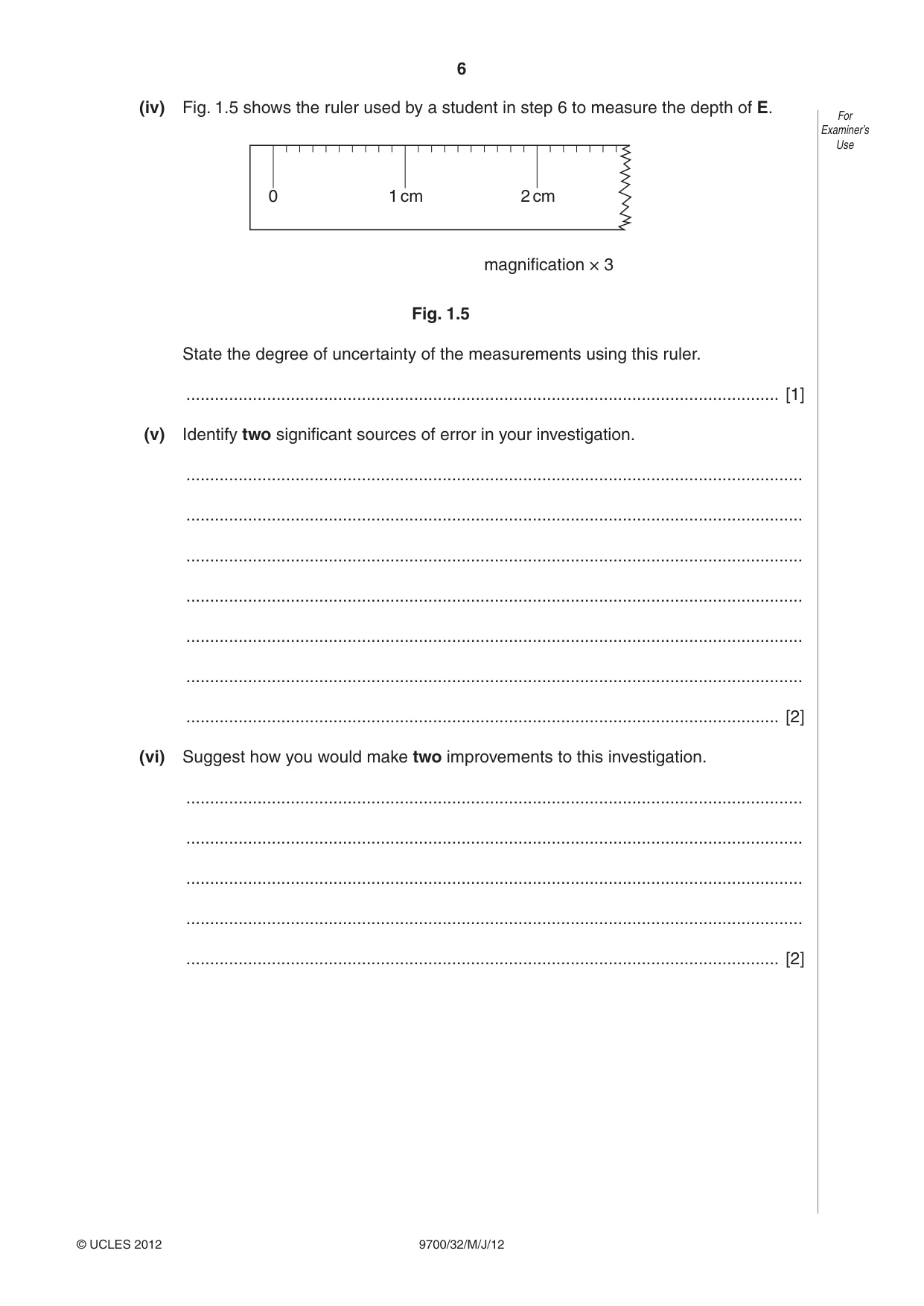
6 9700/32/M/J/12 © UCLES 2012 For Examiner’s Use (iv) Fig. 1.5 shows the ruler used by a student in step 6 to measure the depth of E. 0 1 cm 2 cm magnification × 3 Fig. 1.5 State the degree of uncertainty of the measurements using this ruler. … [1] (v) Identify two significant sources of error in your investigation. … … … … … … … [2] (vi) Suggest how you would make two improvements to this investigation. … … … … … [2]
Question paper, page 7
7 9700/32/M/J/12 © UCLES 2012 [Turn over BLANK PAGE Question 1 continues on page 8
Question paper, page 8
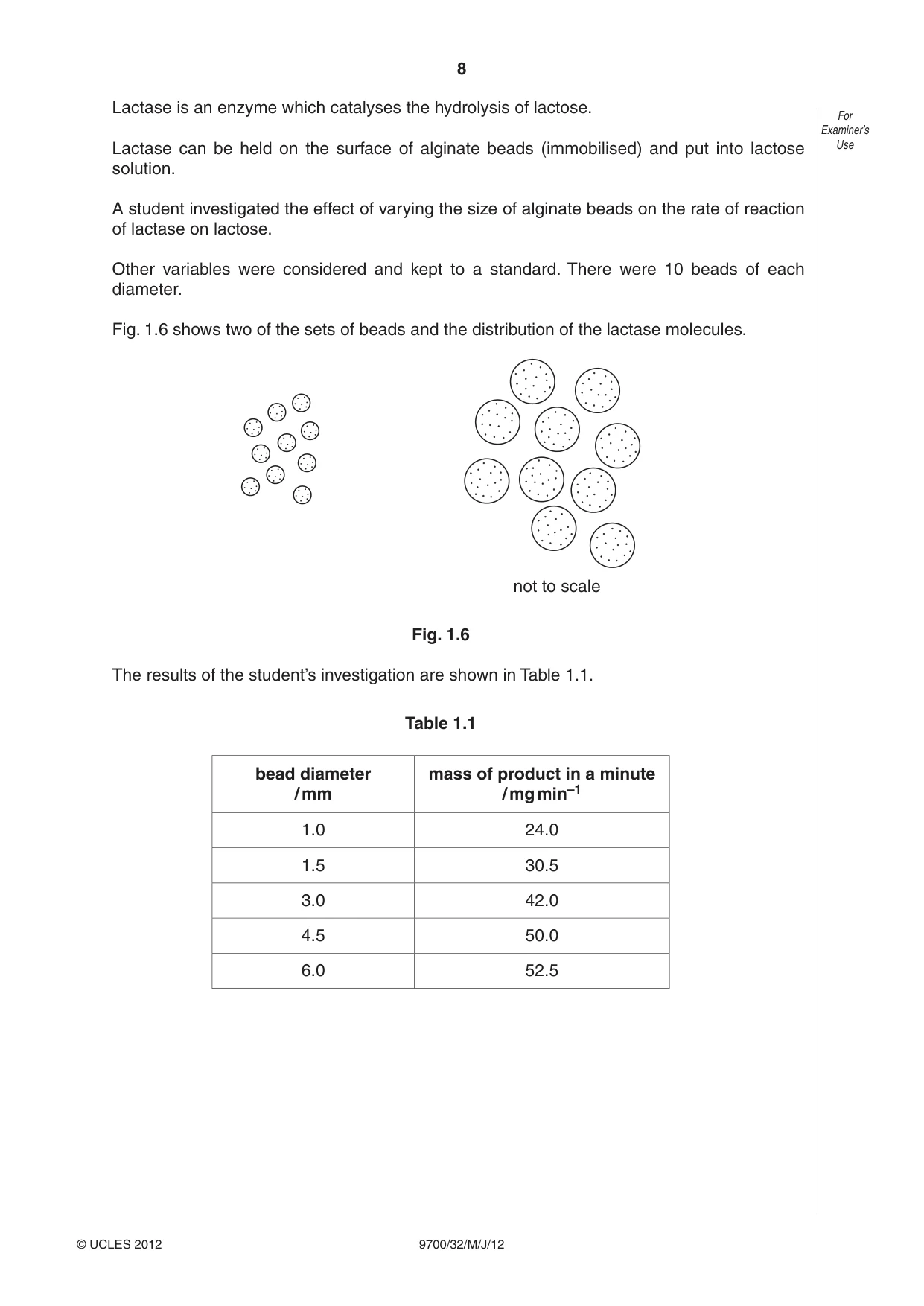
8 9700/32/M/J/12 © UCLES 2012 For Examiner’s Use Lactase is an enzyme which catalyses the hydrolysis of lactose. Lactase can be held on the surface of alginate beads (immobilised) and put into lactose solution. A student investigated the effect of varying the size of alginate beads on the rate of reaction of lactase on lactose. Other variables were considered and kept to a standard. There were 10 beads of each diameter. Fig. 1.6 shows two of the sets of beads and the distribution of the lactase molecules. not to scale Fig. 1.6 The results of the student’s investigation are shown in Table 1.1. Table 1.1 bead diameter / mm mass of product in a minute / mg min–1 1.0 24.0 1.5 30.5 3.0 42.0 4.5 50.0 6.0 52.5
Question paper, page 9
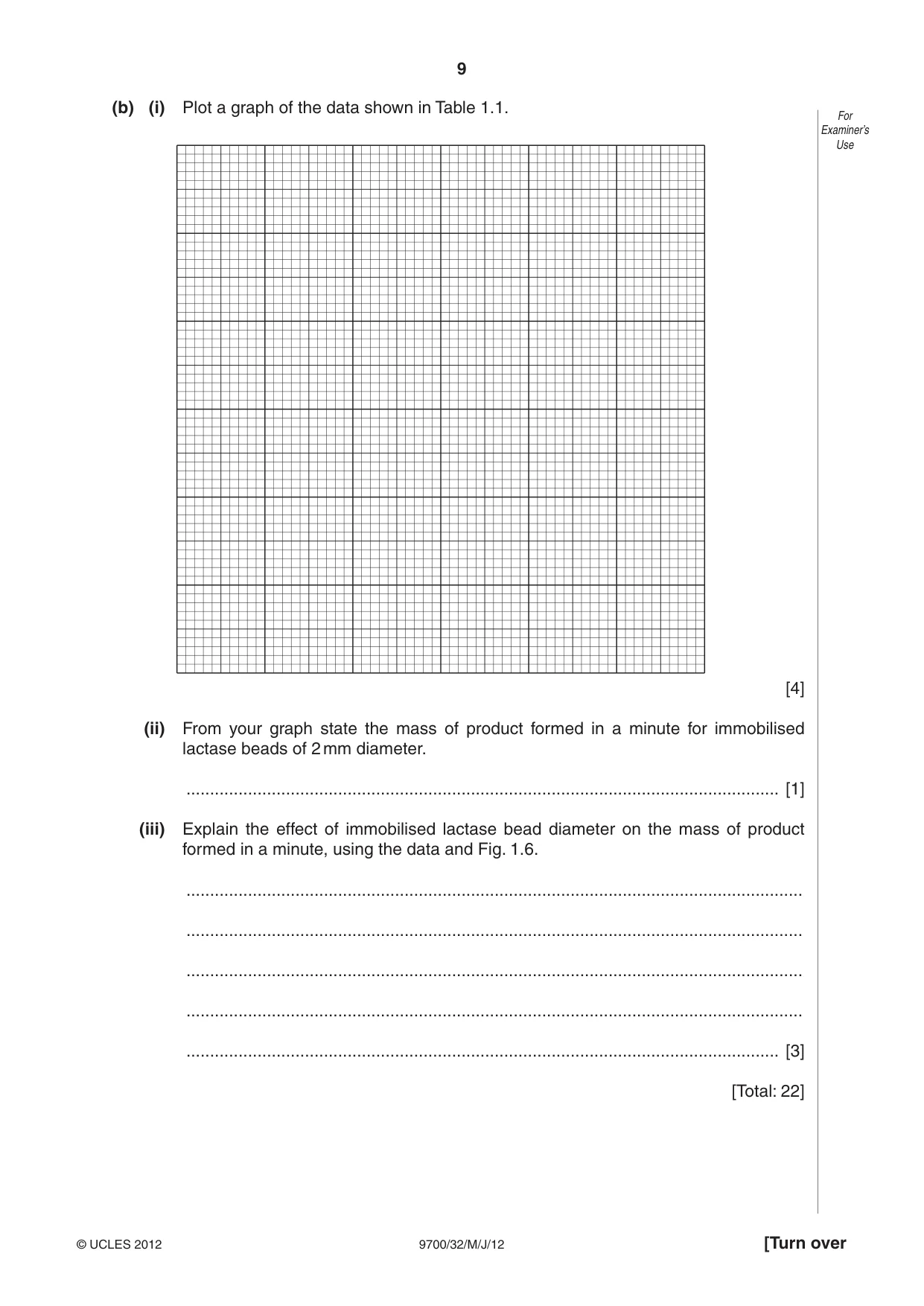
9 9700/32/M/J/12 © UCLES 2012 [Turn over For Examiner’s Use (b) (i) Plot a graph of the data shown in Table 1.1. [4] (ii) From your graph state the mass of product formed in a minute for immobilised lactase beads of 2 mm diameter. … [1] (iii) Explain the effect of immobilised lactase bead diameter on the mass of product formed in a minute, using the data and Fig. 1.6. … … … … … [3] [Total: 22]
Question paper, page 10
10 9700/32/M/J/12 © UCLES 2012 For Examiner’s Use 2 J1 is a slide of a stained transverse section through a mammalian lung. (a) Make a large drawing to show the walls of two whole alveoli. Label a nucleus. [5]
Question paper, page 11
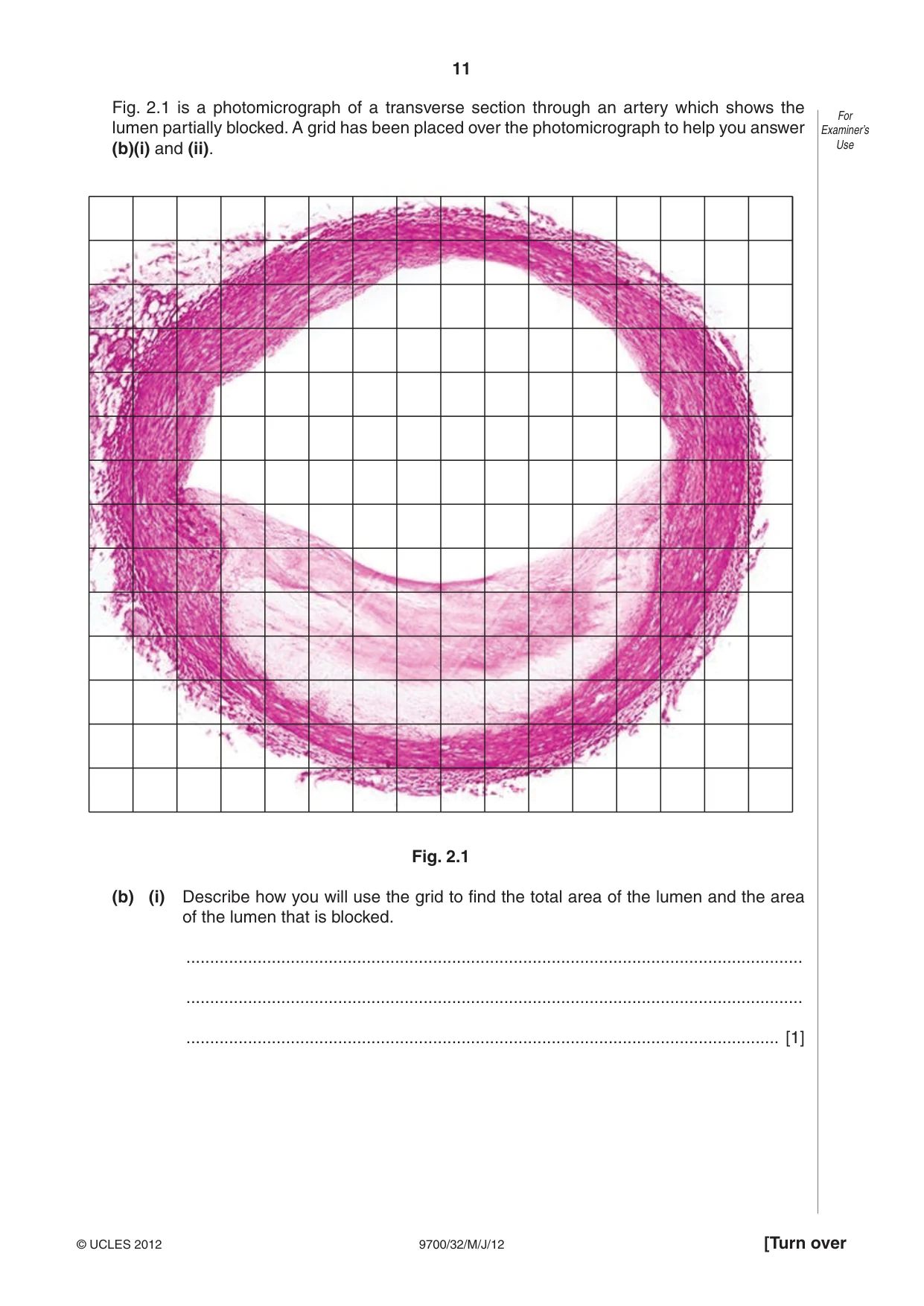
11 9700/32/M/J/12 © UCLES 2012 [Turn over For Examiner’s Use Fig. 2.1 is a photomicrograph of a transverse section through an artery which shows the lumen partially blocked. A grid has been placed over the photomicrograph to help you answer (b)(i) and (ii). Fig. 2.1 (b) (i) Describe how you will use the grid to find the total area of the lumen and the area of the lumen that is blocked. … … … [1]
Question paper, page 12
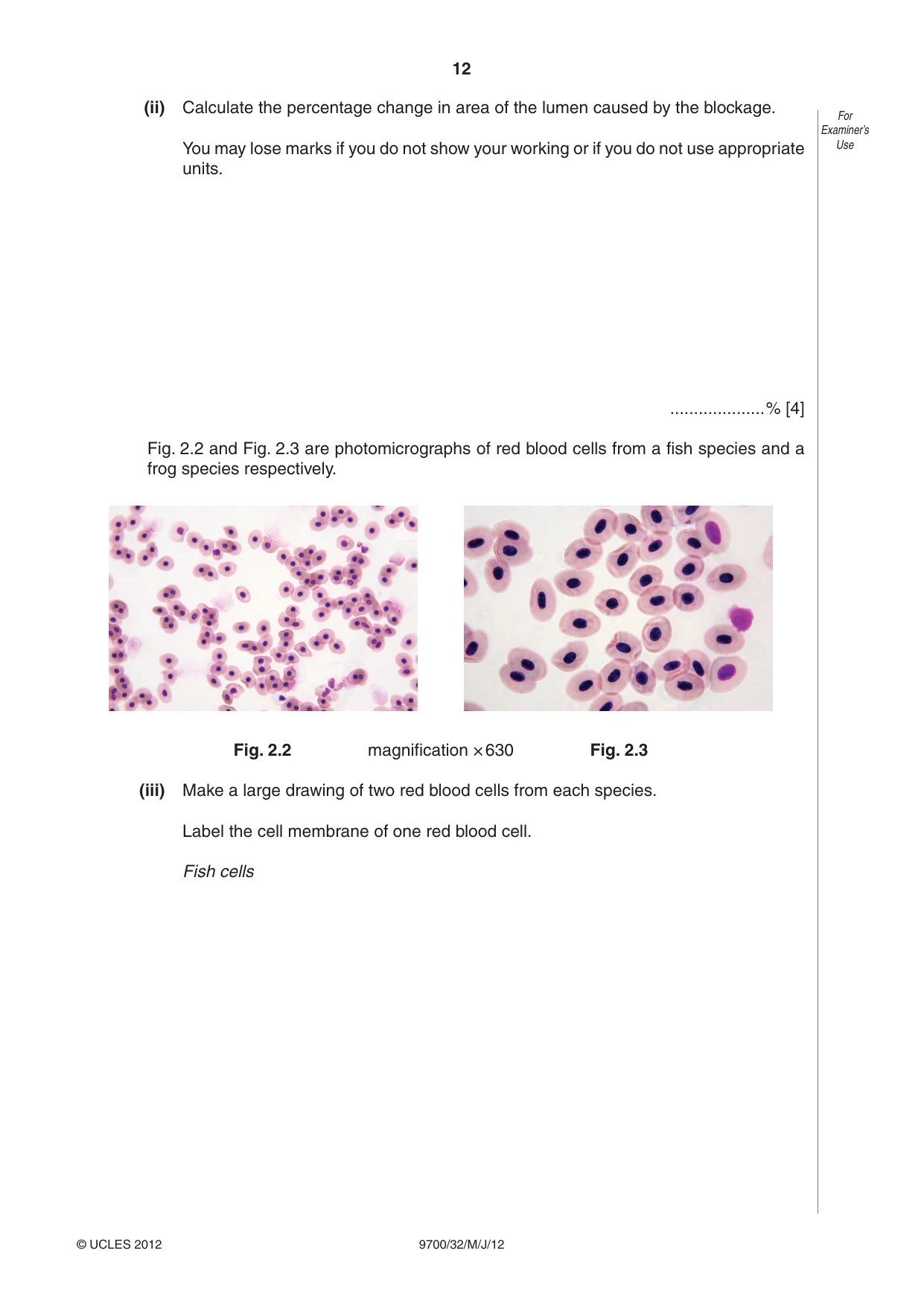
12 9700/32/M/J/12 © UCLES 2012 For Examiner’s Use (ii) Calculate the percentage change in area of the lumen caused by the blockage. You may lose marks if you do not show your working or if you do not use appropriate units. …% [4] Fig. 2.2 and Fig. 2.3 are photomicrographs of red blood cells from a fish species and a frog species respectively. Fig. 2.2 magnification × 630 Fig. 2.3 (iii) Make a large drawing of two red blood cells from each species. Label the cell membrane of one red blood cell. Fish cells
Question paper, page 13
13 9700/32/M/J/12 © UCLES 2012 [Turn over For Examiner’s Use Frog cells [4] (iv) Prepare the space below so that it is suitable for you to show the observable differences between the specimens in Fig. 2.2 and 2.3. Record your observations in the space you have prepared. [4] [Total: 18]
Question paper, page 14
14 9700/32/M/J/12 © UCLES 2012 BLANK PAGE
Question paper, page 15
15 9700/32/M/J/12 © UCLES 2012 Grid for use in Question 1:
Question paper, page 16
16 9700/32/M/J/12 © UCLES 2012 BLANK PAGE Copyright Acknowledgements: Question 2, Fig. 2.1 BIOPHOTOS ASSOCIATES/SCIENCE PHOTO LIBRARY Question 2, Fig. 2.2 EDWARD KINSMAN/SCIENCE PHOTO LIBRARY Question 2, Fig. 2.3 EDWARD KINSMAN/SCIENCE PHOTO LIBRARY Permission to reproduce items where third-party owned material protected by copyright is included has been sought and cleared where possible. Every reasonable effort has been made by the publisher (UCLES) to trace copyright holders, but if any items requiring clearance have unwittingly been included, the publisher will be pleased to make amends at the earliest possible opportunity. University of Cambridge International Examinations is part of the Cambridge Assessment Group. Cambridge Assessment is the brand name of University of Cambridge Local Examinations Syndicate (UCLES), which is itself a department of the University of Cambridge.
Mark scheme, page 1
UNIVERSITY OF CAMBRIDGE INTERNATIONAL EXAMINATIONS GCE Advanced Subsidiary Level and GCE Advanced Level MARK SCHEME for the May/June 2012 question paper for the guidance of teachers 9700 BIOLOGY 9700/32 Paper 32 (Advanced Practical Skills 2), maximum raw mark 40 This mark scheme is published as an aid to teachers and candidates, to indicate the requirements of the examination. It shows the basis on which Examiners were instructed to award marks. It does not indicate the details of the discussions that took place at an Examiners’ meeting before marking began, which would have considered the acceptability of alternative answers. Mark schemes must be read in conjunction with the question papers and the report on the examination. • Cambridge will not enter into discussions or correspondence in connection with these mark schemes. Cambridge is publishing the mark schemes for the May/June 2012 question papers for most IGCSE, GCE Advanced Level and Advanced Subsidiary Level syllabuses and some Ordinary Level syllabuses.
Mark scheme, page 2
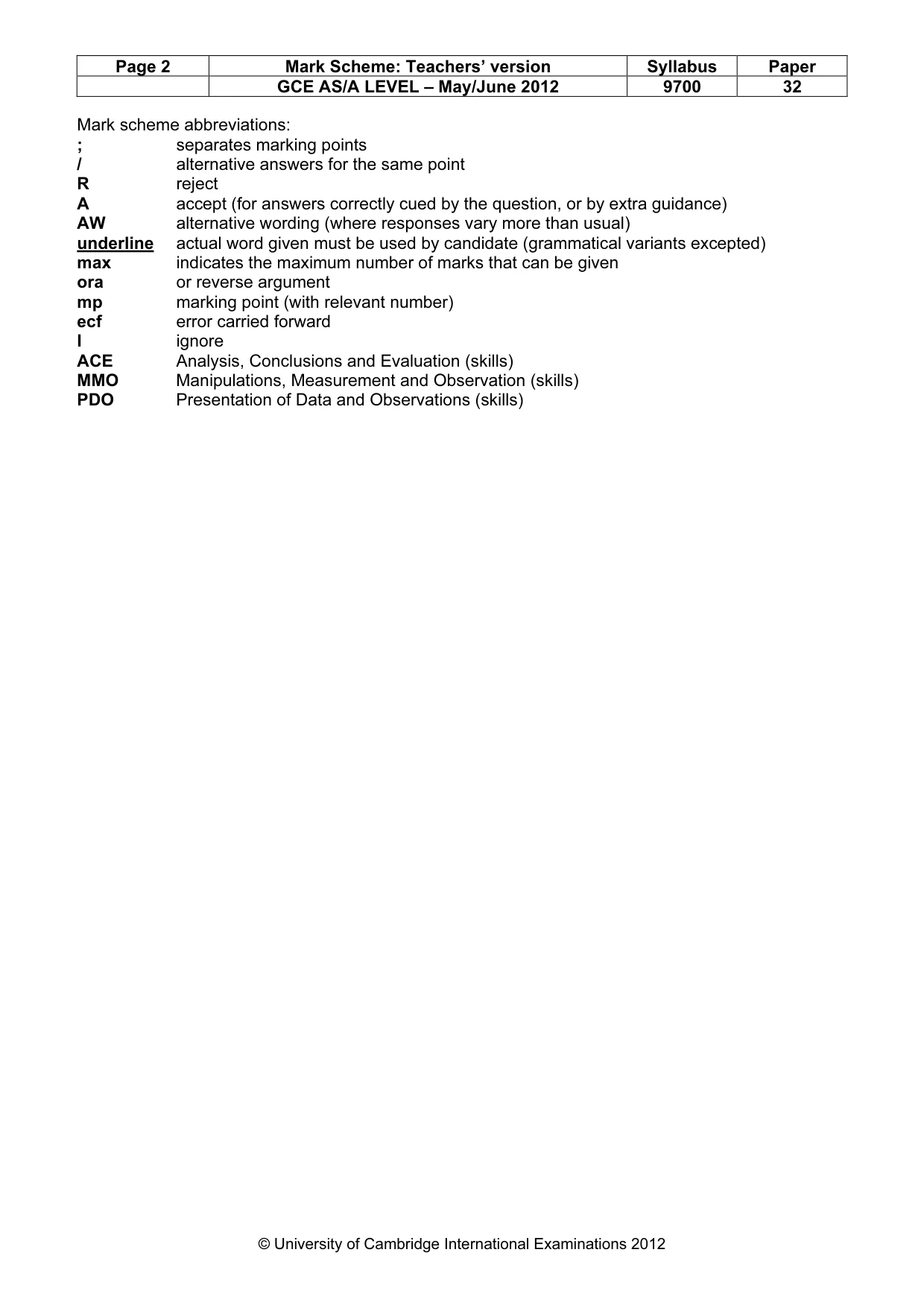
Page 2 Mark Scheme: Teachers’ version Syllabus Paper GCE AS/A LEVEL – May/June 2012 9700 32 © University of Cambridge International Examinations 2012 Mark scheme abbreviations: ; separates marking points / alternative answers for the same point R reject A accept (for answers correctly cued by the question, or by extra guidance) AW alternative wording (where responses vary more than usual) underline actual word given must be used by candidate (grammatical variants excepted) max indicates the maximum number of marks that can be given ora or reverse argument mp marking point (with relevant number) ecf error carried forward I ignore ACE Analysis, Conclusions and Evaluation (skills) MMO Manipulations, Measurement and Observation (skills) PDO Presentation of Data and Observations (skills)
Mark scheme, page 3
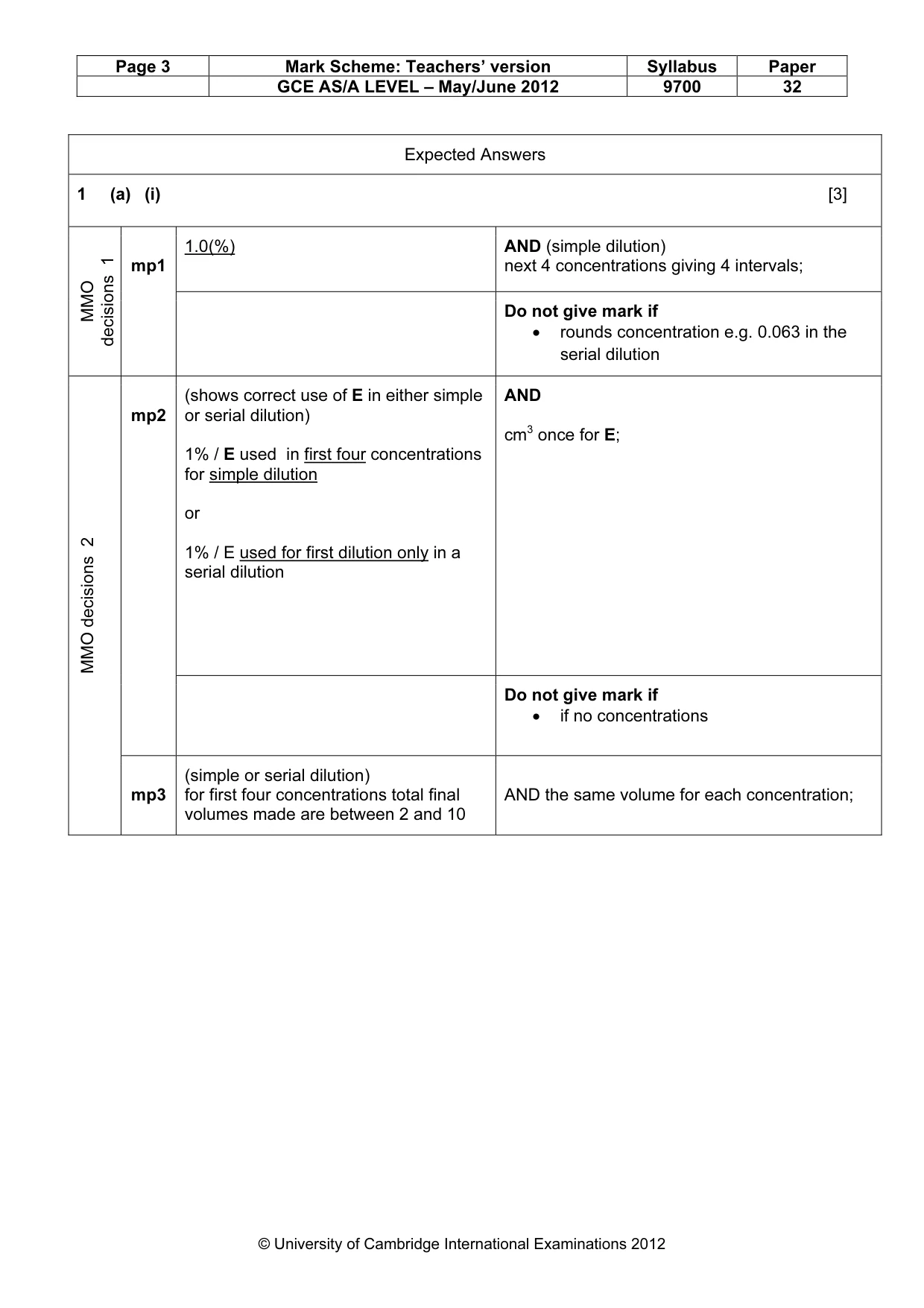
Page 3 Mark Scheme: Teachers’ version Syllabus Paper GCE AS/A LEVEL – May/June 2012 9700 32 © University of Cambridge International Examinations 2012 Expected Answers 1 (a) (i) [3] 1.0(%) AND (simple dilution) next 4 concentrations giving 4 intervals; MMO decisions 1 mp1 Do not give mark if • rounds concentration e.g. 0.063 in the serial dilution (shows correct use of E in either simple or serial dilution) 1% / E used in first four concentrations for simple dilution or 1% / E used for first dilution only in a serial dilution AND cm3 once for E; mp2 Do not give mark if • if no concentrations MMO decisions 2 mp3 (simple or serial dilution) for first four concentrations total final volumes made are between 2 and 10 AND the same volume for each concentration;
Mark scheme, page 4
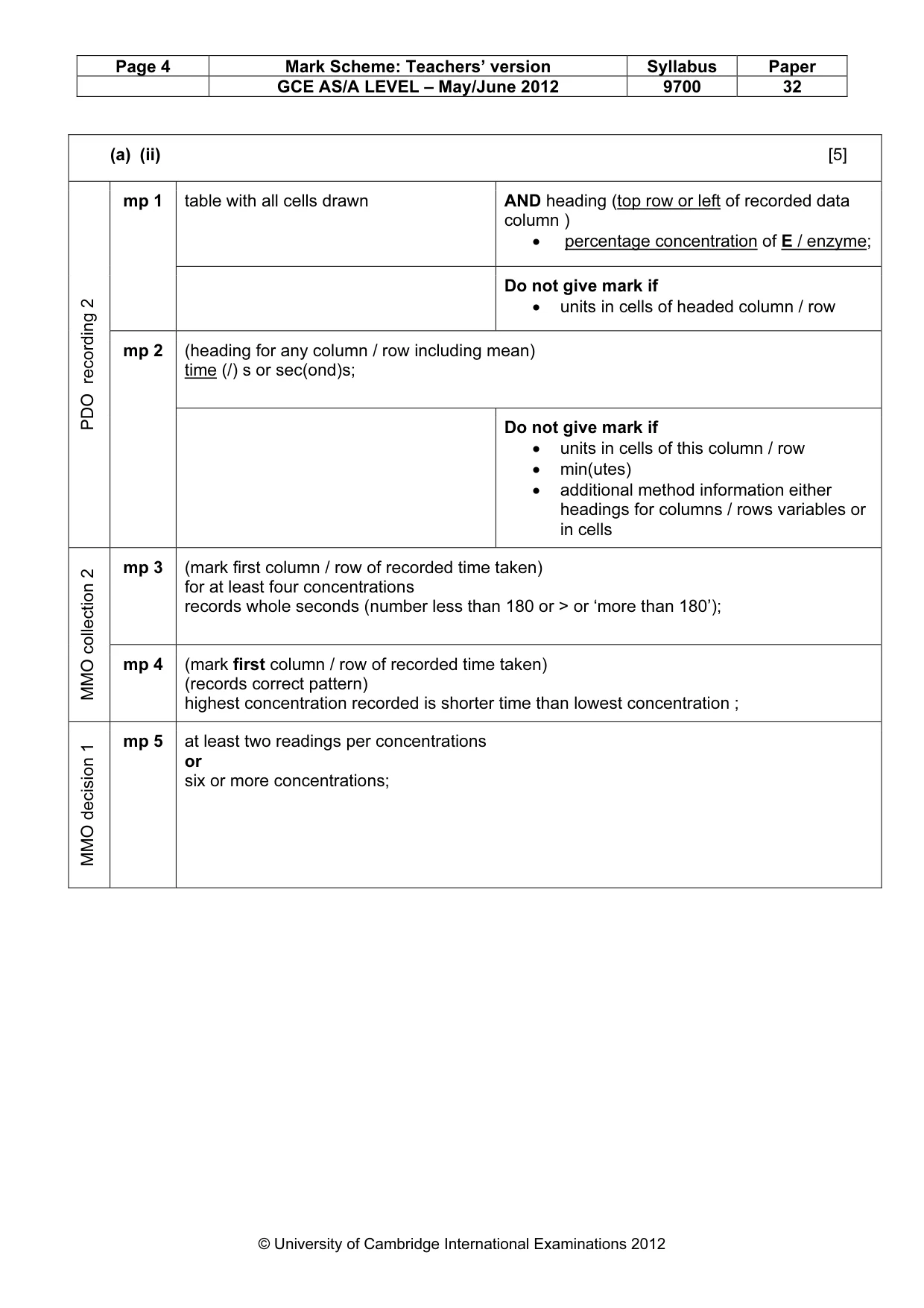
Page 4 Mark Scheme: Teachers’ version Syllabus Paper GCE AS/A LEVEL – May/June 2012 9700 32 © University of Cambridge International Examinations 2012 (a) (ii) [5] table with all cells drawn AND heading (top row or left of recorded data column ) • percentage concentration of E / enzyme; mp 1 Do not give mark if • units in cells of headed column / row (heading for any column / row including mean) time (/) s or sec(ond)s; PDO recording 2 mp 2 Do not give mark if • units in cells of this column / row • min(utes) • additional method information either headings for columns / rows variables or in cells mp 3 (mark first column / row of recorded time taken) for at least four concentrations records whole seconds (number less than 180 or > or ‘more than 180’); MMO collection 2 mp 4 (mark first column / row of recorded time taken) (records correct pattern) highest concentration recorded is shorter time than lowest concentration ; MMO decision 1 mp 5 at least two readings per concentrations or six or more concentrations;
Mark scheme, page 5
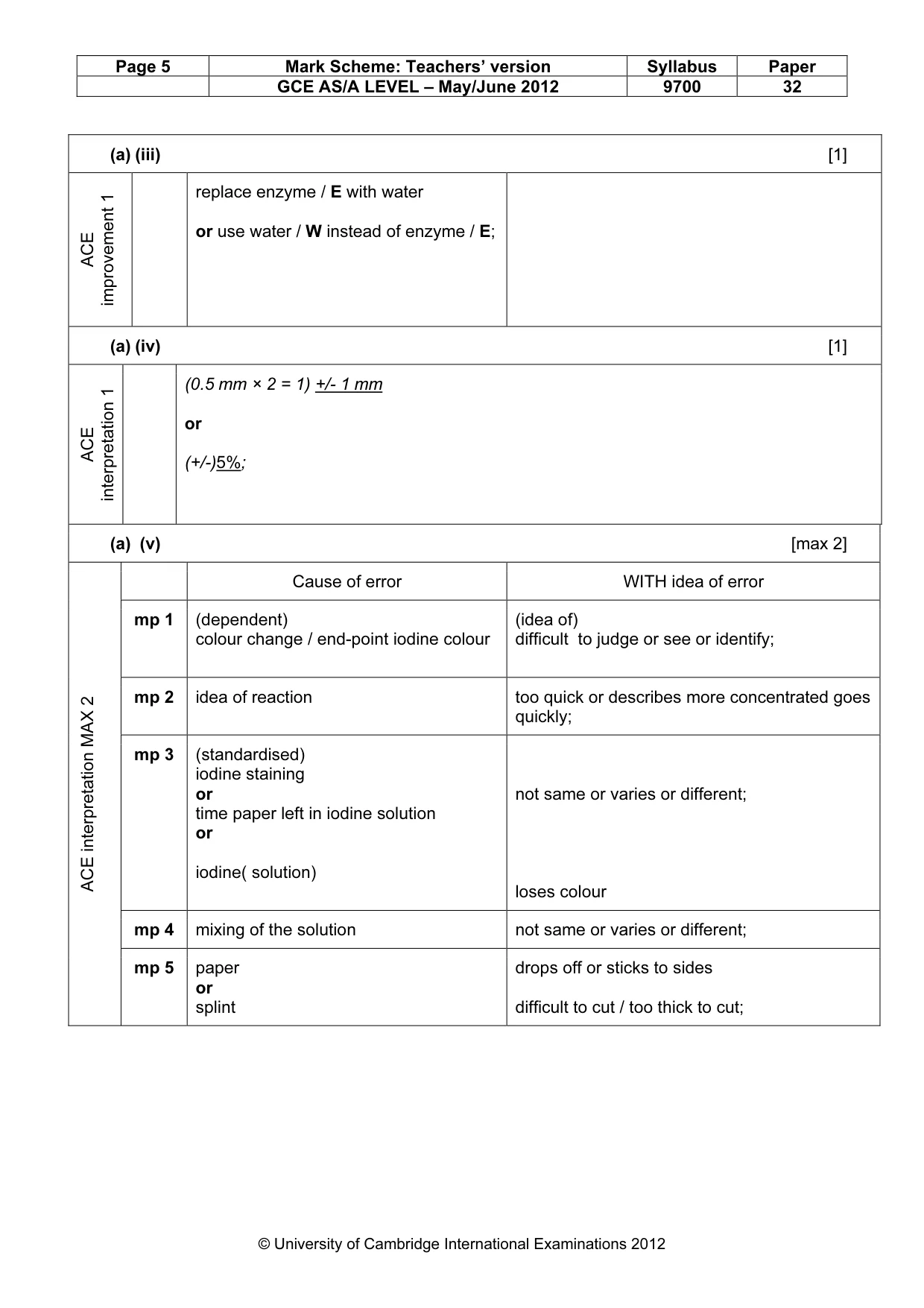
Page 5 Mark Scheme: Teachers’ version Syllabus Paper GCE AS/A LEVEL – May/June 2012 9700 32 © University of Cambridge International Examinations 2012 (a) (iii) [1] ACE improvement 1 replace enzyme / E with water or use water / W instead of enzyme / E; (a) (iv) [1] ACE interpretation 1 (0.5 mm × 2 = 1) +/- 1 mm or (+/-)5%; (a) (v) [max 2] Cause of error WITH idea of error mp 1 (dependent) colour change / end-point iodine colour (idea of) difficult to judge or see or identify; mp 2 idea of reaction too quick or describes more concentrated goes quickly; mp 3 (standardised) iodine staining or time paper left in iodine solution or iodine( solution) not same or varies or different; loses colour mp 4 mixing of the solution not same or varies or different; ACE interpretation MAX 2 mp 5 paper or splint drops off or sticks to sides difficult to cut / too thick to cut;
Mark scheme, page 6
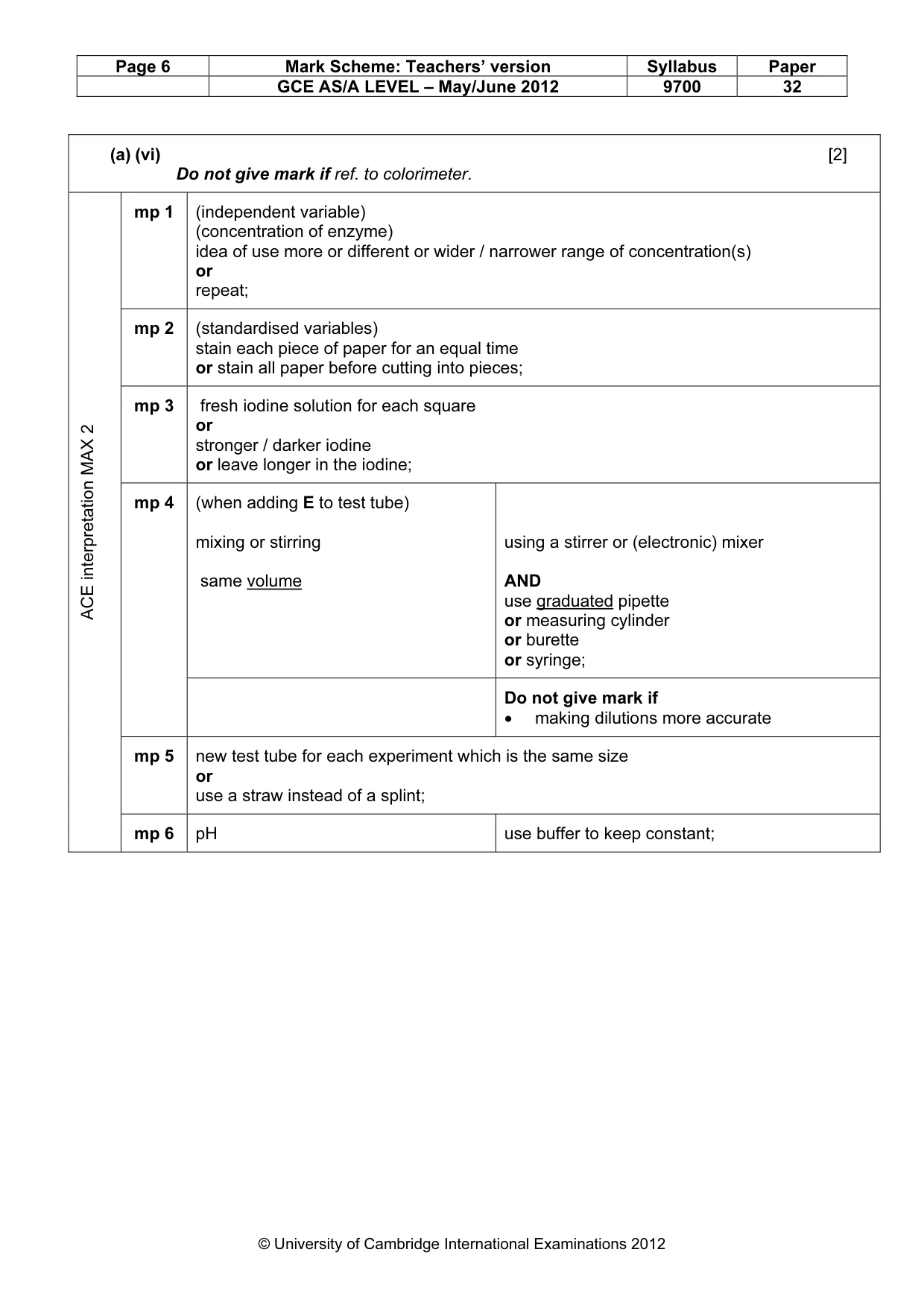
Page 6 Mark Scheme: Teachers’ version Syllabus Paper GCE AS/A LEVEL – May/June 2012 9700 32 © University of Cambridge International Examinations 2012 (a) (vi) [2] Do not give mark if ref. to colorimeter. mp 1 (independent variable) (concentration of enzyme) idea of use more or different or wider / narrower range of concentration(s) or repeat; mp 2 (standardised variables) stain each piece of paper for an equal time or stain all paper before cutting into pieces; mp 3 fresh iodine solution for each square or stronger / darker iodine or leave longer in the iodine; (when adding E to test tube) mixing or stirring same volume using a stirrer or (electronic) mixer AND use graduated pipette or measuring cylinder or burette or syringe; mp 4 Do not give mark if • making dilutions more accurate mp 5 new test tube for each experiment which is the same size or use a straw instead of a splint; ACE interpretation MAX 2 mp 6 pH use buffer to keep constant;
Mark scheme, page 7
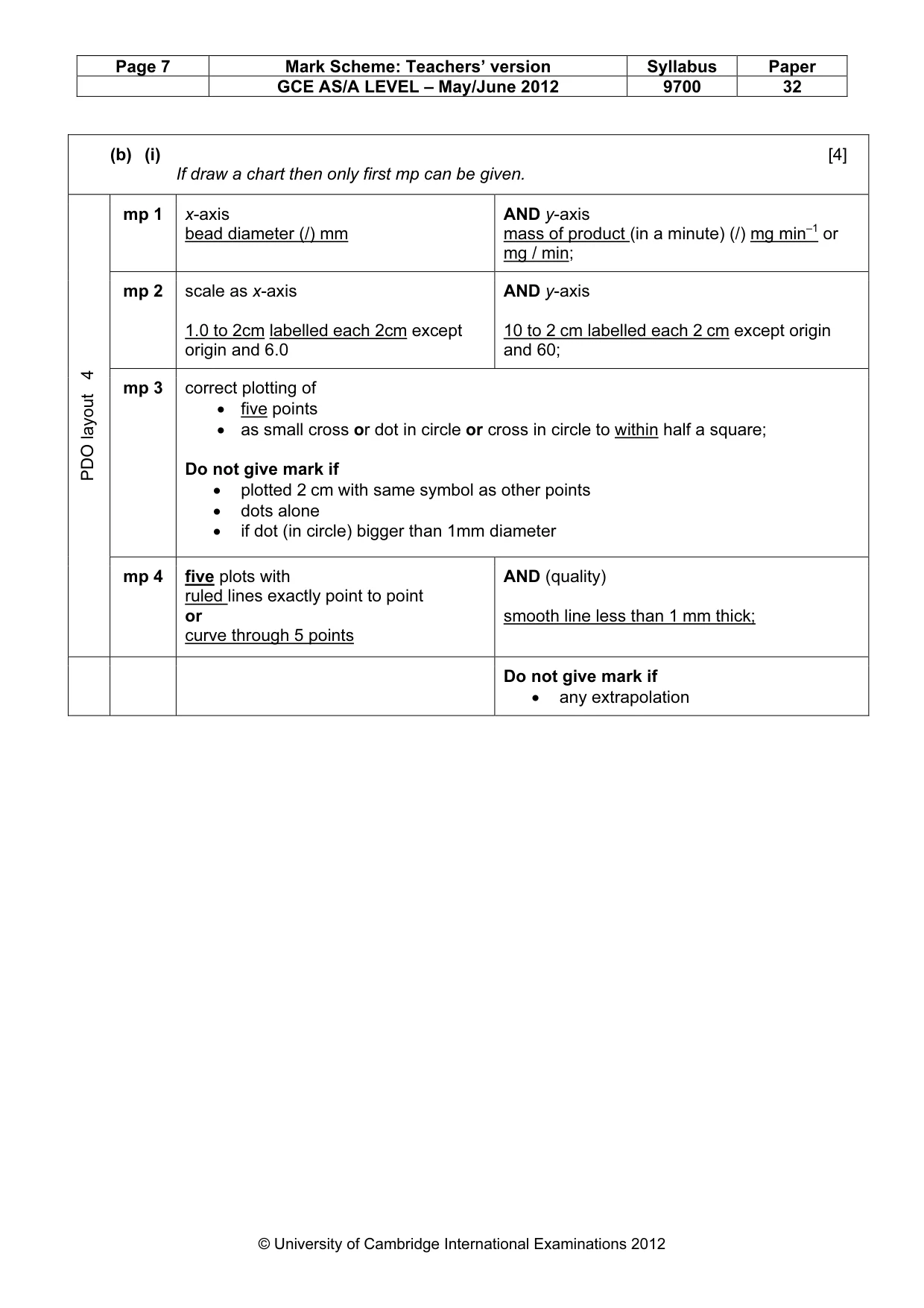
Page 7 Mark Scheme: Teachers’ version Syllabus Paper GCE AS/A LEVEL – May/June 2012 9700 32 © University of Cambridge International Examinations 2012 (b) (i) [4] If draw a chart then only first mp can be given. mp 1 x-axis bead diameter (/) mm AND y-axis mass of product (in a minute) (/) mg min–1 or mg / min; mp 2 scale as x-axis 1.0 to 2cm labelled each 2cm except origin and 6.0 AND y-axis 10 to 2 cm labelled each 2 cm except origin and 60; mp 3 correct plotting of • five points • as small cross or dot in circle or cross in circle to within half a square; Do not give mark if • plotted 2 cm with same symbol as other points • dots alone • if dot (in circle) bigger than 1mm diameter PDO layout 4 mp 4 five plots with ruled lines exactly point to point or curve through 5 points AND (quality) smooth line less than 1 mm thick; Do not give mark if • any extrapolation
Mark scheme, page 8
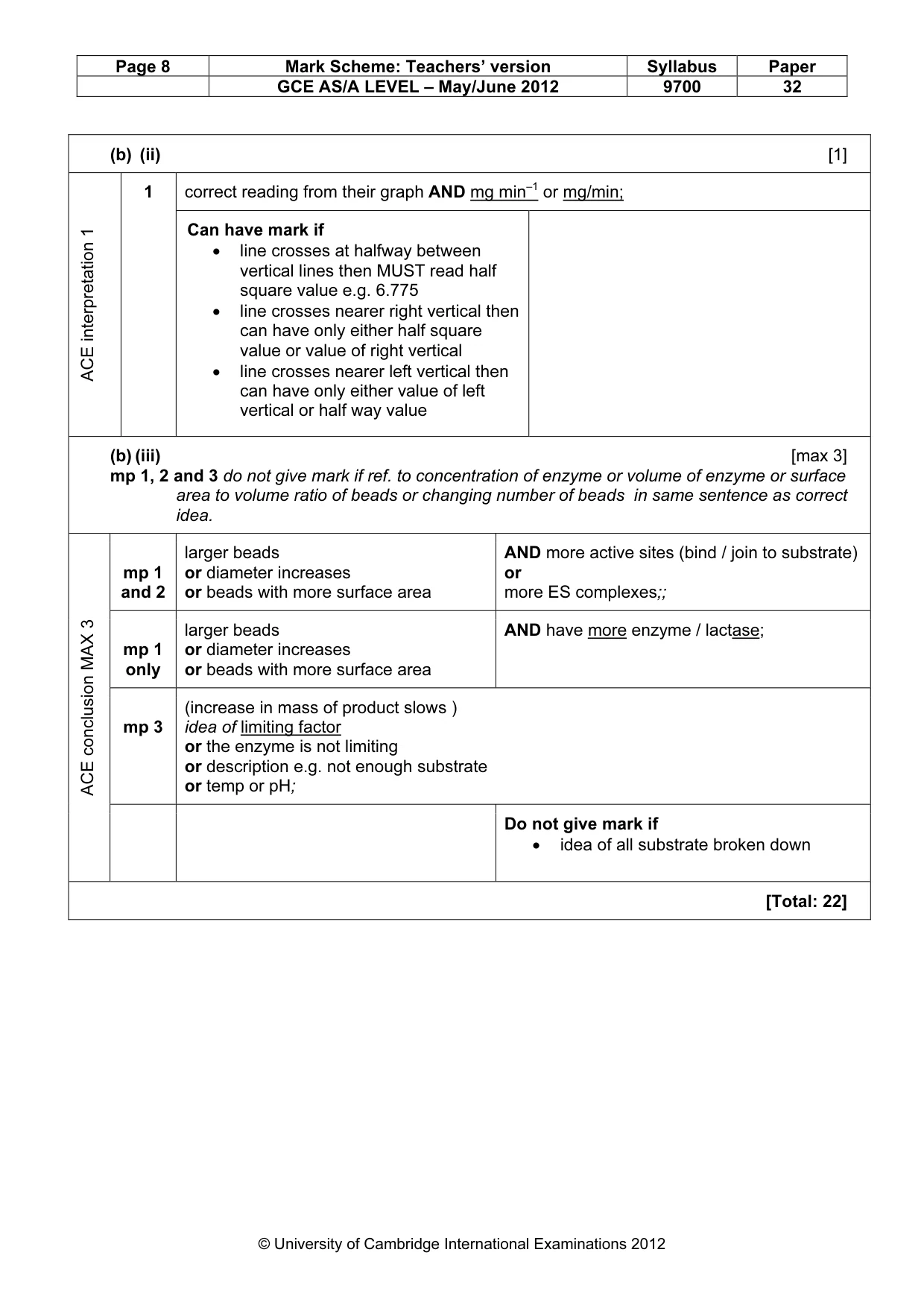
Page 8 Mark Scheme: Teachers’ version Syllabus Paper GCE AS/A LEVEL – May/June 2012 9700 32 © University of Cambridge International Examinations 2012 (b) (ii) [1] correct reading from their graph AND mg min–1 or mg/min; ACE interpretation 1 1 Can have mark if • line crosses at halfway between vertical lines then MUST read half square value e.g. 6.775 • line crosses nearer right vertical then can have only either half square value or value of right vertical • line crosses nearer left vertical then can have only either value of left vertical or half way value (b) (iii) [max 3] mp 1, 2 and 3 do not give mark if ref. to concentration of enzyme or volume of enzyme or surface area to volume ratio of beads or changing number of beads in same sentence as correct idea. mp 1 and 2 larger beads or diameter increases or beads with more surface area AND more active sites (bind / join to substrate) or more ES complexes;; mp 1 only larger beads or diameter increases or beads with more surface area AND have more enzyme / lactase; mp 3 (increase in mass of product slows ) idea of limiting factor or the enzyme is not limiting or description e.g. not enough substrate or temp or pH; ACE conclusion MAX 3 Do not give mark if • idea of all substrate broken down [Total: 22]
Mark scheme, page 9
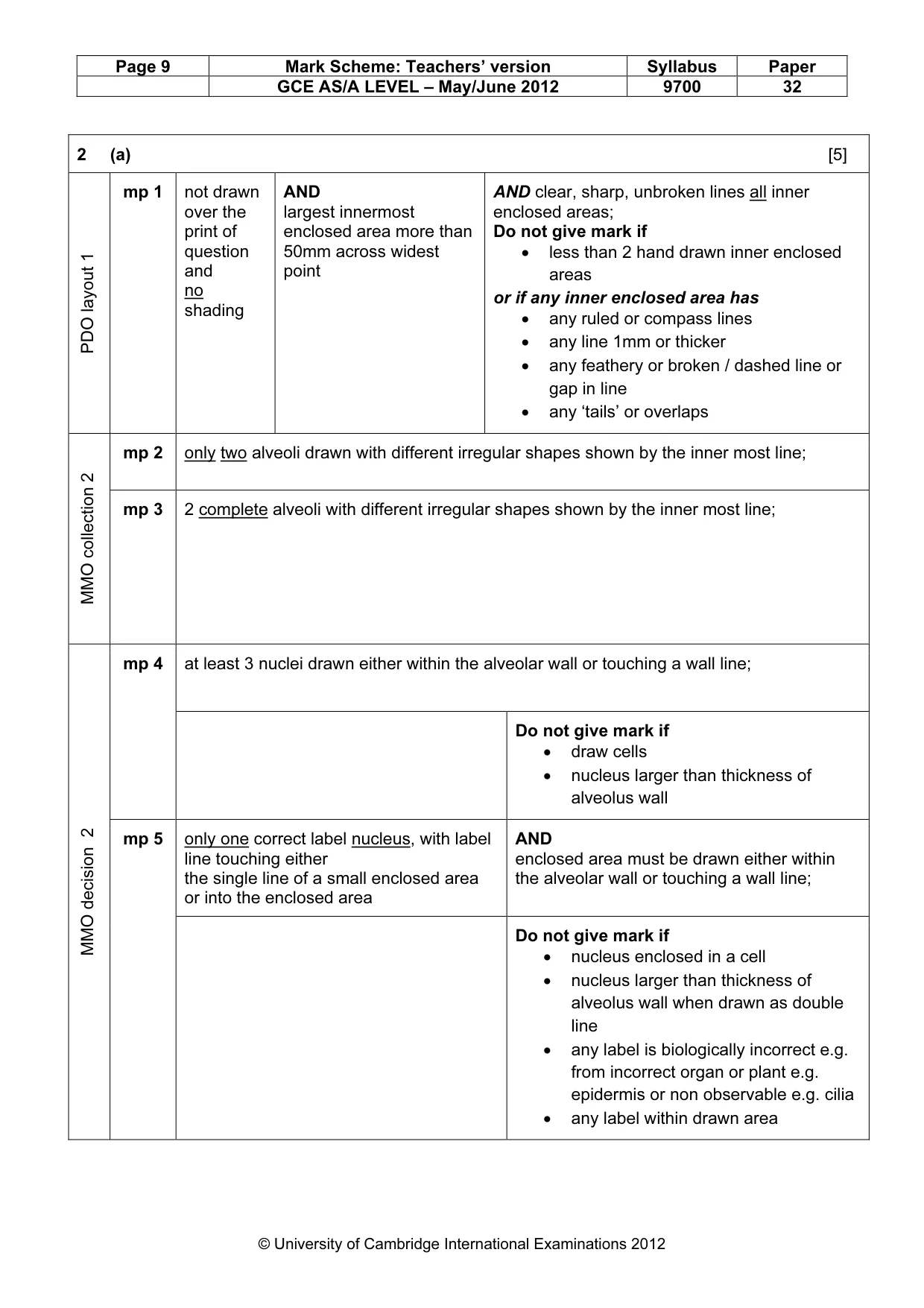
Page 9 Mark Scheme: Teachers’ version Syllabus Paper GCE AS/A LEVEL – May/June 2012 9700 32 © University of Cambridge International Examinations 2012 2 (a) [5] PDO layout 1 mp 1 not drawn over the print of question and no shading AND largest innermost enclosed area more than 50mm across widest point AND clear, sharp, unbroken lines all inner enclosed areas; Do not give mark if • less than 2 hand drawn inner enclosed areas or if any inner enclosed area has • any ruled or compass lines • any line 1mm or thicker • any feathery or broken / dashed line or gap in line • any ‘tails’ or overlaps mp 2 only two alveoli drawn with different irregular shapes shown by the inner most line; MMO collection 2 mp 3 2 complete alveoli with different irregular shapes shown by the inner most line; at least 3 nuclei drawn either within the alveolar wall or touching a wall line; mp 4 Do not give mark if • draw cells • nucleus larger than thickness of alveolus wall only one correct label nucleus, with label line touching either the single line of a small enclosed area or into the enclosed area AND enclosed area must be drawn either within the alveolar wall or touching a wall line; MMO decision 2 mp 5 Do not give mark if • nucleus enclosed in a cell • nucleus larger than thickness of alveolus wall when drawn as double line • any label is biologically incorrect e.g. from incorrect organ or plant e.g. epidermis or non observable e.g. cilia • any label within drawn area
Mark scheme, page 10
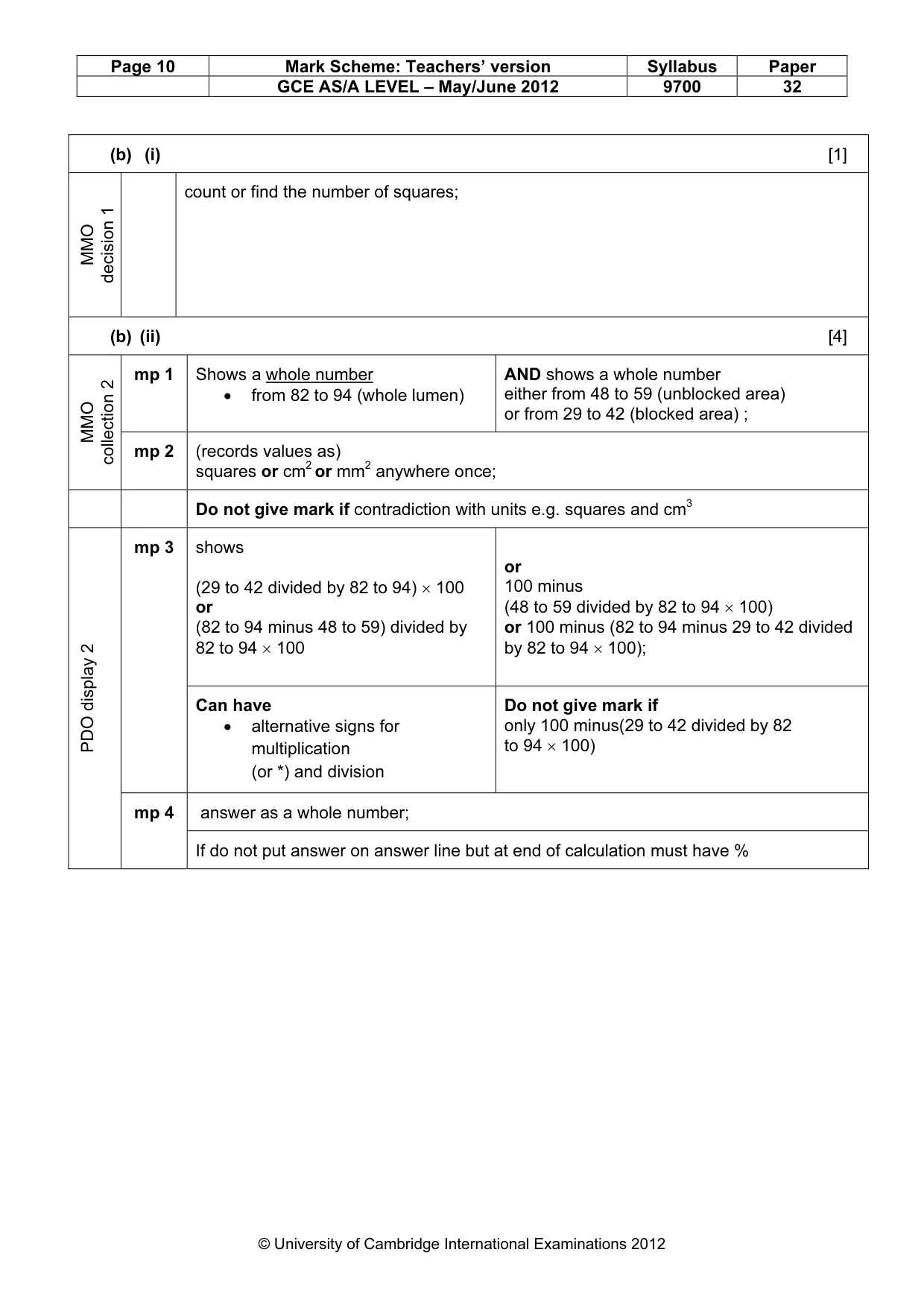
Page 10 Mark Scheme: Teachers’ version Syllabus Paper GCE AS/A LEVEL – May/June 2012 9700 32 © University of Cambridge International Examinations 2012 (b) (i) [1] MMO decision 1 count or find the number of squares; (b) (ii) [4] mp 1 Shows a whole number • from 82 to 94 (whole lumen) AND shows a whole number either from 48 to 59 (unblocked area) or from 29 to 42 (blocked area) ; MMO collection 2 mp 2 (records values as) squares or cm2 or mm2 anywhere once; Do not give mark if contradiction with units e.g. squares and cm3 shows (29 to 42 divided by 82 to 94) × 100 or (82 to 94 minus 48 to 59) divided by 82 to 94 × 100 or 100 minus (48 to 59 divided by 82 to 94 × 100) or 100 minus (82 to 94 minus 29 to 42 divided by 82 to 94 × 100); mp 3 Can have • alternative signs for multiplication (or *) and division Do not give mark if only 100 minus(29 to 42 divided by 82 to 94 × 100) answer as a whole number; PDO display 2 mp 4 If do not put answer on answer line but at end of calculation must have %
Mark scheme, page 11
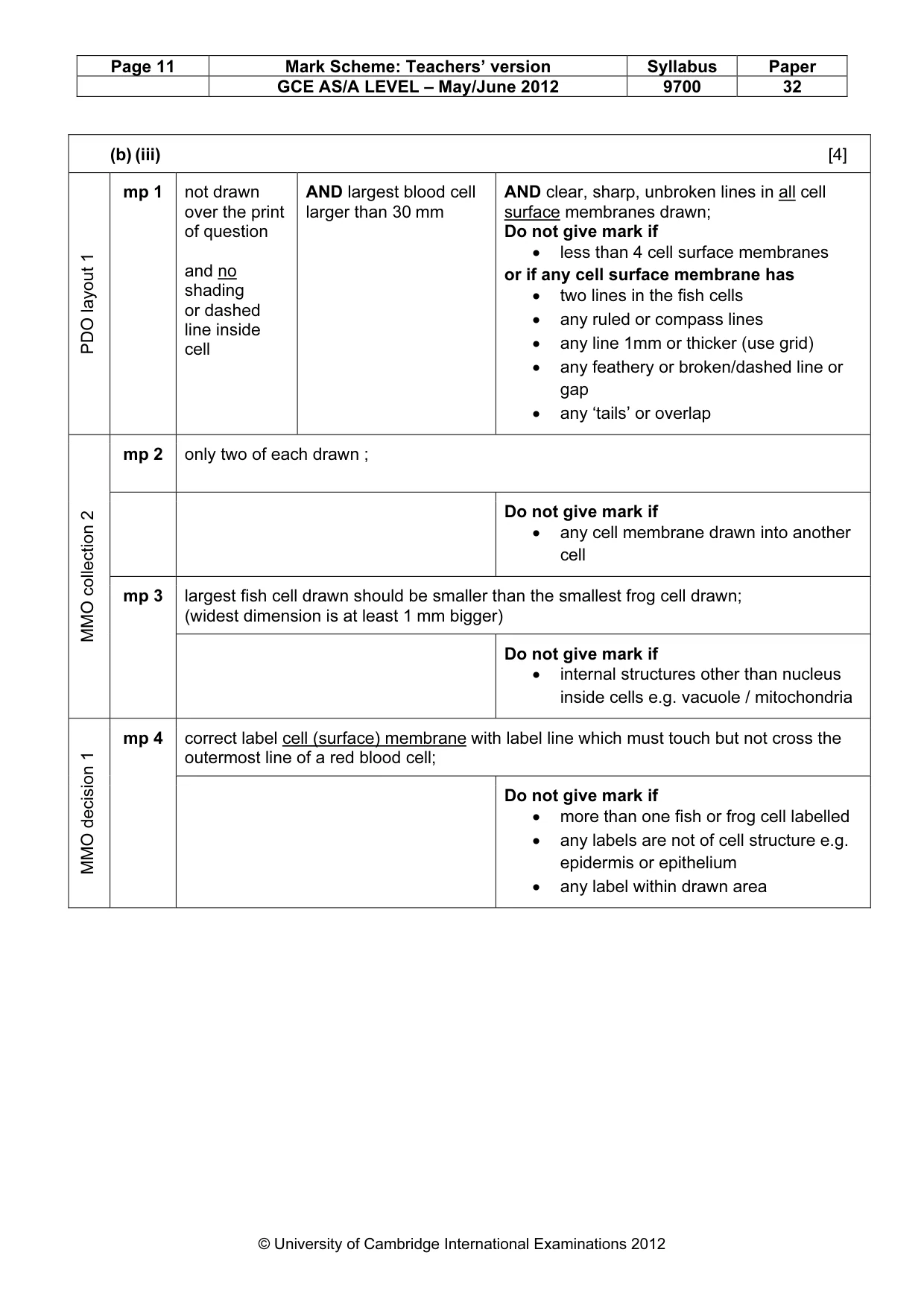
Page 11 Mark Scheme: Teachers’ version Syllabus Paper GCE AS/A LEVEL – May/June 2012 9700 32 © University of Cambridge International Examinations 2012 (b) (iii) [4] PDO layout 1 mp 1 not drawn over the print of question and no shading or dashed line inside cell AND largest blood cell larger than 30 mm AND clear, sharp, unbroken lines in all cell surface membranes drawn; Do not give mark if • less than 4 cell surface membranes or if any cell surface membrane has • two lines in the fish cells • any ruled or compass lines • any line 1mm or thicker (use grid) • any feathery or broken/dashed line or gap • any ‘tails’ or overlap mp 2 only two of each drawn ; Do not give mark if • any cell membrane drawn into another cell largest fish cell drawn should be smaller than the smallest frog cell drawn; (widest dimension is at least 1 mm bigger) MMO collection 2 mp 3 Do not give mark if • internal structures other than nucleus inside cells e.g. vacuole / mitochondria correct label cell (surface) membrane with label line which must touch but not cross the outermost line of a red blood cell; MMO decision 1 mp 4 Do not give mark if • more than one fish or frog cell labelled • any labels are not of cell structure e.g. epidermis or epithelium • any label within drawn area
Mark scheme, page 12
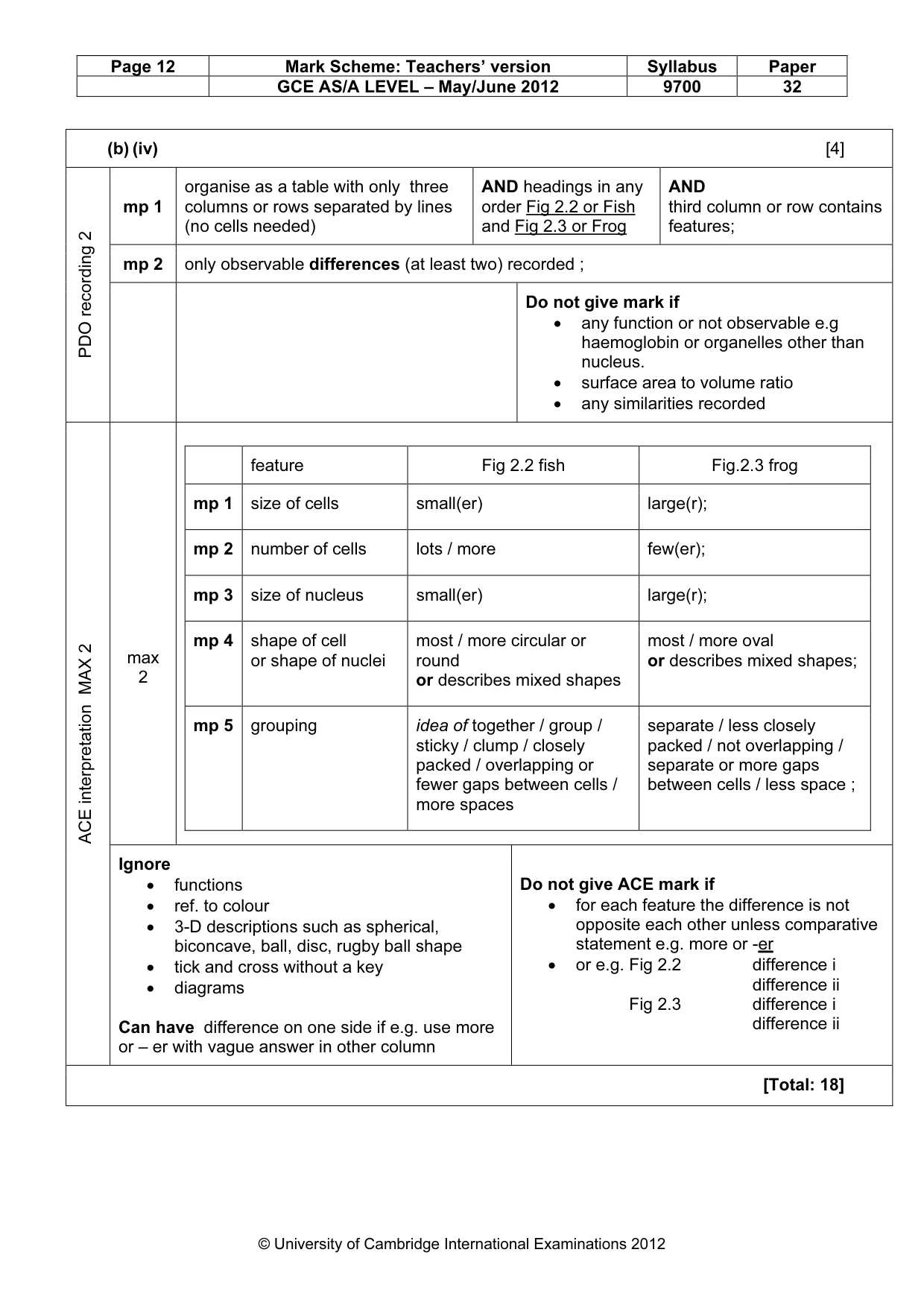
Page 12 Mark Scheme: Teachers’ version Syllabus Paper GCE AS/A LEVEL – May/June 2012 9700 32 © University of Cambridge International Examinations 2012 (b) (iv) [4] mp 1 organise as a table with only three columns or rows separated by lines (no cells needed) AND headings in any order Fig 2.2 or Fish and Fig 2.3 or Frog AND third column or row contains features; mp 2 only observable differences (at least two) recorded ; PDO recording 2 Do not give mark if • any function or not observable e.g haemoglobin or organelles other than nucleus. • surface area to volume ratio • any similarities recorded max 2 feature Fig 2.2 fish Fig.2.3 frog mp 1 size of cells small(er) large(r); mp 2 number of cells lots / more few(er); mp 3 size of nucleus small(er) large(r); mp 4 shape of cell or shape of nuclei most / more circular or round or describes mixed shapes most / more oval or describes mixed shapes; mp 5 grouping idea of together / group / sticky / clump / closely packed / overlapping or fewer gaps between cells / more spaces separate / less closely packed / not overlapping / separate or more gaps between cells / less space ; ACE interpretation MAX 2 Ignore • functions • ref. to colour • 3-D descriptions such as spherical, biconcave, ball, disc, rugby ball shape • tick and cross without a key • diagrams Can have difference on one side if e.g. use more or – er with vague answer in other column Do not give ACE mark if • for each feature the difference is not opposite each other unless comparative statement e.g. more or -er • or e.g. Fig 2.2 difference i difference ii Fig 2.3 difference i difference ii [Total: 18]
What you needed in this session
Cambridge’s own grade thresholds for 2012 May/June, Paper 3 · Variant 2. A higher threshold means an easier paper — the bar moves with how the cohort did.