Cambridge A Level Biology 9700 — 2011 Oct/Nov Paper 5 · Variant 1
9700/51/O/N/11 · 30 marks · ≈34 min
The question paper and its mark scheme, free to read here and free to download. This is Cambridge’s own paper, exactly as it was sat.
Question paper8 pages
Mark scheme7 pages
Answers below. Sit the paper first if you are practising.
Paper as text
Question paper, page 1
This document consists of 8 printed pages. DC (CB (SE/DJ)) 34786/4 © UCLES 2011 [Turn over UNIVERSITY OF CAMBRIDGE INTERNATIONAL EXAMINATIONS General Certificate of Education Advanced Level * 2 3 0 8 9 6 9 9 7 3 * BIOLOGY 9700/51 Paper 5 Planning, Analysis and Evaluation October/November 2011 1 hour 15 minutes Candidates answer on the Question Paper. No Additional Materials are required. READ THESE INSTRUCTIONS FIRST Write your Centre number, candidate number and name on all the work you hand in. Write in dark blue or black ink. You may use a pencil for any diagrams, graphs or rough working. Do not use staples, paper clips, highlighters, glue or correction fluid. DO NOT WRITE IN ANY BARCODES. Answer all questions. At the end of the examination, fasten all your work securely together. The number of marks is given in brackets [ ] at the end of each question or part question. For Examiner’s Use 1 2 Total
Question paper, page 2
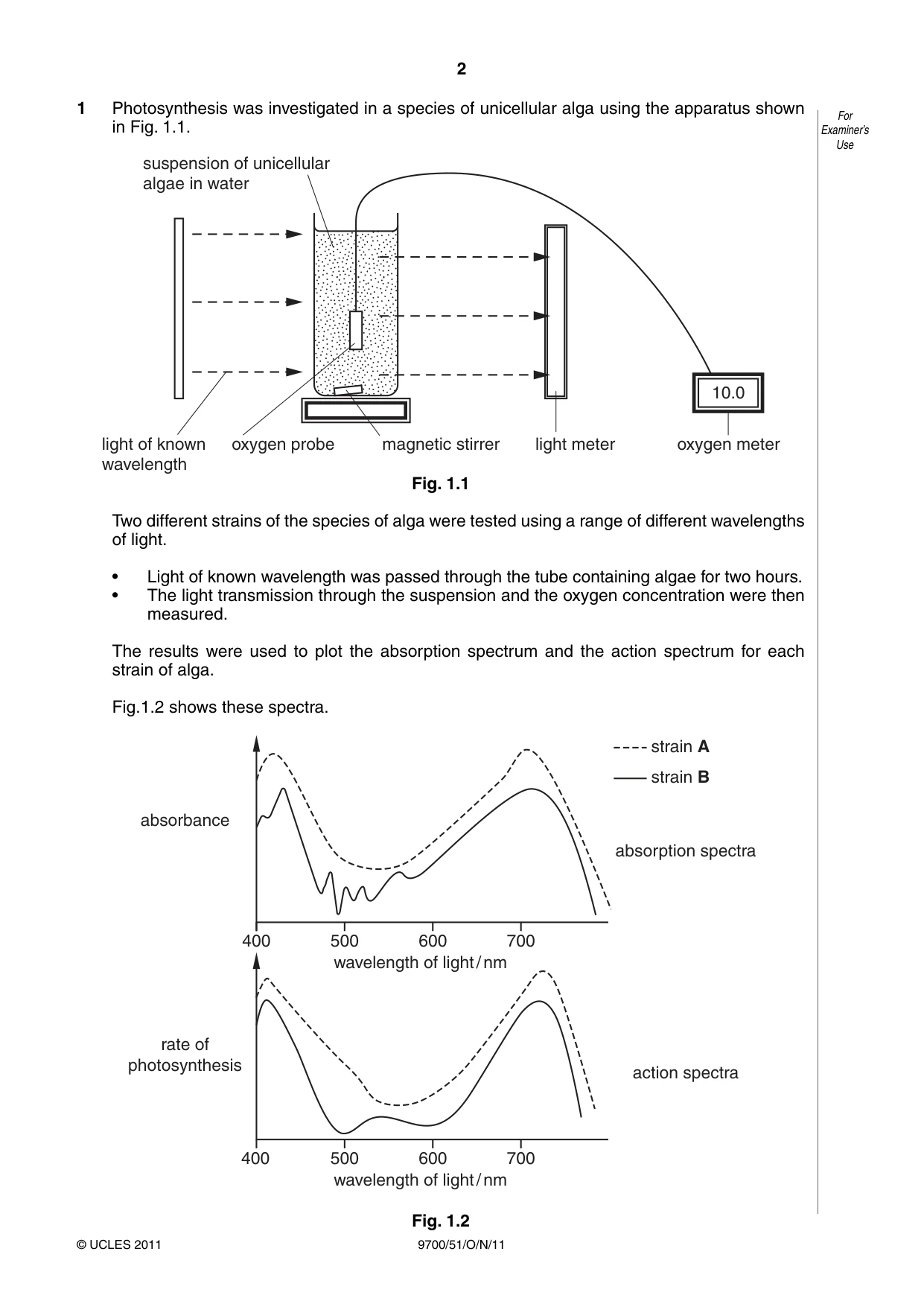
2 9700/51/O/N/11 © UCLES 2011 For Examiner’s Use 1 Photosynthesis was investigated in a species of unicellular alga using the apparatus shown in Fig. 1.1. suspension of unicellular algae in water light of known wavelength oxygen probe magnetic stirrer light meter oxygen meter 10.0 Fig. 1.1 Two different strains of the species of alga were tested using a range of different wavelengths of light. • Light of known wavelength was passed through the tube containing algae for two hours. • The light transmission through the suspension and the oxygen concentration were then measured. The results were used to plot the absorption spectrum and the action spectrum for each strain of alga. Fig.1.2 shows these spectra. 400 500 600 wavelength of light / nm 700 absorption spectra action spectra rate of photosynthesis absorbance strain B strain A 400 500 600 wavelength of light / nm 700 Fig. 1.2
Question paper, page 3
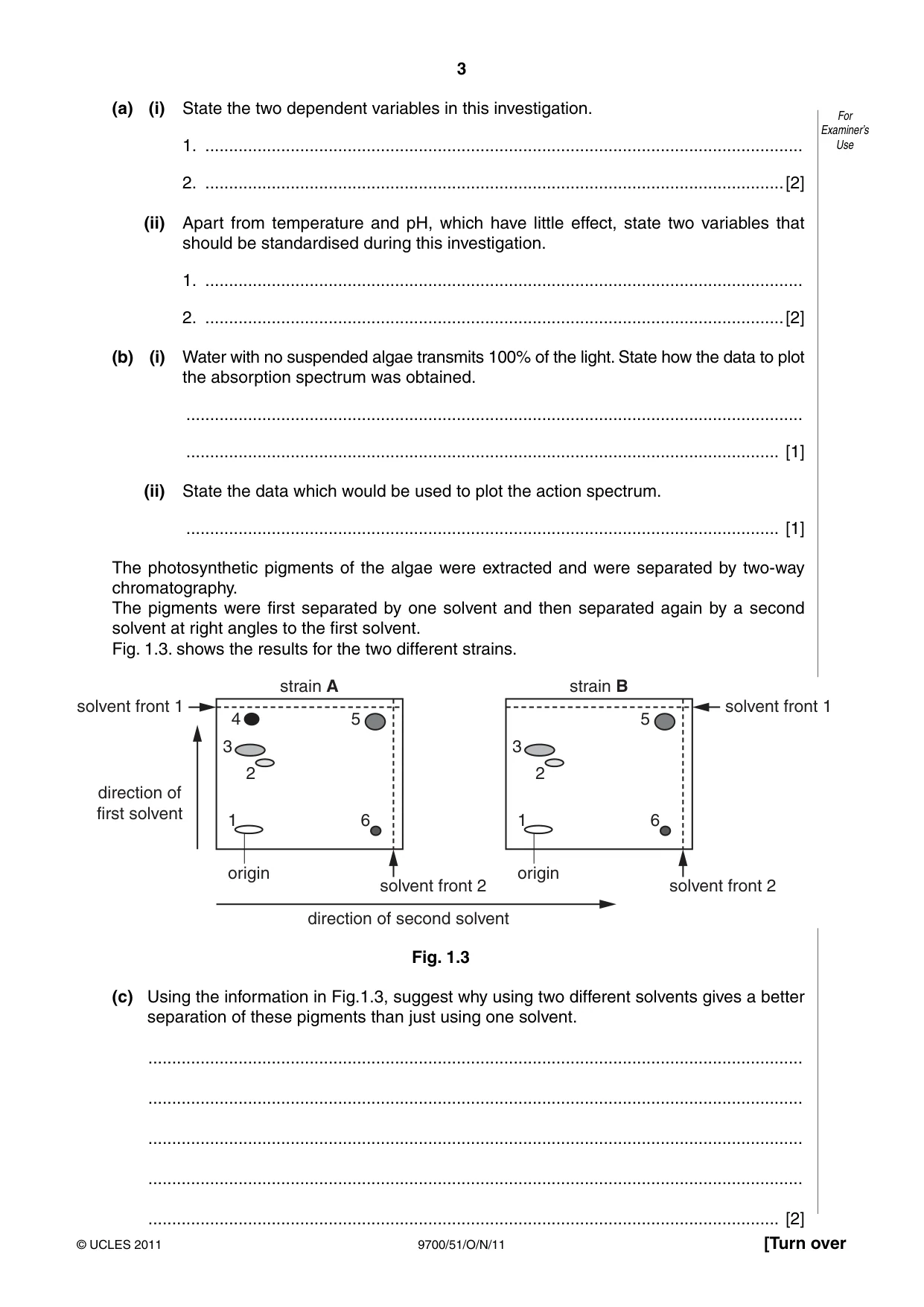
3 9700/51/O/N/11 © UCLES 2011 [Turn over For Examiner’s Use (a) (i) State the two dependent variables in this investigation. 1. … 2. …[2] (ii) Apart from temperature and pH, which have little effect, state two variables that should be standardised during this investigation. 1. … 2. …[2] (b) (i) Water with no suspended algae transmits 100% of the light. State how the data to plot the absorption spectrum was obtained. … … [1] (ii) State the data which would be used to plot the action spectrum. … [1] The photosynthetic pigments of the algae were extracted and were separated by two-way chromatography. The pigments were first separated by one solvent and then separated again by a second solvent at right angles to the first solvent. Fig. 1.3. shows the results for the two different strains. strain A solvent front 1 solvent front 2 direction of second solvent origin direction of first solvent 1 6 2 3 4 5 strain B solvent front 1 solvent front 2 origin 1 6 2 3 5 Fig. 1.3 (c) Using the information in Fig.1.3, suggest why using two different solvents gives a better separation of these pigments than just using one solvent. … … … … … [2]
Question paper, page 4
4 9700/51/O/N/11 © UCLES 2011 For Examiner’s Use (d) Outline a procedure that a student could use to extract the photosynthetic pigments and obtain these chromatograms. … … … … … … … … … … … … … … … … … … … … … … … … … [8]
Question paper, page 5
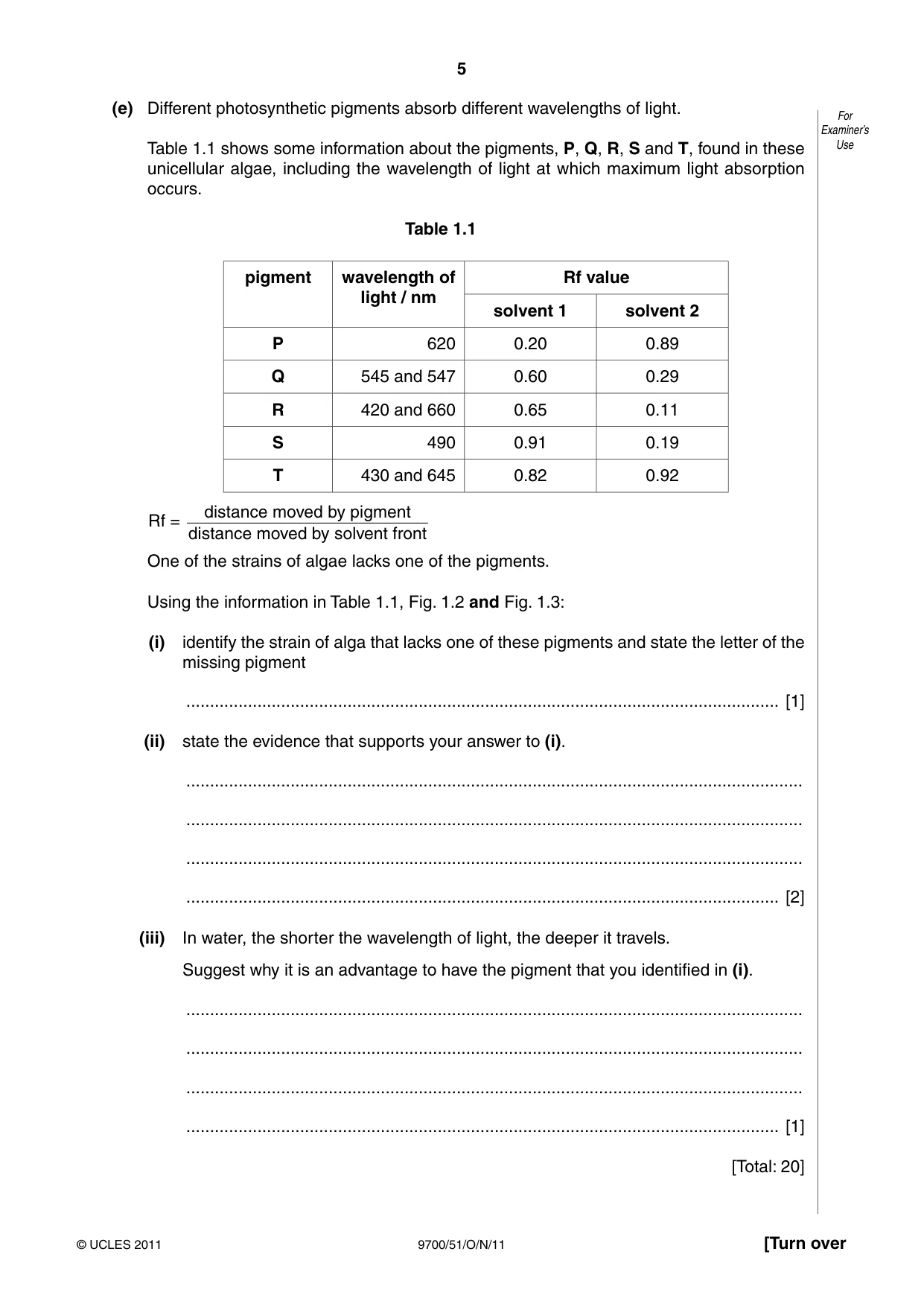
5 9700/51/O/N/11 © UCLES 2011 [Turn over For Examiner’s Use (e) Different photosynthetic pigments absorb different wavelengths of light. Table 1.1 shows some information about the pigments, P, Q, R, S and T, found in these unicellular algae, including the wavelength of light at which maximum light absorption occurs. Table 1.1 pigment wavelength of light / nm Rf value solvent 1 solvent 2 P 620 0.20 0.89 Q 545 and 547 0.60 0.29 R 420 and 660 0.65 0.11 S 490 0.91 0.19 T 430 and 645 0.82 0.92 Rf = distance moved by pigment distance moved by solvent front One of the strains of algae lacks one of the pigments. Using the information in Table 1.1, Fig. 1.2 and Fig. 1.3: (i) identify the strain of alga that lacks one of these pigments and state the letter of the missing pigment … [1] (ii) state the evidence that supports your answer to (i). … … … … [2] (iii) In water, the shorter the wavelength of light, the deeper it travels. Suggest why it is an advantage to have the pigment that you identified in (i). … … … … [1] [Total: 20]
Question paper, page 6
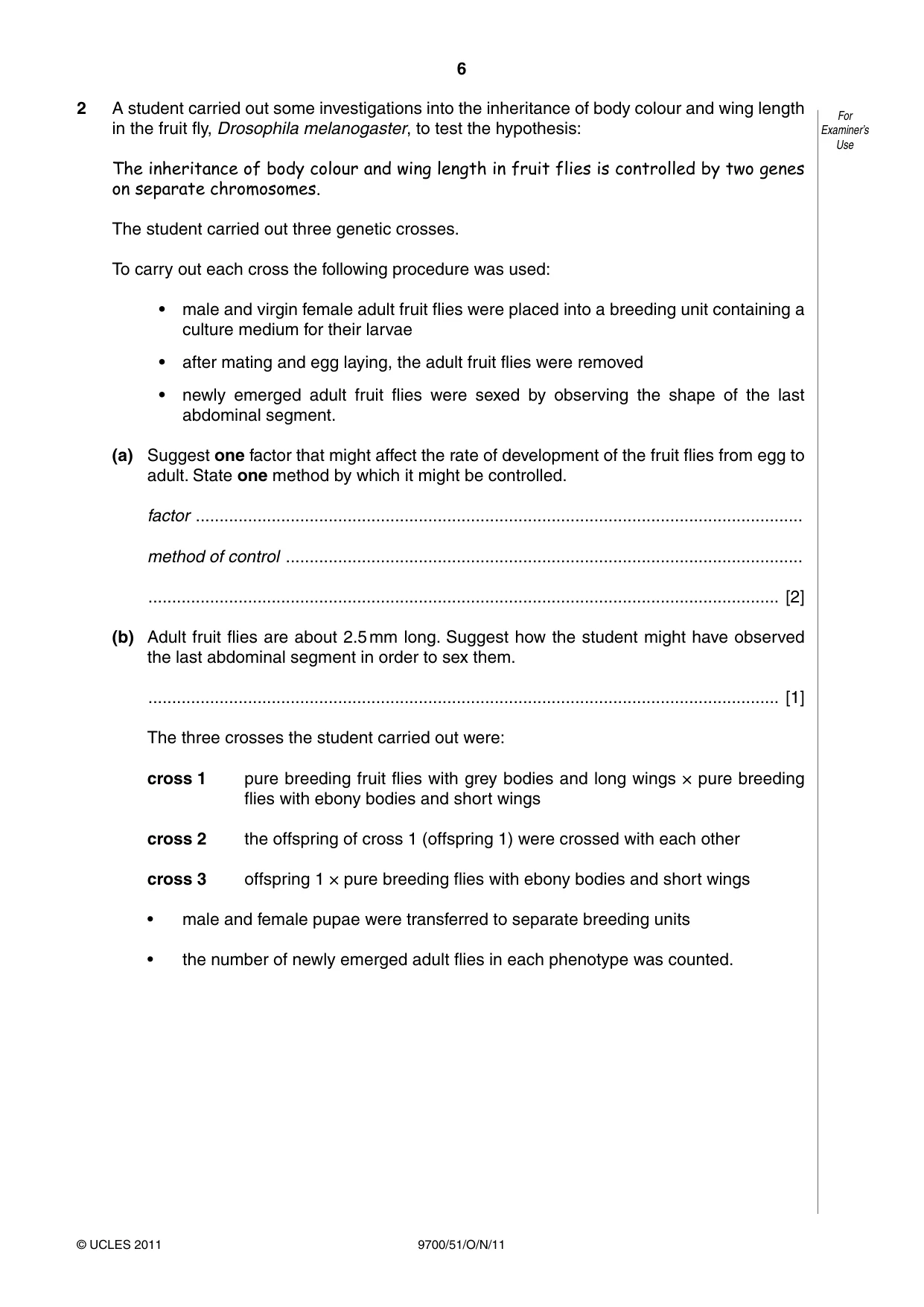
6 9700/51/O/N/11 © UCLES 2011 For Examiner’s Use 2 A student carried out some investigations into the inheritance of body colour and wing length in the fruit fly, Drosophila melanogaster, to test the hypothesis: The inheritance of body colour and wing length in fruit flies is controlled by two genes on separate chromosomes. The student carried out three genetic crosses. To carry out each cross the following procedure was used: • male and virgin female adult fruit flies were placed into a breeding unit containing a culture medium for their larvae • after mating and egg laying, the adult fruit flies were removed • newly emerged adult fruit flies were sexed by observing the shape of the last abdominal segment. (a) Suggest one factor that might affect the rate of development of the fruit flies from egg to adult. State one method by which it might be controlled. factor … method of control … … [2] (b) Adult fruit flies are about 2.5 mm long. Suggest how the student might have observed the last abdominal segment in order to sex them. … [1] The three crosses the student carried out were: cross 1 pure breeding fruit flies with grey bodies and long wings × pure breeding flies with ebony bodies and short wings cross 2 the offspring of cross 1 (offspring 1) were crossed with each other cross 3 offspring 1 × pure breeding flies with ebony bodies and short wings • male and female pupae were transferred to separate breeding units • the number of newly emerged adult flies in each phenotype was counted.
Question paper, page 7
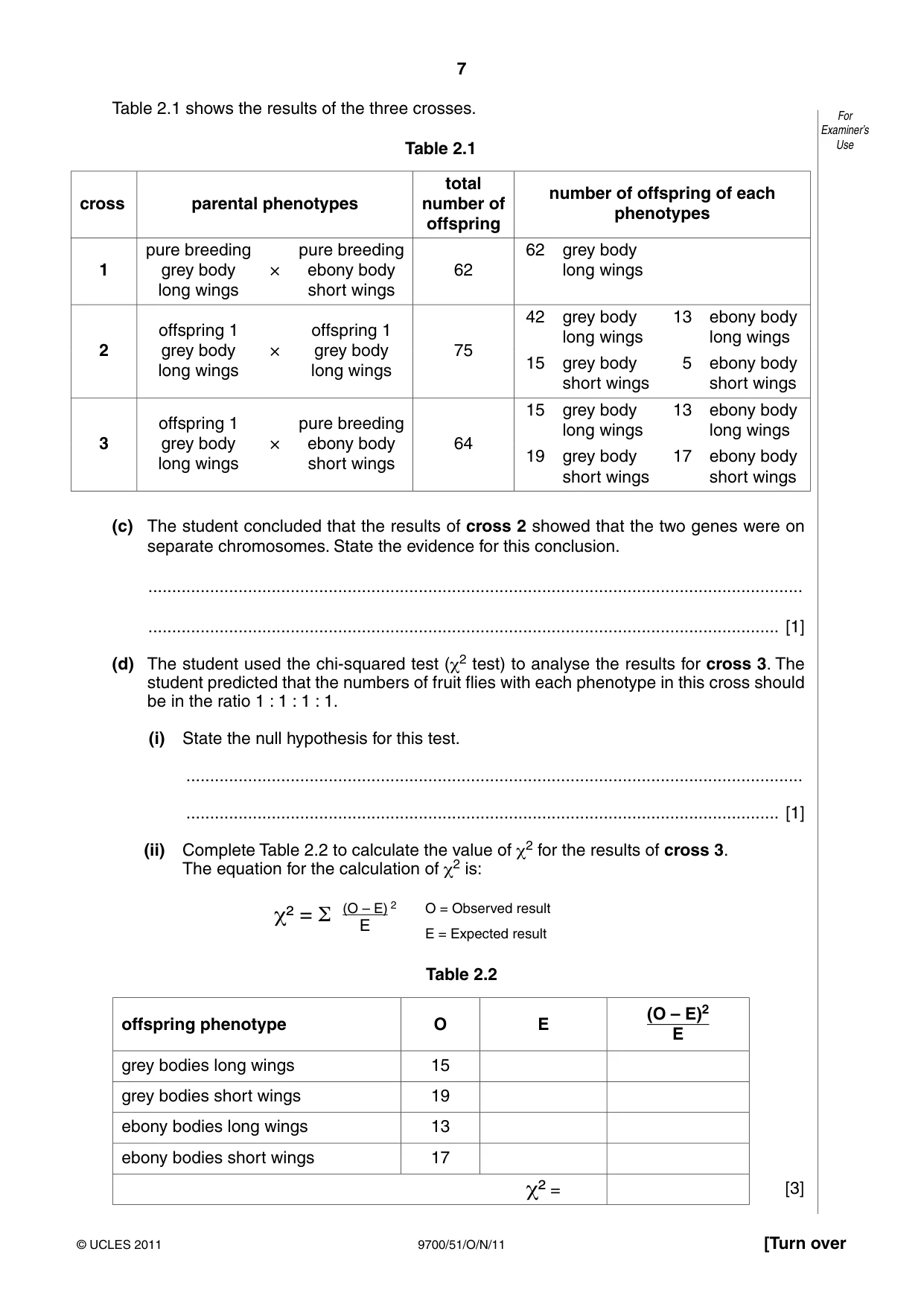
7 9700/51/O/N/11 © UCLES 2011 [Turn over For Examiner’s Use Table 2.1 shows the results of the three crosses. Table 2.1 cross parental phenotypes total number of offspring number of offspring of each phenotypes 1 pure breeding grey body long wings × pure breeding ebony body short wings 62 62 grey body long wings 2 offspring 1 grey body long wings × offspring 1 grey body long wings 75 42 grey body long wings 13 ebony body long wings 15 grey body short wings 5 ebony body short wings 3 offspring 1 grey body long wings × pure breeding ebony body short wings 64 15 grey body long wings 13 ebony body long wings 19 grey body short wings 17 ebony body short wings (c) The student concluded that the results of cross 2 showed that the two genes were on separate chromosomes. State the evidence for this conclusion. … … [1] (d) The student used the chi-squared test (χ2 test) to analyse the results for cross 3. The student predicted that the numbers of fruit flies with each phenotype in this cross should be in the ratio 1 : 1 : 1 : 1. (i) State the null hypothesis for this test. … … [1] (ii) Complete Table 2.2 to calculate the value of χ2 for the results of cross 3. The equation for the calculation of χ2 is: (O – E) 2 O = Observed result E E = Expected result χ² = Σ Table 2.2 offspring phenotype O E (O – E)2 E grey bodies long wings 15 grey bodies short wings 19 ebony bodies long wings 13 ebony bodies short wings 17 χ² = [3]
Question paper, page 8
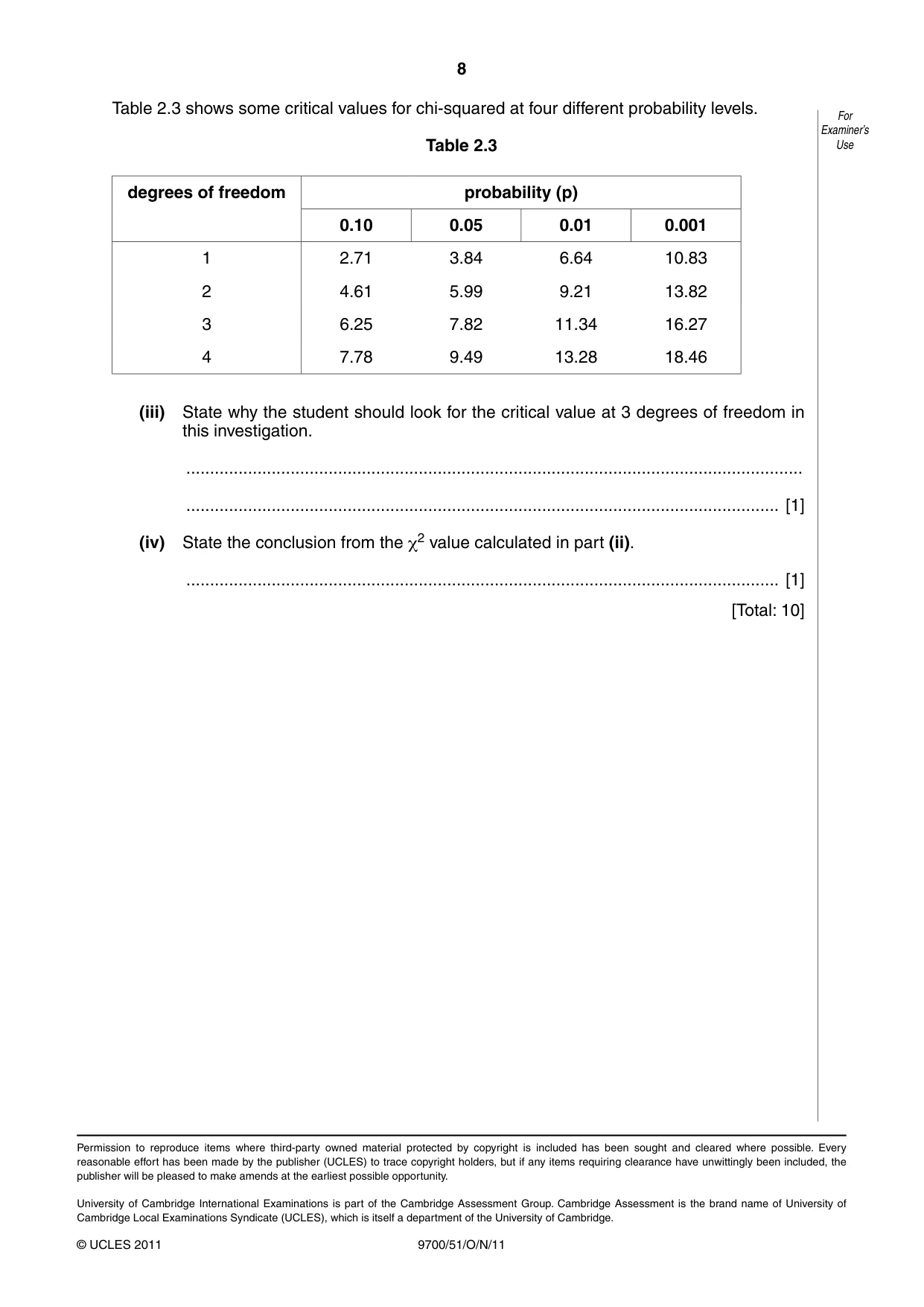
8 9700/51/O/N/11 © UCLES 2011 For Examiner’s Use Table 2.3 shows some critical values for chi-squared at four different probability levels. Table 2.3 degrees of freedom probability (p) 0.10 0.05 0.01 0.001 1 2.71 3.84 6.64 10.83 2 4.61 5.99 9.21 13.82 3 6.25 7.82 11.34 16.27 4 7.78 9.49 13.28 18.46 (iii) State why the student should look for the critical value at 3 degrees of freedom in this investigation. … … [1] (iv) State the conclusion from the χ2 value calculated in part (ii). … [1] [Total: 10] Permission to reproduce items where third-party owned material protected by copyright is included has been sought and cleared where possible. Every reasonable effort has been made by the publisher (UCLES) to trace copyright holders, but if any items requiring clearance have unwittingly been included, the publisher will be pleased to make amends at the earliest possible opportunity. University of Cambridge International Examinations is part of the Cambridge Assessment Group. Cambridge Assessment is the brand name of University of Cambridge Local Examinations Syndicate (UCLES), which is itself a department of the University of Cambridge.
Mark scheme, page 1
UNIVERSITY OF CAMBRIDGE INTERNATIONAL EXAMINATIONS GCE Advanced Subsidiary Level and GCE Advanced Level MARK SCHEME for the October/November 2011 question paper for the guidance of teachers 9700 BIOLOGY 9700/51 Paper 5 (Planning, Analysis and Evaluation), maximum raw mark 30 This mark scheme is published as an aid to teachers and candidates, to indicate the requirements of the examination. It shows the basis on which Examiners were instructed to award marks. It does not indicate the details of the discussions that took place at an Examiners’ meeting before marking began, which would have considered the acceptability of alternative answers. Mark schemes must be read in conjunction with the question papers and the report on the examination. • Cambridge will not enter into discussions or correspondence in connection with these mark schemes. Cambridge is publishing the mark schemes for the October/November 2011 question papers for most IGCSE, GCE Advanced Level and Advanced Subsidiary Level syllabuses and some Ordinary Level syllabuses.
Mark scheme, page 2
Page 2 Mark Scheme: Teachers’ version Syllabus Paper GCE AS/A LEVEL – October/November 2011 9700 51 © University of Cambridge International Examinations 2011 Mark scheme abbreviations: ; separates marking points / alternatives answers for the same point R reject A accept (for answers correctly cued by the question, or guidance for examiners) AW alternative wording (where responses vary more than usual) underline actual word given must be used by candidate (grammatical variants excepted) max indicates the maximum number of marks that can be given ora or reverse argument mp marking point (with relevant number) ecf error carried forward I ignore AVP alternative valid point (examples given as guidance)
Mark scheme, page 3
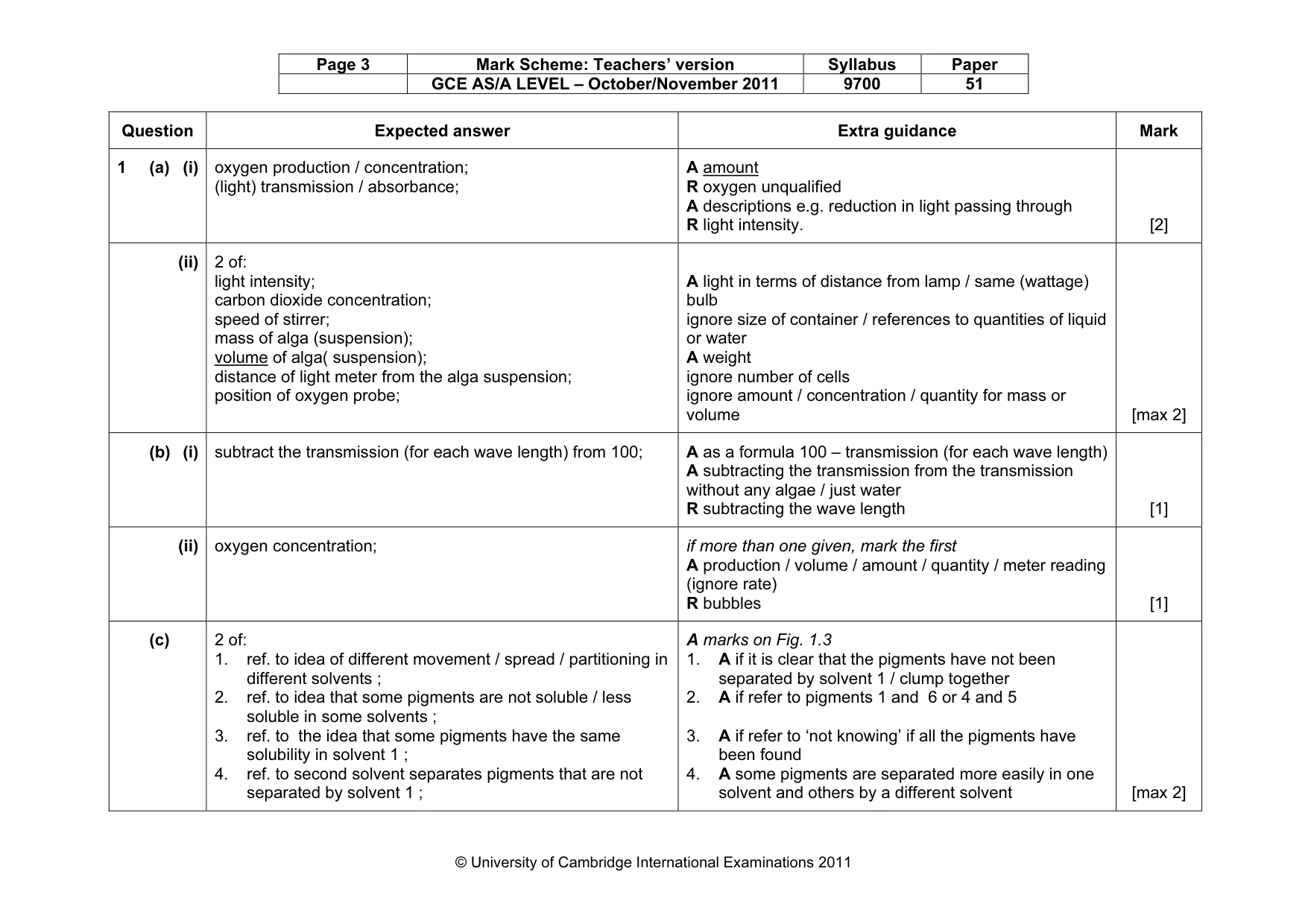
Page 3 Mark Scheme: Teachers’ version Syllabus Paper GCE AS/A LEVEL – October/November 2011 9700 51 © University of Cambridge International Examinations 2011 Question Expected answer Extra guidance Mark 1 (a) (i) oxygen production / concentration; (light) transmission / absorbance; A amount R oxygen unqualified A descriptions e.g. reduction in light passing through R light intensity. [2] (ii) 2 of: light intensity; carbon dioxide concentration; speed of stirrer; mass of alga (suspension); volume of alga( suspension); distance of light meter from the alga suspension; position of oxygen probe; A light in terms of distance from lamp / same (wattage) bulb ignore size of container / references to quantities of liquid or water A weight ignore number of cells ignore amount / concentration / quantity for mass or volume [max 2] (b) (i) subtract the transmission (for each wave length) from 100; A as a formula 100 – transmission (for each wave length) A subtracting the transmission from the transmission without any algae / just water R subtracting the wave length [1] (ii) oxygen concentration; if more than one given, mark the first A production / volume / amount / quantity / meter reading (ignore rate) R bubbles [1] (c) 2 of: 1. ref. to idea of different movement / spread / partitioning in different solvents ; 2. ref. to idea that some pigments are not soluble / less soluble in some solvents ; 3. ref. to the idea that some pigments have the same solubility in solvent 1 ; 4. ref. to second solvent separates pigments that are not separated by solvent 1 ; A marks on Fig. 1.3 1. A if it is clear that the pigments have not been separated by solvent 1 / clump together 2. A if refer to pigments 1 and 6 or 4 and 5 3. A if refer to ‘not knowing’ if all the pigments have been found 4. A some pigments are separated more easily in one solvent and others by a different solvent [max 2]
Mark scheme, page 4
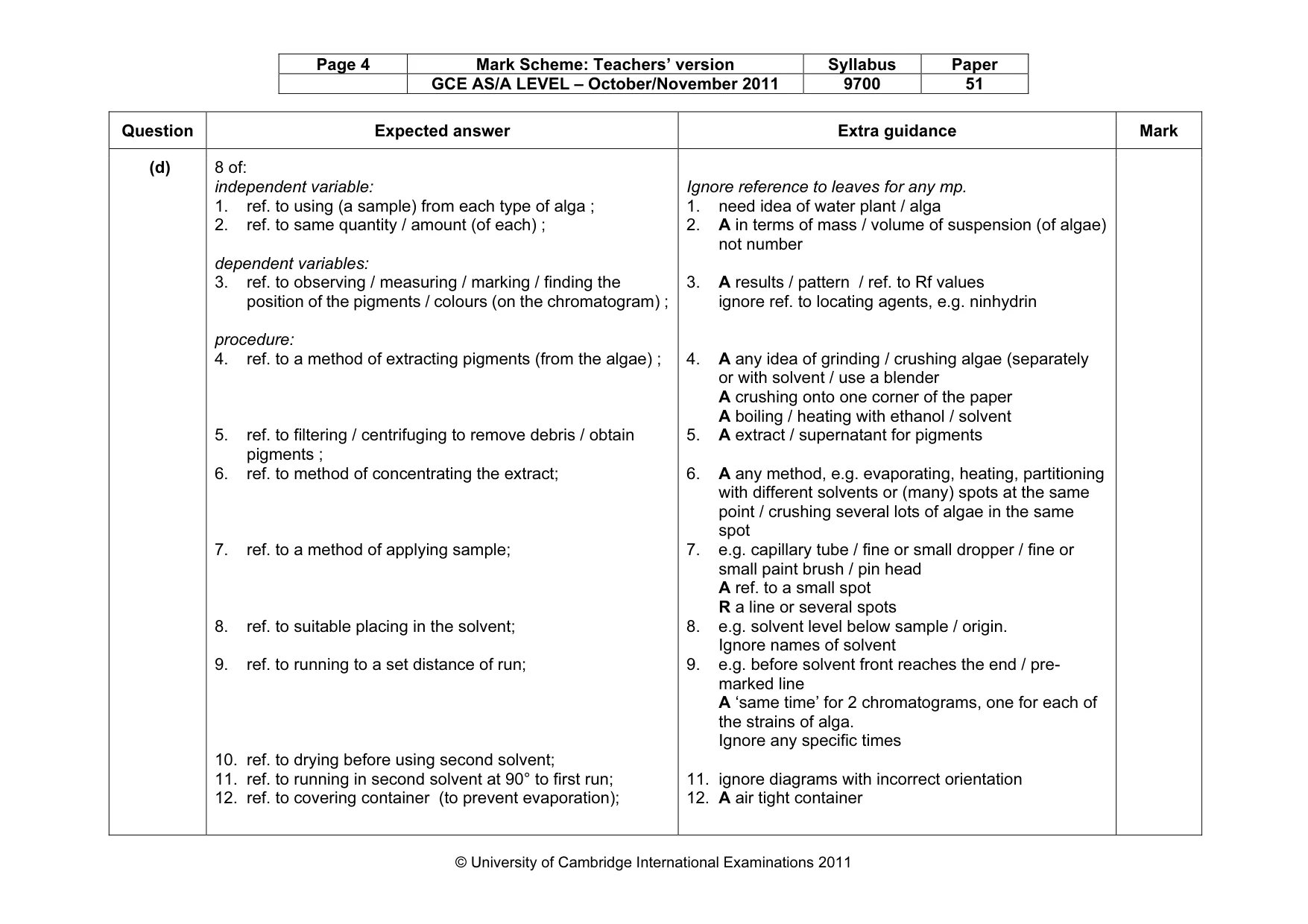
Page 4 Mark Scheme: Teachers’ version Syllabus Paper GCE AS/A LEVEL – October/November 2011 9700 51 © University of Cambridge International Examinations 2011 Question Expected answer Extra guidance Mark (d) 8 of: independent variable: 1. ref. to using (a sample) from each type of alga ; 2. ref. to same quantity / amount (of each) ; dependent variables: 3. ref. to observing / measuring / marking / finding the position of the pigments / colours (on the chromatogram) ; procedure: 4. ref. to a method of extracting pigments (from the algae) ; 5. ref. to filtering / centrifuging to remove debris / obtain pigments ; 6. ref. to method of concentrating the extract; 7. ref. to a method of applying sample; 8. ref. to suitable placing in the solvent; 9. ref. to running to a set distance of run; 10. ref. to drying before using second solvent; 11. ref. to running in second solvent at 90° to first run; 12. ref. to covering container (to prevent evaporation); Ignore reference to leaves for any mp. 1. need idea of water plant / alga 2. A in terms of mass / volume of suspension (of algae) not number 3. A results / pattern / ref. to Rf values ignore ref. to locating agents, e.g. ninhydrin 4. A any idea of grinding / crushing algae (separately or with solvent / use a blender A crushing onto one corner of the paper A boiling / heating with ethanol / solvent 5. A extract / supernatant for pigments 6. A any method, e.g. evaporating, heating, partitioning with different solvents or (many) spots at the same point / crushing several lots of algae in the same spot 7. e.g. capillary tube / fine or small dropper / fine or small paint brush / pin head A ref. to a small spot R a line or several spots 8. e.g. solvent level below sample / origin. Ignore names of solvent 9. e.g. before solvent front reaches the end / pre- marked line A ‘same time’ for 2 chromatograms, one for each of the strains of alga. Ignore any specific times 11. ignore diagrams with incorrect orientation 12. A air tight container
Mark scheme, page 5
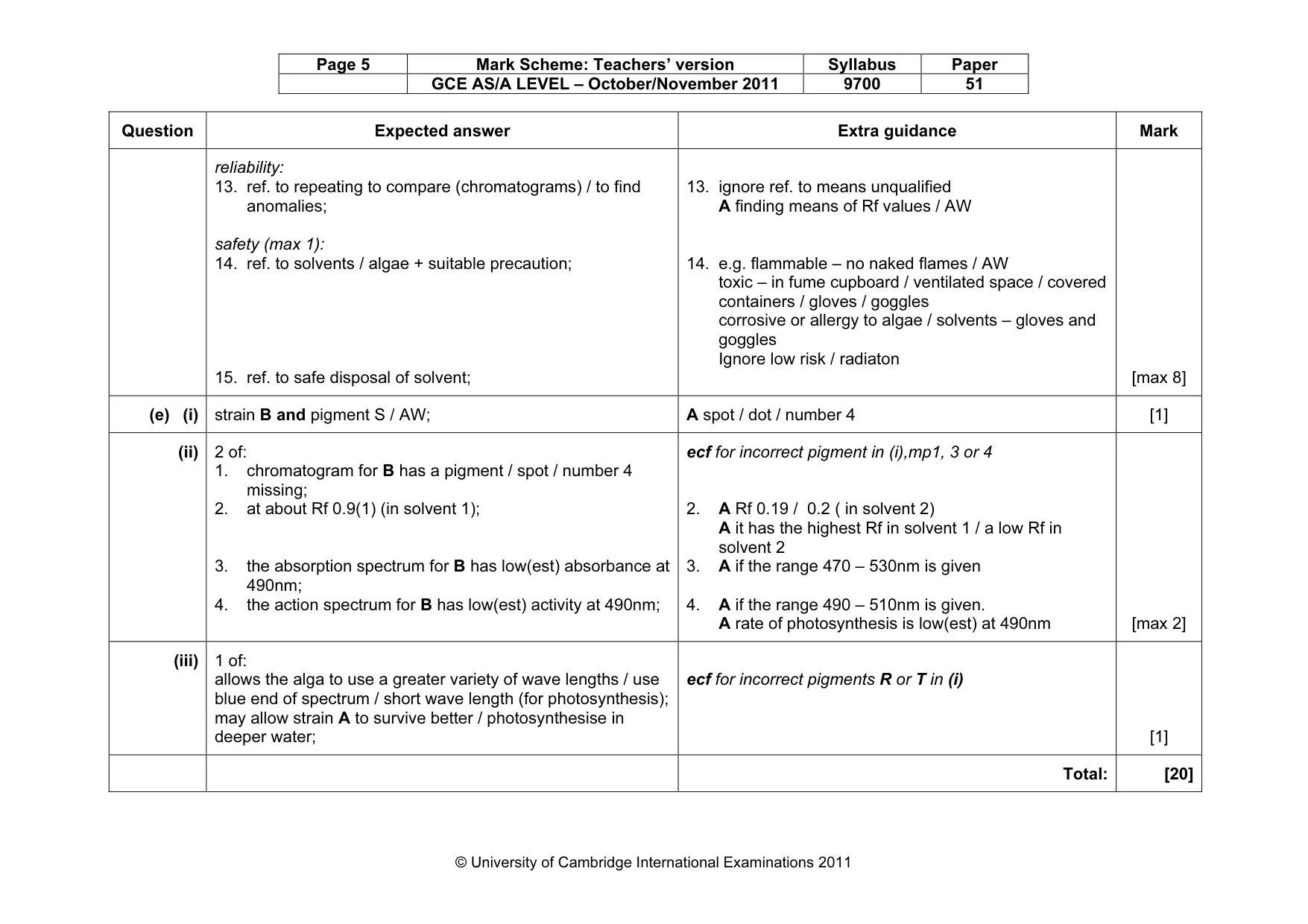
Page 5 Mark Scheme: Teachers’ version Syllabus Paper GCE AS/A LEVEL – October/November 2011 9700 51 © University of Cambridge International Examinations 2011 Question Expected answer Extra guidance Mark reliability: 13. ref. to repeating to compare (chromatograms) / to find anomalies; safety (max 1): 14. ref. to solvents / algae + suitable precaution; 15. ref. to safe disposal of solvent; 13. ignore ref. to means unqualified A finding means of Rf values / AW 14. e.g. flammable – no naked flames / AW toxic – in fume cupboard / ventilated space / covered containers / gloves / goggles corrosive or allergy to algae / solvents – gloves and goggles Ignore low risk / radiaton [max 8] (e) (i) strain B and pigment S / AW; A spot / dot / number 4 [1] (ii) 2 of: 1. chromatogram for B has a pigment / spot / number 4 missing; 2. at about Rf 0.9(1) (in solvent 1); 3. the absorption spectrum for B has low(est) absorbance at 490nm; 4. the action spectrum for B has low(est) activity at 490nm; ecf for incorrect pigment in (i),mp1, 3 or 4 2. A Rf 0.19 / 0.2 ( in solvent 2) A it has the highest Rf in solvent 1 / a low Rf in solvent 2 3. A if the range 470 – 530nm is given 4. A if the range 490 – 510nm is given. A rate of photosynthesis is low(est) at 490nm [max 2] (iii) 1 of: allows the alga to use a greater variety of wave lengths / use blue end of spectrum / short wave length (for photosynthesis); may allow strain A to survive better / photosynthesise in deeper water; ecf for incorrect pigments R or T in (i) [1] Total: [20]
Mark scheme, page 6
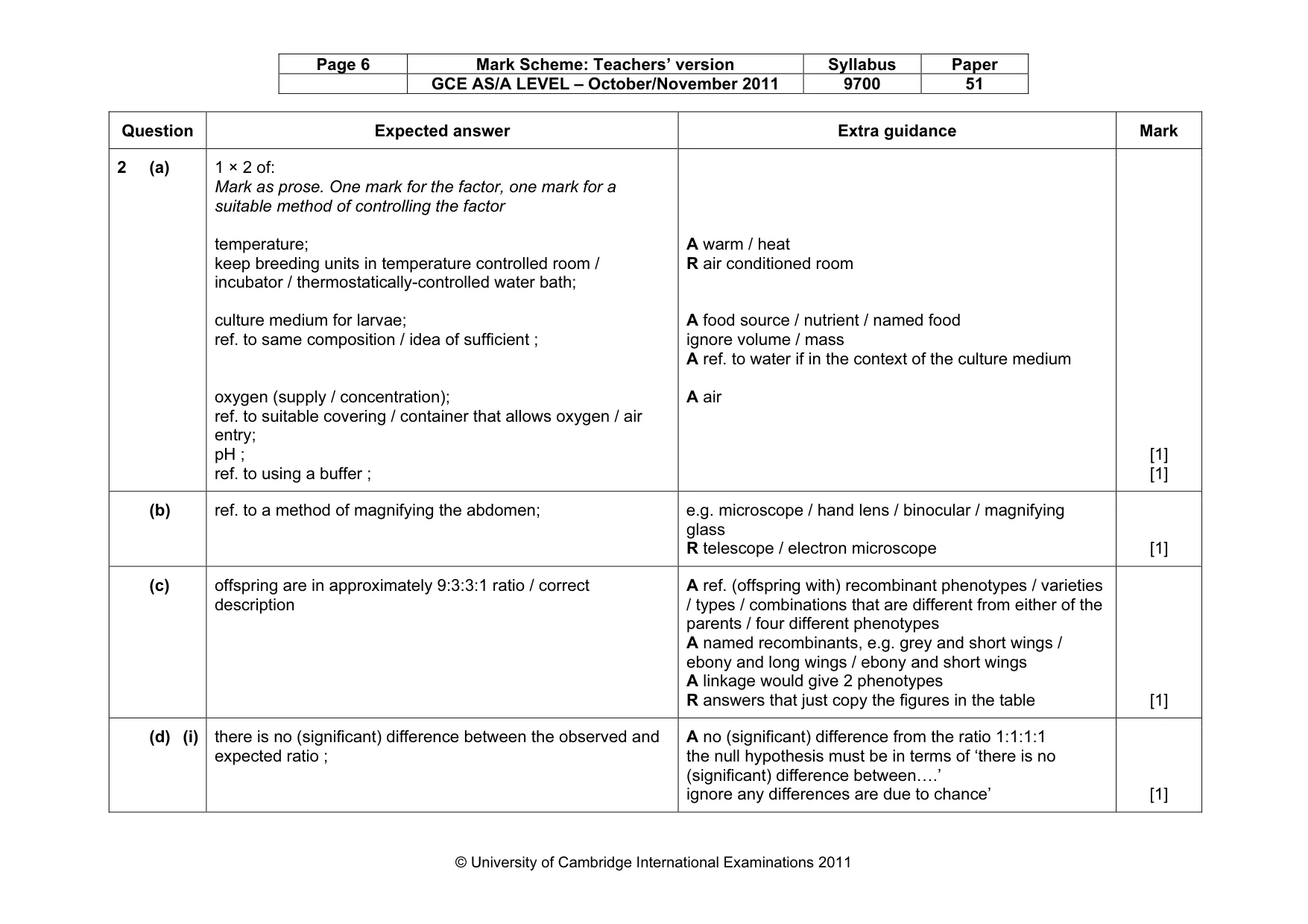
Page 6 Mark Scheme: Teachers’ version Syllabus Paper GCE AS/A LEVEL – October/November 2011 9700 51 © University of Cambridge International Examinations 2011 Question Expected answer Extra guidance Mark 2 (a) 1 × 2 of: Mark as prose. One mark for the factor, one mark for a suitable method of controlling the factor temperature; keep breeding units in temperature controlled room / incubator / thermostatically-controlled water bath; culture medium for larvae; ref. to same composition / idea of sufficient ; oxygen (supply / concentration); ref. to suitable covering / container that allows oxygen / air entry; pH ; ref. to using a buffer ; A warm / heat R air conditioned room A food source / nutrient / named food ignore volume / mass A ref. to water if in the context of the culture medium A air [1] [1] (b) ref. to a method of magnifying the abdomen; e.g. microscope / hand lens / binocular / magnifying glass R telescope / electron microscope [1] (c) offspring are in approximately 9:3:3:1 ratio / correct description A ref. (offspring with) recombinant phenotypes / varieties / types / combinations that are different from either of the parents / four different phenotypes A named recombinants, e.g. grey and short wings / ebony and long wings / ebony and short wings A linkage would give 2 phenotypes R answers that just copy the figures in the table [1] (d) (i) there is no (significant) difference between the observed and expected ratio ; A no (significant) difference from the ratio 1:1:1:1 the null hypothesis must be in terms of ‘there is no (significant) difference between….’ ignore any differences are due to chance’ [1]
Mark scheme, page 7
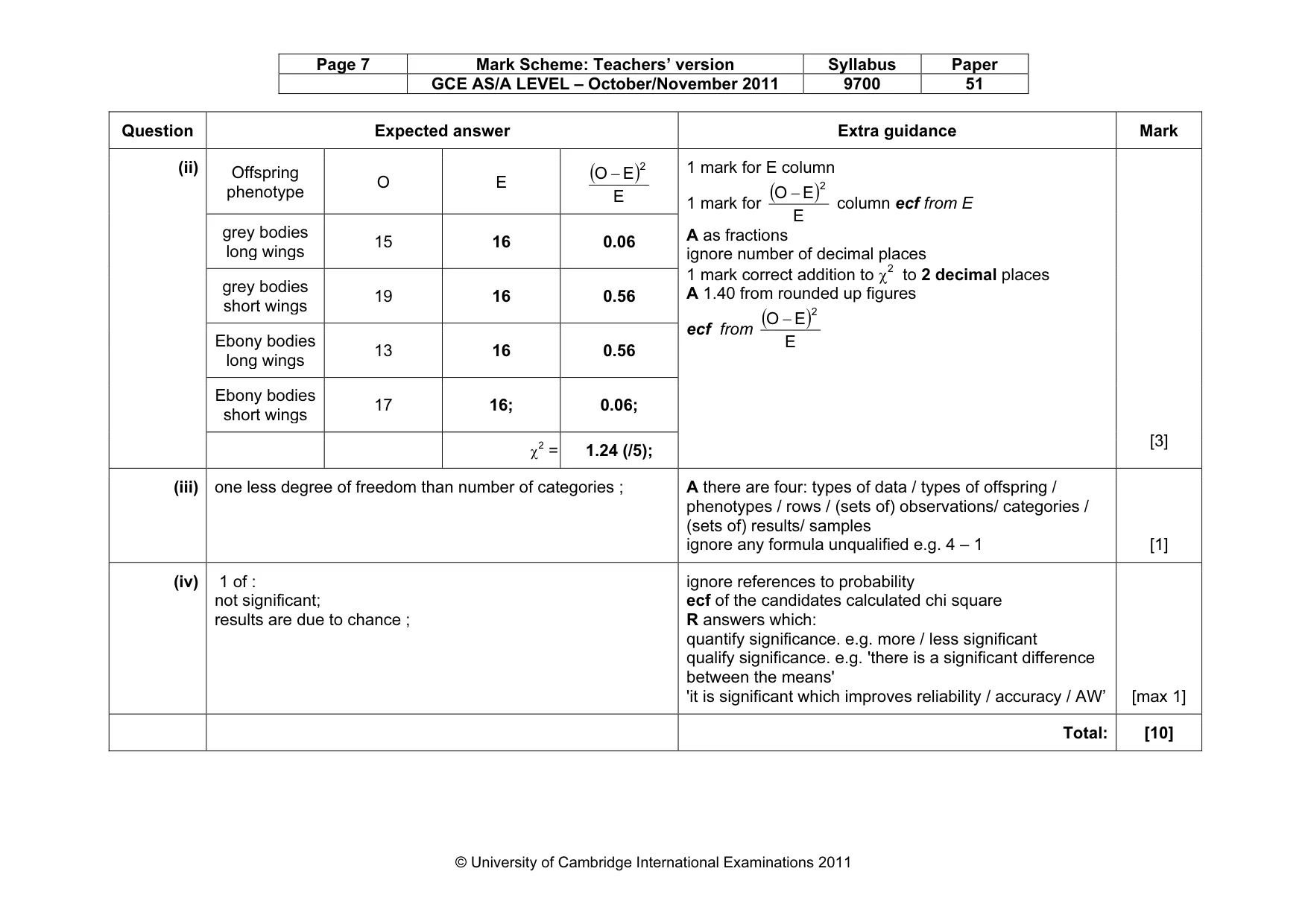
Page 7 Mark Scheme: Teachers’ version Syllabus Paper GCE AS/A LEVEL – October/November 2011 9700 51 © University of Cambridge International Examinations 2011 Question Expected answer Extra guidance Mark Offspring phenotype O E ( ) E E O 2 − grey bodies long wings 15 16 0.06 grey bodies short wings 19 16 0.56 Ebony bodies long wings 13 16 0.56 Ebony bodies short wings 17 16; 0.06; (ii) χ2 = 1.24 (/5); 1 mark for E column 1 mark for ( ) E E O 2 − column ecf from E A as fractions ignore number of decimal places 1 mark correct addition to χ2 to 2 decimal places A 1.40 from rounded up figures ecf from ( ) E E O 2 − [3] (iii) one less degree of freedom than number of categories ; A there are four: types of data / types of offspring / phenotypes / rows / (sets of) observations/ categories / (sets of) results/ samples ignore any formula unqualified e.g. 4 – 1 [1] (iv) 1 of : not significant; results are due to chance ; ignore references to probability ecf of the candidates calculated chi square R answers which: quantify significance. e.g. more / less significant qualify significance. e.g. 'there is a significant difference between the means' 'it is significant which improves reliability / accuracy / AW’ [max 1] Total: [10]
What you needed in this session
Cambridge’s own grade thresholds for 2011 Oct/Nov, Paper 5 · Variant 1. A higher threshold means an easier paper — the bar moves with how the cohort did.