Cambridge A Level Biology 9700 — 2010 Oct/Nov Paper 3 · Variant 4
9700/34/O/N/10 · 40 marks · ≈45 min
The question paper and its mark scheme, free to read here and free to download. This is Cambridge’s own paper, exactly as it was sat.
Question paper12 pages

Mark scheme10 pages
Answers below. Sit the paper first if you are practising.
Paper as text
Question paper, page 1
This document consists of 11 printed pages and 1 blank page. DC (SM/CGW) 24032/3 © UCLES 2010 [Turn over UNIVERSITY OF CAMBRIDGE INTERNATIONAL EXAMINATIONS General Certificate of Education Advanced Subsidiary Level and Advanced Level READ THESE INSTRUCTIONS FIRST Write your Centre number, candidate number and name on all the work you hand in. Write in dark blue or black ink. You may use a pencil for any diagrams, graphs or rough working. Do not use red ink, staples, paper clips, highlighters, glue or correction fluid. DO NOT WRITE IN ANY BARCODES. Answer all questions. You may lose marks if you do not show your working or if you do not use appropriate units. At the end of the examination, fasten all your work securely together. The number of marks is given in brackets [ ] at the end of each question or part question. * 2 5 8 7 5 1 6 5 4 8 * BIOLOGY 9700/34 Advanced Practical Skills 2 October/November 2010 2 hours Candidates answer on the Question Paper. Additional Materials: As listed in the Confidential Instructions. For Examiner’s Use 1 2 Total
Question paper, page 2
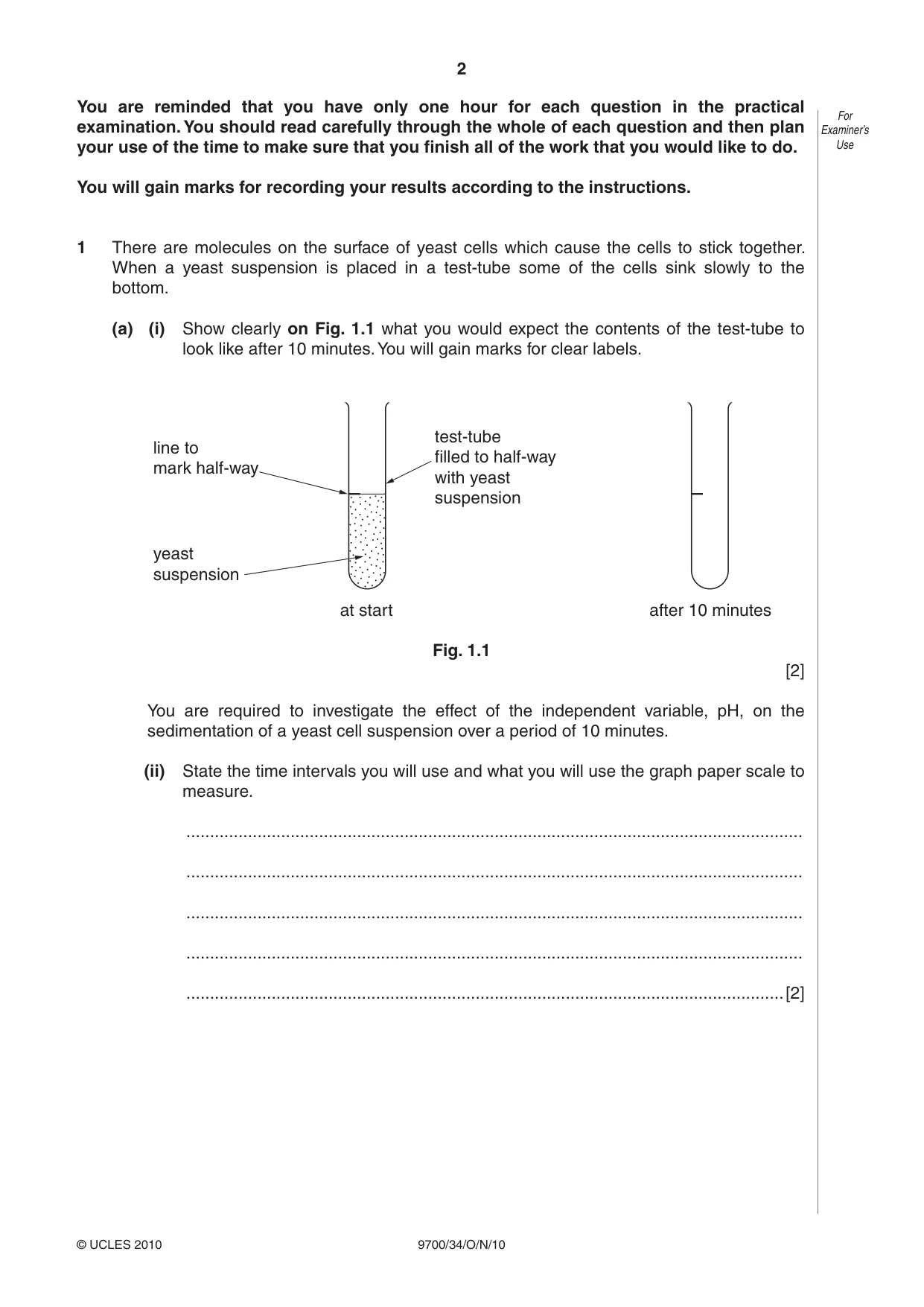
2 9700/34/O/N/10 © UCLES 2010 For Examiner’s Use You are reminded that you have only one hour for each question in the practical examination. You should read carefully through the whole of each question and then plan your use of the time to make sure that you finish all of the work that you would like to do. You will gain marks for recording your results according to the instructions. 1 There are molecules on the surface of yeast cells which cause the cells to stick together. When a yeast suspension is placed in a test-tube some of the cells sink slowly to the bottom. (a) (i) Show clearly on Fig. 1.1 what you would expect the contents of the test-tube to look like after 10 minutes. You will gain marks for clear labels. at start line to mark half-way test-tube filled to half-way with yeast suspension yeast suspension after 10 minutes Fig. 1.1 [2] You are required to investigate the effect of the independent variable, pH, on the sedimentation of a yeast cell suspension over a period of 10 minutes. (ii) State the time intervals you will use and what you will use the graph paper scale to measure. … … … … …[2]
Question paper, page 3
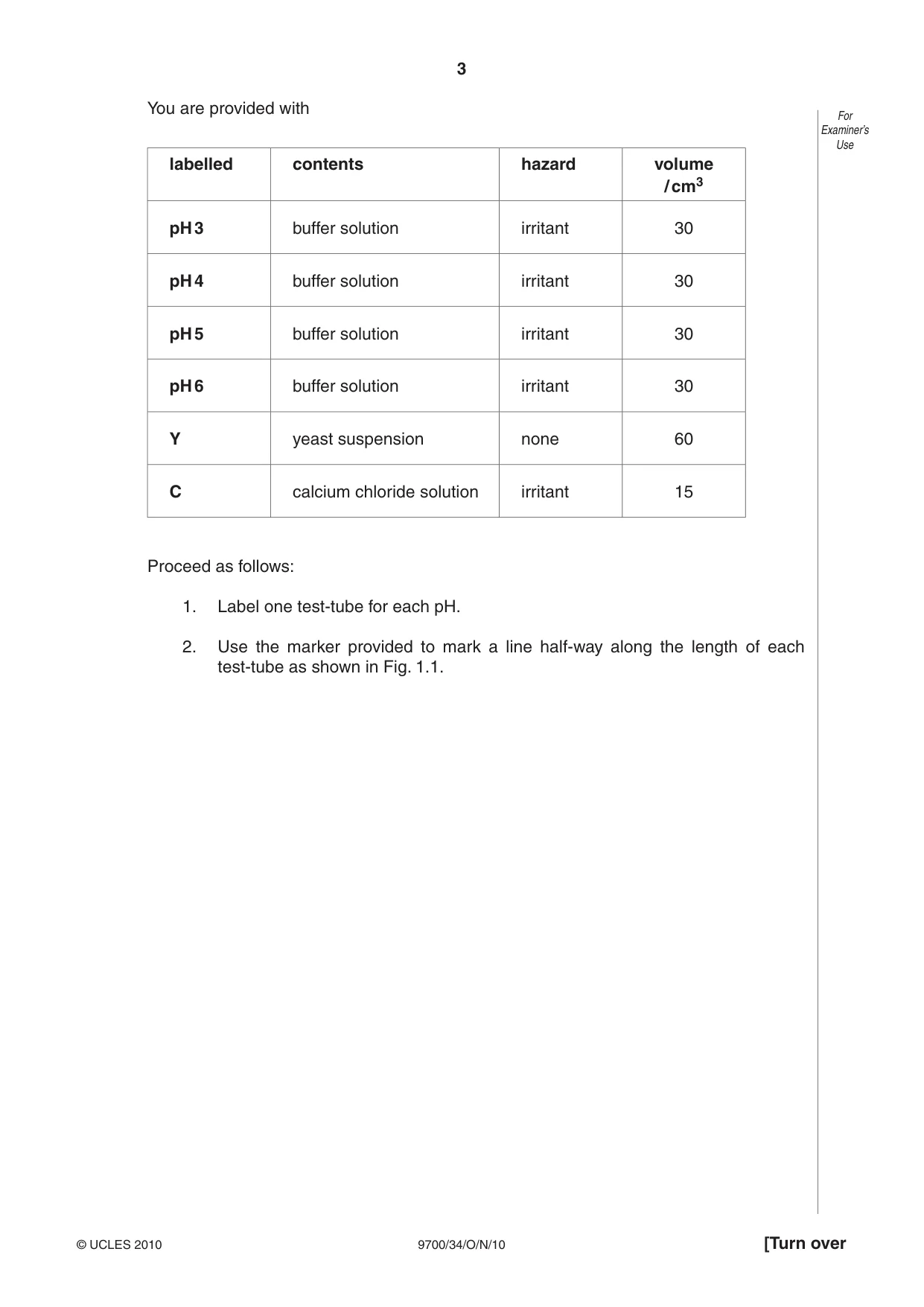
3 [Turn over 9700/34/O/N/10 © UCLES 2010 For Examiner’s Use You are provided with labelled contents hazard volume / cm3 pH 3 buffer solution irritant 30 pH 4 buffer solution irritant 30 pH 5 buffer solution irritant 30 pH 6 buffer solution irritant 30 Y yeast suspension none 60 C calcium chloride solution irritant 15 Proceed as follows: 1. Label one test-tube for each pH. 2. Use the marker provided to mark a line half-way along the length of each test-tube as shown in Fig. 1.1.
Question paper, page 4
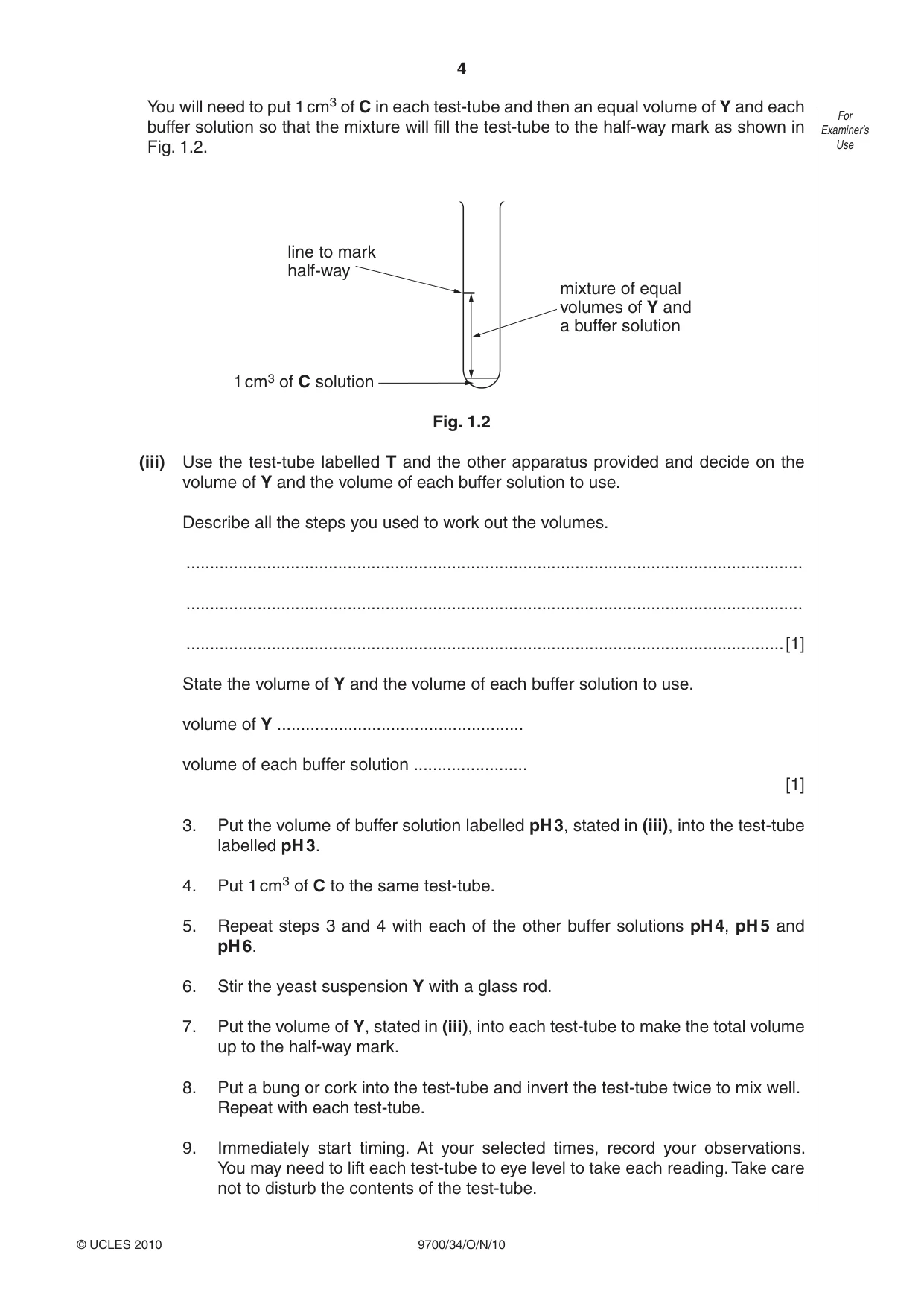
4 9700/34/O/N/10 © UCLES 2010 For Examiner’s Use You will need to put 1 cm3 of C in each test-tube and then an equal volume of Y and each buffer solution so that the mixture will fill the test-tube to the half-way mark as shown in Fig. 1.2. line to mark half-way mixture of equal volumes of Y and a buffer solution 1 cm3 of C solution Fig. 1.2 (iii) Use the test-tube labelled T and the other apparatus provided and decide on the volume of Y and the volume of each buffer solution to use. Describe all the steps you used to work out the volumes. … … …[1] State the volume of Y and the volume of each buffer solution to use. volume of Y … volume of each buffer solution … [1] 3. Put the volume of buffer solution labelled pH 3, stated in (iii), into the test-tube labelled pH 3. 4. Put 1 cm3 of C to the same test-tube. 5. Repeat steps 3 and 4 with each of the other buffer solutions pH 4, pH 5 and pH 6. 6. Stir the yeast suspension Y with a glass rod. 7. Put the volume of Y, stated in (iii), into each test-tube to make the total volume up to the half-way mark. 8. Put a bung or cork into the test-tube and invert the test-tube twice to mix well. Repeat with each test-tube. 9. Immediately start timing. At your selected times, record your observations. You may need to lift each test-tube to eye level to take each reading. Take care not to disturb the contents of the test-tube.
Question paper, page 5
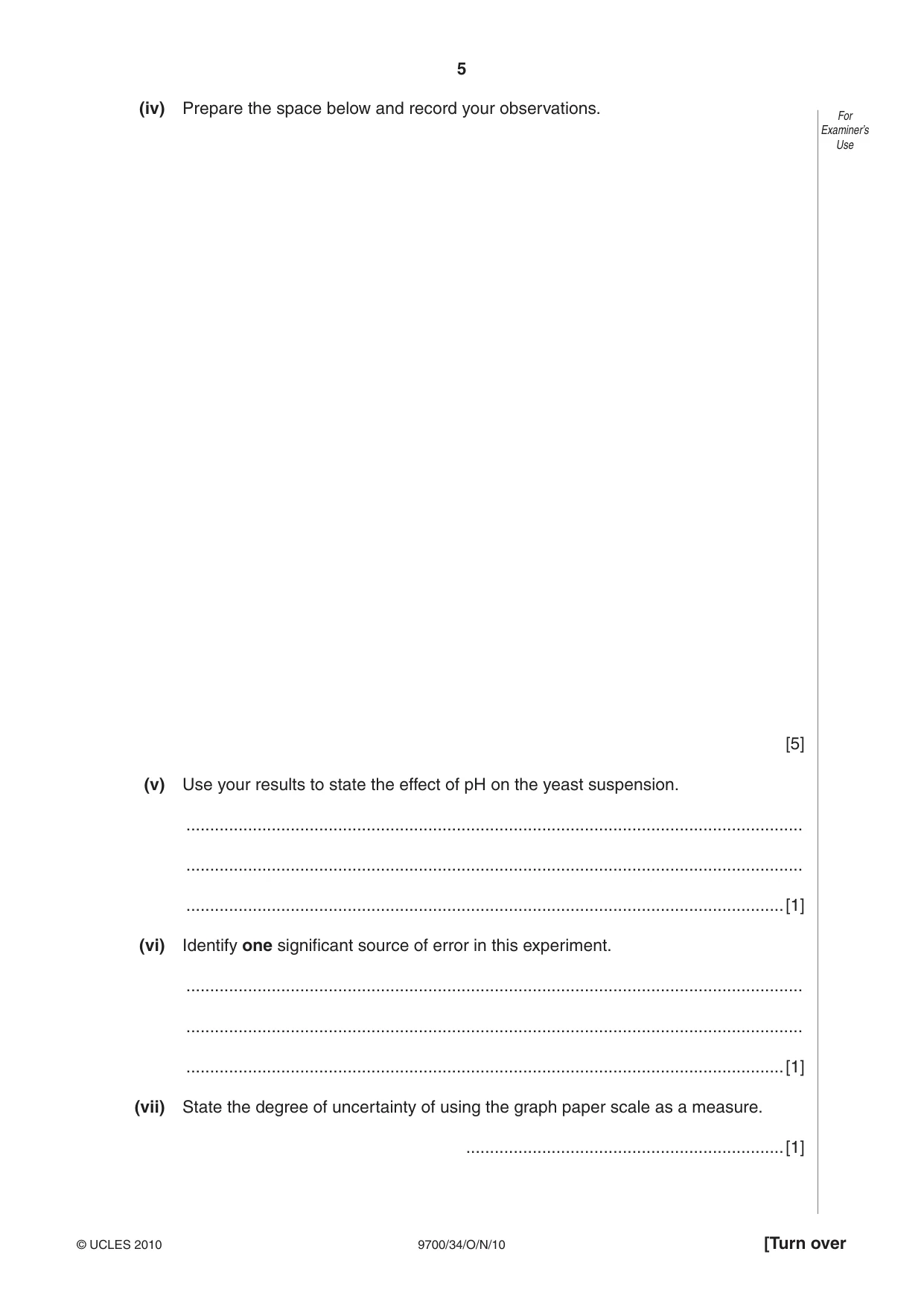
5 [Turn over 9700/34/O/N/10 © UCLES 2010 For Examiner’s Use (iv) Prepare the space below and record your observations. [5] (v) Use your results to state the effect of pH on the yeast suspension. … … …[1] (vi) Identify one significant source of error in this experiment. … … …[1] (vii) State the degree of uncertainty of using the graph paper scale as a measure. …[1]
Question paper, page 6
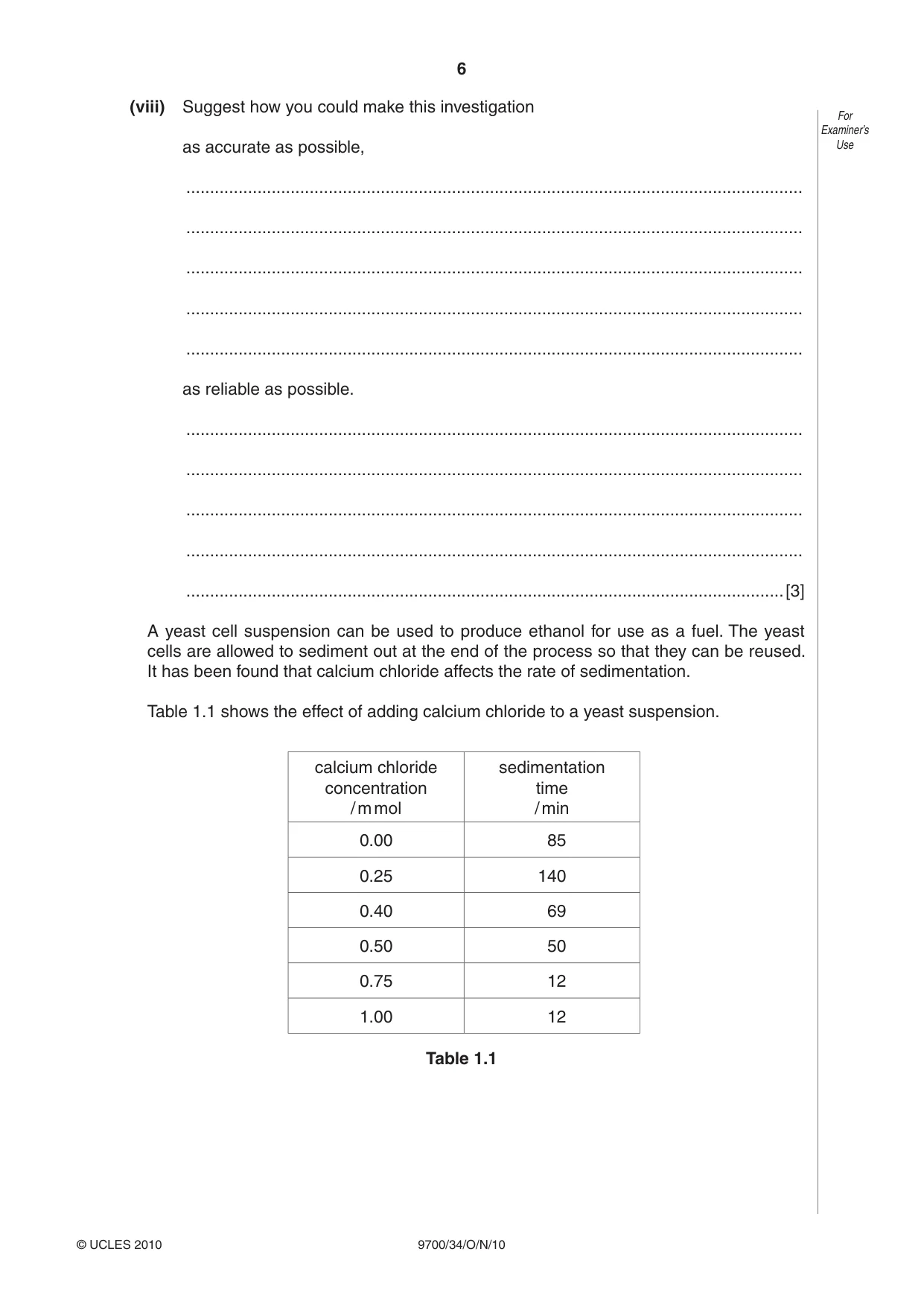
6 9700/34/O/N/10 © UCLES 2010 For Examiner’s Use (viii) Suggest how you could make this investigation as accurate as possible, … … … … … as reliable as possible. … … … … …[3] A yeast cell suspension can be used to produce ethanol for use as a fuel. The yeast cells are allowed to sediment out at the end of the process so that they can be reused. It has been found that calcium chloride affects the rate of sedimentation. Table 1.1 shows the effect of adding calcium chloride to a yeast suspension. calcium chloride concentration / m mol sedimentation time / min 0.00 85 0.25 140 0.40 69 0.50 50 0.75 12 1.00 12 Table 1.1
Question paper, page 7
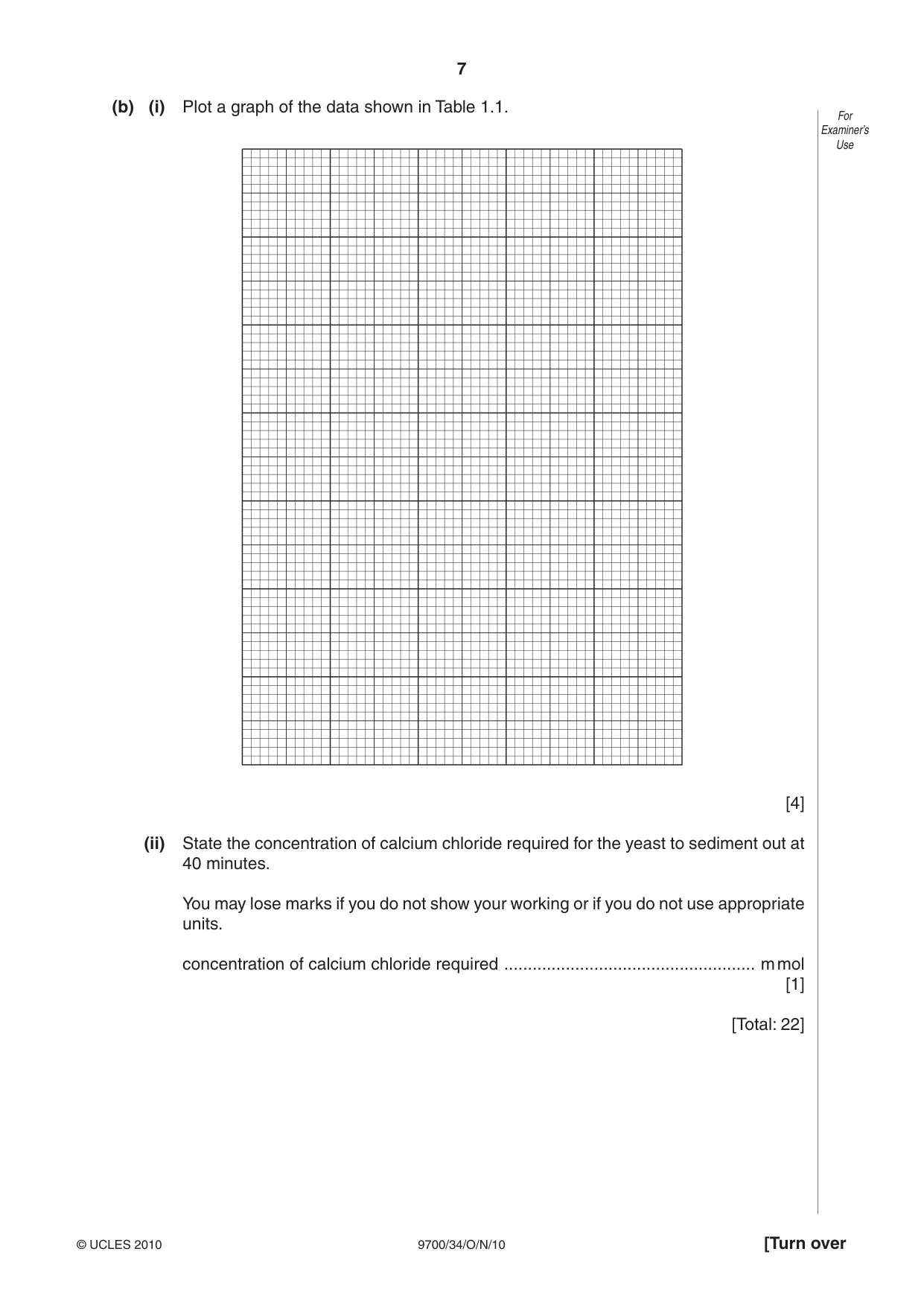
[Turn over 9700/34/O/N/10 © UCLES 2010 For Examiner’s Use 7 (b) (i) Plot a graph of the data shown in Table 1.1. [4] (ii) State the concentration of calcium chloride required for the yeast to sediment out at 40 minutes. You may lose marks if you do not show your working or if you do not use appropriate units. concentration of calcium chloride required … m mol [1] [Total: 22]
Question paper, page 8
8 9700/34/O/N/10 © UCLES 2010 For Examiner’s Use 2 M1 is a slide of a stained transverse section through a plant organ. (a) (i) Select a large vascular bundle and draw a large plan diagram of the vascular bundle. Label the xylem tissue. [5]
Question paper, page 9
9 [Turn over 9700/34/O/N/10 © UCLES 2010 For Examiner’s Use (ii) The epidermis has hair-like structures called trichomes. Make a high-power drawing of one trichome, made up of at least three cells, and one epidermal cell on each side touching the base of the trichome. Label the trichome. [5]
Question paper, page 10
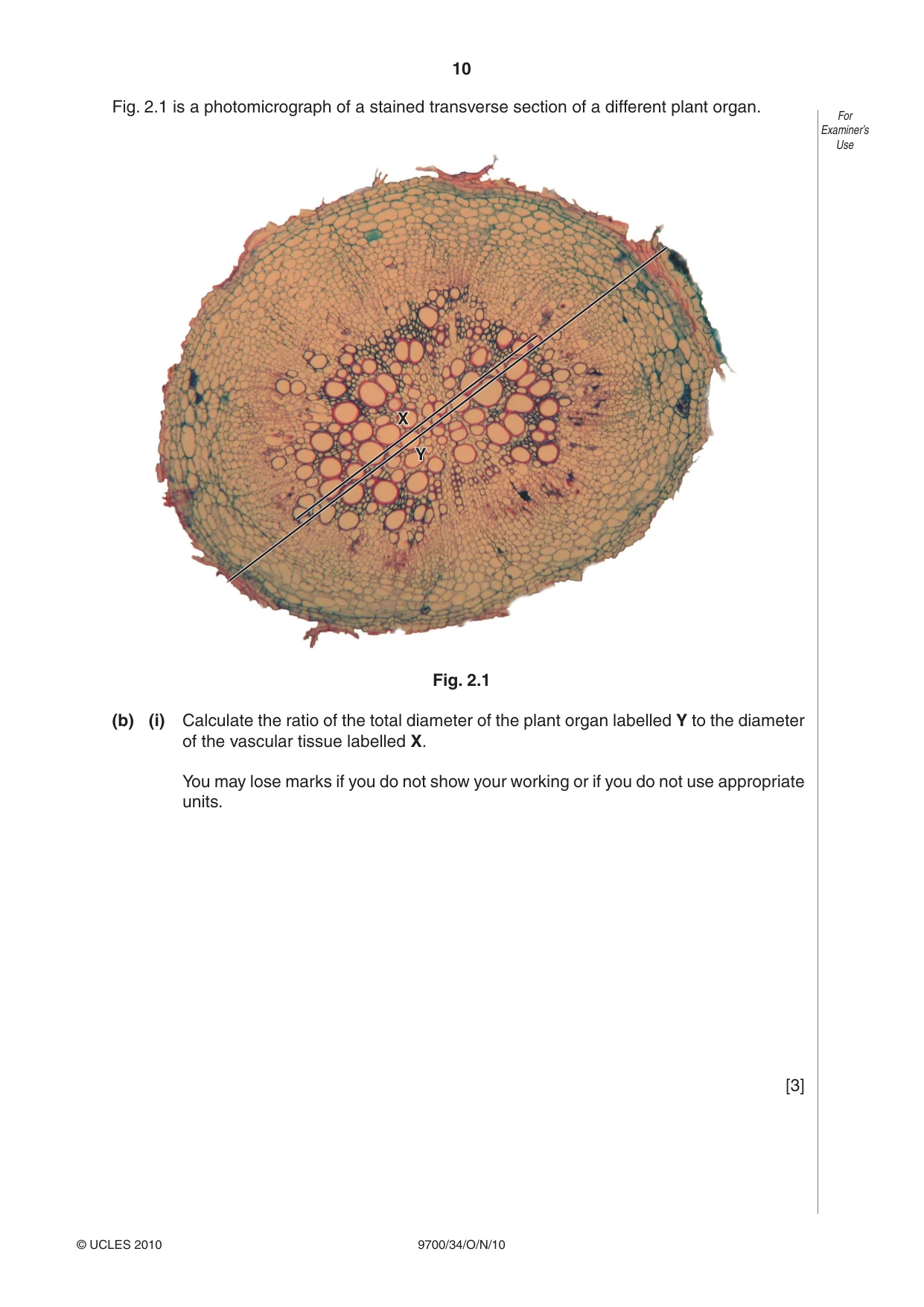
10 9700/34/O/N/10 © UCLES 2010 For Examiner’s Use Fig. 2.1 is a photomicrograph of a stained transverse section of a different plant organ. X Y X Y Fig. 2.1 (b) (i) Calculate the ratio of the total diameter of the plant organ labelled Y to the diameter of the vascular tissue labelled X. You may lose marks if you do not show your working or if you do not use appropriate units. [3]
Question paper, page 11
11 9700/34/O/N/10 © UCLES 2010 For Examiner’s Use (ii) Prepare the space below so that it is suitable for you to describe the observable differences between M1 and Fig. 2.1. Record your observations in the space you have prepared. [5] [Total: 18]
Question paper, page 12
12 9700/34/O/N/10 © UCLES 2010 BLANK PAGE Permission to reproduce items where third-party owned material protected by copyright is included has been sought and cleared where possible. Every reasonable effort has been made by the publisher (UCLES) to trace copyright holders, but if any items requiring clearance have unwittingly been included, the publisher will be pleased to make amends at the earliest possible opportunity. University of Cambridge International Examinations is part of the Cambridge Assessment Group. Cambridge Assessment is the brand name of University of Cambridge Local Examinations Syndicate (UCLES), which is itself a department of the University of Cambridge.
Mark scheme, page 1
UNIVERSITY OF CAMBRIDGE INTERNATIONAL EXAMINATIONS GCE Advanced Subsidiary Level and GCE Advanced Level MARK SCHEME for the October/November 2010 question paper for the guidance of teachers 9700 BIOLOGY 9700/34 Paper 32 (Advanced Practical Skills 2), maximum raw mark 40 This mark scheme is published as an aid to teachers and candidates, to indicate the requirements of the examination. It shows the basis on which Examiners were instructed to award marks. It does not indicate the details of the discussions that took place at an Examiners’ meeting before marking began, which would have considered the acceptability of alternative answers. Mark schemes must be read in conjunction with the question papers and the report on the examination. • CIE will not enter into discussions or correspondence in connection with these mark schemes. CIE is publishing the mark schemes for the October/November 2010 question papers for most IGCSE, GCE Advanced Level and Advanced Subsidiary Level syllabuses and some Ordinary Level syllabuses.
Mark scheme, page 2
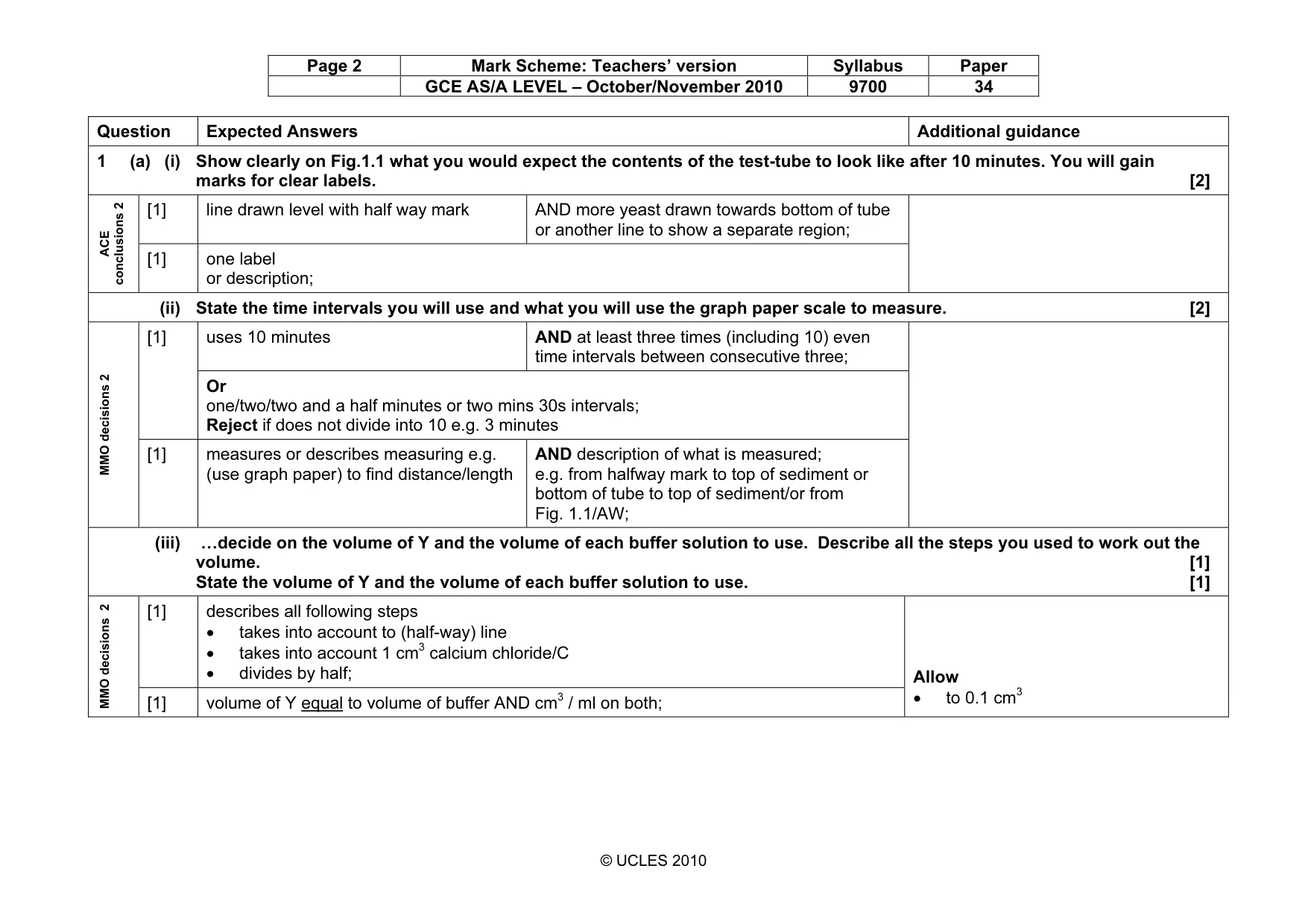
Page 2 Mark Scheme: Teachers’ version Syllabus Paper GCE AS/A LEVEL – October/November 2010 9700 34 © UCLES 2010 Question Expected Answers Additional guidance 1 (a) (i) Show clearly on Fig.1.1 what you would expect the contents of the test-tube to look like after 10 minutes. You will gain marks for clear labels. [2] [1] line drawn level with half way mark AND more yeast drawn towards bottom of tube or another line to show a separate region; ACE conclusions 2 [1] one label or description; (ii) State the time intervals you will use and what you will use the graph paper scale to measure. [2] uses 10 minutes AND at least three times (including 10) even time intervals between consecutive three; [1] Or one/two/two and a half minutes or two mins 30s intervals; Reject if does not divide into 10 e.g. 3 minutes MMO decisions 2 [1] measures or describes measuring e.g. (use graph paper) to find distance/length AND description of what is measured; e.g. from halfway mark to top of sediment or bottom of tube to top of sediment/or from Fig. 1.1/AW; (iii) …decide on the volume of Y and the volume of each buffer solution to use. Describe all the steps you used to work out the volume. [1] State the volume of Y and the volume of each buffer solution to use. [1] [1] describes all following steps • takes into account to (half-way) line • takes into account 1 cm3 calcium chloride/C • divides by half; MMO decisions 2 [1] volume of Y equal to volume of buffer AND cm3 / ml on both; Allow • to 0.1 cm3
Mark scheme, page 3
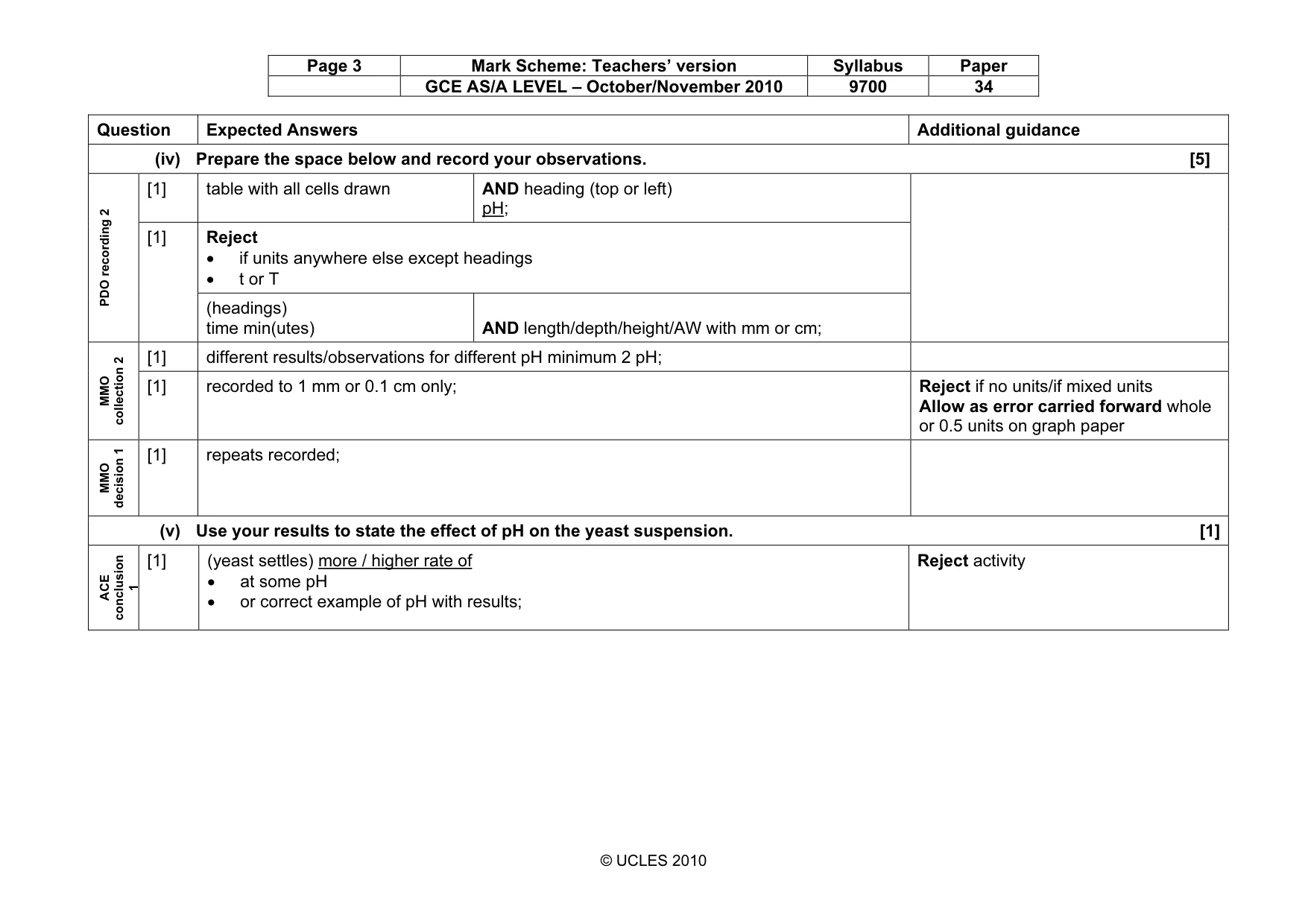
Page 3 Mark Scheme: Teachers’ version Syllabus Paper GCE AS/A LEVEL – October/November 2010 9700 34 © UCLES 2010 Question Expected Answers Additional guidance (iv) Prepare the space below and record your observations. [5] [1] table with all cells drawn AND heading (top or left) pH; Reject • if units anywhere else except headings • t or T PDO recording 2 [1] (headings) time min(utes) AND length/depth/height/AW with mm or cm; [1] different results/observations for different pH minimum 2 pH; MMO collection 2 [1] recorded to 1 mm or 0.1 cm only; Reject if no units/if mixed units Allow as error carried forward whole or 0.5 units on graph paper MMO decision 1 [1] repeats recorded; (v) Use your results to state the effect of pH on the yeast suspension. [1] ACE conclusion 1 [1] (yeast settles) more / higher rate of • at some pH • or correct example of pH with results; Reject activity
Mark scheme, page 4
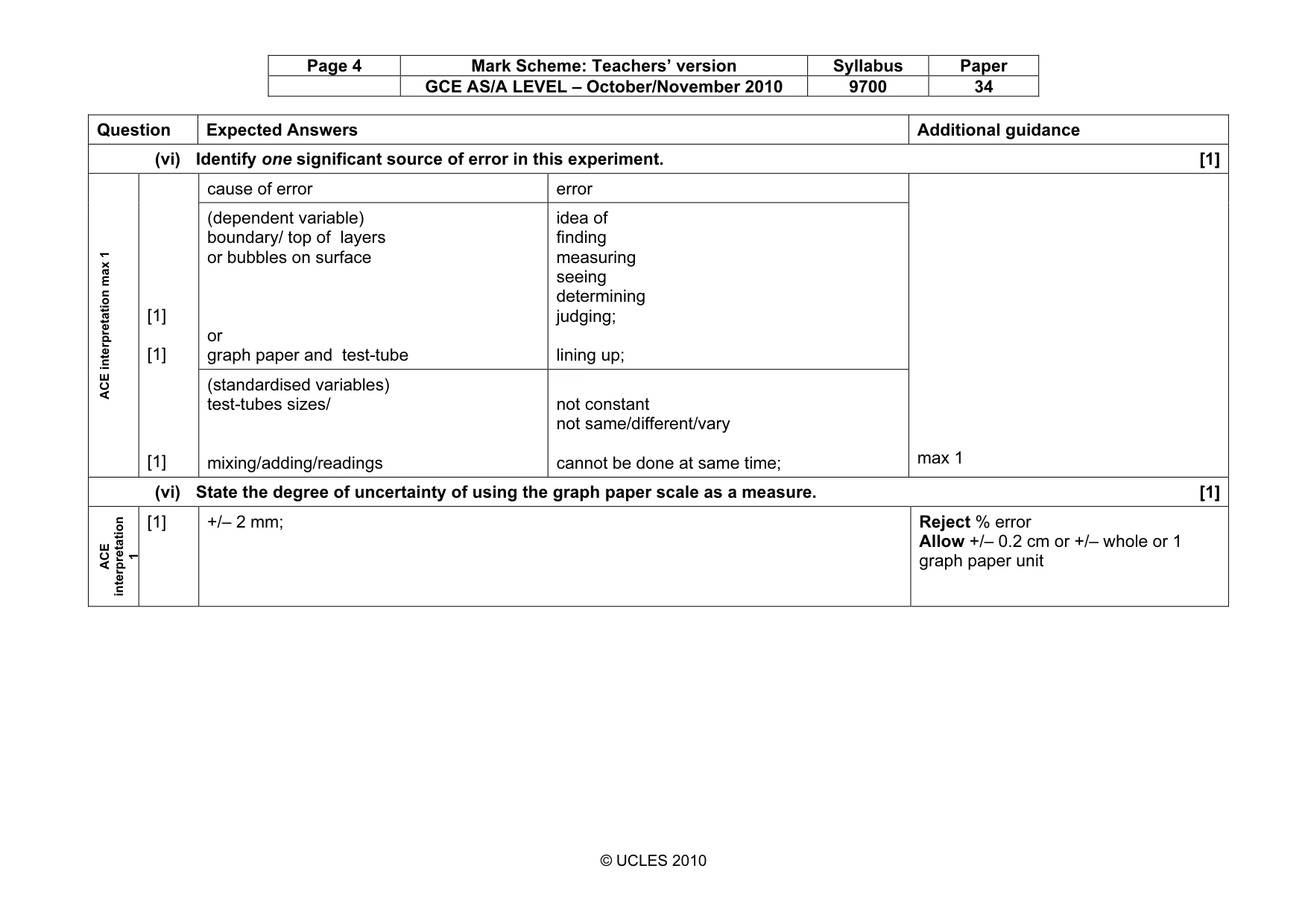
Page 4 Mark Scheme: Teachers’ version Syllabus Paper GCE AS/A LEVEL – October/November 2010 9700 34 © UCLES 2010 Question Expected Answers Additional guidance (vi) Identify one significant source of error in this experiment. [1] cause of error error (dependent variable) boundary/ top of layers or bubbles on surface or graph paper and test-tube idea of finding measuring seeing determining judging; lining up; ACE interpretation max 1 [1] [1] [1] (standardised variables) test-tubes sizes/ mixing/adding/readings not constant not same/different/vary cannot be done at same time; max 1 (vi) State the degree of uncertainty of using the graph paper scale as a measure. [1] ACE interpretation 1 [1] +/– 2 mm; Reject % error Allow +/– 0.2 cm or +/– whole or 1 graph paper unit
Mark scheme, page 5
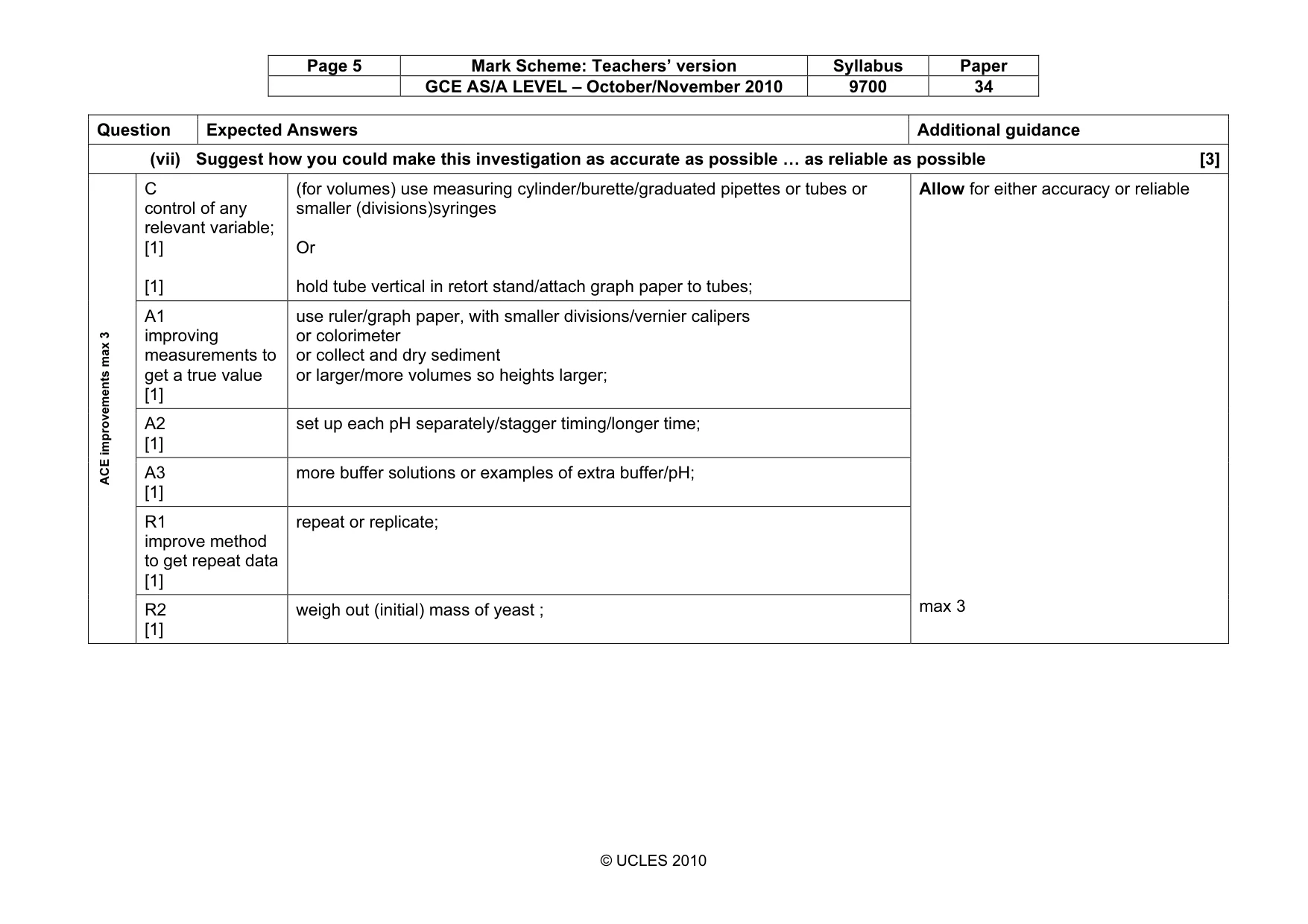
Page 5 Mark Scheme: Teachers’ version Syllabus Paper GCE AS/A LEVEL – October/November 2010 9700 34 © UCLES 2010 Question Expected Answers Additional guidance (vii) Suggest how you could make this investigation as accurate as possible … as reliable as possible [3] C control of any relevant variable; [1] [1] (for volumes) use measuring cylinder/burette/graduated pipettes or tubes or smaller (divisions)syringes Or hold tube vertical in retort stand/attach graph paper to tubes; A1 improving measurements to get a true value [1] use ruler/graph paper, with smaller divisions/vernier calipers or colorimeter or collect and dry sediment or larger/more volumes so heights larger; A2 [1] set up each pH separately/stagger timing/longer time; A3 [1] more buffer solutions or examples of extra buffer/pH; R1 improve method to get repeat data [1] repeat or replicate; ACE improvements max 3 R2 [1] weigh out (initial) mass of yeast ; Allow for either accuracy or reliable max 3
Mark scheme, page 6
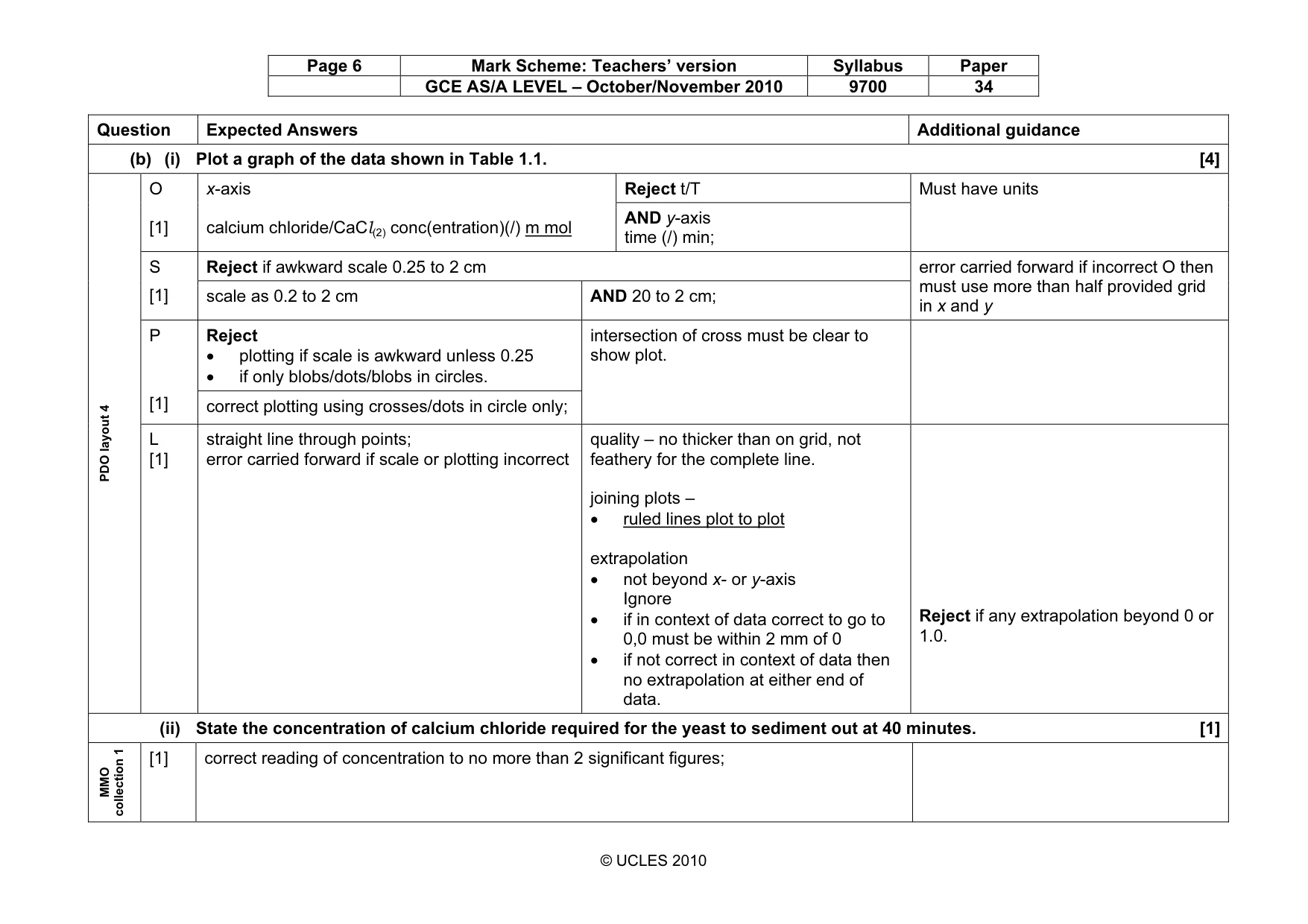
Page 6 Mark Scheme: Teachers’ version Syllabus Paper GCE AS/A LEVEL – October/November 2010 9700 34 © UCLES 2010 Question Expected Answers Additional guidance (b) (i) Plot a graph of the data shown in Table 1.1. [4] Reject t/T O [1] x-axis calcium chloride/CaCl(2) conc(entration)(/) m mol AND y-axis time (/) min; Must have units Reject if awkward scale 0.25 to 2 cm S [1] scale as 0.2 to 2 cm AND 20 to 2 cm; error carried forward if incorrect O then must use more than half provided grid in x and y Reject • plotting if scale is awkward unless 0.25 • if only blobs/dots/blobs in circles. P [1] correct plotting using crosses/dots in circle only; intersection of cross must be clear to show plot. PDO layout 4 L [1] straight line through points; error carried forward if scale or plotting incorrect quality – no thicker than on grid, not feathery for the complete line. joining plots – • ruled lines plot to plot extrapolation • not beyond x- or y-axis Ignore • if in context of data correct to go to 0,0 must be within 2 mm of 0 • if not correct in context of data then no extrapolation at either end of data. Reject if any extrapolation beyond 0 or 1.0. (ii) State the concentration of calcium chloride required for the yeast to sediment out at 40 minutes. [1] MMO collection 1 [1] correct reading of concentration to no more than 2 significant figures;
Mark scheme, page 7
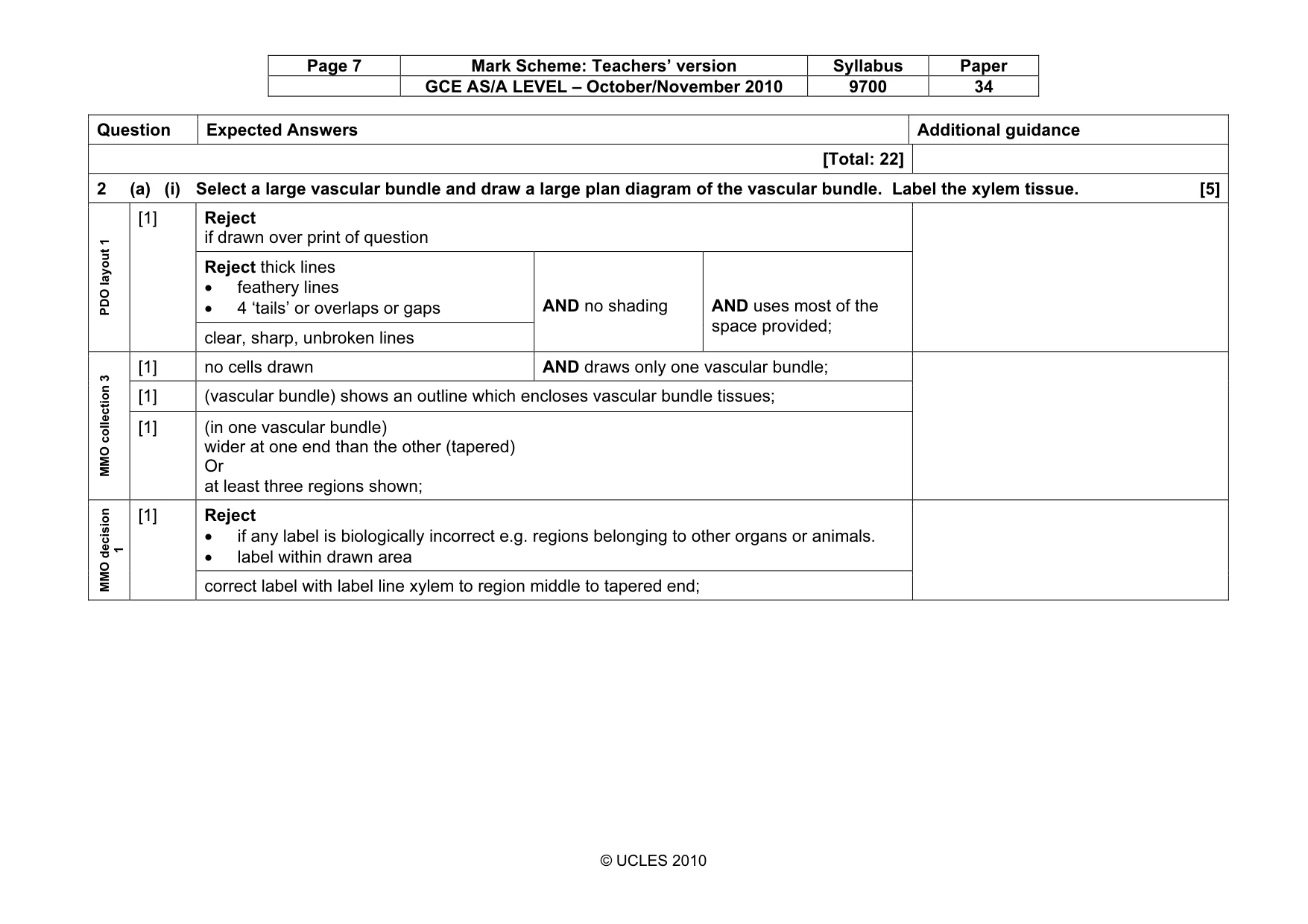
Page 7 Mark Scheme: Teachers’ version Syllabus Paper GCE AS/A LEVEL – October/November 2010 9700 34 © UCLES 2010 Question Expected Answers Additional guidance [Total: 22] 2 (a) (i) Select a large vascular bundle and draw a large plan diagram of the vascular bundle. Label the xylem tissue. [5] Reject if drawn over print of question Reject thick lines • feathery lines • 4 ‘tails’ or overlaps or gaps PDO layout 1 [1] clear, sharp, unbroken lines AND no shading AND uses most of the space provided; [1] no cells drawn AND draws only one vascular bundle; [1] (vascular bundle) shows an outline which encloses vascular bundle tissues; MMO collection 3 [1] (in one vascular bundle) wider at one end than the other (tapered) Or at least three regions shown; Reject • if any label is biologically incorrect e.g. regions belonging to other organs or animals. • label within drawn area MMO decision 1 [1] correct label with label line xylem to region middle to tapered end;
Mark scheme, page 8
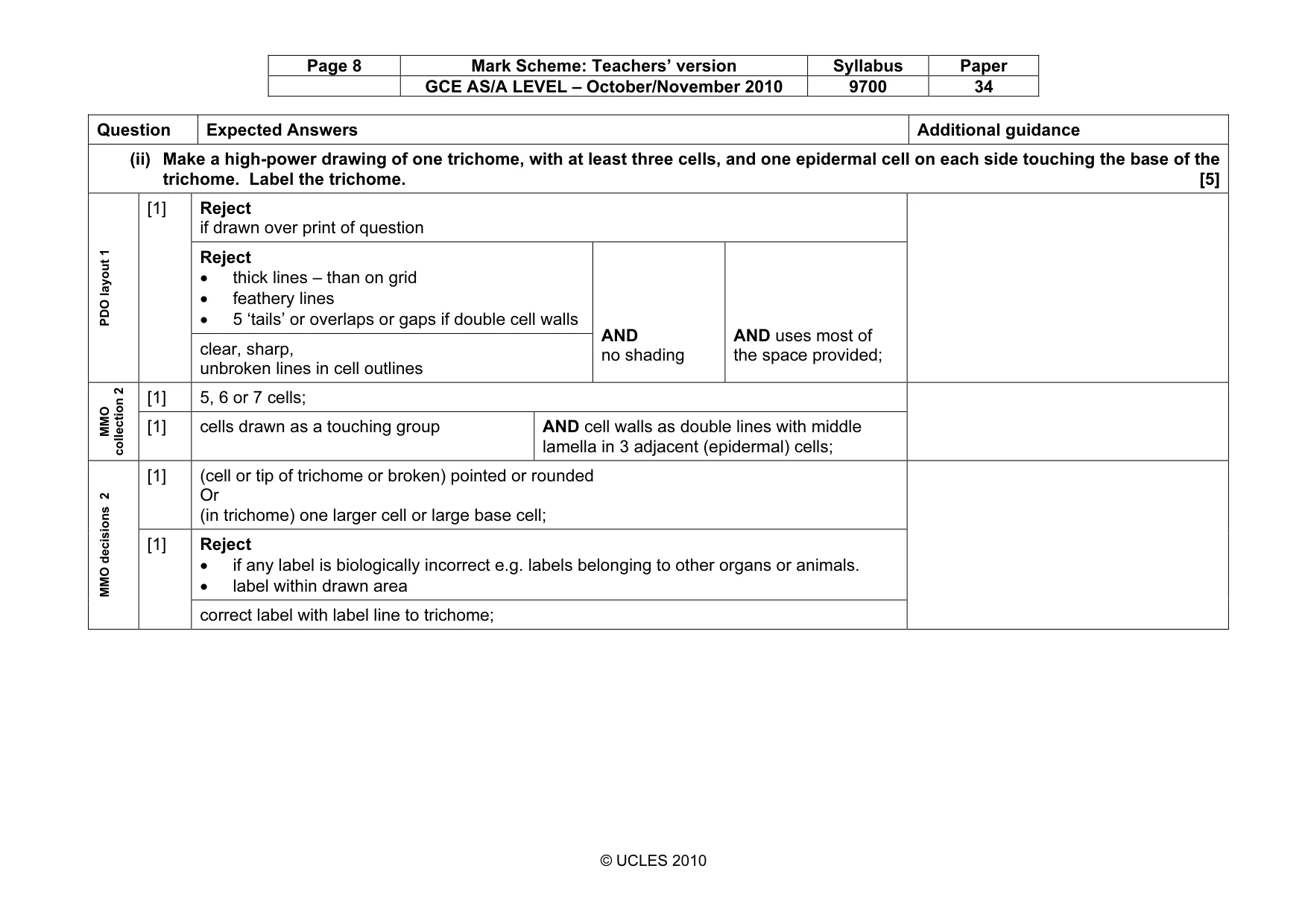
Page 8 Mark Scheme: Teachers’ version Syllabus Paper GCE AS/A LEVEL – October/November 2010 9700 34 © UCLES 2010 Question Expected Answers Additional guidance (ii) Make a high-power drawing of one trichome, with at least three cells, and one epidermal cell on each side touching the base of the trichome. Label the trichome. [5] Reject if drawn over print of question Reject • thick lines – than on grid • feathery lines • 5 ‘tails’ or overlaps or gaps if double cell walls PDO layout 1 [1] clear, sharp, unbroken lines in cell outlines AND no shading AND uses most of the space provided; [1] 5, 6 or 7 cells; MMO collection 2 [1] cells drawn as a touching group AND cell walls as double lines with middle lamella in 3 adjacent (epidermal) cells; [1] (cell or tip of trichome or broken) pointed or rounded Or (in trichome) one larger cell or large base cell; Reject • if any label is biologically incorrect e.g. labels belonging to other organs or animals. • label within drawn area MMO decisions 2 [1] correct label with label line to trichome;
Mark scheme, page 9
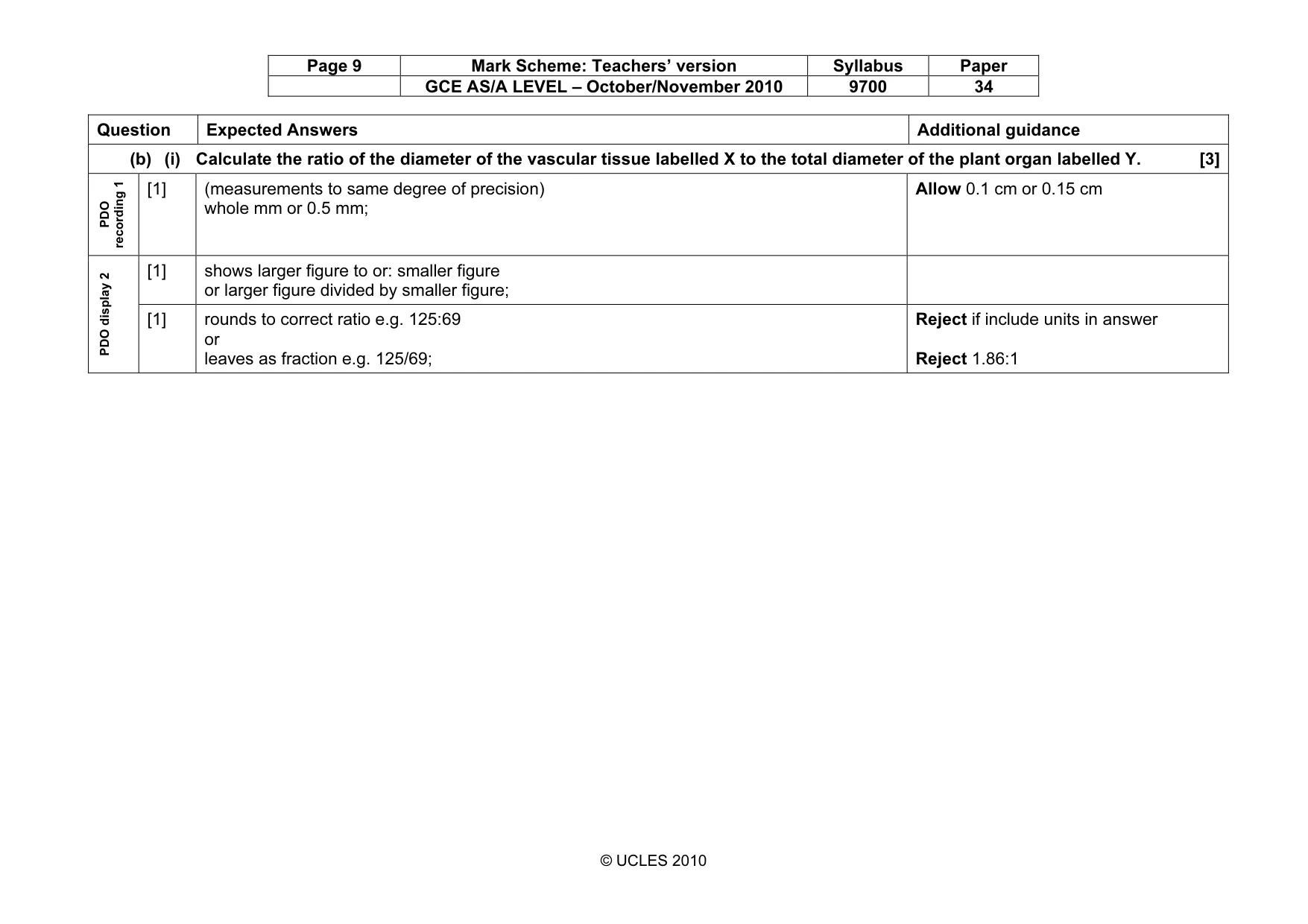
Page 9 Mark Scheme: Teachers’ version Syllabus Paper GCE AS/A LEVEL – October/November 2010 9700 34 © UCLES 2010 Question Expected Answers Additional guidance (b) (i) Calculate the ratio of the diameter of the vascular tissue labelled X to the total diameter of the plant organ labelled Y. [3] PDO recording 1 [1] (measurements to same degree of precision) whole mm or 0.5 mm; Allow 0.1 cm or 0.15 cm [1] shows larger figure to or: smaller figure or larger figure divided by smaller figure; PDO display 2 [1] rounds to correct ratio e.g. 125:69 or leaves as fraction e.g. 125/69; Reject if include units in answer Reject 1.86:1
Mark scheme, page 10
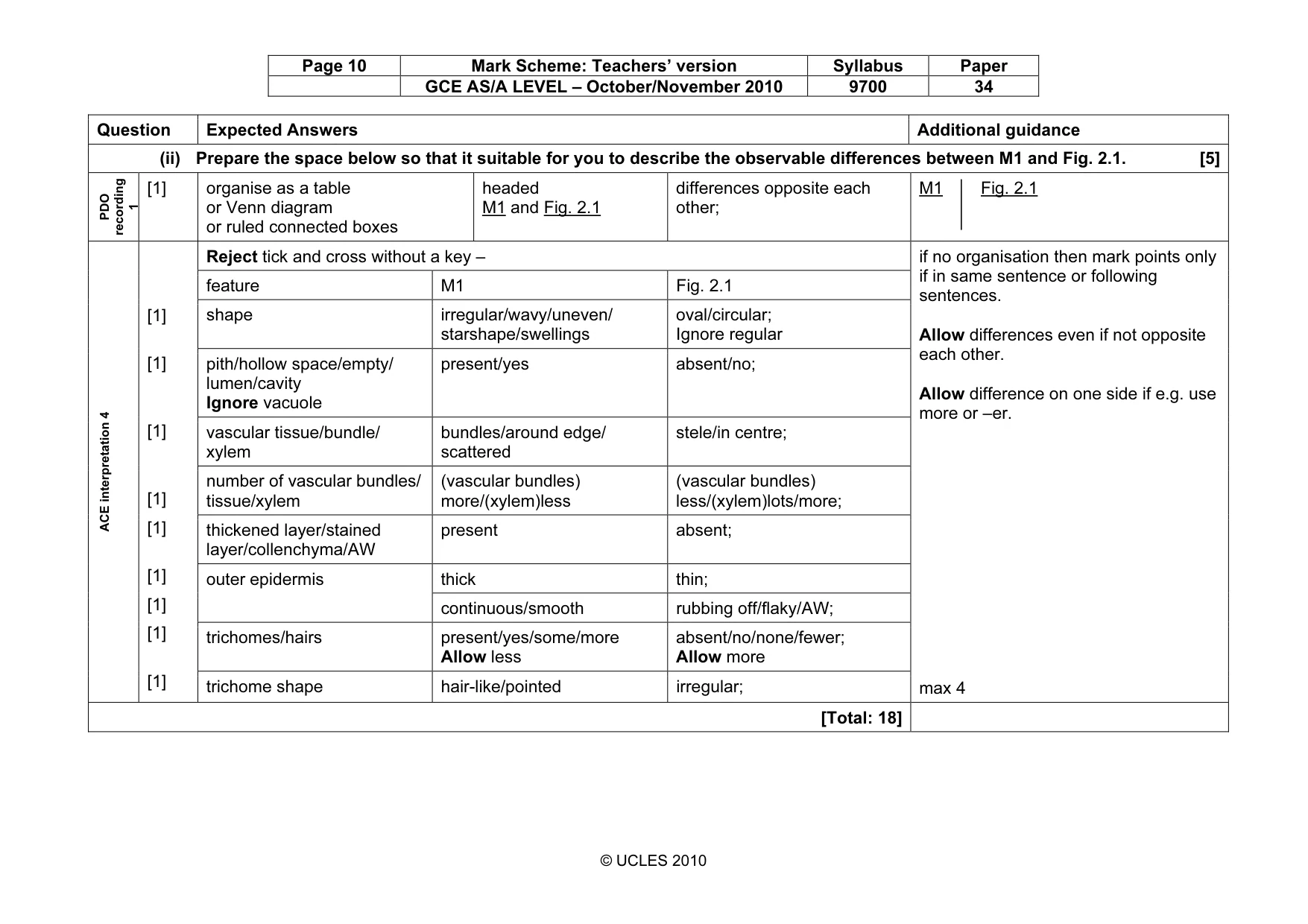
Page 10 Mark Scheme: Teachers’ version Syllabus Paper GCE AS/A LEVEL – October/November 2010 9700 34 © UCLES 2010 Question Expected Answers Additional guidance (ii) Prepare the space below so that it suitable for you to describe the observable differences between M1 and Fig. 2.1. [5] PDO recording 1 [1] organise as a table or Venn diagram or ruled connected boxes headed M1 and Fig. 2.1 differences opposite each other; M1 Fig. 2.1 Reject tick and cross without a key – feature M1 Fig. 2.1 shape irregular/wavy/uneven/ starshape/swellings oval/circular; Ignore regular pith/hollow space/empty/ lumen/cavity Ignore vacuole present/yes absent/no; vascular tissue/bundle/ xylem bundles/around edge/ scattered stele/in centre; number of vascular bundles/ tissue/xylem (vascular bundles) more/(xylem)less (vascular bundles) less/(xylem)lots/more; thickened layer/stained layer/collenchyma/AW present absent; thick thin; outer epidermis continuous/smooth rubbing off/flaky/AW; trichomes/hairs present/yes/some/more Allow less absent/no/none/fewer; Allow more ACE interpretation 4 [1] [1] [1] [1] [1] [1] [1] [1] [1] trichome shape hair-like/pointed irregular; if no organisation then mark points only if in same sentence or following sentences. Allow differences even if not opposite each other. Allow difference on one side if e.g. use more or –er. max 4 [Total: 18]
What you needed in this session
Cambridge’s own grade thresholds for 2010 Oct/Nov, Paper 3 · Variant 4. A higher threshold means an easier paper — the bar moves with how the cohort did.