Cambridge A Level Biology 9700 — 2007 Oct/Nov Paper 5 · Variant 1
9700/51/O/N/07 · 30 marks · ≈34 min
The question paper and its mark scheme, free to read here and free to download. This is Cambridge’s own paper, exactly as it was sat.
Question paper8 pages

Mark scheme4 pages
Answers below. Sit the paper first if you are practising.
Paper as text
Question paper, page 1
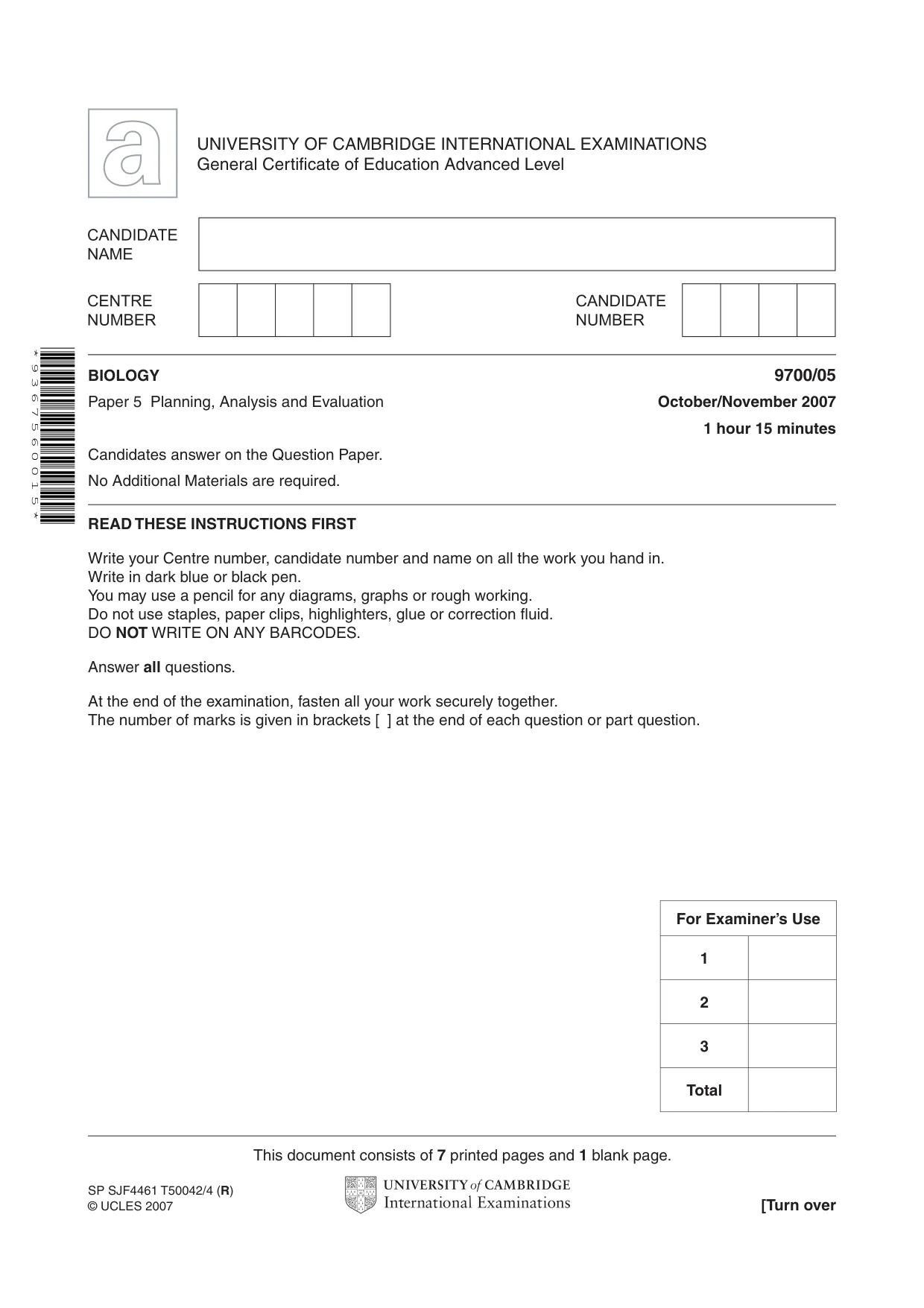
For Examiner’s Use 1 2 3 Total This document consists of 7 printed pages and 1 blank page. SP SJF4461 T50042/4 (R) © UCLES 2007 [Turn over UNIVERSITY OF CAMBRIDGE INTERNATIONAL EXAMINATIONS General Certificate of Education Advanced Level READ THESE INSTRUCTIONS FIRST Write your Centre number, candidate number and name on all the work you hand in. Write in dark blue or black pen. You may use a pencil for any diagrams, graphs or rough working. Do not use staples, paper clips, highlighters, glue or correction fluid. DO NOT WRITE ON ANY BARCODES. Answer all questions. At the end of the examination, fasten all your work securely together. The number of marks is given in brackets [ ] at the end of each question or part question. * 9 3 6 7 5 6 0 0 1 5 * BIOLOGY 9700/05 Paper 5 Planning, Analysis and Evaluation October/November 2007 1 hour 15 minutes Candidates answer on the Question Paper. No Additional Materials are required.
Question paper, page 2
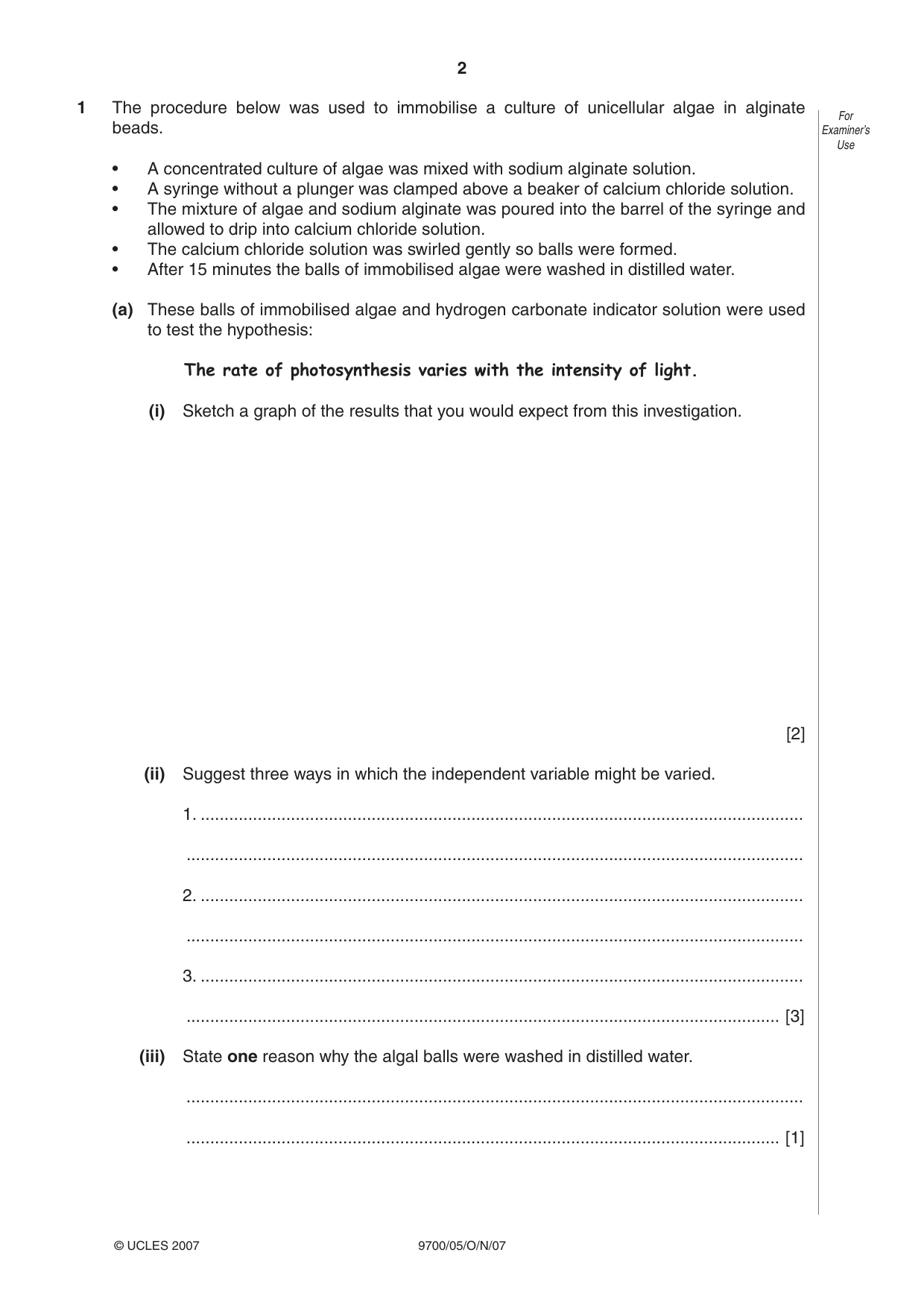
2 9700/05/O/N/07 For Examiner’s Use © UCLES 2007 1 The procedure below was used to immobilise a culture of unicellular algae in alginate beads. • A concentrated culture of algae was mixed with sodium alginate solution. • A syringe without a plunger was clamped above a beaker of calcium chloride solution. • The mixture of algae and sodium alginate was poured into the barrel of the syringe and allowed to drip into calcium chloride solution. • The calcium chloride solution was swirled gently so balls were formed. • After 15 minutes the balls of immobilised algae were washed in distilled water. (a) These balls of immobilised algae and hydrogen carbonate indicator solution were used to test the hypothesis: The rate of photosynthesis varies with the intensity of light. (i) Sketch a graph of the results that you would expect from this investigation. [2] (ii) Suggest three ways in which the independent variable might be varied. 1. … … 2. … … 3. … … [3] (iii) State one reason why the algal balls were washed in distilled water. … … [1]
Question paper, page 3
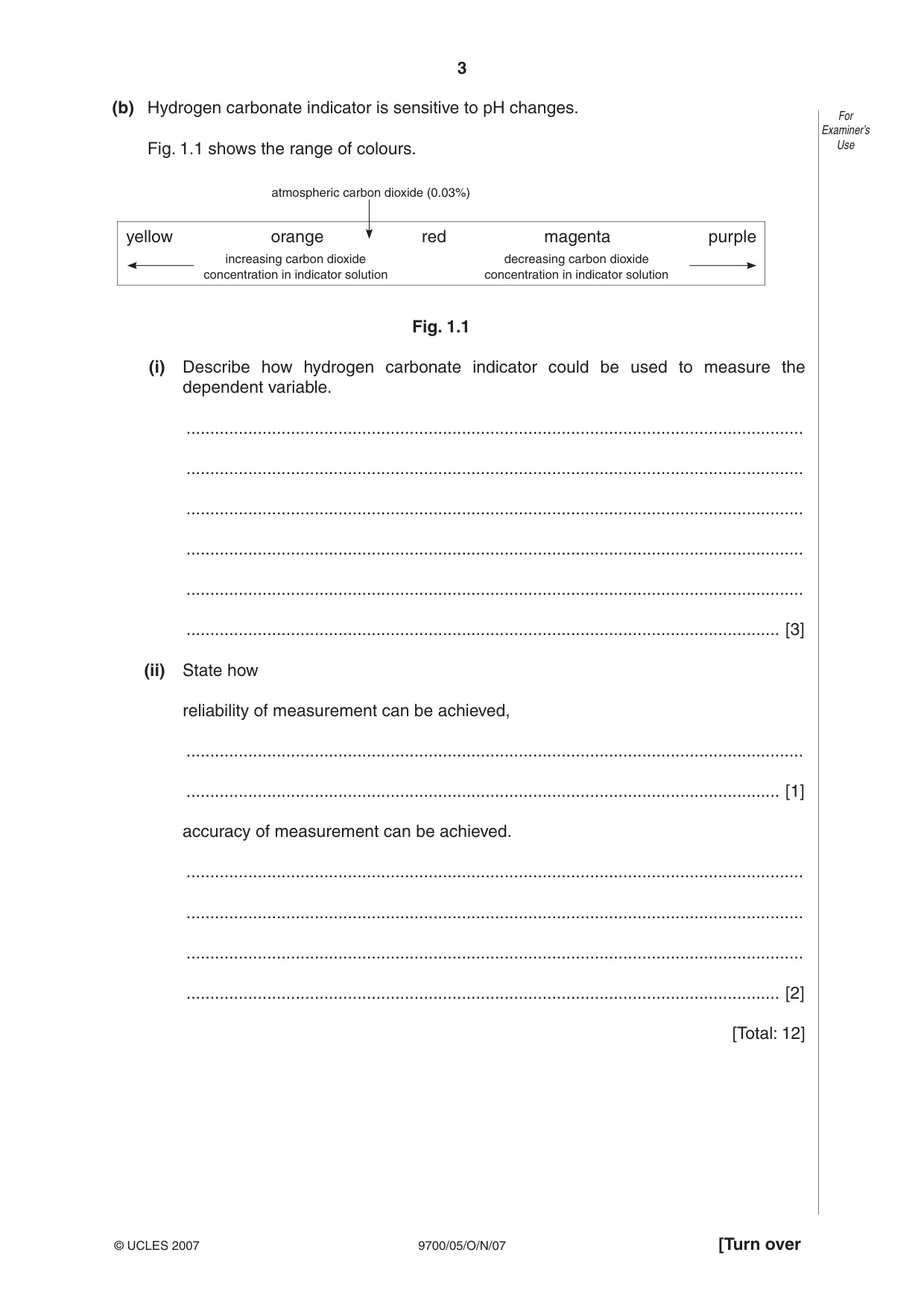
3 9700/05/O/N/07 [Turn over For Examiner’s Use © UCLES 2007 (b) Hydrogen carbonate indicator is sensitive to pH changes. Fig. 1.1 shows the range of colours. yellow orange red magenta purple increasing carbon dioxide concentration in indicator solution decreasing carbon dioxide concentration in indicator solution atmospheric carbon dioxide (0.03%) Fig. 1.1 (i) Describe how hydrogen carbonate indicator could be used to measure the dependent variable. … … … … … … [3] (ii) State how reliability of measurement can be achieved, … … [1] accuracy of measurement can be achieved. … … … … [2] [Total: 12]
Question paper, page 4
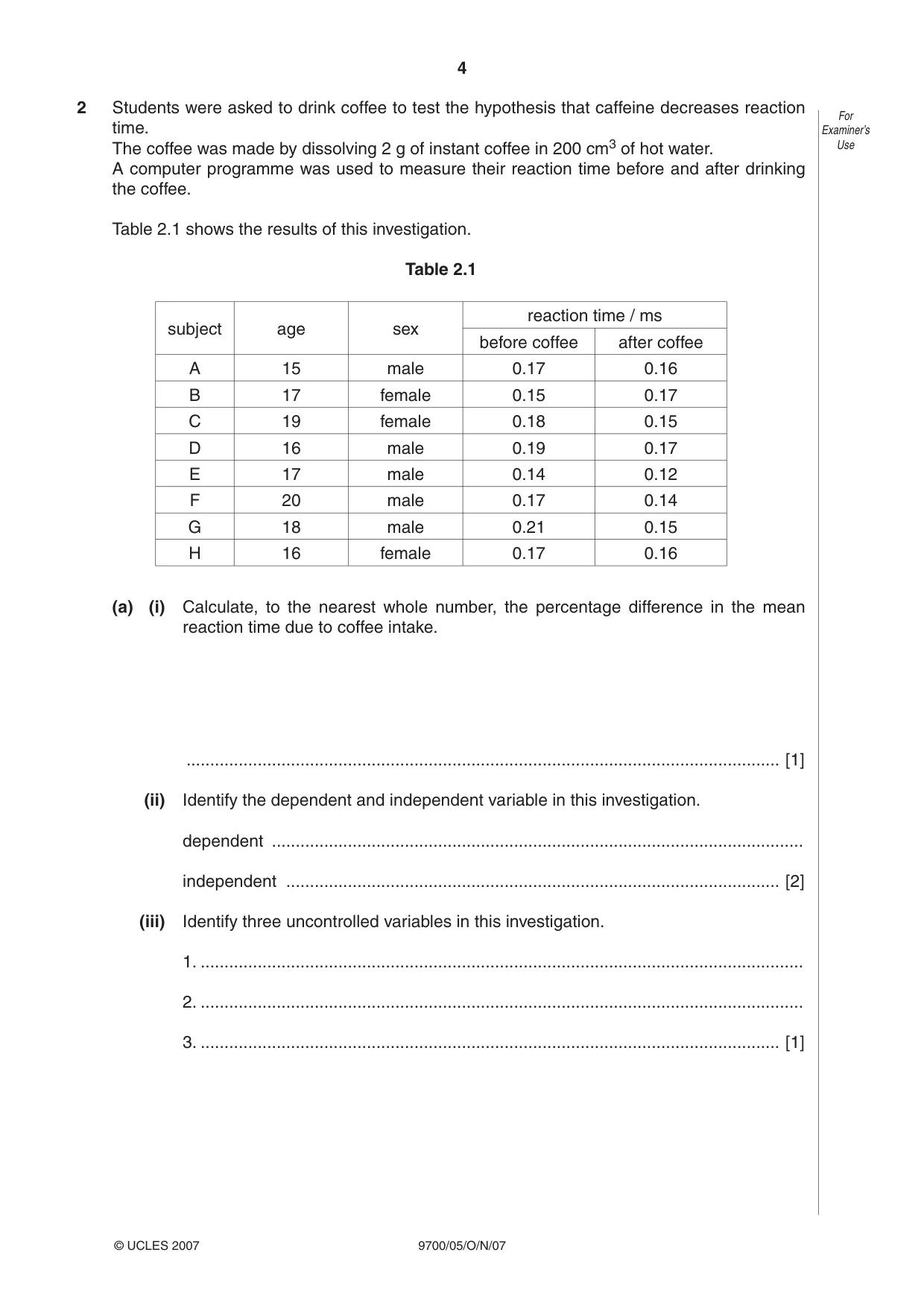
4 9700/05/O/N/07 For Examiner’s Use © UCLES 2007 2 Students were asked to drink coffee to test the hypothesis that caffeine decreases reaction time. The coffee was made by dissolving 2 g of instant coffee in 200 cm3 of hot water. A computer programme was used to measure their reaction time before and after drinking the coffee. Table 2.1 shows the results of this investigation. Table 2.1 subject age sex reaction time / ms before coffee after coffee A 15 male 0.17 0.16 B 17 female 0.15 0.17 C 19 female 0.18 0.15 D 16 male 0.19 0.17 E 17 male 0.14 0.12 F 20 male 0.17 0.14 G 18 male 0.21 0.15 H 16 female 0.17 0.16 (a) (i) Calculate, to the nearest whole number, the percentage difference in the mean reaction time due to coffee intake. … [1] (ii) Identify the dependent and independent variable in this investigation. dependent … independent … [2] (iii) Identify three uncontrolled variables in this investigation. 1. … 2. … 3. … [1]
Question paper, page 5
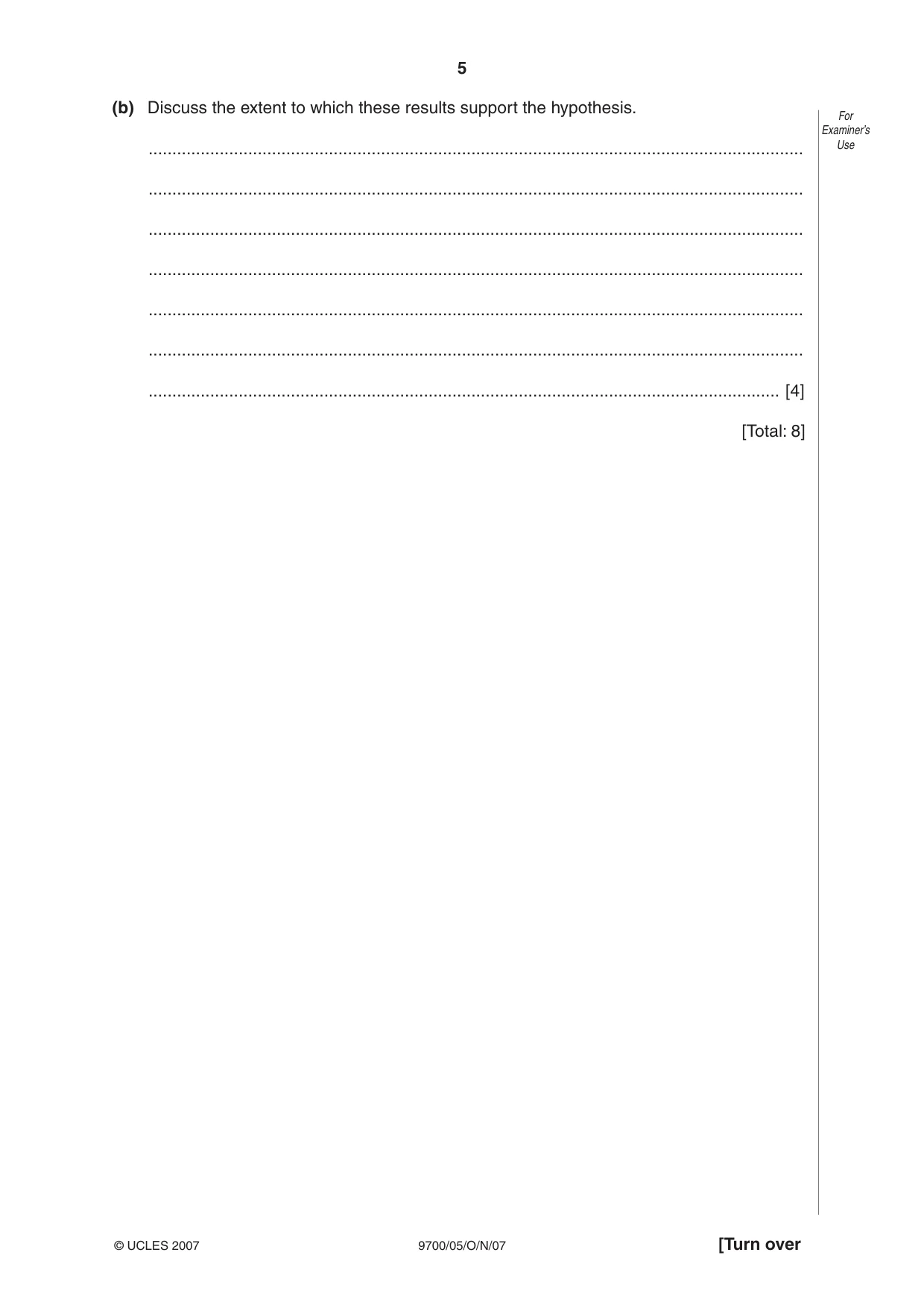
5 9700/05/O/N/07 [Turn over For Examiner’s Use © UCLES 2007 (b) Discuss the extent to which these results support the hypothesis. … … … … … … … [4] [Total: 8]
Question paper, page 6
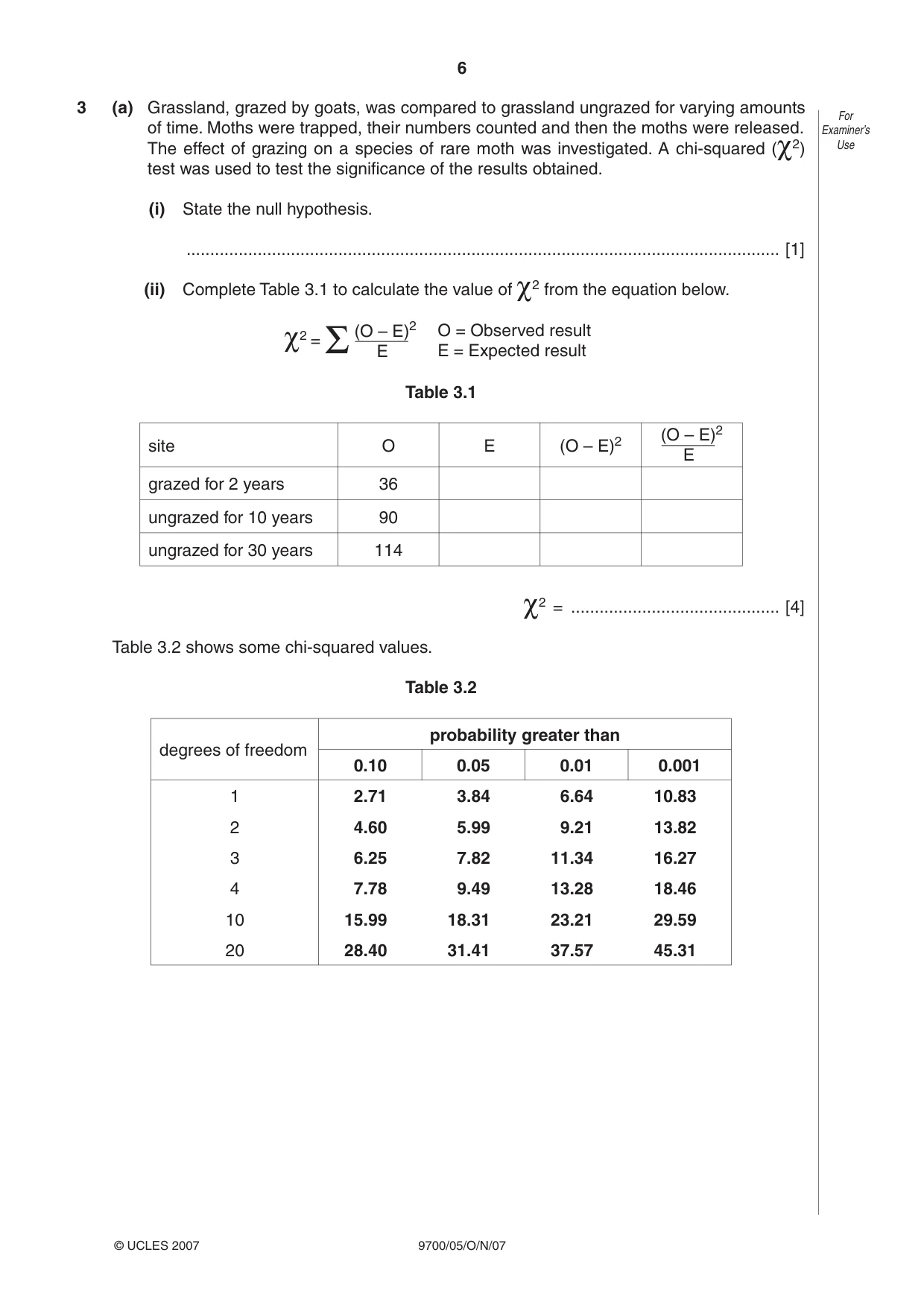
6 9700/05/O/N/07 For Examiner’s Use © UCLES 2007 3 (a) Grassland, grazed by goats, was compared to grassland ungrazed for varying amounts of time. Moths were trapped, their numbers counted and then the moths were released. The effect of grazing on a species of rare moth was investigated. A chi-squared (χ2) test was used to test the significance of the results obtained. (i) State the null hypothesis. … [1] (ii) Complete Table 3.1 to calculate the value of χ2 from the equation below. χ2 = Σ (O – E)2 E O = Observed result E = Expected result Table 3.1 site O E (O – E)2 (O – E)2 E grazed for 2 years 36 ungrazed for 10 years 90 ungrazed for 30 years 114 χ2 = … [4] Table 3.2 shows some chi-squared values. Table 3.2 degrees of freedom probability greater than 0.10 0.05 0.01 0.001 1 2.71 3.84 6.64 10.83 2 4.60 5.99 9.21 13.82 3 6.25 7.82 11.34 16.27 4 7.78 9.49 13.28 18.46 10 15.99 18.31 23.21 29.59 20 28.40 31.41 37.57 45.31
Question paper, page 7
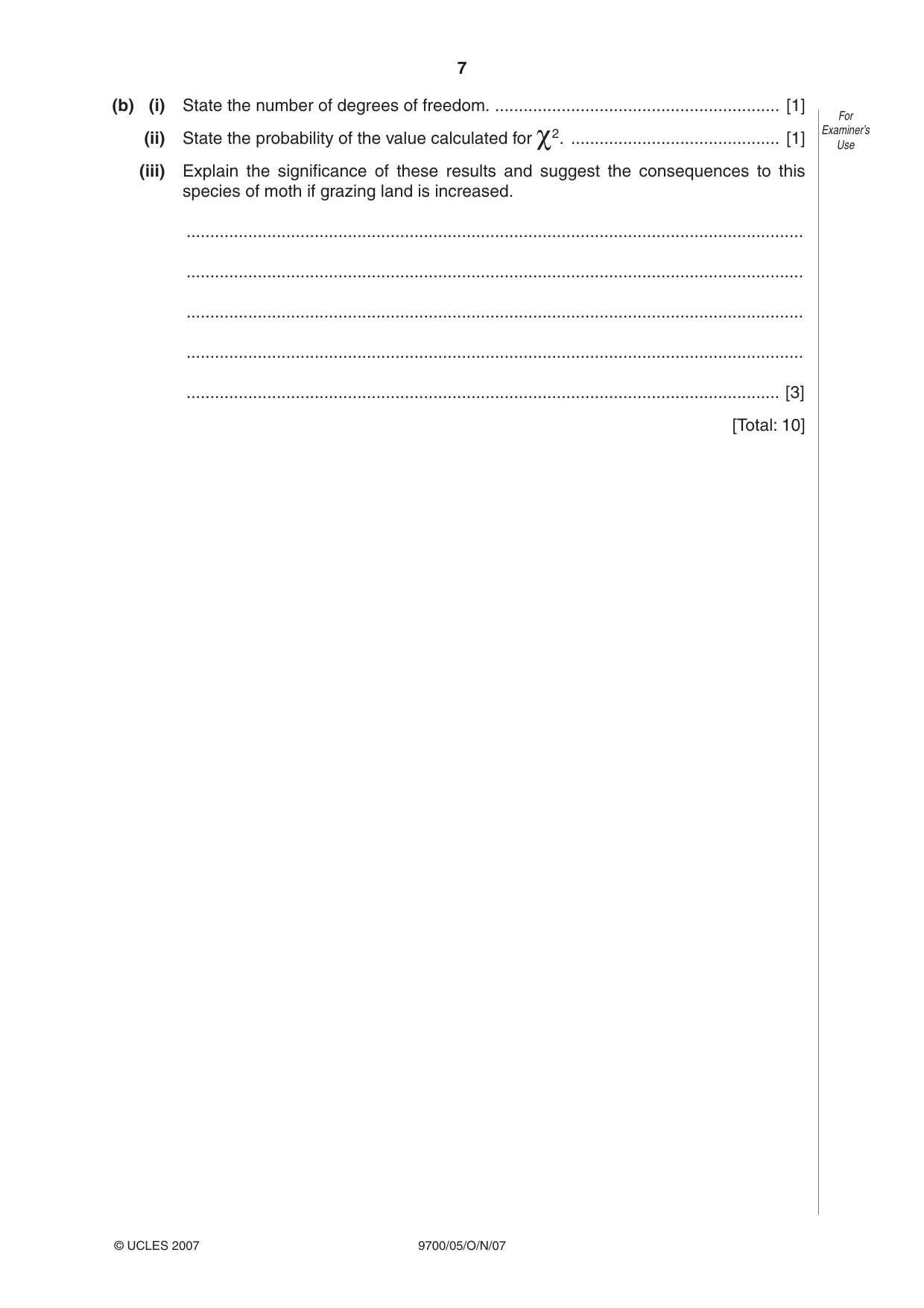
7 9700/05/O/N/07 For Examiner’s Use © UCLES 2007 (b) (i) State the number of degrees of freedom. … [1] (ii) State the probability of the value calculated for χ2. … [1] (iii) Explain the significance of these results and suggest the consequences to this species of moth if grazing land is increased. … … … … … [3] [Total: 10]
Question paper, page 8
8 9700/05/O/N/07 © UCLES 2007 BLANK PAGE Permission to reproduce items where third-party owned material protected by copyright is included has been sought and cleared where possible. Every reasonable effort has been made by the publisher (UCLES) to trace copyright holders, but if any items requiring clearance have unwittingly been included, the publisher will be pleased to make amends at the earliest possible opportunity. University of Cambridge International Examinations is part of the Cambridge Assessment Group. Cambridge Assessment is the brand name of University of Cambridge Local Examinations Syndicate (UCLES), which is itself a department of the University of Cambridge.
Mark scheme, page 1
UNIVERSITY OF CAMBRIDGE INTERNATIONAL EXAMINATIONS GCE Advanced Subsidiary Level and GCE Advanced Level MARK SCHEME for the October/November 2007 question paper 9700 BIOLOGY 9700/05 Paper 5 (Practical 2), maximum raw mark 30 This mark scheme is published as an aid to teachers and candidates, to indicate the requirements of the examination. It shows the basis on which Examiners were instructed to award marks. It does not indicate the details of the discussions that took place at an Examiners’ meeting before marking began. All Examiners are instructed that alternative correct answers and unexpected approaches in candidates’ scripts must be given marks that fairly reflect the relevant knowledge and skills demonstrated. Mark schemes must be read in conjunction with the question papers and the report on the examination. • CIE will not enter into discussions or correspondence in connection with these mark schemes. CIE is publishing the mark schemes for the October/November 2007 question papers for most IGCSE, GCE Advanced Level and Advanced Subsidiary Level syllabuses and some Ordinary Level syllabuses.
Mark scheme, page 2
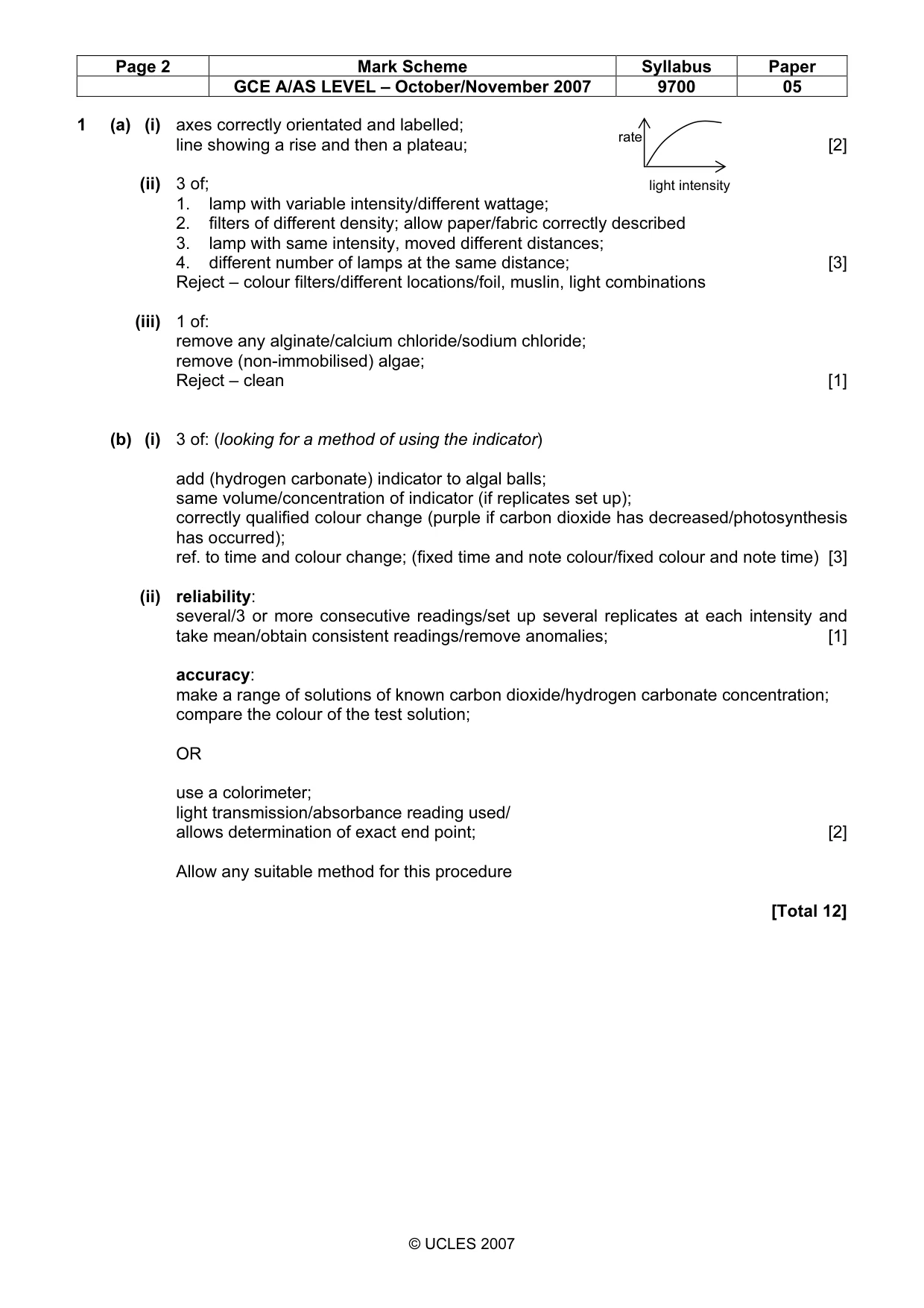
Page 2 Mark Scheme Syllabus Paper GCE A/AS LEVEL – October/November 2007 9700 05 © UCLES 2007 1 (a) (i) axes correctly orientated and labelled; line showing a rise and then a plateau; [2] (ii) 3 of; 1. lamp with variable intensity/different wattage; 2. filters of different density; allow paper/fabric correctly described 3. lamp with same intensity, moved different distances; 4. different number of lamps at the same distance; [3] Reject – colour filters/different locations/foil, muslin, light combinations (iii) 1 of: remove any alginate/calcium chloride/sodium chloride; remove (non-immobilised) algae; Reject – clean [1] (b) (i) 3 of: (looking for a method of using the indicator) add (hydrogen carbonate) indicator to algal balls; same volume/concentration of indicator (if replicates set up); correctly qualified colour change (purple if carbon dioxide has decreased/photosynthesis has occurred); ref. to time and colour change; (fixed time and note colour/fixed colour and note time) [3] (ii) reliability: several/3 or more consecutive readings/set up several replicates at each intensity and take mean/obtain consistent readings/remove anomalies; [1] accuracy: make a range of solutions of known carbon dioxide/hydrogen carbonate concentration; compare the colour of the test solution; OR use a colorimeter; light transmission/absorbance reading used/ allows determination of exact end point; [2] Allow any suitable method for this procedure [Total 12] rate light intensity
Mark scheme, page 3
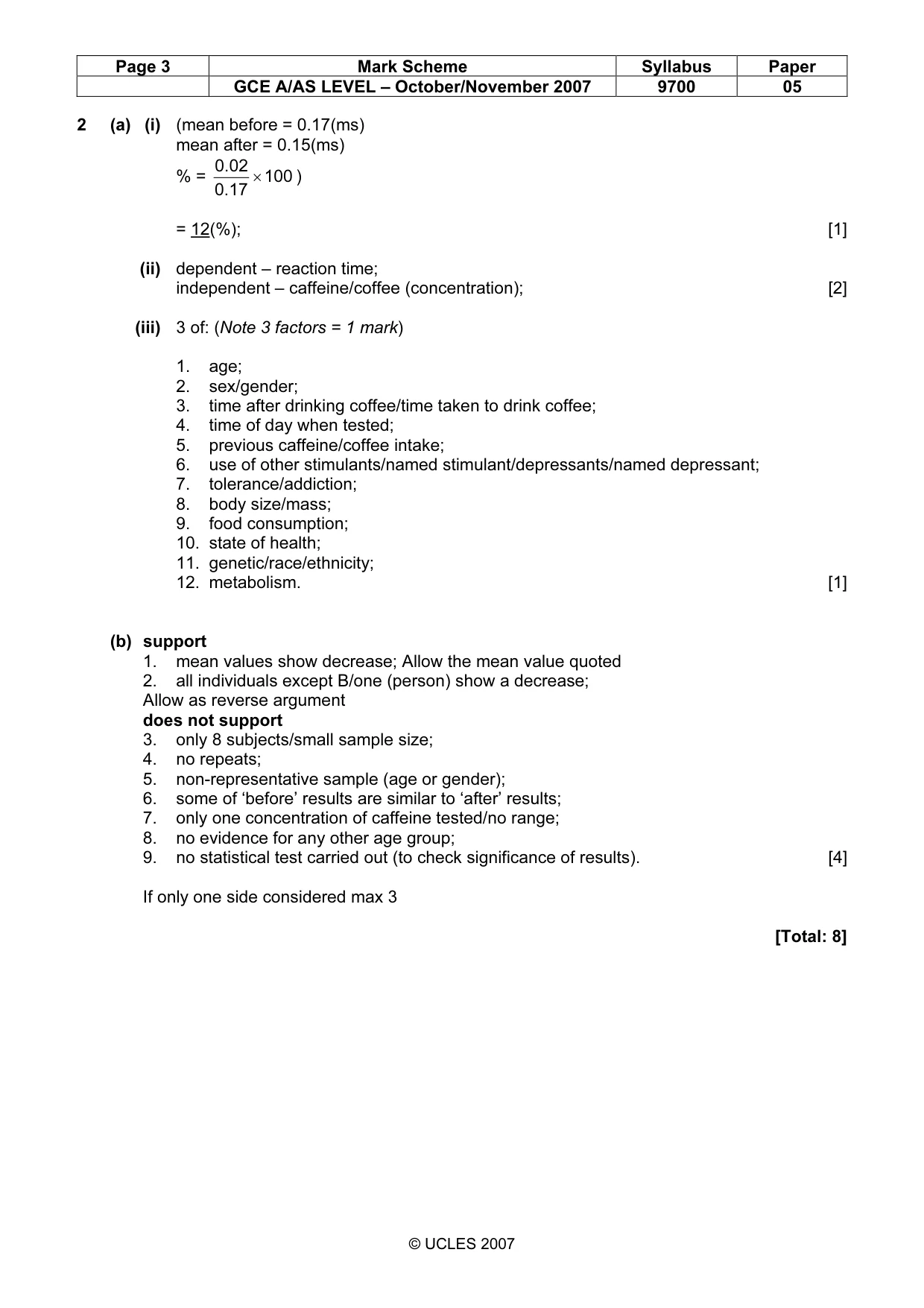
Page 3 Mark Scheme Syllabus Paper GCE A/AS LEVEL – October/November 2007 9700 05 © UCLES 2007 2 (a) (i) (mean before = 0.17(ms) mean after = 0.15(ms) % = 100 17 . 0 02 . 0 × ) = 12(%); [1] (ii) dependent – reaction time; independent – caffeine/coffee (concentration); [2] (iii) 3 of: (Note 3 factors = 1 mark) 1. age; 2. sex/gender; 3. time after drinking coffee/time taken to drink coffee; 4. time of day when tested; 5. previous caffeine/coffee intake; 6. use of other stimulants/named stimulant/depressants/named depressant; 7. tolerance/addiction; 8. body size/mass; 9. food consumption; 10. state of health; 11. genetic/race/ethnicity; 12. metabolism. [1] (b) support 1. mean values show decrease; Allow the mean value quoted 2. all individuals except B/one (person) show a decrease; Allow as reverse argument does not support 3. only 8 subjects/small sample size; 4. no repeats; 5. non-representative sample (age or gender); 6. some of ‘before’ results are similar to ‘after’ results; 7. only one concentration of caffeine tested/no range; 8. no evidence for any other age group; 9. no statistical test carried out (to check significance of results). [4] If only one side considered max 3 [Total: 8]
Mark scheme, page 4
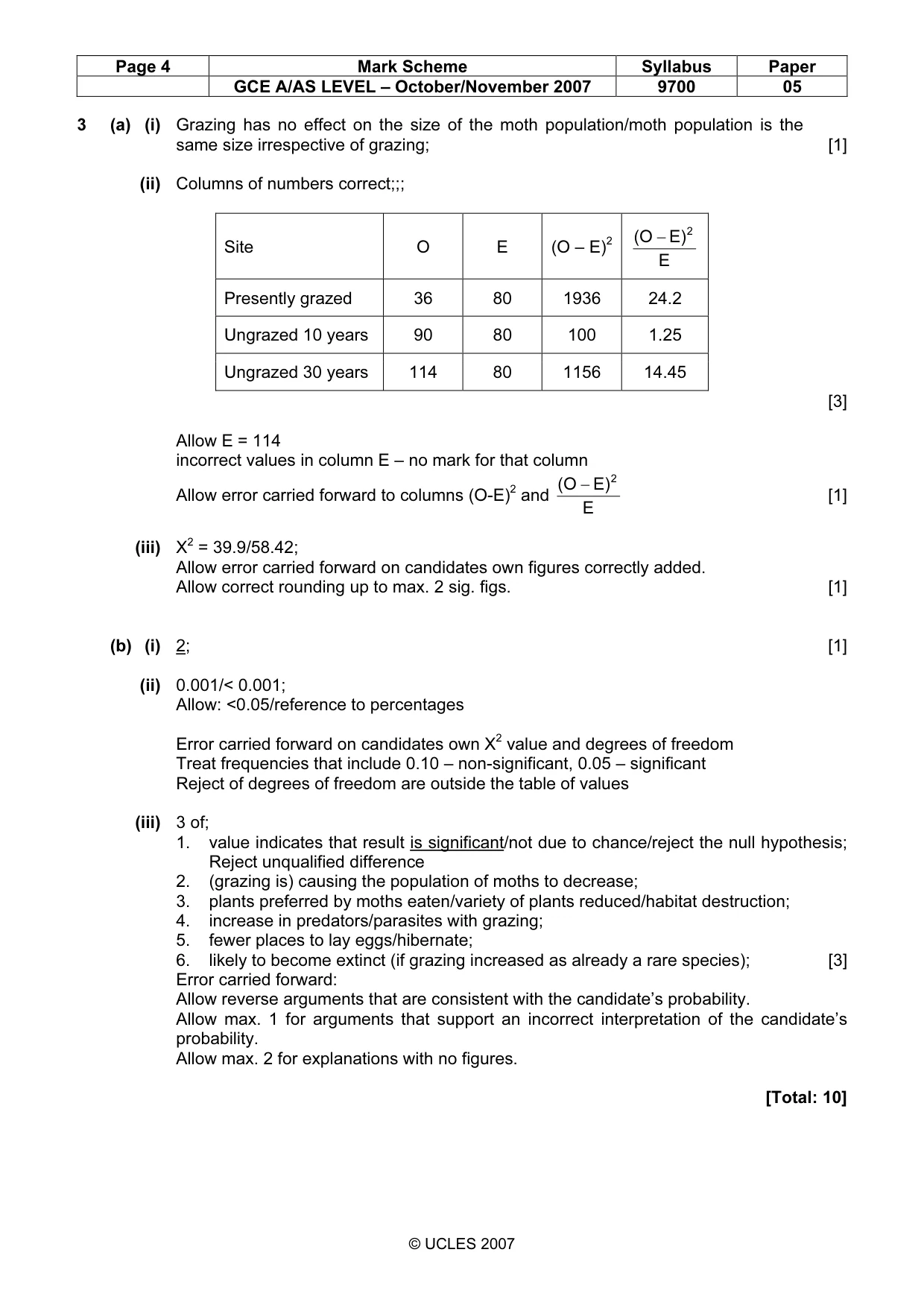
Page 4 Mark Scheme Syllabus Paper GCE A/AS LEVEL – October/November 2007 9700 05 © UCLES 2007 3 (a) (i) Grazing has no effect on the size of the moth population/moth population is the same size irrespective of grazing; [1] (ii) Columns of numbers correct;;; Site O E (O – E)2 E E) (O 2 − Presently grazed 36 80 1936 24.2 Ungrazed 10 years 90 80 100 1.25 Ungrazed 30 years 114 80 1156 14.45 [3] Allow E = 114 incorrect values in column E – no mark for that column Allow error carried forward to columns (O-E)2 and E E) (O 2 − [1] (iii) X2 = 39.9/58.42; Allow error carried forward on candidates own figures correctly added. Allow correct rounding up to max. 2 sig. figs. [1] (b) (i) 2; [1] (ii) 0.001/< 0.001; Allow: <0.05/reference to percentages Error carried forward on candidates own X2 value and degrees of freedom Treat frequencies that include 0.10 – non-significant, 0.05 – significant Reject of degrees of freedom are outside the table of values (iii) 3 of; 1. value indicates that result is significant/not due to chance/reject the null hypothesis; Reject unqualified difference 2. (grazing is) causing the population of moths to decrease; 3. plants preferred by moths eaten/variety of plants reduced/habitat destruction; 4. increase in predators/parasites with grazing; 5. fewer places to lay eggs/hibernate; 6. likely to become extinct (if grazing increased as already a rare species); [3] Error carried forward: Allow reverse arguments that are consistent with the candidate’s probability. Allow max. 1 for arguments that support an incorrect interpretation of the candidate’s probability. Allow max. 2 for explanations with no figures. [Total: 10]
What you needed in this session
Cambridge’s own grade thresholds for 2007 Oct/Nov, Paper 5 · Variant 1. A higher threshold means an easier paper — the bar moves with how the cohort did.