Cambridge A Level Biology 9700 — 2007 May/June Paper 5 · Variant 1
9700/51/M/J/07 · 30 marks · ≈34 min
The question paper and its mark scheme, free to read here and free to download. This is Cambridge’s own paper, exactly as it was sat.
Question paper8 pages

Mark scheme4 pages
Answers below. Sit the paper first if you are practising.
Paper as text
Question paper, page 1
This document consists of 7 printed pages and 1 blank page. SP (NH/CG) T27439/6 © UCLES 2007 [Turn over UNIVERSITY OF CAMBRIDGE INTERNATIONAL EXAMINATIONS General Certificate of Education Advanced Level READ THESE INSTRUCTIONS FIRST Write your Centre number, candidate number and name on all the work you hand in. Write in dark blue or black pen. You may use a soft pencil for any diagrams, graphs or rough working. Do not use staples, paper clips, highlighters, glue or correction fluid. DO NOT WRITE IN ANY BARCODES. Answer all questions. At the end of the examination, fasten all your work securely together. The number of marks is given in brackets [ ] at the end of each question or part question. * 5 7 1 2 3 0 2 8 6 6 * BIOLOGY 9700/05 Paper 5 Planning, Analysis and Evaluation May/June 2007 1 hour 15 minutes Candidates answer on the Question Paper. For Examiner’s Use 1 2 3 Total
Question paper, page 2
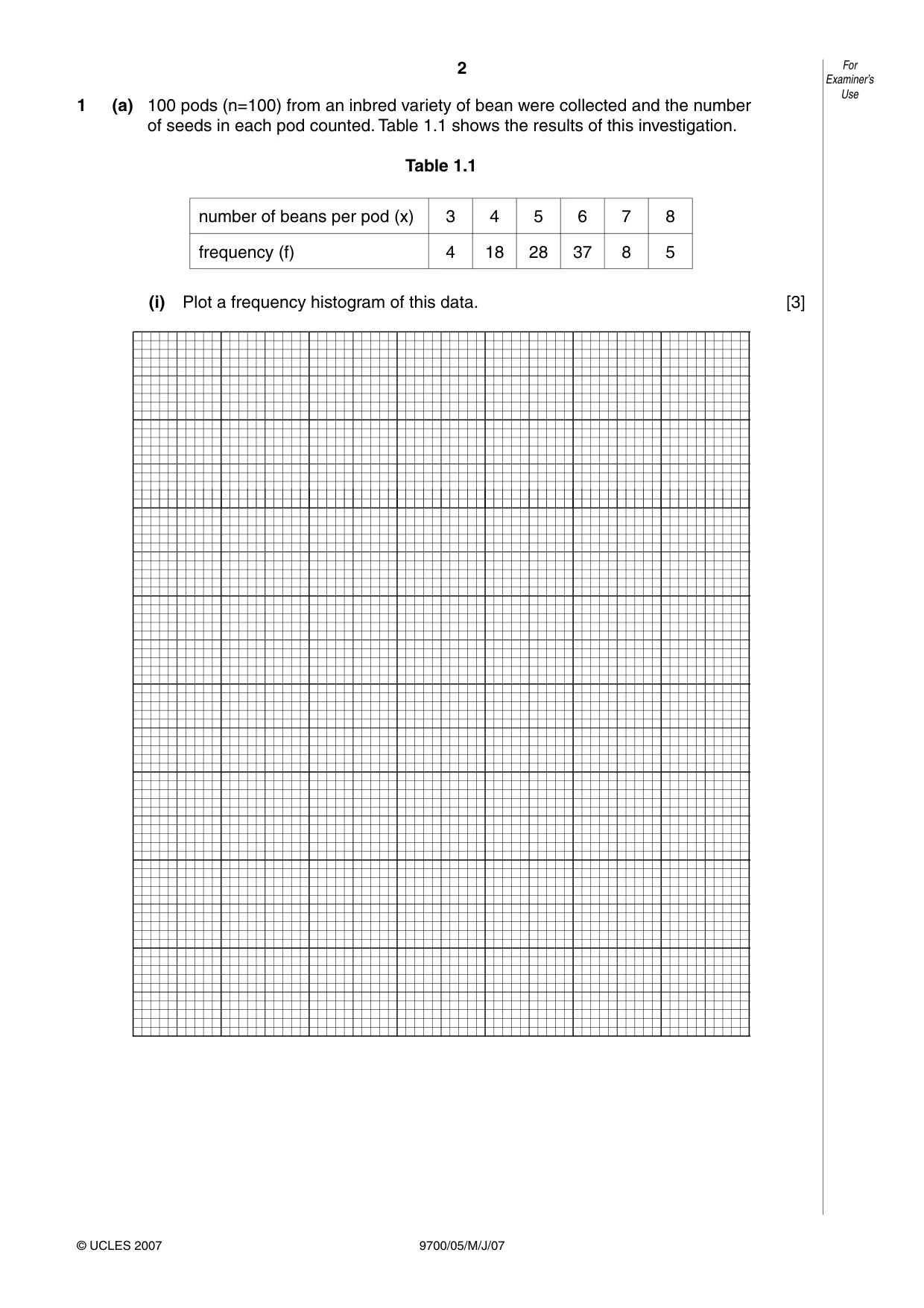
2 9700/05/M/J/07 For Examiner’s Use © UCLES 2007 1 (a) 100 pods (n=100) from an inbred variety of bean were collected and the number of seeds in each pod counted. Table 1.1 shows the results of this investigation. Table 1.1 number of beans per pod (x) 3 4 5 6 7 8 frequency (f) 4 18 28 37 8 5 (i) Plot a frequency histogram of this data. [3]
Question paper, page 3
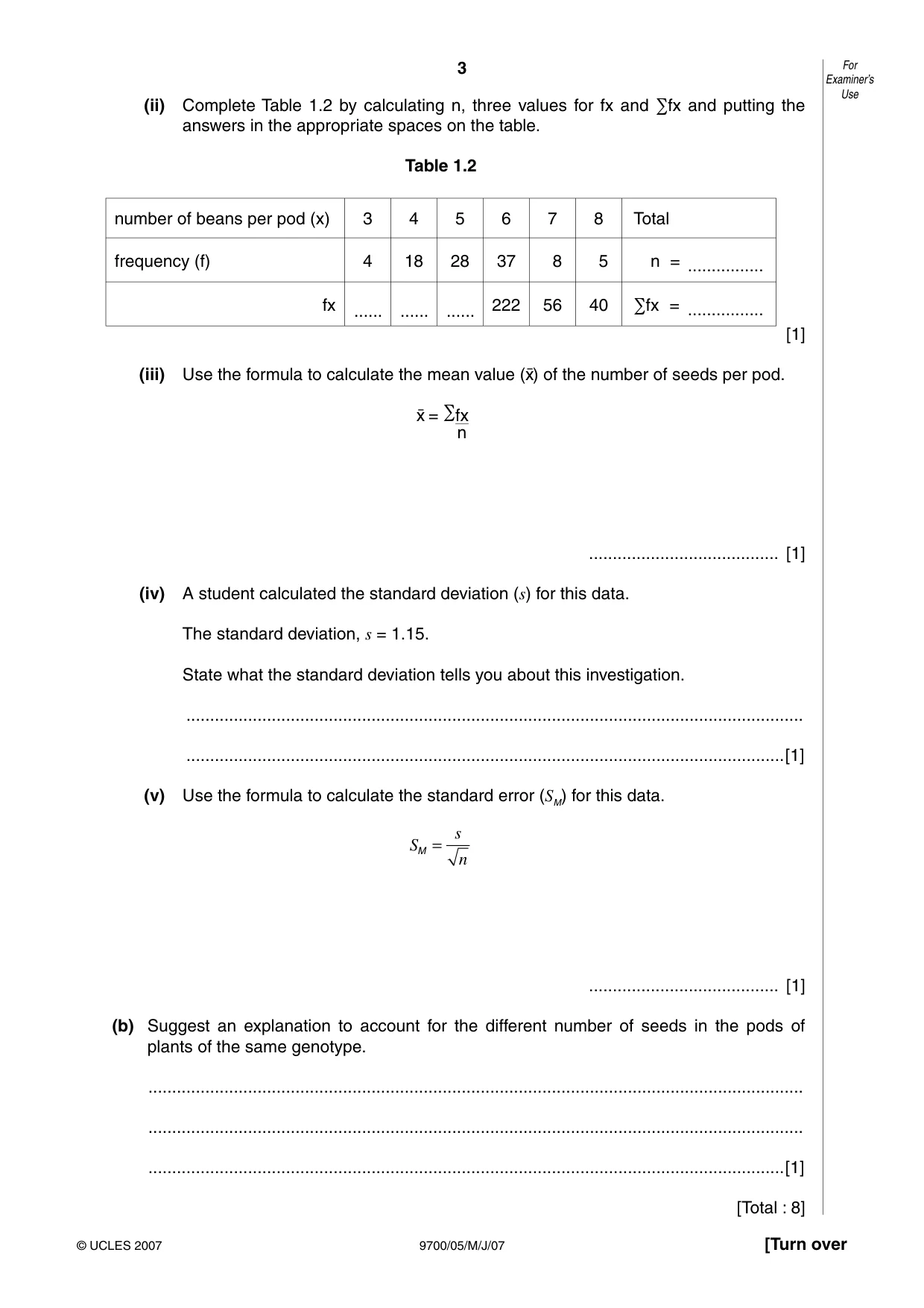
3 9700/05/M/J/07 [Turn over For Examiner’s Use © UCLES 2007 (ii) Complete Table 1.2 by calculating n, three values for fx and ∑fx and putting the answers in the appropriate spaces on the table. Table 1.2 number of beans per pod (x) 3 4 5 6 7 8 Total frequency (f) 4 18 28 37 8 5 n = … fx … … … 222 56 40 ∑fx = … [1] (iii) Use the formula to calculate the mean value (x¯) of the number of seeds per pod. x¯ = ∑fx n … [1] (iv) A student calculated the standard deviation (s) for this data. The standard deviation, s = 1.15. State what the standard deviation tells you about this investigation. … …[1] (v) Use the formula to calculate the standard error (SM) for this data. S s n M = … [1] (b) Suggest an explanation to account for the different number of seeds in the pods of plants of the same genotype. … … …[1] [Total : 8]
Question paper, page 4
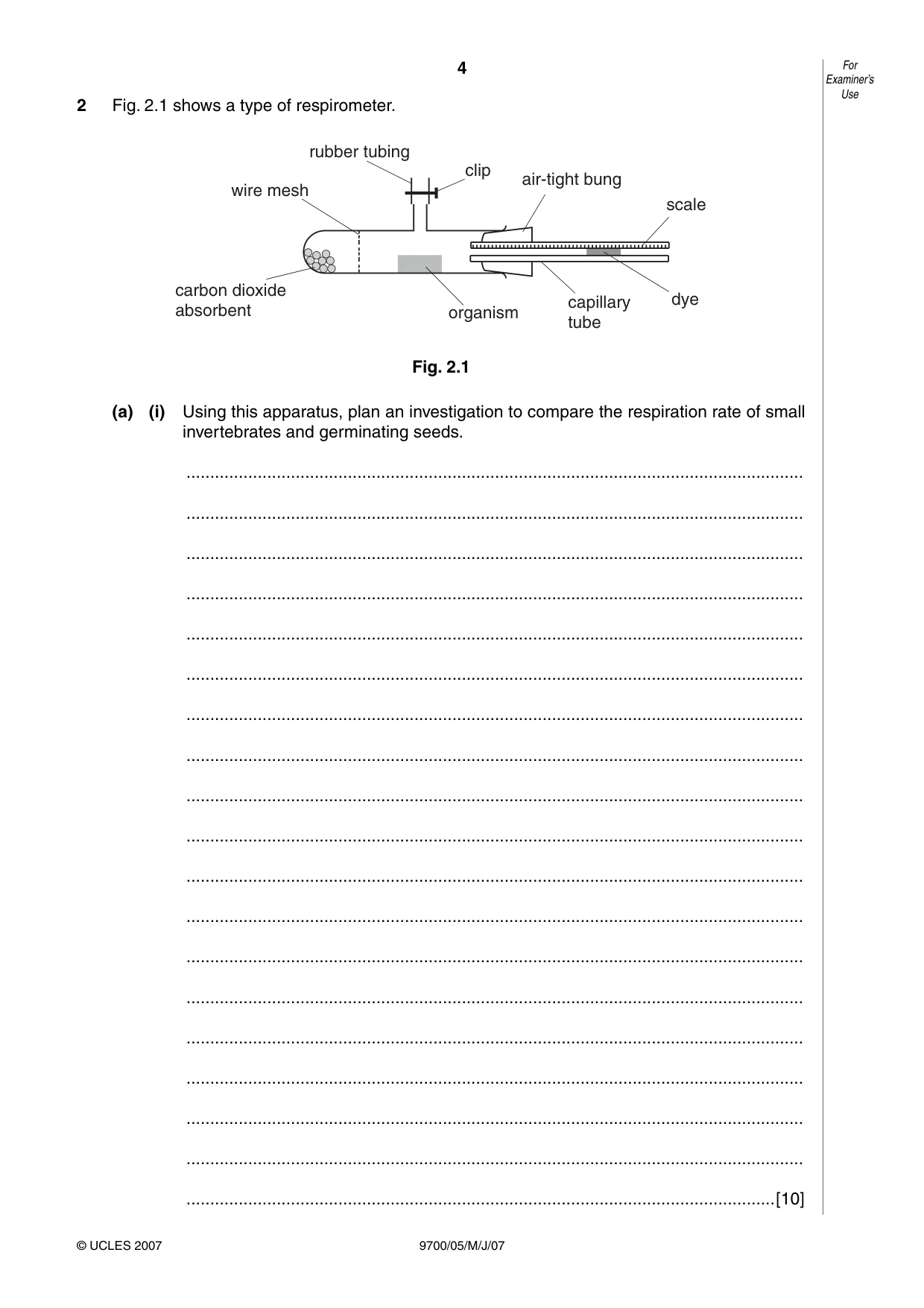
4 9700/05/M/J/07 For Examiner’s Use © UCLES 2007 2 Fig. 2.1 shows a type of respirometer. organism rubber tubing wire mesh carbon dioxide absorbent air-tight bung scale capillary tube dye clip Fig. 2.1 (a) (i) Using this apparatus, plan an investigation to compare the respiration rate of small invertebrates and germinating seeds. … … … … … … … … … … … … … … … … … … …[10]
Question paper, page 5
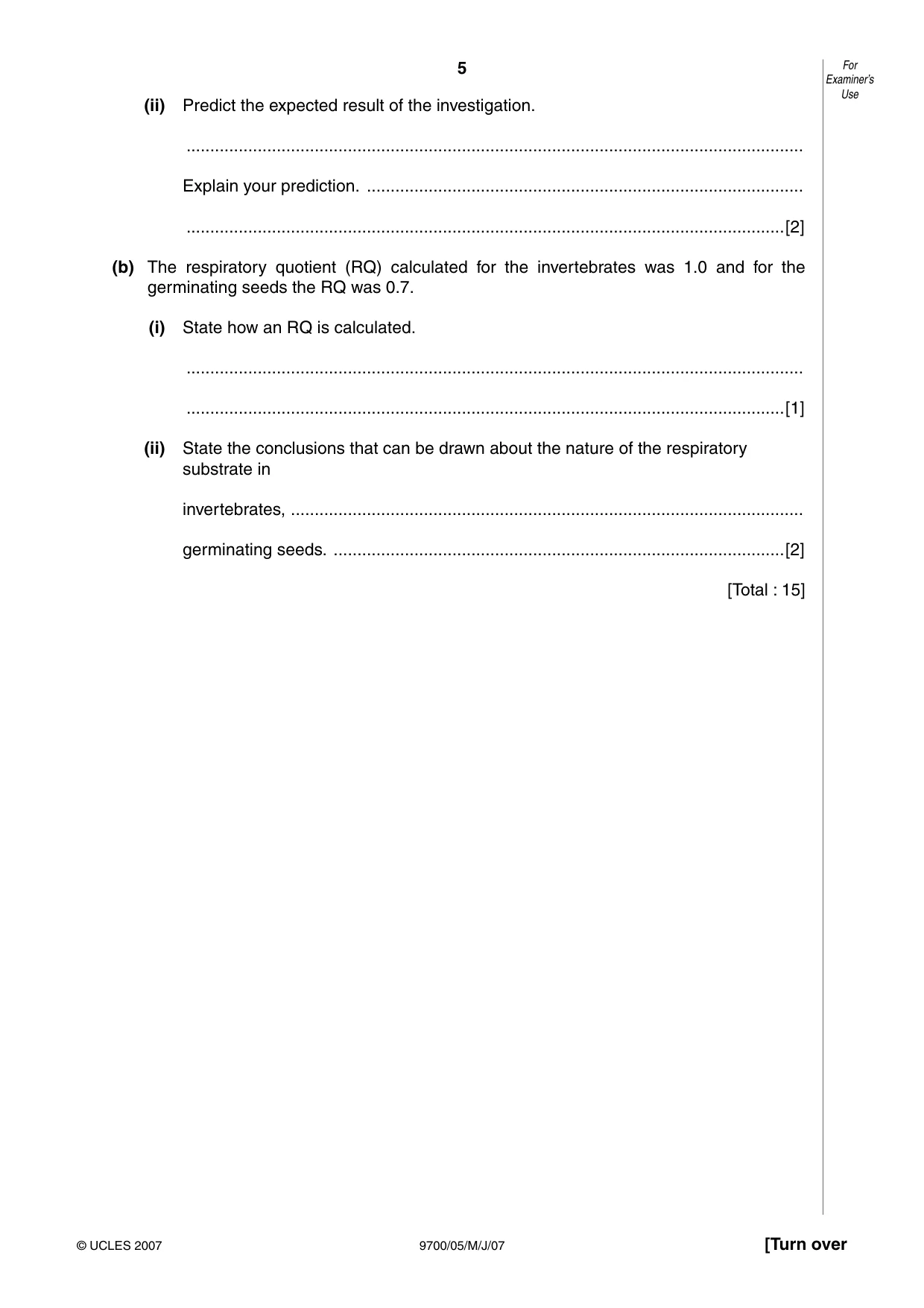
5 9700/05/M/J/07 [Turn over For Examiner’s Use © UCLES 2007 (ii) Predict the expected result of the investigation. … Explain your prediction. … …[2] (b) The respiratory quotient (RQ) calculated for the invertebrates was 1.0 and for the germinating seeds the RQ was 0.7. (i) State how an RQ is calculated. … …[1] (ii) State the conclusions that can be drawn about the nature of the respiratory substrate in invertebrates, … germinating seeds. …[2] [Total : 15]
Question paper, page 6
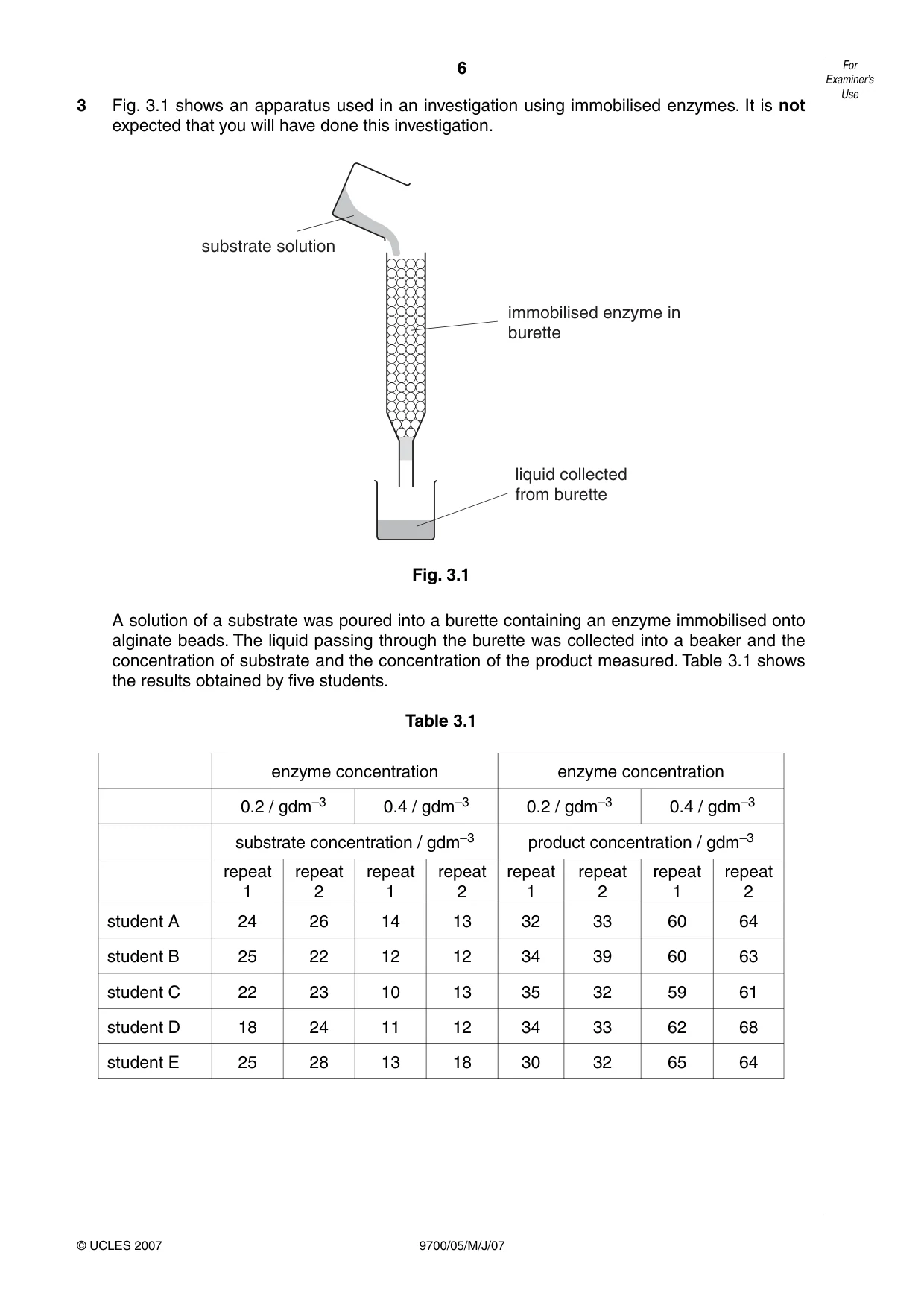
6 9700/05/M/J/07 For Examiner’s Use © UCLES 2007 3 Fig. 3.1 shows an apparatus used in an investigation using immobilised enzymes. It is not expected that you will have done this investigation. substrate solution immobilised enzyme in burette liquid collected from burette Fig. 3.1 A solution of a substrate was poured into a burette containing an enzyme immobilised onto alginate beads. The liquid passing through the burette was collected into a beaker and the concentration of substrate and the concentration of the product measured. Table 3.1 shows the results obtained by five students. Table 3.1 enzyme concentration enzyme concentration 0.2 / gdm–3 0.4 / gdm–3 0.2 / gdm–3 0.4 / gdm–3 substrate concentration / gdm–3 product concentration / gdm–3 repeat 1 repeat 2 repeat 1 repeat 2 repeat 1 repeat 2 repeat 1 repeat 2 student A 24 26 14 13 32 33 60 64 student B 25 22 12 12 34 39 60 63 student C 22 23 10 13 35 32 59 61 student D 18 24 11 12 34 33 62 68 student E 25 28 13 18 30 32 65 64
Question paper, page 7
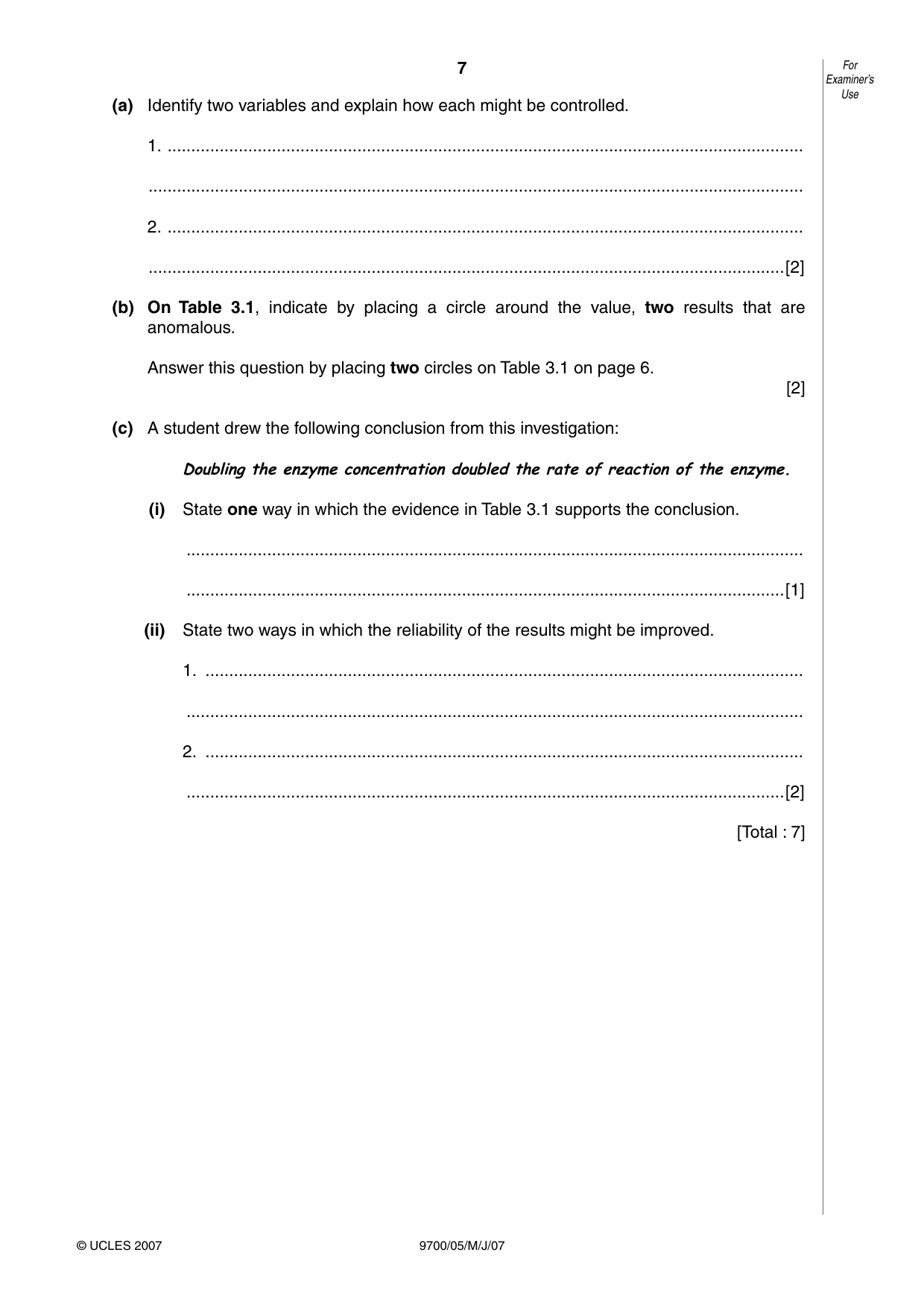
7 9700/05/M/J/07 For Examiner’s Use © UCLES 2007 (a) Identify two variables and explain how each might be controlled. 1. … … 2. … …[2] (b) On Table 3.1, indicate by placing a circle around the value, two results that are anomalous. Answer this question by placing two circles on Table 3.1 on page 6. [2] (c) A student drew the following conclusion from this investigation: Doubling the enzyme concentration doubled the rate of reaction of the enzyme. (i) State one way in which the evidence in Table 3.1 supports the conclusion. … …[1] (ii) State two ways in which the reliability of the results might be improved. 1. … … 2. … …[2] [Total : 7]
Question paper, page 8
8 9700/05/M/J/07 BLANK PAGE Permission to reproduce items where third-party owned material protected by copyright is included has been sought and cleared where possible. Every reasonable effort has been made by the publisher (UCLES) to trace copyright holders, but if any items requiring clearance have unwittingly been included, the publisher will be pleased to make amends at the earliest possible opportunity. University of Cambridge International Examinations is part of the Cambridge Assessment Group. Cambridge Assessment is the brand name of University of Cambridge Local Examinations Syndicate (UCLES), which is itself a department of the University of Cambridge.
Mark scheme, page 1
UNIVERSITY OF CAMBRIDGE INTERNATIONAL EXAMINATIONS GCE Advanced Subsidiary Level and GCE Advanced Level MARK SCHEME for the May/June 2007 question paper 9700 BIOLOGY 9700/05 Paper 5 (Planning, Analysis and Evaluation), maximum raw mark 30 This mark scheme is published as an aid to teachers and candidates, to indicate the requirements of the examination. It shows the basis on which Examiners were instructed to award marks. It does not indicate the details of the discussions that took place at an Examiners’ meeting before marking began. All Examiners are instructed that alternative correct answers and unexpected approaches in candidates’ scripts must be given marks that fairly reflect the relevant knowledge and skills demonstrated. Mark schemes must be read in conjunction with the question papers and the report on the examination. • CIE will not enter into discussions or correspondence in connection with these mark schemes. CIE is publishing the mark schemes for the May/June 2007 question papers for most IGCSE, GCE Advanced Level and Advanced Subsidiary Level syllabuses and some Ordinary Level syllabuses.
Mark scheme, page 2
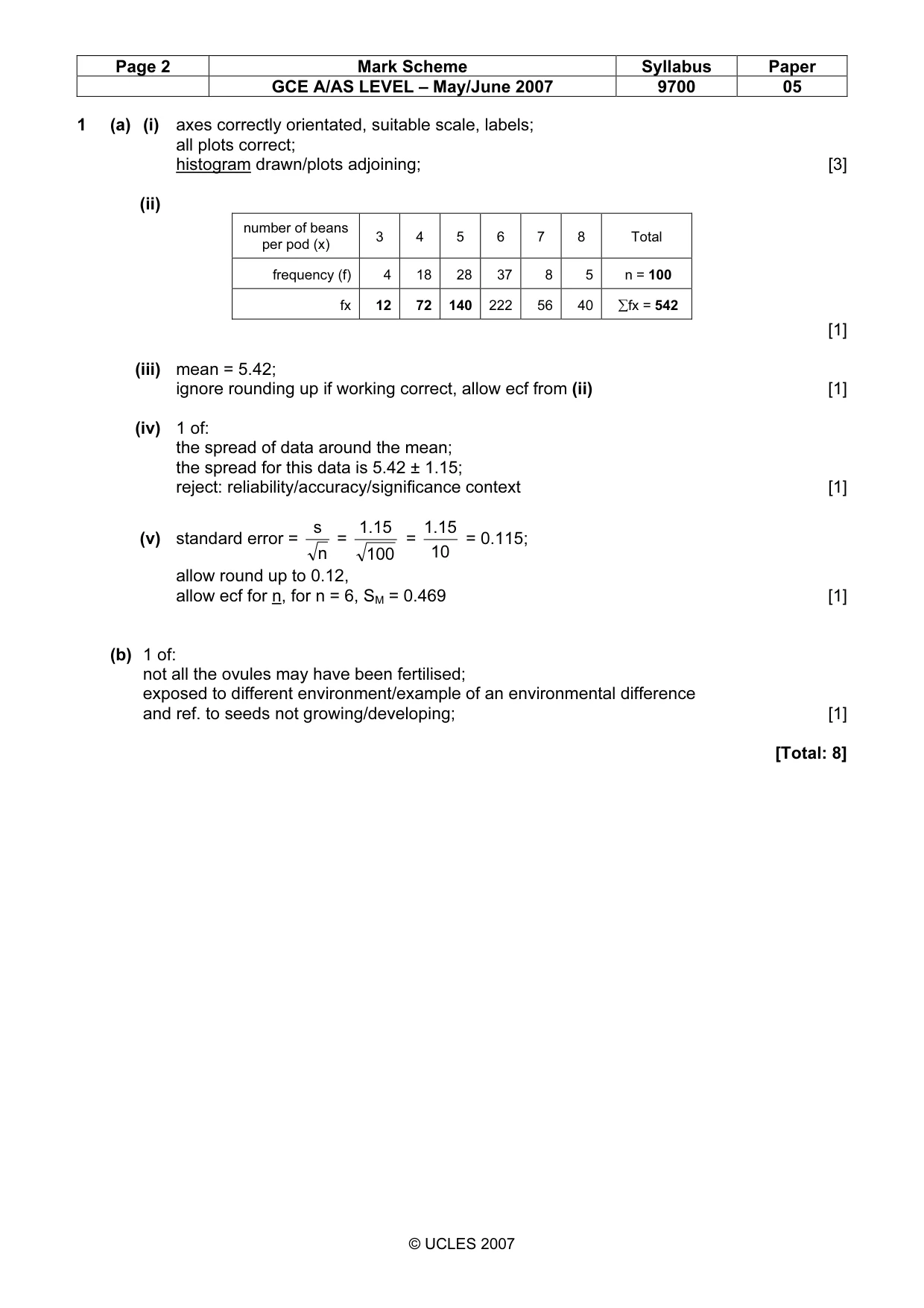
Page 2 Mark Scheme Syllabus Paper GCE A/AS LEVEL – May/June 2007 9700 05 © UCLES 2007 1 (a) (i) axes correctly orientated, suitable scale, labels; all plots correct; histogram drawn/plots adjoining; [3] (ii) number of beans per pod (x) 3 4 5 6 7 8 Total frequency (f) 4 18 28 37 8 5 n = 100 fx 12 72 140 222 56 40 ∑fx = 542 [1] (iii) mean = 5.42; ignore rounding up if working correct, allow ecf from (ii) [1] (iv) 1 of: the spread of data around the mean; the spread for this data is 5.42 ± 1.15; reject: reliability/accuracy/significance context [1] (v) standard error = n s = 100 15 . 1 = 10 15 . 1 = 0.115; allow round up to 0.12, allow ecf for n, for n = 6, SM = 0.469 [1] (b) 1 of: not all the ovules may have been fertilised; exposed to different environment/example of an environmental difference and ref. to seeds not growing/developing; [1] [Total: 8]
Mark scheme, page 3
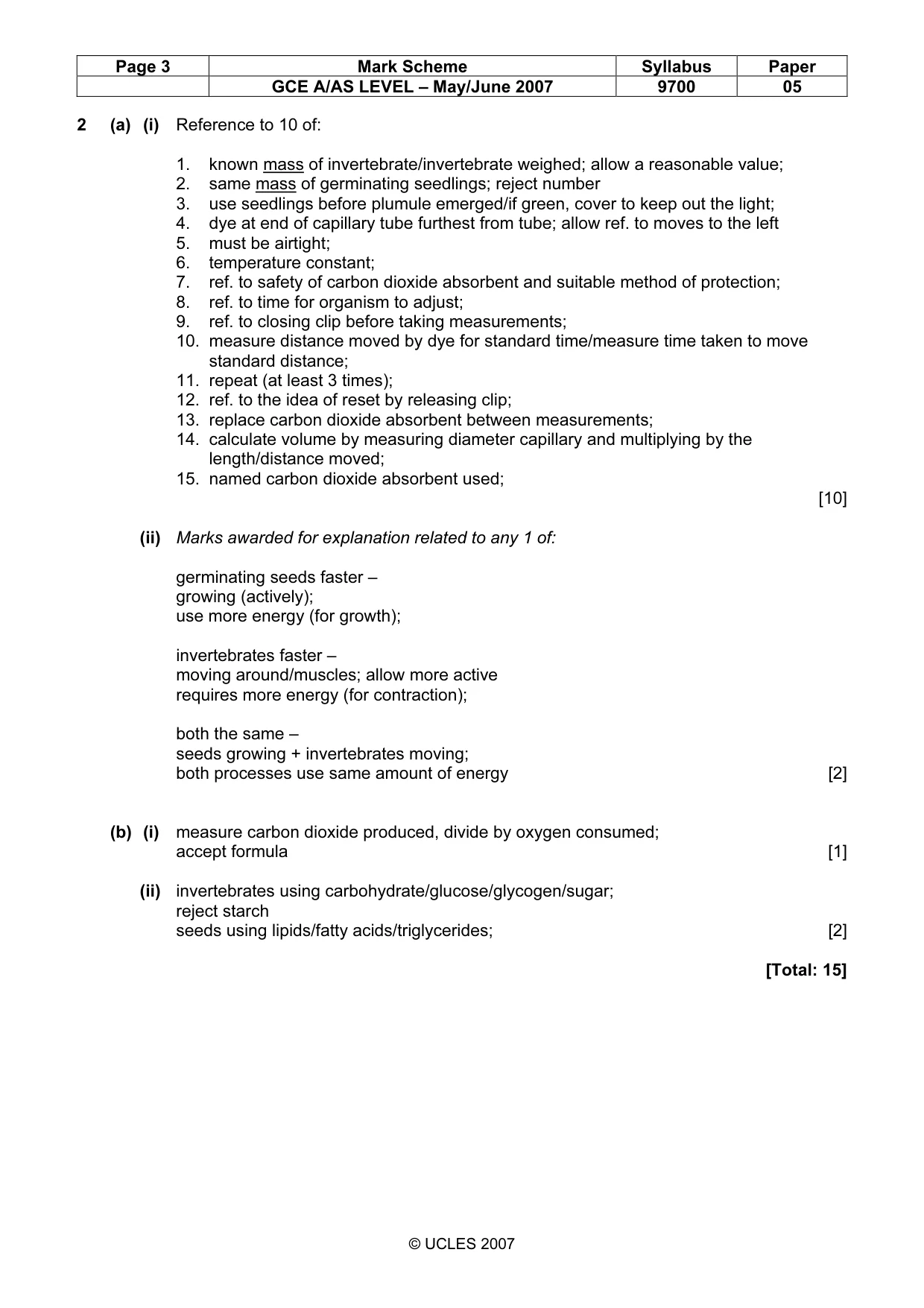
Page 3 Mark Scheme Syllabus Paper GCE A/AS LEVEL – May/June 2007 9700 05 © UCLES 2007 2 (a) (i) Reference to 10 of: 1. known mass of invertebrate/invertebrate weighed; allow a reasonable value; 2. same mass of germinating seedlings; reject number 3. use seedlings before plumule emerged/if green, cover to keep out the light; 4. dye at end of capillary tube furthest from tube; allow ref. to moves to the left 5. must be airtight; 6. temperature constant; 7. ref. to safety of carbon dioxide absorbent and suitable method of protection; 8. ref. to time for organism to adjust; 9. ref. to closing clip before taking measurements; 10. measure distance moved by dye for standard time/measure time taken to move standard distance; 11. repeat (at least 3 times); 12. ref. to the idea of reset by releasing clip; 13. replace carbon dioxide absorbent between measurements; 14. calculate volume by measuring diameter capillary and multiplying by the length/distance moved; 15. named carbon dioxide absorbent used; [10] (ii) Marks awarded for explanation related to any 1 of: germinating seeds faster – growing (actively); use more energy (for growth); invertebrates faster – moving around/muscles; allow more active requires more energy (for contraction); both the same – seeds growing + invertebrates moving; both processes use same amount of energy [2] (b) (i) measure carbon dioxide produced, divide by oxygen consumed; accept formula [1] (ii) invertebrates using carbohydrate/glucose/glycogen/sugar; reject starch seeds using lipids/fatty acids/triglycerides; [2] [Total: 15]
Mark scheme, page 4
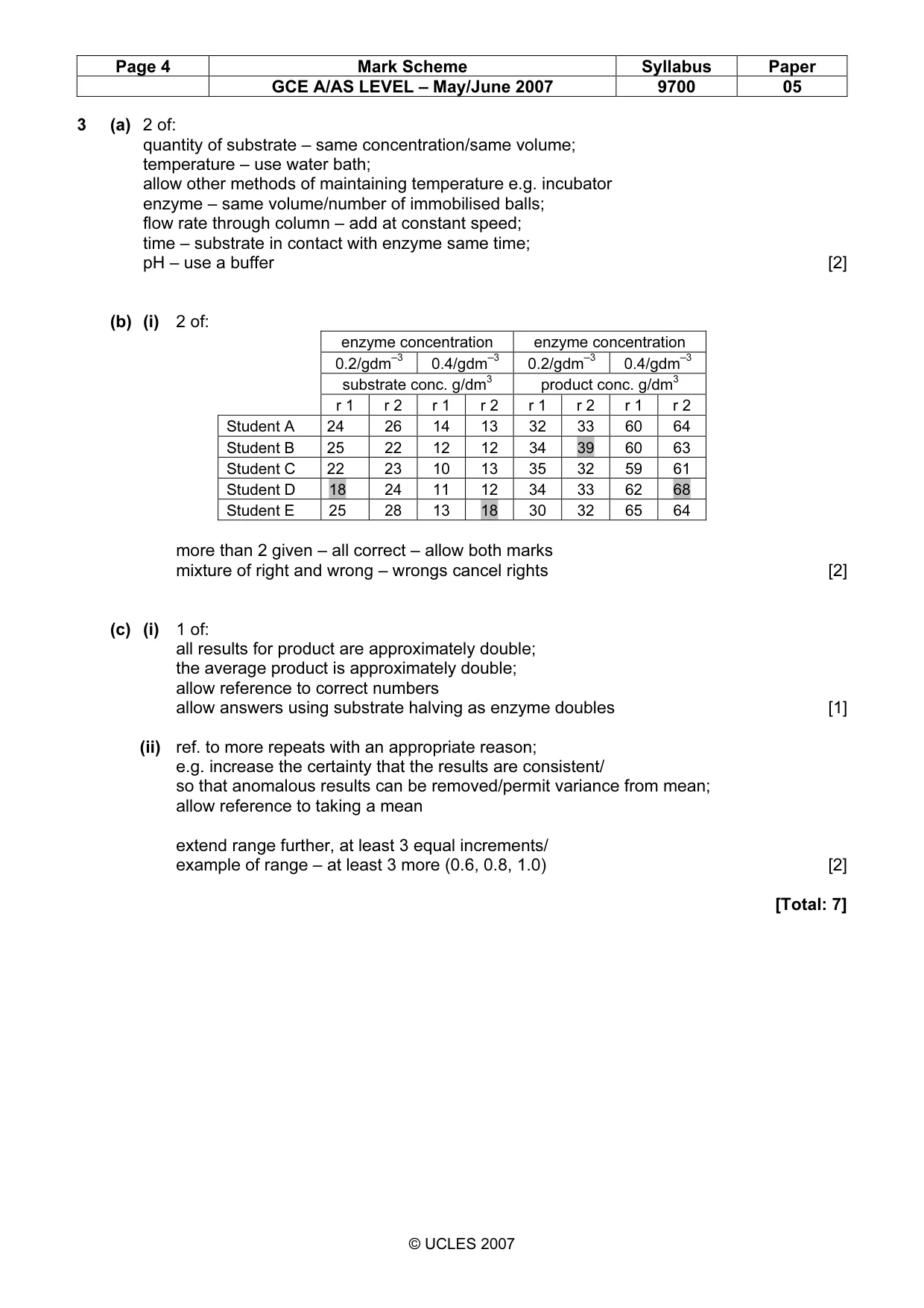
Page 4 Mark Scheme Syllabus Paper GCE A/AS LEVEL – May/June 2007 9700 05 © UCLES 2007 3 (a) 2 of: quantity of substrate – same concentration/same volume; temperature – use water bath; allow other methods of maintaining temperature e.g. incubator enzyme – same volume/number of immobilised balls; flow rate through column – add at constant speed; time – substrate in contact with enzyme same time; pH – use a buffer [2] (b) (i) 2 of: enzyme concentration enzyme concentration 0.2/gdm–3 0.4/gdm–3 0.2/gdm–3 0.4/gdm–3 substrate conc. g/dm3 product conc. g/dm3 r 1 r 2 r 1 r 2 r 1 r 2 r 1 r 2 Student A 24 26 14 13 32 33 60 64 Student B 25 22 12 12 34 39 60 63 Student C 22 23 10 13 35 32 59 61 Student D 18 24 11 12 34 33 62 68 Student E 25 28 13 18 30 32 65 64 more than 2 given – all correct – allow both marks mixture of right and wrong – wrongs cancel rights [2] (c) (i) 1 of: all results for product are approximately double; the average product is approximately double; allow reference to correct numbers allow answers using substrate halving as enzyme doubles [1] (ii) ref. to more repeats with an appropriate reason; e.g. increase the certainty that the results are consistent/ so that anomalous results can be removed/permit variance from mean; allow reference to taking a mean extend range further, at least 3 equal increments/ example of range – at least 3 more (0.6, 0.8, 1.0) [2] [Total: 7]
What you needed in this session
Cambridge’s own grade thresholds for 2007 May/June, Paper 5 · Variant 1. A higher threshold means an easier paper — the bar moves with how the cohort did.