Cambridge A Level Biology 9700 — 2006 Oct/Nov Paper 5 · Variant 1
9700/51/O/N/06 · 30 marks · ≈34 min
The question paper and its mark scheme, free to read here and free to download. This is Cambridge’s own paper, exactly as it was sat.
Question paper8 pages


Mark scheme2 pages
Answers below. Sit the paper first if you are practising.
Paper as text
Question paper, page 1
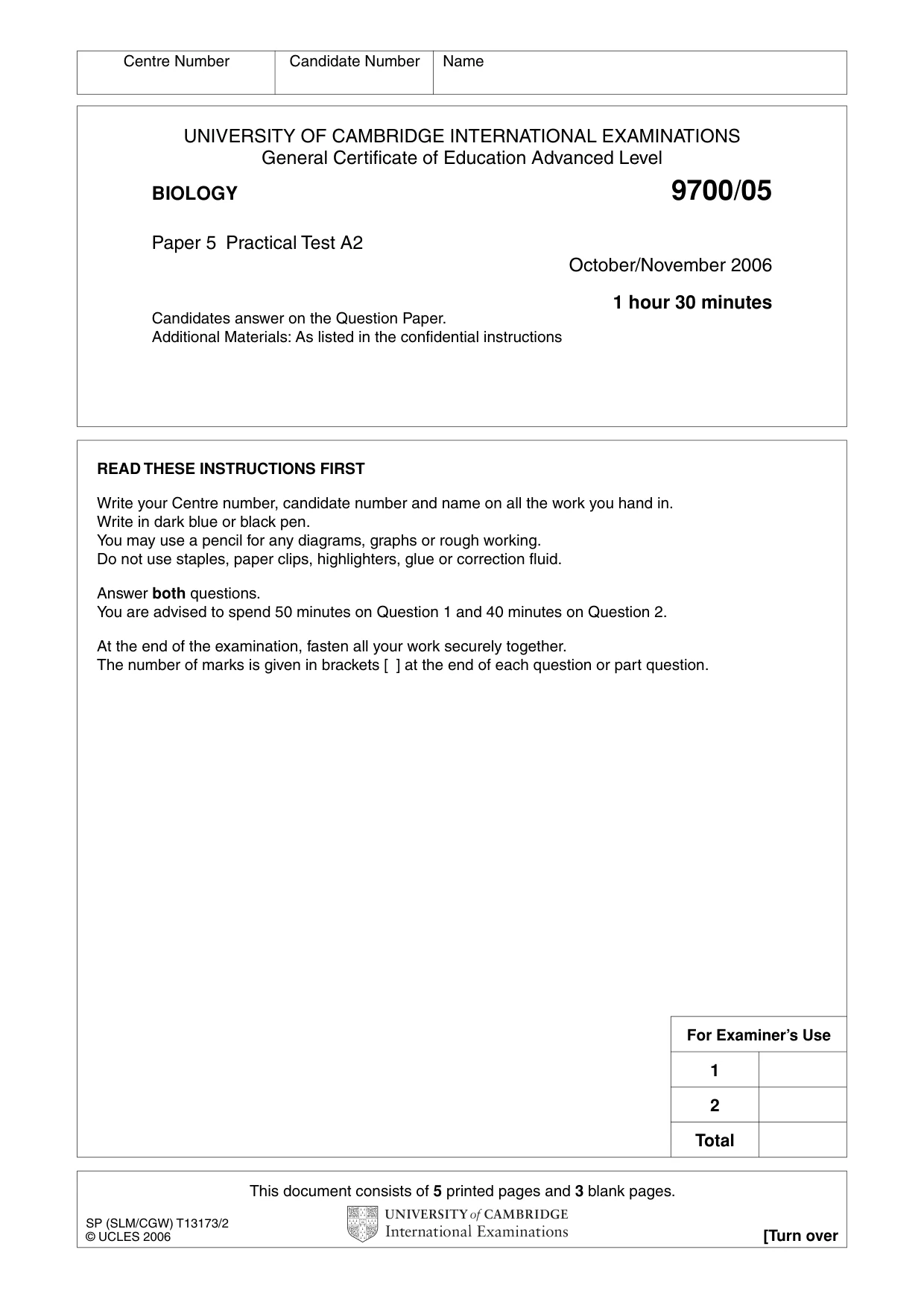
This document consists of 5 printed pages and 3 blank pages. SP (SLM/CGW) T13173/2 © UCLES 2006 [Turn over UNIVERSITY OF CAMBRIDGE INTERNATIONAL EXAMINATIONS General Certificate of Education Advanced Level BIOLOGY 9700/05 Paper 5 Practical Test A2 October/November 2006 1 hour 30 minutes Candidates answer on the Question Paper. Additional Materials: As listed in the confidential instructions READ THESE INSTRUCTIONS FIRST Write your Centre number, candidate number and name on all the work you hand in. Write in dark blue or black pen. You may use a pencil for any diagrams, graphs or rough working. Do not use staples, paper clips, highlighters, glue or correction fluid. Answer both questions. You are advised to spend 50 minutes on Question 1 and 40 minutes on Question 2. At the end of the examination, fasten all your work securely together. The number of marks is given in brackets [ ] at the end of each question or part question. Centre Number Candidate Number Name For Examiner’s Use 1 2 Total
Question paper, page 2
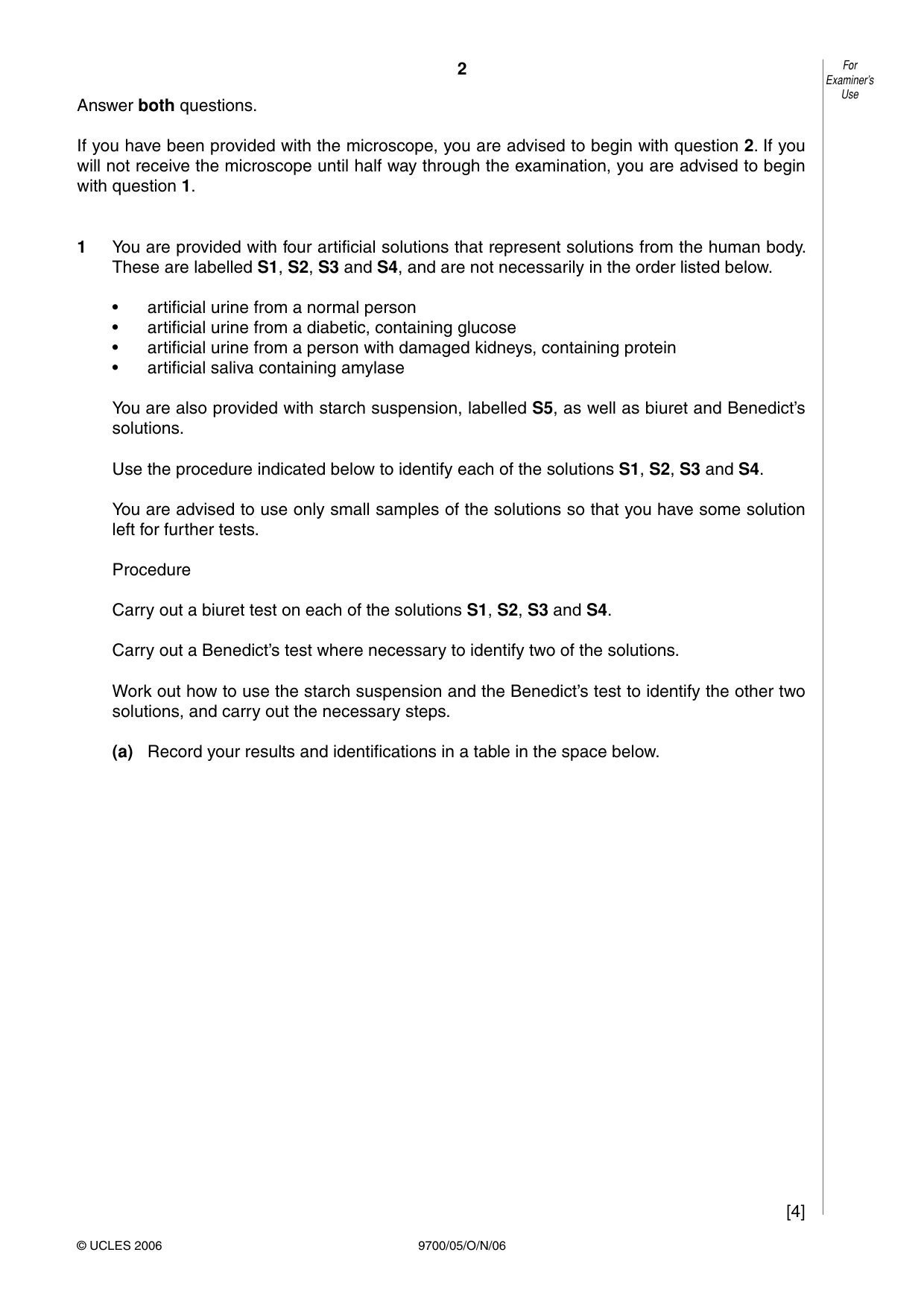
2 9700/05/O/N/06 For Examiner’s Use © UCLES 2006 Answer both questions. If you have been provided with the microscope, you are advised to begin with question 2. If you will not receive the microscope until half way through the examination, you are advised to begin with question 1. 1 You are provided with four artificial solutions that represent solutions from the human body. These are labelled S1, S2, S3 and S4, and are not necessarily in the order listed below. • artificial urine from a normal person • artificial urine from a diabetic, containing glucose • artificial urine from a person with damaged kidneys, containing protein • artificial saliva containing amylase You are also provided with starch suspension, labelled S5, as well as biuret and Benedict’s solutions. Use the procedure indicated below to identify each of the solutions S1, S2, S3 and S4. You are advised to use only small samples of the solutions so that you have some solution left for further tests. Procedure Carry out a biuret test on each of the solutions S1, S2, S3 and S4. Carry out a Benedict’s test where necessary to identify two of the solutions. Work out how to use the starch suspension and the Benedict’s test to identify the other two solutions, and carry out the necessary steps. (a) Record your results and identifications in a table in the space below. [4]
Question paper, page 3
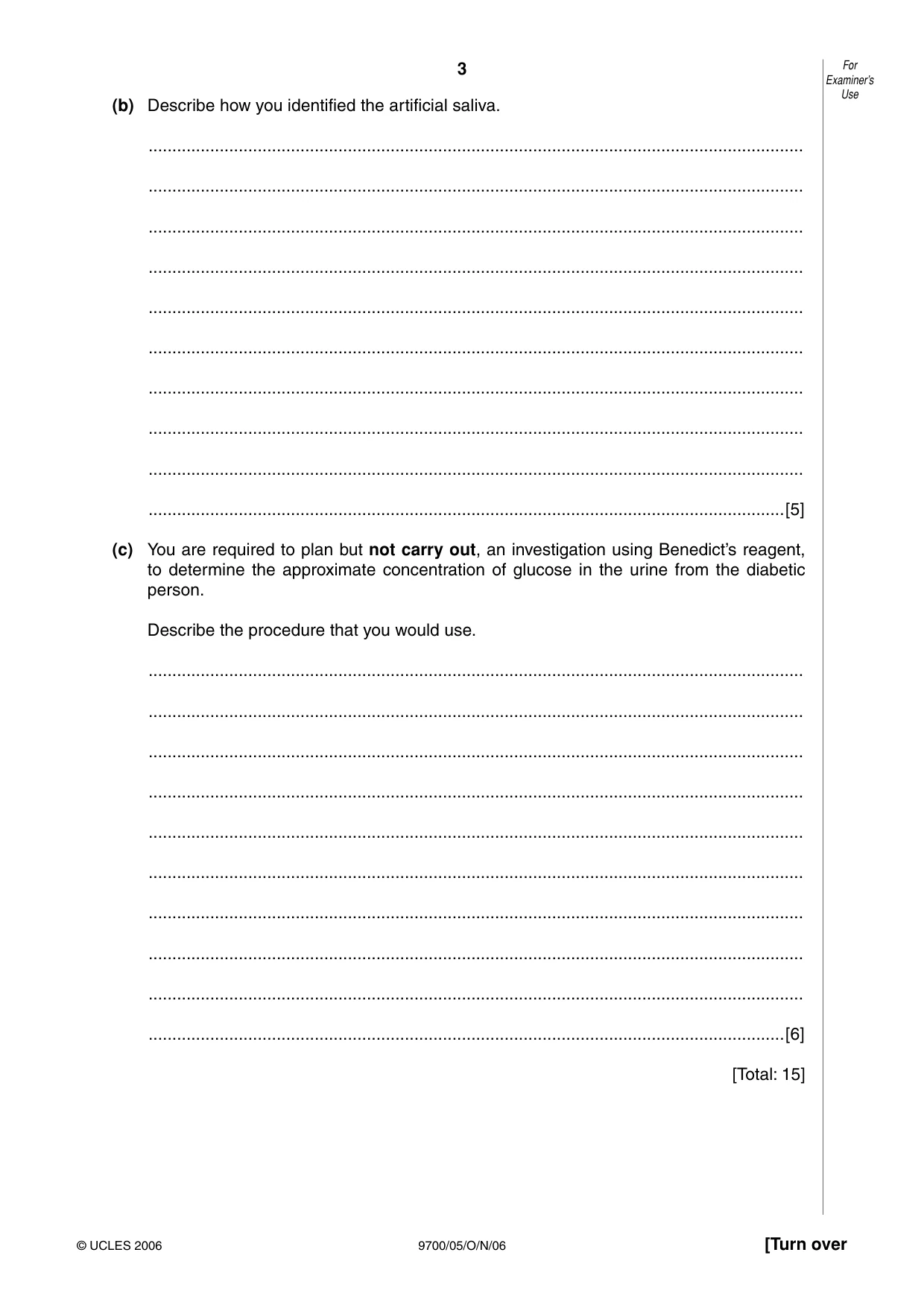
3 9700/05/O/N/06 [Turn over For Examiner’s Use © UCLES 2006 (b) Describe how you identified the artificial saliva. … … … … … … … … … …[5] (c) You are required to plan but not carry out, an investigation using Benedict’s reagent, to determine the approximate concentration of glucose in the urine from the diabetic person. Describe the procedure that you would use. … … … … … … … … … …[6] [Total: 15]
Question paper, page 4
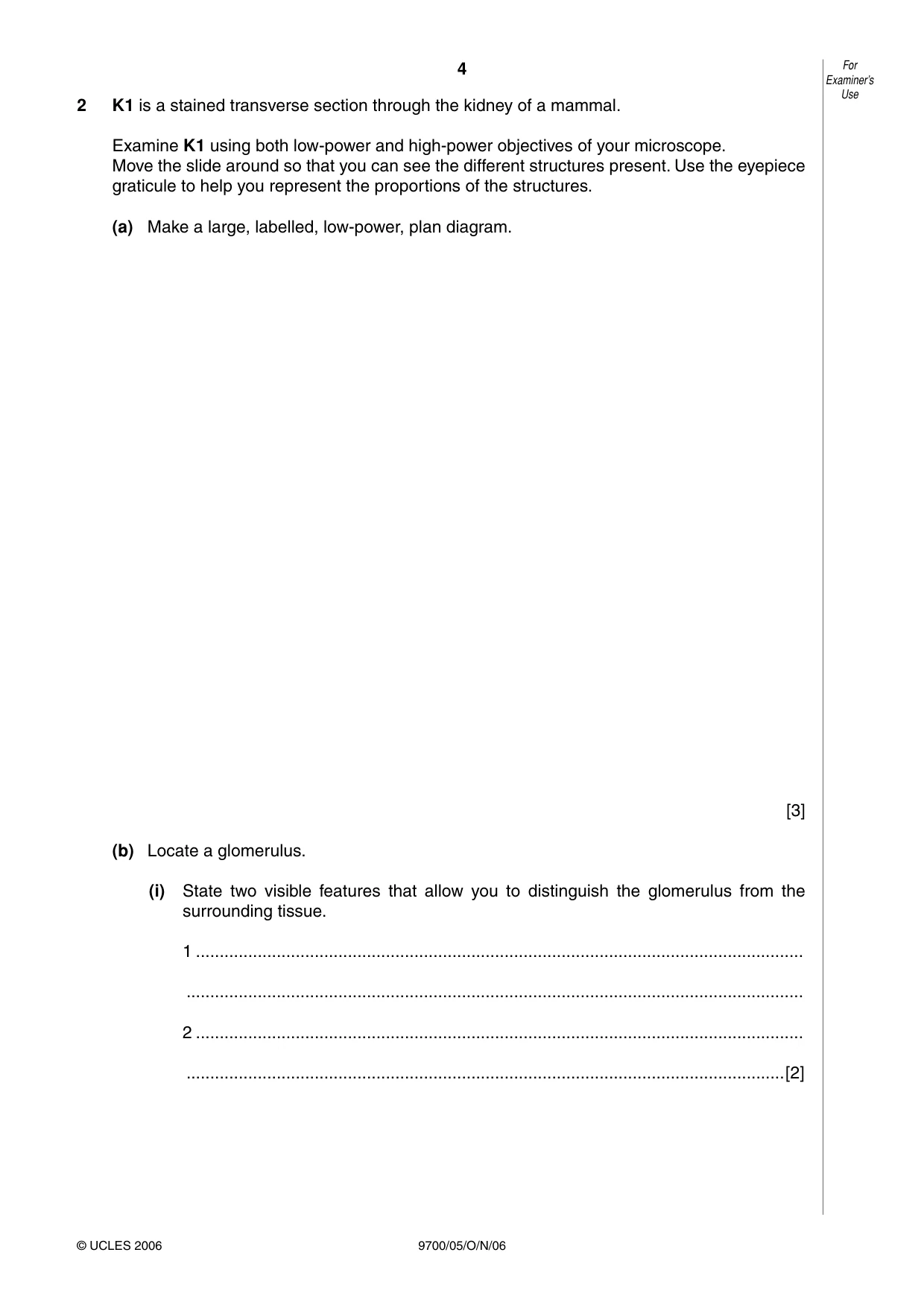
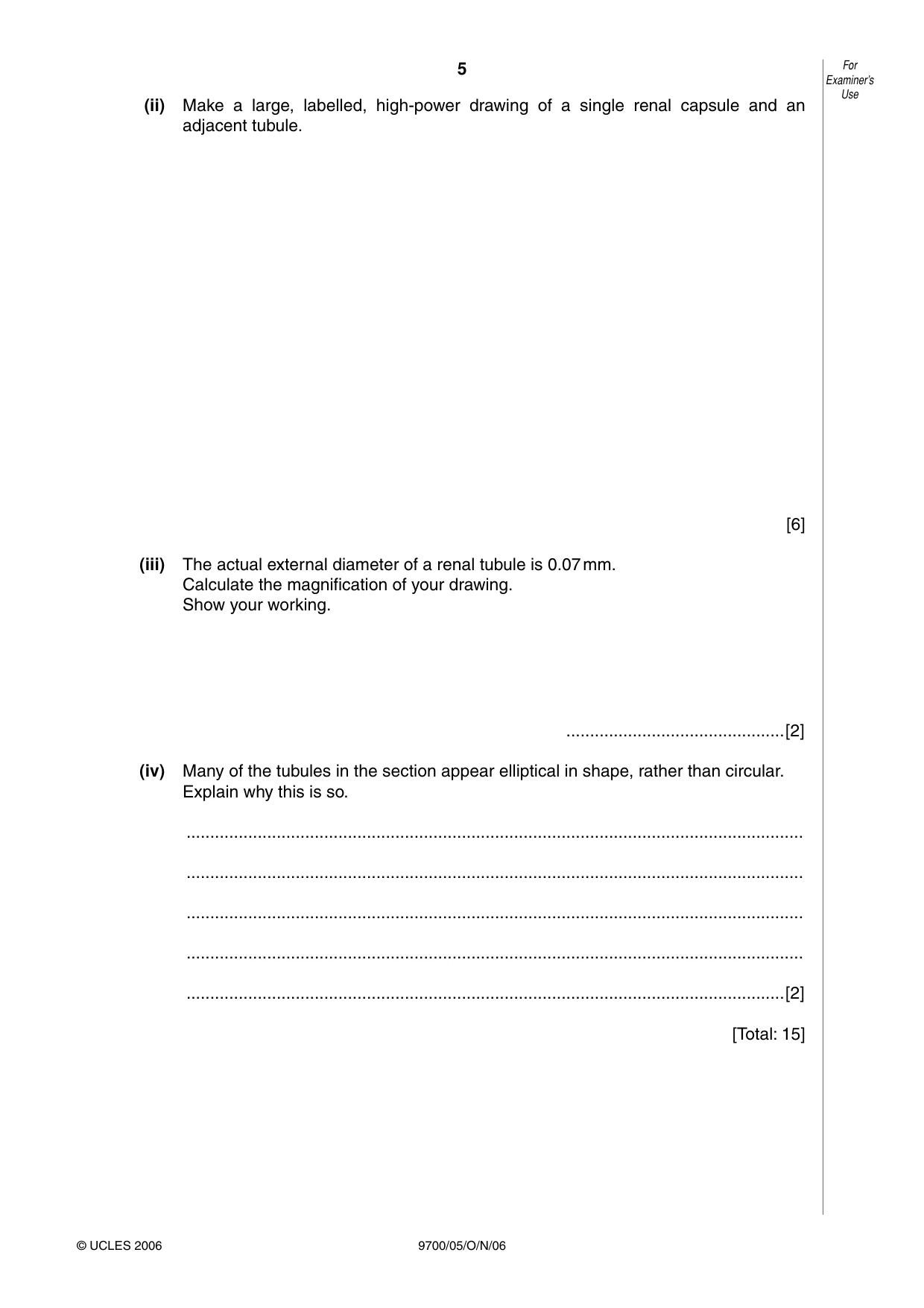
4 9700/05/O/N/06 For Examiner’s Use © UCLES 2006 2 K1 is a stained transverse section through the kidney of a mammal. Examine K1 using both low-power and high-power objectives of your microscope. Move the slide around so that you can see the different structures present. Use the eyepiece graticule to help you represent the proportions of the structures. (a) Make a large, labelled, low-power, plan diagram. [3] (b) Locate a glomerulus. (i) State two visible features that allow you to distinguish the glomerulus from the surrounding tissue. 1 … … 2 … …[2]
Question paper, page 5
5 9700/05/O/N/06 For Examiner’s Use © UCLES 2006 (ii) Make a large, labelled, high-power drawing of a single renal capsule and an adjacent tubule. [6] (iii) The actual external diameter of a renal tubule is 0.07 mm. Calculate the magnification of your drawing. Show your working. …[2] (iv) Many of the tubules in the section appear elliptical in shape, rather than circular. Explain why this is so. … … … … …[2] [Total: 15]
Question paper, page 8
8 9700/05/O/N/06 BLANK PAGE Permission to reproduce items where third-party owned material protected by copyright is included has been sought and cleared where possible. Every reasonable effort has been made by the publisher (UCLES) to trace copyright holders, but if any items requiring clearance have unwittingly been included, the publisher will be pleased to make amends at the earliest possible opportunity. University of Cambridge International Examinations is part of the University of Cambridge Local Examinations Syndicate (UCLES), which is itself a department of the University of Cambridge.
Mark scheme, page 1
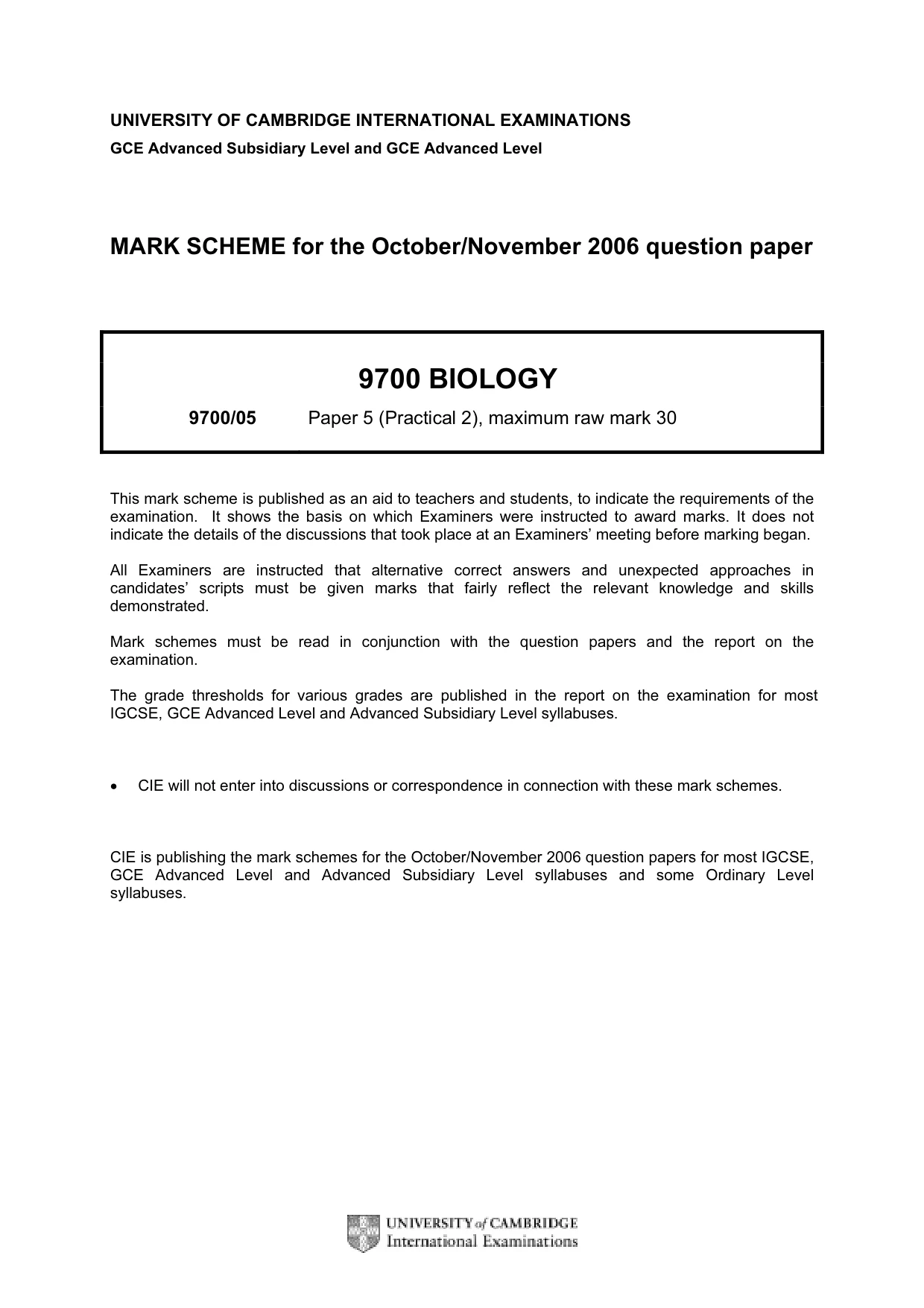
UNIVERSITY OF CAMBRIDGE INTERNATIONAL EXAMINATIONS GCE Advanced Subsidiary Level and GCE Advanced Level MARK SCHEME for the October/November 2006 question paper 9700 BIOLOGY 9700/05 Paper 5 (Practical 2), maximum raw mark 30 This mark scheme is published as an aid to teachers and students, to indicate the requirements of the examination. It shows the basis on which Examiners were instructed to award marks. It does not indicate the details of the discussions that took place at an Examiners’ meeting before marking began. All Examiners are instructed that alternative correct answers and unexpected approaches in candidates’ scripts must be given marks that fairly reflect the relevant knowledge and skills demonstrated. Mark schemes must be read in conjunction with the question papers and the report on the examination. The grade thresholds for various grades are published in the report on the examination for most IGCSE, GCE Advanced Level and Advanced Subsidiary Level syllabuses. • CIE will not enter into discussions or correspondence in connection with these mark schemes. CIE is publishing the mark schemes for the October/November 2006 question papers for most IGCSE, GCE Advanced Level and Advanced Subsidiary Level syllabuses and some Ordinary Level syllabuses.
Mark scheme, page 2
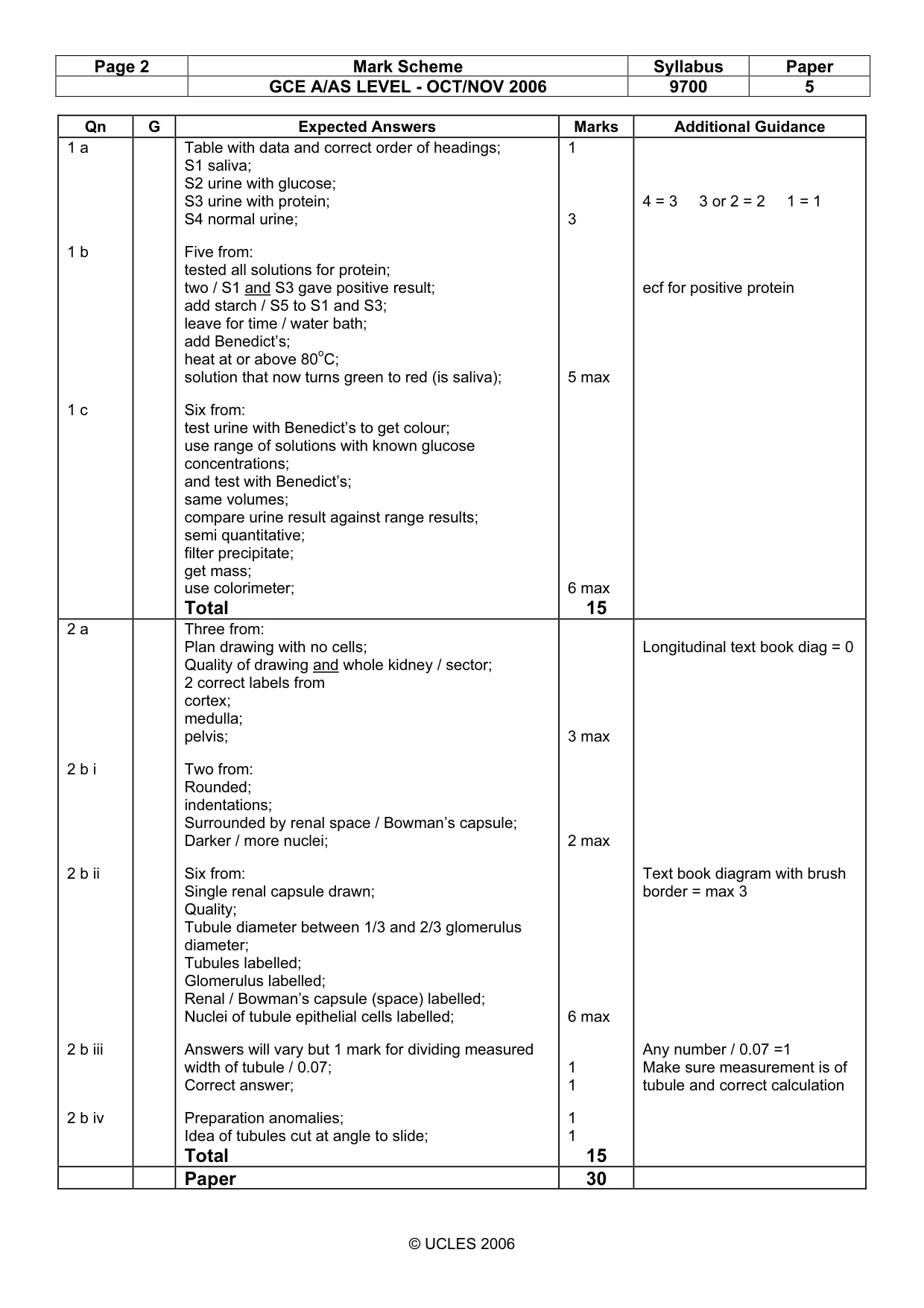
Page 2 Mark Scheme Syllabus Paper GCE A/AS LEVEL - OCT/NOV 2006 9700 5 © UCLES 2006 Qn G Expected Answers Marks Additional Guidance 1 a 1 b 1 c Table with data and correct order of headings; S1 saliva; S2 urine with glucose; S3 urine with protein; S4 normal urine; Five from: tested all solutions for protein; two / S1 and S3 gave positive result; add starch / S5 to S1 and S3; leave for time / water bath; add Benedict’s; heat at or above 80oC; solution that now turns green to red (is saliva); Six from: test urine with Benedict’s to get colour; use range of solutions with known glucose concentrations; and test with Benedict’s; same volumes; compare urine result against range results; semi quantitative; filter precipitate; get mass; use colorimeter; Total 1 3 5 max 6 max 15 4 = 3 3 or 2 = 2 1 = 1 ecf for positive protein 2 a 2 b i 2 b ii 2 b iii 2 b iv Three from: Plan drawing with no cells; Quality of drawing and whole kidney / sector; 2 correct labels from cortex; medulla; pelvis; Two from: Rounded; indentations; Surrounded by renal space / Bowman’s capsule; Darker / more nuclei; Six from: Single renal capsule drawn; Quality; Tubule diameter between 1/3 and 2/3 glomerulus diameter; Tubules labelled; Glomerulus labelled; Renal / Bowman’s capsule (space) labelled; Nuclei of tubule epithelial cells labelled; Answers will vary but 1 mark for dividing measured width of tubule / 0.07; Correct answer; Preparation anomalies; Idea of tubules cut at angle to slide; Total 3 max 2 max 6 max 1 1 1 1 15 Longitudinal text book diag = 0 Text book diagram with brush border = max 3 Any number / 0.07 =1 Make sure measurement is of tubule and correct calculation Paper 30
What you needed in this session
Cambridge’s own grade thresholds for 2006 Oct/Nov, Paper 5 · Variant 1. A higher threshold means an easier paper — the bar moves with how the cohort did.