Cambridge A Level Biology 9700 — 2006 May/June Paper 5 · Variant 1
9700/51/M/J/06 · 30 marks · ≈34 min
The question paper and its mark scheme, free to read here and free to download. This is Cambridge’s own paper, exactly as it was sat.
Question paper8 pages
Mark scheme2 pages
Answers below. Sit the paper first if you are practising.
Paper as text
Question paper, page 1
This document consists of 8 printed pages. SP (SC/CGW) T10866/2 © UCLES 2006 [Turn over UNIVERSITY OF CAMBRIDGE INTERNATIONAL EXAMINATIONS General Certificate of Education Advanced Level BIOLOGY 9700/05 Paper 5 Practical Test A2 May/June 2006 1 hour 30 minutes Candidates answer on the Question Paper. Additional Materials: As listed in the Instructions to Supervisors. READ THESE INSTRUCTIONS FIRST Write your Centre number, candidate number and name on all the work you hand in. Write in dark blue or black pen. You may use a pencil for any diagrams, graphs or rough working. Do not use staples, paper clips, highlighters, glue or correction fluid. Answer both questions. You are advised to spend 45 minutes on each question. At the end of the examination, fasten all your work securely together. The number of marks is given in brackets [ ] at the end of each question or part question. Centre Number Candidate Number Name For Examiner’s Use 1 2 TOTAL
Question paper, page 2
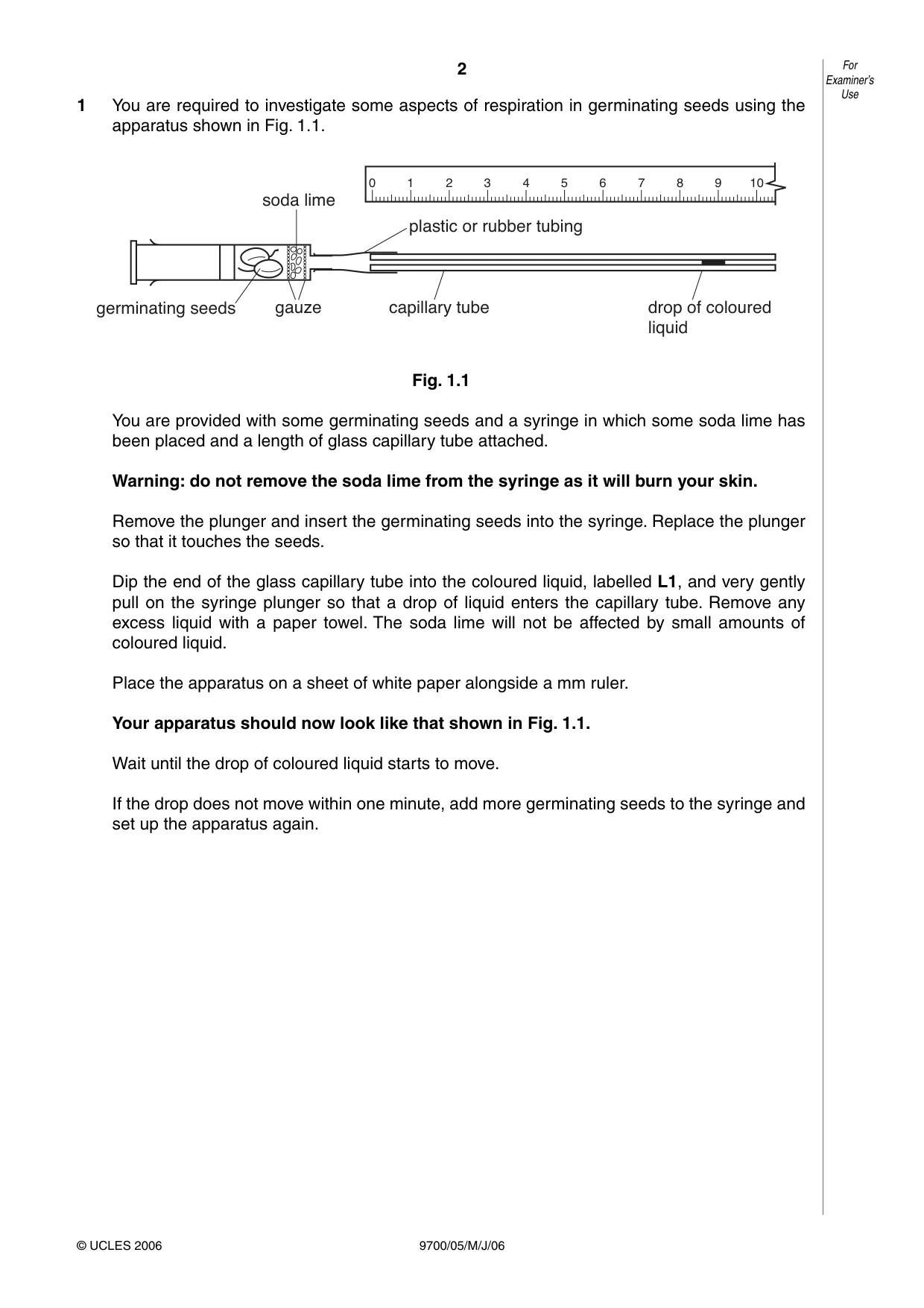
2 9700/05/M/J/06 For Examiner’s Use © UCLES 2006 1 You are required to investigate some aspects of respiration in germinating seeds using the apparatus shown in Fig. 1.1. 0 soda lime germinating seeds gauze capillary tube drop of coloured liquid plastic or rubber tubing 1 2 3 4 5 6 7 8 9 10 Fig. 1.1 You are provided with some germinating seeds and a syringe in which some soda lime has been placed and a length of glass capillary tube attached. Warning: do not remove the soda lime from the syringe as it will burn your skin. Remove the plunger and insert the germinating seeds into the syringe. Replace the plunger so that it touches the seeds. Dip the end of the glass capillary tube into the coloured liquid, labelled L1, and very gently pull on the syringe plunger so that a drop of liquid enters the capillary tube. Remove any excess liquid with a paper towel. The soda lime will not be affected by small amounts of coloured liquid. Place the apparatus on a sheet of white paper alongside a mm ruler. Your apparatus should now look like that shown in Fig. 1.1. Wait until the drop of coloured liquid starts to move. If the drop does not move within one minute, add more germinating seeds to the syringe and set up the apparatus again.
Question paper, page 3
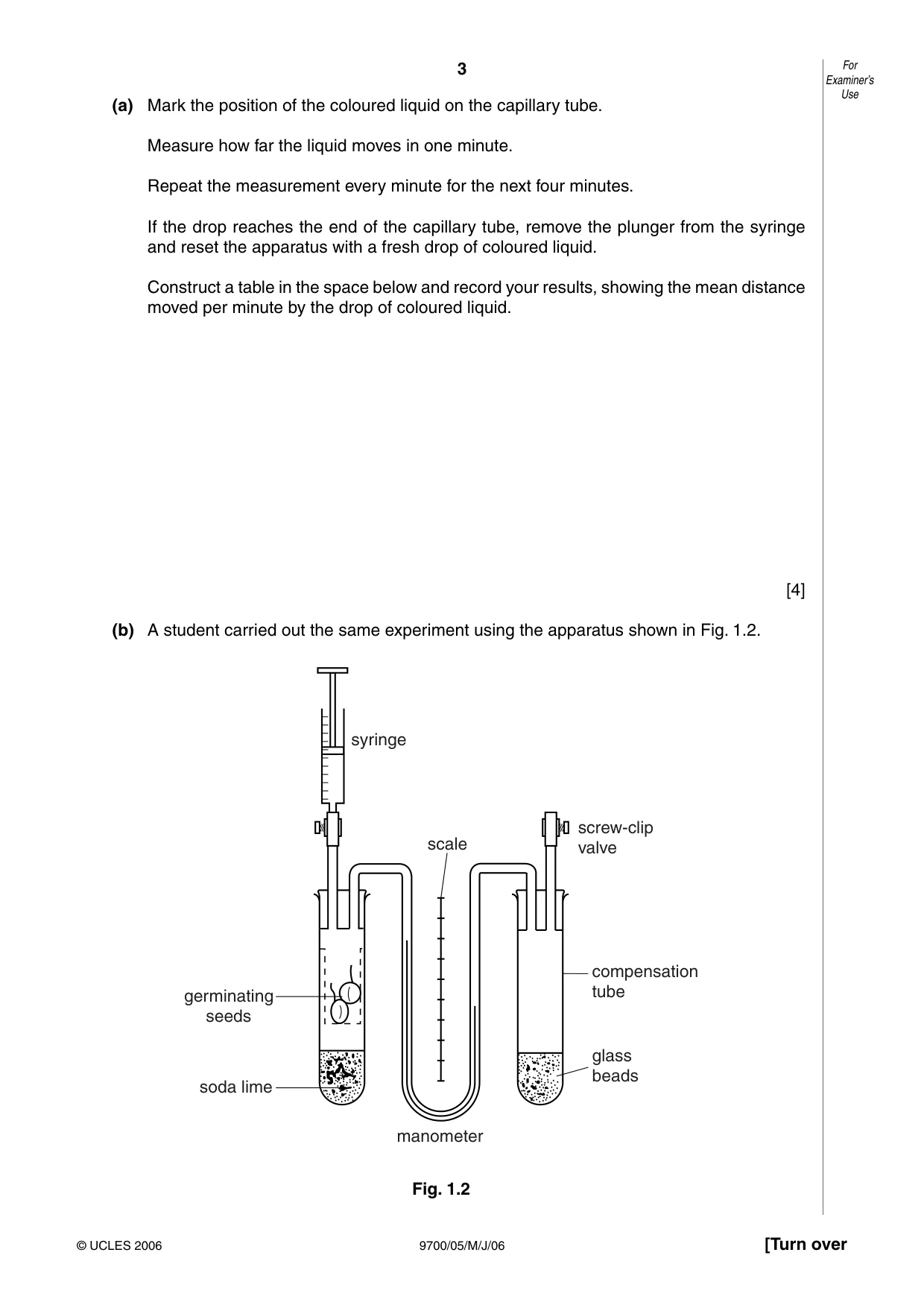
3 9700/05/M/J/06 [Turn over For Examiner’s Use © UCLES 2006 (a) Mark the position of the coloured liquid on the capillary tube. Measure how far the liquid moves in one minute. Repeat the measurement every minute for the next four minutes. If the drop reaches the end of the capillary tube, remove the plunger from the syringe and reset the apparatus with a fresh drop of coloured liquid. Construct a table in the space below and record your results, showing the mean distance moved per minute by the drop of coloured liquid. [4] (b) A student carried out the same experiment using the apparatus shown in Fig. 1.2. manometer soda lime germinating seeds syringe scale screw-clip valve compensation tube glass beads Fig. 1.2
Question paper, page 4
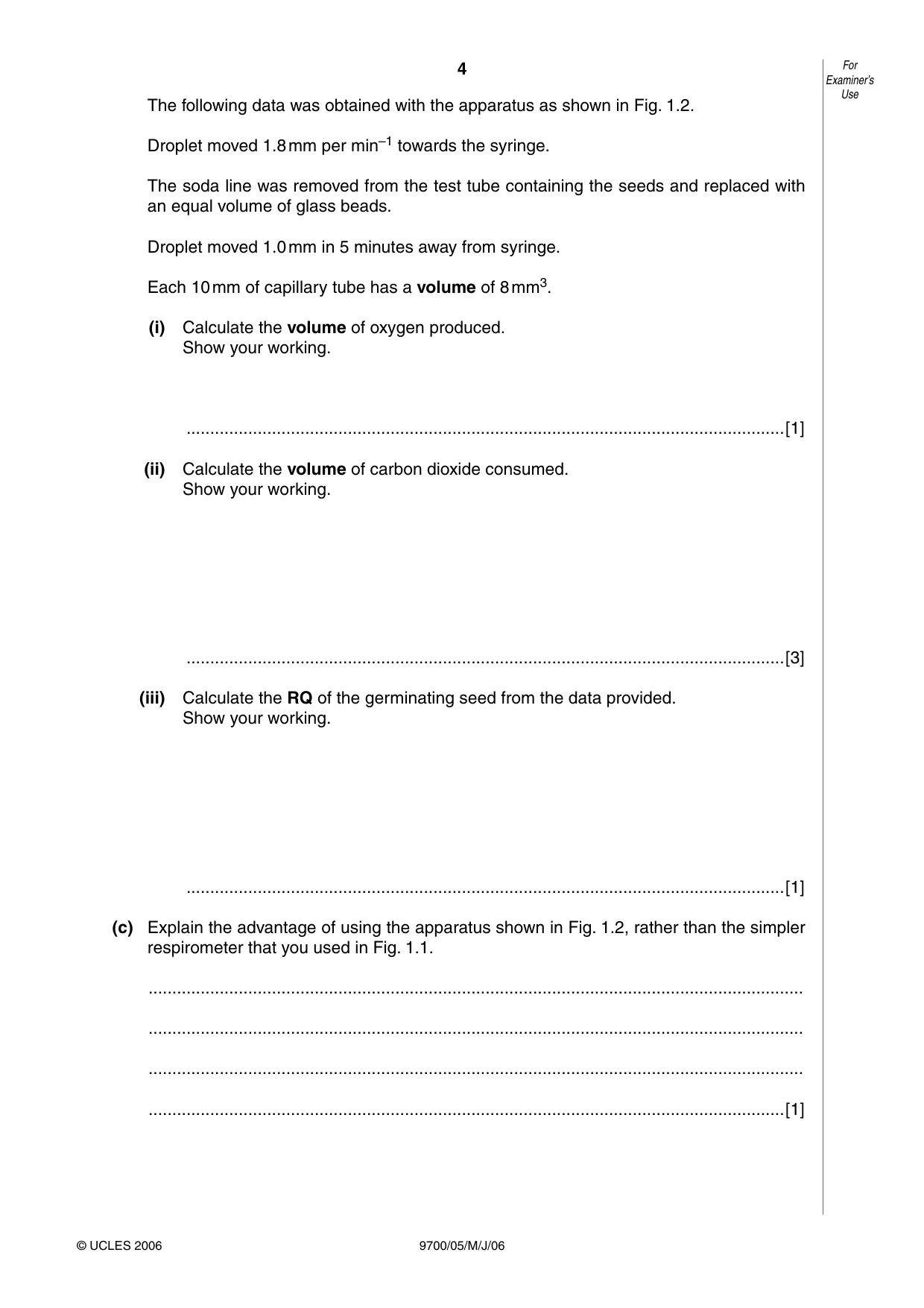
4 9700/05/M/J/06 For Examiner’s Use © UCLES 2006 The following data was obtained with the apparatus as shown in Fig. 1.2. Droplet moved 1.8 mm per min–1 towards the syringe. The soda line was removed from the test tube containing the seeds and replaced with an equal volume of glass beads. Droplet moved 1.0 mm in 5 minutes away from syringe. Each 10 mm of capillary tube has a volume of 8 mm3. (i) Calculate the volume of oxygen produced. Show your working. …[1] (ii) Calculate the volume of carbon dioxide consumed. Show your working. …[3] (iii) Calculate the RQ of the germinating seed from the data provided. Show your working. …[1] (c) Explain the advantage of using the apparatus shown in Fig. 1.2, rather than the simpler respirometer that you used in Fig. 1.1. … … … …[1]
Question paper, page 5
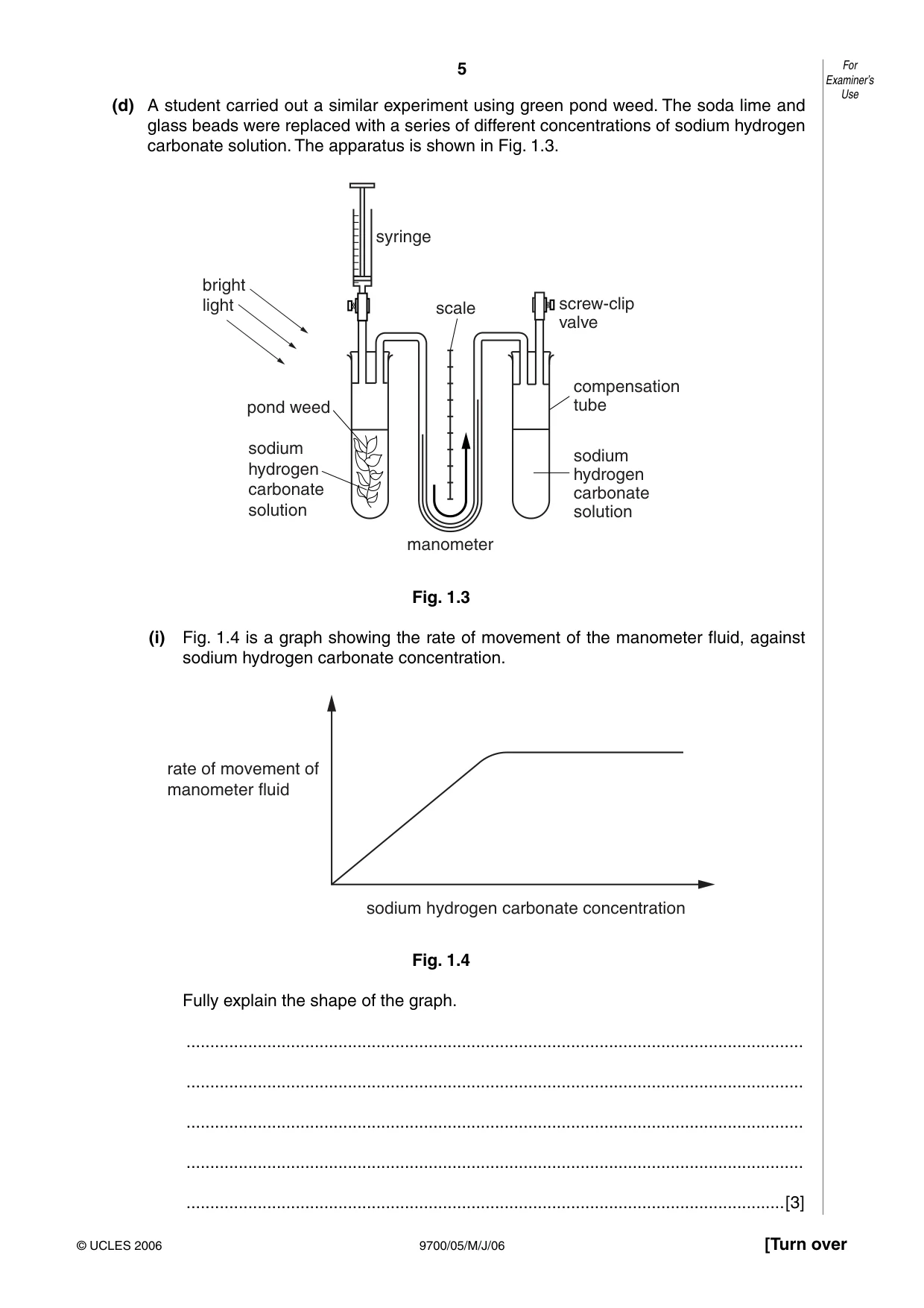
5 9700/05/M/J/06 [Turn over For Examiner’s Use © UCLES 2006 (d) A student carried out a similar experiment using green pond weed. The soda lime and glass beads were replaced with a series of different concentrations of sodium hydrogen carbonate solution. The apparatus is shown in Fig. 1.3. syringe pond weed bright light sodium hydrogen carbonate solution scale manometer screw-clip valve sodium hydrogen carbonate solution compensation tube Fig. 1.3 (i) Fig. 1.4 is a graph showing the rate of movement of the manometer fluid, against sodium hydrogen carbonate concentration. sodium hydrogen carbonate concentration rate of movement of manometer fluid Fig. 1.4 Fully explain the shape of the graph. … … … … …[3]
Question paper, page 6
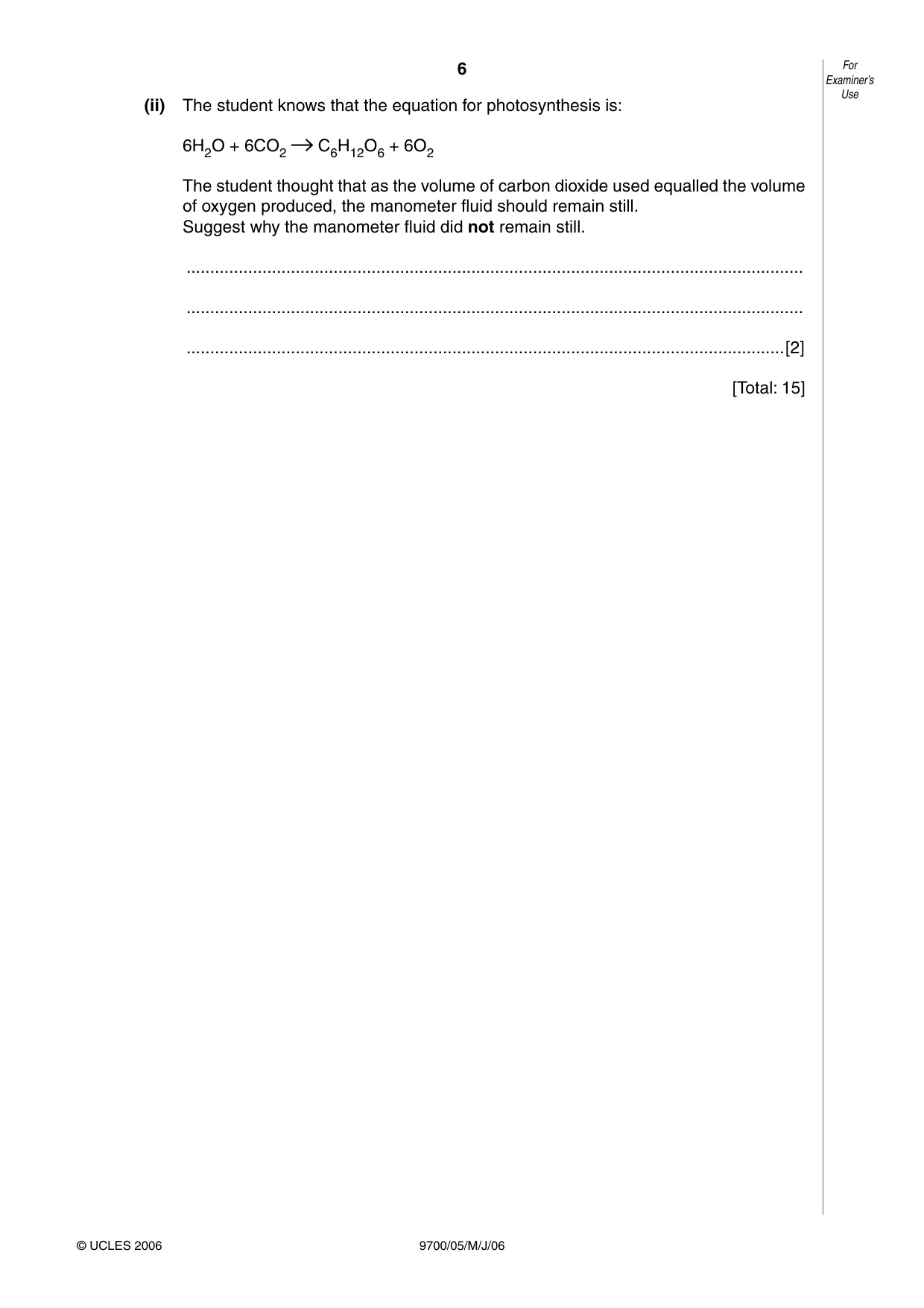
6 9700/05/M/J/06 For Examiner’s Use © UCLES 2006 (ii) The student knows that the equation for photosynthesis is: 6H 2O + 6CO2 C 6H12O6 + 6O2 The student thought that as the volume of carbon dioxide used equalled the volume of oxygen produced, the manometer fluid should remain still. Suggest why the manometer fluid did not remain still. … … …[2] [Total: 15]
Question paper, page 7
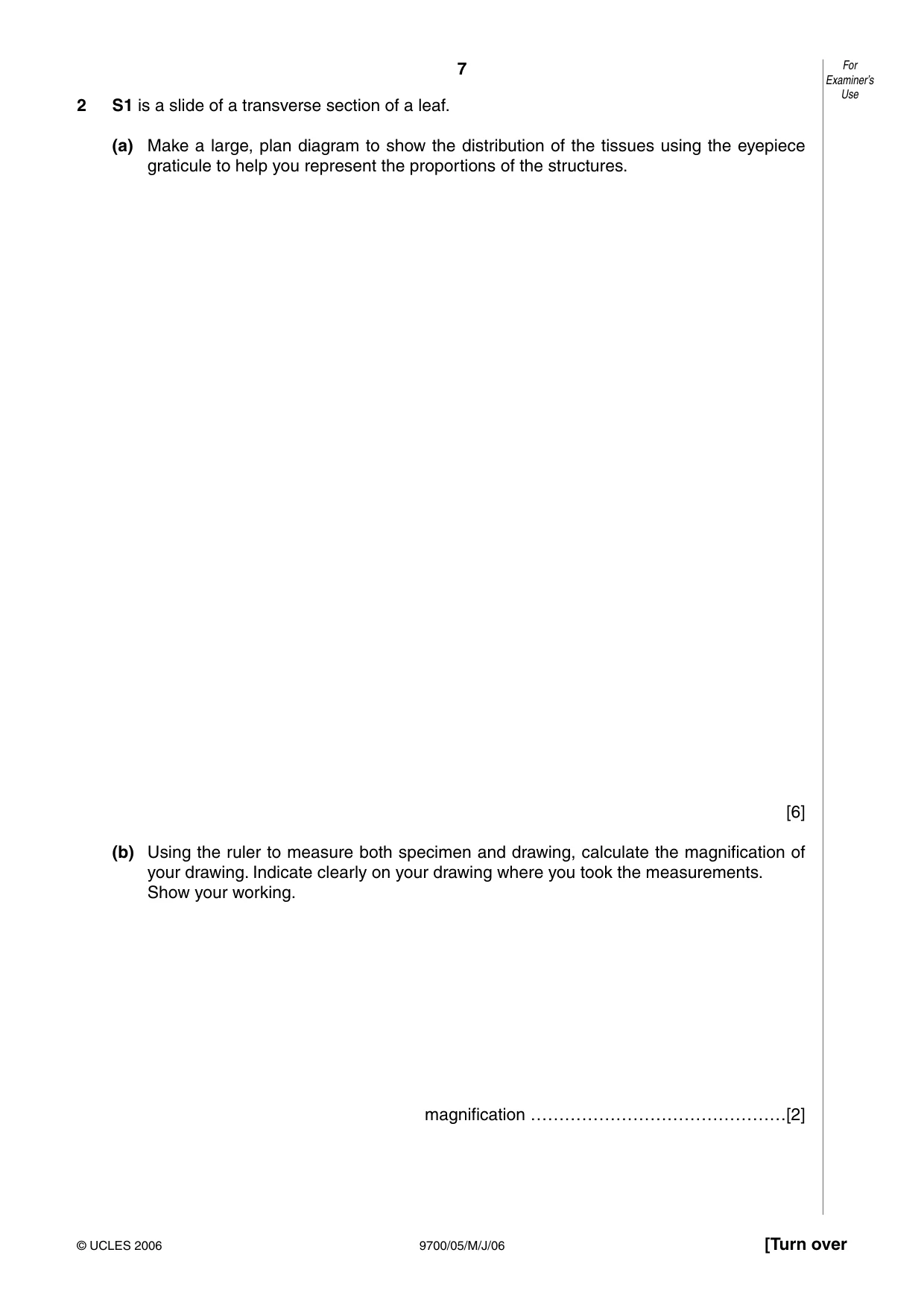
7 9700/05/M/J/06 [Turn over For Examiner’s Use © UCLES 2006 2 S1 is a slide of a transverse section of a leaf. (a) Make a large, plan diagram to show the distribution of the tissues using the eyepiece graticule to help you represent the proportions of the structures. [6] (b) Using the ruler to measure both specimen and drawing, calculate the magnification of your drawing. Indicate clearly on your drawing where you took the measurements. Show your working. magnification ………………………………………[2]
Question paper, page 8
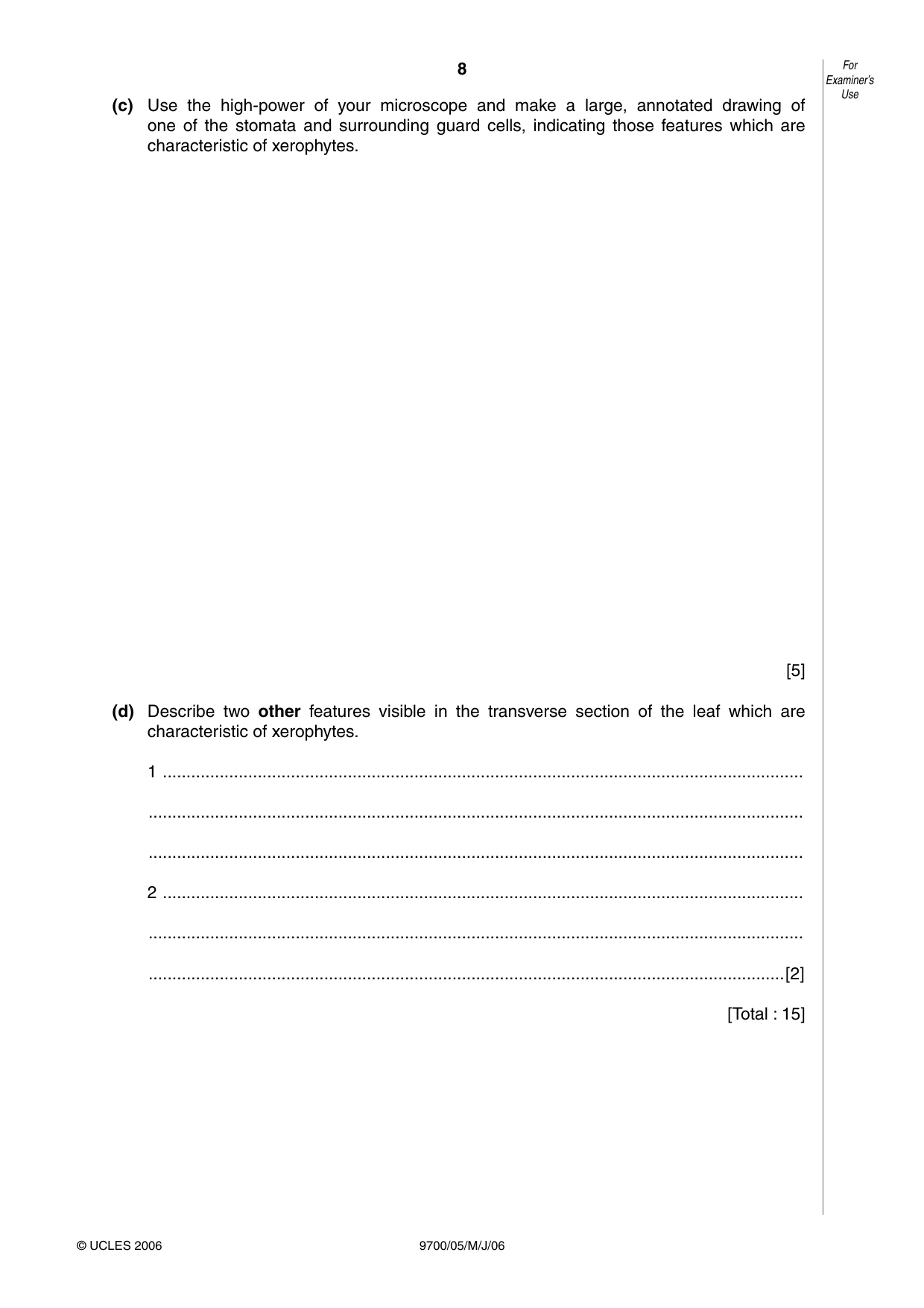
8 9700/05/M/J/06 For Examiner’s Use © UCLES 2006 (c) Use the high-power of your microscope and make a large, annotated drawing of one of the stomata and surrounding guard cells, indicating those features which are characteristic of xerophytes. [5] (d) Describe two other features visible in the transverse section of the leaf which are characteristic of xerophytes. 1 … … … 2 … … …[2] [Total : 15]
Mark scheme, page 1
UNIVERSITY OF CAMBRIDGE INTERNATIONAL EXAMINATIONS GCE Advanced Level and GCE Advanced Subsidiary Level MARK SCHEME for the May/June 2006 question paper 9700 BIOLOGY 9700/05 Paper 5 Maximum mark 30 This mark scheme is published as an aid to teachers and students, to indicate the requirements of the examination. It shows the basis on which Examiners were initially instructed to award marks. It does not indicate the details of the discussions that took place at an Examiners’ meeting before marking began. Any substantial changes to the mark scheme that arose from these discussions will be recorded in the published Report on the Examination. All Examiners are instructed that alternative correct answers and unexpected approaches in candidates’ scripts must be given marks that fairly reflect the relevant knowledge and skills demonstrated. Mark schemes must be read in conjunction with the question papers and the Report on the Examination. The minimum marks in these components needed for various grades were previously published with these mark schemes, but are now instead included in the Report on the Examination for this session. • CIE will not enter into discussion or correspondence in connection with these mark schemes. CIE is publishing the mark schemes for the May/June 2006 question papers for most IGCSE and GCE Advanced Level and Advanced Subsidiary Level syllabuses and some Ordinary Level syllabuses.
Mark scheme, page 2
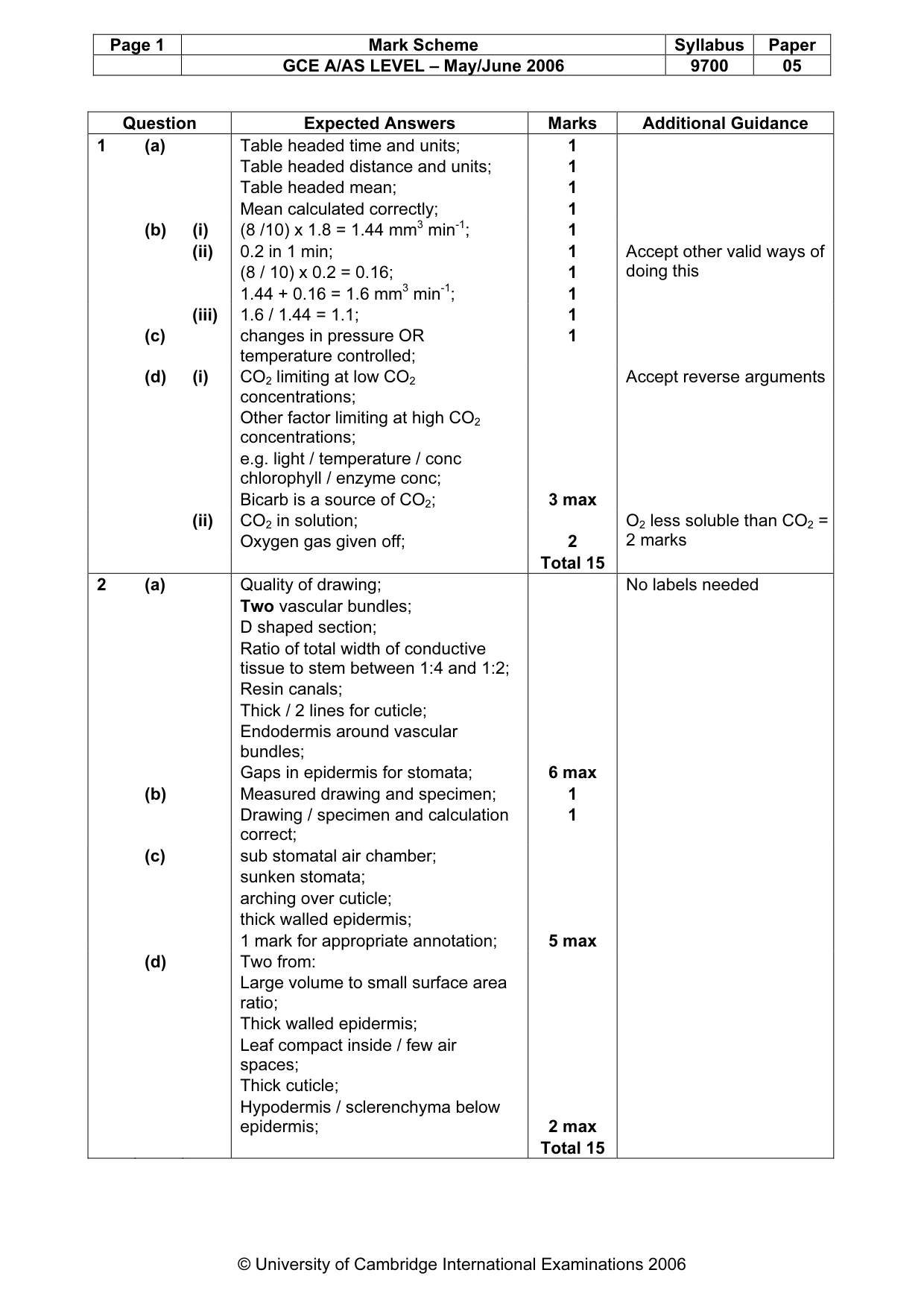
Page 1 Mark Scheme Syllabus Paper GCE A/AS LEVEL – May/June 2006 9700 05 © University of Cambridge International Examinations 2006 Question Expected Answers Marks Additional Guidance 1 (a) Table headed time and units; Table headed distance and units; Table headed mean; Mean calculated correctly; 1 1 1 1 (b) (i) (8 /10) x 1.8 = 1.44 mm3 min-1; 1 (ii) 0.2 in 1 min; (8 / 10) x 0.2 = 0.16; 1.44 + 0.16 = 1.6 mm3 min-1; 1 1 1 Accept other valid ways of doing this (iii) 1.6 / 1.44 = 1.1; 1 (c) changes in pressure OR temperature controlled; 1 (d) (i) CO2 limiting at low CO2 concentrations; Other factor limiting at high CO2 concentrations; e.g. light / temperature / conc chlorophyll / enzyme conc; Bicarb is a source of CO2; 3 max Accept reverse arguments (ii) CO2 in solution; Oxygen gas given off; 2 O2 less soluble than CO2 = 2 marks Total 15 2 (a) Quality of drawing; Two vascular bundles; D shaped section; Ratio of total width of conductive tissue to stem between 1:4 and 1:2; Resin canals; Thick / 2 lines for cuticle; Endodermis around vascular bundles; Gaps in epidermis for stomata; 6 max No labels needed (b) Measured drawing and specimen; Drawing / specimen and calculation correct; 1 1 (c) sub stomatal air chamber; sunken stomata; arching over cuticle; thick walled epidermis; 1 mark for appropriate annotation; 5 max (d) Two from: Large volume to small surface area ratio; Thick walled epidermis; Leaf compact inside / few air spaces; Thick cuticle; Hypodermis / sclerenchyma below epidermis; 2 max Total 15
What you needed in this session
Cambridge’s own grade thresholds for 2006 May/June, Paper 5 · Variant 1. A higher threshold means an easier paper — the bar moves with how the cohort did.