Cambridge A Level Biology 9700 — 2002 Oct/Nov Paper 5 · Variant 1
9700/51/O/N/02
The question paper and its mark scheme, free to read here and free to download. This is Cambridge’s own paper, exactly as it was sat.
Question paper8 pages

Mark scheme3 pages
Answers below. Sit the paper first if you are practising.
Paper as text
Question paper, page 1
This question paper consists of 6 printed pages, 1 blank page and a Report Form. SP (SC/KN) S35158/2 © CIE 2002 [Turn over CAMBRIDGE INTERNATIONAL EXAMINATIONS General Certificate of Education Advanced Level BIOLOGY 9700/5 PAPER 5 Practical Test OCTOBER/NOVEMBER SESSION 2002 1 hour 30 minutes Candidates answer on the question paper. Additional materials: As listed in Instructions to Supervisors TIME 1 hour 30 minutes INSTRUCTIONS TO CANDIDATES Write your name, Centre number and candidate number in the spaces at the top of this page. Answer both questions. Write your answers in the spaces provided on the question paper. INFORMATION FOR CANDIDATES The intended number of marks is given in brackets [ ] at the end of each question or part question. You are advised to spend 40 minutes on Question 1 and 50 minutes on Question 2. Candidate Centre Number Number Candidate Name 2 TOTAL 1 FOR EXAMINER’S USE
Question paper, page 2
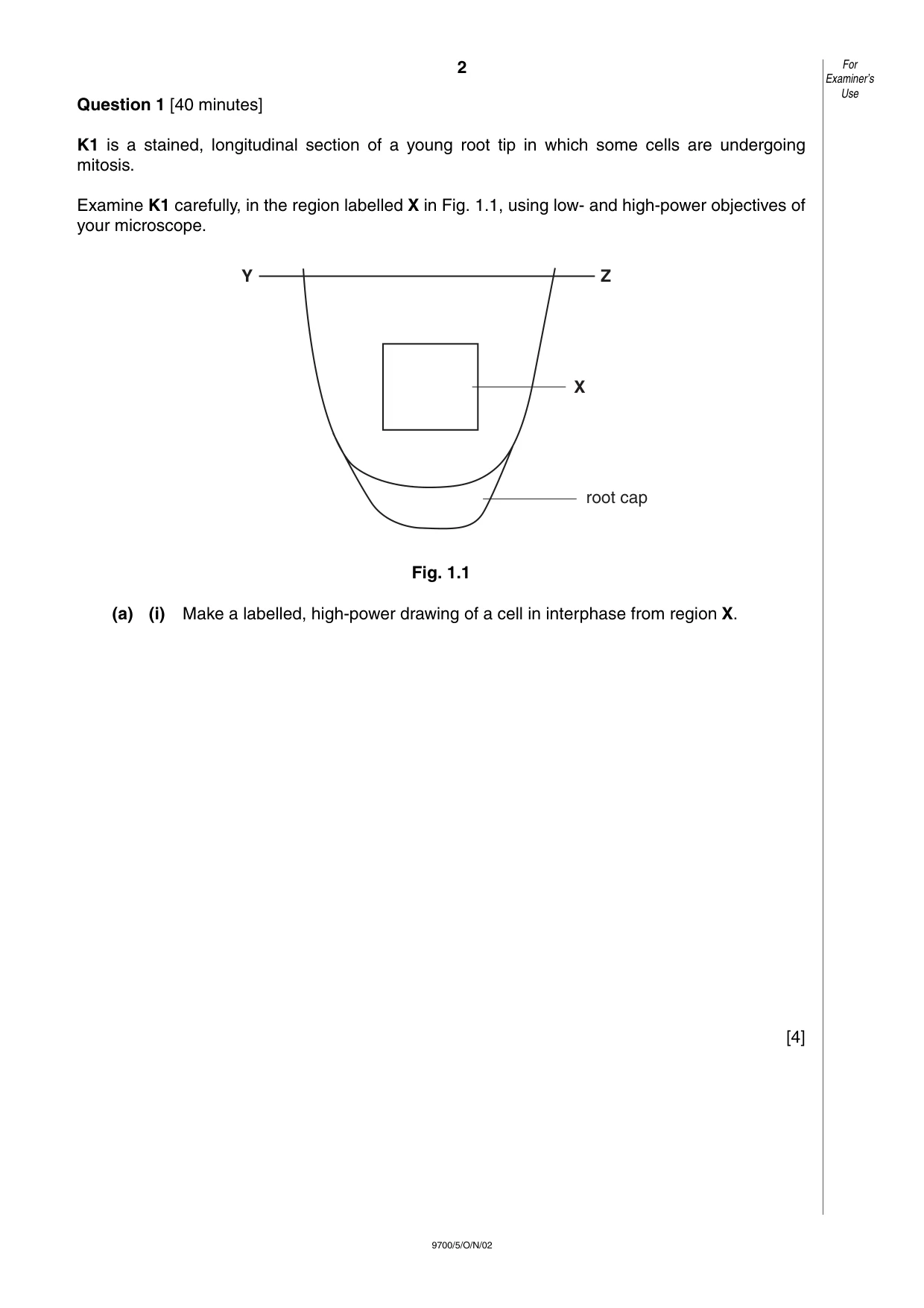
2 9700/5/O/N/02 Question 1 [40 minutes] K1 is a stained, longitudinal section of a young root tip in which some cells are undergoing mitosis. Examine K1 carefully, in the region labelled X in Fig. 1.1, using low- and high-power objectives of your microscope. Fig. 1.1 (a) (i) Make a labelled, high-power drawing of a cell in interphase from region X. [4] Y Z X root cap For Examiner’s Use
Question paper, page 3
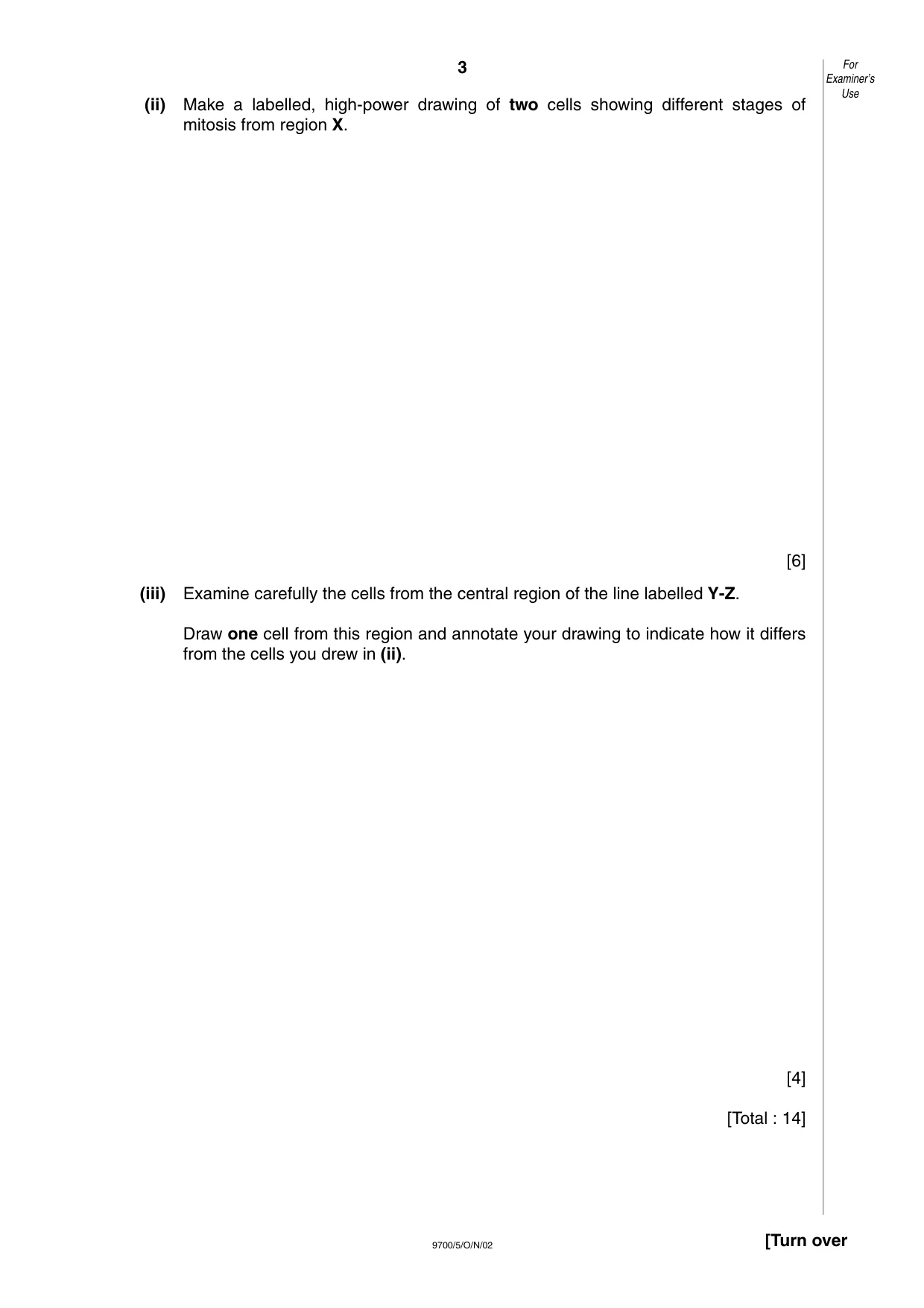
3 9700/5/O/N/02 [Turn over (ii) Make a labelled, high-power drawing of two cells showing different stages of mitosis from region X. [6] (iii) Examine carefully the cells from the central region of the line labelled Y-Z. Draw one cell from this region and annotate your drawing to indicate how it differs from the cells you drew in (ii). [4] [Total : 14] For Examiner’s Use
Question paper, page 4
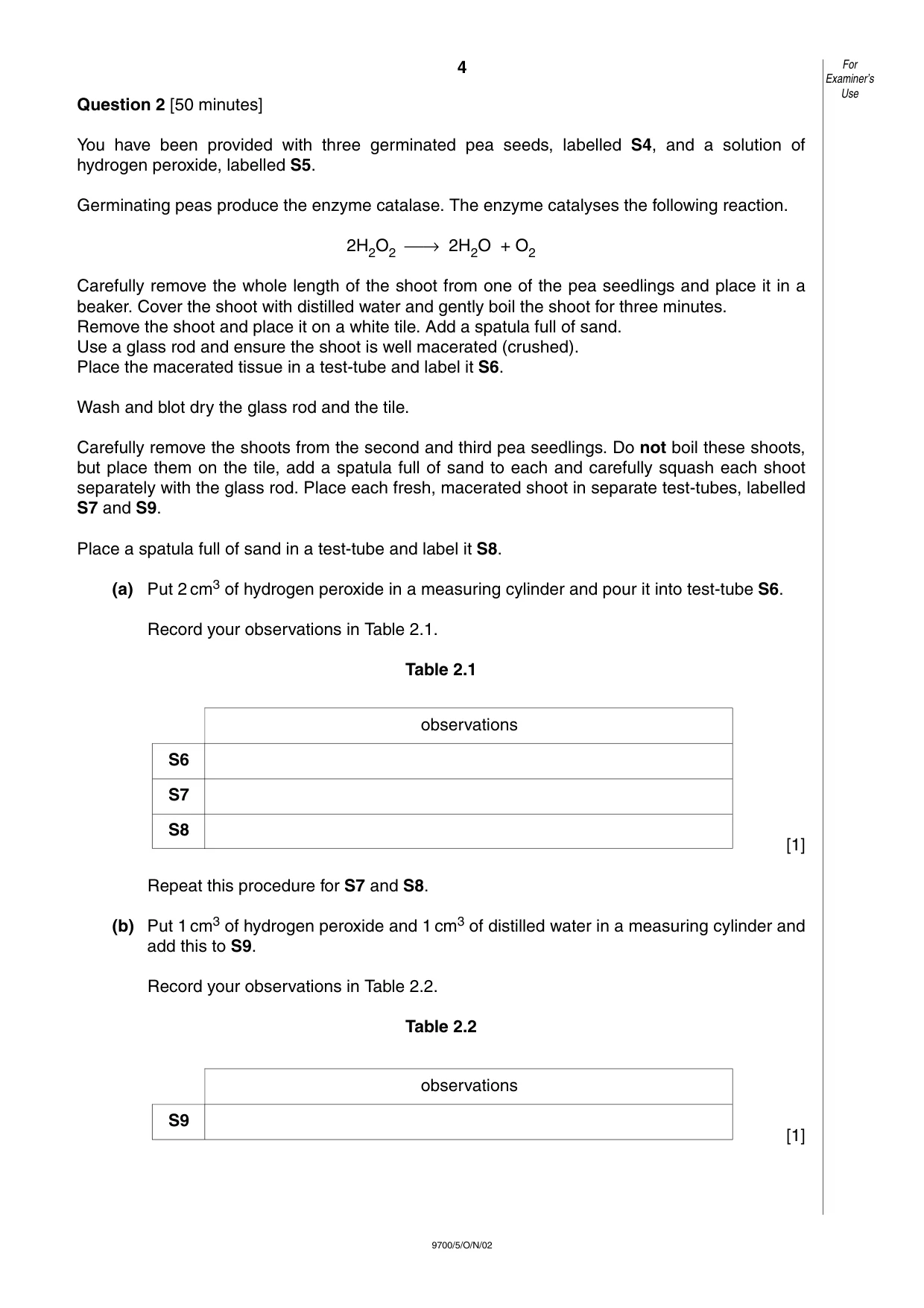
4 9700/5/O/N/02 Question 2 [50 minutes] You have been provided with three germinated pea seeds, labelled S4, and a solution of hydrogen peroxide, labelled S5. Germinating peas produce the enzyme catalase. The enzyme catalyses the following reaction. 2H2O2 →2H2O + O2 Carefully remove the whole length of the shoot from one of the pea seedlings and place it in a beaker. Cover the shoot with distilled water and gently boil the shoot for three minutes. Remove the shoot and place it on a white tile. Add a spatula full of sand. Use a glass rod and ensure the shoot is well macerated (crushed). Place the macerated tissue in a test-tube and label it S6. Wash and blot dry the glass rod and the tile. Carefully remove the shoots from the second and third pea seedlings. Do not boil these shoots, but place them on the tile, add a spatula full of sand to each and carefully squash each shoot separately with the glass rod. Place each fresh, macerated shoot in separate test-tubes, labelled S7 and S9. Place a spatula full of sand in a test-tube and label it S8. (a) Put 2 cm3 of hydrogen peroxide in a measuring cylinder and pour it into test-tube S6. Record your observations in Table 2.1. Table 2.1 [1] Repeat this procedure for S7 and S8. (b) Put 1 cm3 of hydrogen peroxide and 1 cm3 of distilled water in a measuring cylinder and add this to S9. Record your observations in Table 2.2. Table 2.2 [1] For Examiner’s Use observations S6 S7 S8 observations S9
Question paper, page 5
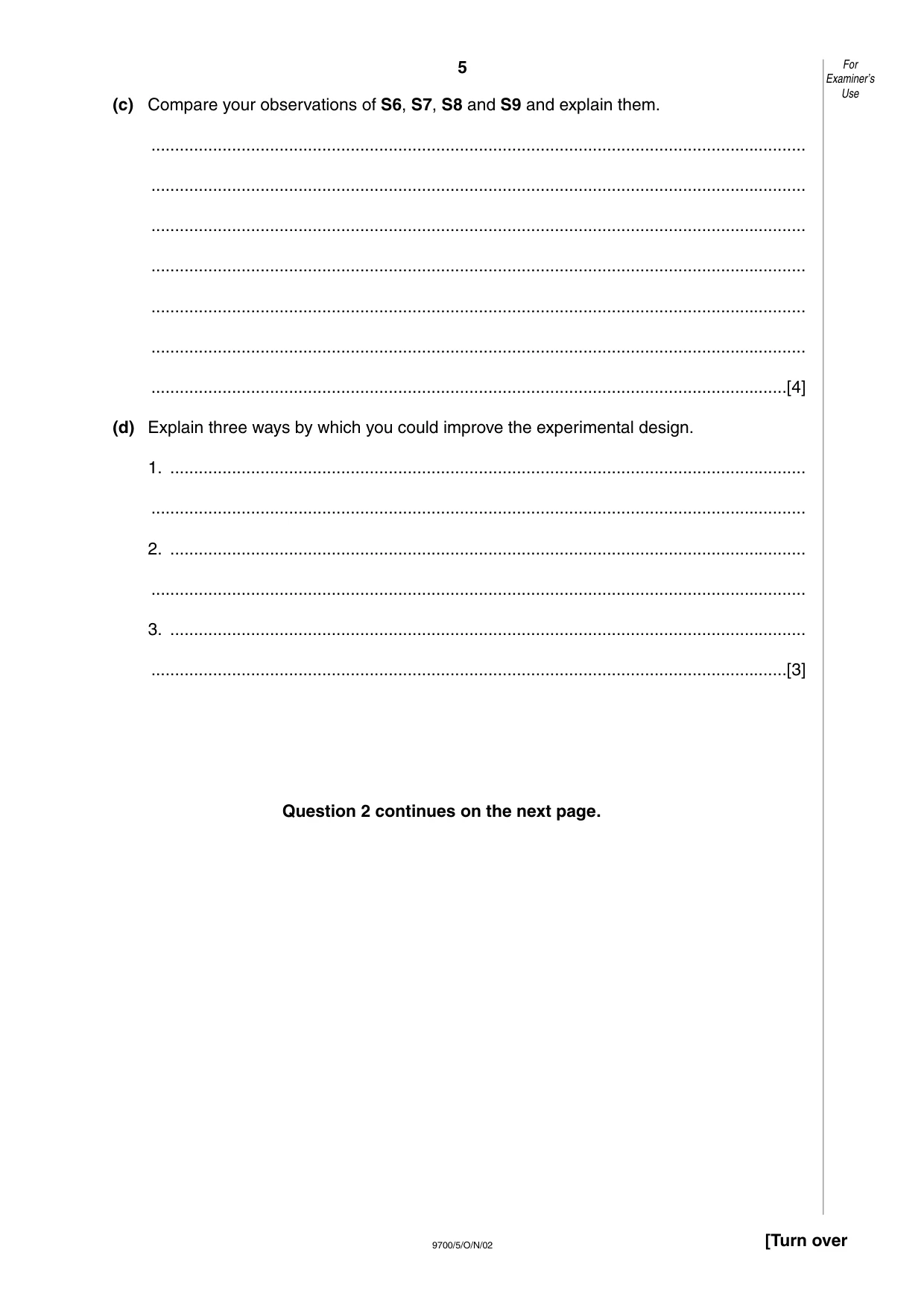
5 9700/5/O/N/02 [Turn over (c) Compare your observations of S6, S7, S8 and S9 and explain them. … … … … … … …[4] (d) Explain three ways by which you could improve the experimental design. 1. … … 2. … … 3. … …[3] Question 2 continues on the next page. For Examiner’s Use
Question paper, page 6
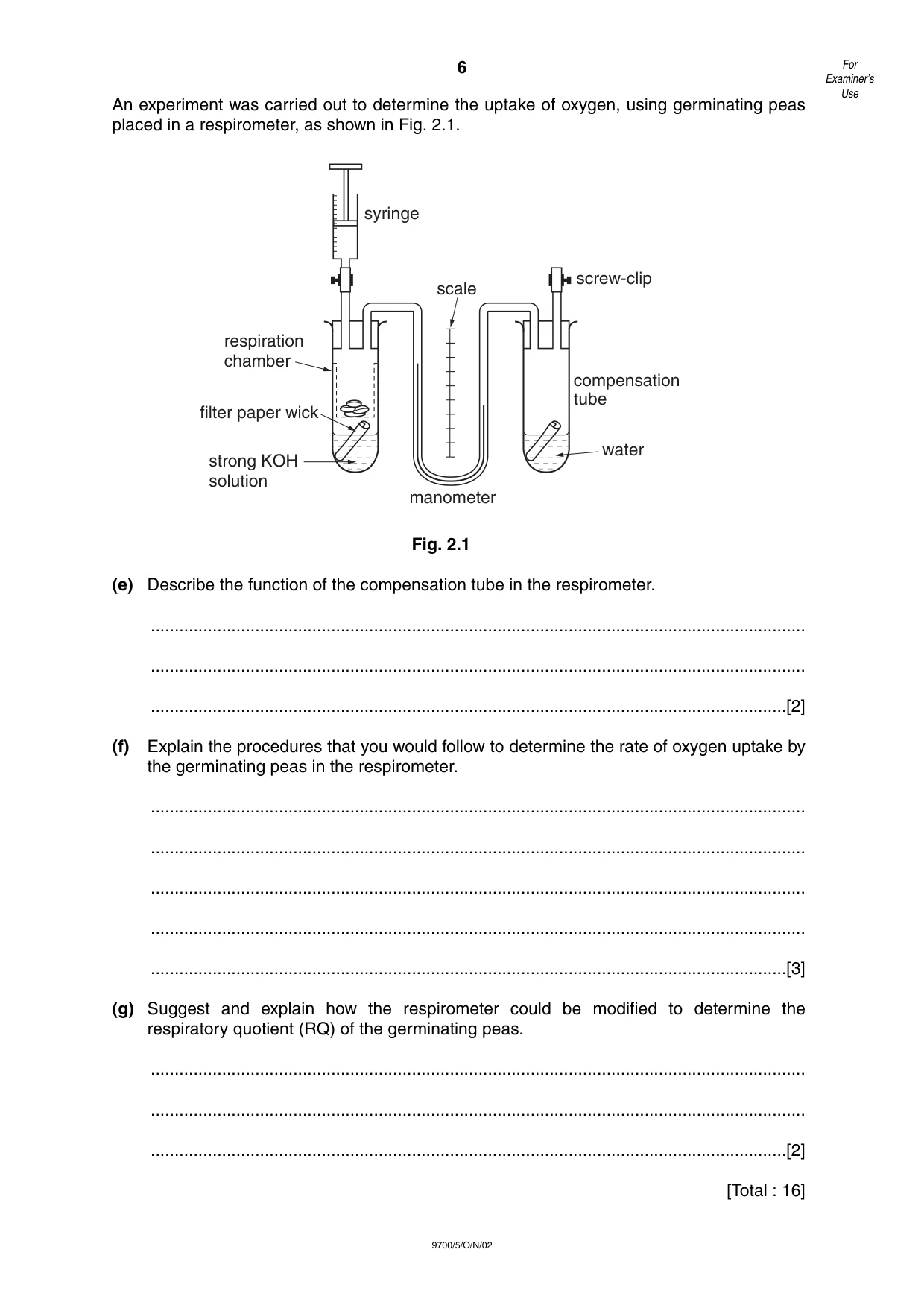
6 9700/5/O/N/02 An experiment was carried out to determine the uptake of oxygen, using germinating peas placed in a respirometer, as shown in Fig. 2.1. Fig. 2.1 (e) Describe the function of the compensation tube in the respirometer. … … …[2] (f) Explain the procedures that you would follow to determine the rate of oxygen uptake by the germinating peas in the respirometer. … … … … …[3] (g) Suggest and explain how the respirometer could be modified to determine the respiratory quotient (RQ) of the germinating peas. … … …[2] [Total : 16] strong KOH solution syringe respiration chamber filter paper wick scale screw-clip compensation tube water manometer For Examiner’s Use
Question paper, page 8
8 9700/5/O/N/02 REPORT FORM The teacher responsible for this subject is asked to answer the following questions. (a) Was the candidate physically handicapped in drawing or in using a microscope or is the candidate colourblind? If so, give brief details. (b) Was the candidate handicapped by deficient material or apparatus? If so, give brief details. (c) Was it necessary to make any substitutions for the materials sent from Cambridge? If so, give brief details of the circumstances. (d) Any comments. Signed ……………………………… N.B. Information that applies to all candidates need only be given on the first candidate’s answer book
Mark scheme, page 1
CAMBRIDGE INTERNATIONAL EXAMINATIONS NOVEMBER 2002 GCE Advanced Level Universiry of CAMBRIDGE Local Examinations Syndicate
Mark scheme, page 2
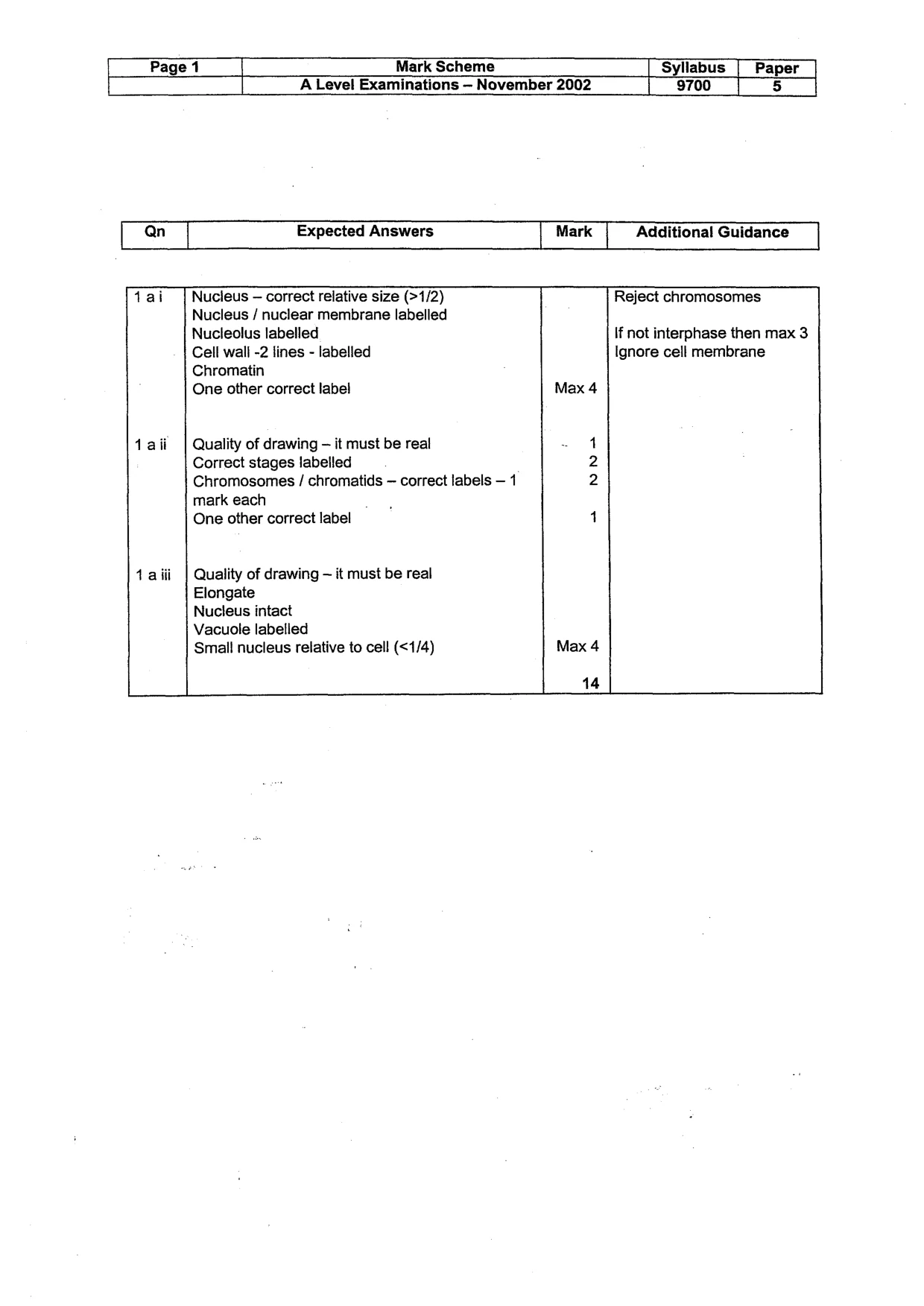
Page 1 Mark Scheme Syllabus | Paper | A Level Examinations — November 2002 9700 5 | [Qn Expected Answers Mark Additional Guidance ‘| dai 1aii aii Nucleus — correct relative size (>1/2) Nucleus / nuclear membrane labelled Nucleolus labelled Cell wall -2 lines - labelled Chromatin One other correct label Quality of drawing — it must be real Correct stages labelled Chromosomes / chromatids — correct labels — 1 mark each One other correct label Quality of drawing — it must be real Elongate Nucleus intact Vacuole labelled Small nucleus relative to cell (<1/4) Max 4 Max 4 14 Reject chromosomes If not interphase then max 3 Ignore cell membrane
Mark scheme, page 3
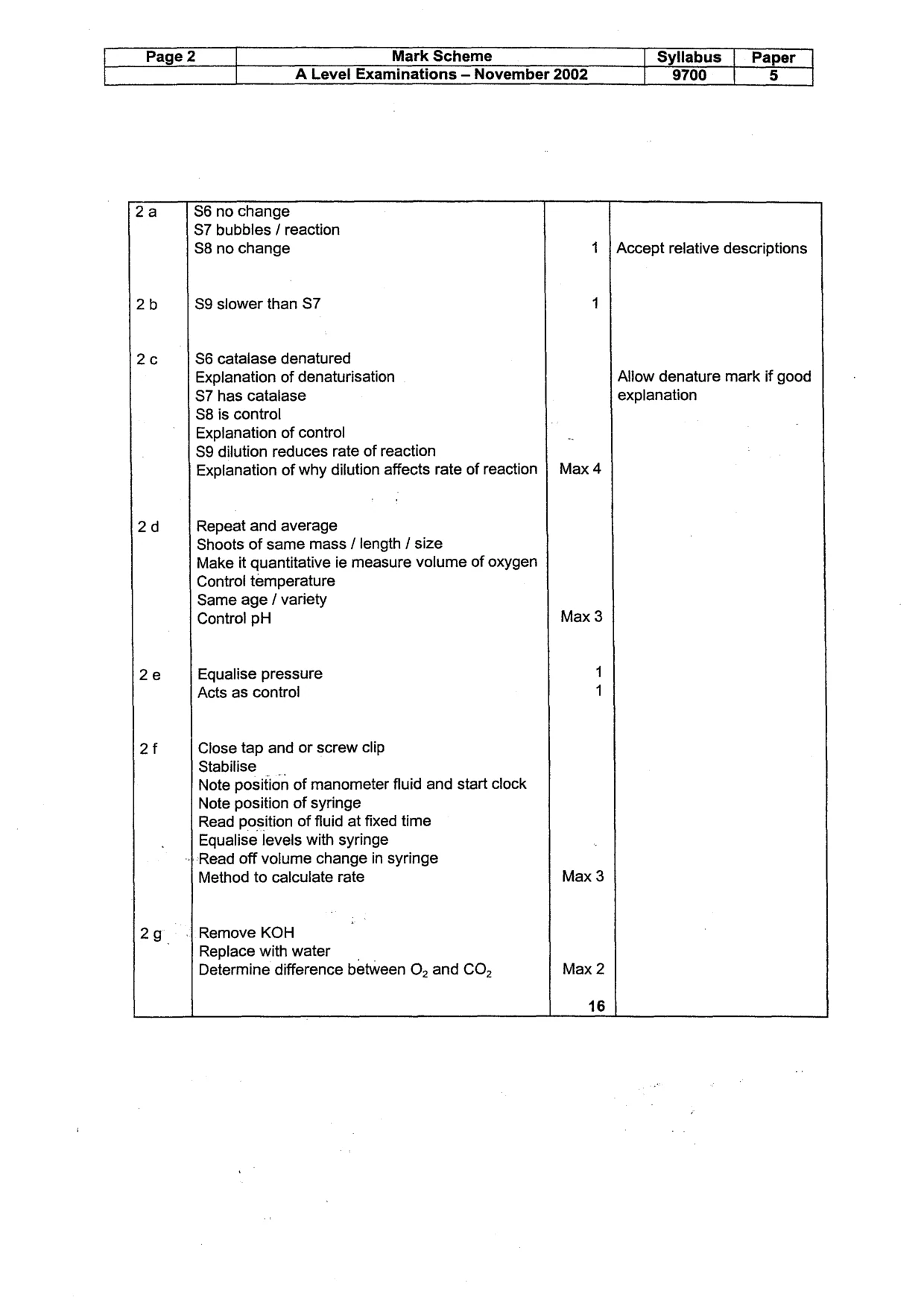
Page 2 Mark Scheme Syllabus Paper A Level Examinations — November 2002 9700 5 2b 2c 2d 2f 2g. S6 no change $7 bubbles / reaction $8 no change S9 slower than S7 S6 catalase denatured Explanation of denaturisation $7 has catalase $8 is control Explanation of control $9 dilution reduces rate of reaction Explanation of why dilution affects rate of reaction Repeat and average Shoots of same mass / length / size Make it quantitative ie measure volume of oxygen Control temperature Same age / variety Control pH Equalise pressure Acts as control Close tap and or screw clip Stabilise Note position of manometer fluid and start clock Note position of syringe Read position of fluid at fixed time Equalise levels with syringe -+-Read off volume change in syringe Method to calculate rate Remove KOH Replace with water Determine difference between O, and CO, Max 4 Max 3 Max 3 Max 2 16 Accept relative descriptions Allow denature mark if good explanation