Cambridge A Level Biology 9700 — 2002 May/June Paper 5 · Variant 1
9700/51/M/J/02
The question paper and its mark scheme, free to read here and free to download. This is Cambridge’s own paper, exactly as it was sat.
Question paper8 pages


Mark scheme3 pages
Answers below. Sit the paper first if you are practising.
Paper as text
Question paper, page 1
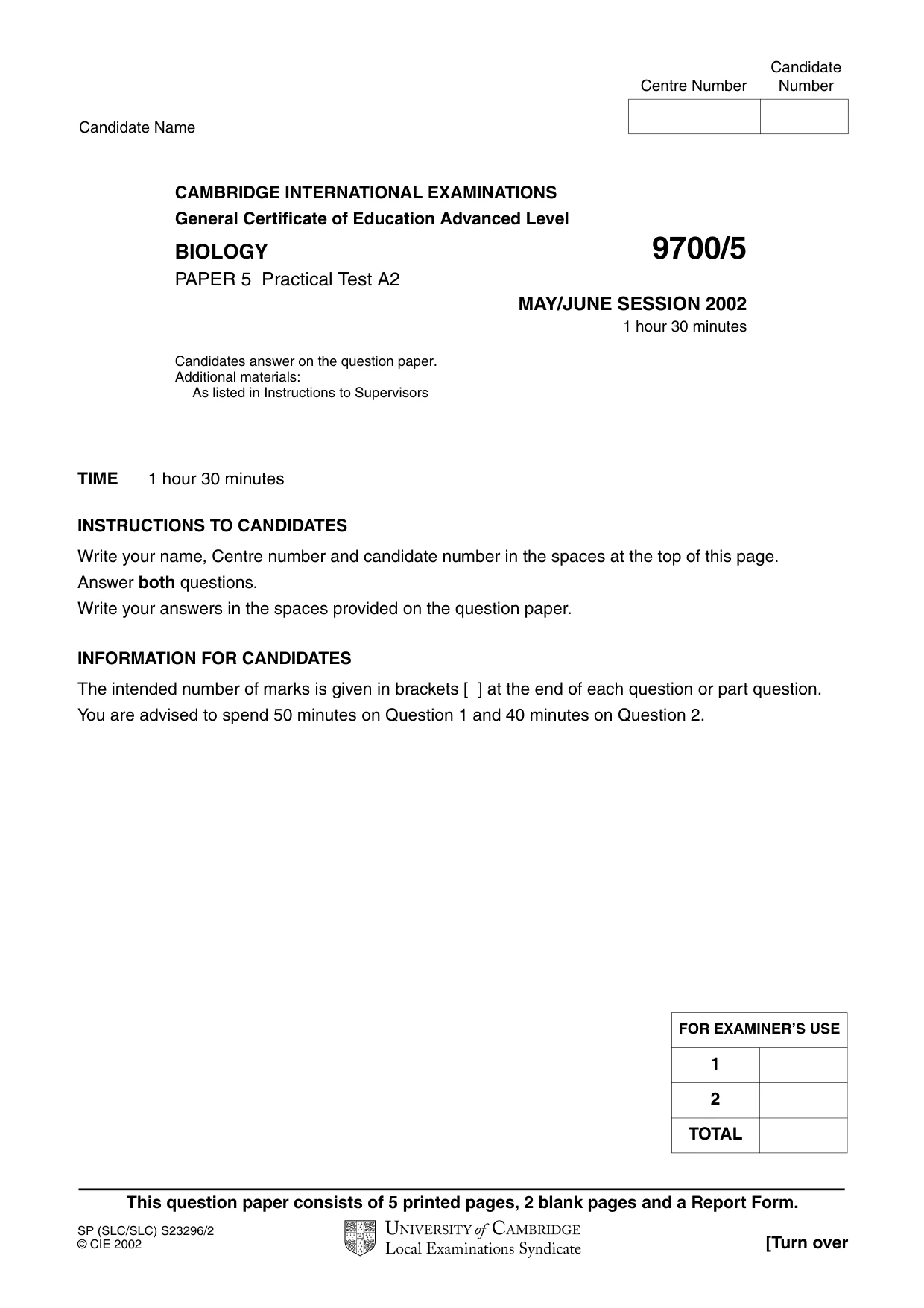
This question paper consists of 5 printed pages, 2 blank pages and a Report Form. SP (SLC/SLC) S23296/2 © CIE 2002 [Turn over CAMBRIDGE INTERNATIONAL EXAMINATIONS General Certificate of Education Advanced Level BIOLOGY 9700/5 PAPER 5 Practical Test A2 MAY/JUNE SESSION 2002 1 hour 30 minutes Candidates answer on the question paper. Additional materials: As listed in Instructions to Supervisors TIME 1 hour 30 minutes INSTRUCTIONS TO CANDIDATES Write your name, Centre number and candidate number in the spaces at the top of this page. Answer both questions. Write your answers in the spaces provided on the question paper. INFORMATION FOR CANDIDATES The intended number of marks is given in brackets [ ] at the end of each question or part question. You are advised to spend 50 minutes on Question 1 and 40 minutes on Question 2. Candidate Centre Number Number Candidate Name FOR EXAMINER’S USE TOTAL 2 1
Question paper, page 2
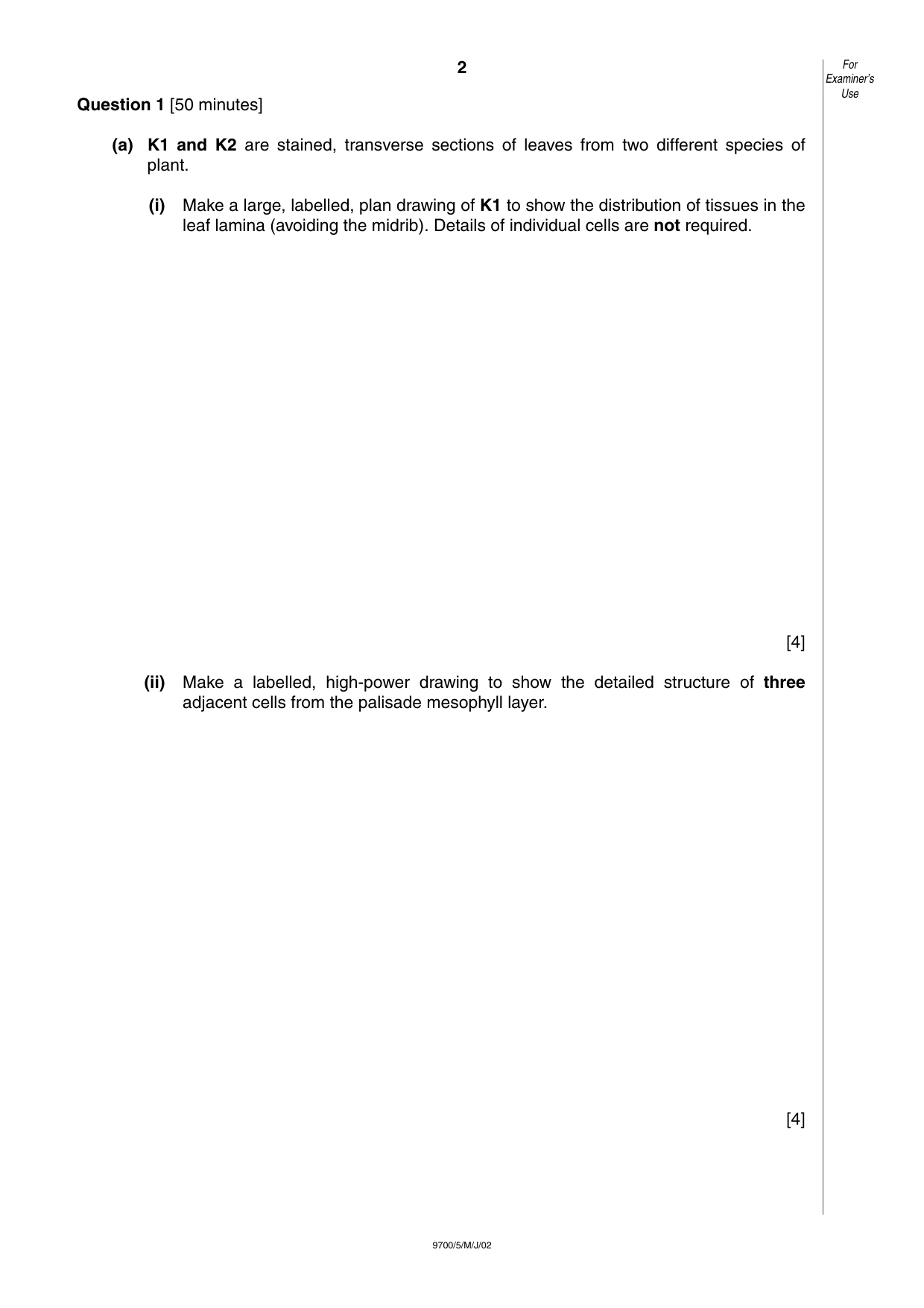
2 9700/5/M/J/02 Question 1 [50 minutes] (a) K1 and K2 are stained, transverse sections of leaves from two different species of plant. (i) Make a large, labelled, plan drawing of K1 to show the distribution of tissues in the leaf lamina (avoiding the midrib). Details of individual cells are not required. [4] (ii) Make a labelled, high-power drawing to show the detailed structure of three adjacent cells from the palisade mesophyll layer. [4] For Examiner’s Use
Question paper, page 3
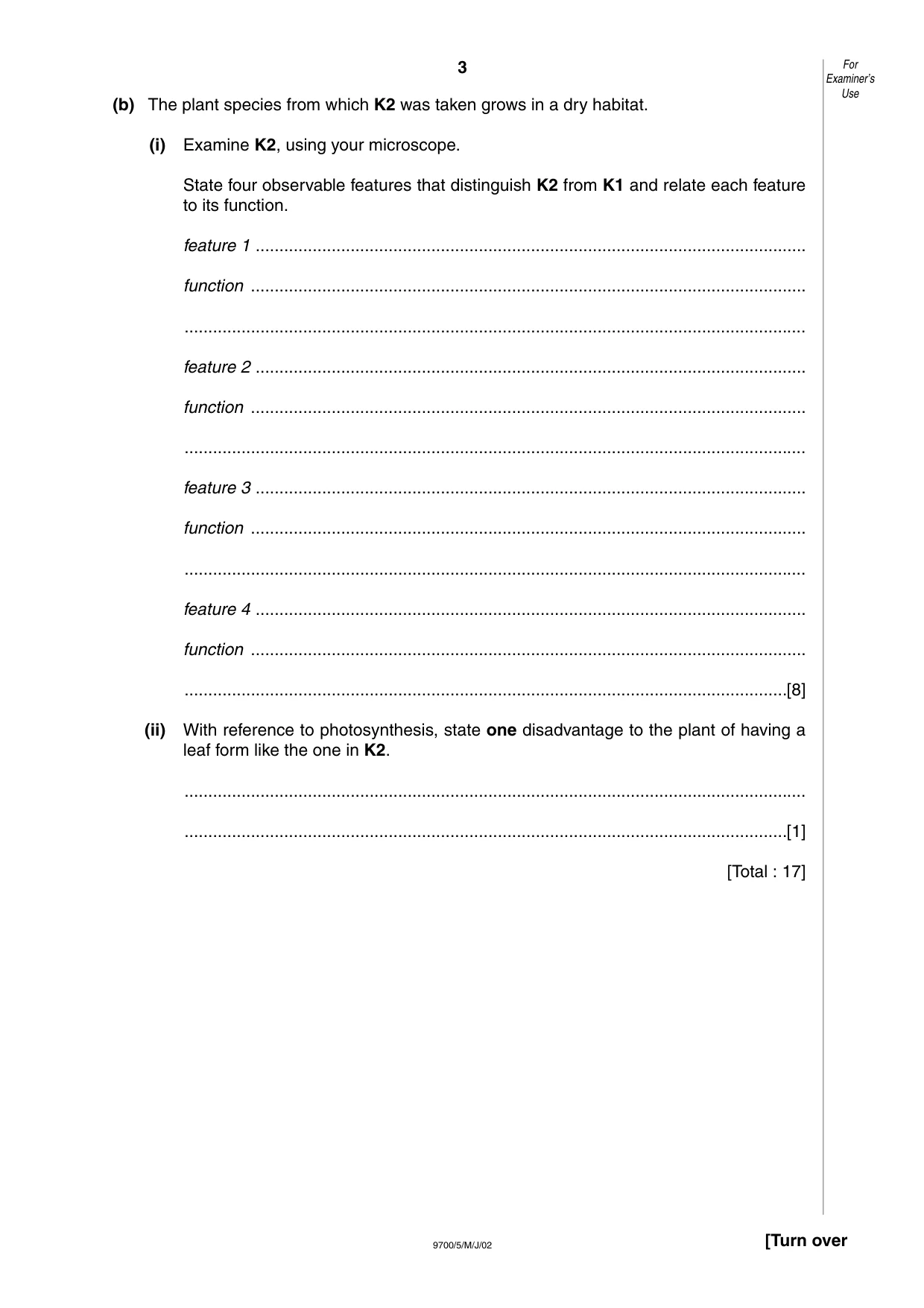
3 9700/5/M/J/02 [Turn over (b) The plant species from which K2 was taken grows in a dry habitat. (i) Examine K2, using your microscope. State four observable features that distinguish K2 from K1 and relate each feature to its function. feature 1 … function … … feature 2 … function … … feature 3 … function … … feature 4 … function … …[8] (ii) With reference to photosynthesis, state one disadvantage to the plant of having a leaf form like the one in K2. … …[1] [Total : 17] For Examiner’s Use
Question paper, page 4
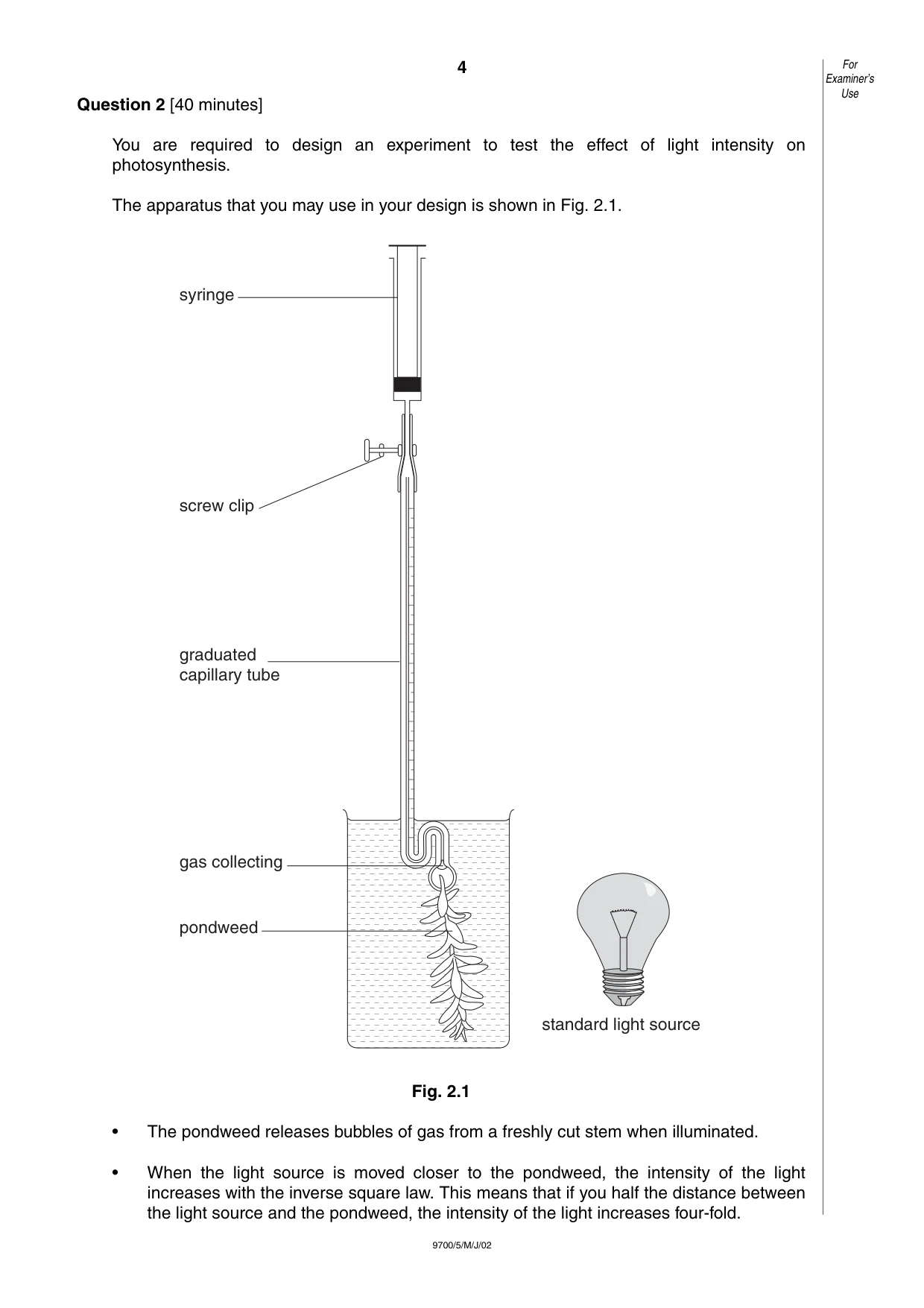
4 9700/5/M/J/02 Question 2 [40 minutes] You are required to design an experiment to test the effect of light intensity on photosynthesis. The apparatus that you may use in your design is shown in Fig. 2.1. Fig. 2.1 • The pondweed releases bubbles of gas from a freshly cut stem when illuminated. • When the light source is moved closer to the pondweed, the intensity of the light increases with the inverse square law. This means that if you half the distance between the light source and the pondweed, the intensity of the light increases four-fold. standard light source syringe screw clip graduated capillary tube gas collecting pondweed For Examiner’s Use
Question paper, page 5
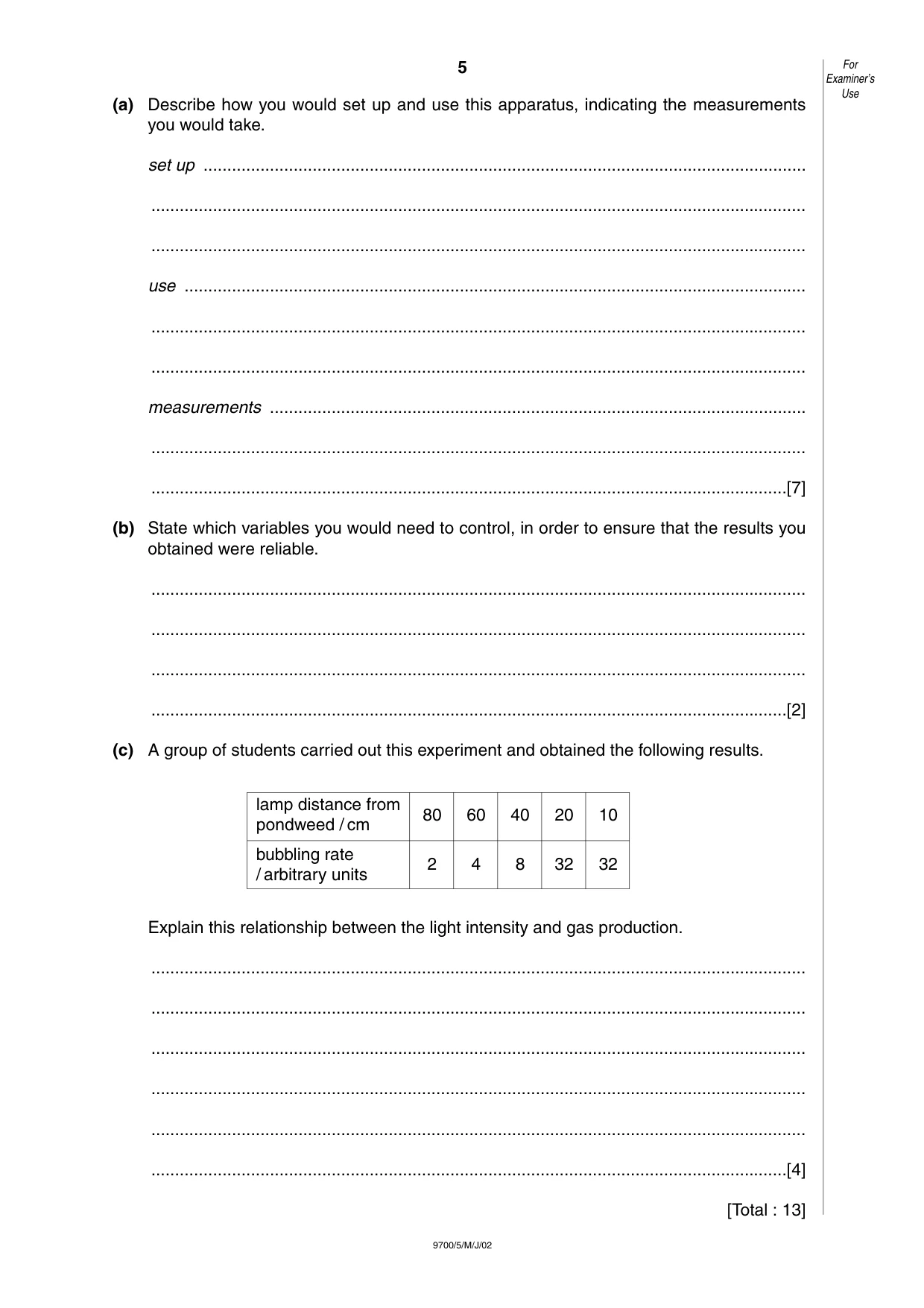
5 9700/5/M/J/02 (a) Describe how you would set up and use this apparatus, indicating the measurements you would take. set up … … … use … … … measurements … … …[7] (b) State which variables you would need to control, in order to ensure that the results you obtained were reliable. … … … …[2] (c) A group of students carried out this experiment and obtained the following results. Explain this relationship between the light intensity and gas production. … … … … … …[4] [Total : 13] For Examiner’s Use lamp distance from pondweed / cm 80 60 40 20 10 bubbling rate / arbitrary units 2 4 8 32 32
Question paper, page 8
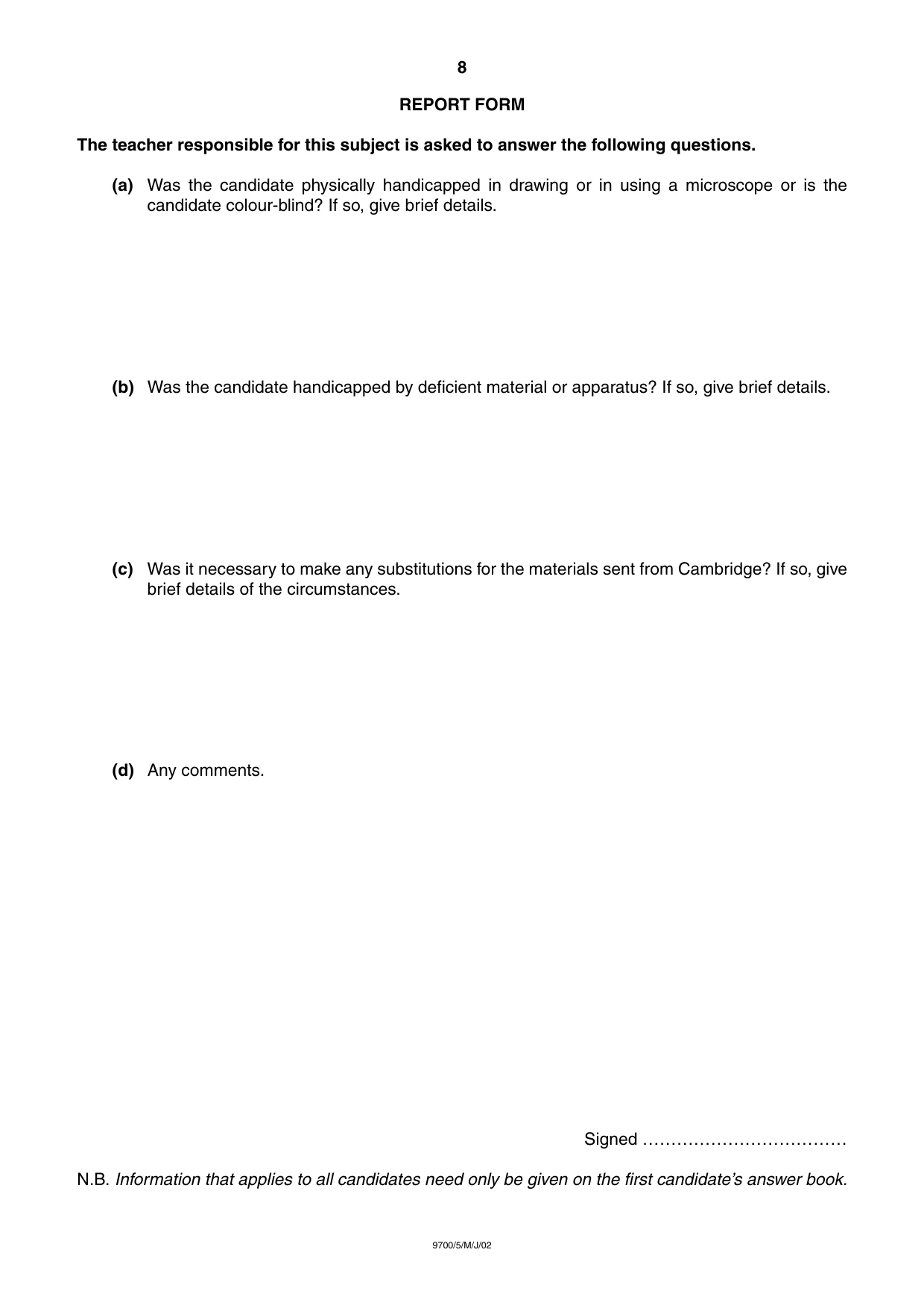
8 9700/5/M/J/02 REPORT FORM The teacher responsible for this subject is asked to answer the following questions. (a) Was the candidate physically handicapped in drawing or in using a microscope or is the candidate colour-blind? If so, give brief details. (b) Was the candidate handicapped by deficient material or apparatus? If so, give brief details. (c) Was it necessary to make any substitutions for the materials sent from Cambridge? If so, give brief details of the circumstances. (d) Any comments. Signed ……………………………… N.B. Information that applies to all candidates need only be given on the first candidate’s answer book.
Mark scheme, page 1
CAMBRIDGE INTERNATIONAL EXAMINATIONS JUNE 2002 GCE Advanced Level MAXIMUM MARK : 30 SYLLABUS/COMPONENT :9700 /5 BIOLOGY (PRACTICAL) P24 UNIVERSITY of CAMBRIDGE 9 Local Examinations Syndicate
Mark scheme, page 2
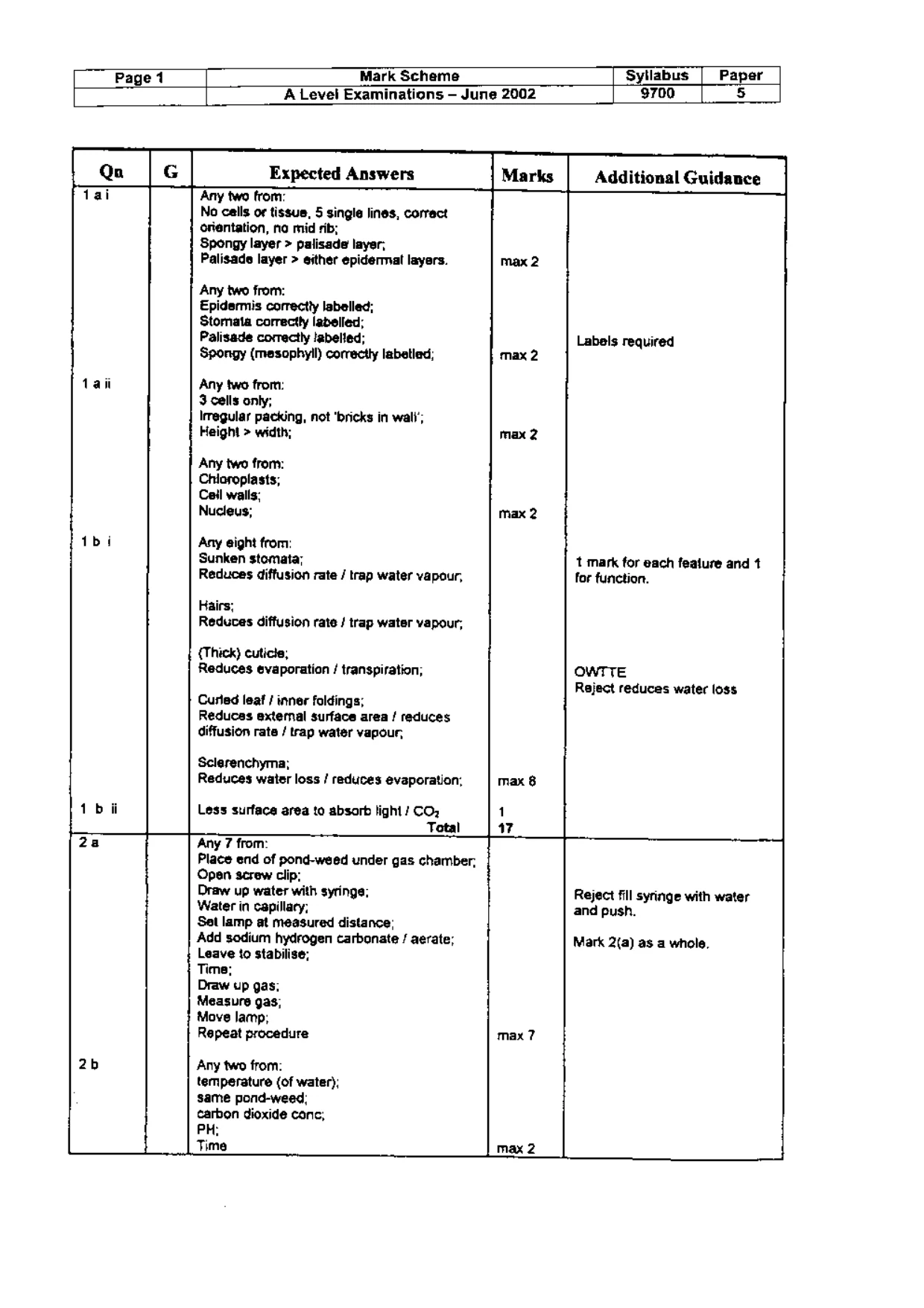
Page 1 Mark Scheme Syllabus | Paper A Level Examinations — June 2002 9700 | 5 lan [| Expected Answers Additional Guidance tai Any two from: No calls of tissue, 5 single lines, corract orientation, no mid rib; Spongy layer > palisade layer; Palisade layer > either epidermat layers. Any two from: Epidermis correctly labelled; Stomata correctly labelled; Palisade correctly labelied; Labels required Spongy (mesophyll) correctly labetlead; Any two from: 3 cells only; Irregular packing, not ‘bricks in wali’; Height > width; Any two from: Chicroplasts; Cell wails: Nucleus; Any eight from: Sunken stomata; 1 mark for each feature and 1 Reduces diffusion rate / trap water vapour, for function. Hairs; Reduces diffusion rate / trap water vapour; (Thick) cuticle, Reduces evaporation / transpiration; OWTTE Reject reduces water loss Curled leaf / inner foldings; Reduces extemal surface area / reduces diffusion rate / trap water vapour, Sclerenchyma; Reduces water loss / reduces evaporation; Less surface area to absorb light / COz Total Any 7 from: Place end of pond-weed under gas chamber, Open screw clip; Draw up water with syringe: Reject fill syringe with water Water in capillary; and push. Set lamp at measured distance; Add sodium hydrogen carbonate / aerate; Mark 2(a) as a whole. Leave to stabilise; Time; Draw up gas; Measure gas; Move lamp, Repeat procedure Any two from: temperature (of water); same pond-weed; carbon dioxide conc, PH; Time
Mark scheme, page 3
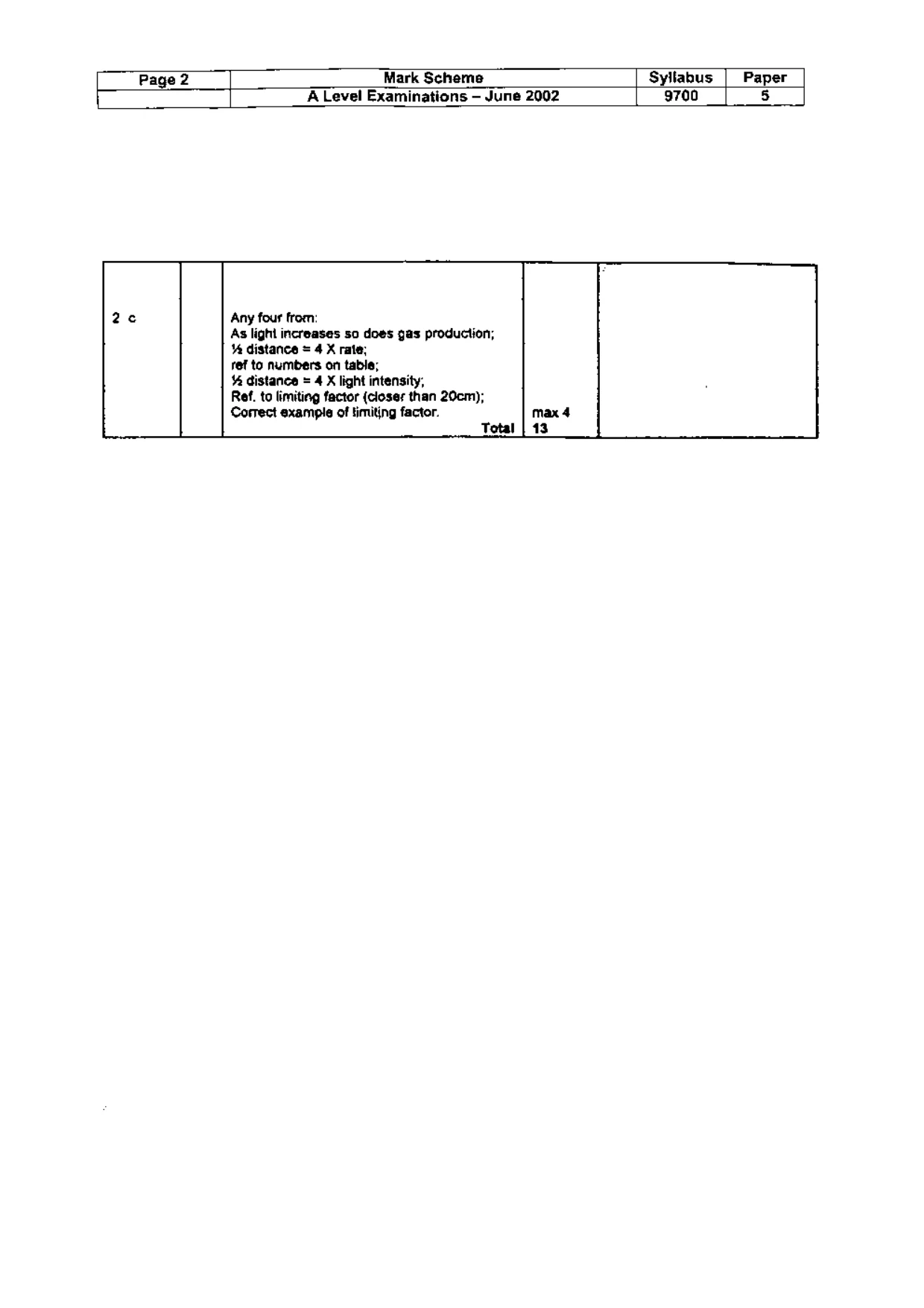
Mark Scheme Syllabus | Paper = Page 2 A Level Examinations — June 2002 9700 | 5 Any four from: As light increases so does gas production; % distance = 4 X rate; fet to numbers on table; ¥ distance = 4 X light intensity, Ref. to limiting factor (closer than 20cm); Correct example of timiting factor. Total