Cambridge A Level Accounting 9706 — 2009 Oct/Nov Paper 4 · Variant 1
9706/41/O/N/09 · 120 marks · ≈135 min
The question paper and its mark scheme, free to read here and free to download. This is Cambridge’s own paper, exactly as it was sat.
Question paper8 pages
Mark scheme5 pages
Answers below. Sit the paper first if you are practising.
Paper as text
Question paper, page 1
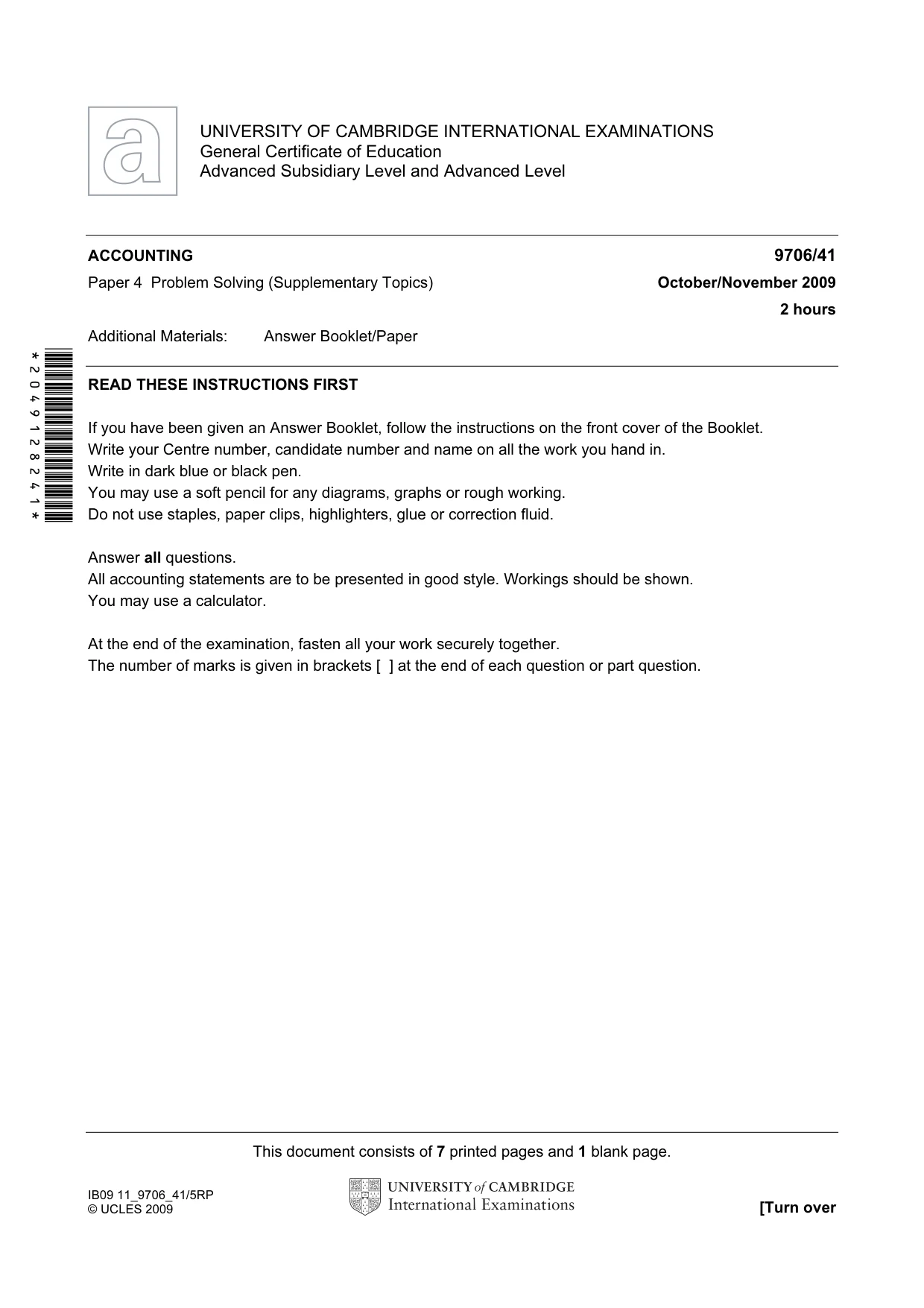
This document consists of 7 printed pages and 1 blank page. IB09 11_9706_41/5RP © UCLES 2009 [Turn over *2049128241* UNIVERSITY OF CAMBRIDGE INTERNATIONAL EXAMINATIONS General Certificate of Education Advanced Subsidiary Level and Advanced Level ACCOUNTING 9706/41 Paper 4 Problem Solving (Supplementary Topics) October/November 2009 2 hours Additional Materials: Answer Booklet/Paper READ THESE INSTRUCTIONS FIRST If you have been given an Answer Booklet, follow the instructions on the front cover of the Booklet. Write your Centre number, candidate number and name on all the work you hand in. Write in dark blue or black pen. You may use a soft pencil for any diagrams, graphs or rough working. Do not use staples, paper clips, highlighters, glue or correction fluid. Answer all questions. All accounting statements are to be presented in good style. Workings should be shown. You may use a calculator. At the end of the examination, fasten all your work securely together. The number of marks is given in brackets [ ] at the end of each question or part question.
Question paper, page 2
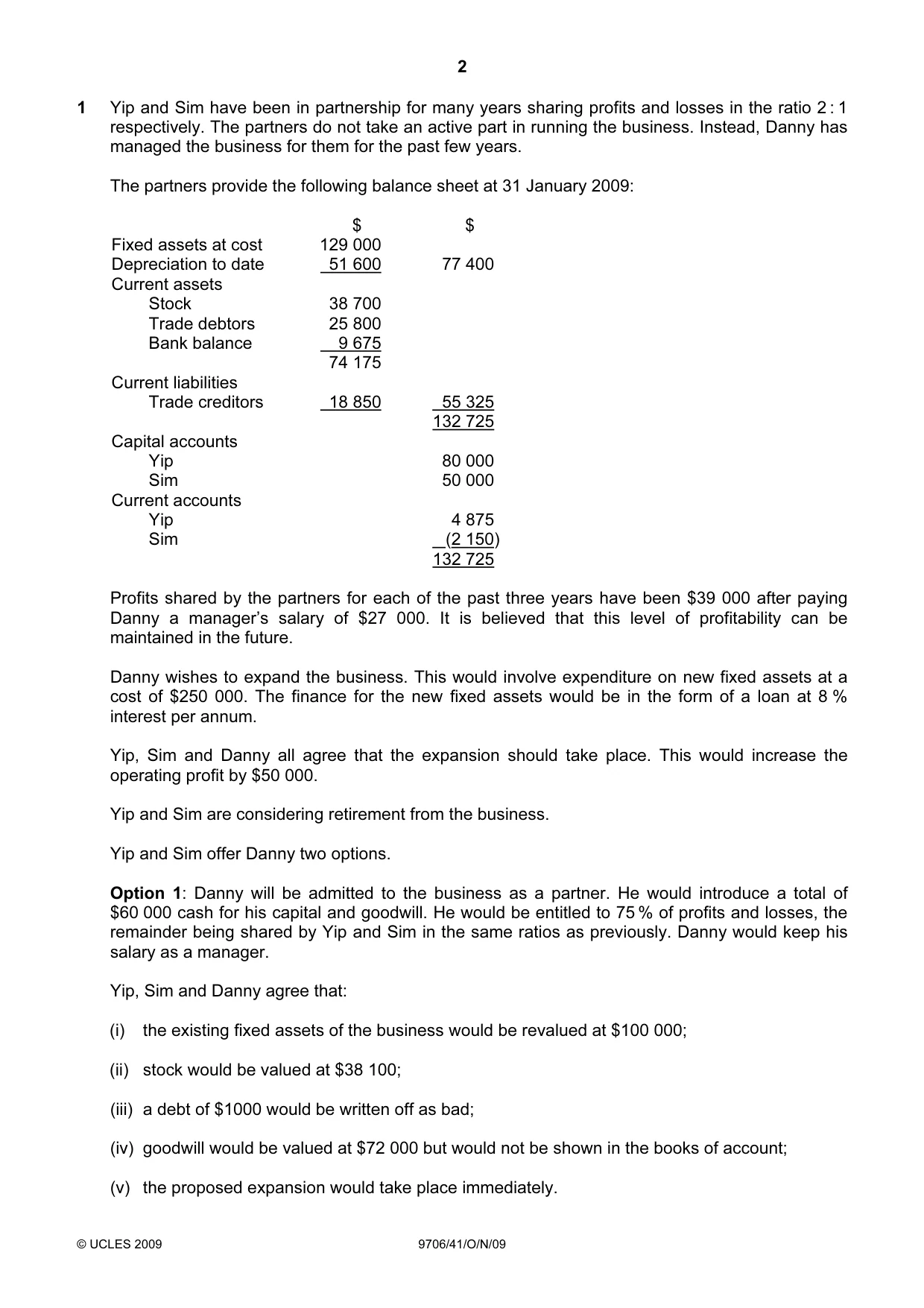
2 © UCLES 2009 9706/41/O/N/09 1 Yip and Sim have been in partnership for many years sharing profits and losses in the ratio 2 : 1 respectively. The partners do not take an active part in running the business. Instead, Danny has managed the business for them for the past few years. The partners provide the following balance sheet at 31 January 2009: $ $ Fixed assets at cost 129 000 Depreciation to date 51 600 77 400 Current assets Stock 38 700 Trade debtors 25 800 Bank balance 9 675 74 175 Current liabilities Trade creditors 18 850 55 325 132 725 Capital accounts Yip 80 000 Sim 50 000 Current accounts Yip 4 875 Sim (2 150) 132 725 Profits shared by the partners for each of the past three years have been $39 000 after paying Danny a manager’s salary of $27 000. It is believed that this level of profitability can be maintained in the future. Danny wishes to expand the business. This would involve expenditure on new fixed assets at a cost of $250 000. The finance for the new fixed assets would be in the form of a loan at 8 % interest per annum. Yip, Sim and Danny all agree that the expansion should take place. This would increase the operating profit by $50 000. Yip and Sim are considering retirement from the business. Yip and Sim offer Danny two options. Option 1: Danny will be admitted to the business as a partner. He would introduce a total of $60 000 cash for his capital and goodwill. He would be entitled to 75 % of profits and losses, the remainder being shared by Yip and Sim in the same ratios as previously. Danny would keep his salary as a manager. Yip, Sim and Danny agree that: (i) the existing fixed assets of the business would be revalued at $100 000; (ii) stock would be valued at $38 100; (iii) a debt of $1000 would be written off as bad; (iv) goodwill would be valued at $72 000 but would not be shown in the books of account; (v) the proposed expansion would take place immediately.
Question paper, page 3
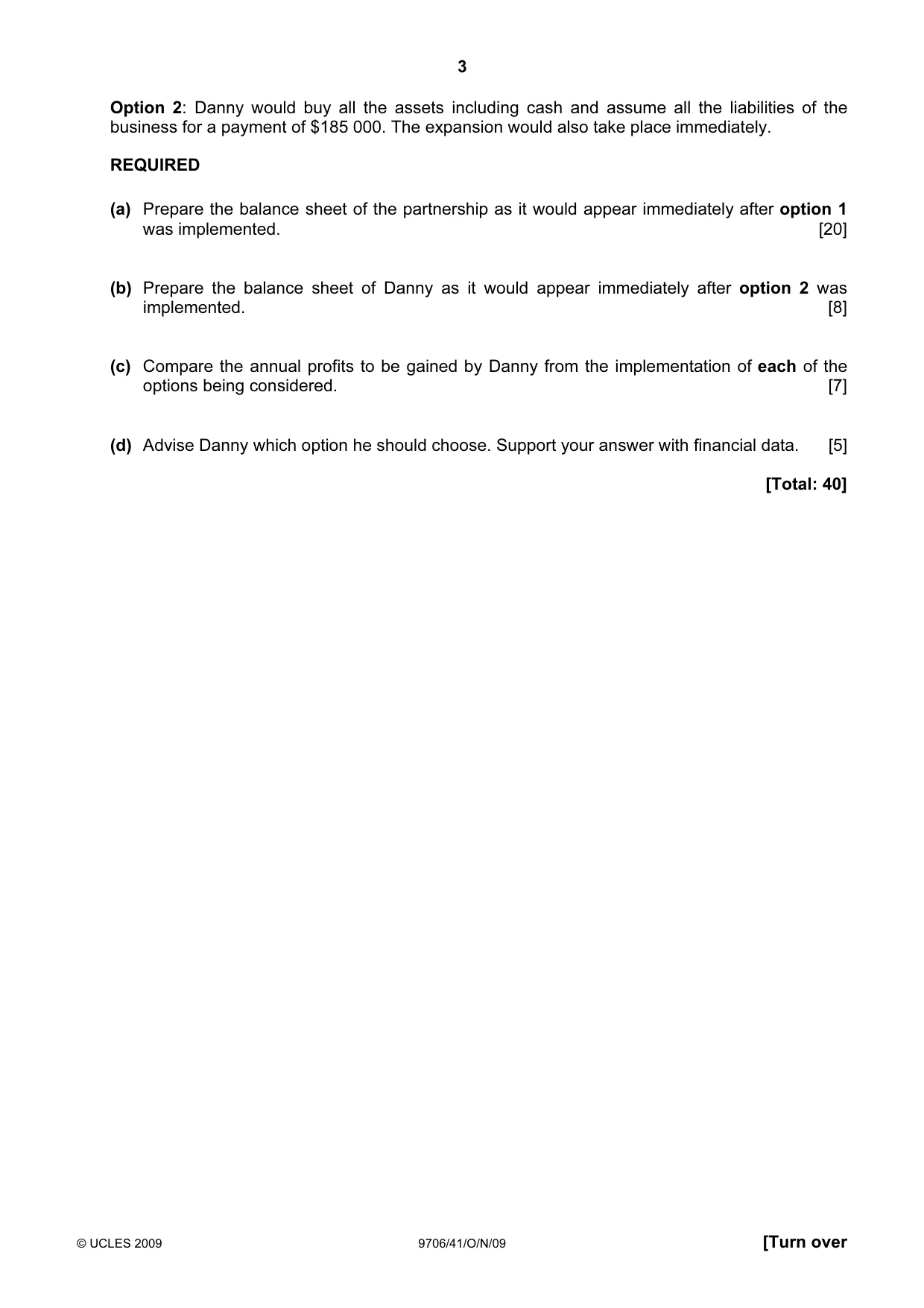
3 © UCLES 2009 9706/41/O/N/09 [Turn over Option 2: Danny would buy all the assets including cash and assume all the liabilities of the business for a payment of $185 000. The expansion would also take place immediately. REQUIRED (a) Prepare the balance sheet of the partnership as it would appear immediately after option 1 was implemented. [20] (b) Prepare the balance sheet of Danny as it would appear immediately after option 2 was implemented. [8] (c) Compare the annual profits to be gained by Danny from the implementation of each of the options being considered. [7] (d) Advise Danny which option he should choose. Support your answer with financial data. [5] [Total: 40]
Question paper, page 4
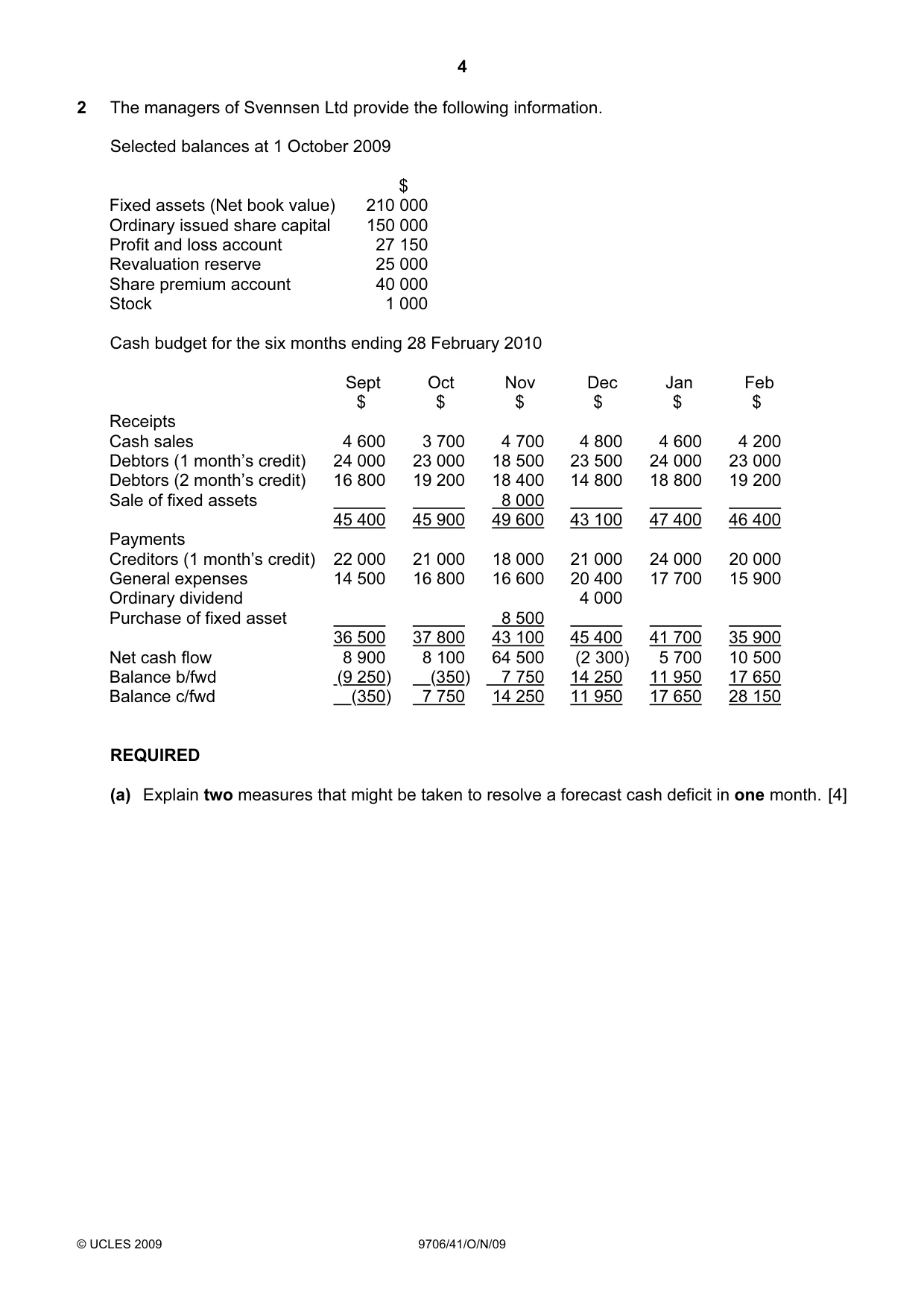
4 © UCLES 2009 9706/41/O/N/09 2 The managers of Svennsen Ltd provide the following information. Selected balances at 1 October 2009 $ Fixed assets (Net book value) 210 000 Ordinary issued share capital 150 000 Profit and loss account 27 150 Revaluation reserve 25 000 Share premium account 40 000 Stock 1 000 Cash budget for the six months ending 28 February 2010 Sept Oct Nov Dec Jan Feb $ $ $ $ $ $ Receipts Cash sales 4 600 3 700 4 700 4 800 4 600 4 200 Debtors (1 month’s credit) 24 000 23 000 18 500 23 500 24 000 23 000 Debtors (2 month’s credit) 16 800 19 200 18 400 14 800 18 800 19 200 Sale of fixed assets 8 000 45 400 45 900 49 600 43 100 47 400 46 400 Payments Creditors (1 month’s credit) 22 000 21 000 18 000 21 000 24 000 20 000 General expenses 14 500 16 800 16 600 20 400 17 700 15 900 Ordinary dividend 4 000 Purchase of fixed asset 8 500 36 500 37 800 43 100 45 400 41 700 35 900 Net cash flow 8 900 8 100 64 500 (2 300) 5 700 10 500 Balance b/fwd (9 250) (350) 7 750 14 250 11 950 17 650 Balance c/fwd (350) 7 750 14 250 11 950 17 650 28 150 REQUIRED (a) Explain two measures that might be taken to resolve a forecast cash deficit in one month. [4]
Question paper, page 5
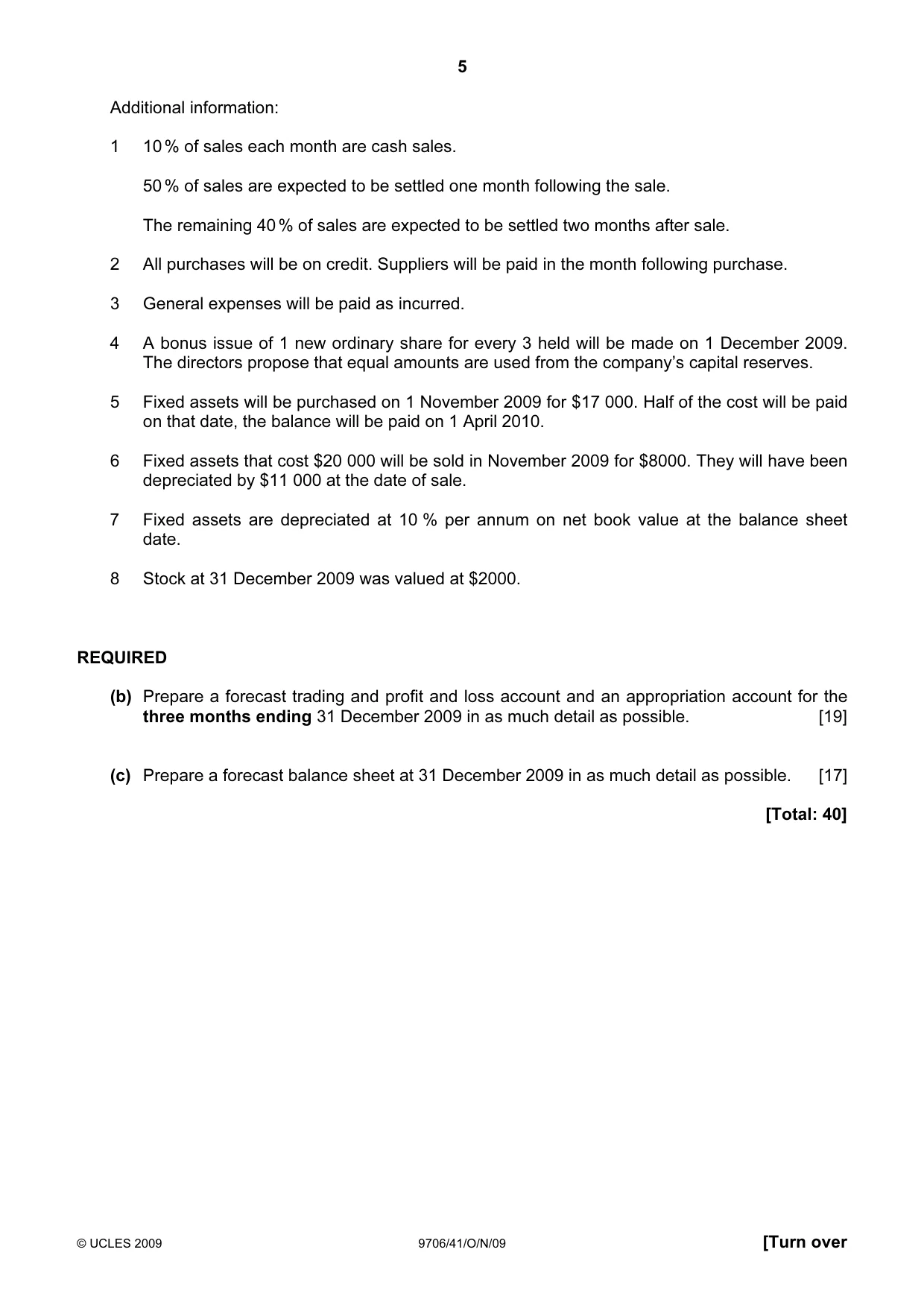
5 © UCLES 2009 9706/41/O/N/09 [Turn over Additional information: 1 10 % of sales each month are cash sales. 50 % of sales are expected to be settled one month following the sale. The remaining 40 % of sales are expected to be settled two months after sale. 2 All purchases will be on credit. Suppliers will be paid in the month following purchase. 3 General expenses will be paid as incurred. 4 A bonus issue of 1 new ordinary share for every 3 held will be made on 1 December 2009. The directors propose that equal amounts are used from the company’s capital reserves. 5 Fixed assets will be purchased on 1 November 2009 for $17 000. Half of the cost will be paid on that date, the balance will be paid on 1 April 2010. 6 Fixed assets that cost $20 000 will be sold in November 2009 for $8000. They will have been depreciated by $11 000 at the date of sale. 7 Fixed assets are depreciated at 10 % per annum on net book value at the balance sheet date. 8 Stock at 31 December 2009 was valued at $2000. REQUIRED (b) Prepare a forecast trading and profit and loss account and an appropriation account for the three months ending 31 December 2009 in as much detail as possible. [19] (c) Prepare a forecast balance sheet at 31 December 2009 in as much detail as possible. [17] [Total: 40]
Question paper, page 6
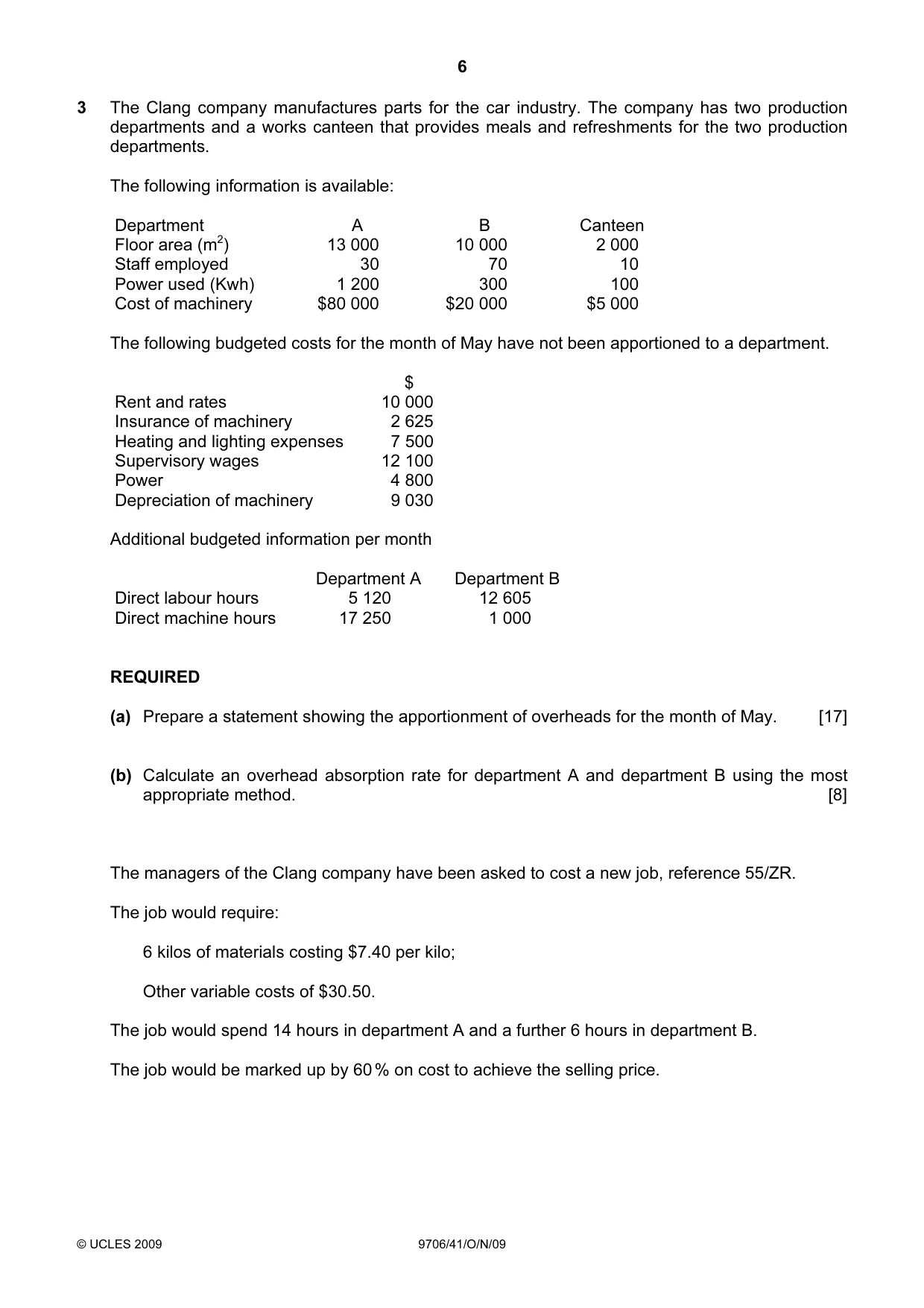
6 © UCLES 2009 9706/41/O/N/09 3 The Clang company manufactures parts for the car industry. The company has two production departments and a works canteen that provides meals and refreshments for the two production departments. The following information is available: Department A B Canteen Floor area (m2) 13 000 10 000 2 000 Staff employed 30 70 10 Power used (Kwh) 1 200 300 100 Cost of machinery $80 000 $20 000 $5 000 The following budgeted costs for the month of May have not been apportioned to a department. $ Rent and rates 10 000 Insurance of machinery 2 625 Heating and lighting expenses 7 500 Supervisory wages 12 100 Power 4 800 Depreciation of machinery 9 030 Additional budgeted information per month Department A Department B Direct labour hours 5 120 12 605 Direct machine hours 17 250 1 000 REQUIRED (a) Prepare a statement showing the apportionment of overheads for the month of May. [17] (b) Calculate an overhead absorption rate for department A and department B using the most appropriate method. [8] The managers of the Clang company have been asked to cost a new job, reference 55/ZR. The job would require: 6 kilos of materials costing $7.40 per kilo; Other variable costs of $30.50. The job would spend 14 hours in department A and a further 6 hours in department B. The job would be marked up by 60 % on cost to achieve the selling price.
Question paper, page 7
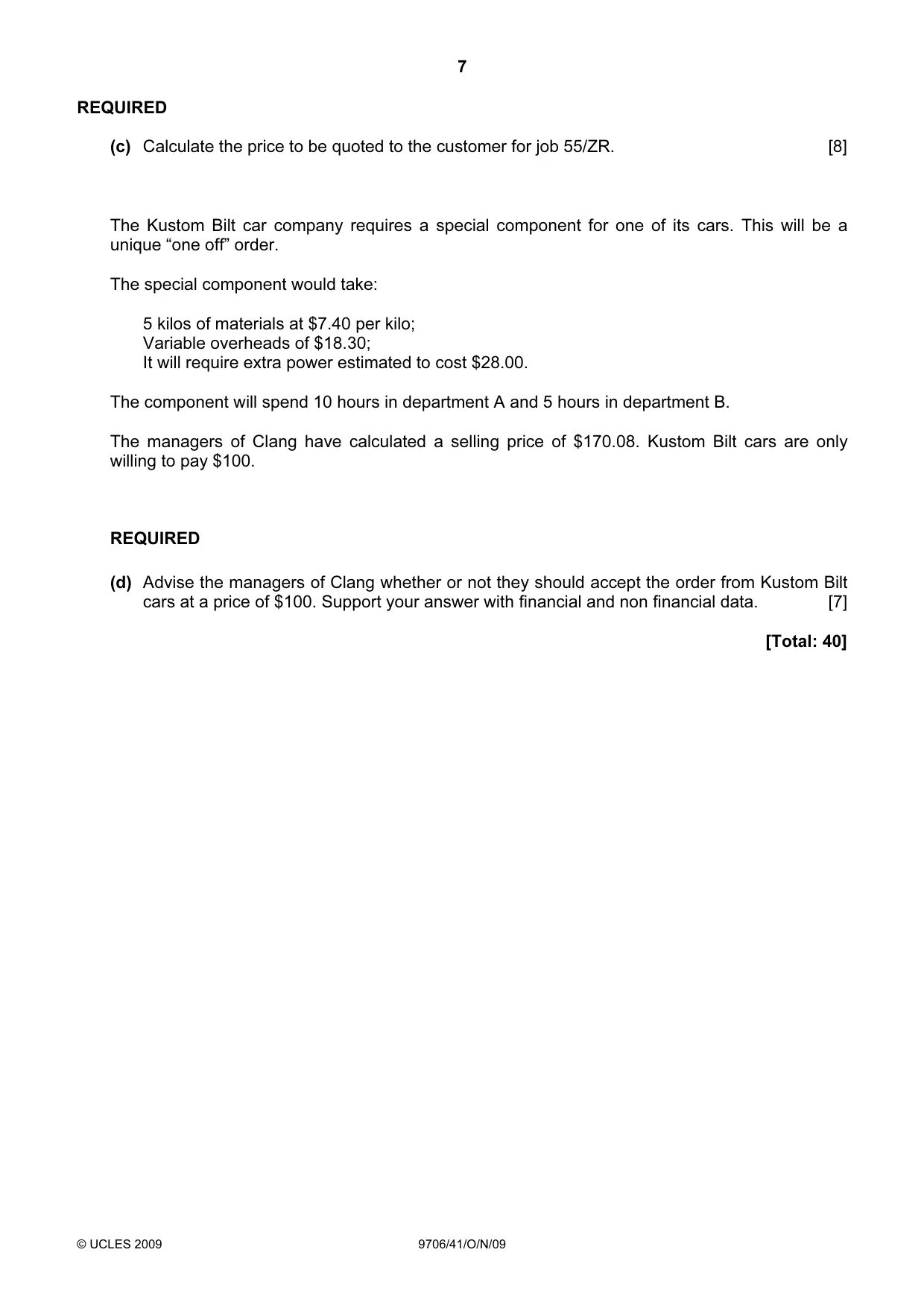
7 © UCLES 2009 9706/41/O/N/09 REQUIRED (c) Calculate the price to be quoted to the customer for job 55/ZR. [8] The Kustom Bilt car company requires a special component for one of its cars. This will be a unique “one off” order. The special component would take: 5 kilos of materials at $7.40 per kilo; Variable overheads of $18.30; It will require extra power estimated to cost $28.00. The component will spend 10 hours in department A and 5 hours in department B. The managers of Clang have calculated a selling price of $170.08. Kustom Bilt cars are only willing to pay $100. REQUIRED (d) Advise the managers of Clang whether or not they should accept the order from Kustom Bilt cars at a price of $100. Support your answer with financial and non financial data. [7] [Total: 40]
Question paper, page 8
8 BLANK PAGE Permission to reproduce items where third-party owned material protected by copyright is included has been sought and cleared where possible. Every reasonable effort has been made by the publisher (UCLES) to trace copyright holders, but if any items requiring clearance have unwittingly been included, the publisher will be pleased to make amends at the earliest possible opportunity. University of Cambridge International Examinations is part of the Cambridge Assessment Group. Cambridge Assessment is the brand name of University of Cambridge Local Examinations Syndicate (UCLES), which is itself a department of the University of Cambridge. 9706/41/O/N/09
Mark scheme, page 1
UNIVERSITY OF CAMBRIDGE INTERNATIONAL EXAMINATIONS GCE Advanced Subsidiary Level and GCE Advanced Level MARK SCHEME for the October/November 2009 question paper for the guidance of teachers 9706 ACCOUNTING 9706/41 Paper 41 (Problem Solving – Supplement), maximum raw mark 120 This mark scheme is published as an aid to teachers and candidates, to indicate the requirements of the examination. It shows the basis on which Examiners were instructed to award marks. It does not indicate the details of the discussions that took place at an Examiners’ meeting before marking began, which would have considered the acceptability of alternative answers. Mark schemes must be read in conjunction with the question papers and the report on the examination. • CIE will not enter into discussions or correspondence in connection with these mark schemes. CIE is publishing the mark schemes for the October/November 2009 question papers for most IGCSE, GCE Advanced Level and Advanced Subsidiary Level syllabuses and some Ordinary Level syllabuses.
Mark scheme, page 2
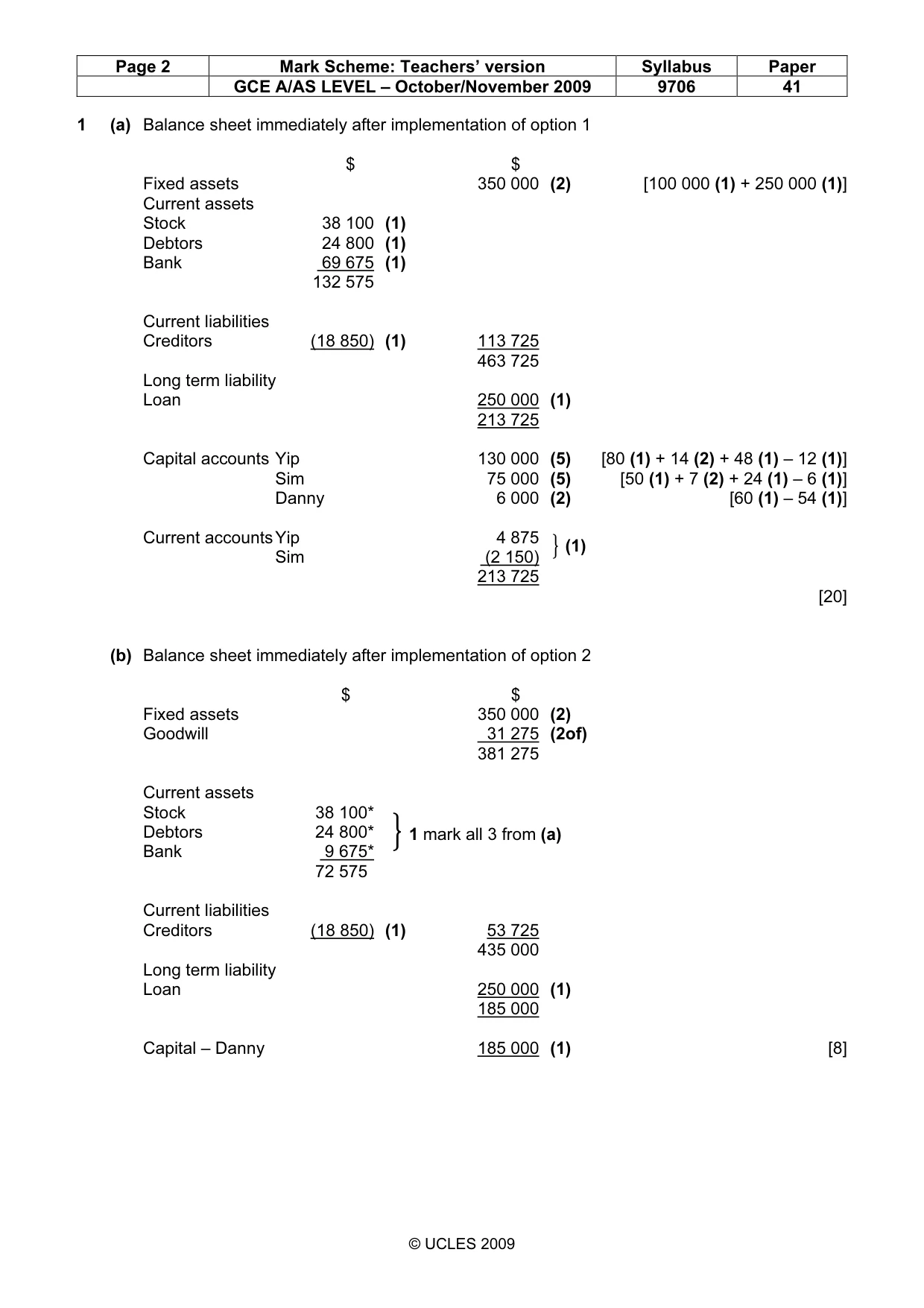
Page 2 Mark Scheme: Teachers’ version Syllabus Paper GCE A/AS LEVEL – October/November 2009 9706 41 © UCLES 2009 1 (a) Balance sheet immediately after implementation of option 1 $ $ Fixed assets 350 000 (2) [100 000 (1) + 250 000 (1)] Current assets Stock 38 100 (1) Debtors 24 800 (1) Bank 69 675 (1) 132 575 Current liabilities Creditors (18 850) (1) 113 725 463 725 Long term liability Loan 250 000 (1) 213 725 Capital accounts Yip 130 000 (5) [80 (1) + 14 (2) + 48 (1) – 12 (1)] Sim 75 000 (5) [50 (1) + 7 (2) + 24 (1) – 6 (1)] Danny 6 000 (2) [60 (1) – 54 (1)] Current accounts Yip 4 875 Sim (2 150) 213 725 [20] (b) Balance sheet immediately after implementation of option 2 $ $ Fixed assets 350 000 (2) Goodwill 31 275 (2of) 381 275 Current assets Stock 38 100* Debtors 24 800* Bank 9 675* 72 575* Current liabilities Creditors (18 850) (1) 53 725 435 000 Long term liability Loan 250 000 (1) 185 000 Capital – Danny 185 000 (1) [8] g (1) g 1 mark all 3 from (a)
Mark scheme, page 3
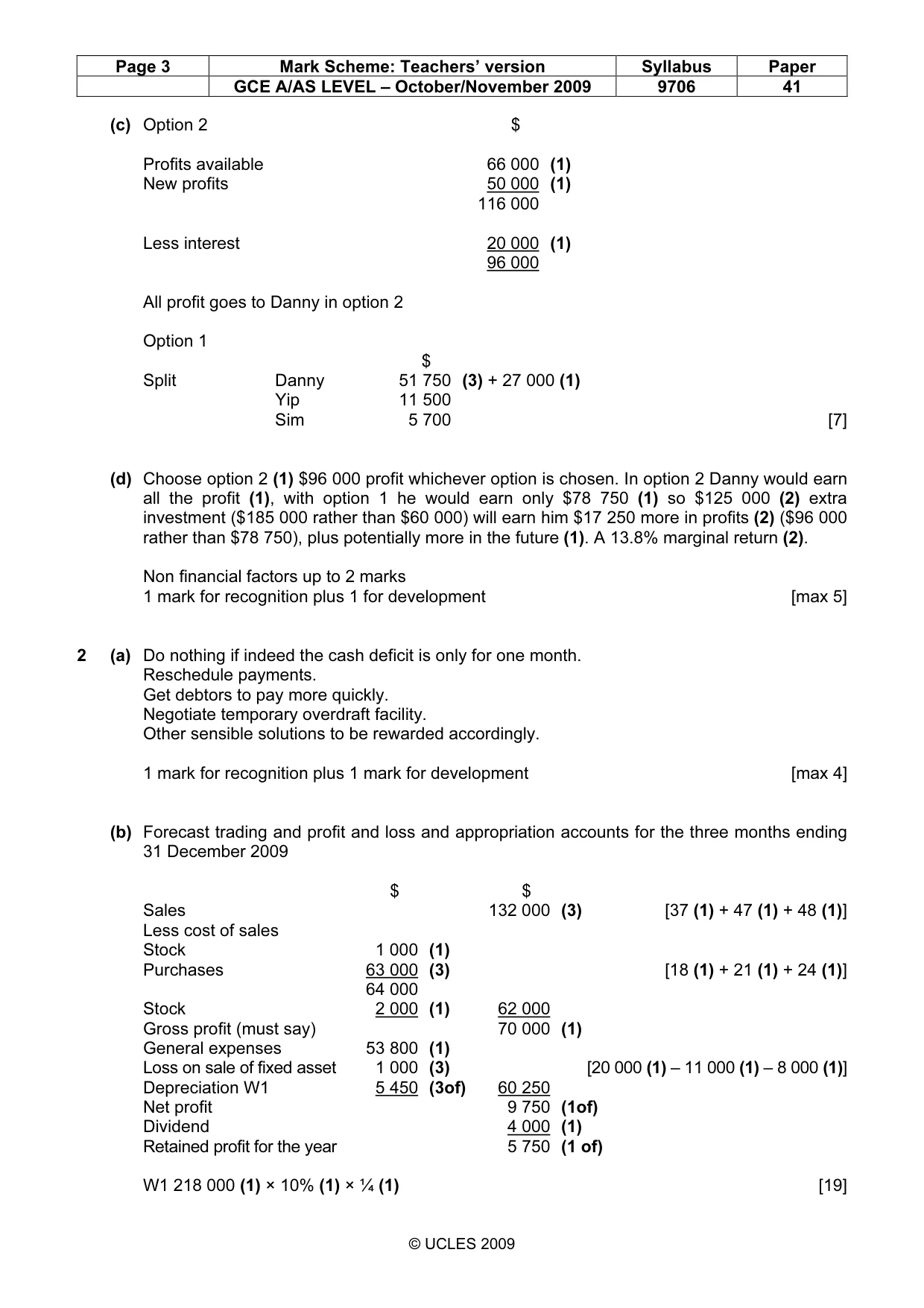
Page 3 Mark Scheme: Teachers’ version Syllabus Paper GCE A/AS LEVEL – October/November 2009 9706 41 © UCLES 2009 (c) Option 2 $ Profits available 66 000 (1) New profits 50 000 (1) 116 000 Less interest 20 000 (1) 96 000 All profit goes to Danny in option 2 Option 1 $ Split Danny 51 750 (3) + 27 000 (1) Yip 11 500 Sim 5 700 [7] (d) Choose option 2 (1) $96 000 profit whichever option is chosen. In option 2 Danny would earn all the profit (1), with option 1 he would earn only $78 750 (1) so $125 000 (2) extra investment ($185 000 rather than $60 000) will earn him $17 250 more in profits (2) ($96 000 rather than $78 750), plus potentially more in the future (1). A 13.8% marginal return (2). Non financial factors up to 2 marks 1 mark for recognition plus 1 for development [max 5] 2 (a) Do nothing if indeed the cash deficit is only for one month. Reschedule payments. Get debtors to pay more quickly. Negotiate temporary overdraft facility. Other sensible solutions to be rewarded accordingly. 1 mark for recognition plus 1 mark for development [max 4] (b) Forecast trading and profit and loss and appropriation accounts for the three months ending 31 December 2009 $ $ Sales 132 000 (3) [37 (1) + 47 (1) + 48 (1)] Less cost of sales Stock 1 000 (1) Purchases 63 000 (3) [18 (1) + 21 (1) + 24 (1)] 64 000 Stock 2 000 (1) 62 000 Gross profit (must say) 70 000 (1) General expenses 53 800 (1) Loss on sale of fixed asset 1 000 (3) [20 000 (1) – 11 000 (1) – 8 000 (1)] Depreciation W1 5 450 (3of) 60 250 Net profit 9 750 (1of) Dividend 4 000 (1) Retained profit for the year 5 750 (1 of) W1 218 000 (1) × 10% (1) × ¼ (1) [19]
Mark scheme, page 4
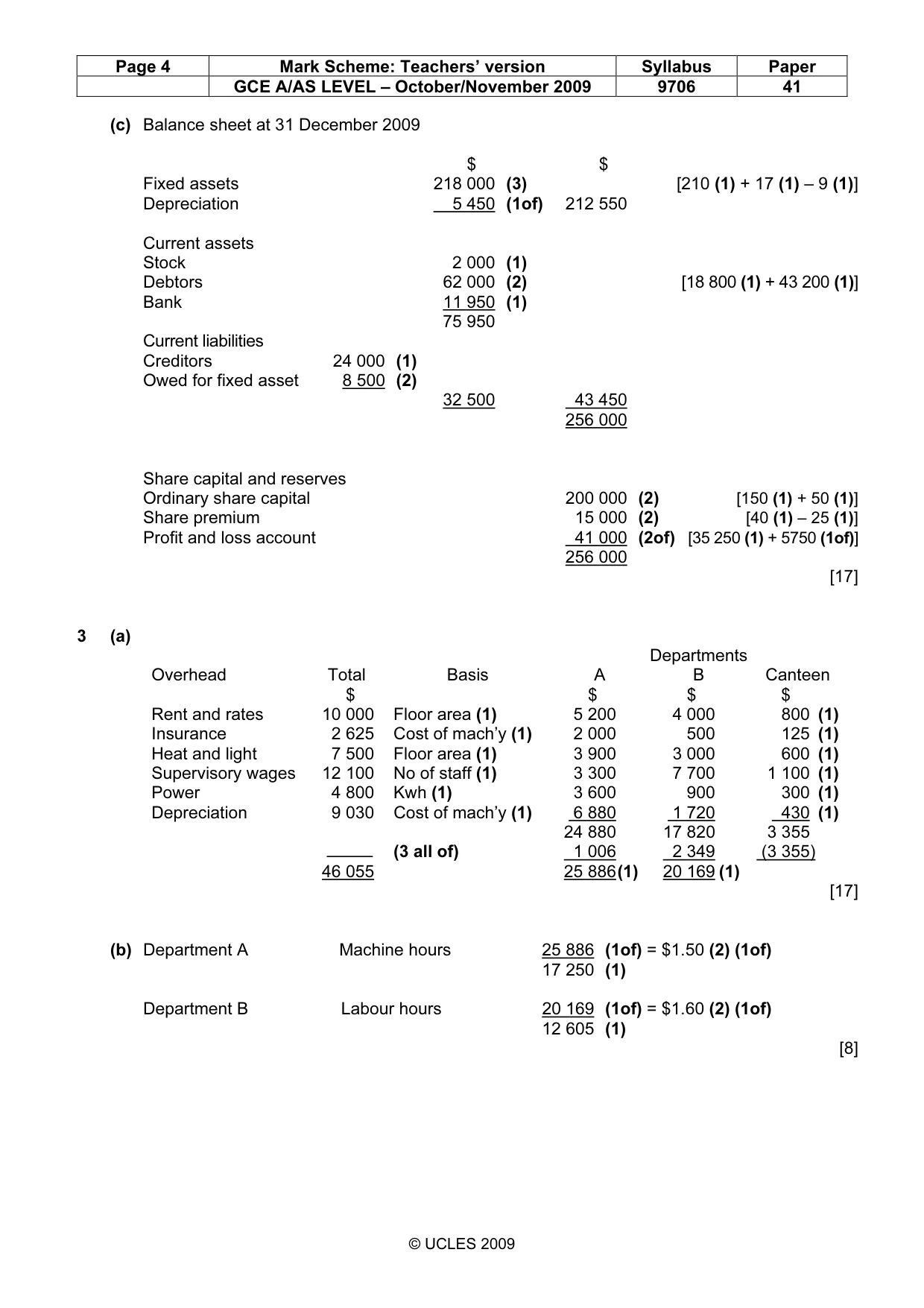
Page 4 Mark Scheme: Teachers’ version Syllabus Paper GCE A/AS LEVEL – October/November 2009 9706 41 © UCLES 2009 (c) Balance sheet at 31 December 2009 $ $ Fixed assets 218 000 (3) [210 (1) + 17 (1) – 9 (1)] Depreciation 5 450 (1of) 212 550 Current assets Stock 2 000 (1) Debtors 62 000 (2) [18 800 (1) + 43 200 (1)] Bank 11 950 (1) 75 950 Current liabilities Creditors 24 000 (1) Owed for fixed asset 8 500 (2) 32 500 43 450 256 000 Share capital and reserves Ordinary share capital 200 000 (2) [150 (1) + 50 (1)] Share premium 15 000 (2) [40 (1) – 25 (1)] Profit and loss account 41 000 (2of) [35 250 (1) + 5750 (1of)] 256 000 [17] 3 (a) Departments Overhead Total Basis A B Canteen $ $ $ $ Rent and rates 10 000 Floor area (1) 5 200 4 000 800 (1) Insurance 2 625 Cost of mach’y (1) 2 000 500 125 (1) Heat and light 7 500 Floor area (1) 3 900 3 000 600 (1) Supervisory wages 12 100 No of staff (1) 3 300 7 700 1 100 (1) Power 4 800 Kwh (1) 3 600 900 300 (1) Depreciation 9 030 Cost of mach’y (1) 6 880 1 720 430 (1) 24 880 17 820 3 355 (3 all of) 1 006 2 349 (3 355) 46 055 25 886 (1) 20 169 (1) [17] (b) Department A Machine hours 25 886 (1of) = $1.50 (2) (1of) 17 250 (1) Department B Labour hours 20 169 (1of) = $1.60 (2) (1of) 12 605 (1) [8]
Mark scheme, page 5
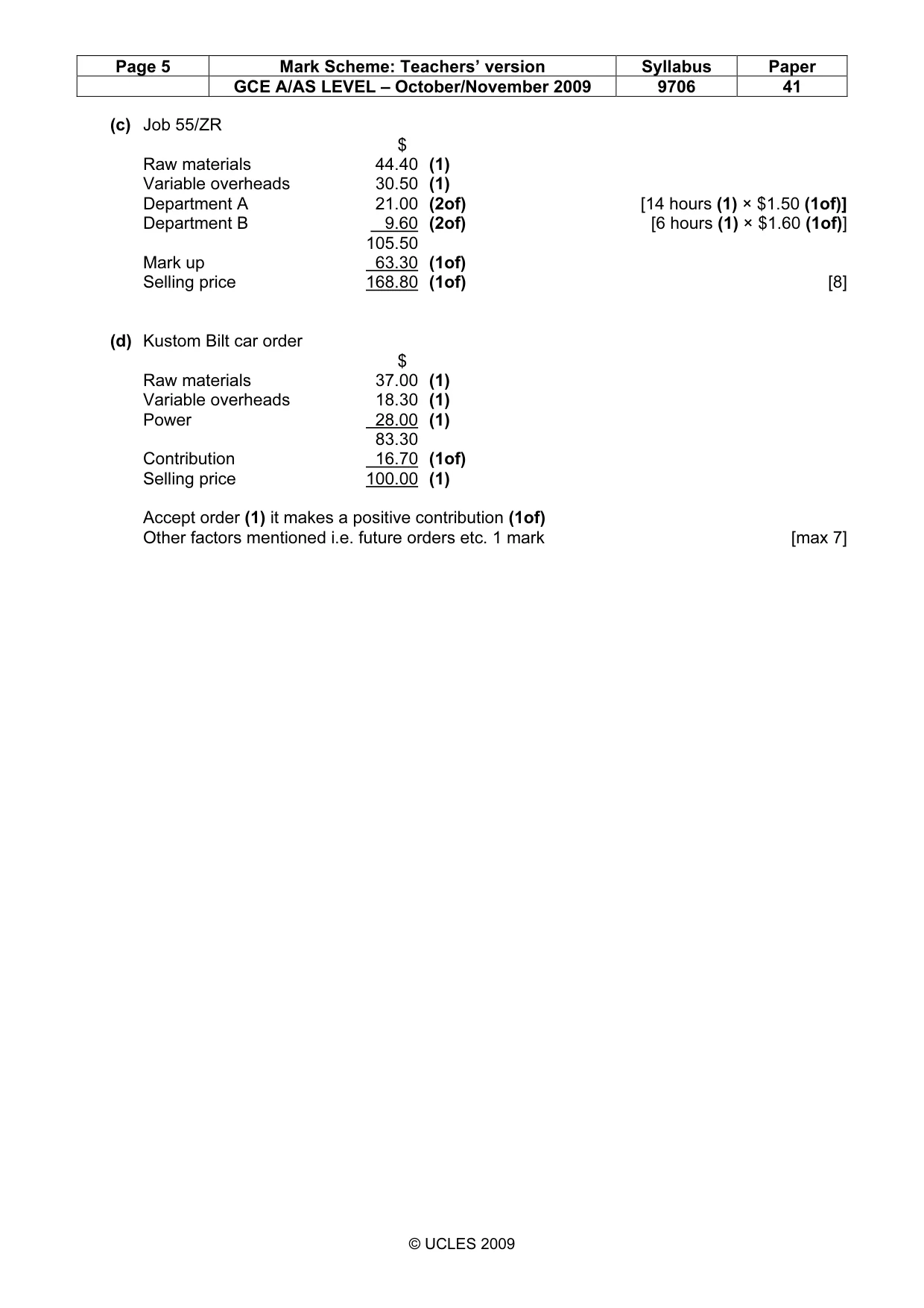
Page 5 Mark Scheme: Teachers’ version Syllabus Paper GCE A/AS LEVEL – October/November 2009 9706 41 © UCLES 2009 (c) Job 55/ZR $ Raw materials 44.40 (1) Variable overheads 30.50 (1) Department A 21.00 (2of) [14 hours (1) × $1.50 (1of)] Department B 9.60 (2of) [6 hours (1) × $1.60 (1of)] 105.50 Mark up 63.30 (1of) Selling price 168.80 (1of) [8] (d) Kustom Bilt car order $ Raw materials 37.00 (1) Variable overheads 18.30 (1) Power 28.00 (1) 83.30 Contribution 16.70 (1of) Selling price 100.00 (1) Accept order (1) it makes a positive contribution (1of) Other factors mentioned i.e. future orders etc. 1 mark [max 7]
What you needed in this session
Cambridge’s own grade thresholds for 2009 Oct/Nov, Paper 4 · Variant 1. A higher threshold means an easier paper — the bar moves with how the cohort did.