Cambridge A Level Accounting 9706 — 2009 May/June Paper 2 · Variant 1
9706/21/M/J/09
The question paper and its mark scheme, free to read here and free to download. This is Cambridge’s own paper, exactly as it was sat.
Question paper33 pages






Mark scheme13 pages
Answers below. Sit the paper first if you are practising.
Paper as text
Question paper, page 1
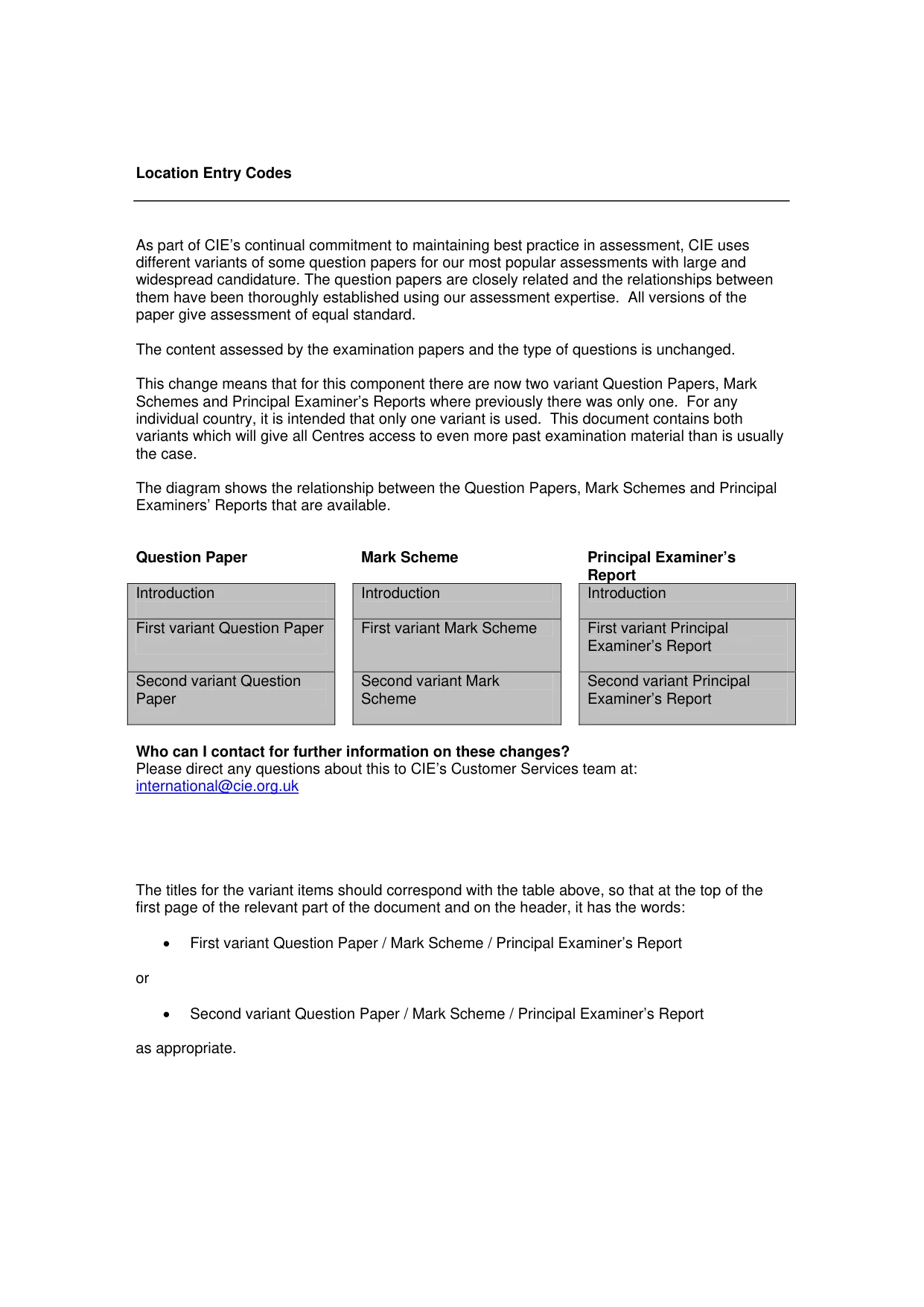
Location Entry Codes As part of CIE’s continual commitment to maintaining best practice in assessment, CIE uses different variants of some question papers for our most popular assessments with large and widespread candidature. The question papers are closely related and the relationships between them have been thoroughly established using our assessment expertise. All versions of the paper give assessment of equal standard. The content assessed by the examination papers and the type of questions is unchanged. This change means that for this component there are now two variant Question Papers, Mark Schemes and Principal Examiner’s Reports where previously there was only one. For any individual country, it is intended that only one variant is used. This document contains both variants which will give all Centres access to even more past examination material than is usually the case. The diagram shows the relationship between the Question Papers, Mark Schemes and Principal Examiners’ Reports that are available. Question Paper Mark Scheme Principal Examiner’s Report Introduction Introduction Introduction First variant Question Paper First variant Mark Scheme First variant Principal Examiner’s Report Second variant Question Paper Second variant Mark Scheme Second variant Principal Examiner’s Report Who can I contact for further information on these changes? Please direct any questions about this to CIE’s Customer Services team at: international@cie.org.uk The titles for the variant items should correspond with the table above, so that at the top of the first page of the relevant part of the document and on the header, it has the words: • First variant Question Paper / Mark Scheme / Principal Examiner’s Report or • Second variant Question Paper / Mark Scheme / Principal Examiner’s Report as appropriate.
Question paper, page 2
This document consists of 13 printed pages and 3 blank pages. IB09 06_9706_21/6RP © UCLES 2009 [Turn over *9616242913* For Examiner's Use 1 2 3 Total UNIVERSITY OF CAMBRIDGE INTERNATIONAL EXAMINATIONS General Certificate of Education Advanced Subsidiary Level and Advanced Level ACCOUNTING 9706/21 Paper 2 Structured Questions May/June 2009 1 hour 30 minutes Candidates answer on the Question Paper. No Additional Materials are required. READ THESE INSTRUCTIONS FIRST Write your Centre number, candidate number and name on all the work you hand in. Write in dark blue or black pen. You may use a soft pencil for rough working. Do not use staples, paper clips, highlighters, glue or correction fluid. DO NOT WRITE IN ANY BARCODES. Answer all questions. All accounting statements are to be presented in good style. Workings must be shown. You may use a calculator. At the end of the examination, fasten all your work securely together. The number of marks is given in brackets [ ] at the end of each question or part question. First Variant Question Paper
Question paper, page 3
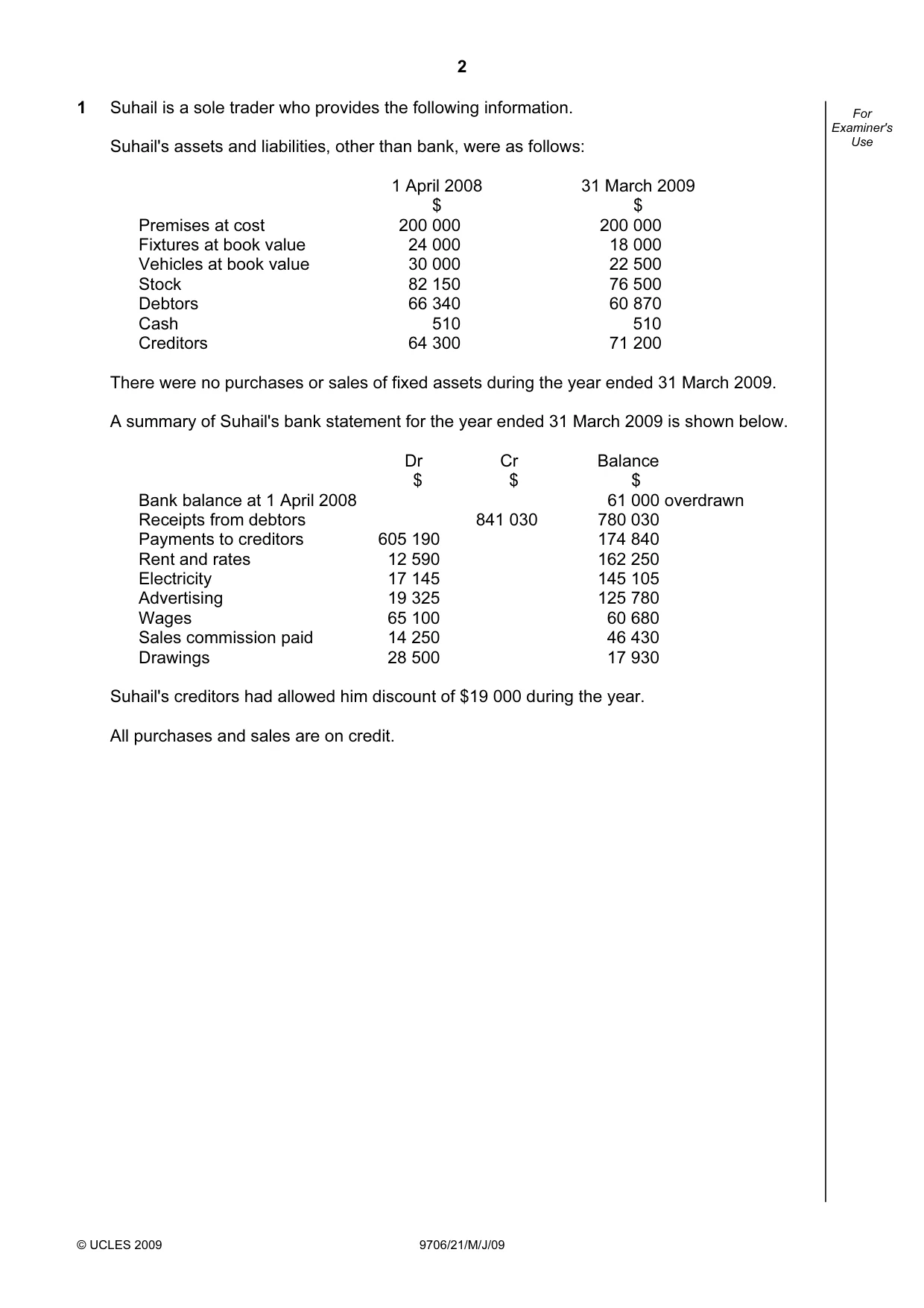
2 © UCLES 2009 9706/21/M/J/09 For Examiner's Use 1 Suhail is a sole trader who provides the following information. Suhail's assets and liabilities, other than bank, were as follows: 1 April 2008 31 March 2009 $ $ Premises at cost 200 000 200 000 Fixtures at book value 24 000 18 000 Vehicles at book value 30 000 22 500 Stock 82 150 76 500 Debtors 66 340 60 870 Cash 510 510 Creditors 64 300 71 200 There were no purchases or sales of fixed assets during the year ended 31 March 2009. A summary of Suhail's bank statement for the year ended 31 March 2009 is shown below. Dr Cr Balance $ $ $ Bank balance at 1 April 2008 61 000 overdrawn Receipts from debtors 841 030 780 030 Payments to creditors 605 190 174 840 Rent and rates 12 590 162 250 Electricity 17 145 145 105 Advertising 19 325 125 780 Wages 65 100 60 680 Sales commission paid 14 250 46 430 Drawings 28 500 17 930 Suhail's creditors had allowed him discount of $19 000 during the year. All purchases and sales are on credit.
Question paper, page 4
3 © UCLES 2009 9706/21/M/J/09 [Turn over For Examiner's Use REQUIRED (a) Prepare Suhail's trading and profit and loss account for the year ended 31 March 2009. [12]
Question paper, page 5
4 © UCLES 2009 9706/21/M/J/09 For Examiner's Use (b) Prepare Suhail's balance sheet at 31 March 2009. [9]
Question paper, page 6
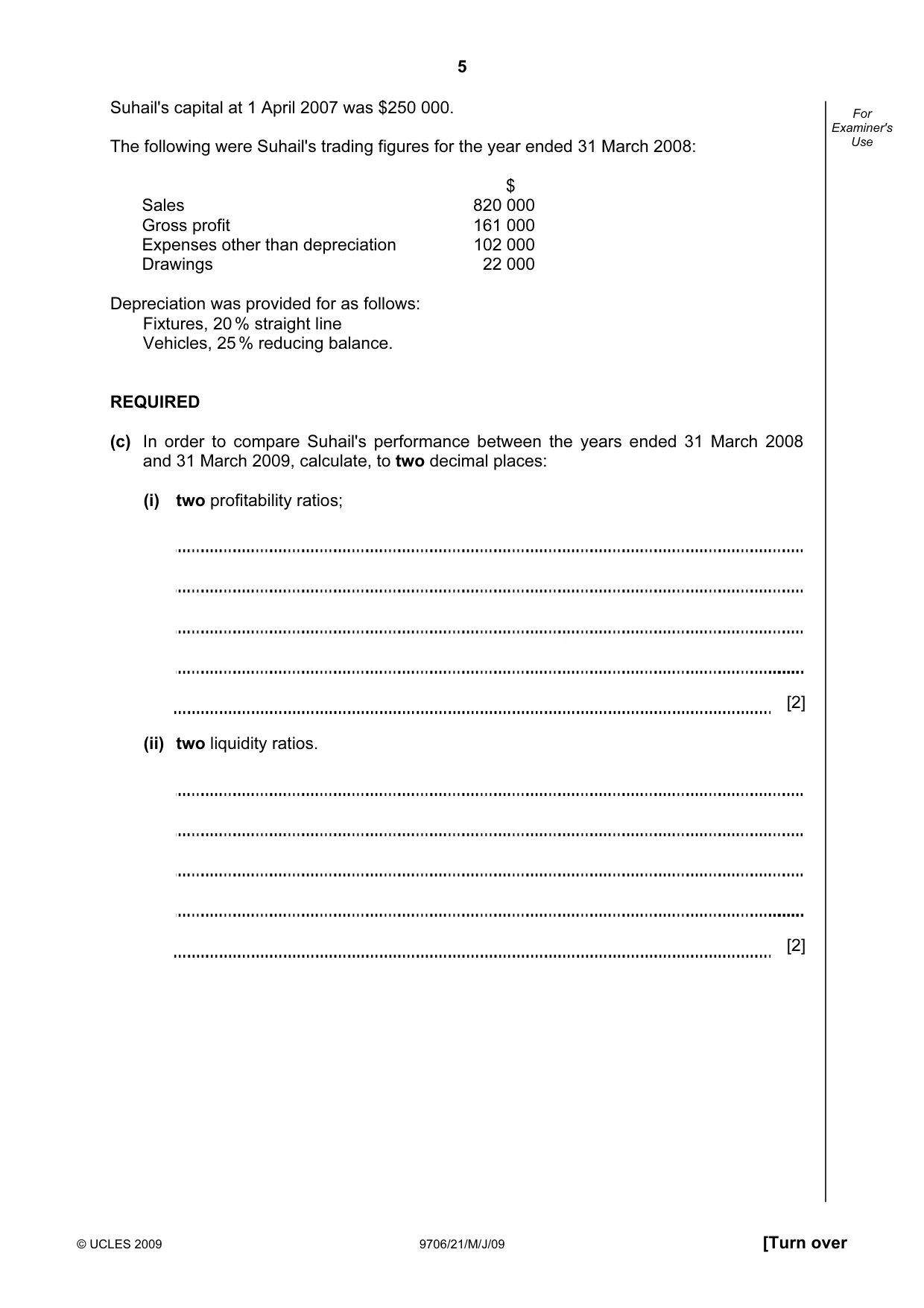
5 © UCLES 2009 9706/21/M/J/09 [Turn over For Examiner's Use Suhail's capital at 1 April 2007 was $250 000. The following were Suhail's trading figures for the year ended 31 March 2008: $ Sales 820 000 Gross profit 161 000 Expenses other than depreciation 102 000 Drawings 22 000 Depreciation was provided for as follows: Fixtures, 20 % straight line Vehicles, 25 % reducing balance. REQUIRED (c) In order to compare Suhail's performance between the years ended 31 March 2008 and 31 March 2009, calculate, to two decimal places: (i) two profitability ratios; [2] (ii) two liquidity ratios. [2]
Question paper, page 7
6 © UCLES 2009 9706/21/M/J/09 For Examiner's Use (iii) Using the ratios calculated in (c)(i) and (ii), comment briefly on Suhail's performance over the two years. [5] [Total: 30]
Question paper, page 8
7 BLANK PAGE 9706/21/M/J/09 [Turn over Question 2 is on the next page.
Question paper, page 9
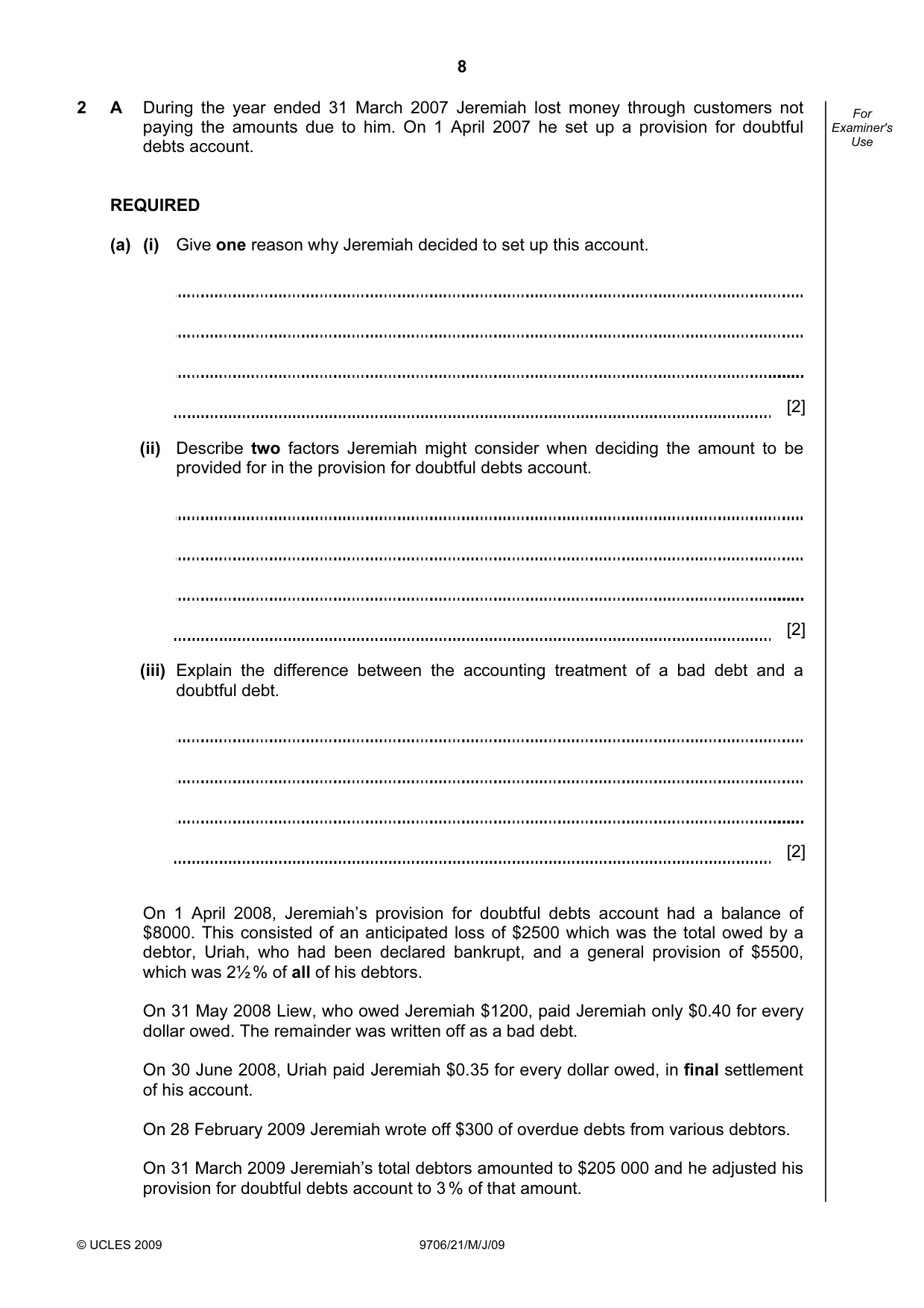
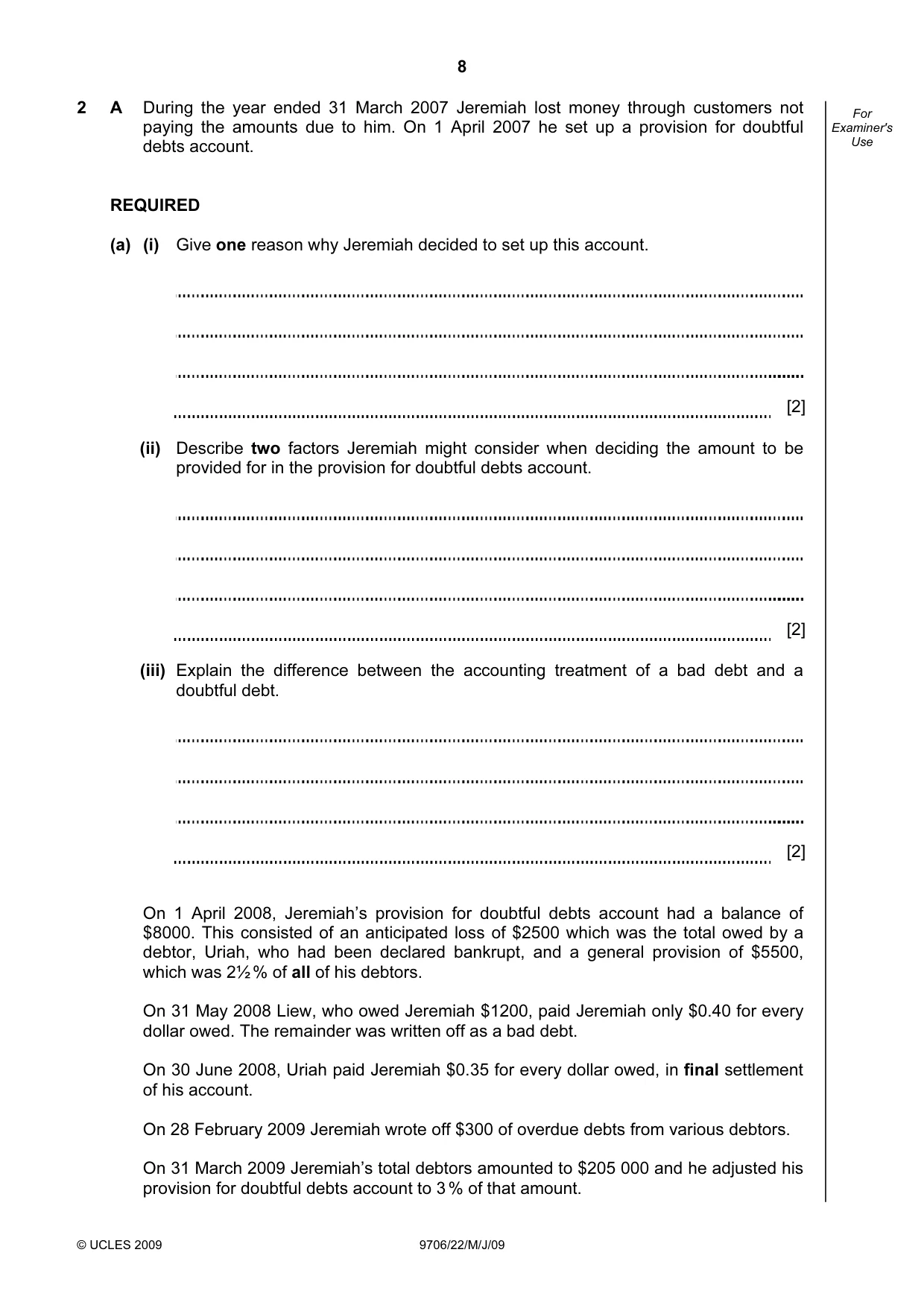
8 © UCLES 2009 9706/21/M/J/09 For Examiner's Use 2 A During the year ended 31 March 2007 Jeremiah lost money through customers not paying the amounts due to him. On 1 April 2007 he set up a provision for doubtful debts account. REQUIRED (a) (i) Give one reason why Jeremiah decided to set up this account. [2] (ii) Describe two factors Jeremiah might consider when deciding the amount to be provided for in the provision for doubtful debts account. [2] (iii) Explain the difference between the accounting treatment of a bad debt and a doubtful debt. [2] On 1 April 2008, Jeremiah’s provision for doubtful debts account had a balance of $8000. This consisted of an anticipated loss of $2500 which was the total owed by a debtor, Uriah, who had been declared bankrupt, and a general provision of $5500, which was 2½ % of all of his debtors. On 31 May 2008 Liew, who owed Jeremiah $1200, paid Jeremiah only $0.40 for every dollar owed. The remainder was written off as a bad debt. On 30 June 2008, Uriah paid Jeremiah $0.35 for every dollar owed, in final settlement of his account. On 28 February 2009 Jeremiah wrote off $300 of overdue debts from various debtors. On 31 March 2009 Jeremiah’s total debtors amounted to $205 000 and he adjusted his provision for doubtful debts account to 3 % of that amount.
Question paper, page 10
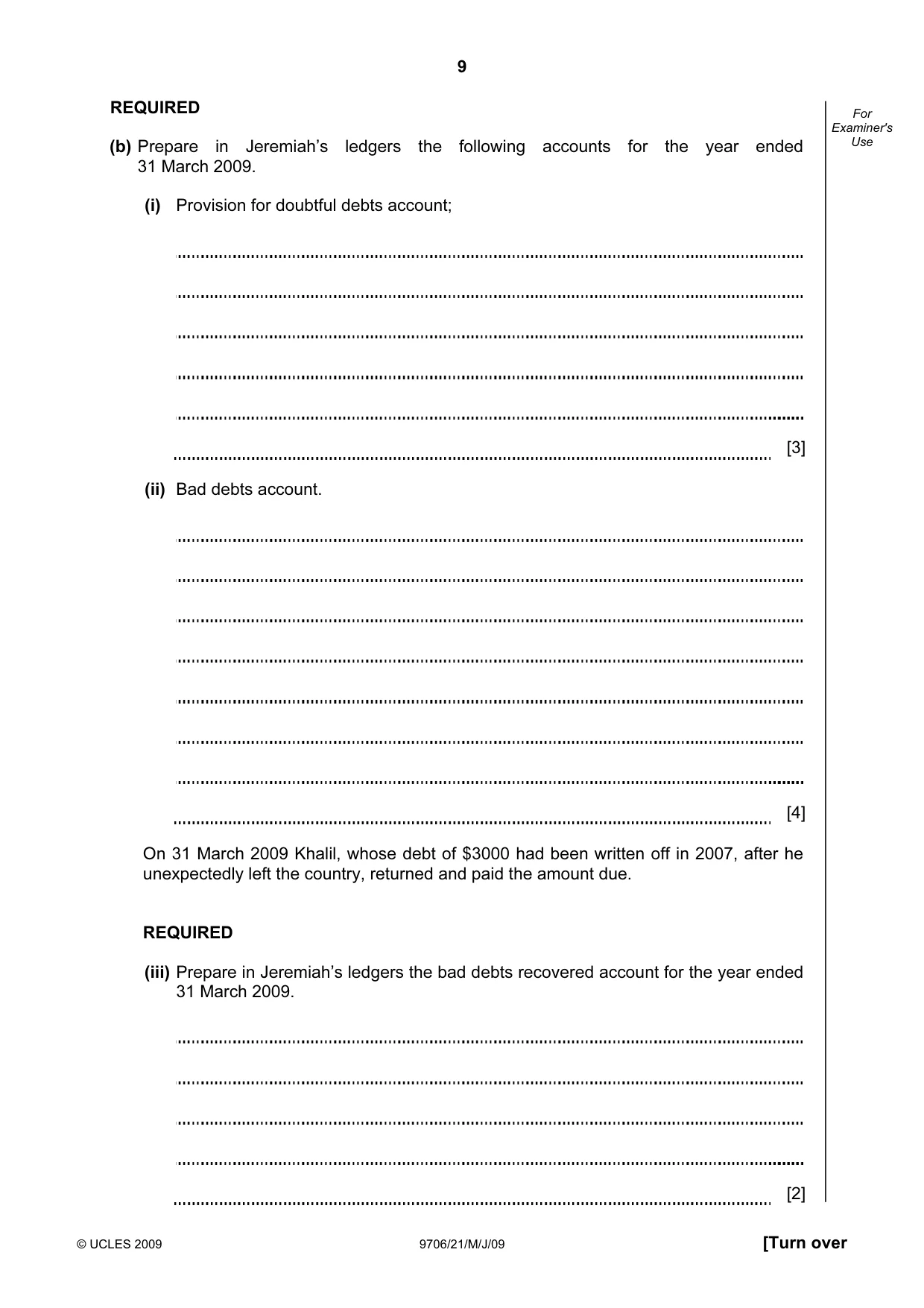
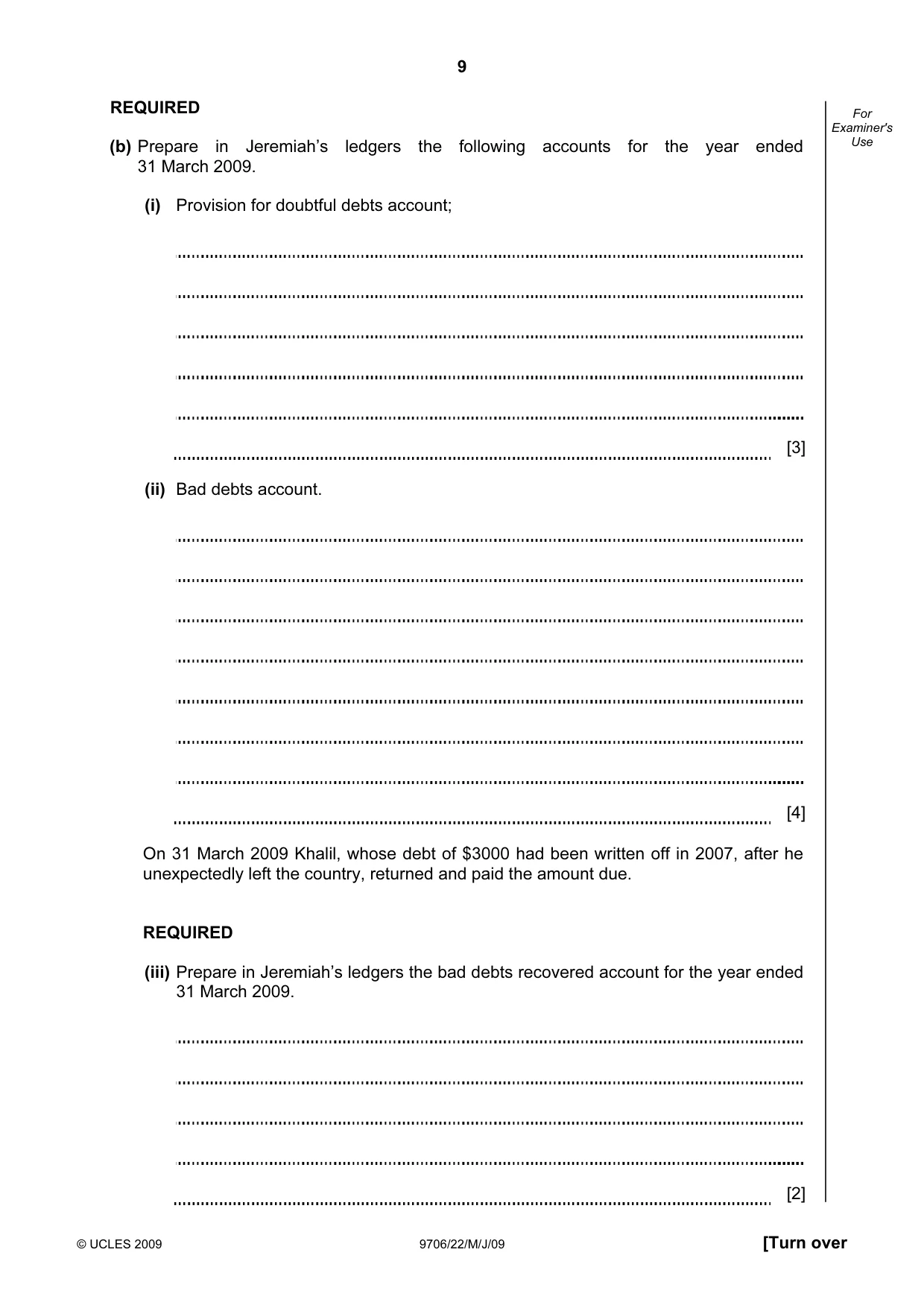
9 © UCLES 2009 9706/21/M/J/09 [Turn over For Examiner's Use REQUIRED (b) Prepare in Jeremiah’s ledgers the following accounts for the year ended 31 March 2009. (i) Provision for doubtful debts account; [3] (ii) Bad debts account. [4] On 31 March 2009 Khalil, whose debt of $3000 had been written off in 2007, after he unexpectedly left the country, returned and paid the amount due. REQUIRED (iii) Prepare in Jeremiah’s ledgers the bad debts recovered account for the year ended 31 March 2009. [2]
Question paper, page 11
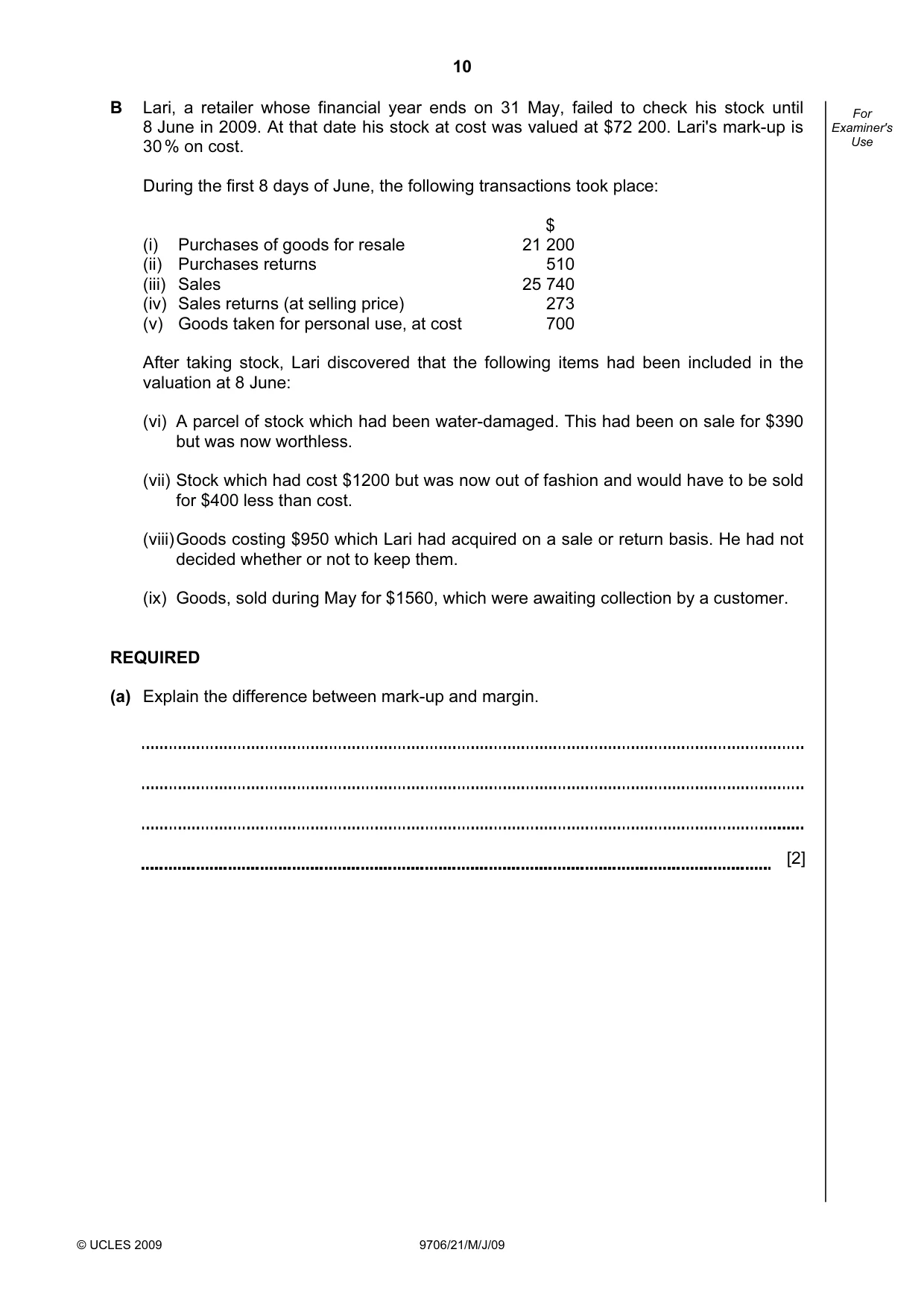
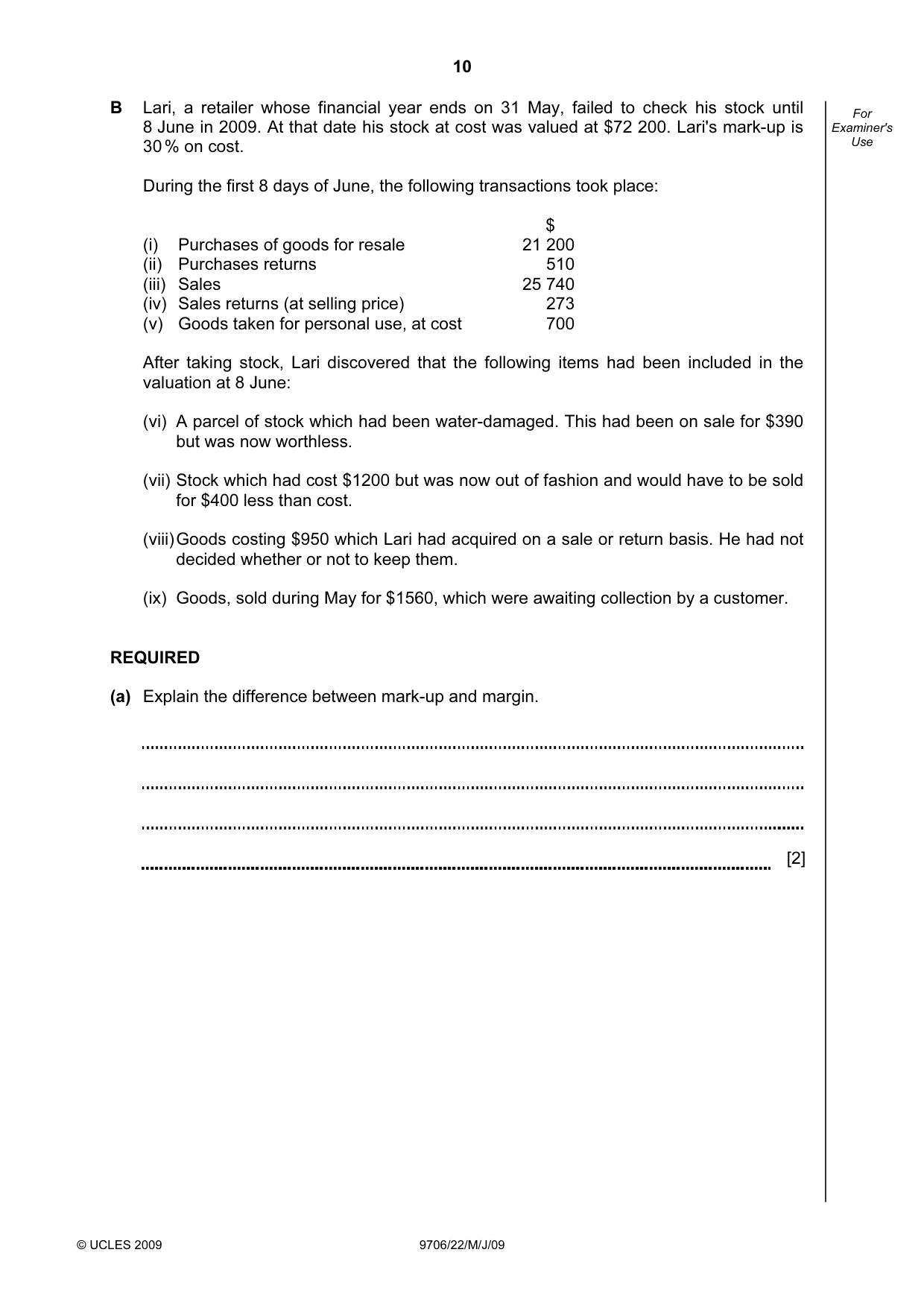
10 © UCLES 2009 9706/21/M/J/09 For Examiner's Use B Lari, a retailer whose financial year ends on 31 May, failed to check his stock until 8 June in 2009. At that date his stock at cost was valued at $72 200. Lari's mark-up is 30 % on cost. During the first 8 days of June, the following transactions took place: $ (i) Purchases of goods for resale 21 200 (ii) Purchases returns 510 (iii) Sales 25 740 (iv) Sales returns (at selling price) 273 (v) Goods taken for personal use, at cost 700 After taking stock, Lari discovered that the following items had been included in the valuation at 8 June: (vi) A parcel of stock which had been water-damaged. This had been on sale for $390 but was now worthless. (vii) Stock which had cost $1200 but was now out of fashion and would have to be sold for $400 less than cost. (viii) Goods costing $950 which Lari had acquired on a sale or return basis. He had not decided whether or not to keep them. (ix) Goods, sold during May for $1560, which were awaiting collection by a customer. REQUIRED (a) Explain the difference between mark-up and margin. [2]
Question paper, page 12
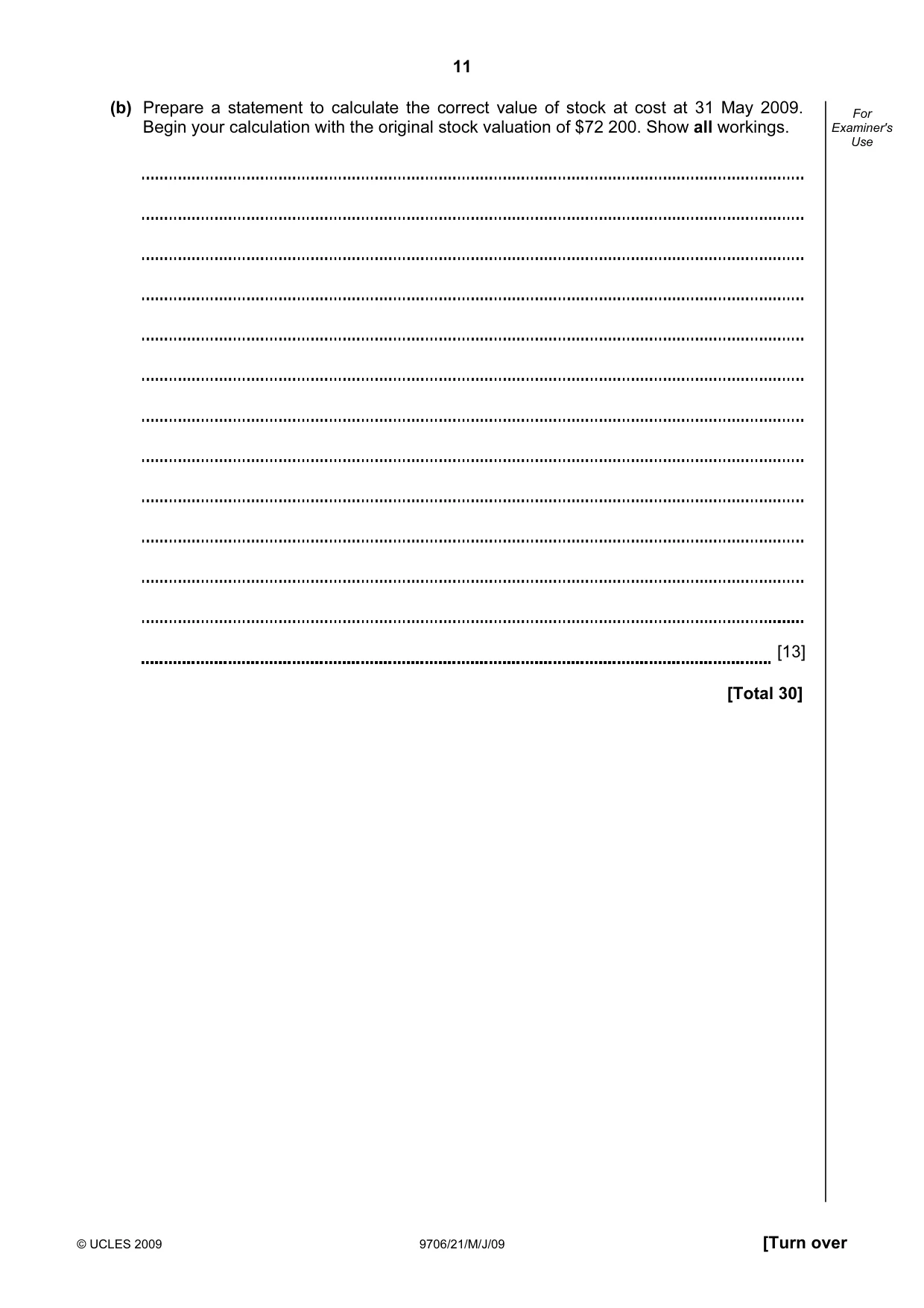
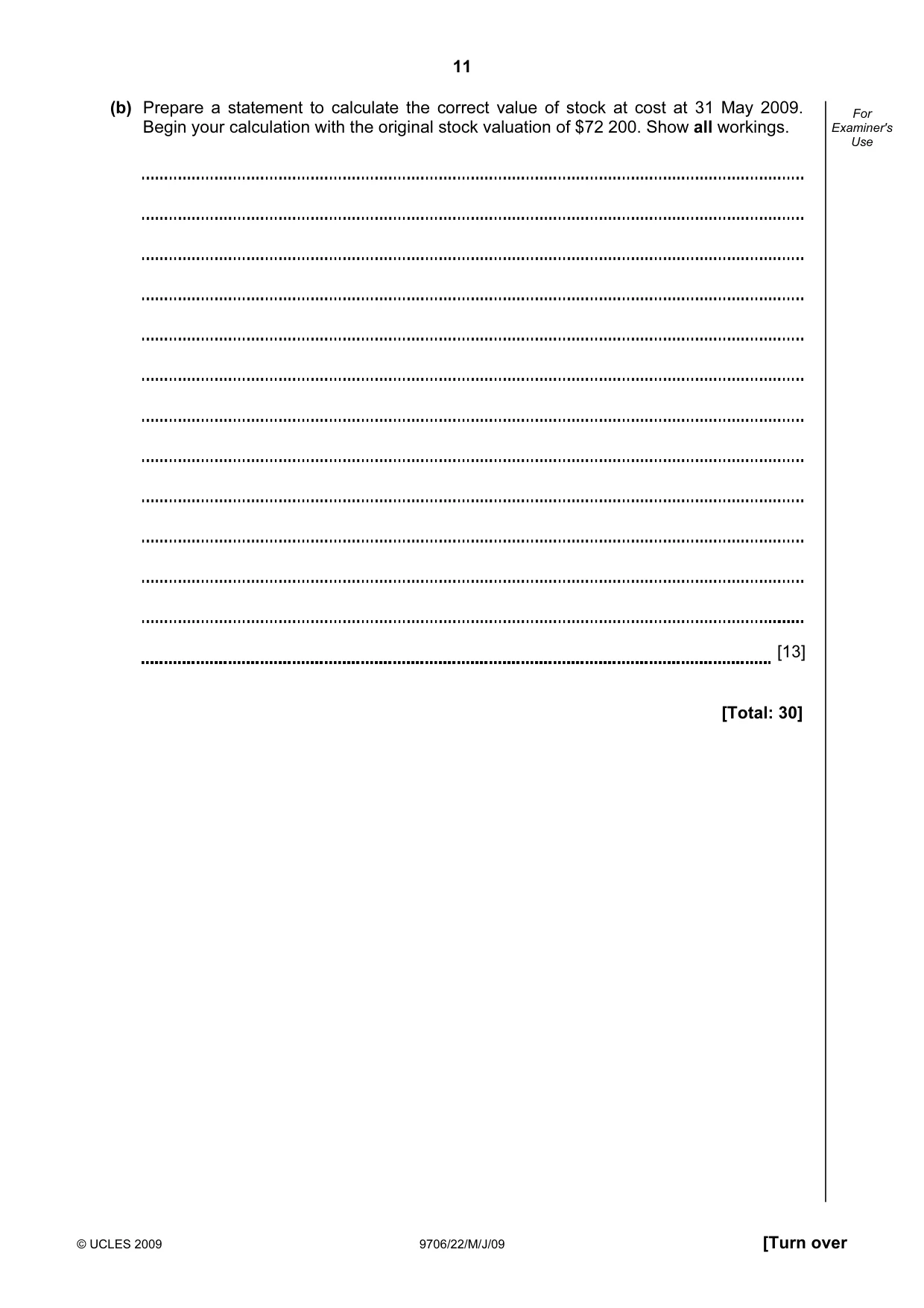
11 © UCLES 2009 9706/21/M/J/09 [Turn over For Examiner's Use (b) Prepare a statement to calculate the correct value of stock at cost at 31 May 2009. Begin your calculation with the original stock valuation of $72 200. Show all workings. [13] [Total 30]
Question paper, page 13
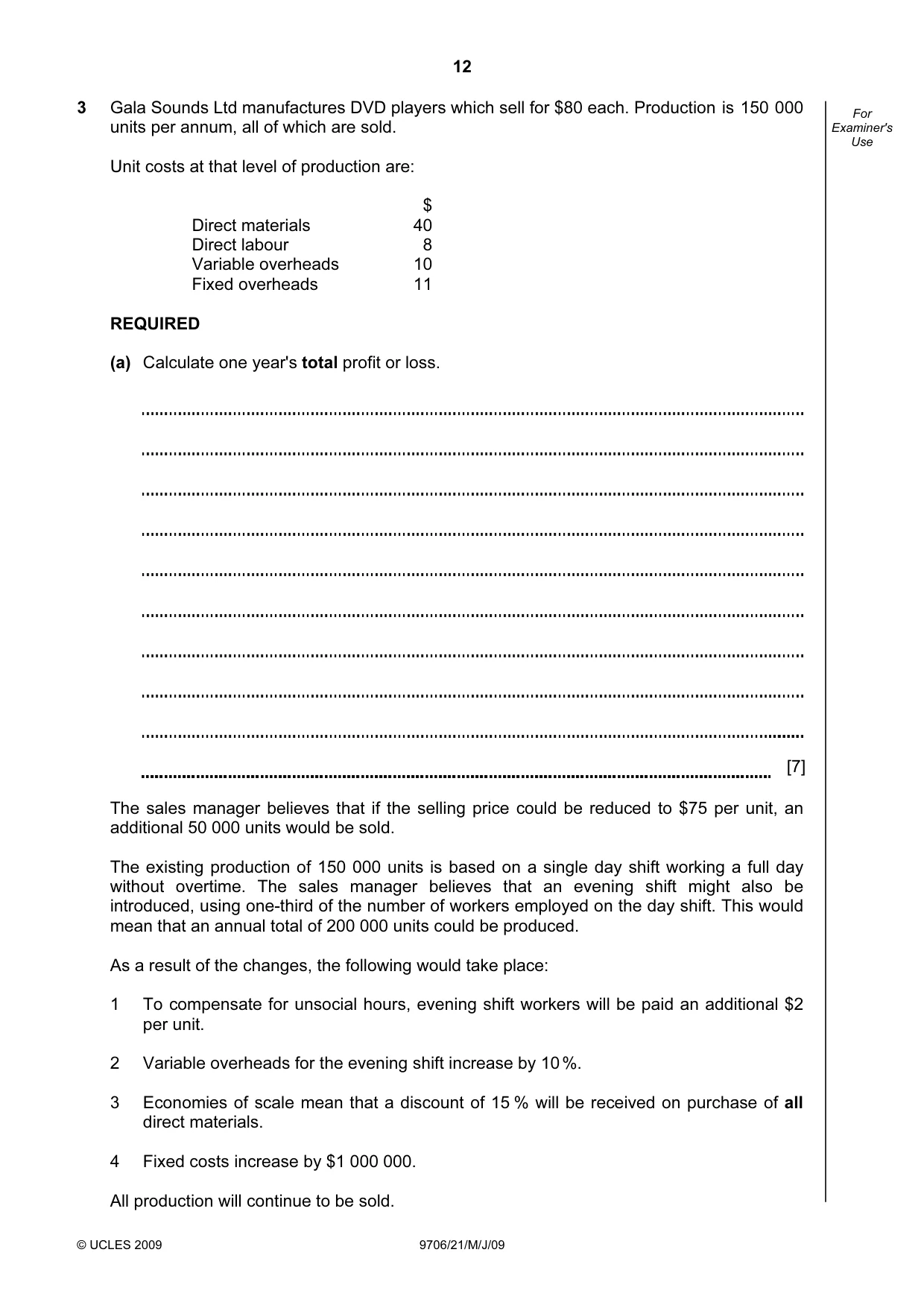
12 © UCLES 2009 9706/21/M/J/09 For Examiner's Use 3 Gala Sounds Ltd manufactures DVD players which sell for $80 each. Production is 150 000 units per annum, all of which are sold. Unit costs at that level of production are: $ Direct materials 40 Direct labour 8 Variable overheads 10 Fixed overheads 11 REQUIRED (a) Calculate one year's total profit or loss. [7] The sales manager believes that if the selling price could be reduced to $75 per unit, an additional 50 000 units would be sold. The existing production of 150 000 units is based on a single day shift working a full day without overtime. The sales manager believes that an evening shift might also be introduced, using one-third of the number of workers employed on the day shift. This would mean that an annual total of 200 000 units could be produced. As a result of the changes, the following would take place: 1 To compensate for unsocial hours, evening shift workers will be paid an additional $2 per unit. 2 Variable overheads for the evening shift increase by 10 %. 3 Economies of scale mean that a discount of 15 % will be received on purchase of all direct materials. 4 Fixed costs increase by $1 000 000. All production will continue to be sold.
Question paper, page 14
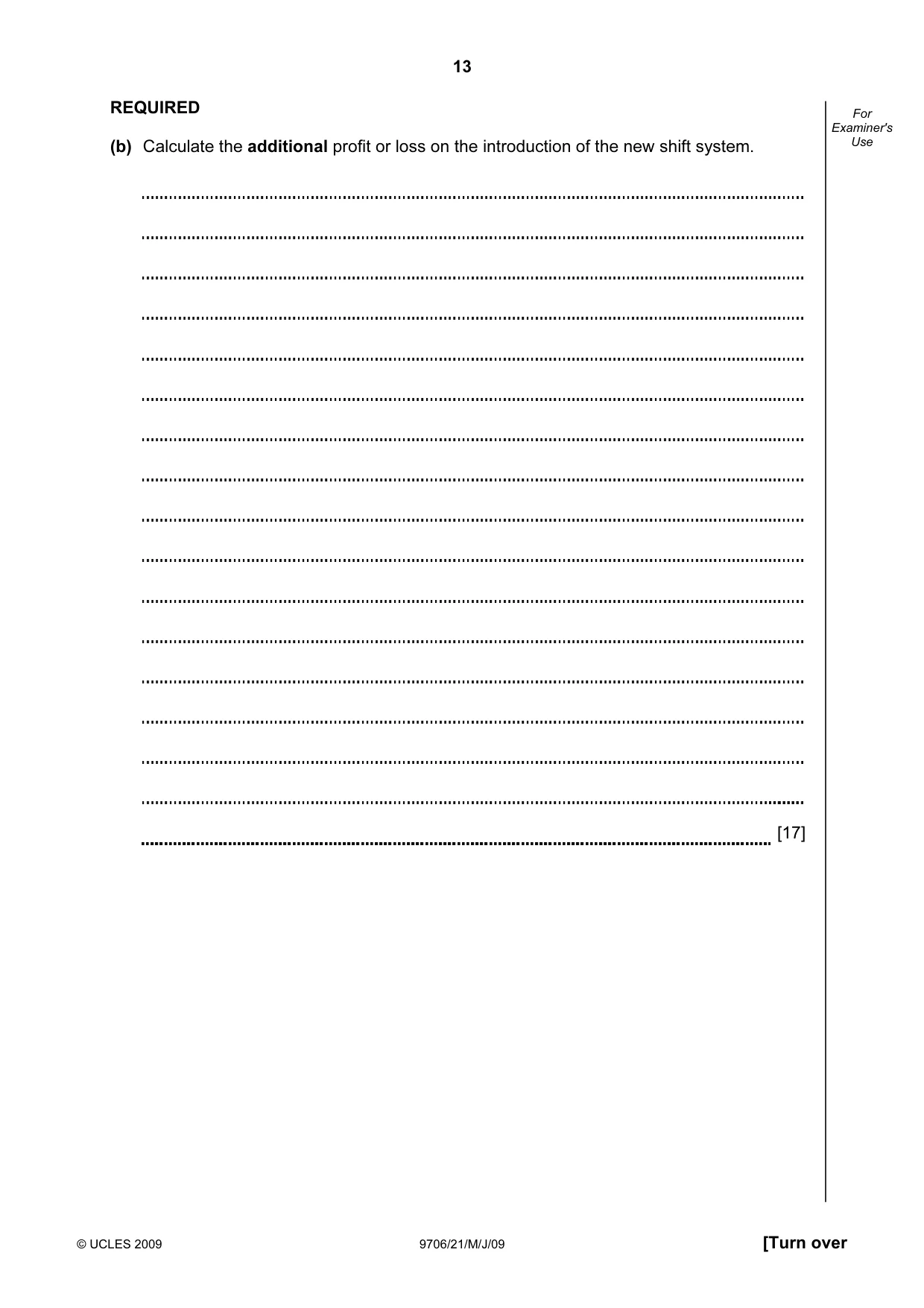
13 © UCLES 2009 9706/21/M/J/09 [Turn over For Examiner's Use REQUIRED (b) Calculate the additional profit or loss on the introduction of the new shift system. [17]
Question paper, page 15
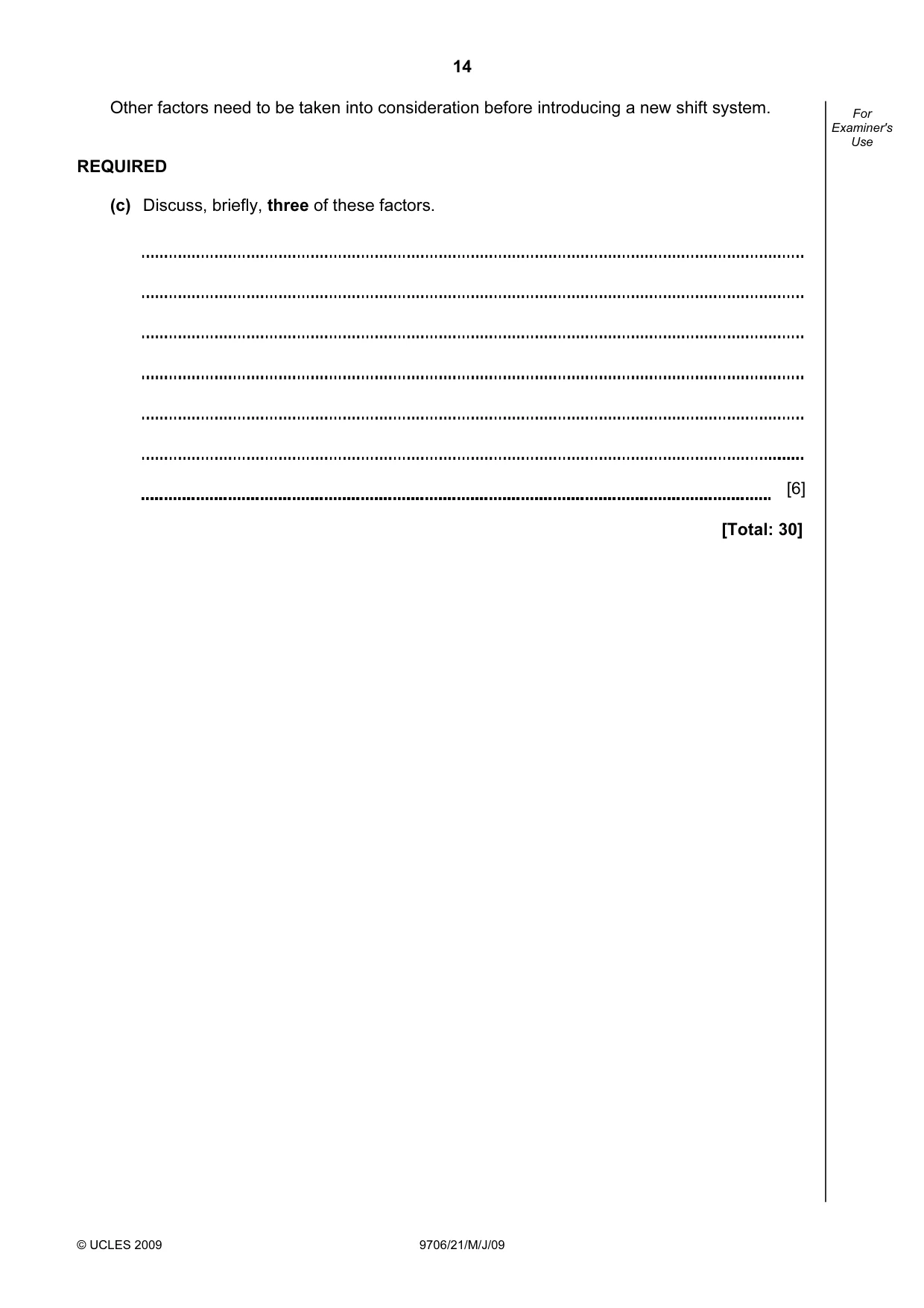
14 © UCLES 2009 9706/21/M/J/09 For Examiner's Use Other factors need to be taken into consideration before introducing a new shift system. REQUIRED (c) Discuss, briefly, three of these factors. [6] [Total: 30]
Question paper, page 17
16 BLANK PAGE Permission to reproduce items where third-party owned material protected by copyright is included has been sought and cleared where possible. Every reasonable effort has been made by the publisher (UCLES) to trace copyright holders, but if any items requiring clearance have unwittingly been included, the publisher will be pleased to make amends at the earliest possible opportunity. University of Cambridge International Examinations is part of the Cambridge Assessment Group. Cambridge Assessment is the brand name of University of Cambridge Local Examinations Syndicate (UCLES), which is itself a department of the University of Cambridge. 9706/21/M/J/09
Question paper, page 18
This document consists of 13 printed pages and 3 blank pages. IB09 06_9706_22/2RP © UCLES 2009 [Turn over *1480362445* For Examiner's Use 1 2 3 Total UNIVERSITY OF CAMBRIDGE INTERNATIONAL EXAMINATIONS General Certificate of Education Advanced Subsidiary Level and Advanced Level ACCOUNTING 9706/22 Paper 2 Structured Questions May/June 2009 1 hour 30 minutes Candidates answer on the Question Paper. No Additional Materials are required. READ THESE INSTRUCTIONS FIRST Write your Centre number, candidate number and name on all the work you hand in. Write in dark blue or black pen. You may use a soft pencil for rough working. Do not use staples, paper clips, highlighters, glue or correction fluid. DO NOT WRITE IN ANY BARCODES. Answer all questions. All accounting statements are to be presented in good style. Workings must be shown. You may use a calculator. At the end of the examination, fasten all your work securely together. The number of marks is given in brackets [ ] at the end of each question or part question. Second Variant Question Paper
Question paper, page 19
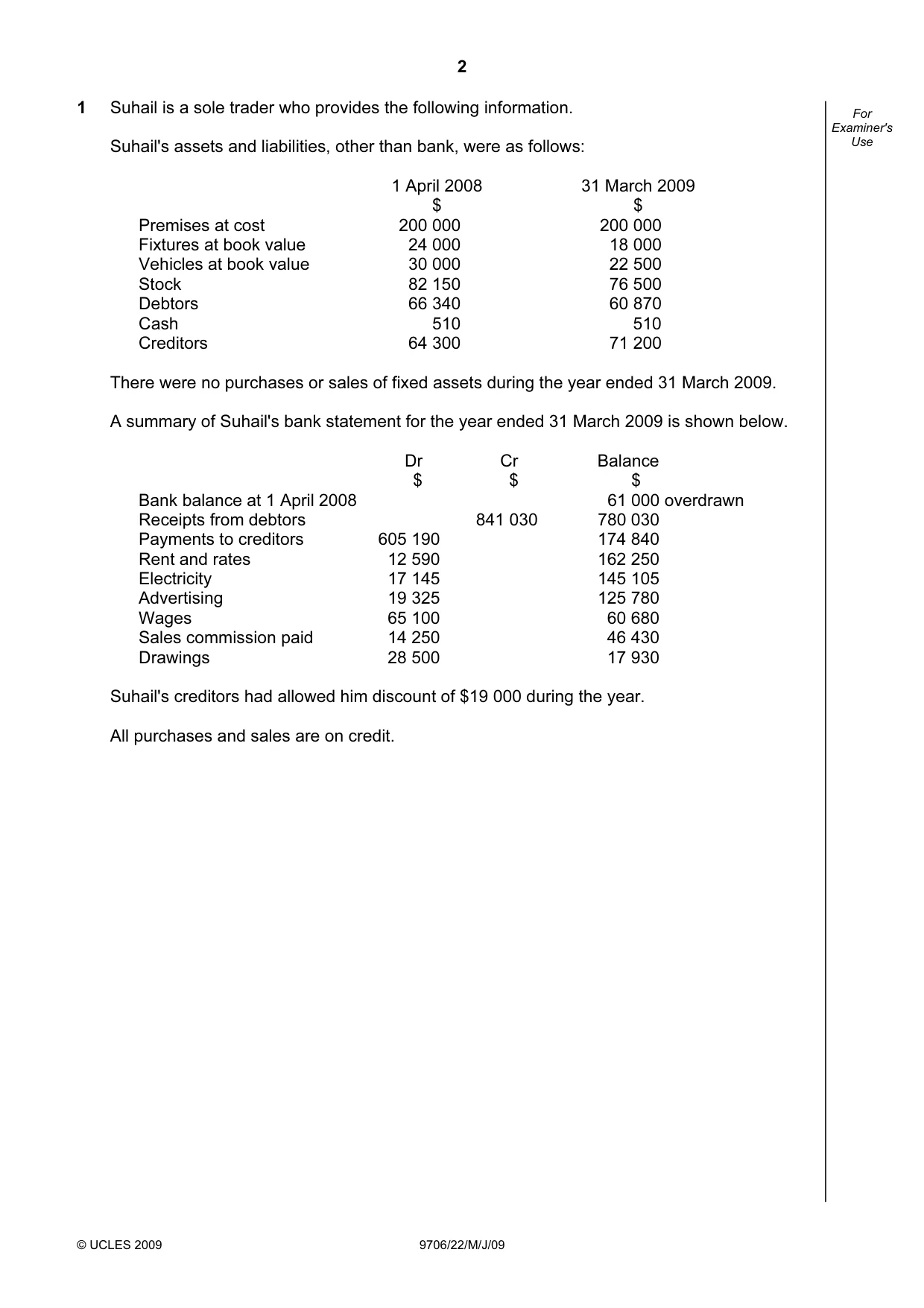
2 © UCLES 2009 9706/22/M/J/09 For Examiner's Use 1 Suhail is a sole trader who provides the following information. Suhail's assets and liabilities, other than bank, were as follows: 1 April 2008 31 March 2009 $ $ Premises at cost 200 000 200 000 Fixtures at book value 24 000 18 000 Vehicles at book value 30 000 22 500 Stock 82 150 76 500 Debtors 66 340 60 870 Cash 510 510 Creditors 64 300 71 200 There were no purchases or sales of fixed assets during the year ended 31 March 2009. A summary of Suhail's bank statement for the year ended 31 March 2009 is shown below. Dr Cr Balance $ $ $ Bank balance at 1 April 2008 61 000 overdrawn Receipts from debtors 841 030 780 030 Payments to creditors 605 190 174 840 Rent and rates 12 590 162 250 Electricity 17 145 145 105 Advertising 19 325 125 780 Wages 65 100 60 680 Sales commission paid 14 250 46 430 Drawings 28 500 17 930 Suhail's creditors had allowed him discount of $19 000 during the year. All purchases and sales are on credit.
Question paper, page 20
3 © UCLES 2009 9706/22/M/J/09 [Turn over For Examiner's Use REQUIRED (a) Prepare Suhail's trading and profit and loss account for the year ended 31 March 2009. [12]
Question paper, page 21
4 © UCLES 2009 9706/22/M/J/09 For Examiner's Use (b) Prepare Suhail's balance sheet at 31 March 2009. [9]
Question paper, page 22
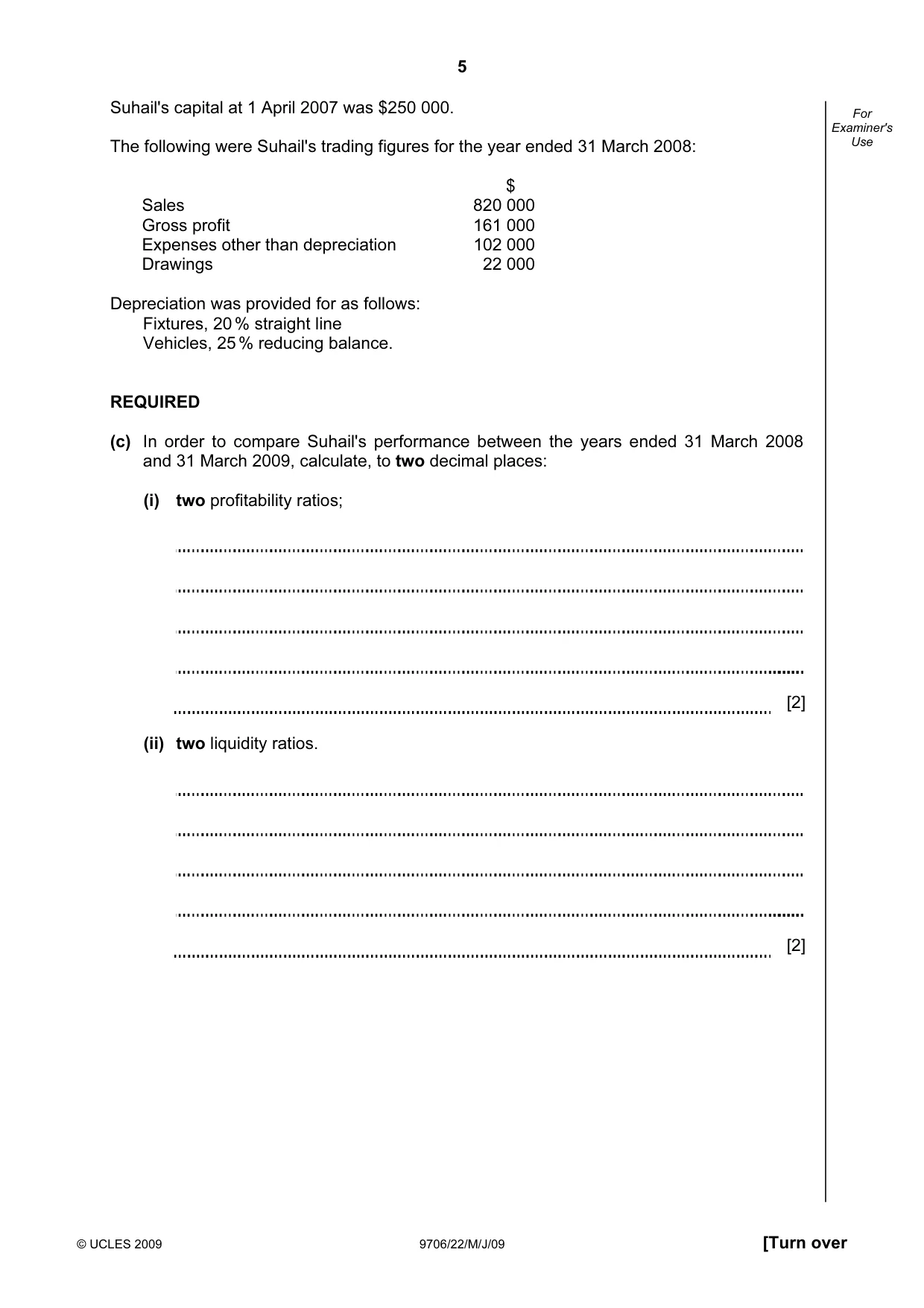
5 © UCLES 2009 9706/22/M/J/09 [Turn over For Examiner's Use Suhail's capital at 1 April 2007 was $250 000. The following were Suhail's trading figures for the year ended 31 March 2008: $ Sales 820 000 Gross profit 161 000 Expenses other than depreciation 102 000 Drawings 22 000 Depreciation was provided for as follows: Fixtures, 20 % straight line Vehicles, 25 % reducing balance. REQUIRED (c) In order to compare Suhail's performance between the years ended 31 March 2008 and 31 March 2009, calculate, to two decimal places: (i) two profitability ratios; [2] (ii) two liquidity ratios. [2]
Question paper, page 23
6 © UCLES 2009 9706/22/M/J/09 For Examiner's Use (iii) Using the ratios calculated in (c)(i) and (ii), comment briefly on Suhail's performance over the two years. [5] [Total: 30]
Question paper, page 24
7 BLANK PAGE 9706/22/M/J/09 [Turn over Question 2 is on the next page.
Question paper, page 25
8 © UCLES 2009 9706/22/M/J/09 For Examiner's Use 2 A During the year ended 31 March 2007 Jeremiah lost money through customers not paying the amounts due to him. On 1 April 2007 he set up a provision for doubtful debts account. REQUIRED (a) (i) Give one reason why Jeremiah decided to set up this account. [2] (ii) Describe two factors Jeremiah might consider when deciding the amount to be provided for in the provision for doubtful debts account. [2] (iii) Explain the difference between the accounting treatment of a bad debt and a doubtful debt. [2] On 1 April 2008, Jeremiah’s provision for doubtful debts account had a balance of $8000. This consisted of an anticipated loss of $2500 which was the total owed by a debtor, Uriah, who had been declared bankrupt, and a general provision of $5500, which was 2½ % of all of his debtors. On 31 May 2008 Liew, who owed Jeremiah $1200, paid Jeremiah only $0.40 for every dollar owed. The remainder was written off as a bad debt. On 30 June 2008, Uriah paid Jeremiah $0.35 for every dollar owed, in final settlement of his account. On 28 February 2009 Jeremiah wrote off $300 of overdue debts from various debtors. On 31 March 2009 Jeremiah’s total debtors amounted to $205 000 and he adjusted his provision for doubtful debts account to 3 % of that amount.
Question paper, page 26
9 © UCLES 2009 9706/22/M/J/09 [Turn over For Examiner's Use REQUIRED (b) Prepare in Jeremiah’s ledgers the following accounts for the year ended 31 March 2009. (i) Provision for doubtful debts account; [3] (ii) Bad debts account. [4] On 31 March 2009 Khalil, whose debt of $3000 had been written off in 2007, after he unexpectedly left the country, returned and paid the amount due. REQUIRED (iii) Prepare in Jeremiah’s ledgers the bad debts recovered account for the year ended 31 March 2009. [2]
Question paper, page 27
10 © UCLES 2009 9706/22/M/J/09 For Examiner's Use B Lari, a retailer whose financial year ends on 31 May, failed to check his stock until 8 June in 2009. At that date his stock at cost was valued at $72 200. Lari's mark-up is 30 % on cost. During the first 8 days of June, the following transactions took place: $ (i) Purchases of goods for resale 21 200 (ii) Purchases returns 510 (iii) Sales 25 740 (iv) Sales returns (at selling price) 273 (v) Goods taken for personal use, at cost 700 After taking stock, Lari discovered that the following items had been included in the valuation at 8 June: (vi) A parcel of stock which had been water-damaged. This had been on sale for $390 but was now worthless. (vii) Stock which had cost $1200 but was now out of fashion and would have to be sold for $400 less than cost. (viii) Goods costing $950 which Lari had acquired on a sale or return basis. He had not decided whether or not to keep them. (ix) Goods, sold during May for $1560, which were awaiting collection by a customer. REQUIRED (a) Explain the difference between mark-up and margin. [2]
Question paper, page 28
11 © UCLES 2009 9706/22/M/J/09 [Turn over For Examiner's Use (b) Prepare a statement to calculate the correct value of stock at cost at 31 May 2009. Begin your calculation with the original stock valuation of $72 200. Show all workings. [13] [Total: 30]
Question paper, page 29
12 © UCLES 2009 9706/22/M/J/09 For Examiner's Use 3 Alberta Limited produces one product, plates, for which the following information is available. $ per unit Selling price 12.00 Direct materials 5.00 Direct labour 2.80 Variable overheads 2.20 Total fixed costs (per annum) $240 000 Sales per annum (units) 400 000 REQUIRED (a) Using the information above, calculate the following: (i) break-even point in units and sales value; [6] (ii) profit for one year, clearly showing the contribution per unit; [4] (iii) margin of safety in units and as a percentage of sales. [4]
Question paper, page 30
13 © UCLES 2009 9706/22/M/J/09 [Turn over For Examiner's Use Alberta Limited is now considering extending the product range by adding two products, cups and saucers. The fixed costs would double to $480 000 if any new product was introduced. The following information is available for the additional products. Cups Saucers $ per unit $ per unit Selling price 18.00 26.00 Direct materials 7.20 14.00 Direct labour 4.80 4.20 Variable overheads 3.00 1.80 Sales per annum (units) 100 000 60 000 The current workforce is operating at full capacity in the production of the plates. There is, however, machine capacity available to undertake the production of both cups and saucers. Alberta Limited extended their product range by adding both products. REQUIRED (b) Calculate the maximum profit for one year that Alberta Limited could achieve if it was to produce plates, cups and saucers. Show the contribution per unit and total contribution for each product. [10]
Question paper, page 31
14 © UCLES 2009 9706/22/M/J/09 For Examiner's Use (c) Explain the implications for the local community if Alberta Limited decides to extend its product range. [6] [Total: 30]
Question paper, page 33
16 BLANK PAGE Permission to reproduce items where third-party owned material protected by copyright is included has been sought and cleared where possible. Every reasonable effort has been made by the publisher (UCLES) to trace copyright holders, but if any items requiring clearance have unwittingly been included, the publisher will be pleased to make amends at the earliest possible opportunity. University of Cambridge International Examinations is part of the Cambridge Assessment Group. Cambridge Assessment is the brand name of University of Cambridge Local Examinations Syndicate (UCLES), which is itself a department of the University of Cambridge. 9706/22/M/J/09
Mark scheme, page 1
Location Entry Codes As part of CIE’s continual commitment to maintaining best practice in assessment, CIE has begun to use different variants of some question papers for our most popular assessments with extremely large and widespread candidature, The question papers are closely related and the relationships between them have been thoroughly established using our assessment expertise. All versions of the paper give assessment of equal standard. The content assessed by the examination papers and the type of questions are unchanged. This change means that for this component there are now two variant Question Papers, Mark Schemes and Principal Examiner’s Reports where previously there was only one. For any individual country, it is intended that only one variant is used. This document contains both variants which will give all Centres access to even more past examination material than is usually the case. The diagram shows the relationship between the Question Papers, Mark Schemes and Principal Examiner’s Reports. Question Paper Mark Scheme Principal Examiner’s Report Introduction Introduction Introduction First variant Question Paper First variant Mark Scheme First variant Principal Examiner’s Report Second variant Question Paper Second variant Mark Scheme Second variant Principal Examiner’s Report Who can I contact for further information on these changes? Please direct any questions about this to CIE’s Customer Services team at: international@cie.org.uk
Mark scheme, page 2
UNIVERSITY OF CAMBRIDGE INTERNATIONAL EXAMINATIONS GCE Advanced Subsidiary Level and GCE Advanced Level MARK SCHEME for the May/June 2009 question paper for the guidance of teachers 9706 ACCOUNTING 9706/21 Paper 2 (Structured Questions – Core), maximum raw mark 90 This mark scheme is published as an aid to teachers and candidates, to indicate the requirements of the examination. It shows the basis on which Examiners were instructed to award marks. It does not indicate the details of the discussions that took place at an Examiners’ meeting before marking began, which would have considered the acceptability of alternative answers. Mark schemes must be read in conjunction with the question papers and the report on the examination. • CIE will not enter into discussions or correspondence in connection with these mark schemes. CIE is publishing the mark schemes for the May/June 2009 question papers for most IGCSE, GCE Advanced Level and Advanced Subsidiary Level syllabuses and some Ordinary Level syllabuses. First variant Mark Scheme
Mark scheme, page 3
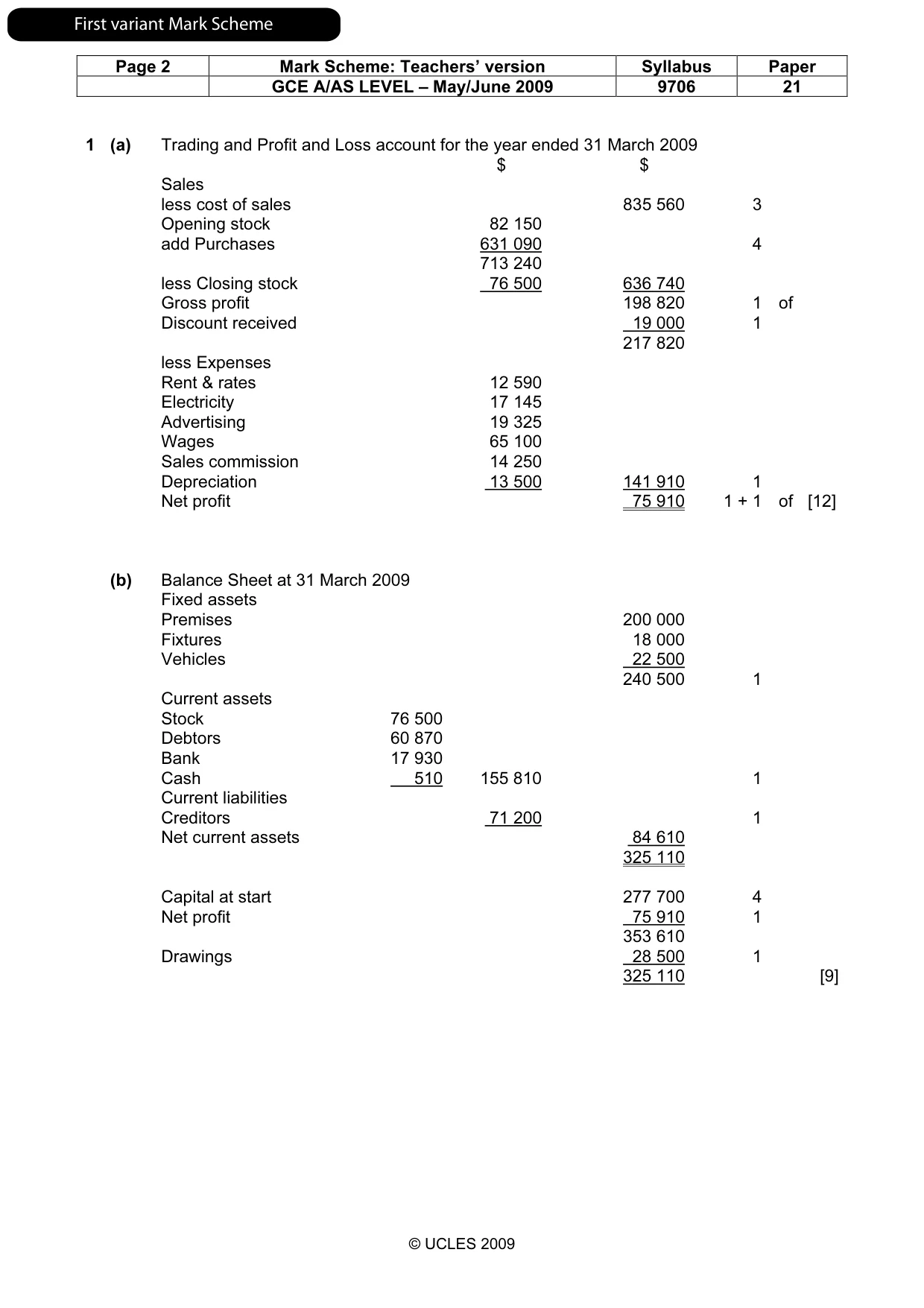
Page 2 Mark Scheme: Teachers’ version Syllabus Paper GCE A/AS LEVEL – May/June 2009 9706 21 © UCLES 2009 1 (a) Trading and Profit and Loss account for the year ended 31 March 2009 $ $ Sales less cost of sales 835 560 3 Opening stock 82 150 add Purchases 631 090 4 713 240 less Closing stock 76 500 636 740 Gross profit 198 820 1 of Discount received 19 000 1 217 820 less Expenses Rent & rates 12 590 Electricity 17 145 Advertising 19 325 Wages 65 100 Sales commission 14 250 Depreciation 13 500 141 910 1 Net profit 75 910 1 + 1 of [12] (b) Balance Sheet at 31 March 2009 Fixed assets Premises 200 000 Fixtures 18 000 Vehicles 22 500 240 500 1 Current assets Stock 76 500 Debtors 60 870 Bank 17 930 Cash 510 155 810 1 Current liabilities Creditors 71 200 1 Net current assets 84 610 325 110 Capital at start 277 700 4 Net profit 75 910 1 353 610 Drawings 28 500 1 325 110 [9] First variant Mark Scheme
Mark scheme, page 4
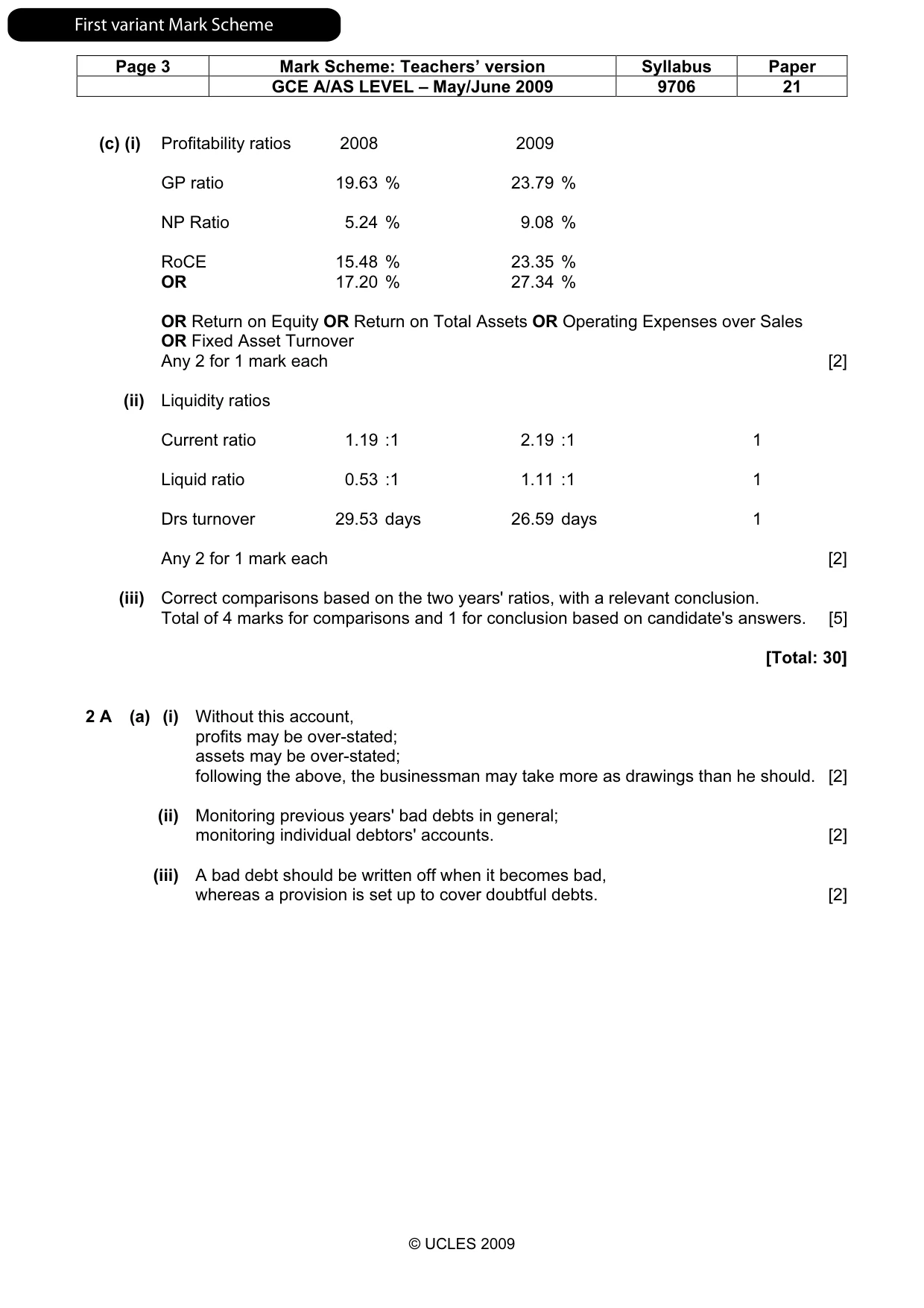
Page 3 Mark Scheme: Teachers’ version Syllabus Paper GCE A/AS LEVEL – May/June 2009 9706 21 © UCLES 2009 (c) (i) Profitability ratios 2008 2009 GP ratio 19.63 % 23.79 % NP Ratio 5.24 % 9.08 % RoCE 15.48 % 23.35 % OR 17.20 % 27.34 % OR Return on Equity OR Return on Total Assets OR Operating Expenses over Sales OR Fixed Asset Turnover Any 2 for 1 mark each [2] (ii) Liquidity ratios Current ratio 1.19 :1 2.19 :1 1 Liquid ratio 0.53 :1 1.11 :1 1 Drs turnover 29.53 days 26.59 days 1 Any 2 for 1 mark each [2] (iii) Correct comparisons based on the two years' ratios, with a relevant conclusion. Total of 4 marks for comparisons and 1 for conclusion based on candidate's answers. [5] [Total: 30] 2 A (a) (i) Without this account, profits may be over-stated; assets may be over-stated; following the above, the businessman may take more as drawings than he should. [2] (ii) Monitoring previous years' bad debts in general; monitoring individual debtors' accounts. [2] (iii) A bad debt should be written off when it becomes bad, whereas a provision is set up to cover doubtful debts. [2] First variant Mark Scheme
Mark scheme, page 5
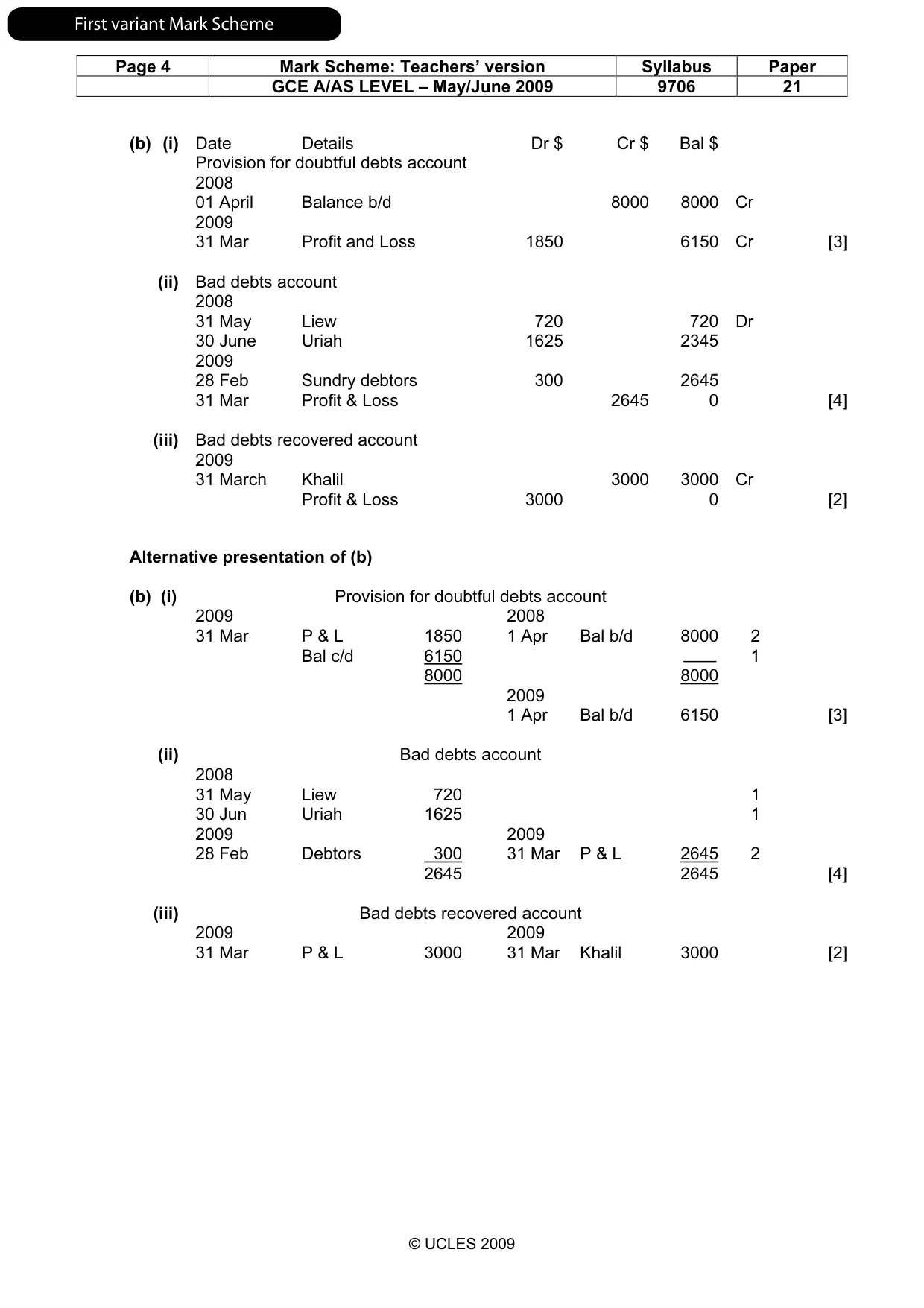
Page 4 Mark Scheme: Teachers’ version Syllabus Paper GCE A/AS LEVEL – May/June 2009 9706 21 © UCLES 2009 (b) (i) Date Details Dr $ Cr $ Bal $ Provision for doubtful debts account 2008 01 April Balance b/d 8000 8000 Cr 2009 31 Mar Profit and Loss 1850 6150 Cr [3] (ii) Bad debts account 2008 31 May Liew 720 720 Dr 30 June Uriah 1625 2345 2009 28 Feb Sundry debtors 300 2645 31 Mar Profit & Loss 2645 0 [4] (iii) Bad debts recovered account 2009 31 March Khalil 3000 3000 Cr Profit & Loss 3000 0 [2] Alternative presentation of (b) (b) (i) Provision for doubtful debts account 2009 2008 31 Mar P & L 1850 1 Apr Bal b/d 8000 2 Bal c/d 6150 1 8000 8000 2009 1 Apr Bal b/d 6150 [3] (ii) Bad debts account 2008 31 May Liew 720 1 30 Jun Uriah 1625 1 2009 2009 28 Feb Debtors 300 31 Mar P & L 2645 2 2645 2645 [4] (iii) Bad debts recovered account 2009 2009 31 Mar P & L 3000 31 Mar Khalil 3000 [2] First variant Mark Scheme
Mark scheme, page 6
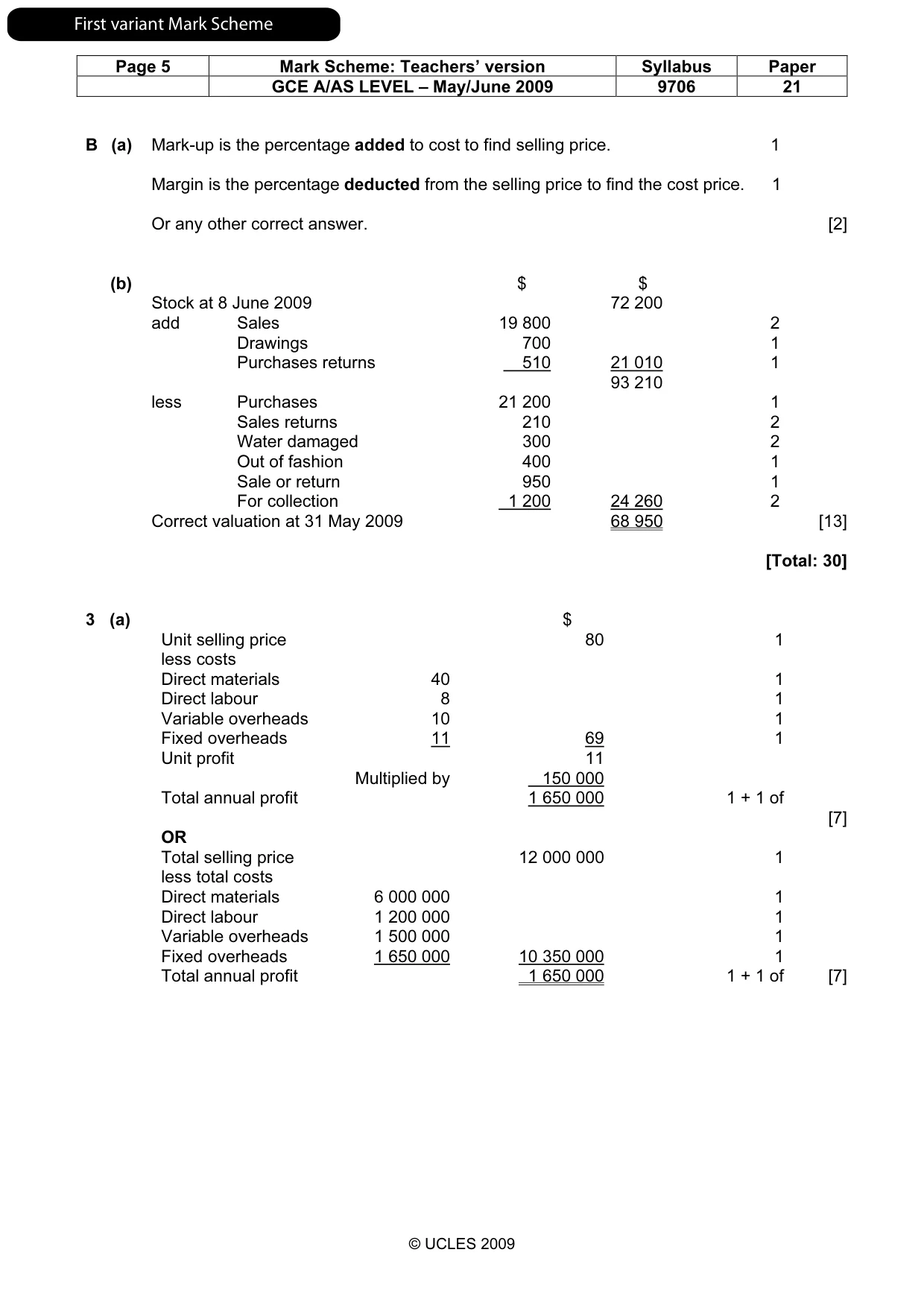
Page 5 Mark Scheme: Teachers’ version Syllabus Paper GCE A/AS LEVEL – May/June 2009 9706 21 © UCLES 2009 B (a) Mark-up is the percentage added to cost to find selling price. 1 Margin is the percentage deducted from the selling price to find the cost price. 1 Or any other correct answer. [2] (b) $ $ Stock at 8 June 2009 72 200 add Sales 19 800 2 Drawings 700 1 Purchases returns 510 21 010 1 93 210 less Purchases 21 200 1 Sales returns 210 2 Water damaged 300 2 Out of fashion 400 1 Sale or return 950 1 For collection 1 200 24 260 2 Correct valuation at 31 May 2009 68 950 [13] [Total: 30] 3 (a) $ Unit selling price 80 1 less costs Direct materials 40 1 Direct labour 8 1 Variable overheads 10 1 Fixed overheads 11 69 1 Unit profit 11 Multiplied by 150 000 Total annual profit 1 650 000 1 + 1 of [7] OR Total selling price 12 000 000 1 less total costs Direct materials 6 000 000 1 Direct labour 1 200 000 1 Variable overheads 1 500 000 1 Fixed overheads 1 650 000 10 350 000 1 Total annual profit 1 650 000 1 + 1 of [7] First variant Mark Scheme
Mark scheme, page 7
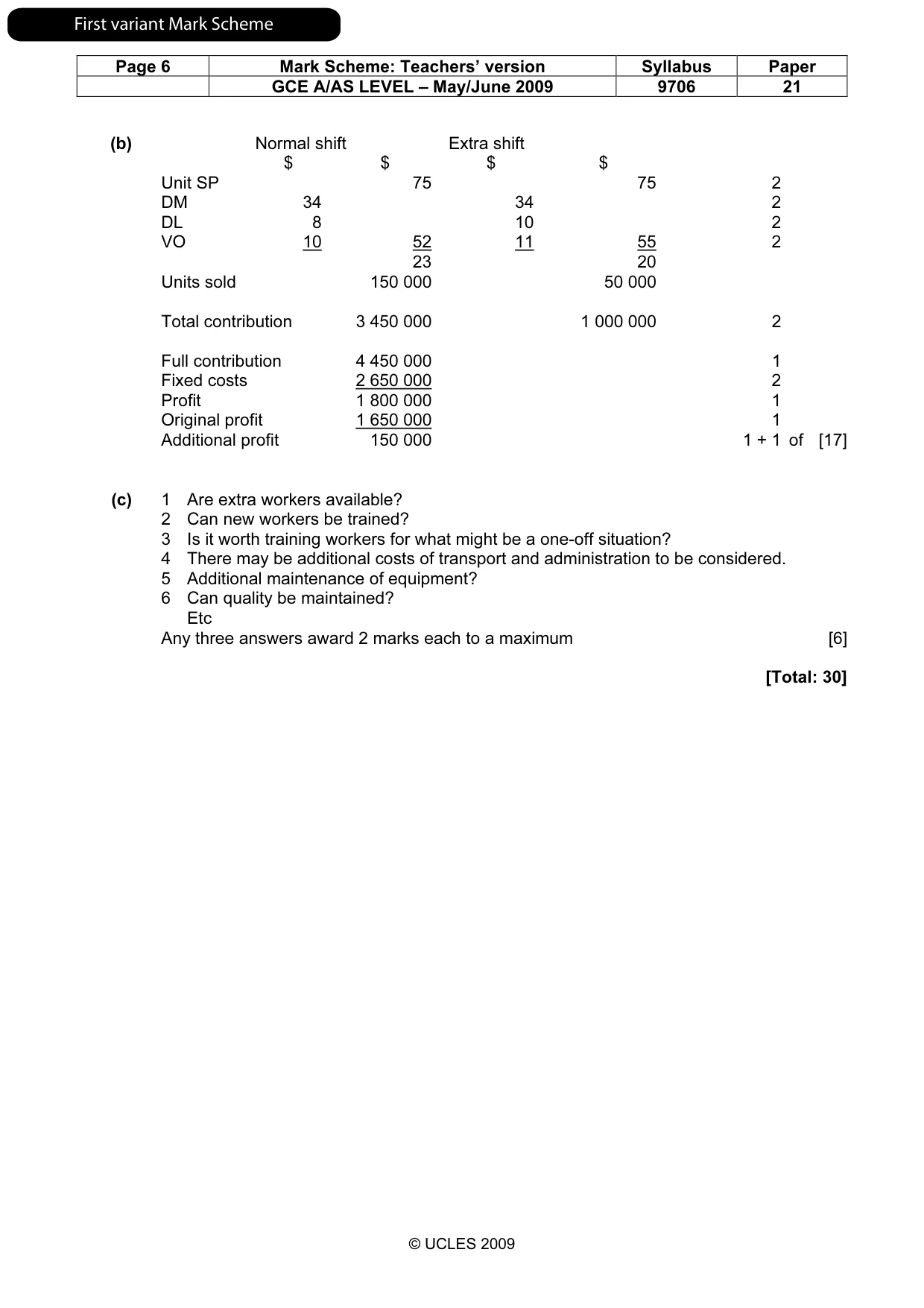
Page 6 Mark Scheme: Teachers’ version Syllabus Paper GCE A/AS LEVEL – May/June 2009 9706 21 © UCLES 2009 (b) Normal shift Extra shift $ $ $ $ Unit SP 75 75 2 DM 34 34 2 DL 8 10 2 VO 10 52 11 55 2 23 20 Units sold 150 000 50 000 Total contribution 3 450 000 1 000 000 2 Full contribution 4 450 000 1 Fixed costs 2 650 000 2 Profit 1 800 000 1 Original profit 1 650 000 1 Additional profit 150 000 1 + 1 of [17] (c) 1 Are extra workers available? 2 Can new workers be trained? 3 Is it worth training workers for what might be a one-off situation? 4 There may be additional costs of transport and administration to be considered. 5 Additional maintenance of equipment? 6 Can quality be maintained? Etc Any three answers award 2 marks each to a maximum [6] [Total: 30] First variant Mark Scheme
Mark scheme, page 8
UNIVERSITY OF CAMBRIDGE INTERNATIONAL EXAMINATIONS GCE Advanced Subsidiary Level and GCE Advanced Level MARK SCHEME for the May/June 2009 question paper for the guidance of teachers 9706 ACCOUNTING 9706/22 Paper 2 (Structured Questions – Core), maximum raw mark 90 This mark scheme is published as an aid to teachers and candidates, to indicate the requirements of the examination. It shows the basis on which Examiners were instructed to award marks. It does not indicate the details of the discussions that took place at an Examiners’ meeting before marking began, which would have considered the acceptability of alternative answers. Mark schemes must be read in conjunction with the question papers and the report on the examination. • CIE will not enter into discussions or correspondence in connection with these mark schemes. CIE is publishing the mark schemes for the May/June 2009 question papers for most IGCSE, GCE Advanced Level and Advanced Subsidiary Level syllabuses and some Ordinary Level syllabuses. Second variant Mark Scheme
Mark scheme, page 9
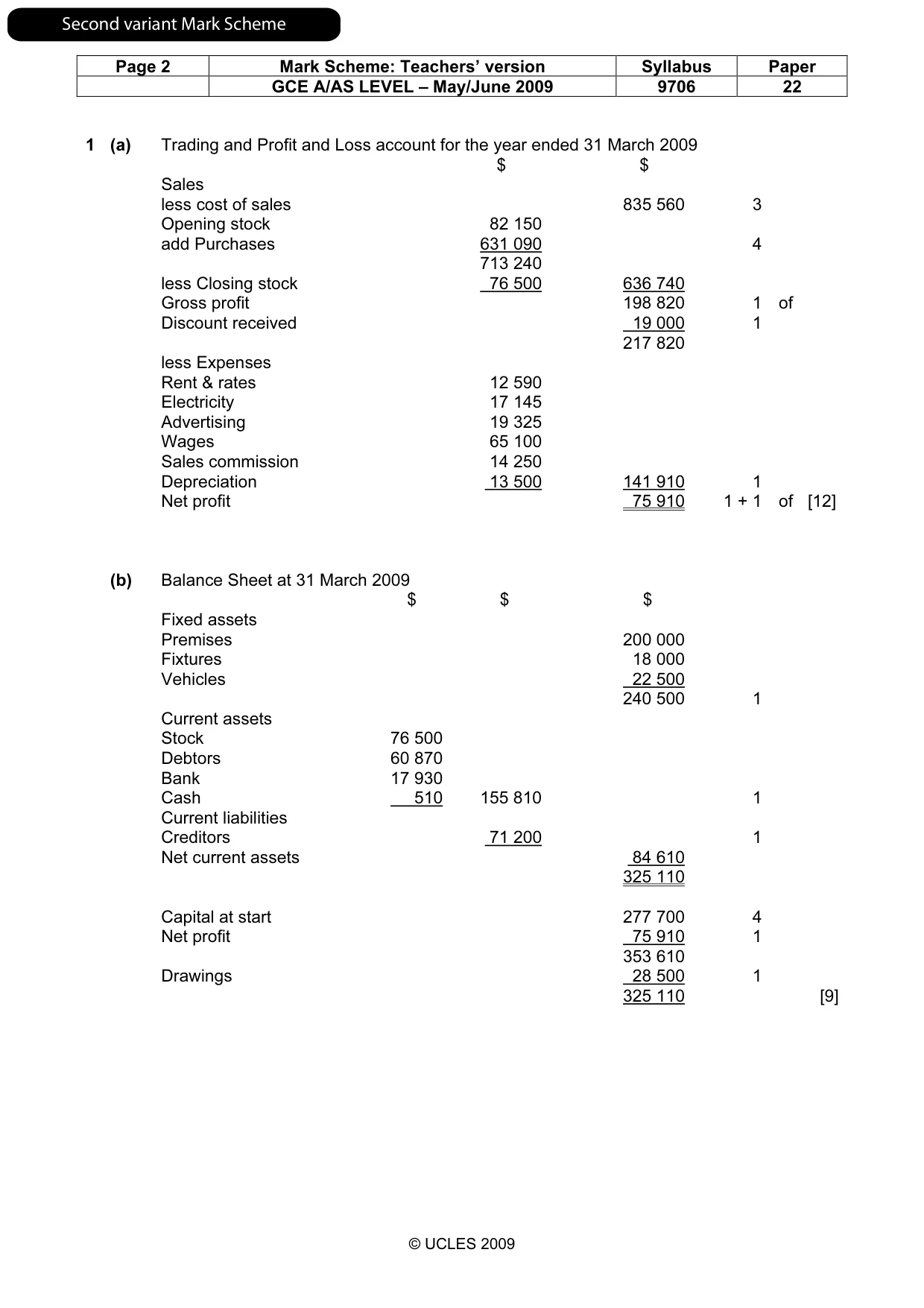
Page 2 Mark Scheme: Teachers’ version Syllabus Paper GCE A/AS LEVEL – May/June 2009 9706 22 © UCLES 2009 1 (a) Trading and Profit and Loss account for the year ended 31 March 2009 $ $ Sales less cost of sales 835 560 3 Opening stock 82 150 add Purchases 631 090 4 713 240 less Closing stock 76 500 636 740 Gross profit 198 820 1 of Discount received 19 000 1 217 820 less Expenses Rent & rates 12 590 Electricity 17 145 Advertising 19 325 Wages 65 100 Sales commission 14 250 Depreciation 13 500 141 910 1 Net profit 75 910 1 + 1 of [12] (b) Balance Sheet at 31 March 2009 $ $ $ Fixed assets Premises 200 000 Fixtures 18 000 Vehicles 22 500 240 500 1 Current assets Stock 76 500 Debtors 60 870 Bank 17 930 Cash 510 155 810 1 Current liabilities Creditors 71 200 1 Net current assets 84 610 325 110 Capital at start 277 700 4 Net profit 75 910 1 353 610 Drawings 28 500 1 325 110 [9] Second variant Mark Scheme
Mark scheme, page 10
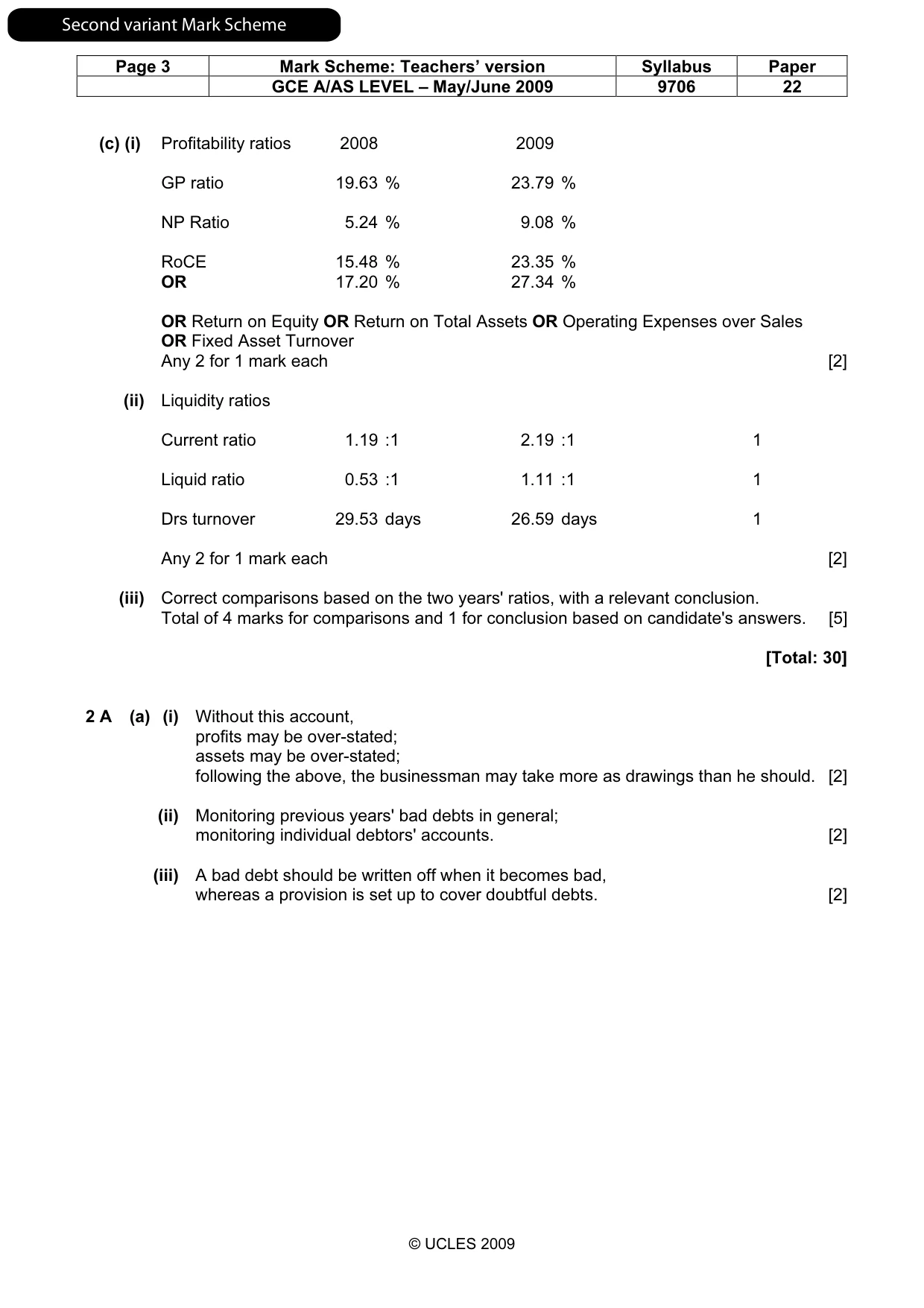
Page 3 Mark Scheme: Teachers’ version Syllabus Paper GCE A/AS LEVEL – May/June 2009 9706 22 © UCLES 2009 (c) (i) Profitability ratios 2008 2009 GP ratio 19.63 % 23.79 % NP Ratio 5.24 % 9.08 % RoCE 15.48 % 23.35 % OR 17.20 % 27.34 % OR Return on Equity OR Return on Total Assets OR Operating Expenses over Sales OR Fixed Asset Turnover Any 2 for 1 mark each [2] (ii) Liquidity ratios Current ratio 1.19 :1 2.19 :1 1 Liquid ratio 0.53 :1 1.11 :1 1 Drs turnover 29.53 days 26.59 days 1 Any 2 for 1 mark each [2] (iii) Correct comparisons based on the two years' ratios, with a relevant conclusion. Total of 4 marks for comparisons and 1 for conclusion based on candidate's answers. [5] [Total: 30] 2 A (a) (i) Without this account, profits may be over-stated; assets may be over-stated; following the above, the businessman may take more as drawings than he should. [2] (ii) Monitoring previous years' bad debts in general; monitoring individual debtors' accounts. [2] (iii) A bad debt should be written off when it becomes bad, whereas a provision is set up to cover doubtful debts. [2] Second variant Mark Scheme
Mark scheme, page 11
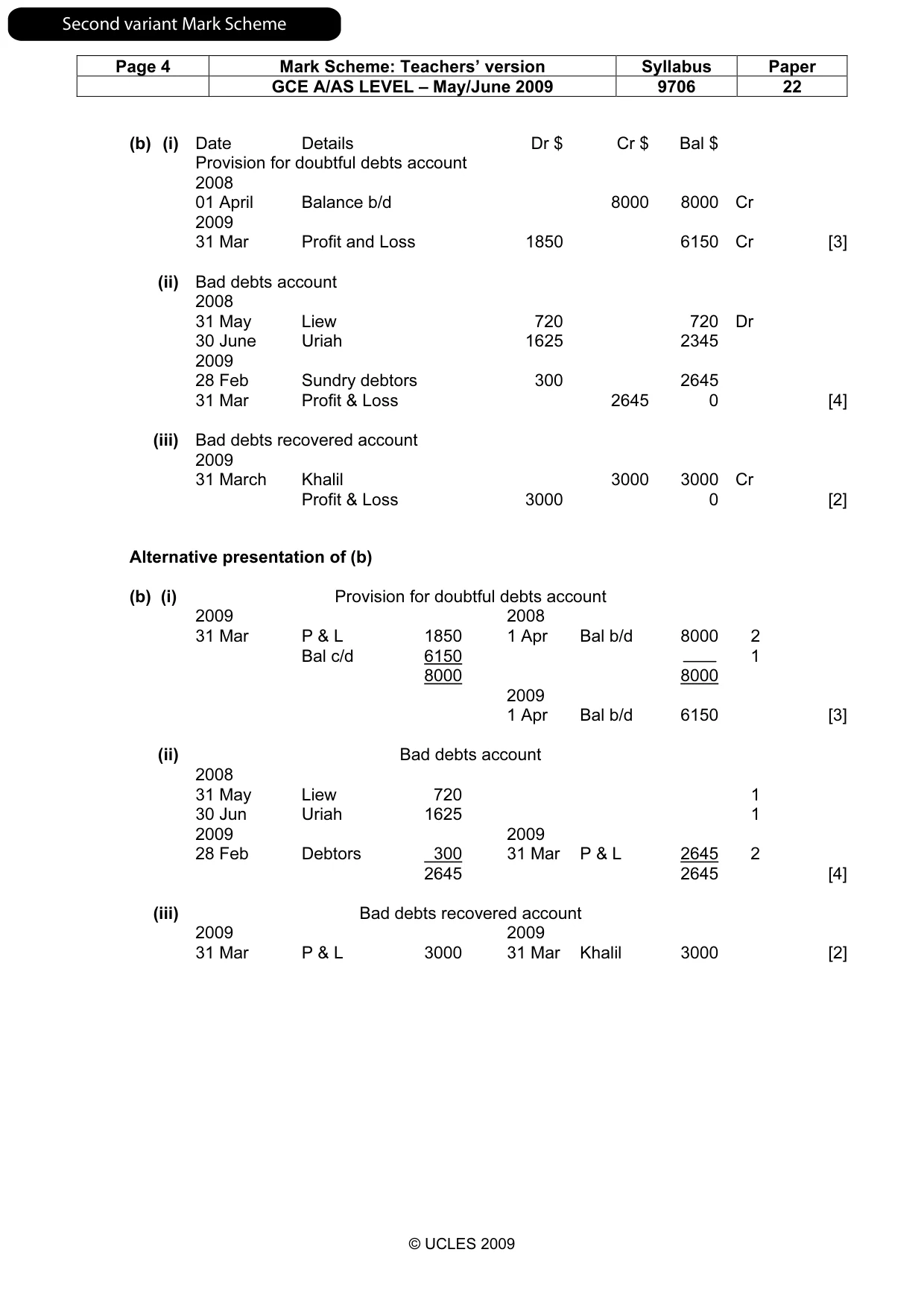
Page 4 Mark Scheme: Teachers’ version Syllabus Paper GCE A/AS LEVEL – May/June 2009 9706 22 © UCLES 2009 (b) (i) Date Details Dr $ Cr $ Bal $ Provision for doubtful debts account 2008 01 April Balance b/d 8000 8000 Cr 2009 31 Mar Profit and Loss 1850 6150 Cr [3] (ii) Bad debts account 2008 31 May Liew 720 720 Dr 30 June Uriah 1625 2345 2009 28 Feb Sundry debtors 300 2645 31 Mar Profit & Loss 2645 0 [4] (iii) Bad debts recovered account 2009 31 March Khalil 3000 3000 Cr Profit & Loss 3000 0 [2] Alternative presentation of (b) (b) (i) Provision for doubtful debts account 2009 2008 31 Mar P & L 1850 1 Apr Bal b/d 8000 2 Bal c/d 6150 1 8000 8000 2009 1 Apr Bal b/d 6150 [3] (ii) Bad debts account 2008 31 May Liew 720 1 30 Jun Uriah 1625 1 2009 2009 28 Feb Debtors 300 31 Mar P & L 2645 2 2645 2645 [4] (iii) Bad debts recovered account 2009 2009 31 Mar P & L 3000 31 Mar Khalil 3000 [2] Second variant Mark Scheme
Mark scheme, page 12
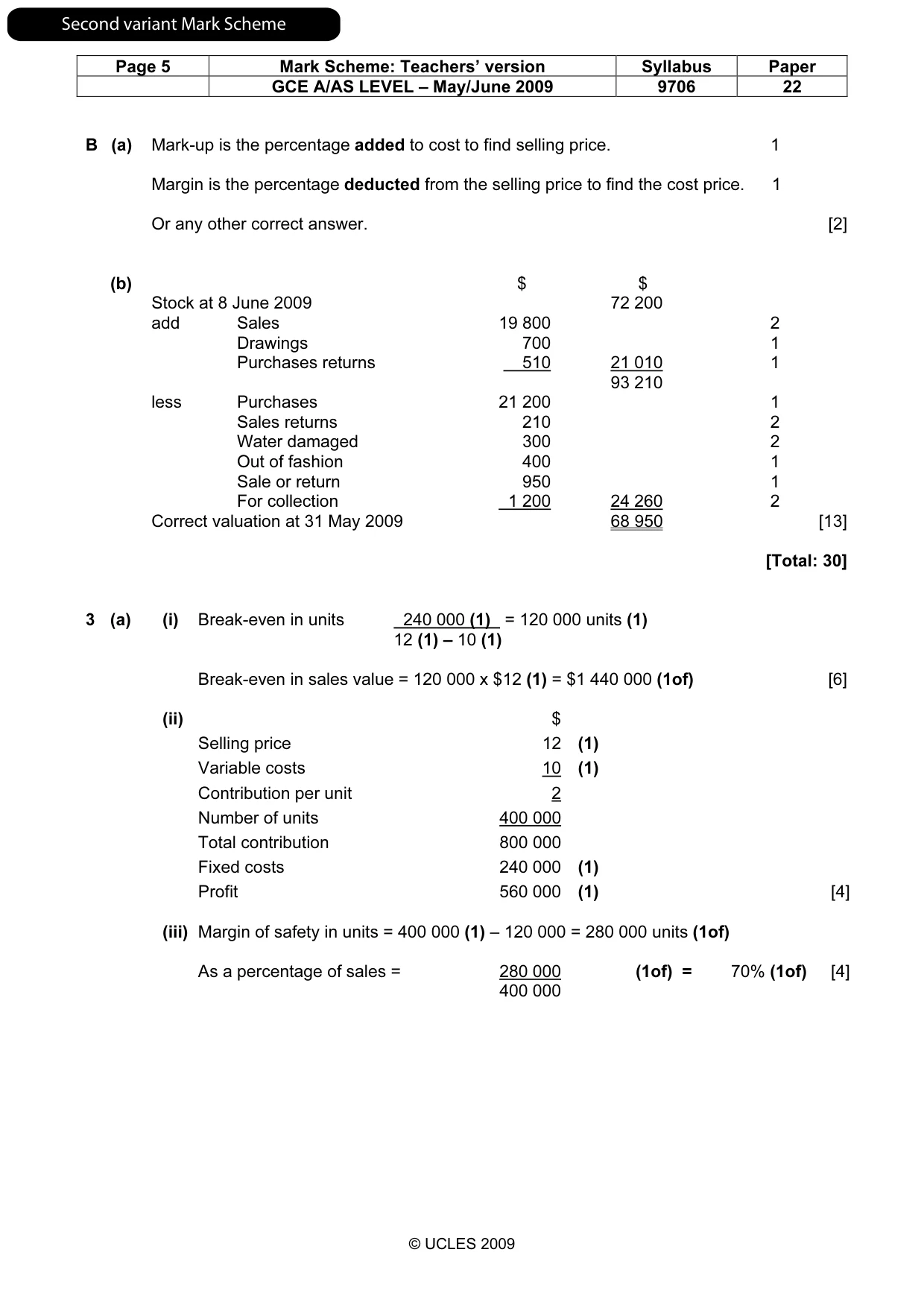
Page 5 Mark Scheme: Teachers’ version Syllabus Paper GCE A/AS LEVEL – May/June 2009 9706 22 © UCLES 2009 B (a) Mark-up is the percentage added to cost to find selling price. 1 Margin is the percentage deducted from the selling price to find the cost price. 1 Or any other correct answer. [2] (b) $ $ Stock at 8 June 2009 72 200 add Sales 19 800 2 Drawings 700 1 Purchases returns 510 21 010 1 93 210 less Purchases 21 200 1 Sales returns 210 2 Water damaged 300 2 Out of fashion 400 1 Sale or return 950 1 For collection 1 200 24 260 2 Correct valuation at 31 May 2009 68 950 [13] [Total: 30] 3 (a) (i) Break-even in units 240 000 (1) = 120 000 units (1) 12 (1) – 10 (1) Break-even in sales value = 120 000 x $12 (1) = $1 440 000 (1of) [6] (ii) $ Selling price 12 (1) Variable costs 10 (1) Contribution per unit 2 Number of units 400 000 Total contribution 800 000 Fixed costs 240 000 (1) Profit 560 000 (1) [4] (iii) Margin of safety in units = 400 000 (1) – 120 000 = 280 000 units (1of) As a percentage of sales = 280 000 (1of) = 70% (1of) [4] 400 000 Second variant Mark Scheme
Mark scheme, page 13
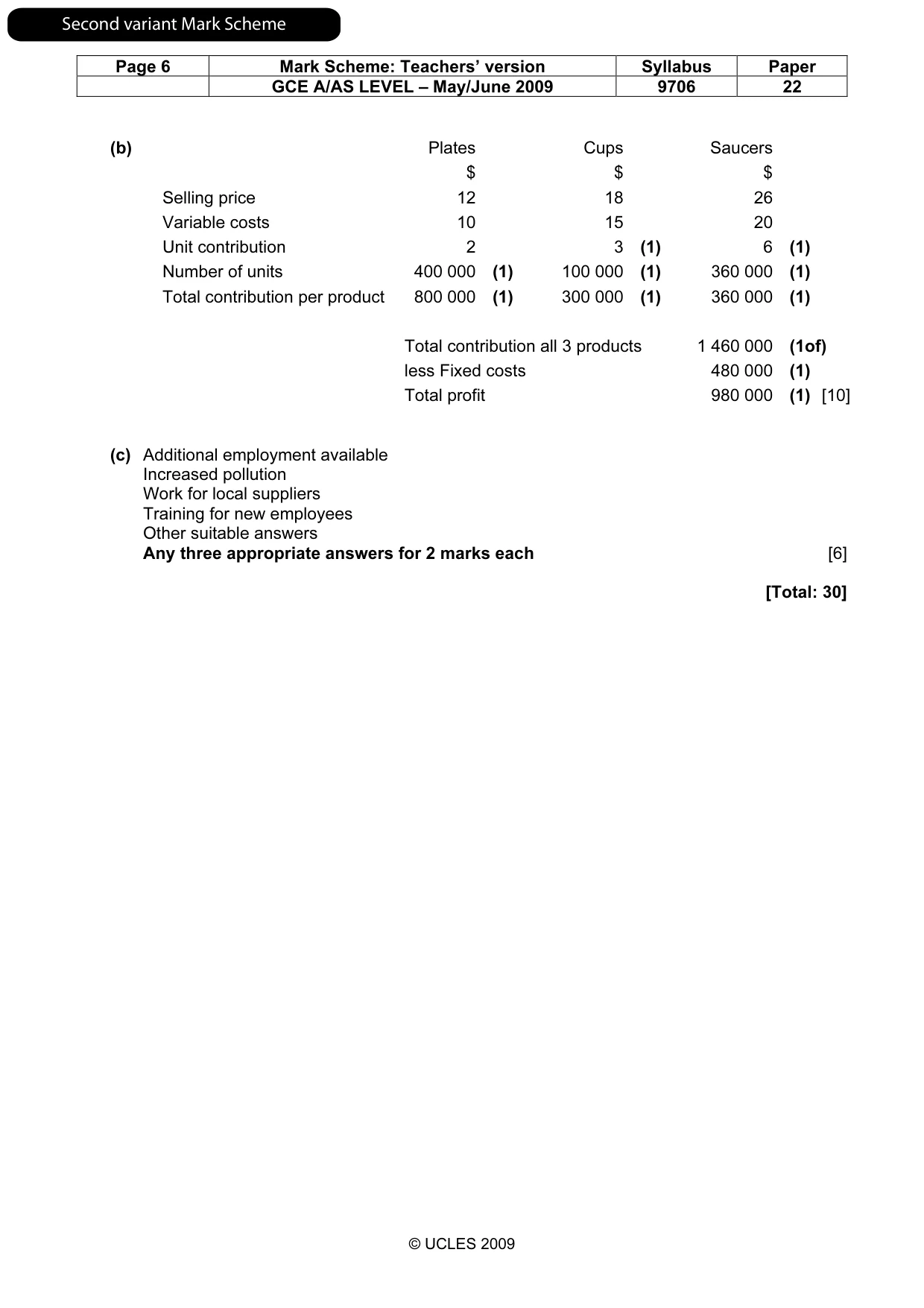
Page 6 Mark Scheme: Teachers’ version Syllabus Paper GCE A/AS LEVEL – May/June 2009 9706 22 © UCLES 2009 (b) Plates Cups Saucers $ $ $ Selling price 12 18 26 Variable costs 10 15 20 Unit contribution 2 3 (1) 6 (1) Number of units 400 000 (1) 100 000 (1) 360 000 (1) Total contribution per product 800 000 (1) 300 000 (1) 360 000 (1) Total contribution all 3 products 1 460 000 (1of) less Fixed costs 480 000 (1) Total profit 980 000 (1) [10] (c) Additional employment available Increased pollution Work for local suppliers Training for new employees Other suitable answers Any three appropriate answers for 2 marks each [6] [Total: 30] Second variant Mark Scheme