Cambridge A Level Accounting 9706 — 2008 May/June Paper 2 · Variant 1
9706/21/M/J/08 · 90 marks · ≈101 min
The question paper and its mark scheme, free to read here and free to download. This is Cambridge’s own paper, exactly as it was sat.
Question paper16 pages


Mark scheme8 pages
Answers below. Sit the paper first if you are practising.
Paper as text
Question paper, page 1
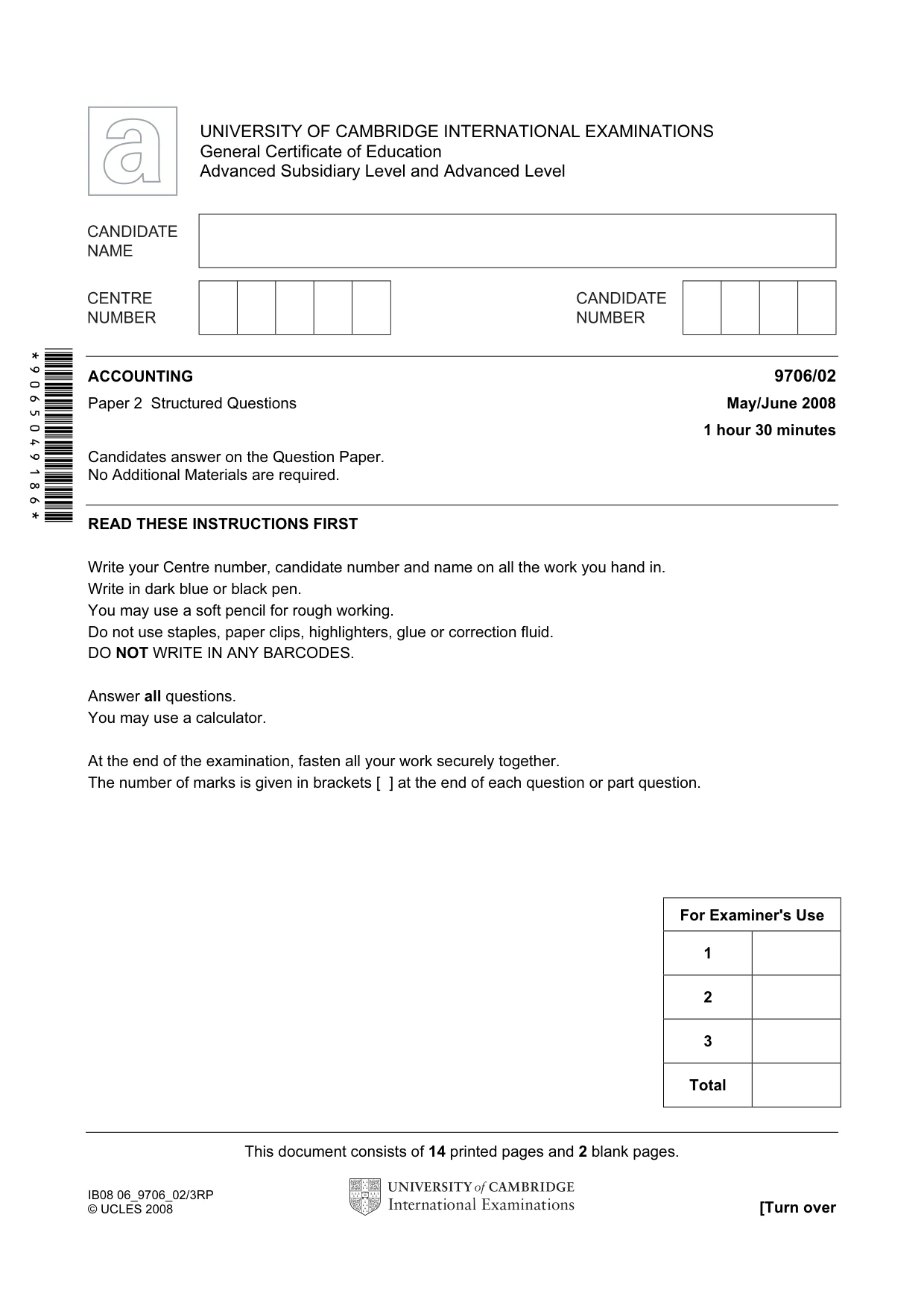
This document consists of 14 printed pages and 2 blank pages. IB08 06_9706_02/3RP © UCLES 2008 [Turn over *9065049186* For Examiner's Use 1 2 3 Total UNIVERSITY OF CAMBRIDGE INTERNATIONAL EXAMINATIONS General Certificate of Education Advanced Subsidiary Level and Advanced Level ACCOUNTING 9706/02 Paper 2 Structured Questions May/June 2008 1 hour 30 minutes Candidates answer on the Question Paper. No Additional Materials are required. READ THESE INSTRUCTIONS FIRST Write your Centre number, candidate number and name on all the work you hand in. Write in dark blue or black pen. You may use a soft pencil for rough working. Do not use staples, paper clips, highlighters, glue or correction fluid. DO NOT WRITE IN ANY BARCODES. Answer all questions. You may use a calculator. At the end of the examination, fasten all your work securely together. The number of marks is given in brackets [ ] at the end of each question or part question.
Question paper, page 2
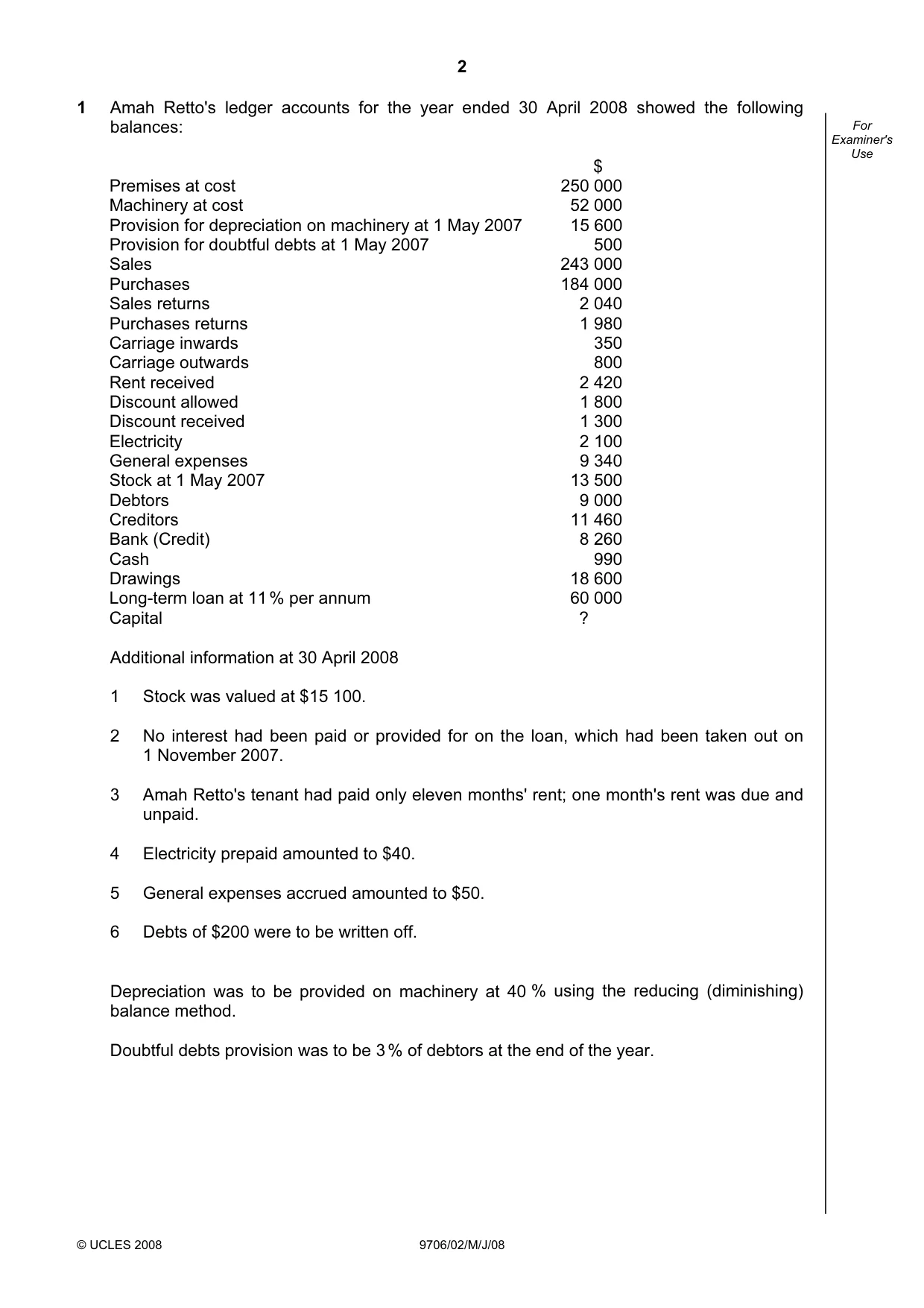
2 © UCLES 2008 9706/02/M/J/08 For Examiner's Use 1 Amah Retto's ledger accounts for the year ended 30 April 2008 showed the following balances: $ Premises at cost 250 000 Machinery at cost 52 000 Provision for depreciation on machinery at 1 May 2007 15 600 Provision for doubtful debts at 1 May 2007 500 Sales 243 000 Purchases 184 000 Sales returns 2 040 Purchases returns 1 980 Carriage inwards 350 Carriage outwards 800 Rent received 2 420 Discount allowed 1 800 Discount received 1 300 Electricity 2 100 General expenses 9 340 Stock at 1 May 2007 13 500 Debtors 9 000 Creditors 11 460 Bank (Credit) 8 260 Cash 990 Drawings 18 600 Long-term loan at 11 % per annum 60 000 Capital ? Additional information at 30 April 2008 1 Stock was valued at $15 100. 2 No interest had been paid or provided for on the loan, which had been taken out on 1 November 2007. 3 Amah Retto's tenant had paid only eleven months' rent; one month's rent was due and unpaid. 4 Electricity prepaid amounted to $40. 5 General expenses accrued amounted to $50. 6 Debts of $200 were to be written off. Depreciation was to be provided on machinery at 40 % using the reducing (diminishing) balance method. Doubtful debts provision was to be 3 % of debtors at the end of the year.
Question paper, page 3
3 © UCLES 2008 9706/02/M/J/08 [Turn over For Examiner's Use REQUIRED (a) Prepare Amah Retto's trading and profit and loss account for the year ended 30 April 2008. [8]
Question paper, page 4
4 © UCLES 2008 9706/02/M/J/08 For Examiner's Use (b) Prepare Amah Retto's balance sheet at 30 April 2008.
Question paper, page 5
5 © UCLES 2008 9706/02/M/J/08 [Turn over For Examiner's Use [11] (c) Use the answers to (a) and (b) to calculate the following ratios to two decimal places. (i) Current ratio; (ii) Liquid ratio; (iii) Rate of stock turnover; (iv) Gross profit as a percentage of sales; (v) Net profit as a percentage of sales. [5]
Question paper, page 6
6 © UCLES 2008 9706/02/M/J/08 For Examiner's Use (d) (i) State two reasons for calculating ratios. [2] (ii) State four user groups who might be interested in or make use of accounting ratios. [4] [Total: 30]
Question paper, page 7
7 BLANK PAGE 9706/02/M/J/08 [Turn over Question 2 is on the next page.
Question paper, page 8
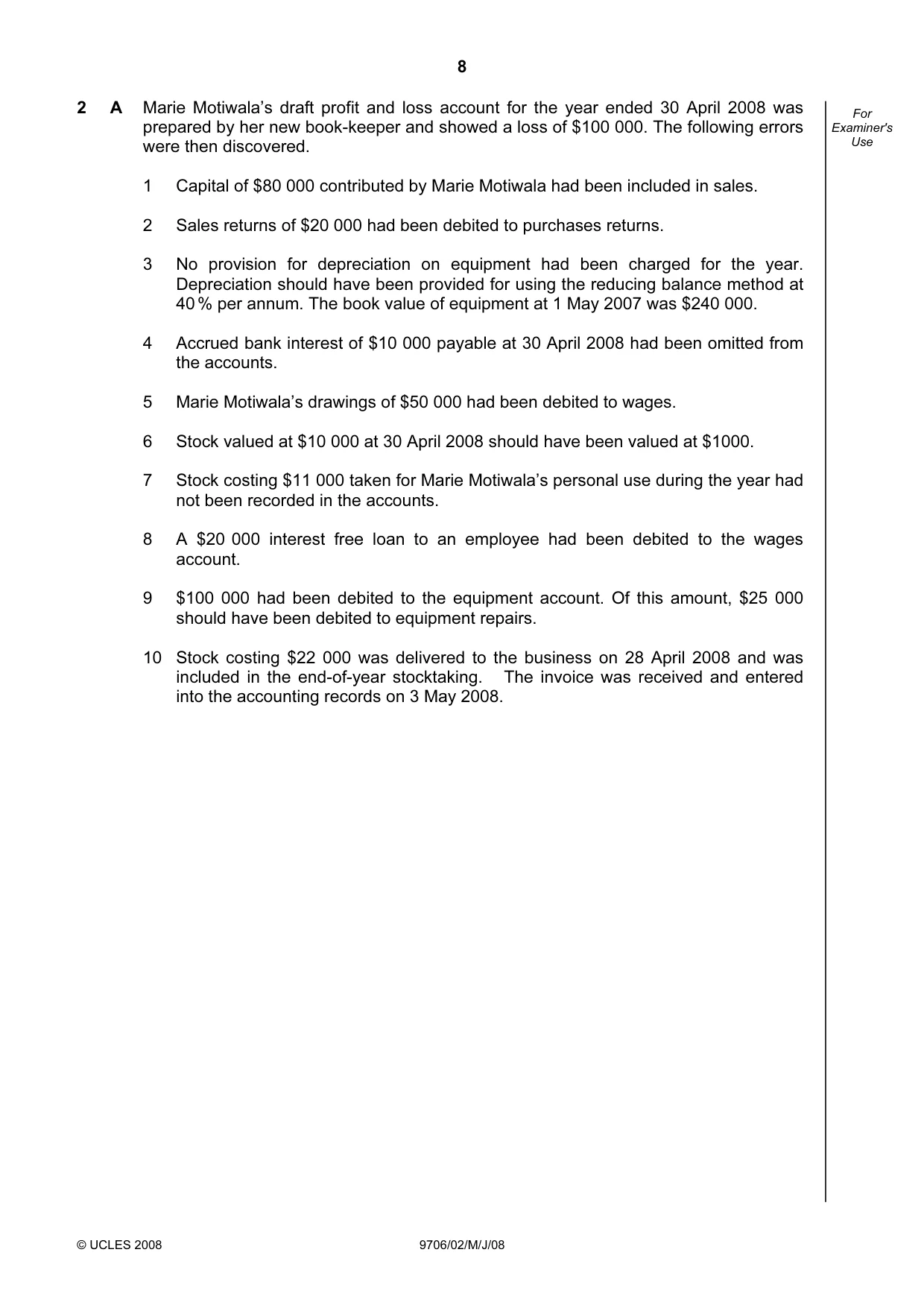
8 © UCLES 2008 9706/02/M/J/08 For Examiner's Use 2 A Marie Motiwala’s draft profit and loss account for the year ended 30 April 2008 was prepared by her new book-keeper and showed a loss of $100 000. The following errors were then discovered. 1 Capital of $80 000 contributed by Marie Motiwala had been included in sales. 2 Sales returns of $20 000 had been debited to purchases returns. 3 No provision for depreciation on equipment had been charged for the year. Depreciation should have been provided for using the reducing balance method at 40 % per annum. The book value of equipment at 1 May 2007 was $240 000. 4 Accrued bank interest of $10 000 payable at 30 April 2008 had been omitted from the accounts. 5 Marie Motiwala’s drawings of $50 000 had been debited to wages. 6 Stock valued at $10 000 at 30 April 2008 should have been valued at $1000. 7 Stock costing $11 000 taken for Marie Motiwala’s personal use during the year had not been recorded in the accounts. 8 A $20 000 interest free loan to an employee had been debited to the wages account. 9 $100 000 had been debited to the equipment account. Of this amount, $25 000 should have been debited to equipment repairs. 10 Stock costing $22 000 was delivered to the business on 28 April 2008 and was included in the end-of-year stocktaking. The invoice was received and entered into the accounting records on 3 May 2008.
Question paper, page 9
9 © UCLES 2008 9706/02/M/J/08 [Turn over For Examiner's Use REQUIRED Prepare a detailed financial statement showing Marie Motiwala’s corrected profit or loss for the year ended 30 April 2008. [12]
Question paper, page 10
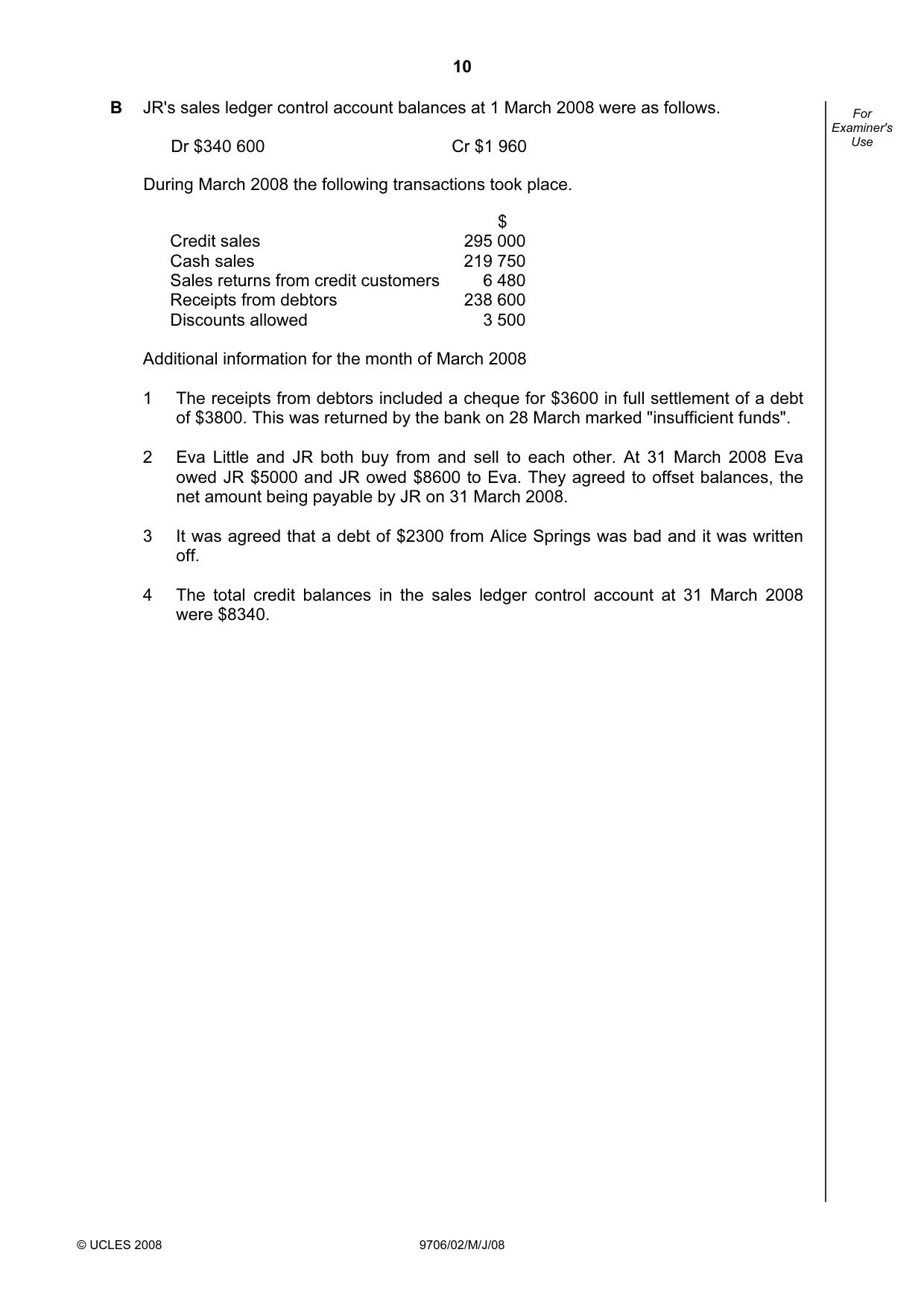
10 © UCLES 2008 9706/02/M/J/08 For Examiner's Use B JR's sales ledger control account balances at 1 March 2008 were as follows. Dr $340 600 Cr $1 960 During March 2008 the following transactions took place. $ Credit sales 295 000 Cash sales 219 750 Sales returns from credit customers 6 480 Receipts from debtors 238 600 Discounts allowed 3 500 Additional information for the month of March 2008 1 The receipts from debtors included a cheque for $3600 in full settlement of a debt of $3800. This was returned by the bank on 28 March marked "insufficient funds". 2 Eva Little and JR both buy from and sell to each other. At 31 March 2008 Eva owed JR $5000 and JR owed $8600 to Eva. They agreed to offset balances, the net amount being payable by JR on 31 March 2008. 3 It was agreed that a debt of $2300 from Alice Springs was bad and it was written off. 4 The total credit balances in the sales ledger control account at 31 March 2008 were $8340.
Question paper, page 11
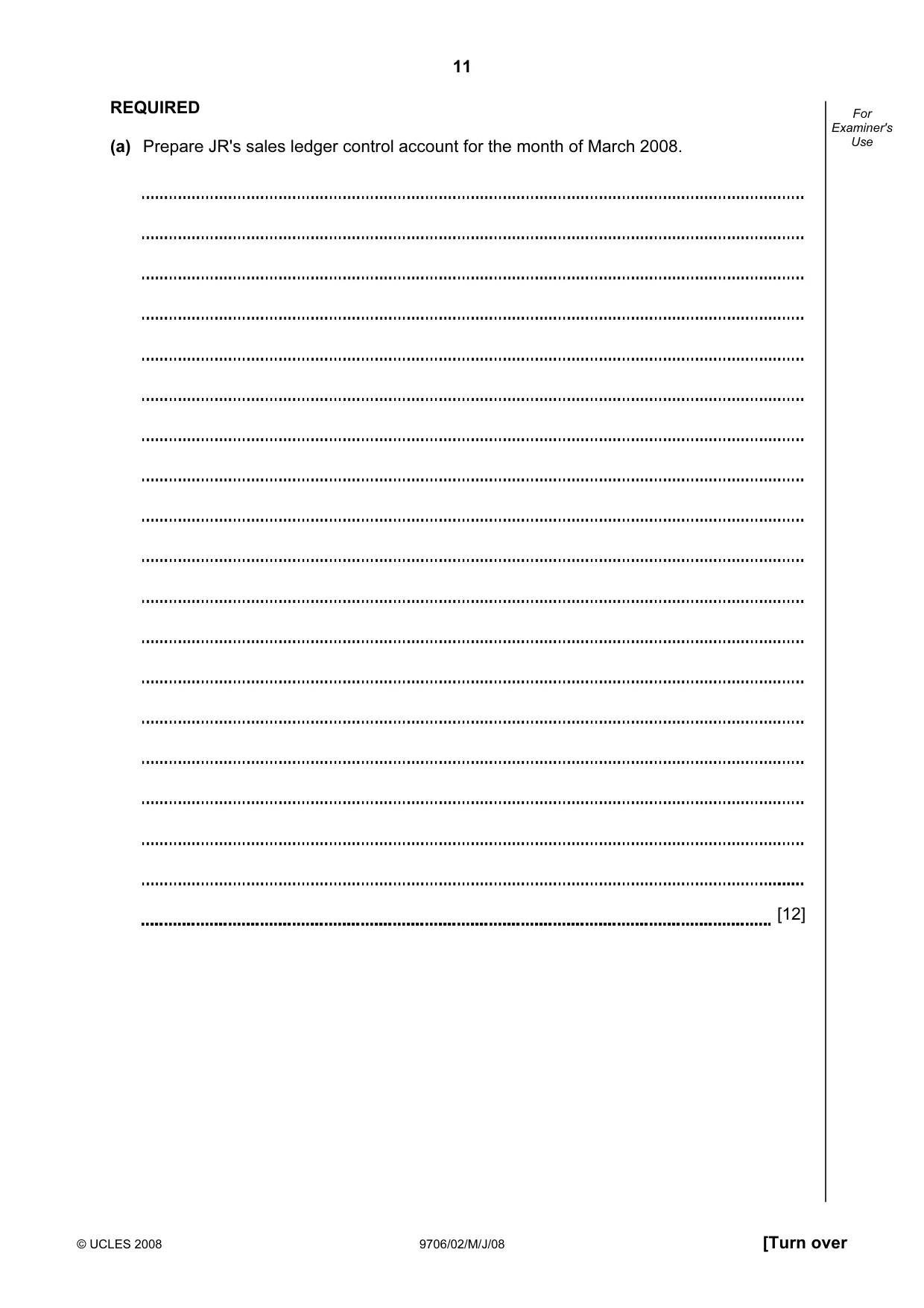
11 © UCLES 2008 9706/02/M/J/08 [Turn over For Examiner's Use REQUIRED (a) Prepare JR's sales ledger control account for the month of March 2008. [12]
Question paper, page 12
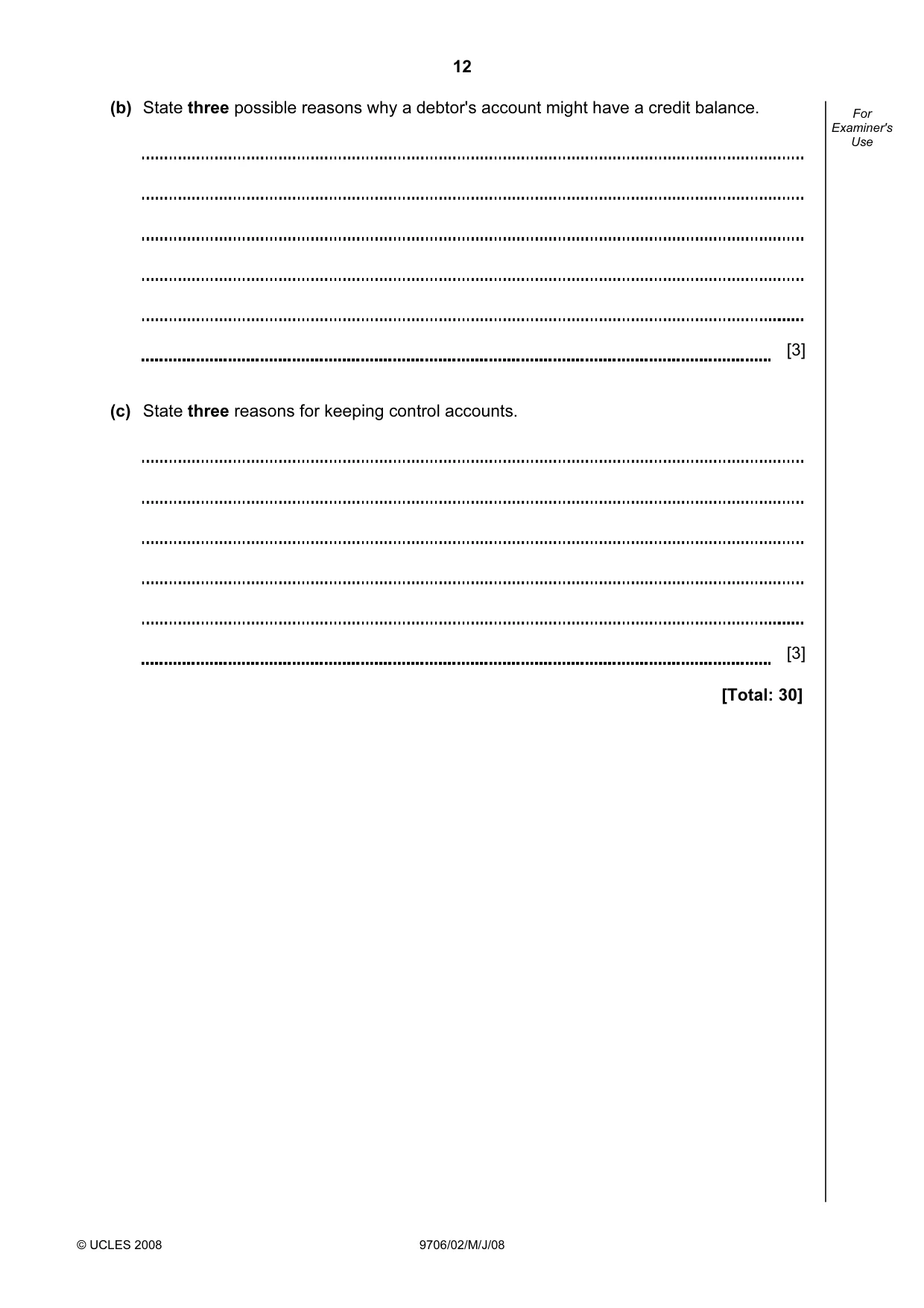
12 © UCLES 2008 9706/02/M/J/08 For Examiner's Use (b) State three possible reasons why a debtor's account might have a credit balance. [3] (c) State three reasons for keeping control accounts. [3] [Total: 30]
Question paper, page 13
13 BLANK PAGE 9706/02/M/J/08 [Turn over Question 3 is on the next page.
Question paper, page 14
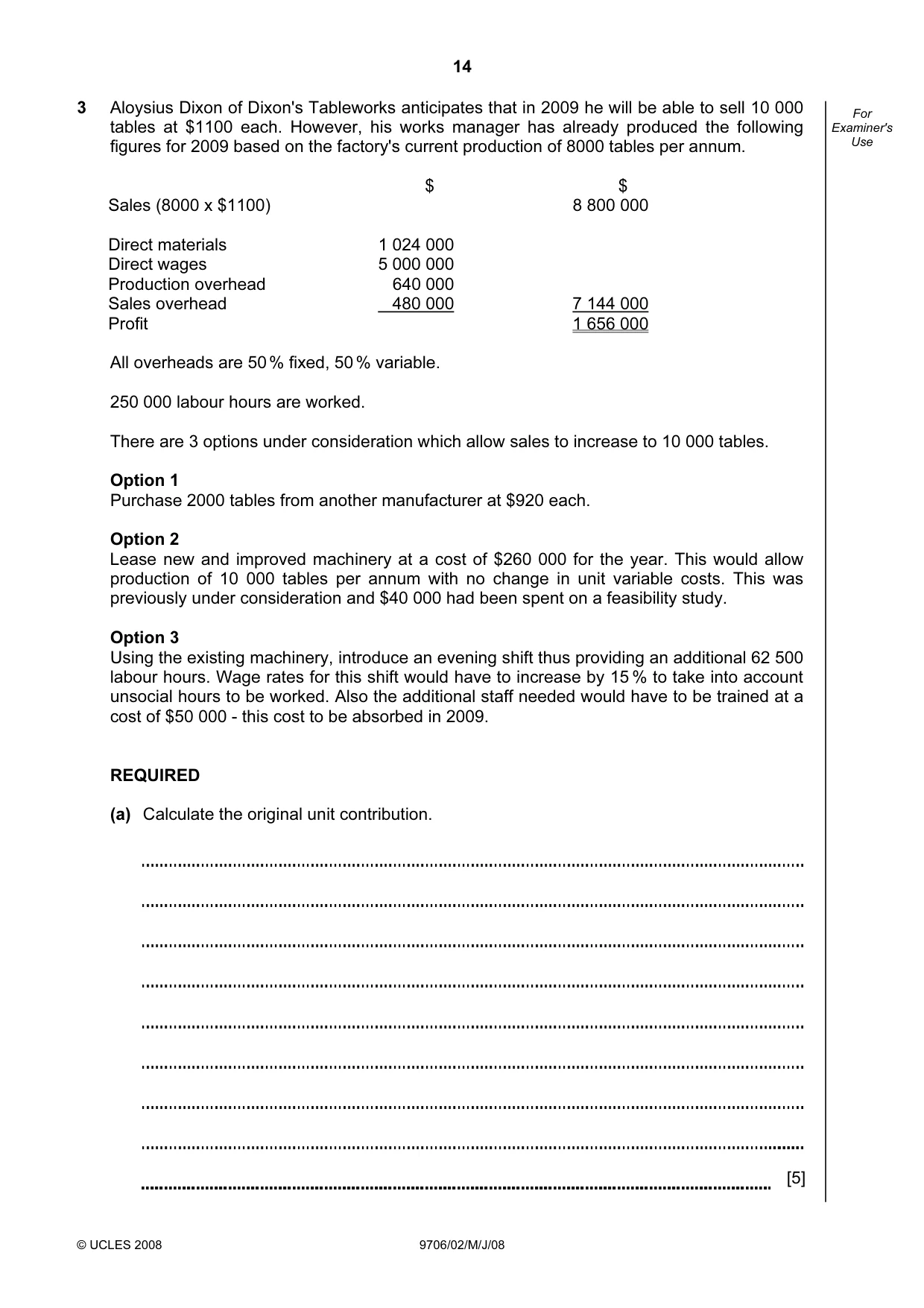
14 © UCLES 2008 9706/02/M/J/08 For Examiner's Use 3 Aloysius Dixon of Dixon's Tableworks anticipates that in 2009 he will be able to sell 10 000 tables at $1100 each. However, his works manager has already produced the following figures for 2009 based on the factory's current production of 8000 tables per annum. $ $ Sales (8000 x $1100) 8 800 000 Direct materials 1 024 000 Direct wages 5 000 000 Production overhead 640 000 Sales overhead 480 000 7 144 000 Profit 1 656 000 All overheads are 50 % fixed, 50 % variable. 250 000 labour hours are worked. There are 3 options under consideration which allow sales to increase to 10 000 tables. Option 1 Purchase 2000 tables from another manufacturer at $920 each. Option 2 Lease new and improved machinery at a cost of $260 000 for the year. This would allow production of 10 000 tables per annum with no change in unit variable costs. This was previously under consideration and $40 000 had been spent on a feasibility study. Option 3 Using the existing machinery, introduce an evening shift thus providing an additional 62 500 labour hours. Wage rates for this shift would have to increase by 15 % to take into account unsocial hours to be worked. Also the additional staff needed would have to be trained at a cost of $50 000 - this cost to be absorbed in 2009. REQUIRED (a) Calculate the original unit contribution. [5]
Question paper, page 15
15 © UCLES 2008 9706/02/M/J/08 [Turn over For Examiner's Use (b) Prepare financial statements showing in detail the calculations for the additional profits or losses arising from each of the three options. [22]
Question paper, page 16
16 Permission to reproduce items where third-party owned material protected by copyright is included has been sought and cleared where possible. Every reasonable effort has been made by the publisher (UCLES) to trace copyright holders, but if any items requiring clearance have unwittingly been included, the publisher will be pleased to make amends at the earliest possible opportunity. University of Cambridge International Examinations is part of the Cambridge Assessment Group. Cambridge Assessment is the brand name of University of Cambridge Local Examinations Syndicate (UCLES), which is itself a department of the University of Cambridge. © UCLES 2008 9706/02/M/J/08 For Examiner's Use (c) State which option should be accepted, giving one advantage and one disadvantage, of that option. [3] [Total: 30]
Mark scheme, page 1
UNIVERSITY OF CAMBRIDGE INTERNATIONAL EXAMINATIONS GCE Advanced Subsidiary Level and GCE Advanced Level MARK SCHEME for the May/June 2008 question paper 9706 ACCOUNTING 9706/02 Paper 2 (Structured Questions (Core)), maximum raw mark 90 This mark scheme is published as an aid to teachers and candidates, to indicate the requirements of the examination. It shows the basis on which Examiners were instructed to award marks. It does not indicate the details of the discussions that took place at an Examiners’ meeting before marking began. All Examiners are instructed that alternative correct answers and unexpected approaches in candidates’ scripts must be given marks that fairly reflect the relevant knowledge and skills demonstrated. Mark schemes must be read in conjunction with the question papers and the report on the examination. • CIE will not enter into discussions or correspondence in connection with these mark schemes. CIE is publishing the mark schemes for the May/June 2008 question papers for most IGCSE, GCE Advanced Level and Advanced Subsidiary Level syllabuses and some Ordinary Level syllabuses.
Mark scheme, page 2
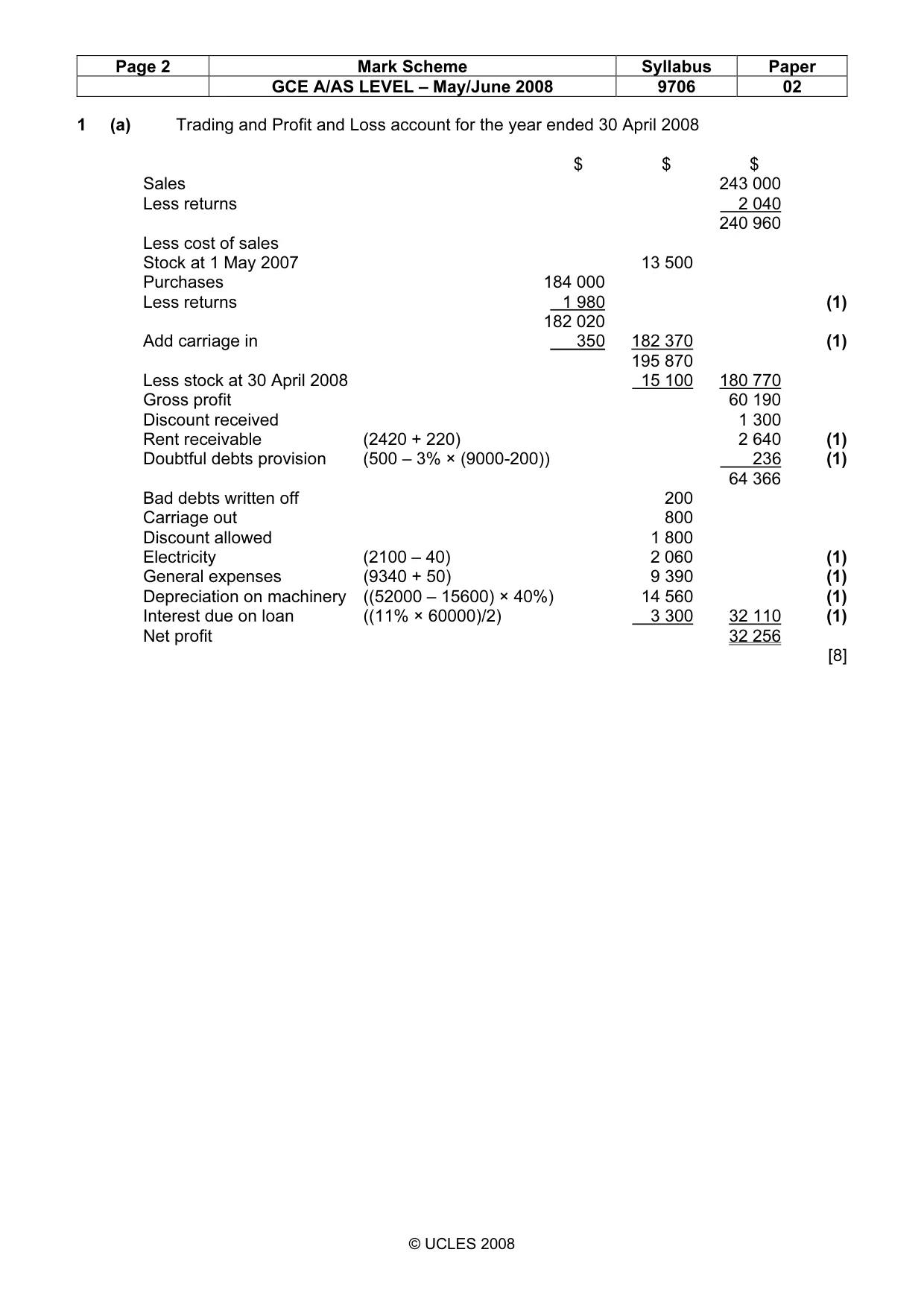
Page 2 Mark Scheme Syllabus Paper GCE A/AS LEVEL – May/June 2008 9706 02 © UCLES 2008 1 (a) Trading and Profit and Loss account for the year ended 30 April 2008 $ $ $ Sales 243 000 Less returns 2 040 240 960 Less cost of sales Stock at 1 May 2007 13 500 Purchases 184 000 Less returns 1 980 (1) 182 020 Add carriage in 350 182 370 (1) 195 870 Less stock at 30 April 2008 15 100 180 770 Gross profit 60 190 Discount received 1 300 Rent receivable (2420 + 220) 2 640 (1) Doubtful debts provision (500 – 3% × (9000-200)) 236 (1) 64 366 Bad debts written off 200 Carriage out 800 Discount allowed 1 800 Electricity (2100 – 40) 2 060 (1) General expenses (9340 + 50) 9 390 (1) Depreciation on machinery ((52000 – 15600) × 40%) 14 560 (1) Interest due on loan ((11% × 60000)/2) 3 300 32 110 (1) Net profit 32 256 [8]
Mark scheme, page 3
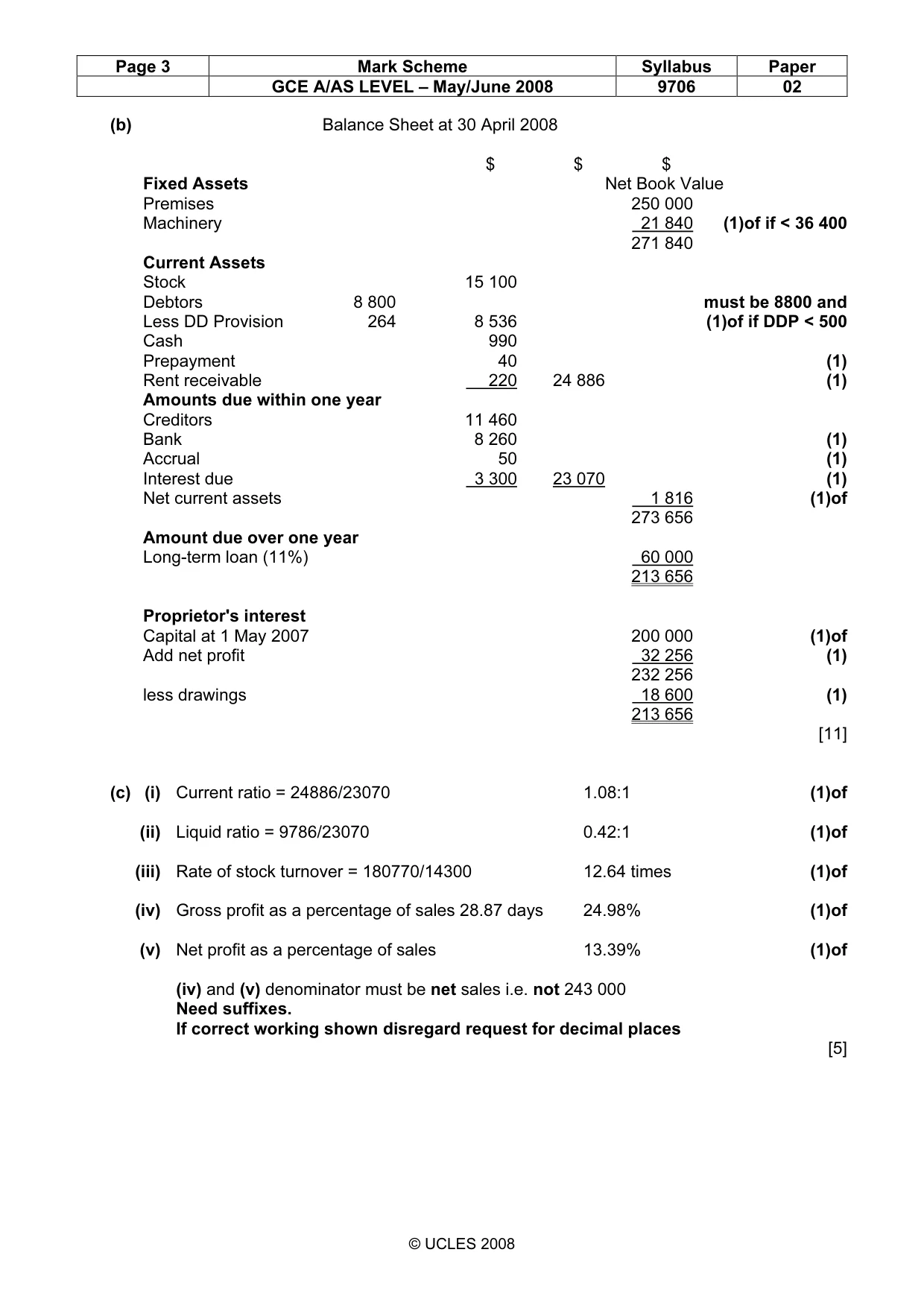
Page 3 Mark Scheme Syllabus Paper GCE A/AS LEVEL – May/June 2008 9706 02 © UCLES 2008 (b) Balance Sheet at 30 April 2008 $ $ $ Fixed Assets Net Book Value Premises 250 000 Machinery 21 840 (1)of if < 36 400 271 840 Current Assets Stock 15 100 Debtors 8 800 must be 8800 and Less DD Provision 264 8 536 (1)of if DDP < 500 Cash 990 Prepayment 40 (1) Rent receivable 220 24 886 (1) Amounts due within one year Creditors 11 460 Bank 8 260 (1) Accrual 50 (1) Interest due 3 300 23 070 (1) Net current assets 1 816 (1)of 273 656 Amount due over one year Long-term loan (11%) 60 000 213 656 Proprietor's interest Capital at 1 May 2007 200 000 (1)of Add net profit 32 256 (1) 232 256 less drawings 18 600 (1) 213 656 [11] (c) (i) Current ratio = 24886/23070 1.08:1 (1)of (ii) Liquid ratio = 9786/23070 0.42:1 (1)of (iii) Rate of stock turnover = 180770/14300 12.64 times (1)of (iv) Gross profit as a percentage of sales 28.87 days 24.98% (1)of (v) Net profit as a percentage of sales 13.39% (1)of (iv) and (v) denominator must be net sales i.e. not 243 000 Need suffixes. If correct working shown disregard request for decimal places [5]
Mark scheme, page 4
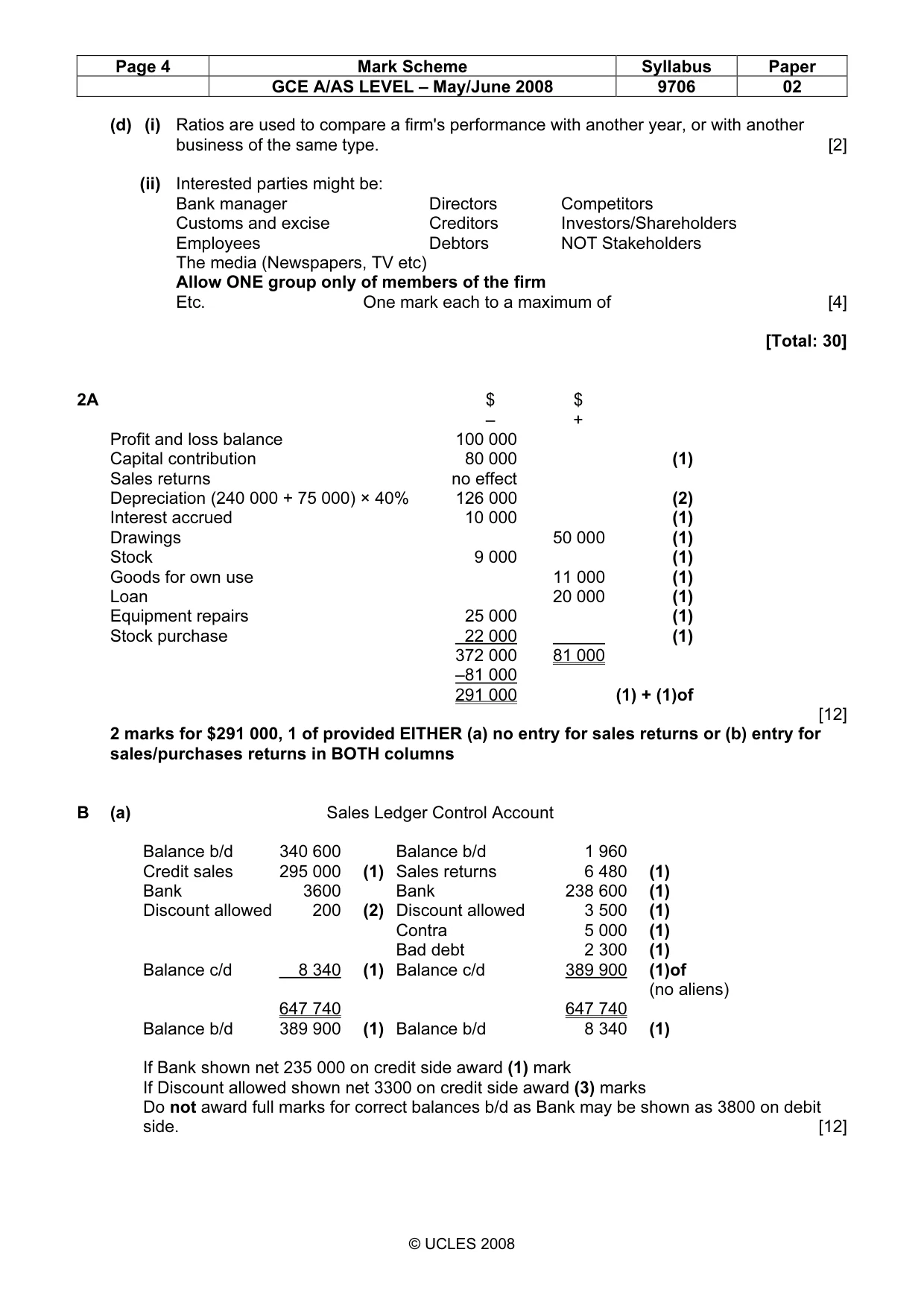
Page 4 Mark Scheme Syllabus Paper GCE A/AS LEVEL – May/June 2008 9706 02 © UCLES 2008 (d) (i) Ratios are used to compare a firm's performance with another year, or with another business of the same type. [2] (ii) Interested parties might be: Bank manager Directors Competitors Customs and excise Creditors Investors/Shareholders Employees Debtors NOT Stakeholders The media (Newspapers, TV etc) Allow ONE group only of members of the firm Etc. One mark each to a maximum of [4] [Total: 30] 2A $ $ – + Profit and loss balance 100 000 Capital contribution 80 000 (1) Sales returns no effect Depreciation (240 000 + 75 000) × 40% 126 000 (2) Interest accrued 10 000 (1) Drawings 50 000 (1) Stock 9 000 (1) Goods for own use 11 000 (1) Loan 20 000 (1) Equipment repairs 25 000 (1) Stock purchase 22 000 (1) 372 000 81 000 –81 000 291 000 (1) + (1)of [12] 2 marks for $291 000, 1 of provided EITHER (a) no entry for sales returns or (b) entry for sales/purchases returns in BOTH columns B (a) Sales Ledger Control Account Balance b/d 340 600 Balance b/d 1 960 Credit sales 295 000 (1) Sales returns 6 480 (1) Bank 3600 Bank 238 600 (1) Discount allowed 200 (2) Discount allowed 3 500 (1) Contra 5 000 (1) Bad debt 2 300 (1) Balance c/d 8 340 (1) Balance c/d 389 900 (1)of (no aliens) 647 740 647 740 Balance b/d 389 900 (1) Balance b/d 8 340 (1) If Bank shown net 235 000 on credit side award (1) mark If Discount allowed shown net 3300 on credit side award (3) marks Do not award full marks for correct balances b/d as Bank may be shown as 3800 on debit side. [12]
Mark scheme, page 5
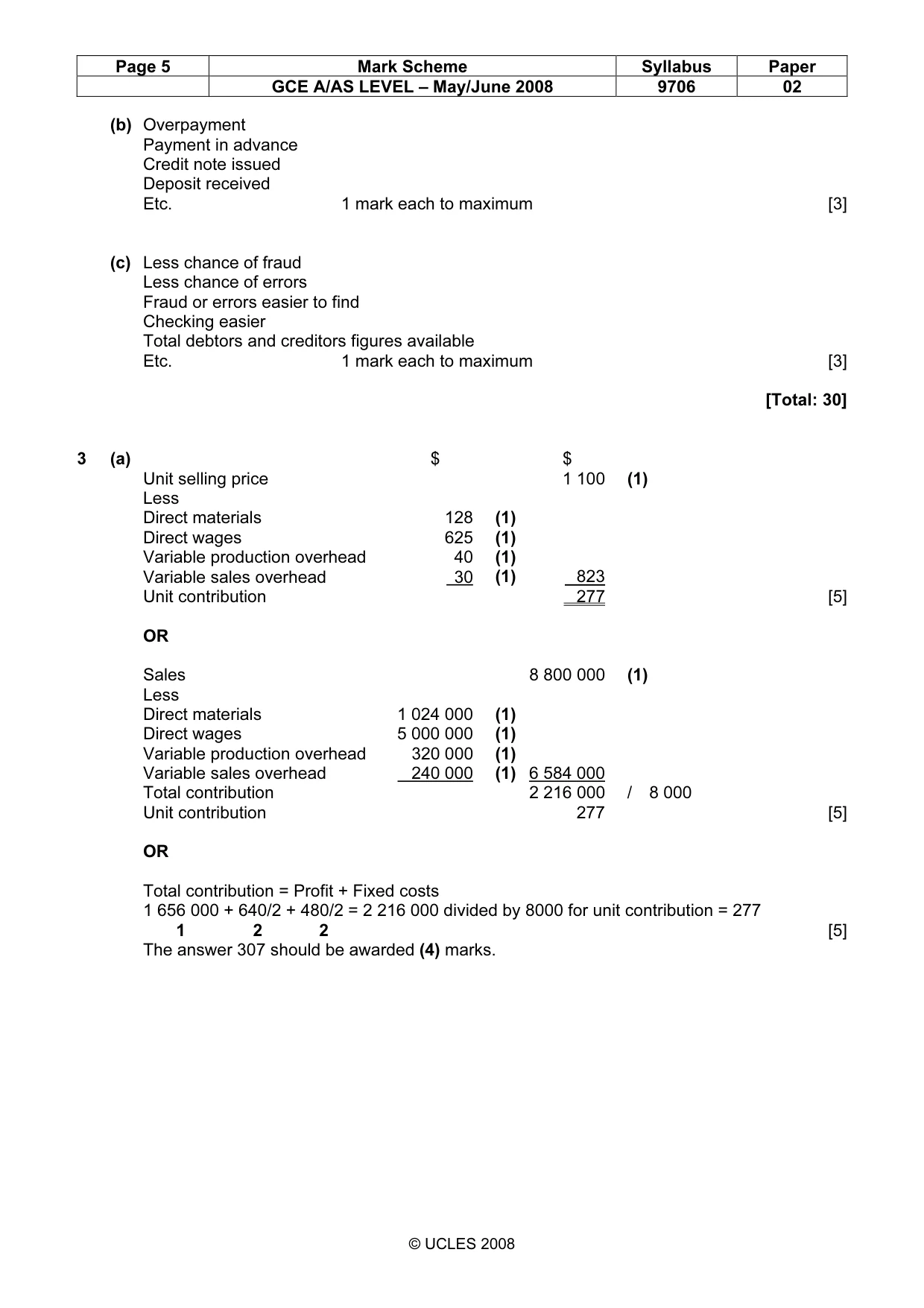
Page 5 Mark Scheme Syllabus Paper GCE A/AS LEVEL – May/June 2008 9706 02 © UCLES 2008 (b) Overpayment Payment in advance Credit note issued Deposit received Etc. 1 mark each to maximum [3] (c) Less chance of fraud Less chance of errors Fraud or errors easier to find Checking easier Total debtors and creditors figures available Etc. 1 mark each to maximum [3] [Total: 30] 3 (a) $ $ Unit selling price 1 100 (1) Less Direct materials 128 (1) Direct wages 625 (1) Variable production overhead 40 (1) Variable sales overhead 30 (1) 823 Unit contribution 277 [5] OR Sales 8 800 000 (1) Less Direct materials 1 024 000 (1) Direct wages 5 000 000 (1) Variable production overhead 320 000 (1) Variable sales overhead 240 000 (1) 6 584 000 Total contribution 2 216 000 / 8 000 Unit contribution 277 [5] OR Total contribution = Profit + Fixed costs 1 656 000 + 640/2 + 480/2 = 2 216 000 divided by 8000 for unit contribution = 277 1 2 2 [5] The answer 307 should be awarded (4) marks.
Mark scheme, page 6
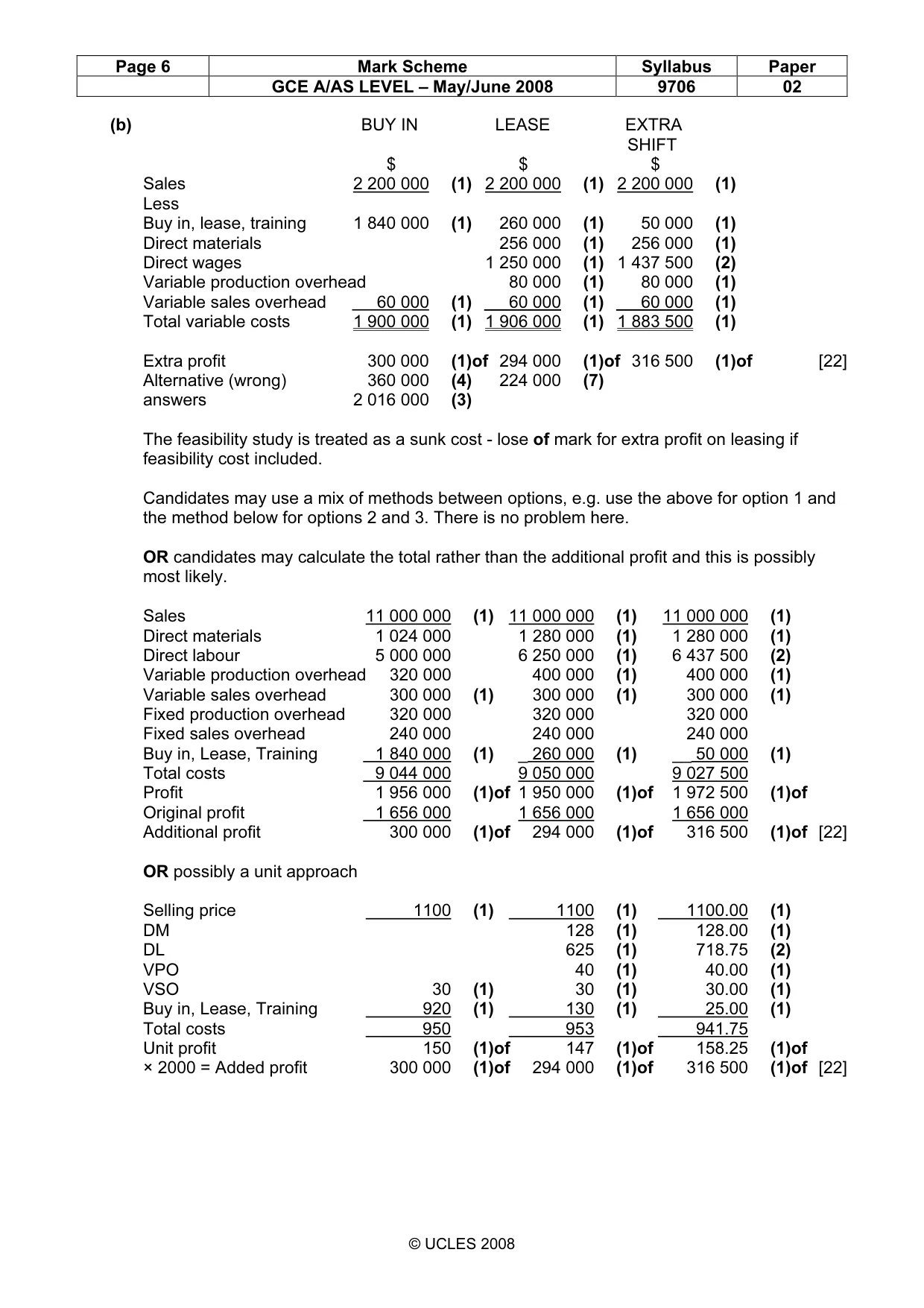
Page 6 Mark Scheme Syllabus Paper GCE A/AS LEVEL – May/June 2008 9706 02 © UCLES 2008 (b) BUY IN LEASE EXTRA SHIFT $ $ $ Sales 2 200 000 (1) 2 200 000 (1) 2 200 000 (1) Less Buy in, lease, training 1 840 000 (1) 260 000 (1) 50 000 (1) Direct materials 256 000 (1) 256 000 (1) Direct wages 1 250 000 (1) 1 437 500 (2) Variable production overhead 80 000 (1) 80 000 (1) Variable sales overhead 60 000 (1) 60 000 (1) 60 000 (1) Total variable costs 1 900 000 (1) 1 906 000 (1) 1 883 500 (1) Extra profit 300 000 (1)of 294 000 (1)of 316 500 (1)of [22] Alternative (wrong) 360 000 (4) 224 000 (7) answers 2 016 000 (3) The feasibility study is treated as a sunk cost - lose of mark for extra profit on leasing if feasibility cost included. Candidates may use a mix of methods between options, e.g. use the above for option 1 and the method below for options 2 and 3. There is no problem here. OR candidates may calculate the total rather than the additional profit and this is possibly most likely. Sales 11 000 000 (1) 11 000 000 (1) 11 000 000 (1) Direct materials 1 024 000 1 280 000 (1) 1 280 000 (1) Direct labour 5 000 000 6 250 000 (1) 6 437 500 (2) Variable production overhead 320 000 400 000 (1) 400 000 (1) Variable sales overhead 300 000 (1) 300 000 (1) 300 000 (1) Fixed production overhead 320 000 320 000 320 000 Fixed sales overhead 240 000 240 000 240 000 Buy in, Lease, Training 1 840 000 (1) _ 260 000 (1) __ 50 000 (1) Total costs 9 044 000 9 050 000 9 027 500 Profit 1 956 000 (1)of 1 950 000 (1)of 1 972 500 (1)of Original profit 1 656 000 1 656 000 1 656 000 Additional profit 300 000 (1)of 294 000 (1)of 316 500 (1)of [22] OR possibly a unit approach Selling price 1100 (1) 1100 (1) 1100.00 (1) DM 128 (1) 128.00 (1) DL 625 (1) 718.75 (2) VPO 40 (1) 40.00 (1) VSO 30 (1) 30 (1) 30.00 (1) Buy in, Lease, Training 920 (1) 130 (1) 25.00 (1) Total costs 950 953 941.75 Unit profit 150 (1)of 147 (1)of 158.25 (1)of × 2000 = Added profit 300 000 (1)of 294 000 (1)of 316 500 (1)of [22]
Mark scheme, page 7
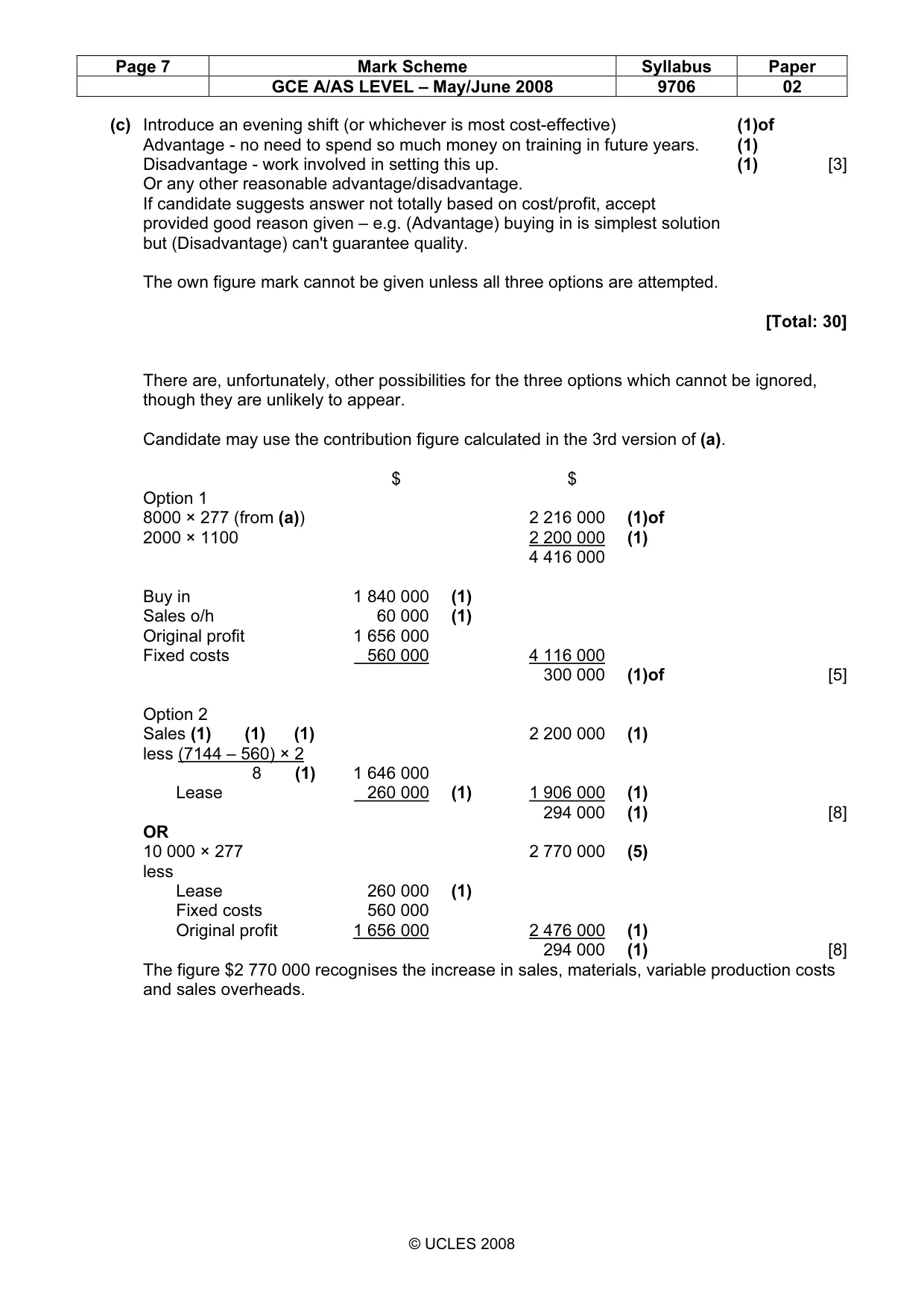
Page 7 Mark Scheme Syllabus Paper GCE A/AS LEVEL – May/June 2008 9706 02 © UCLES 2008 (c) Introduce an evening shift (or whichever is most cost-effective) (1)of Advantage - no need to spend so much money on training in future years. (1) Disadvantage - work involved in setting this up. (1) [3] Or any other reasonable advantage/disadvantage. If candidate suggests answer not totally based on cost/profit, accept provided good reason given – e.g. (Advantage) buying in is simplest solution but (Disadvantage) can't guarantee quality. The own figure mark cannot be given unless all three options are attempted. [Total: 30] There are, unfortunately, other possibilities for the three options which cannot be ignored, though they are unlikely to appear. Candidate may use the contribution figure calculated in the 3rd version of (a). $ $ Option 1 8000 × 277 (from (a)) 2 216 000 (1)of 2000 × 1100 2 200 000 (1) 4 416 000 Buy in 1 840 000 (1) Sales o/h 60 000 (1) Original profit 1 656 000 Fixed costs 560 000 4 116 000 300 000 (1)of [5] Option 2 Sales (1) (1) (1) 2 200 000 (1) less (7144 – 560) × 2 8 (1) 1 646 000 Lease 260 000 (1) 1 906 000 (1) 294 000 (1) [8] OR 10 000 × 277 2 770 000 (5) less Lease 260 000 (1) Fixed costs 560 000 Original profit 1 656 000 2 476 000 (1) 294 000 (1) [8] The figure $2 770 000 recognises the increase in sales, materials, variable production costs and sales overheads.
Mark scheme, page 8
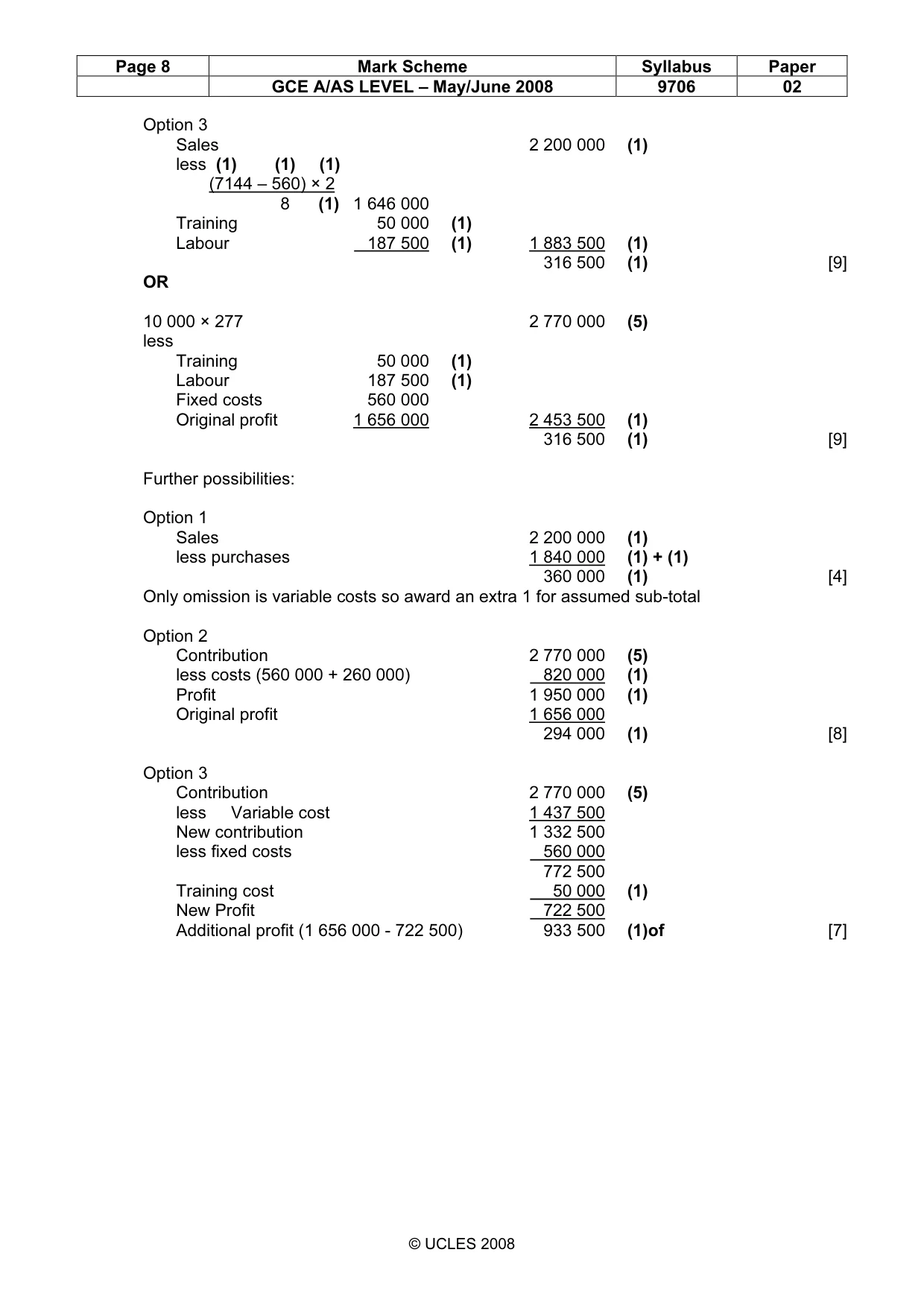
Page 8 Mark Scheme Syllabus Paper GCE A/AS LEVEL – May/June 2008 9706 02 © UCLES 2008 Option 3 Sales 2 200 000 (1) less (1) (1) (1) (7144 – 560) × 2 8 (1) 1 646 000 Training 50 000 (1) Labour 187 500 (1) 1 883 500 (1) 316 500 (1) [9] OR 10 000 × 277 2 770 000 (5) less Training 50 000 (1) Labour 187 500 (1) Fixed costs 560 000 Original profit 1 656 000 2 453 500 (1) 316 500 (1) [9] Further possibilities: Option 1 Sales 2 200 000 (1) less purchases 1 840 000 (1) + (1) 360 000 (1) [4] Only omission is variable costs so award an extra 1 for assumed sub-total Option 2 Contribution 2 770 000 (5) less costs (560 000 + 260 000) 820 000 (1) Profit 1 950 000 (1) Original profit 1 656 000 294 000 (1) [8] Option 3 Contribution 2 770 000 (5) less Variable cost 1 437 500 New contribution 1 332 500 less fixed costs 560 000 772 500 Training cost 50 000 (1) New Profit 722 500 Additional profit (1 656 000 - 722 500) 933 500 (1)of [7]
What you needed in this session
Cambridge’s own grade thresholds for 2008 May/June, Paper 2 · Variant 1. A higher threshold means an easier paper — the bar moves with how the cohort did.