Cambridge A Level Accounting 9706 — 2007 Oct/Nov Paper 2 · Variant 1
9706/21/O/N/07 · 90 marks · ≈101 min
The question paper and its mark scheme, free to read here and free to download. This is Cambridge’s own paper, exactly as it was sat.
Question paper12 pages
Mark scheme4 pages
Answers below. Sit the paper first if you are practising.
Paper as text
Question paper, page 1
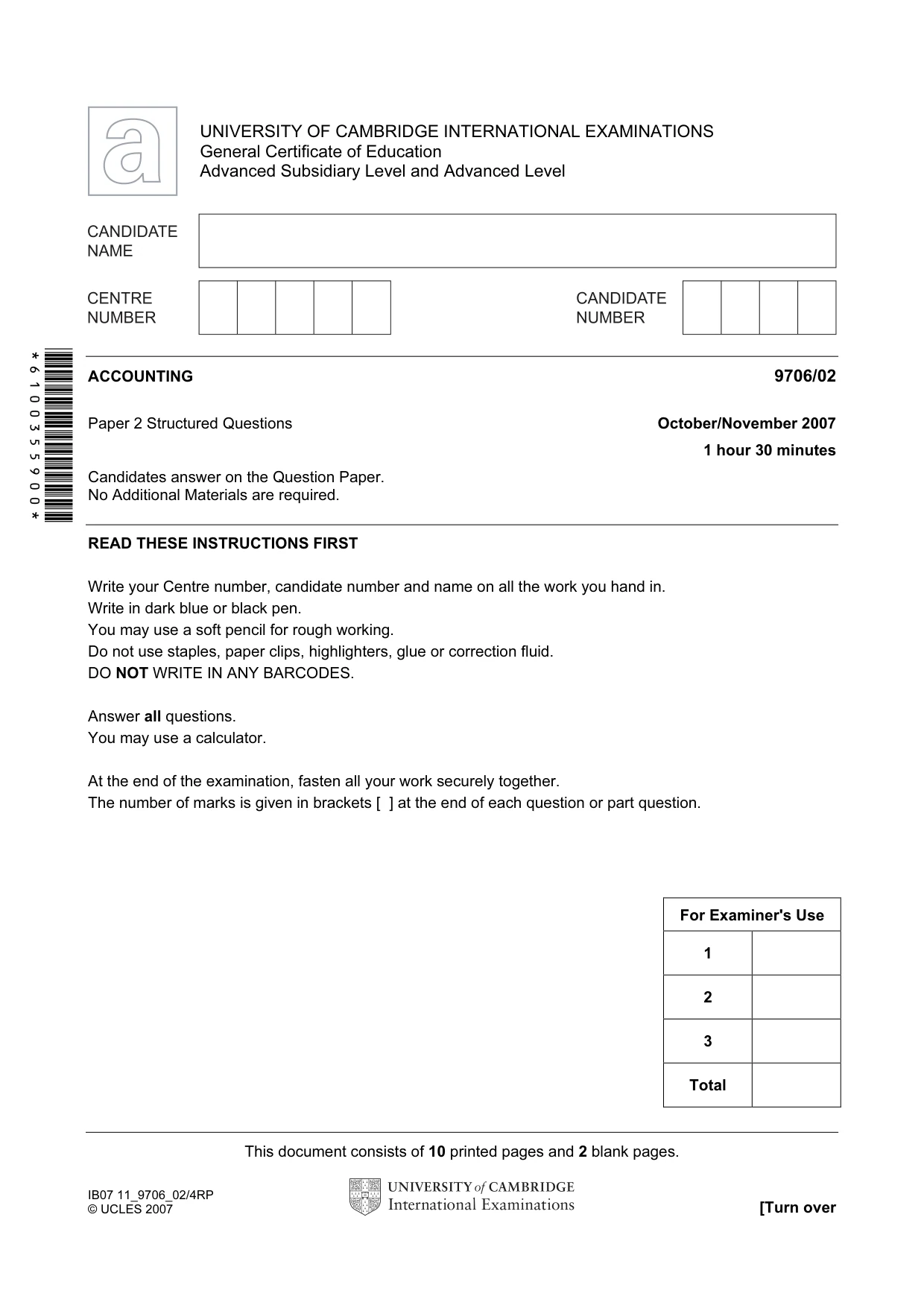
This document consists of 10 printed pages and 2 blank pages. IB07 11_9706_02/4RP © UCLES 2007 [Turn over *6100355900* For Examiner's Use 1 2 3 Total UNIVERSITY OF CAMBRIDGE INTERNATIONAL EXAMINATIONS General Certificate of Education Advanced Subsidiary Level and Advanced Level ACCOUNTING 9706/02 Paper 2 Structured Questions October/November 2007 1 hour 30 minutes Candidates answer on the Question Paper. No Additional Materials are required. READ THESE INSTRUCTIONS FIRST Write your Centre number, candidate number and name on all the work you hand in. Write in dark blue or black pen. You may use a soft pencil for rough working. Do not use staples, paper clips, highlighters, glue or correction fluid. DO NOT WRITE IN ANY BARCODES. Answer all questions. You may use a calculator. At the end of the examination, fasten all your work securely together. The number of marks is given in brackets [ ] at the end of each question or part question.
Question paper, page 2
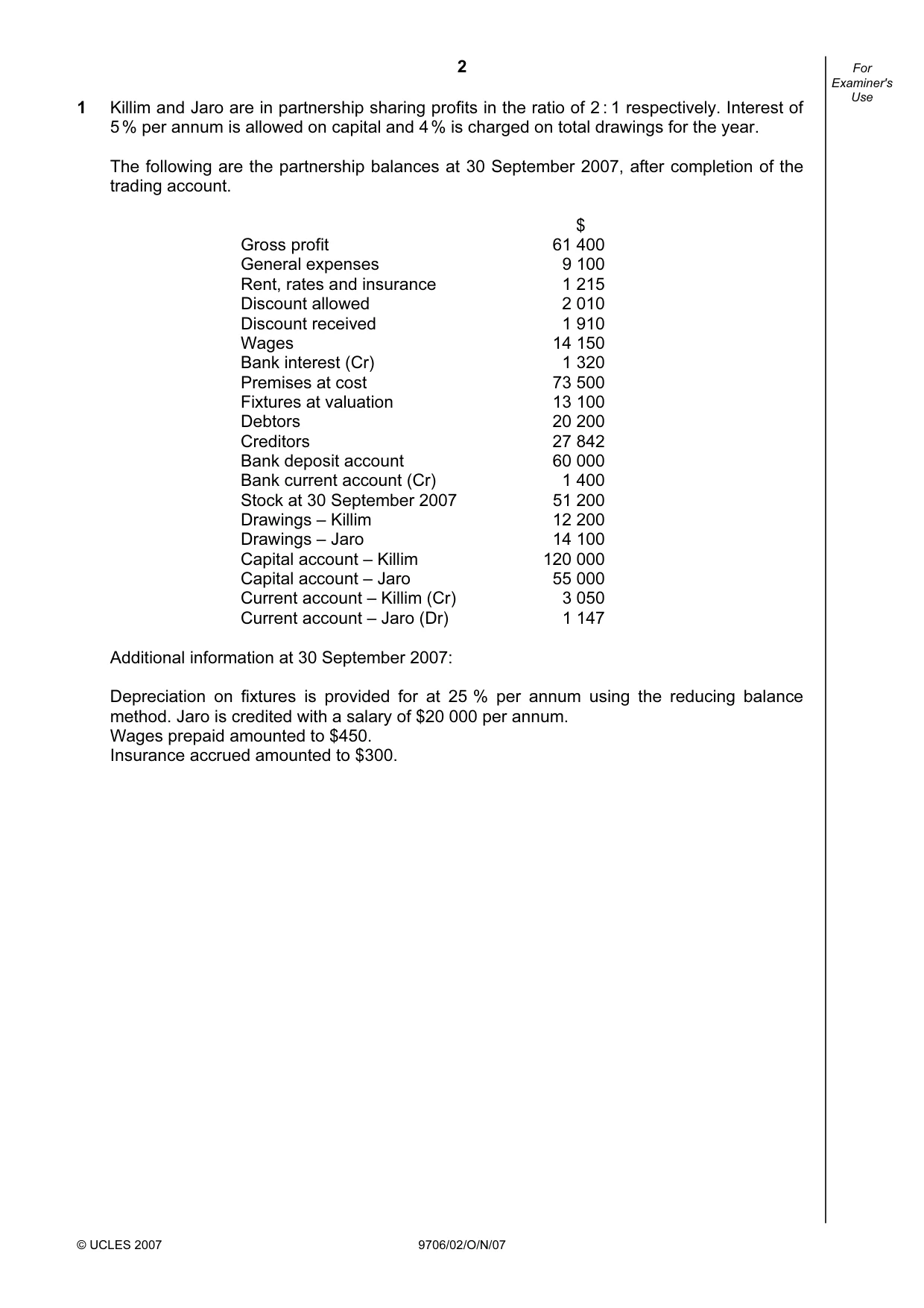
2 © UCLES 2007 9706/02/O/N/07 For Examiner's Use 1 Killim and Jaro are in partnership sharing profits in the ratio of 2 : 1 respectively. Interest of 5 % per annum is allowed on capital and 4 % is charged on total drawings for the year. The following are the partnership balances at 30 September 2007, after completion of the trading account. $ Gross profit 61 400 General expenses 9 100 Rent, rates and insurance 1 215 Discount allowed 2 010 Discount received 1 910 Wages 14 150 Bank interest (Cr) 1 320 Premises at cost 73 500 Fixtures at valuation 13 100 Debtors 20 200 Creditors 27 842 Bank deposit account 60 000 Bank current account (Cr) 1 400 Stock at 30 September 2007 51 200 Drawings – Killim 12 200 Drawings – Jaro 14 100 Capital account – Killim 120 000 Capital account – Jaro 55 000 Current account – Killim (Cr) 3 050 Current account – Jaro (Dr) 1 147 Additional information at 30 September 2007: Depreciation on fixtures is provided for at 25 % per annum using the reducing balance method. Jaro is credited with a salary of $20 000 per annum. Wages prepaid amounted to $450. Insurance accrued amounted to $300.
Question paper, page 3
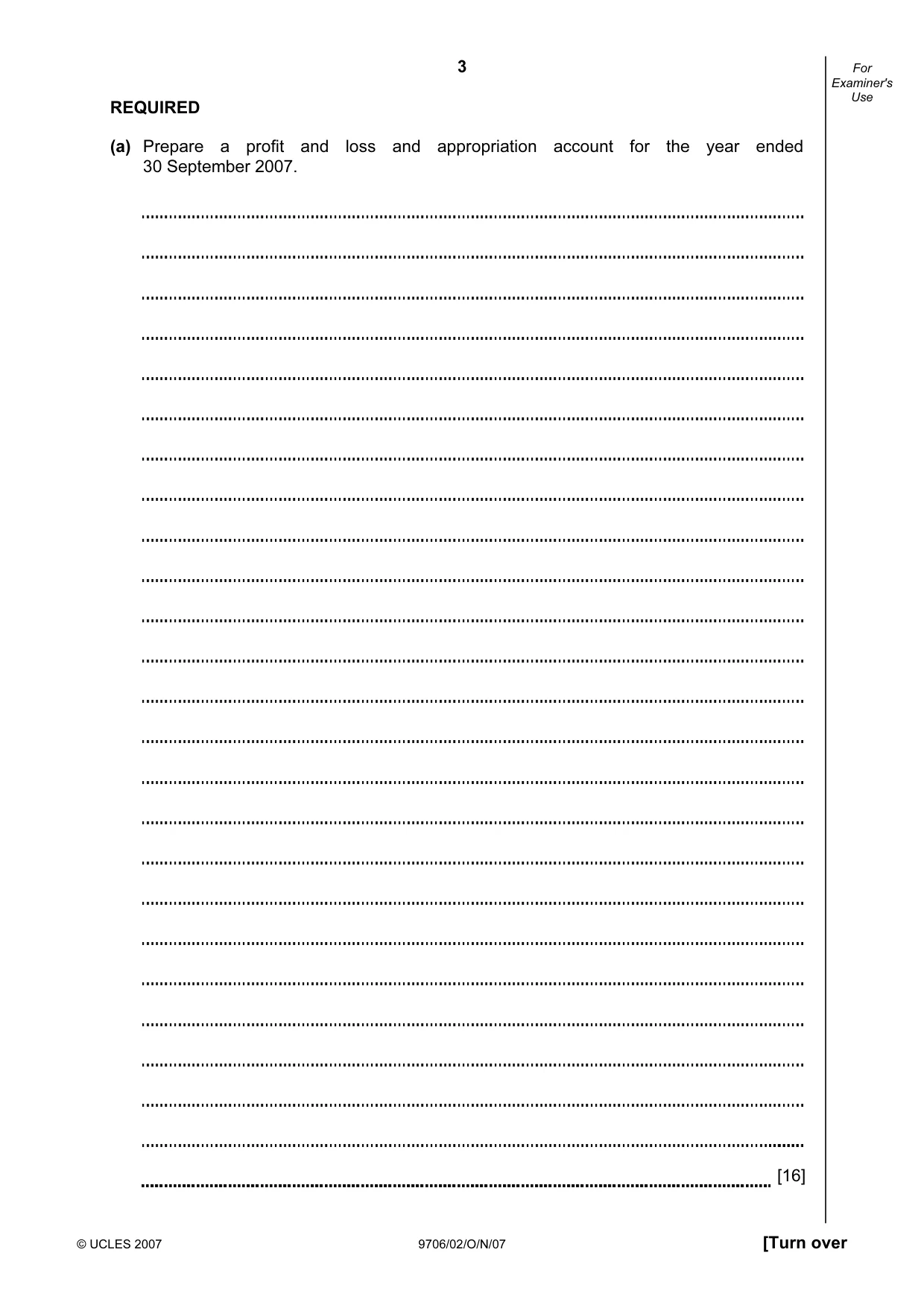
3 © UCLES 2007 9706/02/O/N/07 [Turn over For Examiner's Use REQUIRED (a) Prepare a profit and loss and appropriation account for the year ended 30 September 2007. [16]
Question paper, page 4
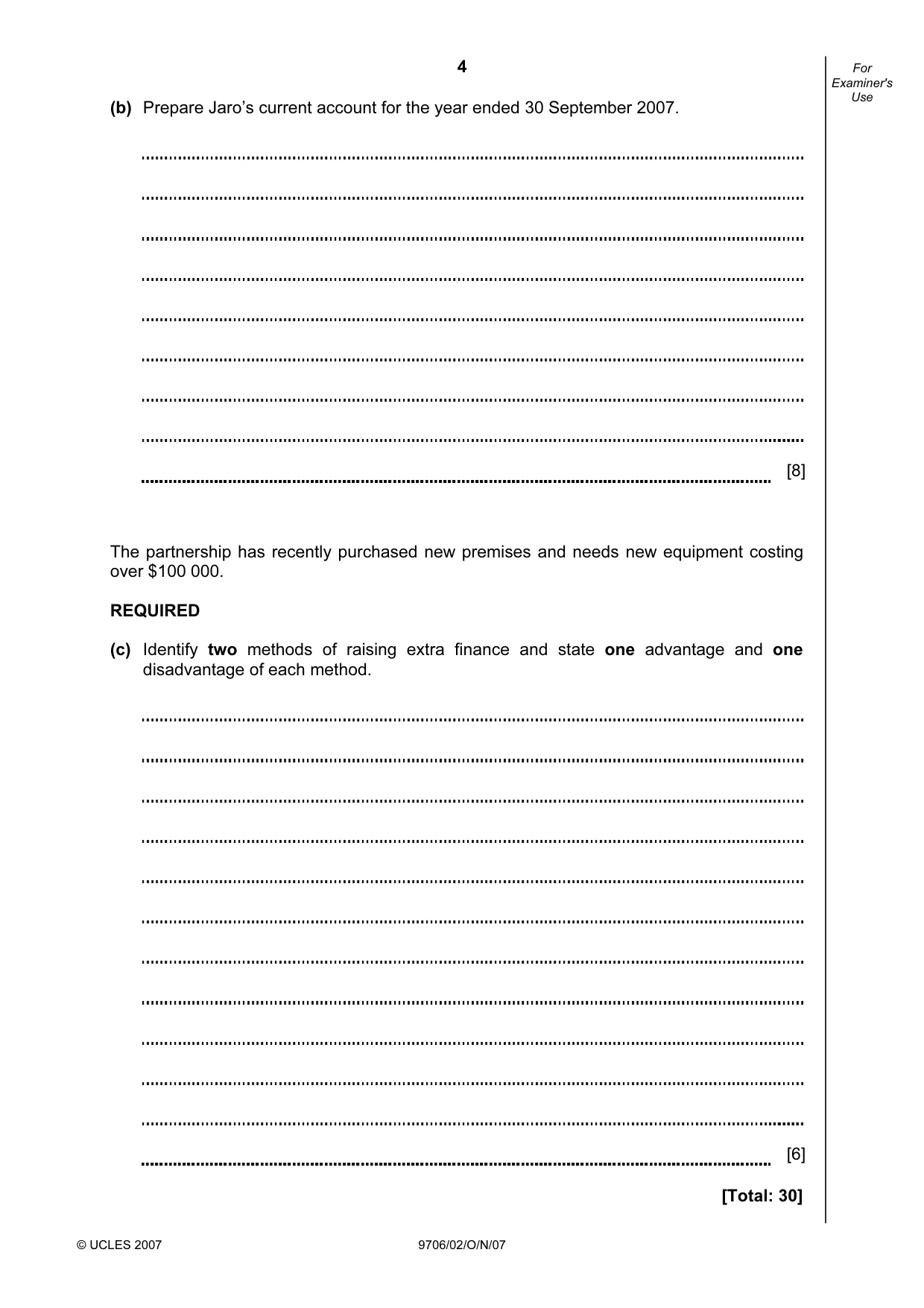
4 © UCLES 2007 9706/02/O/N/07 For Examiner's Use (b) Prepare Jaro’s current account for the year ended 30 September 2007. [8] The partnership has recently purchased new premises and needs new equipment costing over $100 000. REQUIRED (c) Identify two methods of raising extra finance and state one advantage and one disadvantage of each method. [6] [Total: 30]
Question paper, page 5
5 BLANK PAGE 9706/02/O/N/07 [Turn over Question 2 is on the following page
Question paper, page 6
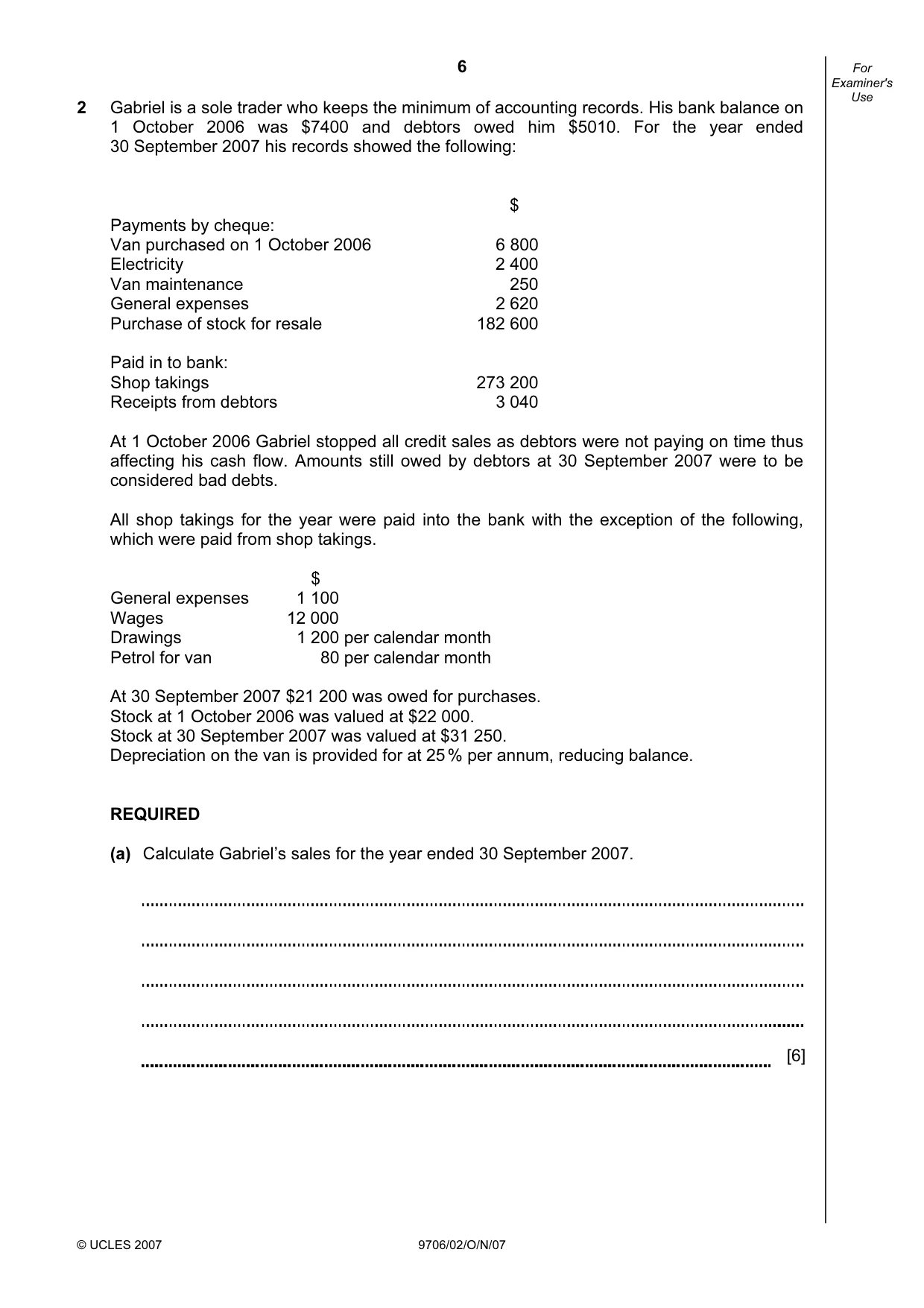
6 © UCLES 2007 9706/02/O/N/07 For Examiner's Use 2 Gabriel is a sole trader who keeps the minimum of accounting records. His bank balance on 1 October 2006 was $7400 and debtors owed him $5010. For the year ended 30 September 2007 his records showed the following: $ Payments by cheque: Van purchased on 1 October 2006 6 800 Electricity 2 400 Van maintenance 250 General expenses 2 620 Purchase of stock for resale 182 600 Paid in to bank: Shop takings 273 200 Receipts from debtors 3 040 At 1 October 2006 Gabriel stopped all credit sales as debtors were not paying on time thus affecting his cash flow. Amounts still owed by debtors at 30 September 2007 were to be considered bad debts. All shop takings for the year were paid into the bank with the exception of the following, which were paid from shop takings. $ General expenses 1 100 Wages 12 000 Drawings 1 200 per calendar month Petrol for van 80 per calendar month At 30 September 2007 $21 200 was owed for purchases. Stock at 1 October 2006 was valued at $22 000. Stock at 30 September 2007 was valued at $31 250. Depreciation on the van is provided for at 25 % per annum, reducing balance. REQUIRED (a) Calculate Gabriel’s sales for the year ended 30 September 2007. [6]
Question paper, page 7
7 © UCLES 2007 9706/02/O/N/07 [Turn over For Examiner's Use (b) Prepare Gabriel’s trading and profit and loss accounts for the year ended 30 September 2007. [15]
Question paper, page 8
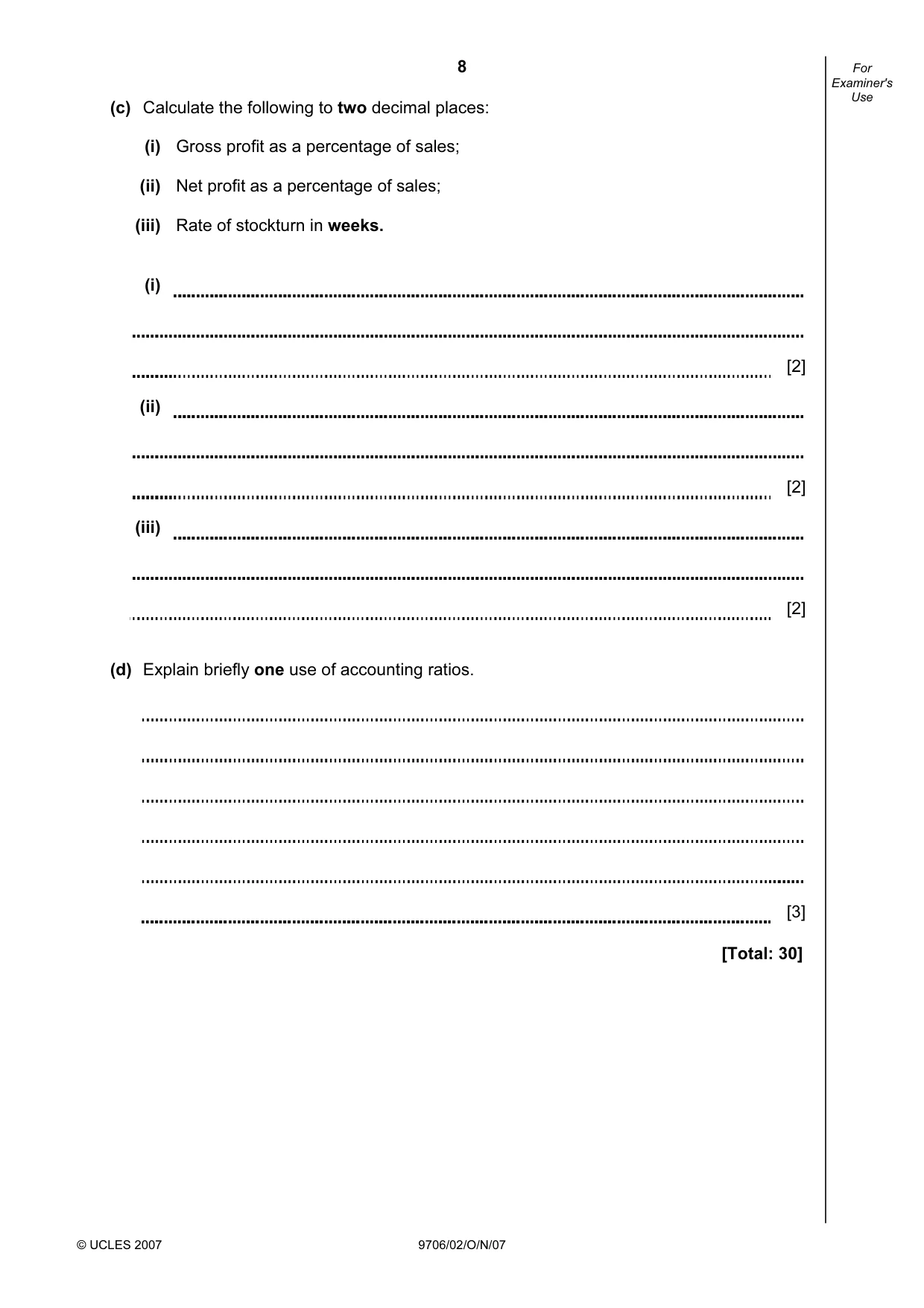
8 © UCLES 2007 9706/02/O/N/07 For Examiner's Use (c) Calculate the following to two decimal places: (i) Gross profit as a percentage of sales; (ii) Net profit as a percentage of sales; (iii) Rate of stockturn in weeks. (i) [2] (ii) [2] (iii) [2] (d) Explain briefly one use of accounting ratios. [3] [Total: 30]
Question paper, page 9
9 BLANK PAGE 9706/02/O/N/07 [Turn over Question 3 is on the following page
Question paper, page 10
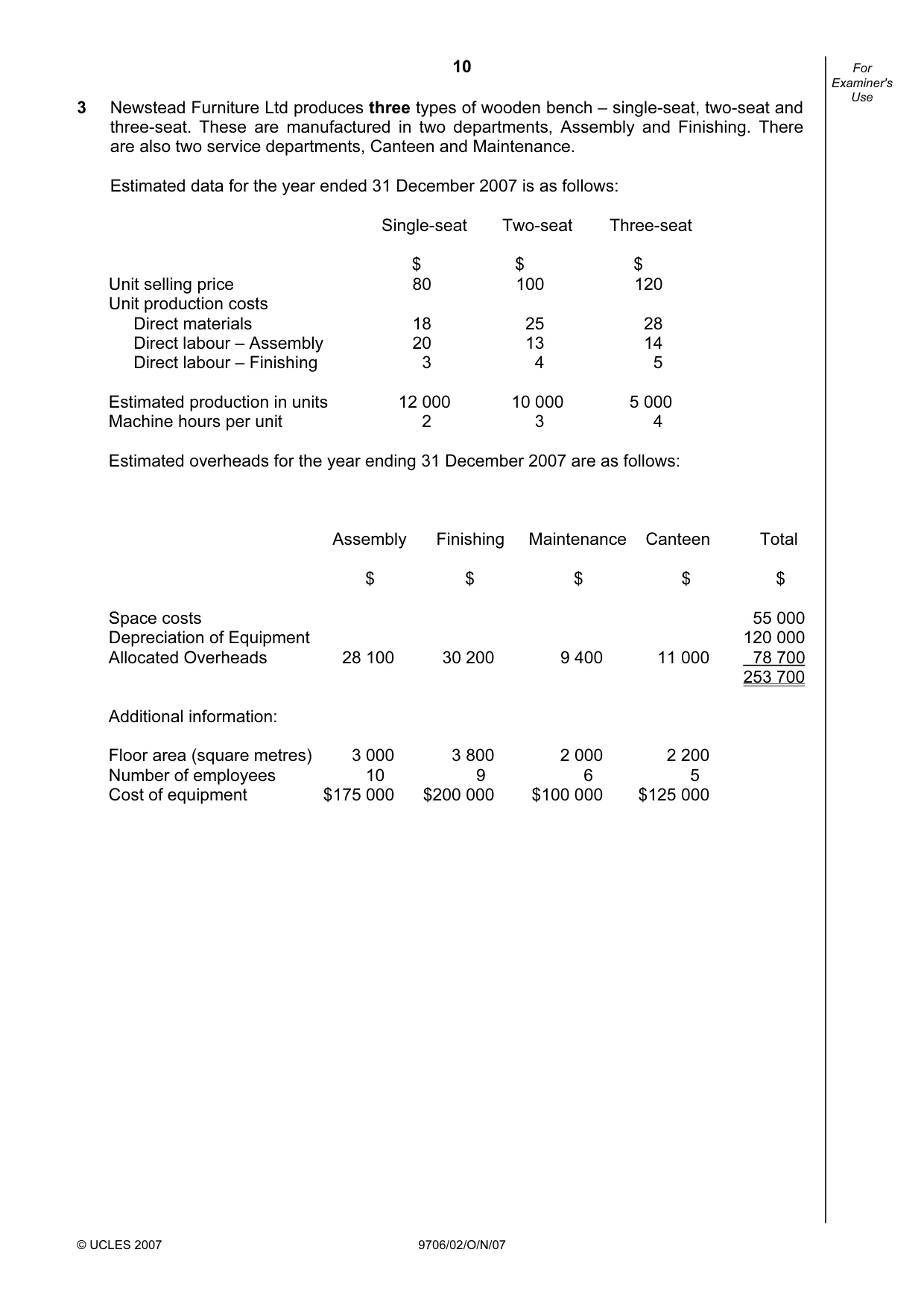
10 © UCLES 2007 9706/02/O/N/07 For Examiner's Use 3 Newstead Furniture Ltd produces three types of wooden bench – single-seat, two-seat and three-seat. These are manufactured in two departments, Assembly and Finishing. There are also two service departments, Canteen and Maintenance. Estimated data for the year ended 31 December 2007 is as follows: Single-seat Two-seat Three-seat $ $ $ Unit selling price 80 100 120 Unit production costs Direct materials 18 25 28 Direct labour – Assembly 20 13 14 Direct labour – Finishing 3 4 5 Estimated production in units 12 000 10 000 5 000 Machine hours per unit 2 3 4 Estimated overheads for the year ending 31 December 2007 are as follows: Assembly Finishing Maintenance Canteen Total $ $ $ $ $ Space costs 55 000 Depreciation of Equipment 120 000 Allocated Overheads 28 100 30 200 9 400 11 000 78 700 253 700 Additional information: Floor area (square metres) 3 000 3 800 2 000 2 200 Number of employees 10 9 6 5 Cost of equipment $175 000 $200 000 $100 000 $125 000
Question paper, page 11
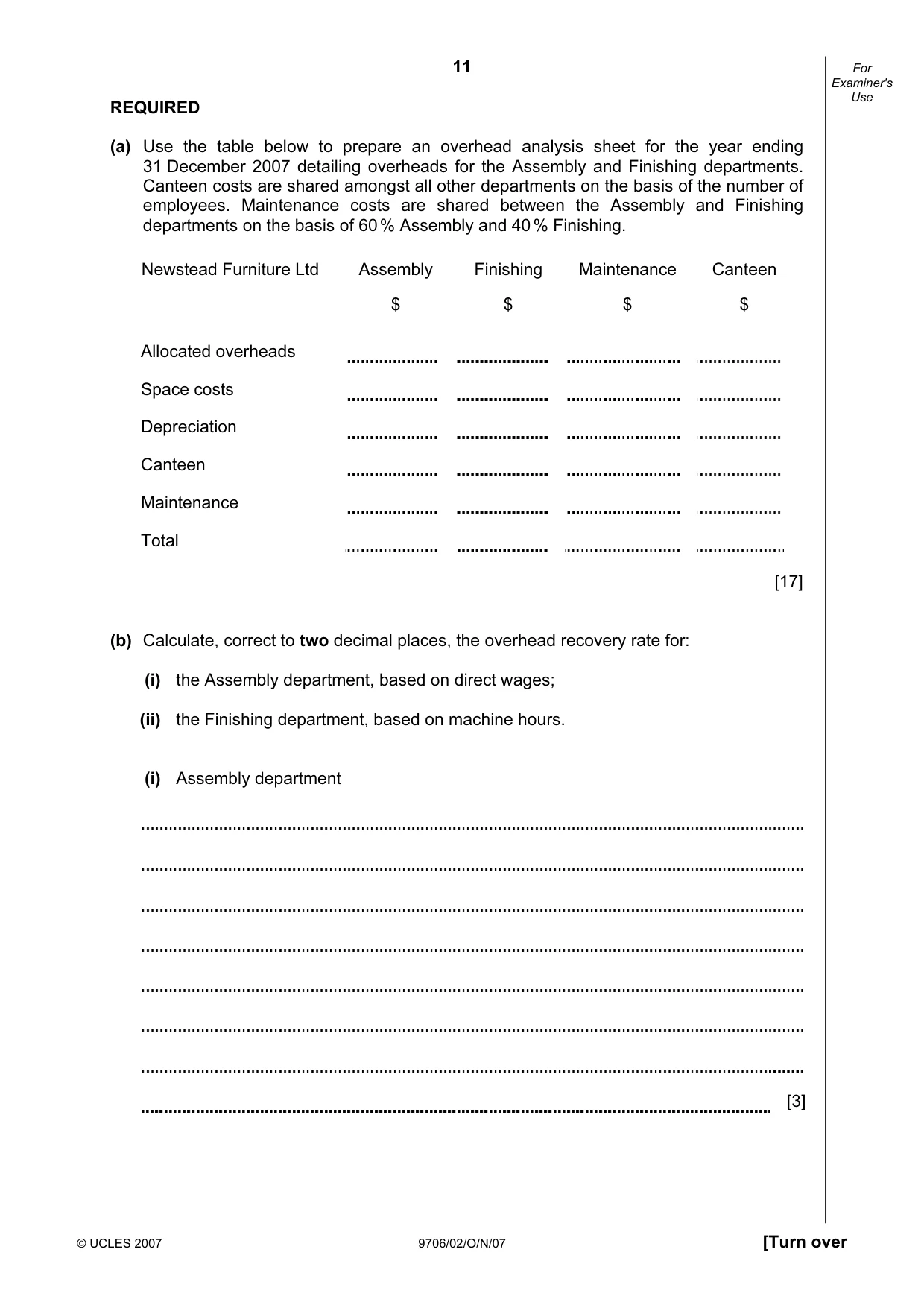
11 © UCLES 2007 9706/02/O/N/07 [Turn over For Examiner's Use REQUIRED (a) Use the table below to prepare an overhead analysis sheet for the year ending 31 December 2007 detailing overheads for the Assembly and Finishing departments. Canteen costs are shared amongst all other departments on the basis of the number of employees. Maintenance costs are shared between the Assembly and Finishing departments on the basis of 60 % Assembly and 40 % Finishing. Newstead Furniture Ltd Assembly Finishing Maintenance Canteen $ $ $ $ Allocated overheads Space costs Depreciation Canteen Maintenance Total [17] (b) Calculate, correct to two decimal places, the overhead recovery rate for: (i) the Assembly department, based on direct wages; (ii) the Finishing department, based on machine hours. (i) Assembly department [3]
Question paper, page 12
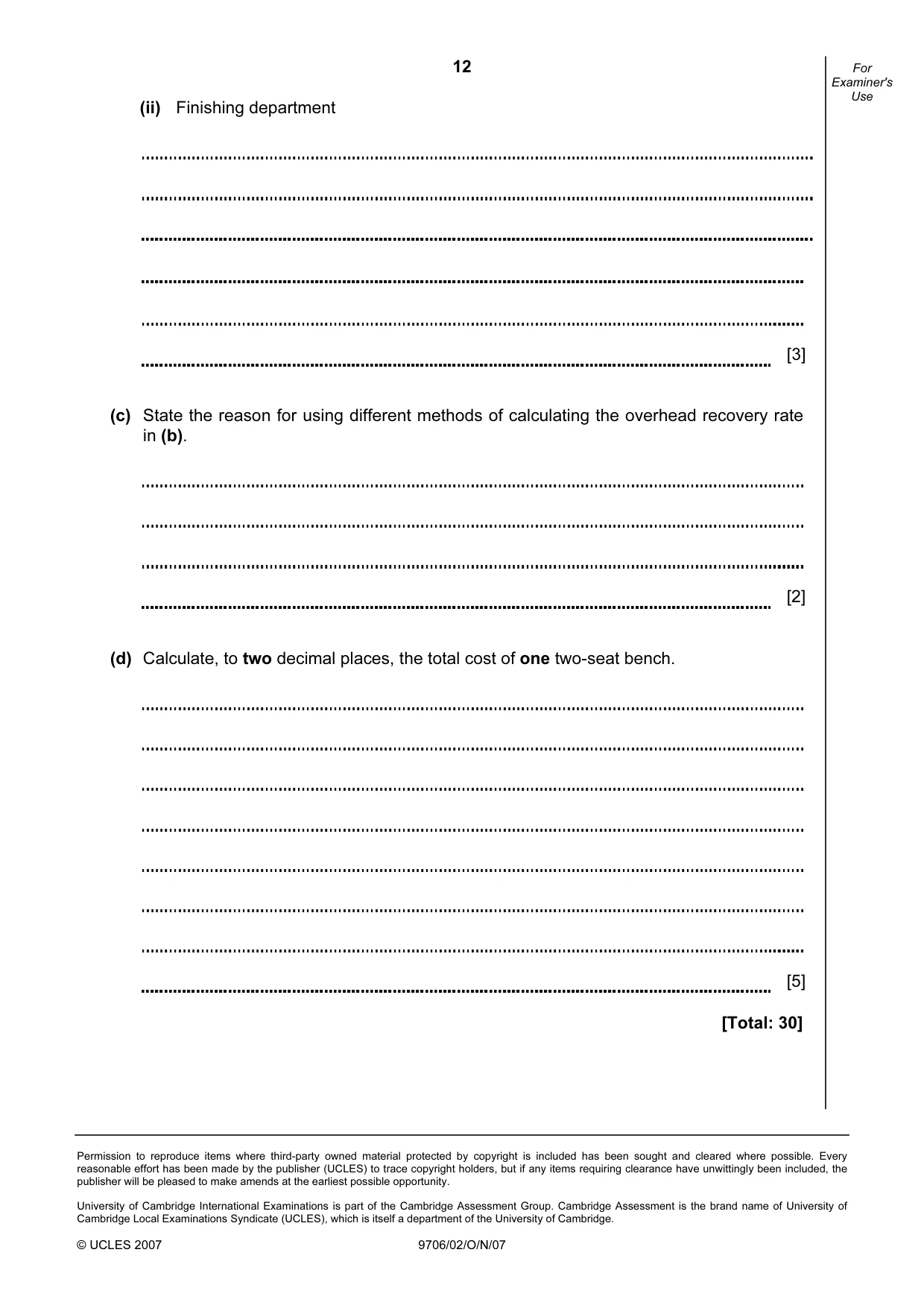
12 Permission to reproduce items where third-party owned material protected by copyright is included has been sought and cleared where possible. Every reasonable effort has been made by the publisher (UCLES) to trace copyright holders, but if any items requiring clearance have unwittingly been included, the publisher will be pleased to make amends at the earliest possible opportunity. University of Cambridge International Examinations is part of the Cambridge Assessment Group. Cambridge Assessment is the brand name of University of Cambridge Local Examinations Syndicate (UCLES), which is itself a department of the University of Cambridge. © UCLES 2007 9706/02/O/N/07 For Examiner's Use (ii) Finishing department (c) State the reason for using different methods of calculating the overhead recovery rate in (b). [2] (d) Calculate, to two decimal places, the total cost of one two-seat bench. [5] [Total: 30] [3]
Mark scheme, page 1
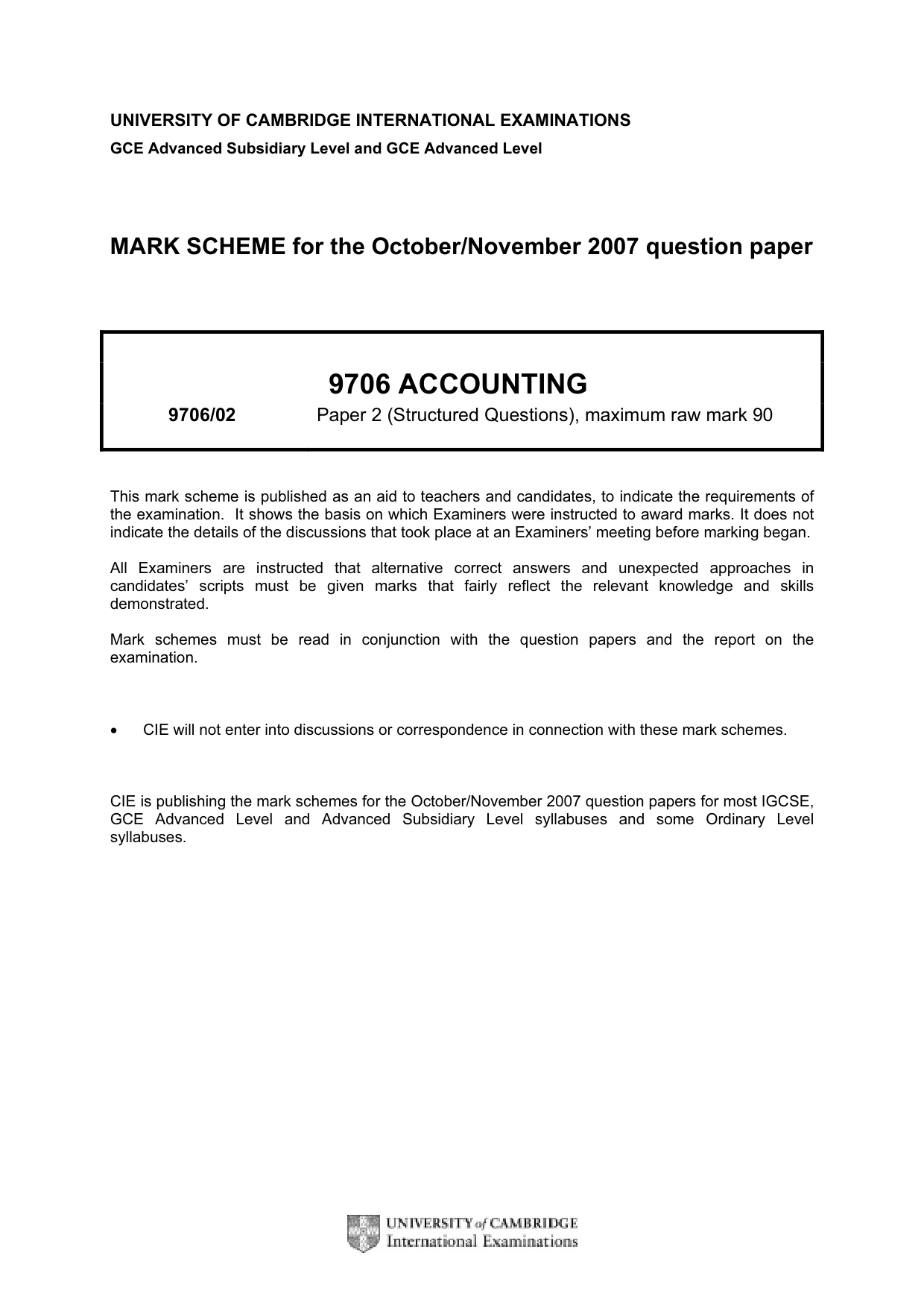
UNIVERSITY OF CAMBRIDGE INTERNATIONAL EXAMINATIONS GCE Advanced Subsidiary Level and GCE Advanced Level MARK SCHEME for the October/November 2007 question paper 9706 ACCOUNTING 9706/02 Paper 2 (Structured Questions), maximum raw mark 90 This mark scheme is published as an aid to teachers and candidates, to indicate the requirements of the examination. It shows the basis on which Examiners were instructed to award marks. It does not indicate the details of the discussions that took place at an Examiners’ meeting before marking began. All Examiners are instructed that alternative correct answers and unexpected approaches in candidates’ scripts must be given marks that fairly reflect the relevant knowledge and skills demonstrated. Mark schemes must be read in conjunction with the question papers and the report on the examination. • CIE will not enter into discussions or correspondence in connection with these mark schemes. CIE is publishing the mark schemes for the October/November 2007 question papers for most IGCSE, GCE Advanced Level and Advanced Subsidiary Level syllabuses and some Ordinary Level syllabuses.
Mark scheme, page 2
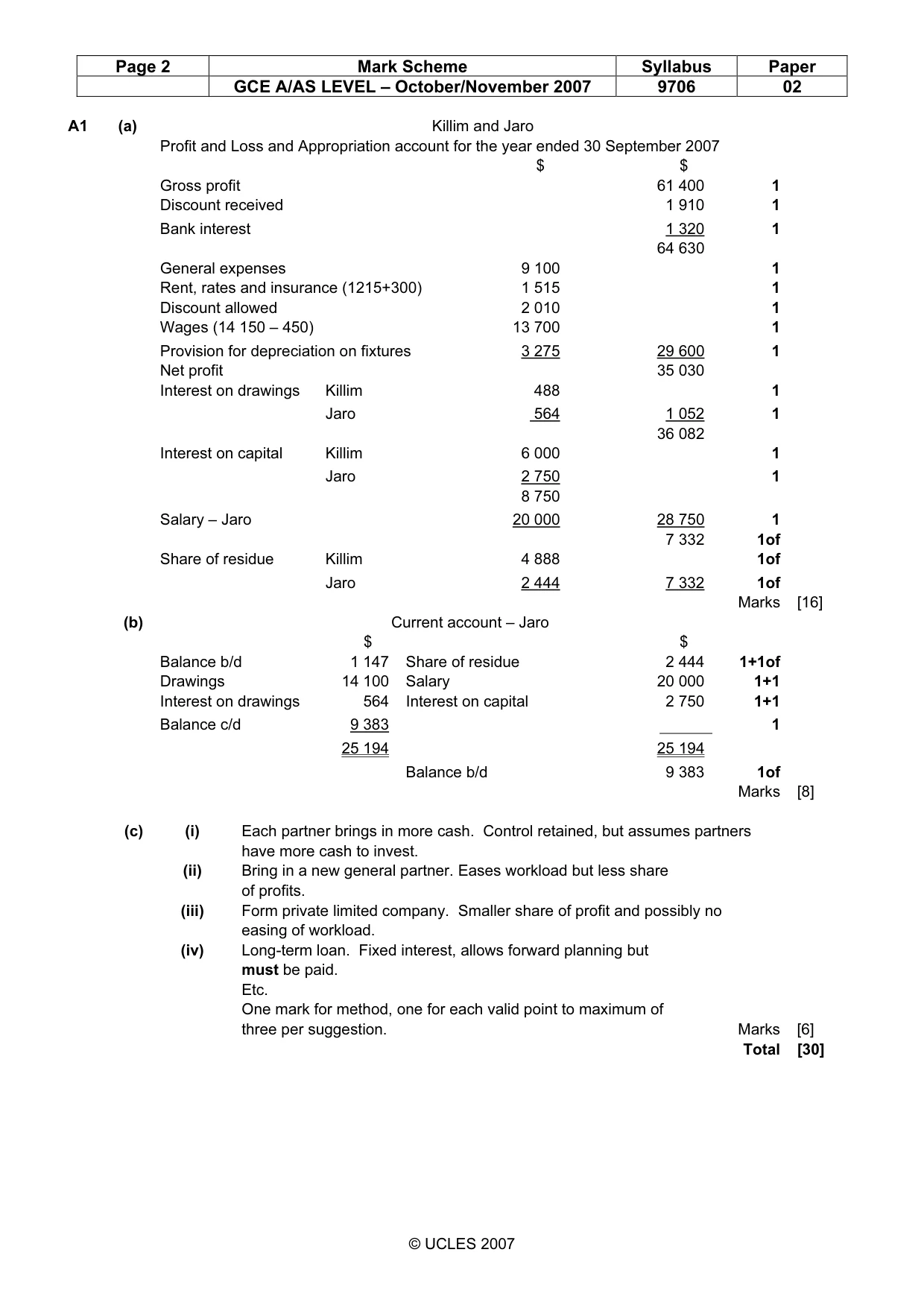
Page 2 Mark Scheme Syllabus Paper GCE A/AS LEVEL – October/November 2007 9706 02 © UCLES 2007 A1 (a) Killim and Jaro Profit and Loss and Appropriation account for the year ended 30 September 2007 $ $ Gross profit 61 400 1 Discount received 1 910 1 Bank interest 1 320 1 64 630 General expenses 9 100 1 Rent, rates and insurance (1215+300) 1 515 1 Discount allowed 2 010 1 Wages (14 150 – 450) 13 700 1 Provision for depreciation on fixtures 3 275 29 600 1 Net profit 35 030 Interest on drawings Killim 488 1 Jaro 564 1 052 1 36 082 Interest on capital Killim 6 000 1 Jaro 2 750 1 8 750 Salary – Jaro 20 000 28 750 1 7 332 1of Share of residue Killim 4 888 1of Jaro 2 444 7 332 1of Marks [16] (b) Current account – Jaro $ $ Balance b/d 1 147 Share of residue 2 444 1+1of Drawings 14 100 Salary 20 000 1+1 Interest on drawings 564 Interest on capital 2 750 1+1 Balance c/d 9 383 1 25 194 25 194 Balance b/d 9 383 1of Marks [8] (c) (i) Each partner brings in more cash. Control retained, but assumes partners have more cash to invest. (ii) Bring in a new general partner. Eases workload but less share of profits. (iii) Form private limited company. Smaller share of profit and possibly no easing of workload. (iv) Long-term loan. Fixed interest, allows forward planning but must be paid. Etc. One mark for method, one for each valid point to maximum of three per suggestion. Marks [6] Total [30]
Mark scheme, page 3
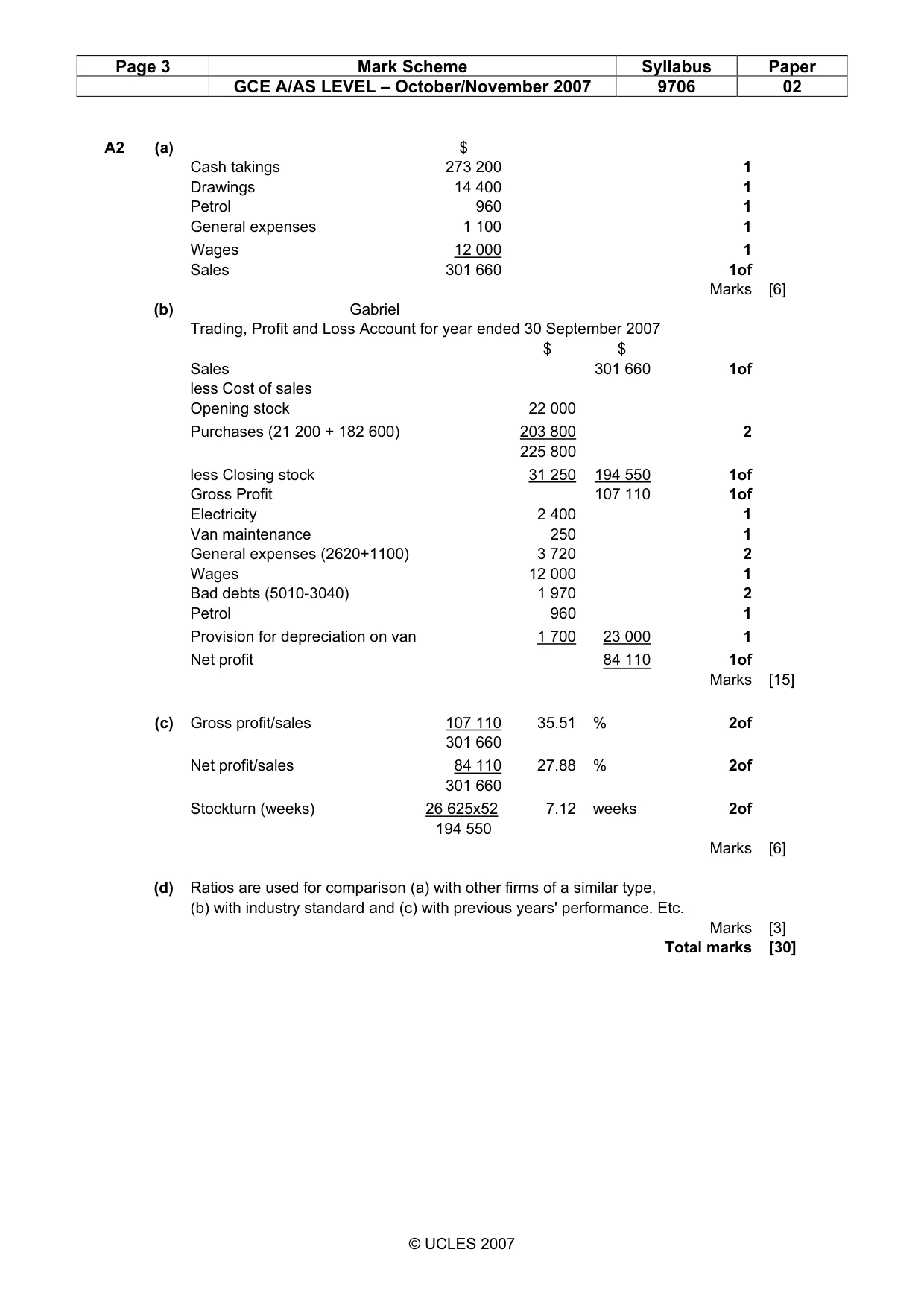
Page 3 Mark Scheme Syllabus Paper GCE A/AS LEVEL – October/November 2007 9706 02 © UCLES 2007 A2 (a) $ Cash takings 273 200 1 Drawings 14 400 1 Petrol 960 1 General expenses 1 100 1 Wages 12 000 1 Sales 301 660 1of Marks [6] (b) Gabriel Trading, Profit and Loss Account for year ended 30 September 2007 $ $ Sales 301 660 1of less Cost of sales Opening stock 22 000 Purchases (21 200 + 182 600) 203 800 2 225 800 less Closing stock 31 250 194 550 1of Gross Profit 107 110 1of Electricity 2 400 1 Van maintenance 250 1 General expenses (2620+1100) 3 720 2 Wages 12 000 1 Bad debts (5010-3040) 1 970 2 Petrol 960 1 Provision for depreciation on van 1 700 23 000 1 Net profit 84 110 1of Marks [15] (c) Gross profit/sales 107 110 35.51 % 2of 301 660 Net profit/sales 84 110 27.88 % 2of 301 660 Stockturn (weeks) 26 625x52 7.12 weeks 2of 194 550 Marks [6] (d) Ratios are used for comparison (a) with other firms of a similar type, (b) with industry standard and (c) with previous years' performance. Etc. Marks [3] Total marks [30]
Mark scheme, page 4
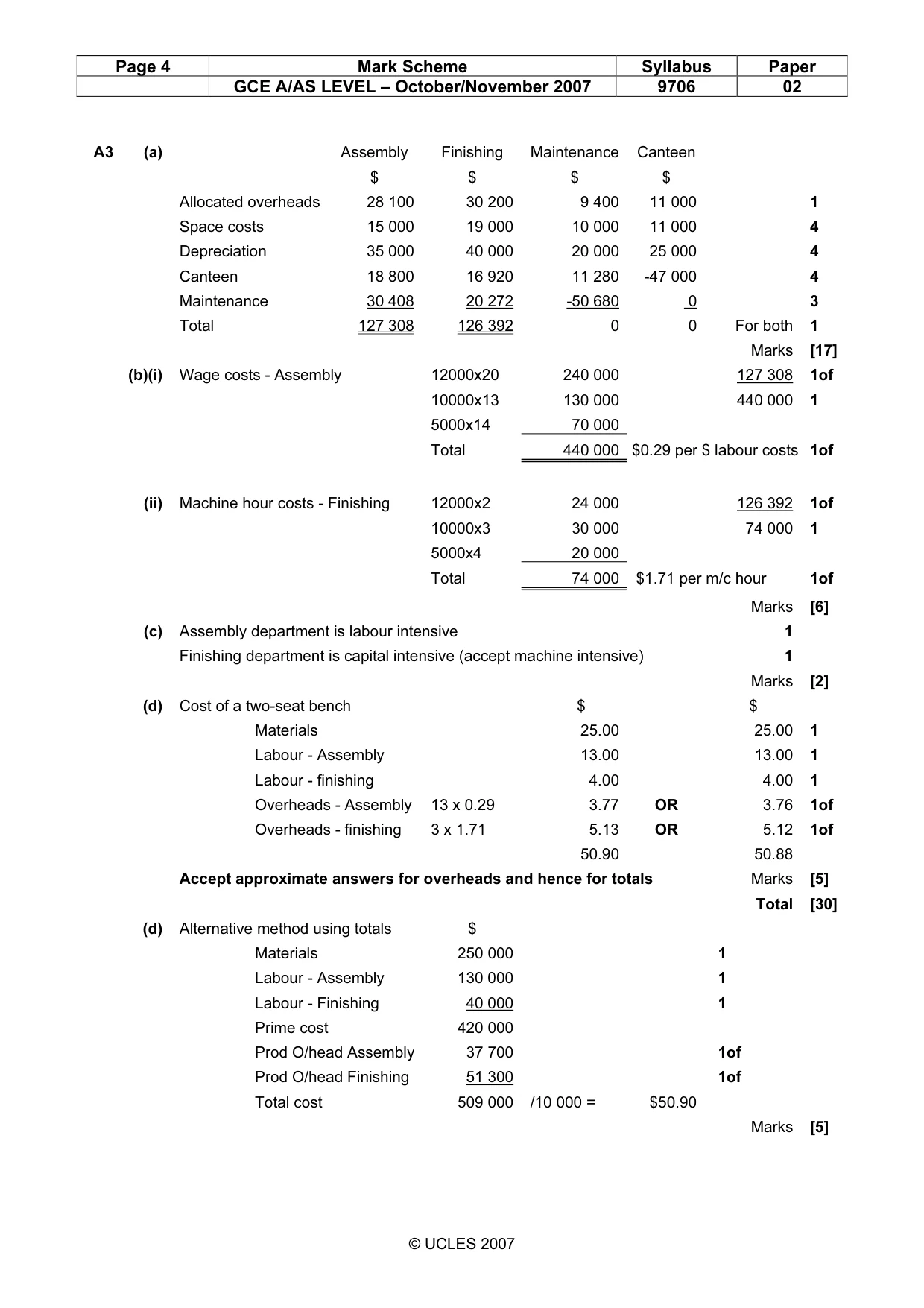
Page 4 Mark Scheme Syllabus Paper GCE A/AS LEVEL – October/November 2007 9706 02 © UCLES 2007 A3 (a) Assembly Finishing Maintenance Canteen $ $ $ $ Allocated overheads 28 100 30 200 9 400 11 000 1 Space costs 15 000 19 000 10 000 11 000 4 Depreciation 35 000 40 000 20 000 25 000 4 Canteen 18 800 16 920 11 280 -47 000 4 Maintenance 30 408 20 272 -50 680 0 3 Total 127 308 126 392 0 0 For both 1 Marks [17] (b)(i) Wage costs - Assembly 12000x20 240 000 127 308 1of 10000x13 130 000 440 000 1 5000x14 70 000 Total 440 000 $0.29 per $ labour costs 1of (ii) Machine hour costs - Finishing 12000x2 24 000 126 392 1of 10000x3 30 000 74 000 1 5000x4 20 000 Total 74 000 $1.71 per m/c hour 1of Marks [6] (c) Assembly department is labour intensive 1 Finishing department is capital intensive (accept machine intensive) 1 Marks [2] (d) Cost of a two-seat bench $ $ Materials 25.00 25.00 1 Labour - Assembly 13.00 13.00 1 Labour - finishing 4.00 4.00 1 Overheads - Assembly 13 x 0.29 3.77 OR 3.76 1of Overheads - finishing 3 x 1.71 5.13 OR 5.12 1of 50.90 50.88 Accept approximate answers for overheads and hence for totals Marks [5] Total [30] (d) Alternative method using totals $ Materials 250 000 1 Labour - Assembly 130 000 1 Labour - Finishing 40 000 1 Prime cost 420 000 Prod O/head Assembly 37 700 1of Prod O/head Finishing 51 300 1of Total cost 509 000 /10 000 = $50.90 Marks [5]
What you needed in this session
Cambridge’s own grade thresholds for 2007 Oct/Nov, Paper 2 · Variant 1. A higher threshold means an easier paper — the bar moves with how the cohort did.