Cambridge A Level Accounting 9706 — 2007 May/June Paper 2 · Variant 1
9706/21/M/J/07 · 90 marks · ≈101 min
The question paper and its mark scheme, free to read here and free to download. This is Cambridge’s own paper, exactly as it was sat.
Question paper12 pages
Mark scheme5 pages
Answers below. Sit the paper first if you are practising.
Paper as text
Question paper, page 1
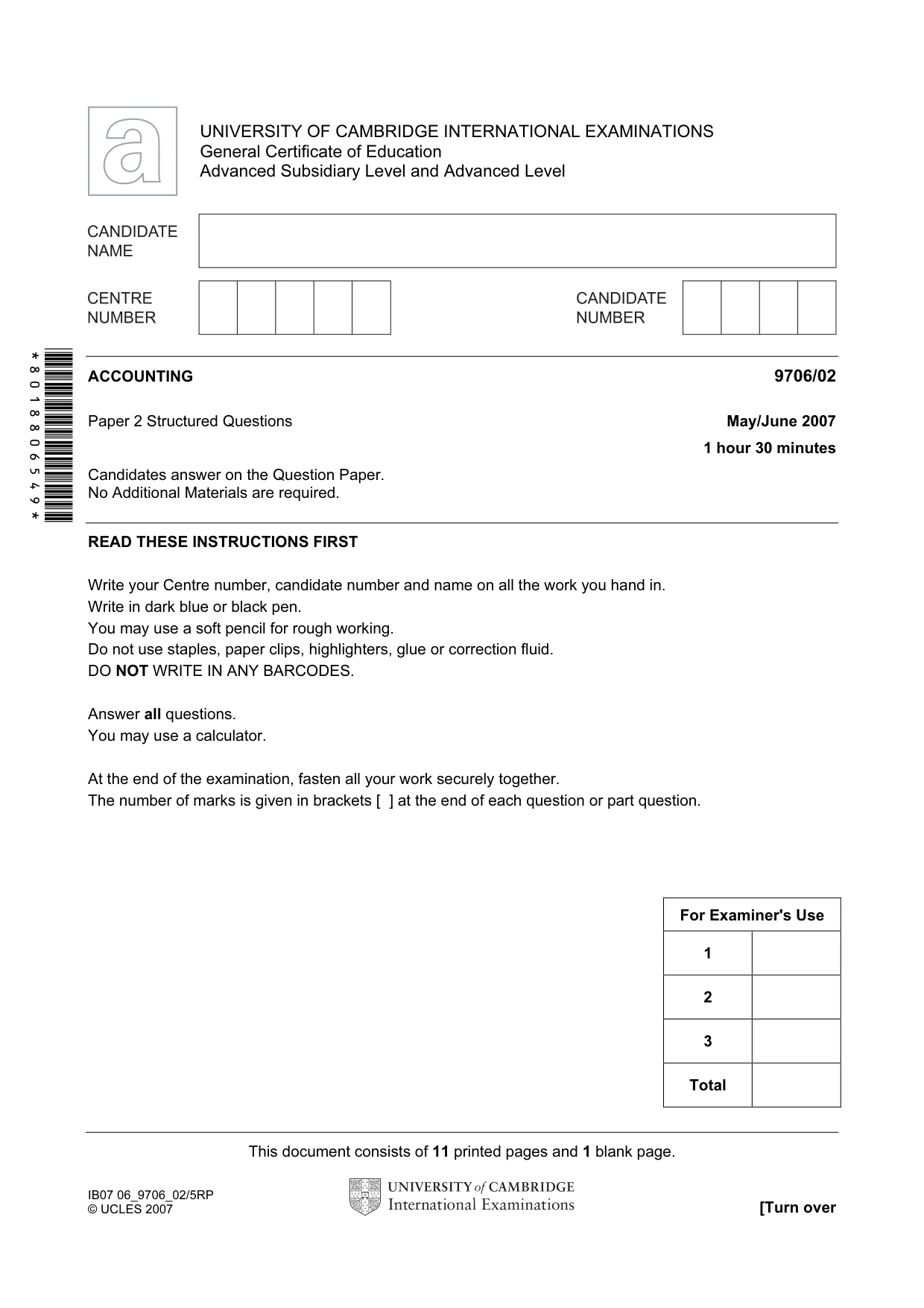
This document consists of 11 printed pages and 1 blank page. IB07 06_9706_02/5RP © UCLES 2007 [Turn over *8018806549* For Examiner's Use 1 2 3 Total UNIVERSITY OF CAMBRIDGE INTERNATIONAL EXAMINATIONS General Certificate of Education Advanced Subsidiary Level and Advanced Level ACCOUNTING 9706/02 Paper 2 Structured Questions May/June 2007 1 hour 30 minutes Candidates answer on the Question Paper. No Additional Materials are required. READ THESE INSTRUCTIONS FIRST Write your Centre number, candidate number and name on all the work you hand in. Write in dark blue or black pen. You may use a soft pencil for rough working. Do not use staples, paper clips, highlighters, glue or correction fluid. DO NOT WRITE IN ANY BARCODES. Answer all questions. You may use a calculator. At the end of the examination, fasten all your work securely together. The number of marks is given in brackets [ ] at the end of each question or part question.
Question paper, page 2
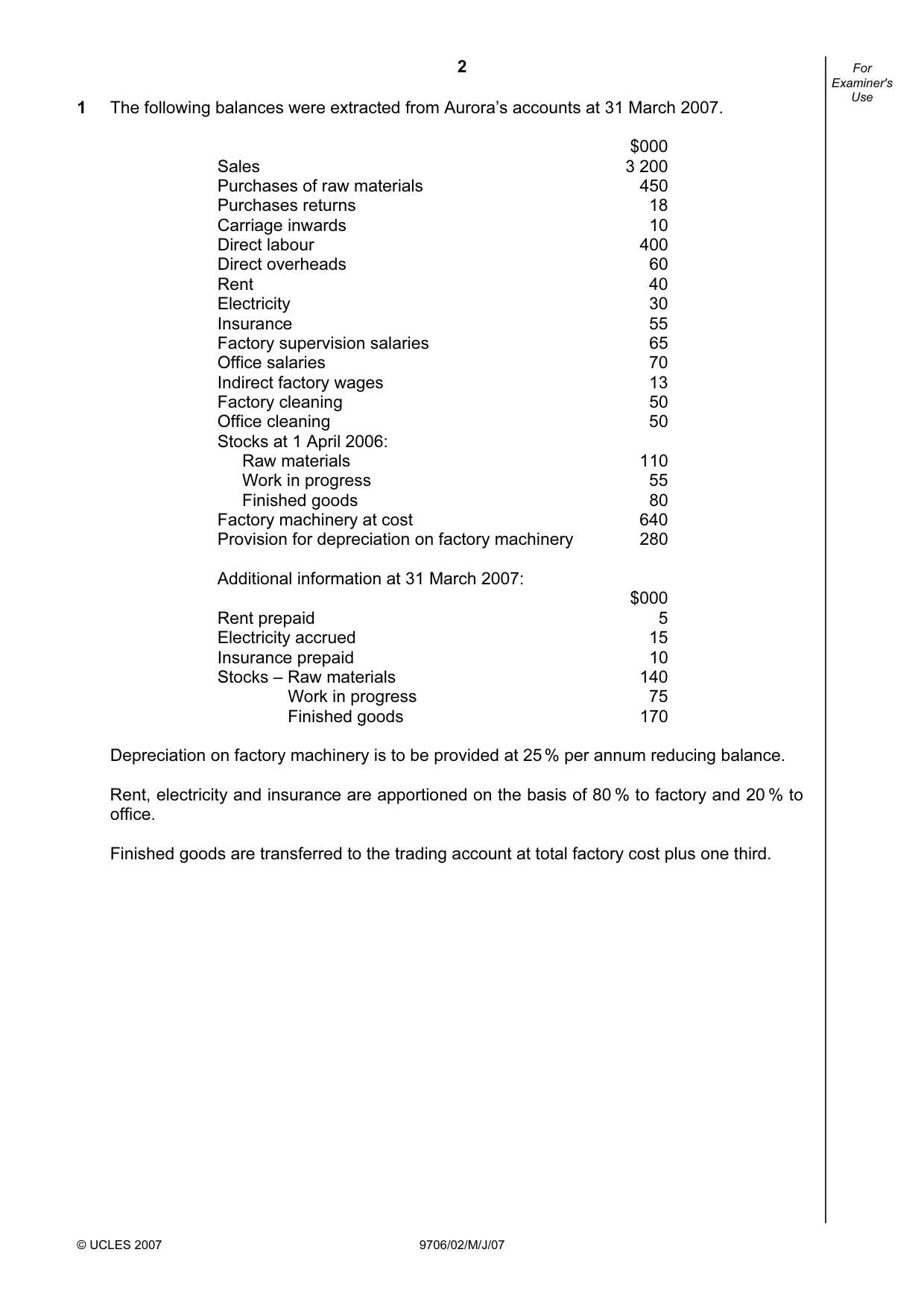
2 © UCLES 2007 9706/02/M/J/07 For Examiner's Use 1 The following balances were extracted from Aurora’s accounts at 31 March 2007. $000 Sales 3 200 Purchases of raw materials 450 Purchases returns 18 Carriage inwards 10 Direct labour 400 Direct overheads 60 Rent 40 Electricity 30 Insurance 55 Factory supervision salaries 65 Office salaries 70 Indirect factory wages 13 Factory cleaning 50 Office cleaning 50 Stocks at 1 April 2006: Raw materials 110 Work in progress 55 Finished goods 80 Factory machinery at cost 640 Provision for depreciation on factory machinery 280 Additional information at 31 March 2007: $000 Rent prepaid 5 Electricity accrued 15 Insurance prepaid 10 Stocks – Raw materials 140 Work in progress 75 Finished goods 170 Depreciation on factory machinery is to be provided at 25 % per annum reducing balance. Rent, electricity and insurance are apportioned on the basis of 80 % to factory and 20 % to office. Finished goods are transferred to the trading account at total factory cost plus one third.
Question paper, page 3
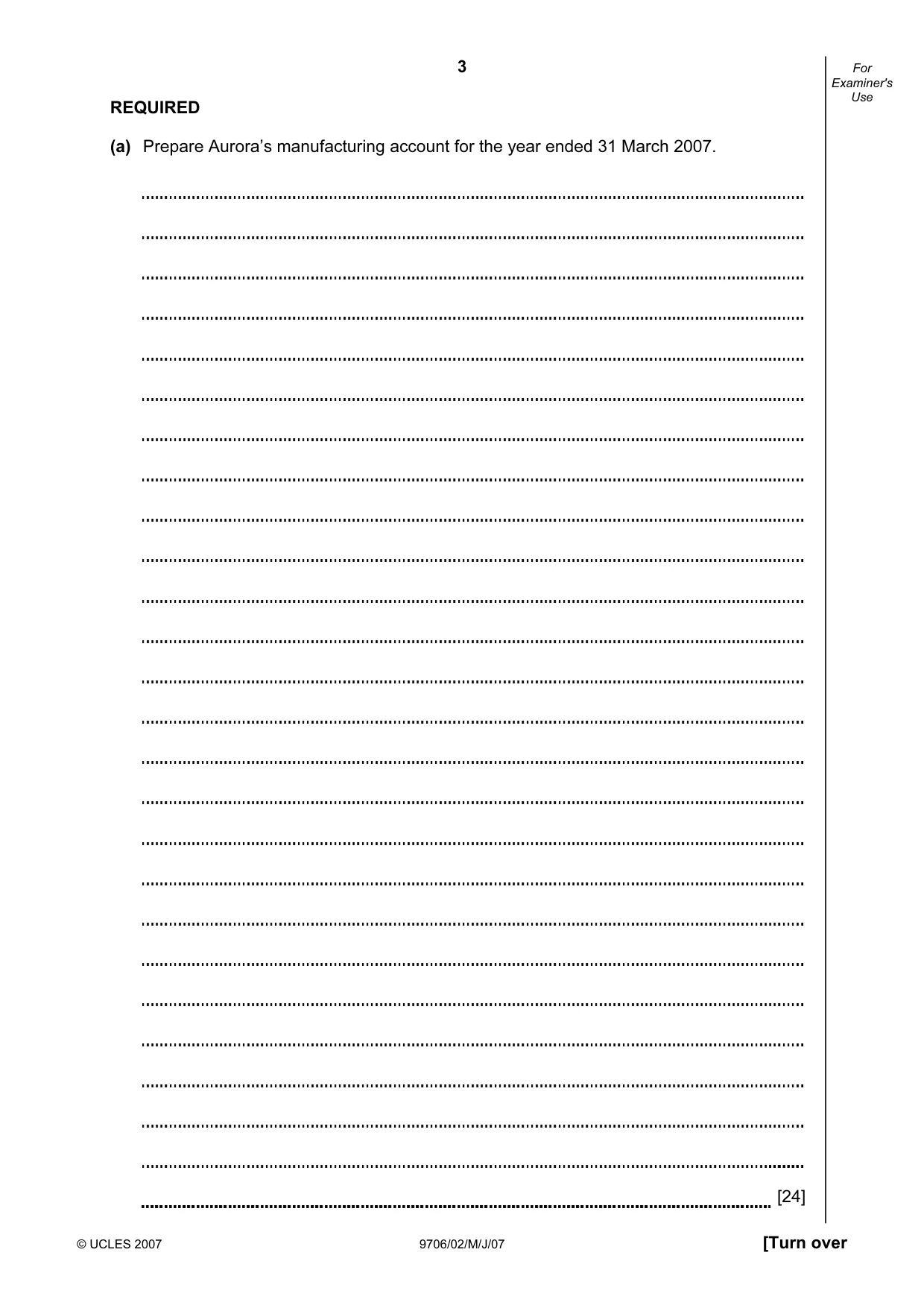
3 © UCLES 2007 9706/02/M/J/07 [Turn over For Examiner's Use REQUIRED (a) Prepare Aurora’s manufacturing account for the year ended 31 March 2007. [24]
Question paper, page 4
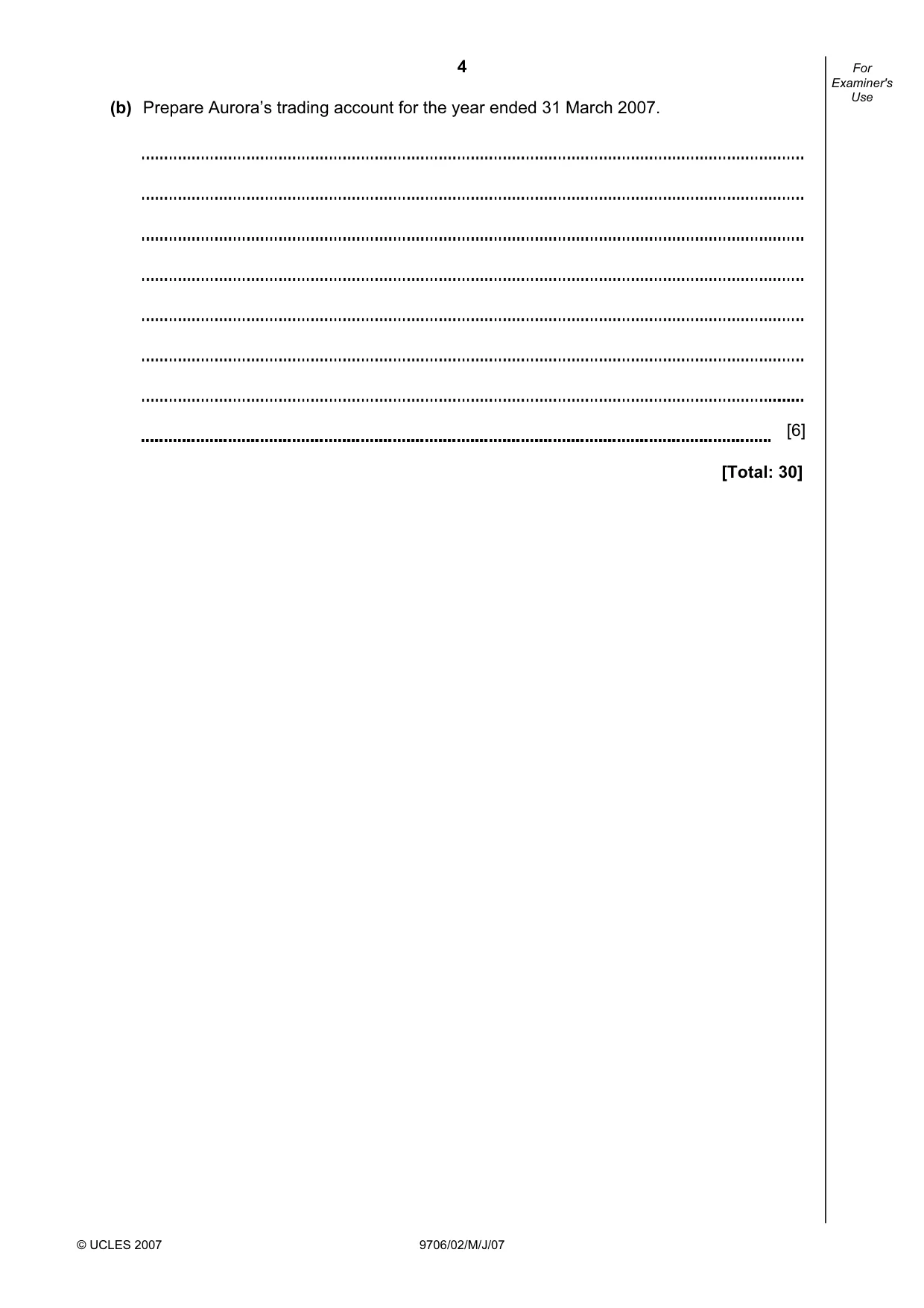
4 © UCLES 2007 9706/02/M/J/07 For Examiner's Use (b) Prepare Aurora’s trading account for the year ended 31 March 2007. [6] [Total: 30]
Question paper, page 5
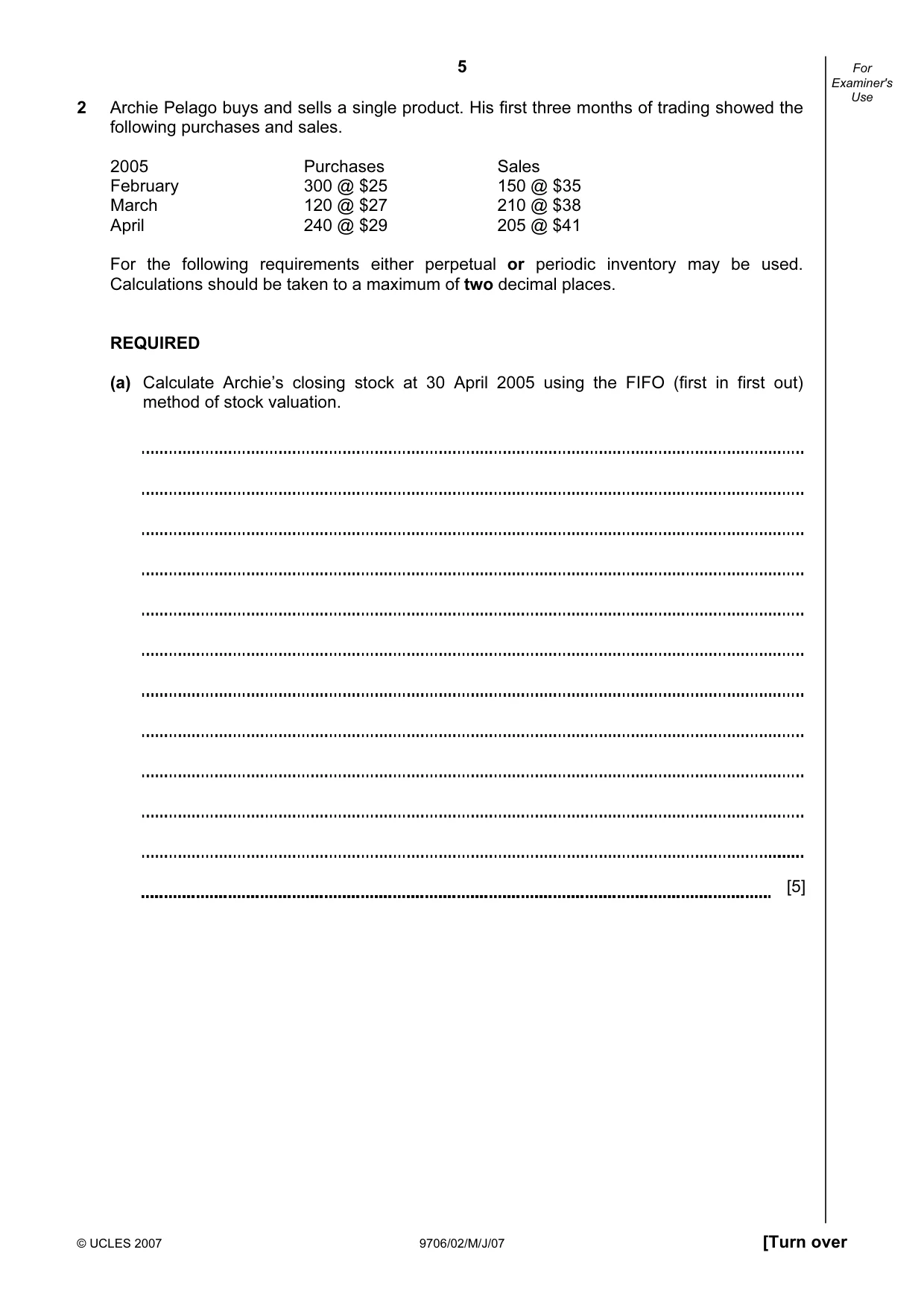
5 © UCLES 2007 9706/02/M/J/07 [Turn over For Examiner's Use 2 Archie Pelago buys and sells a single product. His first three months of trading showed the following purchases and sales. 2005 Purchases Sales February 300 @ $25 150 @ $35 March 120 @ $27 210 @ $38 April 240 @ $29 205 @ $41 For the following requirements either perpetual or periodic inventory may be used. Calculations should be taken to a maximum of two decimal places. REQUIRED (a) Calculate Archie’s closing stock at 30 April 2005 using the FIFO (first in first out) method of stock valuation. [5]
Question paper, page 6
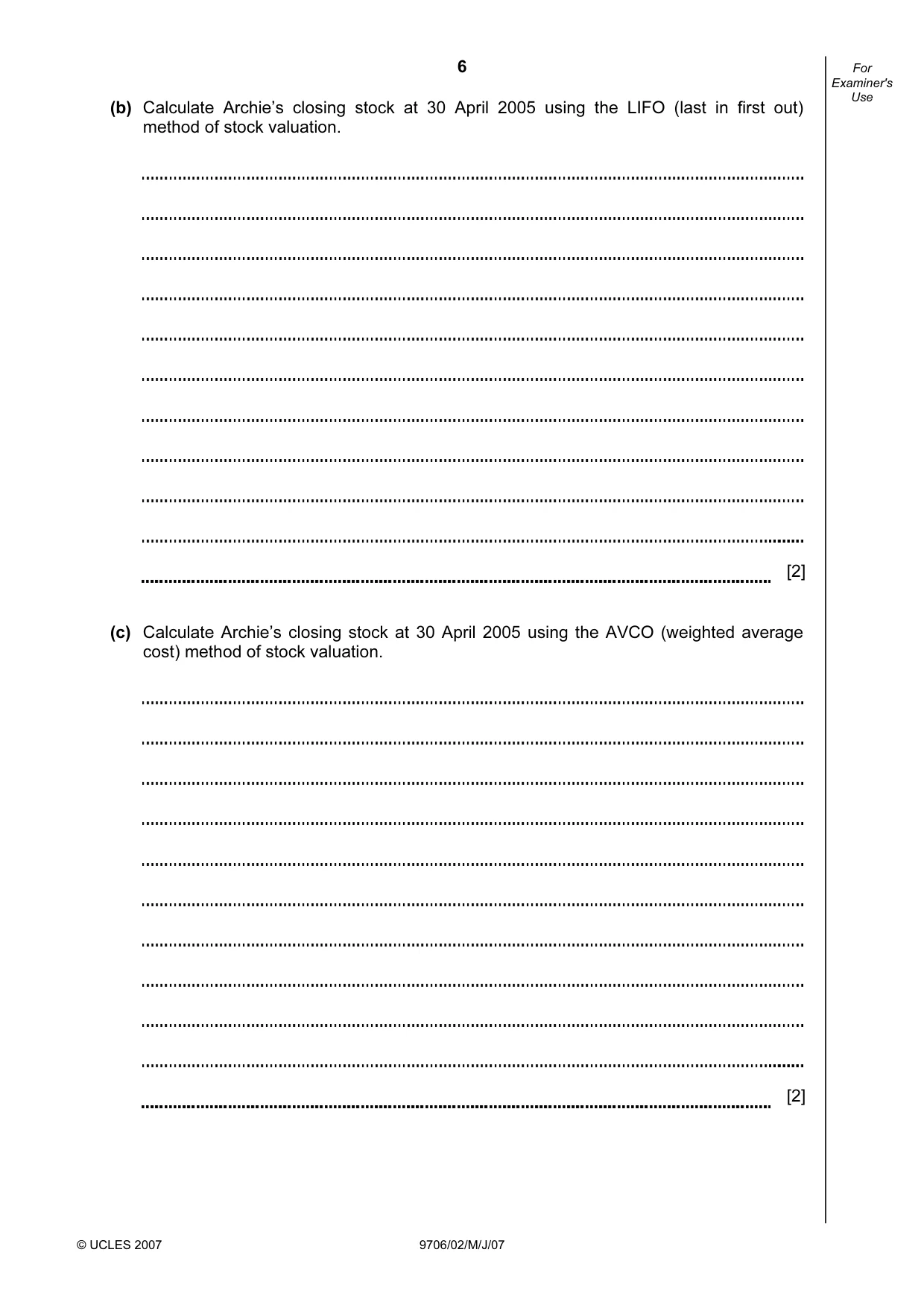
6 © UCLES 2007 9706/02/M/J/07 For Examiner's Use (b) Calculate Archie’s closing stock at 30 April 2005 using the LIFO (last in first out) method of stock valuation. [2] (c) Calculate Archie’s closing stock at 30 April 2005 using the AVCO (weighted average cost) method of stock valuation. [2]
Question paper, page 7
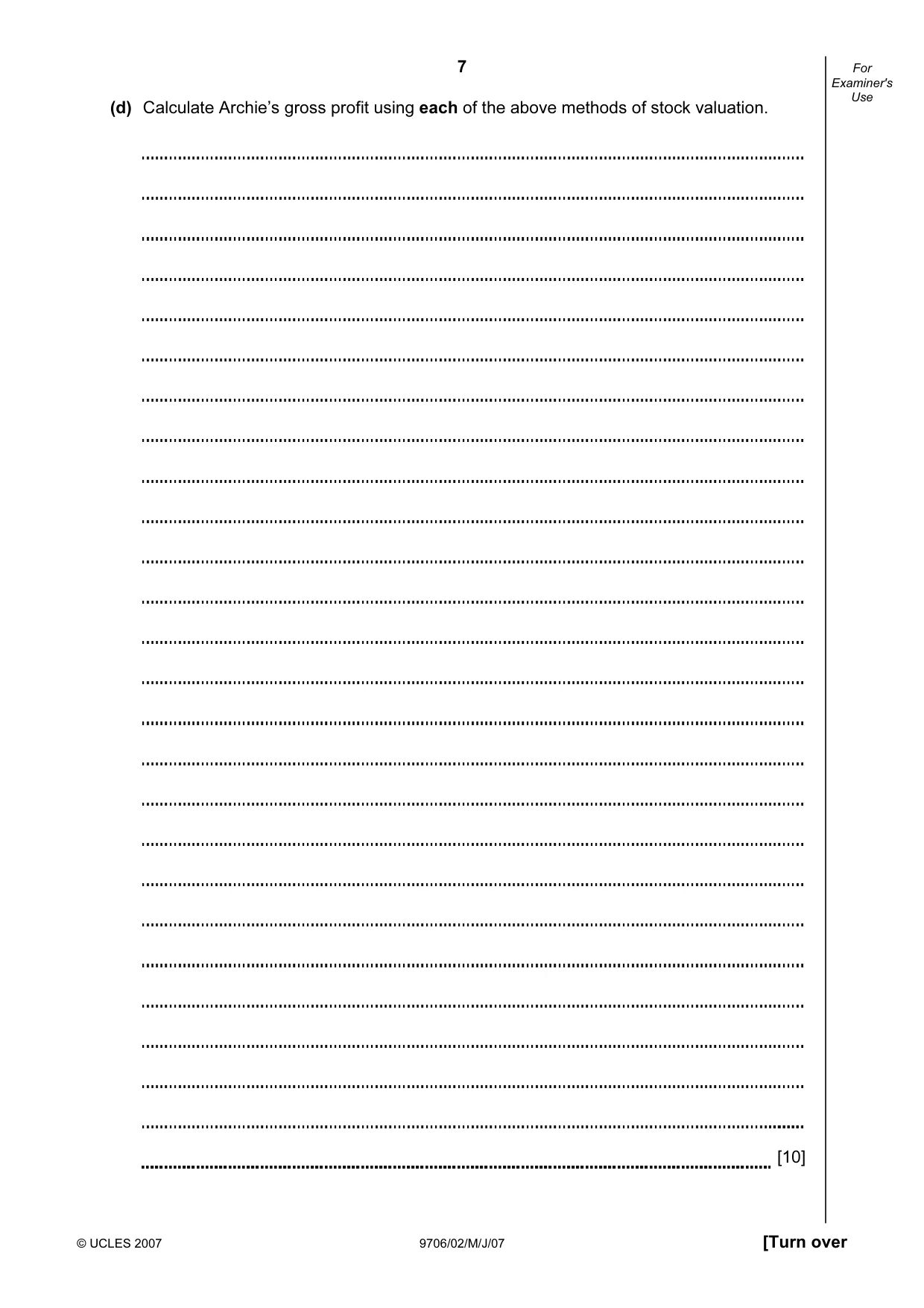
7 © UCLES 2007 9706/02/M/J/07 [Turn over For Examiner's Use (d) Calculate Archie’s gross profit using each of the above methods of stock valuation. [10]
Question paper, page 8
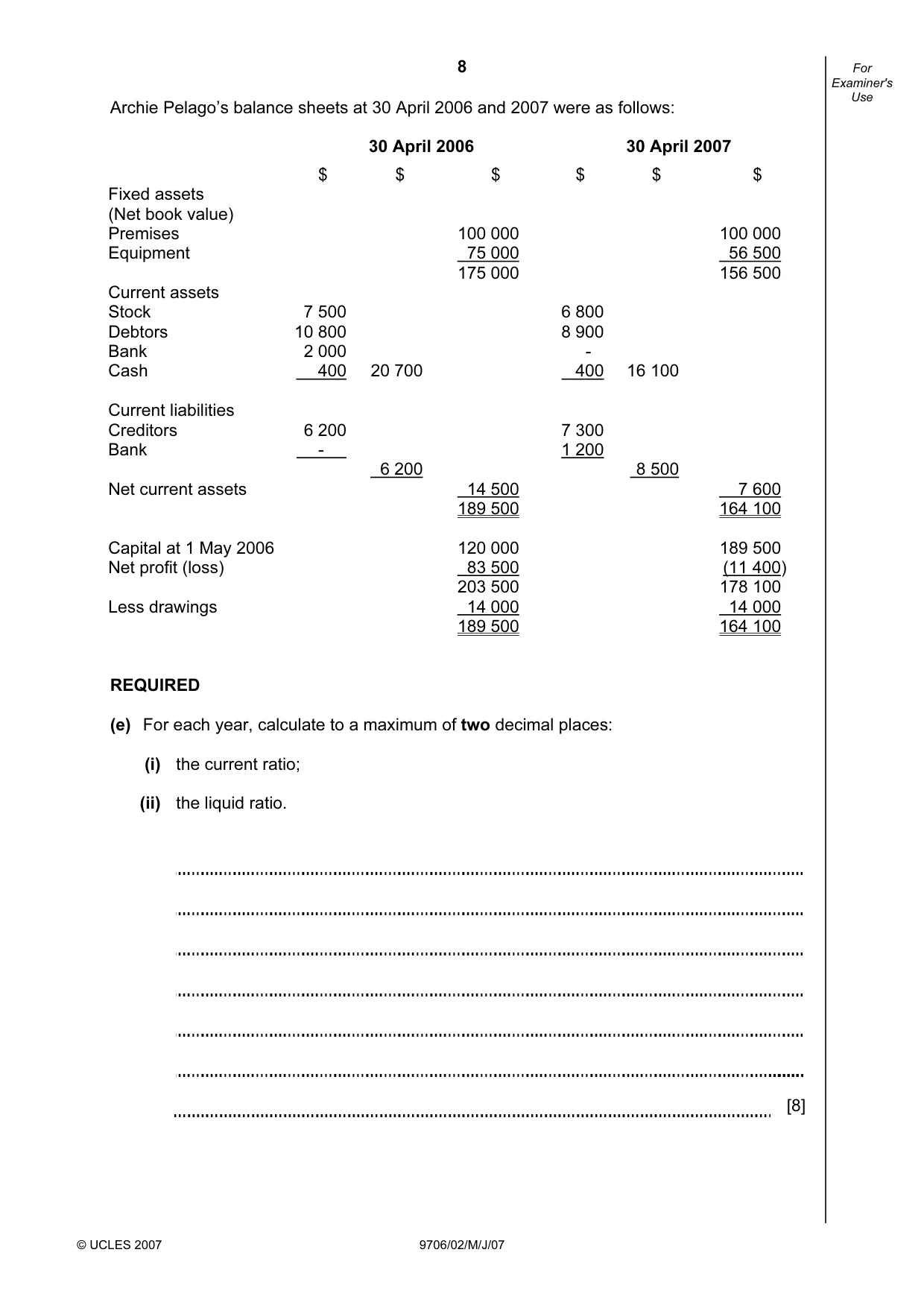
8 © UCLES 2007 9706/02/M/J/07 For Examiner's Use Archie Pelago’s balance sheets at 30 April 2006 and 2007 were as follows: 30 April 2006 30 April 2007 $ $ $ $ $ $ Fixed assets (Net book value) Premises 100 000 100 000 Equipment 75 000 56 500 175 000 156 500 Current assets Stock 7 500 6 800 Debtors 10 800 8 900 Bank 2 000 - Cash 400 20 700 400 16 100 Current liabilities Creditors 6 200 7 300 Bank - 1 200 6 200 8 500 Net current assets 14 500 7 600 189 500 164 100 Capital at 1 May 2006 120 000 189 500 Net profit (loss) 83 500 (11 400) 203 500 178 100 Less drawings 14 000 14 000 189 500 164 100 REQUIRED (e) For each year, calculate to a maximum of two decimal places: (i) the current ratio; (ii) the liquid ratio. [8]
Question paper, page 9
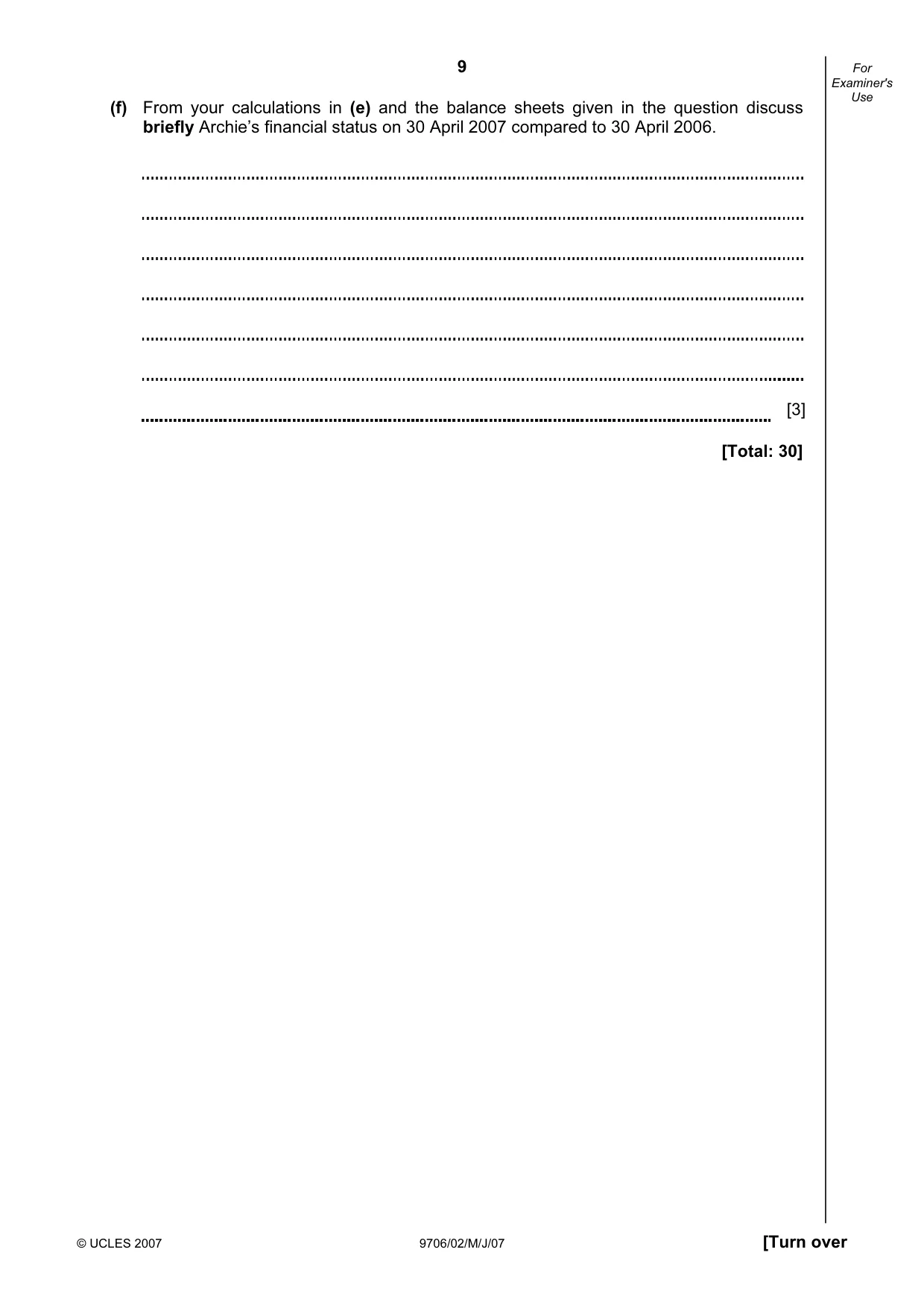
9 © UCLES 2007 9706/02/M/J/07 [Turn over For Examiner's Use (f) From your calculations in (e) and the balance sheets given in the question discuss briefly Archie’s financial status on 30 April 2007 compared to 30 April 2006. [3] [Total: 30]
Question paper, page 10
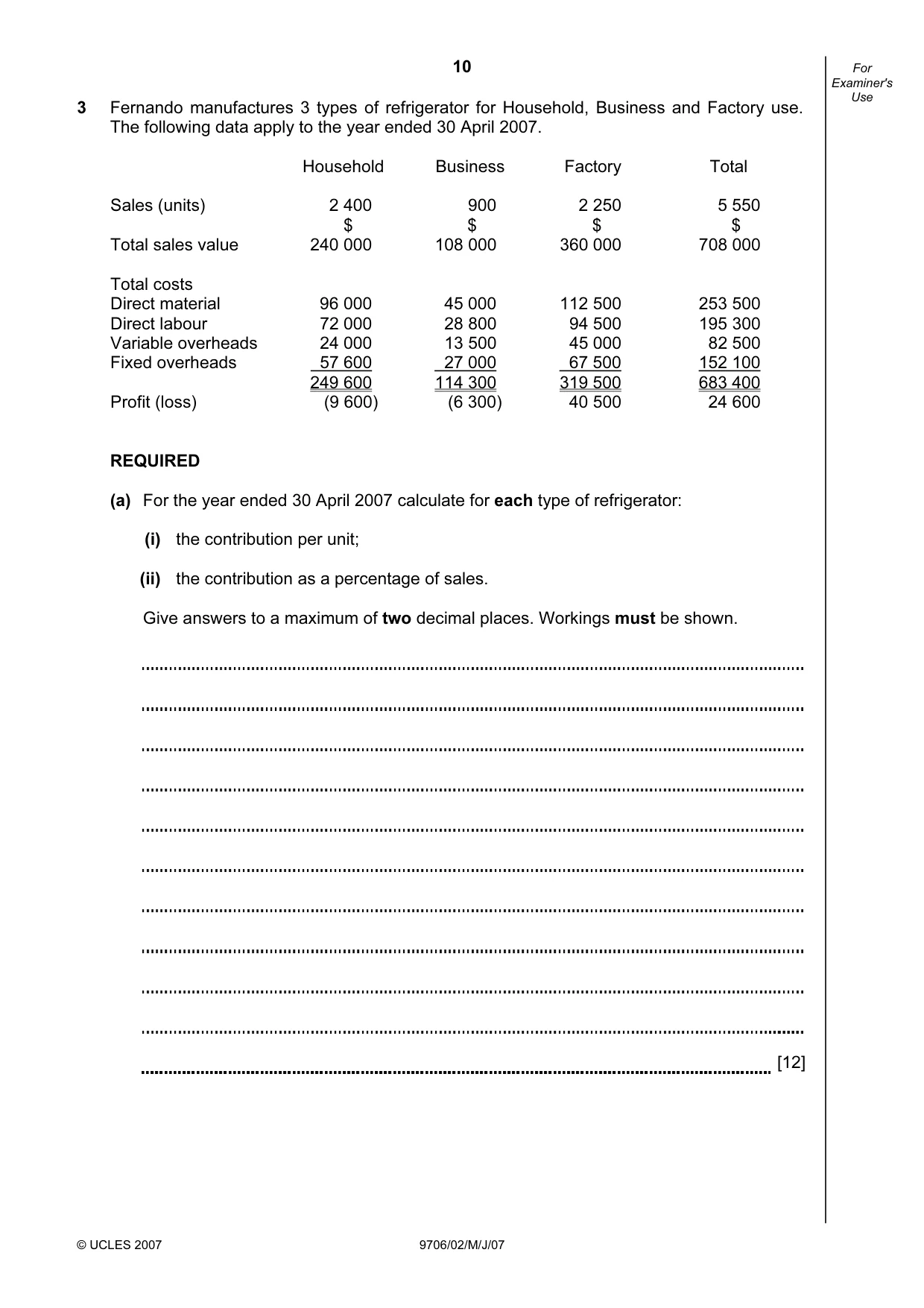
10 © UCLES 2007 9706/02/M/J/07 For Examiner's Use 3 Fernando manufactures 3 types of refrigerator for Household, Business and Factory use. The following data apply to the year ended 30 April 2007. Household Business Factory Total Sales (units) 2 400 900 2 250 5 550 $ $ $ $ Total sales value 240 000 108 000 360 000 708 000 Total costs Direct material 96 000 45 000 112 500 253 500 Direct labour 72 000 28 800 94 500 195 300 Variable overheads 24 000 13 500 45 000 82 500 Fixed overheads 57 600 27 000 67 500 152 100 249 600 114 300 319 500 683 400 Profit (loss) (9 600) (6 300) 40 500 24 600 REQUIRED (a) For the year ended 30 April 2007 calculate for each type of refrigerator: (i) the contribution per unit; (ii) the contribution as a percentage of sales. Give answers to a maximum of two decimal places. Workings must be shown. [12]
Question paper, page 11
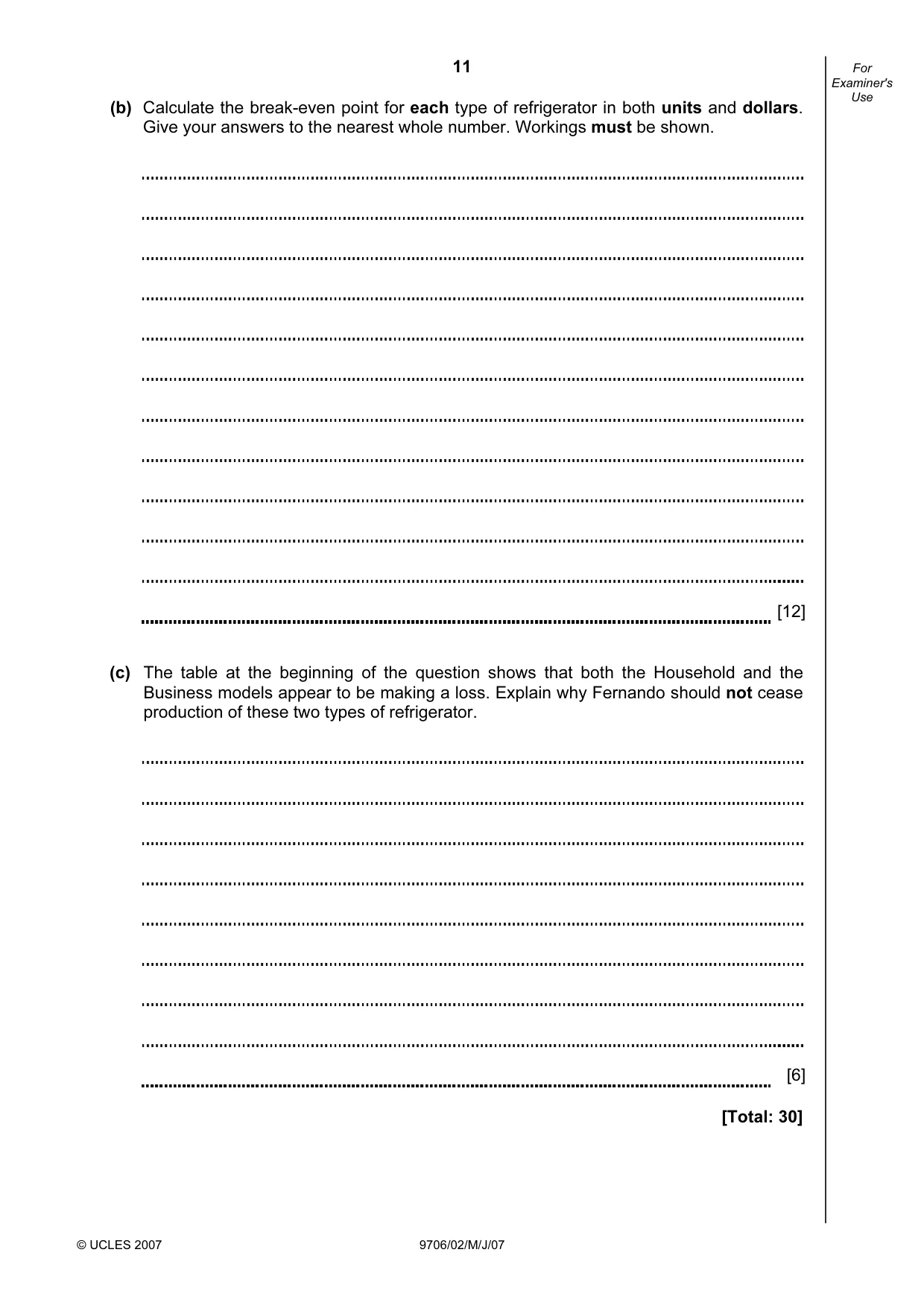
11 © UCLES 2007 9706/02/M/J/07 For Examiner's Use (b) Calculate the break-even point for each type of refrigerator in both units and dollars. Give your answers to the nearest whole number. Workings must be shown. [12] (c) The table at the beginning of the question shows that both the Household and the Business models appear to be making a loss. Explain why Fernando should not cease production of these two types of refrigerator. [6] [Total: 30]
Question paper, page 12
12 BLANK PAGE Permission to reproduce items where third-party owned material protected by copyright is included has been sought and cleared where possible. Every reasonable effort has been made by the publisher (UCLES) to trace copyright holders, but if any items requiring clearance have unwittingly been included, the publisher will be pleased to make amends at the earliest possible opportunity. University of Cambridge International Examinations is part of the Cambridge Assessment Group. Cambridge Assessment is the brand name of University of Cambridge Local Examinations Syndicate (UCLES), which is itself a department of the University of Cambridge. 9706/02/M/J/07
Mark scheme, page 1
UNIVERSITY OF CAMBRIDGE INTERNATIONAL EXAMINATIONS GCE Advanced Subsidiary Level and GCE Advanced Level MARK SCHEME for the May/June 2007 question paper 9706 ACCOUNTING 9706/02 Paper 2 (Structured Questions (AS Topics)), maximum raw mark 90 This mark scheme is published as an aid to teachers and candidates, to indicate the requirements of the examination. It shows the basis on which Examiners were instructed to award marks. It does not indicate the details of the discussions that took place at an Examiners’ meeting before marking began. All Examiners are instructed that alternative correct answers and unexpected approaches in candidates’ scripts must be given marks that fairly reflect the relevant knowledge and skills demonstrated. Mark schemes must be read in conjunction with the question papers and the report on the examination. • CIE will not enter into discussions or correspondence in connection with these mark schemes. CIE is publishing the mark schemes for the May/June 2007 question papers for most IGCSE, GCE Advanced Level and Advanced Subsidiary Level syllabuses and some Ordinary Level syllabuses.
Mark scheme, page 2
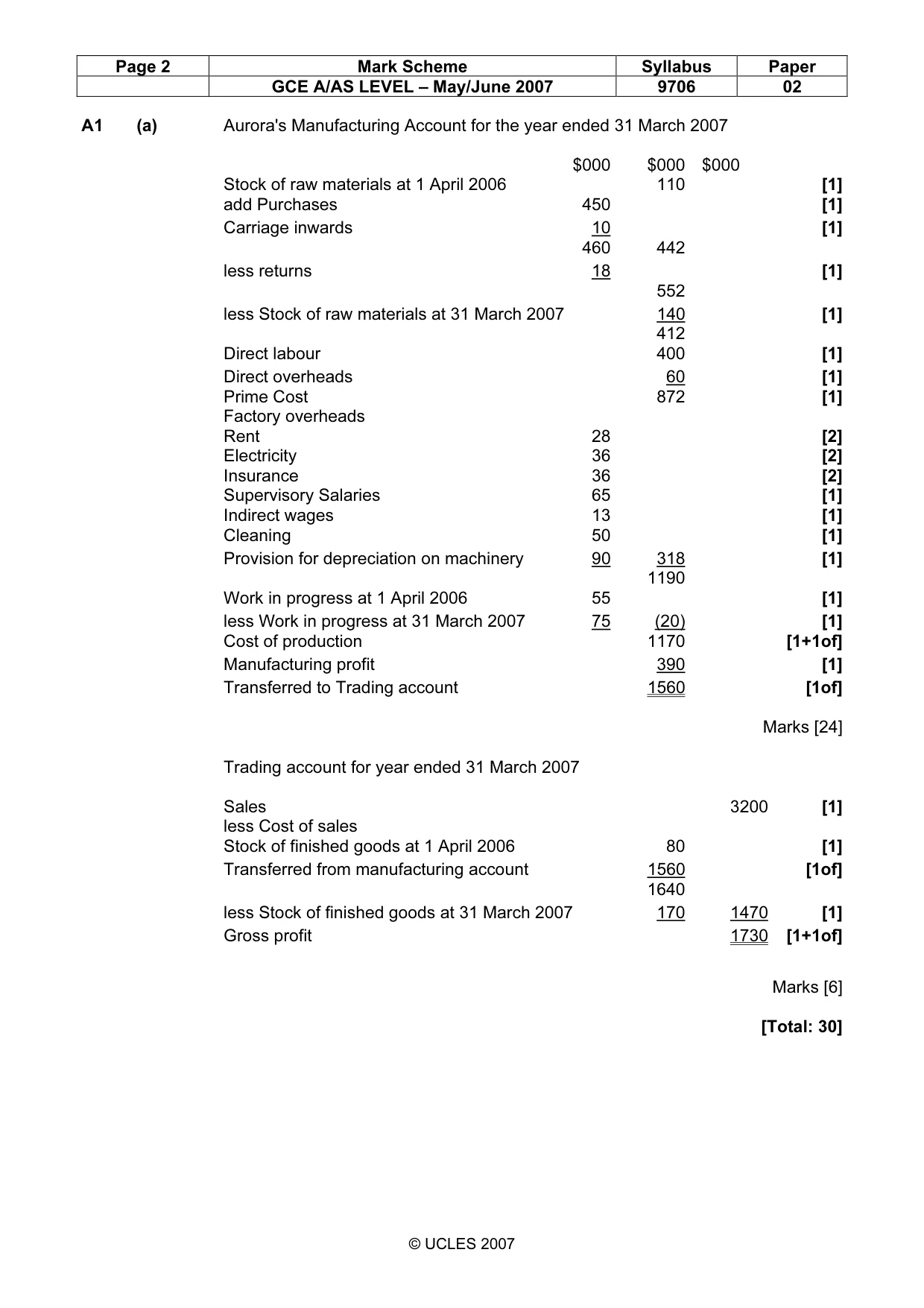
Page 2 Mark Scheme Syllabus Paper GCE A/AS LEVEL – May/June 2007 9706 02 © UCLES 2007 A1 (a) Aurora's Manufacturing Account for the year ended 31 March 2007 $000 $000 $000 Stock of raw materials at 1 April 2006 110 [1] add Purchases 450 [1] Carriage inwards 10 [1] 460 442 less returns 18 [1] 552 less Stock of raw materials at 31 March 2007 140 [1] 412 Direct labour 400 [1] Direct overheads 60 [1] Prime Cost 872 [1] Factory overheads Rent 28 [2] Electricity 36 [2] Insurance 36 [2] Supervisory Salaries 65 [1] Indirect wages 13 [1] Cleaning 50 [1] Provision for depreciation on machinery 90 318 [1] 1190 Work in progress at 1 April 2006 55 [1] less Work in progress at 31 March 2007 75 (20) [1] Cost of production 1170 [1+1of] Manufacturing profit 390 [1] Transferred to Trading account 1560 [1of] Marks [24] Trading account for year ended 31 March 2007 Sales 3200 [1] less Cost of sales Stock of finished goods at 1 April 2006 80 [1] Transferred from manufacturing account 1560 [1of] 1640 less Stock of finished goods at 31 March 2007 170 1470 [1] Gross profit 1730 [1+1of] Marks [6] [Total: 30]
Mark scheme, page 3
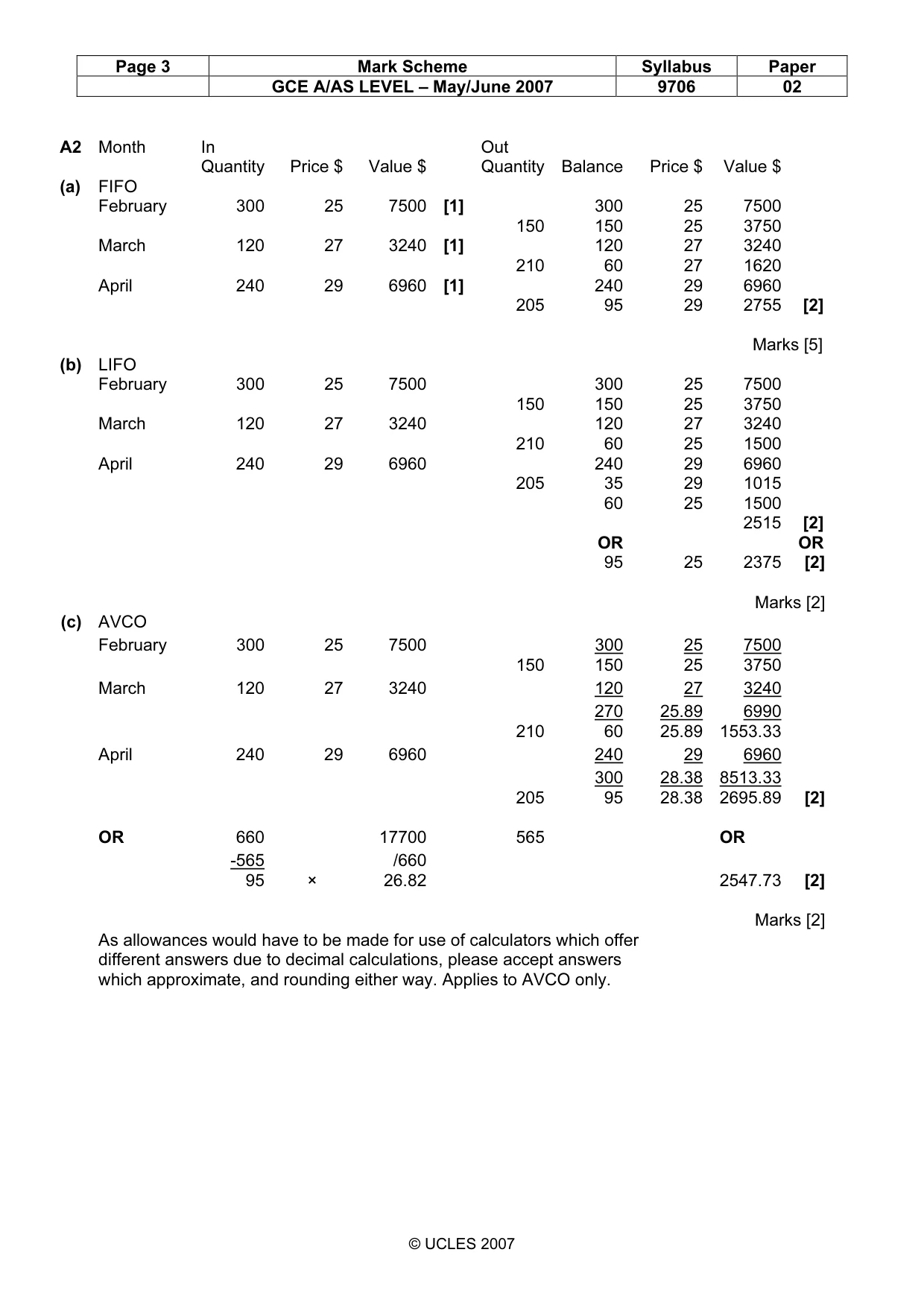
Page 3 Mark Scheme Syllabus Paper GCE A/AS LEVEL – May/June 2007 9706 02 © UCLES 2007 A2 Month In Out Quantity Price $ Value $ Quantity Balance Price $ Value $ (a) FIFO February 300 25 7500 [1] 300 25 7500 150 150 25 3750 March 120 27 3240 [1] 120 27 3240 210 60 27 1620 April 240 29 6960 [1] 240 29 6960 205 95 29 2755 [2] Marks [5] (b) LIFO February 300 25 7500 300 25 7500 150 150 25 3750 March 120 27 3240 120 27 3240 210 60 25 1500 April 240 29 6960 240 29 6960 205 35 29 1015 60 25 1500 2515 [2] OR OR 95 25 2375 [2] Marks [2] (c) AVCO February 300 25 7500 300 25 7500 150 150 25 3750 March 120 27 3240 120 27 3240 270 25.89 6990 210 60 25.89 1553.33 April 240 29 6960 240 29 6960 300 28.38 8513.33 205 95 28.38 2695.89 [2] OR 660 17700 565 OR -565 /660 95 × 26.82 2547.73 [2] Marks [2] As allowances would have to be made for use of calculators which offer different answers due to decimal calculations, please accept answers which approximate, and rounding either way. Applies to AVCO only.
Mark scheme, page 4
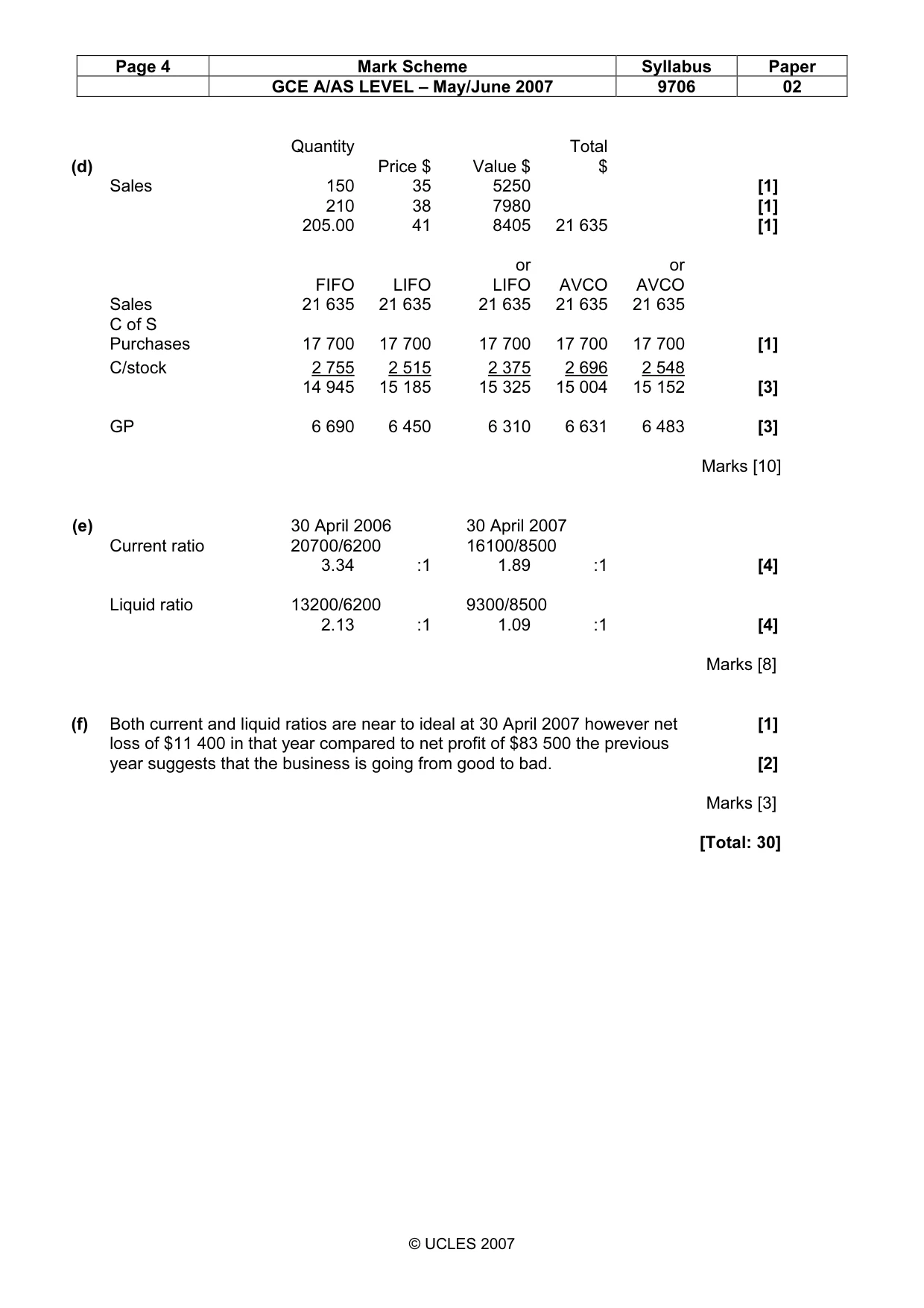
Page 4 Mark Scheme Syllabus Paper GCE A/AS LEVEL – May/June 2007 9706 02 © UCLES 2007 (d) Quantity Price $ Value $ Total $ Sales 150 35 5250 [1] 210 38 7980 [1] 205.00 41 8405 21 635 [1] FIFO LIFO or LIFO AVCO or AVCO Sales 21 635 21 635 21 635 21 635 21 635 C of S Purchases 17 700 17 700 17 700 17 700 17 700 [1] C/stock 2 755 2 515 2 375 2 696 2 548 14 945 15 185 15 325 15 004 15 152 [3] GP 6 690 6 450 6 310 6 631 6 483 [3] Marks [10] (e) 30 April 2006 30 April 2007 Current ratio 20700/6200 16100/8500 3.34 :1 1.89 :1 [4] Liquid ratio 13200/6200 9300/8500 2.13 :1 1.09 :1 [4] Marks [8] (f) Both current and liquid ratios are near to ideal at 30 April 2007 however net [1] loss of $11 400 in that year compared to net profit of $83 500 the previous year suggests that the business is going from good to bad. [2] Marks [3] [Total: 30]
Mark scheme, page 5
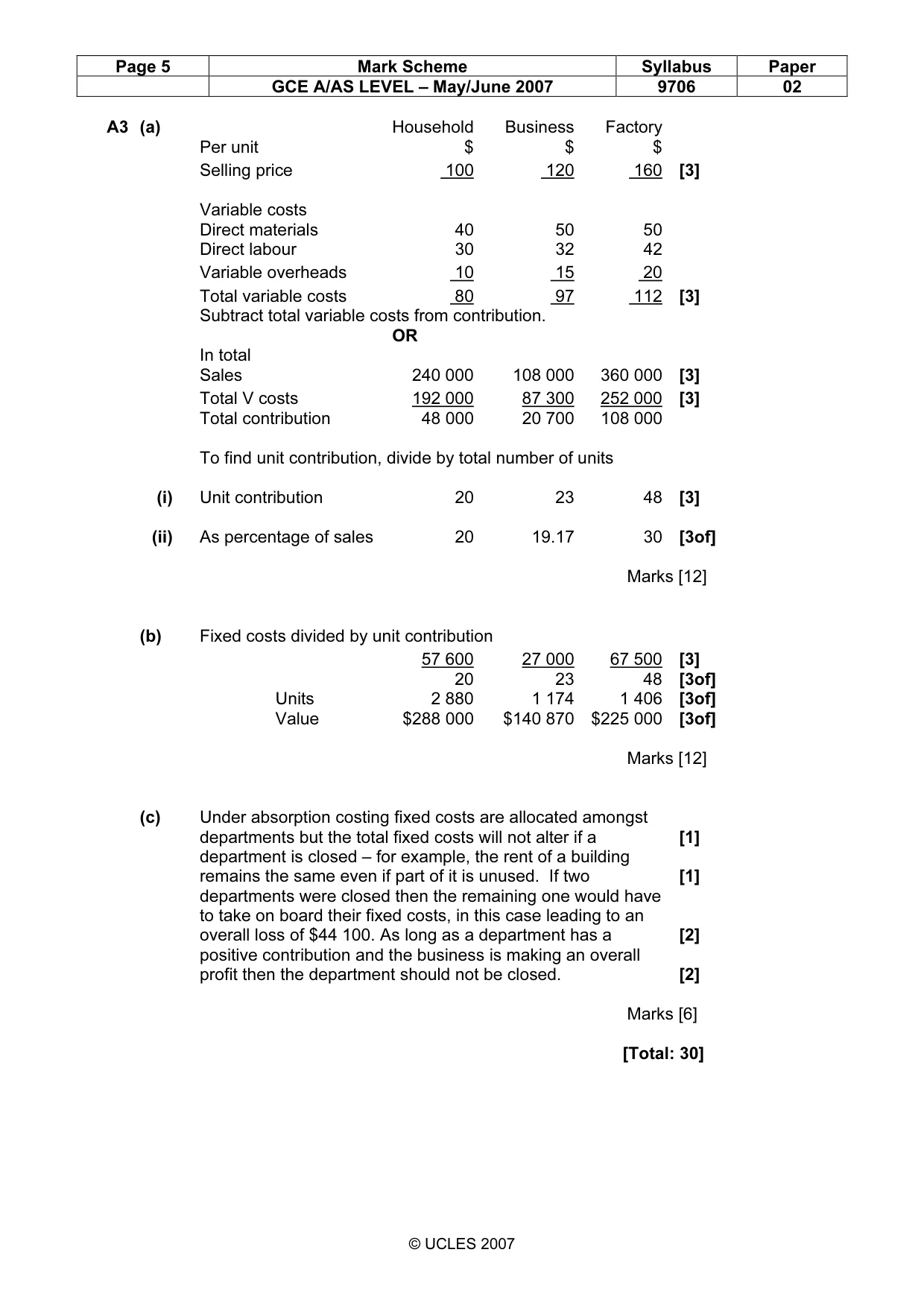
Page 5 Mark Scheme Syllabus Paper GCE A/AS LEVEL – May/June 2007 9706 02 © UCLES 2007 A3 (a) Household Business Factory Per unit $ $ $ Selling price 100 120 160 [3] Variable costs Direct materials 40 50 50 Direct labour 30 32 42 Variable overheads 10 15 20 Total variable costs 80 97 112 [3] Subtract total variable costs from contribution. OR In total Sales 240 000 108 000 360 000 [3] Total V costs 192 000 87 300 252 000 [3] Total contribution 48 000 20 700 108 000 To find unit contribution, divide by total number of units (i) Unit contribution 20 23 48 [3] (ii) As percentage of sales 20 19.17 30 [3of] Marks [12] (b) Fixed costs divided by unit contribution 57 600 27 000 67 500 [3] 20 23 48 [3of] Units 2 880 1 174 1 406 [3of] Value $288 000 $140 870 $225 000 [3of] Marks [12] (c) Under absorption costing fixed costs are allocated amongst departments but the total fixed costs will not alter if a department is closed – for example, the rent of a building remains the same even if part of it is unused. If two departments were closed then the remaining one would have to take on board their fixed costs, in this case leading to an overall loss of $44 100. As long as a department has a positive contribution and the business is making an overall profit then the department should not be closed. [1] [1] [2] [2] Marks [6] [Total: 30]
What you needed in this session
Cambridge’s own grade thresholds for 2007 May/June, Paper 2 · Variant 1. A higher threshold means an easier paper — the bar moves with how the cohort did.