Cambridge A Level Accounting 9706 — 2006 Oct/Nov Paper 2 · Variant 1
9706/21/O/N/06 · 90 marks · ≈101 min
The question paper and its mark scheme, free to read here and free to download. This is Cambridge’s own paper, exactly as it was sat.
Question paper16 pages

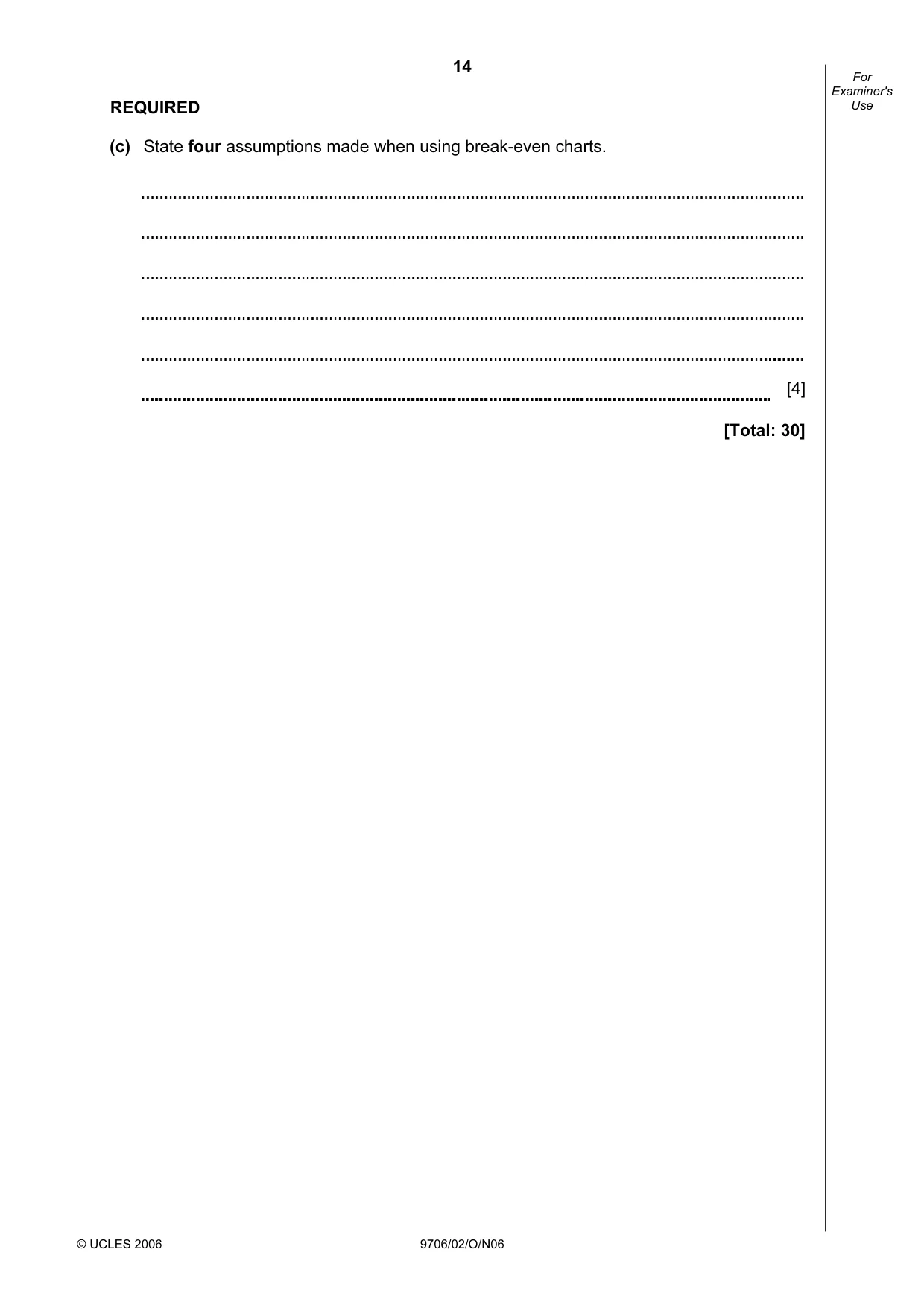

Mark scheme6 pages
Answers below. Sit the paper first if you are practising.
Paper as text
Question paper, page 1
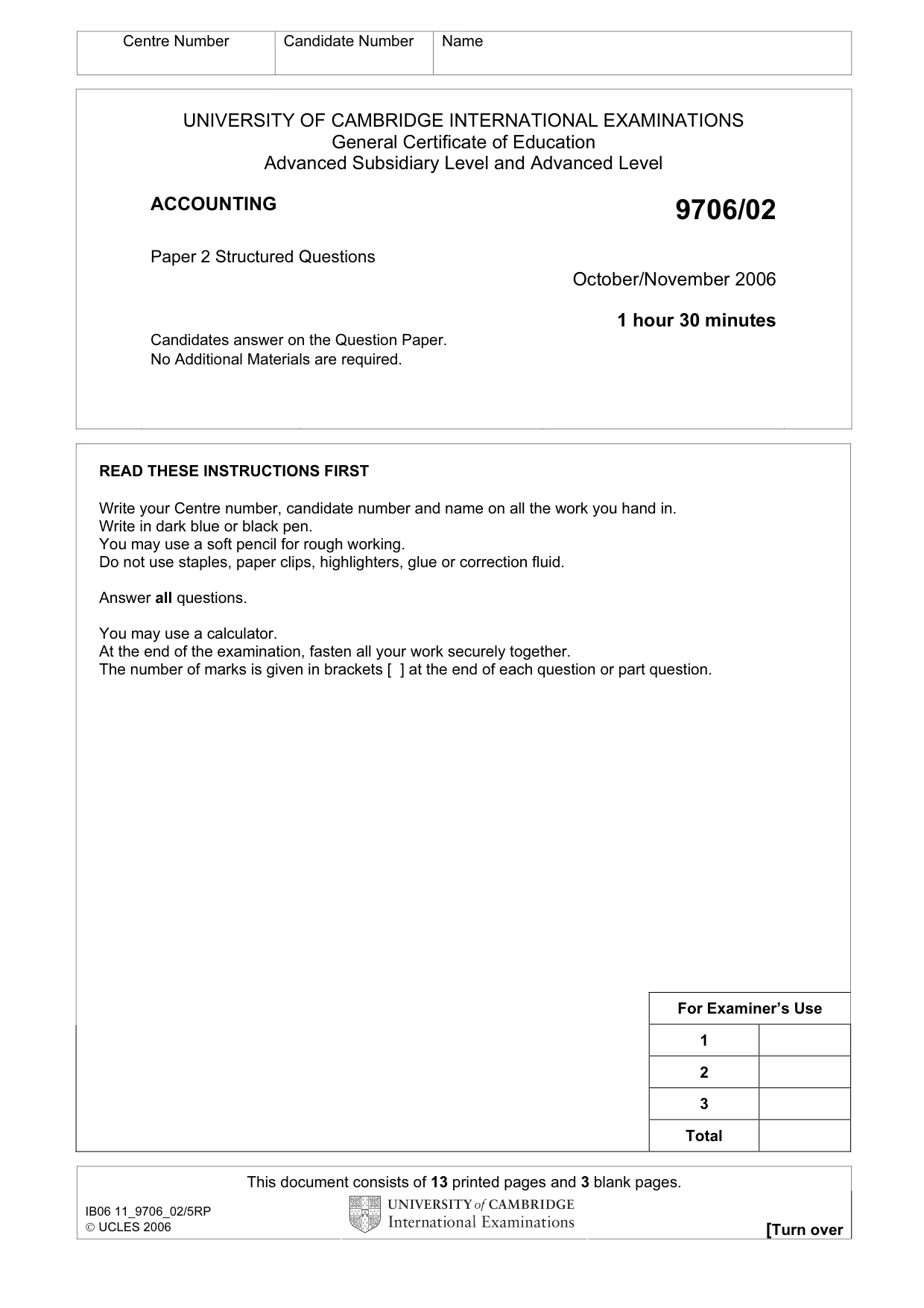
Centre Number Candidate Number Name UNIVERSITY OF CAMBRIDGE INTERNATIONAL EXAMINATIONS General Certificate of Education Advanced Subsidiary Level and Advanced Level ACCOUNTING 9706/02 Paper 2 Structured Questions October/November 2006 1 hour 30 minutes Candidates answer on the Question Paper. No Additional Materials are required. READ THESE INSTRUCTIONS FIRST Write your Centre number, candidate number and name on all the work you hand in. Write in dark blue or black pen. You may use a soft pencil for rough working. Do not use staples, paper clips, highlighters, glue or correction fluid. Answer all questions. You may use a calculator. At the end of the examination, fasten all your work securely together. The number of marks is given in brackets [ ] at the end of each question or part question. For Examiner’s Use 1 2 3 Total This document consists of 13 printed pages and 3 blank pages. IB06 11_9706_02/5RP UCLES 2006 [Turn over
Question paper, page 2
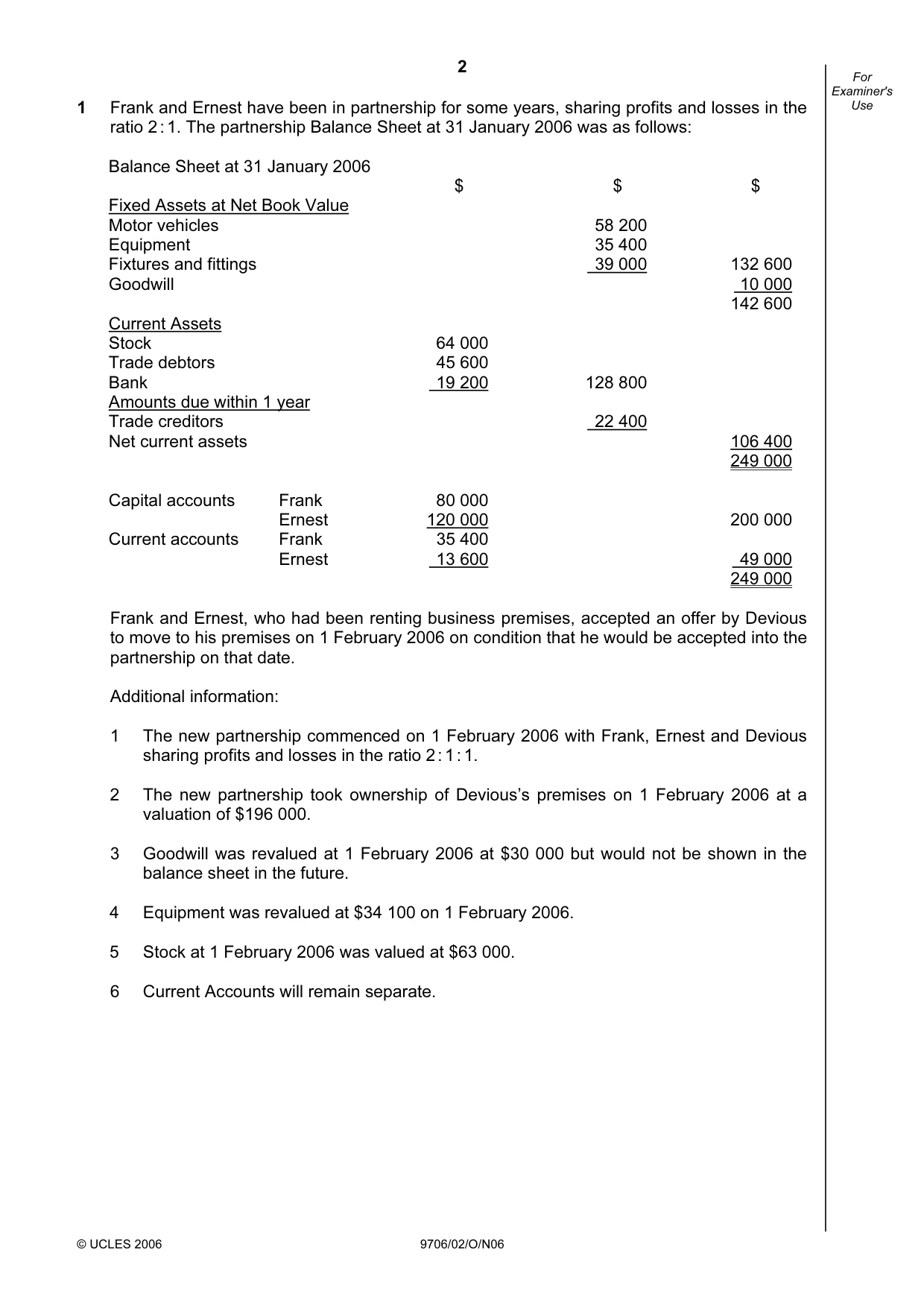
2 © UCLES 2006 9706/02/O/N06 For Examiner's Use 1 Frank and Ernest have been in partnership for some years, sharing profits and losses in the ratio 2 : 1. The partnership Balance Sheet at 31 January 2006 was as follows: Balance Sheet at 31 January 2006 $ $ $ Fixed Assets at Net Book Value Motor vehicles 58 200 Equipment 35 400 Fixtures and fittings 39 000 132 600 Goodwill 10 000 142 600 Current Assets Stock 64 000 Trade debtors 45 600 Bank 19 200 128 800 Amounts due within 1 year Trade creditors 22 400 Net current assets 106 400 249 000 Capital accounts Frank 80 000 Ernest 120 000 200 000 Current accounts Frank 35 400 Ernest 13 600 49 000 249 000 Frank and Ernest, who had been renting business premises, accepted an offer by Devious to move to his premises on 1 February 2006 on condition that he would be accepted into the partnership on that date. Additional information: 1 The new partnership commenced on 1 February 2006 with Frank, Ernest and Devious sharing profits and losses in the ratio 2 : 1 : 1. 2 The new partnership took ownership of Devious’s premises on 1 February 2006 at a valuation of $196 000. 3 Goodwill was revalued at 1 February 2006 at $30 000 but would not be shown in the balance sheet in the future. 4 Equipment was revalued at $34 100 on 1 February 2006. 5 Stock at 1 February 2006 was valued at $63 000. 6 Current Accounts will remain separate.
Question paper, page 3
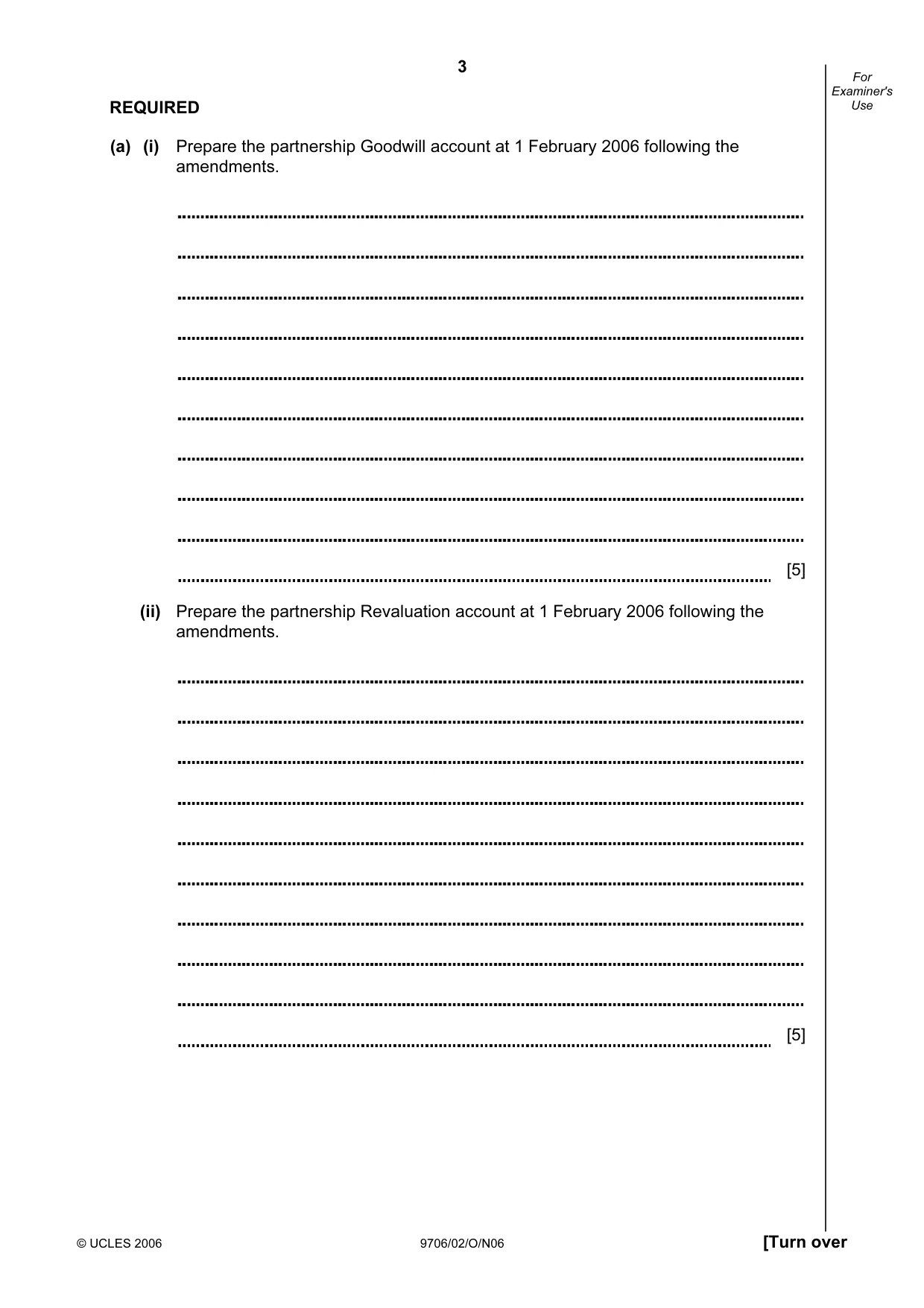
3 © UCLES 2006 9706/02/O/N06 [Turn over For Examiner's Use REQUIRED (a) (i) Prepare the partnership Goodwill account at 1 February 2006 following the amendments. [5] (ii) Prepare the partnership Revaluation account at 1 February 2006 following the amendments. [5]
Question paper, page 4
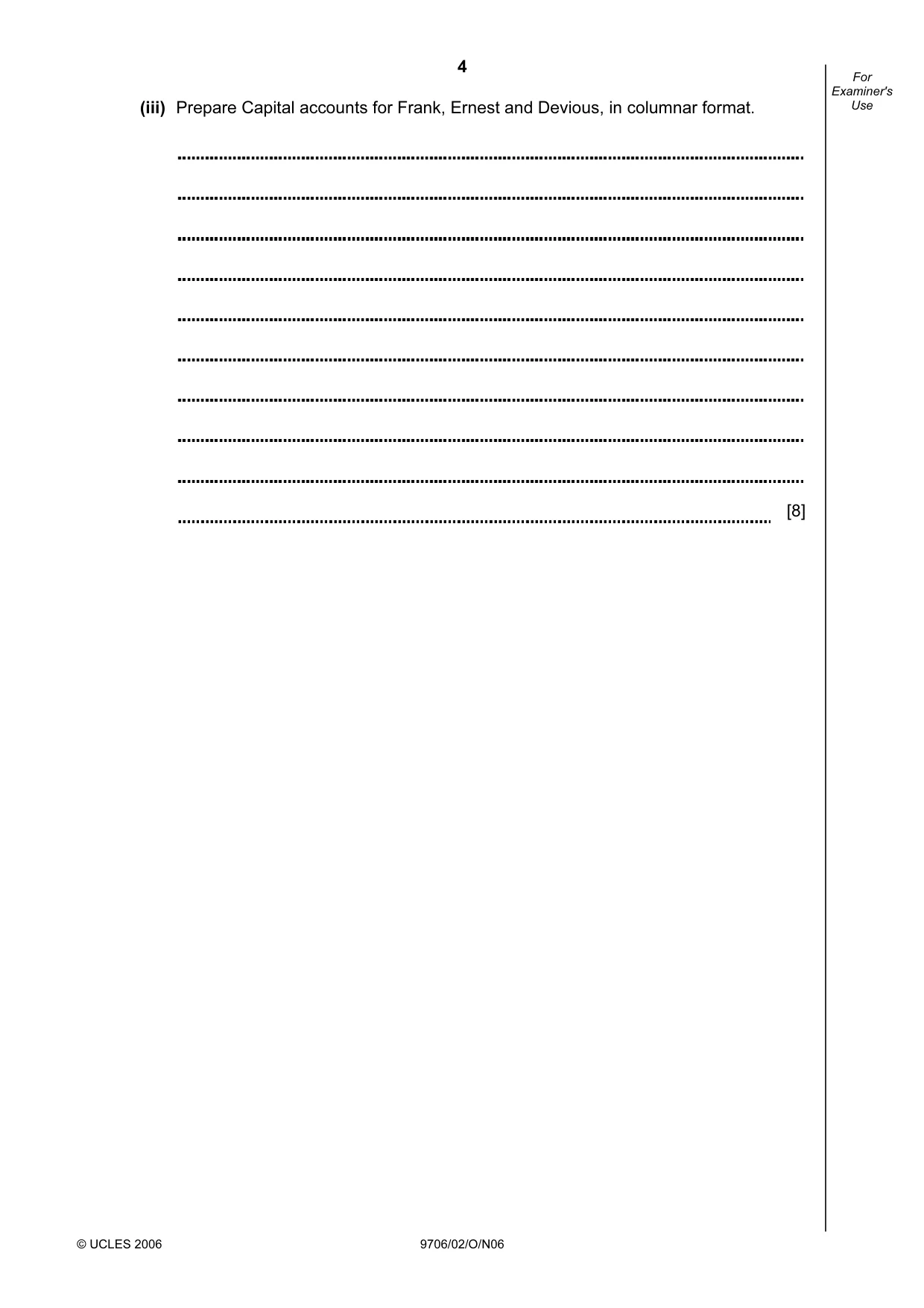
4 © UCLES 2006 9706/02/O/N06 For Examiner's Use (iii) Prepare Capital accounts for Frank, Ernest and Devious, in columnar format. [8]
Question paper, page 5
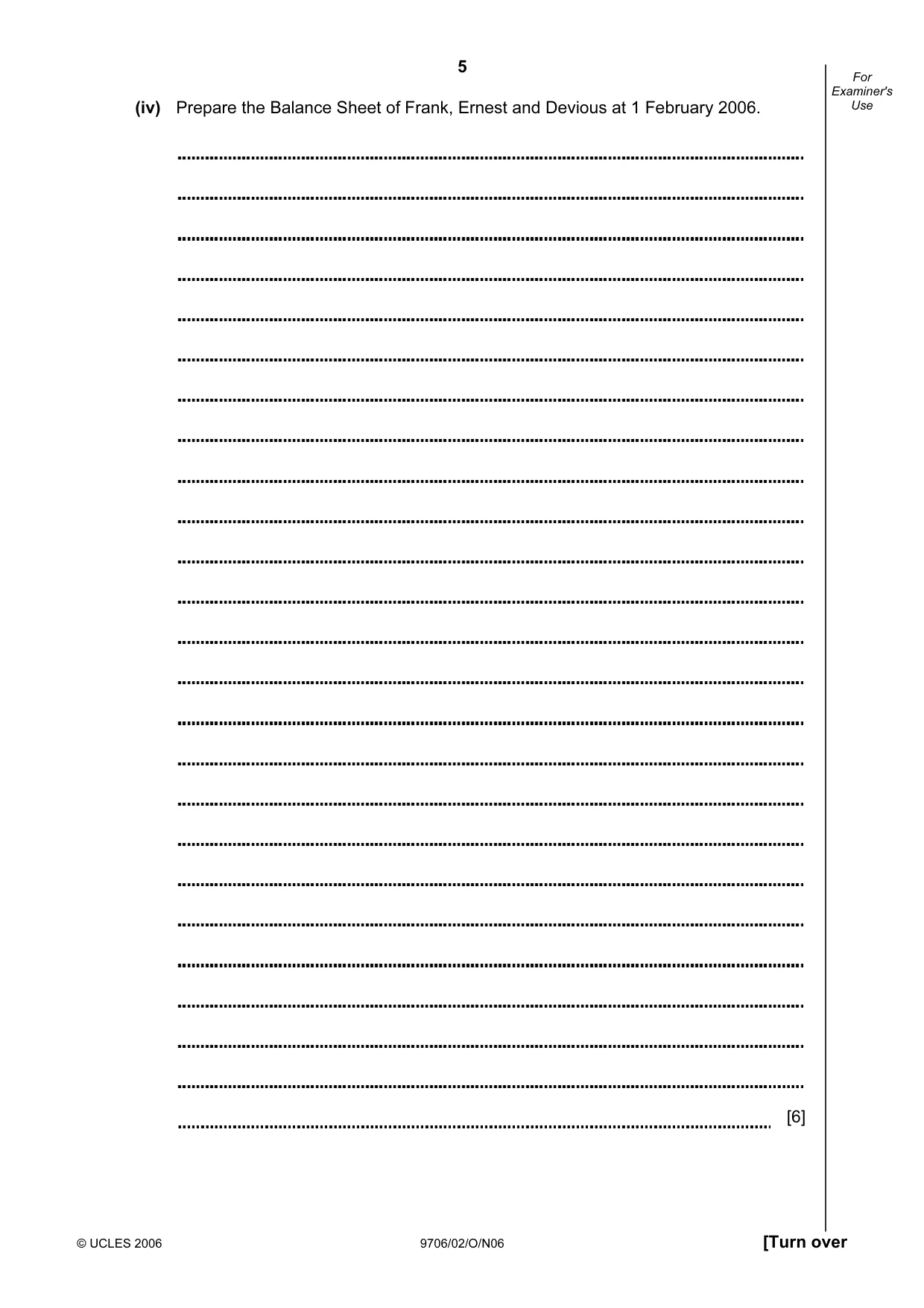
5 © UCLES 2006 9706/02/O/N06 [Turn over For Examiner's Use (iv) Prepare the Balance Sheet of Frank, Ernest and Devious at 1 February 2006. [6]
Question paper, page 6
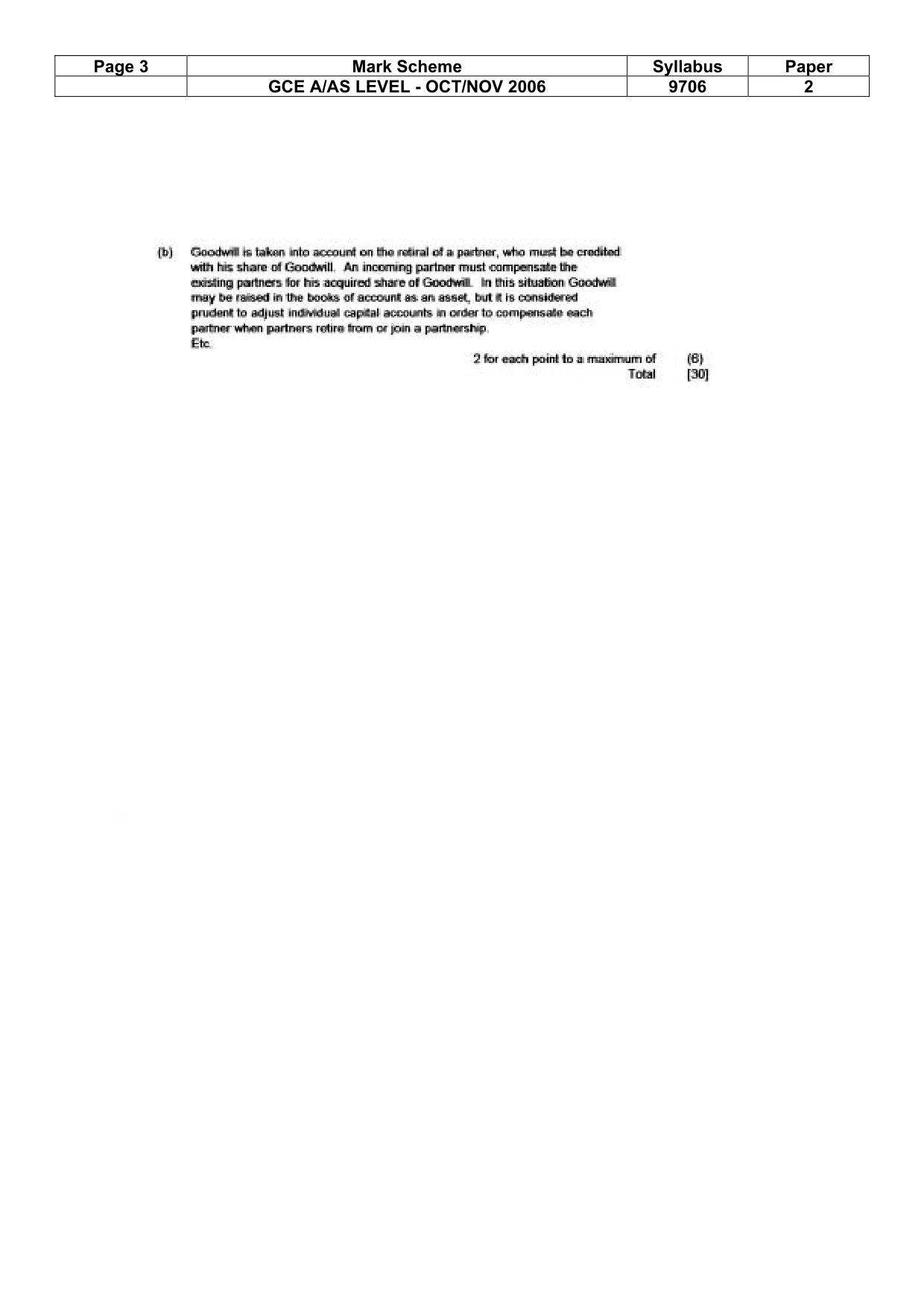
6 © UCLES 2006 9706/02/O/N06 For Examiner's Use (b) Discuss the treatment of Goodwill in partnership accounts, with particular reference to retiring and incoming partners. [6] [Total: 30]
Question paper, page 8
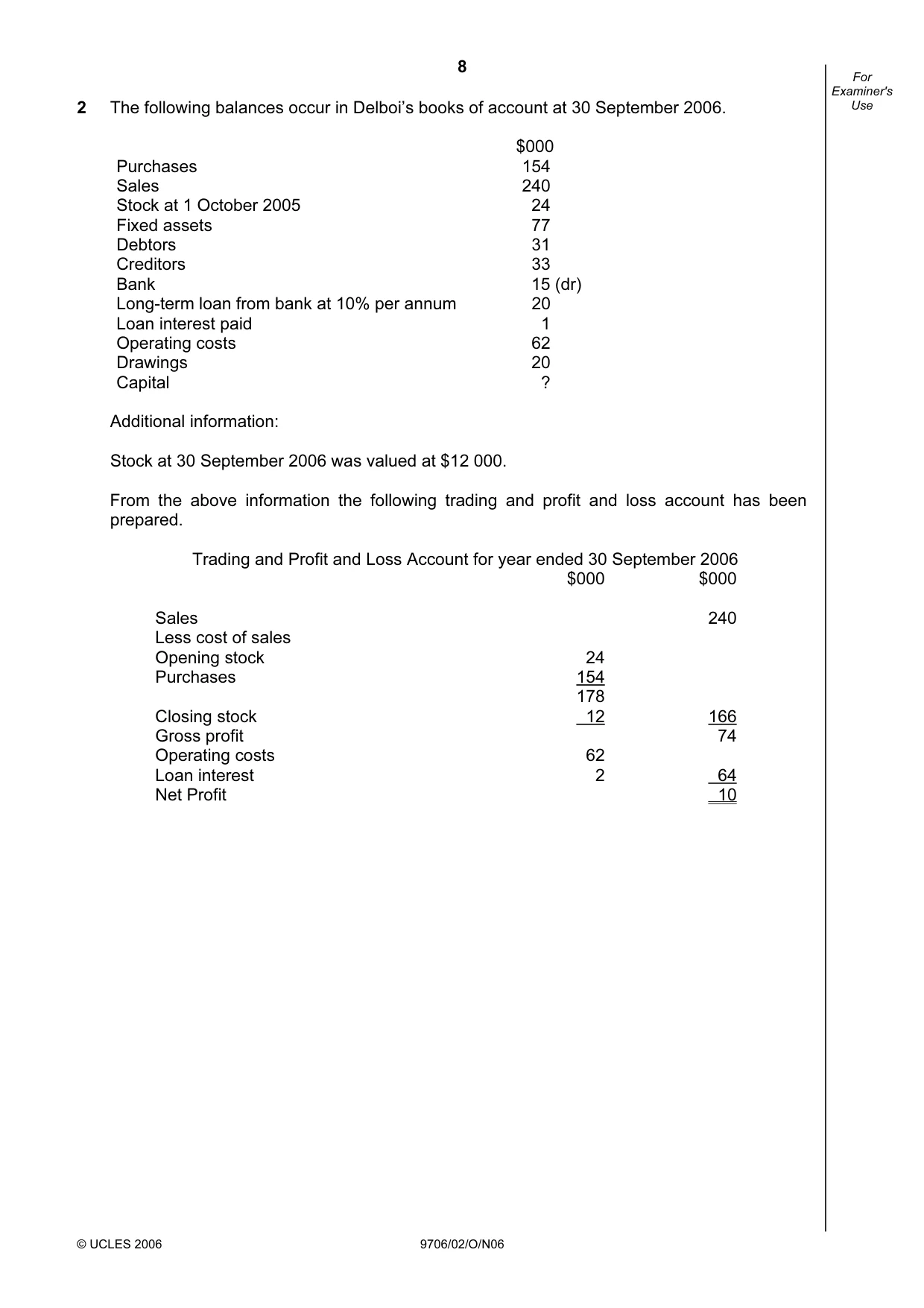
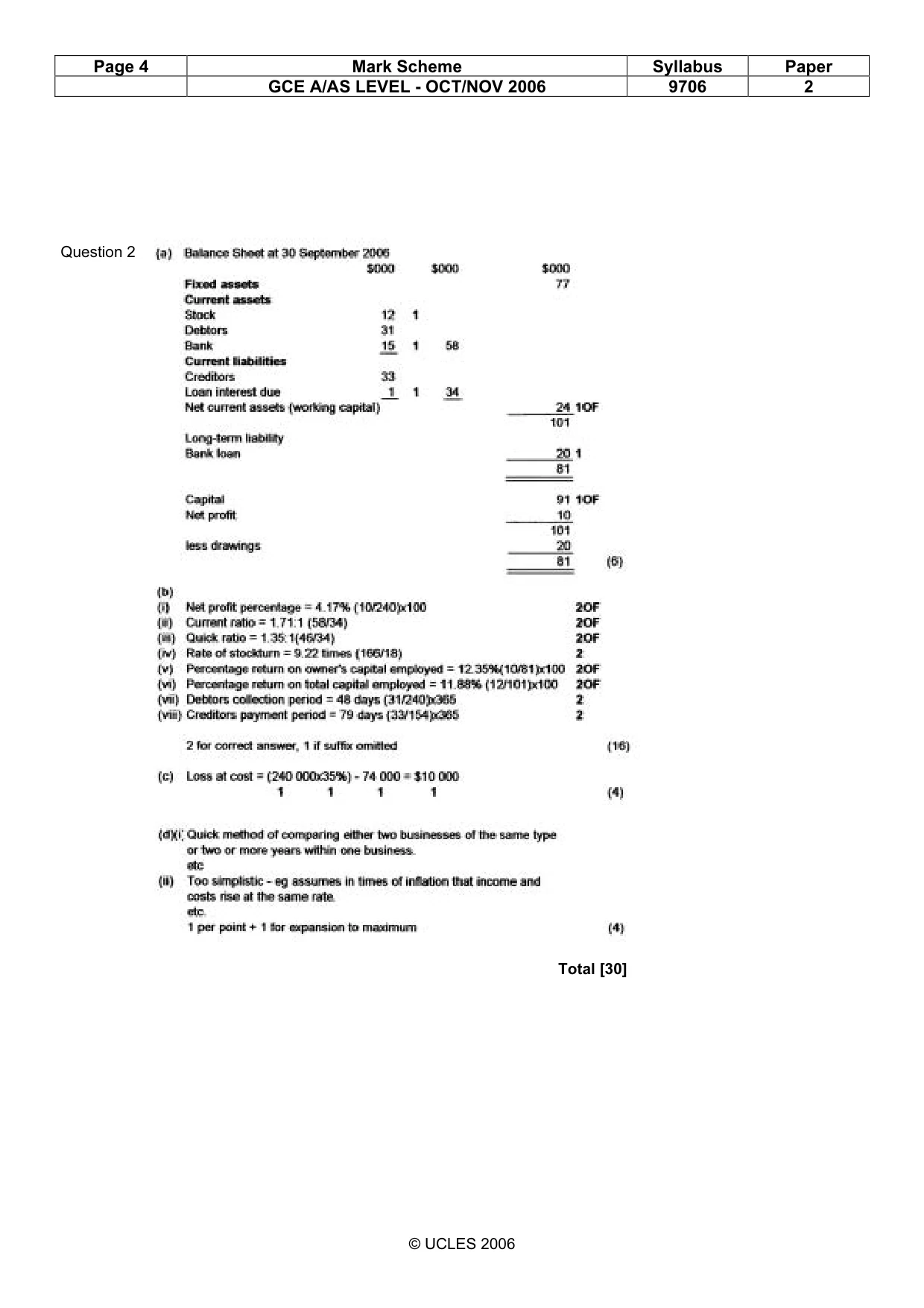
8 © UCLES 2006 9706/02/O/N06 For Examiner's Use 2 The following balances occur in Delboi’s books of account at 30 September 2006. $000 Purchases 154 Sales 240 Stock at 1 October 2005 24 Fixed assets 77 Debtors 31 Creditors 33 Bank 15 (dr) Long-term loan from bank at 10% per annum 20 Loan interest paid 1 Operating costs 62 Drawings 20 Capital ? Additional information: Stock at 30 September 2006 was valued at $12 000. From the above information the following trading and profit and loss account has been prepared. Trading and Profit and Loss Account for year ended 30 September 2006 $000 $000 Sales 240 Less cost of sales Opening stock 24 Purchases 154 178 Closing stock 12 166 Gross profit 74 Operating costs 62 Loan interest 2 64 Net Profit 10
Question paper, page 9
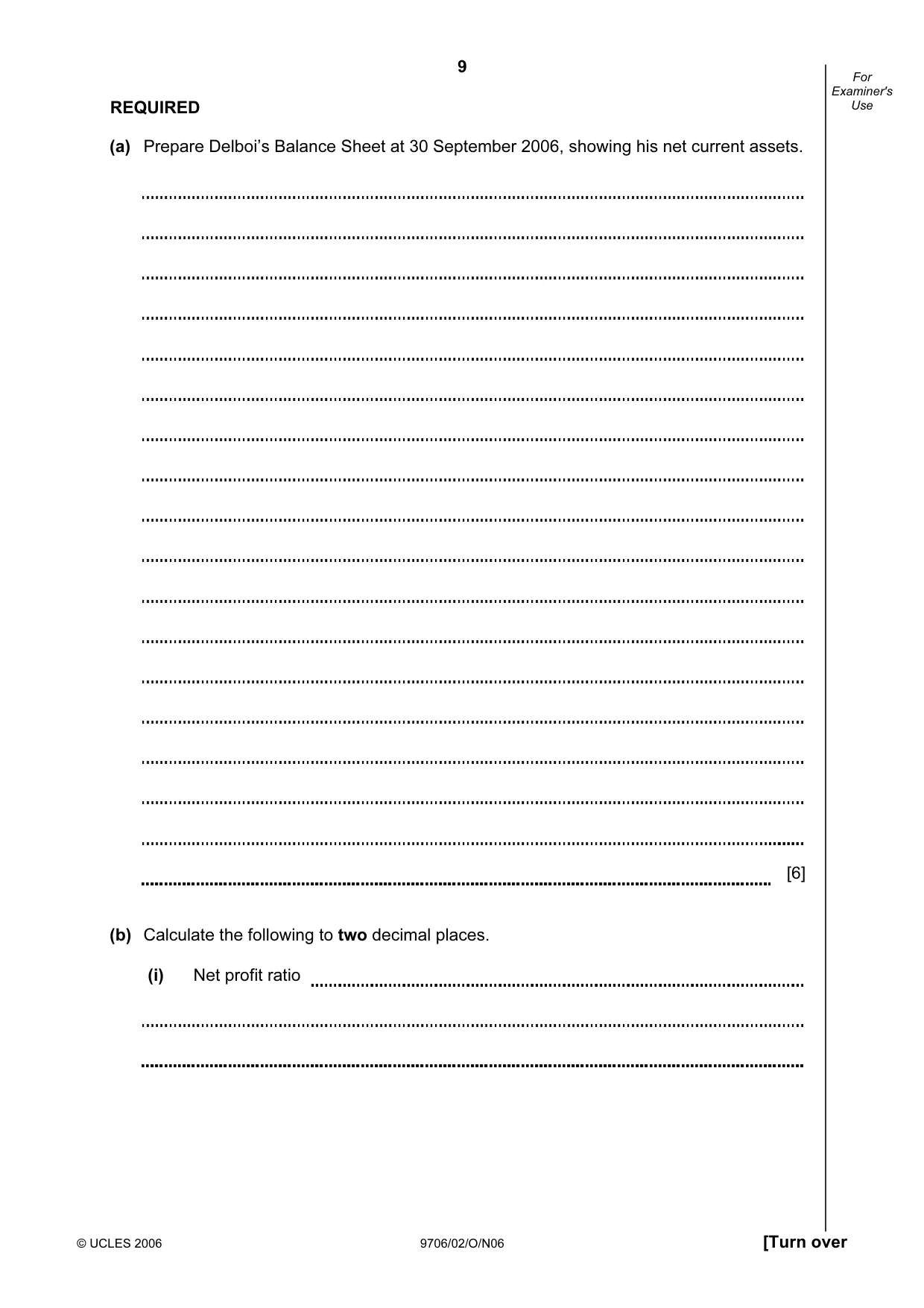
9 © UCLES 2006 9706/02/O/N06 [Turn over For Examiner's Use REQUIRED (a) Prepare Delboi’s Balance Sheet at 30 September 2006, showing his net current assets. [6] (b) Calculate the following to two decimal places. (i) Net profit ratio
Question paper, page 10
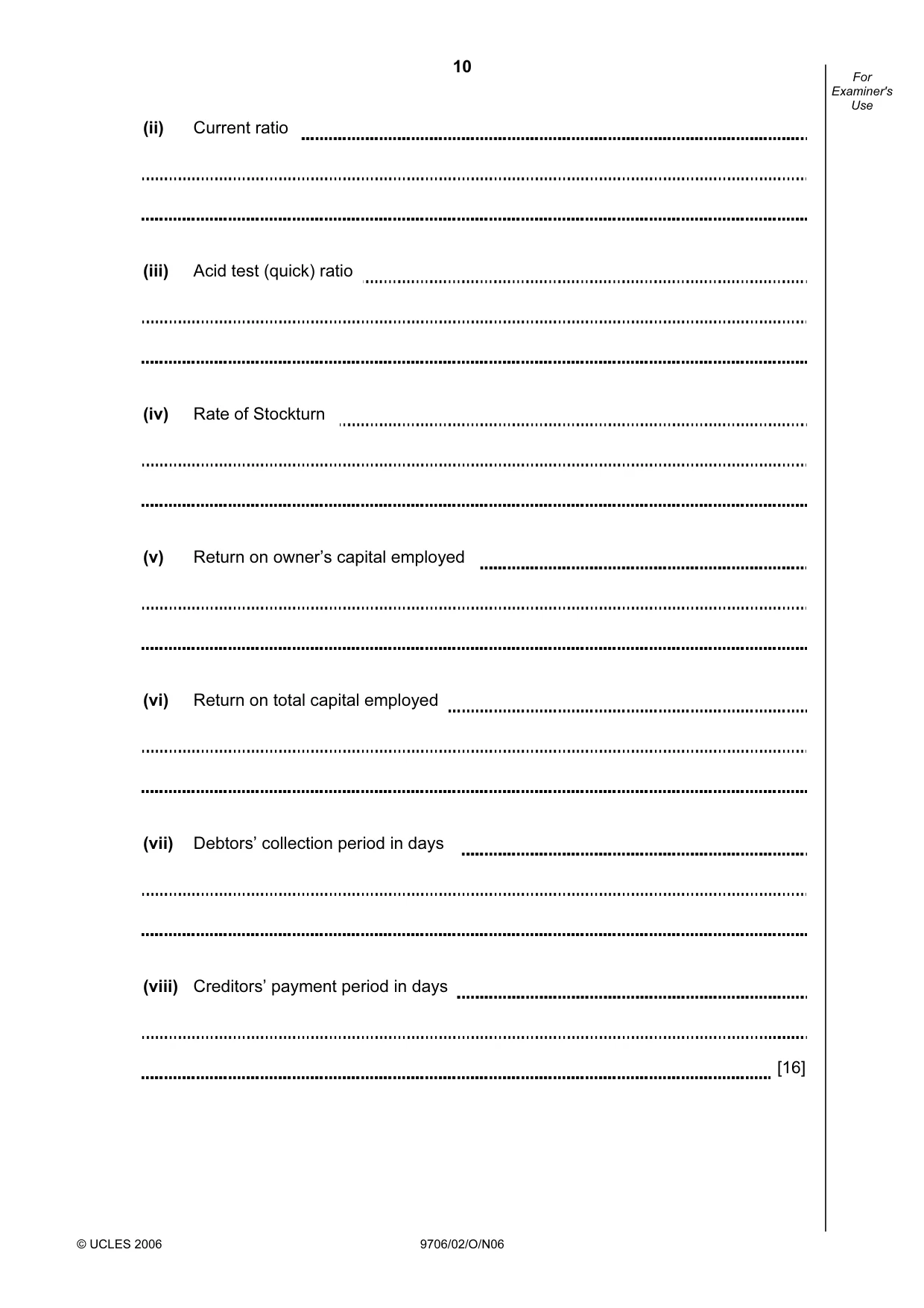
10 © UCLES 2006 9706/02/O/N06 For Examiner's Use (ii) Current ratio (iii) Acid test (quick) ratio (iv) Rate of Stockturn (v) Return on owner’s capital employed (vi) Return on total capital employed (vii) Debtors’ collection period in days (viii) Creditors’ payment period in days [16]
Question paper, page 11
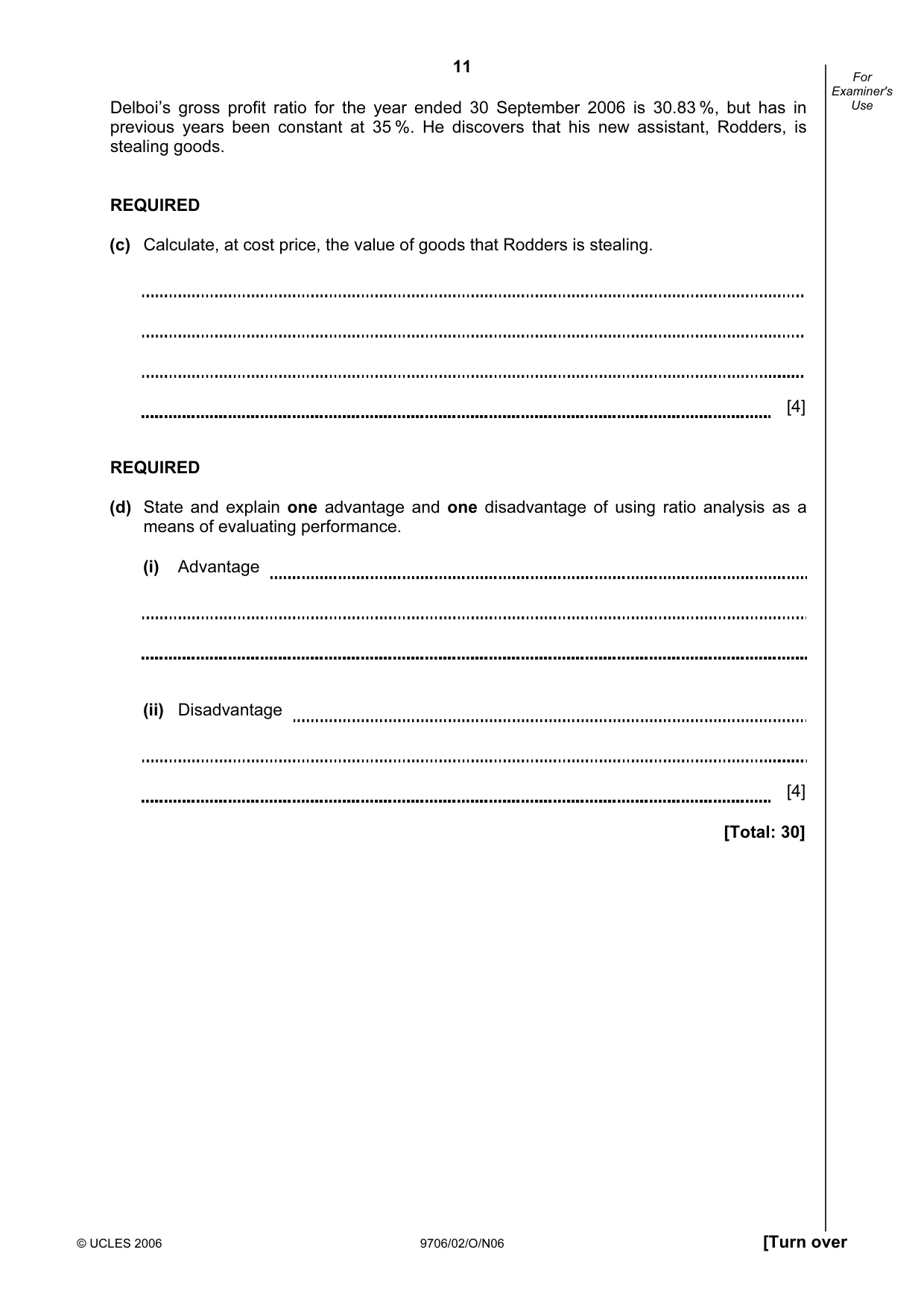
11 © UCLES 2006 9706/02/O/N06 [Turn over For Examiner's Use Delboi’s gross profit ratio for the year ended 30 September 2006 is 30.83 %, but has in previous years been constant at 35 %. He discovers that his new assistant, Rodders, is stealing goods. REQUIRED (c) Calculate, at cost price, the value of goods that Rodders is stealing. [4] REQUIRED (d) State and explain one advantage and one disadvantage of using ratio analysis as a means of evaluating performance. (i) Advantage (ii) Disadvantage [4] [Total: 30]
Question paper, page 12
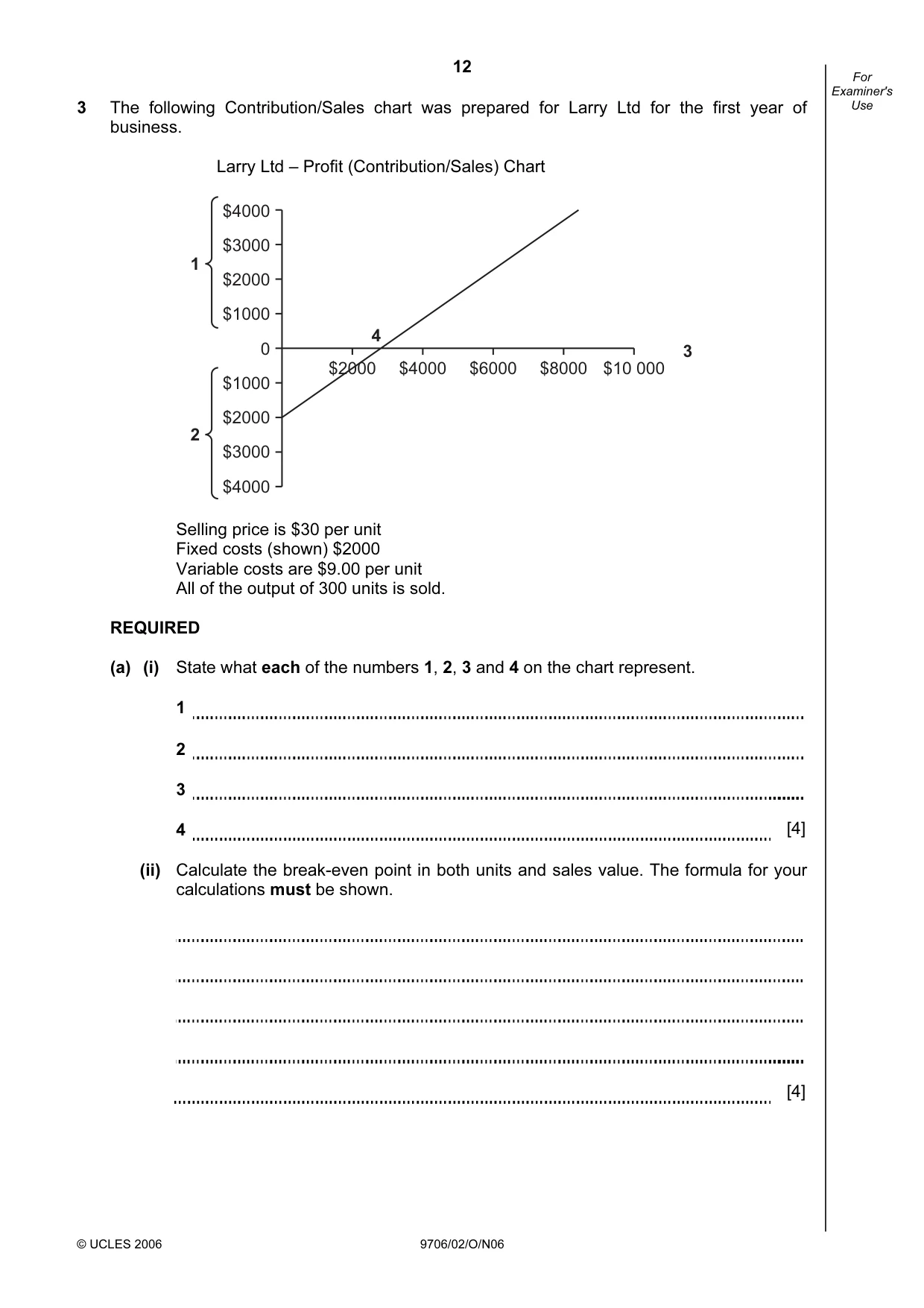
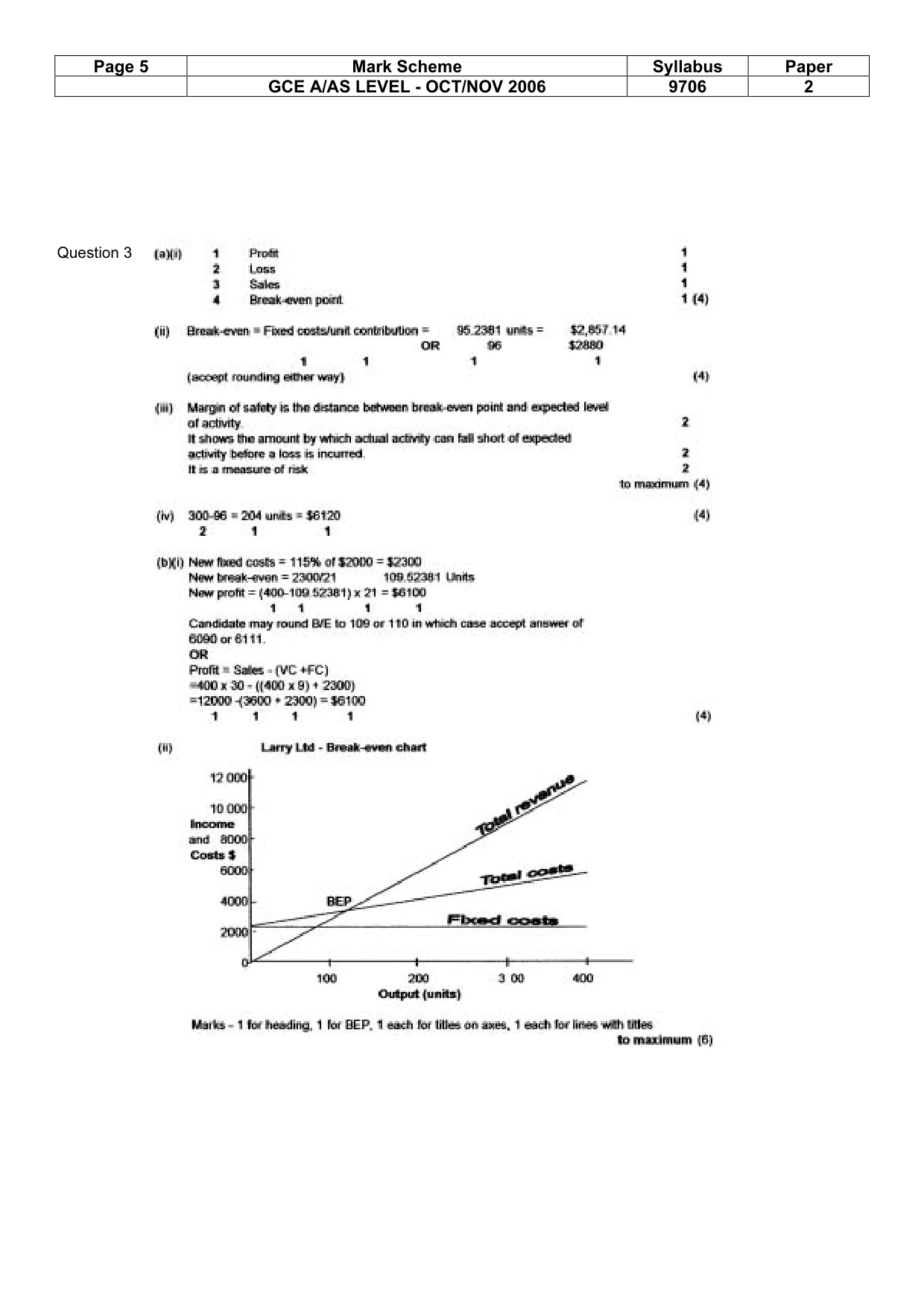
12 © UCLES 2006 9706/02/O/N06 For Examiner's Use 3 The following Contribution/Sales chart was prepared for Larry Ltd for the first year of business. Larry Ltd – Profit (Contribution/Sales) Chart $2000 $4000 $6000 $8000 $10 000 $4000 $3000 $2000 $1000 0 $1000 $2000 $3000 $4000 2 3 4 1 Selling price is $30 per unit Fixed costs (shown) $2000 Variable costs are $9.00 per unit All of the output of 300 units is sold. REQUIRED (a) (i) State what each of the numbers 1, 2, 3 and 4 on the chart represent. 1 2 3 4 [4] (ii) Calculate the break-even point in both units and sales value. The formula for your calculations must be shown. [4]
Question paper, page 13
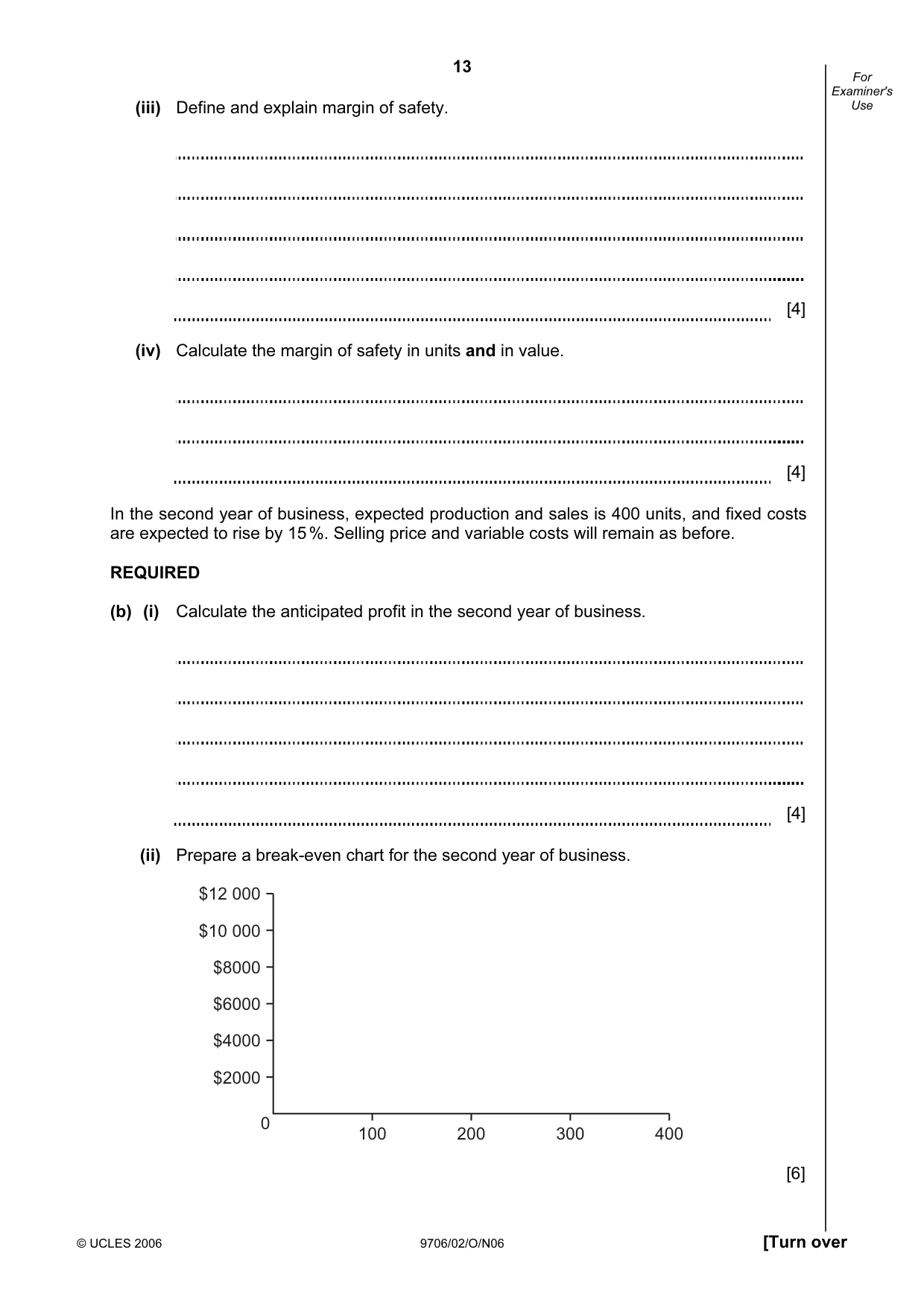
13 © UCLES 2006 9706/02/O/N06 [Turn over For Examiner's Use (iii) Define and explain margin of safety. [4] (iv) Calculate the margin of safety in units and in value. [4] In the second year of business, expected production and sales is 400 units, and fixed costs are expected to rise by 15 %. Selling price and variable costs will remain as before. REQUIRED (b) (i) Calculate the anticipated profit in the second year of business. [4] (ii) Prepare a break-even chart for the second year of business. 100 200 300 400 0 $12 000 $10 000 $8000 $6000 $4000 $2000 [6]
Question paper, page 14
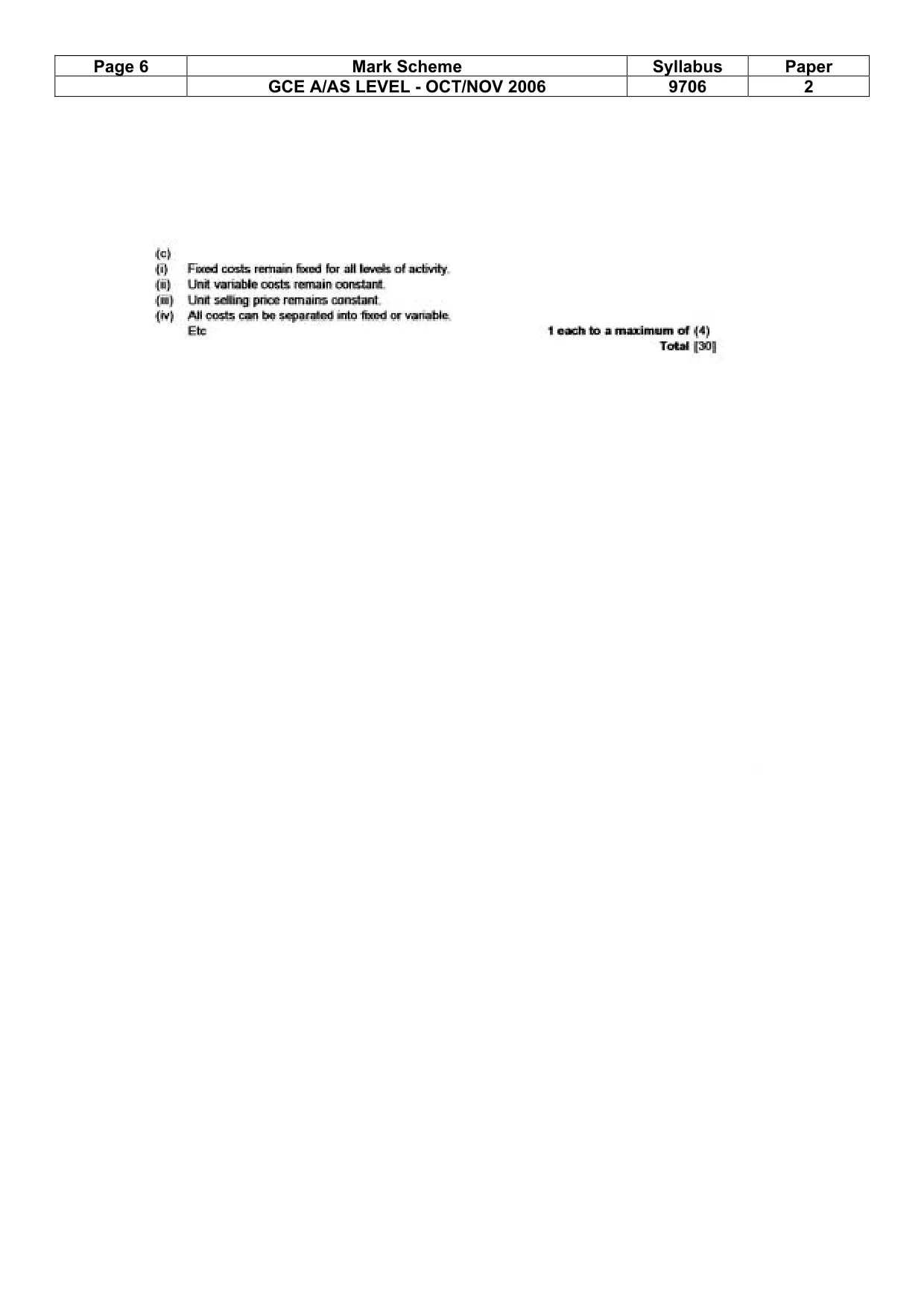
14 © UCLES 2006 9706/02/O/N06 For Examiner's Use REQUIRED (c) State four assumptions made when using break-even charts. [4] [Total: 30]
Question paper, page 16
16 BLANK PAGE Permission to reproduce items where third-party owned material protected by copyright is included has been sought and cleared where possible. Every reasonable effort has been made by the publisher (UCLES) to trace copyright holders, but if any items requiring clearance have unwittingly been included, the publisher will be pleased to make amends at the earliest possible opportunity. University of Cambridge International Examinations is part of the Cambridge Assessment Group. Cambridge Assessment is the brand name of University of Cambridge Local Examinations Syndicate (UCLES), which is itself a department of the University of Cambridge. 9706/02/O/N06
Mark scheme, page 1
UNIVERSITY OF CAMBRIDGE INTERNATIONAL EXAMINATIONS GCE Advanced Subsidiary Level and GCE Advanced Level MARK SCHEME for the October/November 2006 question paper 9706 ACCOUNTING 9706/02 Paper 2 (Structured Questions – Core), maximum raw mark 90 This mark scheme is published as an aid to teachers and students, to indicate the requirements of the examination. It shows the basis on which Examiners were instructed to award marks. It does not indicate the details of the discussions that took place at an Examiners’ meeting before marking began. All Examiners are instructed that alternative correct answers and unexpected approaches in candidates’ scripts must be given marks that fairly reflect the relevant knowledge and skills demonstrated. Mark schemes must be read in conjunction with the question papers and the report on the examination. The grade thresholds for various grades are published in the report on the examination for most IGCSE, GCE Advanced Level and Advanced Subsidiary Level syllabuses. • CIE will not enter into discussions or correspondence in connection with these mark schemes. CIE is publishing the mark schemes for the October/November 2006 question papers for most IGCSE, GCE Advanced Level and Advanced Subsidiary Level syllabuses and some Ordinary Level syllabuses.
Mark scheme, page 2
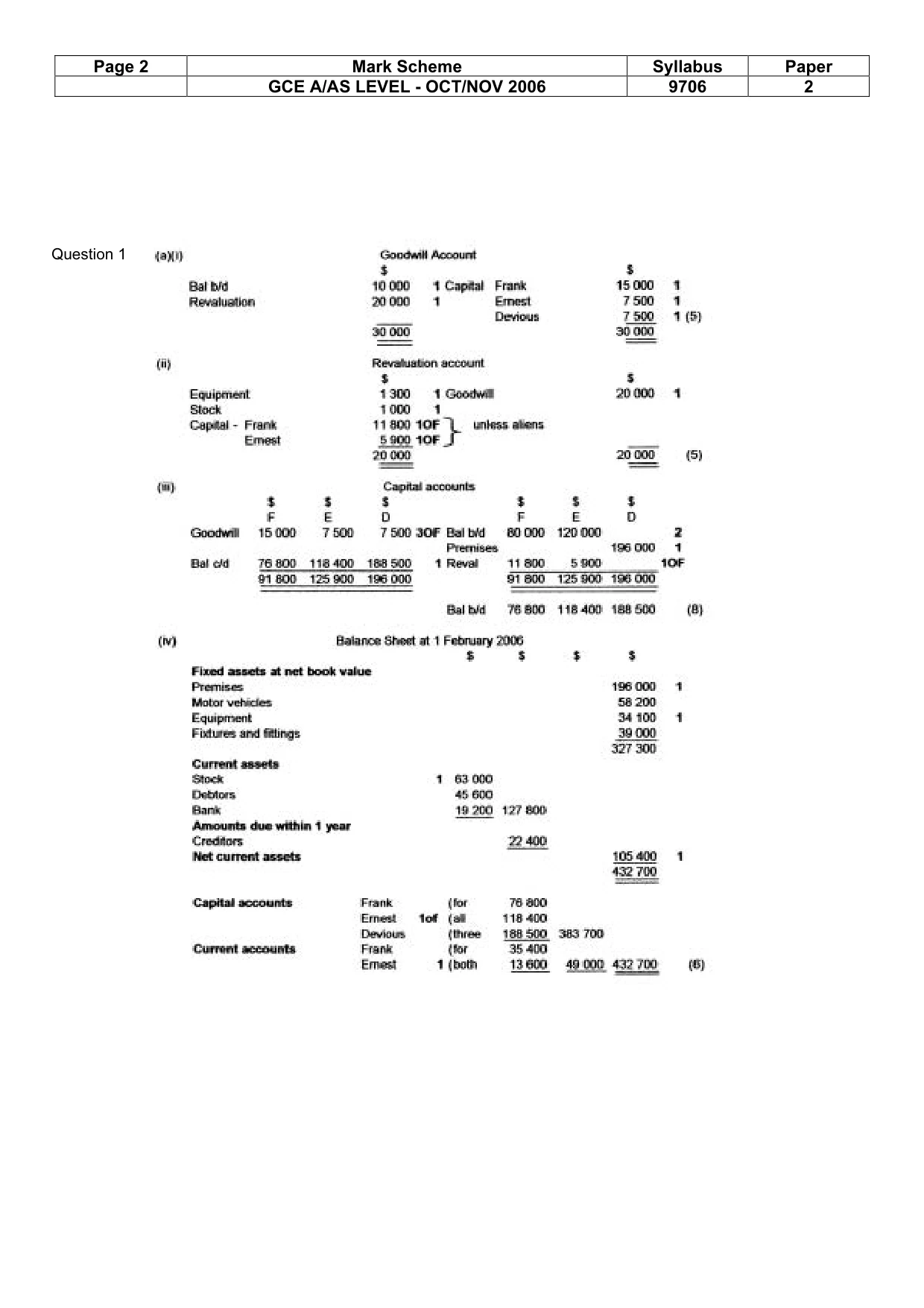
Page 2 Mark Scheme Syllabus Paper GCE A/AS LEVEL - OCT/NOV 2006 9706 2 © UCLES 2006 Question 1
Mark scheme, page 3
Page 3 Mark Scheme Syllabus Paper GCE A/AS LEVEL - OCT/NOV 2006 9706 2 © UCLES 2006
Mark scheme, page 4
Page 4 Mark Scheme Syllabus Paper GCE A/AS LEVEL - OCT/NOV 2006 9706 2 © UCLES 2006 Total [30] Question 2
Mark scheme, page 5
Page 5 Mark Scheme Syllabus Paper GCE A/AS LEVEL - OCT/NOV 2006 9706 2 © UCLES 2006 Question 3
Mark scheme, page 6
Page 6 Mark Scheme Syllabus Paper GCE A/AS LEVEL - OCT/NOV 2006 9706 2 © UCLES 2006
What you needed in this session
Cambridge’s own grade thresholds for 2006 Oct/Nov, Paper 2 · Variant 1. A higher threshold means an easier paper — the bar moves with how the cohort did.