Cambridge A Level Accounting 9706 — 2006 May/June Paper 2 · Variant 1
9706/21/M/J/06 · 90 marks · ≈101 min
The question paper and its mark scheme, free to read here and free to download. This is Cambridge’s own paper, exactly as it was sat.
Question paper16 pages


Mark scheme5 pages
Answers below. Sit the paper first if you are practising.
Paper as text
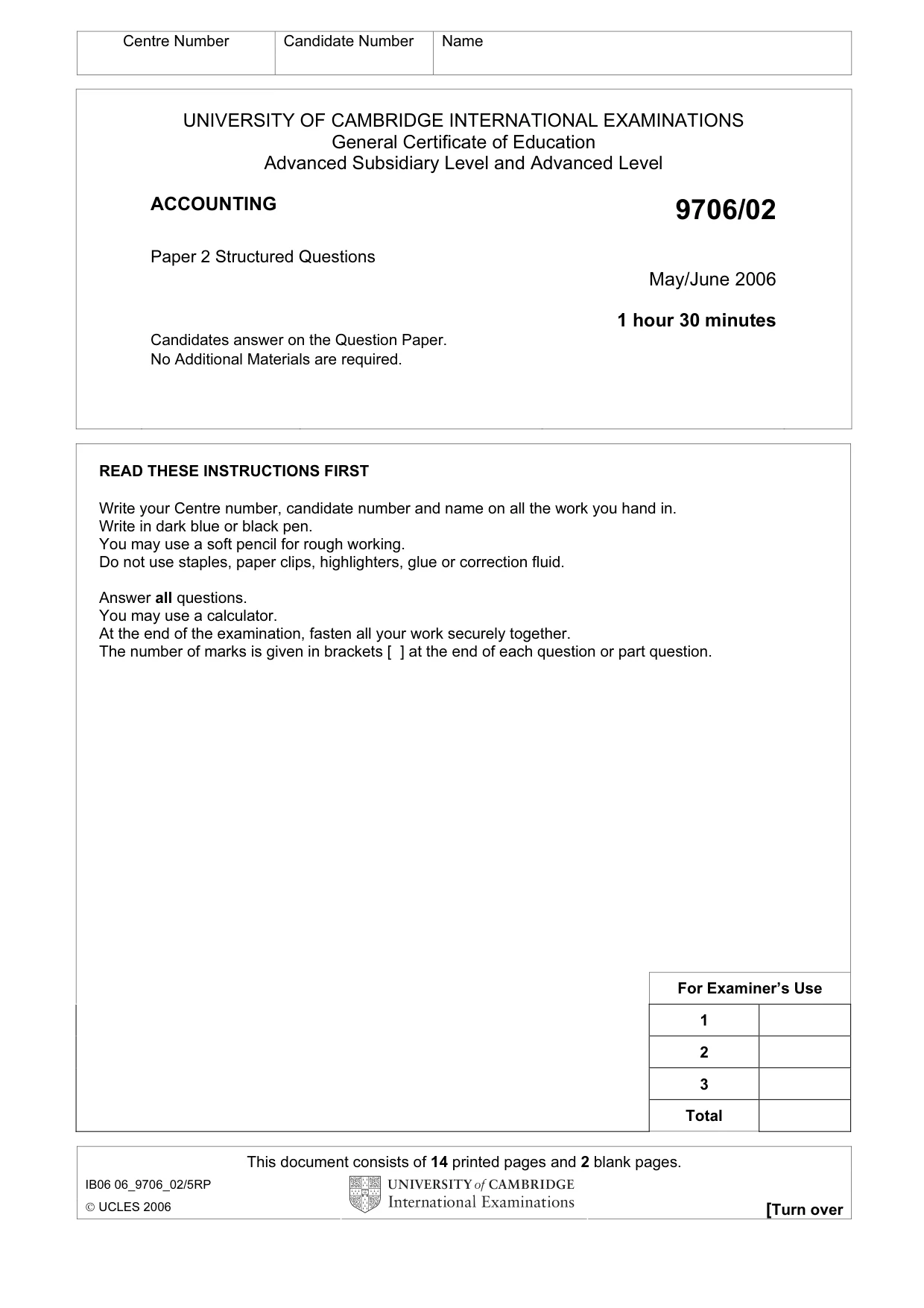
Question paper, page 1
Centre Number Candidate Number Name UNIVERSITY OF CAMBRIDGE INTERNATIONAL EXAMINATIONS General Certificate of Education Advanced Subsidiary Level and Advanced Level ACCOUNTING 9706/02 Paper 2 Structured Questions May/June 2006 1 hour 30 minutes Candidates answer on the Question Paper. No Additional Materials are required. READ THESE INSTRUCTIONS FIRST Write your Centre number, candidate number and name on all the work you hand in. Write in dark blue or black pen. You may use a soft pencil for rough working. Do not use staples, paper clips, highlighters, glue or correction fluid. Answer all questions. You may use a calculator. At the end of the examination, fasten all your work securely together. The number of marks is given in brackets [ ] at the end of each question or part question. For Examiner’s Use 1 2 3 Total This document consists of 14 printed pages and 2 blank pages. IB06 06_9706_02/5RP UCLES 2006 [Turn over
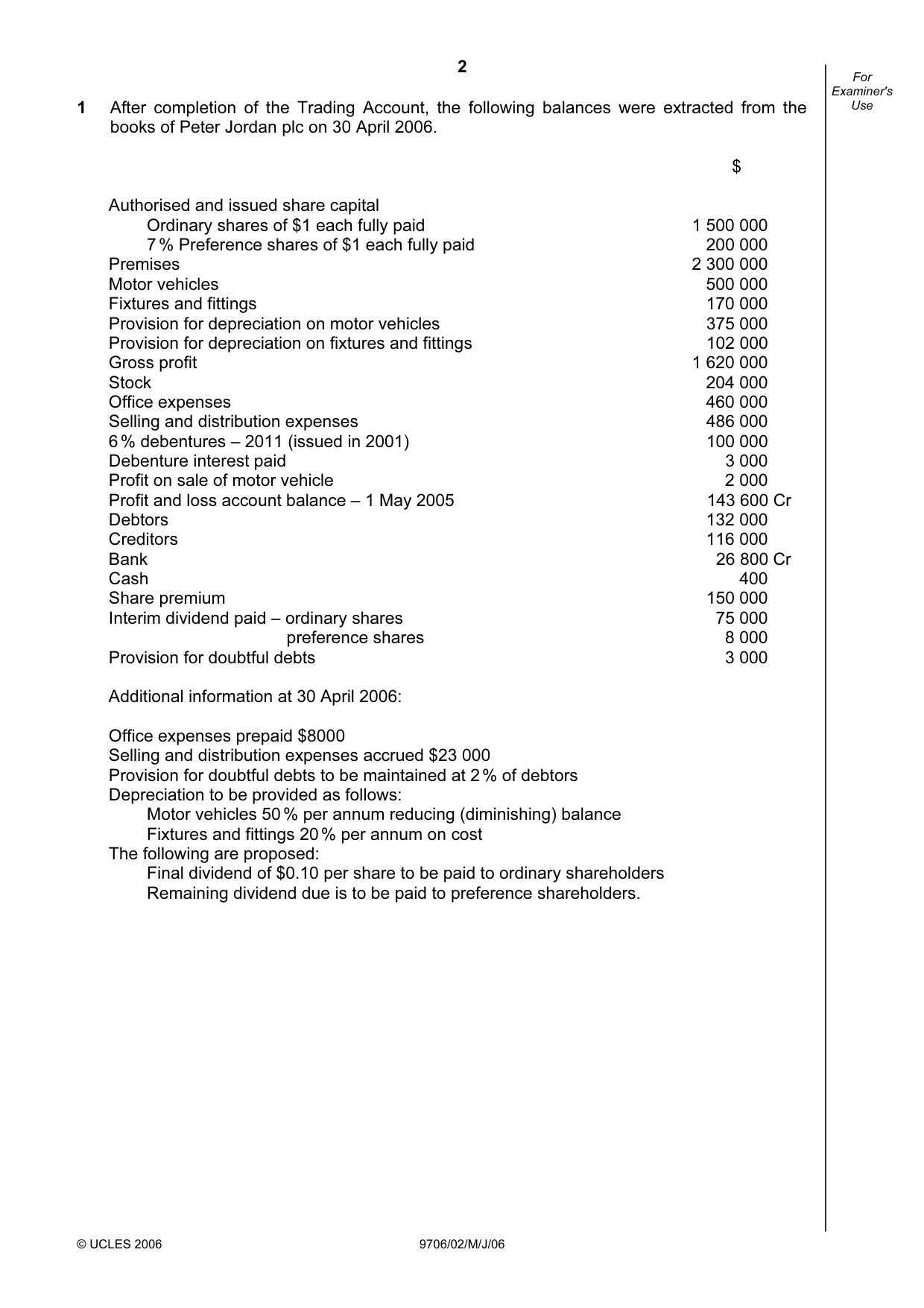
Question paper, page 2
2 © UCLES 2006 9706/02/M/J/06 For Examiner's Use 1 After completion of the Trading Account, the following balances were extracted from the books of Peter Jordan plc on 30 April 2006. $ Authorised and issued share capital Ordinary shares of $1 each fully paid 1 500 000 7 % Preference shares of $1 each fully paid 200 000 Premises 2 300 000 Motor vehicles 500 000 Fixtures and fittings 170 000 Provision for depreciation on motor vehicles 375 000 Provision for depreciation on fixtures and fittings 102 000 Gross profit 1 620 000 Stock 204 000 Office expenses 460 000 Selling and distribution expenses 486 000 6 % debentures – 2011 (issued in 2001) 100 000 Debenture interest paid 3 000 Profit on sale of motor vehicle 2 000 Profit and loss account balance – 1 May 2005 143 600 Cr Debtors 132 000 Creditors 116 000 Bank 26 800 Cr Cash 400 Share premium 150 000 Interim dividend paid – ordinary shares 75 000 preference shares 8 000 Provision for doubtful debts 3 000 Additional information at 30 April 2006: Office expenses prepaid $8000 Selling and distribution expenses accrued $23 000 Provision for doubtful debts to be maintained at 2 % of debtors Depreciation to be provided as follows: Motor vehicles 50 % per annum reducing (diminishing) balance Fixtures and fittings 20 % per annum on cost The following are proposed: Final dividend of $0.10 per share to be paid to ordinary shareholders Remaining dividend due is to be paid to preference shareholders.
Question paper, page 3
3 © UCLES 2006 9706/02/M/J/06 [Turn over For Examiner's Use REQUIRED (a) Prepare Peter Jordan plc’s Profit and Loss and Appropriation Account for the year ended 30 April 2006. [11]
Question paper, page 4
4 © UCLES 2006 9706/02/M/J/06 For Examiner's Use (b) Prepare Peter Jordan plc’s Balance Sheet at 30 April 2006. [13]
Question paper, page 5
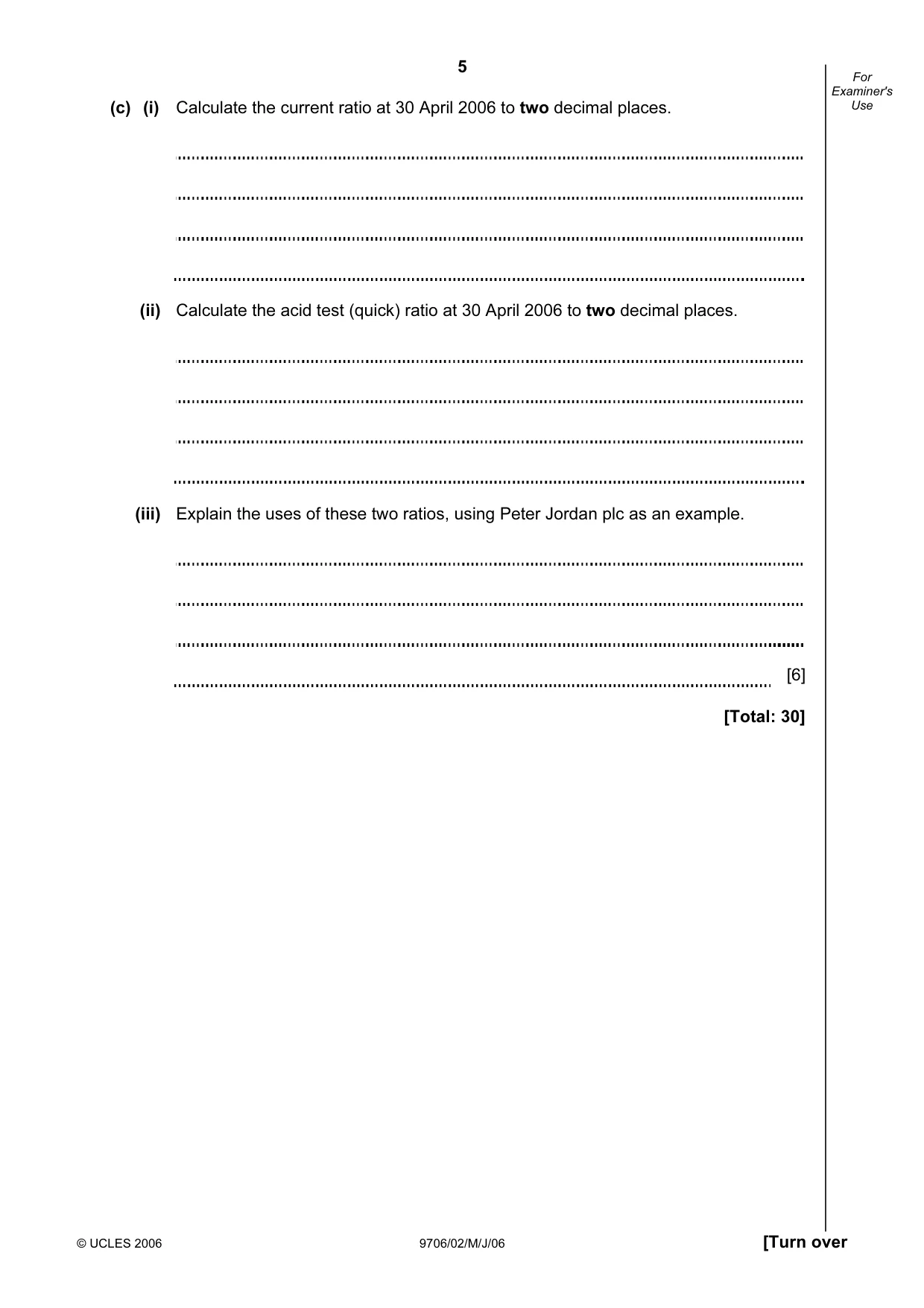
5 © UCLES 2006 9706/02/M/J/06 [Turn over For Examiner's Use (c) (i) Calculate the current ratio at 30 April 2006 to two decimal places. (ii) Calculate the acid test (quick) ratio at 30 April 2006 to two decimal places. (iii) Explain the uses of these two ratios, using Peter Jordan plc as an example. [6] [Total: 30]
Question paper, page 6
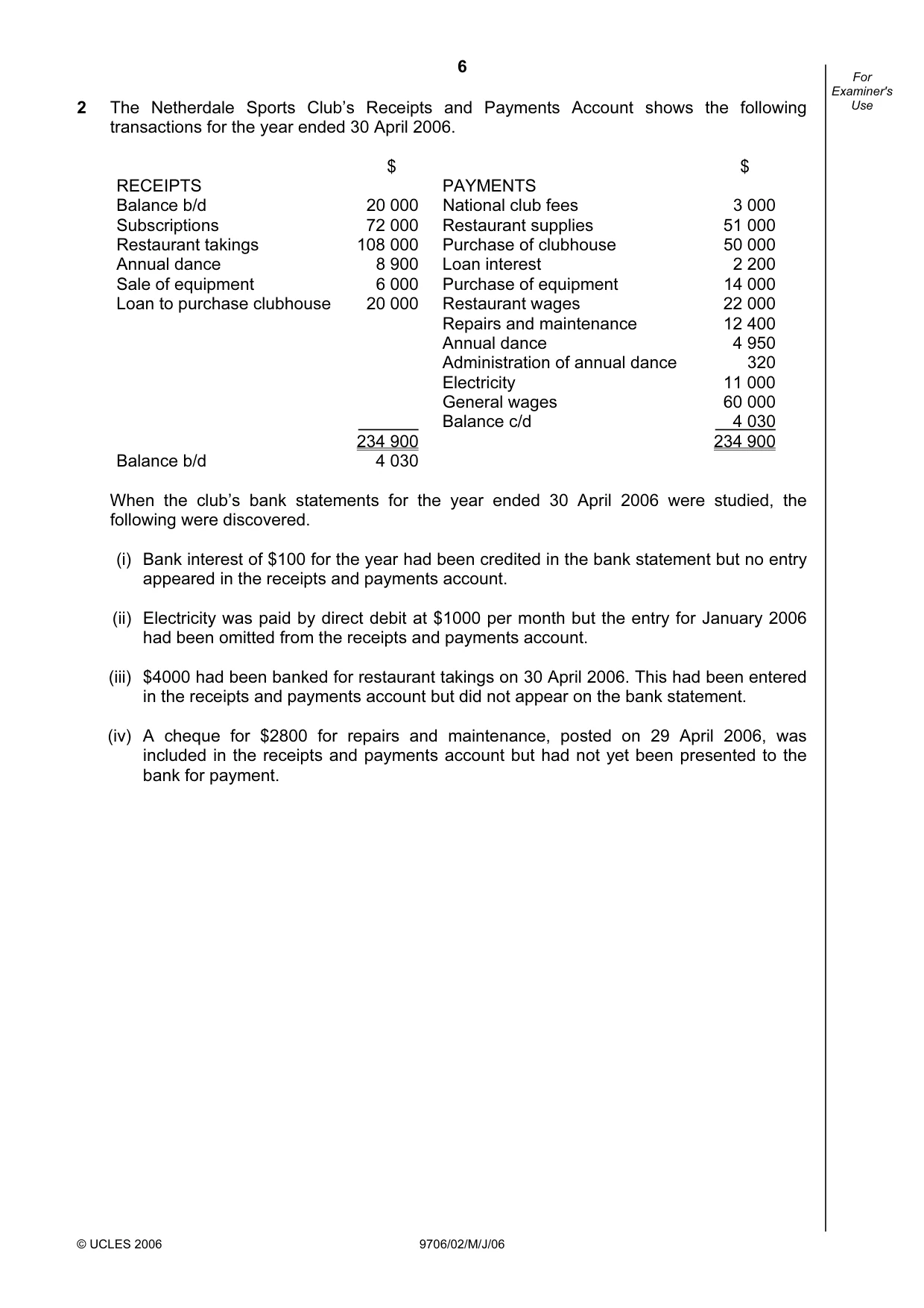
6 © UCLES 2006 9706/02/M/J/06 For Examiner's Use 2 The Netherdale Sports Club’s Receipts and Payments Account shows the following transactions for the year ended 30 April 2006. $ $ RECEIPTS PAYMENTS Balance b/d 20 000 National club fees 3 000 Subscriptions 72 000 Restaurant supplies 51 000 Restaurant takings 108 000 Purchase of clubhouse 50 000 Annual dance 8 900 Loan interest 2 200 Sale of equipment 6 000 Purchase of equipment 14 000 Loan to purchase clubhouse 20 000 Restaurant wages 22 000 Repairs and maintenance 12 400 Annual dance 4 950 Administration of annual dance 320 Electricity 11 000 General wages 60 000 Balance c/d 4 030 234 900 234 900 Balance b/d 4 030 When the club’s bank statements for the year ended 30 April 2006 were studied, the following were discovered. (i) Bank interest of $100 for the year had been credited in the bank statement but no entry appeared in the receipts and payments account. (ii) Electricity was paid by direct debit at $1000 per month but the entry for January 2006 had been omitted from the receipts and payments account. (iii) $4000 had been banked for restaurant takings on 30 April 2006. This had been entered in the receipts and payments account but did not appear on the bank statement. (iv) A cheque for $2800 for repairs and maintenance, posted on 29 April 2006, was included in the receipts and payments account but had not yet been presented to the bank for payment.
Question paper, page 7
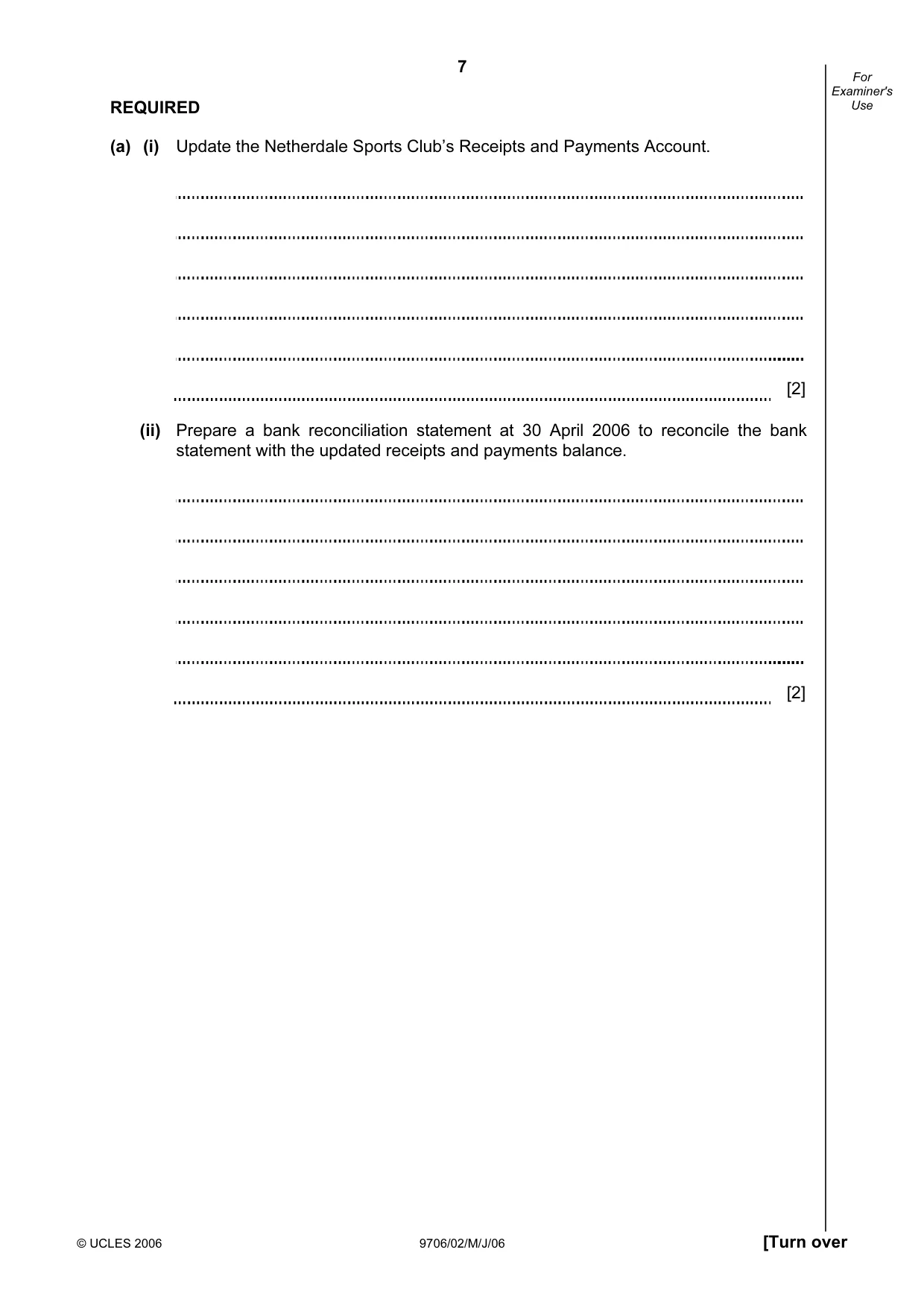
7 © UCLES 2006 9706/02/M/J/06 [Turn over For Examiner's Use REQUIRED (a) (i) Update the Netherdale Sports Club’s Receipts and Payments Account. [2] (ii) Prepare a bank reconciliation statement at 30 April 2006 to reconcile the bank statement with the updated receipts and payments balance. [2]
Question paper, page 8
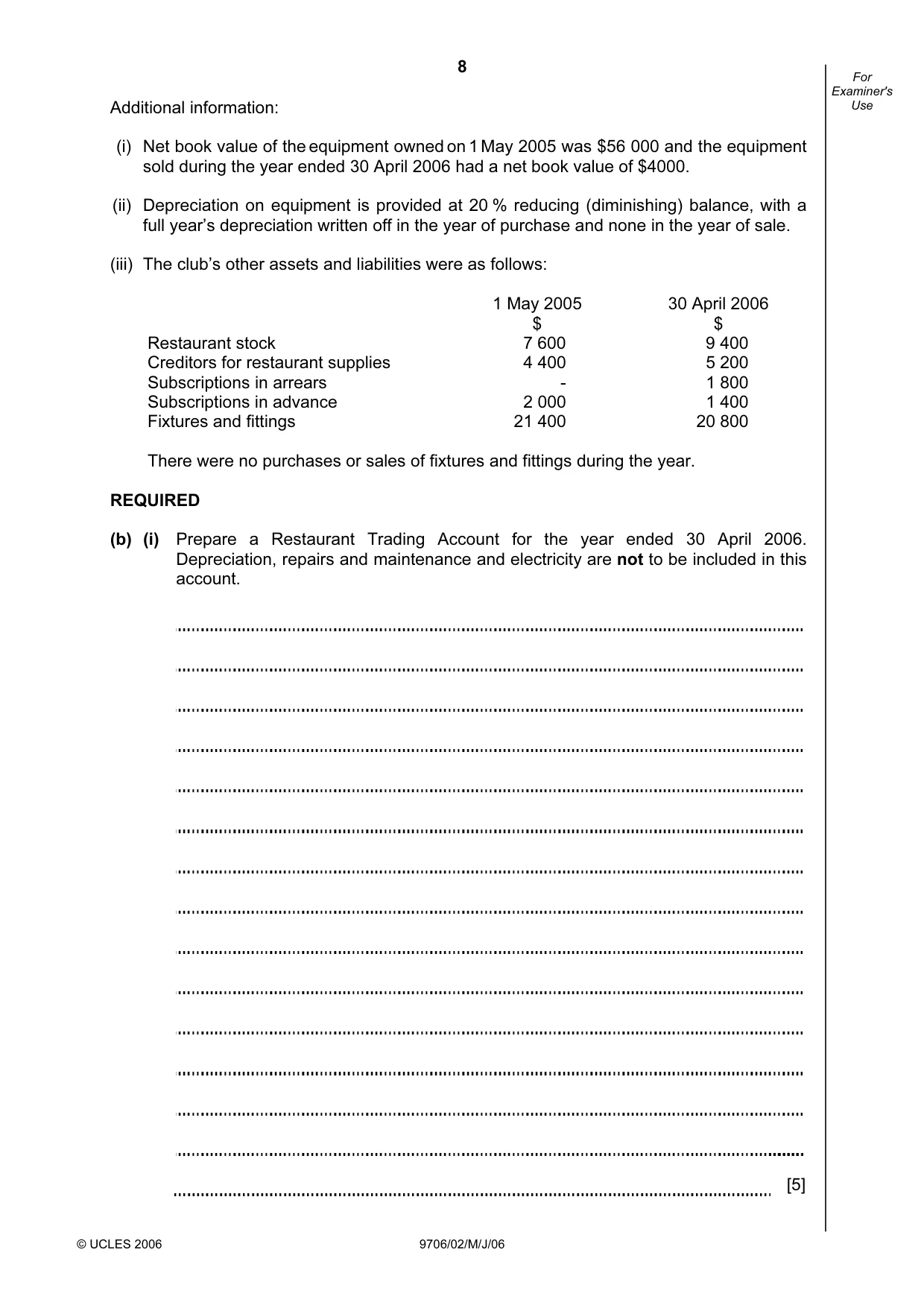
8 © UCLES 2006 9706/02/M/J/06 For Examiner's Use Additional information: (i) Net book value of the equipment owned on 1 May 2005 was $56 000 and the equipment sold during the year ended 30 April 2006 had a net book value of $4000. (ii) Depreciation on equipment is provided at 20 % reducing (diminishing) balance, with a full year’s depreciation written off in the year of purchase and none in the year of sale. (iii) The club’s other assets and liabilities were as follows: 1 May 2005 30 April 2006 $ $ Restaurant stock 7 600 9 400 Creditors for restaurant supplies 4 400 5 200 Subscriptions in arrears - 1 800 Subscriptions in advance 2 000 1 400 Fixtures and fittings 21 400 20 800 There were no purchases or sales of fixtures and fittings during the year. REQUIRED (b) (i) Prepare a Restaurant Trading Account for the year ended 30 April 2006. Depreciation, repairs and maintenance and electricity are not to be included in this account. [5]
Question paper, page 9
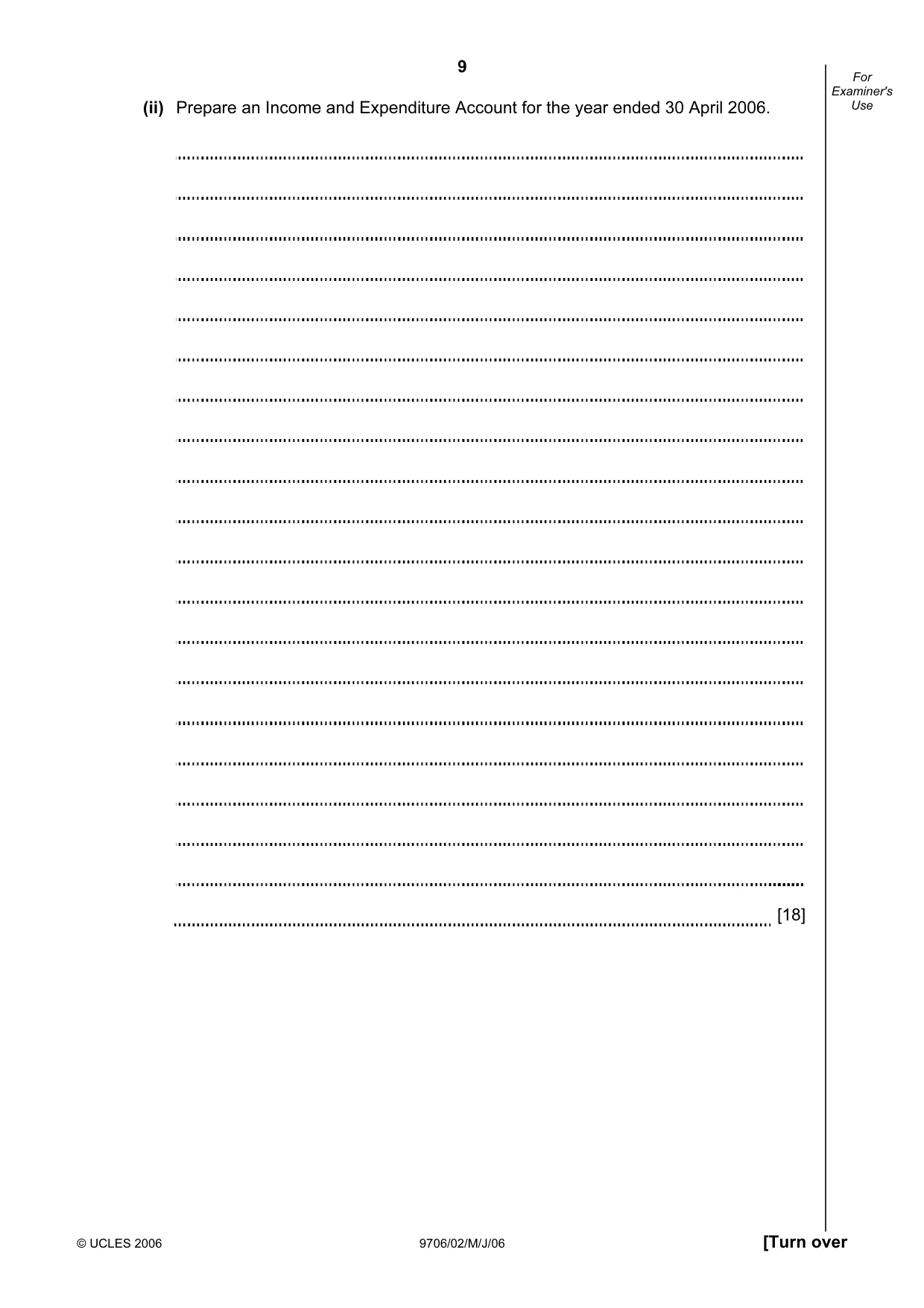
9 © UCLES 2006 9706/02/M/J/06 [Turn over For Examiner's Use (ii) Prepare an Income and Expenditure Account for the year ended 30 April 2006. [18]
Question paper, page 10
10 © UCLES 2006 9706/02/M/J/06 For Examiner's Use (c) State three reasons why, for most clubs, a Receipts and Payments Account is not always a satisfactory record of the club’s activities. [3] [Total: 30]
Question paper, page 12
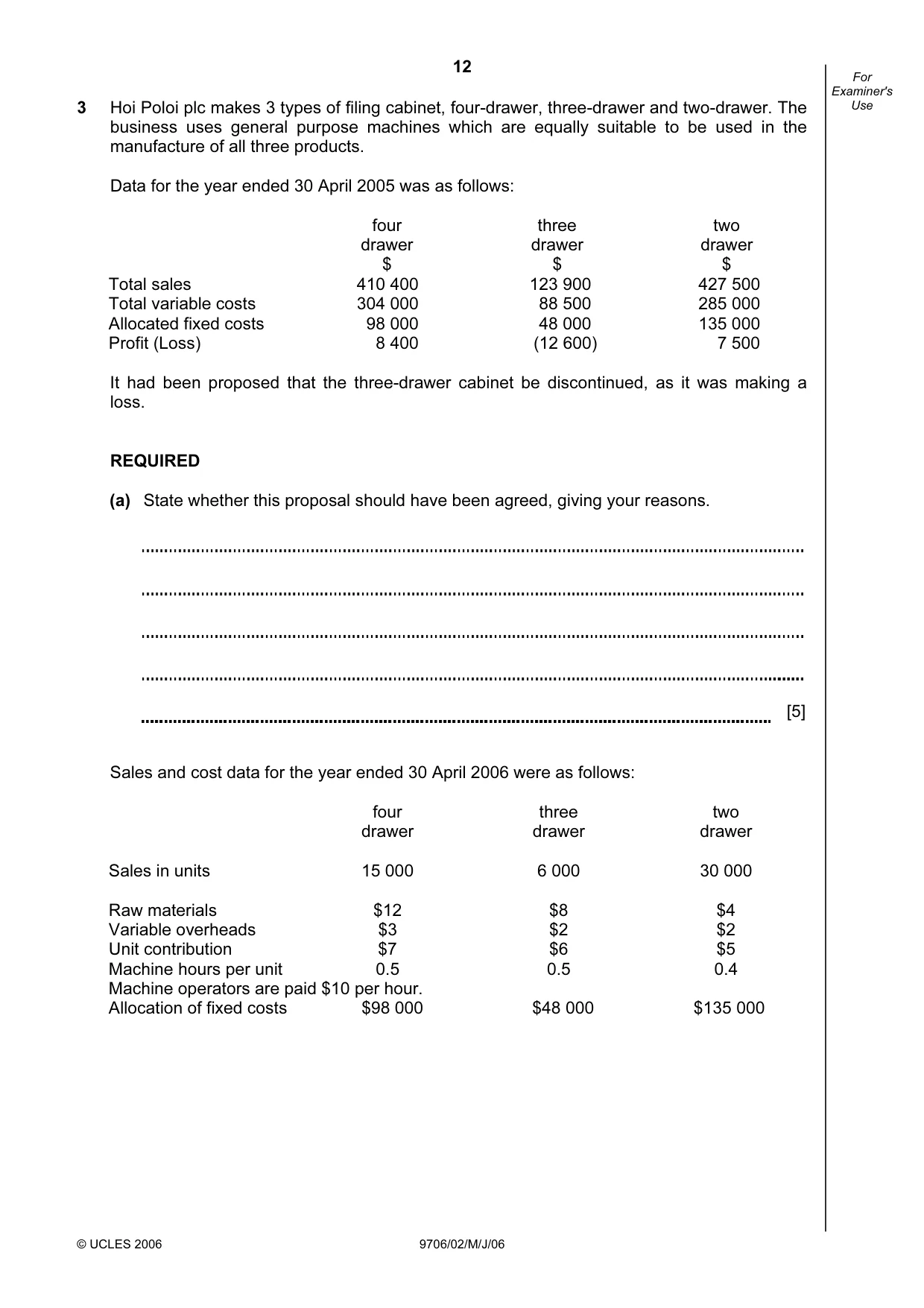
12 © UCLES 2006 9706/02/M/J/06 For Examiner's Use 3 Hoi Poloi plc makes 3 types of filing cabinet, four-drawer, three-drawer and two-drawer. The business uses general purpose machines which are equally suitable to be used in the manufacture of all three products. Data for the year ended 30 April 2005 was as follows: four three two drawer drawer drawer $ $ $ Total sales 410 400 123 900 427 500 Total variable costs 304 000 88 500 285 000 Allocated fixed costs 98 000 48 000 135 000 Profit (Loss) 8 400 (12 600) 7 500 It had been proposed that the three-drawer cabinet be discontinued, as it was making a loss. REQUIRED (a) State whether this proposal should have been agreed, giving your reasons. [5] Sales and cost data for the year ended 30 April 2006 were as follows: four three two drawer drawer drawer Sales in units 15 000 6 000 30 000 Raw materials $12 $8 $4 Variable overheads $3 $2 $2 Unit contribution $7 $6 $5 Machine hours per unit 0.5 0.5 0.4 Machine operators are paid $10 per hour. Allocation of fixed costs $98 000 $48 000 $135 000
Question paper, page 13
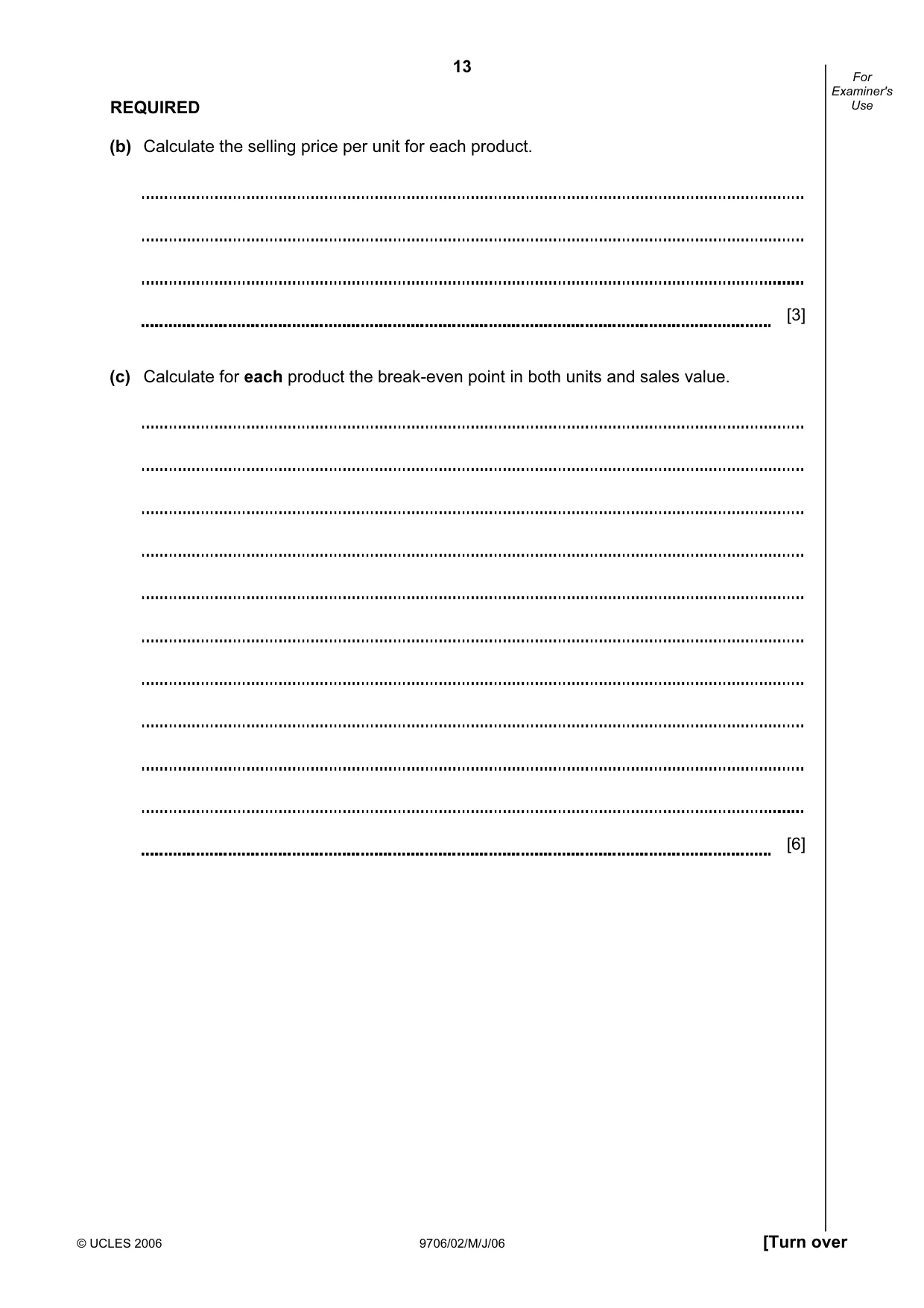
13 © UCLES 2006 9706/02/M/J/06 [Turn over For Examiner's Use REQUIRED (b) Calculate the selling price per unit for each product. [3] (c) Calculate for each product the break-even point in both units and sales value. [6]
Question paper, page 14
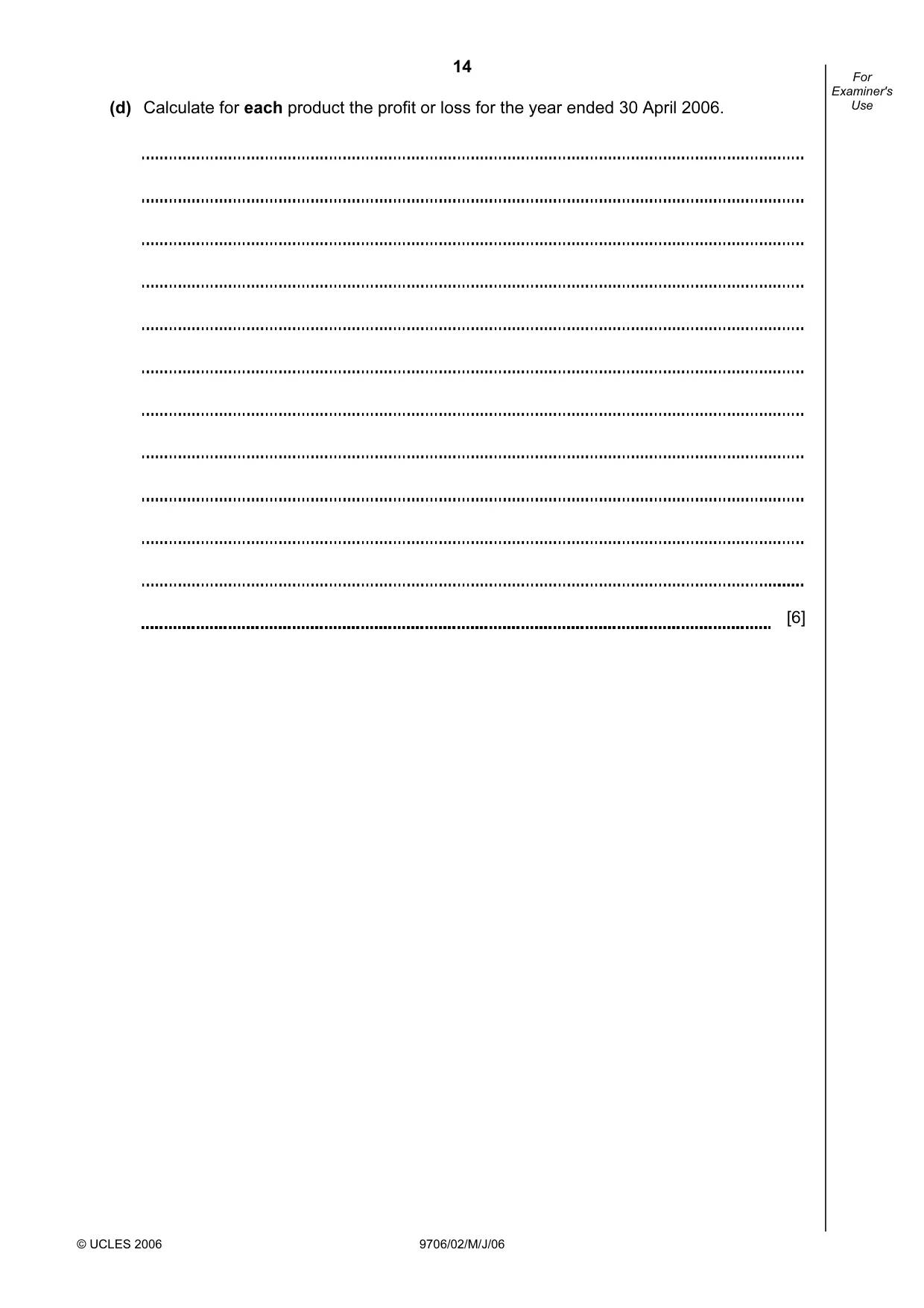
14 © UCLES 2006 9706/02/M/J/06 For Examiner's Use (d) Calculate for each product the profit or loss for the year ended 30 April 2006. [6]
Question paper, page 15
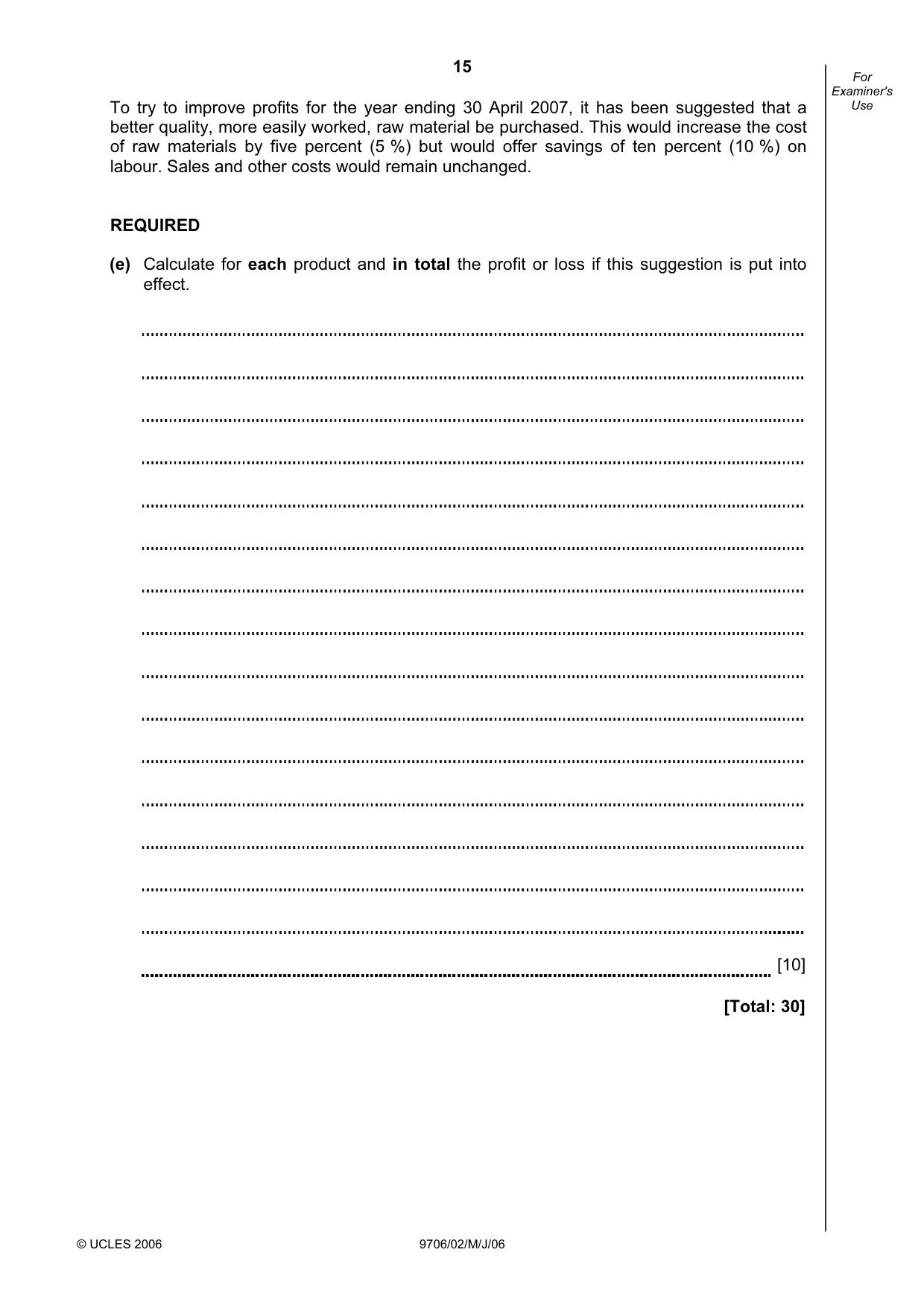
15 © UCLES 2006 9706/02/M/J/06 For Examiner's Use To try to improve profits for the year ending 30 April 2007, it has been suggested that a better quality, more easily worked, raw material be purchased. This would increase the cost of raw materials by five percent (5 %) but would offer savings of ten percent (10 %) on labour. Sales and other costs would remain unchanged. REQUIRED (e) Calculate for each product and in total the profit or loss if this suggestion is put into effect. [10] [Total: 30]
Question paper, page 16
16 BLANK PAGE Permission to reproduce items where third-party owned material protected by copyright is included has been sought and cleared where possible. Every reasonable effort has been made by the publisher (UCLES) to trace copyright holders, but if any items requiring clearance have unwittingly been included, the publisher will be pleased to make amends at the earliest possible opportunity. University of Cambridge International Examinations is part of the University of Cambridge Local Examinations Syndicate (UCLES), which is itself a department of the University of Cambridge. 9706/02/M/J/06
Mark scheme, page 1
UNIVERSITY OF CAMBRIDGE INTERNATIONAL EXAMINATIONS GCE Advanced/Advanced Subsidiary Level MARK SCHEME for the May/June 2006 question paper 9706 ACCOUNTING 9706/02 Paper 2 – Structured Questions Maximum raw mark 90 This mark scheme is published as an aid to teachers and students, to indicate the requirements of the examination. It shows the basis on which Examiners were initially instructed to award marks. It does not indicate the details of the discussions that took place at an Examiners’ meeting before marking began. Any substantial changes to the mark scheme that arose from these discussions will be recorded in the published Report on the Examination. All Examiners are instructed that alternative correct answers and unexpected approaches in candidates’ scripts must be given marks that fairly reflect the relevant knowledge and skills demonstrated. Mark schemes must be read in conjunction with the question papers and the Report on the Examination. The minimum marks in these components needed for various grades were previously published with these mark schemes, but are now instead included in the Report on the Examination for this session. • CIE will not enter into discussion or correspondence in connection with these mark schemes. CIE is publishing the mark schemes for the May/June 2006 question papers for most IGCSE and GCE Advanced Level and Advanced Subsidiary Level syllabuses and some Ordinary Level syllabuses.
Mark scheme, page 2
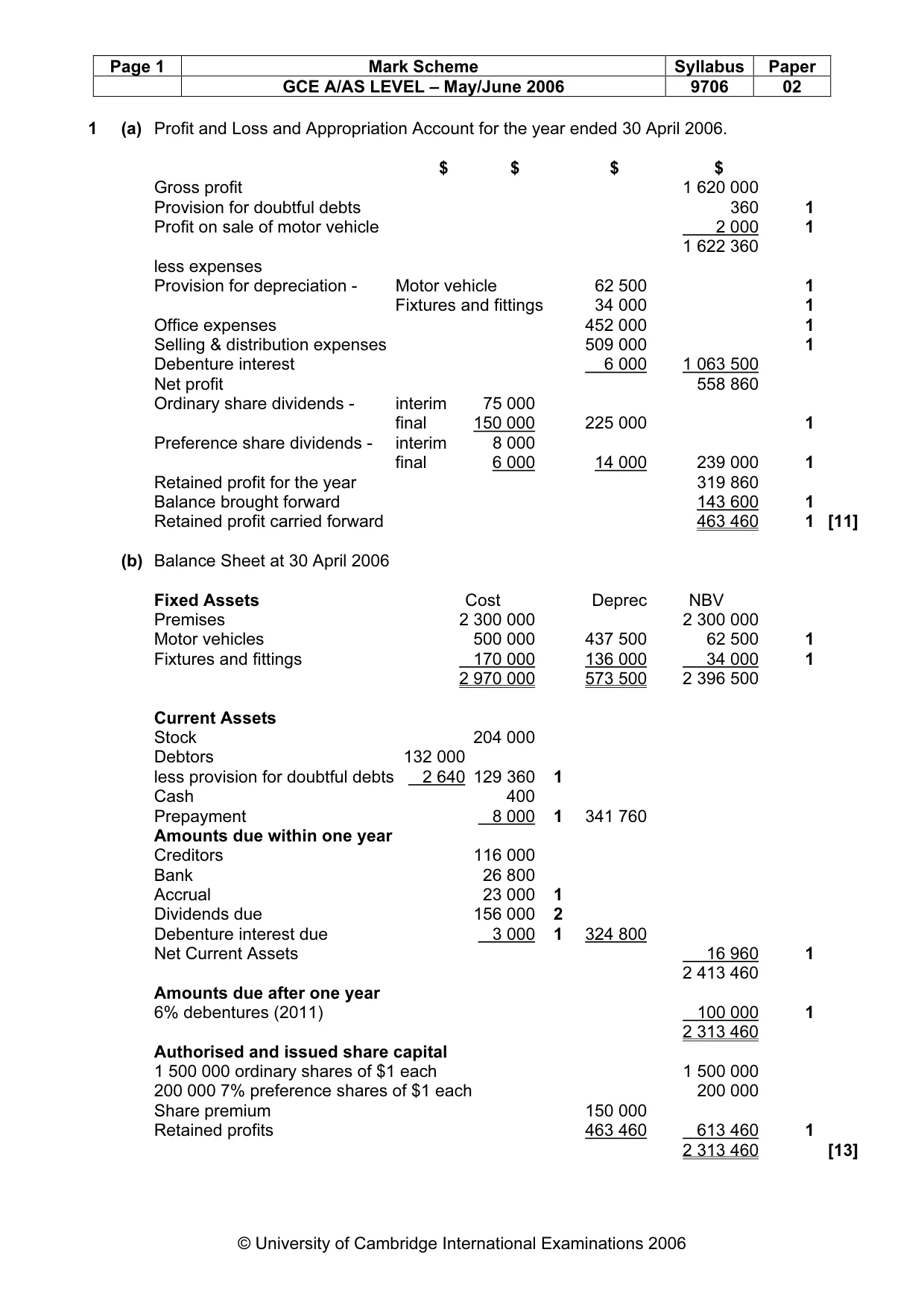
Page 1 Mark Scheme Syllabus Paper GCE A/AS LEVEL – May/June 2006 9706 02 © University of Cambridge International Examinations 2006 1 (a) Profit and Loss and Appropriation Account for the year ended 30 April 2006. $ $ $ $ Gross profit 1 620 000 Provision for doubtful debts 360 1 Profit on sale of motor vehicle 2 000 1 1 622 360 less expenses Provision for depreciation - Motor vehicle 62 500 1 Fixtures and fittings 34 000 1 Office expenses 452 000 1 Selling & distribution expenses 509 000 1 Debenture interest 6 000 1 063 500 Net profit 558 860 Ordinary share dividends - interim 75 000 final 150 000 225 000 1 Preference share dividends - interim 8 000 final 6 000 14 000 239 000 1 Retained profit for the year 319 860 Balance brought forward 143 600 1 Retained profit carried forward 463 460 1 [11] (b) Balance Sheet at 30 April 2006 Fixed Assets Cost Deprec NBV Premises 2 300 000 2 300 000 Motor vehicles 500 000 437 500 62 500 1 Fixtures and fittings 170 000 136 000 34 000 1 2 970 000 573 500 2 396 500 Current Assets Stock 204 000 Debtors 132 000 less provision for doubtful debts 2 640 129 360 1 Cash 400 Prepayment 8 000 1 341 760 Amounts due within one year Creditors 116 000 Bank 26 800 Accrual 23 000 1 Dividends due 156 000 2 Debenture interest due 3 000 1 324 800 Net Current Assets 16 960 1 2 413 460 Amounts due after one year 6% debentures (2011) 100 000 1 2 313 460 Authorised and issued share capital 1 500 000 ordinary shares of $1 each 1 500 000 200 000 7% preference shares of $1 each 200 000 Share premium 150 000 Retained profits 463 460 613 460 1 2 313 460 [13]
Mark scheme, page 3
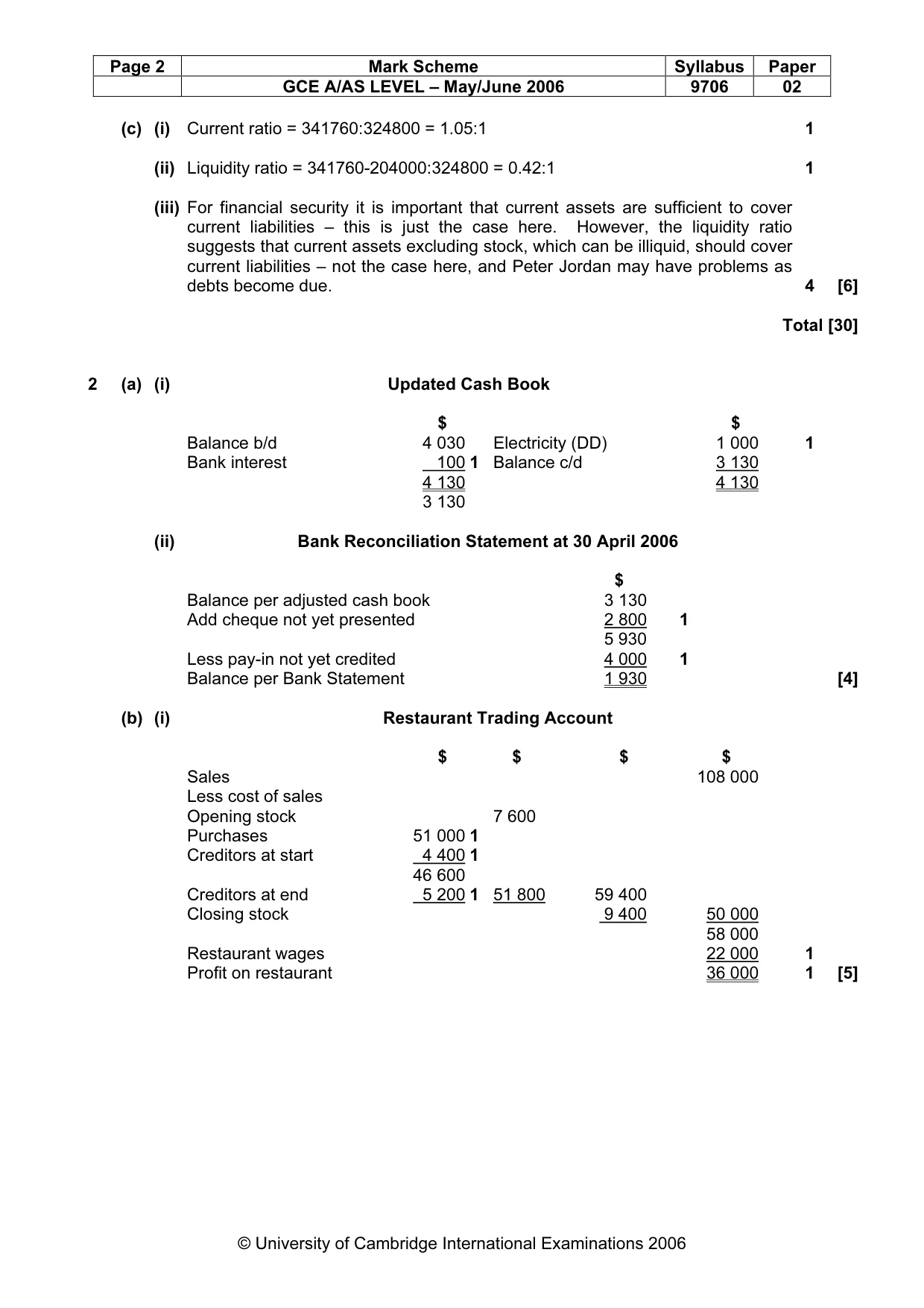
Page 2 Mark Scheme Syllabus Paper GCE A/AS LEVEL – May/June 2006 9706 02 © University of Cambridge International Examinations 2006 (c) (i) Current ratio = 341760:324800 = 1.05:1 1 (ii) Liquidity ratio = 341760-204000:324800 = 0.42:1 1 (iii) For financial security it is important that current assets are sufficient to cover current liabilities – this is just the case here. However, the liquidity ratio suggests that current assets excluding stock, which can be illiquid, should cover current liabilities – not the case here, and Peter Jordan may have problems as debts become due. 4 [6] Total [30] 2 (a) (i) Updated Cash Book $ $ Balance b/d 4 030 Electricity (DD) 1 000 1 Bank interest 100 1 Balance c/d 3 130 4 130 4 130 3 130 (ii) Bank Reconciliation Statement at 30 April 2006 $ Balance per adjusted cash book 3 130 Add cheque not yet presented 2 800 1 5 930 Less pay-in not yet credited 4 000 1 Balance per Bank Statement 1 930 [4] (b) (i) Restaurant Trading Account $ $ $ $ Sales 108 000 Less cost of sales Opening stock 7 600 Purchases 51 000 1 Creditors at start 4 400 1 46 600 Creditors at end 5 200 1 51 800 59 400 Closing stock 9 400 50 000 58 000 Restaurant wages 22 000 1 Profit on restaurant 36 000 1 [5]
Mark scheme, page 4
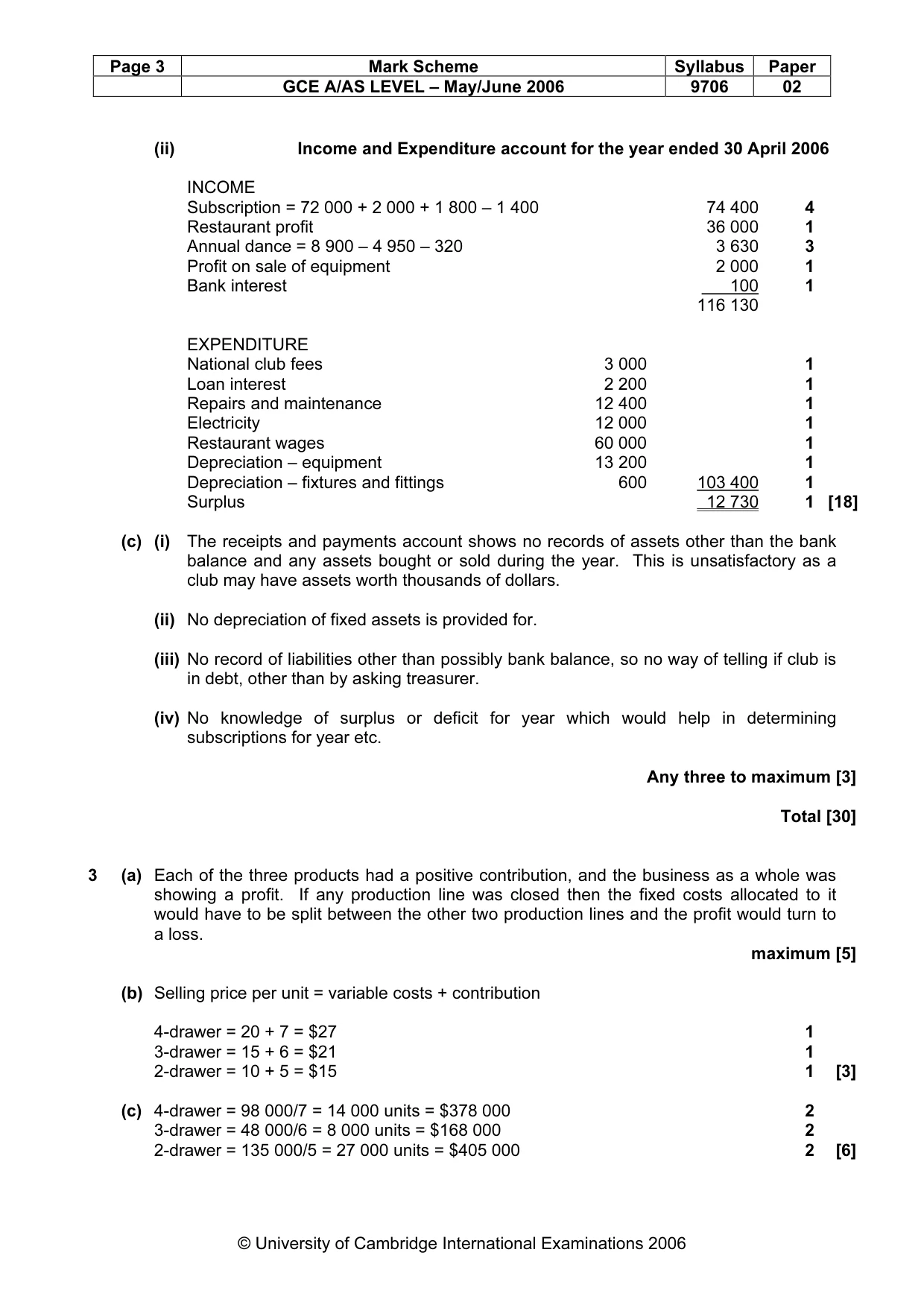
Page 3 Mark Scheme Syllabus Paper GCE A/AS LEVEL – May/June 2006 9706 02 © University of Cambridge International Examinations 2006 (ii) Income and Expenditure account for the year ended 30 April 2006 INCOME Subscription = 72 000 + 2 000 + 1 800 – 1 400 74 400 4 Restaurant profit 36 000 1 Annual dance = 8 900 – 4 950 – 320 3 630 3 Profit on sale of equipment 2 000 1 Bank interest 100 1 116 130 EXPENDITURE National club fees 3 000 1 Loan interest 2 200 1 Repairs and maintenance 12 400 1 Electricity 12 000 1 Restaurant wages 60 000 1 Depreciation – equipment 13 200 1 Depreciation – fixtures and fittings 600 103 400 1 Surplus 12 730 1 [18] (c) (i) The receipts and payments account shows no records of assets other than the bank balance and any assets bought or sold during the year. This is unsatisfactory as a club may have assets worth thousands of dollars. (ii) No depreciation of fixed assets is provided for. (iii) No record of liabilities other than possibly bank balance, so no way of telling if club is in debt, other than by asking treasurer. (iv) No knowledge of surplus or deficit for year which would help in determining subscriptions for year etc. Any three to maximum [3] Total [30] 3 (a) Each of the three products had a positive contribution, and the business as a whole was showing a profit. If any production line was closed then the fixed costs allocated to it would have to be split between the other two production lines and the profit would turn to a loss. maximum [5] (b) Selling price per unit = variable costs + contribution 4-drawer = 20 + 7 = $27 1 3-drawer = 15 + 6 = $21 1 2-drawer = 10 + 5 = $15 1 [3] (c) 4-drawer = 98 000/7 = 14 000 units = $378 000 2 3-drawer = 48 000/6 = 8 000 units = $168 000 2 2-drawer = 135 000/5 = 27 000 units = $405 000 2 [6]
Mark scheme, page 5
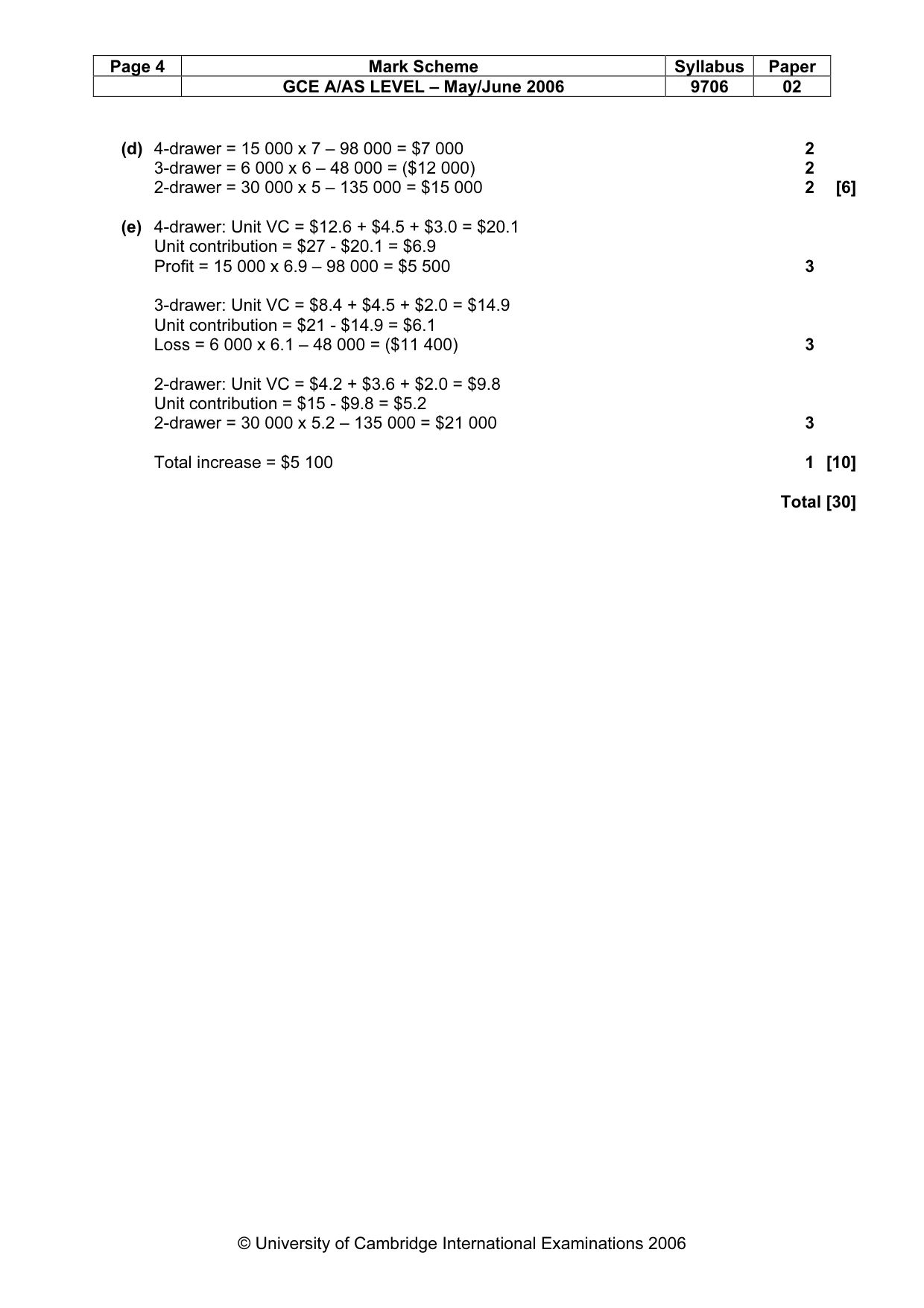
Page 4 Mark Scheme Syllabus Paper GCE A/AS LEVEL – May/June 2006 9706 02 © University of Cambridge International Examinations 2006 (d) 4-drawer = 15 000 x 7 – 98 000 = $7 000 2 3-drawer = 6 000 x 6 – 48 000 = ($12 000) 2 2-drawer = 30 000 x 5 – 135 000 = $15 000 2 [6] (e) 4-drawer: Unit VC = $12.6 + $4.5 + $3.0 = $20.1 Unit contribution = $27 - $20.1 = $6.9 Profit = 15 000 x 6.9 – 98 000 = $5 500 3 3-drawer: Unit VC = $8.4 + $4.5 + $2.0 = $14.9 Unit contribution = $21 - $14.9 = $6.1 Loss = 6 000 x 6.1 – 48 000 = ($11 400) 3 2-drawer: Unit VC = $4.2 + $3.6 + $2.0 = $9.8 Unit contribution = $15 - $9.8 = $5.2 2-drawer = 30 000 x 5.2 – 135 000 = $21 000 3 Total increase = $5 100 1 [10] Total [30]
What you needed in this session
Cambridge’s own grade thresholds for 2006 May/June, Paper 2 · Variant 1. A higher threshold means an easier paper — the bar moves with how the cohort did.