Cambridge A Level Accounting 9706 — 2005 May/June Paper 2 · Variant 1
9706/21/M/J/05
The question paper and its mark scheme, free to read here and free to download. This is Cambridge’s own paper, exactly as it was sat.
Question paper12 pages


Mark scheme7 pages
Answers below. Sit the paper first if you are practising.
Paper as text
Question paper, page 1
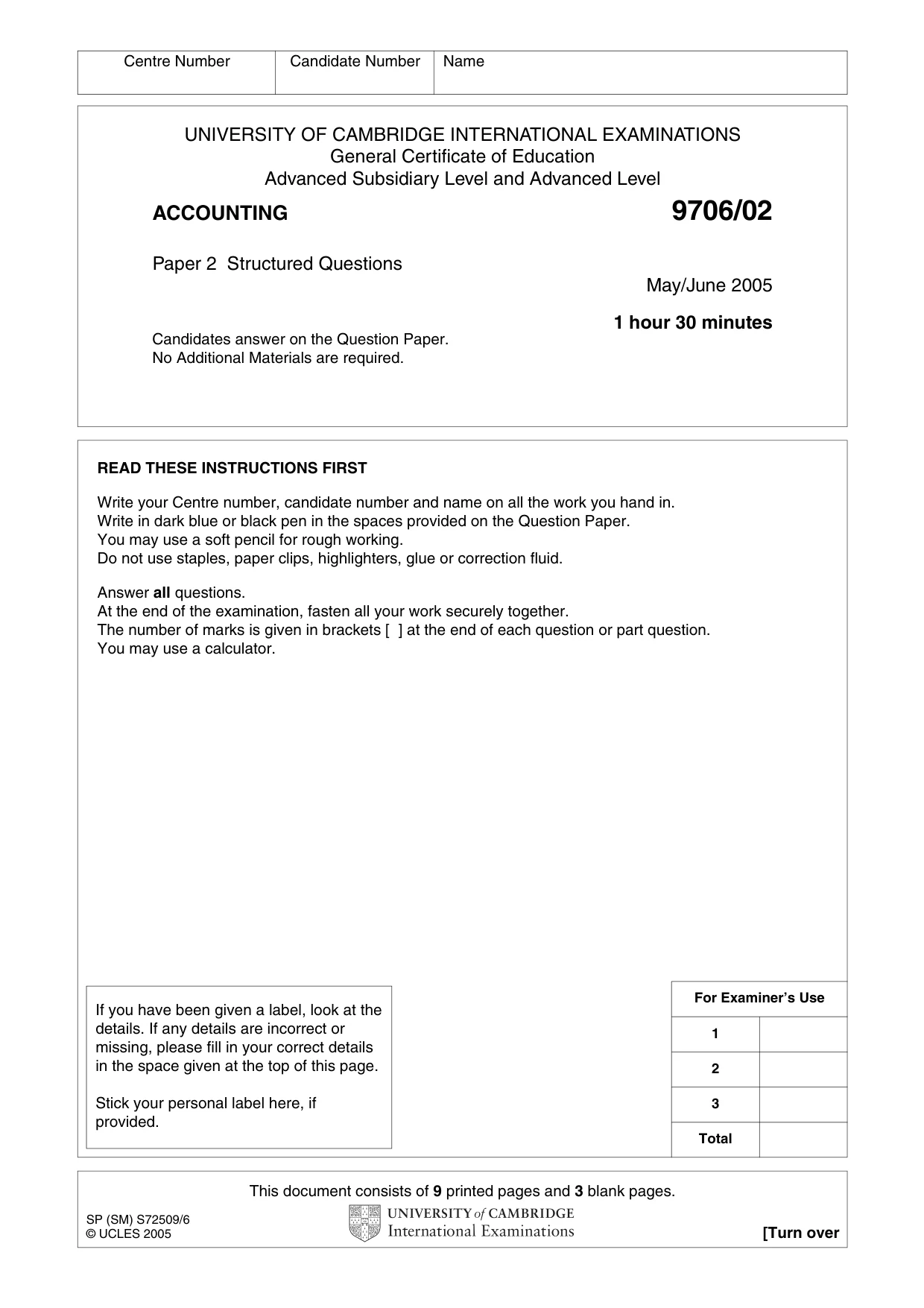
This document consists of 9 printed pages and 3 blank pages. SP (SM) S72509/6 © UCLES 2005 [Turn over UNIVERSITY OF CAMBRIDGE INTERNATIONAL EXAMINATIONS General Certificate of Education Advanced Subsidiary Level and Advanced Level ACCOUNTING 9706/02 Paper 2 Structured Questions May/June 2005 1 hour 30 minutes Candidates answer on the Question Paper. No Additional Materials are required. READ THESE INSTRUCTIONS FIRST Write your Centre number, candidate number and name on all the work you hand in. Write in dark blue or black pen in the spaces provided on the Question Paper. You may use a soft pencil for rough working. Do not use staples, paper clips, highlighters, glue or correction fluid. Answer all questions. At the end of the examination, fasten all your work securely together. The number of marks is given in brackets [ ] at the end of each question or part question. You may use a calculator. Centre Number Candidate Number Name If you have been given a label, look at the details. If any details are incorrect or missing, please fill in your correct details in the space given at the top of this page. Stick your personal label here, if provided. For Examiner’s Use 1 2 3 Total
Question paper, page 2
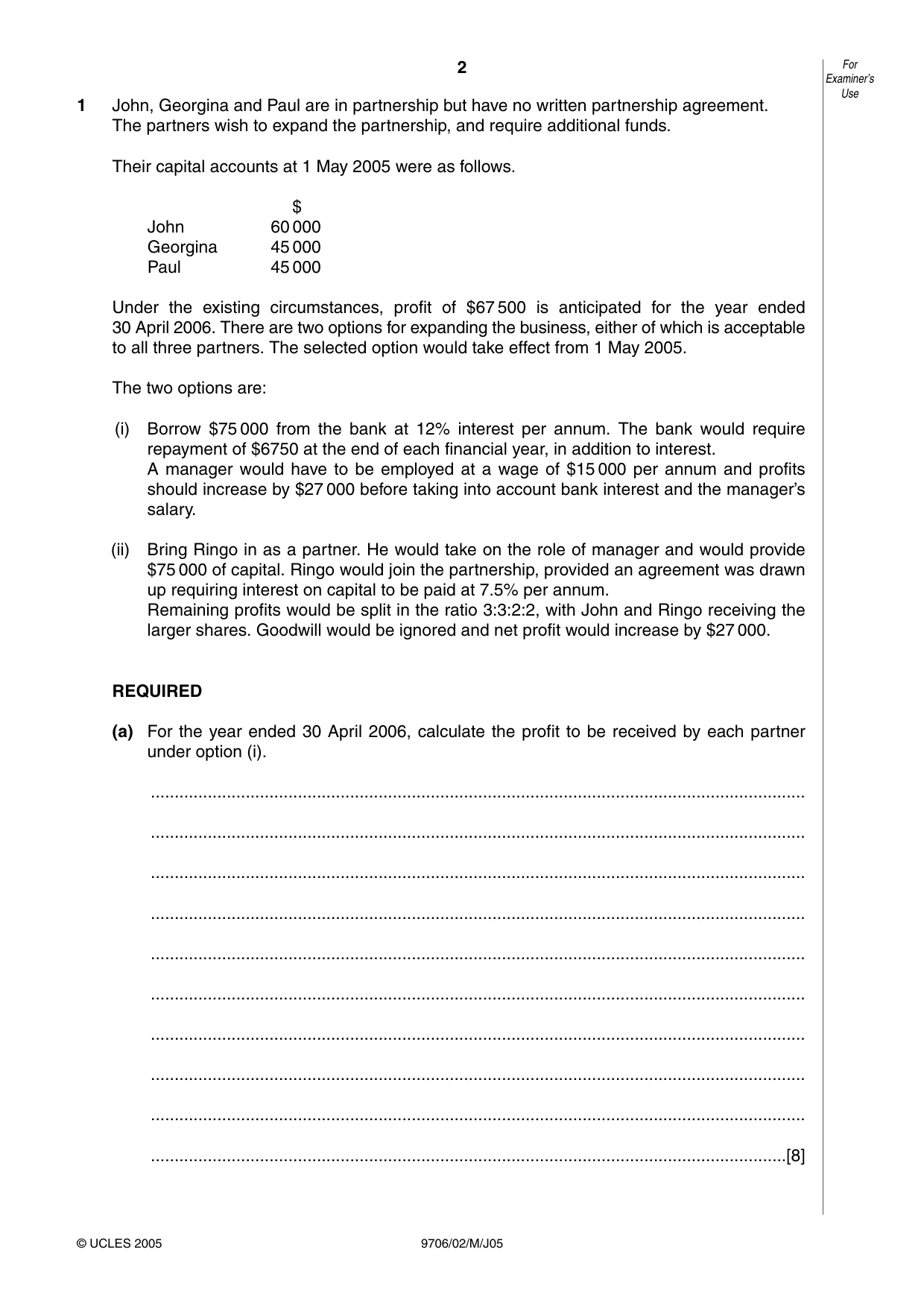
2 9706/02/M/J05 1 John, Georgina and Paul are in partnership but have no written partnership agreement. The partners wish to expand the partnership, and require additional funds. Their capital accounts at 1 May 2005 were as follows. $ John 60 000 Georgina 45 000 Paul 45 000 Under the existing circumstances, profit of $67 500 is anticipated for the year ended 30 April 2006. There are two options for expanding the business, either of which is acceptable to all three partners. The selected option would take effect from 1 May 2005. The two options are: (i) Borrow $75 000 from the bank at 12% interest per annum. The bank would require repayment of $6750 at the end of each financial year, in addition to interest. A manager would have to be employed at a wage of $15 000 per annum and profits should increase by $27 000 before taking into account bank interest and the manager’s salary. (ii) Bring Ringo in as a partner. He would take on the role of manager and would provide $75 000 of capital. Ringo would join the partnership, provided an agreement was drawn up requiring interest on capital to be paid at 7.5% per annum. Remaining profits would be split in the ratio 3:3:2:2, with John and Ringo receiving the larger shares. Goodwill would be ignored and net profit would increase by $27 000. REQUIRED (a) For the year ended 30 April 2006, calculate the profit to be received by each partner under option (i). … … … … … … … … … …[8] For Examiner’s Use © UCLES 2005
Question paper, page 3
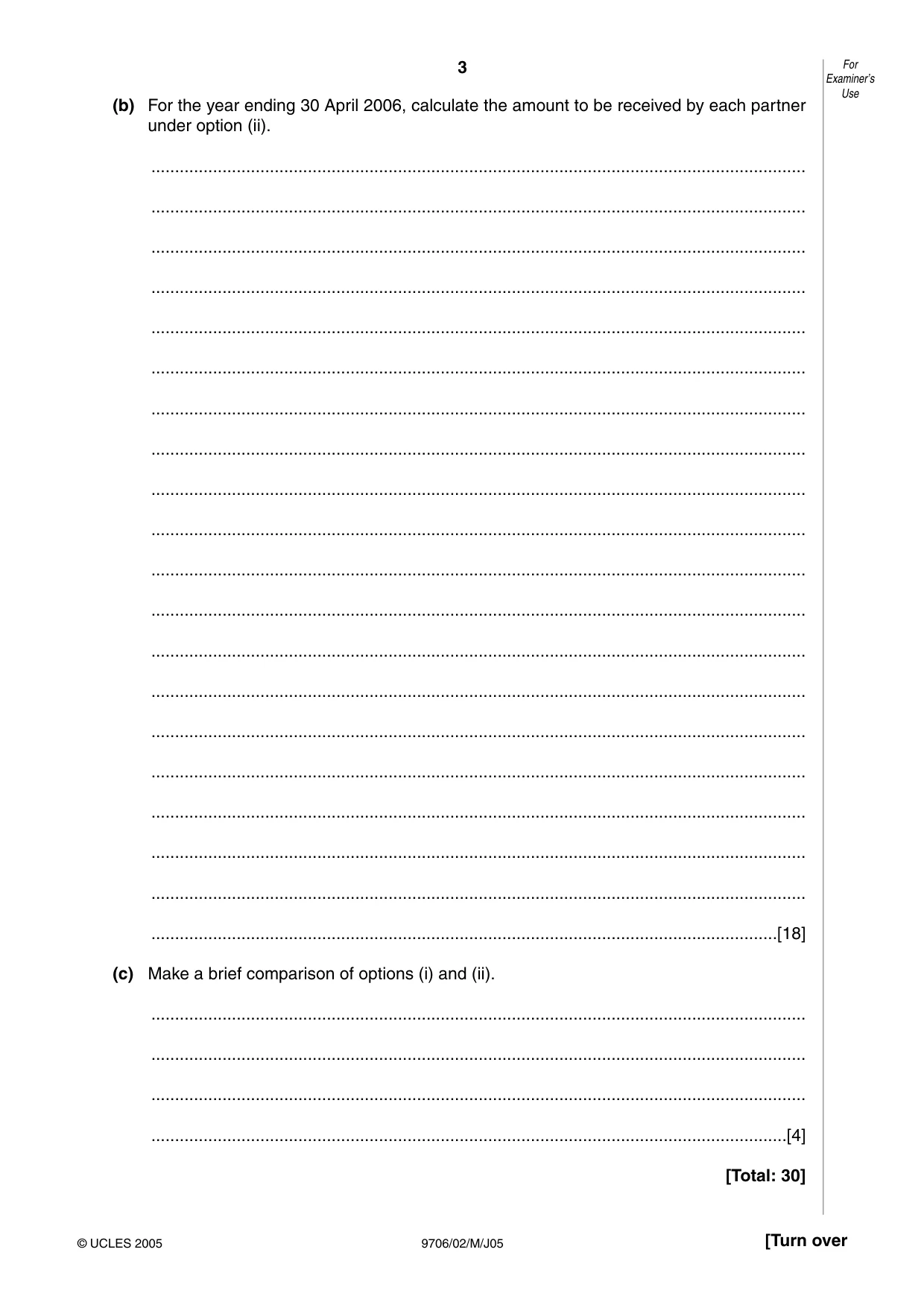
3 9706/02/M/J05 [Turn over (b) For the year ending 30 April 2006, calculate the amount to be received by each partner under option (ii). … … … … … … … … … … … … … … … … … … … …[18] (c) Make a brief comparison of options (i) and (ii). … … … …[4] [Total: 30] For Examiner’s Use © UCLES 2005
Question paper, page 4
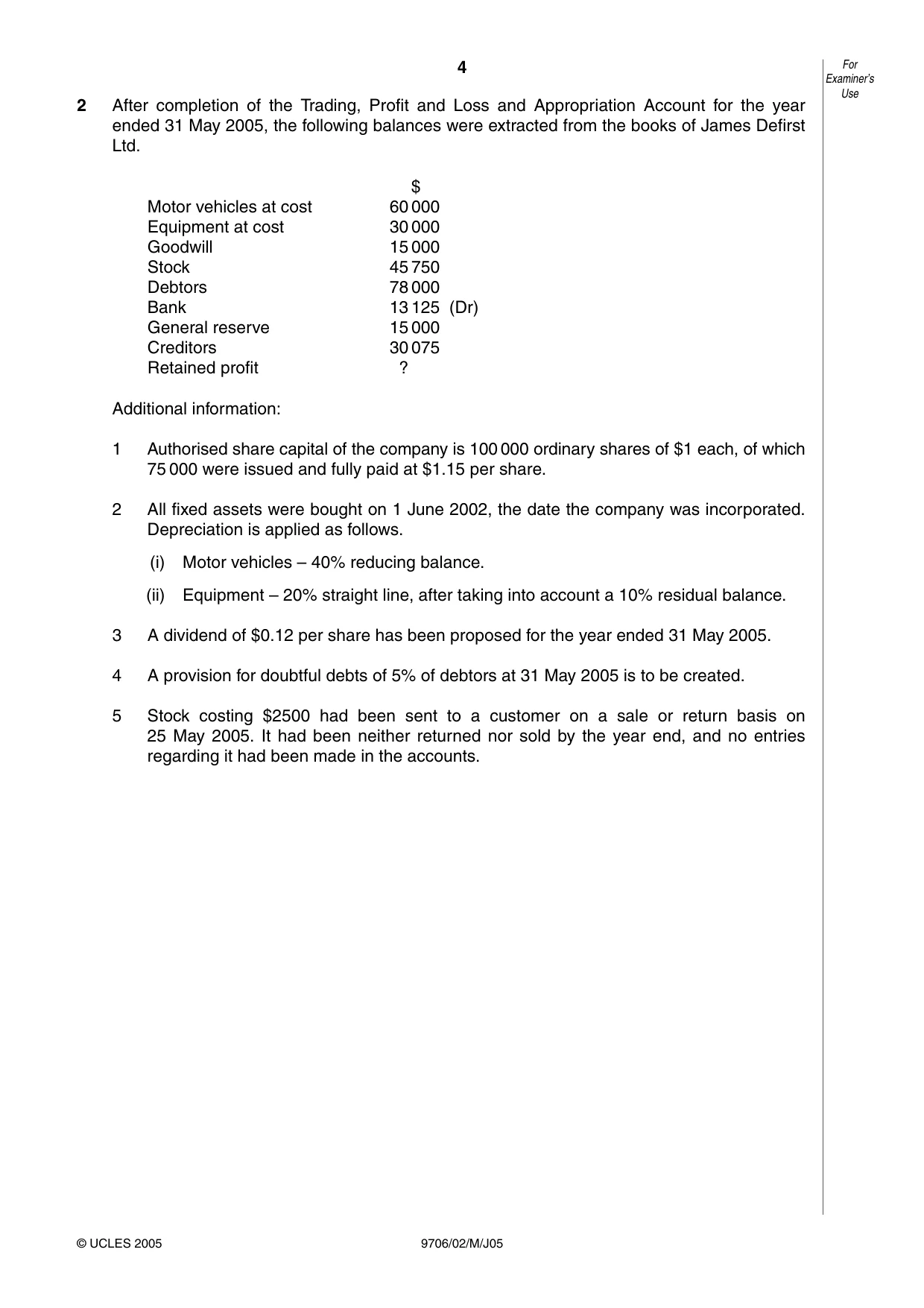
4 9706/02/M/J05 2 After completion of the Trading, Profit and Loss and Appropriation Account for the year ended 31 May 2005, the following balances were extracted from the books of James Defirst Ltd. $ Motor vehicles at cost 60 000 Equipment at cost 30 000 Goodwill 15 000 Stock 45 750 Debtors 78 000 Bank 13 125 (Dr) General reserve 15 000 Creditors 30 075 Retained profit ? Additional information: 1 Authorised share capital of the company is 100 000 ordinary shares of $1 each, of which 75 000 were issued and fully paid at $1.15 per share. 2 All fixed assets were bought on 1 June 2002, the date the company was incorporated. Depreciation is applied as follows. (i) Motor vehicles – 40% reducing balance. (ii) Equipment – 20% straight line, after taking into account a 10% residual balance. 3 A dividend of $0.12 per share has been proposed for the year ended 31 May 2005. 4 A provision for doubtful debts of 5% of debtors at 31 May 2005 is to be created. 5 Stock costing $2500 had been sent to a customer on a sale or return basis on 25 May 2005. It had been neither returned nor sold by the year end, and no entries regarding it had been made in the accounts. For Examiner’s Use © UCLES 2005
Question paper, page 5
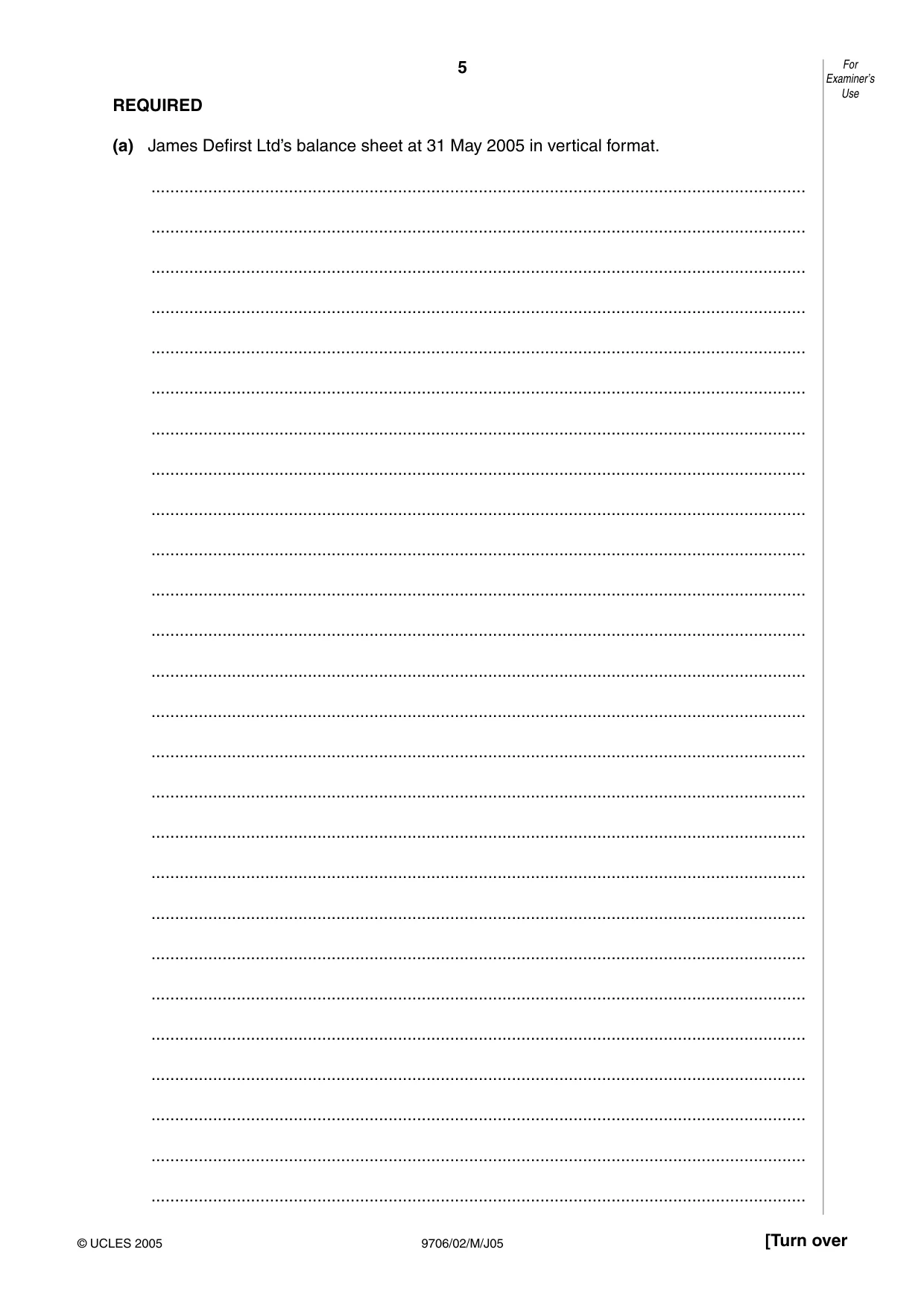
5 9706/02/M/J05 [Turn over REQUIRED (a) James Defirst Ltd’s balance sheet at 31 May 2005 in vertical format. … … … … … … … … … … … … … … … … … … … … … … … … … … For Examiner’s Use © UCLES 2005
Question paper, page 6
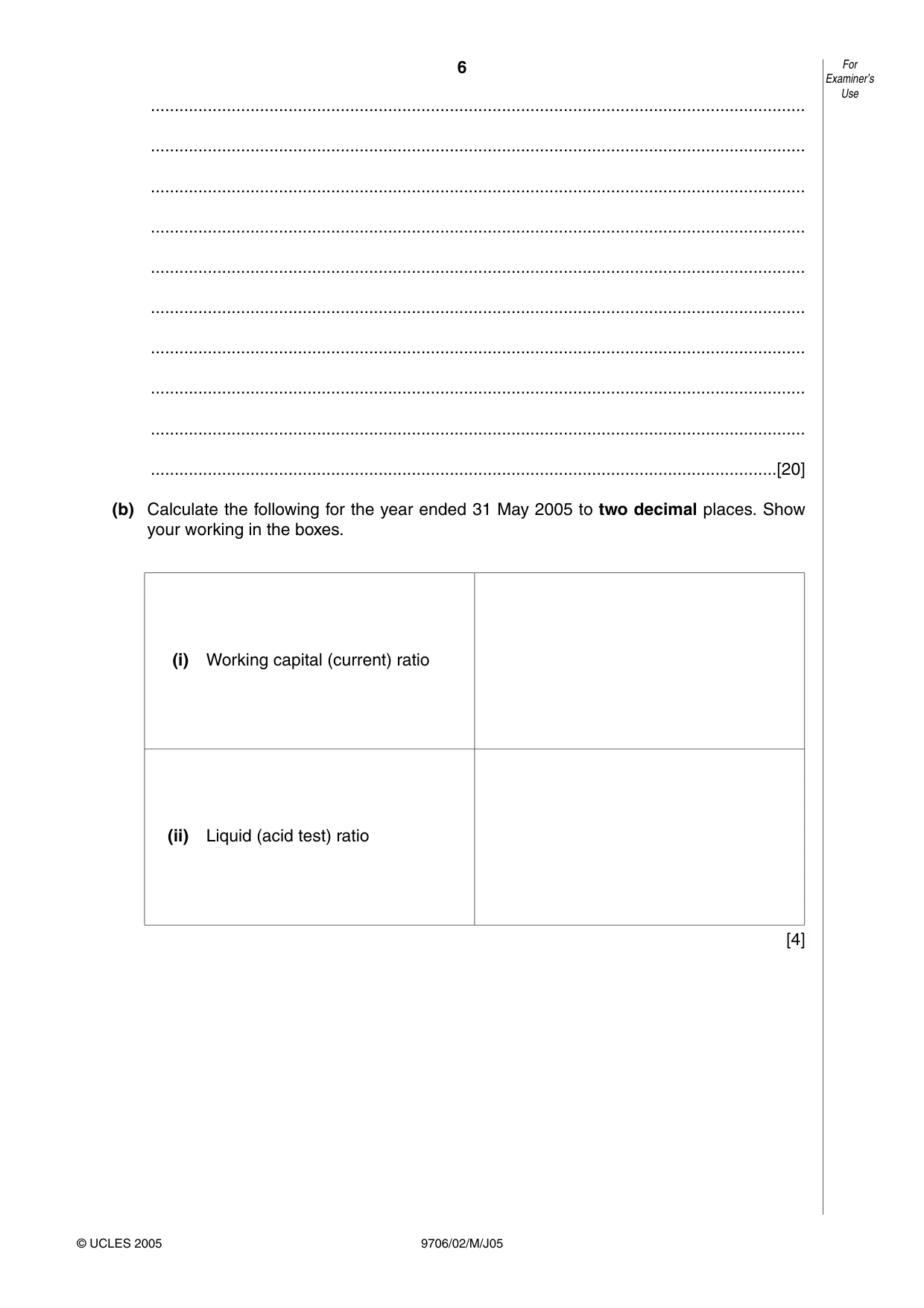
6 9706/02/M/J05 … … … … … … … … … …[20] (b) Calculate the following for the year ended 31 May 2005 to two decimal places. Show your working in the boxes. [4] For Examiner’s Use © UCLES 2005 (i) Working capital (current) ratio (ii) Liquid (acid test) ratio
Question paper, page 7
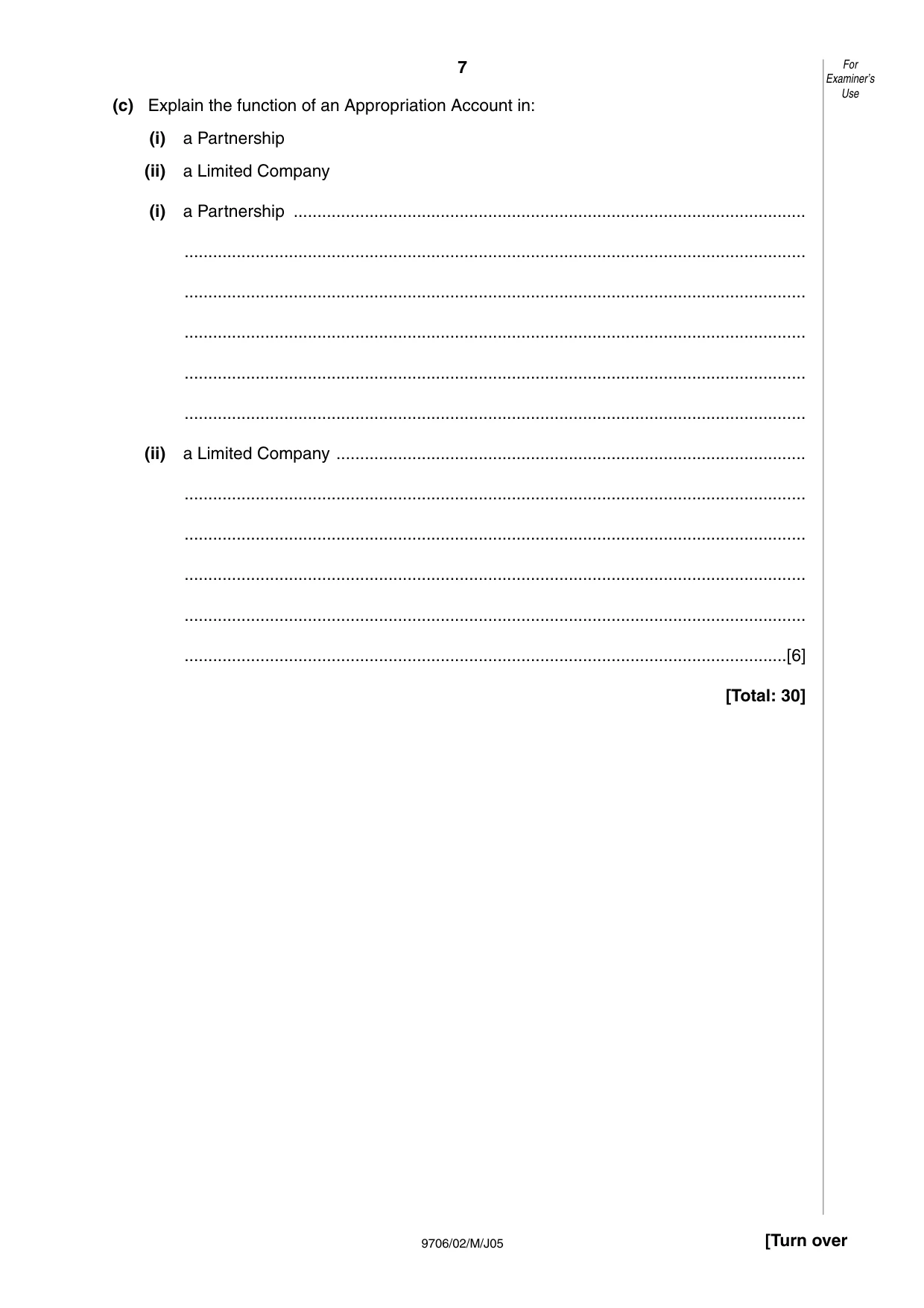
7 9706/02/M/J05 [Turn over (c) Explain the function of an Appropriation Account in: (i) a Partnership (ii) a Limited Company (i) a Partnership … … … … … … (ii) a Limited Company … … … … … …[6] [Total: 30] For Examiner’s Use
Question paper, page 8
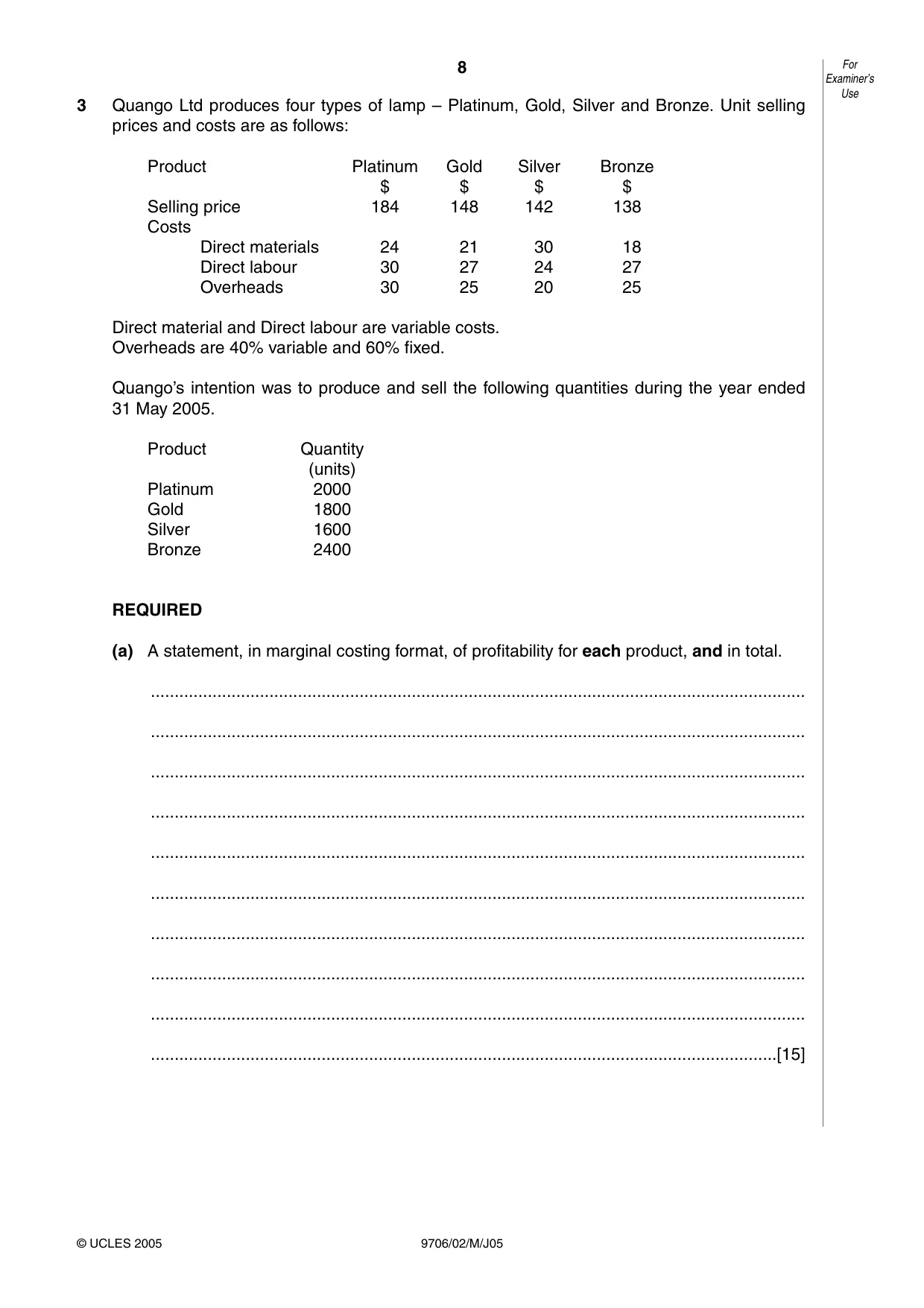
8 9706/02/M/J05 3 Quango Ltd produces four types of lamp – Platinum, Gold, Silver and Bronze. Unit selling prices and costs are as follows: Product Platinum Gold Silver Bronze $ $ $ $ Selling price 184 148 142 138 Costs Direct materials 24 21 30 18 Direct labour 30 27 24 27 Overheads 30 25 20 25 Direct material and Direct labour are variable costs. Overheads are 40% variable and 60% fixed. Quango’s intention was to produce and sell the following quantities during the year ended 31 May 2005. Product Quantity (units) Platinum 2000 Gold 1800 Silver 1600 Bronze 2400 REQUIRED (a) A statement, in marginal costing format, of profitability for each product, and in total. … … … … … … … … … …[15] For Examiner’s Use © UCLES 2005
Question paper, page 9
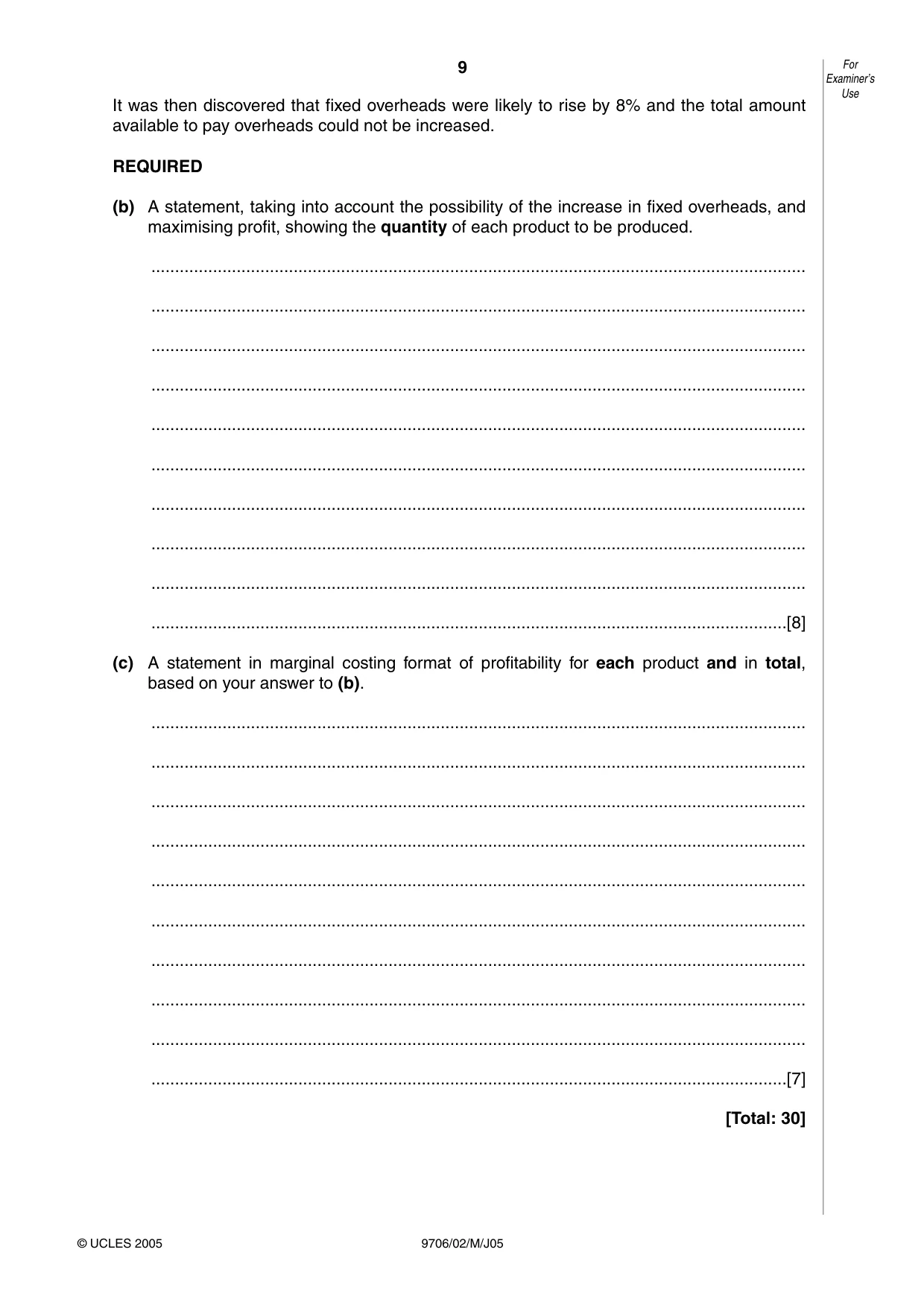
9 9706/02/M/J05 It was then discovered that fixed overheads were likely to rise by 8% and the total amount available to pay overheads could not be increased. REQUIRED (b) A statement, taking into account the possibility of the increase in fixed overheads, and maximising profit, showing the quantity of each product to be produced. … … … … … … … … … …[8] (c) A statement in marginal costing format of profitability for each product and in total, based on your answer to (b). … … … … … … … … … …[7] [Total: 30] For Examiner’s Use © UCLES 2005
Question paper, page 12
12 9706/02/M/J05 BLANK PAGE Permission to reproduce items where third-party owned material protected by copyright is included has been sought and cleared where possible. Every reasonable effort has been made by the publisher (UCLES) to trace copyright holders, but if any items requiring clearance have unwittingly been included, the publisher will be pleased to make amends at the earliest possible opportunity. University of Cambridge International Examinations is part of the University of Cambridge Local Examinations Syndicate (UCLES), which is itself a department of the University of Cambridge.
Mark scheme, page 1
UNIVERSITY OF CAMBRIDGE INTERNATIONAL EXAMINATIONS GCE Advanced/Advanced Subsidiary Level MARK SCHEME for the June 2005 question paper 9706 ACCOUNTING 9706/02 Paper 2 (Structured Questions), maximum raw mark 90 This mark scheme is published as an aid to teachers and students, to indicate the requirements of the examination. It shows the basis on which Examiners were initially instructed to award marks. It does not indicate the details of the discussions that took place at an Examiners’ meeting before marking began. Any substantial changes to the mark scheme that arose from these discussions will be recorded in the published Report on the Examination. All Examiners are instructed that alternative correct answers and unexpected approaches in candidates’ scripts must be given marks that fairly reflect the relevant knowledge and skills demonstrated. Mark schemes must be read in conjunction with the question papers and the Report on the Examination. • CIE will not enter into discussion or correspondence in connection with these mark schemes. CIE is publishing the mark schemes for the June 2005 question papers for most IGCSE and GCE Advanced Level syllabuses.
Mark scheme, page 2
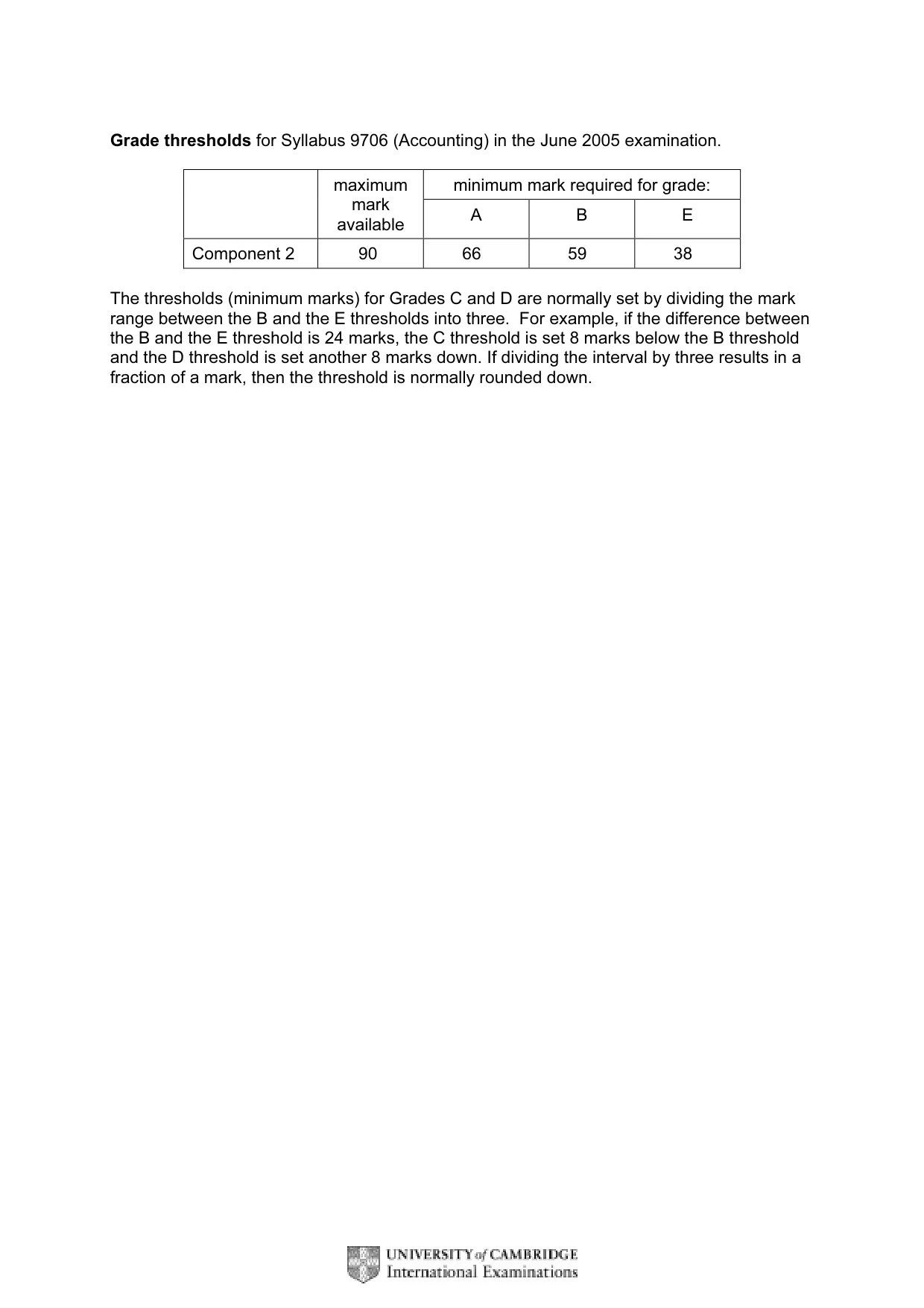
Grade thresholds for Syllabus 9706 (Accounting) in the June 2005 examination. minimum mark required for grade: maximum mark available A B E Component 2 90 66 59 38 The thresholds (minimum marks) for Grades C and D are normally set by dividing the mark range between the B and the E thresholds into three. For example, if the difference between the B and the E threshold is 24 marks, the C threshold is set 8 marks below the B threshold and the D threshold is set another 8 marks down. If dividing the interval by three results in a fraction of a mark, then the threshold is normally rounded down.
Mark scheme, page 3
June 2005 GCE A/AS LEVEL MARK SCHEME MAXIMUM MARK: 90 SYLLABUS/COMPONENT: 9706/02 ACCOUNTING Paper 2 (Structured Questions)
Mark scheme, page 4
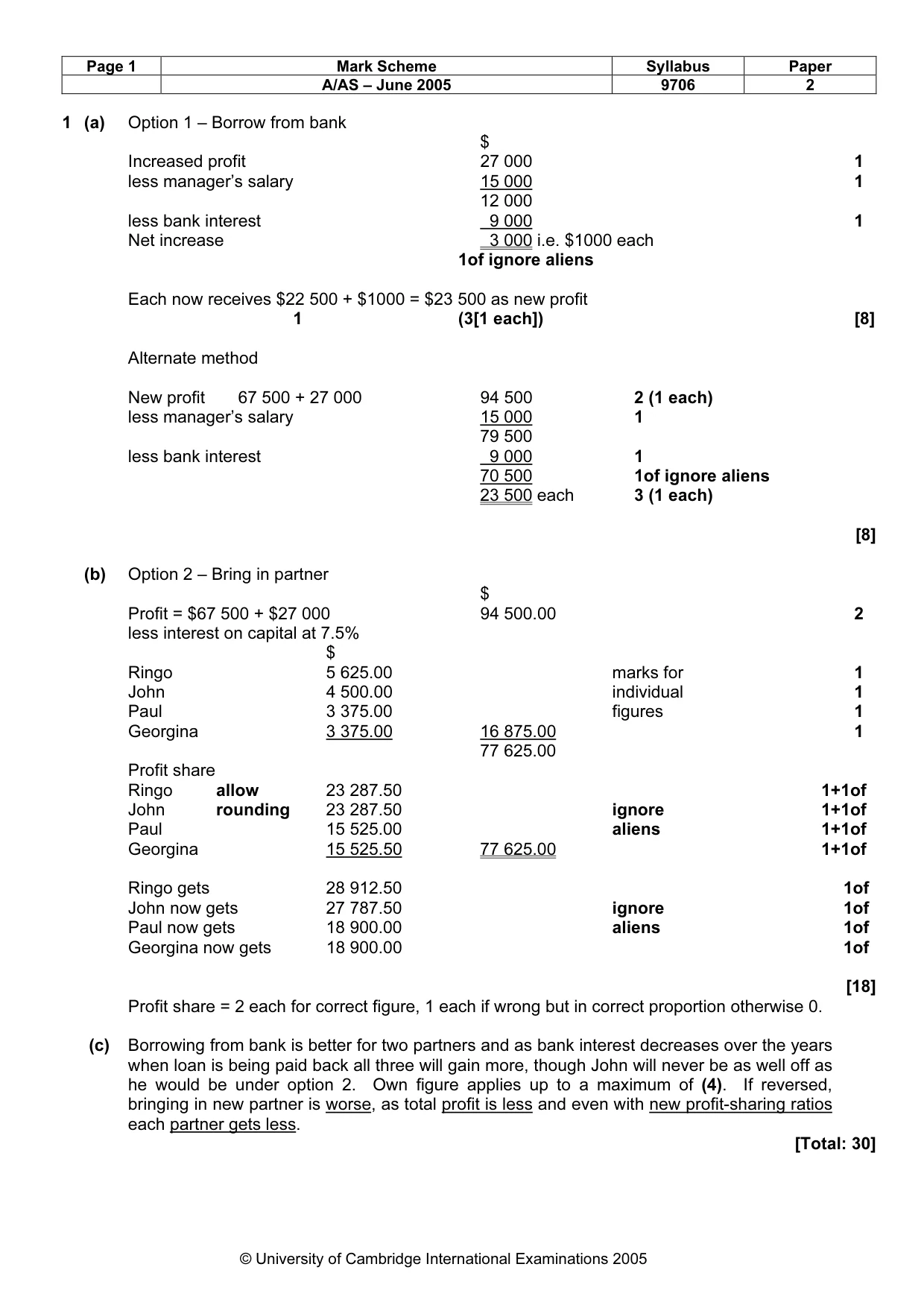
Page 1 Mark Scheme Syllabus Paper A/AS – June 2005 9706 2 © University of Cambridge International Examinations 2005 1 (a) Option 1 – Borrow from bank $ Increased profit 27 000 1 less manager’s salary 15 000 1 12 000 less bank interest 9 000 1 Net increase 3 000 i.e. $1000 each 1of ignore aliens Each now receives $22 500 + $1000 = $23 500 as new profit 1 (3[1 each]) [8] Alternate method New profit 67 500 + 27 000 94 500 2 (1 each) less manager’s salary 15 000 1 79 500 less bank interest 9 000 1 70 500 1of ignore aliens 23 500 each 3 (1 each) [8] (b) Option 2 – Bring in partner $ Profit = $67 500 + $27 000 94 500.00 2 less interest on capital at 7.5% $ Ringo 5 625.00 marks for 1 John 4 500.00 individual 1 Paul 3 375.00 figures 1 Georgina 3 375.00 16 875.00 1 77 625.00 Profit share Ringo allow 23 287.50 1+1of John rounding 23 287.50 ignore 1+1of Paul 15 525.00 aliens 1+1of Georgina 15 525.50 77 625.00 1+1of Ringo gets 28 912.50 1of John now gets 27 787.50 ignore 1of Paul now gets 18 900.00 aliens 1of Georgina now gets 18 900.00 1of [18] Profit share = 2 each for correct figure, 1 each if wrong but in correct proportion otherwise 0. (c) Borrowing from bank is better for two partners and as bank interest decreases over the years when loan is being paid back all three will gain more, though John will never be as well off as he would be under option 2. Own figure applies up to a maximum of (4). If reversed, bringing in new partner is worse, as total profit is less and even with new profit-sharing ratios each partner gets less. [Total: 30]
Mark scheme, page 5
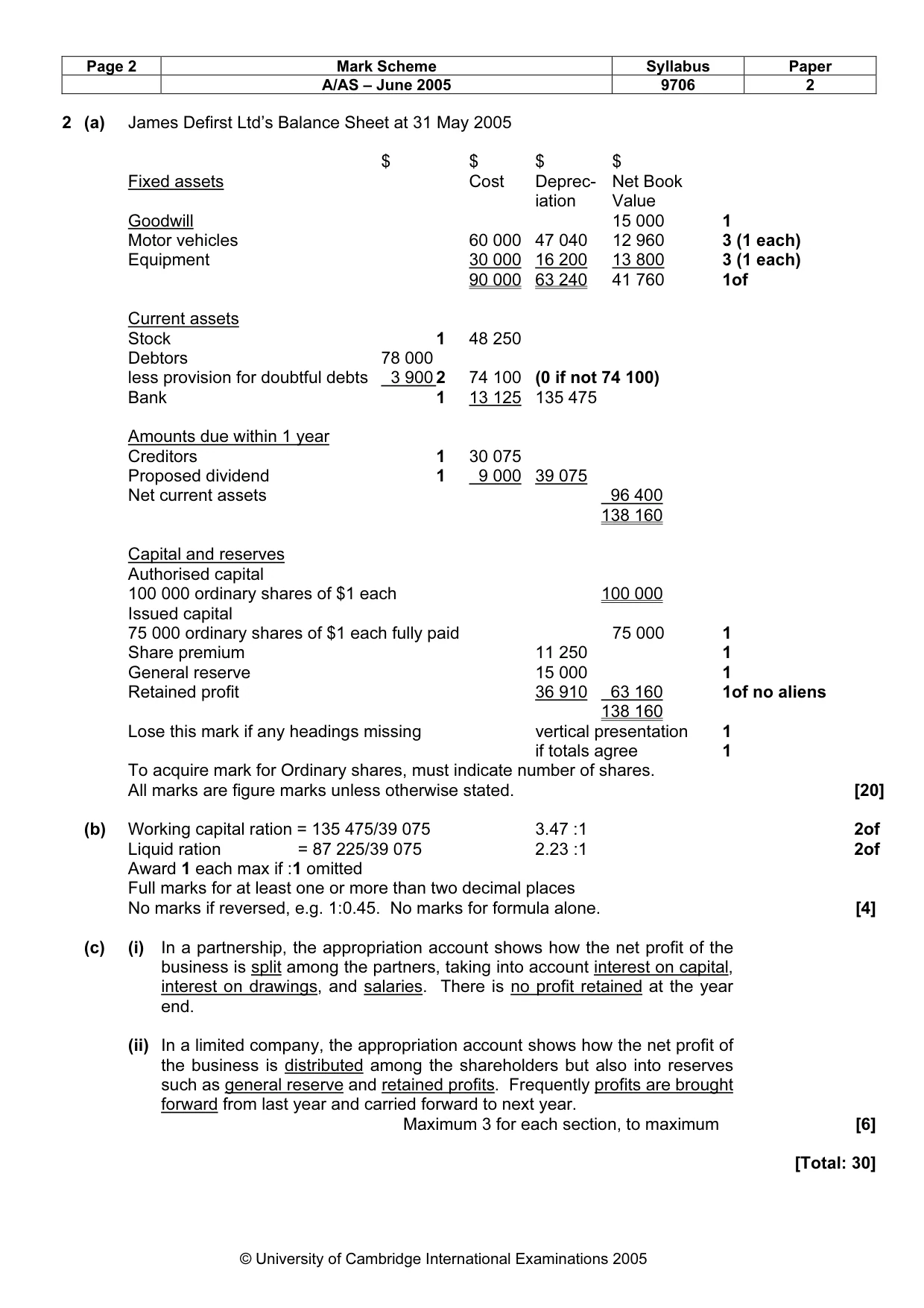
Page 2 Mark Scheme Syllabus Paper A/AS – June 2005 9706 2 © University of Cambridge International Examinations 2005 2 (a) James Defirst Ltd’s Balance Sheet at 31 May 2005 $ $ $ $ Fixed assets Cost Deprec- Net Book iation Value Goodwill 15 000 1 Motor vehicles 60 000 47 040 12 960 3 (1 each) Equipment 30 000 16 200 13 800 3 (1 each) 90 000 63 240 41 760 1of Current assets Stock 1 48 250 Debtors 78 000 less provision for doubtful debts 3 900 2 74 100 (0 if not 74 100) Bank 1 13 125 135 475 Amounts due within 1 year Creditors 1 30 075 Proposed dividend 1 9 000 39 075 Net current assets 96 400 138 160 Capital and reserves Authorised capital 100 000 ordinary shares of $1 each 100 000 Issued capital 75 000 ordinary shares of $1 each fully paid 75 000 1 Share premium 11 250 1 General reserve 15 000 1 Retained profit 36 910 63 160 1of no aliens 138 160 Lose this mark if any headings missing vertical presentation 1 if totals agree 1 To acquire mark for Ordinary shares, must indicate number of shares. All marks are figure marks unless otherwise stated. [20] (b) Working capital ration = 135 475/39 075 3.47 :1 2of Liquid ration = 87 225/39 075 2.23 :1 2of Award 1 each max if :1 omitted Full marks for at least one or more than two decimal places No marks if reversed, e.g. 1:0.45. No marks for formula alone. [4] (c) (i) In a partnership, the appropriation account shows how the net profit of the business is split among the partners, taking into account interest on capital, interest on drawings, and salaries. There is no profit retained at the year end. (ii) In a limited company, the appropriation account shows how the net profit of the business is distributed among the shareholders but also into reserves such as general reserve and retained profits. Frequently profits are brought forward from last year and carried forward to next year. Maximum 3 for each section, to maximum [6] [Total: 30]
Mark scheme, page 6
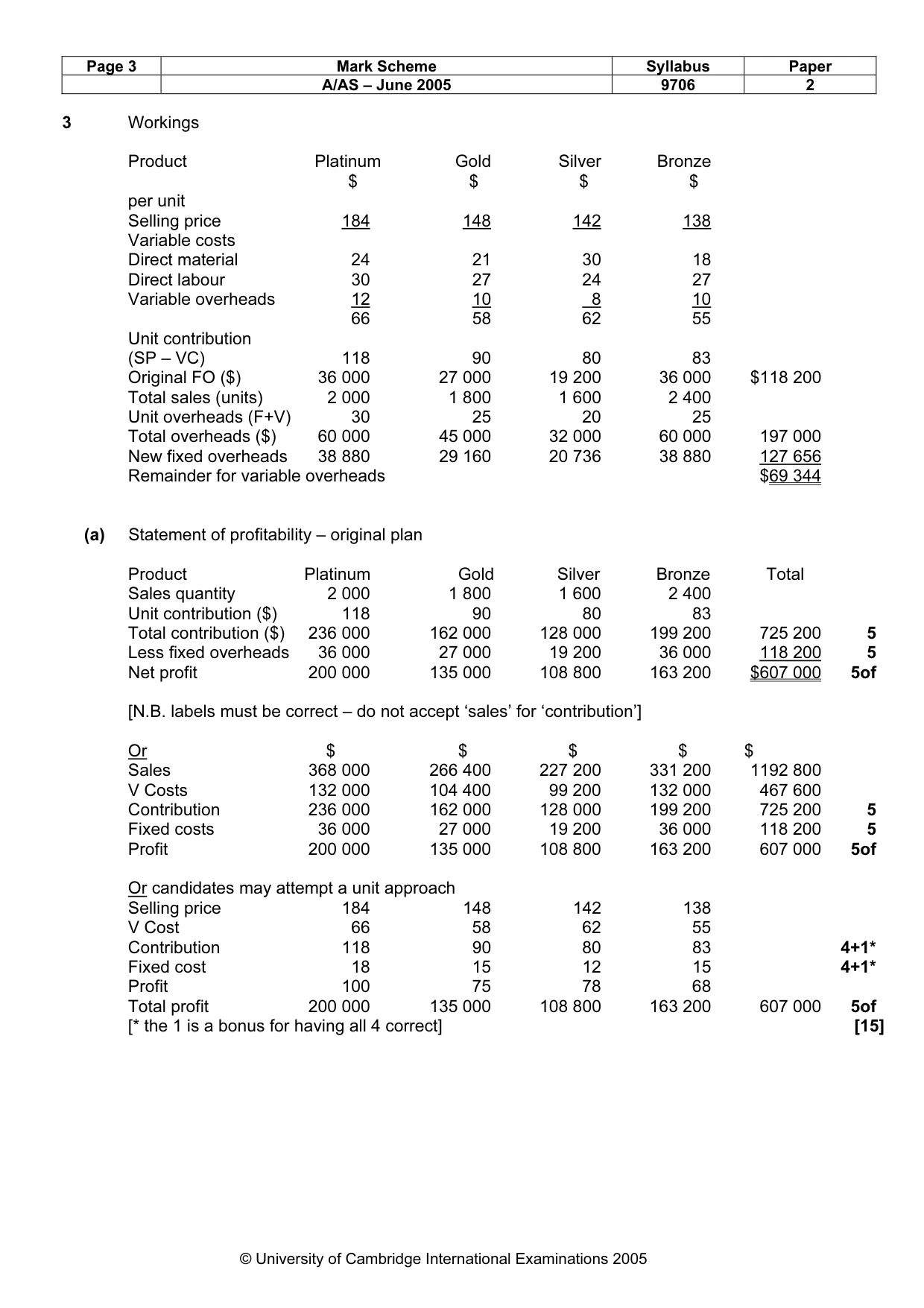
Page 3 Mark Scheme Syllabus Paper A/AS – June 2005 9706 2 © University of Cambridge International Examinations 2005 3 Workings Product Platinum Gold Silver Bronze $ $ $ $ per unit Selling price 184 148 142 138 Variable costs Direct material 24 21 30 18 Direct labour 30 27 24 27 Variable overheads 12 10 8 10 66 58 62 55 Unit contribution (SP – VC) 118 90 80 83 Original FO ($) 36 000 27 000 19 200 36 000 $118 200 Total sales (units) 2 000 1 800 1 600 2 400 Unit overheads (F+V) 30 25 20 25 Total overheads ($) 60 000 45 000 32 000 60 000 197 000 New fixed overheads 38 880 29 160 20 736 38 880 127 656 Remainder for variable overheads $69 344 (a) Statement of profitability – original plan Product Platinum Gold Silver Bronze Total Sales quantity 2 000 1 800 1 600 2 400 Unit contribution ($) 118 90 80 83 Total contribution ($) 236 000 162 000 128 000 199 200 725 200 5 Less fixed overheads 36 000 27 000 19 200 36 000 118 200 5 Net profit 200 000 135 000 108 800 163 200 $607 000 5of [N.B. labels must be correct – do not accept ‘sales’ for ‘contribution’] Or $ $ $ $ $ Sales 368 000 266 400 227 200 331 200 1192 800 V Costs 132 000 104 400 99 200 132 000 467 600 Contribution 236 000 162 000 128 000 199 200 725 200 5 Fixed costs 36 000 27 000 19 200 36 000 118 200 5 Profit 200 000 135 000 108 800 163 200 607 000 5of Or candidates may attempt a unit approach Selling price 184 148 142 138 V Cost 66 58 62 55 Contribution 118 90 80 83 4+1* Fixed cost 18 15 12 15 4+1* Profit 100 75 78 68 Total profit 200 000 135 000 108 800 163 200 607 000 5of [* the 1 is a bonus for having all 4 correct] [15]
Mark scheme, page 7
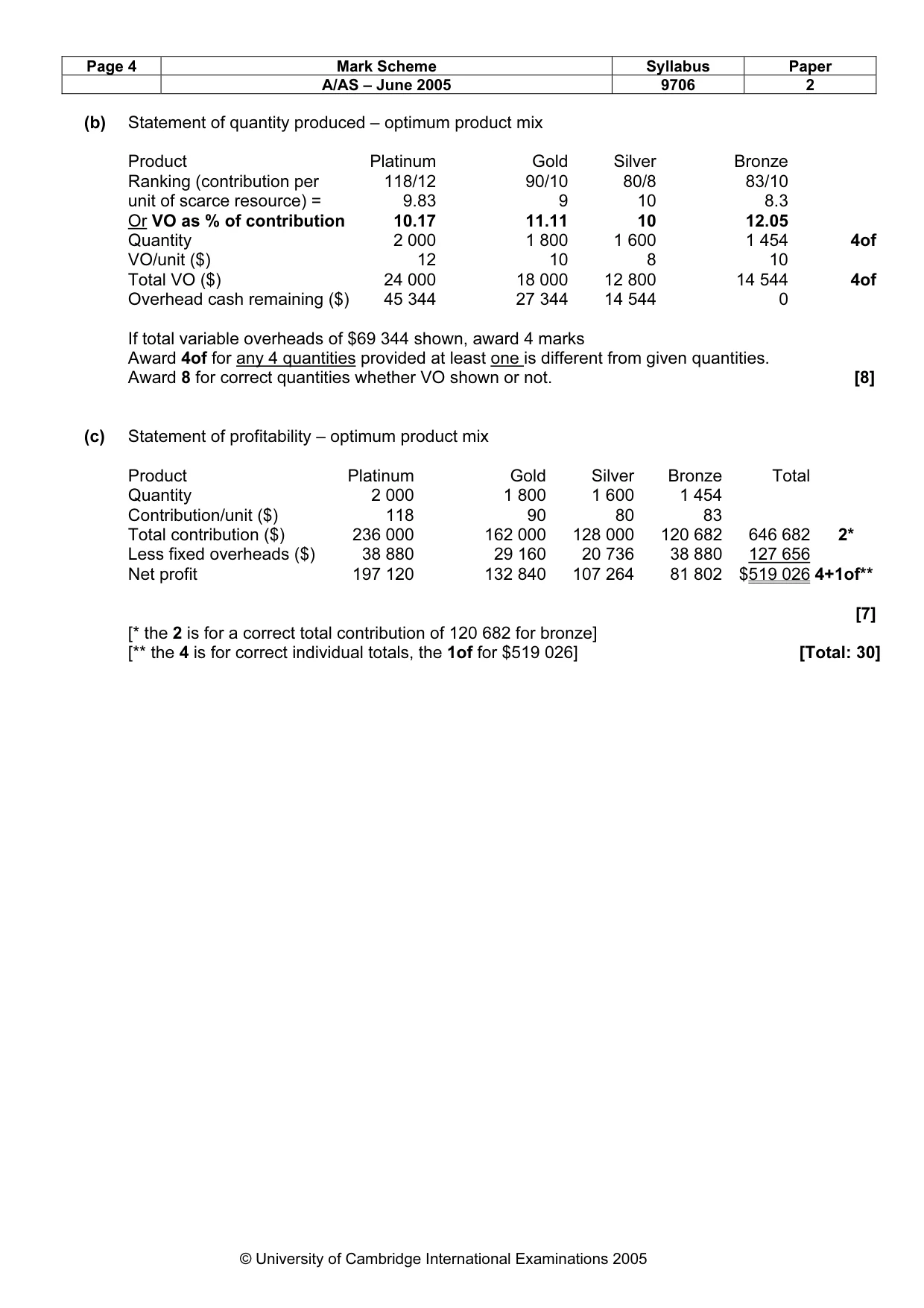
Page 4 Mark Scheme Syllabus Paper A/AS – June 2005 9706 2 © University of Cambridge International Examinations 2005 (b) Statement of quantity produced – optimum product mix Product Platinum Gold Silver Bronze Ranking (contribution per 118/12 90/10 80/8 83/10 unit of scarce resource) = 9.83 9 10 8.3 Or VO as % of contribution 10.17 11.11 10 12.05 Quantity 2 000 1 800 1 600 1 454 4of VO/unit ($) 12 10 8 10 Total VO ($) 24 000 18 000 12 800 14 544 4of Overhead cash remaining ($) 45 344 27 344 14 544 0 If total variable overheads of $69 344 shown, award 4 marks Award 4of for any 4 quantities provided at least one is different from given quantities. Award 8 for correct quantities whether VO shown or not. [8] (c) Statement of profitability – optimum product mix Product Platinum Gold Silver Bronze Total Quantity 2 000 1 800 1 600 1 454 Contribution/unit ($) 118 90 80 83 Total contribution ($) 236 000 162 000 128 000 120 682 646 682 2* Less fixed overheads ($) 38 880 29 160 20 736 38 880 127 656 Net profit 197 120 132 840 107 264 81 802 $519 026 4+1of** [7] [* the 2 is for a correct total contribution of 120 682 for bronze] [** the 4 is for correct individual totals, the 1of for $519 026] [Total: 30]