Cambridge A Level Accounting 9706 — 2004 Oct/Nov Paper 2 · Variant 1
9706/21/O/N/04
The question paper and its mark scheme, free to read here and free to download. This is Cambridge’s own paper, exactly as it was sat.
Question paper12 pages
Mark scheme10 pages
Answers below. Sit the paper first if you are practising.

Paper as text
Question paper, page 1
This document consists of 11 printed pages and 1 blank page. SP (SJF2965) S53063/4 © UCLES 2004 [Turn over UNIVERSITY OF CAMBRIDGE INTERNATIONAL EXAMINATIONS General Certificate of Education Advanced Subsidiary Level and Advanced Level ACCOUNTING 9706/02 Paper 2 Structured Questions October/November 2004 1 hour 30 minutes Candidates answer on the Question Paper. No Additional Materials are required. READ THESE INSTRUCTIONS FIRST Write your Centre number, candidate number and name on all the work you hand in. Write in dark blue or black pen in the spaces provided on the Question Paper. You may use a soft pencil for rough working. Do not use staples, paper clips, highlighters, glue or correction fluid. Answer all questions. At the end of the examination, fasten all your work securely together. The number of marks is given in brackets [ ] at the end of each question or part question. You may use a calculator. Centre Number Candidate Number Name If you have been given a label, look at the details. If any details are incorrect or missing, please fill in your correct details in the space given at the top of this page. Stick your personal label here, if provided. For Examiner’s Use 1 2 3 Total
Question paper, page 2
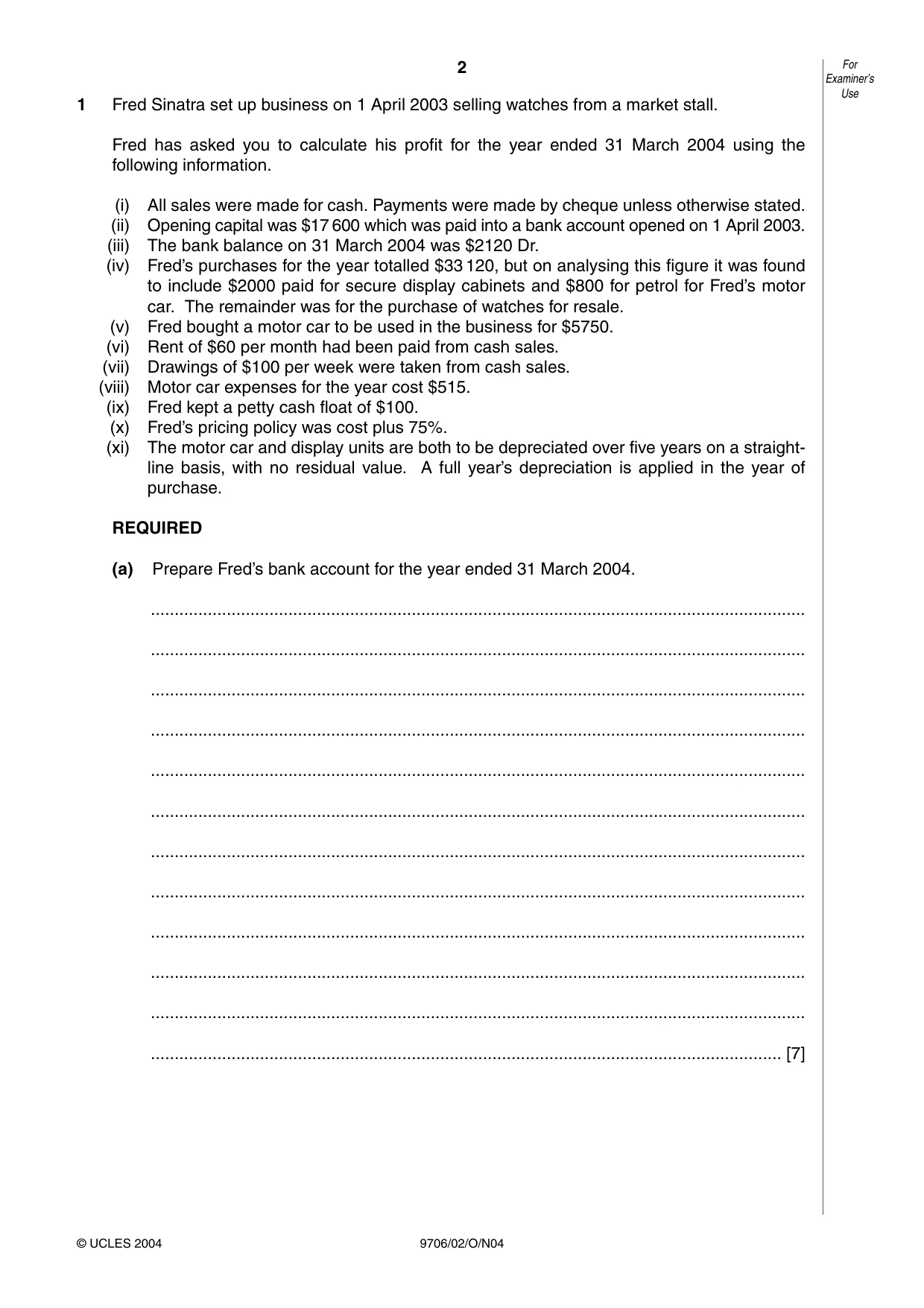
2 9706/02/O/N04 1 Fred Sinatra set up business on 1 April 2003 selling watches from a market stall. Fred has asked you to calculate his profit for the year ended 31 March 2004 using the following information. (i) All sales were made for cash. Payments were made by cheque unless otherwise stated. (ii) Opening capital was $17 600 which was paid into a bank account opened on 1 April 2003. (iii) The bank balance on 31 March 2004 was $2120 Dr. (iv) Fred’s purchases for the year totalled $33 120, but on analysing this figure it was found to include $2000 paid for secure display cabinets and $800 for petrol for Fred’s motor car. The remainder was for the purchase of watches for resale. (v) Fred bought a motor car to be used in the business for $5750. (vi) Rent of $60 per month had been paid from cash sales. (vii) Drawings of $100 per week were taken from cash sales. (viii) Motor car expenses for the year cost $515. (ix) Fred kept a petty cash float of $100. (x) Fred’s pricing policy was cost plus 75%. (xi) The motor car and display units are both to be depreciated over five years on a straight- line basis, with no residual value. A full year’s depreciation is applied in the year of purchase. REQUIRED (a) Prepare Fred’s bank account for the year ended 31 March 2004. … … … … … … … … … … … … [7] For Examiner’s Use © UCLES 2004
Question paper, page 3
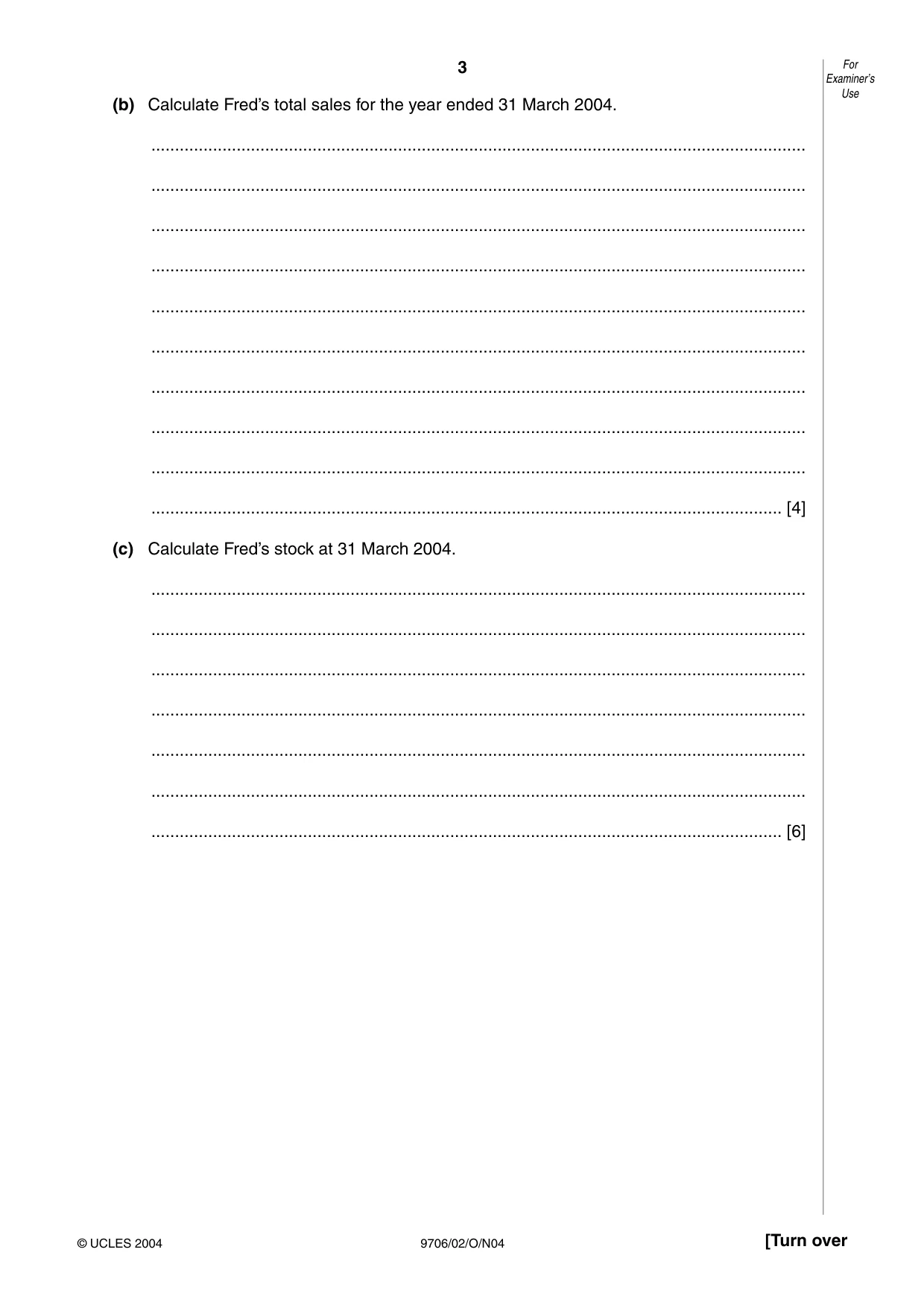
3 9706/02/O/N04 [Turn over (b) Calculate Fred’s total sales for the year ended 31 March 2004. … … … … … … … … … … [4] (c) Calculate Fred’s stock at 31 March 2004. … … … … … … … [6] For Examiner’s Use © UCLES 2004
Question paper, page 4
4 9706/02/O/N04 (d) Prepare Fred’s Trading and Profit and Loss Account for the year ended 31 March 2004. … … … … … … … … … … … … … … … … … … … … … … … … [8] For Examiner’s Use © UCLES 2004
Question paper, page 5
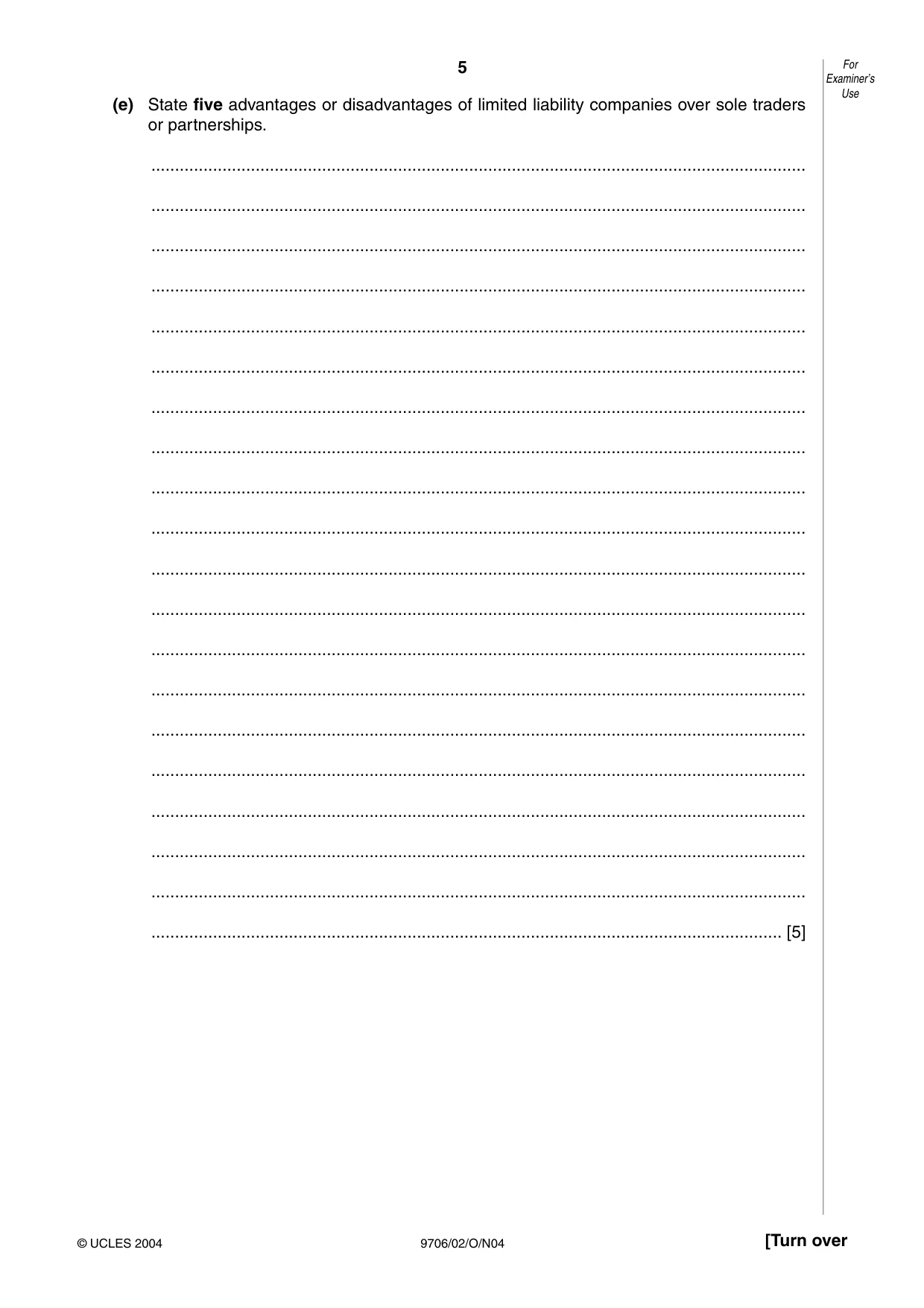
5 9706/02/O/N04 [Turn over (e) State five advantages or disadvantages of limited liability companies over sole traders or partnerships. … … … … … … … … … … … … … … … … … … … … [5] For Examiner’s Use © UCLES 2004
Question paper, page 6
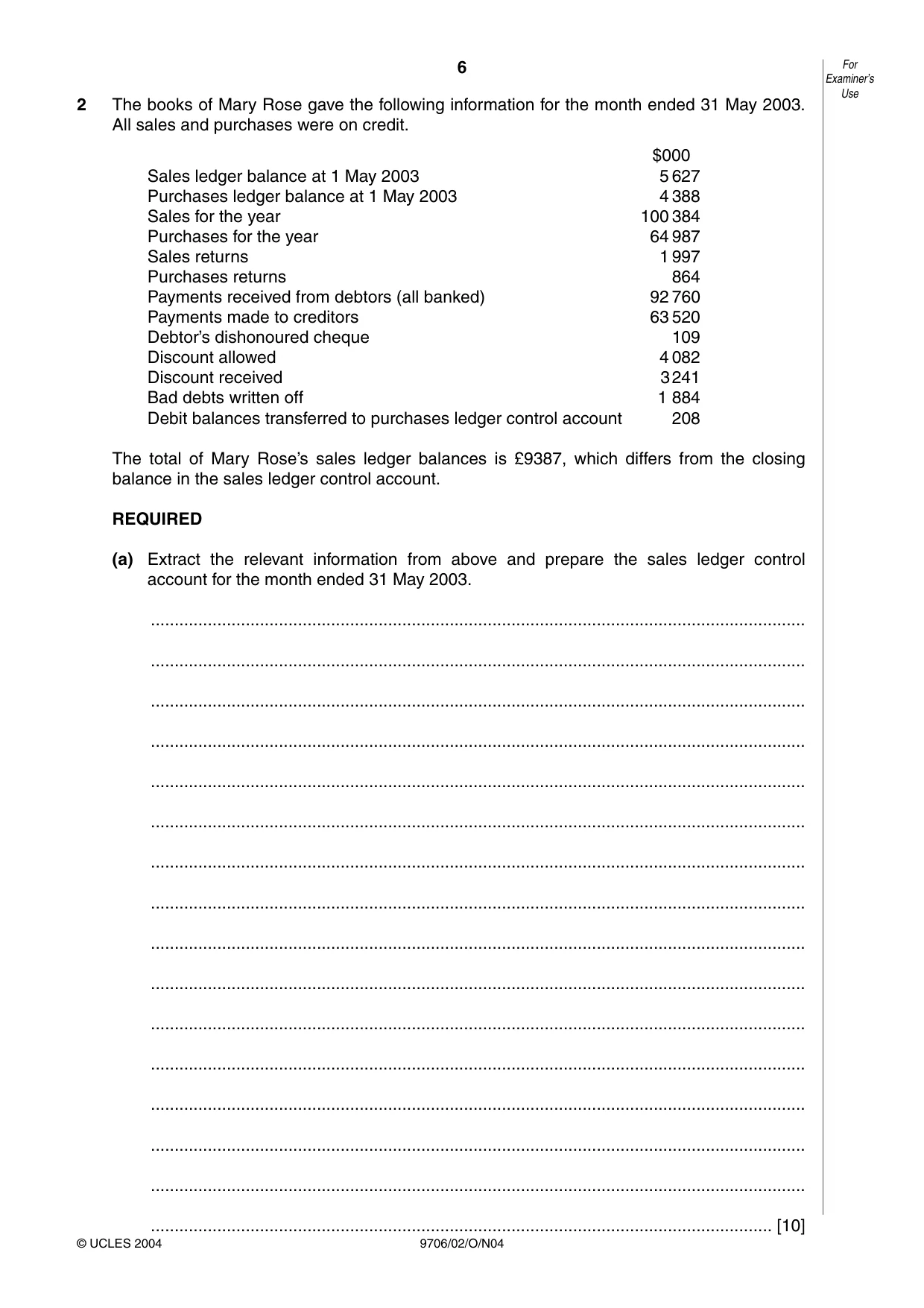
6 9706/02/O/N04 2 The books of Mary Rose gave the following information for the month ended 31 May 2003. All sales and purchases were on credit. $000 Sales ledger balance at 1 May 2003 5 627 Purchases ledger balance at 1 May 2003 4 388 Sales for the year 100 384 Purchases for the year 64 987 Sales returns 1 997 Purchases returns 864 Payments received from debtors (all banked) 92 760 Payments made to creditors 63 520 Debtor’s dishonoured cheque 109 Discount allowed 4 082 Discount received 3241 Bad debts written off 1 884 Debit balances transferred to purchases ledger control account 208 The total of Mary Rose’s sales ledger balances is £9387, which differs from the closing balance in the sales ledger control account. REQUIRED (a) Extract the relevant information from above and prepare the sales ledger control account for the month ended 31 May 2003. … … … … … … … … … … … … … … … … [10] For Examiner’s Use © UCLES 2004
Question paper, page 7
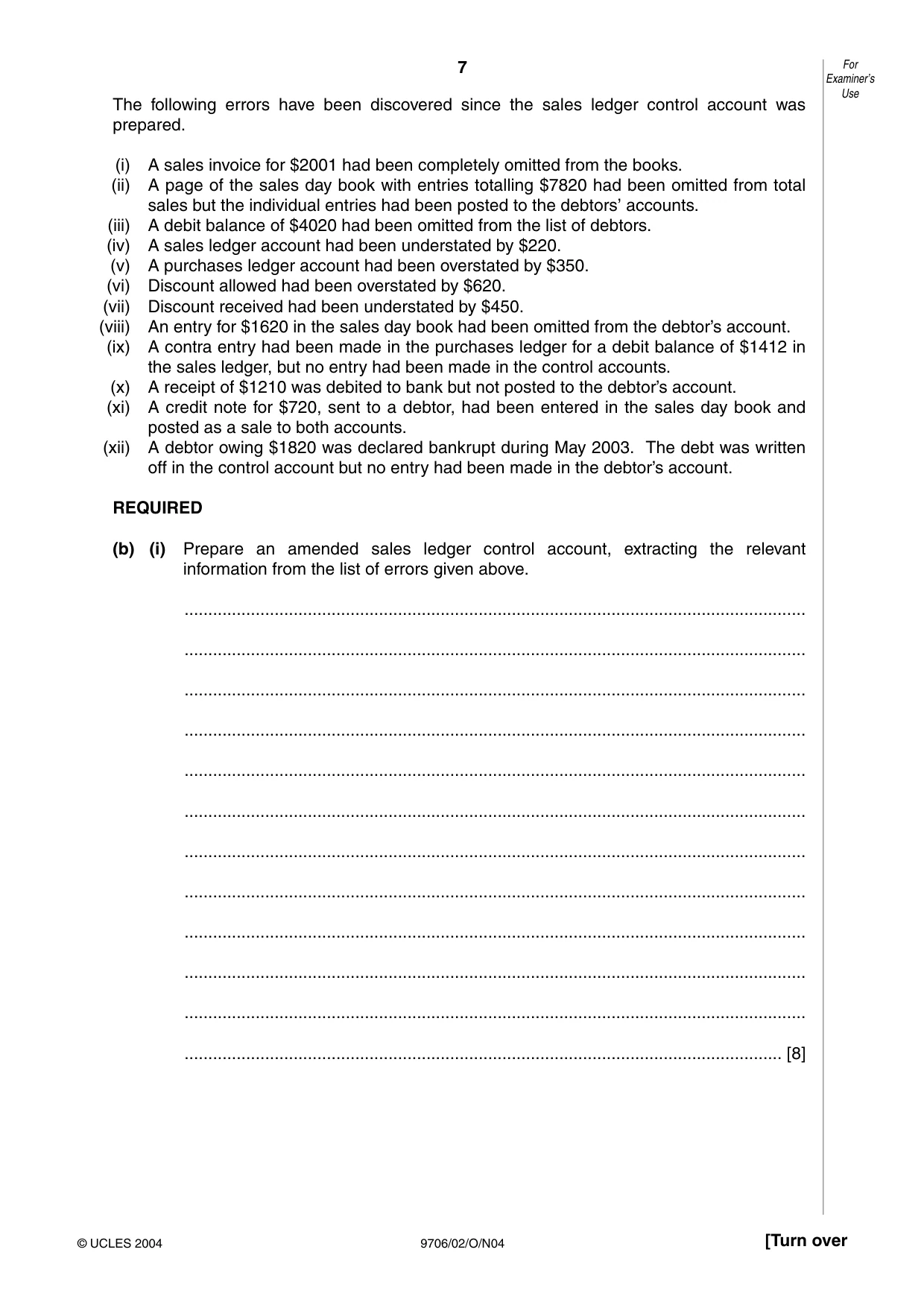
7 9706/02/O/N04 [Turn over The following errors have been discovered since the sales ledger control account was prepared. (i) A sales invoice for $2001 had been completely omitted from the books. (ii) A page of the sales day book with entries totalling $7820 had been omitted from total sales but the individual entries had been posted to the debtors’ accounts. (iii) A debit balance of $4020 had been omitted from the list of debtors. (iv) A sales ledger account had been understated by $220. (v) A purchases ledger account had been overstated by $350. (vi) Discount allowed had been overstated by $620. (vii) Discount received had been understated by $450. (viii) An entry for $1620 in the sales day book had been omitted from the debtor’s account. (ix) A contra entry had been made in the purchases ledger for a debit balance of $1412 in the sales ledger, but no entry had been made in the control accounts. (x) A receipt of $1210 was debited to bank but not posted to the debtor’s account. (xi) A credit note for $720, sent to a debtor, had been entered in the sales day book and posted as a sale to both accounts. (xii) A debtor owing $1820 was declared bankrupt during May 2003. The debt was written off in the control account but no entry had been made in the debtor’s account. REQUIRED (b) (i) Prepare an amended sales ledger control account, extracting the relevant information from the list of errors given above. … … … … … … … … … … … … [8] For Examiner’s Use © UCLES 2004
Question paper, page 8
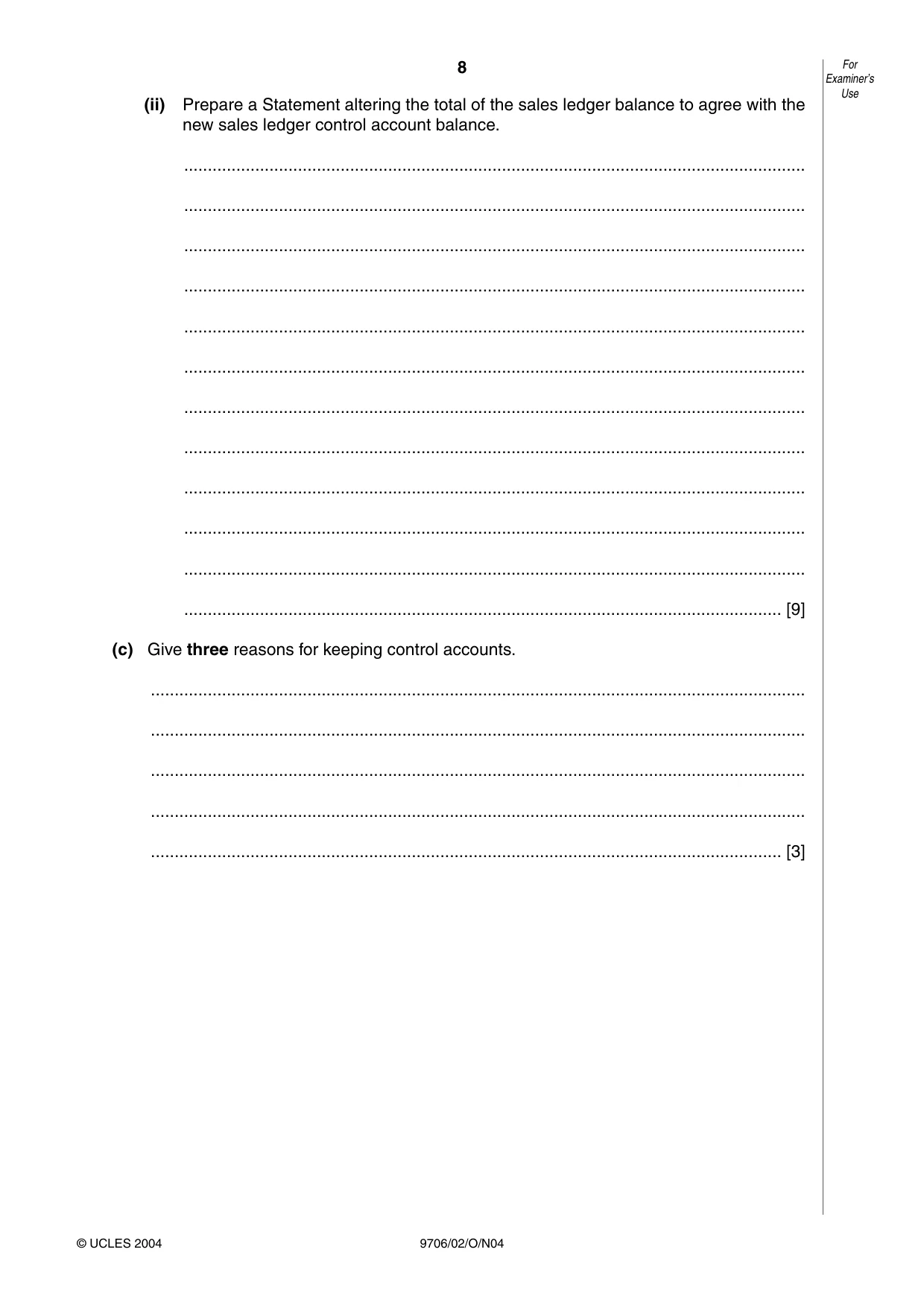
8 9706/02/O/N04 (ii) Prepare a Statement altering the total of the sales ledger balance to agree with the new sales ledger control account balance. … … … … … … … … … … … … [9] (c) Give three reasons for keeping control accounts. … … … … … [3] For Examiner’s Use © UCLES 2004
Question paper, page 9
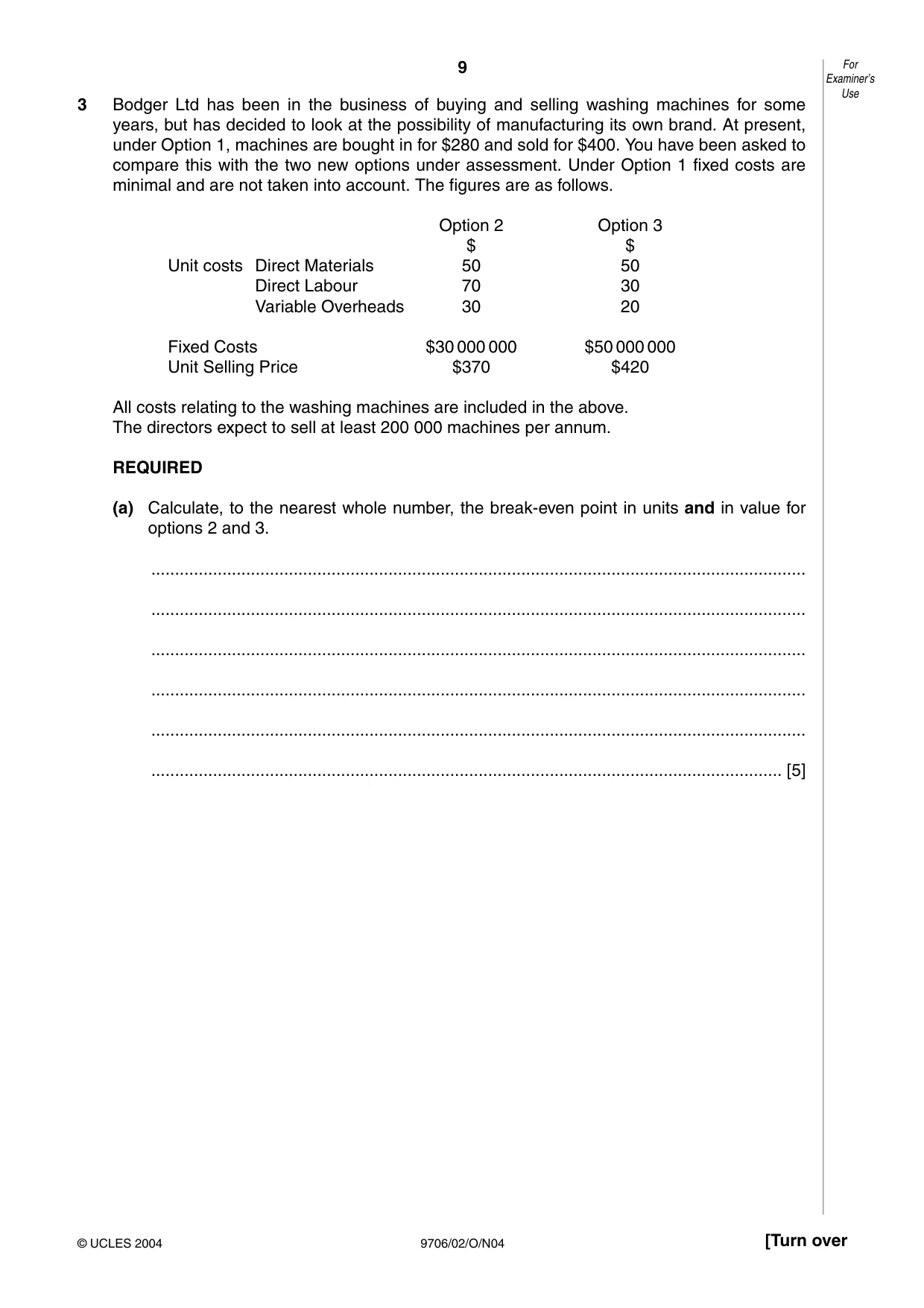
9 9706/02/O/N04 [Turn over 3 Bodger Ltd has been in the business of buying and selling washing machines for some years, but has decided to look at the possibility of manufacturing its own brand. At present, under Option 1, machines are bought in for $280 and sold for $400. You have been asked to compare this with the two new options under assessment. Under Option 1 fixed costs are minimal and are not taken into account. The figures are as follows. Option 2 Option 3 $ $ Unit costs Direct Materials 50 50 Direct Labour 70 30 Variable Overheads 30 20 Fixed Costs $30 000 000 $50 000 000 Unit Selling Price $370 $420 All costs relating to the washing machines are included in the above. The directors expect to sell at least 200 000 machines per annum. REQUIRED (a) Calculate, to the nearest whole number, the break-even point in units and in value for options 2 and 3. … … … … … … [5] For Examiner’s Use © UCLES 2004
Question paper, page 10
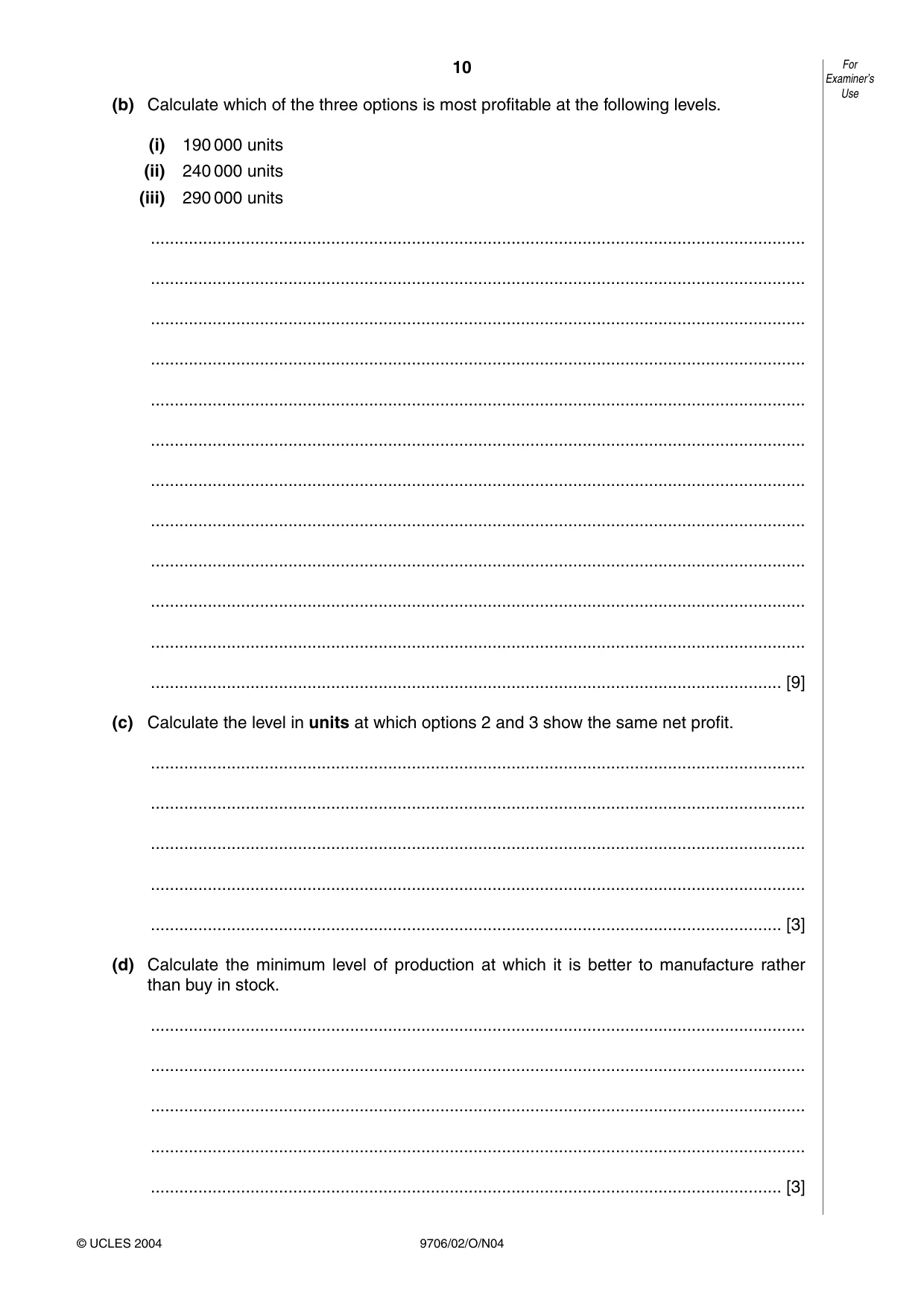
10 9706/02/O/N04 (b) Calculate which of the three options is most profitable at the following levels. (i) 190 000 units (ii) 240 000 units (iii) 290 000 units … … … … … … … … … … … … [9] (c) Calculate the level in units at which options 2 and 3 show the same net profit. … … … … … [3] (d) Calculate the minimum level of production at which it is better to manufacture rather than buy in stock. … … … … … [3] For Examiner’s Use © UCLES 2004
Question paper, page 11
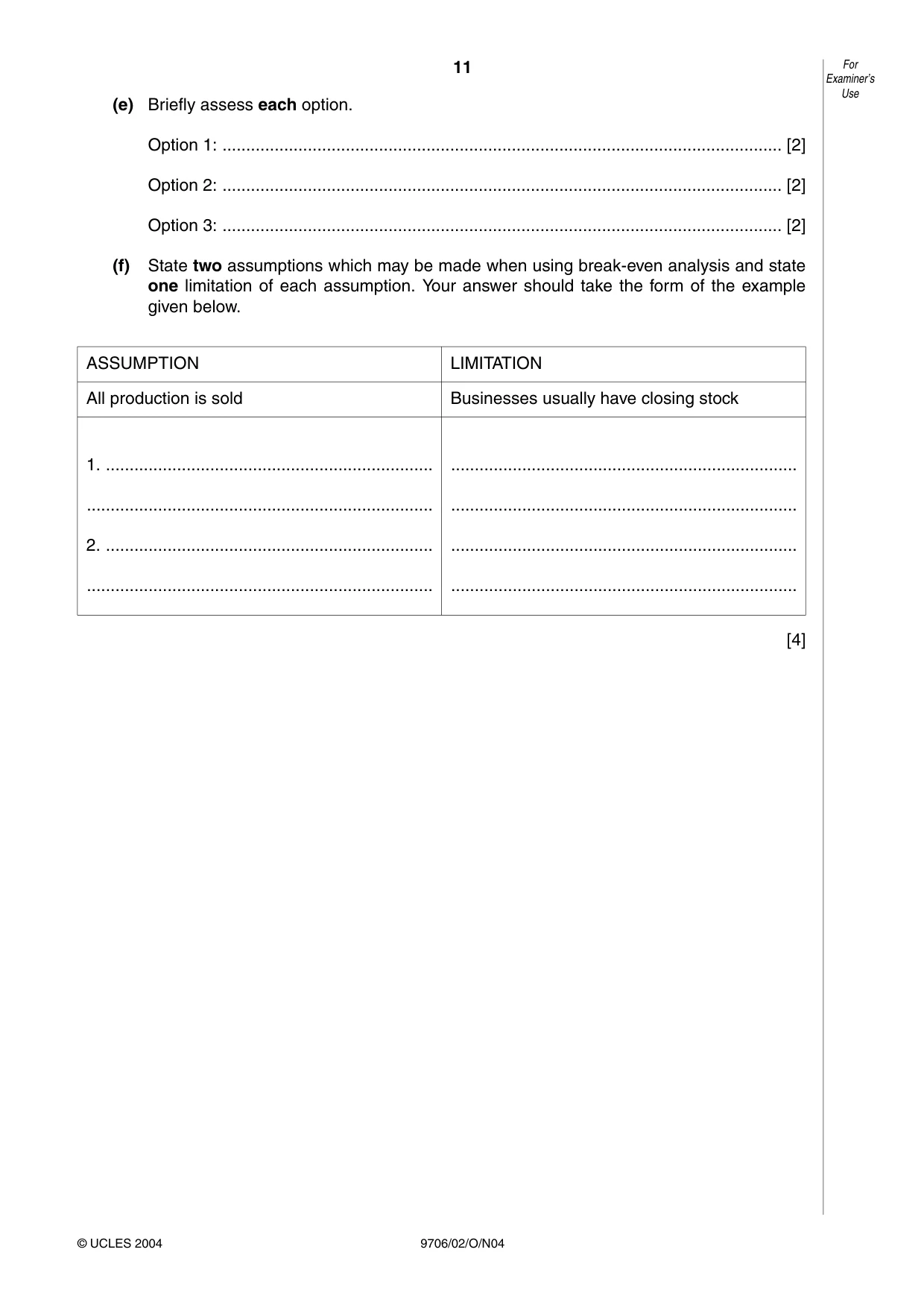
11 9706/02/O/N04 (e) Briefly assess each option. Option 1: … [2] Option 2: … [2] Option 3: … [2] (f) State two assumptions which may be made when using break-even analysis and state one limitation of each assumption. Your answer should take the form of the example given below. [4] For Examiner’s Use © UCLES 2004 ASSUMPTION All production is sold 1. … … 2. … … Businesses usually have closing stock … … … … LIMITATION
Question paper, page 12
12 9706/02/O/N04 BLANK PAGE University of Cambridge International Examinations is part of the University of Cambridge Local Examinations Syndicate (UCLES) which is itself a department of the University of Cambridge.
Mark scheme, page 1
UNIVERSITY OF CAMBRIDGE INTERNATIONAL EXAMINATIONS GCE Advanced/Advanced Subsidiary Level MARK SCHEME for the November 2004 question paper 9706 ACCOUNTING 9706/02 Paper 2 (Structured Questions), maximum raw mark 90 This mark scheme is published as an aid to teachers and students, to indicate the requirements of the examination. It shows the basis on which Examiners were initially instructed to award marks. It does not indicate the details of the discussions that took place at an Examiners’ meeting before marking began. Any substantial changes to the mark scheme that arose from these discussions will be recorded in the published Report on the Examination. All Examiners are instructed that alternative correct answers and unexpected approaches in candidates’ scripts must be given marks that fairly reflect the relevant knowledge and skills demonstrated. Mark schemes must be read in conjunction with the question papers and the Report on the Examination. • CIE will not enter into discussion or correspondence in connection with these mark schemes. CIE is publishing the mark schemes for the November 2004 question papers for most IGCSE and GCE Advanced Level syllabuses.
Mark scheme, page 2
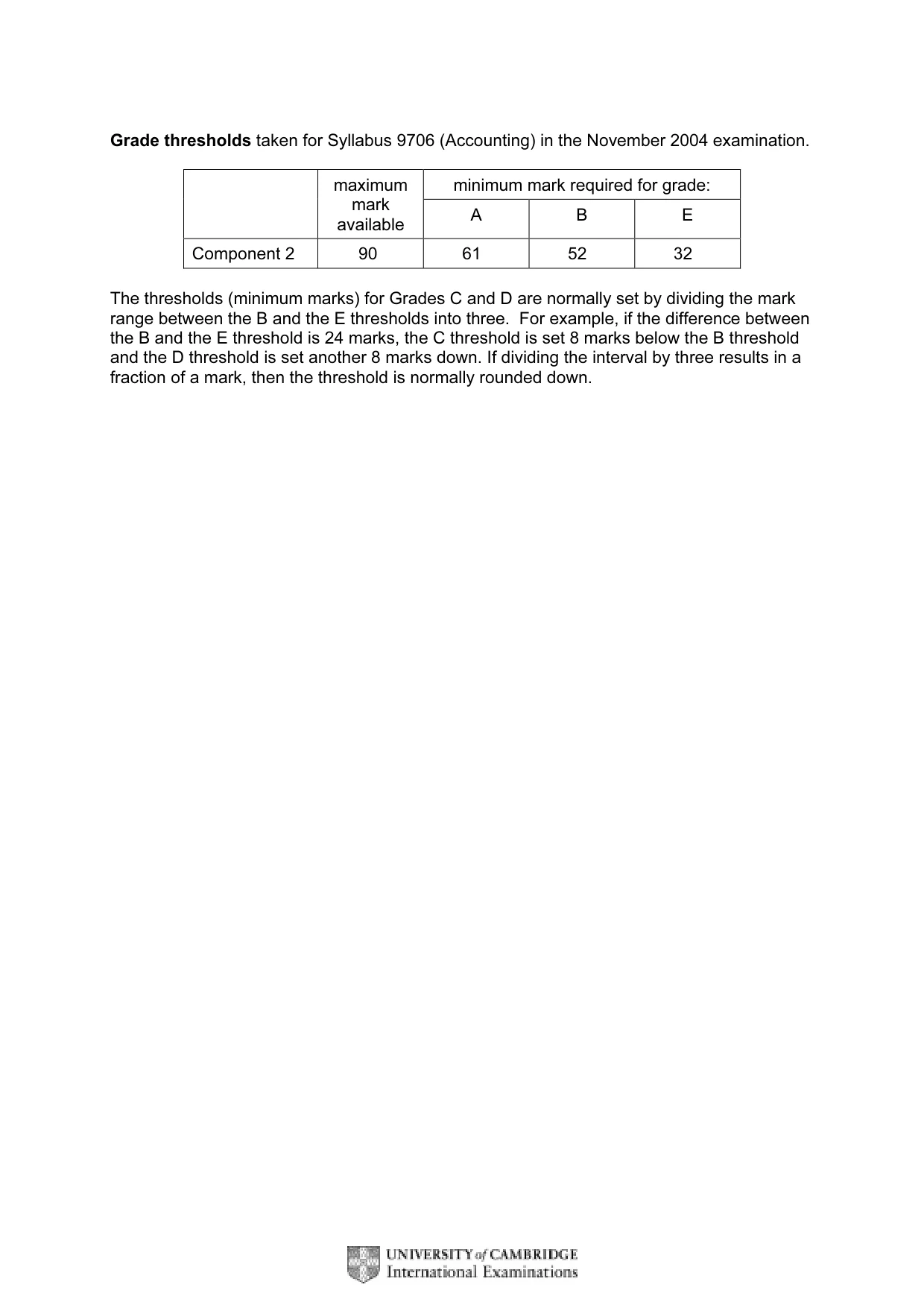
Grade thresholds taken for Syllabus 9706 (Accounting) in the November 2004 examination. minimum mark required for grade: maximum mark available A B E Component 2 90 61 52 32 The thresholds (minimum marks) for Grades C and D are normally set by dividing the mark range between the B and the E thresholds into three. For example, if the difference between the B and the E threshold is 24 marks, the C threshold is set 8 marks below the B threshold and the D threshold is set another 8 marks down. If dividing the interval by three results in a fraction of a mark, then the threshold is normally rounded down.
Mark scheme, page 3
NOVEMBER 2004 GCE A/AS LEVEL MARK SCHEME MAXIMUM MARK: 90 SYLLABUS/COMPONENT: 9706/02 ACCOUNTING Paper 2 (Structured Questions)
Mark scheme, page 4
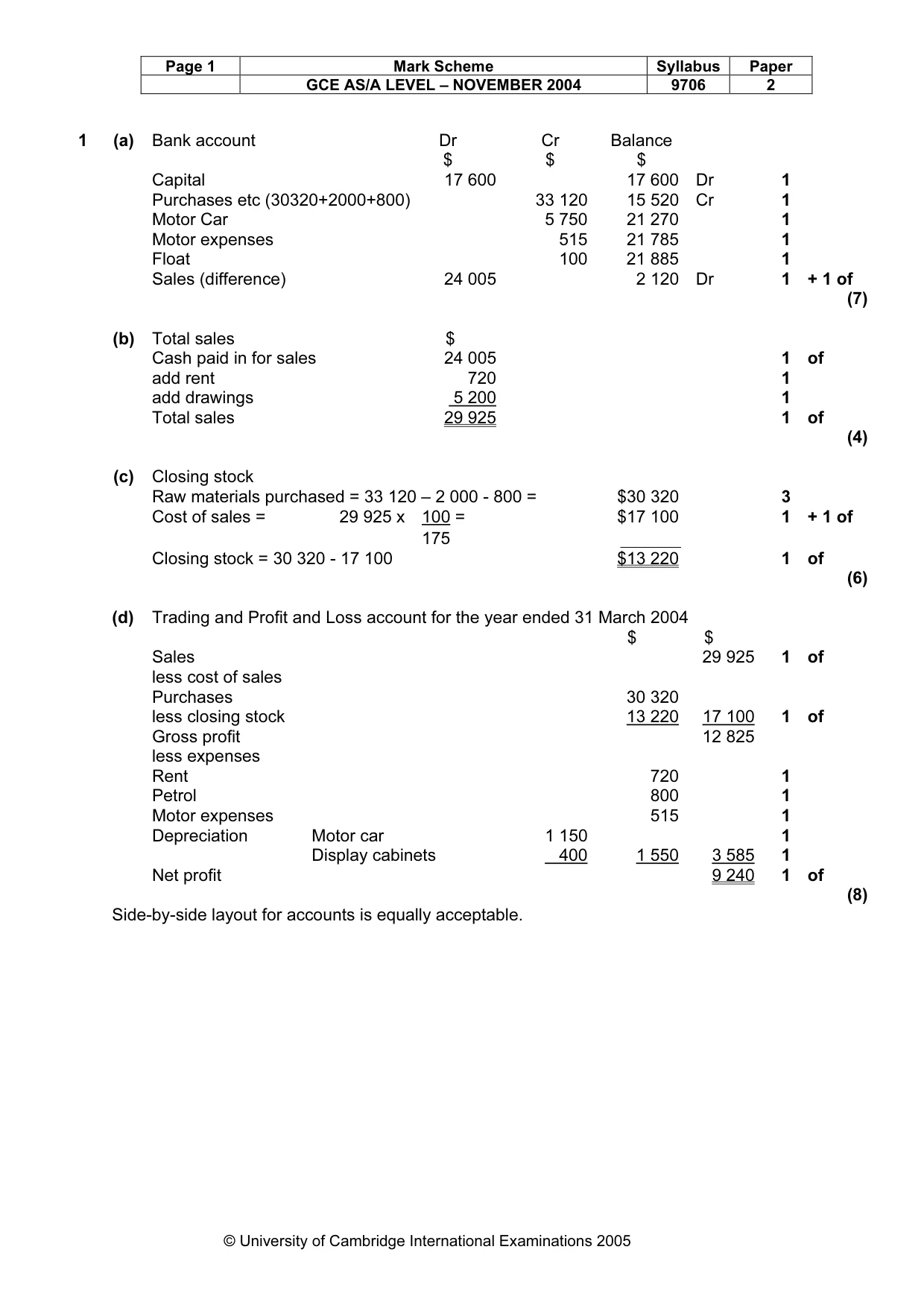
Page 1 Mark Scheme Syllabus Paper GCE AS/A LEVEL – NOVEMBER 2004 9706 2 © University of Cambridge International Examinations 2005 1 (a) Bank account Dr Cr Balance $ $ $ Capital 17 600 17 600 Dr 1 Purchases etc (30320+2000+800) 33 120 15 520 Cr 1 Motor Car 5 750 21 270 1 Motor expenses 515 21 785 1 Float 100 21 885 1 Sales (difference) 24 005 2 120 Dr 1 + 1 of (7) (b) Total sales $ Cash paid in for sales 24 005 1 of add rent 720 1 add drawings 5 200 1 Total sales 29 925 1 of (4) (c) Closing stock Raw materials purchased = 33 120 – 2 000 - 800 = $30 320 3 Cost of sales = 29 925 x 100 = $17 100 1 + 1 of 175 Closing stock = 30 320 - 17 100 $13 220 1 of (6) (d) Trading and Profit and Loss account for the year ended 31 March 2004 $ $ Sales 29 925 1 of less cost of sales Purchases 30 320 less closing stock 13 220 17 100 1 of Gross profit 12 825 less expenses Rent 720 1 Petrol 800 1 Motor expenses 515 1 Depreciation Motor car 1 150 1 Display cabinets 400 1 550 3 585 1 Net profit 9 240 1 of (8) Side-by-side layout for accounts is equally acceptable.
Mark scheme, page 5
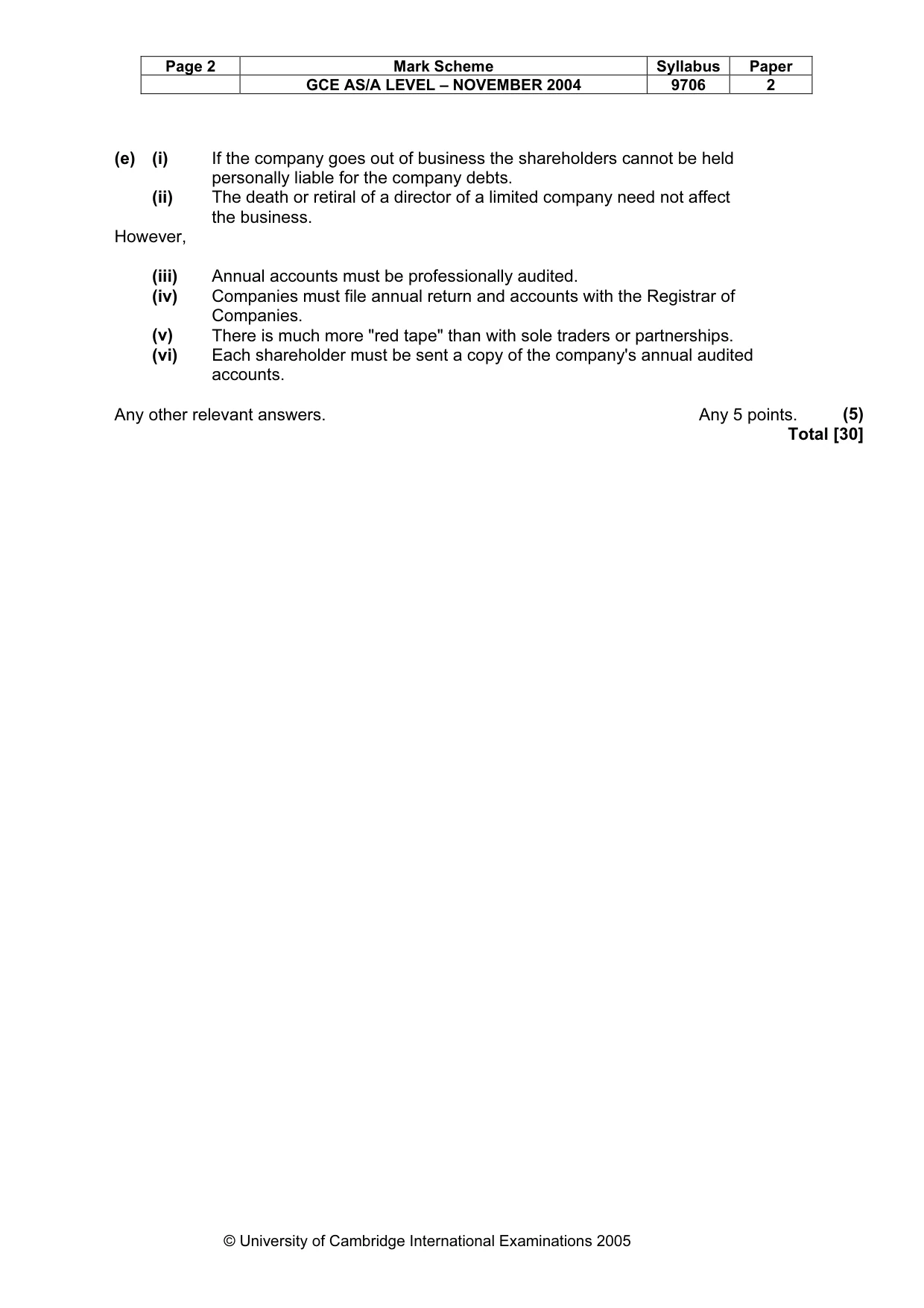
Page 2 Mark Scheme Syllabus Paper GCE AS/A LEVEL – NOVEMBER 2004 9706 2 © University of Cambridge International Examinations 2005 (e) (i) If the company goes out of business the shareholders cannot be held personally liable for the company debts. (ii) The death or retiral of a director of a limited company need not affect the business. However, (iii) Annual accounts must be professionally audited. (iv) Companies must file annual return and accounts with the Registrar of Companies. (v) There is much more "red tape" than with sole traders or partnerships. (vi) Each shareholder must be sent a copy of the company's annual audited accounts. Any other relevant answers. Any 5 points. (5) Total [30]
Mark scheme, page 6
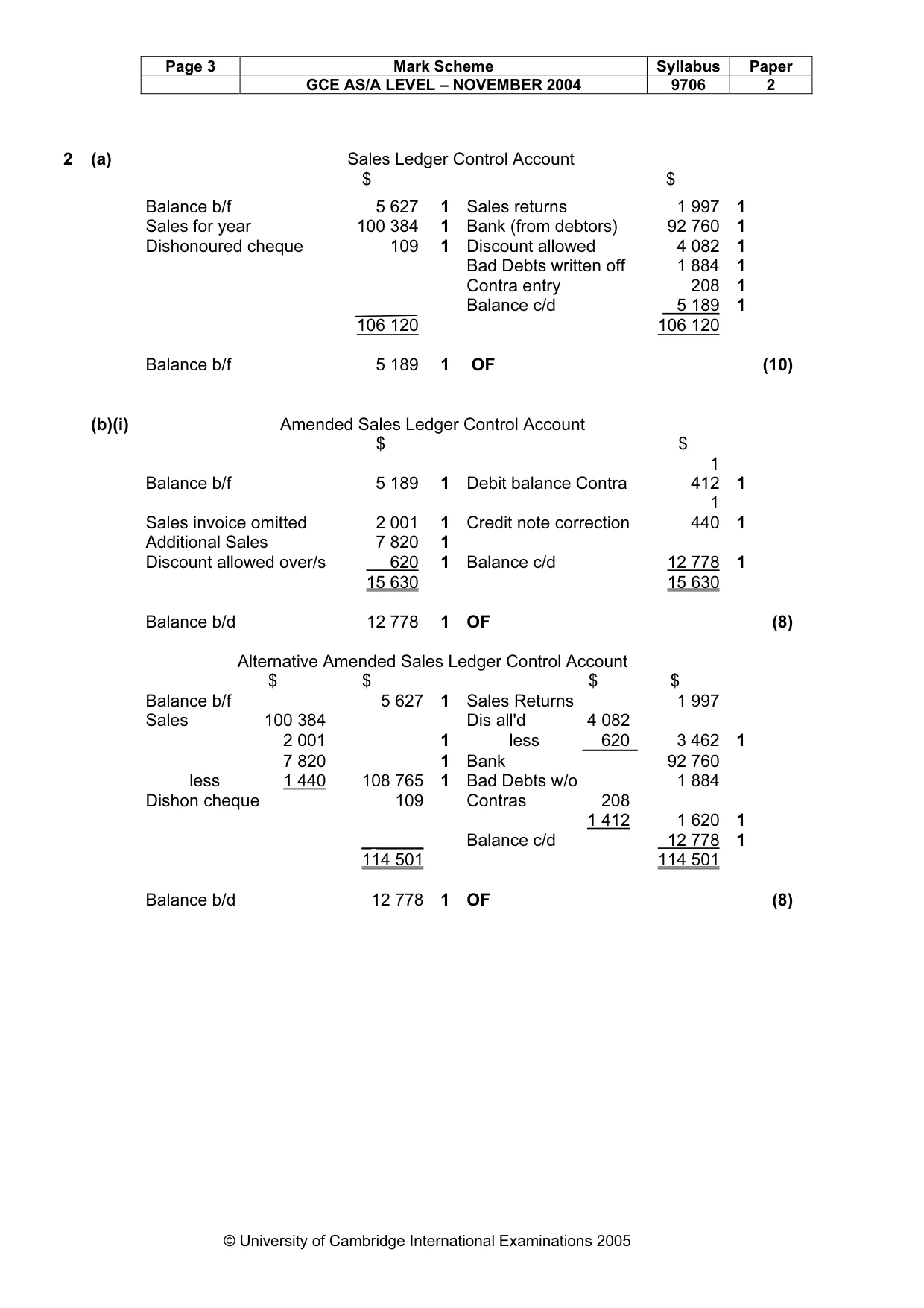
Page 3 Mark Scheme Syllabus Paper GCE AS/A LEVEL – NOVEMBER 2004 9706 2 © University of Cambridge International Examinations 2005 2 (a) Sales Ledger Control Account $ $ Balance b/f 5 627 1 Sales returns 1 997 1 Sales for year 100 384 1 Bank (from debtors) 92 760 1 Dishonoured cheque 109 1 Discount allowed 4 082 1 Bad Debts written off 1 884 1 Contra entry 208 1 Balance c/d 5 189 1 106 120 106 120 Balance b/f 5 189 1 OF (10) (b)(i) Amended Sales Ledger Control Account $ $ Balance b/f 5 189 1 Debit balance Contra 1 412 1 Sales invoice omitted 2 001 1 Credit note correction 1 440 1 Additional Sales 7 820 1 Discount allowed over/s 620 1 Balance c/d 12 778 1 15 630 15 630 Balance b/d 12 778 1 OF (8) Alternative Amended Sales Ledger Control Account $ $ $ $ Balance b/f 5 627 1 Sales Returns 1 997 Sales 100 384 Dis all'd 4 082 2 001 1 less 620 3 462 1 7 820 1 Bank 92 760 less 1 440 108 765 1 Bad Debts w/o 1 884 Dishon cheque 109 Contras 208 1 412 1 620 1 _ _____ Balance c/d 12 778 1 114 501 114 501 Balance b/d 12 778 1 OF (8)
Mark scheme, page 7
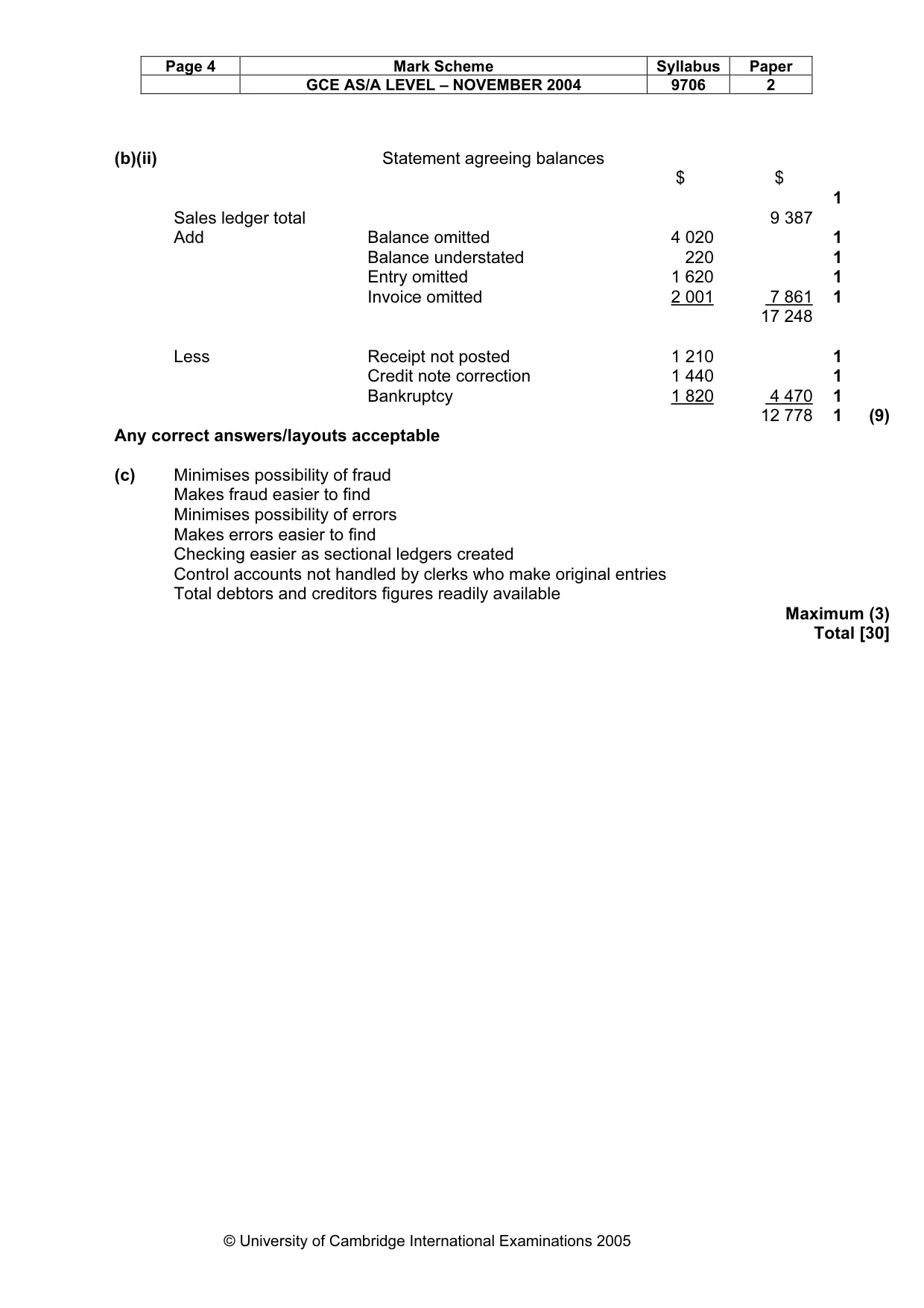
Page 4 Mark Scheme Syllabus Paper GCE AS/A LEVEL – NOVEMBER 2004 9706 2 © University of Cambridge International Examinations 2005 (b)(ii) Statement agreeing balances $ $ 1 Sales ledger total 9 387 Add Balance omitted 4 020 1 Balance understated 220 1 Entry omitted 1 620 1 Invoice omitted 2 001 7 861 1 17 248 Less Receipt not posted 1 210 1 Credit note correction 1 440 1 Bankruptcy 1 820 4 470 1 12 778 1 (9) Any correct answers/layouts acceptable (c) Minimises possibility of fraud Makes fraud easier to find Minimises possibility of errors Makes errors easier to find Checking easier as sectional ledgers created Control accounts not handled by clerks who make original entries Total debtors and creditors figures readily available Maximum (3) Total [30]
Mark scheme, page 8
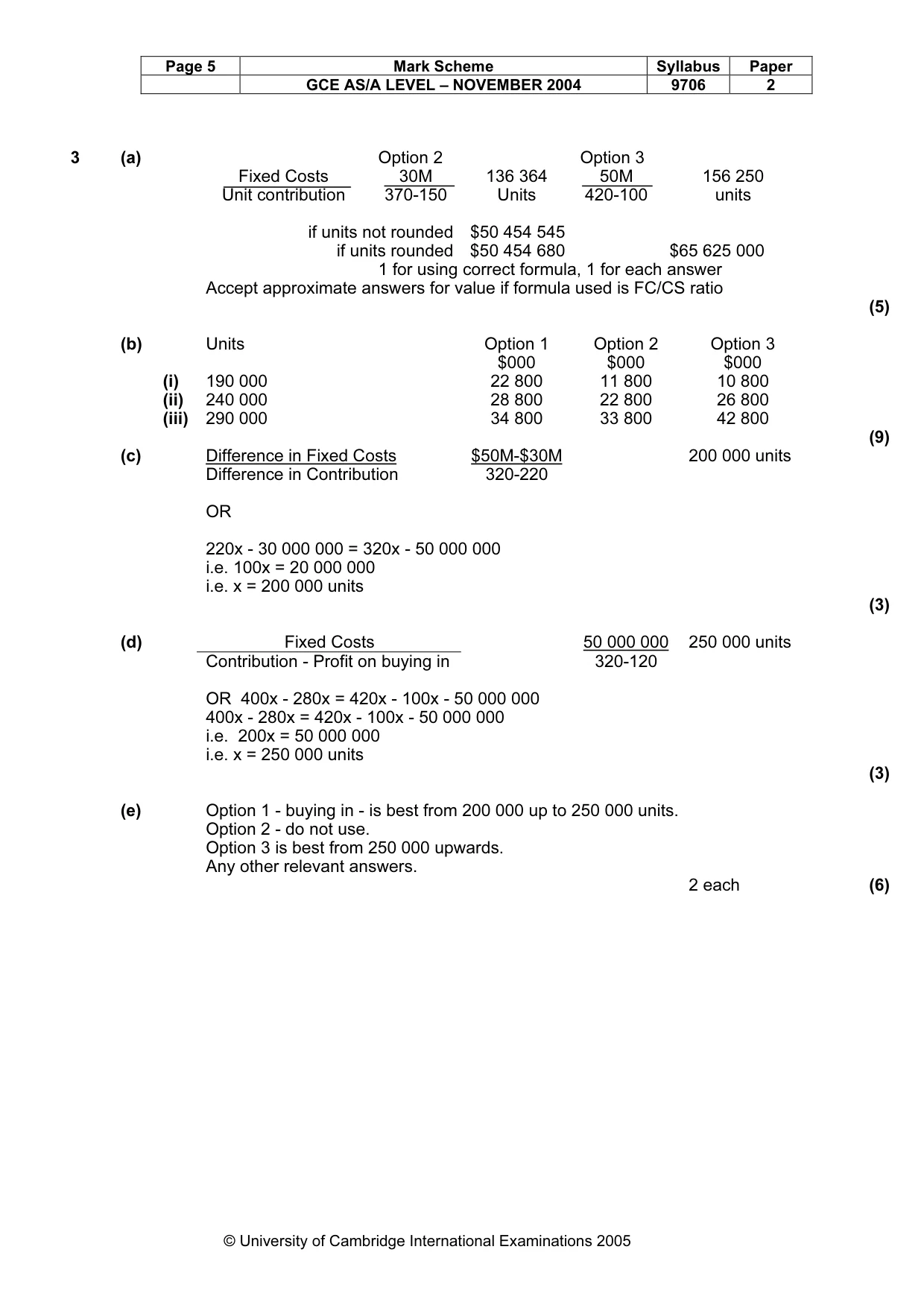
Page 5 Mark Scheme Syllabus Paper GCE AS/A LEVEL – NOVEMBER 2004 9706 2 © University of Cambridge International Examinations 2005 3 (a) Option 2 Option 3 Fixed Costs 30M 136 364 50M 156 250 Unit contribution 370-150 Units 420-100 units if units not rounded $50 454 545 if units rounded $50 454 680 $65 625 000 1 for using correct formula, 1 for each answer Accept approximate answers for value if formula used is FC/CS ratio (5) (b) Units Option 1 Option 2 Option 3 $000 $000 $000 (i) 190 000 22 800 11 800 10 800 (ii) 240 000 28 800 22 800 26 800 (iii) 290 000 34 800 33 800 42 800 (9) (c) Difference in Fixed Costs $50M-$30M 200 000 units Difference in Contribution 320-220 OR 220x - 30 000 000 = 320x - 50 000 000 i.e. 100x = 20 000 000 i.e. x = 200 000 units (3) (d) Fixed Costs 50 000 000 250 000 units Contribution - Profit on buying in 320-120 OR 400x - 280x = 420x - 100x - 50 000 000 400x - 280x = 420x - 100x - 50 000 000 i.e. 200x = 50 000 000 i.e. x = 250 000 units (3) (e) Option 1 - buying in - is best from 200 000 up to 250 000 units. Option 2 - do not use. Option 3 is best from 250 000 upwards. Any other relevant answers. 2 each (6)
Mark scheme, page 9
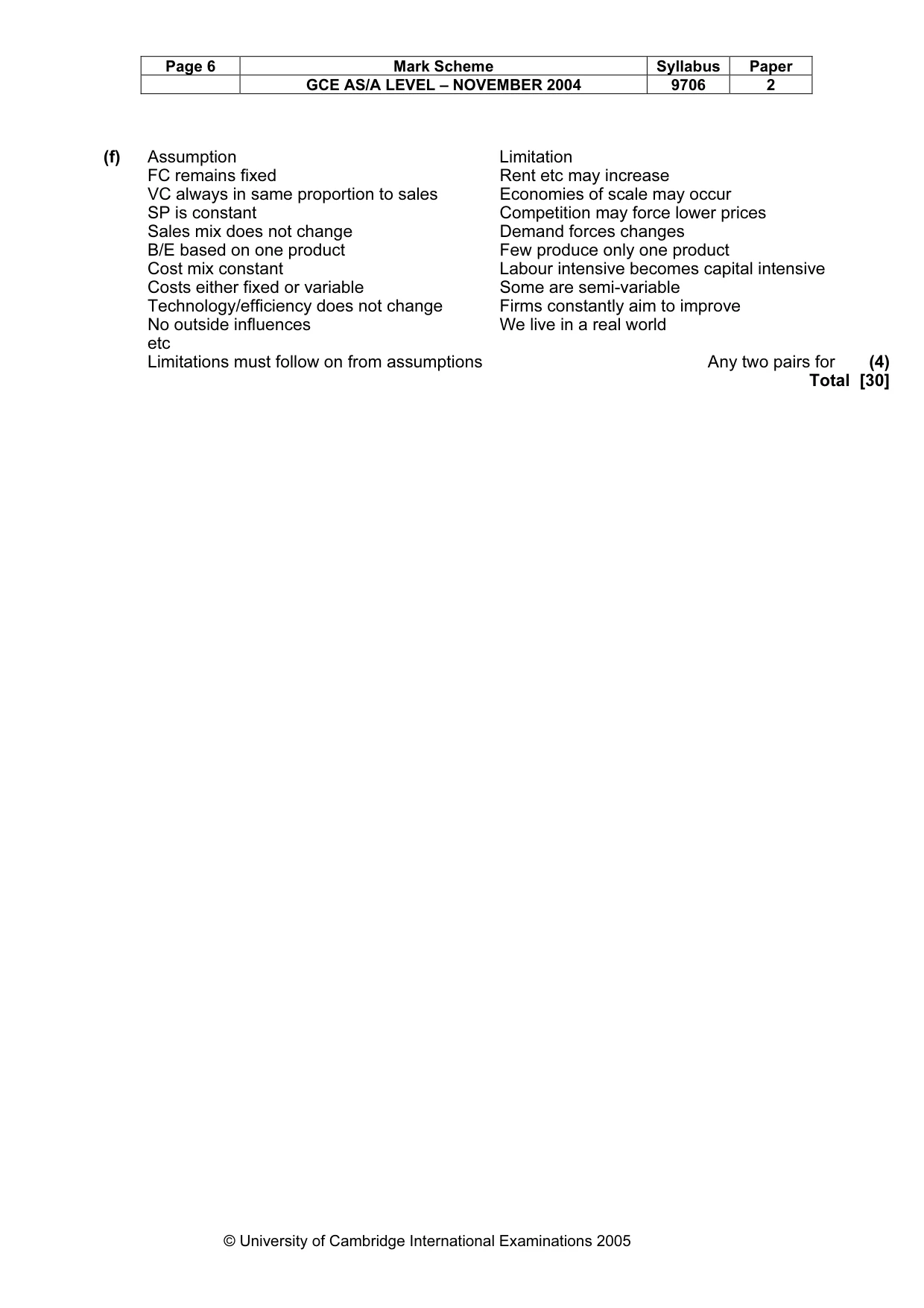
Page 6 Mark Scheme Syllabus Paper GCE AS/A LEVEL – NOVEMBER 2004 9706 2 © University of Cambridge International Examinations 2005 (f) Assumption Limitation FC remains fixed Rent etc may increase VC always in same proportion to sales Economies of scale may occur SP is constant Competition may force lower prices Sales mix does not change Demand forces changes B/E based on one product Few produce only one product Cost mix constant Labour intensive becomes capital intensive Costs either fixed or variable Some are semi-variable Technology/efficiency does not change Firms constantly aim to improve No outside influences We live in a real world etc Limitations must follow on from assumptions Any two pairs for (4) Total [30]