Cambridge A Level Accounting 9706 — 2002 Oct/Nov Paper 1 · Variant 1
9706/11/O/N/02
The question paper and its mark scheme, free to read here and free to download. This is Cambridge’s own paper, exactly as it was sat.
Question paper12 pages


Mark scheme
No mark scheme is in the library for this paper.
Paper as text
Question paper, page 1
This question paper consists of 10 printed pages and 2 blank pages. SJF2465(JB) S26244/1 © CIE 2002 [Turn over CAMBRIDGE INTERNATIONAL EXAMINATIONS General Certificate of Education Advanced Subsidiary Level and Advanced Level ACCOUNTING 9706/1 PAPER 1 Multiple Choice OCTOBER/NOVEMBER SESSION 2002 1 hour Additional materials: Multiple Choice answer sheet Soft clean eraser Soft pencil (type B or HB are recommended) TIME 1 hour INSTRUCTIONS TO CANDIDATES Do not open this booklet until you are told to do so. Write your name, Centre number and candidate number on the answer sheet in the spaces provided unless this has already been done for you. There are thirty questions in this paper. Answer all questions. For each question, there are four possible answers, A, B, C and D. Choose the one you consider correct and record your choice in soft pencil on the separate answer sheet. Read very carefully the instructions on the answer sheet. INFORMATION FOR CANDIDATES Each correct answer will score one mark. A mark will not be deducted for a wrong answer. Any rough working should be done in this booklet. Calculators may be used.
Question paper, page 2
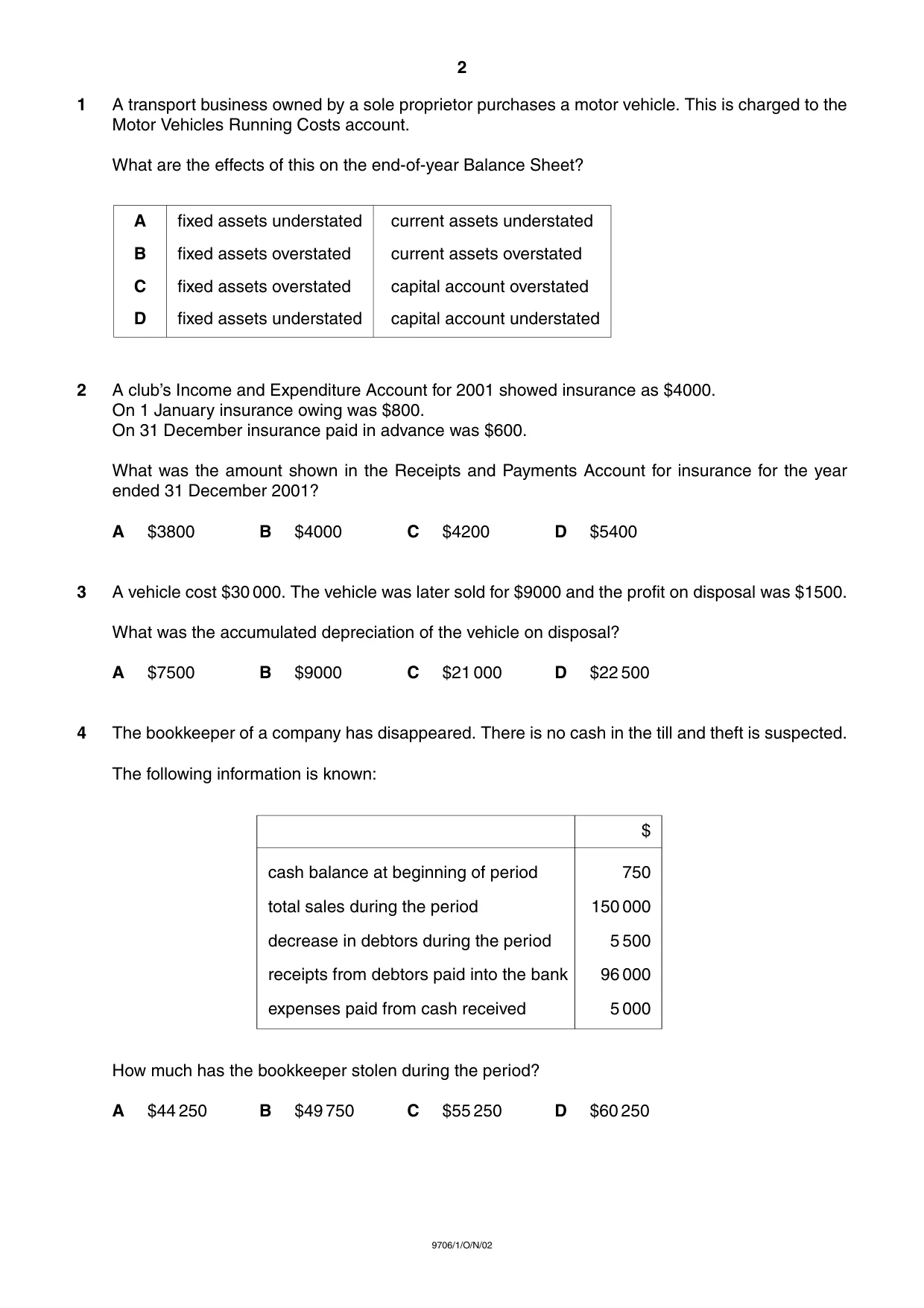
2 9706/1/O/N/02 1 A transport business owned by a sole proprietor purchases a motor vehicle. This is charged to the Motor Vehicles Running Costs account. What are the effects of this on the end-of-year Balance Sheet? 2 A club’s Income and Expenditure Account for 2001 showed insurance as $4000. On 1 January insurance owing was $800. On 31 December insurance paid in advance was $600. What was the amount shown in the Receipts and Payments Account for insurance for the year ended 31 December 2001? A $3800 B $4000 C $4200 D $5400 3 A vehicle cost $30 000. The vehicle was later sold for $9000 and the profit on disposal was $1500. What was the accumulated depreciation of the vehicle on disposal? A $7500 B $9000 C $21 000 D $22 500 4 The bookkeeper of a company has disappeared. There is no cash in the till and theft is suspected. The following information is known: How much has the bookkeeper stolen during the period? A $44 250 B $49 750 C $55 250 D $60 250 A B C D fixed assets understated current assets understated fixed assets overstated current assets overstated fixed assets overstated capital account overstated fixed assets understated capital account understated $ cash balance at beginning of period 750 total sales during the period 150 000 decrease in debtors during the period 5 500 receipts from debtors paid into the bank 96 000 expenses paid from cash received 5 000
Question paper, page 3
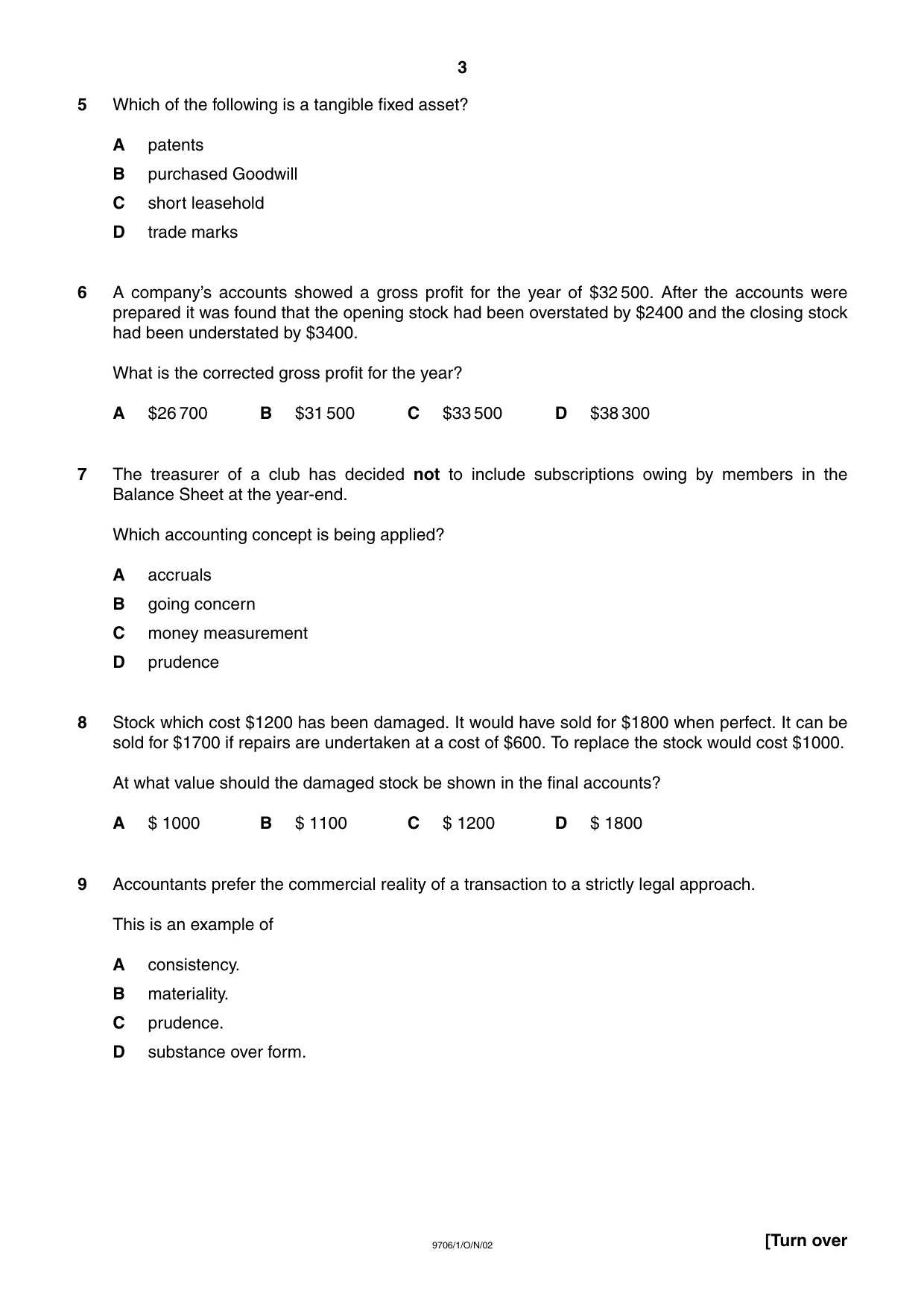
3 9706/1/O/N/02 [Turn over 5 Which of the following is a tangible fixed asset? A patents B purchased Goodwill C short leasehold D trade marks 6 A company’s accounts showed a gross profit for the year of $32 500. After the accounts were prepared it was found that the opening stock had been overstated by $2400 and the closing stock had been understated by $3400. What is the corrected gross profit for the year? A $26 700 B $31 500 C $33 500 D $38 300 7 The treasurer of a club has decided not to include subscriptions owing by members in the Balance Sheet at the year-end. Which accounting concept is being applied? A accruals B going concern C money measurement D prudence 8 Stock which cost $1200 has been damaged. It would have sold for $1800 when perfect. It can be sold for $1700 if repairs are undertaken at a cost of $600. To replace the stock would cost $1000. At what value should the damaged stock be shown in the final accounts? A $ 1000 B $ 1100 C $ 1200 D $ 1800 9 Accountants prefer the commercial reality of a transaction to a strictly legal approach. This is an example of A consistency. B materiality. C prudence. D substance over form.
Question paper, page 4
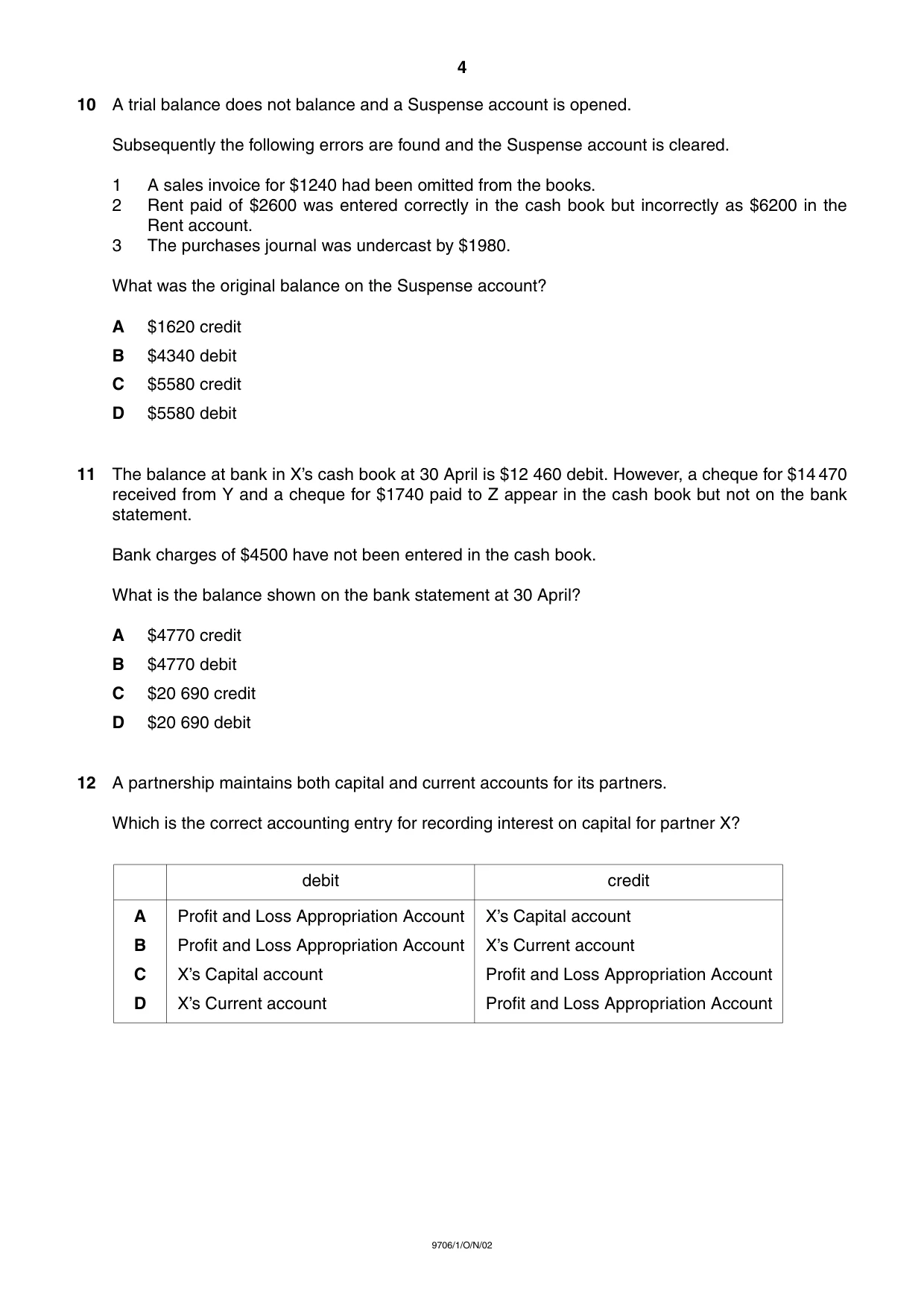
4 9706/1/O/N/02 10 A trial balance does not balance and a Suspense account is opened. Subsequently the following errors are found and the Suspense account is cleared. 1 A sales invoice for $1240 had been omitted from the books. 2 Rent paid of $2600 was entered correctly in the cash book but incorrectly as $6200 in the Rent account. 3 The purchases journal was undercast by $1980. What was the original balance on the Suspense account? A $1620 credit B $4340 debit C $5580 credit D $5580 debit 11 The balance at bank in X’s cash book at 30 April is $12 460 debit. However, a cheque for $14 470 received from Y and a cheque for $1740 paid to Z appear in the cash book but not on the bank statement. Bank charges of $4500 have not been entered in the cash book. What is the balance shown on the bank statement at 30 April? A $4770 credit B $4770 debit C $20 690 credit D $20 690 debit 12 A partnership maintains both capital and current accounts for its partners. Which is the correct accounting entry for recording interest on capital for partner X? Profit and Loss Appropriation Account Profit and Loss Appropriation Account X’s Capital account X’s Current account debit credit X’s Capital account X’s Current account Profit and Loss Appropriation Account Profit and Loss Appropriation Account A B C D
Question paper, page 5
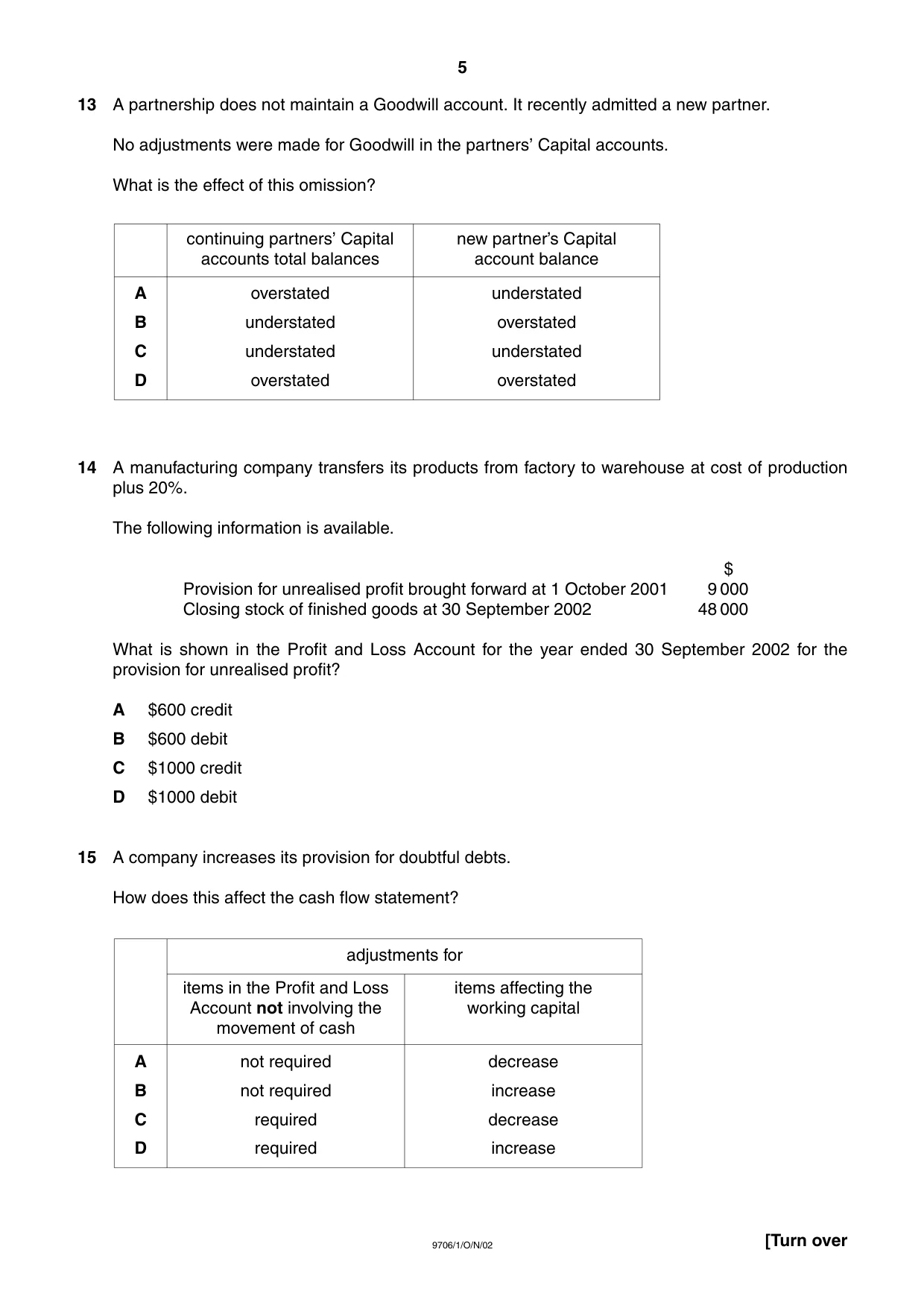
5 9706/1/O/N/02 [Turn over 13 A partnership does not maintain a Goodwill account. It recently admitted a new partner. No adjustments were made for Goodwill in the partners’ Capital accounts. What is the effect of this omission? 14 A manufacturing company transfers its products from factory to warehouse at cost of production plus 20%. The following information is available. $ Provision for unrealised profit brought forward at 1 October 2001 9 000 Closing stock of finished goods at 30 September 2002 48 000 What is shown in the Profit and Loss Account for the year ended 30 September 2002 for the provision for unrealised profit? A $600 credit B $600 debit C $1000 credit D $1000 debit 15 A company increases its provision for doubtful debts. How does this affect the cash flow statement? A B C D overstated understated understated overstated continuing partners’ Capital accounts total balances understated overstated understated overstated new partner’s Capital account balance A B C D not required not required required required decrease increase decrease increase items in the Profit and Loss Account not involving the movement of cash adjustments for items affecting the working capital
Question paper, page 6
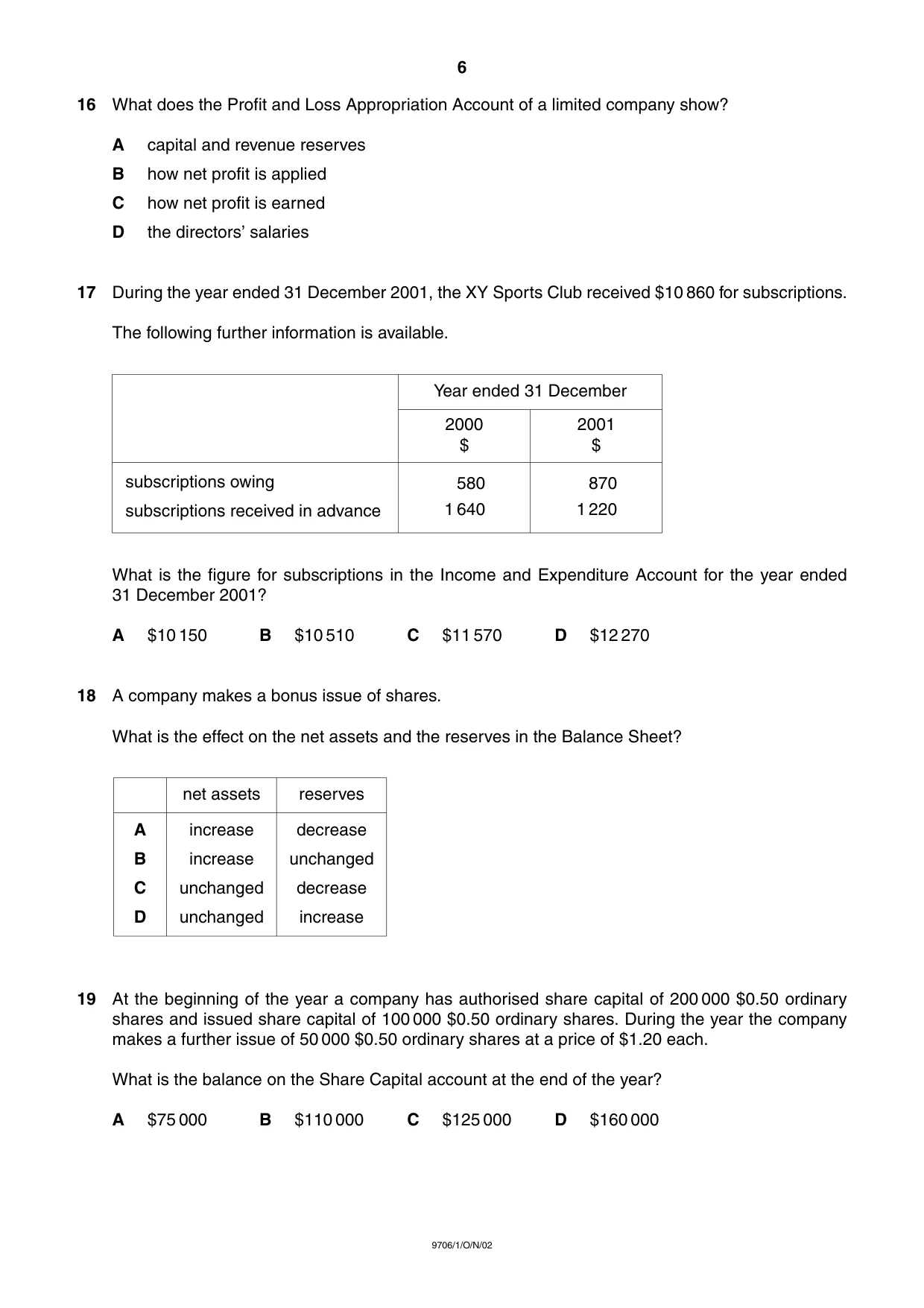
6 9706/1/O/N/02 16 What does the Profit and Loss Appropriation Account of a limited company show? A capital and revenue reserves B how net profit is applied C how net profit is earned D the directors’ salaries 17 During the year ended 31 December 2001, the XY Sports Club received $10 860 for subscriptions. The following further information is available. What is the figure for subscriptions in the Income and Expenditure Account for the year ended 31 December 2001? A $10 150 B $10 510 C $11 570 D $12 270 18 A company makes a bonus issue of shares. What is the effect on the net assets and the reserves in the Balance Sheet? 19 At the beginning of the year a company has authorised share capital of 200 000 $0.50 ordinary shares and issued share capital of 100 000 $0.50 ordinary shares. During the year the company makes a further issue of 50 000 $0.50 ordinary shares at a price of $1.20 each. What is the balance on the Share Capital account at the end of the year? A $75 000 B $110 000 C $125 000 D $160 000 subscriptions owing subscriptions received in advance Year ended 31 December 2000 $ 580 1 640 870 1 220 2001 $ A B C D increase increase unchanged unchanged net assets reserves decrease unchanged decrease increase
Question paper, page 7
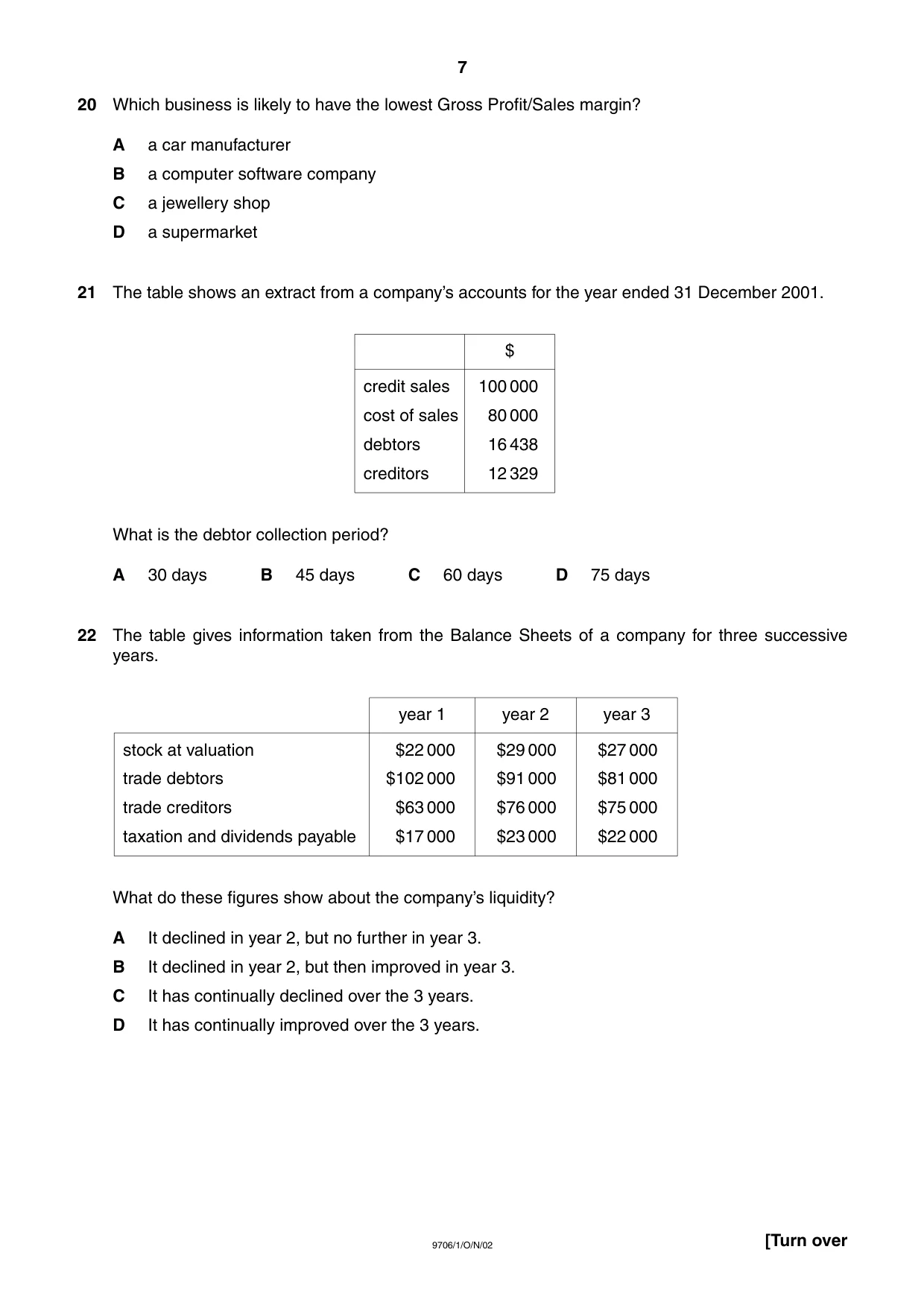
7 9706/1/O/N/02 [Turn over 20 Which business is likely to have the lowest Gross Profit/Sales margin? A a car manufacturer B a computer software company C a jewellery shop D a supermarket 21 The table shows an extract from a company’s accounts for the year ended 31 December 2001. What is the debtor collection period? A 30 days B 45 days C 60 days D 75 days 22 The table gives information taken from the Balance Sheets of a company for three successive years. What do these figures show about the company’s liquidity? A It declined in year 2, but no further in year 3. B It declined in year 2, but then improved in year 3. C It has continually declined over the 3 years. D It has continually improved over the 3 years. credit sales cost of sales debtors creditors 100 000 80 000 16 438 12 329 $ stock at valuation trade debtors trade creditors taxation and dividends payable $22 000 $102 000 $63 000 $17 000 year 1 year 2 year 3 $29 000 $91 000 $76 000 $23 000 $27 000 $81 000 $75 000 $22 000
Question paper, page 8
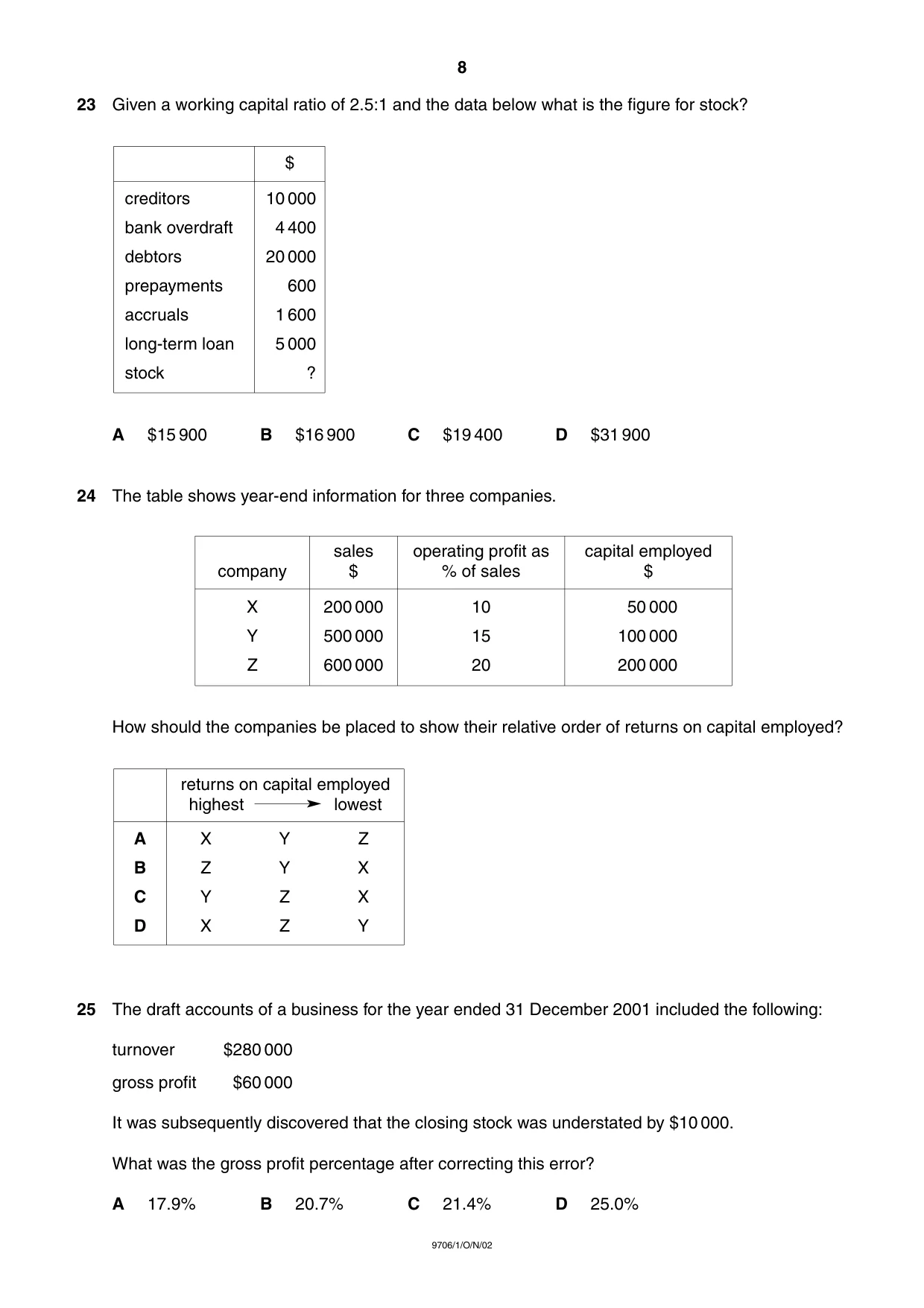
8 9706/1/O/N/02 23 Given a working capital ratio of 2.5:1 and the data below what is the figure for stock? A $15 900 B $16 900 C $19 400 D $31 900 24 The table shows year-end information for three companies. How should the companies be placed to show their relative order of returns on capital employed? 25 The draft accounts of a business for the year ended 31 December 2001 included the following: turnover $280 000 gross profit $60 000 It was subsequently discovered that the closing stock was understated by $10 000. What was the gross profit percentage after correcting this error? A 17.9% B 20.7% C 21.4% D 25.0% creditors bank overdraft debtors prepayments accruals long-term loan stock 10 000 4 400 20 000 600 1 600 5 000 ? $ company X Y Z sales $ operating profit as % of sales capital employed $ 200 000 500 000 600 000 10 15 20 50 000 100 000 200 000 A B C D X Z Y X Y Y Z Z Z X X Y returns on capital employed highest lowest
Question paper, page 9
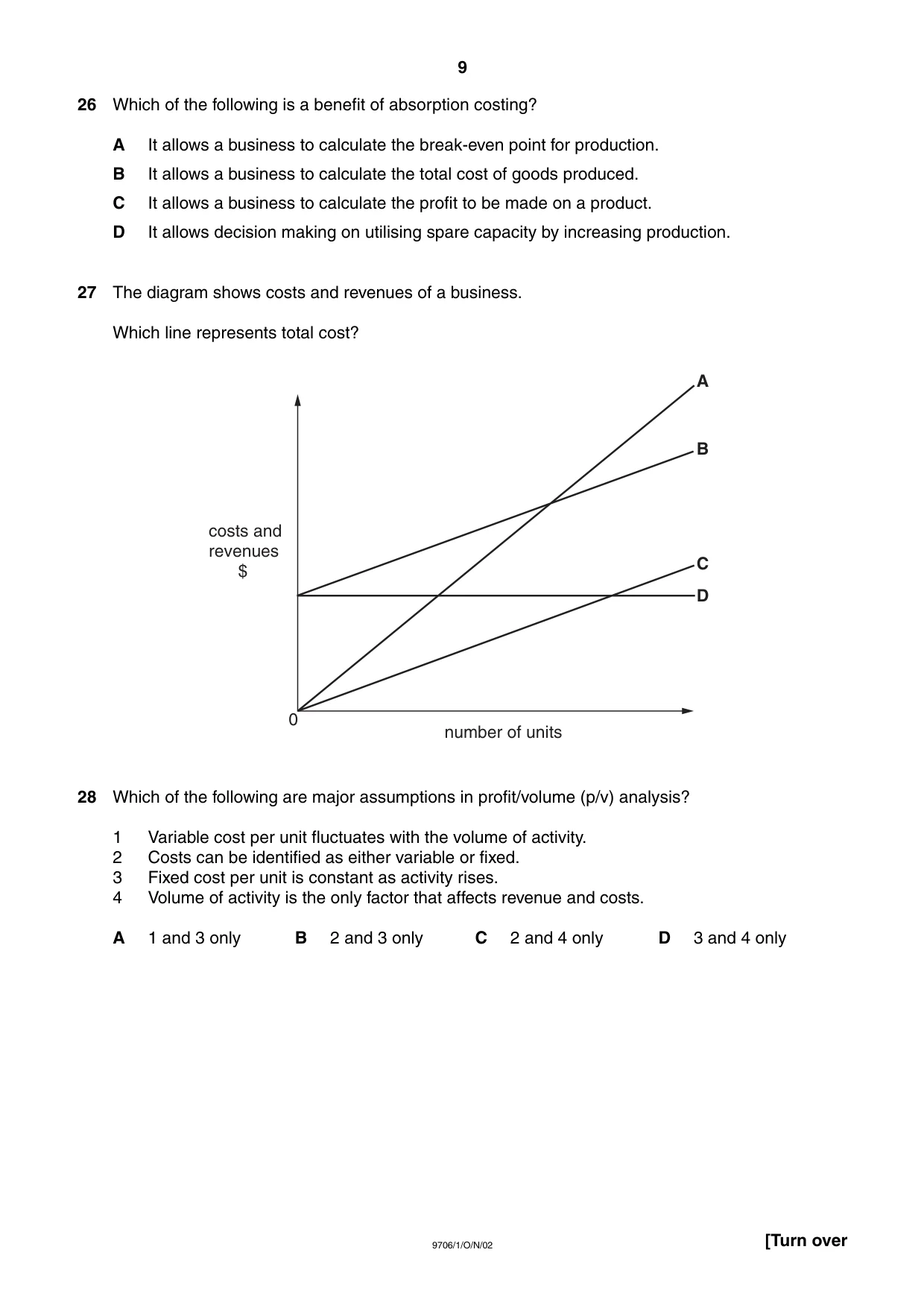
9 9706/1/O/N/02 [Turn over 26 Which of the following is a benefit of absorption costing? A It allows a business to calculate the break-even point for production. B It allows a business to calculate the total cost of goods produced. C It allows a business to calculate the profit to be made on a product. D It allows decision making on utilising spare capacity by increasing production. 27 The diagram shows costs and revenues of a business. Which line represents total cost? 28 Which of the following are major assumptions in profit/volume (p/v) analysis? 1 Variable cost per unit fluctuates with the volume of activity. 2 Costs can be identified as either variable or fixed. 3 Fixed cost per unit is constant as activity rises. 4 Volume of activity is the only factor that affects revenue and costs. A 1 and 3 only B 2 and 3 only C 2 and 4 only D 3 and 4 only A B C D 0 costs and revenues $ number of units
Question paper, page 10
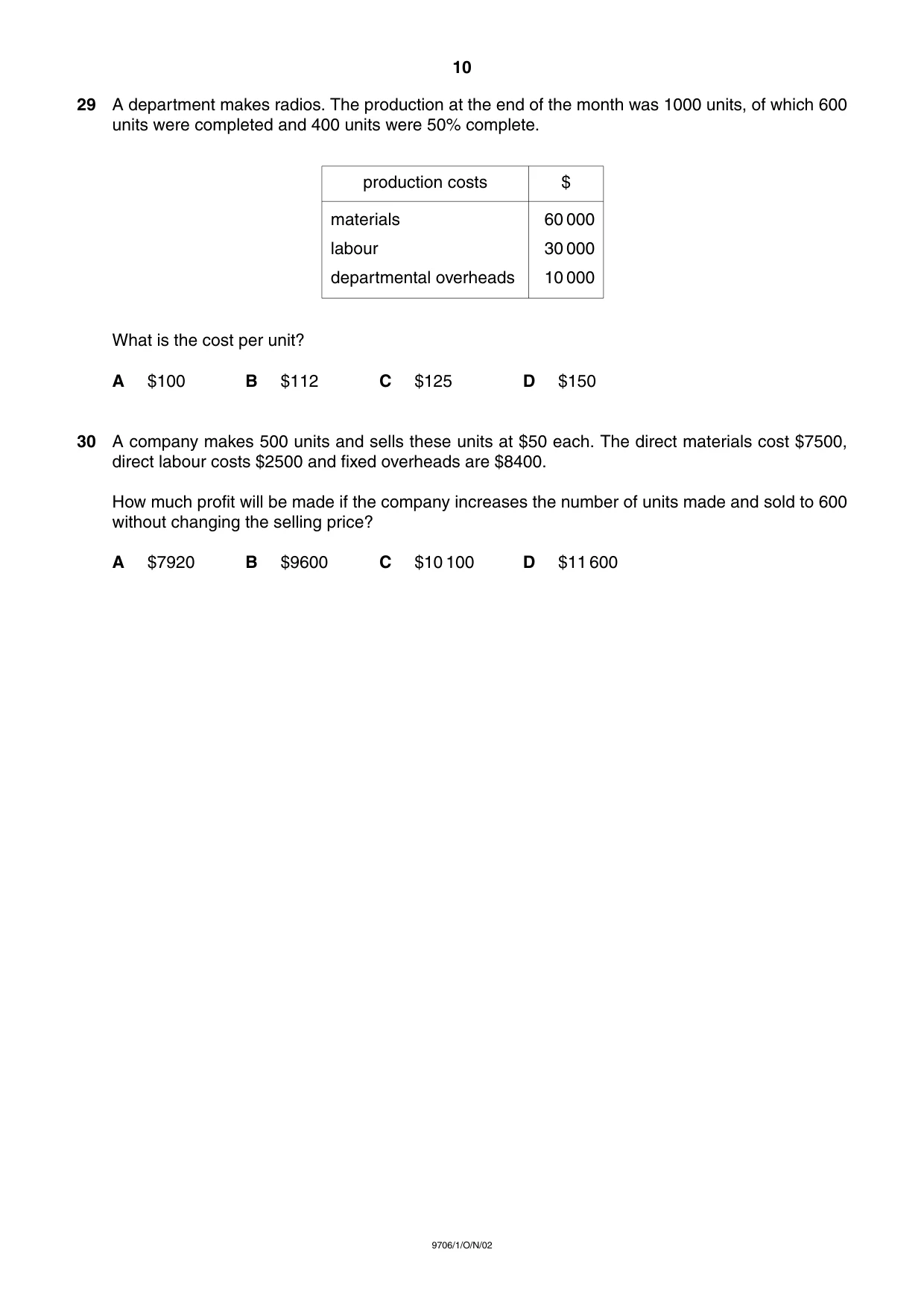
10 9706/1/O/N/02 29 A department makes radios. The production at the end of the month was 1000 units, of which 600 units were completed and 400 units were 50% complete. What is the cost per unit? A $100 B $112 C $125 D $150 30 A company makes 500 units and sells these units at $50 each. The direct materials cost $7500, direct labour costs $2500 and fixed overheads are $8400. How much profit will be made if the company increases the number of units made and sold to 600 without changing the selling price? A $7920 B $9600 C $10 100 D $11 600 materials labour departmental overheads 60 000 30 000 10 000 production costs $