Cambridge A Level Accounting 9706 — 2002 May/June Paper 2 · Variant 1
9706/21/M/J/02
The question paper and its mark scheme, free to read here and free to download. This is Cambridge’s own paper, exactly as it was sat.
Question paper16 pages
Mark scheme8 pages
Answers below. Sit the paper first if you are practising.
Paper as text
Question paper, page 1
This question paper consists of 14 printed pages and 2 lined pages. SP (SLC) S17343/2 © CIE 2002 [Turn over CAMBRIDGE INTERNATIONAL EXAMINATIONS General Certificate of Education Advanced Subsidiary Level and Advanced Level ACCOUNTING 9706/2 PAPER 2 Structured Questions MAY/JUNE SESSION 2002 1 hour 30 minutes Candidates answer on the question paper. No additional materials are required. TIME 1 hour 30 minutes INSTRUCTIONS TO CANDIDATES Write your name, Centre number and candidate number in the spaces at the top of this page. Answer all questions. Write your answers in the spaces provided on the question paper. If you require extra space for your answers or workings, use pages 15 and 16. INFORMATION FOR CANDIDATES The number of marks is given in brackets [ ] at the end of each question or part question. You may use a calculator. Candidate Centre Number Number Candidate Name FOR EXAMINER’S USE 1 2 3 TOTAL
Question paper, page 2
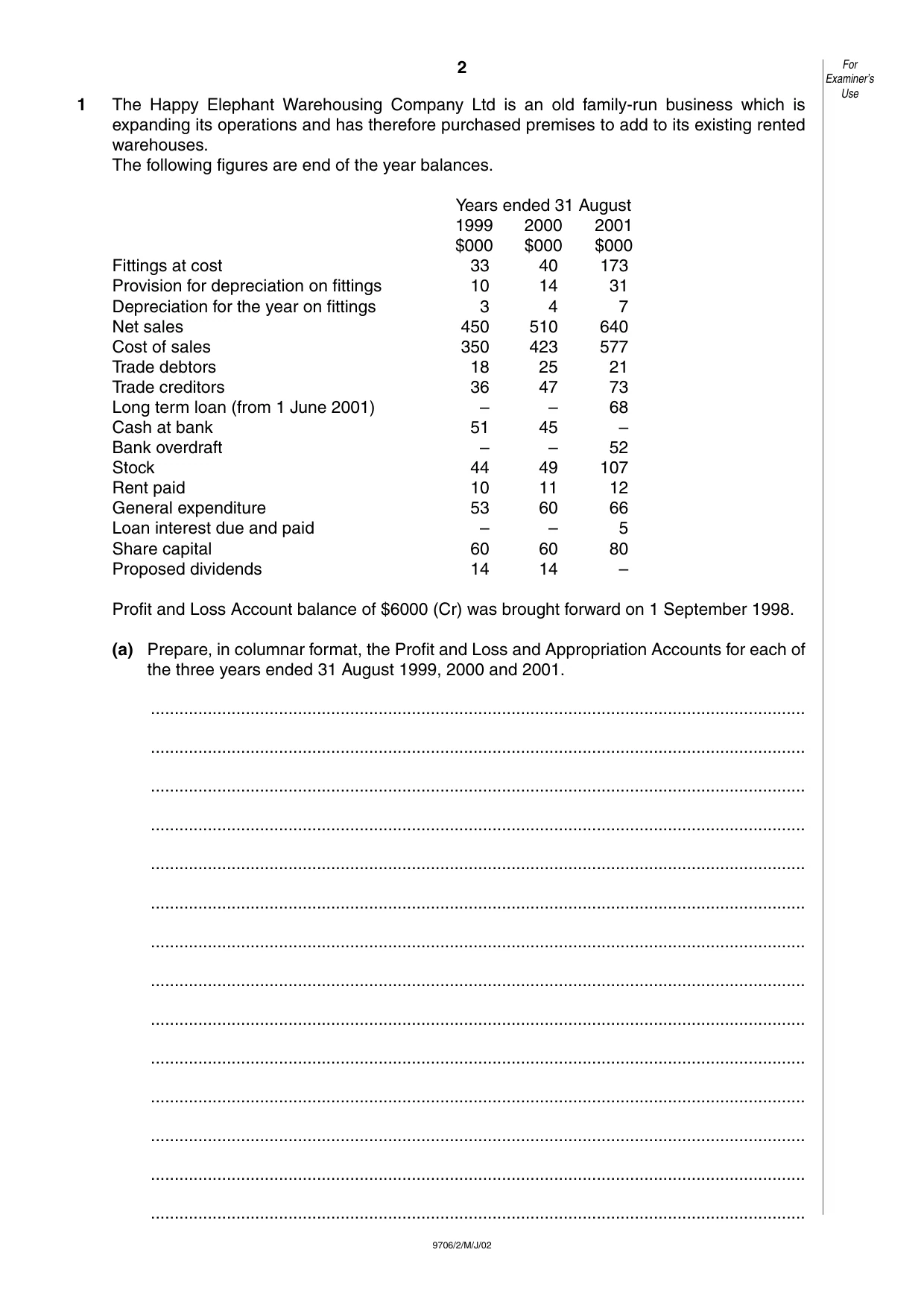
2 9706/2/M/J/02 1 The Happy Elephant Warehousing Company Ltd is an old family-run business which is expanding its operations and has therefore purchased premises to add to its existing rented warehouses. The following figures are end of the year balances. Years ended 31 August 1999 2000 2001 $000 $000 $000 Fittings at cost 33 40 173 Provision for depreciation on fittings 10 14 31 Depreciation for the year on fittings 3 4 7 Net sales 450 510 640 Cost of sales 350 423 577 Trade debtors 18 25 21 Trade creditors 36 47 73 Long term loan (from 1 June 2001) – – 68 Cash at bank 51 45 – Bank overdraft – – 52 Stock 44 49 107 Rent paid 10 11 12 General expenditure 53 60 66 Loan interest due and paid – – 5 Share capital 60 60 80 Proposed dividends 14 14 – Profit and Loss Account balance of $6000 (Cr) was brought forward on 1 September 1998. (a) Prepare, in columnar format, the Profit and Loss and Appropriation Accounts for each of the three years ended 31 August 1999, 2000 and 2001. … … … … … … … … … … … … … … For Examiner’s Use
Question paper, page 3
3 9706/2/M/J/02 [Turn over … … … … … … … … … … … … … … … … … … … … … … … … … … … … …[8] For Examiner’s Use
Question paper, page 4
4 9706/2/M/J/02 (b) Prepare, in columnar format, Balance Sheets as at 31 August 1999, 2000 and 2001. … … … … … … … … … … … … … … … … … … … … … … … … … … … … For Examiner’s Use
Question paper, page 5
5 9706/2/M/J/02 [Turn over … … … … … … … … … … … … … … … … … … … … … … … … … … … … … For Examiner’s Use
Question paper, page 6
6 9706/2/M/J/02 … … … … … … … … … …[14] (c) Identify and comment on four trends shown in the company’s results for the three years. … … … … … … … … … …[8] For Examiner’s Use
Question paper, page 7
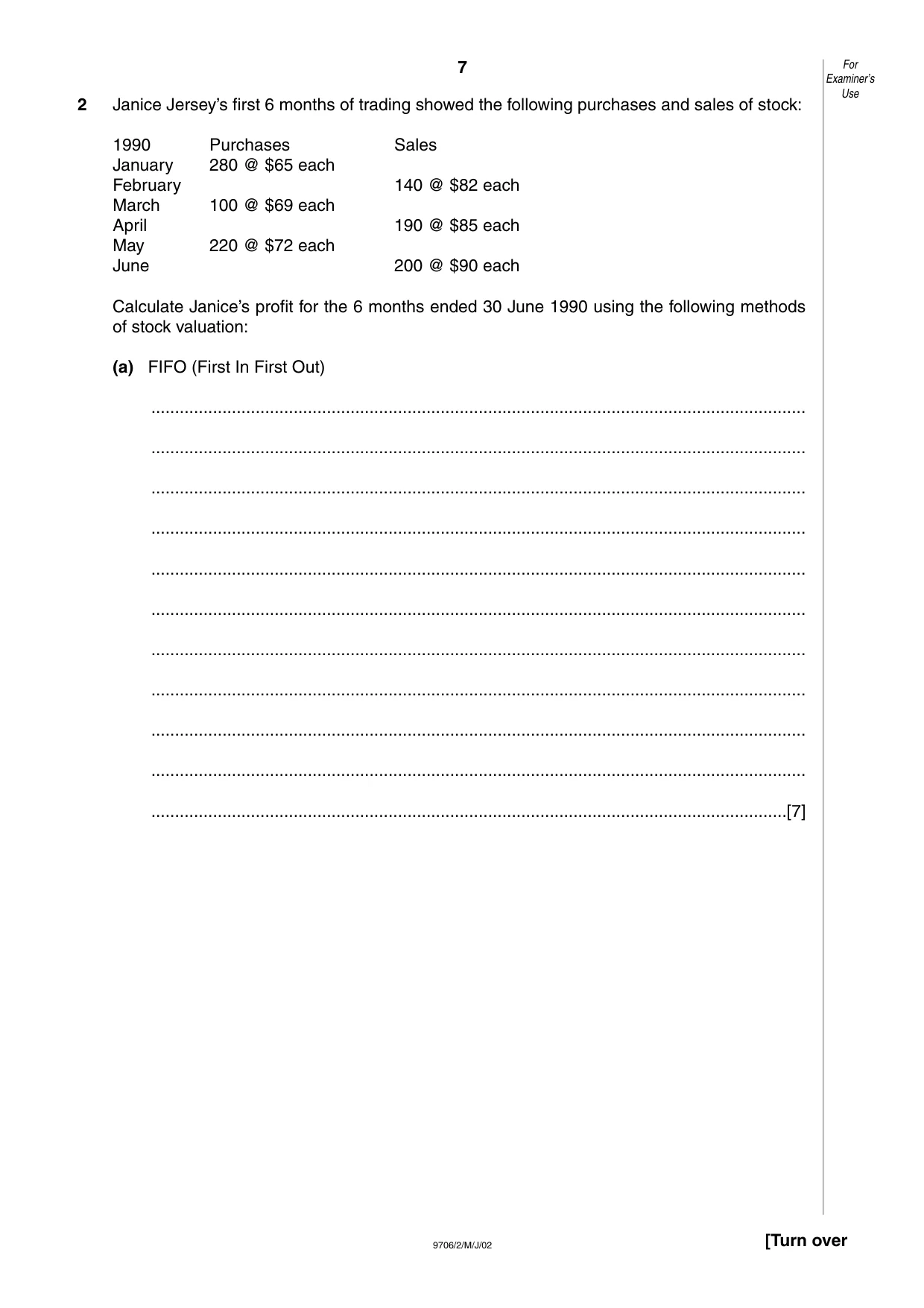
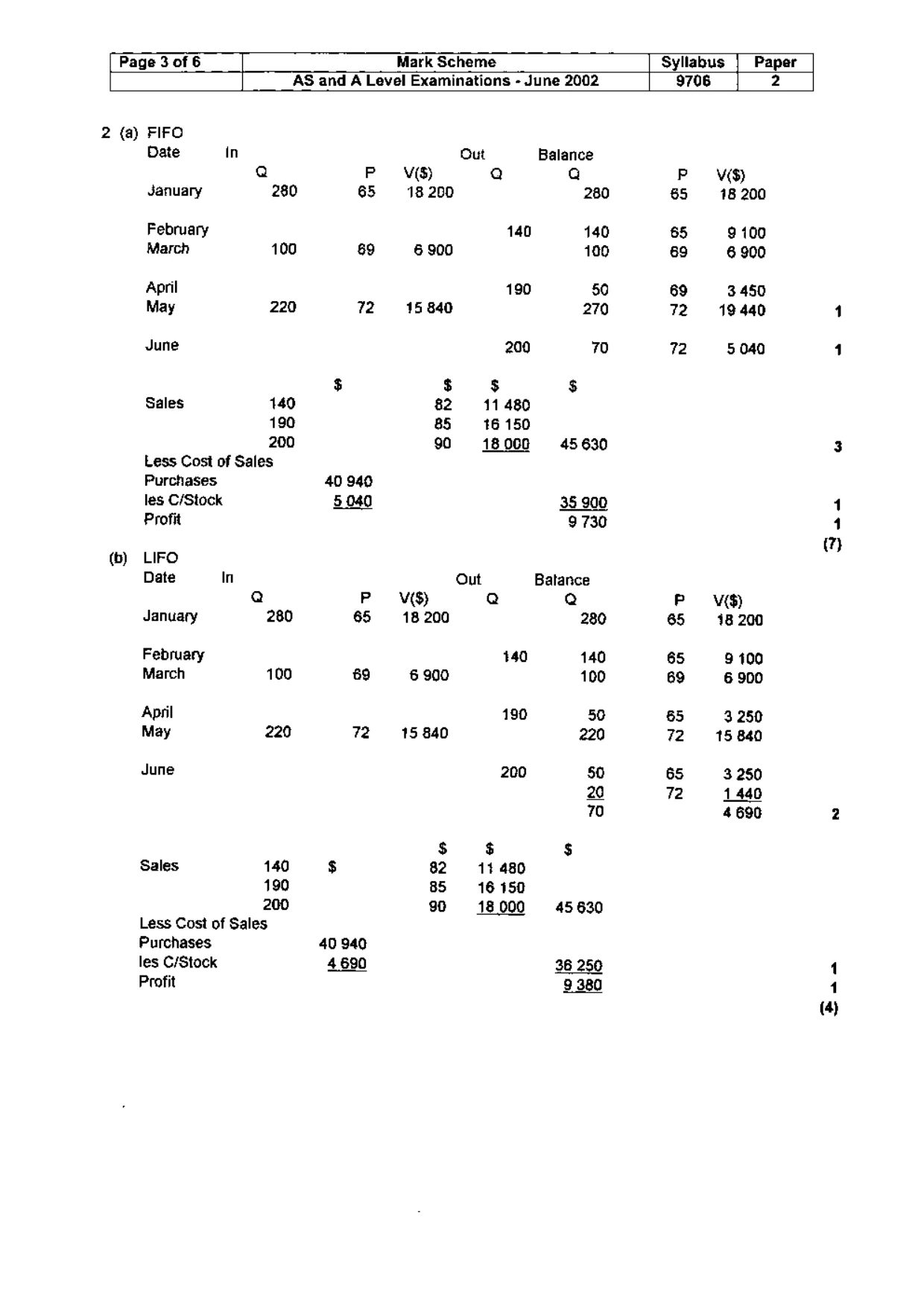
7 9706/2/M/J/02 [Turn over 2 Janice Jersey’s first 6 months of trading showed the following purchases and sales of stock: 1990 Purchases Sales January 280 @ $65 each February 140 @ $82 each March 100 @ $69 each April 190 @ $85 each May 220 @ $72 each June 200 @ $90 each Calculate Janice’s profit for the 6 months ended 30 June 1990 using the following methods of stock valuation: (a) FIFO (First In First Out) … … … … … … … … … … …[7] For Examiner’s Use
Question paper, page 8
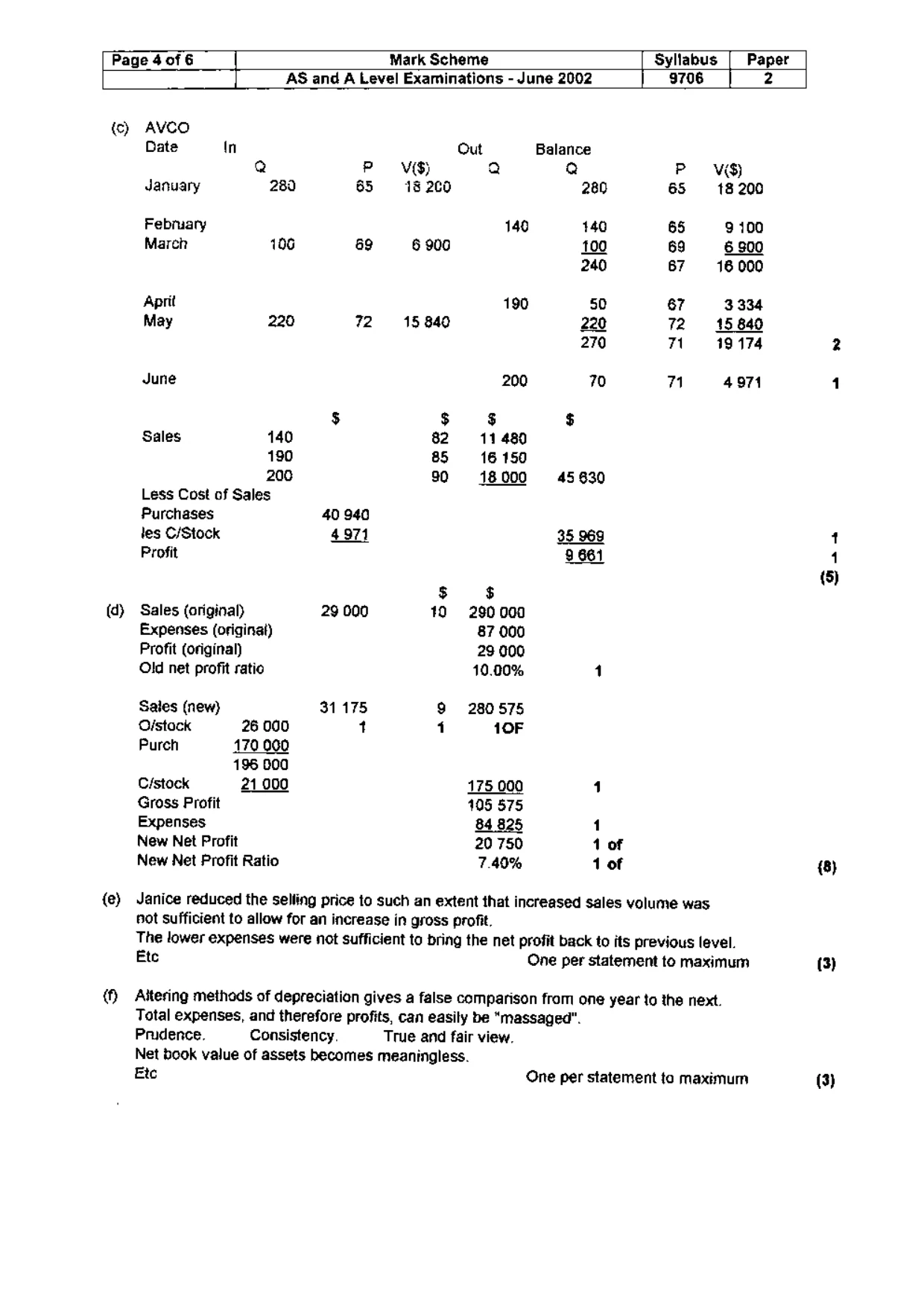
8 9706/2/M/J/02 (b) LIFO (Last In First Out) … … … … … … … … … … …[4] (c) AVCO (Weighted Average Cost). Calculate to 2 decimal places. … … … … … … … … … …[5] For Examiner’s Use
Question paper, page 9
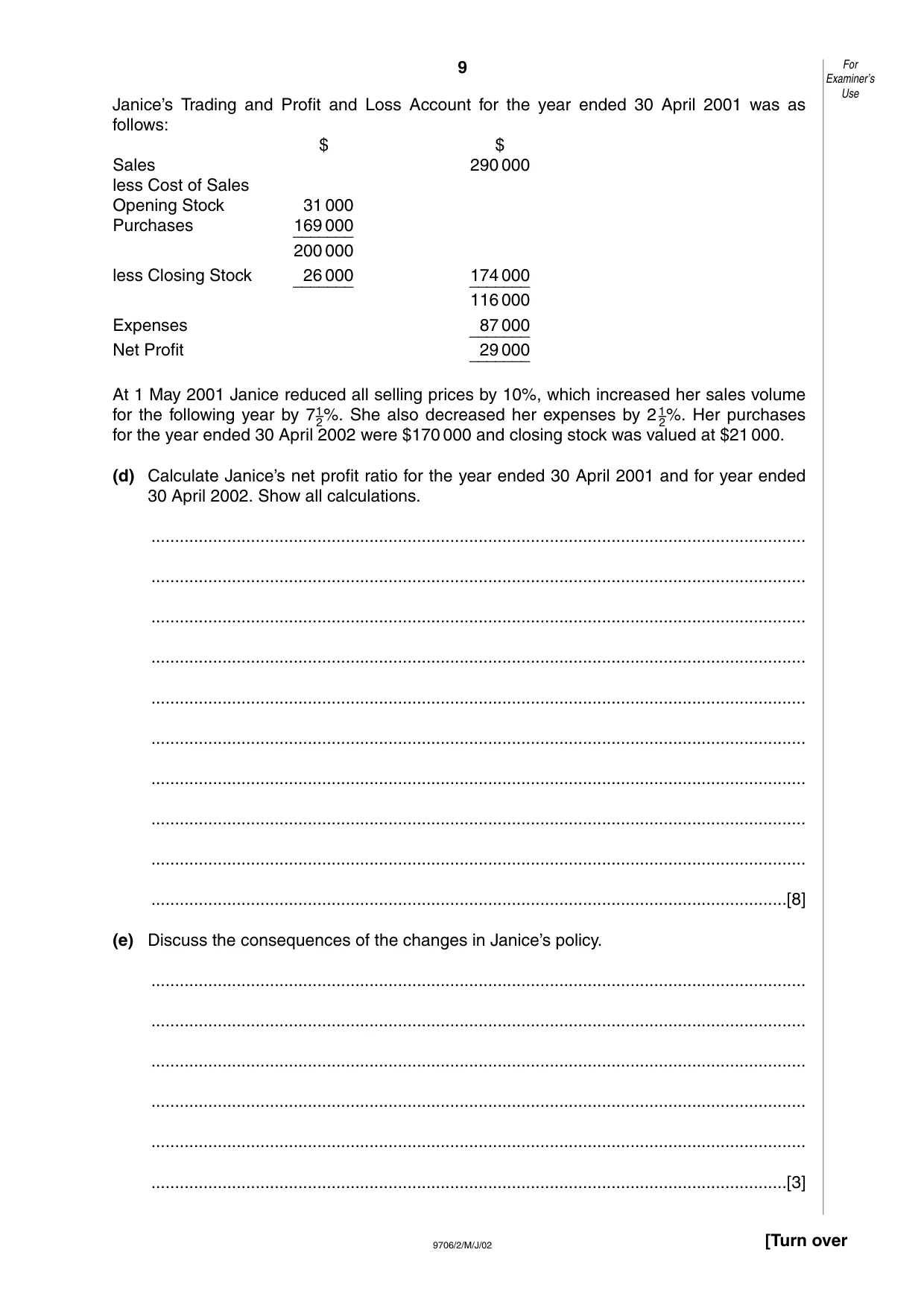
9 9706/2/M/J/02 [Turn over Janice’s Trading and Profit and Loss Account for the year ended 30 April 2001 was as follows: $ $ Sales 290 000 less Cost of Sales Opening Stock 31 000 Purchases 169 000 _______ 200 000 less Closing Stock 26 000 174 000 _______ _______ 116 000 Expenses 87 000 _______ Net Profit 29 000 _______ At 1 May 2001 Janice reduced all selling prices by 10%, which increased her sales volume for the following year by 71–2%. She also decreased her expenses by 2 1–2%. Her purchases for the year ended 30 April 2002 were $170 000 and closing stock was valued at $21 000. (d) Calculate Janice’s net profit ratio for the year ended 30 April 2001 and for year ended 30 April 2002. Show all calculations. … … … … … … … … … …[8] (e) Discuss the consequences of the changes in Janice’s policy. … … … … … …[3] For Examiner’s Use
Question paper, page 10
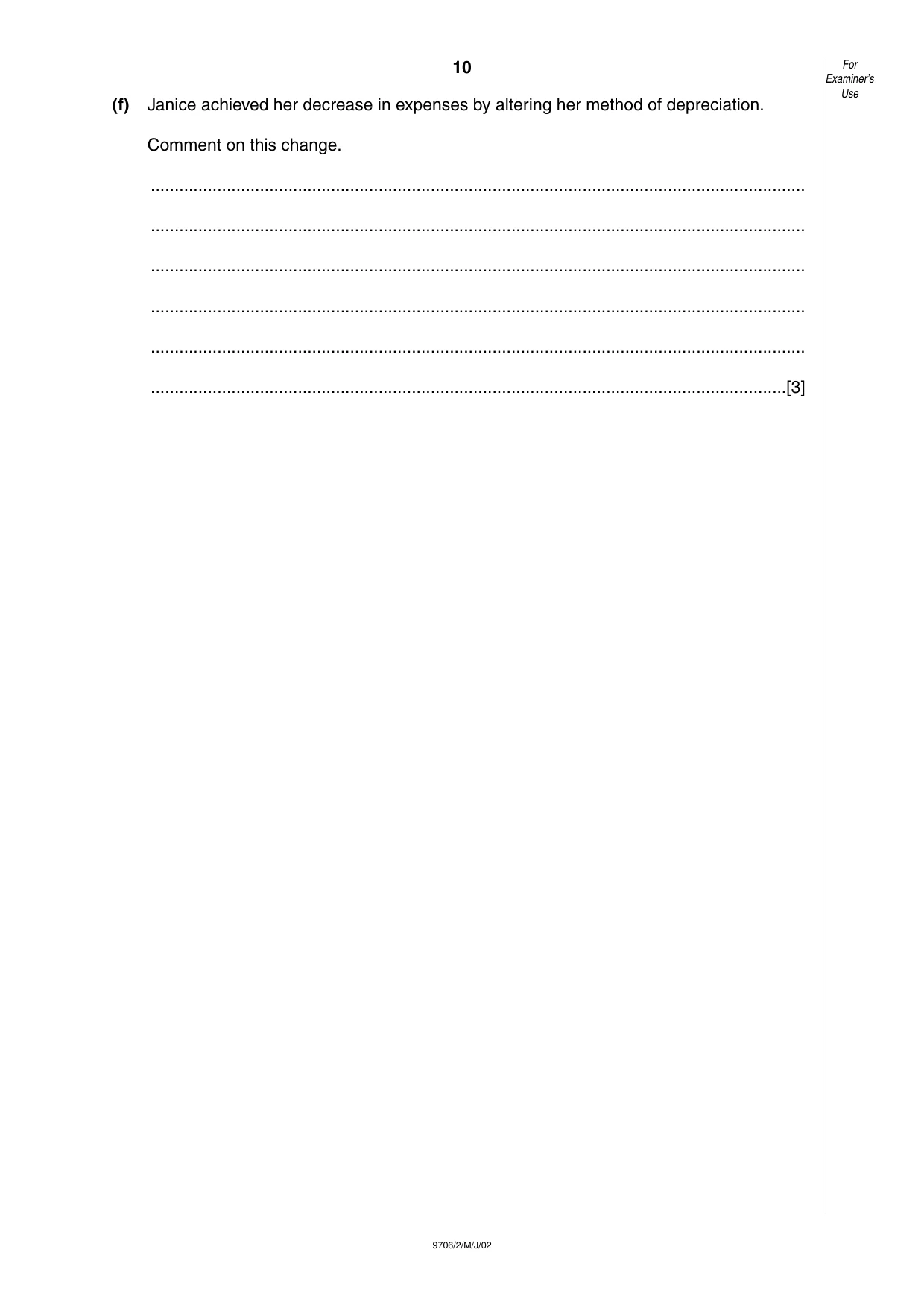
10 9706/2/M/J/02 (f) Janice achieved her decrease in expenses by altering her method of depreciation. Comment on this change. … … … … … …[3] For Examiner’s Use
Question paper, page 11
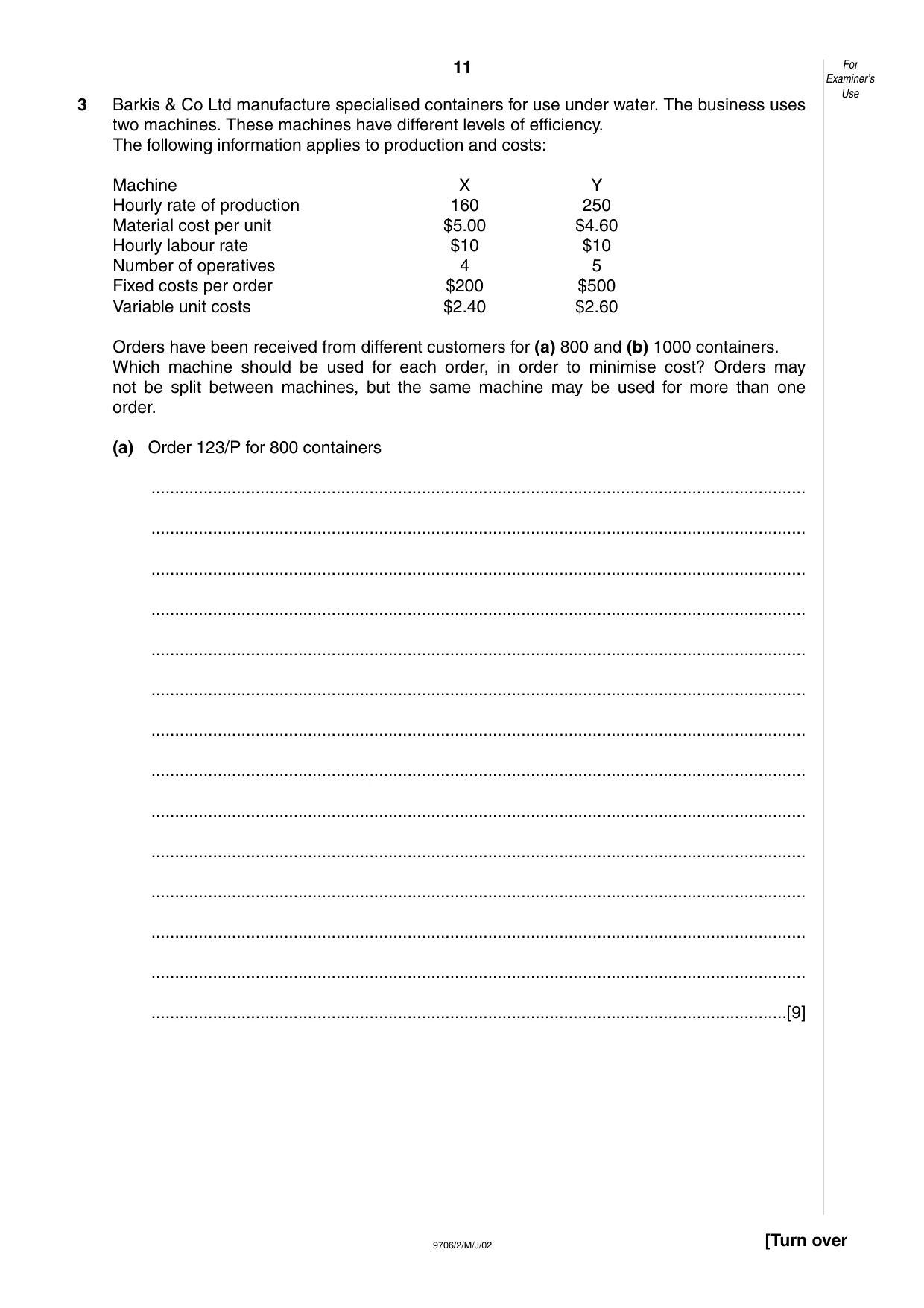
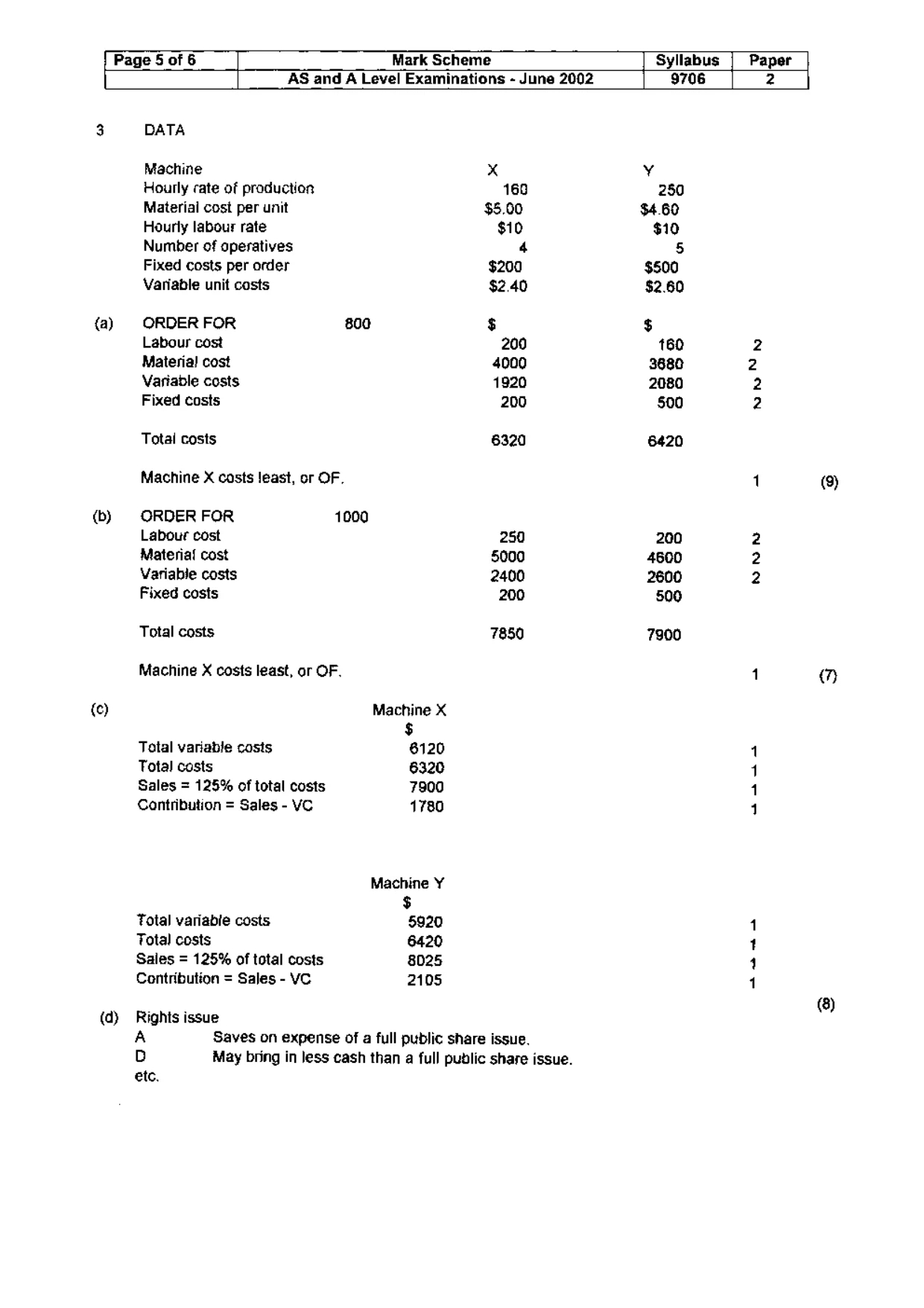
11 9706/2/M/J/02 [Turn over 3 Barkis & Co Ltd manufacture specialised containers for use under water. The business uses two machines. These machines have different levels of efficiency. The following information applies to production and costs: Machine X Y Hourly rate of production 160 250 Material cost per unit $5.00 $4.60 Hourly labour rate $10 $10 Number of operatives 4 5 Fixed costs per order $200 $500 Variable unit costs $2.40 $2.60 Orders have been received from different customers for (a) 800 and (b) 1000 containers. Which machine should be used for each order, in order to minimise cost? Orders may not be split between machines, but the same machine may be used for more than one order. (a) Order 123/P for 800 containers … … … … … … … … … … … … … …[9] For Examiner’s Use
Question paper, page 12
12 9706/2/M/J/02 (b) Order 382/Q for 1000 containers … … … … … … … … … … … … … … …[7] For Examiner’s Use
Question paper, page 13
13 9706/2/M/J/02 [Turn over (c) Calculate the contribution to be made for order number 123/P to make a profit of 25% on total cost, using each machine. (i) Machine X … … … … … … … … (ii) Machine Y … … … … … … … … [8] For Examiner’s Use
Question paper, page 14
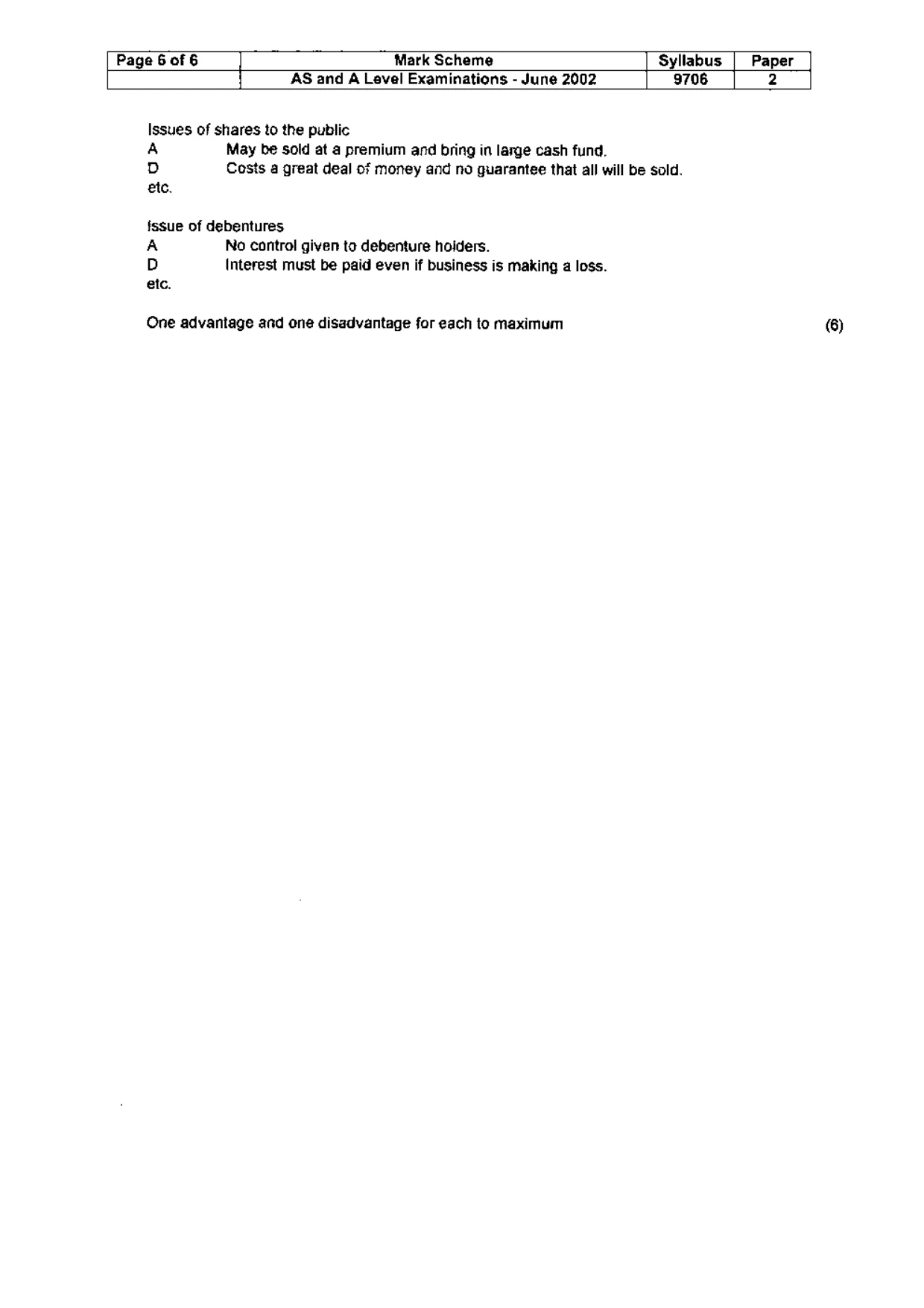
14 9706/2/M/J/02 (d) Barkis & Co Ltd require more funds to purchase an additional machine to complete further orders. Three methods of doing so have been discussed: (i) a rights issue; (ii) an issue of shares to the public; (iii) an issue of debentures. Give one advantage and one disadvantage of each method. … … … … … … … … … … … … … …[6] For Examiner’s Use
Question paper, page 15
15 9706/2/M/J/02 … … … … … … … … … … … … … … … … … … … … … … … … … … …
Question paper, page 16
16 9706/2/M/J/02 … … … … … … … … … … … … … … … … … … … … … … … … … … …
Mark scheme, page 1
CAMBRIDGE INTERNATIONAL EXAMINATIONS CAMBRIDGE INTERNATIONAL EXAMINATIONS General Certificate of Education Advanced Subsidiary and Advanced Level MARK SCHEME FOR the June 2002 question papers 9706 ACCOUNTING 9706/2 Paper 2 (Structured Questions), maximum raw mark 90 9706/4 Paper 4 (Problem Solving}, maximum raw mark 120 These mark schemes are published as an aid to teachers and students, to indicate the requirements of the examination. They show the basis on which Examiners were initially instructed to award marks. They do not indicate the details of the discussions that took place at an Examiners’ meeting before marking began. Any substantial changes to the mark scheme that arose from these discussions will be recorded in the published Report on the Examination. All Examiners are instructed that alternative correct answers and unexpected approaches in candidates’ scripts must be given marks that fairly reflect the relevant knowledge and skills demonstrated. Mark schemes must be read in conjunction with the question papers and the Report on the Examination. . CIE will not enter into discussions or correspondence in connection with these mark schemes CIE is publishing the mark schemes for the June 2002 question papers for most IGCSE and GCE Advanced (A) and Advanced Subsidiary (AS) Level syllabuses. UNIVERSITY of CAMBRIDGE F Local Examinations Syndicate
Mark scheme, page 2
CAMBRIDGE INTERNATIONAL EXAMINATIONS JUNE 2002 GCE ADVANCED SUBSIDIARY AND ADVANCED LEVEL MARK SCHEME SYLLABUS/COMPONENT : 9706/2 ACCOUNTING B28 University of CAMBRIDGE ‘Local Examinations Syndicate
Mark scheme, page 3
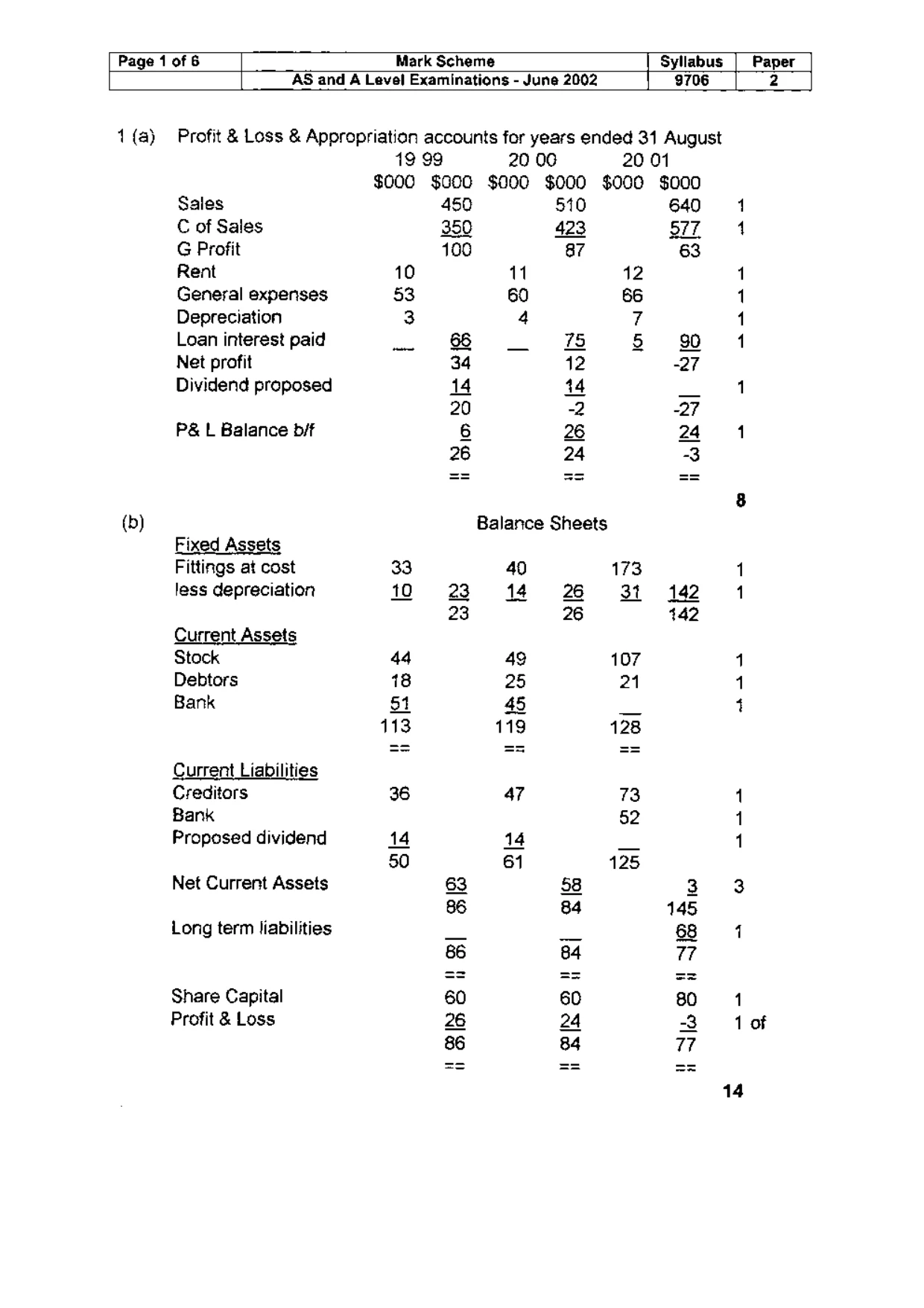
Page 1 of 6 Mark Scheme Syllabus Paper | AS and A Level Examinations - June 2002 9706 1 (a) (b) Profit & Loss & Appropriation accounts for years ended 31 August Sales C of Sales G Profit Rent General expenses Depreciation Loan interest paid Net profit Dividend proposed P& L Balance b/f Fixed Assets Fittings at cost less depreciation Current Assets Stock Debtors Bank Current Liabilities Creditors Bank Proposed dividend Net Current Assets Long term liabilities Share Capital Profit & Loss 19 99 20 06 20 01 $000 $600 $000 $000 $000 $000 450 510 640 350 423 S77 100 87 63 10 1 12 53 60 66 3 4 7 —~ &6 _ ® § 34 12 -27 14 44 _ 20 -2 -27 6 26 24 26 24 -3 Balance Sheets 33 40 173 10 23 14 26 31 442 23 26 142 44 49 107 18 25 21 54 45 _ 113 119 128 36 47 73 §2 14 14 _ 50 61 125 63 58 3 86 84 145 _ _ 88 86 84 77 60 60 80 26 24 3 86 84 77 14
Mark scheme, page 4
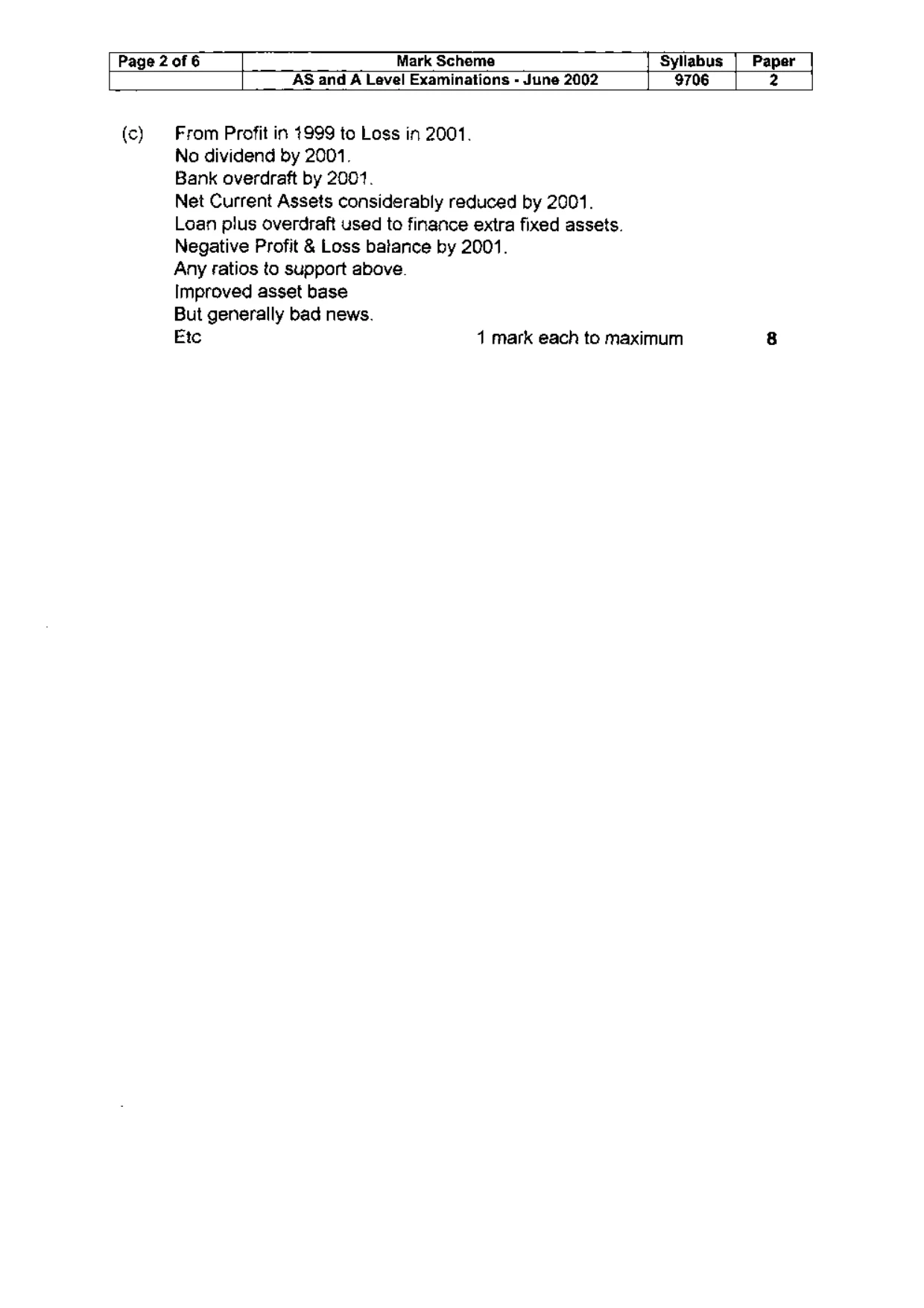
Page 2 of 6 Mark Scheme | Syllabus | Paper AS and A Level Examinations - June 2002 | 9706 2 (c) | From Profit in +999 to Loss in 2001. No dividend by 2001. Bank overdraft by 2001. Net Current Assets considerably reduced by 2001. Loan plus overdraft used to finance extra fixed assets. Negative Profit & Loss batance by 2001. Any ratios to support above. Improved asset base But generally bad news. Etc 1 mark each to maximum 8
Mark scheme, page 5
Page 3 of 6 Mark Scheme Syllabus Paper AS and A Level Examinations - June 2002 9706 2 2 (a) FIFO Date in Out Balance P V(S) Q Q PKS) January 280 65 18 200 280 65 18 200 February 140 140 65 9 100 March 100 69 6 900 100 69 6 900 April 190 50 69 3.450 May 220 72 15 840 270 72 19 440 1 June 200 70 72 5 040 1 $ $ $ $ Sales 140 82 11 480 190 85 16 150 200 90 18 900 45 630 3 Less Cost of Sales Purchases 40 940 les C/Stock 5040 35900 1 Profit 9730 4 a) (b) LIFO Date In Out Batance P US) Q Q PVCS) January 280 65 18 200 280 65 418 200 February 140 140 65 9 100 March 100 69 6 900 100 69 6 900 April 190 50 65 3250 May 220 72 15 840 220 72 15 840 dune 200 $0 65 3 250 20 72 1440 70 4690 2 $ $ $ Sales 140 $ 82 11.480 190 85 16 150 200 90 18 000 45 630 Less Cost of Sales Purchases 40 940 les C/Stock 4690 36 250 1 Profit 9.380 1
Mark scheme, page 6
Page 4 of 6 Mark Scheme Syllabus Paper AS and A Level Examinations - June 2002 9706 2 {) AVEO Date {n Out Balance Q PS) Q Q PMS) January 289 65 18 200 280 65 18 200 February 146 140 65 9100 March 106 69 6 900 100 69 6 900 240 67 16 000 Aprit 190 50 87 3334 May 220 72 1§ 840 220 72 15 846 270 71 19 174 June 200 70 71 4971 $ $ $ $ Sales 140 82 11 480 190 a5 16 150 200 30 18 000 45 630 Less Cost of Sales Purchases 40940 les C/Stock 4971 35 969 Profit 9 661 $ $ (d) Sales (original) 29 000 19 290000 Expenses (original) 87 000 Profit (original) 29 000 Old net profit ratio 10.00% 1 Sales (new) 31175 9 280575 Olstock 26 000 t 1 10F Purch 170 060 196 G00 Cistock 21.000 175 000 41 Gross Profit 105 575 Expenses 84 825 1 New Net Profit 20 750 1 of New Net Profit Ratio 7.40% 1 of {e) Janice reduced the selling price to such an extent that increased sales volume was sot sufficient to allow for an increase in gross profit. The lower expenses were not sufficient to bring the net profit back to its previous level. Etc One per statement to maximum {f} Altering methods of depreciation gives a false comparison fram one year to the next. Total expenses, and therefore profits, can easily be “massaged". True and fair view. Net book value of assets becomes meaningless. Prudence. Etc Consistency. One per statement to maximum {8} (3)
Mark scheme, page 7
Page 5 of 6 Mark Scheme Syllabus Paper AS and A Level Examinations - June 2002 9706 2 3 DATA Machine x Y Hourly cate of production 160 250 Material cost per unit $5.00 $4.60 Hourly labour rate $10 $10 Number of operatives 4 5 Fixed costs per order $200 $500 Variable unit costs $2.40 $2.60 {a) ORDER FOR 800 $ $ Labour cost 200 160 2 Materia! cost 4000 3680 2 Variable costs 1920 2080 2 Fixed costs 200 $00 2 Total costs 6320 6420 Machine X costs least, or OF. 1 (b) ORDER FOR 1000 Labour cost 250 200 2 Material cost 5000 4600 2 Variable costs 2400 2600 2 Fixed costs 200 500 Total costs 7850 7900 Machine X costs least, or OF. 1 (ce) Machine X $ Total variable costs 6120 1 Total costs 6320 1 Sales = 125% of total costs 7900 1 Contribution = Sales - VC 1780 1 Machine Y $ Total variable costs §920 1 Total costs 6420 1 Sales = 125% of total costs 8025 1 Contribution = Sales - VC 2105 1 (d) Rights issue A Saves on expense of a full public share issue. D May bring in less cash than a full public share issue. etc. (9) ( @)
Mark scheme, page 8
Page 6 of 6 Mark Scheme Syllabus | Paper AS and A Level Examinations - June 2002 9706 2 Issues of shares to the public A May be sold at a premium and bring in large cash fund. D Costs a great deal of money and no guarantee that all will be sold. etc. fssue of debentures A No control given to debenture holders. D Interest must be paid even if business is making a loss. etc. One advantage and one disadvantage for each to maximum (6)