Cambridge A Level Accounting 9706 — 2001 Oct/Nov Paper 2 · Variant 1
9706/21/O/N/01
The question paper and its mark scheme, free to read here and free to download. This is Cambridge’s own paper, exactly as it was sat.
Question paper12 pages
Mark scheme12 pages
Answers below. Sit the paper first if you are practising.




Paper as text
Question paper, page 1
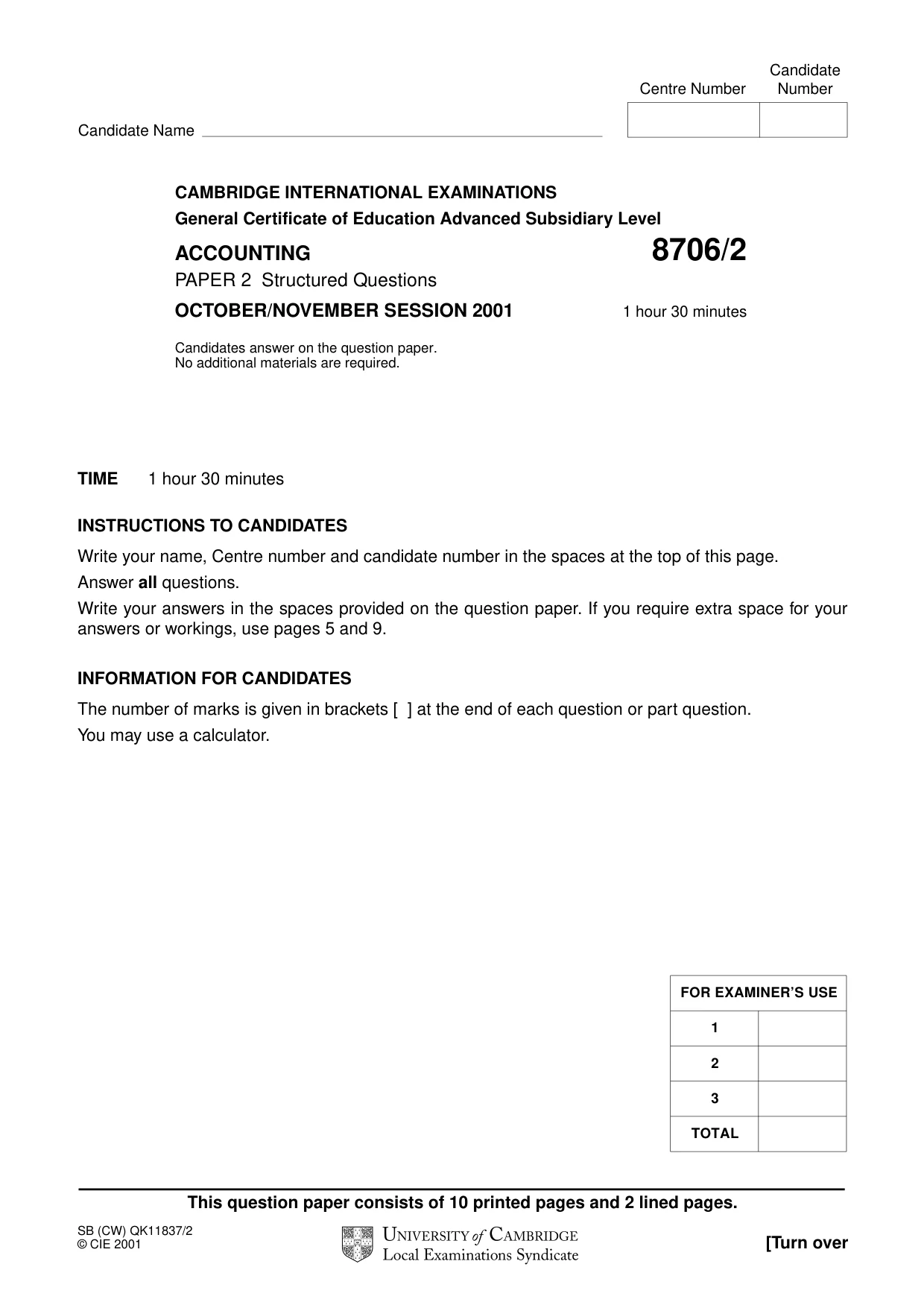
This question paper consists of 10 printed pages and 2 lined pages. SB (CW) QK11837/2 © CIE 2001 [Turn over CAMBRIDGE INTERNATIONAL EXAMINATIONS General Certificate of Education Advanced Subsidiary Level ACCOUNTING 8706/2 PAPER 2 Structured Questions OCTOBER/NOVEMBER SESSION 2001 1 hour 30 minutes Candidates answer on the question paper. No additional materials are required. TIME 1 hour 30 minutes INSTRUCTIONS TO CANDIDATES Write your name, Centre number and candidate number in the spaces at the top of this page. Answer all questions. Write your answers in the spaces provided on the question paper. If you require extra space for your answers or workings, use pages 5 and 9. INFORMATION FOR CANDIDATES The number of marks is given in brackets [ ] at the end of each question or part question. You may use a calculator. Candidate Centre Number Number Candidate Name FOR EXAMINER’S USE 1 2 3 TOTAL
Question paper, page 2
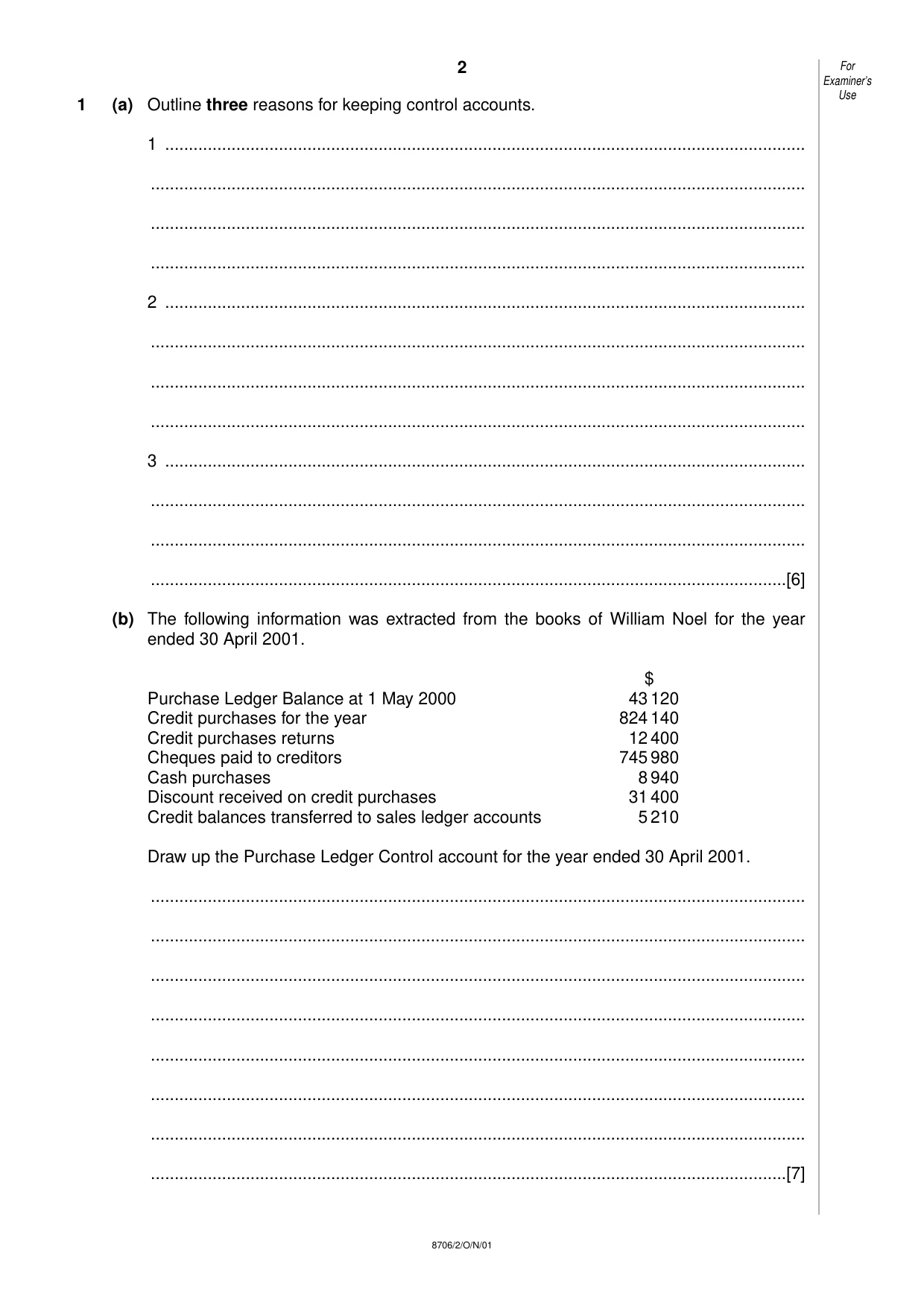
2 8706/2/O/N/01 1 (a) Outline three reasons for keeping control accounts. 1 … … … … 2 … … … … 3 … … … …[6] (b) The following information was extracted from the books of William Noel for the year ended 30 April 2001. $ Purchase Ledger Balance at 1 May 2000 43 120 Credit purchases for the year 824 140 Credit purchases returns 12 400 Cheques paid to creditors 745 980 Cash purchases 8 940 Discount received on credit purchases 31 400 Credit balances transferred to sales ledger accounts 5 210 Draw up the Purchase Ledger Control account for the year ended 30 April 2001. … … … … … … … …[7] For Examiner’s Use
Question paper, page 3
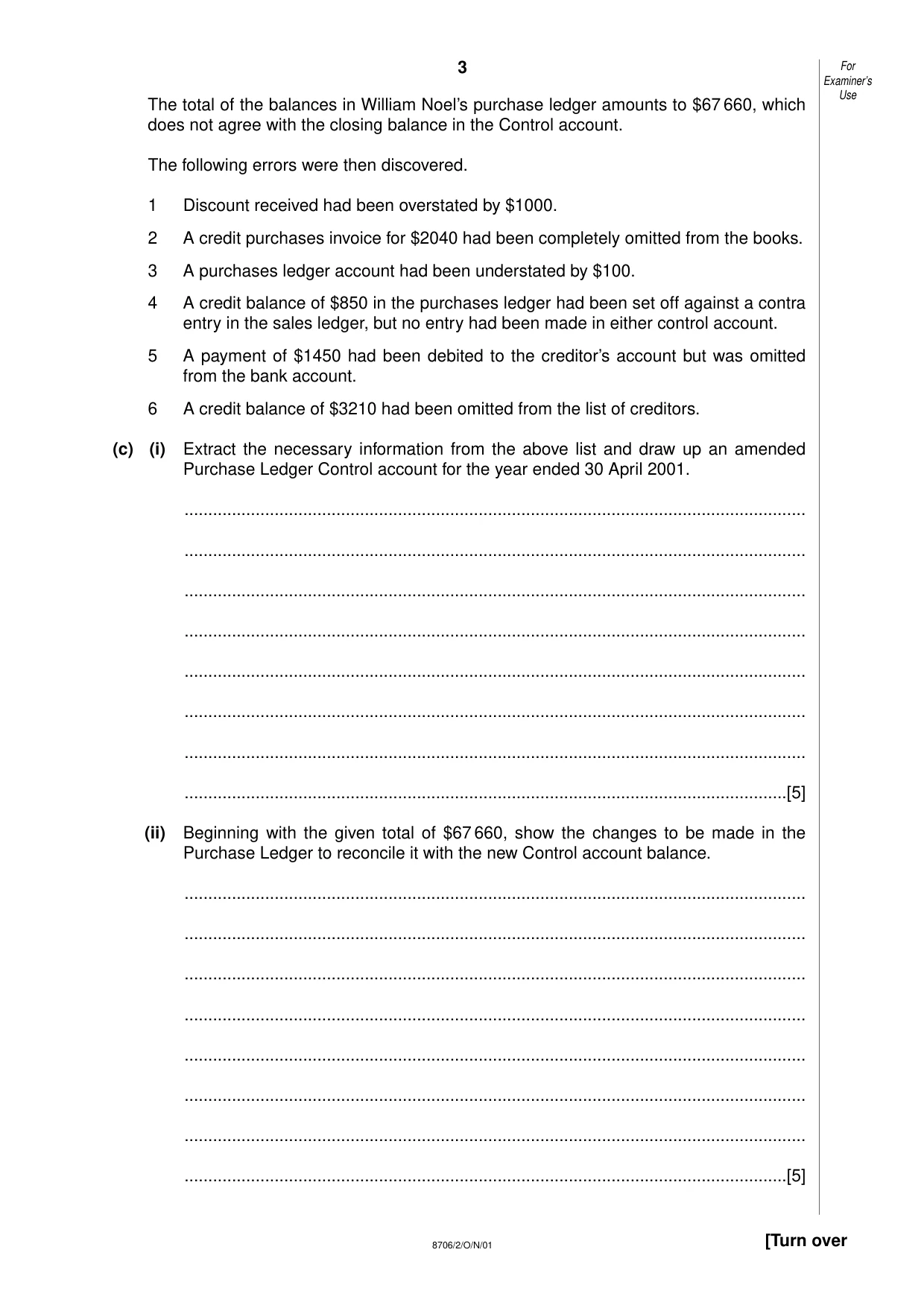
3 8706/2/O/N/01 [Turn over The total of the balances in William Noel’s purchase ledger amounts to $67 660, which does not agree with the closing balance in the Control account. The following errors were then discovered. 1 Discount received had been overstated by $1000. 2 A credit purchases invoice for $2040 had been completely omitted from the books. 3 A purchases ledger account had been understated by $100. 4 A credit balance of $850 in the purchases ledger had been set off against a contra entry in the sales ledger, but no entry had been made in either control account. 5 A payment of $1450 had been debited to the creditor’s account but was omitted from the bank account. 6 A credit balance of $3210 had been omitted from the list of creditors. (c) (i) Extract the necessary information from the above list and draw up an amended Purchase Ledger Control account for the year ended 30 April 2001. … … … … … … … …[5] (ii) Beginning with the given total of $67 660, show the changes to be made in the Purchase Ledger to reconcile it with the new Control account balance. … … … … … … … …[5] For Examiner’s Use
Question paper, page 4
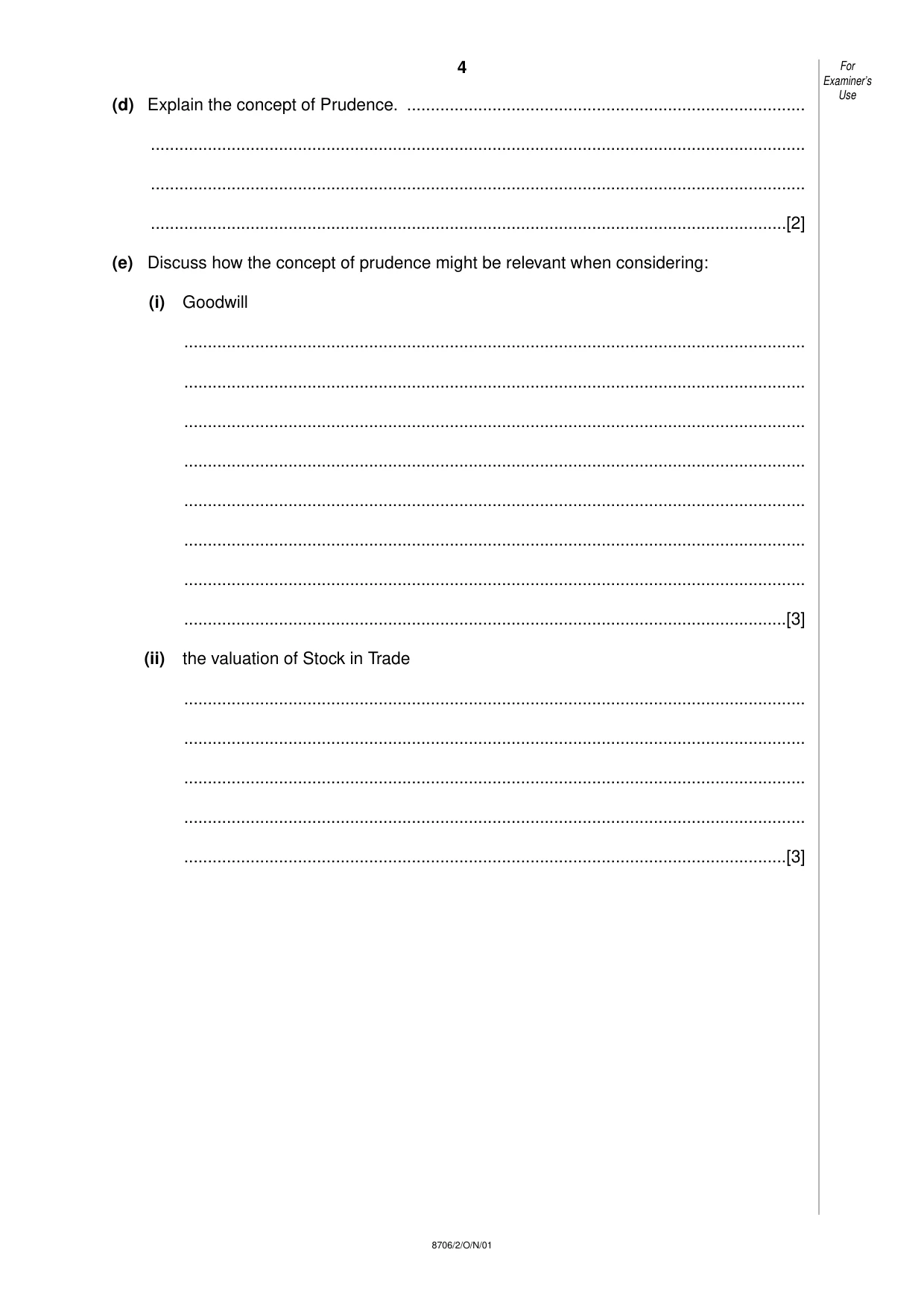
4 8706/2/O/N/01 (d) Explain the concept of Prudence. … … … …[2] (e) Discuss how the concept of prudence might be relevant when considering: (i) Goodwill … … … … … … … …[3] (ii) the valuation of Stock in Trade … … … … …[3] For Examiner’s Use
Question paper, page 5
5 8706/2/O/N/01 [Turn over … … … … … … … … … … … … … … … … … … … … … … … … … … … … For Examiner’s Use
Question paper, page 6
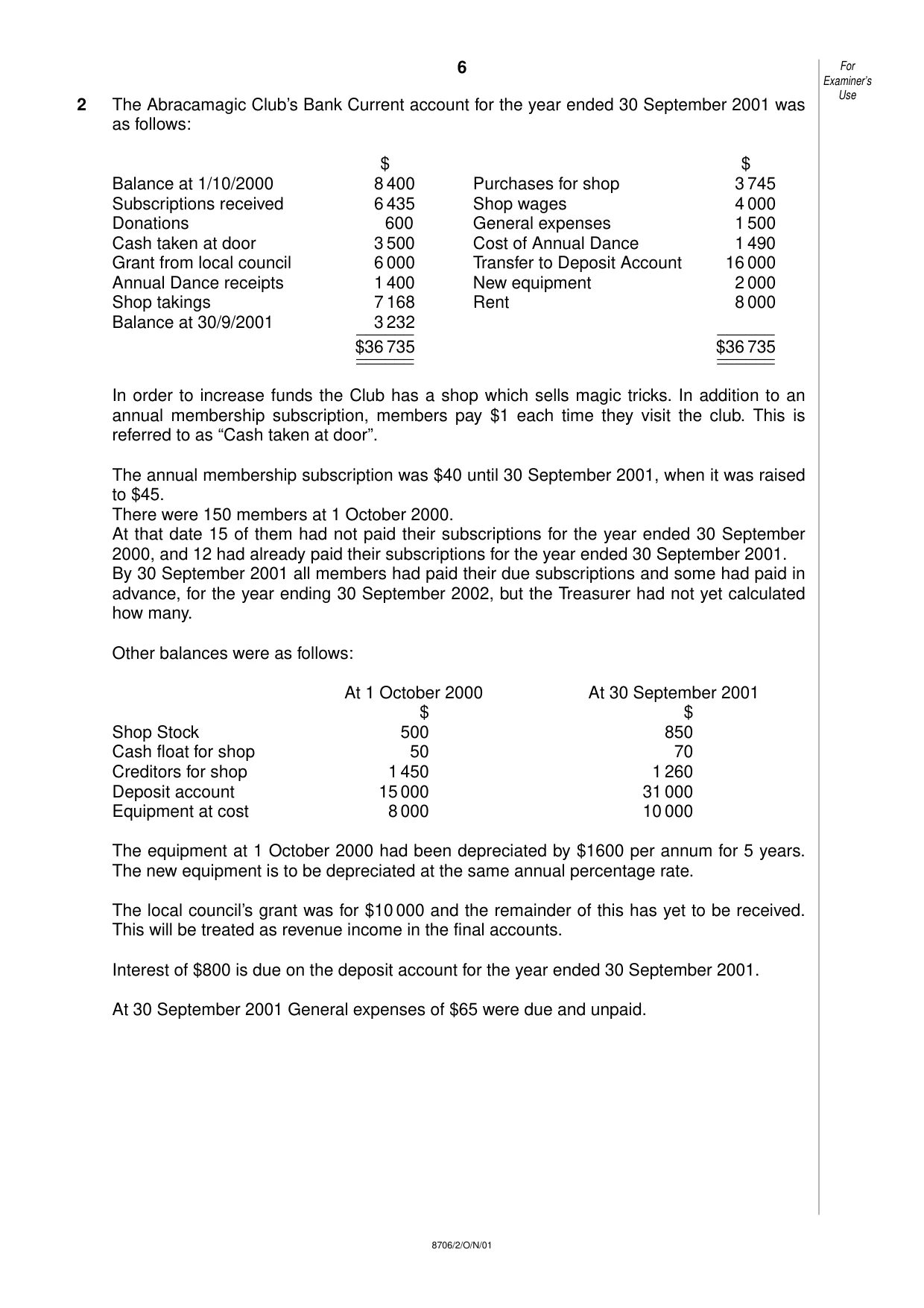
6 8706/2/O/N/01 2 The Abracamagic Club’s Bank Current account for the year ended 30 September 2001 was as follows: $ $ Balance at 1/10/2000 8 400 Purchases for shop 3 745 Subscriptions received 6 435 Shop wages 4 000 Donations 600 General expenses 1 500 Cash taken at door 3 500 Cost of Annual Dance 1 490 Grant from local council 6 000 Transfer to Deposit Account 16 000 Annual Dance receipts 1 400 New equipment 2 000 Shop takings 7 168 Rent 8 000 Balance at 30/9/2001 3 232 ______ ______ $36 735 $36 735 ______ ______ ______ ______ In order to increase funds the Club has a shop which sells magic tricks. In addition to an annual membership subscription, members pay $1 each time they visit the club. This is referred to as “Cash taken at door”. The annual membership subscription was $40 until 30 September 2001, when it was raised to $45. There were 150 members at 1 October 2000. At that date 15 of them had not paid their subscriptions for the year ended 30 September 2000, and 12 had already paid their subscriptions for the year ended 30 September 2001. By 30 September 2001 all members had paid their due subscriptions and some had paid in advance, for the year ending 30 September 2002, but the Treasurer had not yet calculated how many. Other balances were as follows: At 1 October 2000 At 30 September 2001 $ $ Shop Stock 500 850 Cash float for shop 50 70 Creditors for shop 1 450 1 260 Deposit account 15 000 31 000 Equipment at cost 8 000 10 000 The equipment at 1 October 2000 had been depreciated by $1600 per annum for 5 years. The new equipment is to be depreciated at the same annual percentage rate. The local council’s grant was for $10 000 and the remainder of this has yet to be received. This will be treated as revenue income in the final accounts. Interest of $800 is due on the deposit account for the year ended 30 September 2001. At 30 September 2001 General expenses of $65 were due and unpaid. For Examiner’s Use
Question paper, page 7
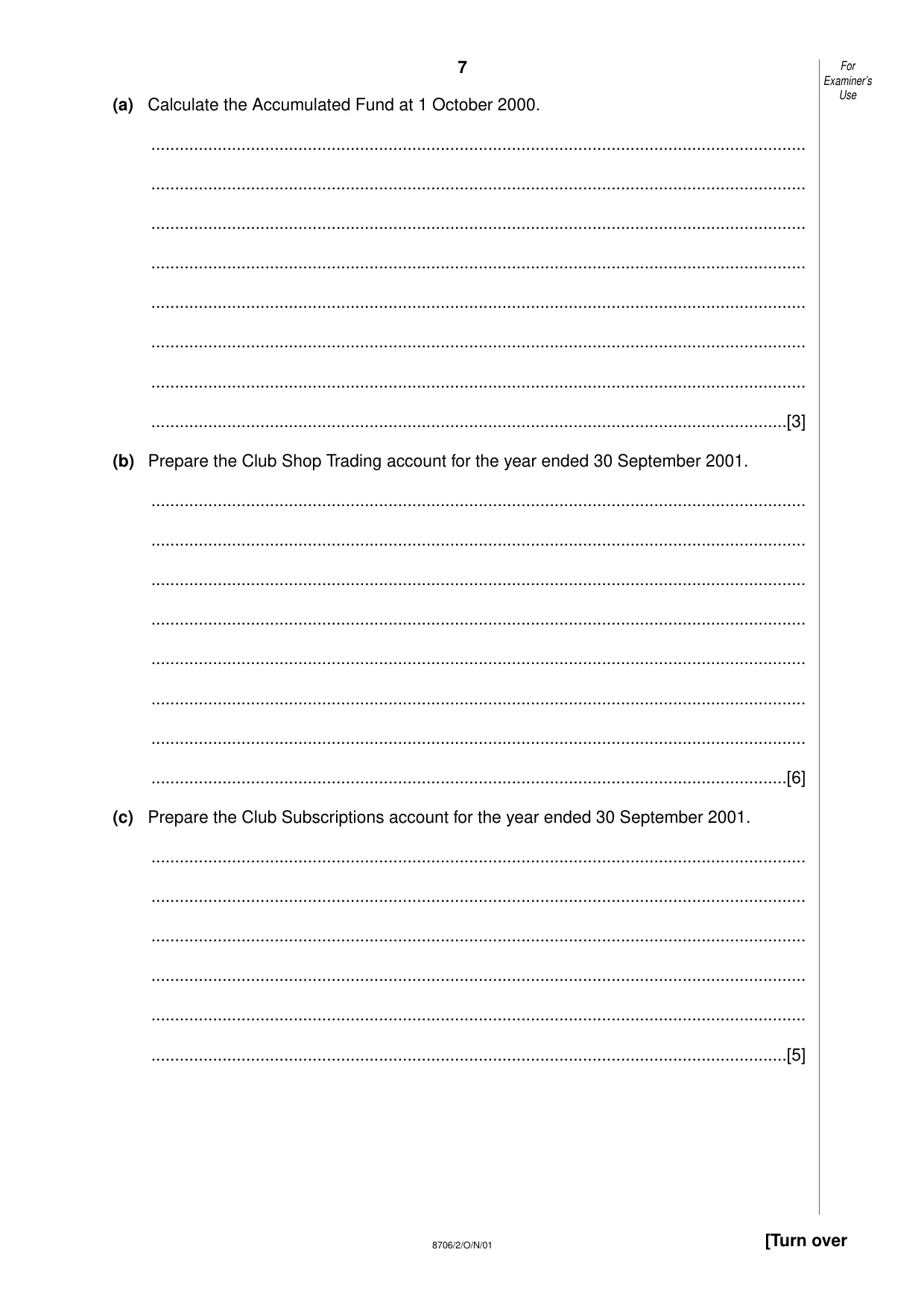
7 8706/2/O/N/01 [Turn over (a) Calculate the Accumulated Fund at 1 October 2000. … … … … … … … …[3] (b) Prepare the Club Shop Trading account for the year ended 30 September 2001. … … … … … … … …[6] (c) Prepare the Club Subscriptions account for the year ended 30 September 2001. … … … … … …[5] For Examiner’s Use
Question paper, page 8
8 8706/2/O/N/01 (d) Prepare the Club Income and Expenditure account for the year ended 30 September 2001. … … … … … … … … … … … … … … … … … … …[16] For Examiner’s Use
Question paper, page 9
9 8706/2/O/N/01 [Turn over … … … … … … … … … … … … … … … … … … … … … … … … … … … … For Examiner’s Use
Question paper, page 10
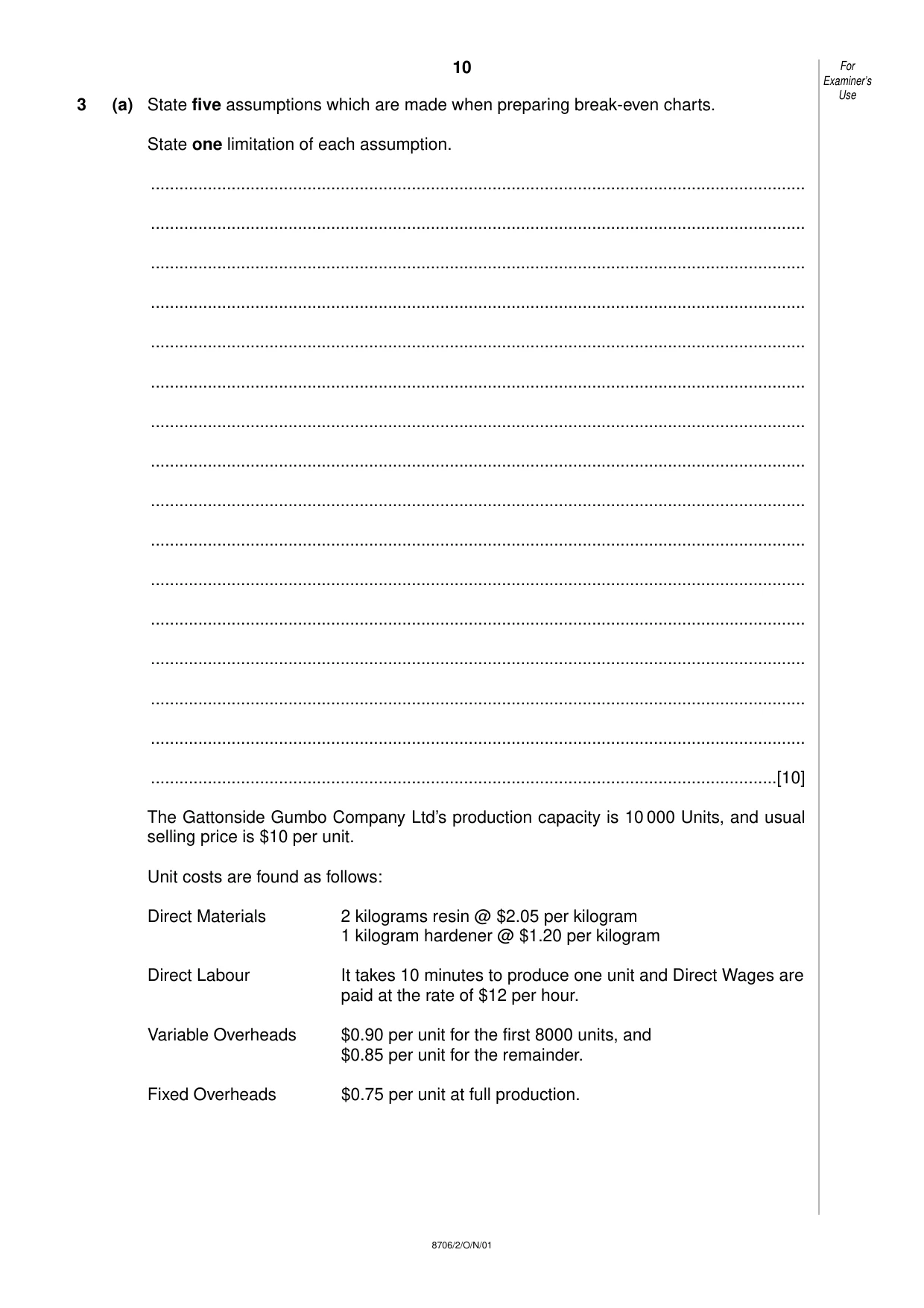
10 8706/2/O/N/01 3 (a) State five assumptions which are made when preparing break-even charts. State one limitation of each assumption. … … … … … … … … … … … … … … … …[10] The Gattonside Gumbo Company Ltd’s production capacity is 10 000 Units, and usual selling price is $10 per unit. Unit costs are found as follows: Direct Materials 2 kilograms resin @ $2.05 per kilogram 1 kilogram hardener @ $1.20 per kilogram Direct Labour It takes 10 minutes to produce one unit and Direct Wages are paid at the rate of $12 per hour. Variable Overheads $0.90 per unit for the first 8000 units, and $0.85 per unit for the remainder. Fixed Overheads $0.75 per unit at full production. For Examiner’s Use
Question paper, page 11
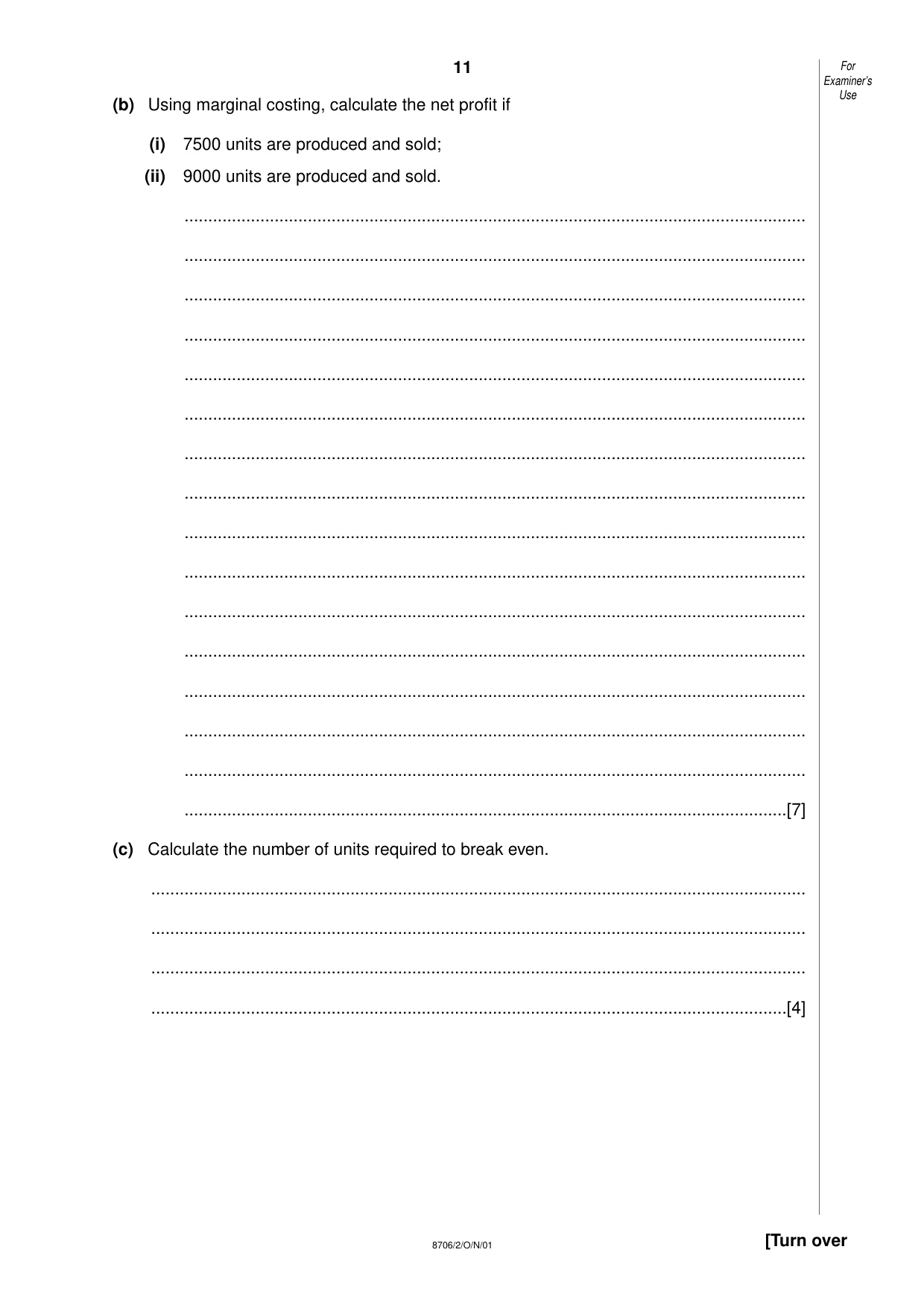
11 8706/2/O/N/01 [Turn over (b) Using marginal costing, calculate the net profit if (i) 7500 units are produced and sold; (ii) 9000 units are produced and sold. … … … … … … … … … … … … … … … …[7] (c) Calculate the number of units required to break even. … … … …[4] For Examiner’s Use
Question paper, page 12
12 8706/2/O/N/01 (d) Calculate the expected profit at full production capacity assuming all production is sold, if selling price is reduced to $9 per unit. … … … … … … … … … … … …[4] (e) Comment on the possible advantages and disadvantages of lowering a selling price. … … … … … … … … … …[4] For Examiner’s Use
Mark scheme, page 1
CAMBRIDGE INTERNATIONAL EXAMINATIONS CAMBRIDGE INTERNATIONAL EXAMINATIONS GCE Advanced Subsidiary Level MARK SCHEME FOR the November 2001 question papers 8706 ACCOUNTING 8706/1 Paper 1 (Multiple Choice), maximum raw mark 30 8706/2 Paper 2 (Structured questions), maximum raw mark 90 These mark schemes are published as an aid to teachers and students, to indicate the requirements of the examination. They show the basis on which Examiners were initially instructed to award marks. They do not indicate the details of the discussions that took place at an Examiners’ meeting before marking began. Any substantial changes to the mark scheme that arose from these discussions will be recorded in the published Report on the Examination. All Examiners are instructed that alternative correct answers and unexpected approaches in candidates’ scripts must be given marks that fairly reflect the relevant knowledge and _ skills demonstrated. Mark schemes must be read in conjunction with the question papers and the Report on the Examination. . CIE will not enter into discussions or correspondence in connection with these mark schemes. CIE is publishing the mark schemes for the November 2001 question papers for most IGCSE and GCE Advanced Subsidiary (AS) Level syllabuses. UNIVERSITY of CAMBRIDGE Local Examinations Syndicate
Mark scheme, page 3
CAMBRIDGE INTERNATIONAL EXAMINATIONS NOVEMBER 2001 ADVANCED SUBSIDIARY LEVEL MARK SCHEME SYLLABUS/COMPONENT : 8706/1 ACCOUNTING (MULTIPLE CHOICE) 8 University of CAMBRIDGE 9) Local Examinations Syndicate
Mark scheme, page 4
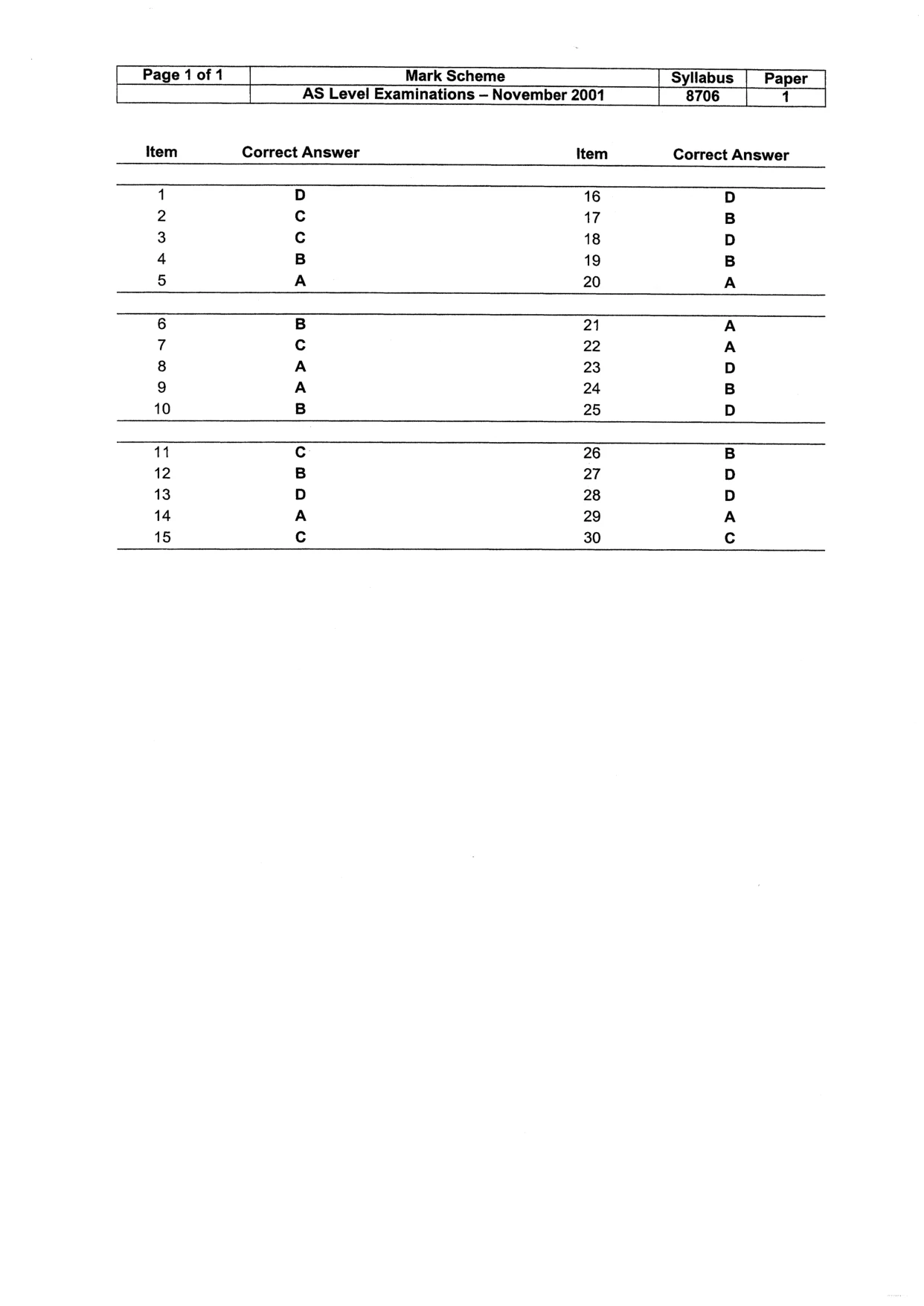
Page 1 of 1 Mark Scheme Syllabus Paper AS Level Examinations — November 2001 8706 1 Item Correct Answer Item Correct Answer 1 D 16 D 2 c 17 B 3 c 18 D 4 B 19 B 5 A 20 A 6 B 21 A 7 c 22 A 8 A 23 D 9 A 24 B 10 B 25 D 11 c 26 B 12 B 27 D 13 D 28 D 14 A 29 A 15 c 30 Cc
Mark scheme, page 5
CAMBRIDGE INTERNATIONAL EXAMINATIONS NOVEMBER 2001 ADVANCED SUBSIDIARY LEVEL MARK SCHEME SYLLABUS/COMPONENT : 8706/2 ACCOUNTING (STRUCTURED QUESTIONS) (839 University of CAMBRIDGE 9 Local Examinations Syndicate
Mark scheme, page 6
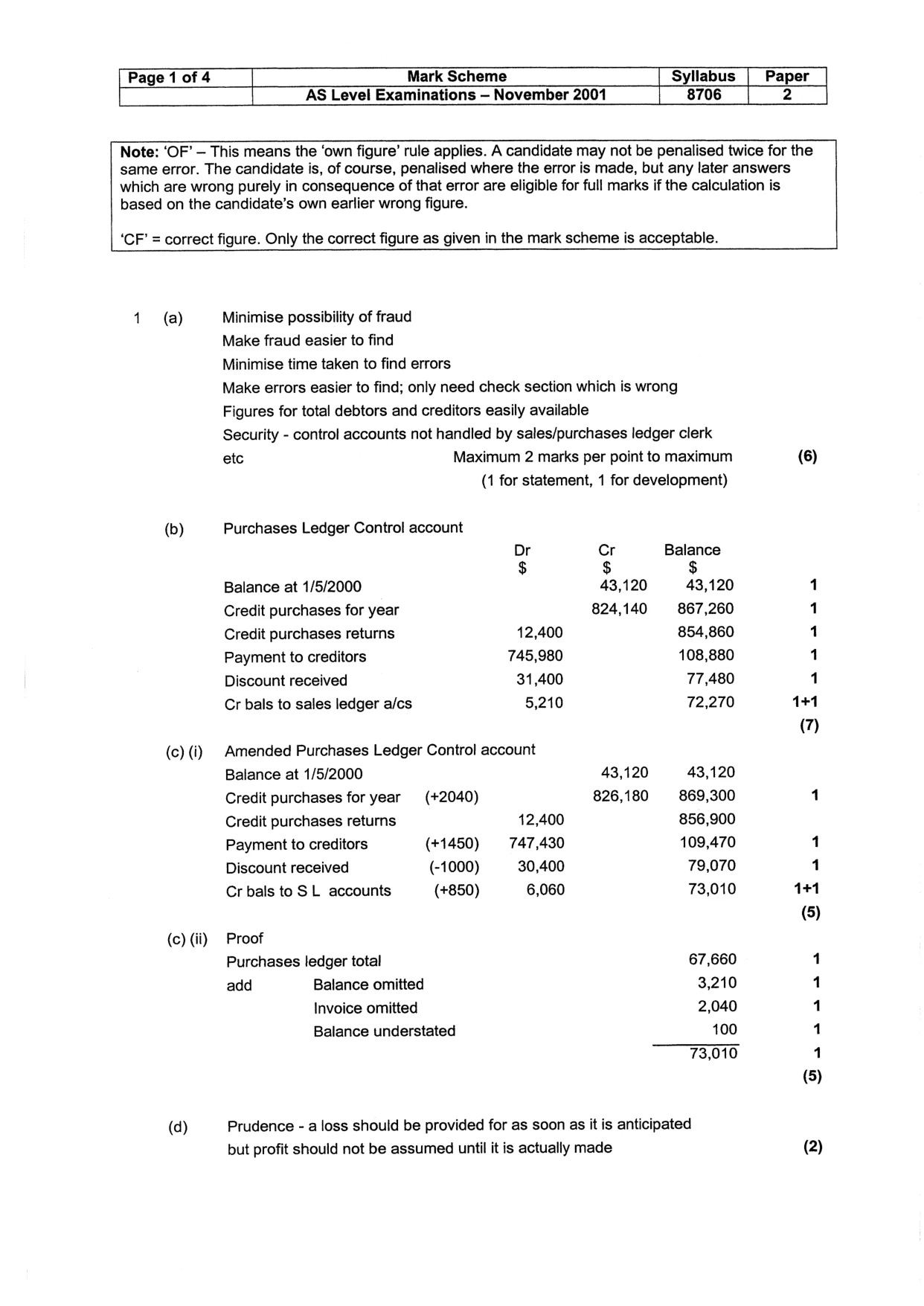
Page 1 of 4 Mark Scheme Syllabus Paper AS Level Examinations — November 2001 8706 2 Note: ‘OF’ — This means the ‘own figure’ rule applies. A candidate may not be penalised twice for the same error. The candidate is, of course, penalised where the error is made, but any later answers which are wrong purely in consequence of that error are eligible for full marks if the calculation is based on the candidate’s own earlier wrong figure. ‘CF’ = correct figure. Only the correct figure as given in the mark scheme is acceptable. (b) (c) (i) (c) (ii) (d) Minimise possibility of fraud Make fraud easier to find Minimise time taken to find errors Make errors easier to find; only need check section which is wrong Figures for total debtors and creditors easily available Security - control accounts not handled by sales/purchases ledger clerk etc Maximum 2 marks per point to maximum (1 for statement, 1 for development) Purchases Ledger Control account Dr $ Balance at 1/5/2000 Credit purchases for year Credit purchases returns 12,400 Payment to creditors 745,980 Discount received 31,400 Cr bals to sales ledger a/cs 5,210 Amended Purchases Ledger Control account Balance at 1/5/2000 Credit purchases for year (+2040) Credit purchases returns 12,400 Payment to creditors (+1450) 747,430 Discount received (-1000) 30,400 Cr bals to S L accounts (+850) 6,060 Proof Purchases ledger total add Balance omitted Invoice omitted Balance understated Cr 43,120 824,140 43,120 826,180 Balance $ 43,120 867,260 854,860 108,880 77,480 72,270 43,120 869,300 856,900 109,470 79,070 73,010 67,660 3,210 2,040 100 73,010 Prudence - a loss should be provided for as soon as it is anticipated but profit should not be assumed until it is actually made (6) asaaaa 141 (7) 441 (5) aaa aa (5) (2)
Mark scheme, page 7
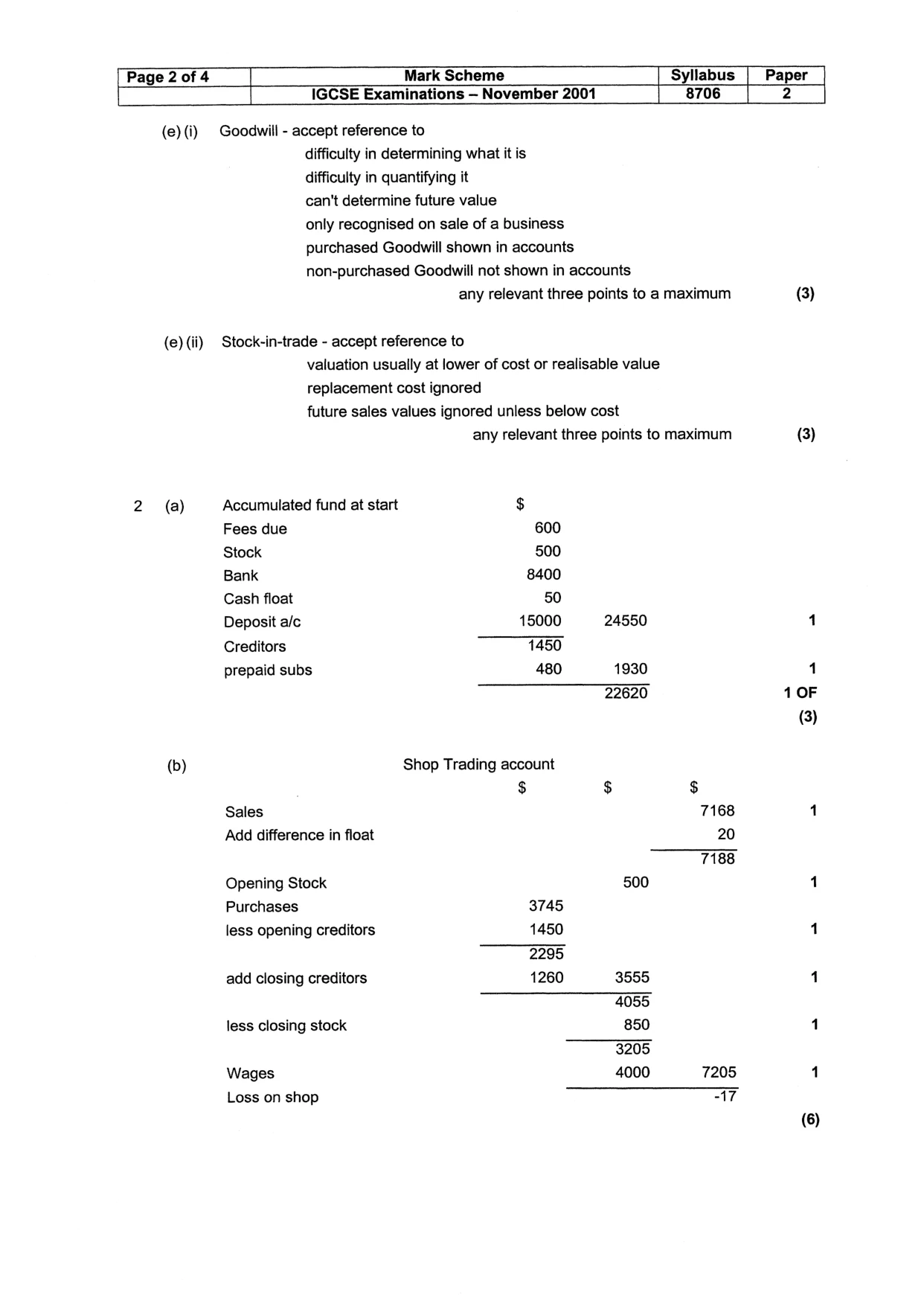
Page 2 of 4 Mark Scheme Syllabus Paper IGCSE Examinations — November 2001 8706 2 (e) (i) | Goodwill - accept reference to difficulty in determining what it is difficulty in quantifying it can't determine future value only recognised on sale of a business purchased Goodwill shown in accounts non-purchased Goodwill not shown in accounts any relevant three points to a maximum (3) (e) (ii) Stock-in-trade - accept reference to valuation usually at lower of cost or realisable value replacement cost ignored future sales values ignored unless below cost any relevant three points to maximum (3) 2 (a) Accumulated fund at start $ Fees due 600 Stock 500 Bank 8400 Cash float 50 Deposit a/c 15000 24550 1 Creditors ~~ 1450 prepaid subs 480 1930 1 22620 1 OF (3) (b) Shop Trading account $ $ $ Sales 7168 1 Add difference in float 20 7188 Opening Stock 500 1 Purchases 3745 less opening creditors 1450 1 2295 add closing creditors 1260 3555 1 4055 less closing stock 850 1 “3205 Wages 4000 7205 1 Loss on shop -17 (6)
Mark scheme, page 8
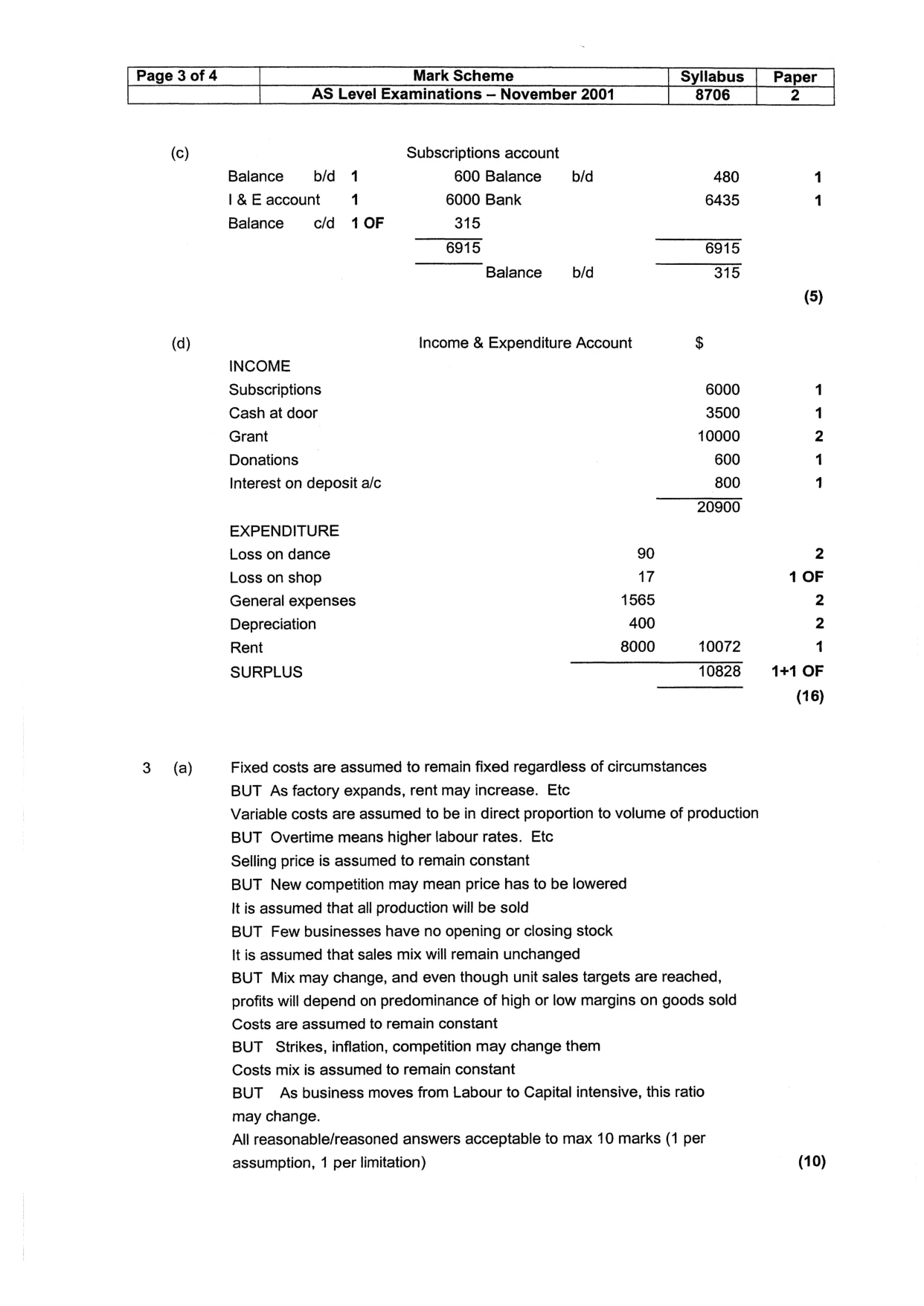
Page 3 of 4 Mark Scheme Syllabus | Paper AS Level Examinations — November 2001 8706 2 (c) Subscriptions account Balance bid 1 600 Balance b/d 480 1 |!&Eaccount 1 6000 Bank 6435 1 Balance c/d 10OF 315 ~~ 6915, 6915 Balance b/d ~~ 315 (5) (d) Income & Expenditure Account $ INCOME Subscriptions 6000 1 Cash at door 3500 1 Grant 10000 2 Donations 600 1 Interest on deposit a/c 800 1 “20900 EXPENDITURE Loss on dance 90 2 Loss on shop 17 1 OF General expenses 1565 2 Depreciation 400 2 Rent 8000 10072 1 SURPLUS 10828 1+1 OF (18) 3 (a) Fixed costs are assumed to remain fixed regardless of circumstances BUT As factory expands, rent may increase. Etc Variable costs are assumed to be in direct proportion to volume of production BUT Overtime means higher labour rates. Etc Selling price is assumed to remain constant BUT New competition may mean price has to be lowered It is assumed that all production will be sold BUT Few businesses have no opening or closing stock It is assumed that sales mix will remain unchanged BUT Mix may change, and even though unit sales targets are reached, profits will depend on predominance of high or low margins on goods sold Costs are assumed to remain constant BUT Strikes, inflation, competition may change them Costs mix is assumed to remain constant BUT As business moves from Labour to Capital intensive, this ratio may change. All reasonable/reasoned answers acceptable to max 10 marks (1 per assumption, 1 per limitation) (10)
Mark scheme, page 9
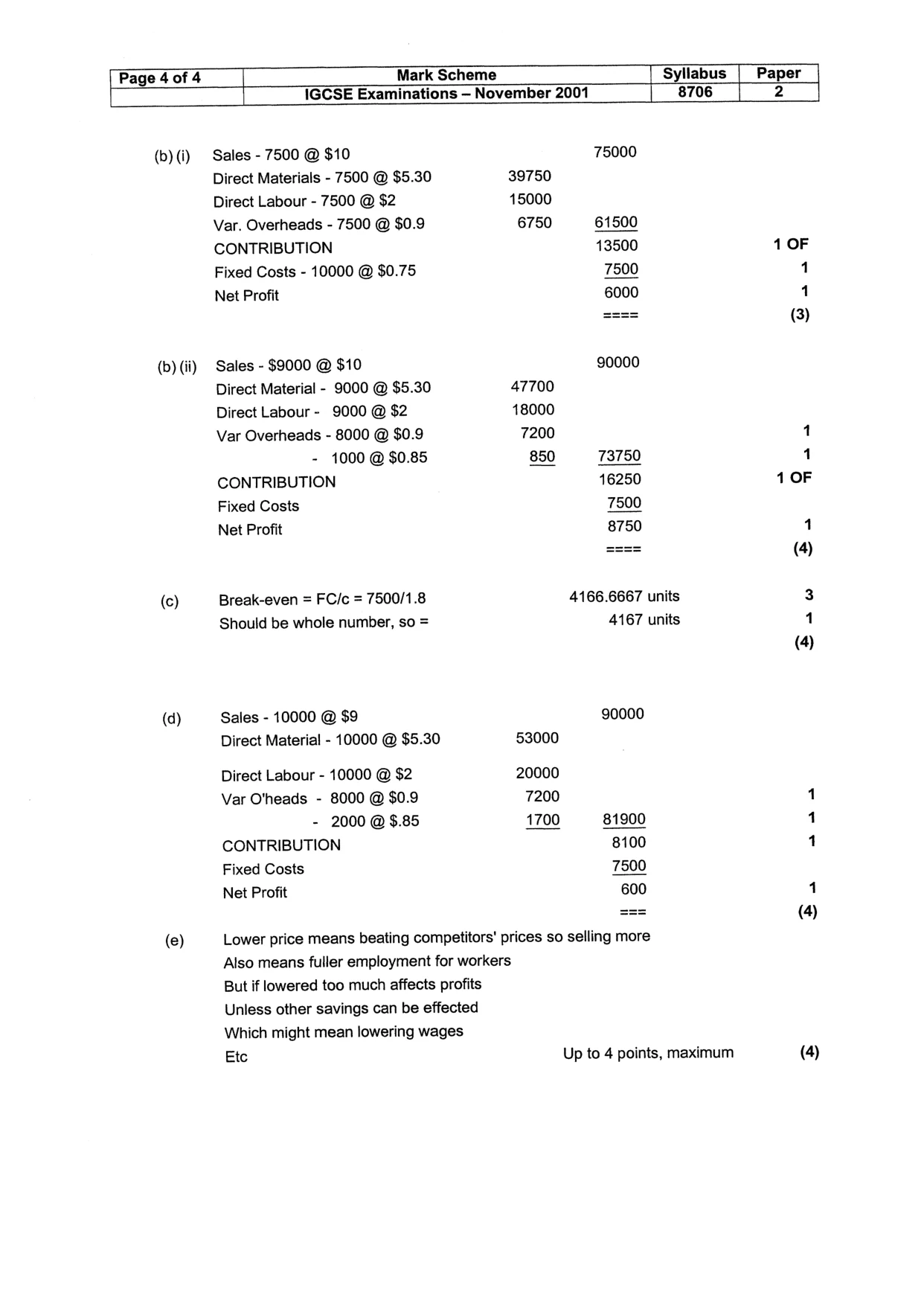
Page 4 of 4 Mark Scheme Syllabus Paper IGCSE Examinations — November 2001 8706 2 (b)(i) Sales - 7500 @ $10 75000 Direct Materials - 7500 @ $5.30 39750 Direct Labour - 7500 @ $2 15000 Var. Overheads - 7500 @ $0.9 6750 61500 CONTRIBUTION 13500 1 OF Fixed Costs - 10000 @ $0.75 7500 1 Net Profit 6000 1 (3) (b) (ii) Sales - $9000 @ $10 90000 Direct Material - 9000 @ $5.30 47700 Direct Labour - 9000 @ $2 18000 Var Overheads - 8000 @ $0.9 7200 1 - 1000 @ $0.85 850 73750 1 CONTRIBUTION 16250 1 OF Fixed Costs 7500 Net Profit 1 (4) (c) Break-even = FC/c = 7500/1.8 4166.6667 units 3 Should be whole number, so = 4167 units 1 (4) (d) Sales - 10000 @ $9 90000 Direct Material - 10000 @ $5.30 53000 Direct Labour - 10000 @ $2 20000 Var O'heads - 8000 @ $0.9 7200 1 - 2000 @ $.85 1700 81900 1 CONTRIBUTION 8100 Fixed Costs 7500 Net Profit 600 1 (4) (e) Lower price means beating competitors’ prices so selling more Also means fuller employment for workers But if lowered too much affects profits Unless other savings can be effected Which might mean lowering wages Etc Up to 4 points, maximum (4)