Cambridge IGCSE Twenty-First Century Science 0608 — 2013 Oct/Nov Paper 3 · Variant 1
0608/31/O/N/13
The question paper and its mark scheme, free to read here and free to download. This is Cambridge’s own paper, exactly as it was sat.
Question paper16 pages
Mark scheme5 pages
Answers below. Sit the paper first if you are practising.
Paper as text
Question paper, page 1
This document consists of 16 printed pages. DC (LEG/JG) 65054/2 © UCLES 2013 [Turn over UNIVERSITY OF CAMBRIDGE INTERNATIONAL EXAMINATIONS International General Certificate of Secondary Education * 3 4 5 8 3 4 6 8 8 7 * TWENTY FIRST CENTURY SCIENCE 0608/03 Paper 3 October/November 2013 1 hour 30 minutes Candidates answer on the Question Paper. No Additional Materials are required. READ THESE INSTRUCTIONS FIRST Write your Centre number, candidate number and name on all the work you hand in. Write in dark blue or black pen. You may use a pencil for any diagrams or graphs. Do not use staples, paper clips, highlighters, glue or correction fluid. DO NOT WRITE IN ANY BARCODES. Answer all questions. Electronic calculators may be used. At the end of the examination, fasten all your work securely together. The number of marks is given in brackets [ ] at the end of each question or part question. www.XtremePapers.com
Question paper, page 2
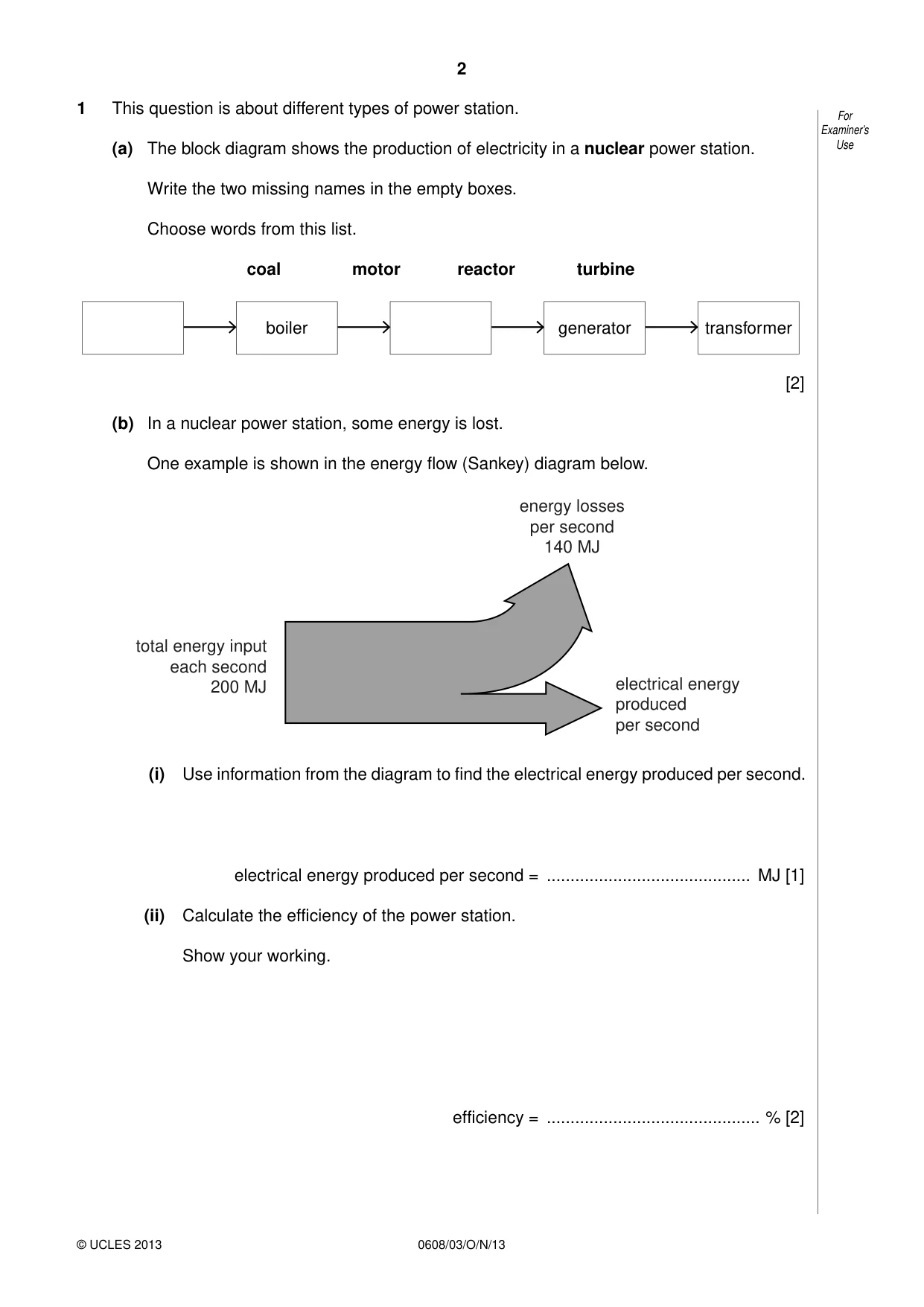
2 0608/03/O/N/13 © UCLES 2013 For Examiner’s Use 1 This question is about different types of power station. (a) The block diagram shows the production of electricity in a nuclear power station. Write the two missing names in the empty boxes. Choose words from this list. coal motor reactor turbine boiler generator transformer [2] (b) In a nuclear power station, some energy is lost. One example is shown in the energy flow (Sankey) diagram below. energy losses per second 140 MJ total energy input each second 200 MJ electrical energy produced per second (i) Use information from the diagram to find the electrical energy produced per second. electrical energy produced per second = … MJ [1] (ii) Calculate the efficiency of the power station. Show your working. efficiency = … % [2]
Question paper, page 3
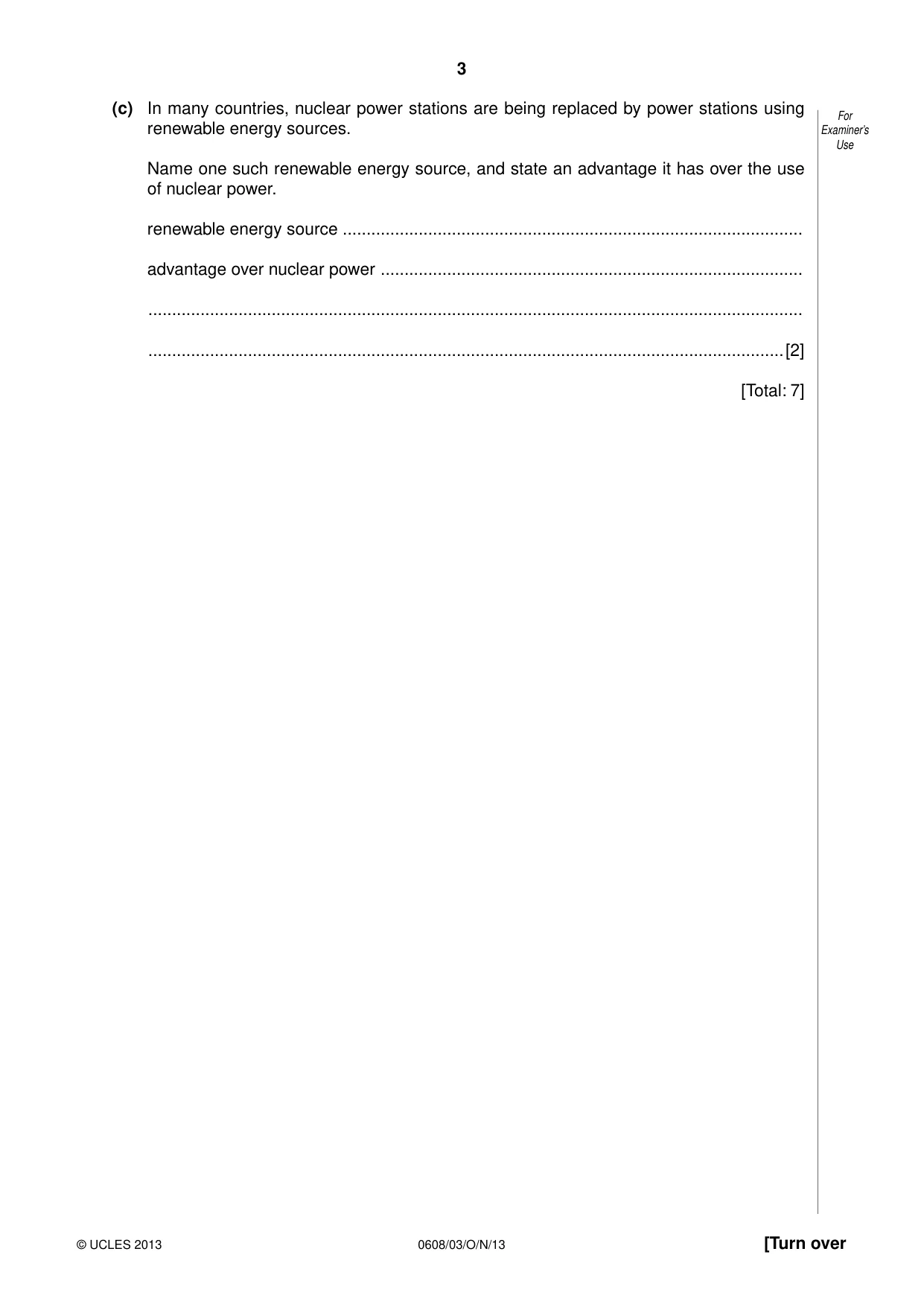
3 0608/03/O/N/13 © UCLES 2013 [Turn over For Examiner’s Use (c) In many countries, nuclear power stations are being replaced by power stations using renewable energy sources. Name one such renewable energy source, and state an advantage it has over the use of nuclear power. renewable energy source … advantage over nuclear power … … …[2] [Total: 7]
Question paper, page 4
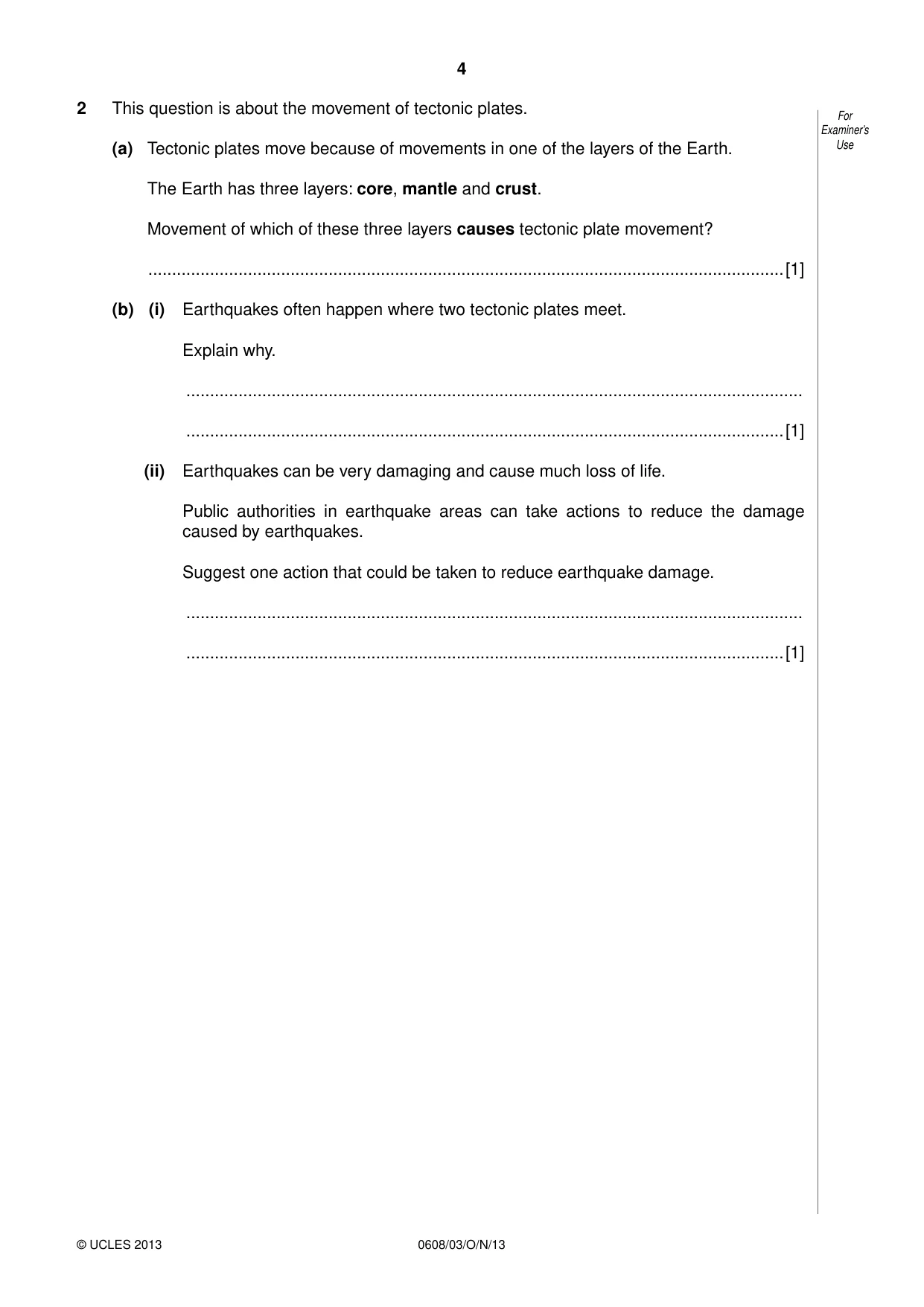
4 0608/03/O/N/13 © UCLES 2013 For Examiner’s Use 2 This question is about the movement of tectonic plates. (a) Tectonic plates move because of movements in one of the layers of the Earth. The Earth has three layers: core, mantle and crust. Movement of which of these three layers causes tectonic plate movement? …[1] (b) (i) Earthquakes often happen where two tectonic plates meet. Explain why. … …[1] (ii) Earthquakes can be very damaging and cause much loss of life. Public authorities in earthquake areas can take actions to reduce the damage caused by earthquakes. Suggest one action that could be taken to reduce earthquake damage. … …[1]
Question paper, page 5
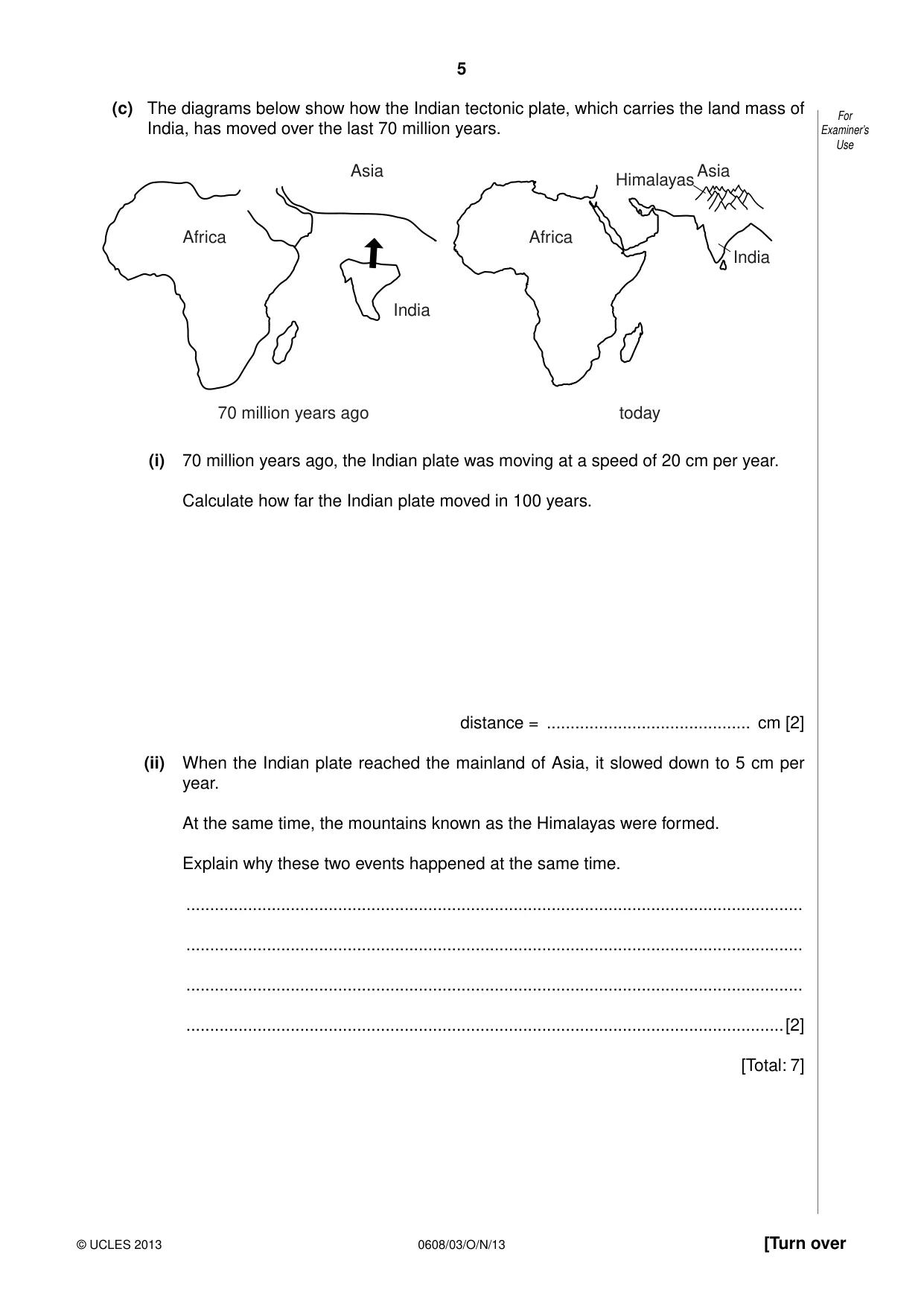
5 0608/03/O/N/13 © UCLES 2013 [Turn over For Examiner’s Use (c) The diagrams below show how the Indian tectonic plate, which carries the land mass of India, has moved over the last 70 million years. Africa Asia India 70 million years ago Africa Asia India today Himalayas (i) 70 million years ago, the Indian plate was moving at a speed of 20 cm per year. Calculate how far the Indian plate moved in 100 years. distance = … cm [2] (ii) When the Indian plate reached the mainland of Asia, it slowed down to 5 cm per year. At the same time, the mountains known as the Himalayas were formed. Explain why these two events happened at the same time. … … … …[2] [Total: 7]
Question paper, page 6
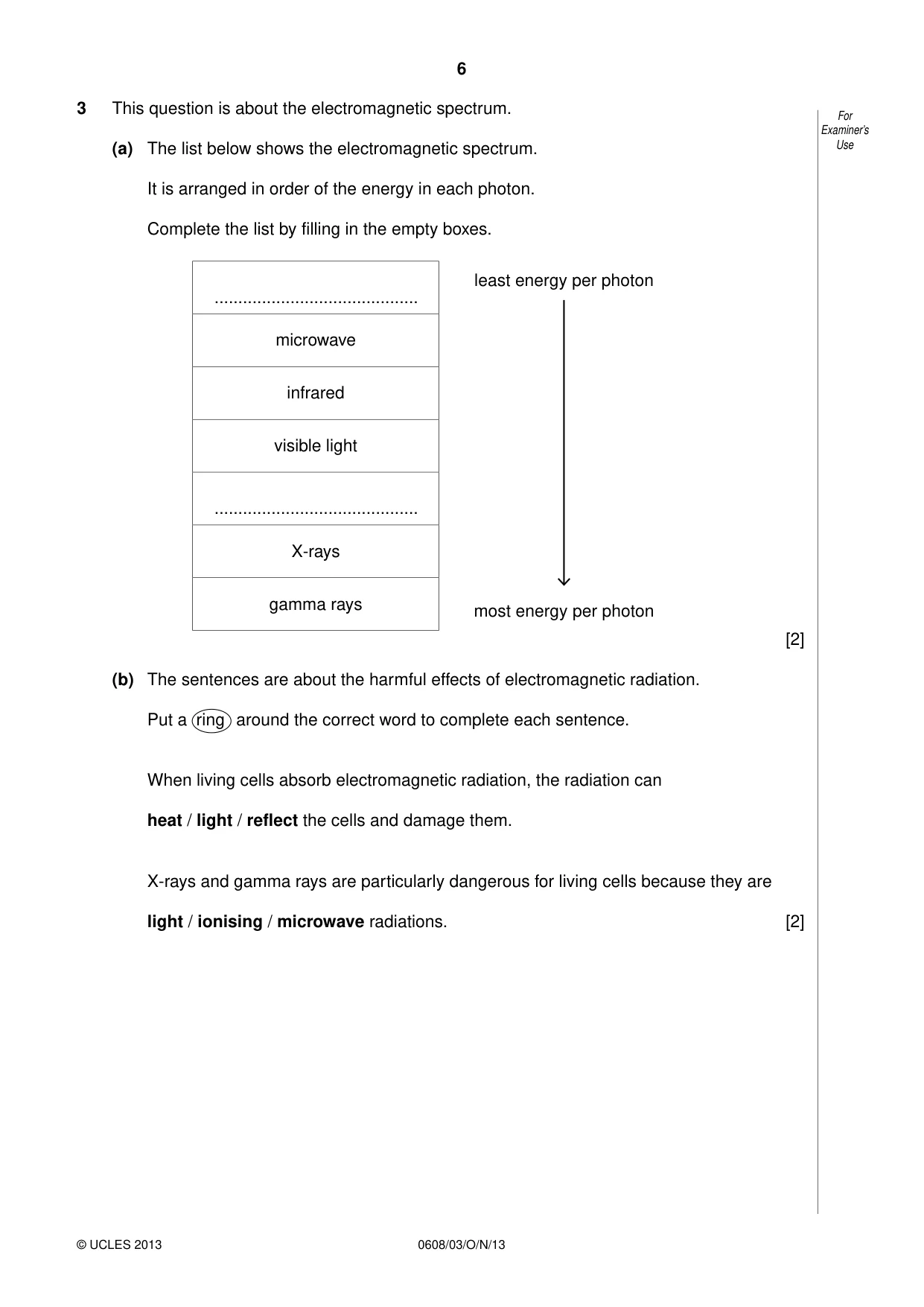
6 0608/03/O/N/13 © UCLES 2013 For Examiner’s Use 3 This question is about the electromagnetic spectrum. (a) The list below shows the electromagnetic spectrum. It is arranged in order of the energy in each photon. Complete the list by filling in the empty boxes. … least energy per photon most energy per photon microwave infrared visible light … X-rays gamma rays [2] (b) The sentences are about the harmful effects of electromagnetic radiation. Put a ring around the correct word to complete each sentence. When living cells absorb electromagnetic radiation, the radiation can heat / light / reflect the cells and damage them. X-rays and gamma rays are particularly dangerous for living cells because they are light / ionising / microwave radiations. [2]
Question paper, page 7
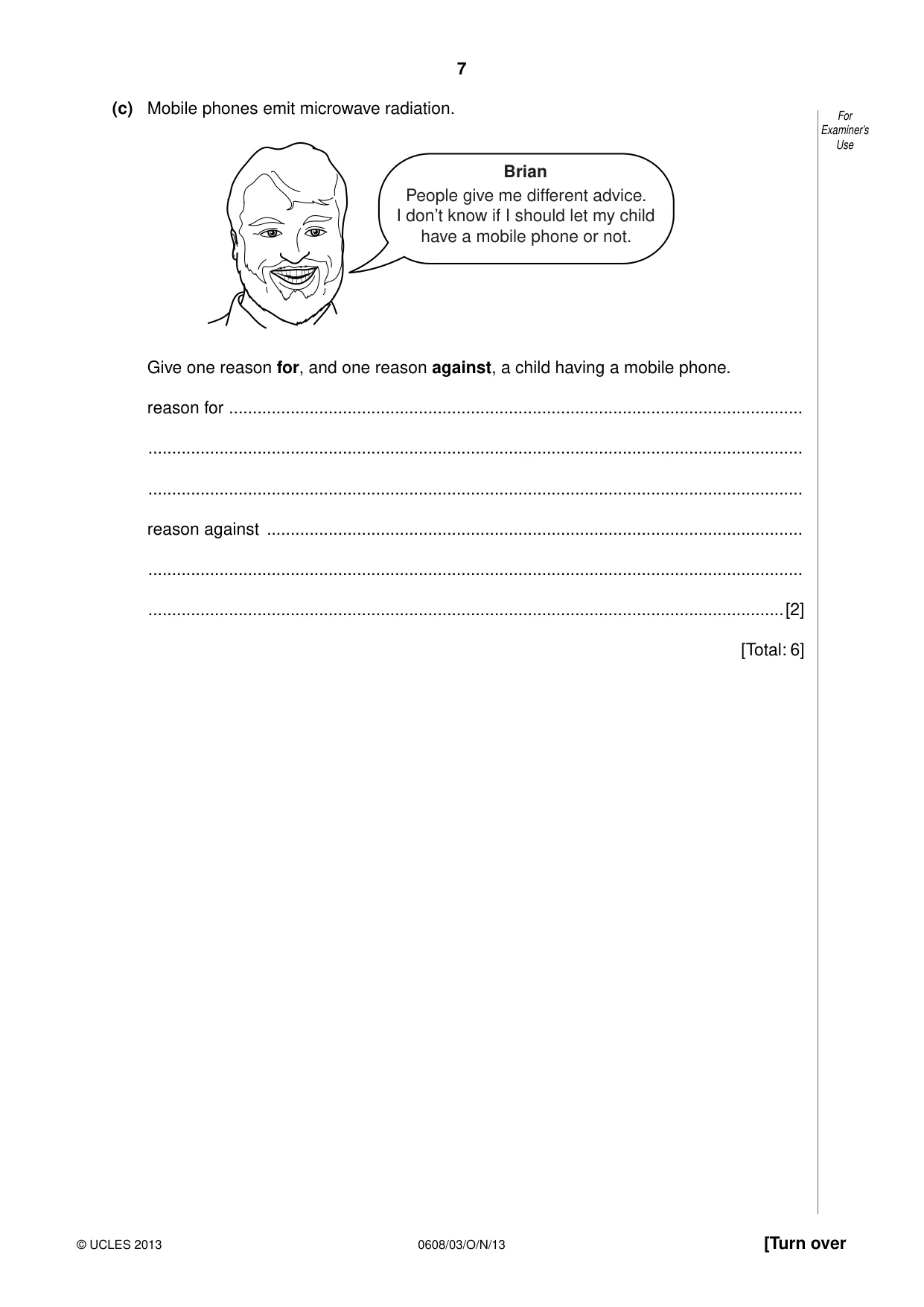
7 0608/03/O/N/13 © UCLES 2013 [Turn over For Examiner’s Use (c) Mobile phones emit microwave radiation. Brian People give me different advice. I don’t know if I should let my child have a mobile phone or not. Give one reason for, and one reason against, a child having a mobile phone. reason for … … … reason against … … …[2] [Total: 6]
Question paper, page 8
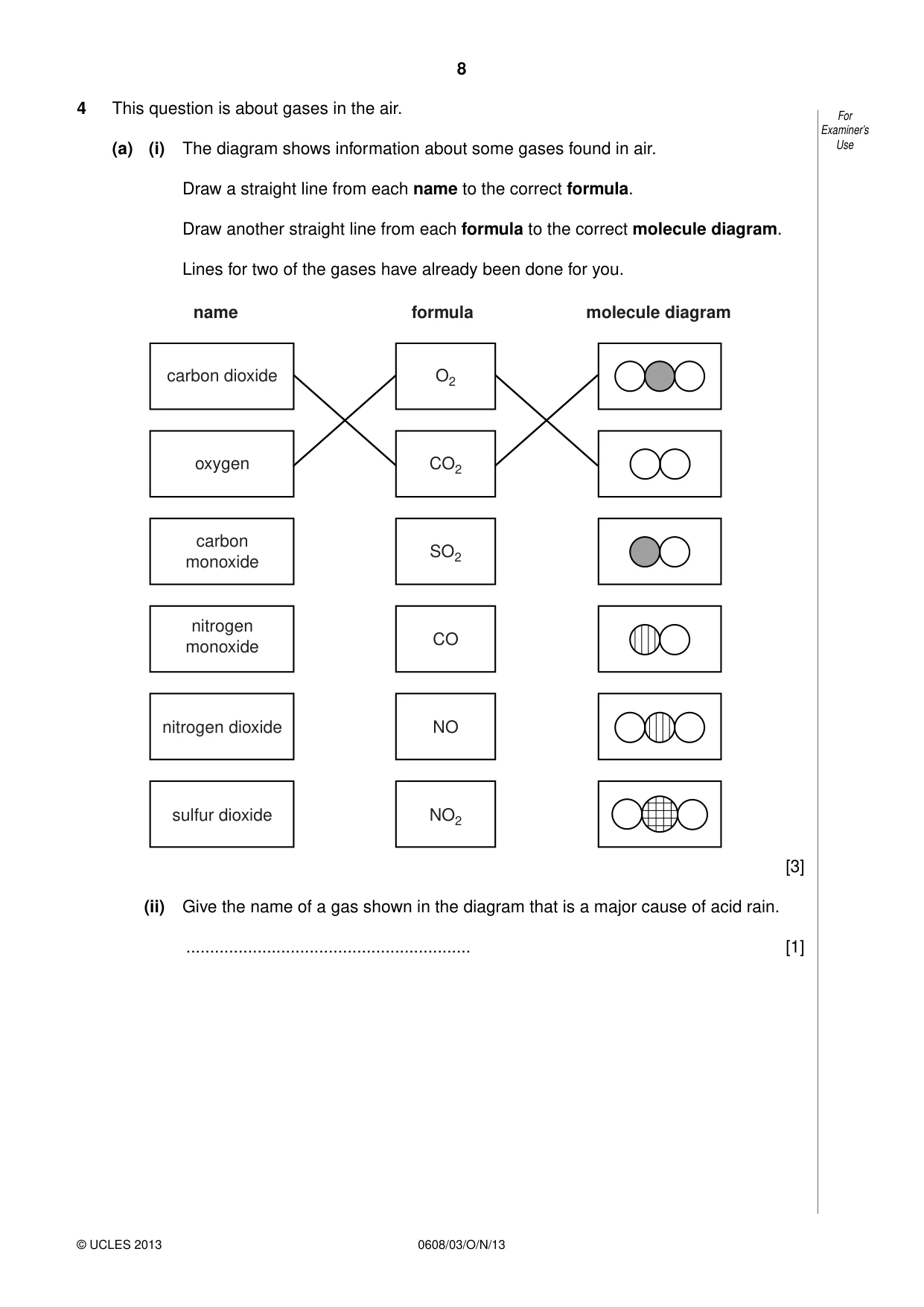
8 0608/03/O/N/13 © UCLES 2013 For Examiner’s Use 4 This question is about gases in the air. (a) (i) The diagram shows information about some gases found in air. Draw a straight line from each name to the correct formula. Draw another straight line from each formula to the correct molecule diagram. Lines for two of the gases have already been done for you. carbon dioxide O2 oxygen CO2 SO2 nitrogen monoxide carbon monoxide CO nitrogen dioxide NO sulfur dioxide NO2 name formula molecule diagram [3] (ii) Give the name of a gas shown in the diagram that is a major cause of acid rain. … [1]
Question paper, page 9
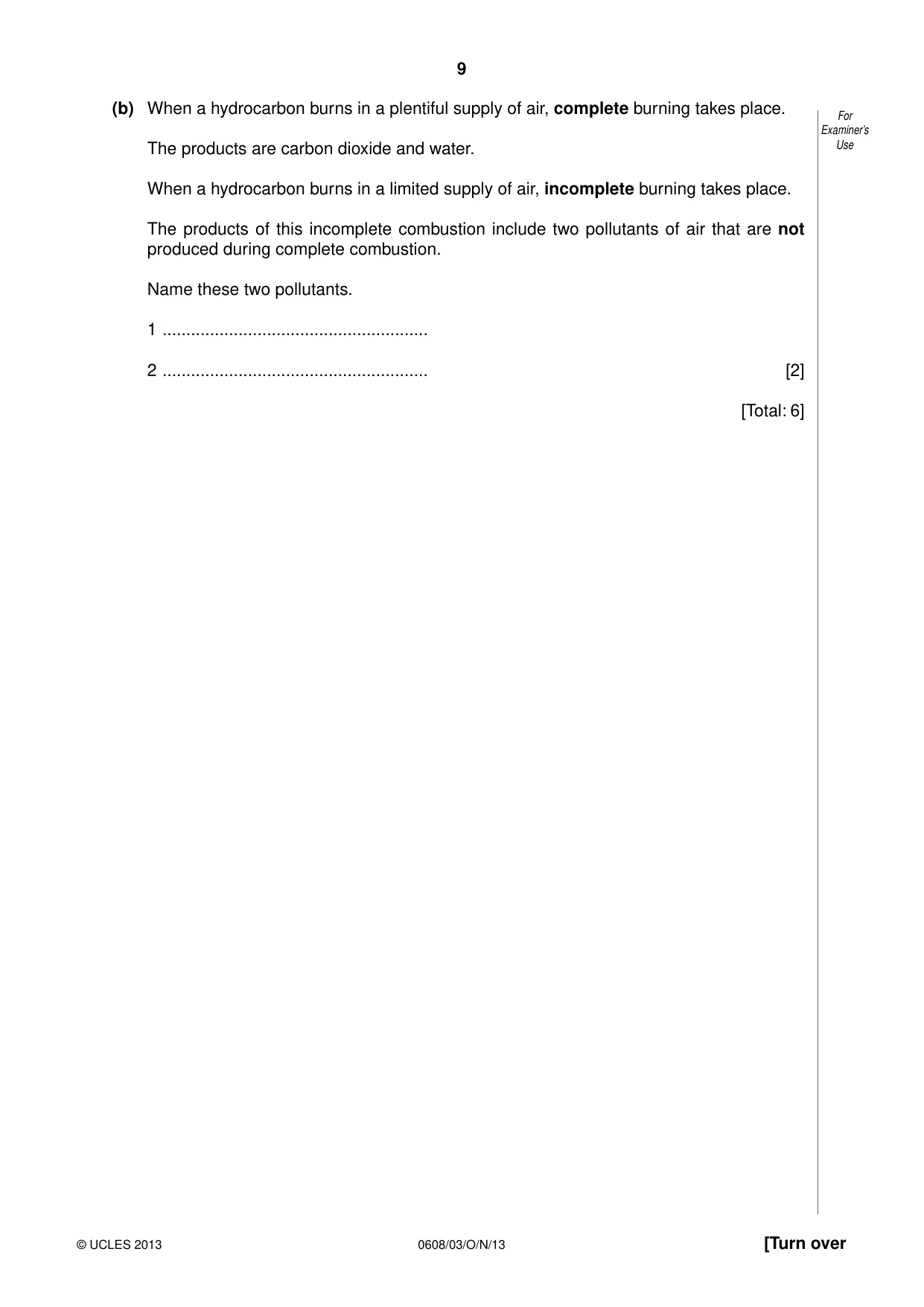
9 0608/03/O/N/13 © UCLES 2013 [Turn over For Examiner’s Use (b) When a hydrocarbon burns in a plentiful supply of air, complete burning takes place. The products are carbon dioxide and water. When a hydrocarbon burns in a limited supply of air, incomplete burning takes place. The products of this incomplete combustion include two pollutants of air that are not produced during complete combustion. Name these two pollutants. 1 … 2 … [2] [Total: 6]
Question paper, page 10
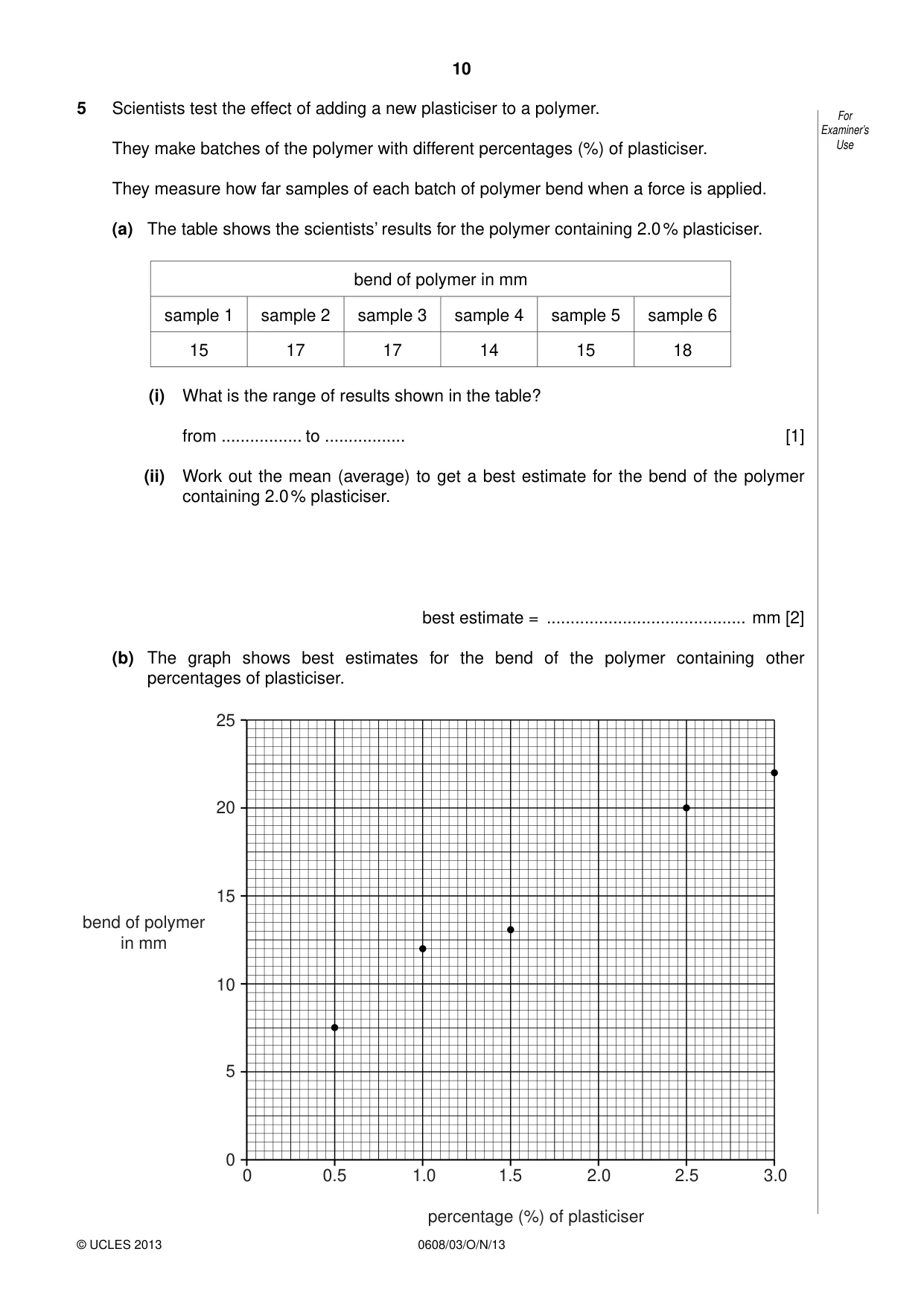
10 0608/03/O/N/13 © UCLES 2013 For Examiner’s Use 5 Scientists test the effect of adding a new plasticiser to a polymer. They make batches of the polymer with different percentages (%) of plasticiser. They measure how far samples of each batch of polymer bend when a force is applied. (a) The table shows the scientists’ results for the polymer containing 2.0 % plasticiser. bend of polymer in mm sample 1 sample 2 sample 3 sample 4 sample 5 sample 6 15 17 17 14 15 18 (i) What is the range of results shown in the table? from … to … [1] (ii) Work out the mean (average) to get a best estimate for the bend of the polymer containing 2.0 % plasticiser. best estimate = … mm [2] (b) The graph shows best estimates for the bend of the polymer containing other percentages of plasticiser. 0 0 5 10 15 20 25 0.5 1.0 1.5 2.0 2.5 3.0 bend of polymer in mm percentage (%) of plasticiser
Question paper, page 11
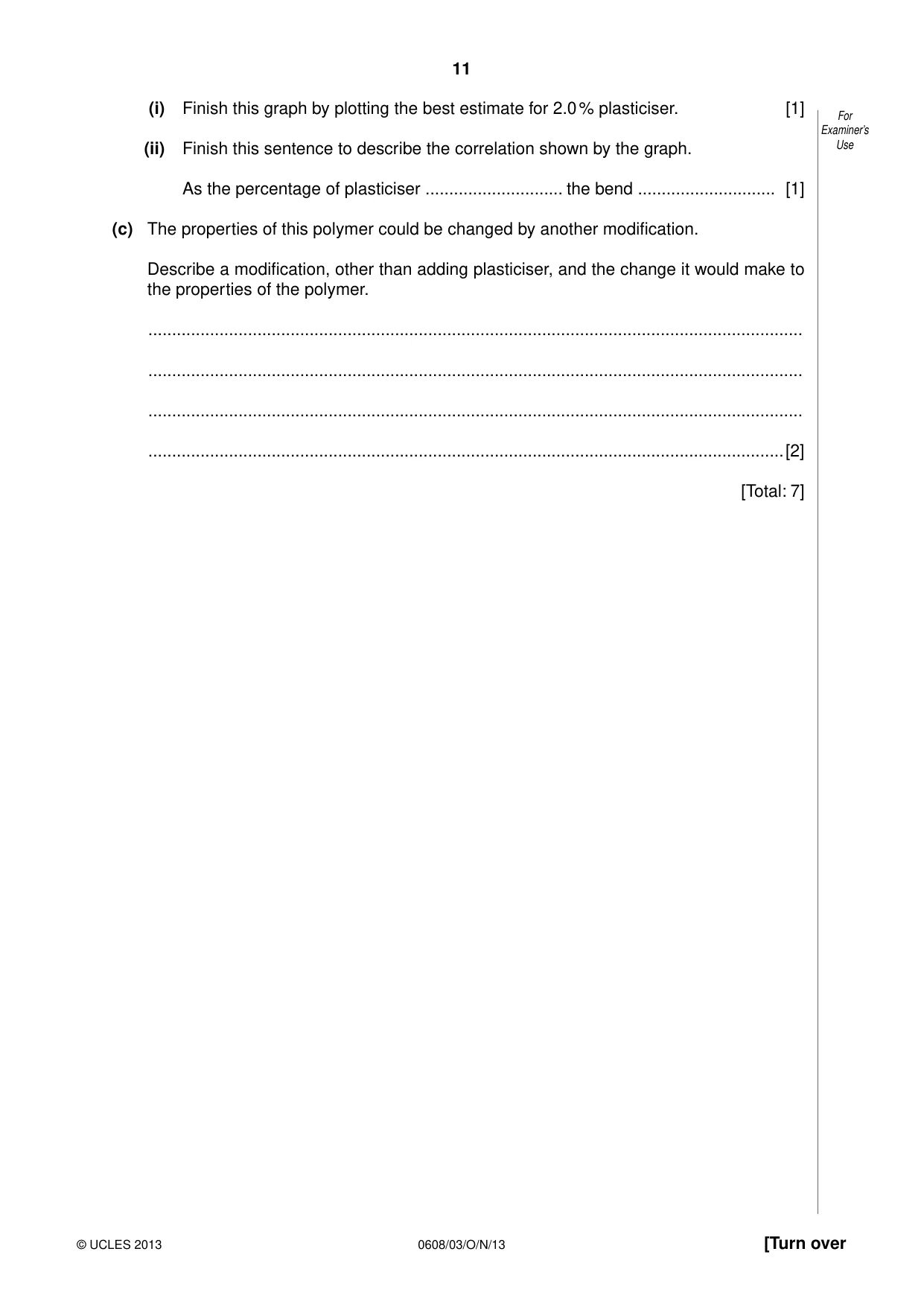
11 0608/03/O/N/13 © UCLES 2013 [Turn over For Examiner’s Use (i) Finish this graph by plotting the best estimate for 2.0 % plasticiser. [1] (ii) Finish this sentence to describe the correlation shown by the graph. As the percentage of plasticiser … the bend … [1] (c) The properties of this polymer could be changed by another modification. Describe a modification, other than adding plasticiser, and the change it would make to the properties of the polymer. … … … …[2] [Total: 7]
Question paper, page 12
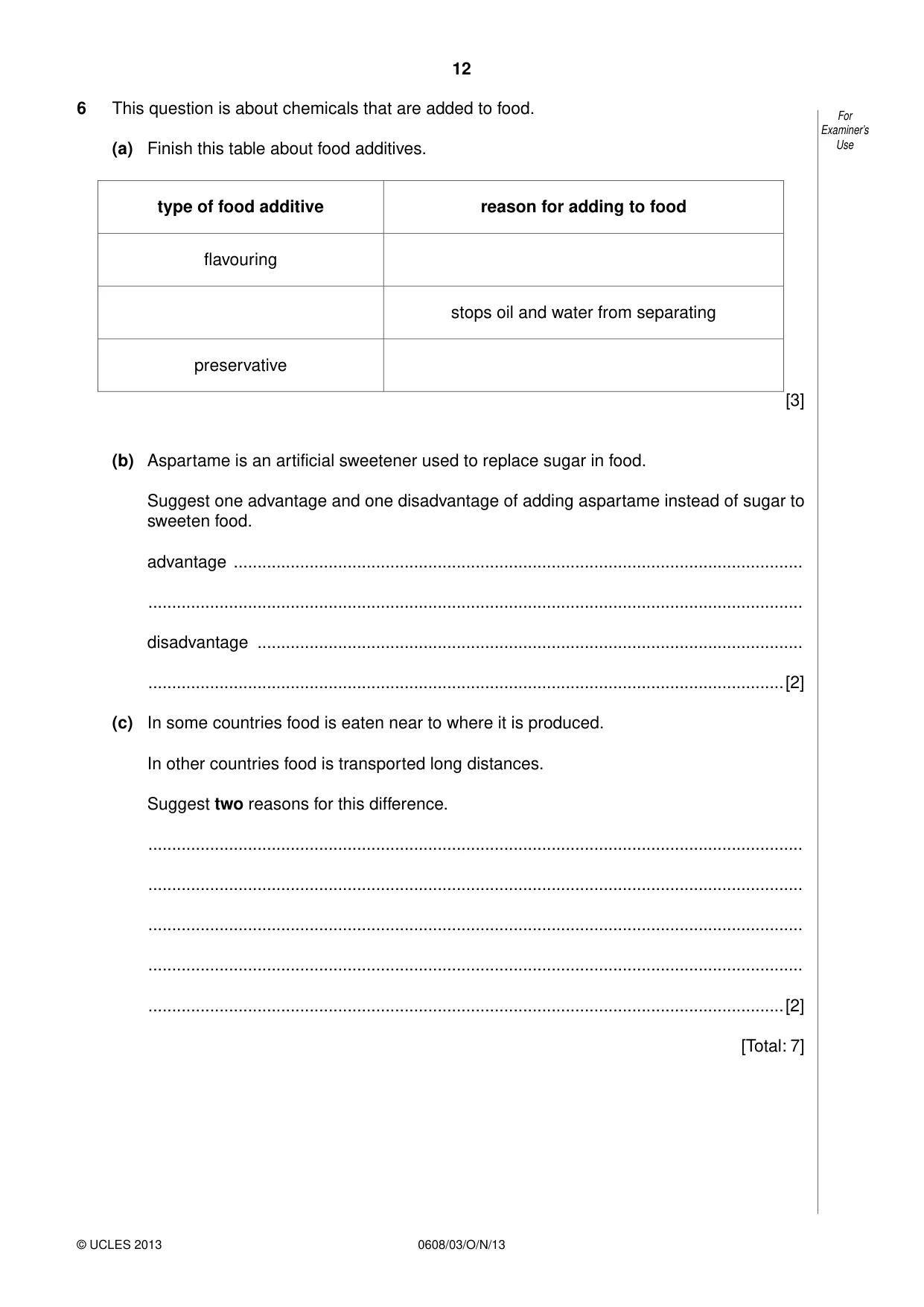
12 0608/03/O/N/13 © UCLES 2013 For Examiner’s Use 6 This question is about chemicals that are added to food. (a) Finish this table about food additives. type of food additive reason for adding to food flavouring stops oil and water from separating preservative [3] (b) Aspartame is an artificial sweetener used to replace sugar in food. Suggest one advantage and one disadvantage of adding aspartame instead of sugar to sweeten food. advantage … … disadvantage … …[2] (c) In some countries food is eaten near to where it is produced. In other countries food is transported long distances. Suggest two reasons for this difference. … … … … …[2] [Total: 7]
Question paper, page 13
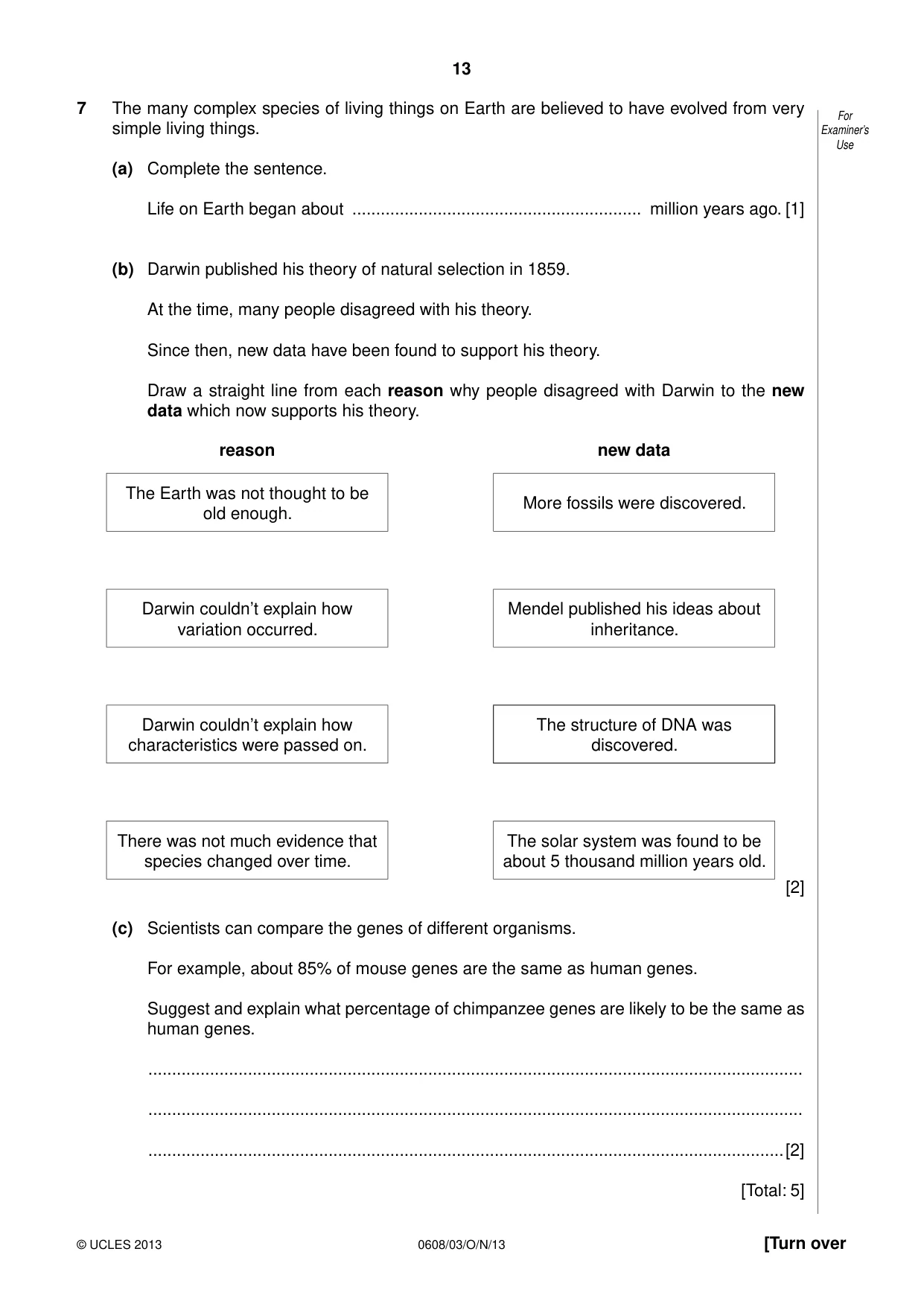
13 0608/03/O/N/13 © UCLES 2013 [Turn over For Examiner’s Use 7 The many complex species of living things on Earth are believed to have evolved from very simple living things. (a) Complete the sentence. Life on Earth began about … million years ago. [1] (b) Darwin published his theory of natural selection in 1859. At the time, many people disagreed with his theory. Since then, new data have been found to support his theory. Draw a straight line from each reason why people disagreed with Darwin to the new data which now supports his theory. reason new data The Earth was not thought to be old enough. More fossils were discovered. Darwin couldn’t explain how variation occurred. Mendel published his ideas about inheritance. Darwin couldn’t explain how characteristics were passed on. The structure of DNA was discovered. There was not much evidence that species changed over time. The solar system was found to be about 5 thousand million years old. [2] (c) Scientists can compare the genes of different organisms. For example, about 85% of mouse genes are the same as human genes. Suggest and explain what percentage of chimpanzee genes are likely to be the same as human genes. … … …[2] [Total: 5]
Question paper, page 14
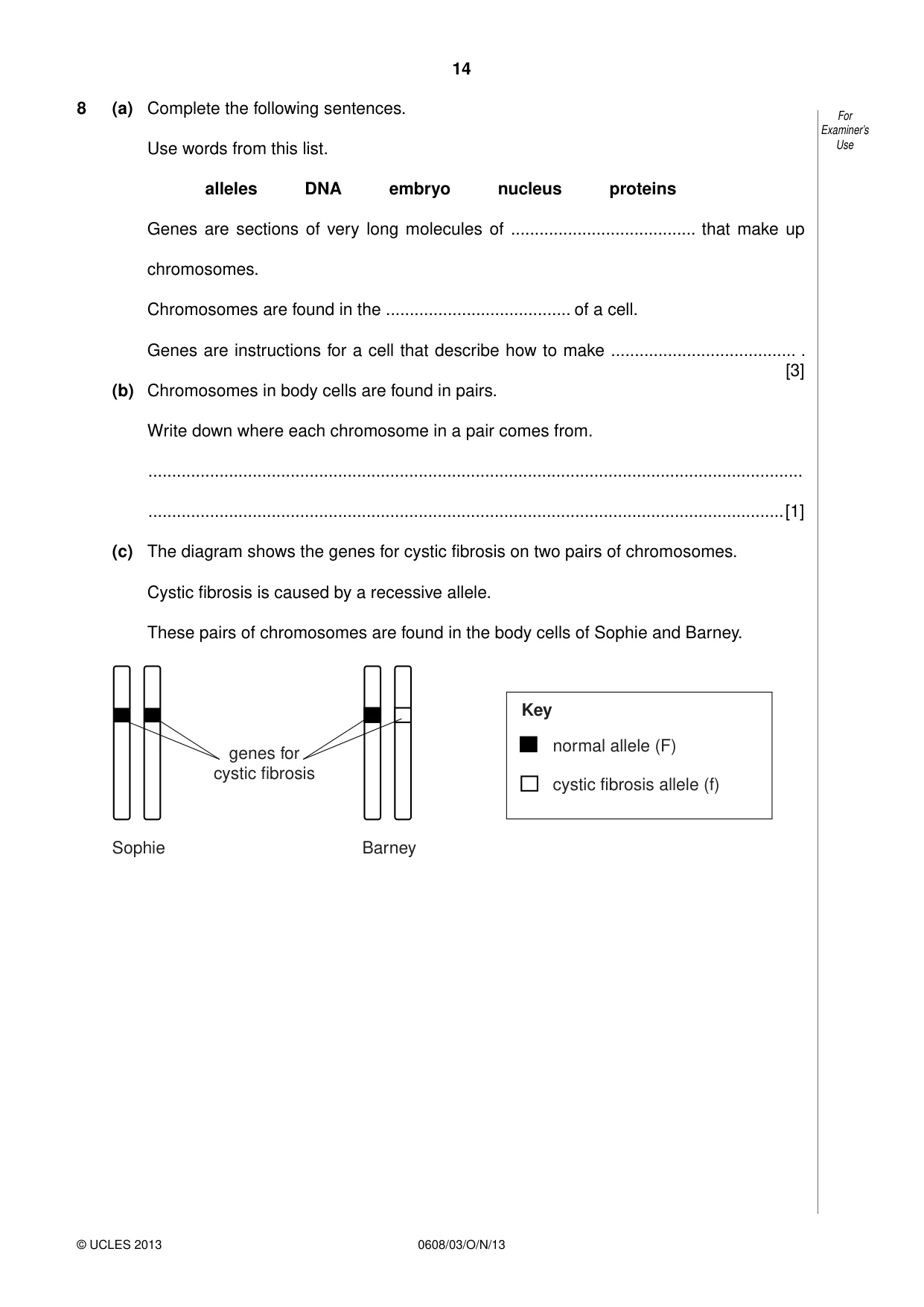
14 0608/03/O/N/13 © UCLES 2013 For Examiner’s Use 8 (a) Complete the following sentences. Use words from this list. alleles DNA embryo nucleus proteins Genes are sections of very long molecules of … that make up chromosomes. Chromosomes are found in the … of a cell. Genes are instructions for a cell that describe how to make … . [3] (b) Chromosomes in body cells are found in pairs. Write down where each chromosome in a pair comes from. … …[1] (c) The diagram shows the genes for cystic fibrosis on two pairs of chromosomes. Cystic fibrosis is caused by a recessive allele. These pairs of chromosomes are found in the body cells of Sophie and Barney. genes for cystic fibrosis Sophie Barney normal allele (F) cystic fibrosis allele (f) Key
Question paper, page 15
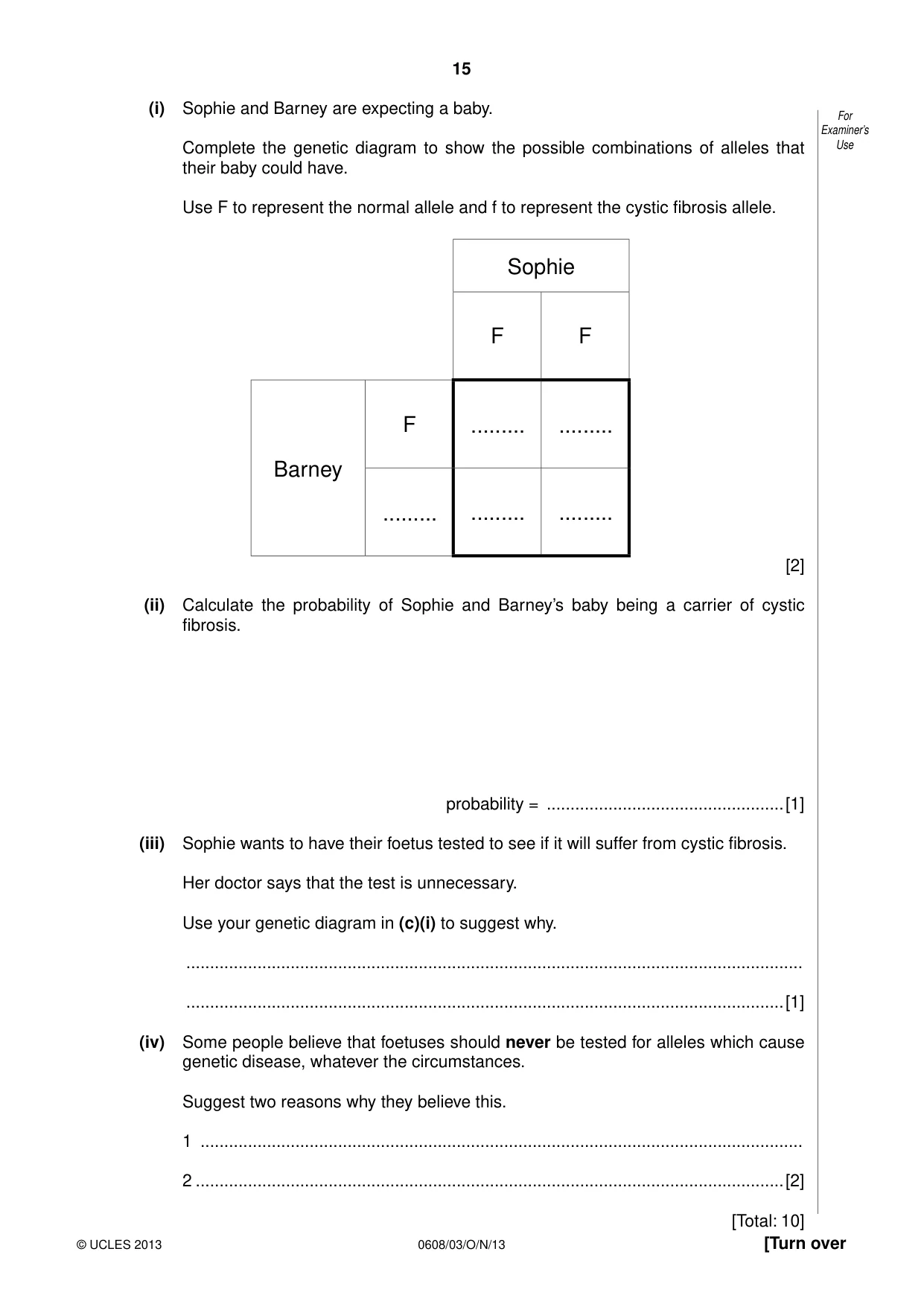
15 0608/03/O/N/13 © UCLES 2013 [Turn over For Examiner’s Use (i) Sophie and Barney are expecting a baby. Complete the genetic diagram to show the possible combinations of alleles that their baby could have. Use F to represent the normal allele and f to represent the cystic fibrosis allele. Sophie F F Barney F … … … … … [2] (ii) Calculate the probability of Sophie and Barney’s baby being a carrier of cystic fibrosis. probability = …[1] (iii) Sophie wants to have their foetus tested to see if it will suffer from cystic fibrosis. Her doctor says that the test is unnecessary. Use your genetic diagram in (c)(i) to suggest why. … …[1] (iv) Some people believe that foetuses should never be tested for alleles which cause genetic disease, whatever the circumstances. Suggest two reasons why they believe this. 1 … 2 …[2] [Total: 10]
Question paper, page 16
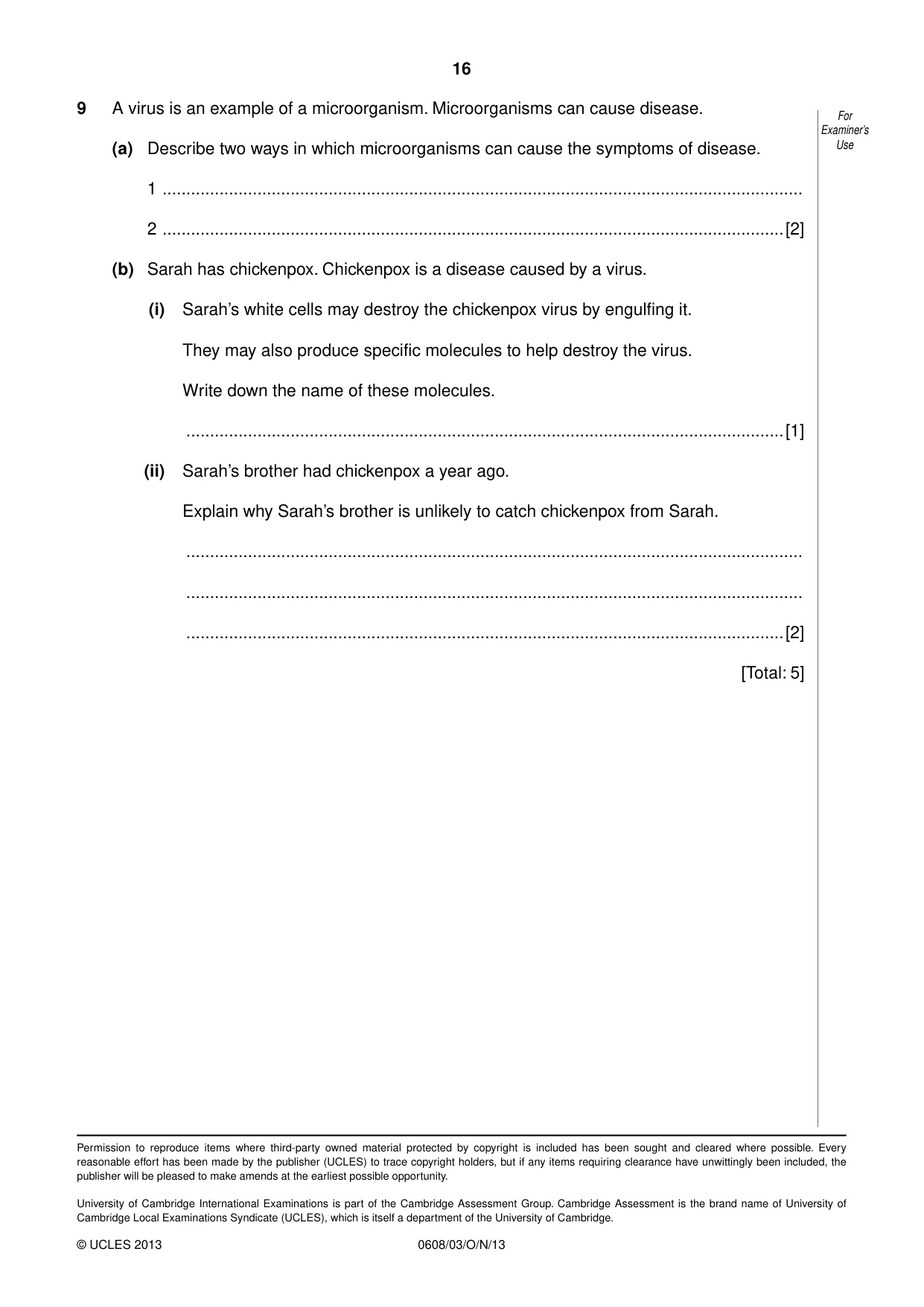
16 0608/03/O/N/13 © UCLES 2013 For Examiner’s Use 9 A virus is an example of a microorganism. Microorganisms can cause disease. (a) Describe two ways in which microorganisms can cause the symptoms of disease. 1 … 2 …[2] (b) Sarah has chickenpox. Chickenpox is a disease caused by a virus. (i) Sarah’s white cells may destroy the chickenpox virus by engulfing it. They may also produce specific molecules to help destroy the virus. Write down the name of these molecules. …[1] (ii) Sarah’s brother had chickenpox a year ago. Explain why Sarah’s brother is unlikely to catch chickenpox from Sarah. … … …[2] [Total: 5] Permission to reproduce items where third-party owned material protected by copyright is included has been sought and cleared where possible. Every reasonable effort has been made by the publisher (UCLES) to trace copyright holders, but if any items requiring clearance have unwittingly been included, the publisher will be pleased to make amends at the earliest possible opportunity. University of Cambridge International Examinations is part of the Cambridge Assessment Group. Cambridge Assessment is the brand name of University of Cambridge Local Examinations Syndicate (UCLES), which is itself a department of the University of Cambridge.
Mark scheme, page 1
CAMBRIDGE INTERNATIONAL EXAMINATIONS International General Certificate of Secondary Education MARK SCHEME for the October/November 2013 series 0608 TWENTY FIRST CENTURY SCIENCE 0608/03 Paper 3 (Core Written), maximum raw mark 60 This mark scheme is published as an aid to teachers and candidates, to indicate the requirements of the examination. It shows the basis on which Examiners were instructed to award marks. It does not indicate the details of the discussions that took place at an Examiners’ meeting before marking began, which would have considered the acceptability of alternative answers. Mark schemes should be read in conjunction with the question paper and the Principal Examiner Report for Teachers. Cambridge will not enter into discussions about these mark schemes. Cambridge is publishing the mark schemes for the October/November 2013 series for most IGCSE, GCE Advanced Level and Advanced Subsidiary Level components and some Ordinary Level components. www.XtremePapers.com
Mark scheme, page 2
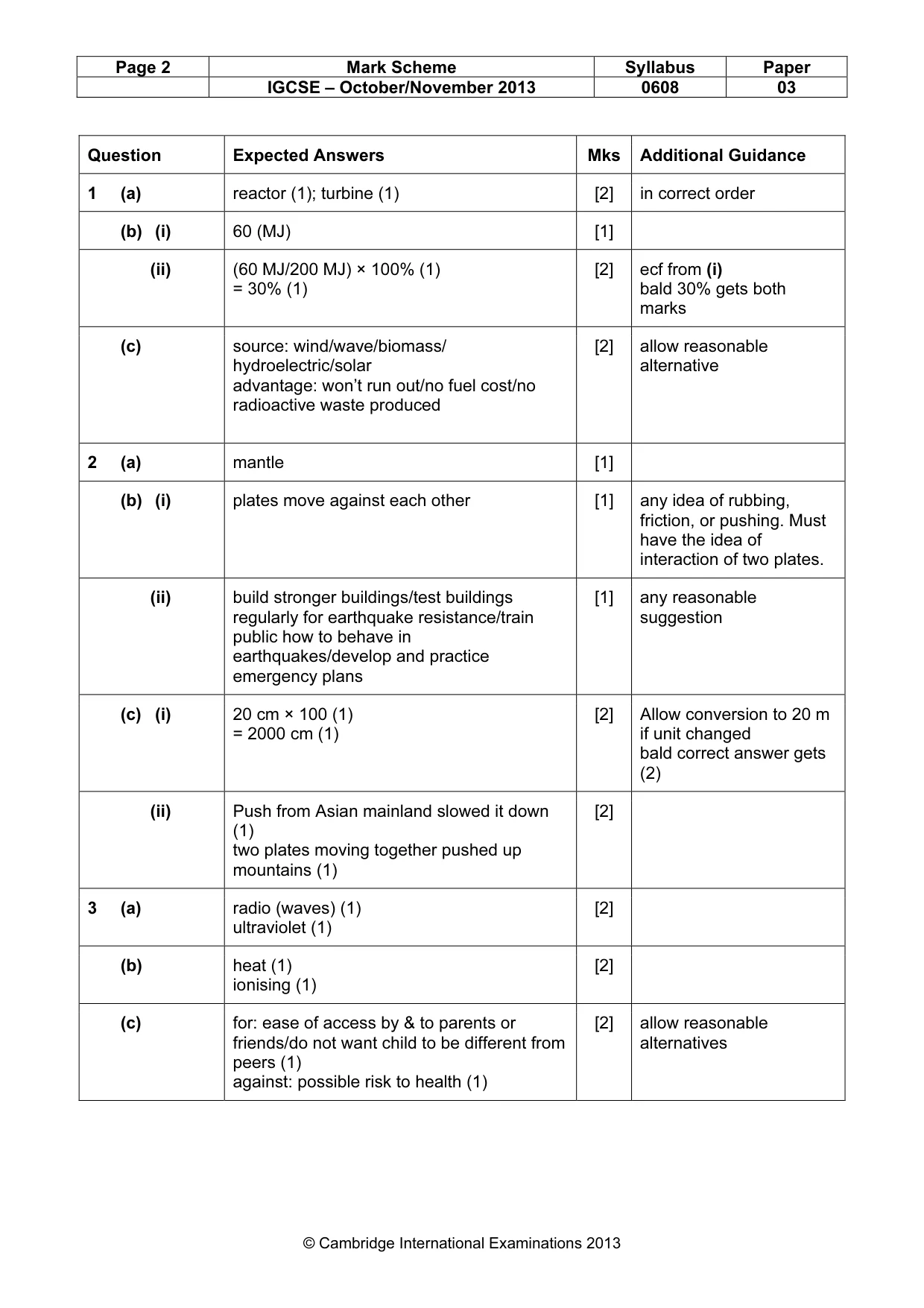
Page 2 Mark Scheme Syllabus Paper IGCSE – October/November 2013 0608 03 © Cambridge International Examinations 2013 Question Expected Answers Mks Additional Guidance 1 (a) reactor (1); turbine (1) [2] in correct order (b) (i) 60 (MJ) [1] (ii) (60 MJ/200 MJ) × 100% (1) = 30% (1) [2] ecf from (i) bald 30% gets both marks (c) source: wind/wave/biomass/ hydroelectric/solar advantage: won’t run out/no fuel cost/no radioactive waste produced [2] allow reasonable alternative 2 (a) mantle [1] (b) (i) plates move against each other [1] any idea of rubbing, friction, or pushing. Must have the idea of interaction of two plates. (ii) build stronger buildings/test buildings regularly for earthquake resistance/train public how to behave in earthquakes/develop and practice emergency plans [1] any reasonable suggestion (c) (i) 20 cm × 100 (1) = 2000 cm (1) [2] Allow conversion to 20 m if unit changed bald correct answer gets (2) (ii) Push from Asian mainland slowed it down (1) two plates moving together pushed up mountains (1) [2] 3 (a) radio (waves) (1) ultraviolet (1) [2] (b) heat (1) ionising (1) [2] (c) for: ease of access by & to parents or friends/do not want child to be different from peers (1) against: possible risk to health (1) [2] allow reasonable alternatives
Mark scheme, page 3
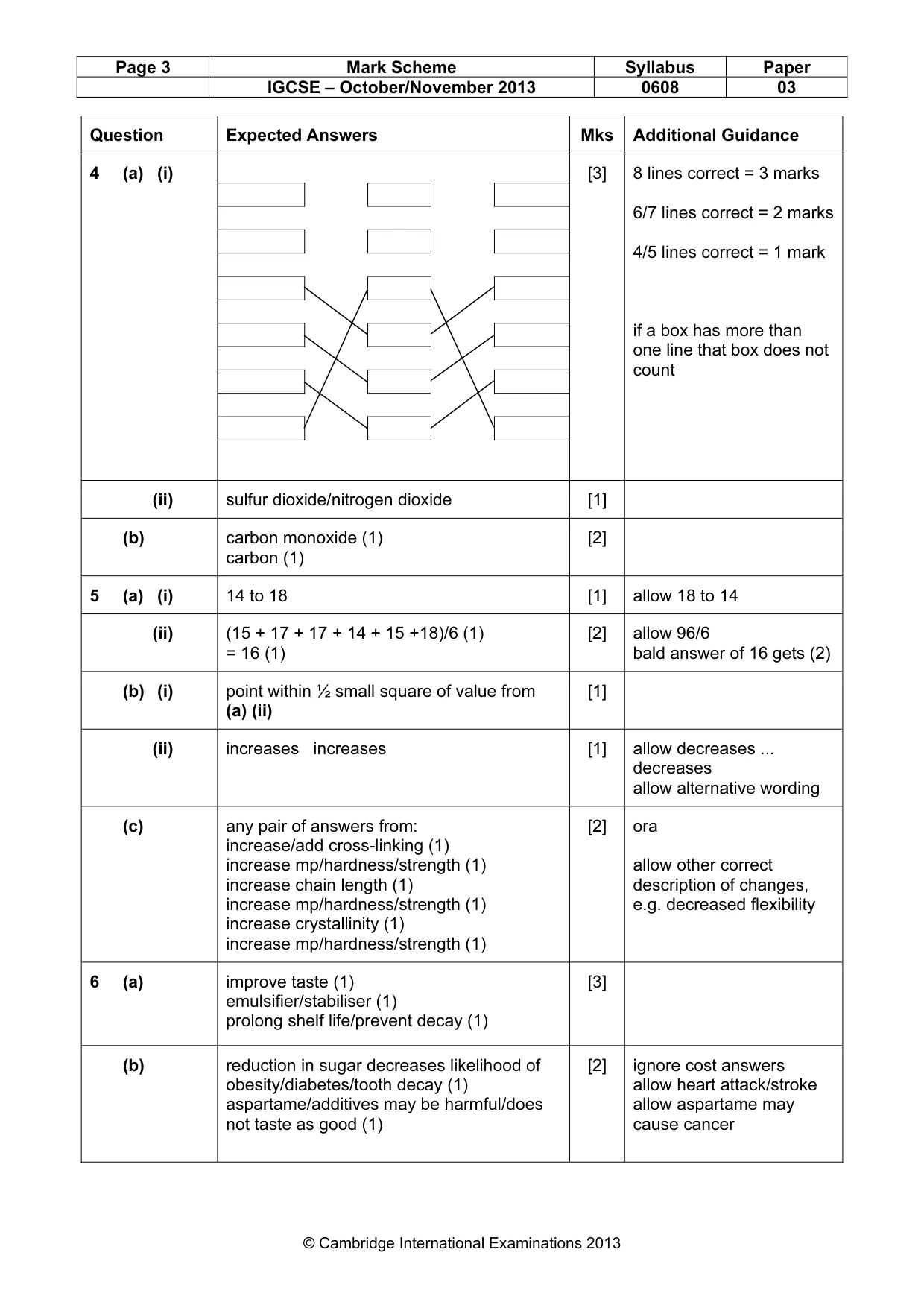
Page 3 Mark Scheme Syllabus Paper IGCSE – October/November 2013 0608 03 © Cambridge International Examinations 2013 Question Expected Answers Mks Additional Guidance 4 (a) (i) [3] 8 lines correct = 3 marks 6/7 lines correct = 2 marks 4/5 lines correct = 1 mark if a box has more than one line that box does not count (ii) sulfur dioxide/nitrogen dioxide [1] (b) carbon monoxide (1) carbon (1) [2] 5 (a) (i) 14 to 18 [1] allow 18 to 14 (ii) (15 + 17 + 17 + 14 + 15 +18)/6 (1) = 16 (1) [2] allow 96/6 bald answer of 16 gets (2) (b) (i) point within ½ small square of value from (a) (ii) [1] (ii) increases increases [1] allow decreases ... decreases allow alternative wording (c) any pair of answers from: increase/add cross-linking (1) increase mp/hardness/strength (1) increase chain length (1) increase mp/hardness/strength (1) increase crystallinity (1) increase mp/hardness/strength (1) [2] ora allow other correct description of changes, e.g. decreased flexibility 6 (a) improve taste (1) emulsifier/stabiliser (1) prolong shelf life/prevent decay (1) [3] (b) reduction in sugar decreases likelihood of obesity/diabetes/tooth decay (1) aspartame/additives may be harmful/does not taste as good (1) [2] ignore cost answers allow heart attack/stroke allow aspartame may cause cancer
Mark scheme, page 4
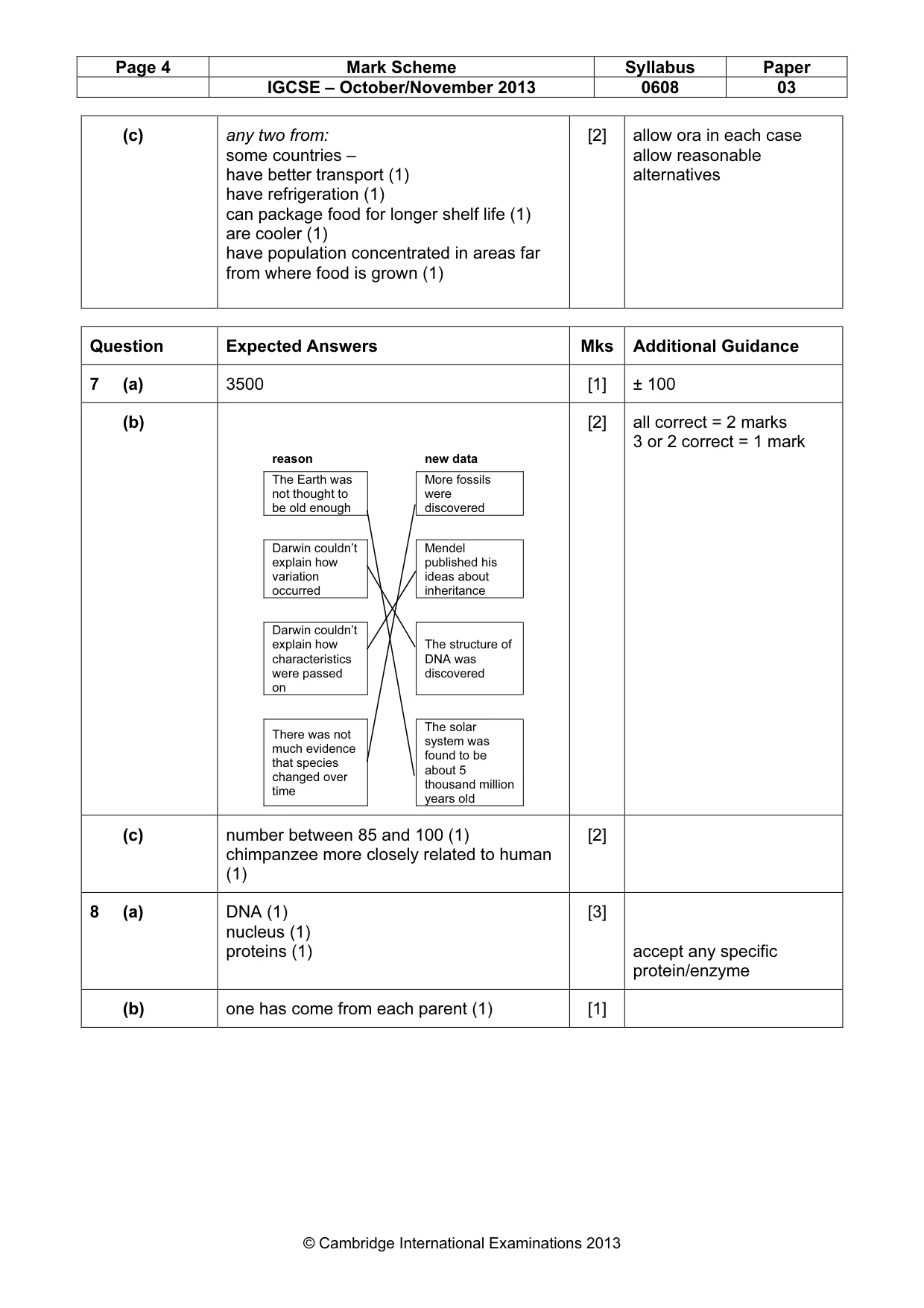
Page 4 Mark Scheme Syllabus Paper IGCSE – October/November 2013 0608 03 © Cambridge International Examinations 2013 (c) any two from: some countries – have better transport (1) have refrigeration (1) can package food for longer shelf life (1) are cooler (1) have population concentrated in areas far from where food is grown (1) [2] allow ora in each case allow reasonable alternatives Question Expected Answers Mks Additional Guidance 7 (a) 3500 [1] ± 100 (b) reason new data The Earth was not thought to be old enough More fossils were discovered Darwin couldn’t explain how variation occurred Mendel published his ideas about inheritance Darwin couldn’t explain how characteristics were passed on The structure of DNA was discovered There was not much evidence that species changed over time The solar system was found to be about 5 thousand million years old [2] all correct = 2 marks 3 or 2 correct = 1 mark (c) number between 85 and 100 (1) chimpanzee more closely related to human (1) [2] 8 (a) DNA (1) nucleus (1) proteins (1) [3] accept any specific protein/enzyme (b) one has come from each parent (1) [1]
Mark scheme, page 5
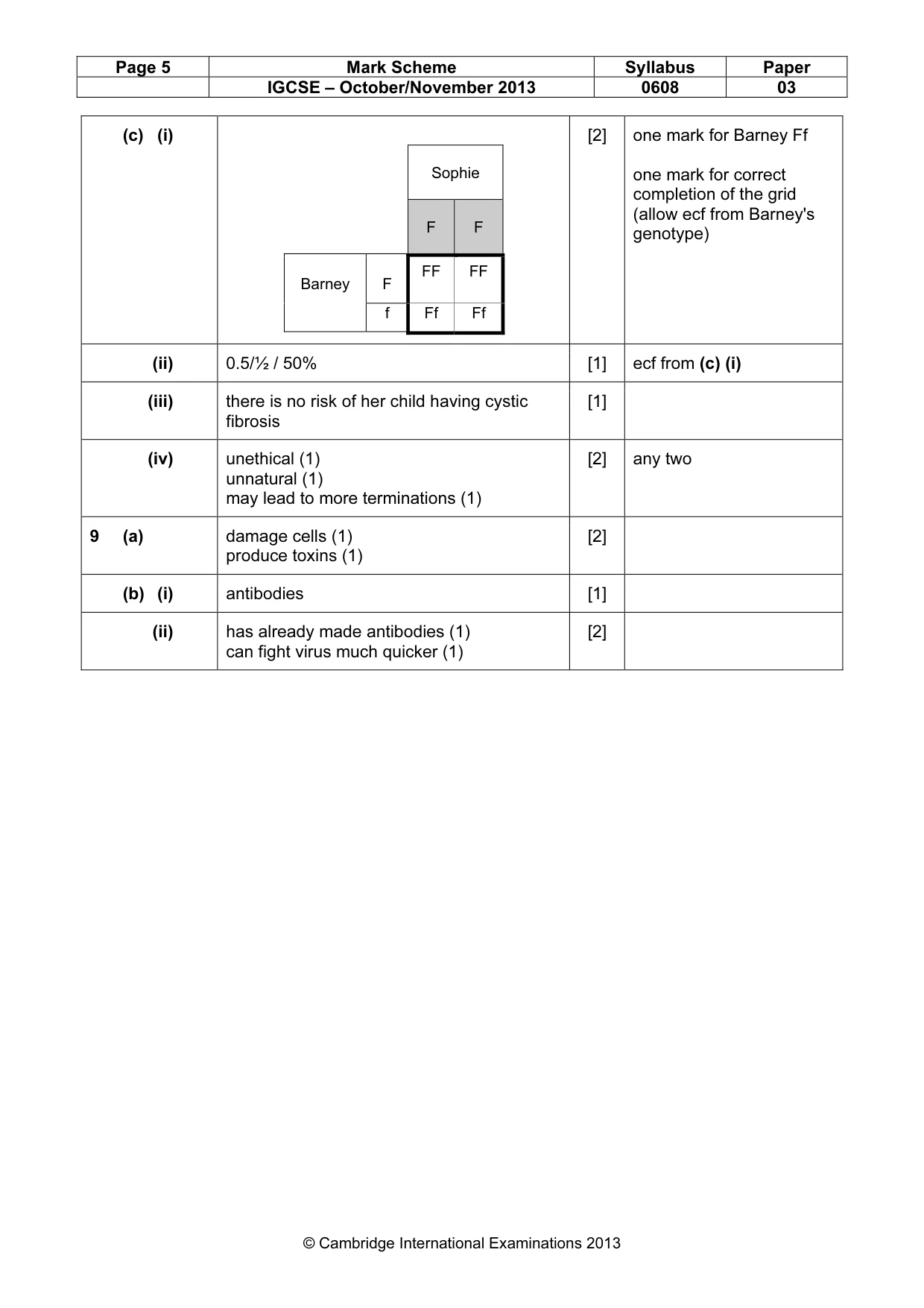
Page 5 Mark Scheme Syllabus Paper IGCSE – October/November 2013 0608 03 © Cambridge International Examinations 2013 (c) (i) Sophie F F Barney F FF FF f Ff Ff [2] one mark for Barney Ff one mark for correct completion of the grid (allow ecf from Barney's genotype) (ii) 0.5/½ / 50% [1] ecf from (c) (i) (iii) there is no risk of her child having cystic fibrosis [1] (iv) unethical (1) unnatural (1) may lead to more terminations (1) [2] any two 9 (a) damage cells (1) produce toxins (1) [2] (b) (i) antibodies [1] (ii) has already made antibodies (1) can fight virus much quicker (1) [2]