Cambridge IGCSE Twenty-First Century Science 0608 — 2012 May/June Paper 3 · Variant 1
0608/31/M/J/12 · 60 marks · ≈68 min
The question paper and its mark scheme, free to read here and free to download. This is Cambridge’s own paper, exactly as it was sat.
Question paper16 pages
Mark scheme5 pages
Answers below. Sit the paper first if you are practising.
Paper as text
Question paper, page 1
This document consists of 16 printed pages. DC (NS/SW) 51581/2 © UCLES 2012 [Turn over UNIVERSITY OF CAMBRIDGE INTERNATIONAL EXAMINATIONS International General Certificate of Secondary Education * 0 7 3 4 3 1 0 9 8 4 * TWENTY FIRST CENTURY SCIENCE 0608/03 Paper 3 May/June 2012 1 hour 30 minutes Candidates answer on the Question Paper. No Additional Materials are required. READ THESE INSTRUCTIONS FIRST Write your Centre number, candidate number and name on all the work you hand in. Write in dark blue or black pen. You may use a pencil for any diagrams or graphs. Do not use staples, paper clips, highlighters, glue or correction fluid. DO NOT WRITE IN ANY BARCODES. Answer all questions. At the end of the examination, fasten all your work securely together. The number of marks is given in brackets [ ] at the end of each question or part question. For Examiner’s Use 1 2 3 4 5 6 7 8 9 Total www.XtremePapers.com
Question paper, page 2
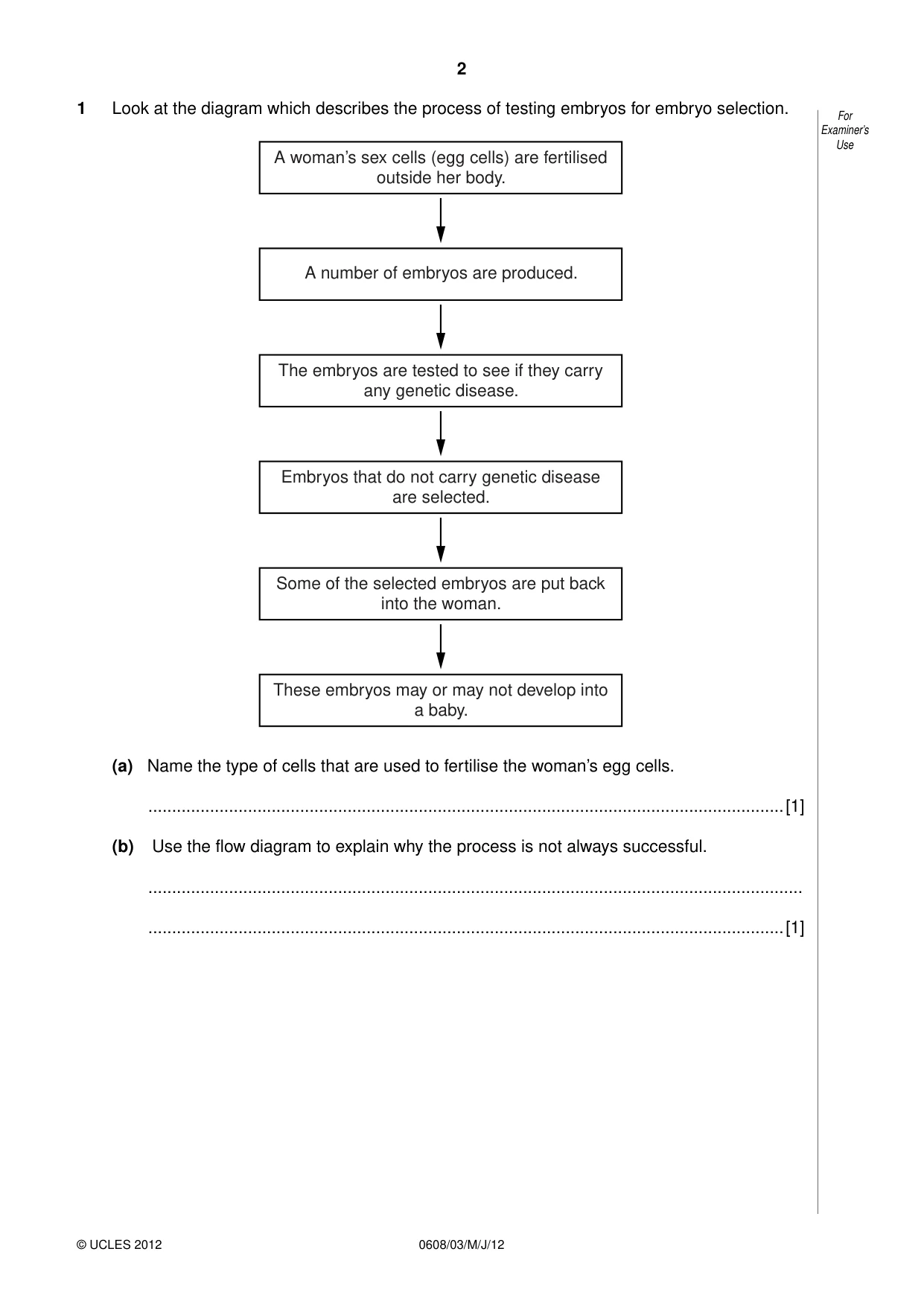
2 0608/03/M/J/12 © UCLES 2012 For Examiner’s Use 1 Look at the diagram which describes the process of testing embryos for embryo selection. A woman’s sex cells (egg cells) are fertilised outside her body. A number of embryos are produced. The embryos are tested to see if they carry any genetic disease. Embryos that do not carry genetic disease are selected. Some of the selected embryos are put back into the woman. These embryos may or may not develop into a baby. (a) Name the type of cells that are used to fertilise the woman’s egg cells. …[1] (b) Use the flow diagram to explain why the process is not always successful. … …[1]
Question paper, page 3
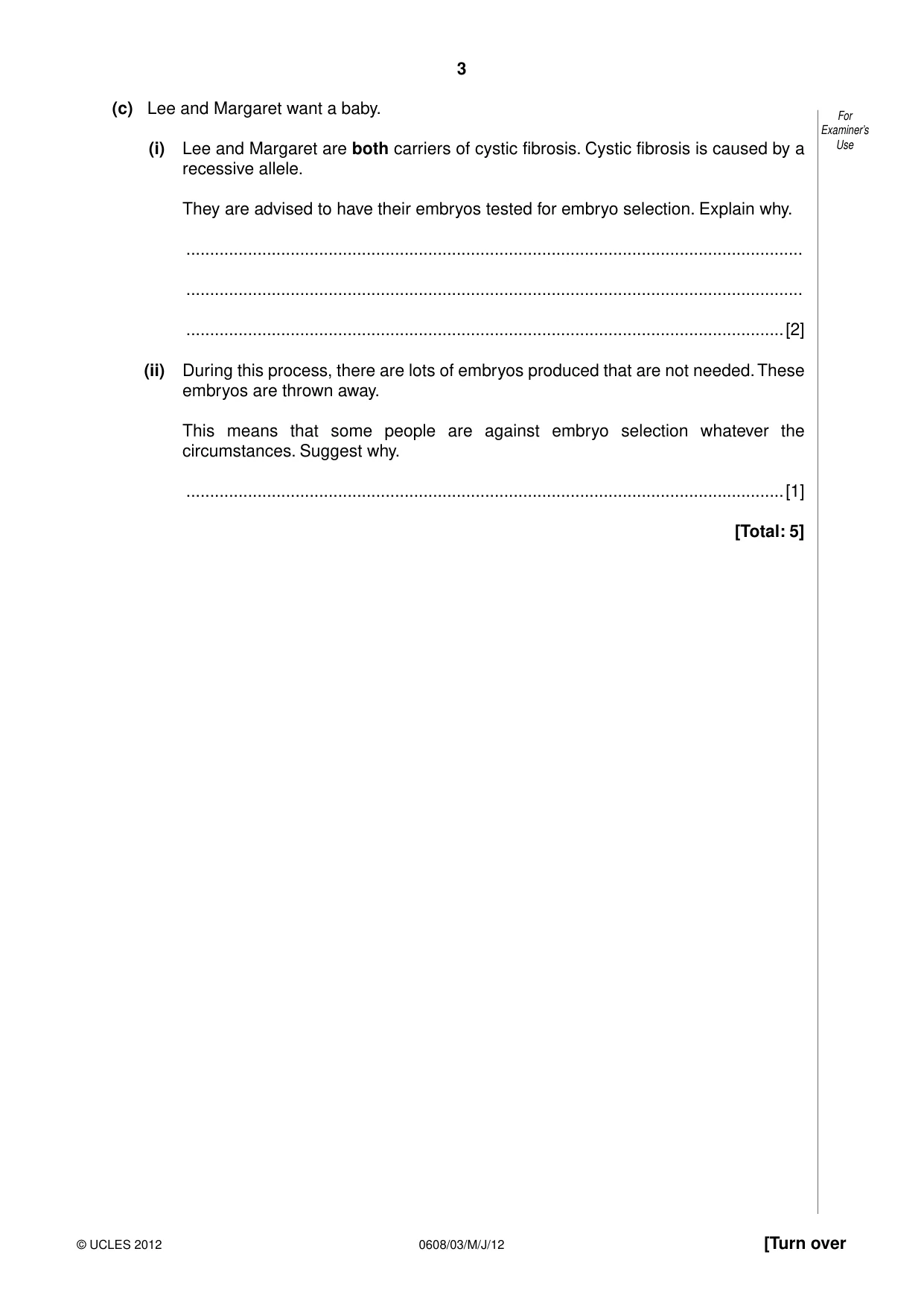
3 0608/03/M/J/12 © UCLES 2012 [Turn over For Examiner’s Use (c) Lee and Margaret want a baby. (i) Lee and Margaret are both carriers of cystic fibrosis. Cystic fibrosis is caused by a recessive allele. They are advised to have their embryos tested for embryo selection. Explain why. … … …[2] (ii) During this process, there are lots of embryos produced that are not needed. These embryos are thrown away. This means that some people are against embryo selection whatever the circumstances. Suggest why. …[1] [Total: 5]
Question paper, page 4
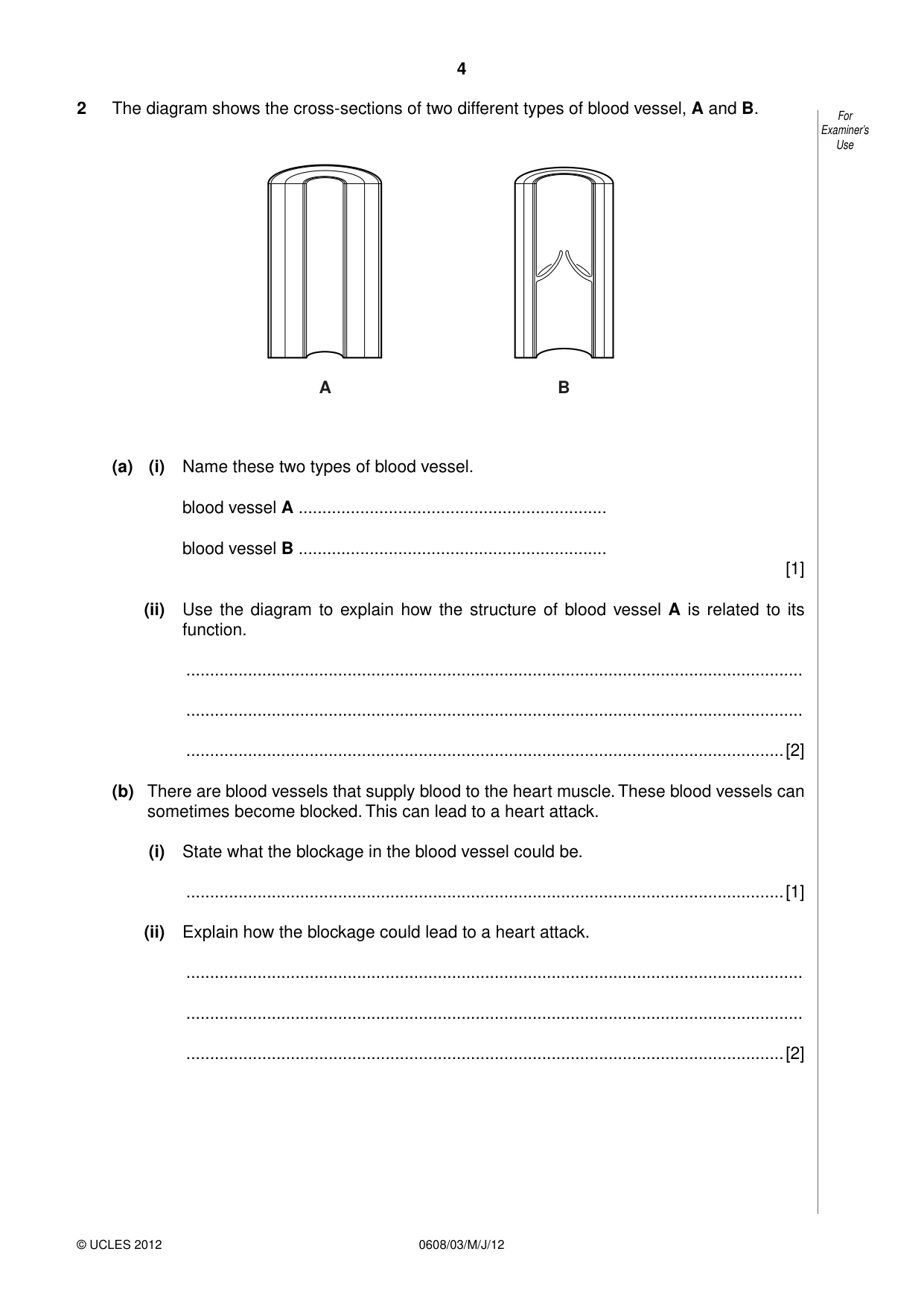
4 0608/03/M/J/12 © UCLES 2012 For Examiner’s Use 2 The diagram shows the cross-sections of two different types of blood vessel, A and B. A B (a) (i) Name these two types of blood vessel. blood vessel A … blood vessel B … [1] (ii) Use the diagram to explain how the structure of blood vessel A is related to its function. … … …[2] (b) There are blood vessels that supply blood to the heart muscle. These blood vessels can sometimes become blocked. This can lead to a heart attack. (i) State what the blockage in the blood vessel could be. …[1] (ii) Explain how the blockage could lead to a heart attack. … … …[2]
Question paper, page 5
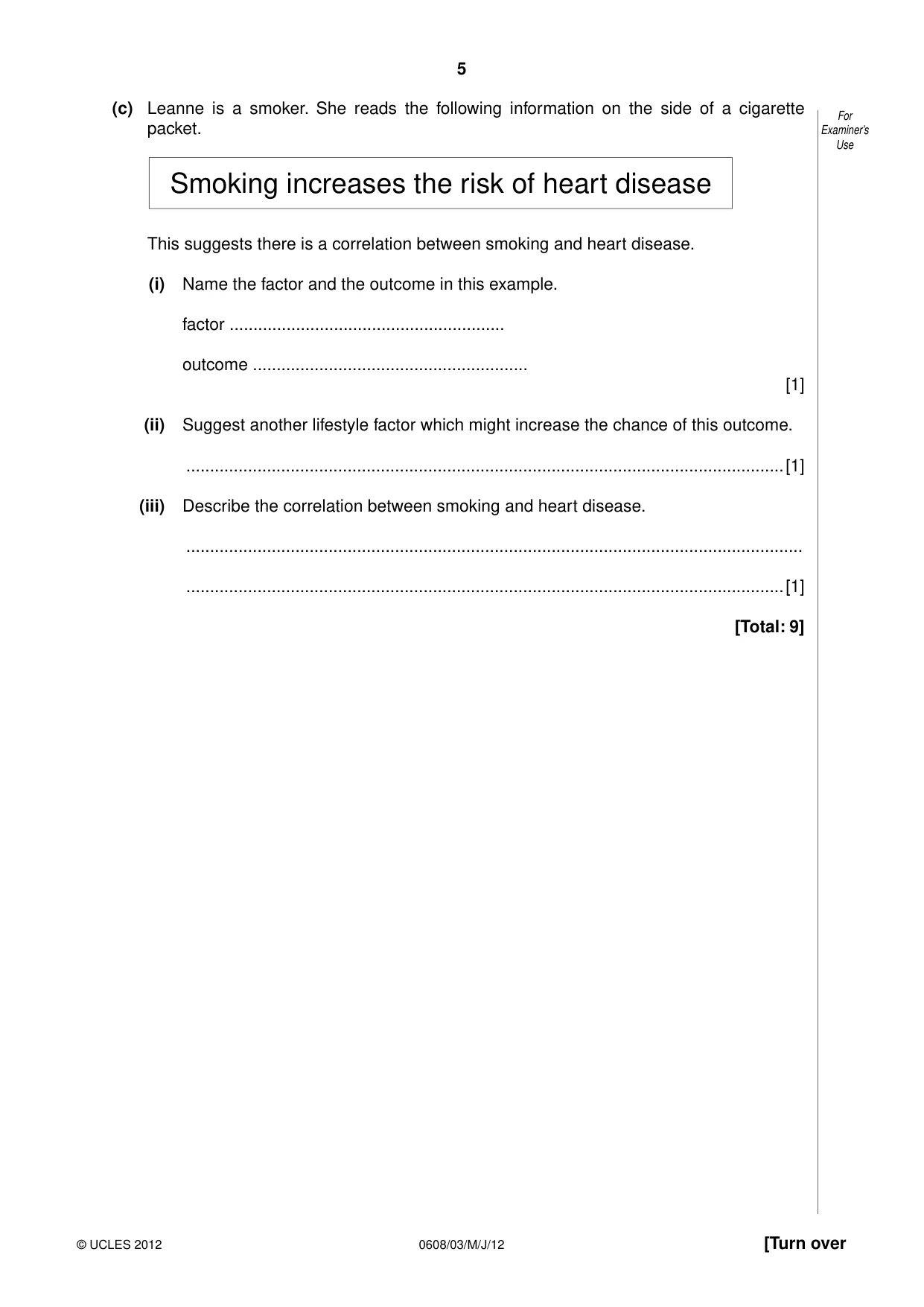
5 0608/03/M/J/12 © UCLES 2012 [Turn over For Examiner’s Use (c) Leanne is a smoker. She reads the following information on the side of a cigarette packet. Smoking increases the risk of heart disease This suggests there is a correlation between smoking and heart disease. (i) Name the factor and the outcome in this example. factor … outcome … [1] (ii) Suggest another lifestyle factor which might increase the chance of this outcome. …[1] (iii) Describe the correlation between smoking and heart disease. … …[1] [Total: 9]
Question paper, page 6
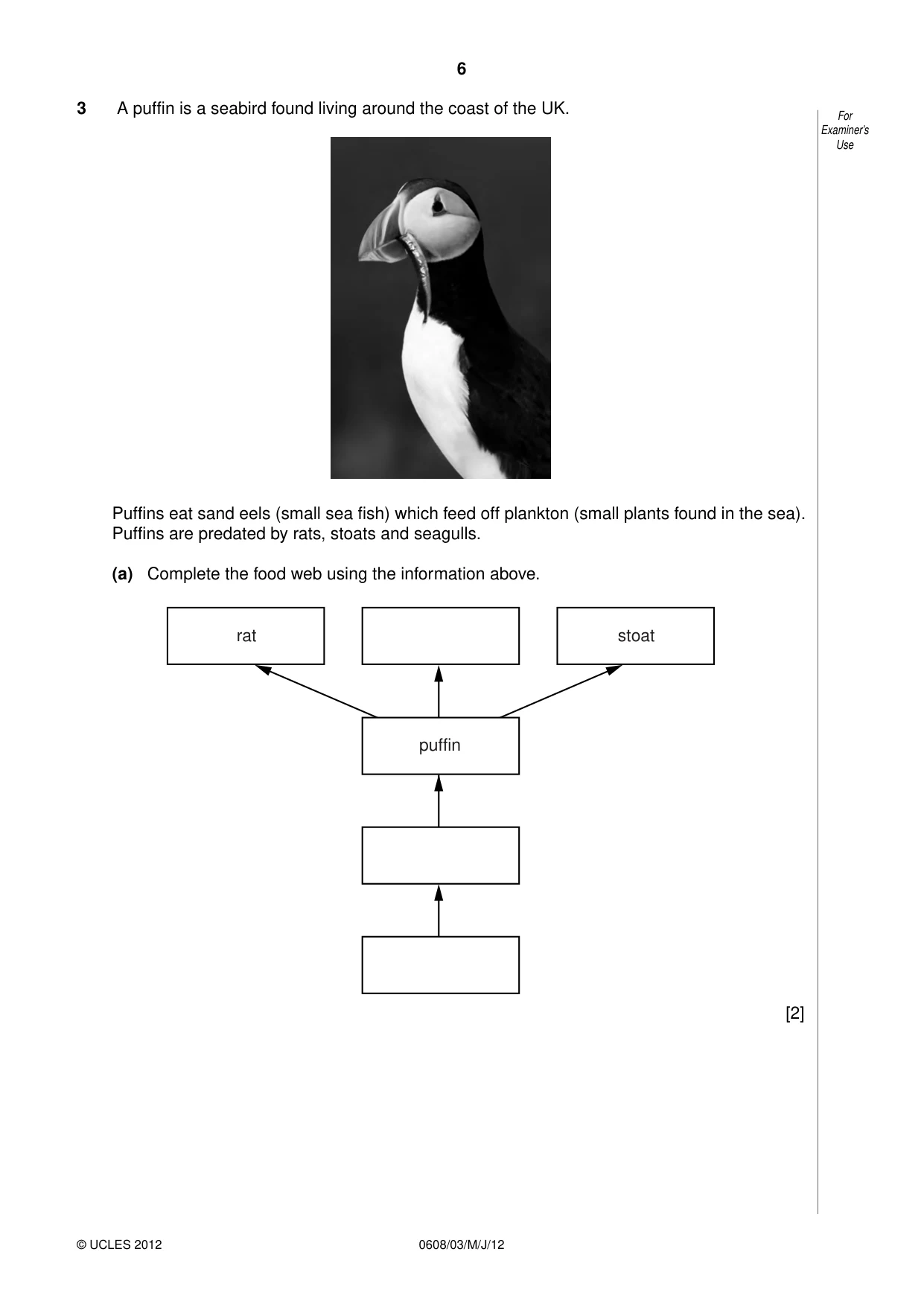
6 0608/03/M/J/12 © UCLES 2012 For Examiner’s Use 3 A puffin is a seabird found living around the coast of the UK. Puffins eat sand eels (small sea fish) which feed off plankton (small plants found in the sea). Puffins are predated by rats, stoats and seagulls. (a) Complete the food web using the information above. rat puffin stoat [2]
Question paper, page 7
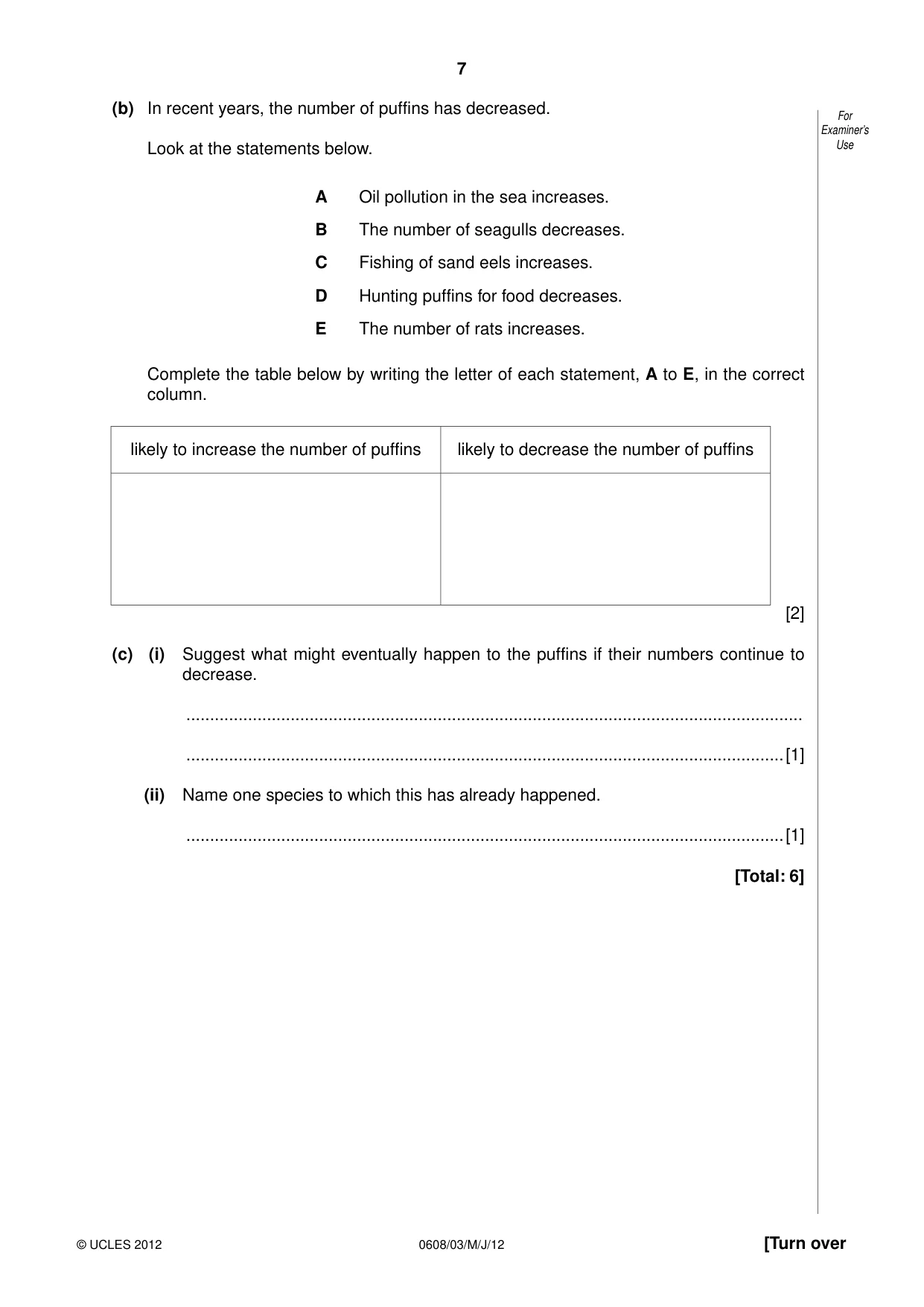
7 0608/03/M/J/12 © UCLES 2012 [Turn over For Examiner’s Use (b) In recent years, the number of puffins has decreased. Look at the statements below. A Oil pollution in the sea increases. B The number of seagulls decreases. C Fishing of sand eels increases. D Hunting puffins for food decreases. E The number of rats increases. Complete the table below by writing the letter of each statement, A to E, in the correct column. likely to increase the number of puffins likely to decrease the number of puffins [2] (c) (i) Suggest what might eventually happen to the puffins if their numbers continue to decrease. … …[1] (ii) Name one species to which this has already happened. …[1] [Total: 6]
Question paper, page 8
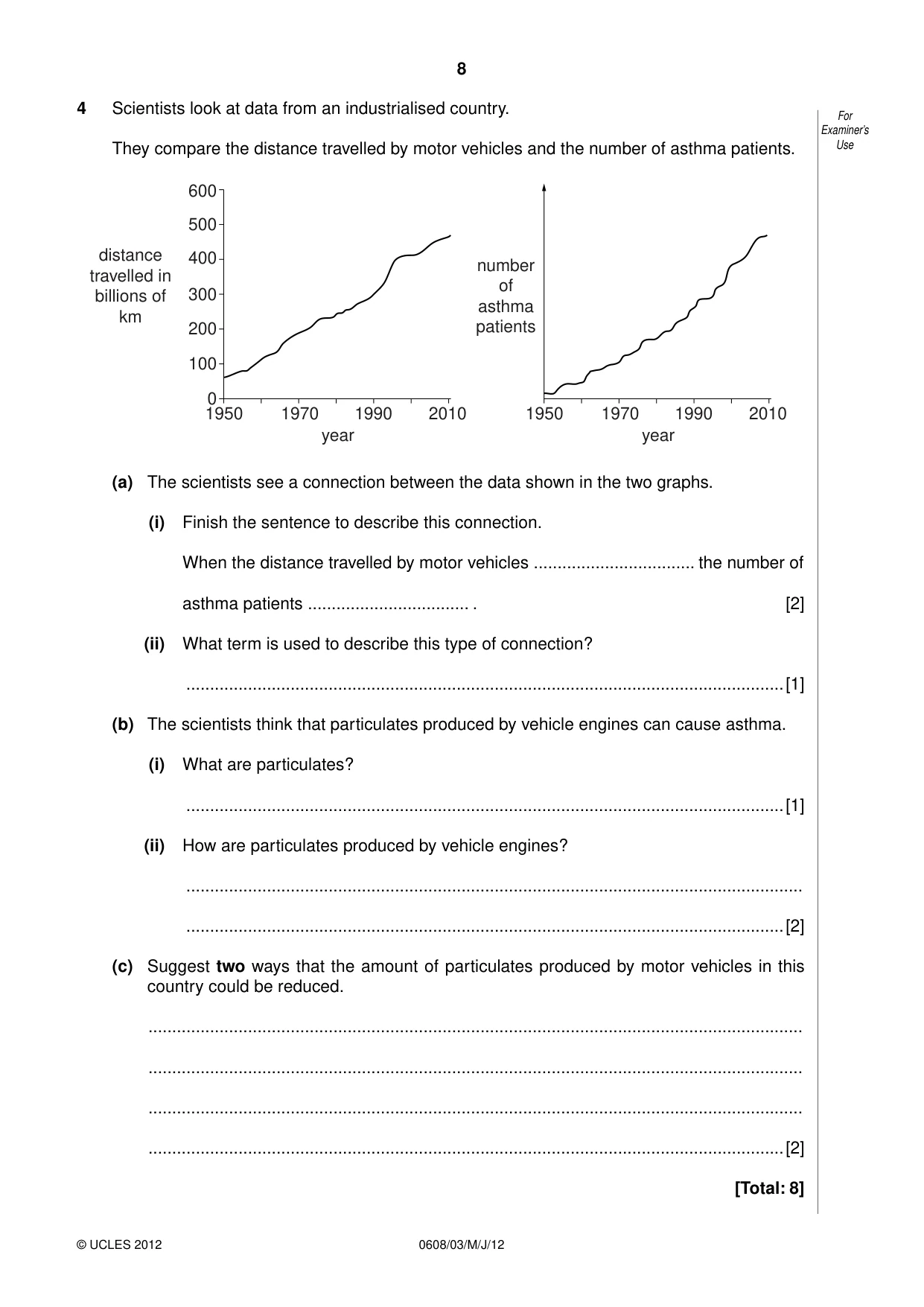
8 0608/03/M/J/12 © UCLES 2012 For Examiner’s Use 4 Scientists look at data from an industrialised country. They compare the distance travelled by motor vehicles and the number of asthma patients. 1950 0 100 200 300 400 500 600 distance travelled in billions of km 1970 1990 year 2010 1950 number of asthma patients 1970 1990 year 2010 (a) The scientists see a connection between the data shown in the two graphs. (i) Finish the sentence to describe this connection. When the distance travelled by motor vehicles … the number of asthma patients … . [2] (ii) What term is used to describe this type of connection? …[1] (b) The scientists think that particulates produced by vehicle engines can cause asthma. (i) What are particulates? …[1] (ii) How are particulates produced by vehicle engines? … …[2] (c) Suggest two ways that the amount of particulates produced by motor vehicles in this country could be reduced. … … … …[2] [Total: 8]
Question paper, page 9
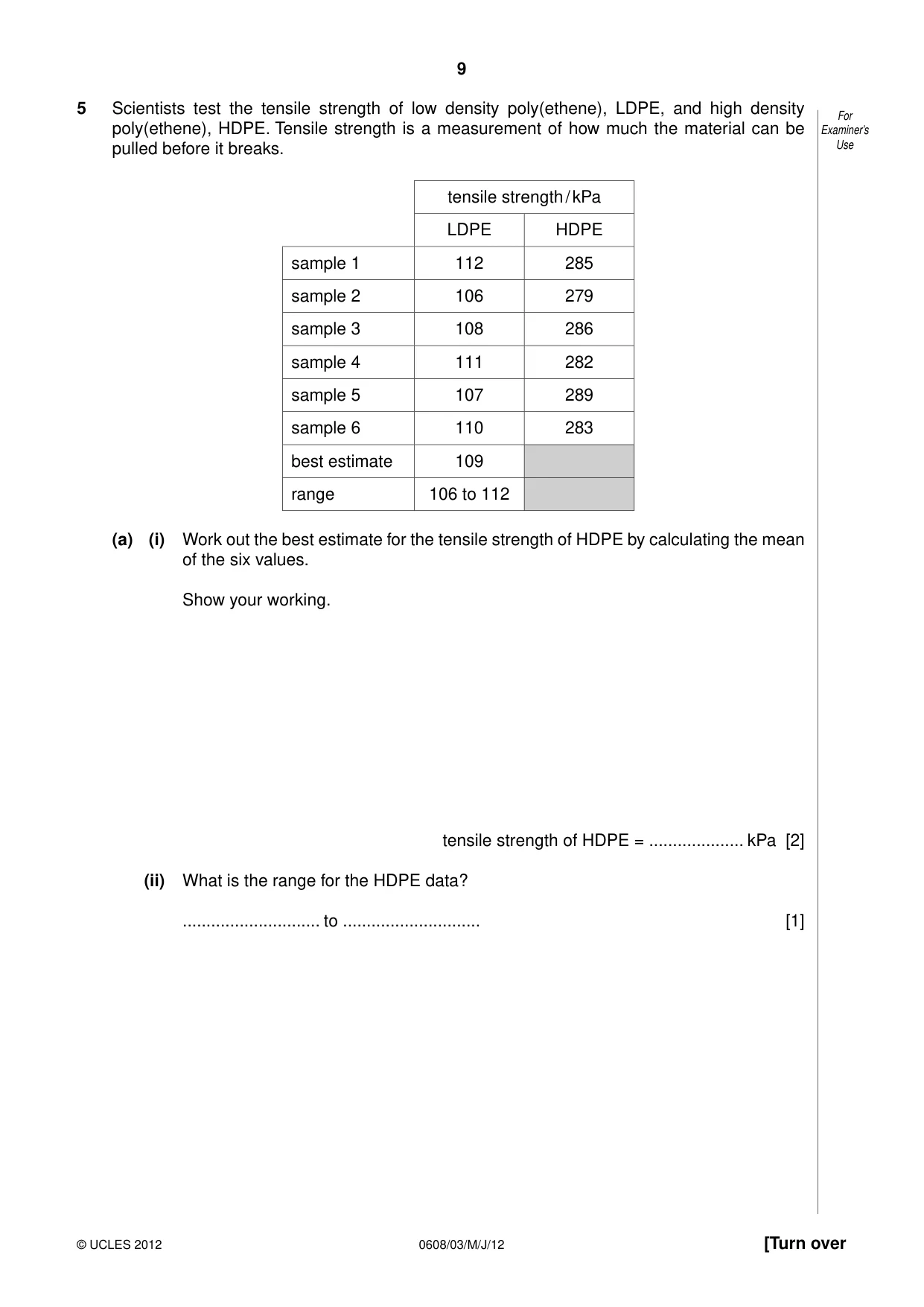
9 0608/03/M/J/12 © UCLES 2012 [Turn over For Examiner’s Use 5 Scientists test the tensile strength of low density poly(ethene), LDPE, and high density poly(ethene), HDPE. Tensile strength is a measurement of how much the material can be pulled before it breaks. tensile strength / kPa LDPE HDPE sample 1 112 285 sample 2 106 279 sample 3 108 286 sample 4 111 282 sample 5 107 289 sample 6 110 283 best estimate 109 range 106 to 112 (a) (i) Work out the best estimate for the tensile strength of HDPE by calculating the mean of the six values. Show your working. tensile strength of HDPE = … kPa [2] (ii) What is the range for the HDPE data? … to … [1]
Question paper, page 10
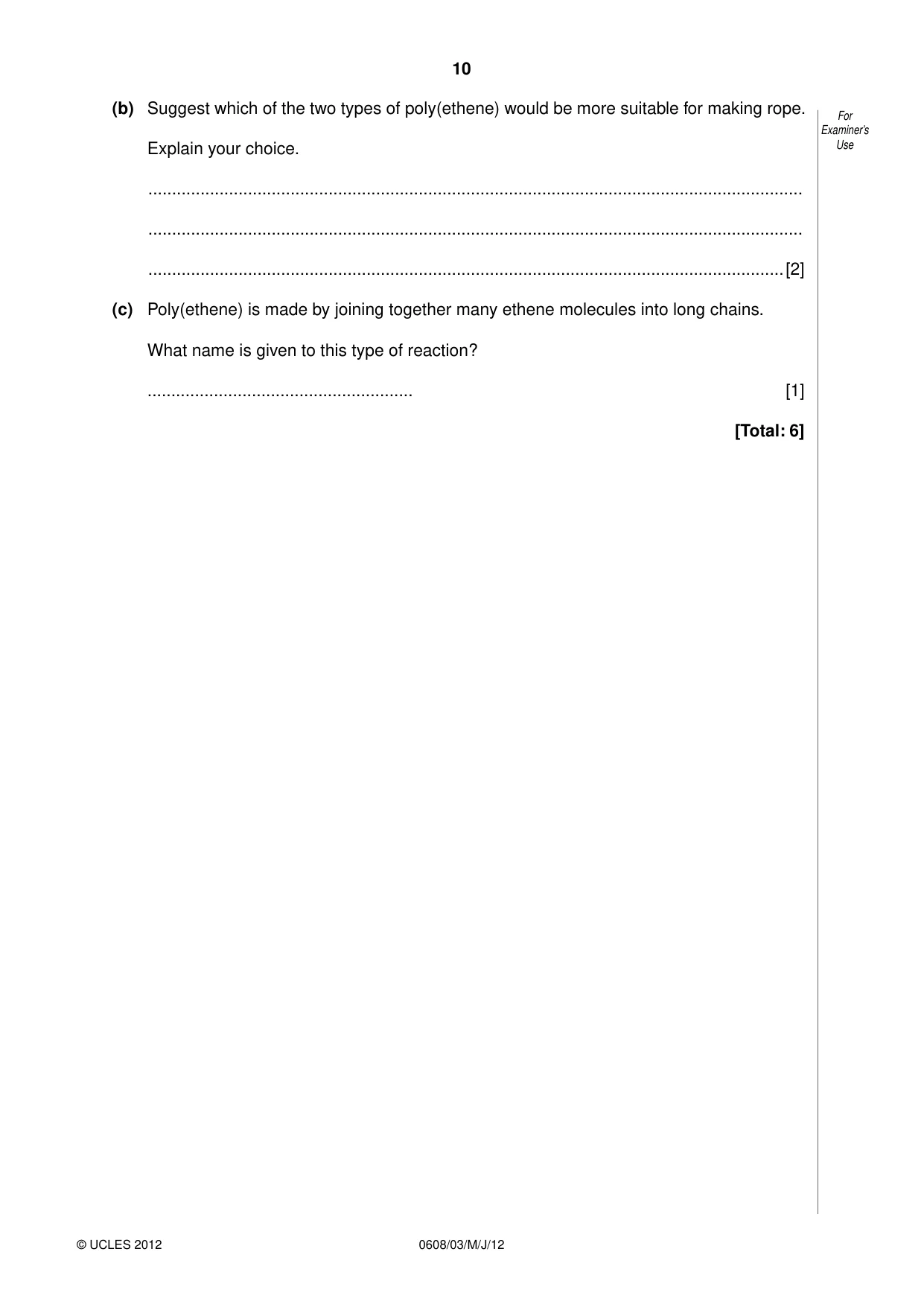
10 0608/03/M/J/12 © UCLES 2012 For Examiner’s Use (b) Suggest which of the two types of poly(ethene) would be more suitable for making rope. Explain your choice. … … …[2] (c) Poly(ethene) is made by joining together many ethene molecules into long chains. What name is given to this type of reaction? … [1] [Total: 6]
Question paper, page 11
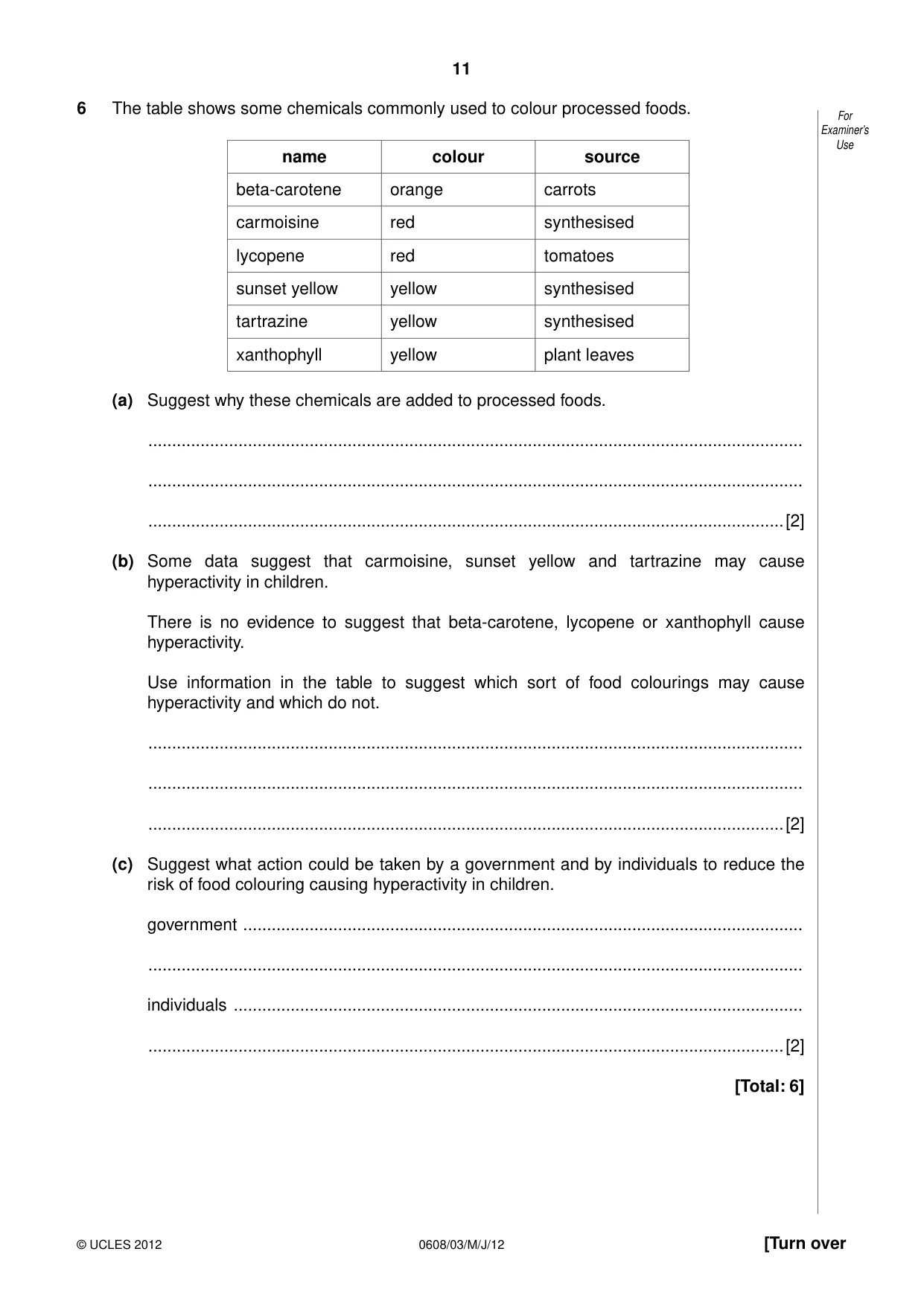
11 0608/03/M/J/12 © UCLES 2012 [Turn over For Examiner’s Use 6 The table shows some chemicals commonly used to colour processed foods. name colour source beta-carotene orange carrots carmoisine red synthesised lycopene red tomatoes sunset yellow yellow synthesised tartrazine yellow synthesised xanthophyll yellow plant leaves (a) Suggest why these chemicals are added to processed foods. … … …[2] (b) Some data suggest that carmoisine, sunset yellow and tartrazine may cause hyperactivity in children. There is no evidence to suggest that beta-carotene, lycopene or xanthophyll cause hyperactivity. Use information in the table to suggest which sort of food colourings may cause hyperactivity and which do not. … … …[2] (c) Suggest what action could be taken by a government and by individuals to reduce the risk of food colouring causing hyperactivity in children. government … … individuals … …[2] [Total: 6]
Question paper, page 12
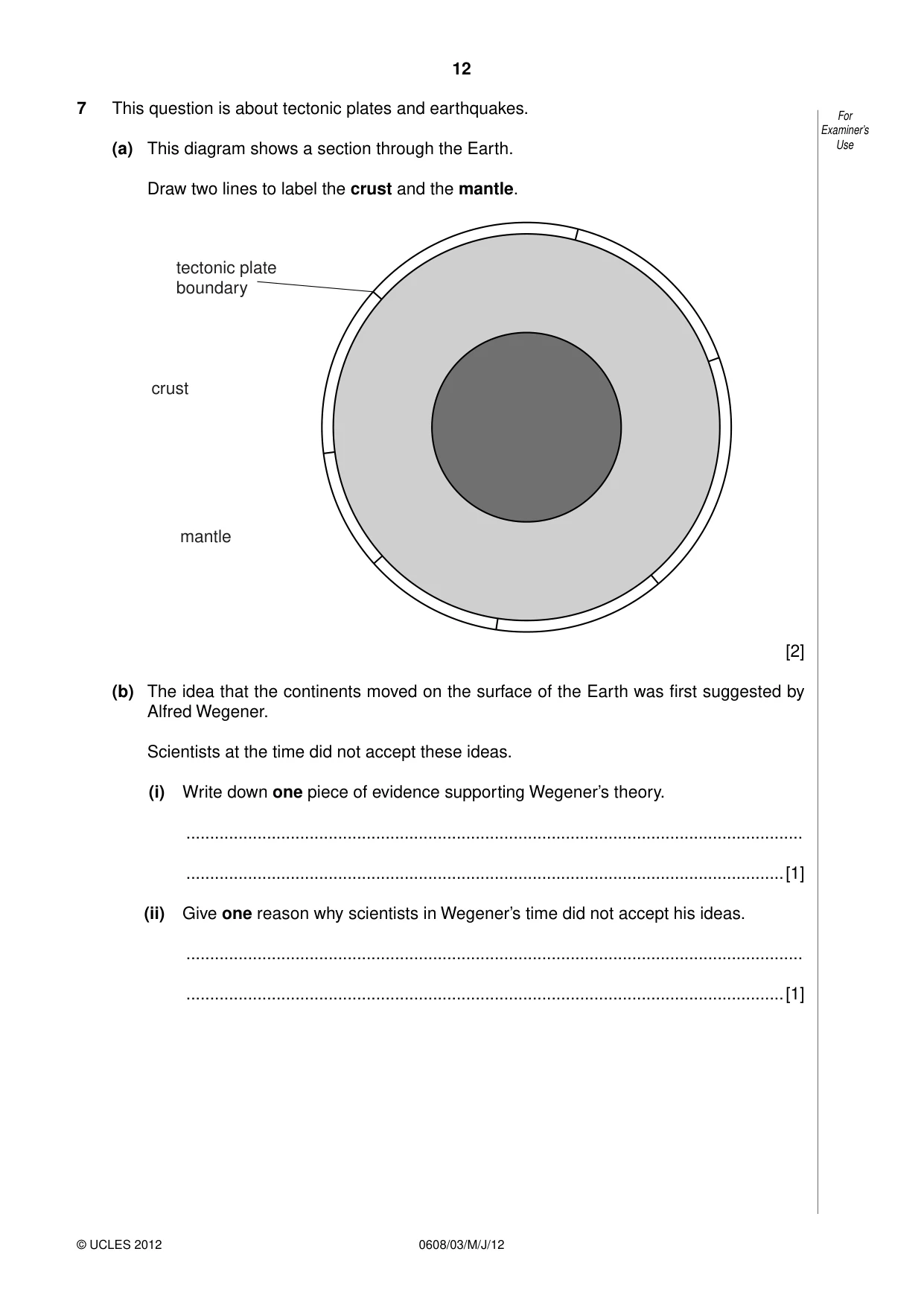
12 0608/03/M/J/12 © UCLES 2012 For Examiner’s Use 7 This question is about tectonic plates and earthquakes. (a) This diagram shows a section through the Earth. Draw two lines to label the crust and the mantle. tectonic plate boundary crust mantle [2] (b) The idea that the continents moved on the surface of the Earth was first suggested by Alfred Wegener. Scientists at the time did not accept these ideas. (i) Write down one piece of evidence supporting Wegener’s theory. … …[1] (ii) Give one reason why scientists in Wegener’s time did not accept his ideas. … …[1]
Question paper, page 13
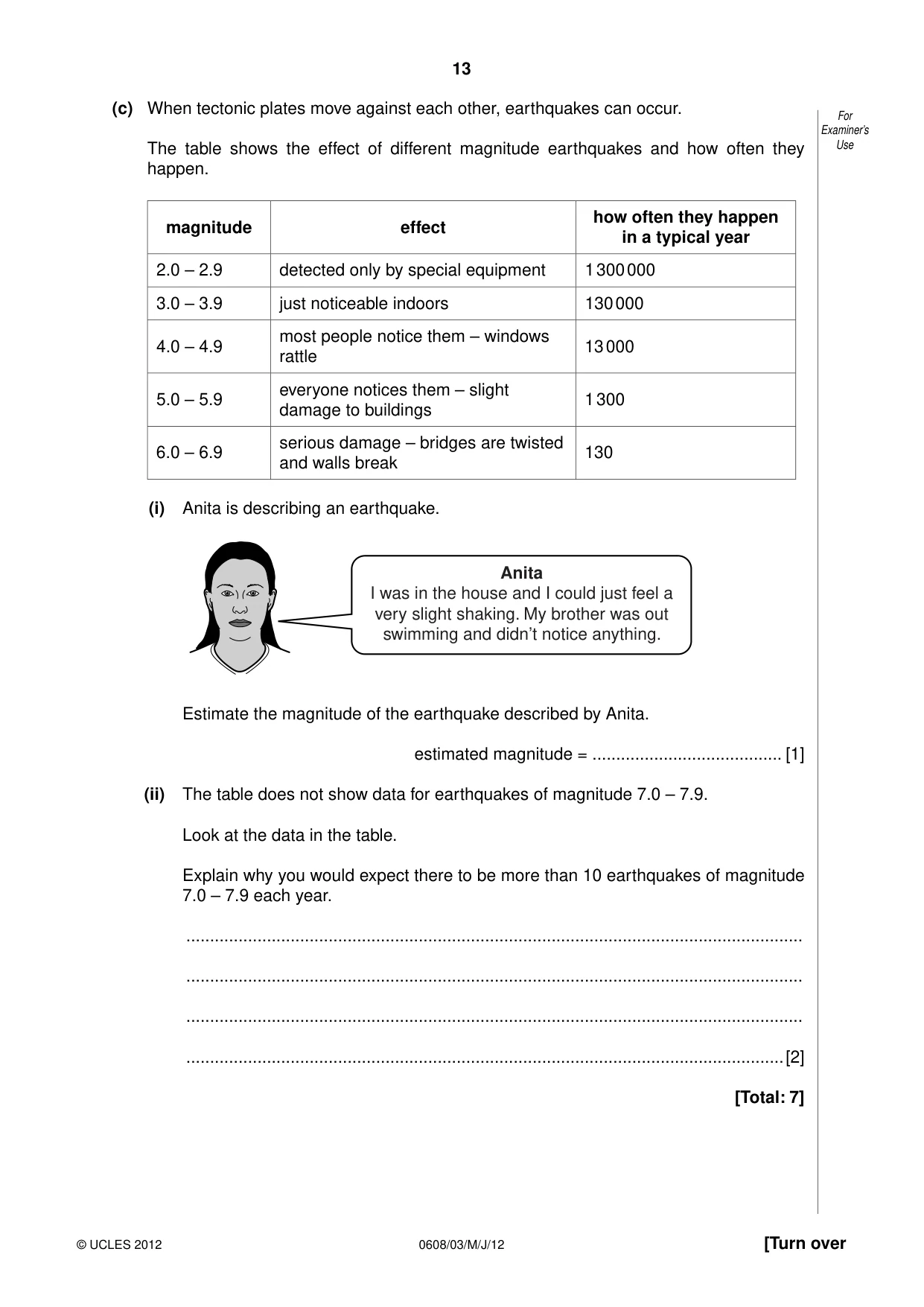
13 0608/03/M/J/12 © UCLES 2012 [Turn over For Examiner’s Use (c) When tectonic plates move against each other, earthquakes can occur. The table shows the effect of different magnitude earthquakes and how often they happen. magnitude effect how often they happen in a typical year 2.0 – 2.9 detected only by special equipment 1 300 000 3.0 – 3.9 just noticeable indoors 130 000 4.0 – 4.9 most people notice them – windows rattle 13 000 5.0 – 5.9 everyone notices them – slight damage to buildings 1 300 6.0 – 6.9 serious damage – bridges are twisted and walls break 130 (i) Anita is describing an earthquake. Anita I was in the house and I could just feel a very slight shaking. My brother was out swimming and didn’t notice anything. Estimate the magnitude of the earthquake described by Anita. estimated magnitude = … [1] (ii) The table does not show data for earthquakes of magnitude 7.0 – 7.9. Look at the data in the table. Explain why you would expect there to be more than 10 earthquakes of magnitude 7.0 – 7.9 each year. … … … …[2] [Total: 7]
Question paper, page 14
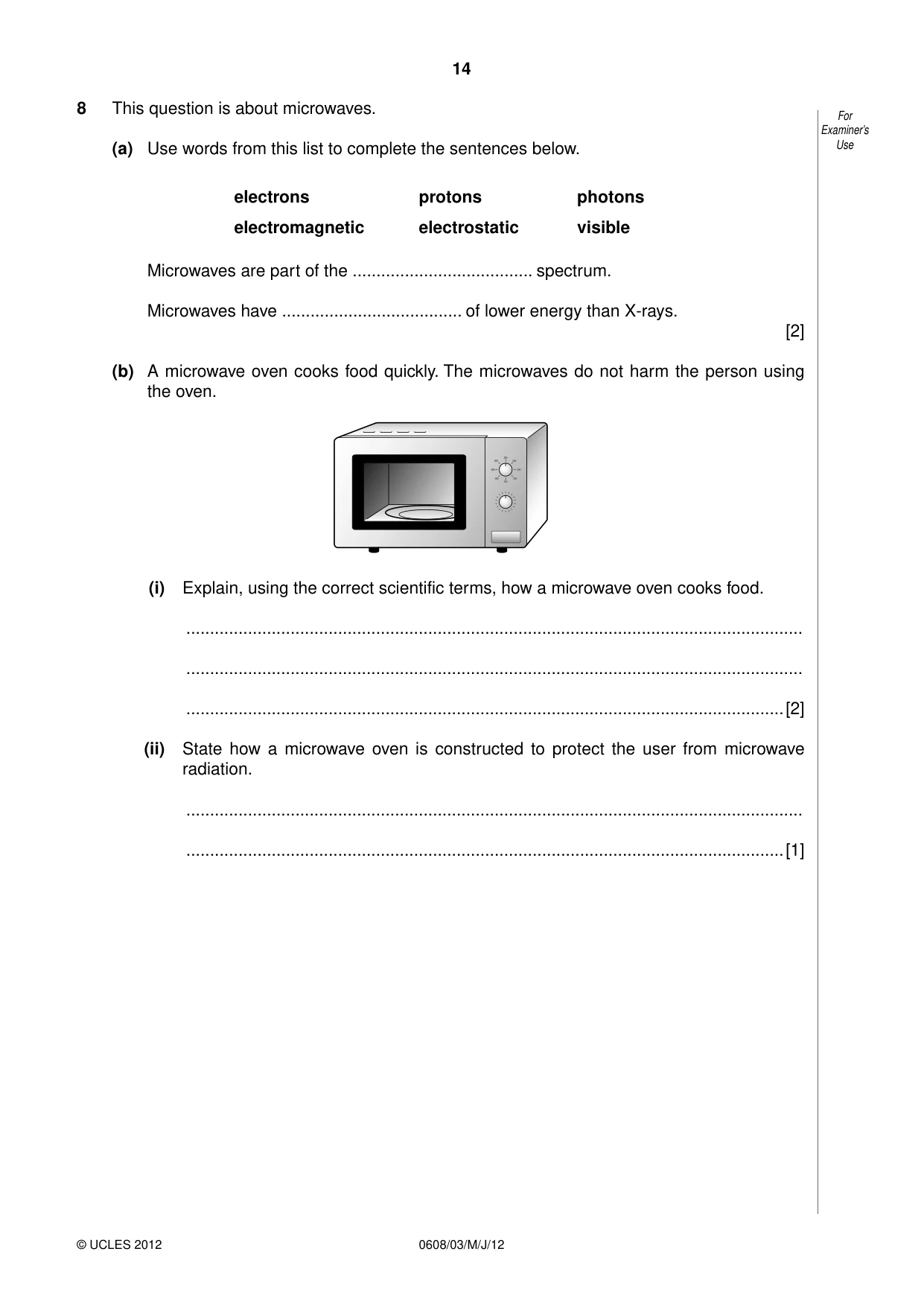
14 0608/03/M/J/12 © UCLES 2012 For Examiner’s Use 8 This question is about microwaves. (a) Use words from this list to complete the sentences below. electrons protons photons electromagnetic electrostatic visible Microwaves are part of the … spectrum. Microwaves have … of lower energy than X-rays. [2] (b) A microwave oven cooks food quickly. The microwaves do not harm the person using the oven. (i) Explain, using the correct scientific terms, how a microwave oven cooks food. … … …[2] (ii) State how a microwave oven is constructed to protect the user from microwave radiation. … …[1]
Question paper, page 15
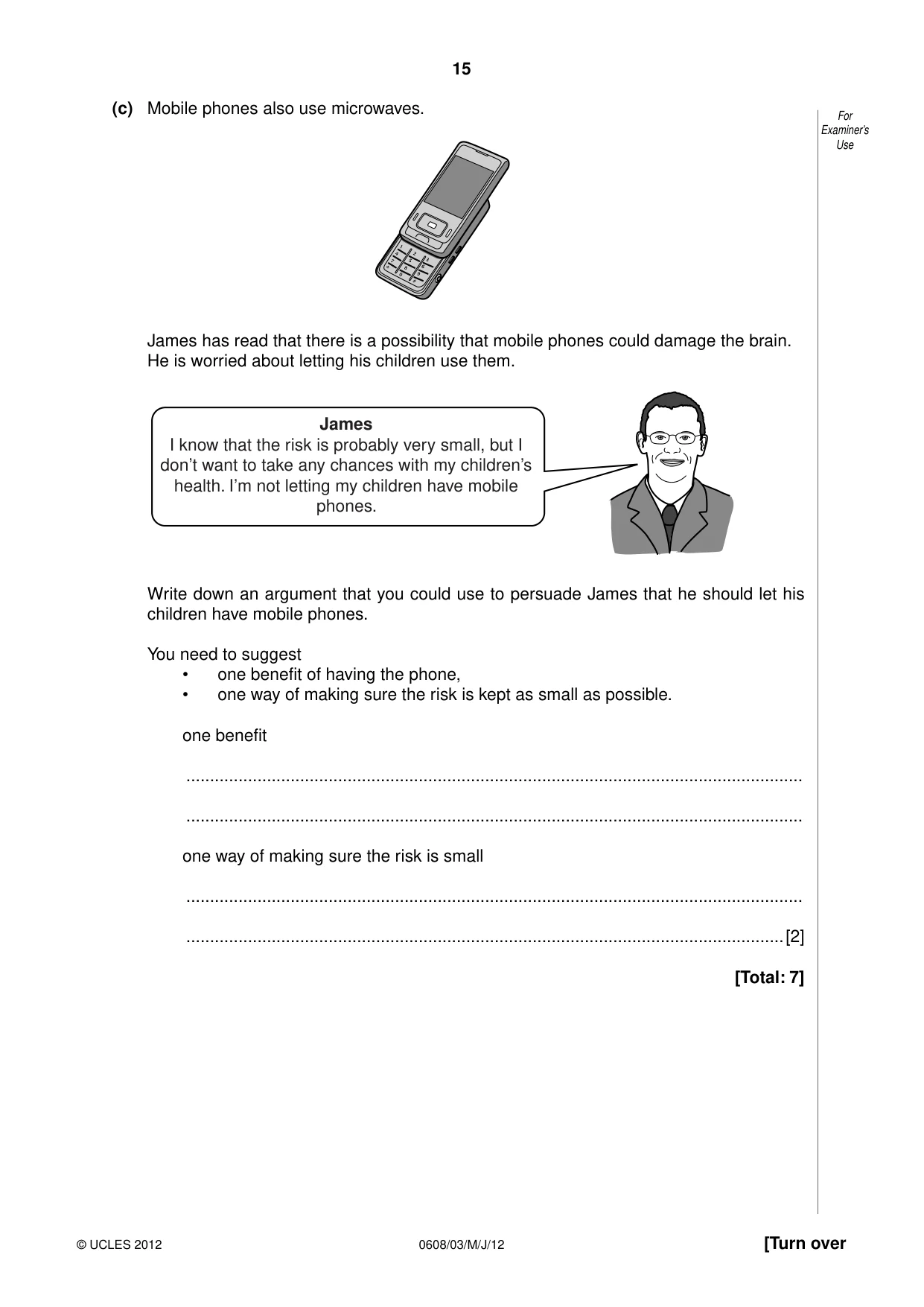
15 0608/03/M/J/12 © UCLES 2012 [Turn over For Examiner’s Use (c) Mobile phones also use microwaves. James has read that there is a possibility that mobile phones could damage the brain. He is worried about letting his children use them. James I know that the risk is probably very small, but I don’t want to take any chances with my children’s health. I’m not letting my children have mobile phones. Write down an argument that you could use to persuade James that he should let his children have mobile phones. You need to suggest • one benefit of having the phone, • one way of making sure the risk is kept as small as possible. one benefit … … one way of making sure the risk is small … …[2] [Total: 7]
Question paper, page 16
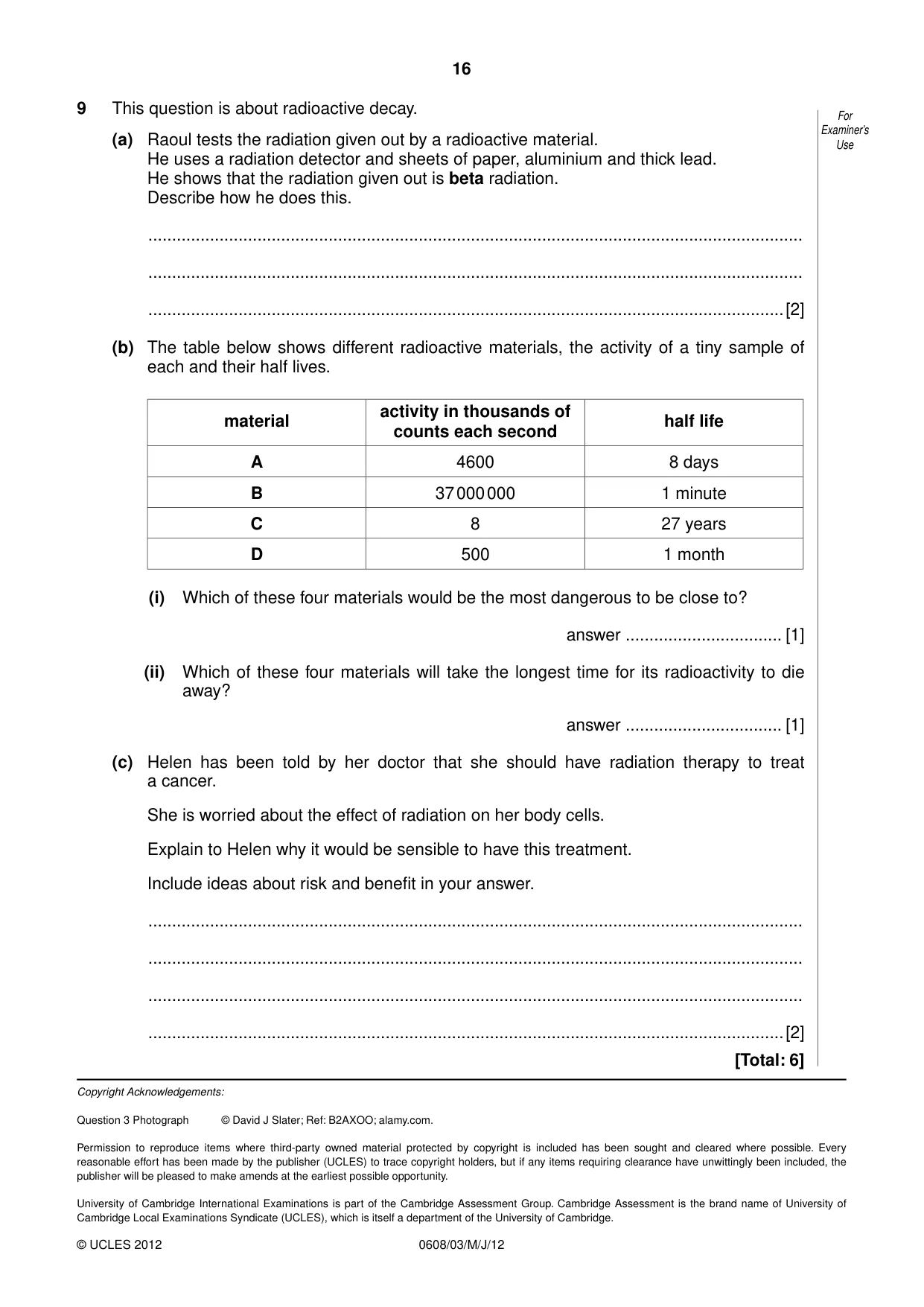
16 0608/03/M/J/12 © UCLES 2012 For Examiner’s Use Copyright Acknowledgements: Question 3 Photograph © David J Slater; Ref: B2AXOO; alamy.com. Permission to reproduce items where third-party owned material protected by copyright is included has been sought and cleared where possible. Every reasonable effort has been made by the publisher (UCLES) to trace copyright holders, but if any items requiring clearance have unwittingly been included, the publisher will be pleased to make amends at the earliest possible opportunity. University of Cambridge International Examinations is part of the Cambridge Assessment Group. Cambridge Assessment is the brand name of University of Cambridge Local Examinations Syndicate (UCLES), which is itself a department of the University of Cambridge. 9 This question is about radioactive decay. (a) Raoul tests the radiation given out by a radioactive material. He uses a radiation detector and sheets of paper, aluminium and thick lead. He shows that the radiation given out is beta radiation. Describe how he does this. … … …[2] (b) The table below shows different radioactive materials, the activity of a tiny sample of each and their half lives. material activity in thousands of counts each second half life A 4600 8 days B 37 000 000 1 minute C 8 27 years D 500 1 month (i) Which of these four materials would be the most dangerous to be close to? answer … [1] (ii) Which of these four materials will take the longest time for its radioactivity to die away? answer … [1] (c) Helen has been told by her doctor that she should have radiation therapy to treat a cancer. She is worried about the effect of radiation on her body cells. Explain to Helen why it would be sensible to have this treatment. Include ideas about risk and benefit in your answer. … … … …[2] [Total: 6]
Mark scheme, page 1
UNIVERSITY OF CAMBRIDGE INTERNATIONAL EXAMINATIONS International General Certificate of Secondary Education MARK SCHEME for the May/June 2012 question paper for the guidance of teachers 0608 TWENTY FIRST CENTURY SCIENCE 0608/03 Paper 3 (Core Written), maximum raw mark 60 This mark scheme is published as an aid to teachers and candidates, to indicate the requirements of the examination. It shows the basis on which Examiners were instructed to award marks. It does not indicate the details of the discussions that took place at an Examiners’ meeting before marking began, which would have considered the acceptability of alternative answers. Mark schemes must be read in conjunction with the question papers and the report on the examination. • Cambridge will not enter into discussions or correspondence in connection with these mark schemes. Cambridge is publishing the mark schemes for the May/June 2012 question papers for most IGCSE, GCE Advanced Level and Advanced Subsidiary Level syllabuses and some Ordinary Level syllabuses. www.XtremePapers.com
Mark scheme, page 2
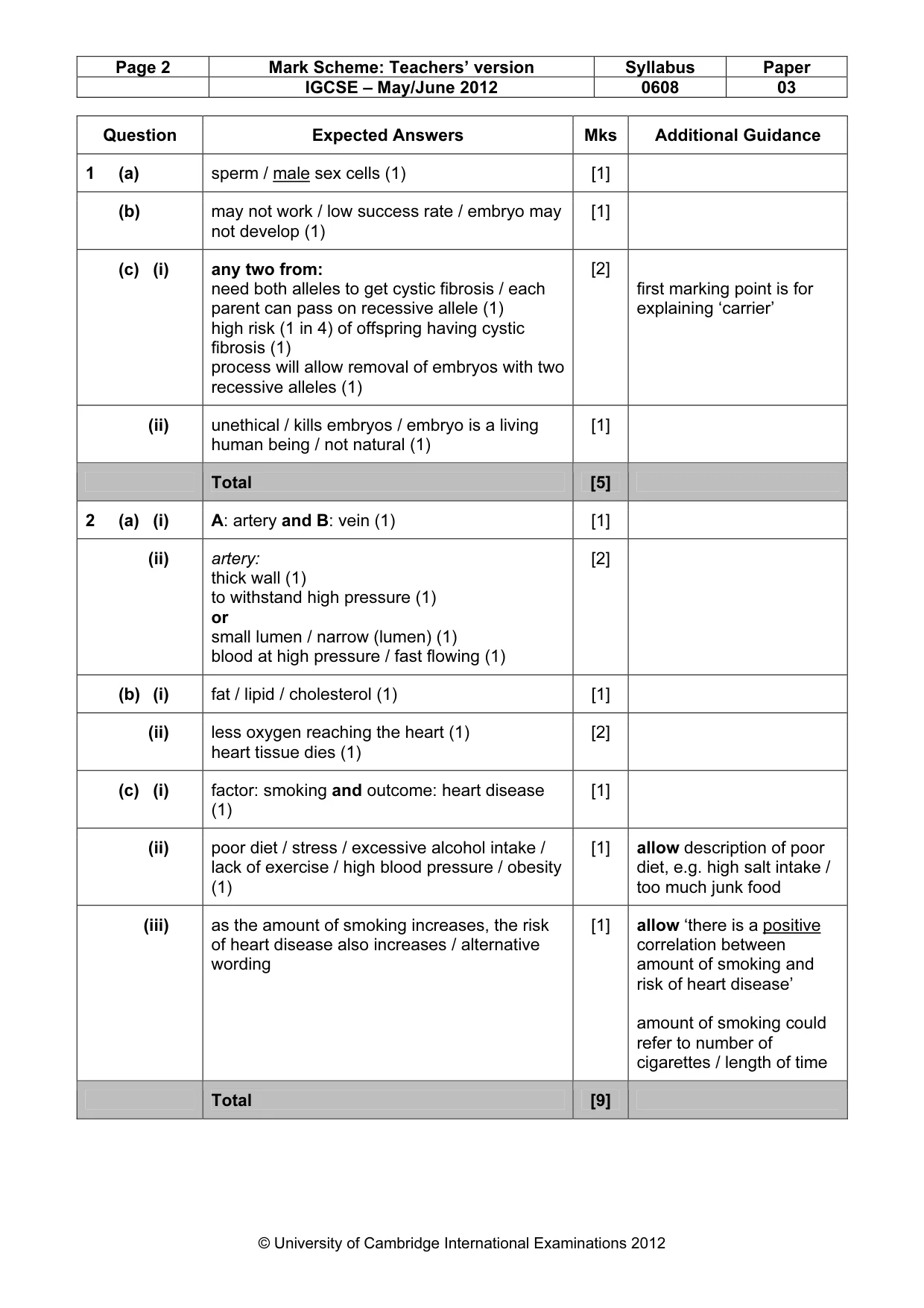
Page 2 Mark Scheme: Teachers’ version Syllabus Paper IGCSE – May/June 2012 0608 03 © University of Cambridge International Examinations 2012 Question Expected Answers Mks Additional Guidance 1 (a) sperm / male sex cells (1) [1] (b) may not work / low success rate / embryo may not develop (1) [1] (c) (i) any two from: need both alleles to get cystic fibrosis / each parent can pass on recessive allele (1) high risk (1 in 4) of offspring having cystic fibrosis (1) process will allow removal of embryos with two recessive alleles (1) [2] first marking point is for explaining ‘carrier’ (ii) unethical / kills embryos / embryo is a living human being / not natural (1) [1] Total [5] 2 (a) (i) A: artery and B: vein (1) [1] (ii) artery: thick wall (1) to withstand high pressure (1) or small lumen / narrow (lumen) (1) blood at high pressure / fast flowing (1) [2] (b) (i) fat / lipid / cholesterol (1) [1] (ii) less oxygen reaching the heart (1) heart tissue dies (1) [2] (c) (i) factor: smoking and outcome: heart disease (1) [1] (ii) poor diet / stress / excessive alcohol intake / lack of exercise / high blood pressure / obesity (1) [1] allow description of poor diet, e.g. high salt intake / too much junk food (iii) as the amount of smoking increases, the risk of heart disease also increases / alternative wording [1] allow ‘there is a positive correlation between amount of smoking and risk of heart disease’ amount of smoking could refer to number of cigarettes / length of time Total [9]
Mark scheme, page 3
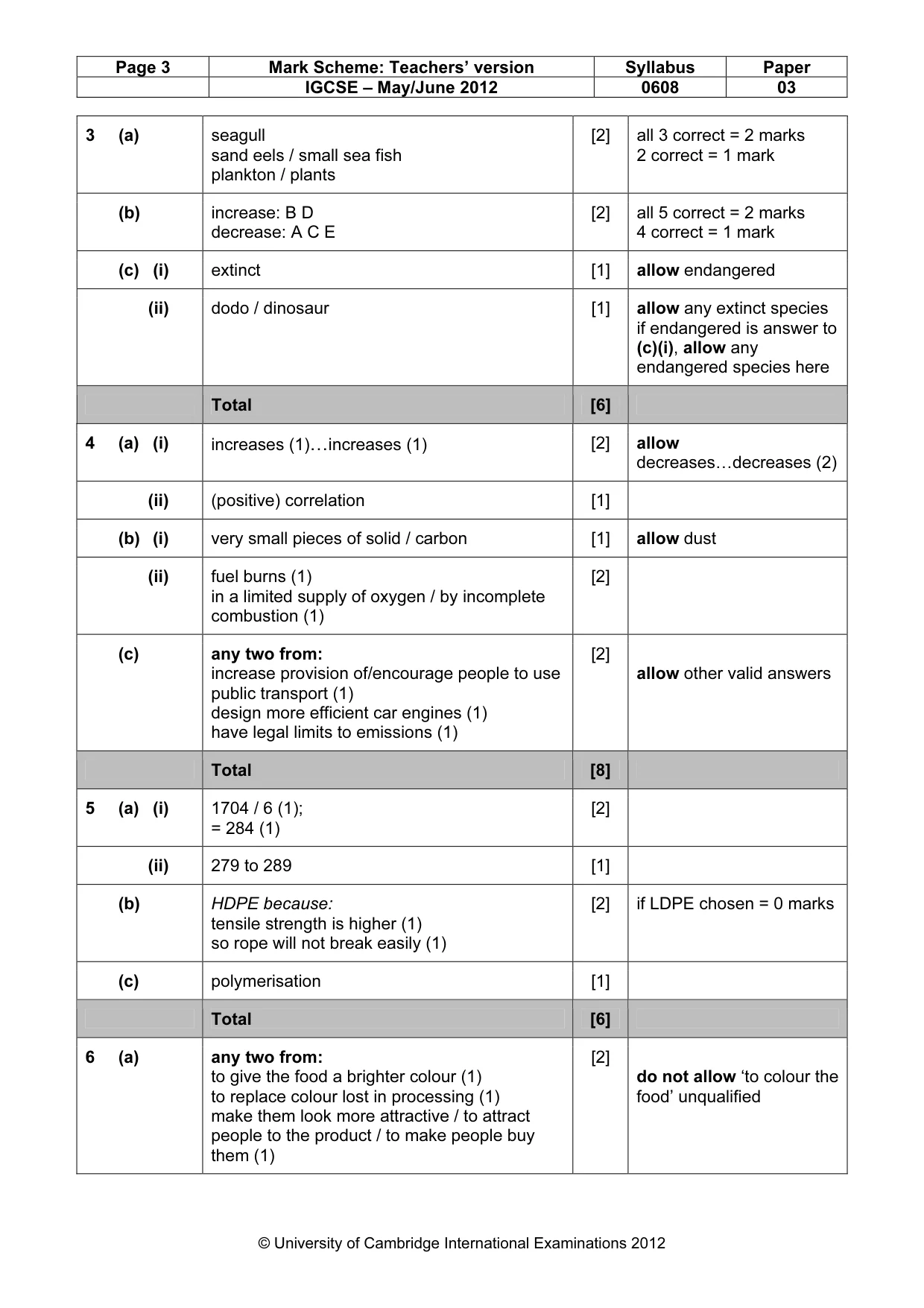
Page 3 Mark Scheme: Teachers’ version Syllabus Paper IGCSE – May/June 2012 0608 03 © University of Cambridge International Examinations 2012 3 (a) seagull sand eels / small sea fish plankton / plants [2] all 3 correct = 2 marks 2 correct = 1 mark (b) increase: B D decrease: A C E [2] all 5 correct = 2 marks 4 correct = 1 mark (c) (i) extinct [1] allow endangered (ii) dodo / dinosaur [1] allow any extinct species if endangered is answer to (c)(i), allow any endangered species here Total [6] 4 (a) (i) increases (1)…increases (1) [2] allow decreases…decreases (2) (ii) (positive) correlation [1] (b) (i) very small pieces of solid / carbon [1] allow dust (ii) fuel burns (1) in a limited supply of oxygen / by incomplete combustion (1) [2] (c) any two from: increase provision of/encourage people to use public transport (1) design more efficient car engines (1) have legal limits to emissions (1) [2] allow other valid answers Total [8] 5 (a) (i) 1704 / 6 (1); = 284 (1) [2] (ii) 279 to 289 [1] (b) HDPE because: tensile strength is higher (1) so rope will not break easily (1) [2] if LDPE chosen = 0 marks (c) polymerisation [1] Total [6] 6 (a) any two from: to give the food a brighter colour (1) to replace colour lost in processing (1) make them look more attractive / to attract people to the product / to make people buy them (1) [2] do not allow ‘to colour the food’ unqualified
Mark scheme, page 4
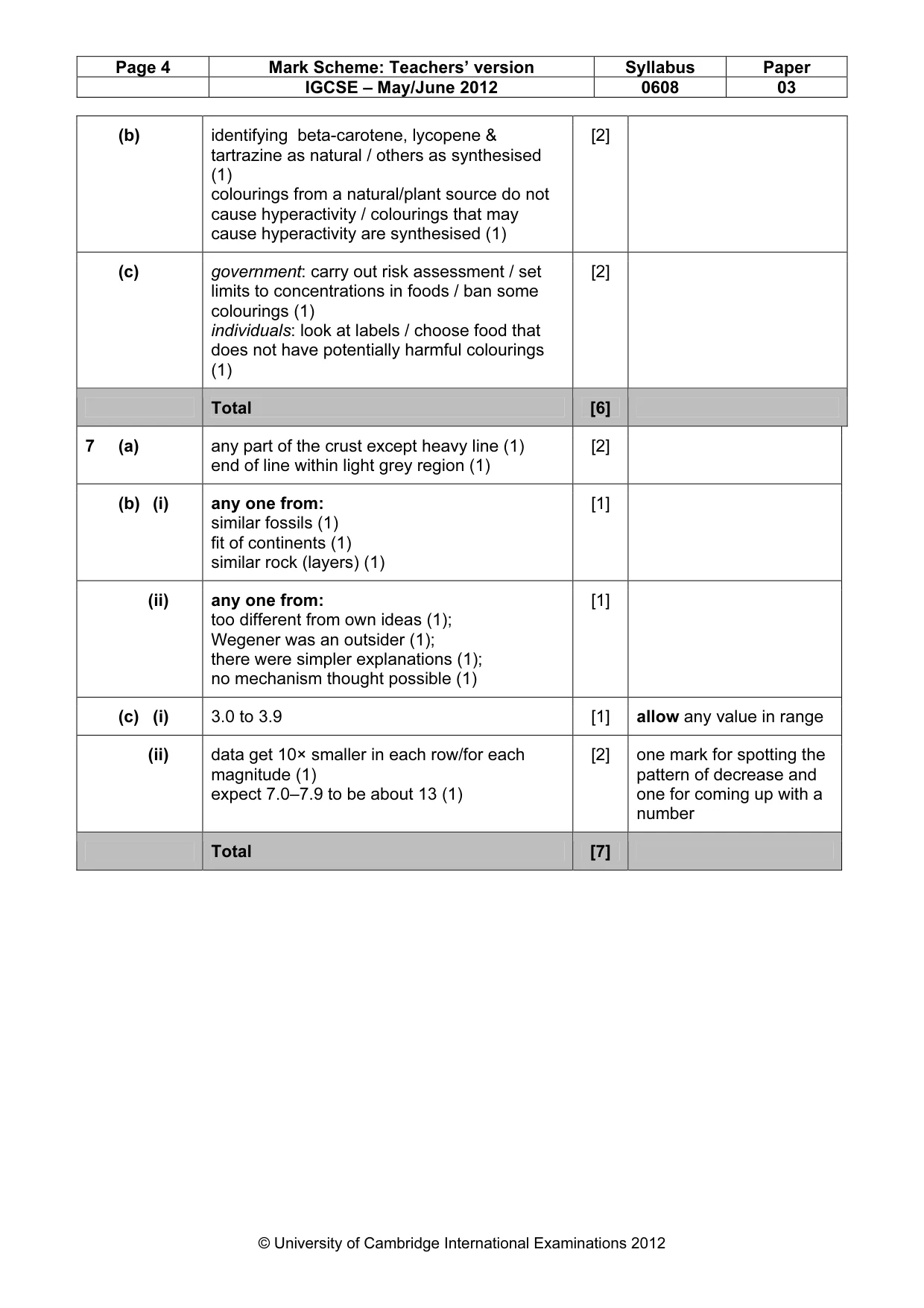
Page 4 Mark Scheme: Teachers’ version Syllabus Paper IGCSE – May/June 2012 0608 03 © University of Cambridge International Examinations 2012 (b) identifying beta-carotene, lycopene & tartrazine as natural / others as synthesised (1) colourings from a natural/plant source do not cause hyperactivity / colourings that may cause hyperactivity are synthesised (1) [2] (c) government: carry out risk assessment / set limits to concentrations in foods / ban some colourings (1) individuals: look at labels / choose food that does not have potentially harmful colourings (1) [2] Total [6] 7 (a) any part of the crust except heavy line (1) end of line within light grey region (1) [2] (b) (i) any one from: similar fossils (1) fit of continents (1) similar rock (layers) (1) [1] (ii) any one from: too different from own ideas (1); Wegener was an outsider (1); there were simpler explanations (1); no mechanism thought possible (1) [1] (c) (i) 3.0 to 3.9 [1] allow any value in range (ii) data get 10× smaller in each row/for each magnitude (1) expect 7.0–7.9 to be about 13 (1) [2] one mark for spotting the pattern of decrease and one for coming up with a number Total [7]
Mark scheme, page 5
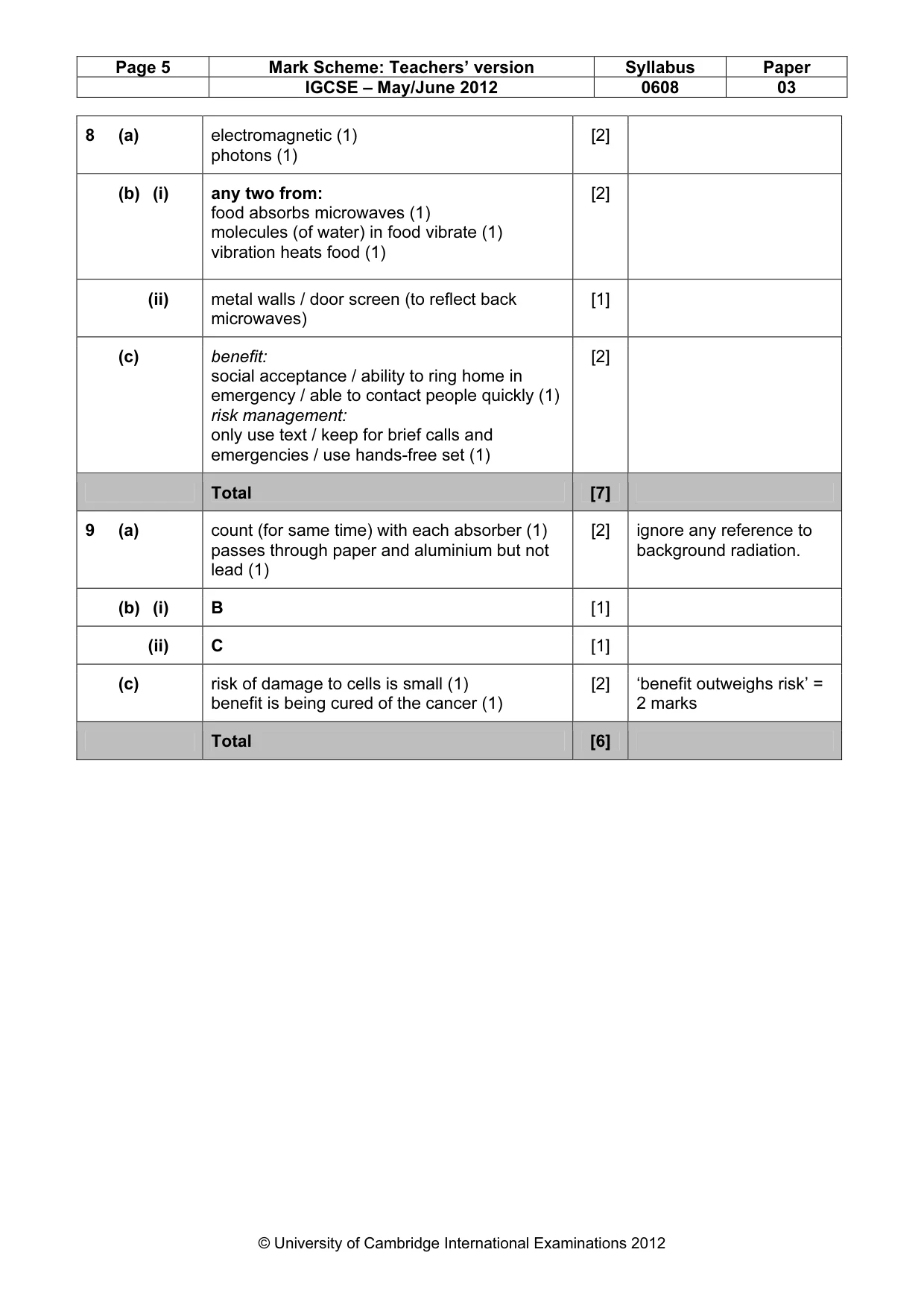
Page 5 Mark Scheme: Teachers’ version Syllabus Paper IGCSE – May/June 2012 0608 03 © University of Cambridge International Examinations 2012 8 (a) electromagnetic (1) photons (1) [2] (b) (i) any two from: food absorbs microwaves (1) molecules (of water) in food vibrate (1) vibration heats food (1) [2] (ii) metal walls / door screen (to reflect back microwaves) [1] (c) benefit: social acceptance / ability to ring home in emergency / able to contact people quickly (1) risk management: only use text / keep for brief calls and emergencies / use hands-free set (1) [2] Total [7] 9 (a) count (for same time) with each absorber (1) passes through paper and aluminium but not lead (1) [2] ignore any reference to background radiation. (b) (i) B [1] (ii) C [1] (c) risk of damage to cells is small (1) benefit is being cured of the cancer (1) [2] ‘benefit outweighs risk’ = 2 marks Total [6]
What you needed in this session
Cambridge’s own grade thresholds for 2012 May/June, Paper 3 · Variant 1. A higher threshold means an easier paper — the bar moves with how the cohort did.