Cambridge IGCSE Twenty-First Century Science 0608 — 2013 May/June Paper 3 · Variant 1
0608/31/M/J/13 · 60 marks · ≈68 min
The question paper and its mark scheme, free to read here and free to download. This is Cambridge’s own paper, exactly as it was sat.
Question paper16 pages


Mark scheme5 pages
Answers below. Sit the paper first if you are practising.
Paper as text
Question paper, page 1
This document consists of 16 printed pages. DC (LEG/CGW) 64751/4 © UCLES 2013 [Turn over UNIVERSITY OF CAMBRIDGE INTERNATIONAL EXAMINATIONS International General Certificate of Secondary Education * 0 9 8 2 2 1 6 8 8 7 * TWENTY FIRST CENTURY SCIENCE 0608/03 Paper 3 May/June 2013 1 hour 30 minutes Candidates answer on the Question Paper. No Additional Materials are required. READ THESE INSTRUCTIONS FIRST Write your Centre number, candidate number and name on all the work you hand in. Write in dark blue or black pen. You may use a pencil for any diagrams or graphs. Do not use staples, paper clips, highlighters, glue or correction fluid. DO NOT WRITE IN ANY BARCODES. Answer all questions. Electronic calculators may be used. At the end of the examination, fasten all your work securely together. The number of marks is given in brackets [ ] at the end of each question or part question. www.XtremePapers.com
Question paper, page 2
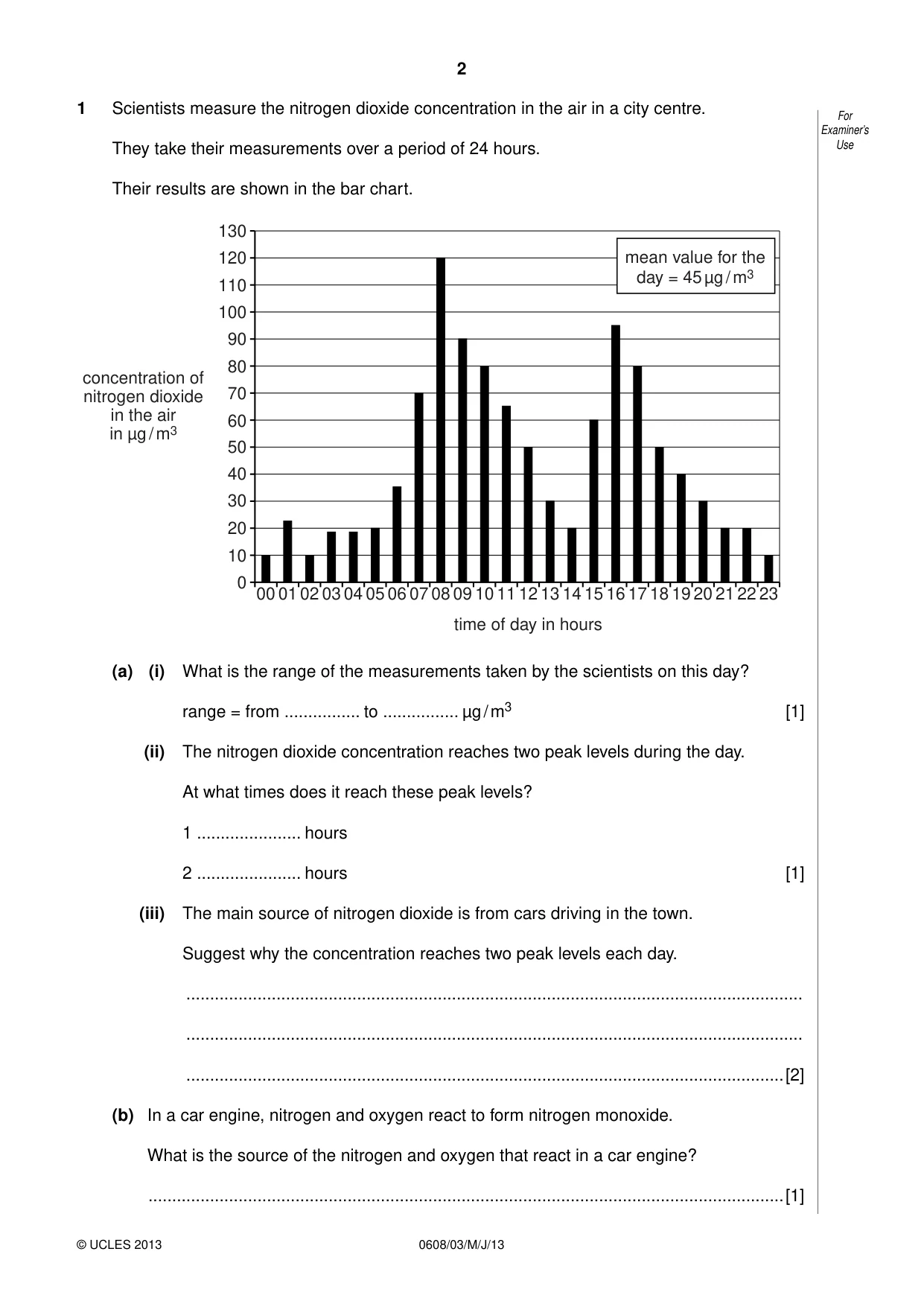
2 0608/03/M/J/13 © UCLES 2013 For Examiner’s Use 1 Scientists measure the nitrogen dioxide concentration in the air in a city centre. They take their measurements over a period of 24 hours. Their results are shown in the bar chart. 130 120 110 100 90 80 70 60 concentration of nitrogen dioxide in the air in µg / m3 50 01 02 03 04 05 06 07 08 09 10 11 12 time of day in hours mean value for the day = 45 µg / m3 13 14 15 16 17 18 19 20 21 22 23 00 40 30 20 10 0 (a) (i) What is the range of the measurements taken by the scientists on this day? range = from … to … µg / m3 [1] (ii) The nitrogen dioxide concentration reaches two peak levels during the day. At what times does it reach these peak levels? 1 … hours 2 … hours [1] (iii) The main source of nitrogen dioxide is from cars driving in the town. Suggest why the concentration reaches two peak levels each day. … … …[2] (b) In a car engine, nitrogen and oxygen react to form nitrogen monoxide. What is the source of the nitrogen and oxygen that react in a car engine? …[1]
Question paper, page 3
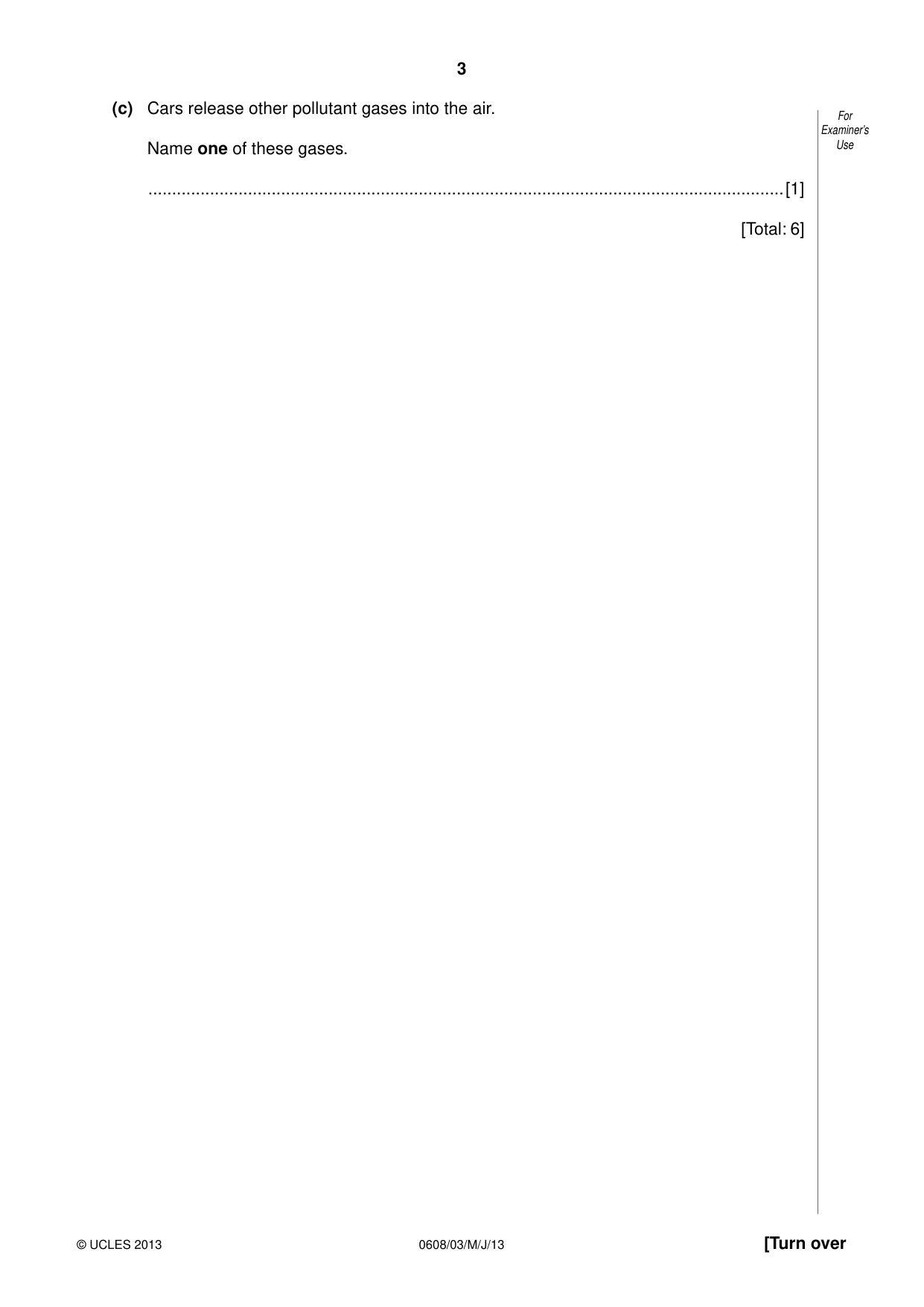
3 0608/03/M/J/13 © UCLES 2013 [Turn over For Examiner’s Use (c) Cars release other pollutant gases into the air. Name one of these gases. …[1] [Total: 6]
Question paper, page 4
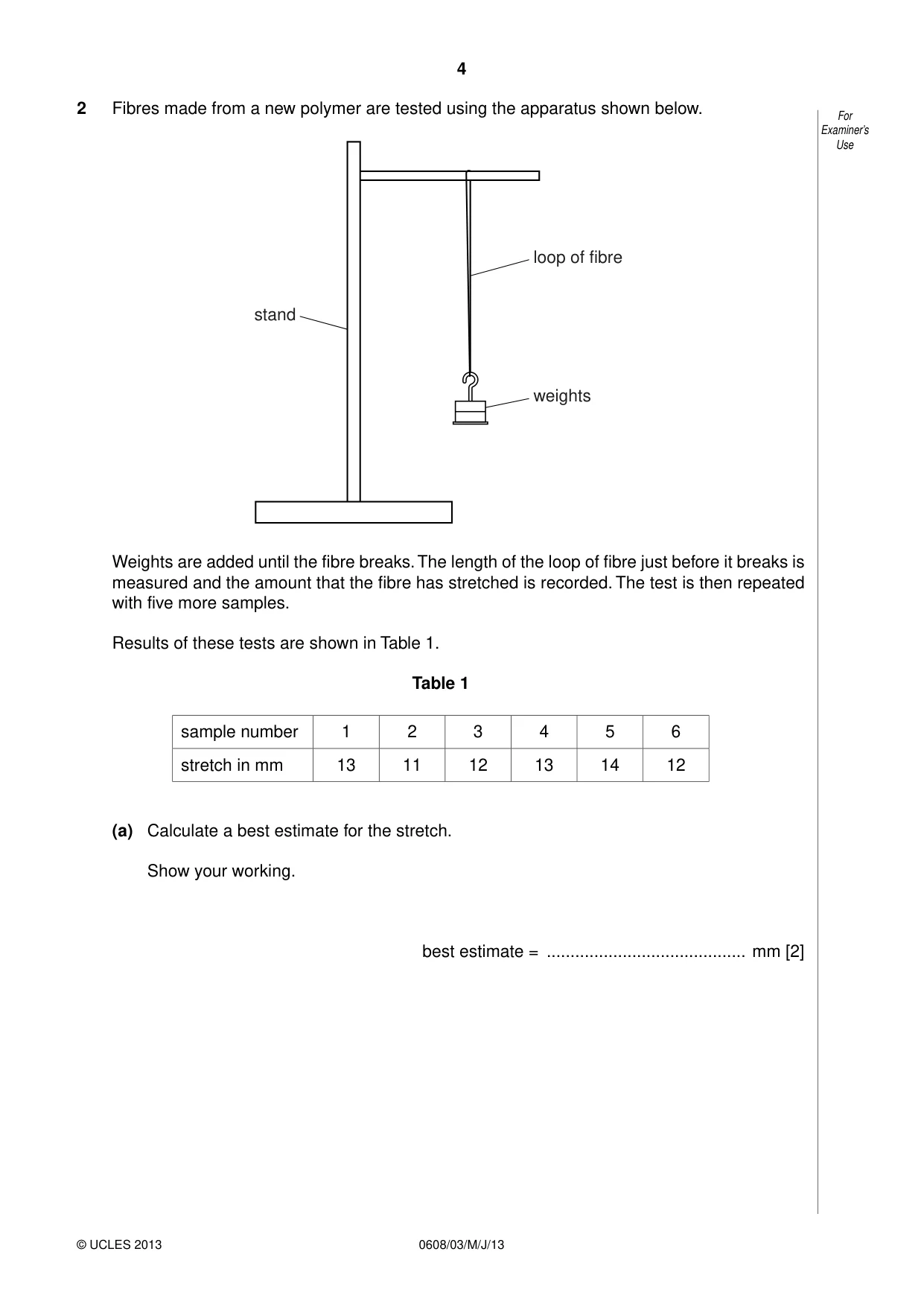
4 0608/03/M/J/13 © UCLES 2013 For Examiner’s Use 2 Fibres made from a new polymer are tested using the apparatus shown below. stand loop of fibre weights Weights are added until the fibre breaks. The length of the loop of fibre just before it breaks is measured and the amount that the fibre has stretched is recorded. The test is then repeated with five more samples. Results of these tests are shown in Table 1. Table 1 sample number 1 2 3 4 5 6 stretch in mm 13 11 12 13 14 12 (a) Calculate a best estimate for the stretch. Show your working. best estimate = … mm [2]
Question paper, page 5
5 0608/03/M/J/13 © UCLES 2013 [Turn over For Examiner’s Use (b) A plasticiser is added to the new polymer. Fibres of the plasticised polymer are then tested in the same way as the unplasticised polymer. Results of these tests are shown in Table 2. Table 2 sample number 1 2 3 4 5 6 mean stretch in mm 21 20 22 21 23 22 21.5 (i) Describe how adding a plasticiser has changed the properties of the polymer. … …[1] (ii) Explain how the plasticiser caused this change in properties. Use ideas about forces between molecules in your answer. … … … … …[3] (c) A company wants to use the fibres of the new polymer to make jogging trousers. Which of the two polymers, plasticised or unplasticised, should they choose? Explain your answer. … … …[1] [Total: 7]
Question paper, page 6
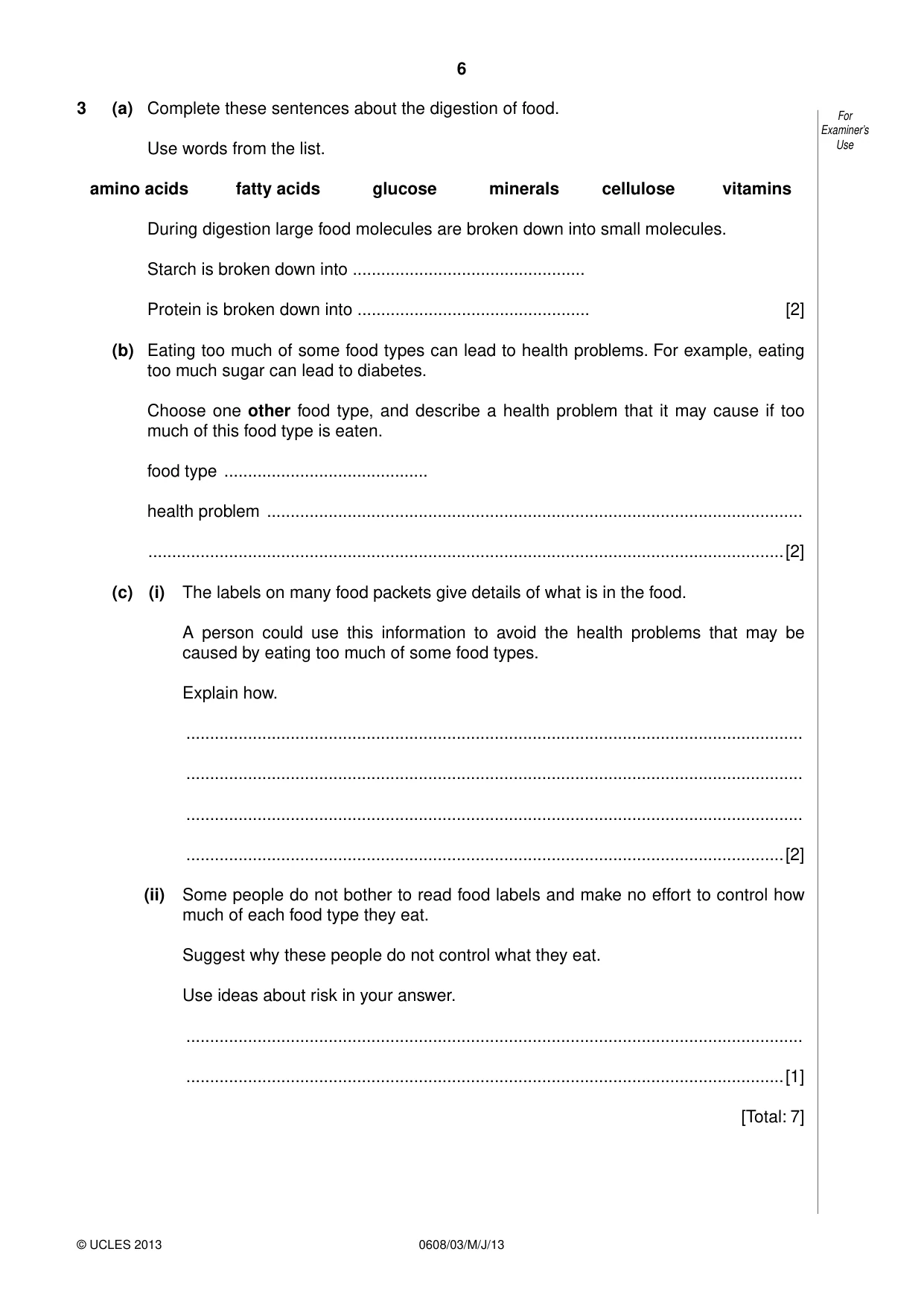
6 0608/03/M/J/13 © UCLES 2013 For Examiner’s Use 3 (a) Complete these sentences about the digestion of food. Use words from the list. amino acids fatty acids glucose minerals cellulose vitamins During digestion large food molecules are broken down into small molecules. Starch is broken down into … Protein is broken down into … [2] (b) Eating too much of some food types can lead to health problems. For example, eating too much sugar can lead to diabetes. Choose one other food type, and describe a health problem that it may cause if too much of this food type is eaten. food type … health problem … …[2] (c) (i) The labels on many food packets give details of what is in the food. A person could use this information to avoid the health problems that may be caused by eating too much of some food types. Explain how. … … … …[2] (ii) Some people do not bother to read food labels and make no effort to control how much of each food type they eat. Suggest why these people do not control what they eat. Use ideas about risk in your answer. … …[1] [Total: 7]
Question paper, page 7
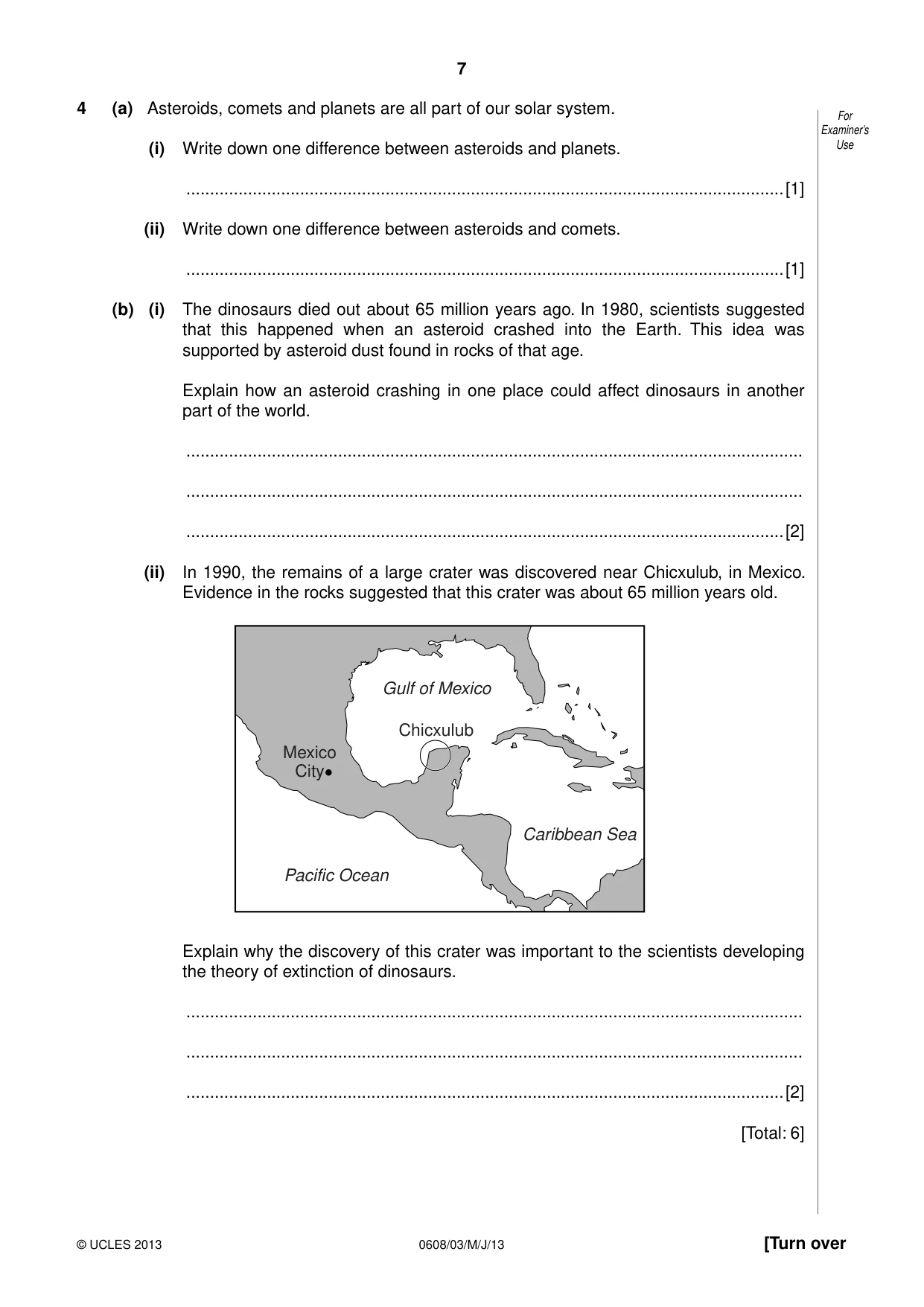
7 0608/03/M/J/13 © UCLES 2013 [Turn over For Examiner’s Use 4 (a) Asteroids, comets and planets are all part of our solar system. (i) Write down one difference between asteroids and planets. …[1] (ii) Write down one difference between asteroids and comets. …[1] (b) (i) The dinosaurs died out about 65 million years ago. In 1980, scientists suggested that this happened when an asteroid crashed into the Earth. This idea was supported by asteroid dust found in rocks of that age. Explain how an asteroid crashing in one place could affect dinosaurs in another part of the world. … … …[2] (ii) In 1990, the remains of a large crater was discovered near Chicxulub, in Mexico. Evidence in the rocks suggested that this crater was about 65 million years old. Pacific Ocean Mexico City Chicxulub Gulf of Mexico Caribbean Sea Explain why the discovery of this crater was important to the scientists developing the theory of extinction of dinosaurs. … … …[2] [Total: 6]
Question paper, page 8
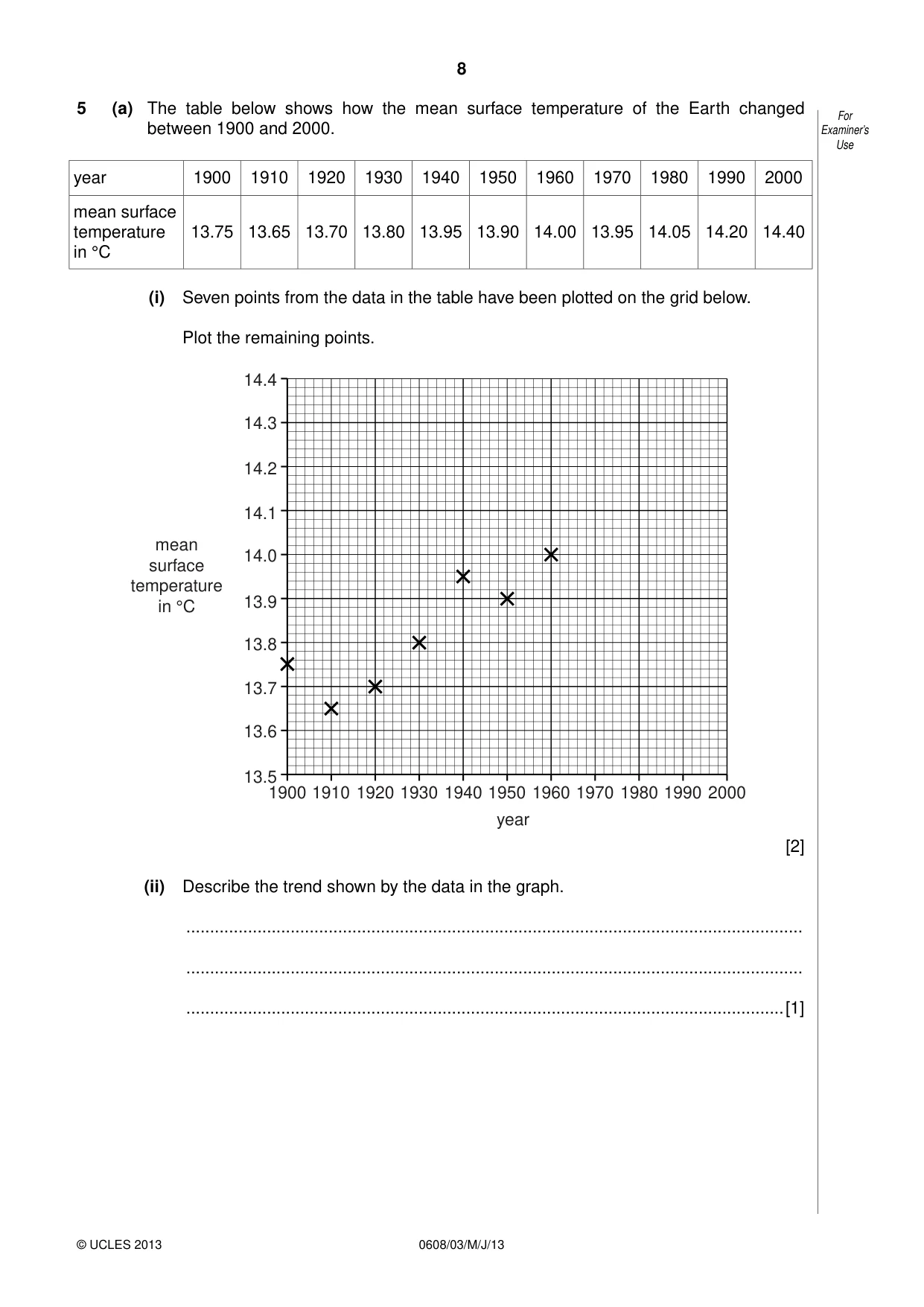
8 0608/03/M/J/13 © UCLES 2013 For Examiner’s Use 5 (a) The table below shows how the mean surface temperature of the Earth changed between 1900 and 2000. year 1900 1910 1920 1930 1940 1950 1960 1970 1980 1990 2000 mean surface temperature in °C 13.75 13.65 13.70 13.80 13.95 13.90 14.00 13.95 14.05 14.20 14.40 (i) Seven points from the data in the table have been plotted on the grid below. Plot the remaining points. 1900 13.5 13.6 13.7 13.8 13.9 14.0 14.1 14.2 14.3 14.4 1920 1940 1960 year mean surface temperature in °C 1980 2000 1910 1930 1950 1970 1990 [2] (ii) Describe the trend shown by the data in the graph. … … …[1]
Question paper, page 9
9 0608/03/M/J/13 © UCLES 2013 [Turn over For Examiner’s Use (b) Scientists are very concerned about the changes shown in the graph. (i) What gas in the atmosphere do scientists think is causing these changes? …[1] (ii) Give two causes of the increase in this gas in the atmosphere. … …[2] (iii) Bangladesh is a country with large areas of land which are not far above sea level. Farmers in Bangladesh need rain in September so that their crops will grow. Explain why changes in the world’s climate could be a serious problem in Bangladesh. … … … …[2] [Total: 8]
Question paper, page 10
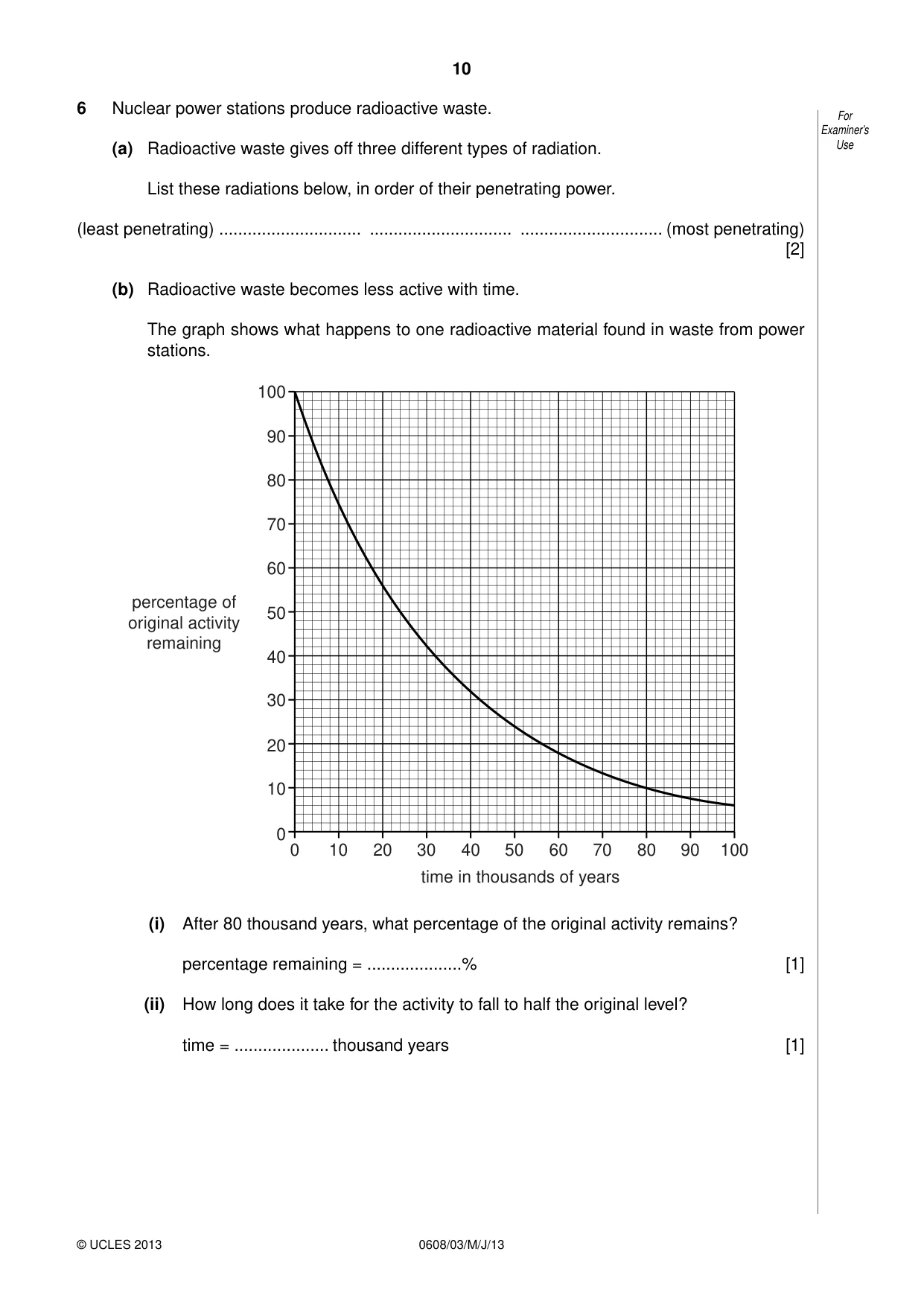
10 0608/03/M/J/13 © UCLES 2013 For Examiner’s Use 6 Nuclear power stations produce radioactive waste. (a) Radioactive waste gives off three different types of radiation. List these radiations below, in order of their penetrating power. (least penetrating) … … … (most penetrating) [2] (b) Radioactive waste becomes less active with time. The graph shows what happens to one radioactive material found in waste from power stations. 0 0 10 20 30 40 50 60 70 80 90 20 40 60 time in thousands of years percentage of original activity remaining 80 100 10 30 50 70 90 100 (i) After 80 thousand years, what percentage of the original activity remains? percentage remaining = …% [1] (ii) How long does it take for the activity to fall to half the original level? time = … thousand years [1]
Question paper, page 11
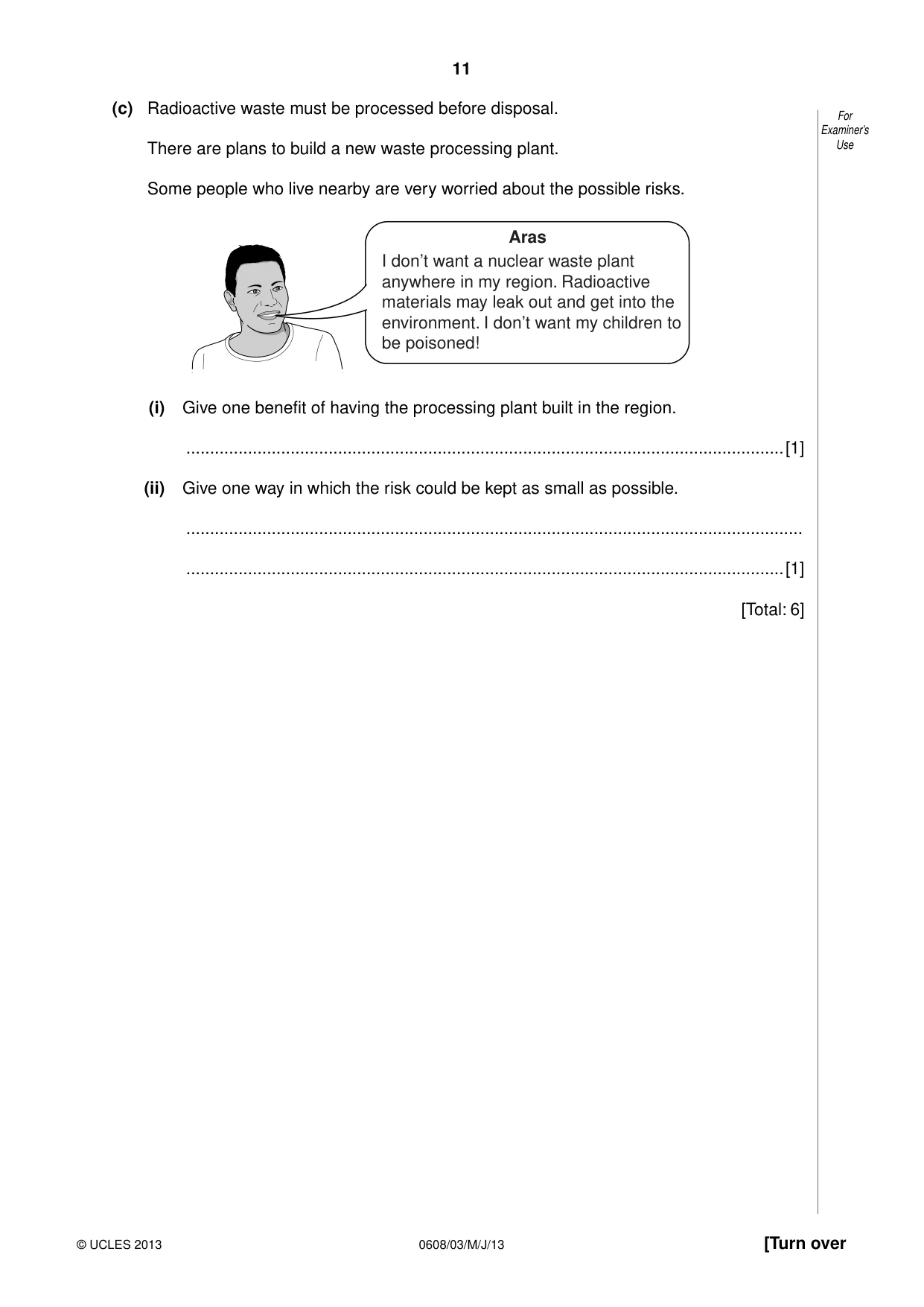
11 0608/03/M/J/13 © UCLES 2013 [Turn over For Examiner’s Use (c) Radioactive waste must be processed before disposal. There are plans to build a new waste processing plant. Some people who live nearby are very worried about the possible risks. I don’t want a nuclear waste plant anywhere in my region. Radioactive materials may leak out and get into the environment. I don’t want my children to be poisoned! Aras (i) Give one benefit of having the processing plant built in the region. …[1] (ii) Give one way in which the risk could be kept as small as possible. … …[1] [Total: 6]
Question paper, page 12
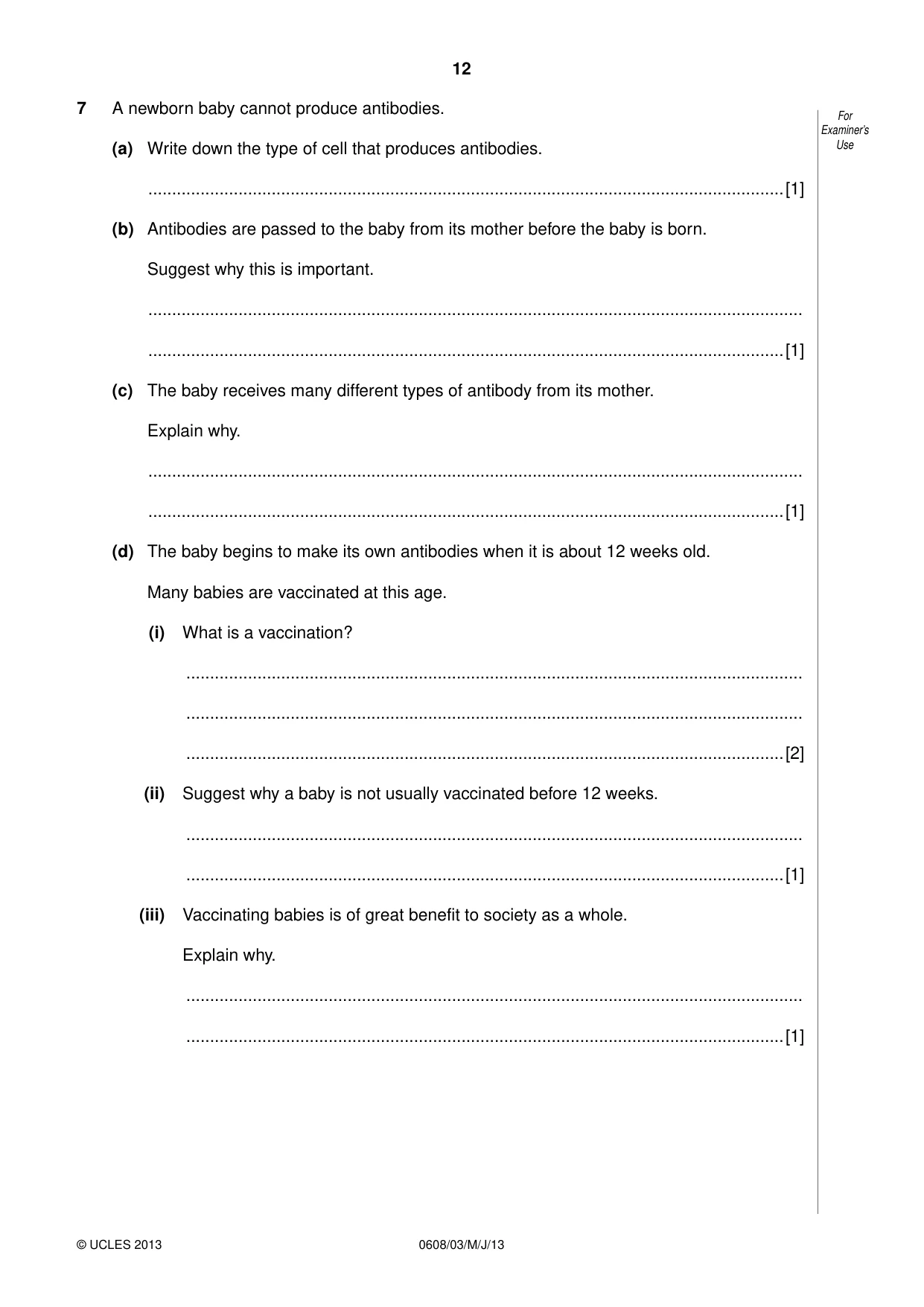
12 0608/03/M/J/13 © UCLES 2013 For Examiner’s Use 7 A newborn baby cannot produce antibodies. (a) Write down the type of cell that produces antibodies. …[1] (b) Antibodies are passed to the baby from its mother before the baby is born. Suggest why this is important. … …[1] (c) The baby receives many different types of antibody from its mother. Explain why. … …[1] (d) The baby begins to make its own antibodies when it is about 12 weeks old. Many babies are vaccinated at this age. (i) What is a vaccination? … … …[2] (ii) Suggest why a baby is not usually vaccinated before 12 weeks. … …[1] (iii) Vaccinating babies is of great benefit to society as a whole. Explain why. … …[1]
Question paper, page 13
13 0608/03/M/J/13 © UCLES 2013 [Turn over For Examiner’s Use (iv) Some parents still choose not to get their babies vaccinated. Suggest one reason why. … …[1] [Total: 8]
Question paper, page 14
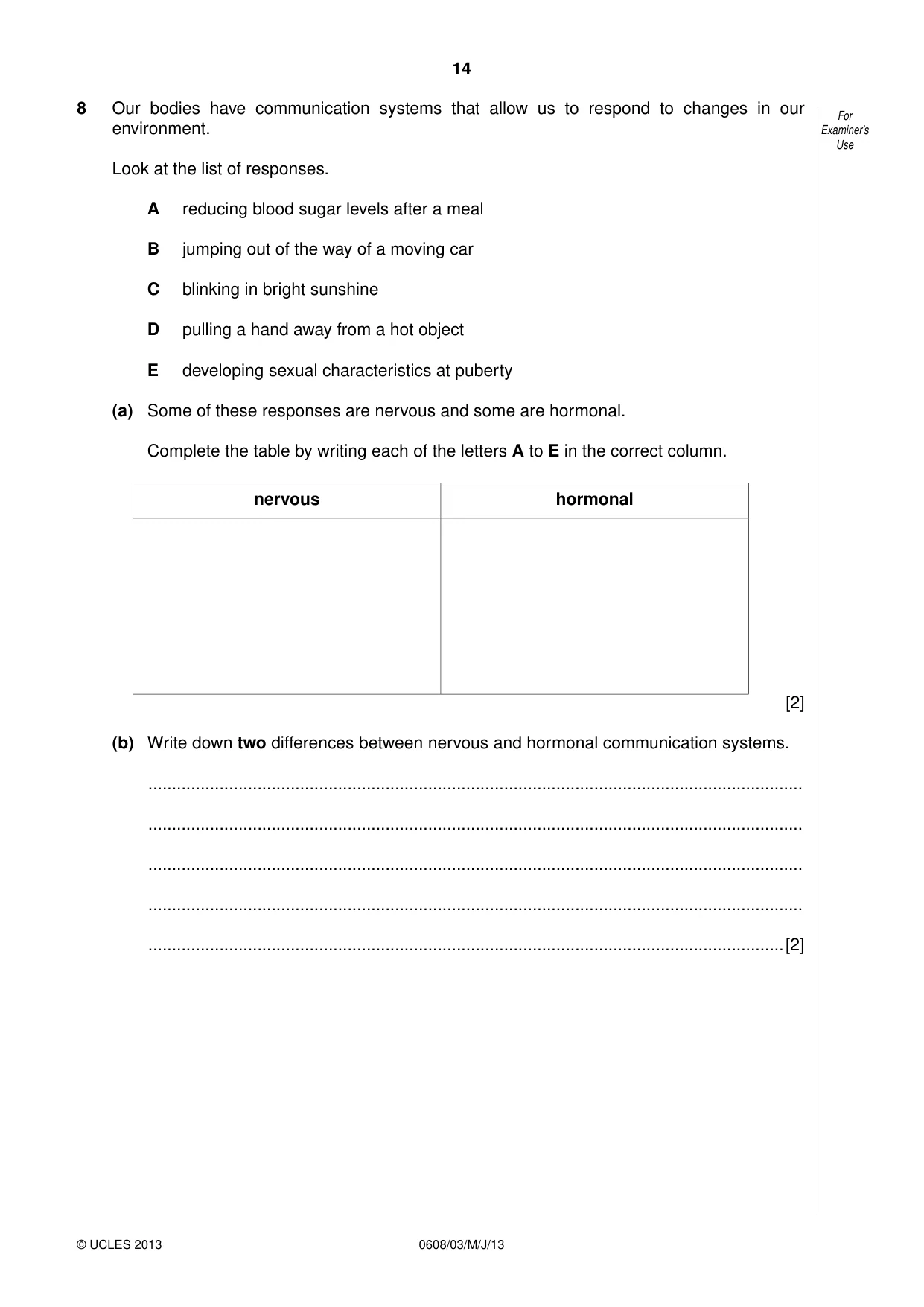
14 0608/03/M/J/13 © UCLES 2013 For Examiner’s Use 8 Our bodies have communication systems that allow us to respond to changes in our environment. Look at the list of responses. A reducing blood sugar levels after a meal B jumping out of the way of a moving car C blinking in bright sunshine D pulling a hand away from a hot object E developing sexual characteristics at puberty (a) Some of these responses are nervous and some are hormonal. Complete the table by writing each of the letters A to E in the correct column. nervous hormonal [2] (b) Write down two differences between nervous and hormonal communication systems. … … … … …[2]
Question paper, page 15
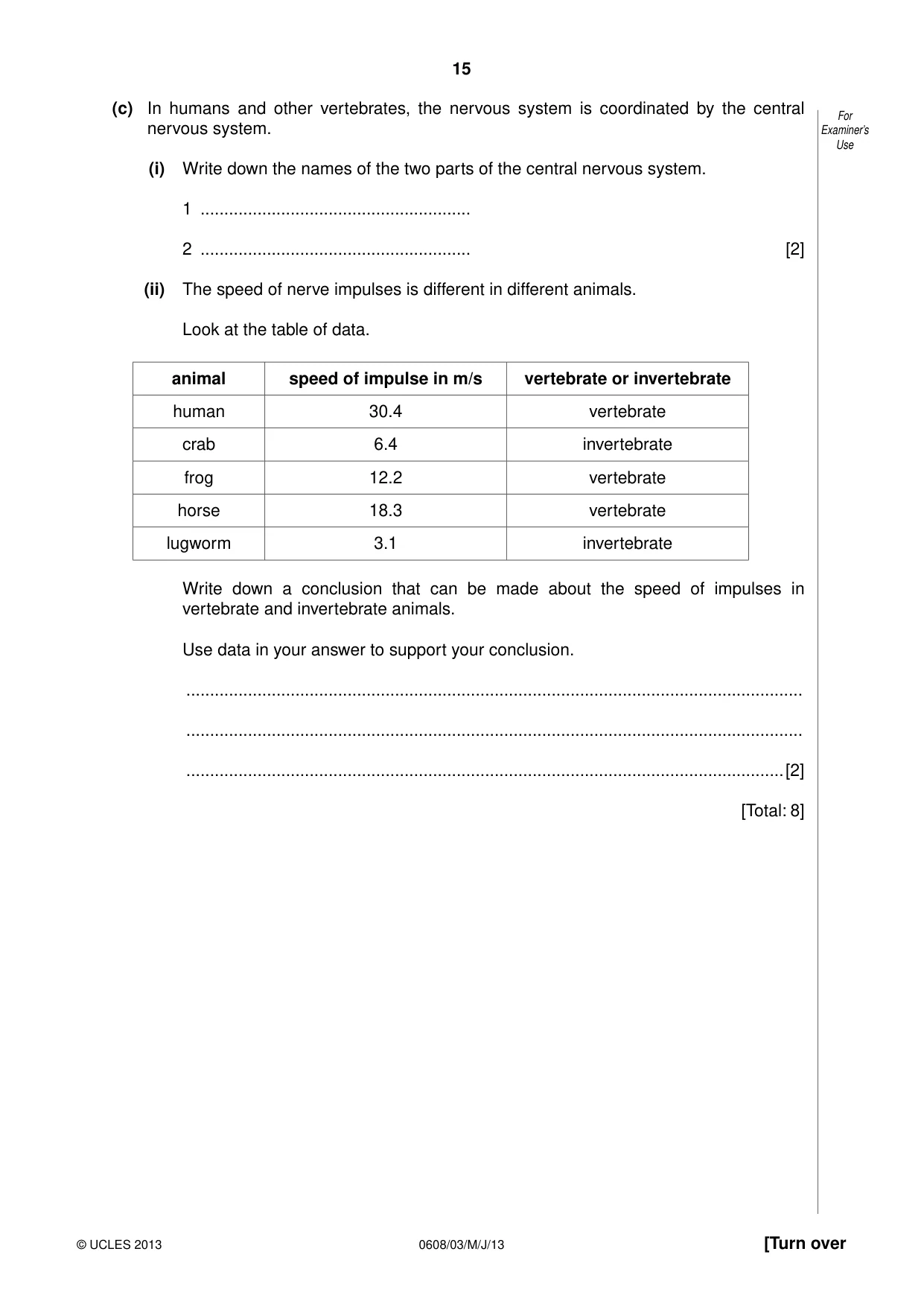
15 0608/03/M/J/13 © UCLES 2013 [Turn over For Examiner’s Use (c) In humans and other vertebrates, the nervous system is coordinated by the central nervous system. (i) Write down the names of the two parts of the central nervous system. 1 … 2 … [2] (ii) The speed of nerve impulses is different in different animals. Look at the table of data. animal speed of impulse in m/s vertebrate or invertebrate human 30.4 vertebrate crab 6.4 invertebrate frog 12.2 vertebrate horse 18.3 vertebrate lugworm 3.1 invertebrate Write down a conclusion that can be made about the speed of impulses in vertebrate and invertebrate animals. Use data in your answer to support your conclusion. … … …[2] [Total: 8]
Question paper, page 16
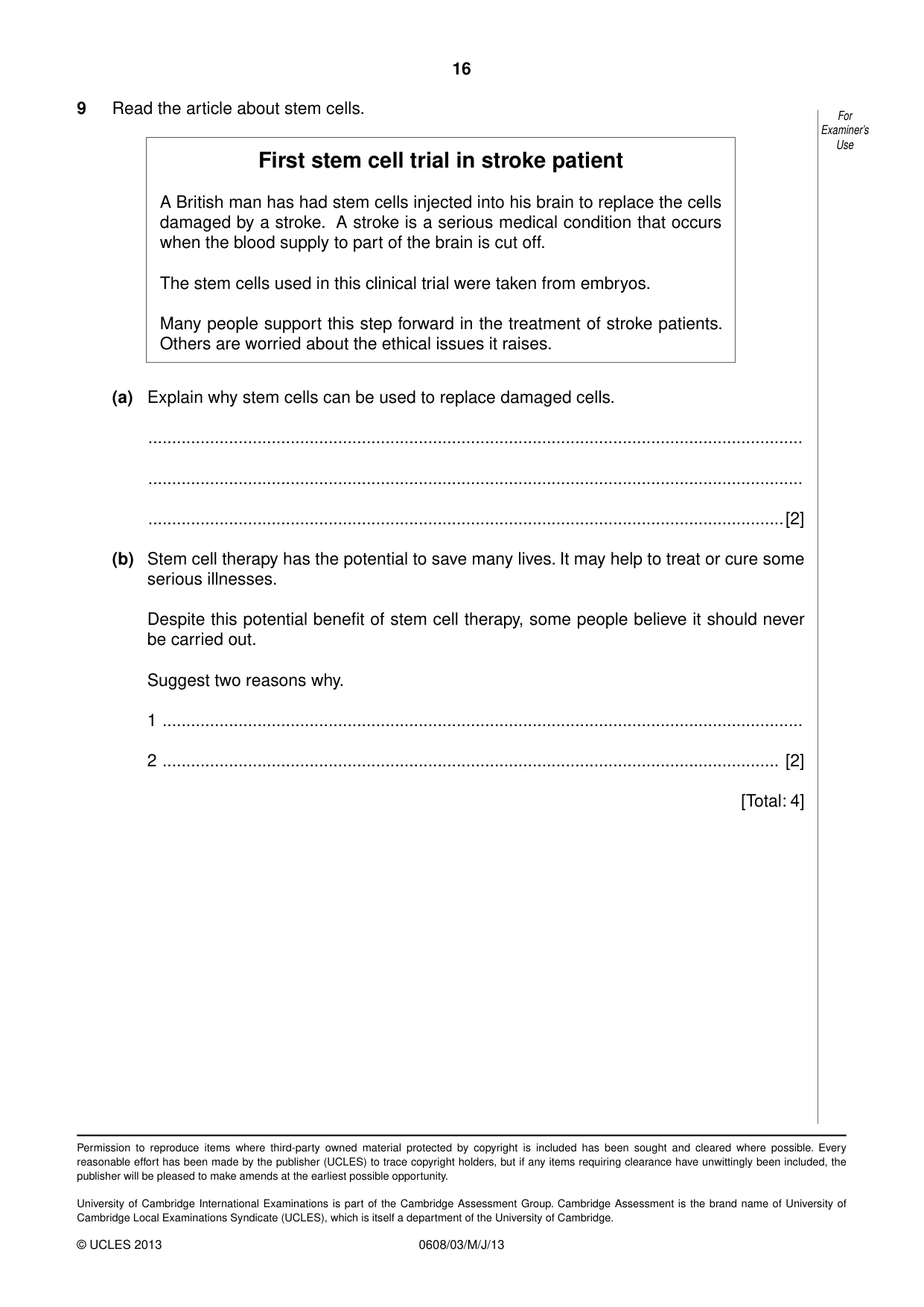
16 0608/03/M/J/13 © UCLES 2013 For Examiner’s Use Permission to reproduce items where third-party owned material protected by copyright is included has been sought and cleared where possible. Every reasonable effort has been made by the publisher (UCLES) to trace copyright holders, but if any items requiring clearance have unwittingly been included, the publisher will be pleased to make amends at the earliest possible opportunity. University of Cambridge International Examinations is part of the Cambridge Assessment Group. Cambridge Assessment is the brand name of University of Cambridge Local Examinations Syndicate (UCLES), which is itself a department of the University of Cambridge. 9 Read the article about stem cells. First stem cell trial in stroke patient A British man has had stem cells injected into his brain to replace the cells damaged by a stroke. A stroke is a serious medical condition that occurs when the blood supply to part of the brain is cut off. The stem cells used in this clinical trial were taken from embryos. Many people support this step forward in the treatment of stroke patients. Others are worried about the ethical issues it raises. (a) Explain why stem cells can be used to replace damaged cells. … … …[2] (b) Stem cell therapy has the potential to save many lives. It may help to treat or cure some serious illnesses. Despite this potential benefit of stem cell therapy, some people believe it should never be carried out. Suggest two reasons why. 1 … 2 … [2] [Total: 4]
Mark scheme, page 1
CAMBRIDGE INTERNATIONAL EXAMINATIONS International General Certificate of Secondary Education MARK SCHEME for the May/June 2013 series 0608 TWENTY FIRST CENTURY SCIENCE 0608/03 Paper 3 (Core Written), maximum raw mark 60 This mark scheme is published as an aid to teachers and candidates, to indicate the requirements of the examination. It shows the basis on which Examiners were instructed to award marks. It does not indicate the details of the discussions that took place at an Examiners’ meeting before marking began, which would have considered the acceptability of alternative answers. Mark schemes should be read in conjunction with the question paper and the Principal Examiner Report for Teachers. Cambridge will not enter into discussions about these mark schemes. Cambridge is publishing the mark schemes for the May/June 2013 series for most IGCSE, GCE Advanced Level and Advanced Subsidiary Level components and some Ordinary Level components. www.XtremePapers.com
Mark scheme, page 2
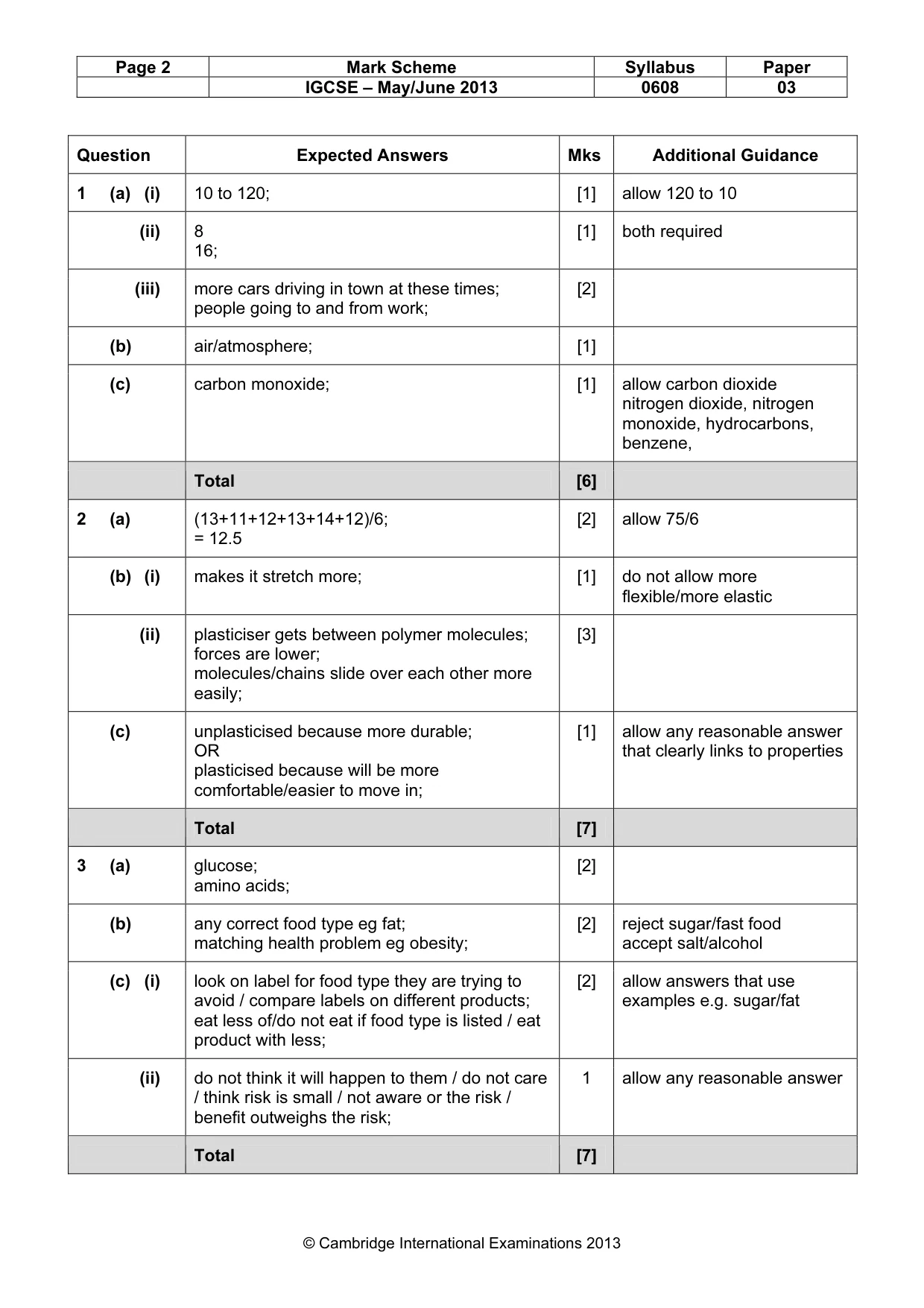
Page 2 Mark Scheme Syllabus Paper IGCSE – May/June 2013 0608 03 © Cambridge International Examinations 2013 Question Expected Answers Mks Additional Guidance 1 (a) (i) 10 to 120; [1] allow 120 to 10 (ii) 8 16; [1] both required (iii) more cars driving in town at these times; people going to and from work; [2] (b) air/atmosphere; [1] (c) carbon monoxide; [1] allow carbon dioxide nitrogen dioxide, nitrogen monoxide, hydrocarbons, benzene, Total [6] 2 (a) (13+11+12+13+14+12)/6; = 12.5 [2] allow 75/6 (b) (i) makes it stretch more; [1] do not allow more flexible/more elastic (ii) plasticiser gets between polymer molecules; forces are lower; molecules/chains slide over each other more easily; [3] (c) unplasticised because more durable; OR plasticised because will be more comfortable/easier to move in; [1] allow any reasonable answer that clearly links to properties Total [7] 3 (a) glucose; amino acids; [2] (b) any correct food type eg fat; matching health problem eg obesity; [2] reject sugar/fast food accept salt/alcohol (c) (i) look on label for food type they are trying to avoid / compare labels on different products; eat less of/do not eat if food type is listed / eat product with less; [2] allow answers that use examples e.g. sugar/fat (ii) do not think it will happen to them / do not care / think risk is small / not aware or the risk / benefit outweighs the risk; 1 allow any reasonable answer Total [7]
Mark scheme, page 3
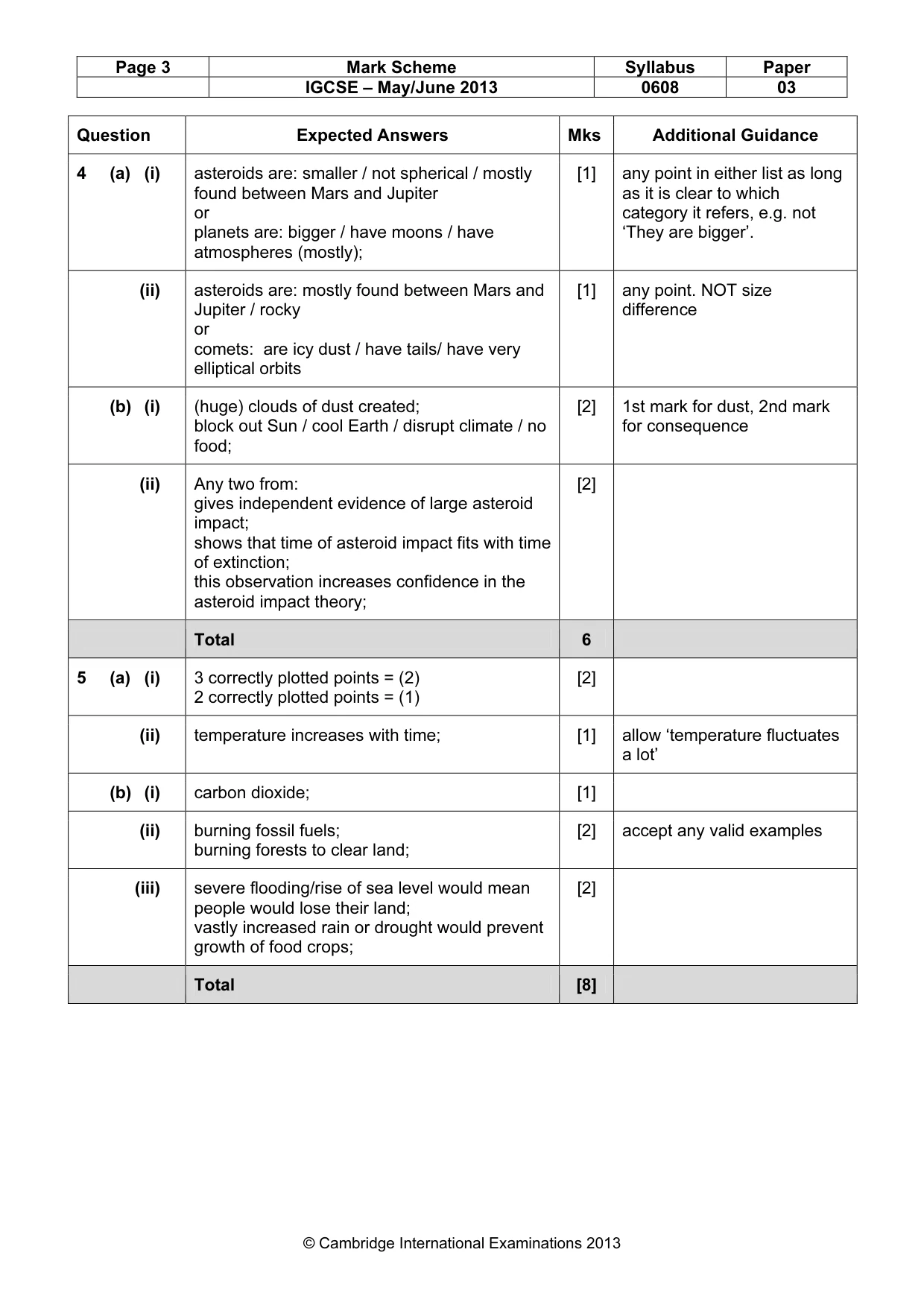
Page 3 Mark Scheme Syllabus Paper IGCSE – May/June 2013 0608 03 © Cambridge International Examinations 2013 Question Expected Answers Mks Additional Guidance 4 (a) (i) asteroids are: smaller / not spherical / mostly found between Mars and Jupiter or planets are: bigger / have moons / have atmospheres (mostly); [1] any point in either list as long as it is clear to which category it refers, e.g. not ‘They are bigger’. (ii) asteroids are: mostly found between Mars and Jupiter / rocky or comets: are icy dust / have tails/ have very elliptical orbits [1] any point. NOT size difference (b) (i) (huge) clouds of dust created; block out Sun / cool Earth / disrupt climate / no food; [2] 1st mark for dust, 2nd mark for consequence (ii) Any two from: gives independent evidence of large asteroid impact; shows that time of asteroid impact fits with time of extinction; this observation increases confidence in the asteroid impact theory; [2] Total 6 5 (a) (i) 3 correctly plotted points = (2) 2 correctly plotted points = (1) [2] (ii) temperature increases with time; [1] allow ‘temperature fluctuates a lot’ (b) (i) carbon dioxide; [1] (ii) burning fossil fuels; burning forests to clear land; [2] accept any valid examples (iii) severe flooding/rise of sea level would mean people would lose their land; vastly increased rain or drought would prevent growth of food crops; [2] Total [8]
Mark scheme, page 4
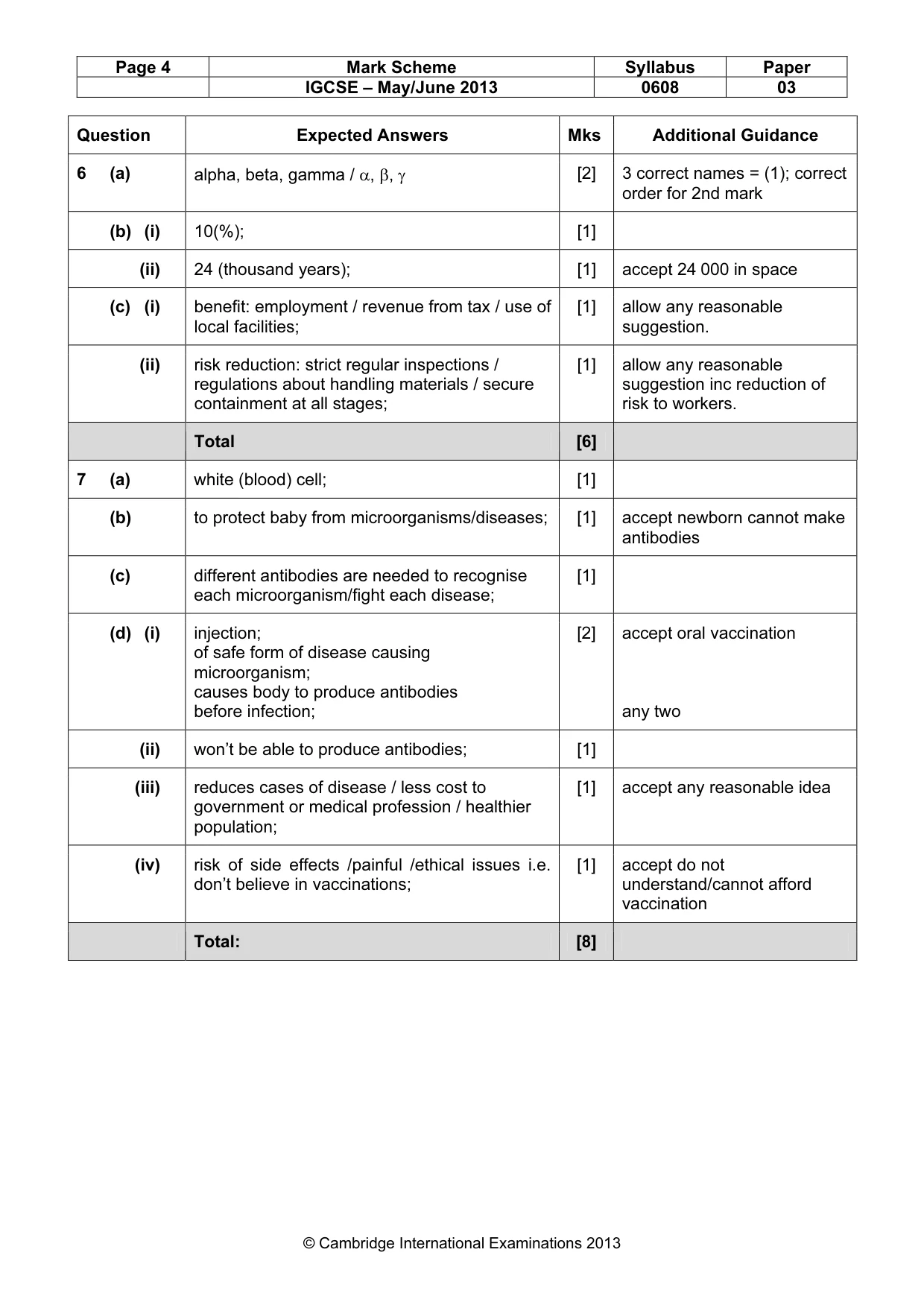
Page 4 Mark Scheme Syllabus Paper IGCSE – May/June 2013 0608 03 © Cambridge International Examinations 2013 Question Expected Answers Mks Additional Guidance 6 (a) alpha, beta, gamma / α, β, γ [2] 3 correct names = (1); correct order for 2nd mark (b) (i) 10(%); [1] (ii) 24 (thousand years); [1] accept 24 000 in space (c) (i) benefit: employment / revenue from tax / use of local facilities; [1] allow any reasonable suggestion. (ii) risk reduction: strict regular inspections / regulations about handling materials / secure containment at all stages; [1] allow any reasonable suggestion inc reduction of risk to workers. Total [6] 7 (a) white (blood) cell; [1] (b) to protect baby from microorganisms/diseases; [1] accept newborn cannot make antibodies (c) different antibodies are needed to recognise each microorganism/fight each disease; [1] (d) (i) injection; of safe form of disease causing microorganism; causes body to produce antibodies before infection; [2] accept oral vaccination any two (ii) won’t be able to produce antibodies; [1] (iii) reduces cases of disease / less cost to government or medical profession / healthier population; [1] accept any reasonable idea (iv) risk of side effects /painful /ethical issues i.e. don’t believe in vaccinations; [1] accept do not understand/cannot afford vaccination Total: [8]
Mark scheme, page 5
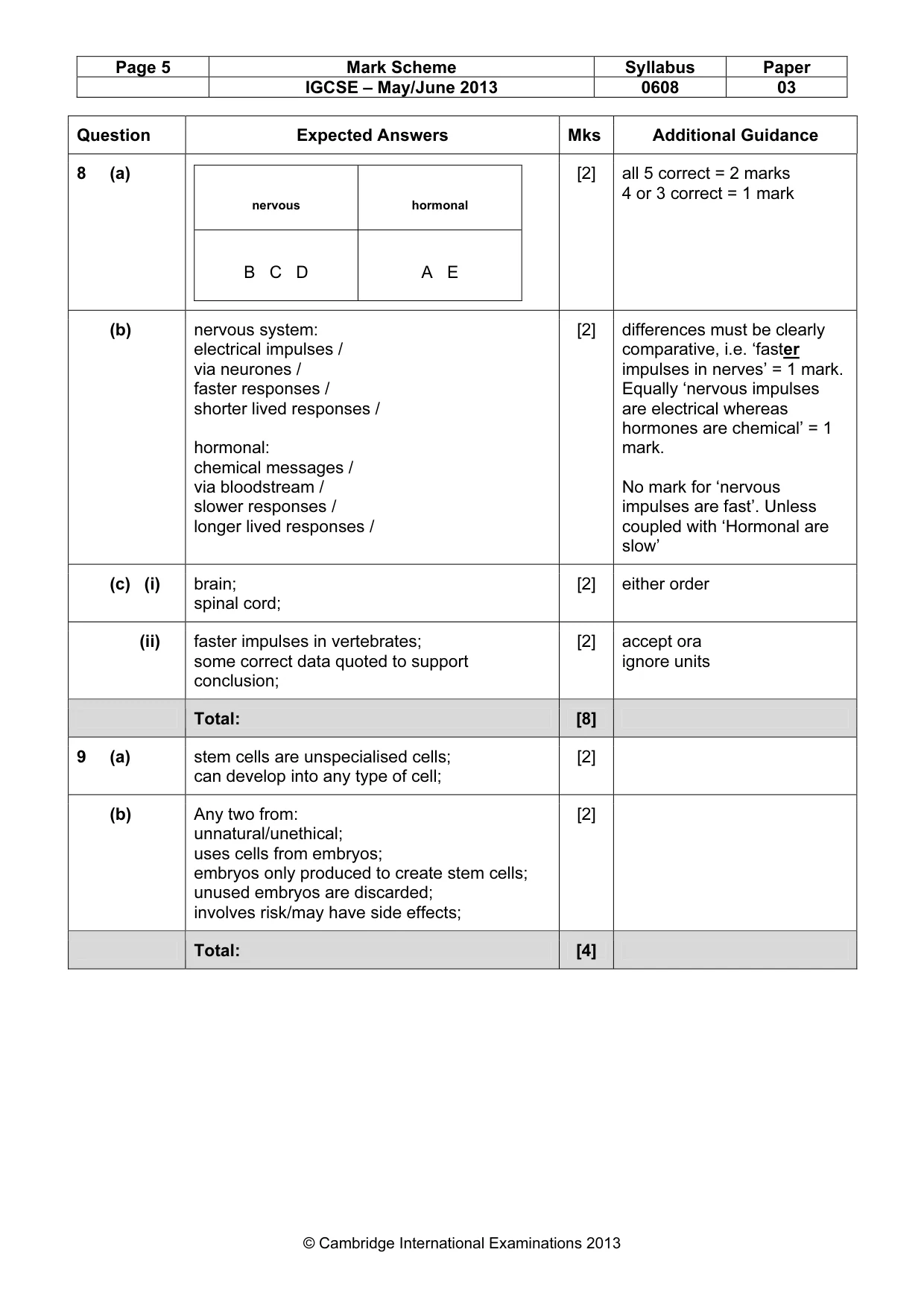
Page 5 Mark Scheme Syllabus Paper IGCSE – May/June 2013 0608 03 © Cambridge International Examinations 2013 Question Expected Answers Mks Additional Guidance 8 (a) nervous hormonal B C D A E [2] all 5 correct = 2 marks 4 or 3 correct = 1 mark (b) nervous system: electrical impulses / via neurones / faster responses / shorter lived responses / hormonal: chemical messages / via bloodstream / slower responses / longer lived responses / [2] differences must be clearly comparative, i.e. ‘faster impulses in nerves’ = 1 mark. Equally ‘nervous impulses are electrical whereas hormones are chemical’ = 1 mark. No mark for ‘nervous impulses are fast’. Unless coupled with ‘Hormonal are slow’ (c) (i) brain; spinal cord; [2] either order (ii) faster impulses in vertebrates; some correct data quoted to support conclusion; [2] accept ora ignore units Total: [8] 9 (a) stem cells are unspecialised cells; can develop into any type of cell; [2] (b) Any two from: unnatural/unethical; uses cells from embryos; embryos only produced to create stem cells; unused embryos are discarded; involves risk/may have side effects; [2] Total: [4]
What you needed in this session
Cambridge’s own grade thresholds for 2013 May/June, Paper 3 · Variant 1. A higher threshold means an easier paper — the bar moves with how the cohort did.