Cambridge IGCSE Twenty-First Century Science 0608 — 2011 May/June Paper 3 · Variant 1
0608/31/M/J/11 · 60 marks · ≈68 min
The question paper and its mark scheme, free to read here and free to download. This is Cambridge’s own paper, exactly as it was sat.
Question paper16 pages


Mark scheme5 pages
Answers below. Sit the paper first if you are practising.
Paper as text
Question paper, page 1
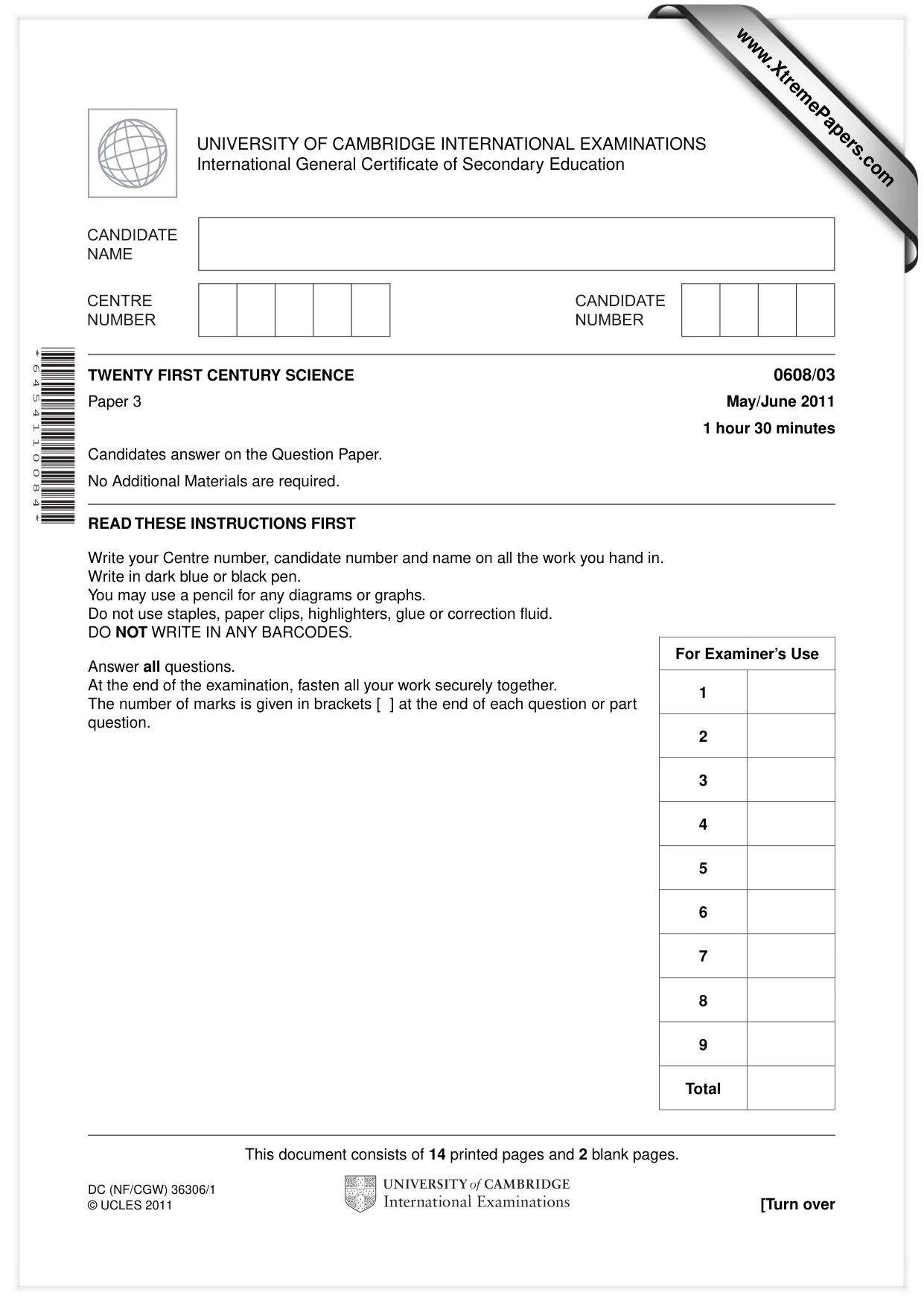
This document consists of 14 printed pages and 2 blank pages. DC (NF/CGW) 36306/1 © UCLES 2011 [Turn over UNIVERSITY OF CAMBRIDGE INTERNATIONAL EXAMINATIONS International General Certificate of Secondary Education * 6 4 5 4 1 1 0 0 8 4 * TWENTY FIRST CENTURY SCIENCE 0608/03 Paper 3 May/June 2011 1 hour 30 minutes Candidates answer on the Question Paper. No Additional Materials are required. READ THESE INSTRUCTIONS FIRST Write your Centre number, candidate number and name on all the work you hand in. Write in dark blue or black pen. You may use a pencil for any diagrams or graphs. Do not use staples, paper clips, highlighters, glue or correction fluid. DO NOT WRITE IN ANY BARCODES. Answer all questions. At the end of the examination, fasten all your work securely together. The number of marks is given in brackets [ ] at the end of each question or part question. For Examiner’s Use 1 2 3 4 5 6 7 8 9 Total www.XtremePapers.com
Question paper, page 2
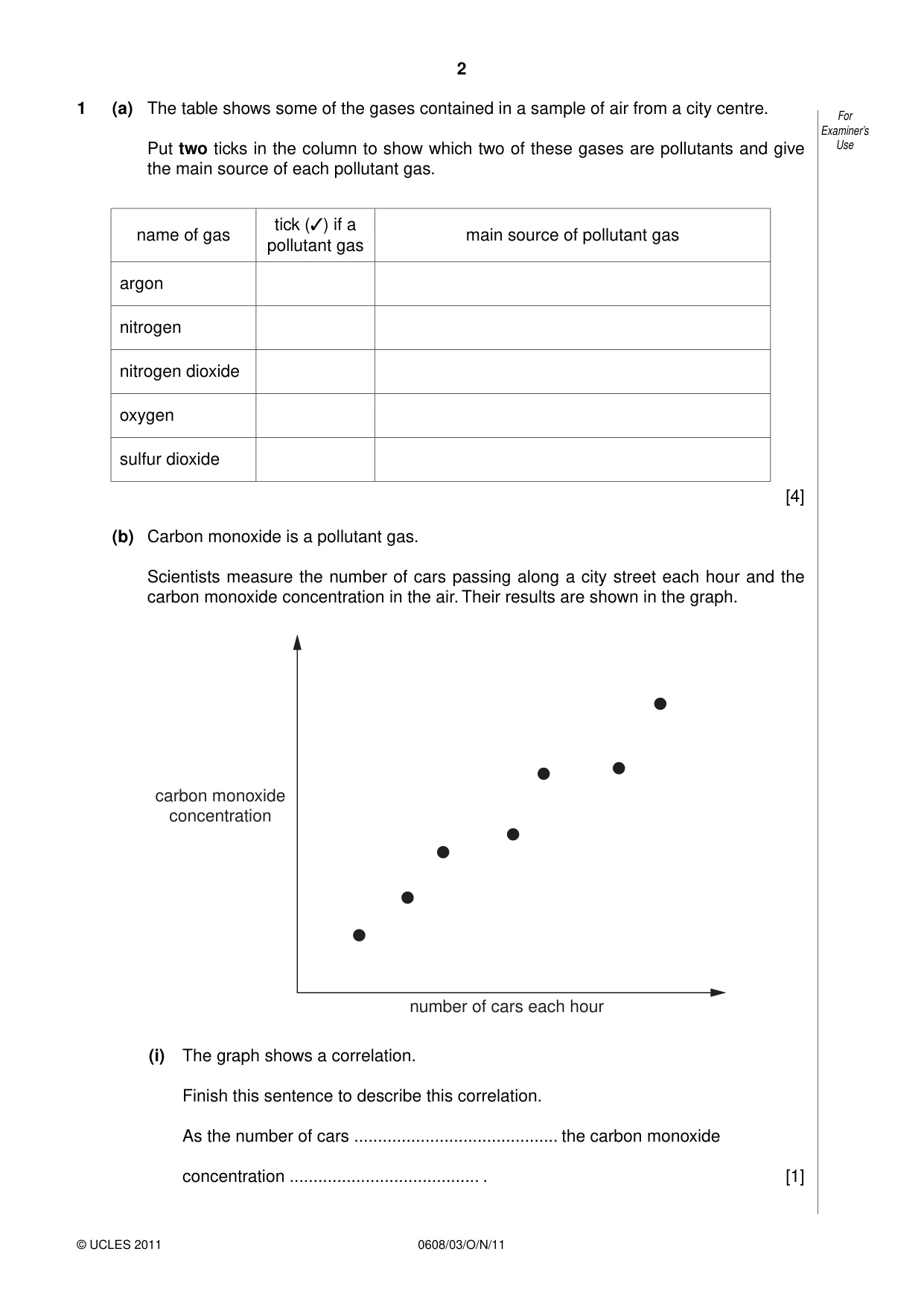
2 0608/03/O/N/11 © UCLES 2011 For Examiner’s Use 1 (a) The table shows some of the gases contained in a sample of air from a city centre. Put two ticks in the column to show which two of these gases are pollutants and give the main source of each pollutant gas. name of gas tick (✓) if a pollutant gas main source of pollutant gas argon nitrogen nitrogen dioxide oxygen sulfur dioxide [4] (b) Carbon monoxide is a pollutant gas. Scientists measure the number of cars passing along a city street each hour and the carbon monoxide concentration in the air. Their results are shown in the graph. carbon monoxide concentration number of cars each hour (i) The graph shows a correlation. Finish this sentence to describe this correlation. As the number of cars … the carbon monoxide concentration … . [1]
Question paper, page 3
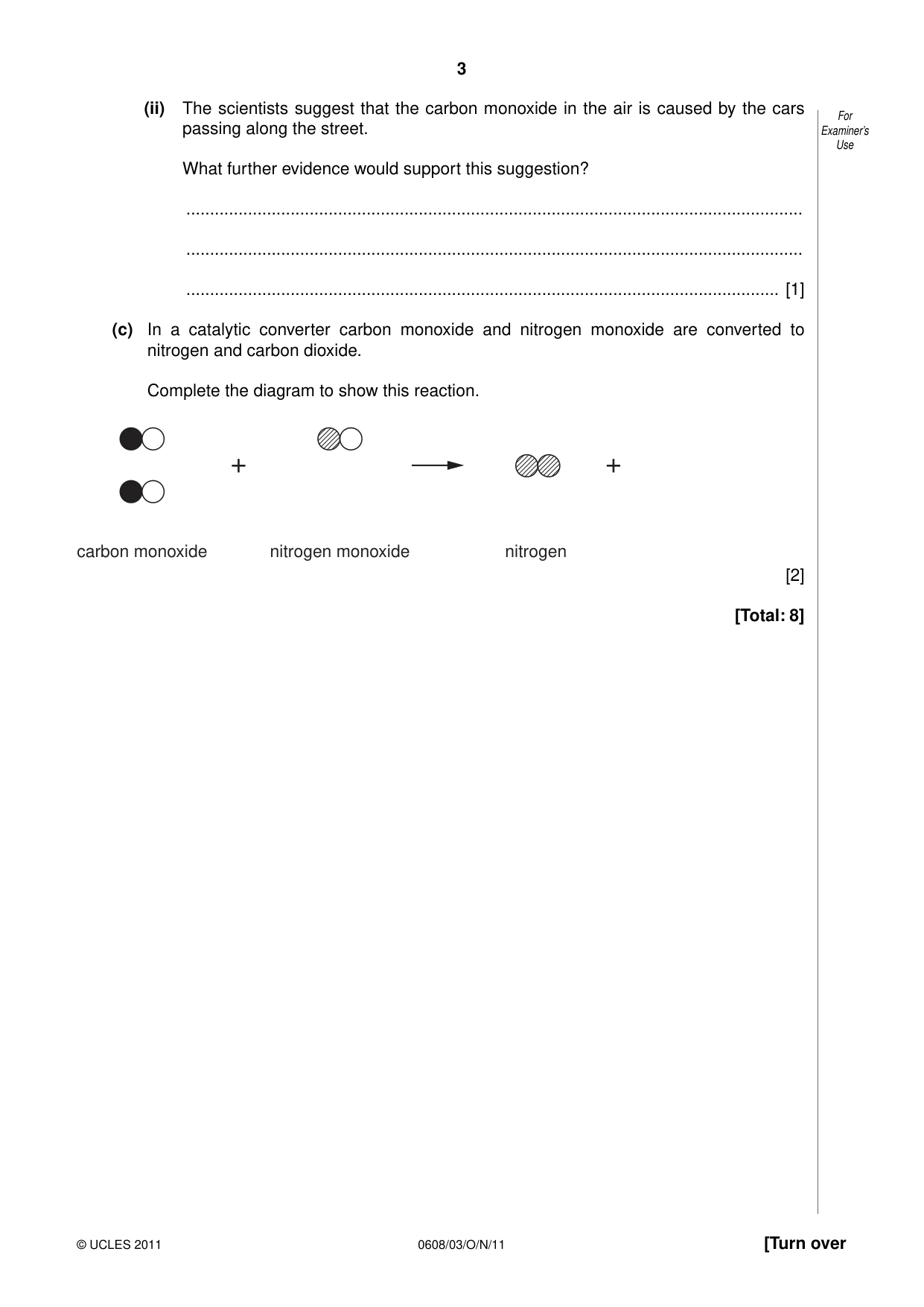
3 0608/03/O/N/11 © UCLES 2011 [Turn over For Examiner’s Use (ii) The scientists suggest that the carbon monoxide in the air is caused by the cars passing along the street. What further evidence would support this suggestion? … … … [1] (c) In a catalytic converter carbon monoxide and nitrogen monoxide are converted to nitrogen and carbon dioxide. Complete the diagram to show this reaction. + + carbon monoxide nitrogen nitrogen monoxide [2] [Total: 8]
Question paper, page 4
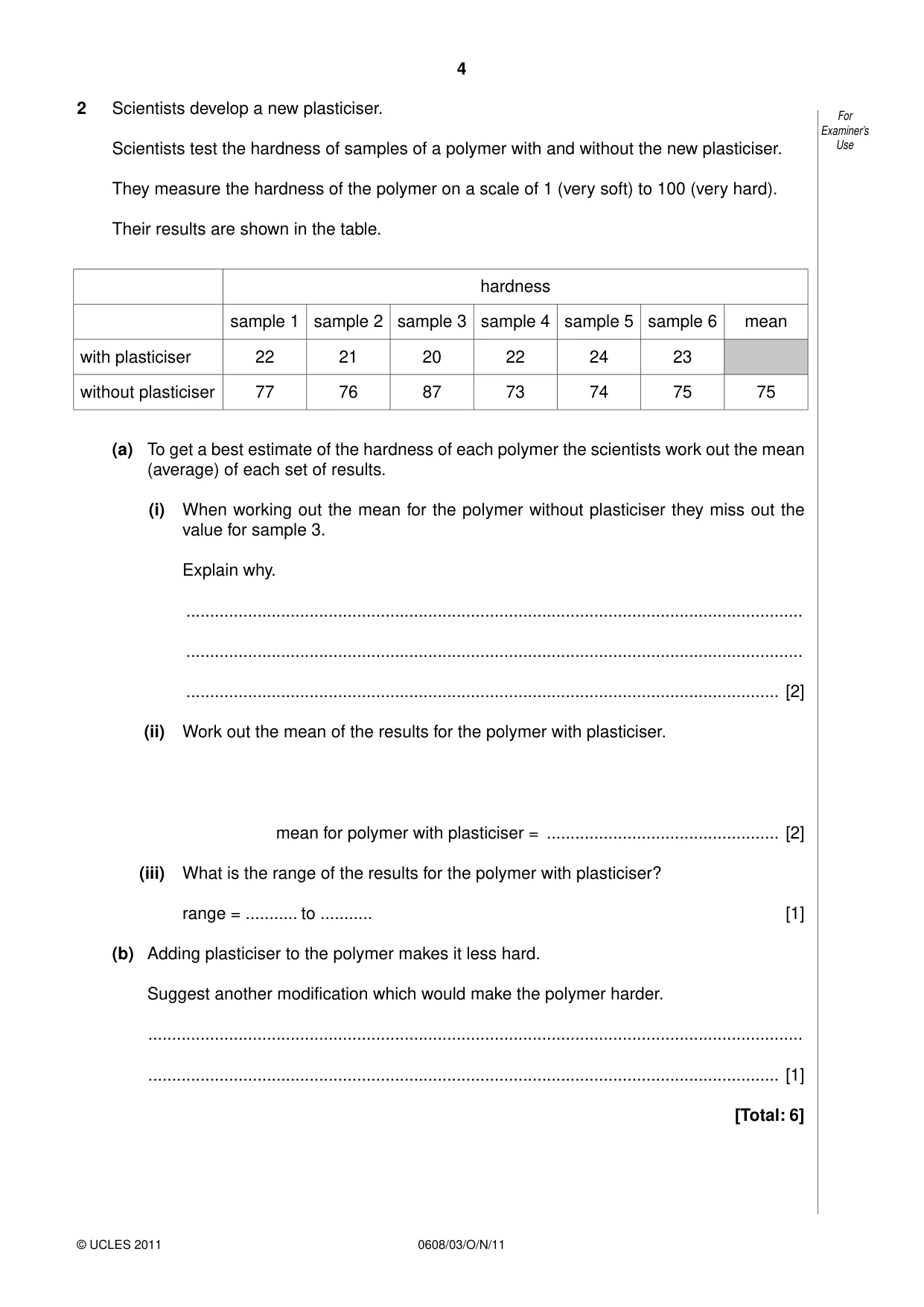
4 0608/03/O/N/11 © UCLES 2011 For Examiner’s Use 2 Scientists develop a new plasticiser. Scientists test the hardness of samples of a polymer with and without the new plasticiser. They measure the hardness of the polymer on a scale of 1 (very soft) to 100 (very hard). Their results are shown in the table. hardness sample 1 sample 2 sample 3 sample 4 sample 5 sample 6 mean with plasticiser 22 21 20 22 24 23 without plasticiser 77 76 87 73 74 75 75 (a) To get a best estimate of the hardness of each polymer the scientists work out the mean (average) of each set of results. (i) When working out the mean for the polymer without plasticiser they miss out the value for sample 3. Explain why. … … … [2] (ii) Work out the mean of the results for the polymer with plasticiser. mean for polymer with plasticiser = … [2] (iii) What is the range of the results for the polymer with plasticiser? range = … to … [1] (b) Adding plasticiser to the polymer makes it less hard. Suggest another modification which would make the polymer harder. … … [1] [Total: 6]
Question paper, page 5
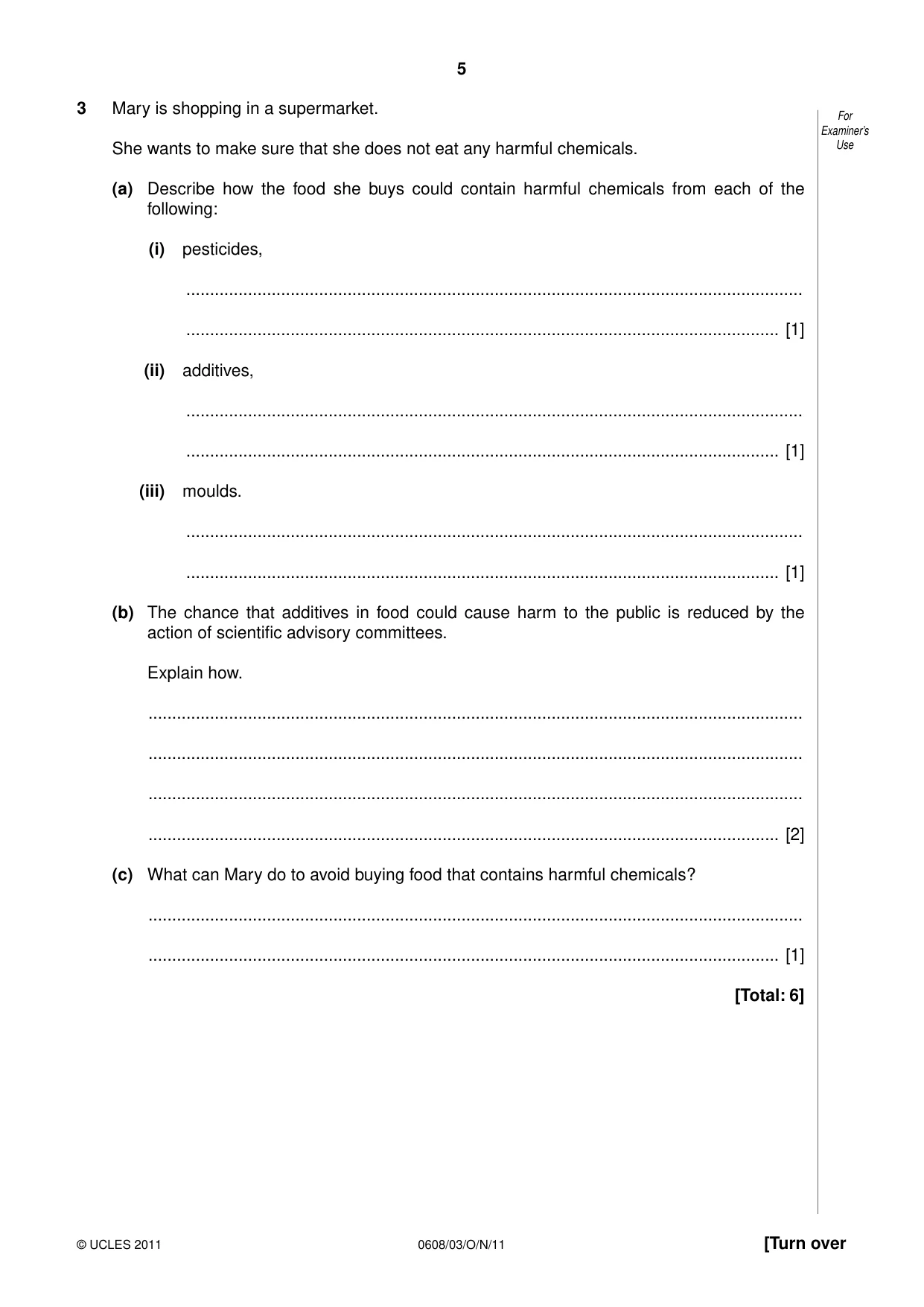
5 0608/03/O/N/11 © UCLES 2011 [Turn over For Examiner’s Use 3 Mary is shopping in a supermarket. She wants to make sure that she does not eat any harmful chemicals. (a) Describe how the food she buys could contain harmful chemicals from each of the following: (i) pesticides, … … [1] (ii) additives, … … [1] (iii) moulds. … … [1] (b) The chance that additives in food could cause harm to the public is reduced by the action of scientific advisory committees. Explain how. … … … … [2] (c) What can Mary do to avoid buying food that contains harmful chemicals? … … [1] [Total: 6]
Question paper, page 6
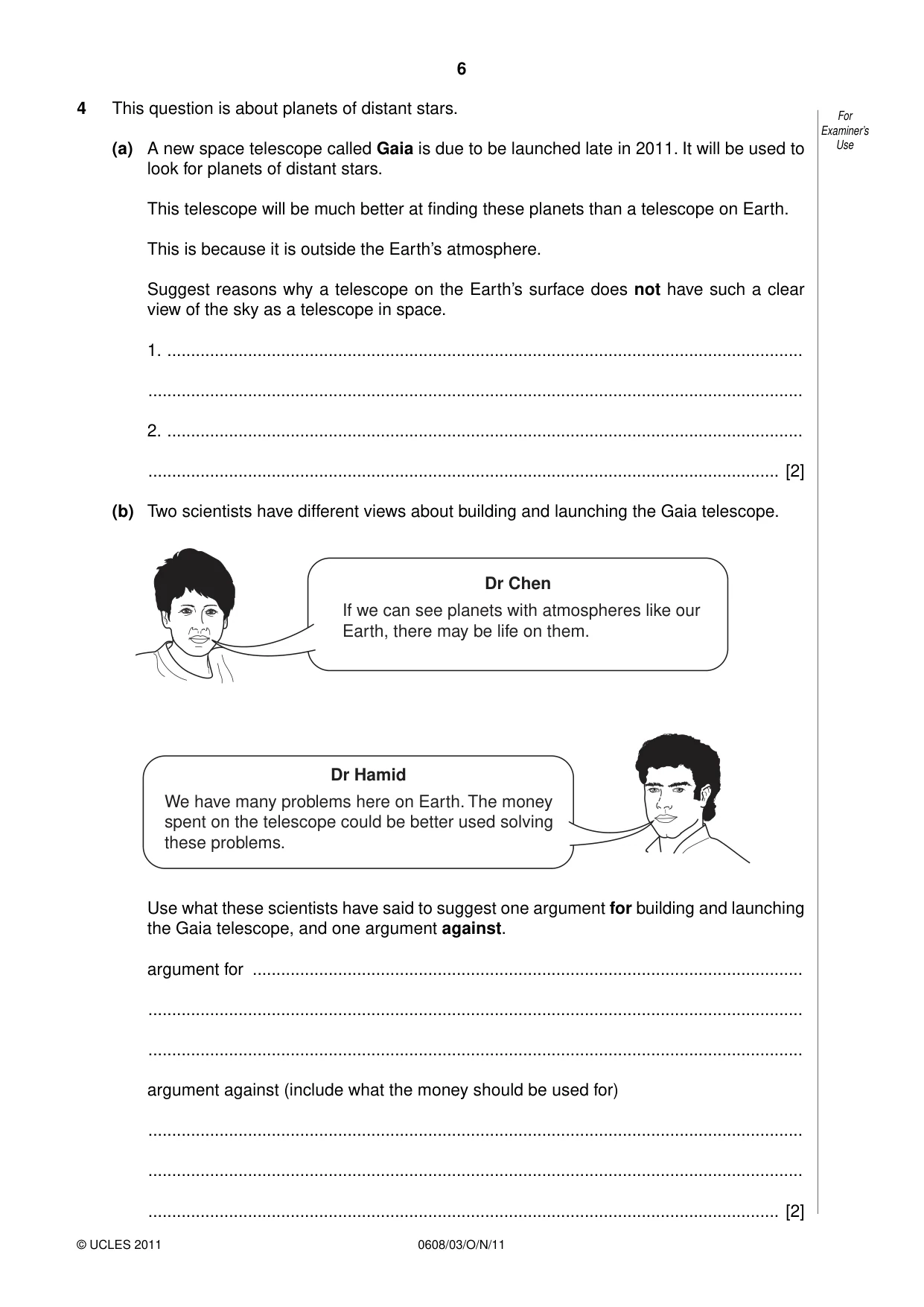
6 0608/03/O/N/11 © UCLES 2011 For Examiner’s Use 4 This question is about planets of distant stars. (a) A new space telescope called Gaia is due to be launched late in 2011. It will be used to look for planets of distant stars. This telescope will be much better at finding these planets than a telescope on Earth. This is because it is outside the Earth’s atmosphere. Suggest reasons why a telescope on the Earth’s surface does not have such a clear view of the sky as a telescope in space. 1. … … 2. … … [2] (b) Two scientists have different views about building and launching the Gaia telescope. Dr Chen If we can see planets with atmospheres like our Earth, there may be life on them. Dr Hamid We have many problems here on Earth. The money spent on the telescope could be better used solving these problems. Use what these scientists have said to suggest one argument for building and launching the Gaia telescope, and one argument against. argument for … … … argument against (include what the money should be used for) … … … [2]
Question paper, page 7
7 0608/03/O/N/11 © UCLES 2011 [Turn over For Examiner’s Use (c) Astronomers believe that stars with planets are common in the Universe. Describe how planetary systems, like our solar system, were formed. … … … [2] (d) Planets of distant stars that have been discovered so far are at least 50 light-years from Earth. (i) What is meant by the term light-year? … [1] (ii) Why are distances to stars measured in light-years instead of kilometres? … [1] [Total: 8]
Question paper, page 8
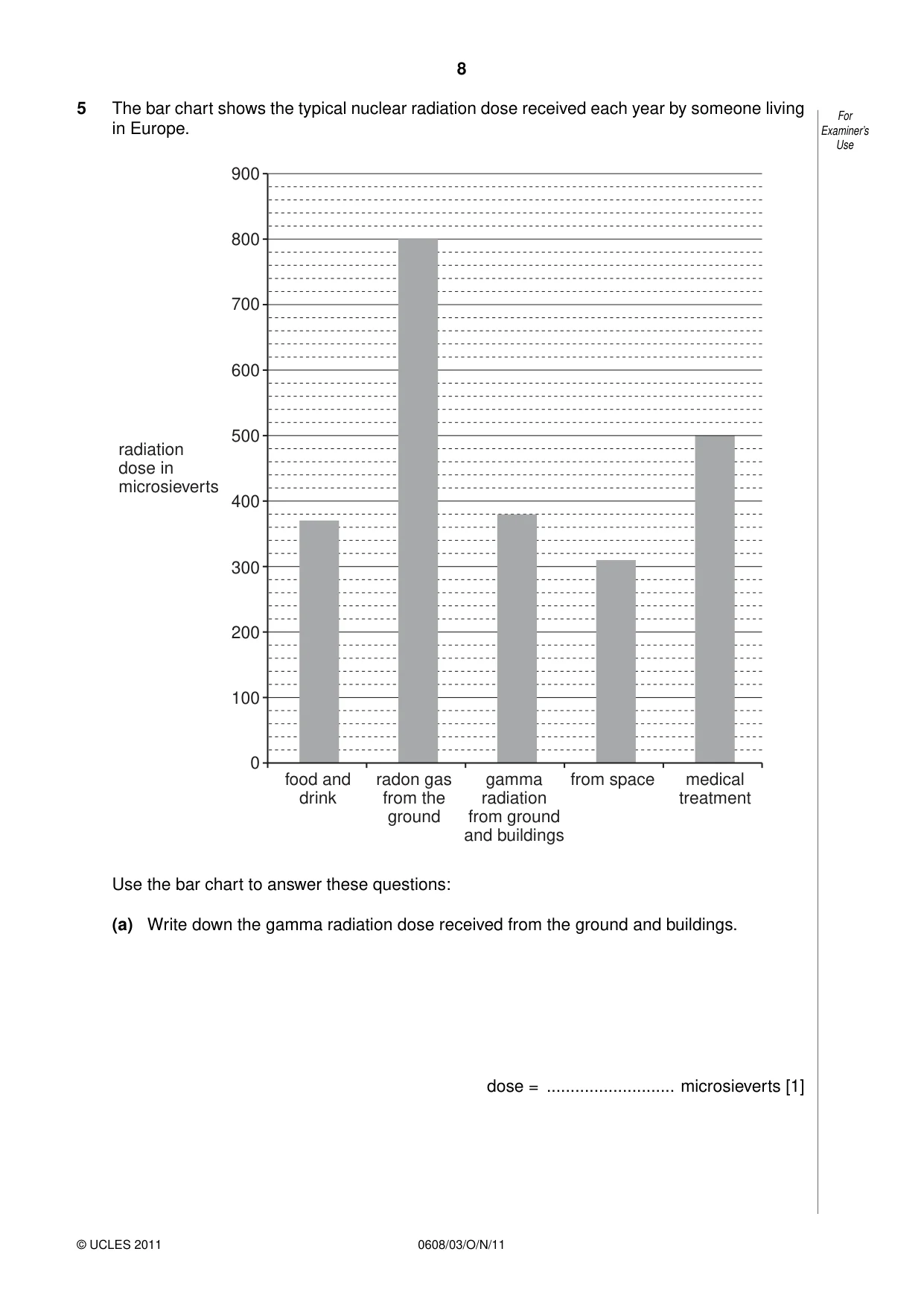
8 0608/03/O/N/11 © UCLES 2011 For Examiner’s Use 5 The bar chart shows the typical nuclear radiation dose received each year by someone living in Europe. 0 100 200 300 food and drink radon gas from the ground gamma radiation from ground and buildings from space medical treatment 400 radiation dose in microsieverts 500 600 700 800 900 Use the bar chart to answer these questions: (a) Write down the gamma radiation dose received from the ground and buildings. dose = … microsieverts [1]
Question paper, page 9
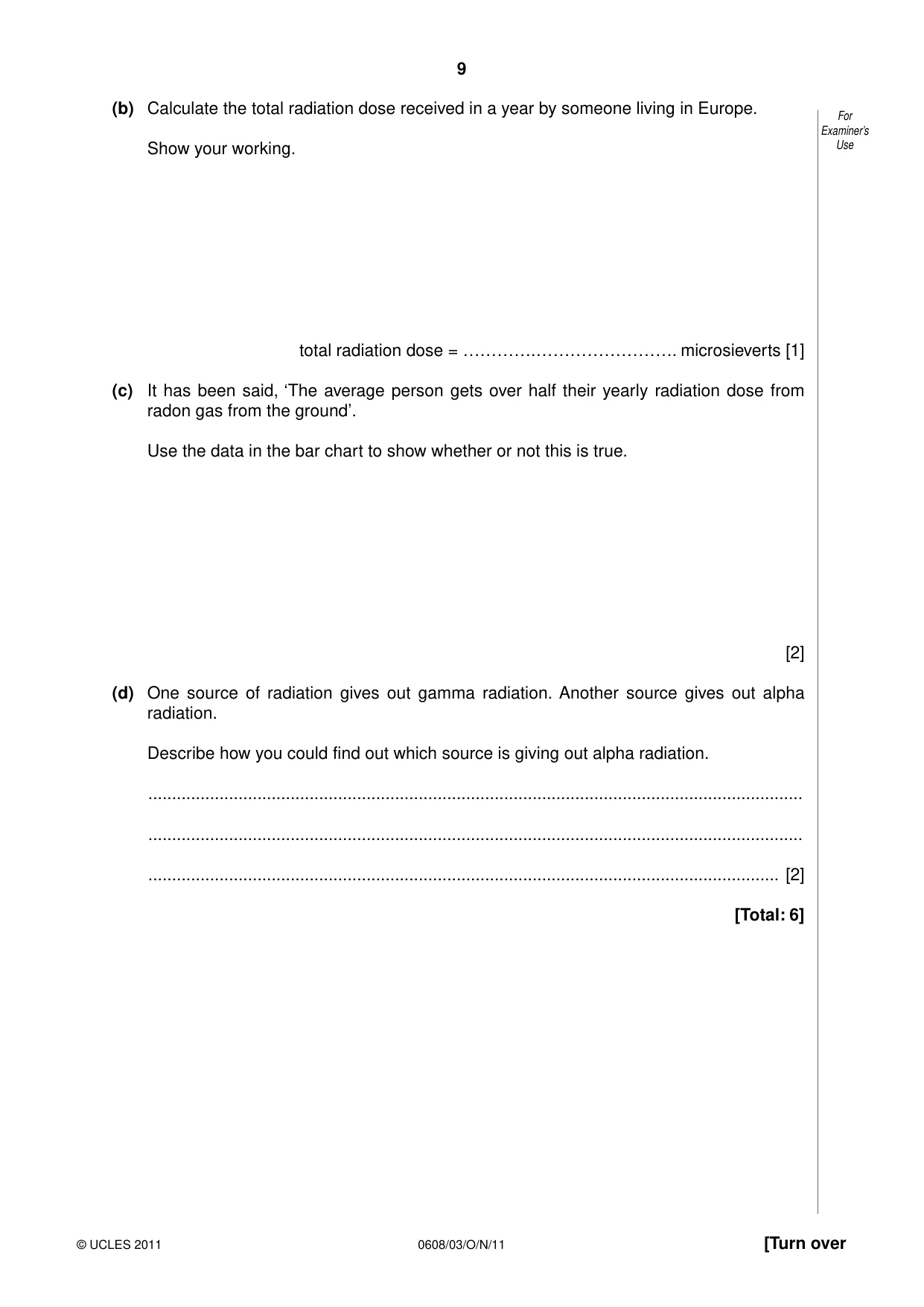
9 0608/03/O/N/11 © UCLES 2011 [Turn over For Examiner’s Use (b) Calculate the total radiation dose received in a year by someone living in Europe. Show your working. total radiation dose = ………….……………………. microsieverts [1] (c) It has been said, ‘The average person gets over half their yearly radiation dose from radon gas from the ground’. Use the data in the bar chart to show whether or not this is true. [2] (d) One source of radiation gives out gamma radiation. Another source gives out alpha radiation. Describe how you could find out which source is giving out alpha radiation. … … … [2] [Total: 6]
Question paper, page 10
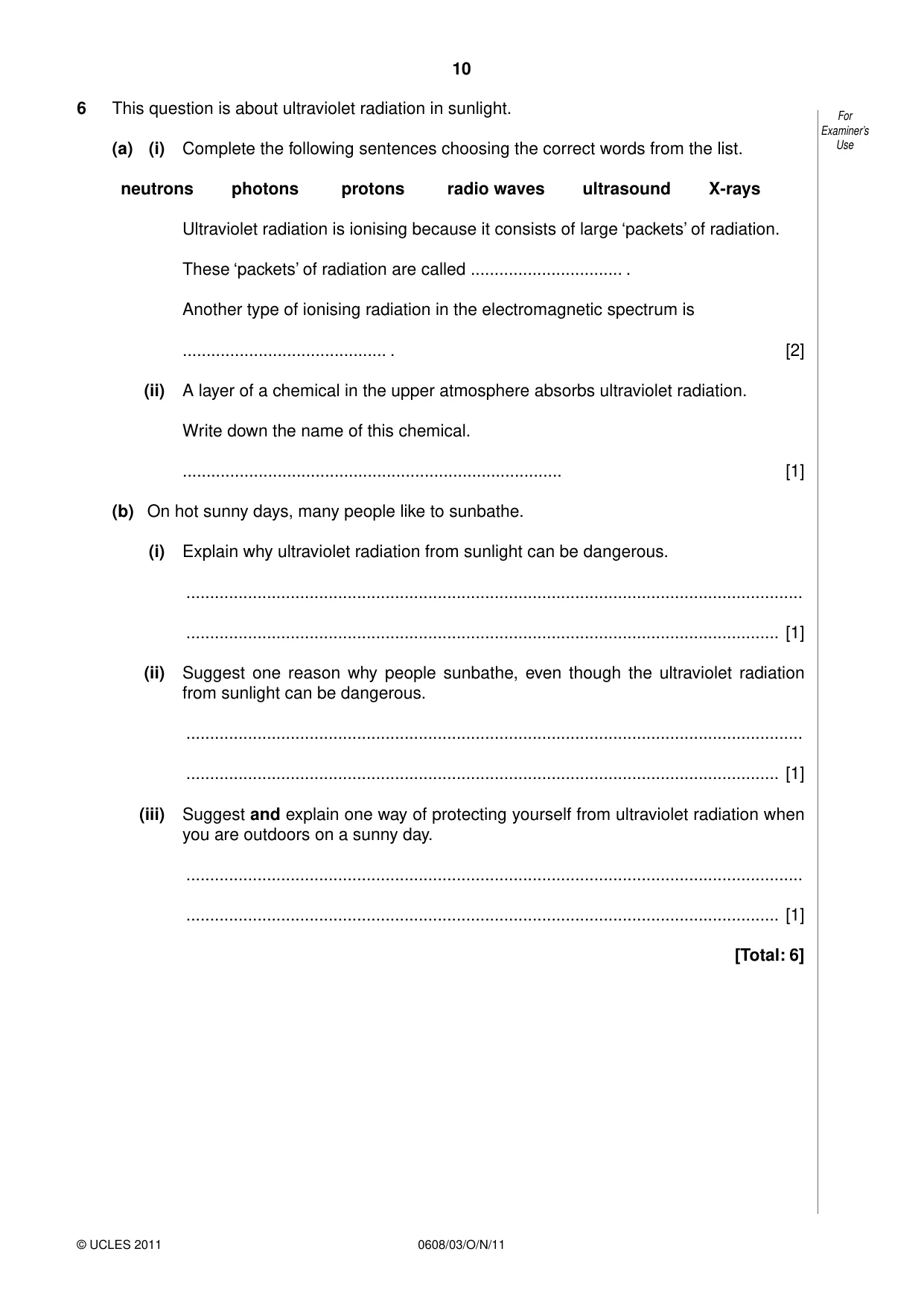
10 0608/03/O/N/11 © UCLES 2011 For Examiner’s Use 6 This question is about ultraviolet radiation in sunlight. (a) (i) Complete the following sentences choosing the correct words from the list. neutrons photons protons radio waves ultrasound X-rays Ultraviolet radiation is ionising because it consists of large ‘packets’ of radiation. These ‘packets’ of radiation are called … . Another type of ionising radiation in the electromagnetic spectrum is … . [2] (ii) A layer of a chemical in the upper atmosphere absorbs ultraviolet radiation. Write down the name of this chemical. … [1] (b) On hot sunny days, many people like to sunbathe. (i) Explain why ultraviolet radiation from sunlight can be dangerous. … … [1] (ii) Suggest one reason why people sunbathe, even though the ultraviolet radiation from sunlight can be dangerous. … … [1] (iii) Suggest and explain one way of protecting yourself from ultraviolet radiation when you are outdoors on a sunny day. … … [1] [Total: 6]
Question paper, page 11
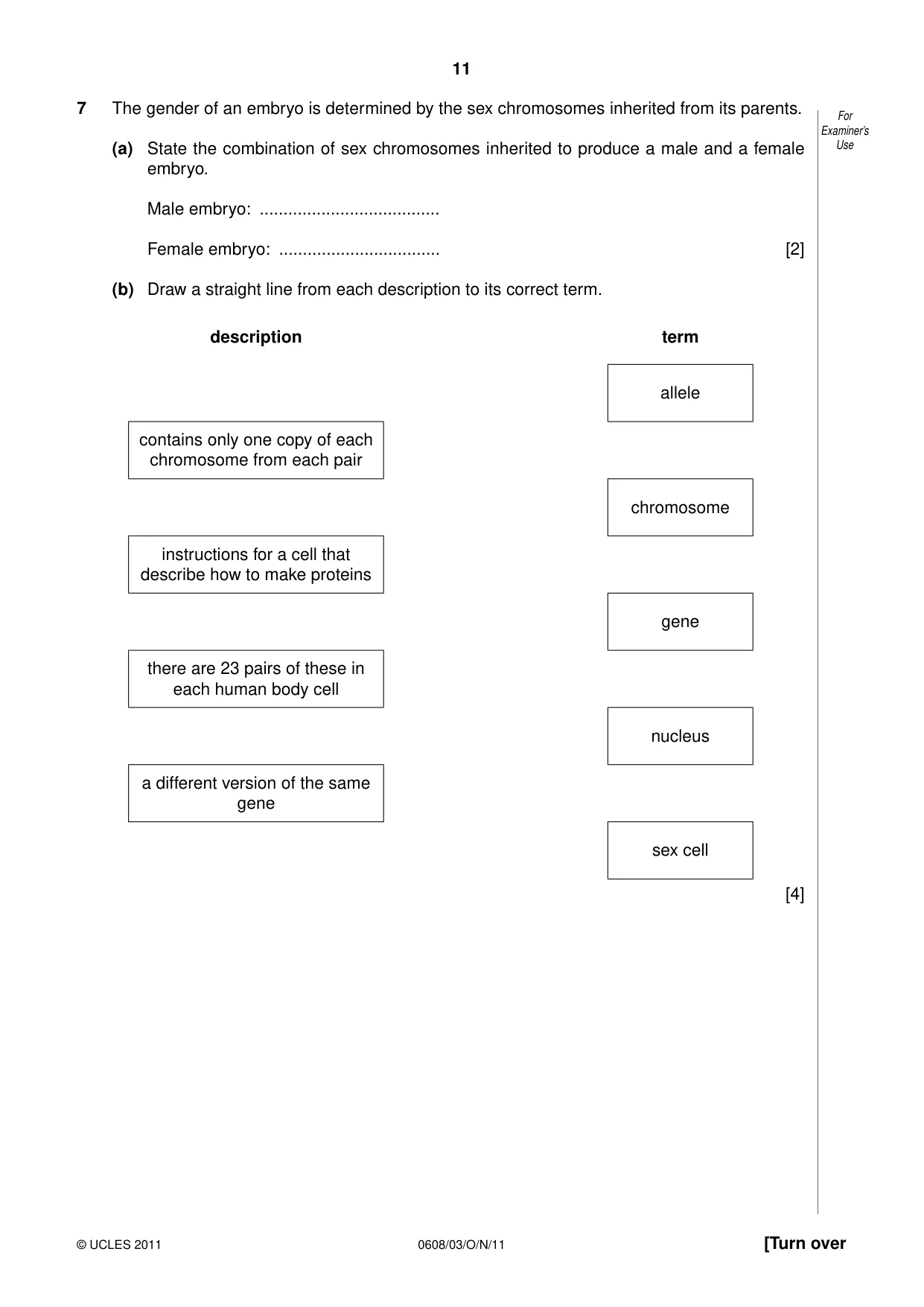
11 0608/03/O/N/11 © UCLES 2011 [Turn over For Examiner’s Use 7 The gender of an embryo is determined by the sex chromosomes inherited from its parents. (a) State the combination of sex chromosomes inherited to produce a male and a female embryo. Male embryo: … Female embryo: … [2] (b) Draw a straight line from each description to its correct term. description term allele contains only one copy of each chromosome from each pair chromosome instructions for a cell that describe how to make proteins gene there are 23 pairs of these in each human body cell nucleus a different version of the same gene sex cell [4]
Question paper, page 12
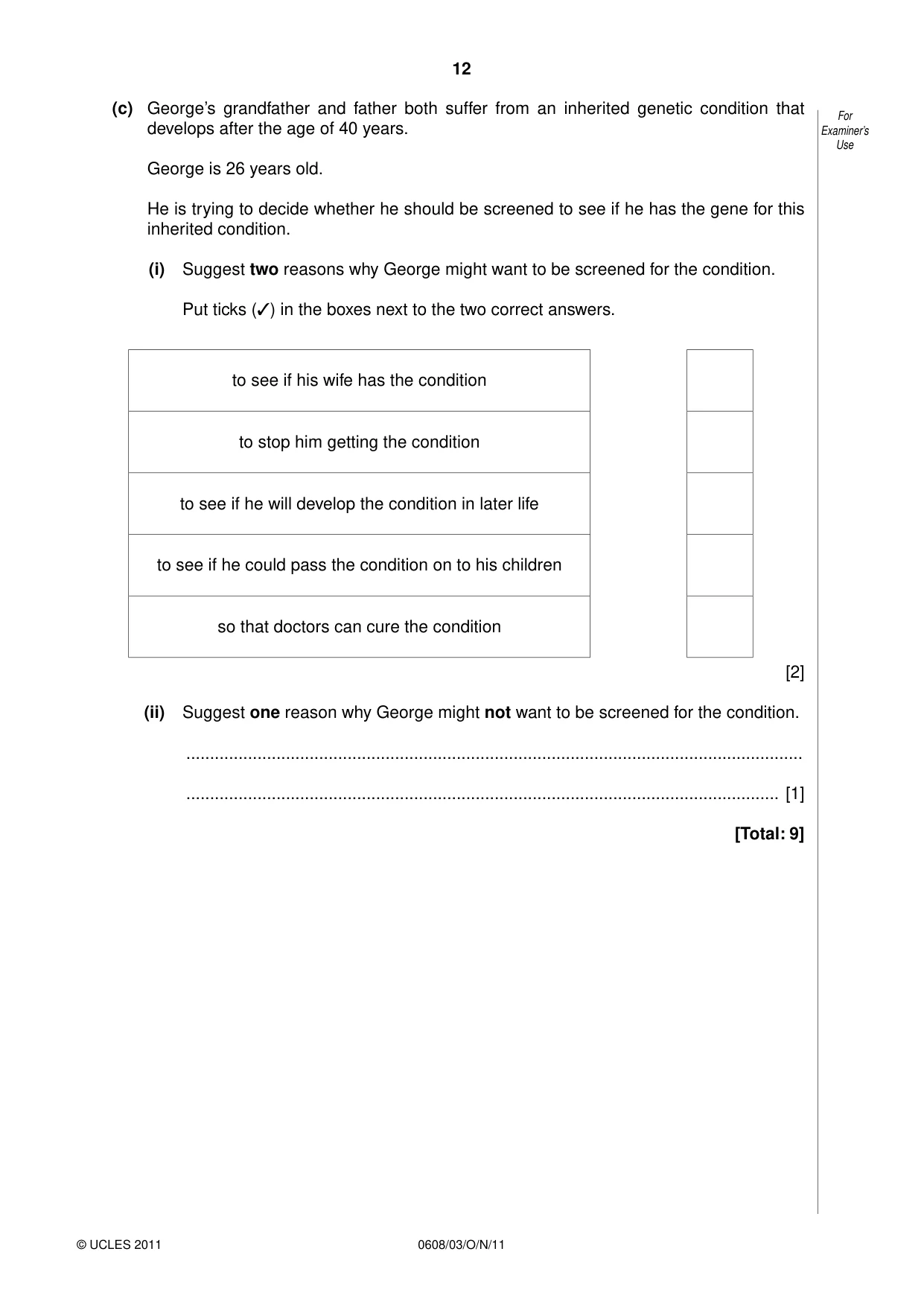
12 0608/03/O/N/11 © UCLES 2011 For Examiner’s Use (c) George’s grandfather and father both suffer from an inherited genetic condition that develops after the age of 40 years. George is 26 years old. He is trying to decide whether he should be screened to see if he has the gene for this inherited condition. (i) Suggest two reasons why George might want to be screened for the condition. Put ticks (✓) in the boxes next to the two correct answers. to see if his wife has the condition to stop him getting the condition to see if he will develop the condition in later life to see if he could pass the condition on to his children so that doctors can cure the condition [2] (ii) Suggest one reason why George might not want to be screened for the condition. … … [1] [Total: 9]
Question paper, page 13
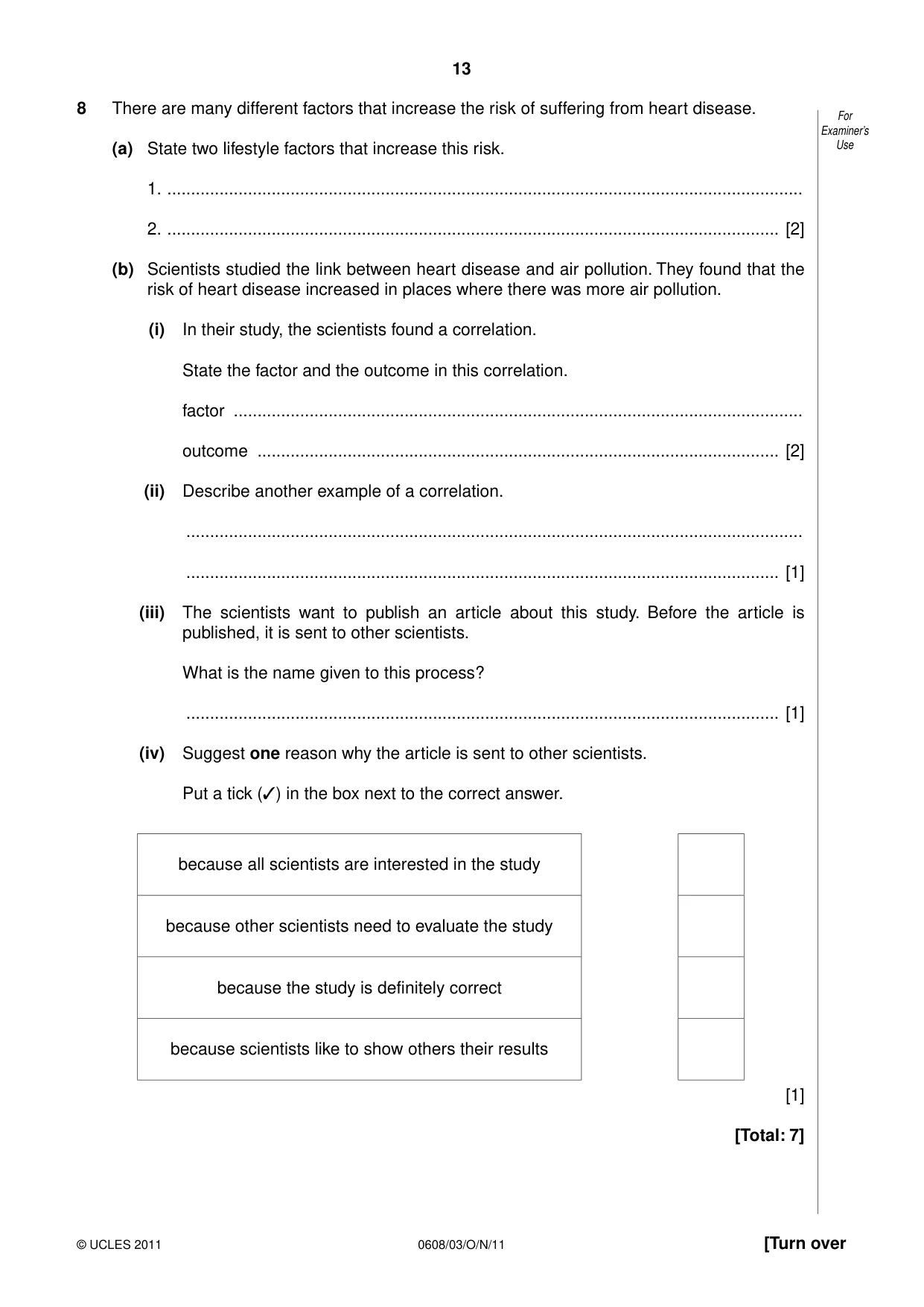
13 0608/03/O/N/11 © UCLES 2011 [Turn over For Examiner’s Use 8 There are many different factors that increase the risk of suffering from heart disease. (a) State two lifestyle factors that increase this risk. 1. … 2. … [2] (b) Scientists studied the link between heart disease and air pollution. They found that the risk of heart disease increased in places where there was more air pollution. (i) In their study, the scientists found a correlation. State the factor and the outcome in this correlation. factor … outcome … [2] (ii) Describe another example of a correlation. … … [1] (iii) The scientists want to publish an article about this study. Before the article is published, it is sent to other scientists. What is the name given to this process? … [1] (iv) Suggest one reason why the article is sent to other scientists. Put a tick (✓) in the box next to the correct answer. because all scientists are interested in the study because other scientists need to evaluate the study because the study is definitely correct because scientists like to show others their results [1] [Total: 7]
Question paper, page 14
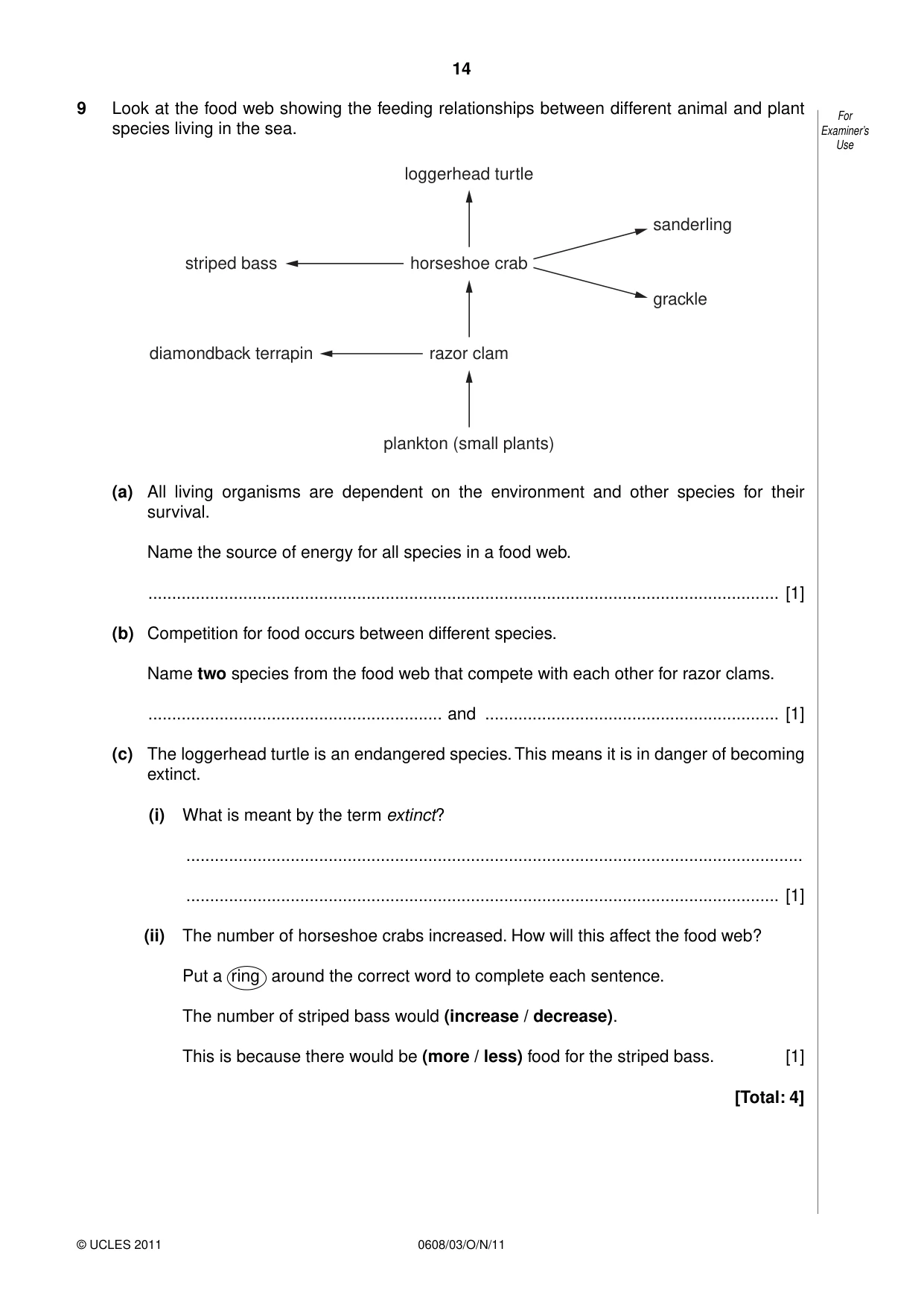
14 0608/03/O/N/11 © UCLES 2011 For Examiner’s Use 9 Look at the food web showing the feeding relationships between different animal and plant species living in the sea. loggerhead turtle sanderling grackle horseshoe crab striped bass diamondback terrapin razor clam plankton (small plants) (a) All living organisms are dependent on the environment and other species for their survival. Name the source of energy for all species in a food web. … [1] (b) Competition for food occurs between different species. Name two species from the food web that compete with each other for razor clams. … and … [1] (c) The loggerhead turtle is an endangered species. This means it is in danger of becoming extinct. (i) What is meant by the term extinct? … … [1] (ii) The number of horseshoe crabs increased. How will this affect the food web? Put a ring around the correct word to complete each sentence. The number of striped bass would (increase / decrease). This is because there would be (more / less) food for the striped bass. [1] [Total: 4]
Question paper, page 15
15 0608/03/O/N/11 © UCLES 2011 BLANK PAGE
Question paper, page 16
16 0608/03/O/N/11 © UCLES 2011 Permission to reproduce items where third-party owned material protected by copyright is included has been sought and cleared where possible. Every reasonable effort has been made by the publisher (UCLES) to trace copyright holders, but if any items requiring clearance have unwittingly been included, the publisher will be pleased to make amends at the earliest possible opportunity. University of Cambridge International Examinations is part of the Cambridge Assessment Group. Cambridge Assessment is the brand name of University of Cambridge Local Examinations Syndicate (UCLES), which is itself a department of the University of Cambridge. BLANK PAGE
Mark scheme, page 1
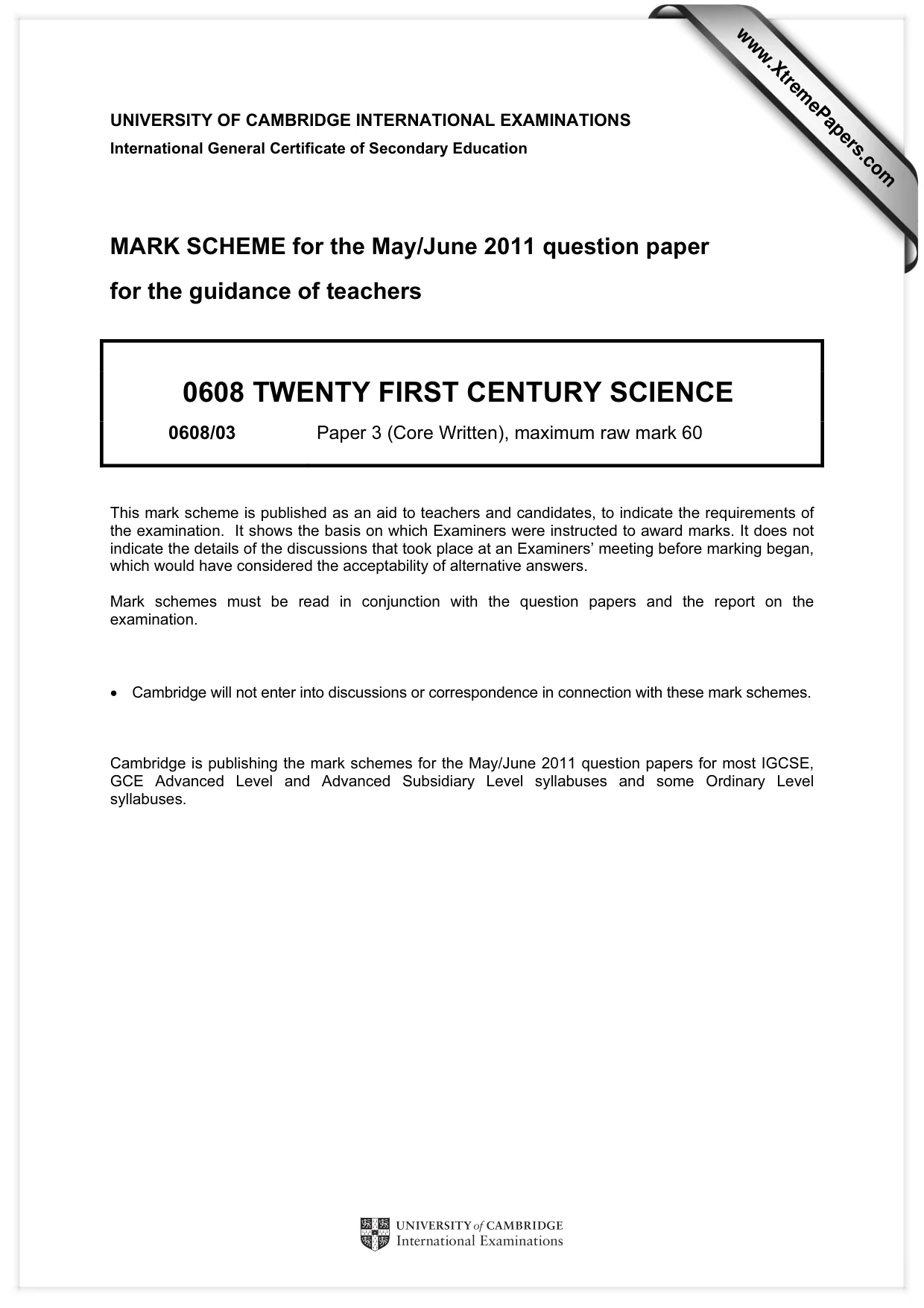
UNIVERSITY OF CAMBRIDGE INTERNATIONAL EXAMINATIONS International General Certificate of Secondary Education MARK SCHEME for the May/June 2011 question paper for the guidance of teachers 0608 TWENTY FIRST CENTURY SCIENCE 0608/03 Paper 3 (Core Written), maximum raw mark 60 This mark scheme is published as an aid to teachers and candidates, to indicate the requirements of the examination. It shows the basis on which Examiners were instructed to award marks. It does not indicate the details of the discussions that took place at an Examiners’ meeting before marking began, which would have considered the acceptability of alternative answers. Mark schemes must be read in conjunction with the question papers and the report on the examination. • Cambridge will not enter into discussions or correspondence in connection with these mark schemes. Cambridge is publishing the mark schemes for the May/June 2011 question papers for most IGCSE, GCE Advanced Level and Advanced Subsidiary Level syllabuses and some Ordinary Level syllabuses. www.XtremePapers.com
Mark scheme, page 2
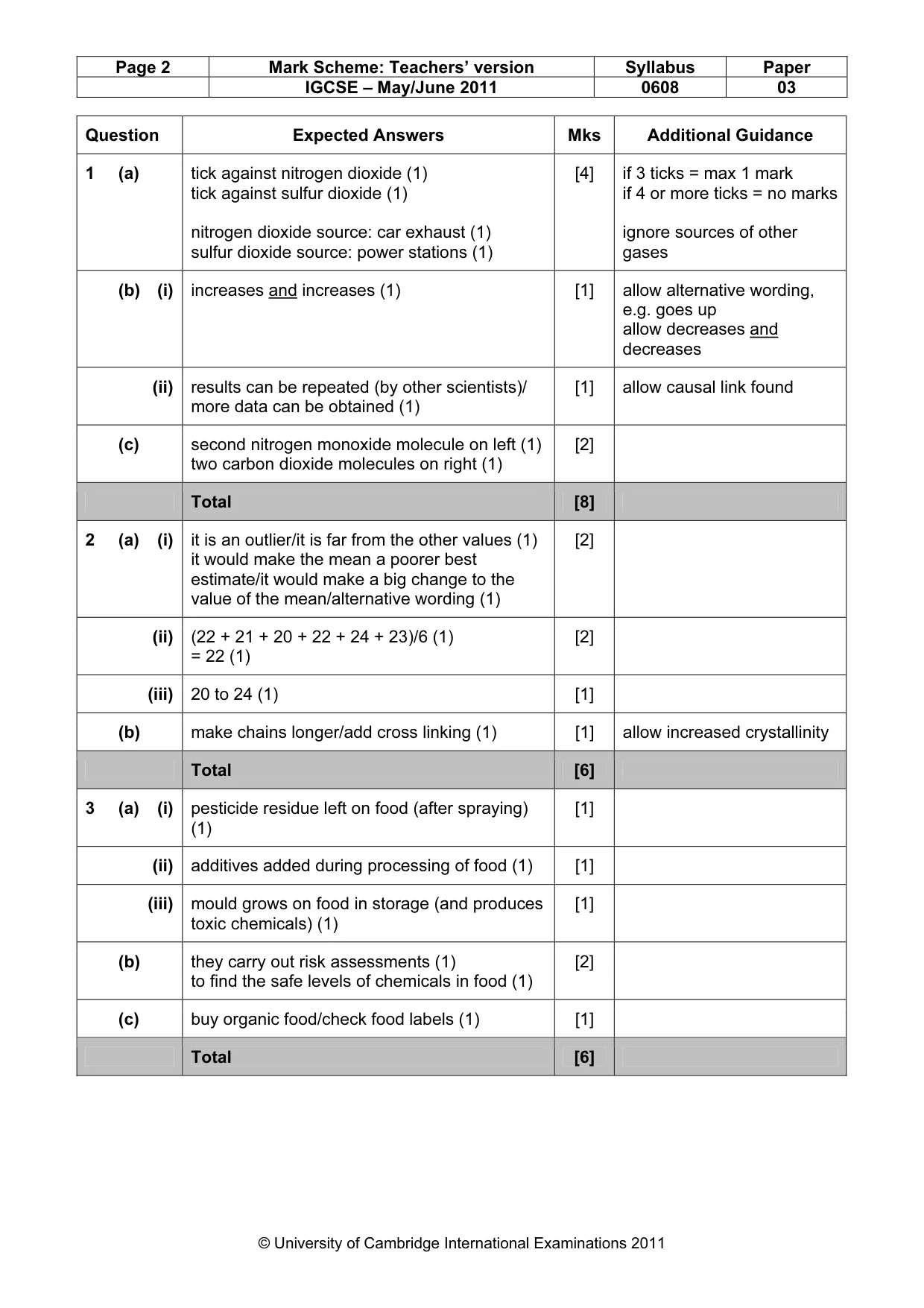
Page 2 Mark Scheme: Teachers’ version Syllabus Paper IGCSE – May/June 2011 0608 03 © University of Cambridge International Examinations 2011 Question Expected Answers Mks Additional Guidance 1 (a) tick against nitrogen dioxide (1) tick against sulfur dioxide (1) nitrogen dioxide source: car exhaust (1) sulfur dioxide source: power stations (1) [4] if 3 ticks = max 1 mark if 4 or more ticks = no marks ignore sources of other gases (b) (i) increases and increases (1) [1] allow alternative wording, e.g. goes up allow decreases and decreases (ii) results can be repeated (by other scientists)/ more data can be obtained (1) [1] allow causal link found (c) second nitrogen monoxide molecule on left (1) two carbon dioxide molecules on right (1) [2] Total [8] 2 (a) (i) it is an outlier/it is far from the other values (1) it would make the mean a poorer best estimate/it would make a big change to the value of the mean/alternative wording (1) [2] (ii) (22 + 21 + 20 + 22 + 24 + 23)/6 (1) = 22 (1) [2] (iii) 20 to 24 (1) [1] (b) make chains longer/add cross linking (1) [1] allow increased crystallinity Total [6] 3 (a) (i) pesticide residue left on food (after spraying) (1) [1] (ii) additives added during processing of food (1) [1] (iii) mould grows on food in storage (and produces toxic chemicals) (1) [1] (b) they carry out risk assessments (1) to find the safe levels of chemicals in food (1) [2] (c) buy organic food/check food labels (1) [1] Total [6]
Mark scheme, page 3
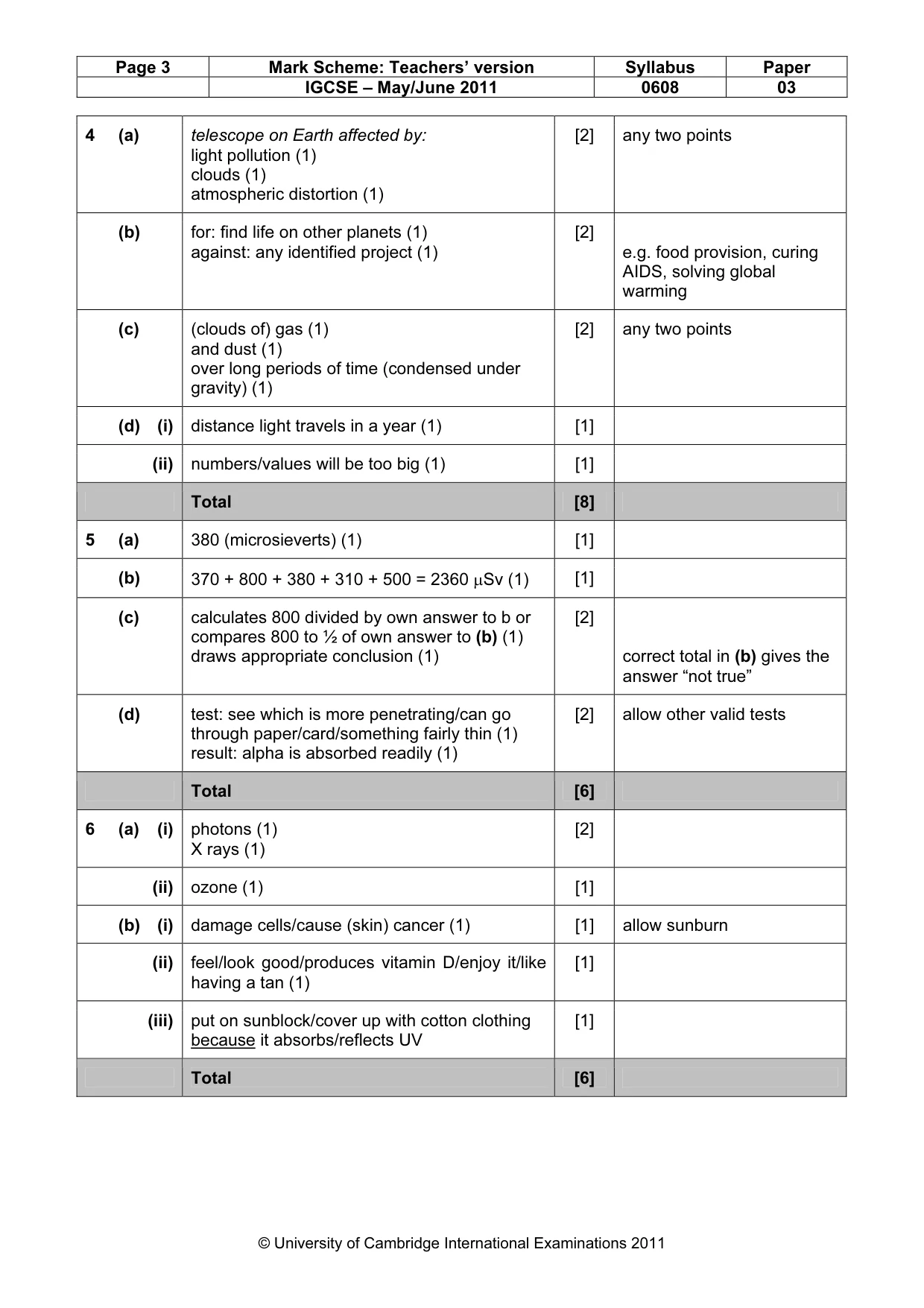
Page 3 Mark Scheme: Teachers’ version Syllabus Paper IGCSE – May/June 2011 0608 03 © University of Cambridge International Examinations 2011 4 (a) telescope on Earth affected by: light pollution (1) clouds (1) atmospheric distortion (1) [2] any two points (b) for: find life on other planets (1) against: any identified project (1) [2] e.g. food provision, curing AIDS, solving global warming (c) (clouds of) gas (1) and dust (1) over long periods of time (condensed under gravity) (1) [2] any two points (d) (i) distance light travels in a year (1) [1] (ii) numbers/values will be too big (1) [1] Total [8] 5 (a) 380 (microsieverts) (1) [1] (b) 370 + 800 + 380 + 310 + 500 = 2360 µSv (1) [1] (c) calculates 800 divided by own answer to b or compares 800 to ½ of own answer to (b) (1) draws appropriate conclusion (1) [2] correct total in (b) gives the answer “not true” (d) test: see which is more penetrating/can go through paper/card/something fairly thin (1) result: alpha is absorbed readily (1) [2] allow other valid tests Total [6] 6 (a) (i) photons (1) X rays (1) [2] (ii) ozone (1) [1] (b) (i) damage cells/cause (skin) cancer (1) [1] allow sunburn (ii) feel/look good/produces vitamin D/enjoy it/like having a tan (1) [1] (iii) put on sunblock/cover up with cotton clothing because it absorbs/reflects UV [1] Total [6]
Mark scheme, page 4
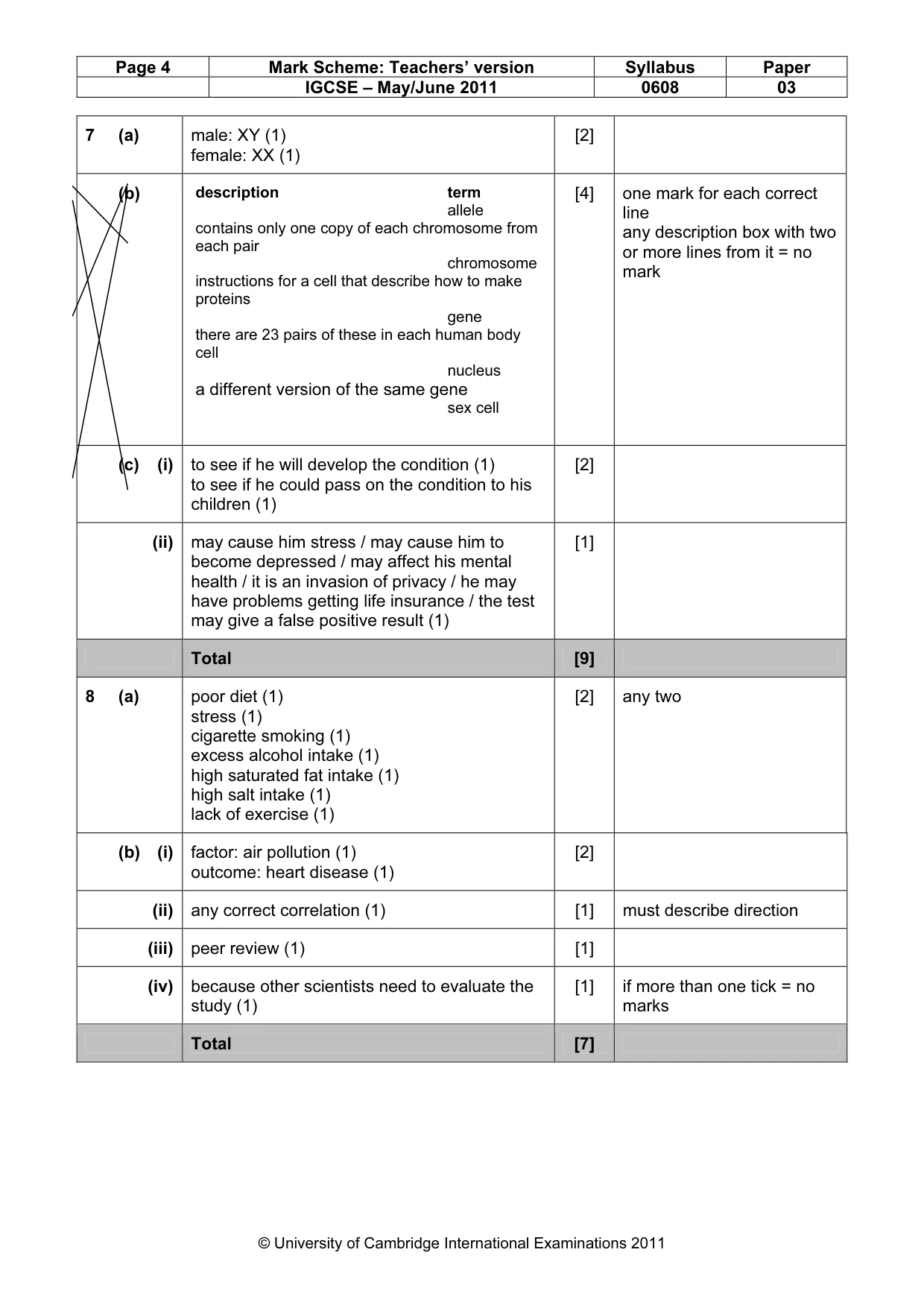
Page 4 Mark Scheme: Teachers’ version Syllabus Paper IGCSE – May/June 2011 0608 03 © University of Cambridge International Examinations 2011 7 (a) male: XY (1) female: XX (1) [2] (b) description term allele contains only one copy of each chromosome from each pair chromosome instructions for a cell that describe how to make proteins gene there are 23 pairs of these in each human body cell nucleus a different version of the same gene sex cell [4] one mark for each correct line any description box with two or more lines from it = no mark (c) (i) to see if he will develop the condition (1) to see if he could pass on the condition to his children (1) [2] (ii) may cause him stress / may cause him to become depressed / may affect his mental health / it is an invasion of privacy / he may have problems getting life insurance / the test may give a false positive result (1) [1] Total [9] 8 (a) poor diet (1) stress (1) cigarette smoking (1) excess alcohol intake (1) high saturated fat intake (1) high salt intake (1) lack of exercise (1) [2] any two (b) (i) factor: air pollution (1) outcome: heart disease (1) [2] (ii) any correct correlation (1) [1] must describe direction (iii) peer review (1) [1] (iv) because other scientists need to evaluate the study (1) [1] if more than one tick = no marks Total [7]
Mark scheme, page 5
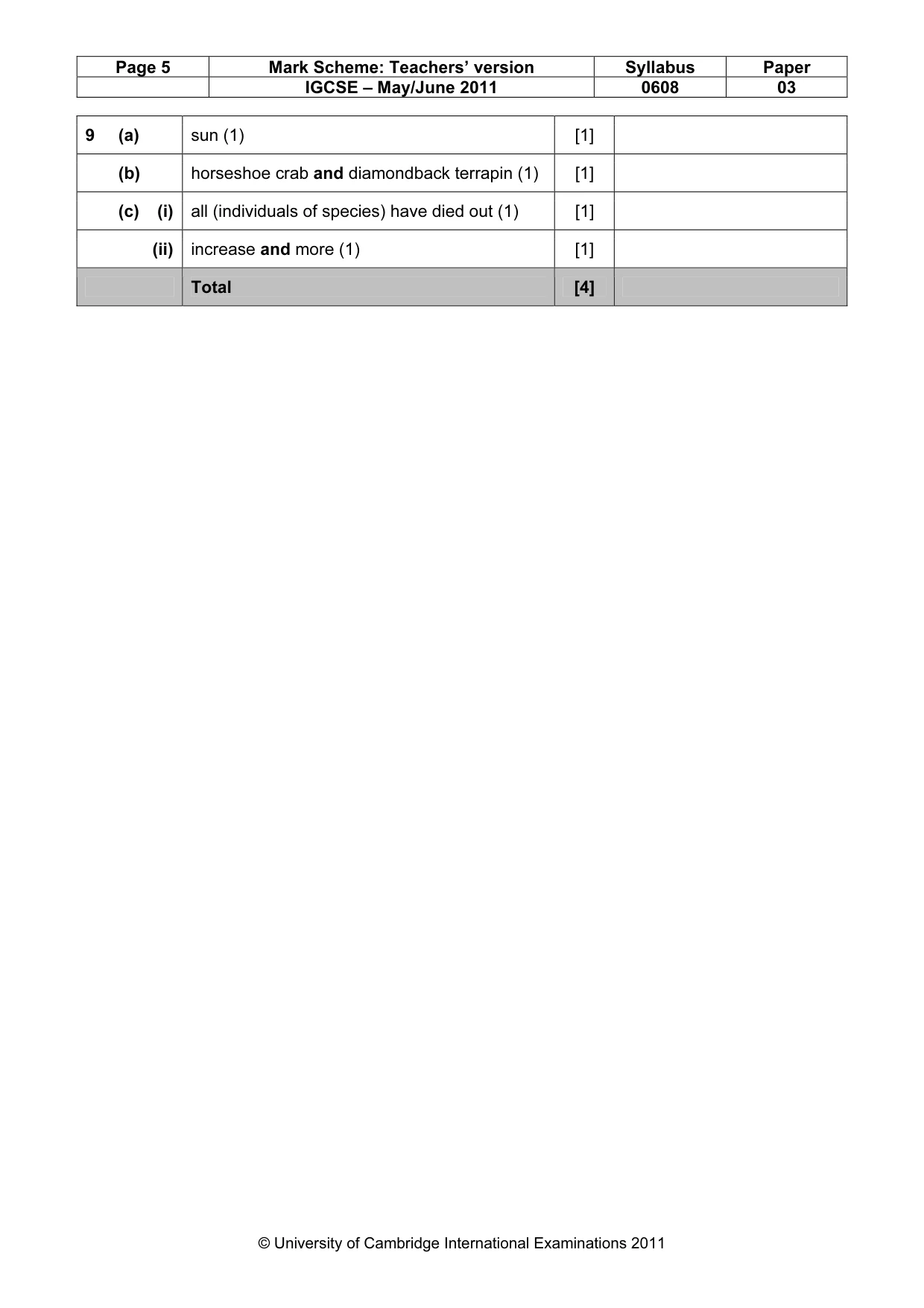
Page 5 Mark Scheme: Teachers’ version Syllabus Paper IGCSE – May/June 2011 0608 03 © University of Cambridge International Examinations 2011 9 (a) sun (1) [1] (b) horseshoe crab and diamondback terrapin (1) [1] (c) (i) all (individuals of species) have died out (1) [1] (ii) increase and more (1) [1] Total [4]
What you needed in this session
Cambridge’s own grade thresholds for 2011 May/June, Paper 3 · Variant 1. A higher threshold means an easier paper — the bar moves with how the cohort did.