Cambridge IGCSE Twenty-First Century Science 0608 — 2012 Oct/Nov Paper 3 · Variant 1
0608/31/O/N/12
The question paper and its mark scheme, free to read here and free to download. This is Cambridge’s own paper, exactly as it was sat.
Question paper16 pages

Mark scheme5 pages
Answers below. Sit the paper first if you are practising.
Paper as text
Question paper, page 1
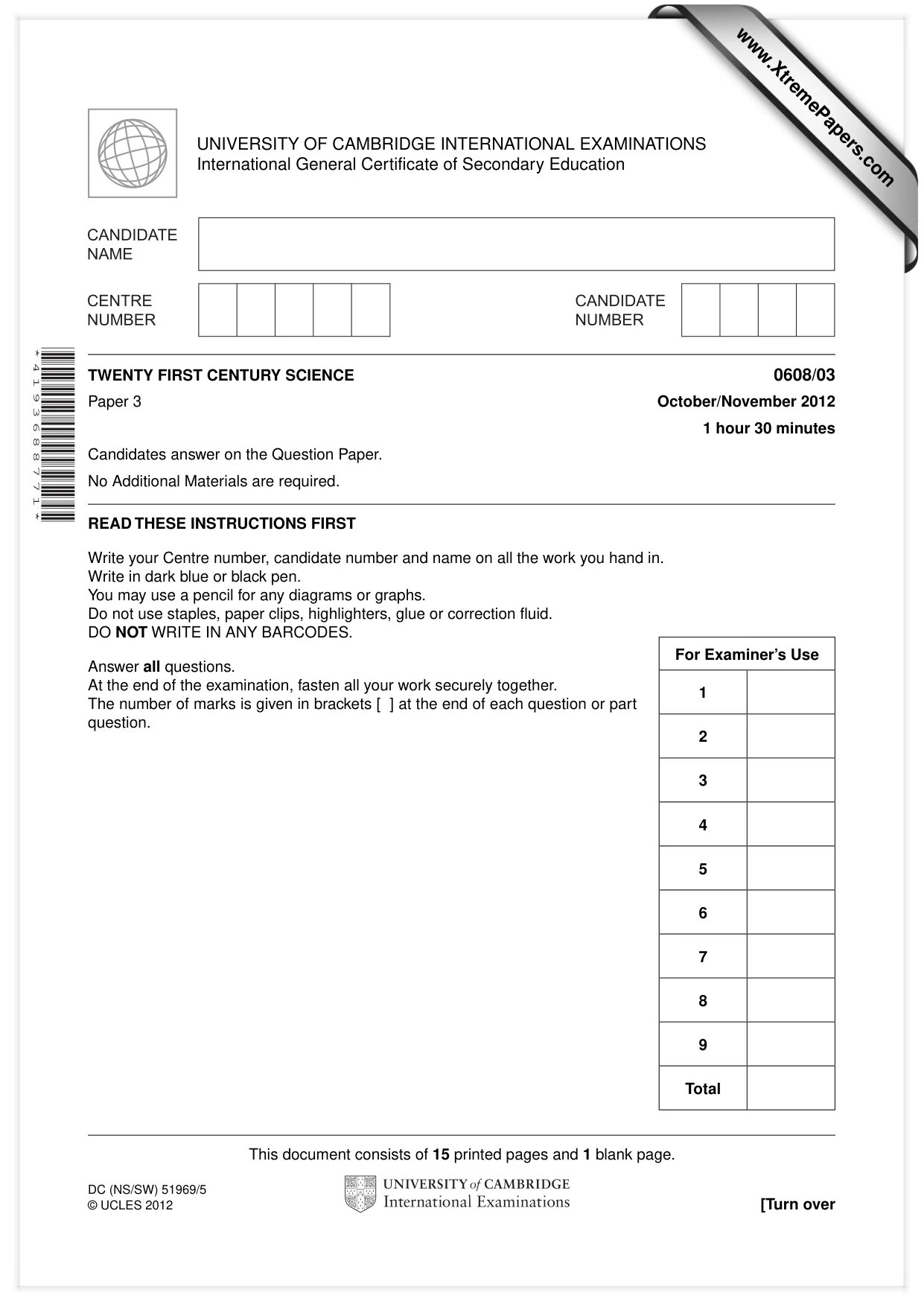
This document consists of 15 printed pages and 1 blank page. DC (NS/SW) 51969/5 © UCLES 2012 [Turn over UNIVERSITY OF CAMBRIDGE INTERNATIONAL EXAMINATIONS International General Certificate of Secondary Education * 4 1 9 3 6 8 8 7 7 1 * TWENTY FIRST CENTURY SCIENCE 0608/03 Paper 3 October/November 2012 1 hour 30 minutes Candidates answer on the Question Paper. No Additional Materials are required. READ THESE INSTRUCTIONS FIRST Write your Centre number, candidate number and name on all the work you hand in. Write in dark blue or black pen. You may use a pencil for any diagrams or graphs. Do not use staples, paper clips, highlighters, glue or correction fluid. DO NOT WRITE IN ANY BARCODES. Answer all questions. At the end of the examination, fasten all your work securely together. The number of marks is given in brackets [ ] at the end of each question or part question. For Examiner’s Use 1 2 3 4 5 6 7 8 9 Total www.XtremePapers.com
Question paper, page 2
2 0608/03/O/N/12 © UCLES 2012 BLANK PAGE
Question paper, page 3
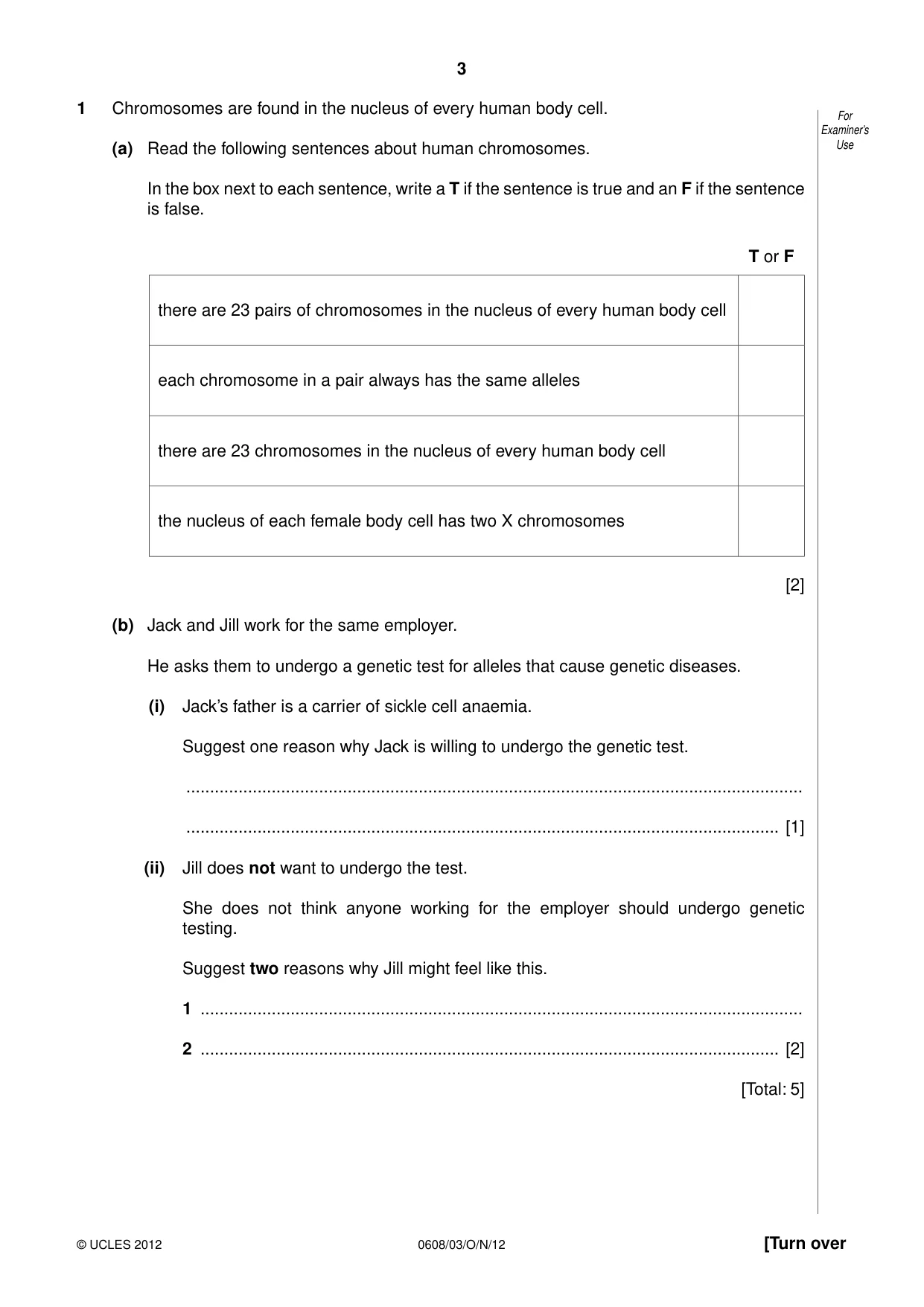
3 0608/03/O/N/12 © UCLES 2012 [Turn over For Examiner’s Use 1 Chromosomes are found in the nucleus of every human body cell. (a) Read the following sentences about human chromosomes. In the box next to each sentence, write a T if the sentence is true and an F if the sentence is false. T or F there are 23 pairs of chromosomes in the nucleus of every human body cell each chromosome in a pair always has the same alleles there are 23 chromosomes in the nucleus of every human body cell the nucleus of each female body cell has two X chromosomes [2] (b) Jack and Jill work for the same employer. He asks them to undergo a genetic test for alleles that cause genetic diseases. (i) Jack’s father is a carrier of sickle cell anaemia. Suggest one reason why Jack is willing to undergo the genetic test. … … [1] (ii) Jill does not want to undergo the test. She does not think anyone working for the employer should undergo genetic testing. Suggest two reasons why Jill might feel like this. 1 … 2 … [2] [Total: 5]
Question paper, page 4
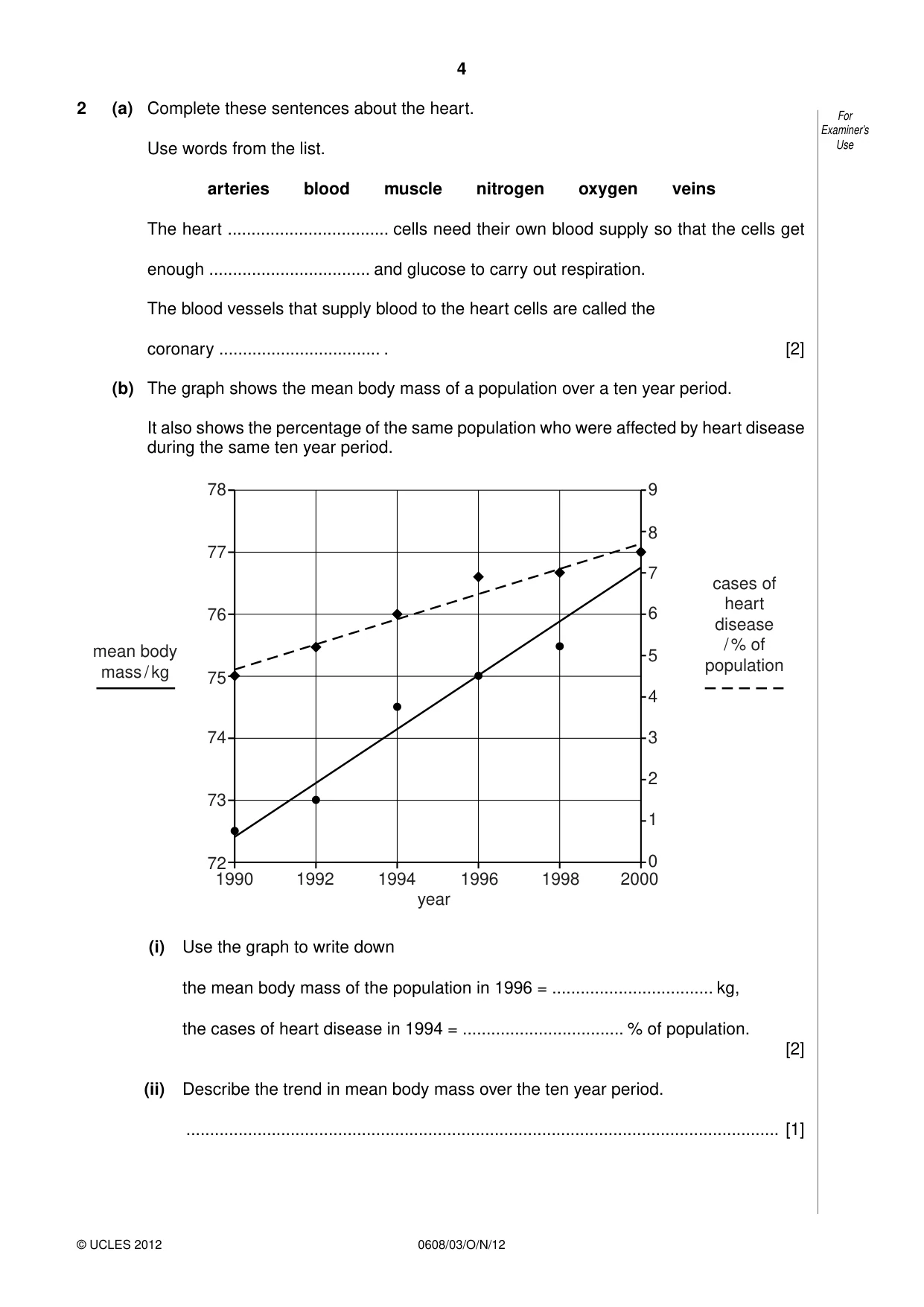
4 0608/03/O/N/12 © UCLES 2012 For Examiner’s Use 2 (a) Complete these sentences about the heart. Use words from the list. arteries blood muscle nitrogen oxygen veins The heart … cells need their own blood supply so that the cells get enough … and glucose to carry out respiration. The blood vessels that supply blood to the heart cells are called the coronary … . [2] (b) The graph shows the mean body mass of a population over a ten year period. It also shows the percentage of the same population who were affected by heart disease during the same ten year period. 78 9 8 7 6 5 4 3 2 1 0 77 76 mean body mass / kg 75 74 73 72 1990 1992 1994 1996 year 1998 2000 cases of heart disease / % of population (i) Use the graph to write down the mean body mass of the population in 1996 = … kg, the cases of heart disease in 1994 = … % of population. [2] (ii) Describe the trend in mean body mass over the ten year period. … [1]
Question paper, page 5
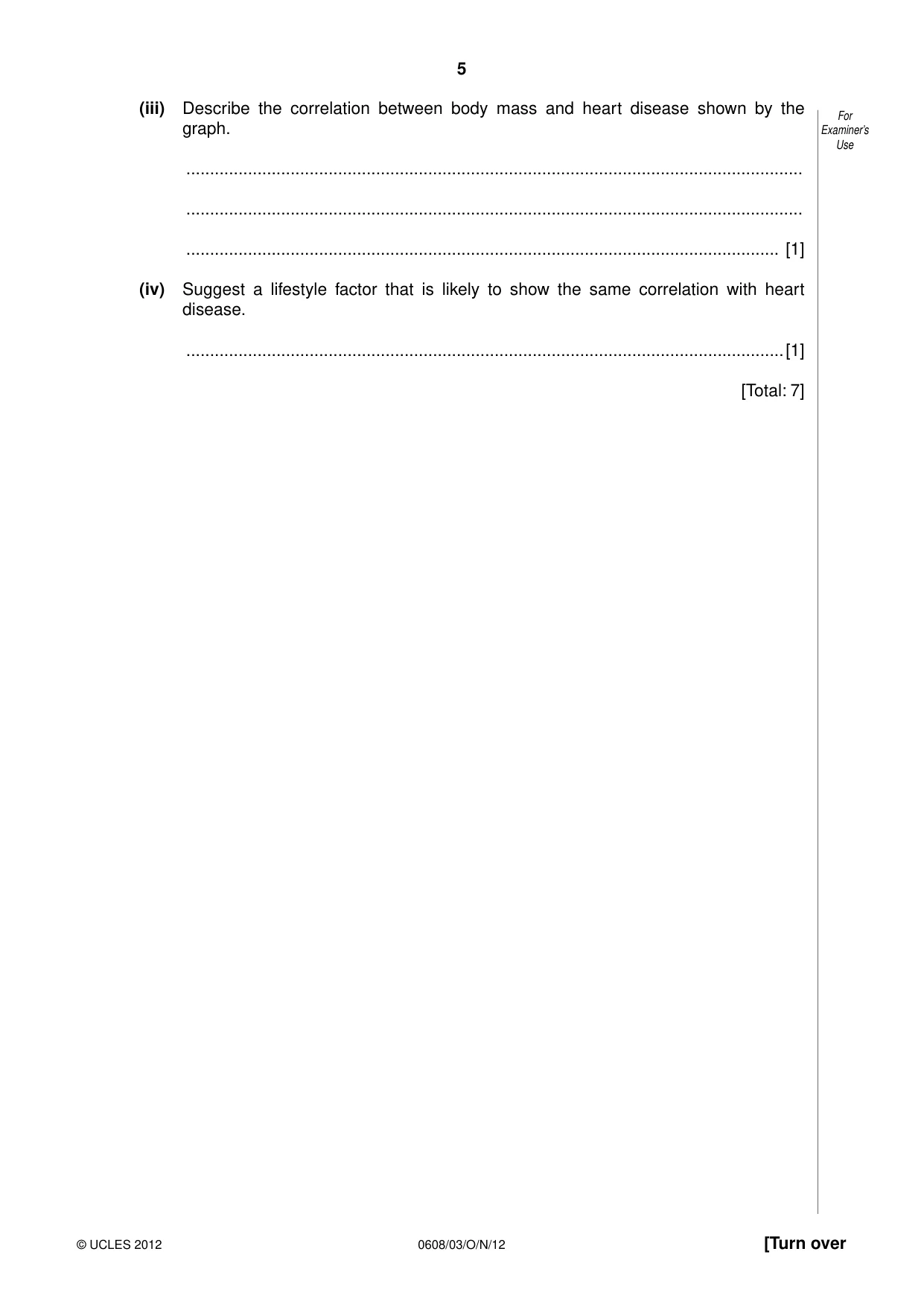
5 0608/03/O/N/12 © UCLES 2012 [Turn over For Examiner’s Use (iii) Describe the correlation between body mass and heart disease shown by the graph. … … … [1] (iv) Suggest a lifestyle factor that is likely to show the same correlation with heart disease. …[1] [Total: 7]
Question paper, page 6
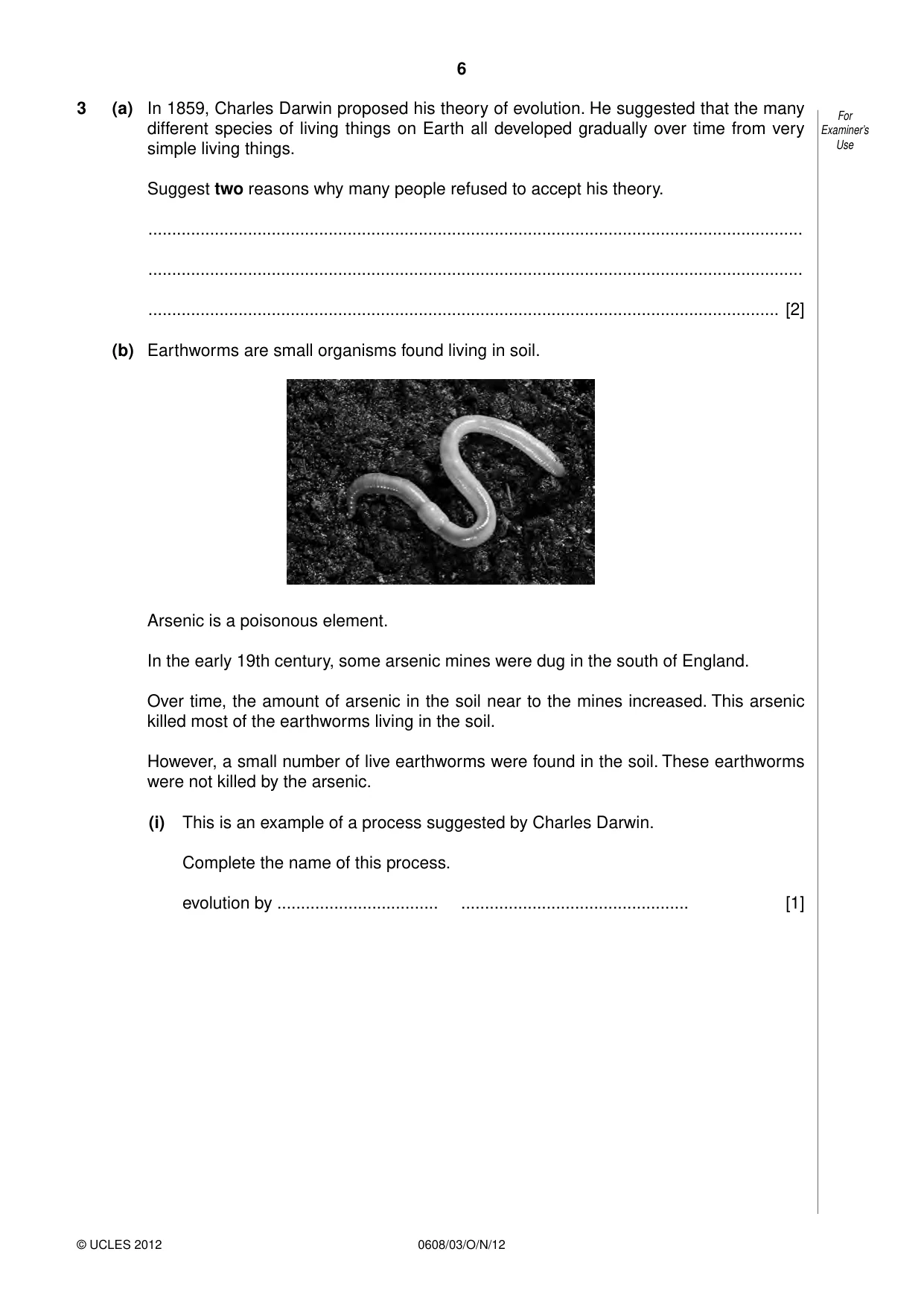
6 0608/03/O/N/12 © UCLES 2012 For Examiner’s Use 3 (a) In 1859, Charles Darwin proposed his theory of evolution. He suggested that the many different species of living things on Earth all developed gradually over time from very simple living things. Suggest two reasons why many people refused to accept his theory. … … … [2] (b) Earthworms are small organisms found living in soil. Arsenic is a poisonous element. In the early 19th century, some arsenic mines were dug in the south of England. Over time, the amount of arsenic in the soil near to the mines increased. This arsenic killed most of the earthworms living in the soil. However, a small number of live earthworms were found in the soil. These earthworms were not killed by the arsenic. (i) This is an example of a process suggested by Charles Darwin. Complete the name of this process. evolution by … … [1]
Question paper, page 7
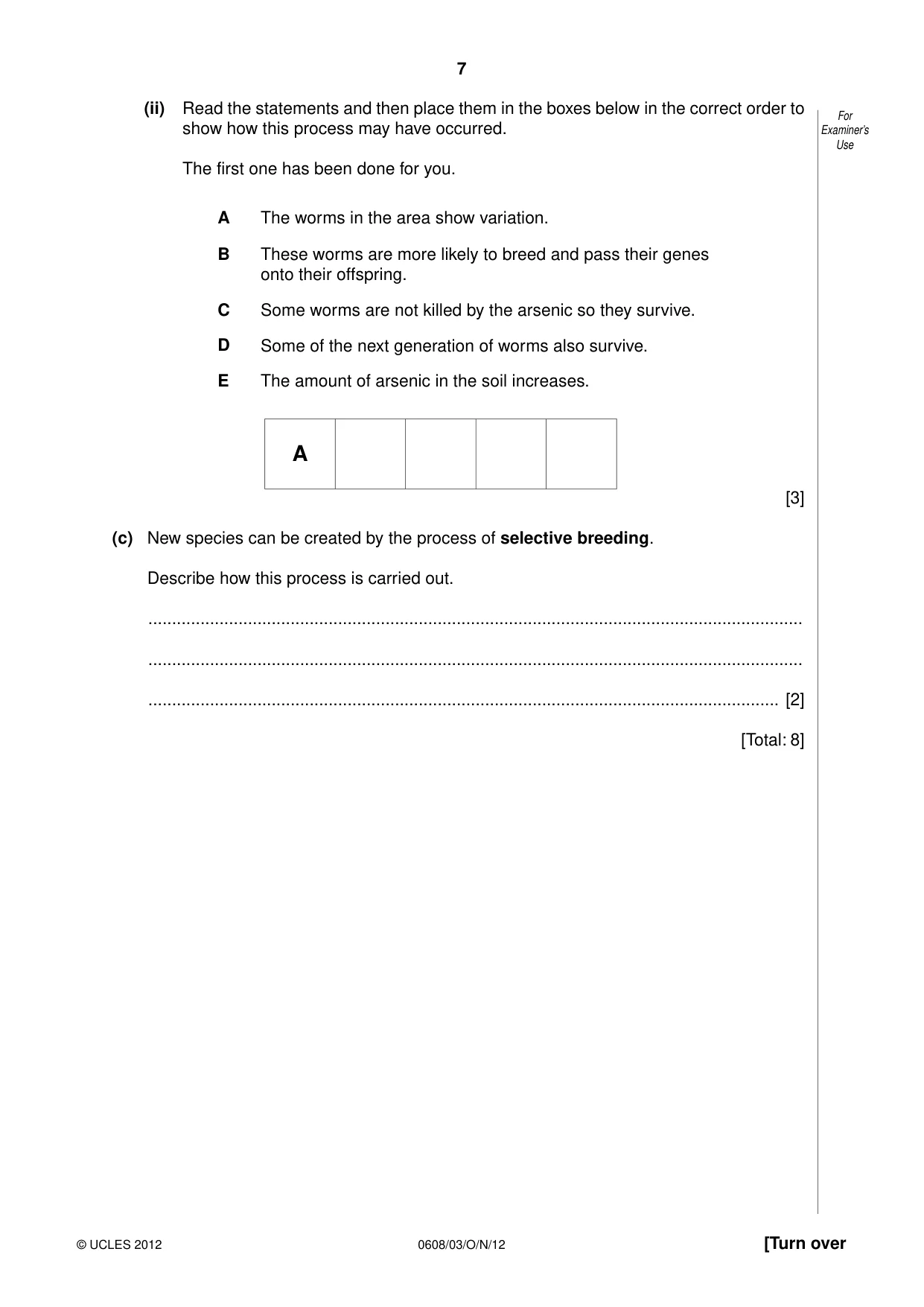
7 0608/03/O/N/12 © UCLES 2012 [Turn over For Examiner’s Use (ii) Read the statements and then place them in the boxes below in the correct order to show how this process may have occurred. The first one has been done for you. A The worms in the area show variation. B These worms are more likely to breed and pass their genes onto their offspring. C Some worms are not killed by the arsenic so they survive. D Some of the next generation of worms also survive. E The amount of arsenic in the soil increases. A [3] (c) New species can be created by the process of selective breeding. Describe how this process is carried out. … … … [2] [Total: 8]
Question paper, page 8
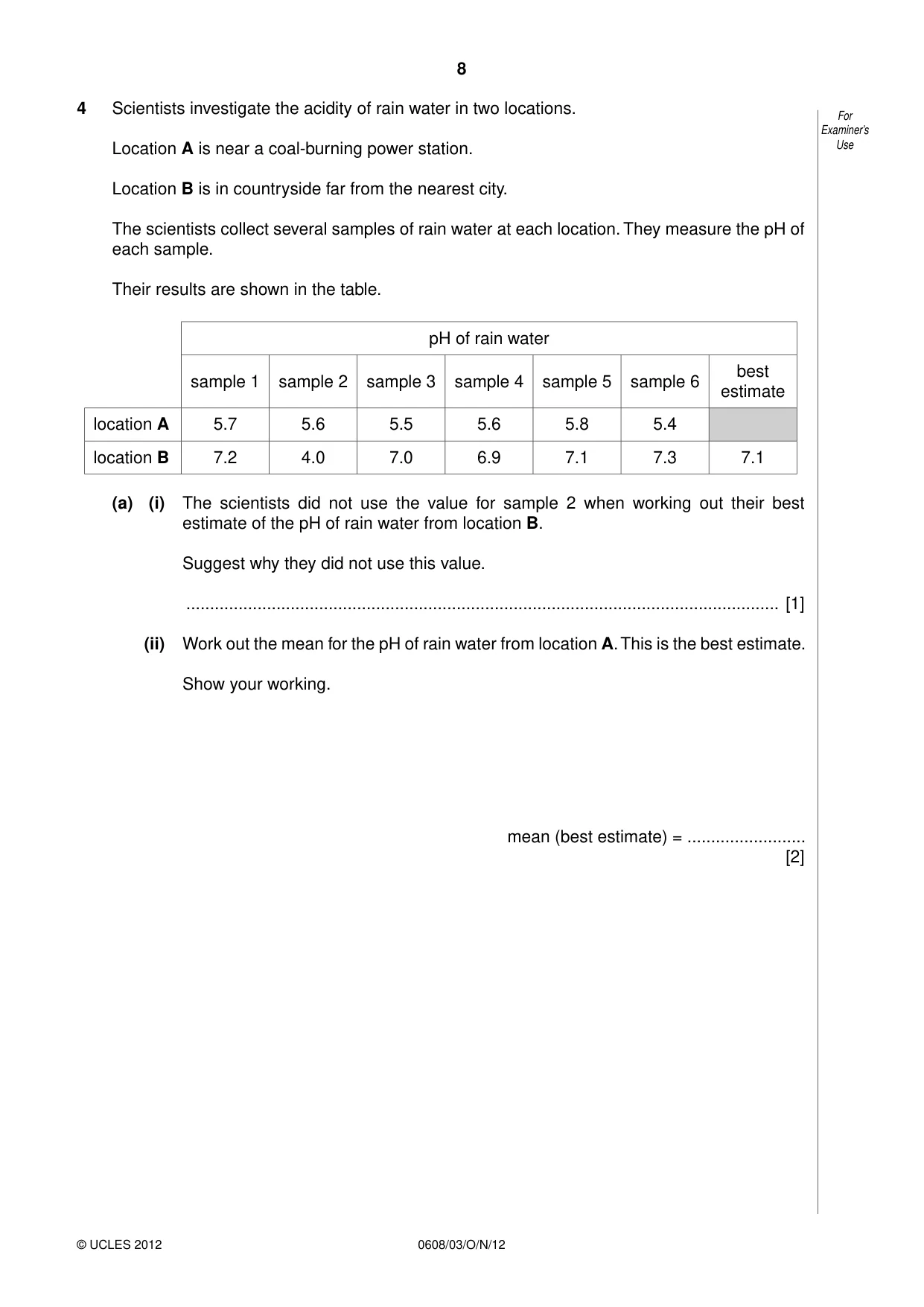
8 0608/03/O/N/12 © UCLES 2012 For Examiner’s Use 4 Scientists investigate the acidity of rain water in two locations. Location A is near a coal-burning power station. Location B is in countryside far from the nearest city. The scientists collect several samples of rain water at each location. They measure the pH of each sample. Their results are shown in the table. pH of rain water sample 1 sample 2 sample 3 sample 4 sample 5 sample 6 best estimate location A 5.7 5.6 5.5 5.6 5.8 5.4 location B 7.2 4.0 7.0 6.9 7.1 7.3 7.1 (a) (i) The scientists did not use the value for sample 2 when working out their best estimate of the pH of rain water from location B. Suggest why they did not use this value. … [1] (ii) Work out the mean for the pH of rain water from location A. This is the best estimate. Show your working. mean (best estimate) = … [2]
Question paper, page 9
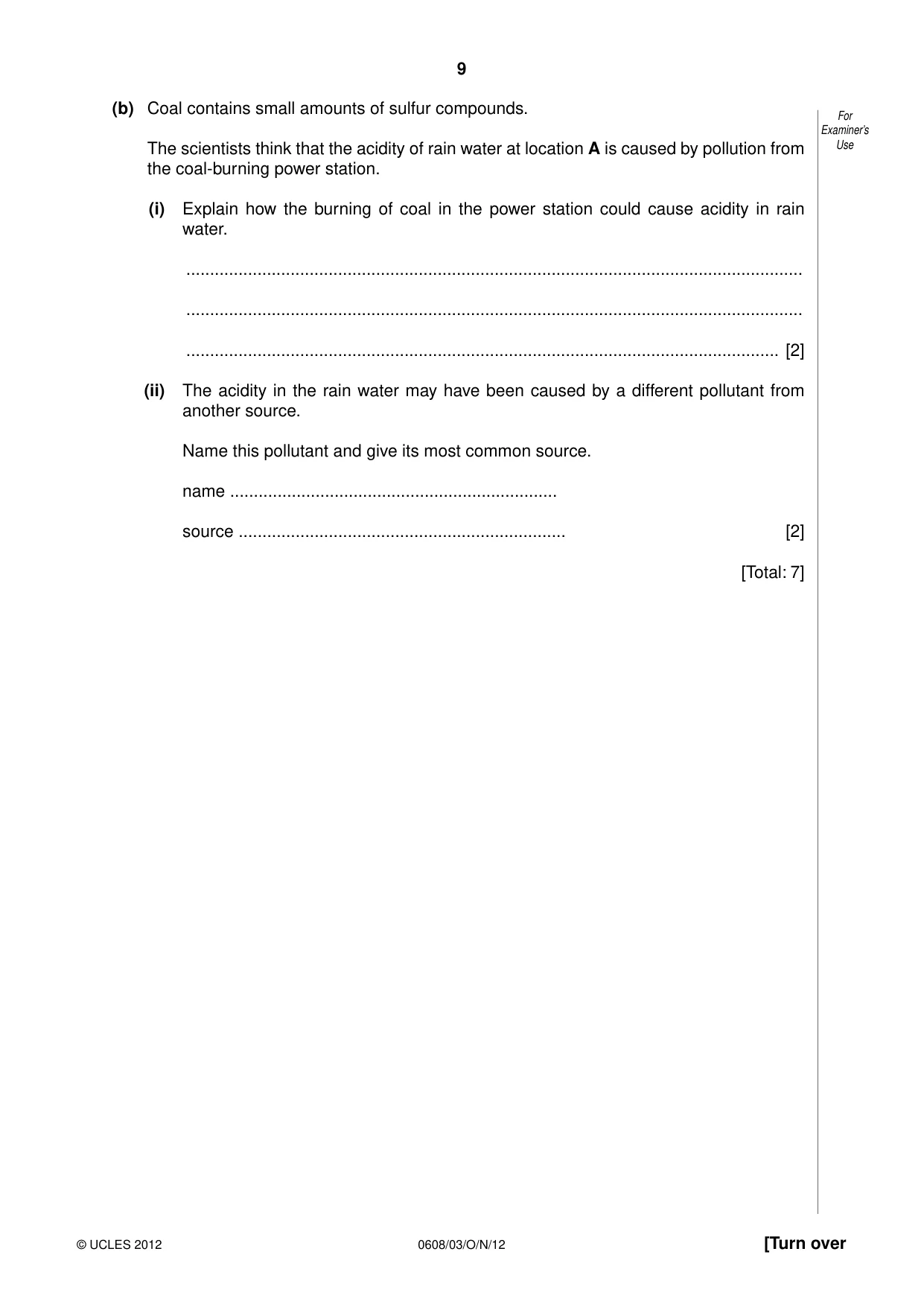
9 0608/03/O/N/12 © UCLES 2012 [Turn over For Examiner’s Use (b) Coal contains small amounts of sulfur compounds. The scientists think that the acidity of rain water at location A is caused by pollution from the coal-burning power station. (i) Explain how the burning of coal in the power station could cause acidity in rain water. … … … [2] (ii) The acidity in the rain water may have been caused by a different pollutant from another source. Name this pollutant and give its most common source. name … source … [2] [Total: 7]
Question paper, page 10
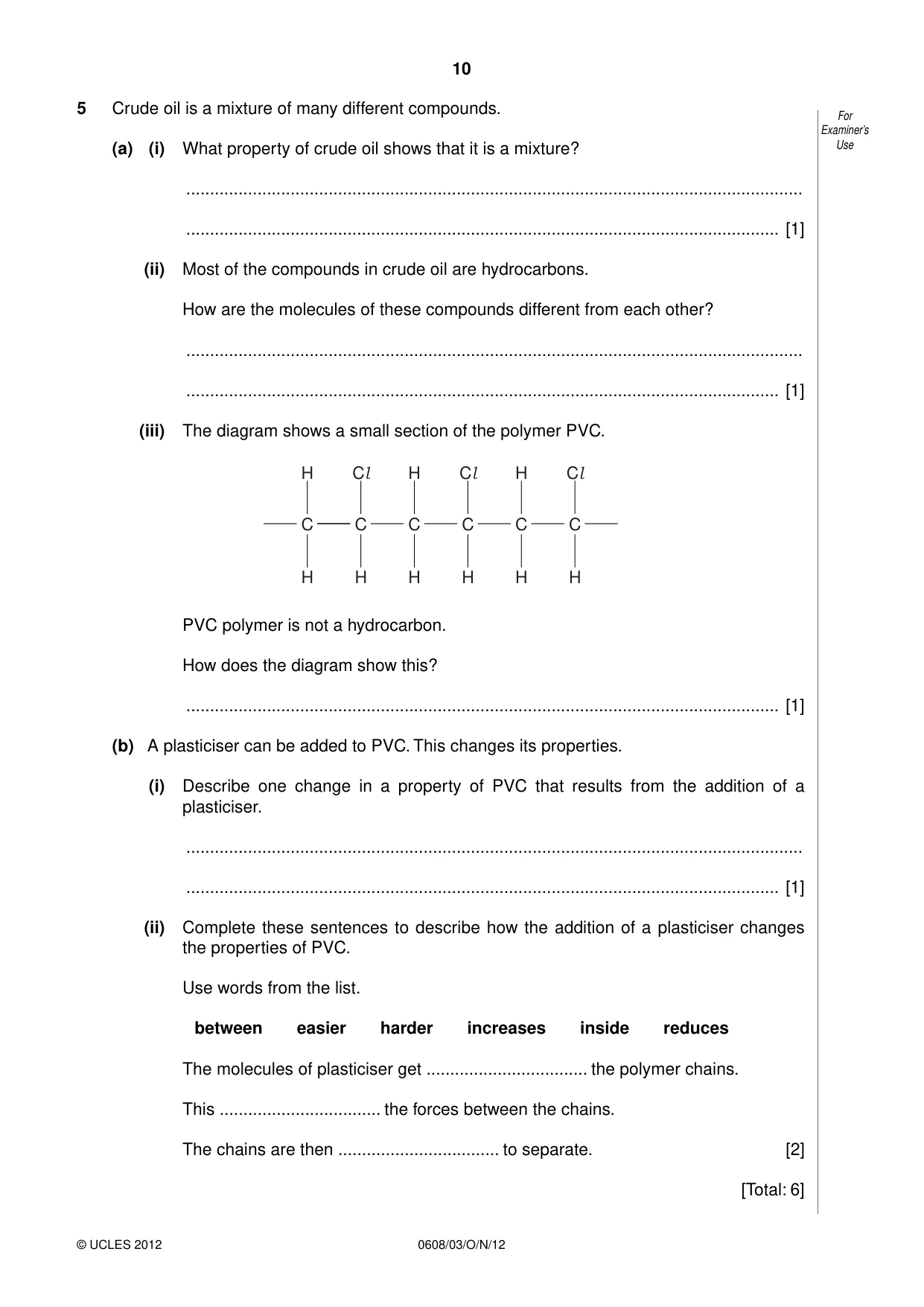
10 0608/03/O/N/12 © UCLES 2012 For Examiner’s Use 5 Crude oil is a mixture of many different compounds. (a) (i) What property of crude oil shows that it is a mixture? … … [1] (ii) Most of the compounds in crude oil are hydrocarbons. How are the molecules of these compounds different from each other? … … [1] (iii) The diagram shows a small section of the polymer PVC. C H H C H Cl C H H C H Cl C H H C H Cl PVC polymer is not a hydrocarbon. How does the diagram show this? … [1] (b) A plasticiser can be added to PVC. This changes its properties. (i) Describe one change in a property of PVC that results from the addition of a plasticiser. … … [1] (ii) Complete these sentences to describe how the addition of a plasticiser changes the properties of PVC. Use words from the list. between easier harder increases inside reduces The molecules of plasticiser get … the polymer chains. This … the forces between the chains. The chains are then … to separate. [2] [Total: 6]
Question paper, page 11
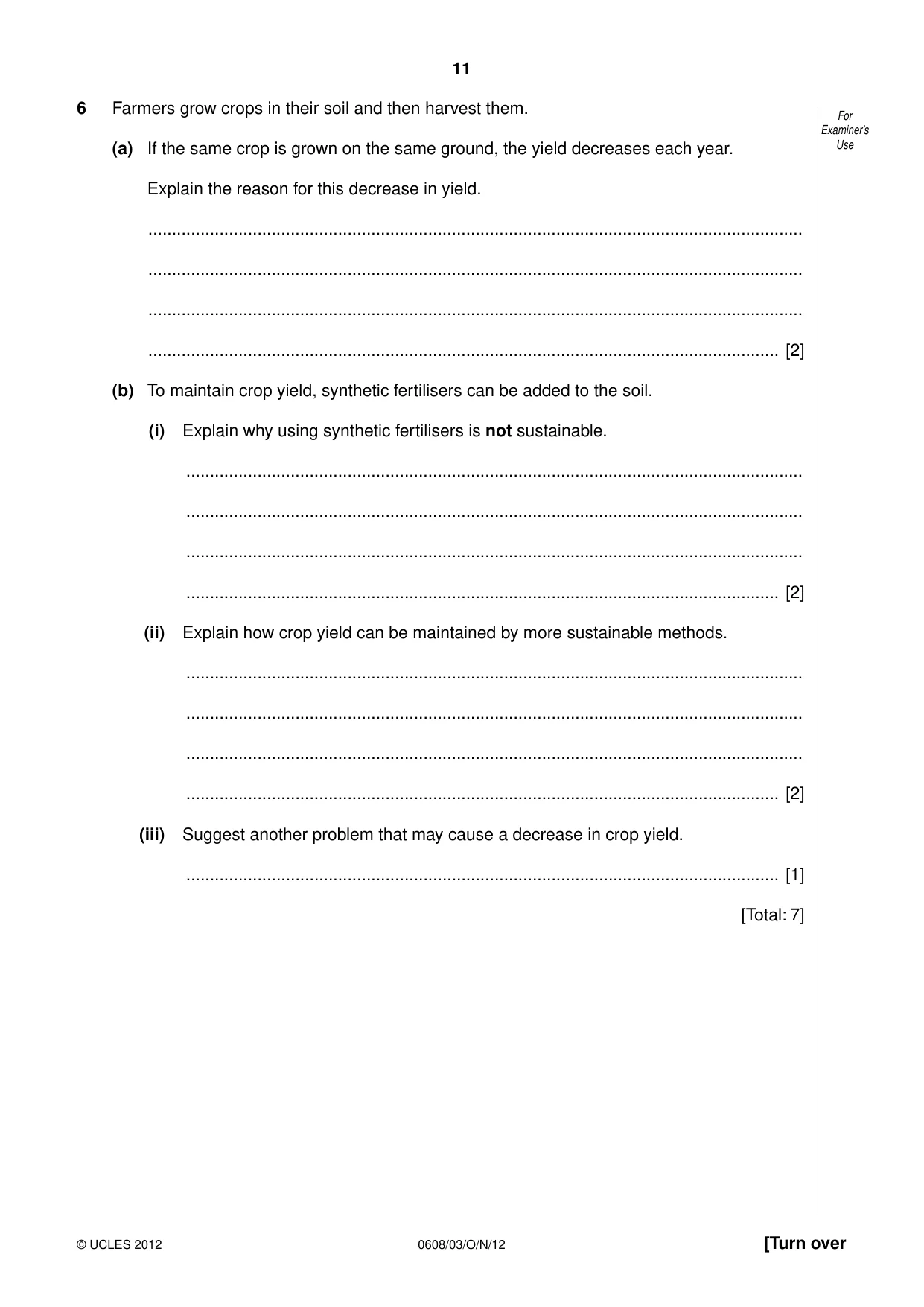
11 0608/03/O/N/12 © UCLES 2012 [Turn over For Examiner’s Use 6 Farmers grow crops in their soil and then harvest them. (a) If the same crop is grown on the same ground, the yield decreases each year. Explain the reason for this decrease in yield. … … … … [2] (b) To maintain crop yield, synthetic fertilisers can be added to the soil. (i) Explain why using synthetic fertilisers is not sustainable. … … … … [2] (ii) Explain how crop yield can be maintained by more sustainable methods. … … … … [2] (iii) Suggest another problem that may cause a decrease in crop yield. … [1] [Total: 7]
Question paper, page 12
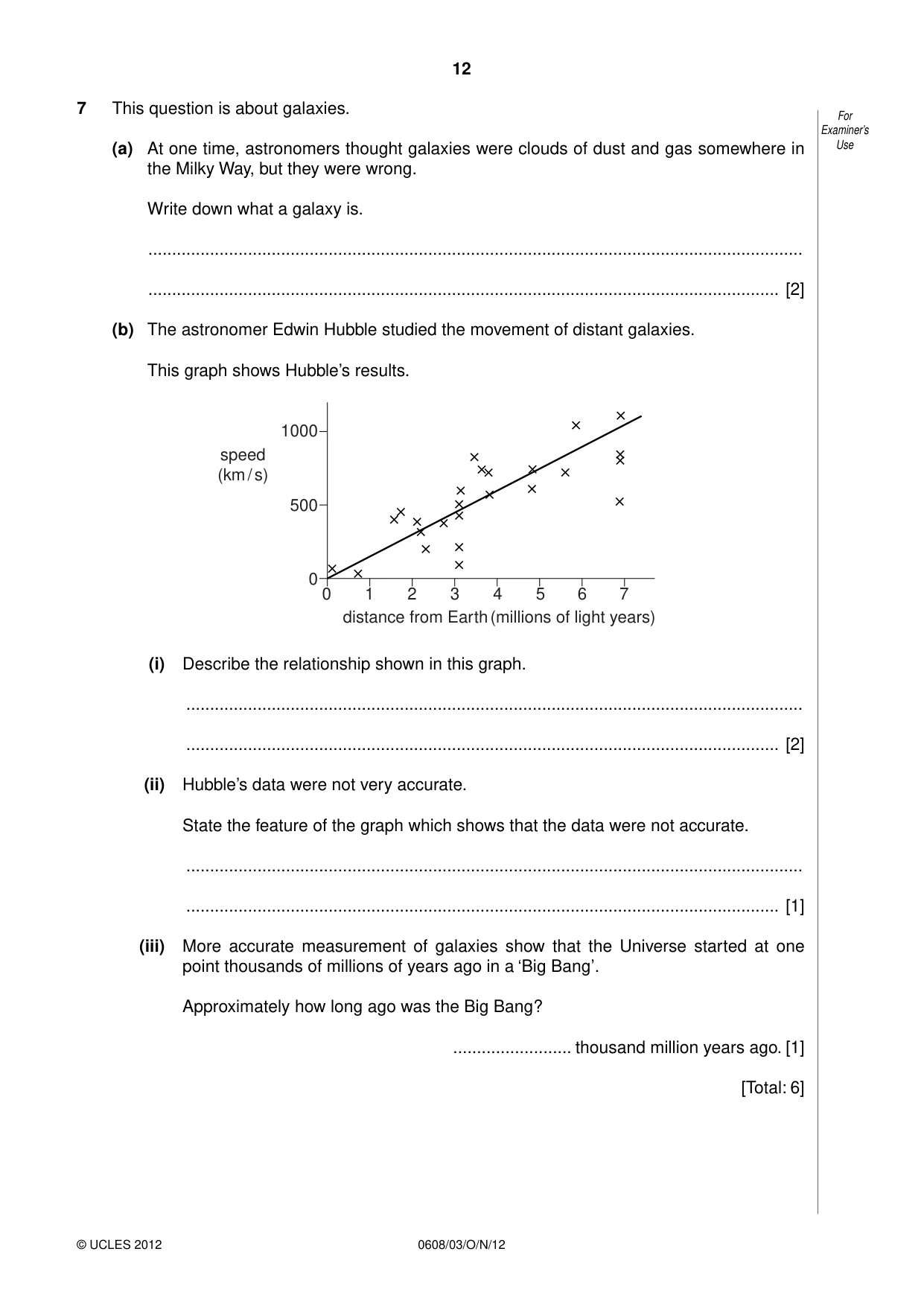
12 0608/03/O/N/12 © UCLES 2012 For Examiner’s Use 7 This question is about galaxies. (a) At one time, astronomers thought galaxies were clouds of dust and gas somewhere in the Milky Way, but they were wrong. Write down what a galaxy is. … … [2] (b) The astronomer Edwin Hubble studied the movement of distant galaxies. This graph shows Hubble’s results. 0 0 500 1000 speed (km / s) 1 2 3 4 distance from Earth (millions of light years) 5 6 7 (i) Describe the relationship shown in this graph. … … [2] (ii) Hubble’s data were not very accurate. State the feature of the graph which shows that the data were not accurate. … … [1] (iii) More accurate measurement of galaxies show that the Universe started at one point thousands of millions of years ago in a ‘Big Bang’. Approximately how long ago was the Big Bang? … thousand million years ago. [1] [Total: 6]
Question paper, page 13
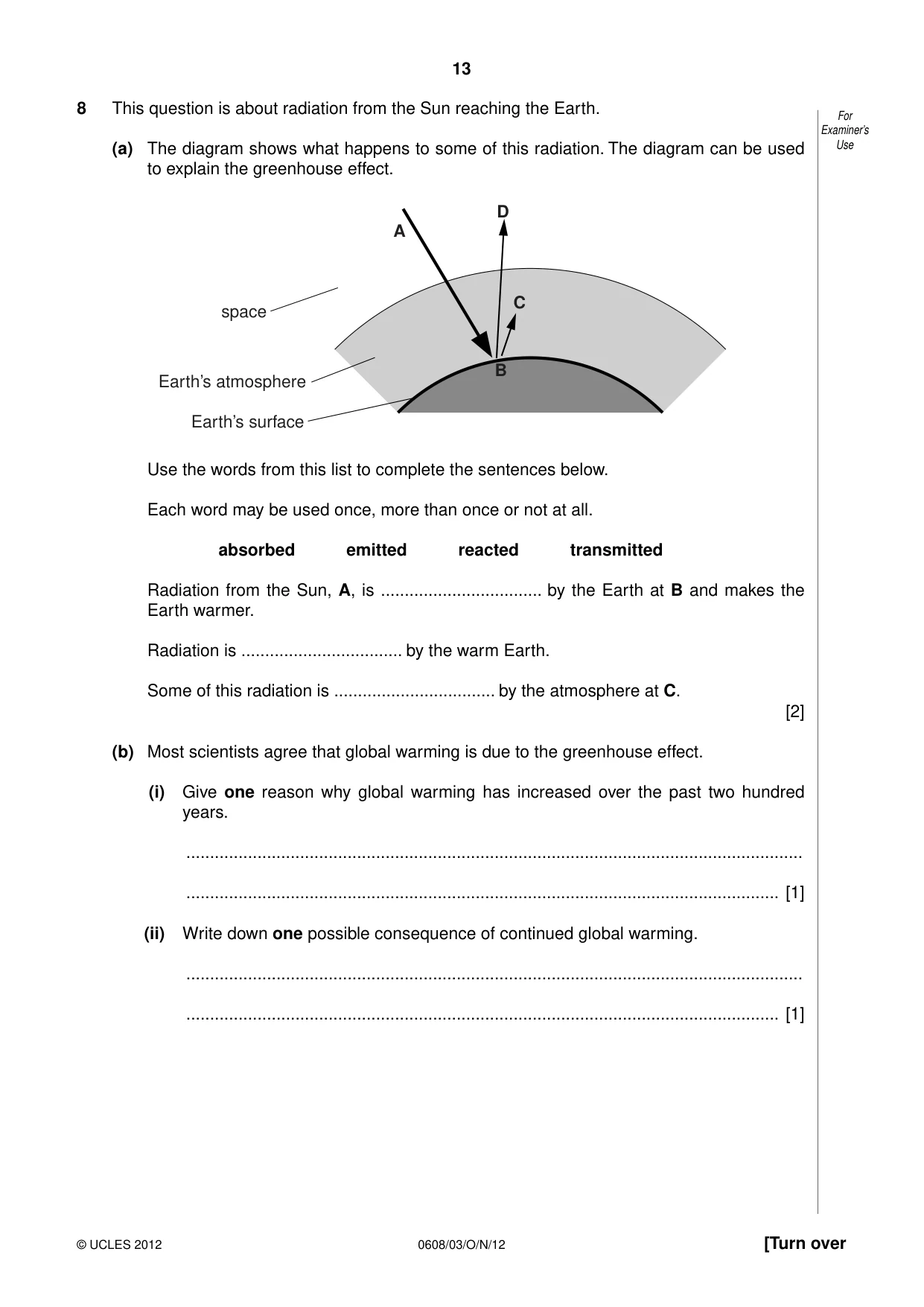
13 0608/03/O/N/12 © UCLES 2012 [Turn over For Examiner’s Use 8 This question is about radiation from the Sun reaching the Earth. (a) The diagram shows what happens to some of this radiation. The diagram can be used to explain the greenhouse effect. space Earth’s atmosphere Earth’s surface A D C B Use the words from this list to complete the sentences below. Each word may be used once, more than once or not at all. absorbed emitted reacted transmitted Radiation from the Sun, A, is … by the Earth at B and makes the Earth warmer. Radiation is … by the warm Earth. Some of this radiation is … by the atmosphere at C. [2] (b) Most scientists agree that global warming is due to the greenhouse effect. (i) Give one reason why global warming has increased over the past two hundred years. … … [1] (ii) Write down one possible consequence of continued global warming. … … [1]
Question paper, page 14
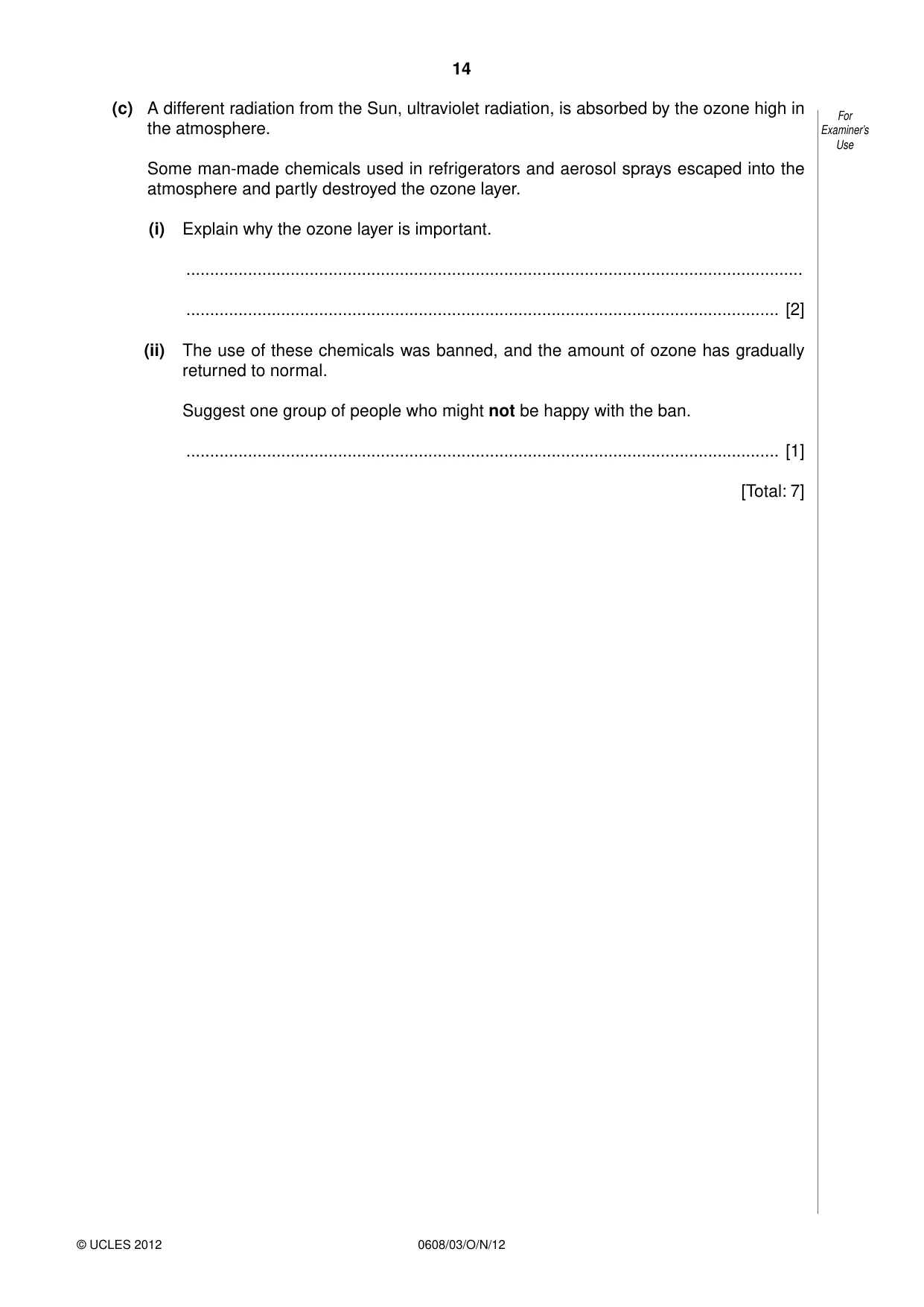
14 0608/03/O/N/12 © UCLES 2012 For Examiner’s Use (c) A different radiation from the Sun, ultraviolet radiation, is absorbed by the ozone high in the atmosphere. Some man-made chemicals used in refrigerators and aerosol sprays escaped into the atmosphere and partly destroyed the ozone layer. (i) Explain why the ozone layer is important. … … [2] (ii) The use of these chemicals was banned, and the amount of ozone has gradually returned to normal. Suggest one group of people who might not be happy with the ban. … [1] [Total: 7]
Question paper, page 15
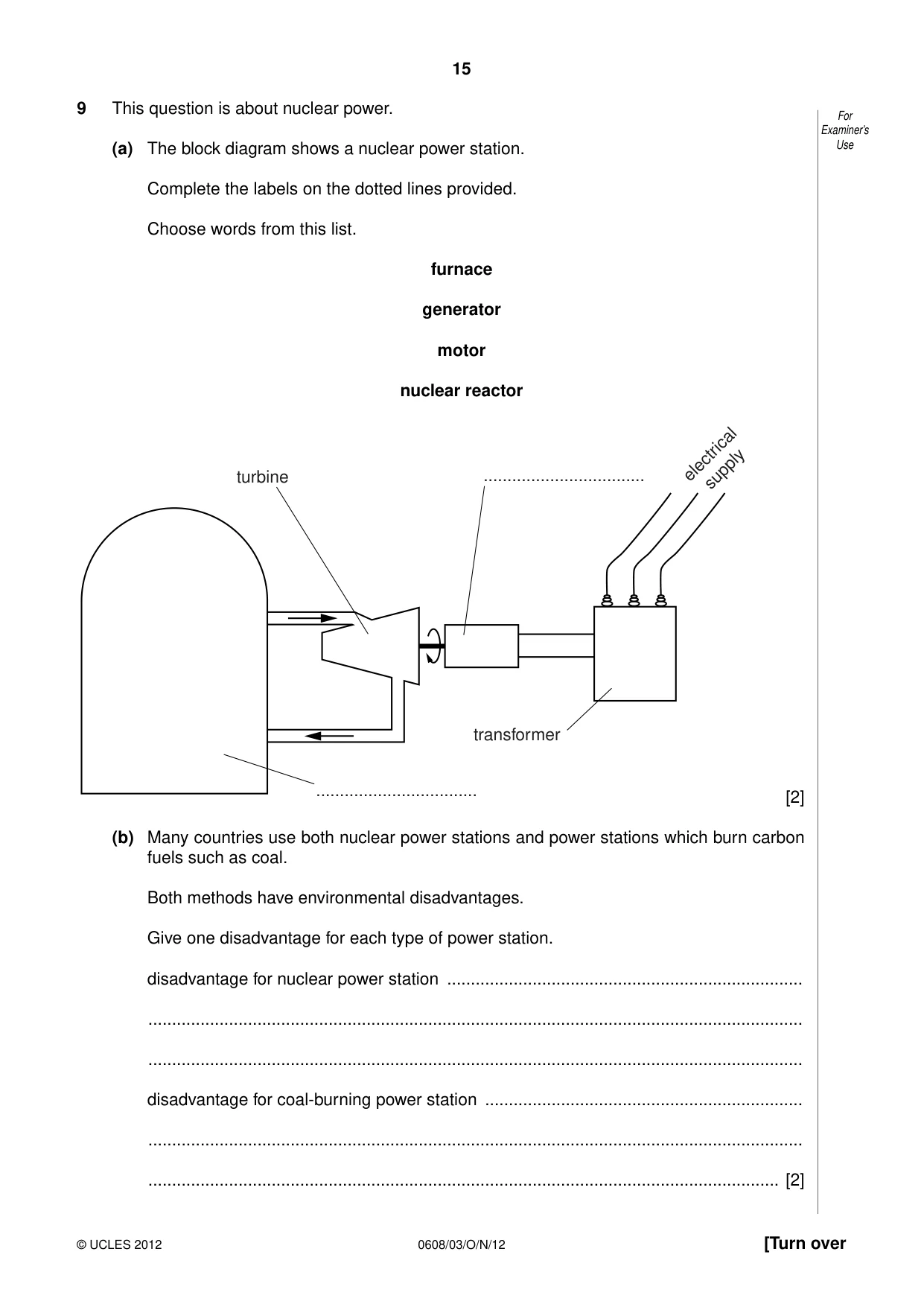
15 0608/03/O/N/12 © UCLES 2012 [Turn over For Examiner’s Use 9 This question is about nuclear power. (a) The block diagram shows a nuclear power station. Complete the labels on the dotted lines provided. Choose words from this list. furnace generator motor nuclear reactor turbine transformer … … electrical supply [2] (b) Many countries use both nuclear power stations and power stations which burn carbon fuels such as coal. Both methods have environmental disadvantages. Give one disadvantage for each type of power station. disadvantage for nuclear power station … … … disadvantage for coal-burning power station … … … [2]
Question paper, page 16
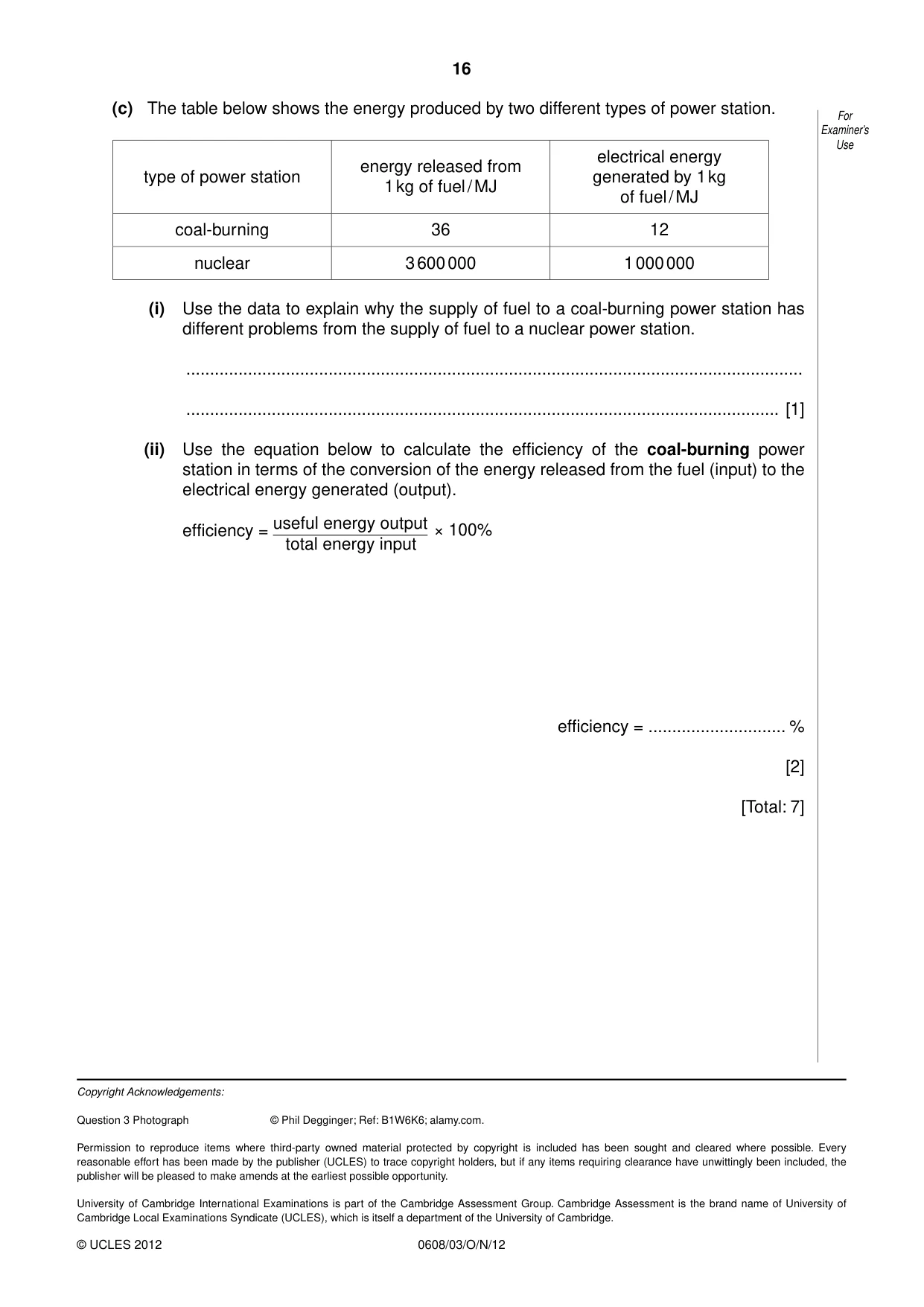
16 0608/03/O/N/12 © UCLES 2012 (c) The table below shows the energy produced by two different types of power station. type of power station energy released from 1 kg of fuel / MJ electrical energy generated by 1 kg of fuel / MJ coal-burning 36 12 nuclear 3 600 000 1 000 000 (i) Use the data to explain why the supply of fuel to a coal-burning power station has different problems from the supply of fuel to a nuclear power station. … … [1] (ii) Use the equation below to calculate the efficiency of the coal-burning power station in terms of the conversion of the energy released from the fuel (input) to the electrical energy generated (output). efficiency = useful energy output total energy input × 100% efficiency = … % [2] [Total: 7] For Examiner’s Use Copyright Acknowledgements: Question 3 Photograph © Phil Degginger; Ref: B1W6K6; alamy.com. Permission to reproduce items where third-party owned material protected by copyright is included has been sought and cleared where possible. Every reasonable effort has been made by the publisher (UCLES) to trace copyright holders, but if any items requiring clearance have unwittingly been included, the publisher will be pleased to make amends at the earliest possible opportunity. University of Cambridge International Examinations is part of the Cambridge Assessment Group. Cambridge Assessment is the brand name of University of Cambridge Local Examinations Syndicate (UCLES), which is itself a department of the University of Cambridge.
Mark scheme, page 1
CAMBRIDGE INTERNATIONAL EXAMINATIONS International General Certificate of Secondary Education MARK SCHEME for the October/November 2012 series 0608 TWENTY FIRST CENTURY SCIENCE 0608/03 Paper 3 (Core Written), maximum raw mark 60 This mark scheme is published as an aid to teachers and candidates, to indicate the requirements of the examination. It shows the basis on which Examiners were instructed to award marks. It does not indicate the details of the discussions that took place at an Examiners’ meeting before marking began, which would have considered the acceptability of alternative answers. Mark schemes should be read in conjunction with the question paper and the Principal Examiner Report for Teachers. Cambridge will not enter into discussions about these mark schemes. Cambridge is publishing the mark schemes for the October/November 2012 series for most IGCSE, GCE Advanced Level and Advanced Subsidiary Level components and some Ordinary Level components. www.XtremePapers.com
Mark scheme, page 2
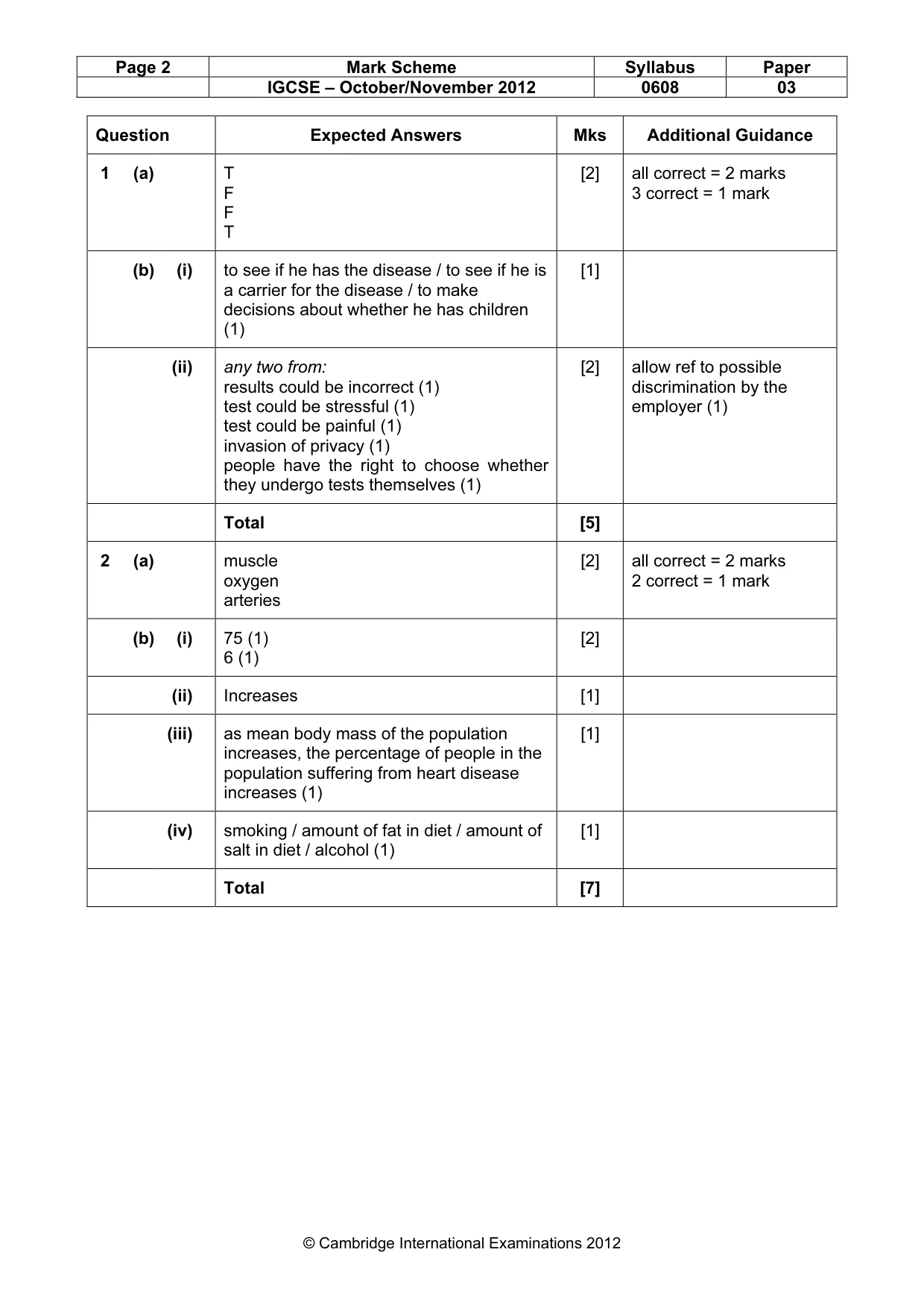
Page 2 Mark Scheme Syllabus Paper IGCSE – October/November 2012 0608 03 © Cambridge International Examinations 2012 Question Expected Answers Mks Additional Guidance 1 (a) T F F T [2] all correct = 2 marks 3 correct = 1 mark (b) (i) to see if he has the disease / to see if he is a carrier for the disease / to make decisions about whether he has children (1) [1] (ii) any two from: results could be incorrect (1) test could be stressful (1) test could be painful (1) invasion of privacy (1) people have the right to choose whether they undergo tests themselves (1) [2] allow ref to possible discrimination by the employer (1) Total [5] 2 (a) muscle oxygen arteries [2] all correct = 2 marks 2 correct = 1 mark (b) (i) 75 (1) 6 (1) [2] (ii) Increases [1] (iii) as mean body mass of the population increases, the percentage of people in the population suffering from heart disease increases (1) [1] (iv) smoking / amount of fat in diet / amount of salt in diet / alcohol (1) [1] Total [7]
Mark scheme, page 3
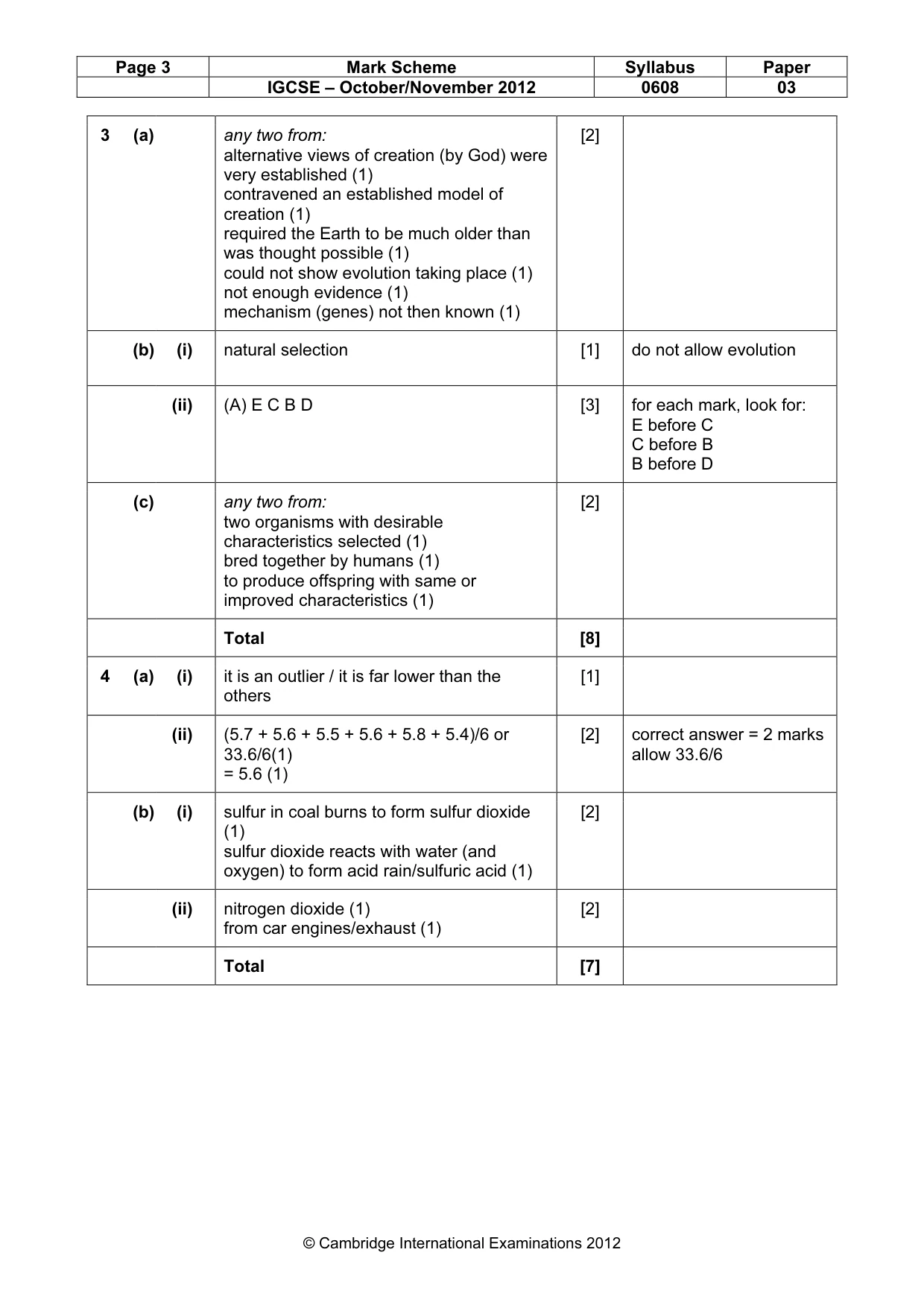
Page 3 Mark Scheme Syllabus Paper IGCSE – October/November 2012 0608 03 © Cambridge International Examinations 2012 3 (a) any two from: alternative views of creation (by God) were very established (1) contravened an established model of creation (1) required the Earth to be much older than was thought possible (1) could not show evolution taking place (1) not enough evidence (1) mechanism (genes) not then known (1) [2] (b) (i) natural selection [1] do not allow evolution (ii) (A) E C B D [3] for each mark, look for: E before C C before B B before D (c) any two from: two organisms with desirable characteristics selected (1) bred together by humans (1) to produce offspring with same or improved characteristics (1) [2] Total [8] 4 (a) (i) it is an outlier / it is far lower than the others [1] (ii) (5.7 + 5.6 + 5.5 + 5.6 + 5.8 + 5.4)/6 or 33.6/6(1) = 5.6 (1) [2] correct answer = 2 marks allow 33.6/6 (b) (i) sulfur in coal burns to form sulfur dioxide (1) sulfur dioxide reacts with water (and oxygen) to form acid rain/sulfuric acid (1) [2] (ii) nitrogen dioxide (1) from car engines/exhaust (1) [2] Total [7]
Mark scheme, page 4
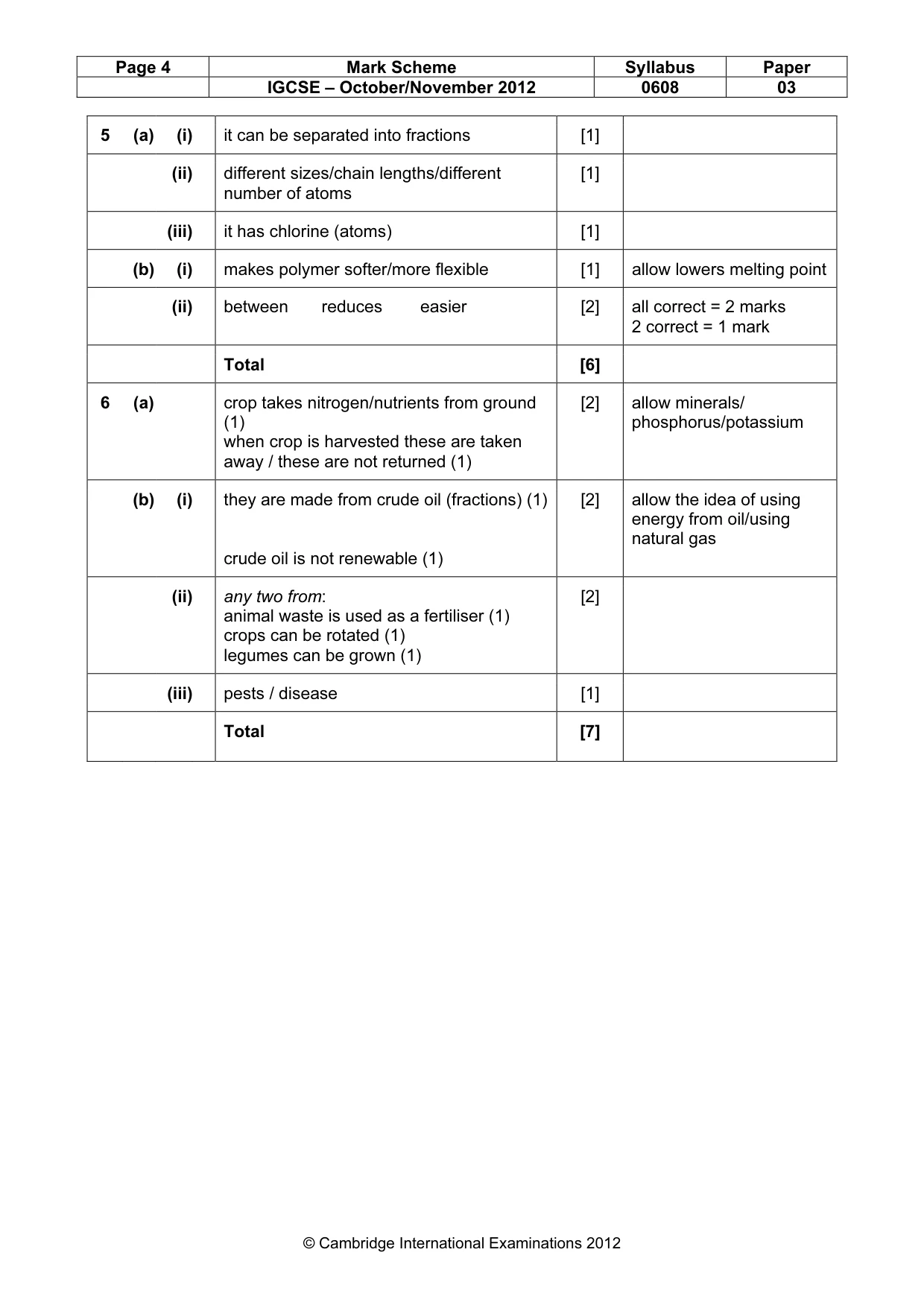
Page 4 Mark Scheme Syllabus Paper IGCSE – October/November 2012 0608 03 © Cambridge International Examinations 2012 5 (a) (i) it can be separated into fractions [1] (ii) different sizes/chain lengths/different number of atoms [1] (iii) it has chlorine (atoms) [1] (b) (i) makes polymer softer/more flexible [1] allow lowers melting point (ii) between reduces easier [2] all correct = 2 marks 2 correct = 1 mark Total [6] 6 (a) crop takes nitrogen/nutrients from ground (1) when crop is harvested these are taken away / these are not returned (1) [2] allow minerals/ phosphorus/potassium (b) (i) they are made from crude oil (fractions) (1) crude oil is not renewable (1) [2] allow the idea of using energy from oil/using natural gas (ii) any two from: animal waste is used as a fertiliser (1) crops can be rotated (1) legumes can be grown (1) [2] (iii) pests / disease [1] Total [7]
Mark scheme, page 5
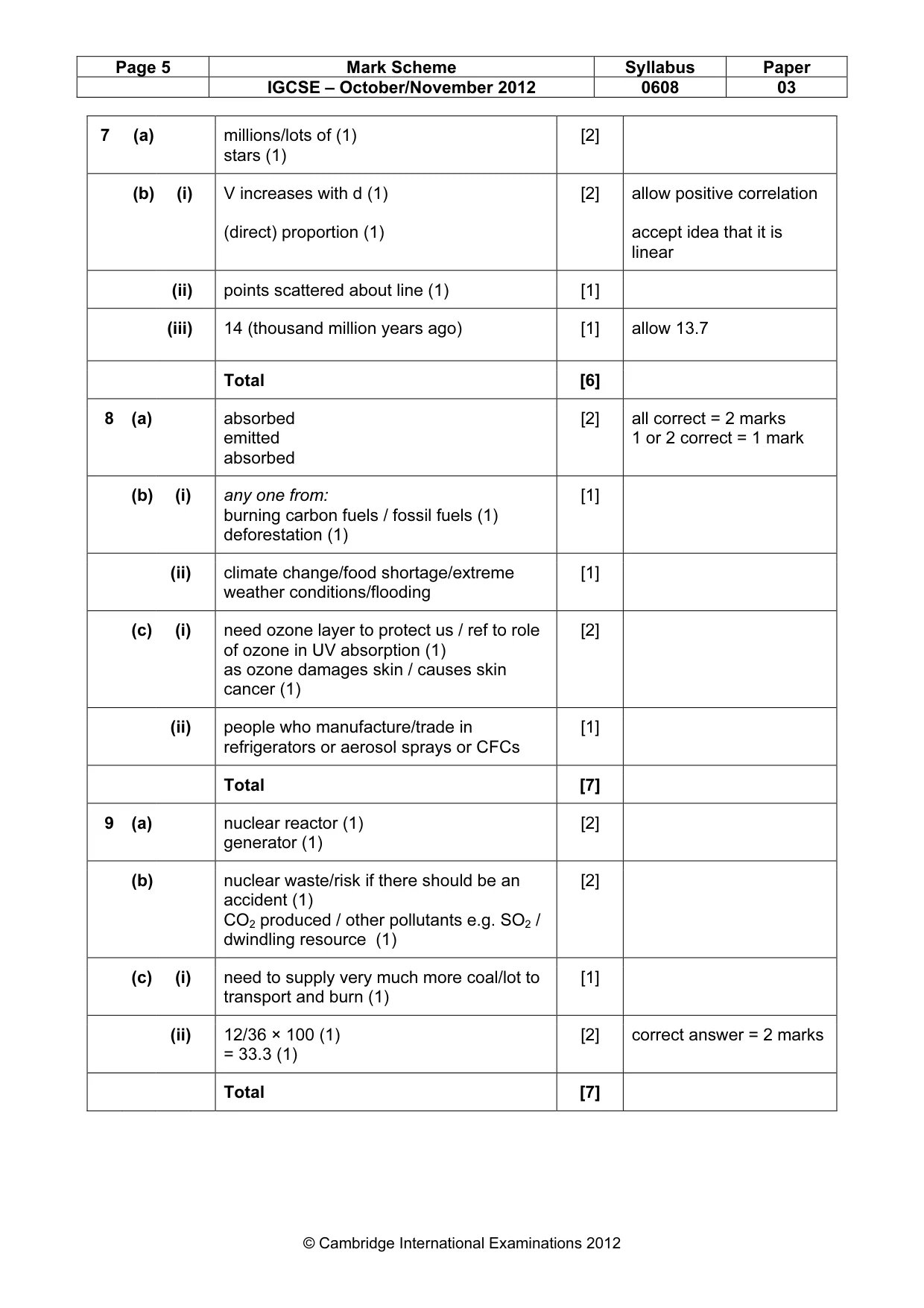
Page 5 Mark Scheme Syllabus Paper IGCSE – October/November 2012 0608 03 © Cambridge International Examinations 2012 7 (a) millions/lots of (1) stars (1) [2] (b) (i) V increases with d (1) (direct) proportion (1) [2] allow positive correlation accept idea that it is linear (ii) points scattered about line (1) [1] (iii) 14 (thousand million years ago) [1] allow 13.7 Total [6] 8 (a) absorbed emitted absorbed [2] all correct = 2 marks 1 or 2 correct = 1 mark (b) (i) any one from: burning carbon fuels / fossil fuels (1) deforestation (1) [1] (ii) climate change/food shortage/extreme weather conditions/flooding [1] (c) (i) need ozone layer to protect us / ref to role of ozone in UV absorption (1) as ozone damages skin / causes skin cancer (1) [2] (ii) people who manufacture/trade in refrigerators or aerosol sprays or CFCs [1] Total [7] 9 (a) nuclear reactor (1) generator (1) [2] (b) nuclear waste/risk if there should be an accident (1) CO2 produced / other pollutants e.g. SO2 / dwindling resource (1) [2] (c) (i) need to supply very much more coal/lot to transport and burn (1) [1] (ii) 12/36 × 100 (1) = 33.3 (1) [2] correct answer = 2 marks Total [7]