Cambridge IGCSE Travel and Tourism 0471 — 2024 May/June Paper 2 · Variant 2
0471/22/M/J/24 · 80 marks · 120 min
The question paper and its mark scheme, free to read here and free to download. This is Cambridge’s own paper, exactly as it was sat.
Question paper12 pages


Mark scheme21 pages
Answers below. Sit the paper first if you are practising.
Paper as text
Question paper, page 1
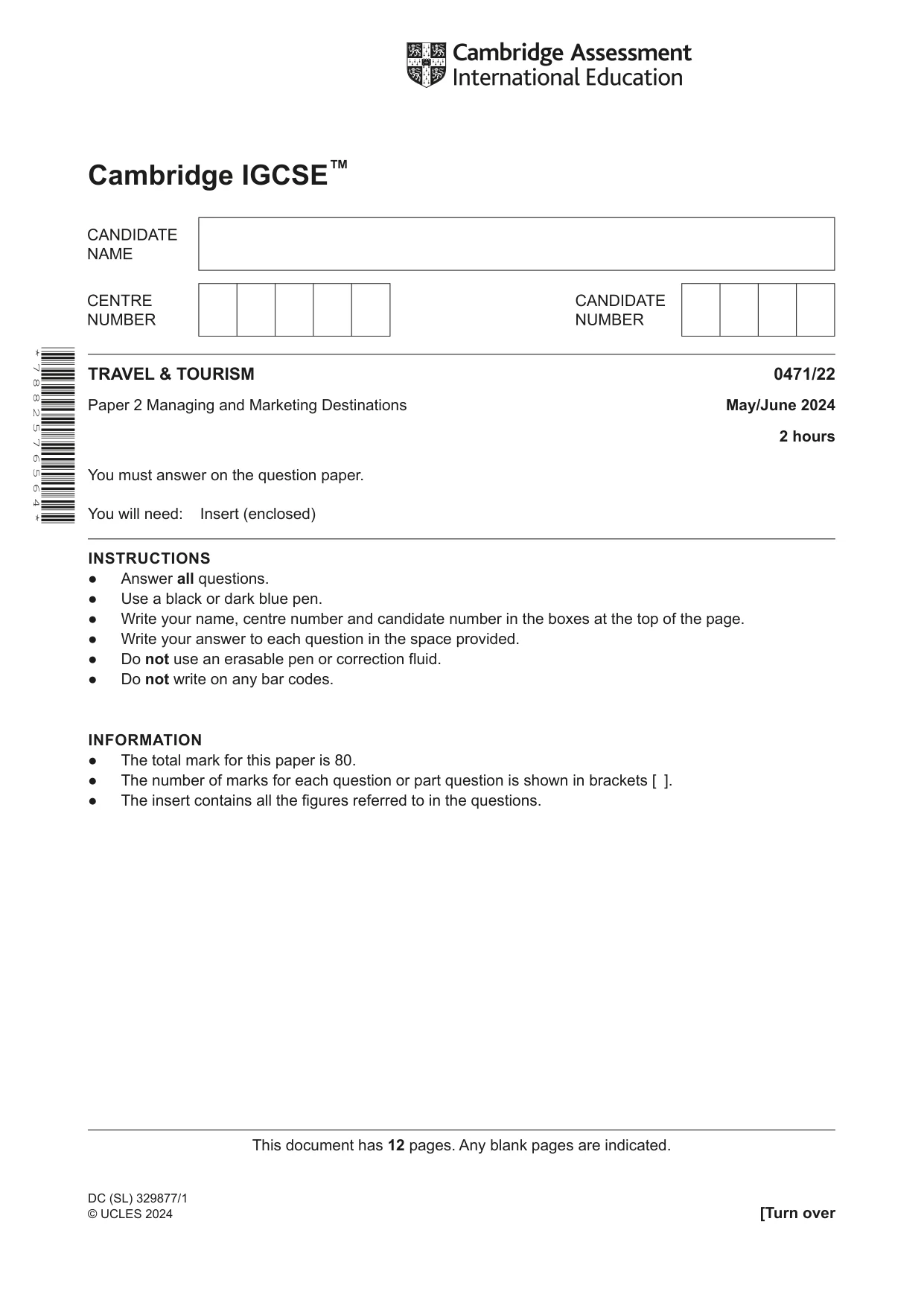
This document has 12 pages. Any blank pages are indicated. [Turn over Cambridge IGCSE™ TRAVEL & TOURISM 0471/22 Paper 2 Managing and Marketing Destinations May/June 2024 2 hours You must answer on the question paper. You will need: Insert (enclosed) INSTRUCTIONS ● Answer all questions. ● Use a black or dark blue pen. ● Write your name, centre number and candidate number in the boxes at the top of the page. ● Write your answer to each question in the space provided. ● Do not use an erasable pen or correction fluid. ● Do not write on any bar codes. INFORMATION ● The total mark for this paper is 80. ● The number of marks for each question or part question is shown in brackets [ ]. ● The insert contains all the figures referred to in the questions. * 7 8 8 2 5 7 6 5 6 4 * DC (SL) 329877/1 © UCLES 2024
Question paper, page 2
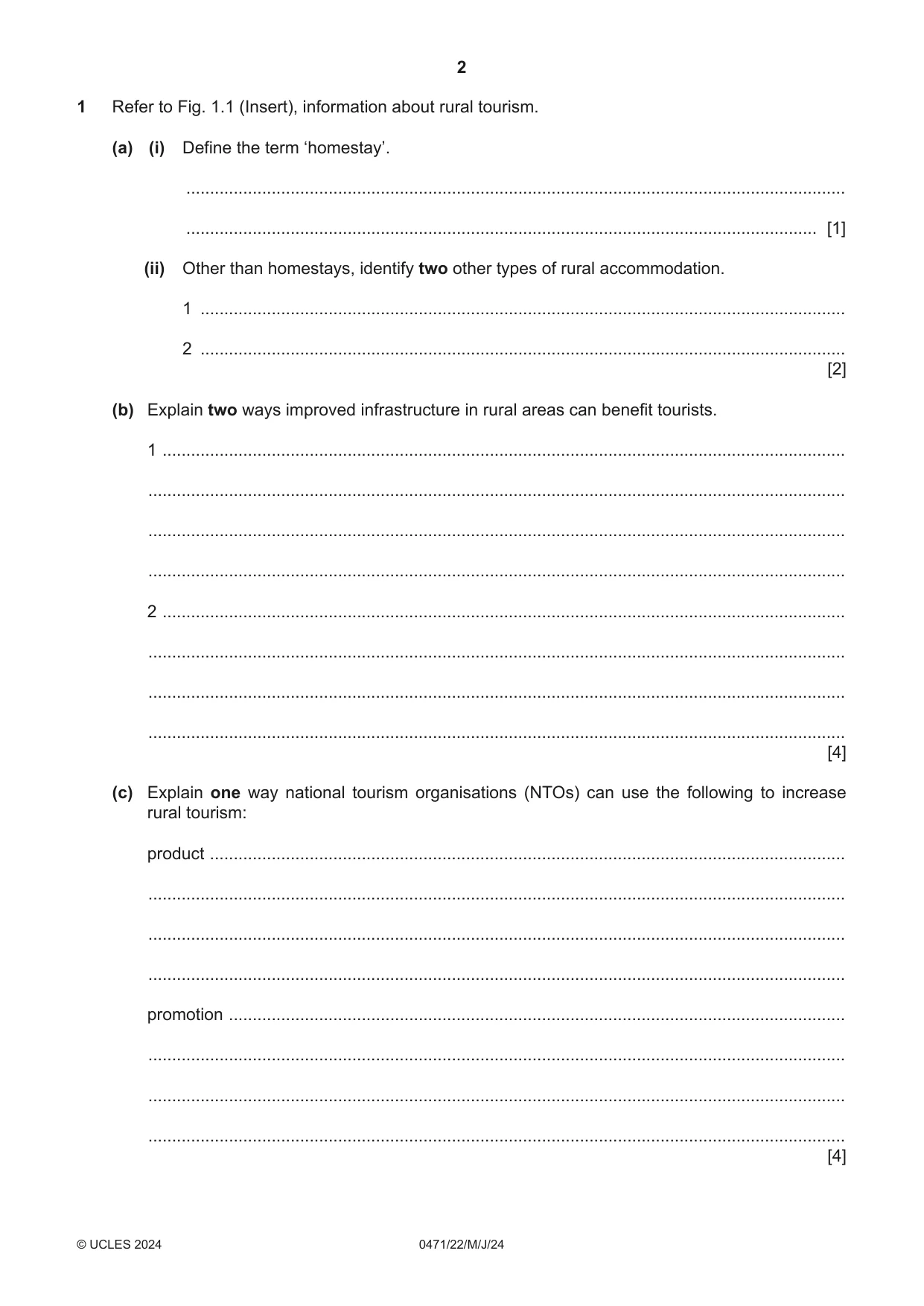
2 0471/22/M/J/24 © UCLES 2024 1 Refer to Fig. 1.1 (Insert), information about rural tourism. (a) (i) Define the term ‘homestay’. … … [1] (ii) Other than homestays, identify two other types of rural accommodation. 1 … 2 … [2] (b) Explain two ways improved infrastructure in rural areas can benefit tourists. 1 … … … … 2 … … … … [4] (c) Explain one way national tourism organisations (NTOs) can use the following to increase rural tourism: product … … … … promotion … … … … [4]
Question paper, page 3
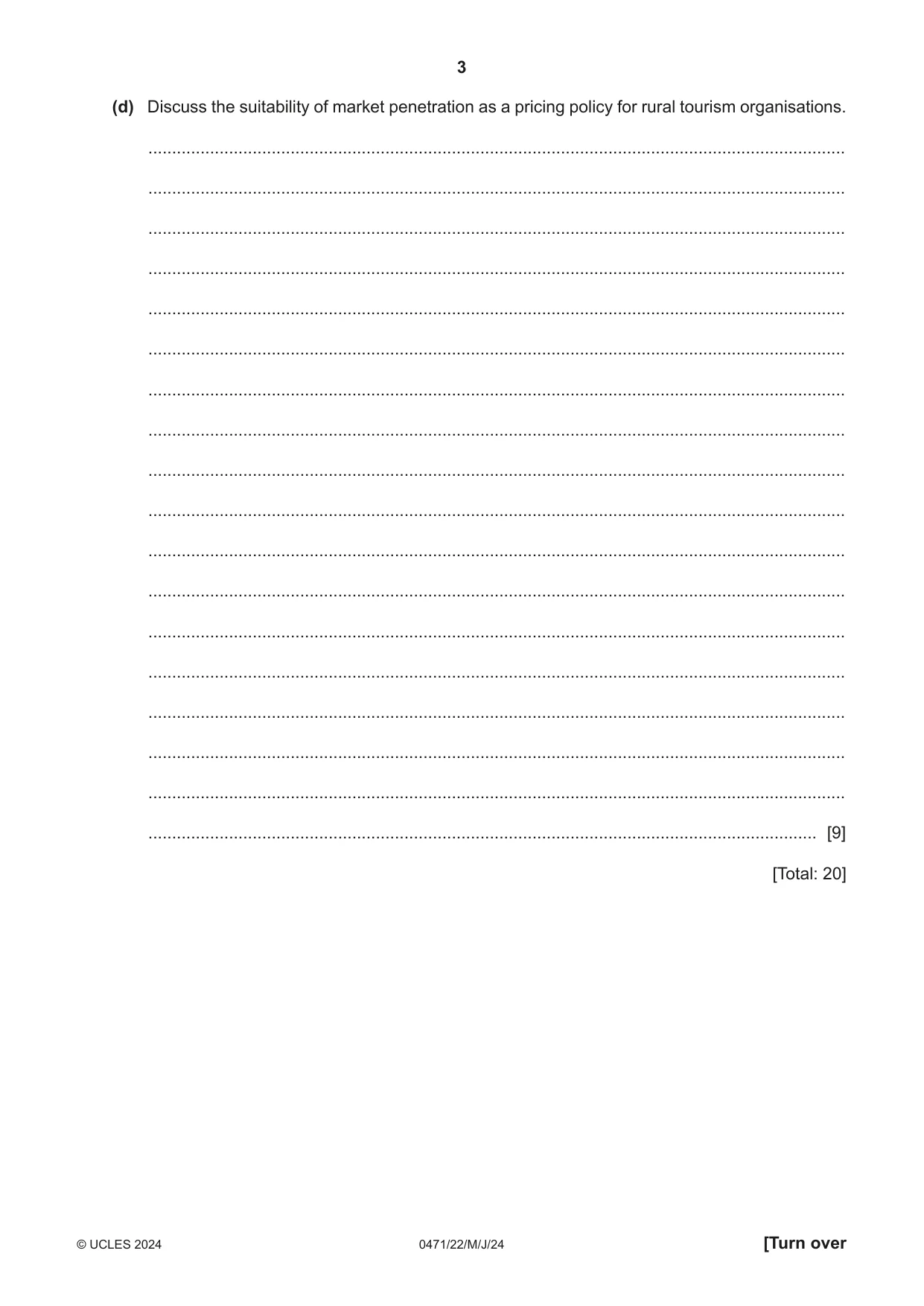
3 0471/22/M/J/24 © UCLES 2024 [Turn over (d) Discuss the suitability of market penetration as a pricing policy for rural tourism organisations. … … … … … … … … … … … … … … … … … … [9] [Total: 20]
Question paper, page 4
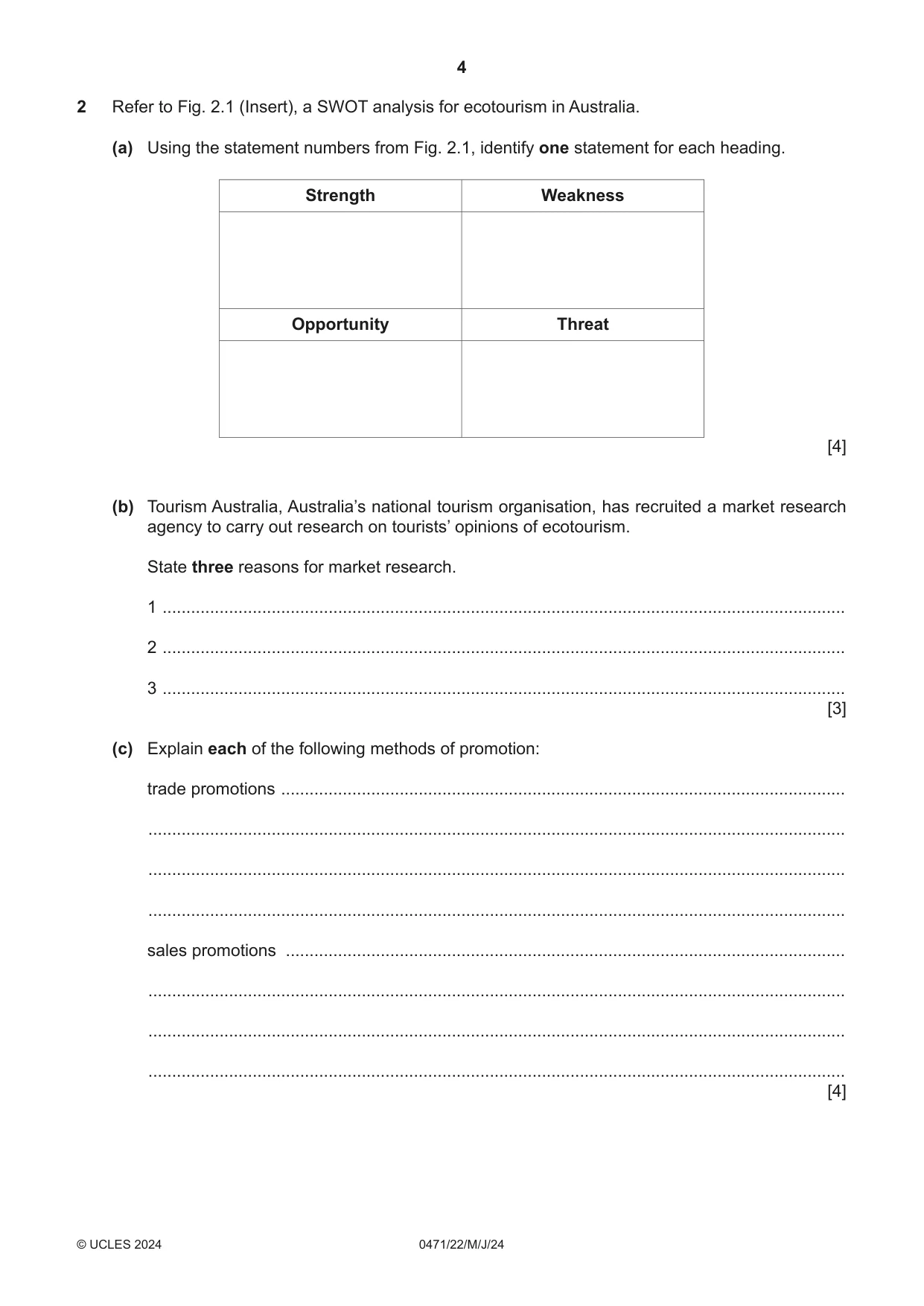
4 0471/22/M/J/24 © UCLES 2024 2 Refer to Fig. 2.1 (Insert), a SWOT analysis for ecotourism in Australia. (a) Using the statement numbers from Fig. 2.1, identify one statement for each heading. Strength Weakness Opportunity Threat [4] (b) Tourism Australia, Australia’s national tourism organisation, has recruited a market research agency to carry out research on tourists’ opinions of ecotourism. State three reasons for market research. 1 … 2 … 3 … [3] (c) Explain each of the following methods of promotion: trade promotions … … … … sales promotions … … … … [4]
Question paper, page 5
5 0471/22/M/J/24 © UCLES 2024 [Turn over (d) Evaluate the ways responsible tourism can help make tourism sustainable. … … … … … … … … … … … … … … … … … … [9] [Total: 20]
Question paper, page 6
6 0471/22/M/J/24 © UCLES 2024 3 Refer to Fig. 3.1 (Insert), an advertisement for the opening of the London Resort. (a) (i) Identify two products available at the London Resort. 1 … 2 … [2] (ii) Identify one service available at the London Resort. … [1] (b) Describe one way each of the following pricing policies is suitable for the London Resort: promotional pricing … … … … price bundling … … … … [4] (c) Explain two reasons why marketing is important for the London Resort. 1 … … … … 2 … … … … [4]
Question paper, page 7
7 0471/22/M/J/24 © UCLES 2024 [Turn over (d) Discuss why social media would be the most suitable type of advertising for a new attraction such as the London Resort. … … … … … … … … … … … … … … … … … … [9] [Total: 20]
Question paper, page 8
8 0471/22/M/J/24 © UCLES 2024 4 Refer to Fig. 4.1 (Insert), an advertisement for Luxury Boat Hire. (a) Identify three target markets for Luxury Boat Hire. 1 … 2 … 3 … [3] (b) Explain two advantages to tourists of having no set itinerary while on holiday. 1 … … … … 2 … … … … [4] (c) Explain two reasons tourism organisations use competitor analysis. 1 … … … … 2 … … … … [4]
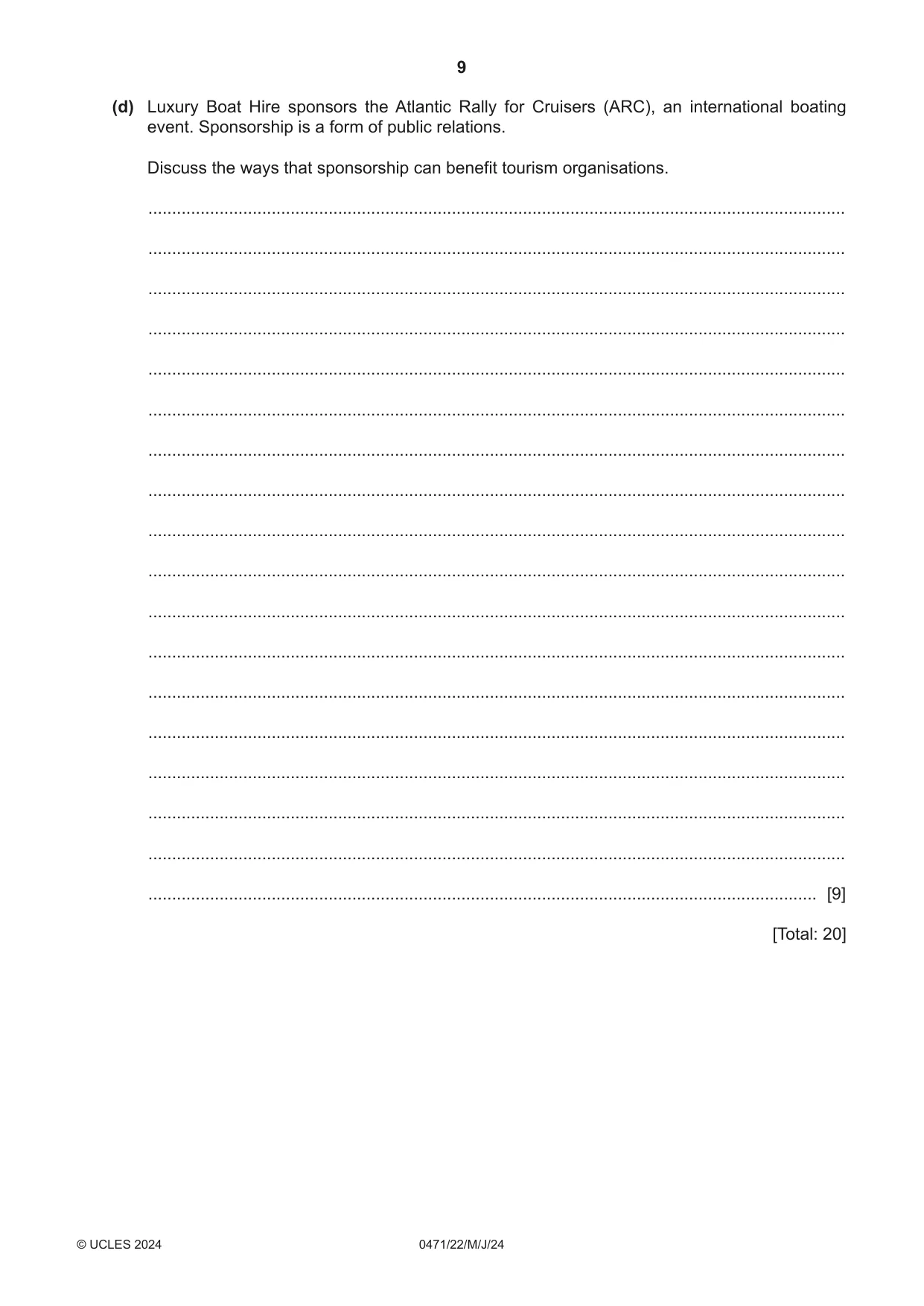
Question paper, page 9
9 0471/22/M/J/24 © UCLES 2024 (d) Luxury Boat Hire sponsors the Atlantic Rally for Cruisers (ARC), an international boating event. Sponsorship is a form of public relations. Discuss the ways that sponsorship can benefit tourism organisations. … … … … … … … … … … … … … … … … … … [9] [Total: 20]
Question paper, page 10
10 0471/22/M/J/24 © UCLES 2024 BLANK PAGE
Question paper, page 11
11 0471/22/M/J/24 © UCLES 2024 BLANK PAGE
Question paper, page 12
12 0471/22/M/J/24 © UCLES 2024 The boundaries and names shown, the designations used and the presentation of material on any maps contained in this question paper/insert do not imply official endorsement or acceptance by Cambridge Assessment International Education concerning the legal status of any country, territory, or area or any of its authorities, or of the delimitation of its frontiers or boundaries. Permission to reproduce items where third-party owned material protected by copyright is included has been sought and cleared where possible. Every reasonable effort has been made by the publisher (UCLES) to trace copyright holders, but if any items requiring clearance have unwittingly been included, the publisher will be pleased to make amends at the earliest possible opportunity. To avoid the issue of disclosure of answer-related information to candidates, all copyright acknowledgements are reproduced online in the Cambridge Assessment International Education Copyright Acknowledgements Booklet. This is produced for each series of examinations and is freely available to download at www.cambridgeinternational.org after the live examination series. Cambridge Assessment International Education is part of Cambridge Assessment. Cambridge Assessment is the brand name of the University of Cambridge Local Examinations Syndicate (UCLES), which is a department of the University of Cambridge. BLANK PAGE
Mark scheme, page 1
This document consists of 21 printed pages. © Cambridge University Press & Assessment 2024 [Turn over Cambridge IGCSE™ TRAVEL & TOURISM 0471/22 Paper 2 Managing and Marketing Destinations May/June 2024 MARK SCHEME Maximum Mark: 100 Published This mark scheme is published as an aid to teachers and candidates, to indicate the requirements of the examination. It shows the basis on which Examiners were instructed to award marks. It does not indicate the details of the discussions that took place at an Examiners’ meeting before marking began, which would have considered the acceptability of alternative answers. Mark schemes should be read in conjunction with the question paper and the Principal Examiner Report for Teachers. Cambridge International will not enter into discussions about these mark schemes. Cambridge International is publishing the mark schemes for the May/June 2024 series for most Cambridge IGCSE, Cambridge International A and AS Level and Cambridge Pre-U components, and some Cambridge O Level components.
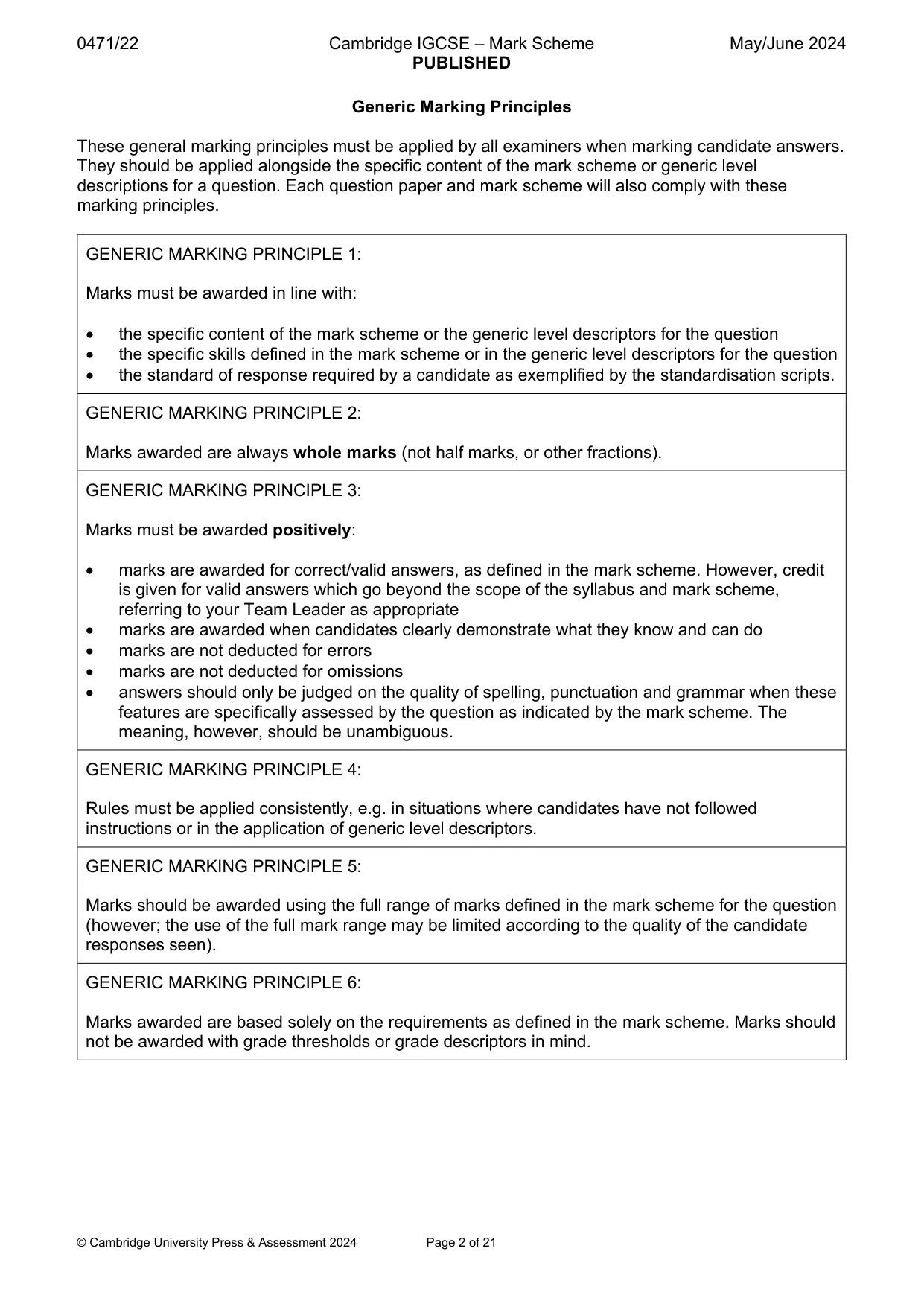
Mark scheme, page 2
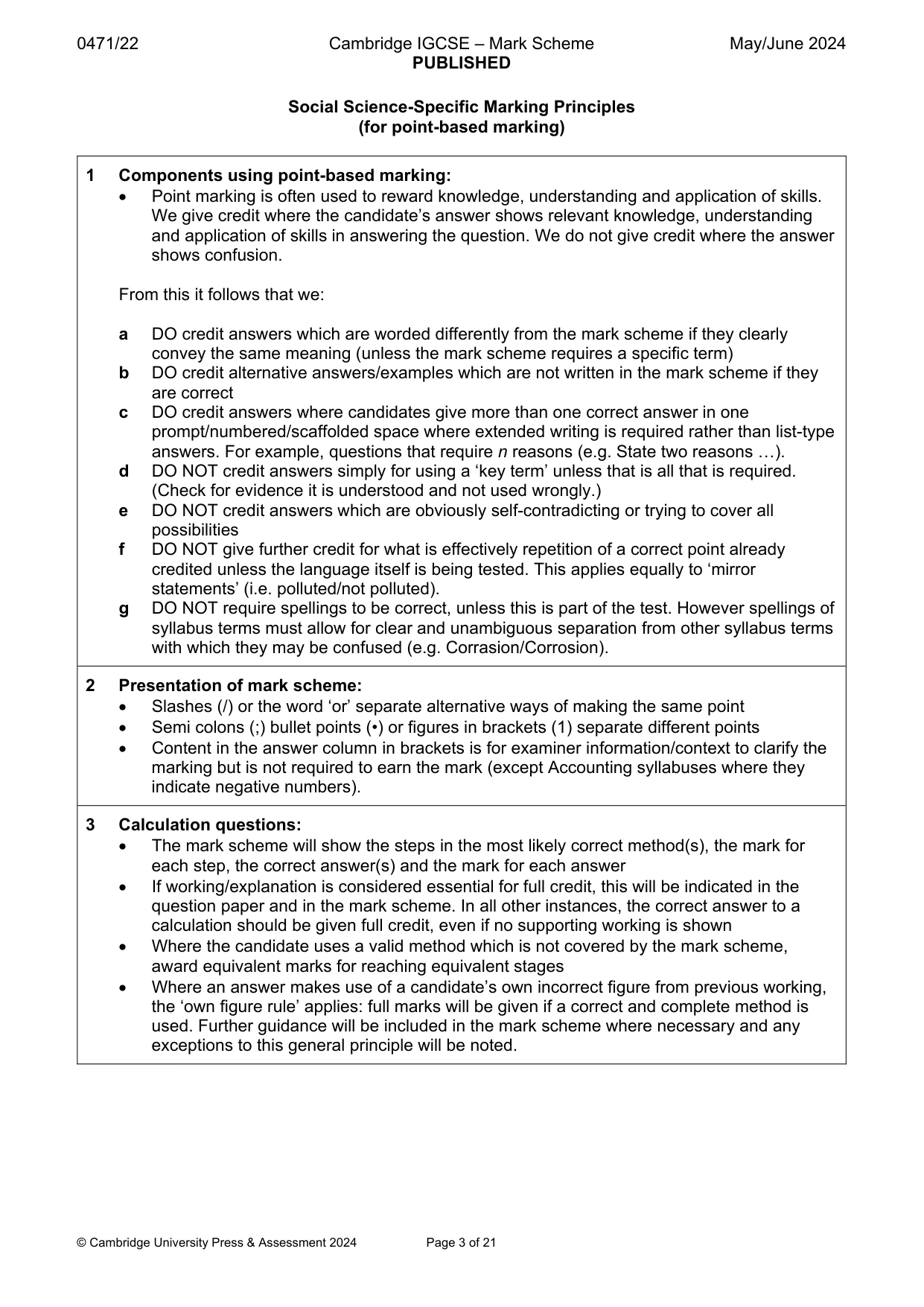
0471/22 Cambridge IGCSE – Mark Scheme PUBLISHED May/June 2024 © Cambridge University Press & Assessment 2024 Page 2 of 21 Generic Marking Principles These general marking principles must be applied by all examiners when marking candidate answers. They should be applied alongside the specific content of the mark scheme or generic level descriptions for a question. Each question paper and mark scheme will also comply with these marking principles. GENERIC MARKING PRINCIPLE 1: Marks must be awarded in line with: the specific content of the mark scheme or the generic level descriptors for the question the specific skills defined in the mark scheme or in the generic level descriptors for the question the standard of response required by a candidate as exemplified by the standardisation scripts. GENERIC MARKING PRINCIPLE 2: Marks awarded are always whole marks (not half marks, or other fractions). GENERIC MARKING PRINCIPLE 3: Marks must be awarded positively: marks are awarded for correct/valid answers, as defined in the mark scheme. However, credit is given for valid answers which go beyond the scope of the syllabus and mark scheme, referring to your Team Leader as appropriate marks are awarded when candidates clearly demonstrate what they know and can do marks are not deducted for errors marks are not deducted for omissions answers should only be judged on the quality of spelling, punctuation and grammar when these features are specifically assessed by the question as indicated by the mark scheme. The meaning, however, should be unambiguous. GENERIC MARKING PRINCIPLE 4: Rules must be applied consistently, e.g. in situations where candidates have not followed instructions or in the application of generic level descriptors. GENERIC MARKING PRINCIPLE 5: Marks should be awarded using the full range of marks defined in the mark scheme for the question (however; the use of the full mark range may be limited according to the quality of the candidate responses seen). GENERIC MARKING PRINCIPLE 6: Marks awarded are based solely on the requirements as defined in the mark scheme. Marks should not be awarded with grade thresholds or grade descriptors in mind.
Mark scheme, page 3
0471/22 Cambridge IGCSE – Mark Scheme PUBLISHED May/June 2024 © Cambridge University Press & Assessment 2024 Page 3 of 21 Social Science-Specific Marking Principles (for point-based marking) 1 Components using point-based marking: Point marking is often used to reward knowledge, understanding and application of skills. We give credit where the candidate’s answer shows relevant knowledge, understanding and application of skills in answering the question. We do not give credit where the answer shows confusion. From this it follows that we: a DO credit answers which are worded differently from the mark scheme if they clearly convey the same meaning (unless the mark scheme requires a specific term) b DO credit alternative answers/examples which are not written in the mark scheme if they are correct c DO credit answers where candidates give more than one correct answer in one prompt/numbered/scaffolded space where extended writing is required rather than list-type answers. For example, questions that require n reasons (e.g. State two reasons …). d DO NOT credit answers simply for using a ‘key term’ unless that is all that is required. (Check for evidence it is understood and not used wrongly.) e DO NOT credit answers which are obviously self-contradicting or trying to cover all possibilities f DO NOT give further credit for what is effectively repetition of a correct point already credited unless the language itself is being tested. This applies equally to ‘mirror statements’ (i.e. polluted/not polluted). g DO NOT require spellings to be correct, unless this is part of the test. However spellings of syllabus terms must allow for clear and unambiguous separation from other syllabus terms with which they may be confused (e.g. Corrasion/Corrosion). 2 Presentation of mark scheme: Slashes (/) or the word ‘or’ separate alternative ways of making the same point Semi colons (;) bullet points (•) or figures in brackets (1) separate different points Content in the answer column in brackets is for examiner information/context to clarify the marking but is not required to earn the mark (except Accounting syllabuses where they indicate negative numbers). 3 Calculation questions: The mark scheme will show the steps in the most likely correct method(s), the mark for each step, the correct answer(s) and the mark for each answer If working/explanation is considered essential for full credit, this will be indicated in the question paper and in the mark scheme. In all other instances, the correct answer to a calculation should be given full credit, even if no supporting working is shown Where the candidate uses a valid method which is not covered by the mark scheme, award equivalent marks for reaching equivalent stages Where an answer makes use of a candidate’s own incorrect figure from previous working, the ‘own figure rule’ applies: full marks will be given if a correct and complete method is used. Further guidance will be included in the mark scheme where necessary and any exceptions to this general principle will be noted.
Mark scheme, page 4
0471/22 Cambridge IGCSE – Mark Scheme PUBLISHED May/June 2024 © Cambridge University Press & Assessment 2024 Page 4 of 21 4 Annotation: For point marking, ticks can be used to indicate correct answers and crosses can be used to indicate wrong answers. There is no direct relationship between ticks and marks. Ticks have no defined meaning for levels of response marking For levels of response marking, the level awarded should be annotated on the script Other annotations will be used by examiners as agreed during standardisation, and the meaning will be understood by all examiners who marked that paper.
Mark scheme, page 5
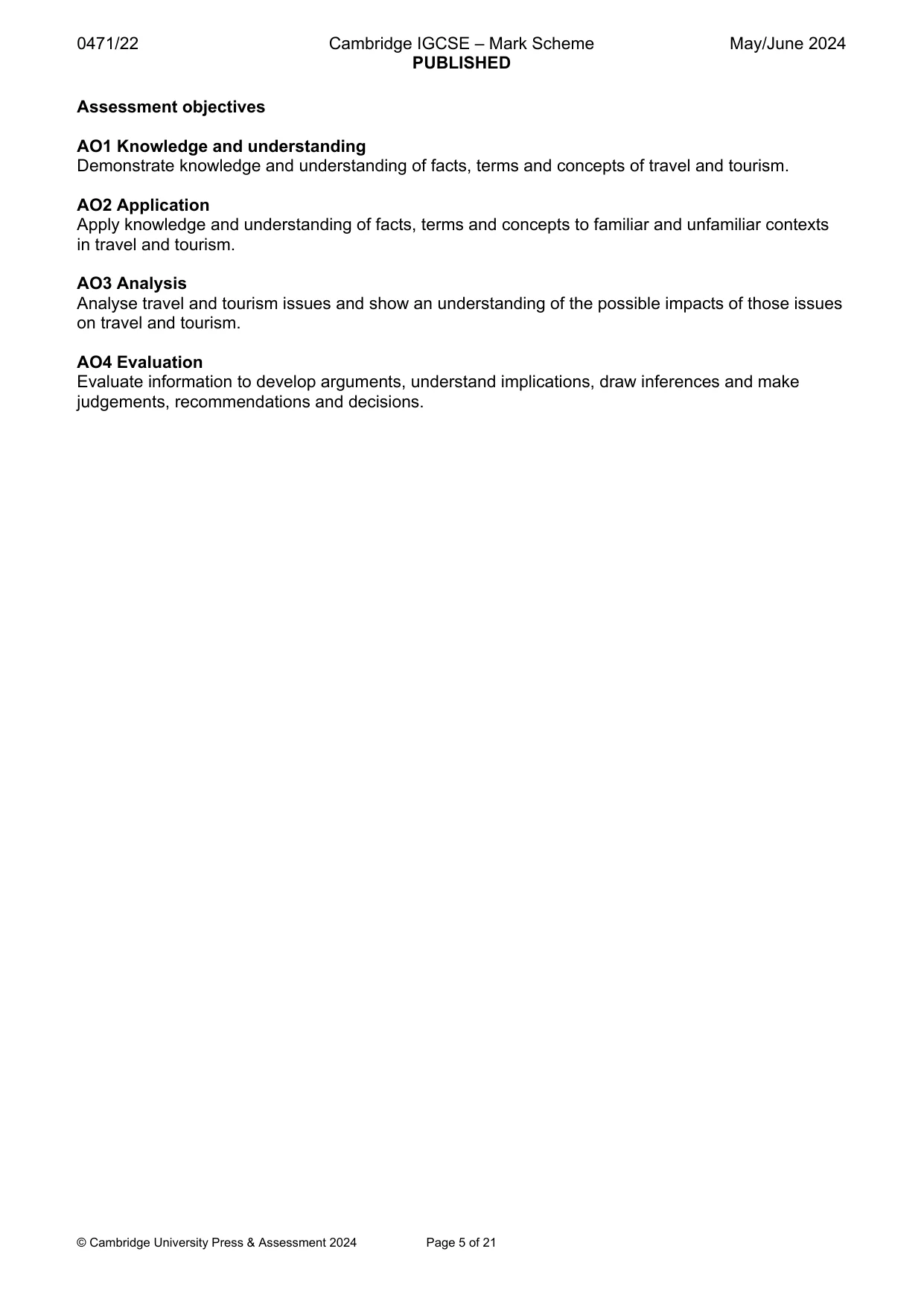
0471/22 Cambridge IGCSE – Mark Scheme PUBLISHED May/June 2024 © Cambridge University Press & Assessment 2024 Page 5 of 21 Assessment objectives AO1 Knowledge and understanding Demonstrate knowledge and understanding of facts, terms and concepts of travel and tourism. AO2 Application Apply knowledge and understanding of facts, terms and concepts to familiar and unfamiliar contexts in travel and tourism. AO3 Analysis Analyse travel and tourism issues and show an understanding of the possible impacts of those issues on travel and tourism. AO4 Evaluation Evaluate information to develop arguments, understand implications, draw inferences and make judgements, recommendations and decisions.
Mark scheme, page 6
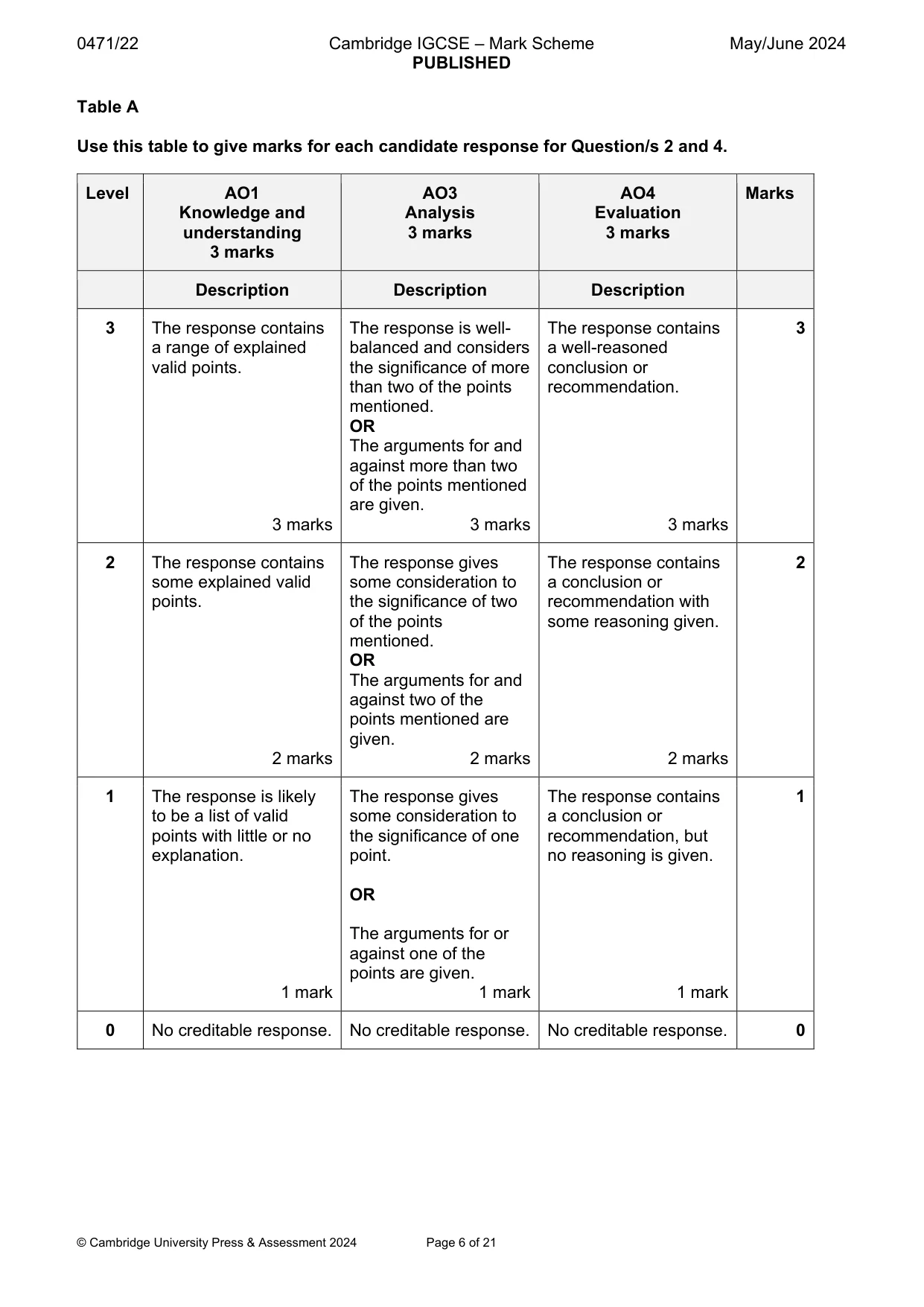
0471/22 Cambridge IGCSE – Mark Scheme PUBLISHED May/June 2024 © Cambridge University Press & Assessment 2024 Page 6 of 21 Table A Use this table to give marks for each candidate response for Question/s 2 and 4. Level AO1 Knowledge and understanding 3 marks AO3 Analysis 3 marks AO4 Evaluation 3 marks Marks Description Description Description 3 The response contains a range of explained valid points. 3 marks The response is well- balanced and considers the significance of more than two of the points mentioned. OR The arguments for and against more than two of the points mentioned are given. 3 marks The response contains a well-reasoned conclusion or recommendation. 3 marks 3 2 The response contains some explained valid points. 2 marks The response gives some consideration to the significance of two of the points mentioned. OR The arguments for and against two of the points mentioned are given. 2 marks The response contains a conclusion or recommendation with some reasoning given. 2 marks 2 1 The response is likely to be a list of valid points with little or no explanation. 1 mark The response gives some consideration to the significance of one point. OR The arguments for or against one of the points are given. 1 mark The response contains a conclusion or recommendation, but no reasoning is given. 1 mark 1 0 No creditable response. No creditable response. No creditable response. 0
Mark scheme, page 7
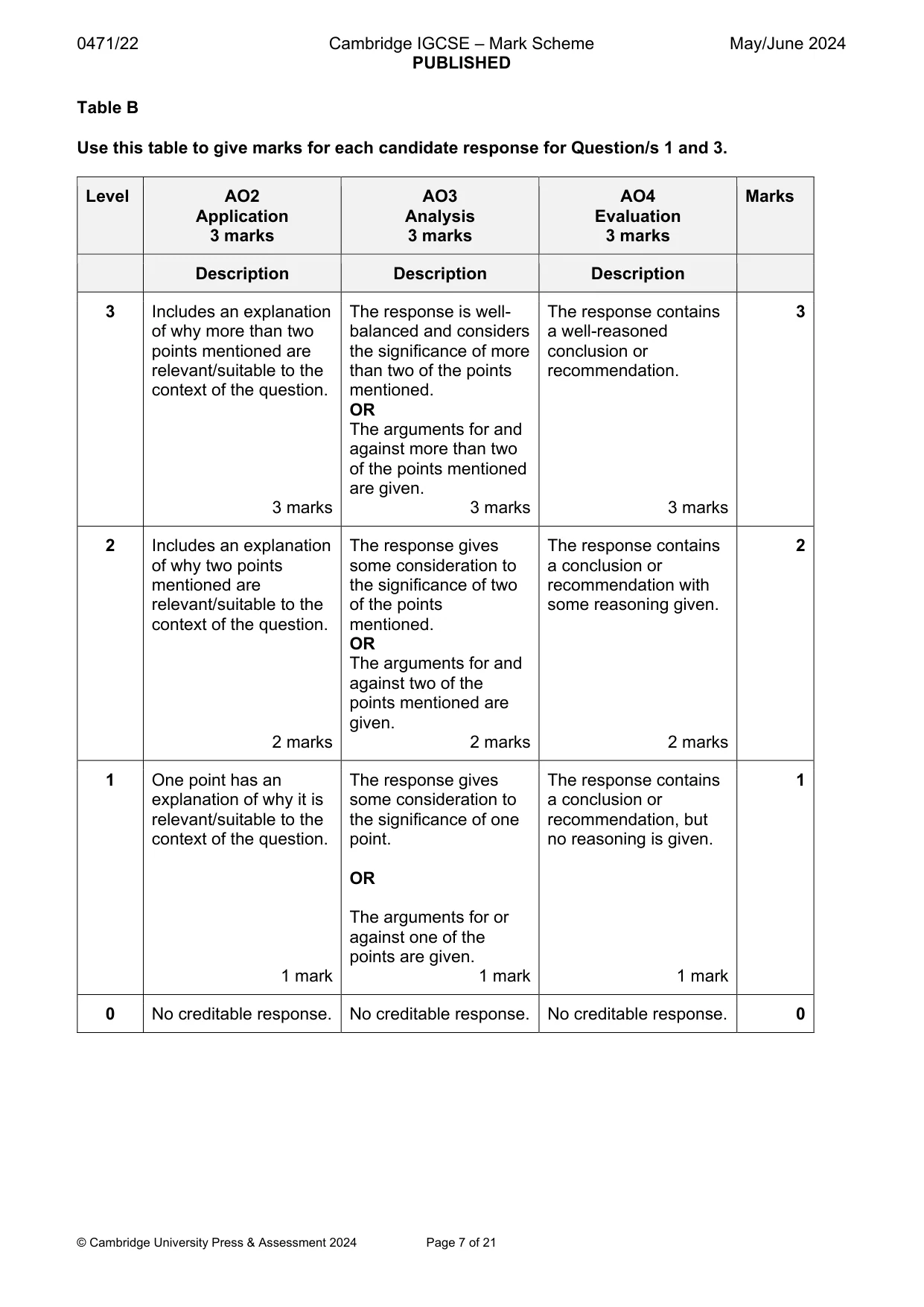
0471/22 Cambridge IGCSE – Mark Scheme PUBLISHED May/June 2024 © Cambridge University Press & Assessment 2024 Page 7 of 21 Table B Use this table to give marks for each candidate response for Question/s 1 and 3. Level AO2 Application 3 marks AO3 Analysis 3 marks AO4 Evaluation 3 marks Marks Description Description Description 3 Includes an explanation of why more than two points mentioned are relevant/suitable to the context of the question. 3 marks The response is well- balanced and considers the significance of more than two of the points mentioned. OR The arguments for and against more than two of the points mentioned are given. 3 marks The response contains a well-reasoned conclusion or recommendation. 3 marks 3 2 Includes an explanation of why two points mentioned are relevant/suitable to the context of the question. 2 marks The response gives some consideration to the significance of two of the points mentioned. OR The arguments for and against two of the points mentioned are given. 2 marks The response contains a conclusion or recommendation with some reasoning given. 2 marks 2 1 One point has an explanation of why it is relevant/suitable to the context of the question. 1 mark The response gives some consideration to the significance of one point. OR The arguments for or against one of the points are given. 1 mark The response contains a conclusion or recommendation, but no reasoning is given. 1 mark 1 0 No creditable response. No creditable response. No creditable response. 0
Mark scheme, page 8
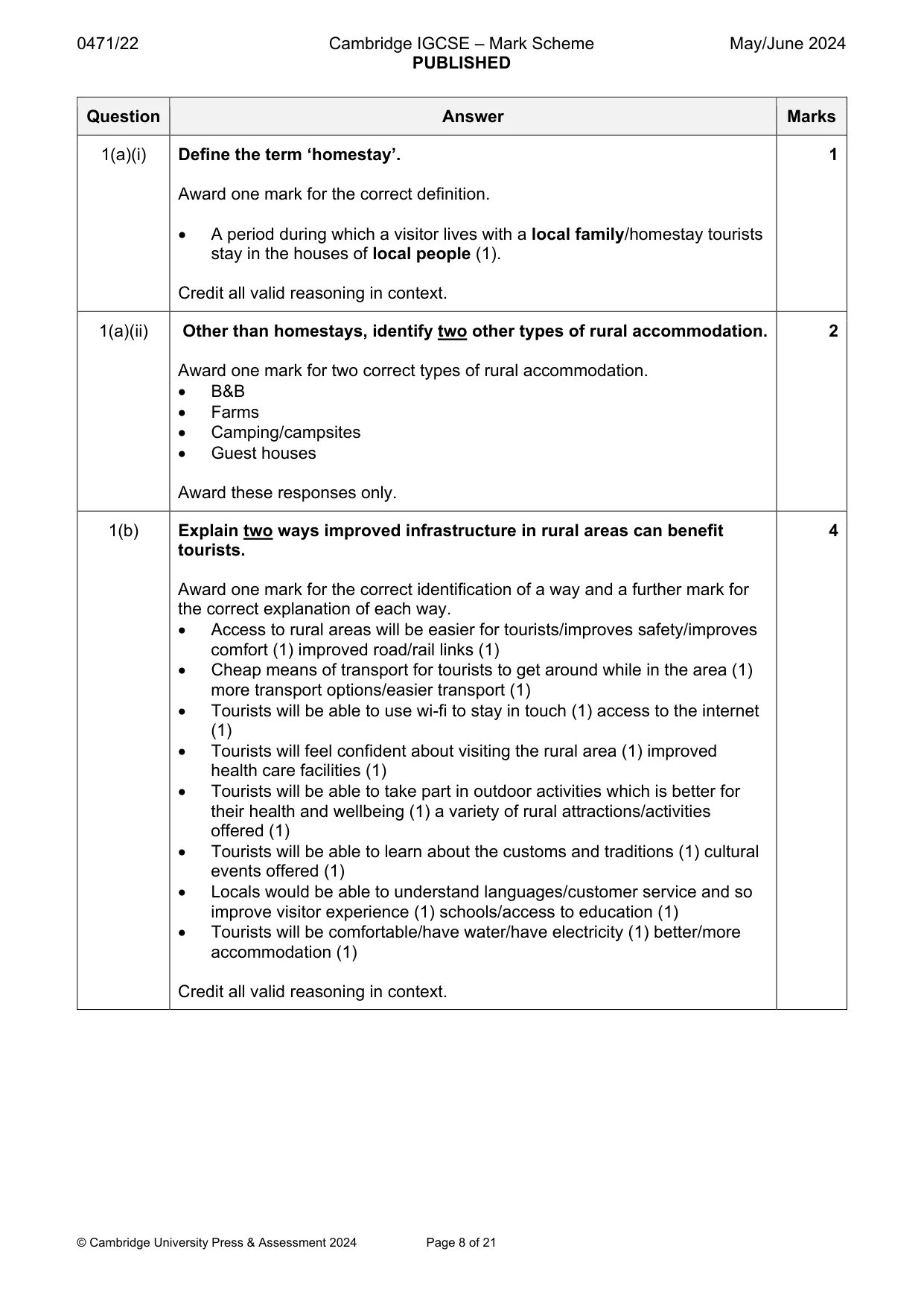
0471/22 Cambridge IGCSE – Mark Scheme PUBLISHED May/June 2024 © Cambridge University Press & Assessment 2024 Page 8 of 21 Question Answer Marks 1(a)(i) Define the term ‘homestay’. Award one mark for the correct definition. A period during which a visitor lives with a local family/homestay tourists stay in the houses of local people (1). Credit all valid reasoning in context. 1 1(a)(ii) Other than homestays, identify two other types of rural accommodation. Award one mark for two correct types of rural accommodation. B&B Farms Camping/campsites Guest houses Award these responses only. 2 1(b) Explain two ways improved infrastructure in rural areas can benefit tourists. Award one mark for the correct identification of a way and a further mark for the correct explanation of each way. Access to rural areas will be easier for tourists/improves safety/improves comfort (1) improved road/rail links (1) Cheap means of transport for tourists to get around while in the area (1) more transport options/easier transport (1) Tourists will be able to use wi-fi to stay in touch (1) access to the internet (1) Tourists will feel confident about visiting the rural area (1) improved health care facilities (1) Tourists will be able to take part in outdoor activities which is better for their health and wellbeing (1) a variety of rural attractions/activities offered (1) Tourists will be able to learn about the customs and traditions (1) cultural events offered (1) Locals would be able to understand languages/customer service and so improve visitor experience (1) schools/access to education (1) Tourists will be comfortable/have water/have electricity (1) better/more accommodation (1) Credit all valid reasoning in context. 4
Mark scheme, page 9
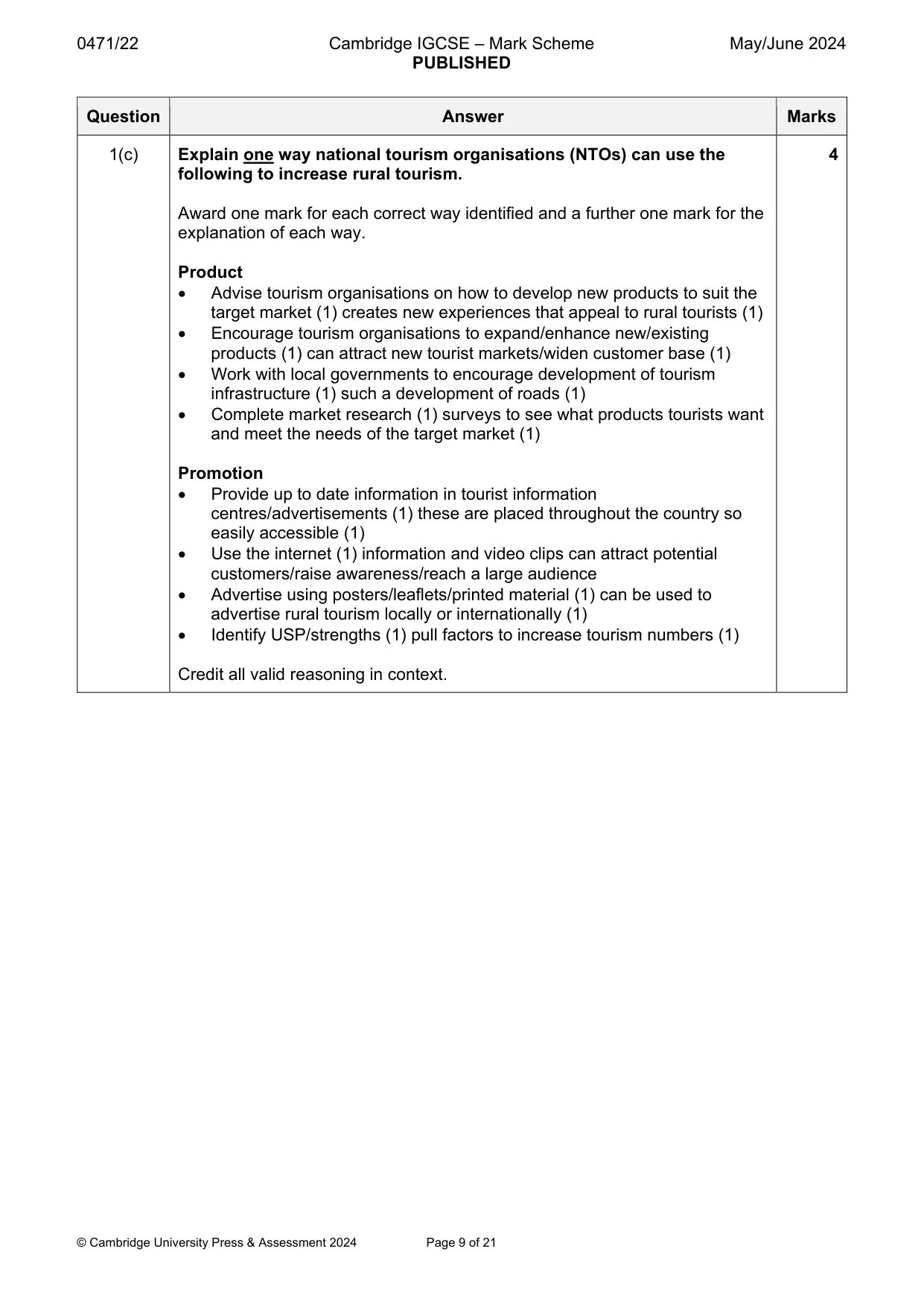
0471/22 Cambridge IGCSE – Mark Scheme PUBLISHED May/June 2024 © Cambridge University Press & Assessment 2024 Page 9 of 21 Question Answer Marks 1(c) Explain one way national tourism organisations (NTOs) can use the following to increase rural tourism. Award one mark for each correct way identified and a further one mark for the explanation of each way. Product Advise tourism organisations on how to develop new products to suit the target market (1) creates new experiences that appeal to rural tourists (1) Encourage tourism organisations to expand/enhance new/existing products (1) can attract new tourist markets/widen customer base (1) Work with local governments to encourage development of tourism infrastructure (1) such a development of roads (1) Complete market research (1) surveys to see what products tourists want and meet the needs of the target market (1) Promotion Provide up to date information in tourist information centres/advertisements (1) these are placed throughout the country so easily accessible (1) Use the internet (1) information and video clips can attract potential customers/raise awareness/reach a large audience Advertise using posters/leaflets/printed material (1) can be used to advertise rural tourism locally or internationally (1) Identify USP/strengths (1) pull factors to increase tourism numbers (1) Credit all valid reasoning in context. 4
Mark scheme, page 10
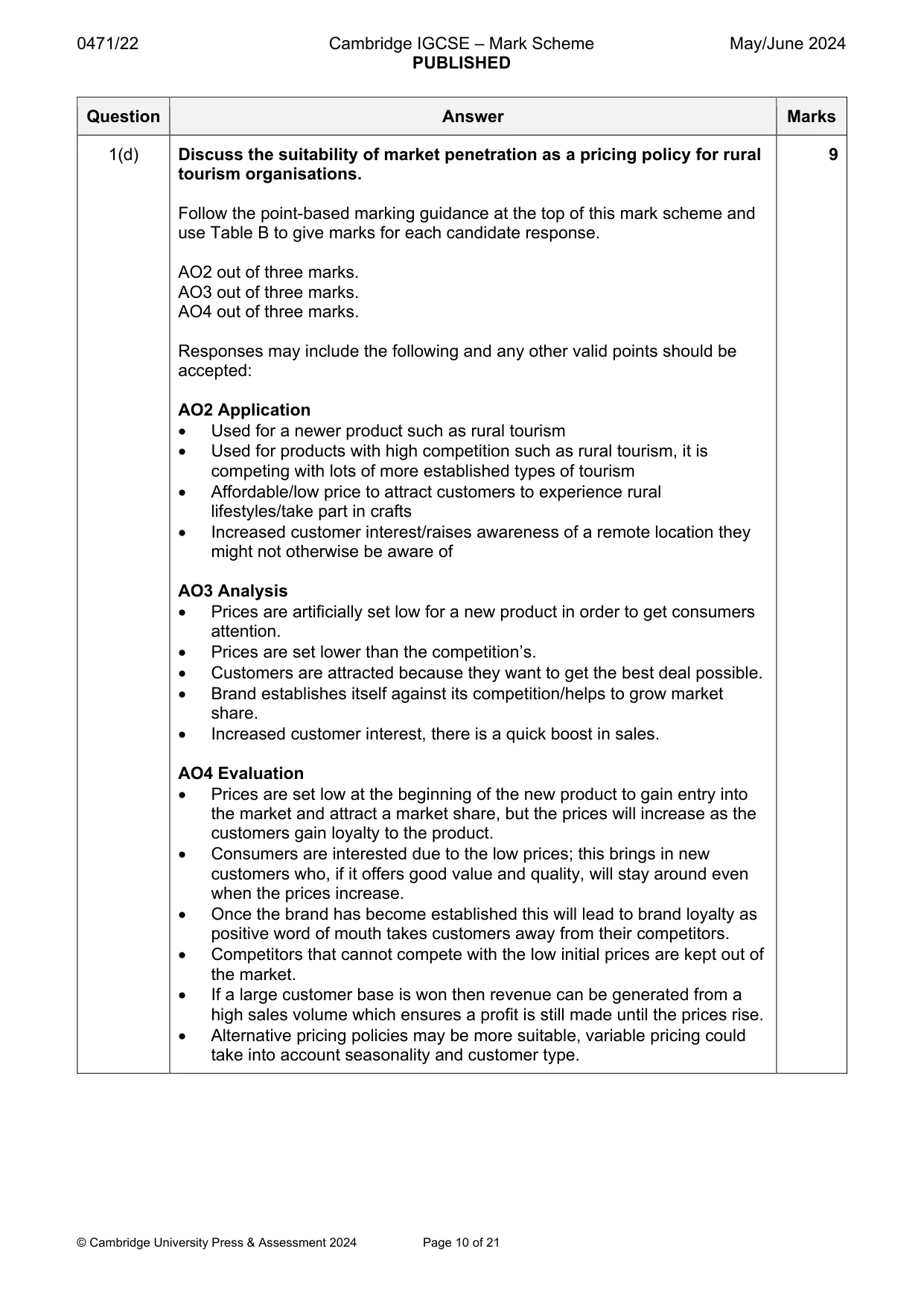
0471/22 Cambridge IGCSE – Mark Scheme PUBLISHED May/June 2024 © Cambridge University Press & Assessment 2024 Page 10 of 21 Question Answer Marks 1(d) Discuss the suitability of market penetration as a pricing policy for rural tourism organisations. Follow the point-based marking guidance at the top of this mark scheme and use Table B to give marks for each candidate response. AO2 out of three marks. AO3 out of three marks. AO4 out of three marks. Responses may include the following and any other valid points should be accepted: AO2 Application Used for a newer product such as rural tourism Used for products with high competition such as rural tourism, it is competing with lots of more established types of tourism Affordable/low price to attract customers to experience rural lifestyles/take part in crafts Increased customer interest/raises awareness of a remote location they might not otherwise be aware of AO3 Analysis Prices are artificially set low for a new product in order to get consumers attention. Prices are set lower than the competition’s. Customers are attracted because they want to get the best deal possible. Brand establishes itself against its competition/helps to grow market share. Increased customer interest, there is a quick boost in sales. AO4 Evaluation Prices are set low at the beginning of the new product to gain entry into the market and attract a market share, but the prices will increase as the customers gain loyalty to the product. Consumers are interested due to the low prices; this brings in new customers who, if it offers good value and quality, will stay around even when the prices increase. Once the brand has become established this will lead to brand loyalty as positive word of mouth takes customers away from their competitors. Competitors that cannot compete with the low initial prices are kept out of the market. If a large customer base is won then revenue can be generated from a high sales volume which ensures a profit is still made until the prices rise. Alternative pricing policies may be more suitable, variable pricing could take into account seasonality and customer type. 9
Mark scheme, page 11
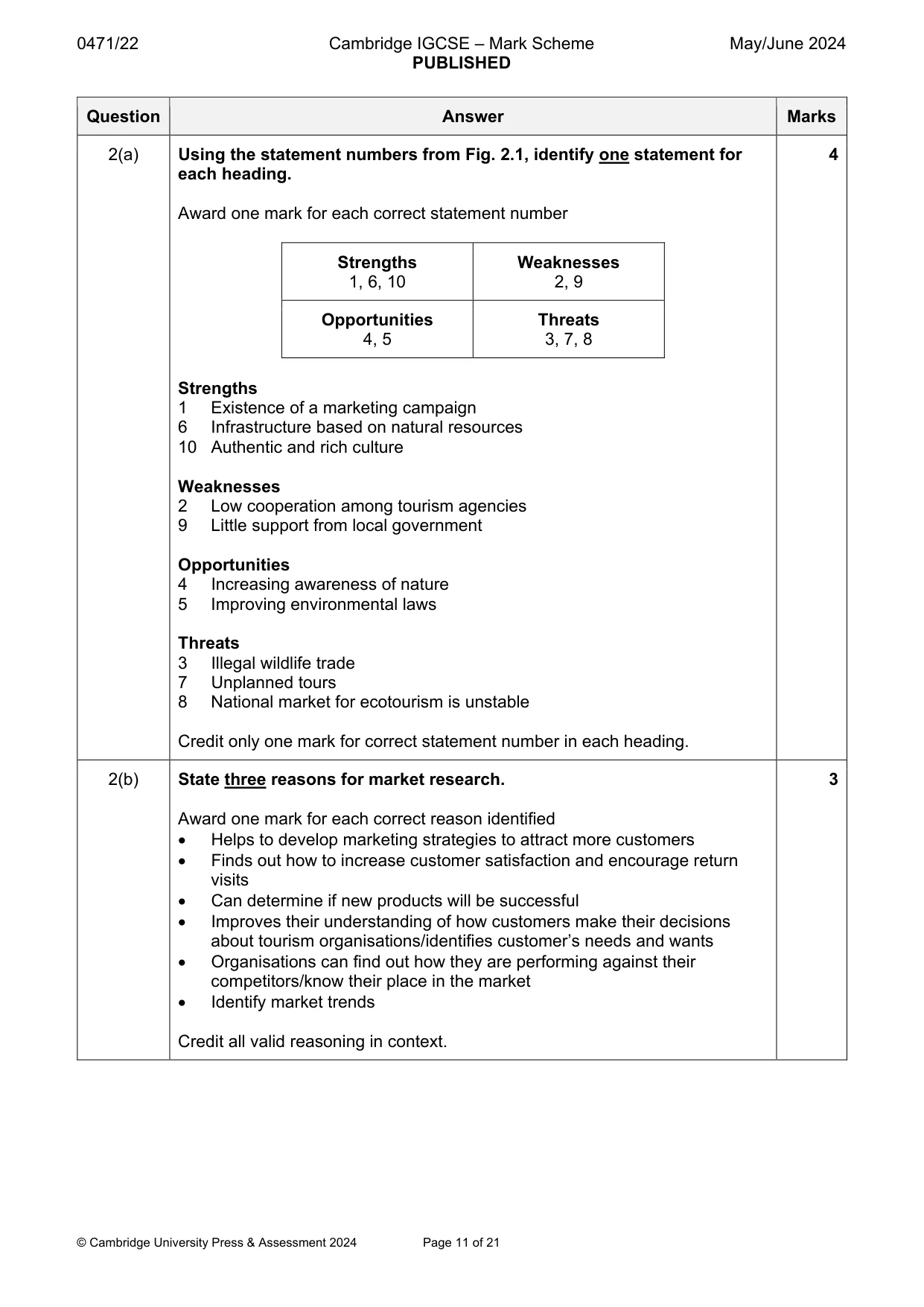
0471/22 Cambridge IGCSE – Mark Scheme PUBLISHED May/June 2024 © Cambridge University Press & Assessment 2024 Page 11 of 21 Question Answer Marks 2(a) Using the statement numbers from Fig. 2.1, identify one statement for each heading. Award one mark for each correct statement number Strengths 1, 6, 10 Weaknesses 2, 9 Opportunities 4, 5 Threats 3, 7, 8 Strengths 1 Existence of a marketing campaign 6 Infrastructure based on natural resources 10 Authentic and rich culture Weaknesses 2 Low cooperation among tourism agencies 9 Little support from local government Opportunities 4 Increasing awareness of nature 5 Improving environmental laws Threats 3 Illegal wildlife trade 7 Unplanned tours 8 National market for ecotourism is unstable Credit only one mark for correct statement number in each heading. 4 2(b) State three reasons for market research. Award one mark for each correct reason identified Helps to develop marketing strategies to attract more customers Finds out how to increase customer satisfaction and encourage return visits Can determine if new products will be successful Improves their understanding of how customers make their decisions about tourism organisations/identifies customer’s needs and wants Organisations can find out how they are performing against their competitors/know their place in the market Identify market trends Credit all valid reasoning in context. 3
Mark scheme, page 12
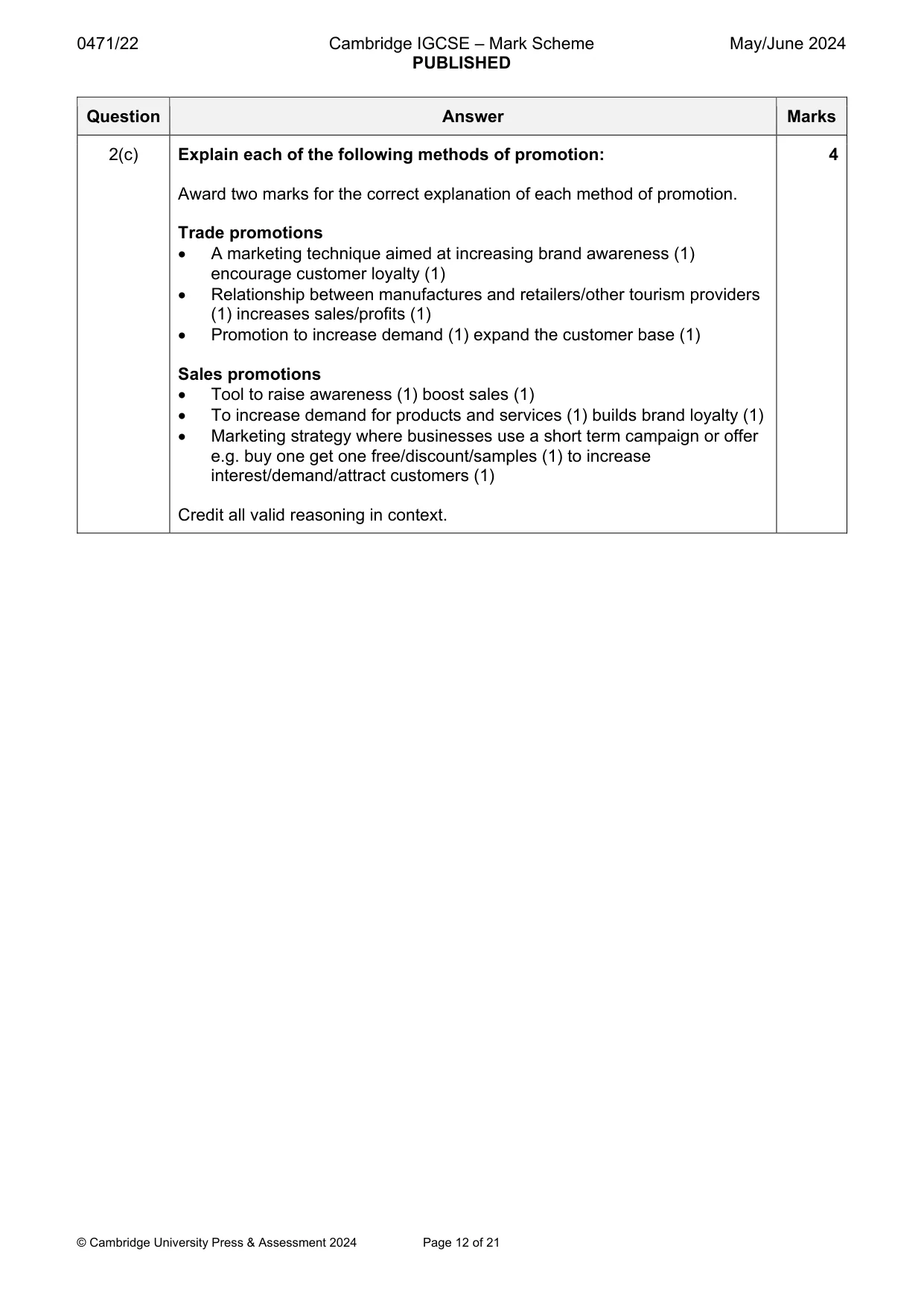
0471/22 Cambridge IGCSE – Mark Scheme PUBLISHED May/June 2024 © Cambridge University Press & Assessment 2024 Page 12 of 21 Question Answer Marks 2(c) Explain each of the following methods of promotion: Award two marks for the correct explanation of each method of promotion. Trade promotions A marketing technique aimed at increasing brand awareness (1) encourage customer loyalty (1) Relationship between manufactures and retailers/other tourism providers (1) increases sales/profits (1) Promotion to increase demand (1) expand the customer base (1) Sales promotions Tool to raise awareness (1) boost sales (1) To increase demand for products and services (1) builds brand loyalty (1) Marketing strategy where businesses use a short term campaign or offer e.g. buy one get one free/discount/samples (1) to increase interest/demand/attract customers (1) Credit all valid reasoning in context. 4
Mark scheme, page 13
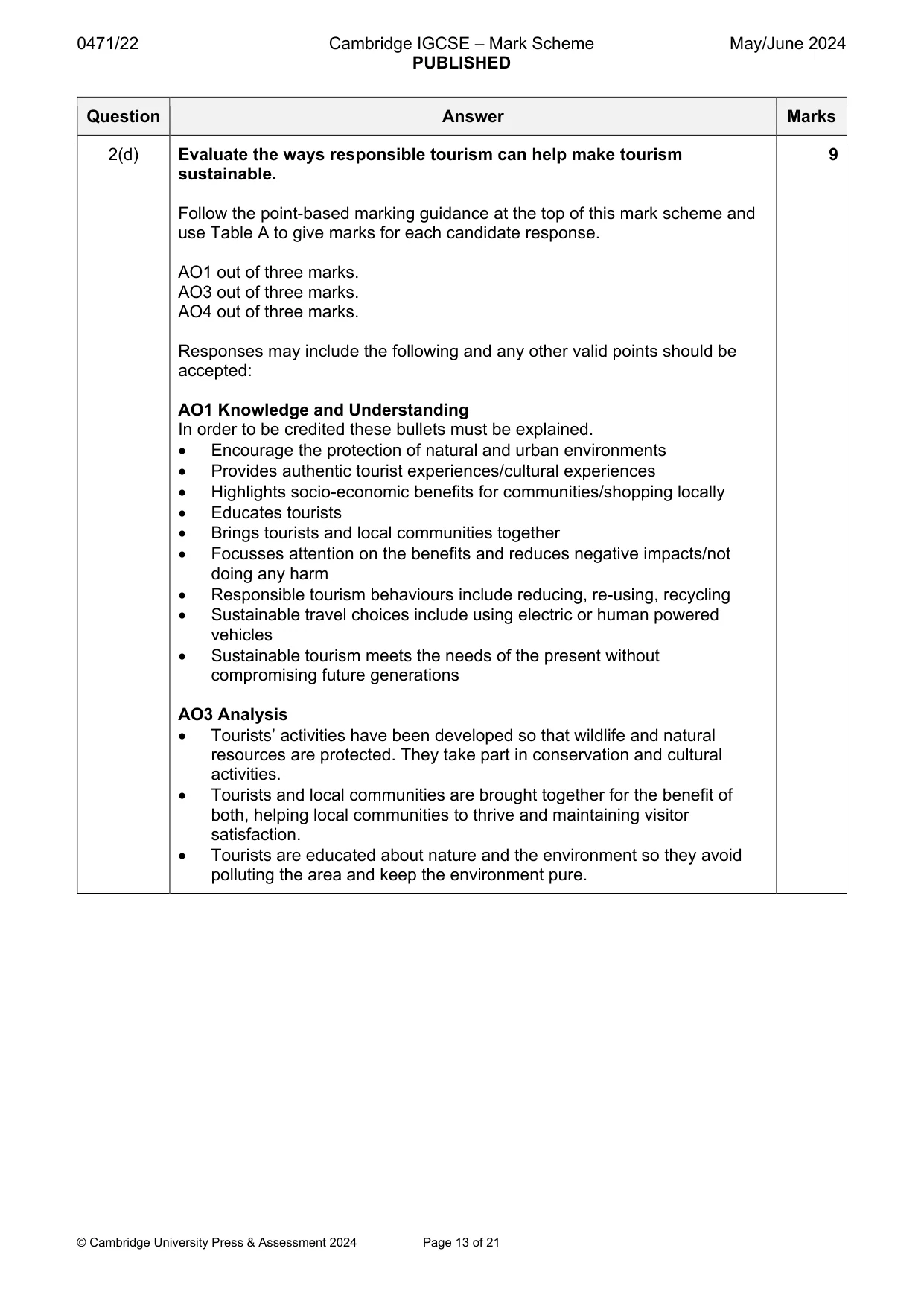
0471/22 Cambridge IGCSE – Mark Scheme PUBLISHED May/June 2024 © Cambridge University Press & Assessment 2024 Page 13 of 21 Question Answer Marks 2(d) Evaluate the ways responsible tourism can help make tourism sustainable. Follow the point-based marking guidance at the top of this mark scheme and use Table A to give marks for each candidate response. AO1 out of three marks. AO3 out of three marks. AO4 out of three marks. Responses may include the following and any other valid points should be accepted: AO1 Knowledge and Understanding In order to be credited these bullets must be explained. Encourage the protection of natural and urban environments Provides authentic tourist experiences/cultural experiences Highlights socio-economic benefits for communities/shopping locally Educates tourists Brings tourists and local communities together Focusses attention on the benefits and reduces negative impacts/not doing any harm Responsible tourism behaviours include reducing, re-using, recycling Sustainable travel choices include using electric or human powered vehicles Sustainable tourism meets the needs of the present without compromising future generations AO3 Analysis Tourists’ activities have been developed so that wildlife and natural resources are protected. They take part in conservation and cultural activities. Tourists and local communities are brought together for the benefit of both, helping local communities to thrive and maintaining visitor satisfaction. Tourists are educated about nature and the environment so they avoid polluting the area and keep the environment pure. 9
Mark scheme, page 14
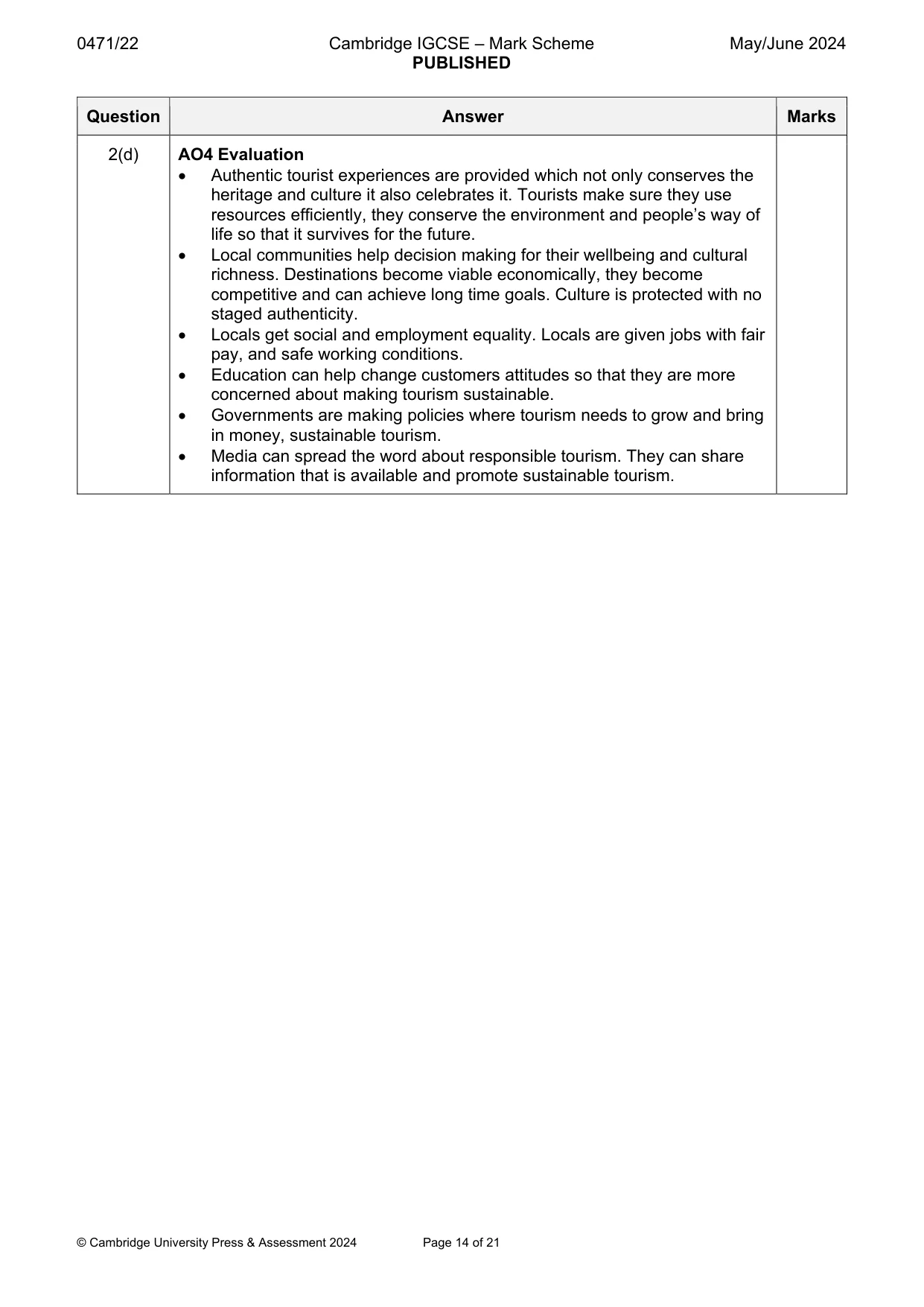
0471/22 Cambridge IGCSE – Mark Scheme PUBLISHED May/June 2024 © Cambridge University Press & Assessment 2024 Page 14 of 21 Question Answer Marks 2(d) AO4 Evaluation Authentic tourist experiences are provided which not only conserves the heritage and culture it also celebrates it. Tourists make sure they use resources efficiently, they conserve the environment and people’s way of life so that it survives for the future. Local communities help decision making for their wellbeing and cultural richness. Destinations become viable economically, they become competitive and can achieve long time goals. Culture is protected with no staged authenticity. Locals get social and employment equality. Locals are given jobs with fair pay, and safe working conditions. Education can help change customers attitudes so that they are more concerned about making tourism sustainable. Governments are making policies where tourism needs to grow and bring in money, sustainable tourism. Media can spread the word about responsible tourism. They can share information that is available and promote sustainable tourism.
Mark scheme, page 15
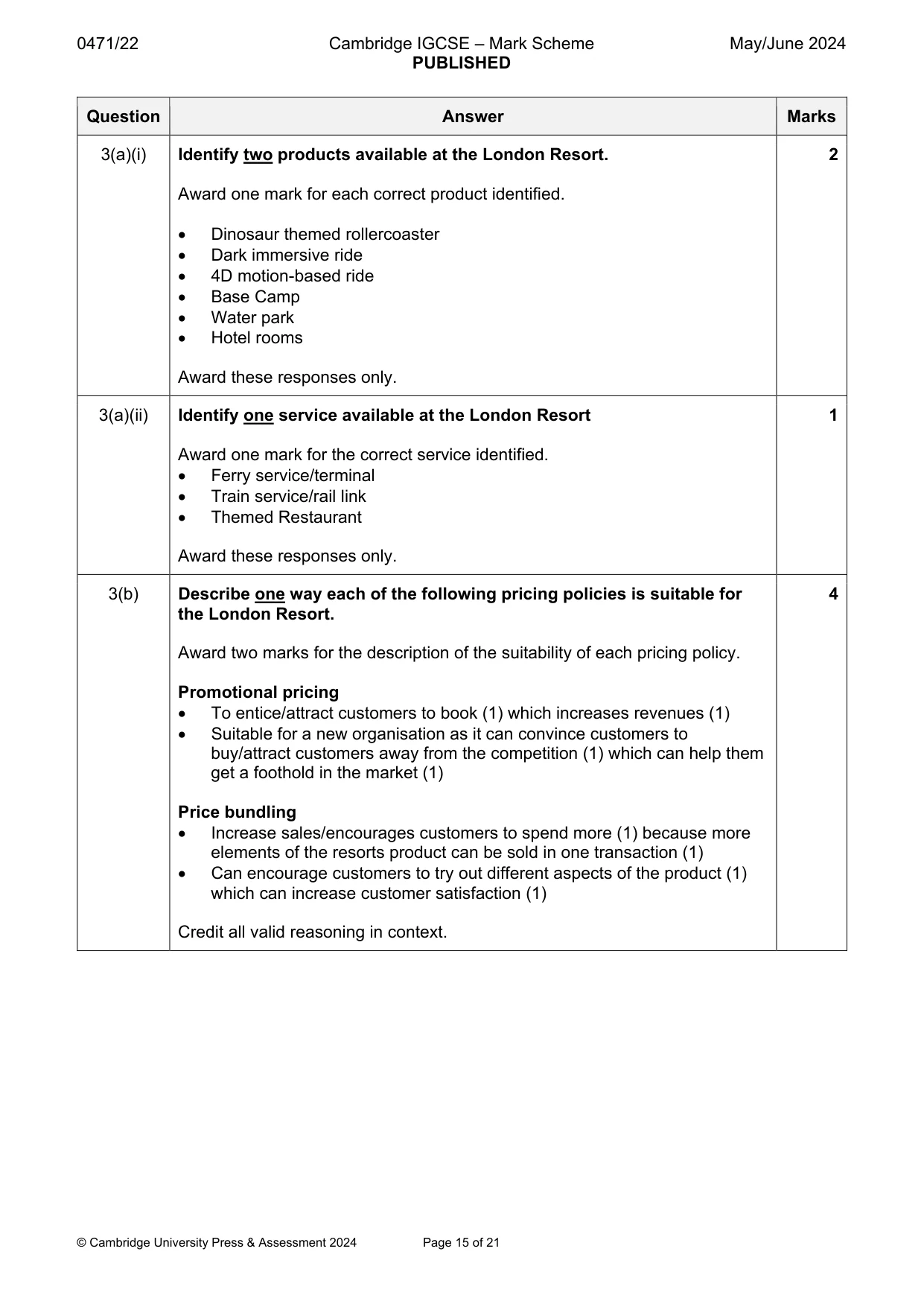
0471/22 Cambridge IGCSE – Mark Scheme PUBLISHED May/June 2024 © Cambridge University Press & Assessment 2024 Page 15 of 21 Question Answer Marks 3(a)(i) Identify two products available at the London Resort. Award one mark for each correct product identified. Dinosaur themed rollercoaster Dark immersive ride 4D motion-based ride Base Camp Water park Hotel rooms Award these responses only. 2 3(a)(ii) Identify one service available at the London Resort Award one mark for the correct service identified. Ferry service/terminal Train service/rail link Themed Restaurant Award these responses only. 1 3(b) Describe one way each of the following pricing policies is suitable for the London Resort. Award two marks for the description of the suitability of each pricing policy. Promotional pricing To entice/attract customers to book (1) which increases revenues (1) Suitable for a new organisation as it can convince customers to buy/attract customers away from the competition (1) which can help them get a foothold in the market (1) Price bundling Increase sales/encourages customers to spend more (1) because more elements of the resorts product can be sold in one transaction (1) Can encourage customers to try out different aspects of the product (1) which can increase customer satisfaction (1) Credit all valid reasoning in context. 4
Mark scheme, page 16
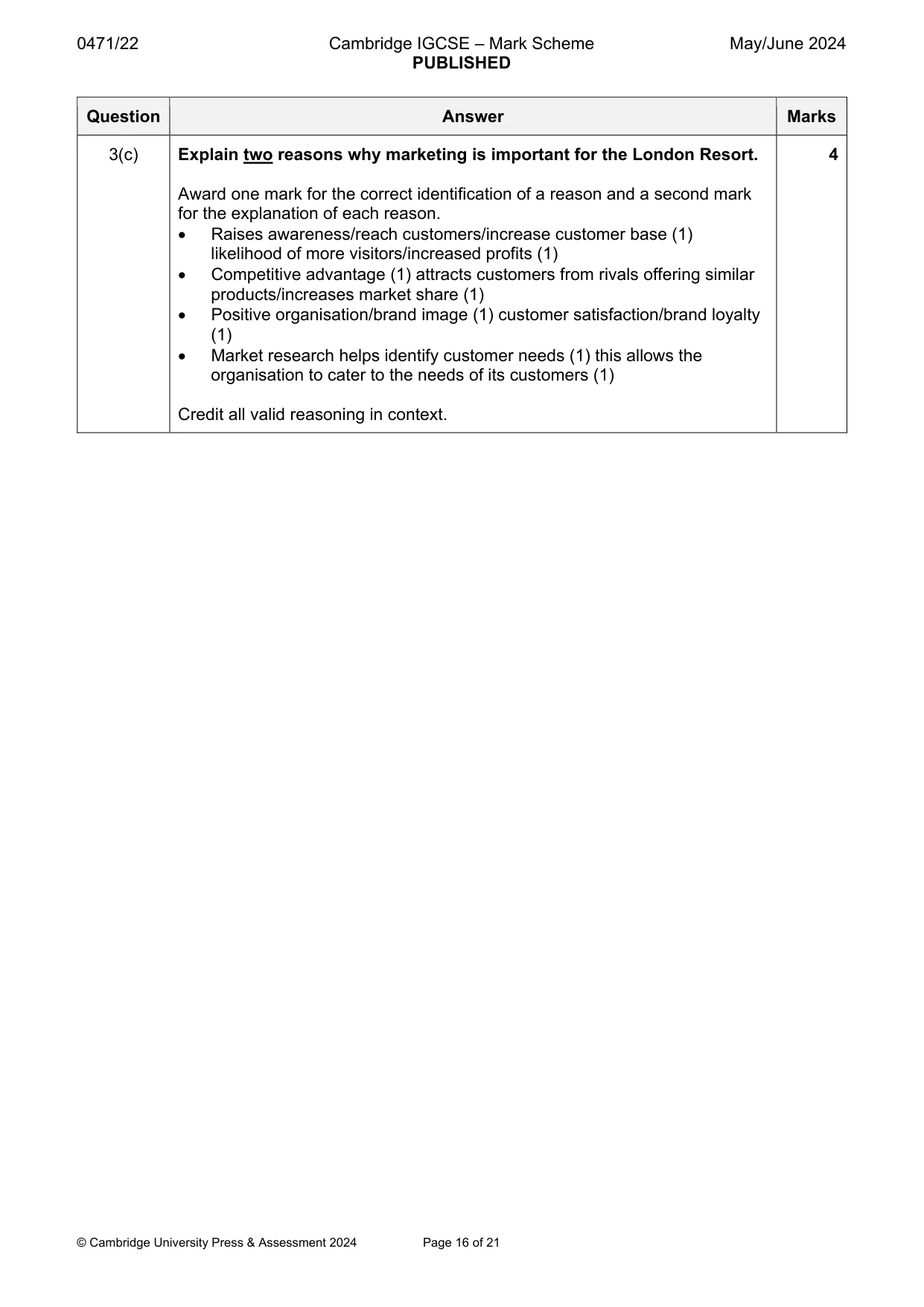
0471/22 Cambridge IGCSE – Mark Scheme PUBLISHED May/June 2024 © Cambridge University Press & Assessment 2024 Page 16 of 21 Question Answer Marks 3(c) Explain two reasons why marketing is important for the London Resort. Award one mark for the correct identification of a reason and a second mark for the explanation of each reason. Raises awareness/reach customers/increase customer base (1) likelihood of more visitors/increased profits (1) Competitive advantage (1) attracts customers from rivals offering similar products/increases market share (1) Positive organisation/brand image (1) customer satisfaction/brand loyalty (1) Market research helps identify customer needs (1) this allows the organisation to cater to the needs of its customers (1) Credit all valid reasoning in context. 4
Mark scheme, page 17
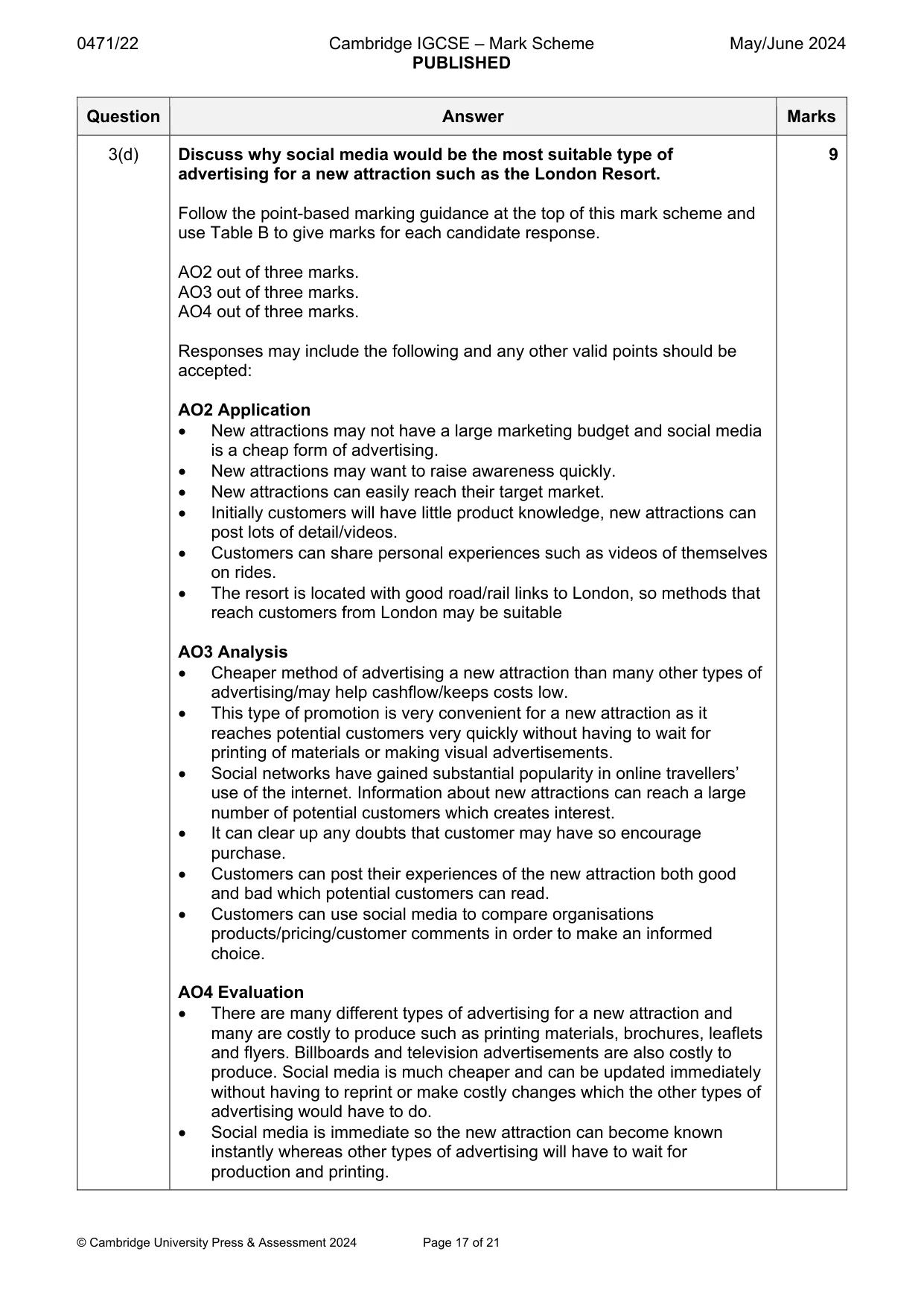
0471/22 Cambridge IGCSE – Mark Scheme PUBLISHED May/June 2024 © Cambridge University Press & Assessment 2024 Page 17 of 21 Question Answer Marks 3(d) Discuss why social media would be the most suitable type of advertising for a new attraction such as the London Resort. Follow the point-based marking guidance at the top of this mark scheme and use Table B to give marks for each candidate response. AO2 out of three marks. AO3 out of three marks. AO4 out of three marks. Responses may include the following and any other valid points should be accepted: AO2 Application New attractions may not have a large marketing budget and social media is a cheap form of advertising. New attractions may want to raise awareness quickly. New attractions can easily reach their target market. Initially customers will have little product knowledge, new attractions can post lots of detail/videos. Customers can share personal experiences such as videos of themselves on rides. The resort is located with good road/rail links to London, so methods that reach customers from London may be suitable AO3 Analysis Cheaper method of advertising a new attraction than many other types of advertising/may help cashflow/keeps costs low. This type of promotion is very convenient for a new attraction as it reaches potential customers very quickly without having to wait for printing of materials or making visual advertisements. Social networks have gained substantial popularity in online travellers’ use of the internet. Information about new attractions can reach a large number of potential customers which creates interest. It can clear up any doubts that customer may have so encourage purchase. Customers can post their experiences of the new attraction both good and bad which potential customers can read. Customers can use social media to compare organisations products/pricing/customer comments in order to make an informed choice. AO4 Evaluation There are many different types of advertising for a new attraction and many are costly to produce such as printing materials, brochures, leaflets and flyers. Billboards and television advertisements are also costly to produce. Social media is much cheaper and can be updated immediately without having to reprint or make costly changes which the other types of advertising would have to do. Social media is immediate so the new attraction can become known instantly whereas other types of advertising will have to wait for production and printing. 9
Mark scheme, page 18
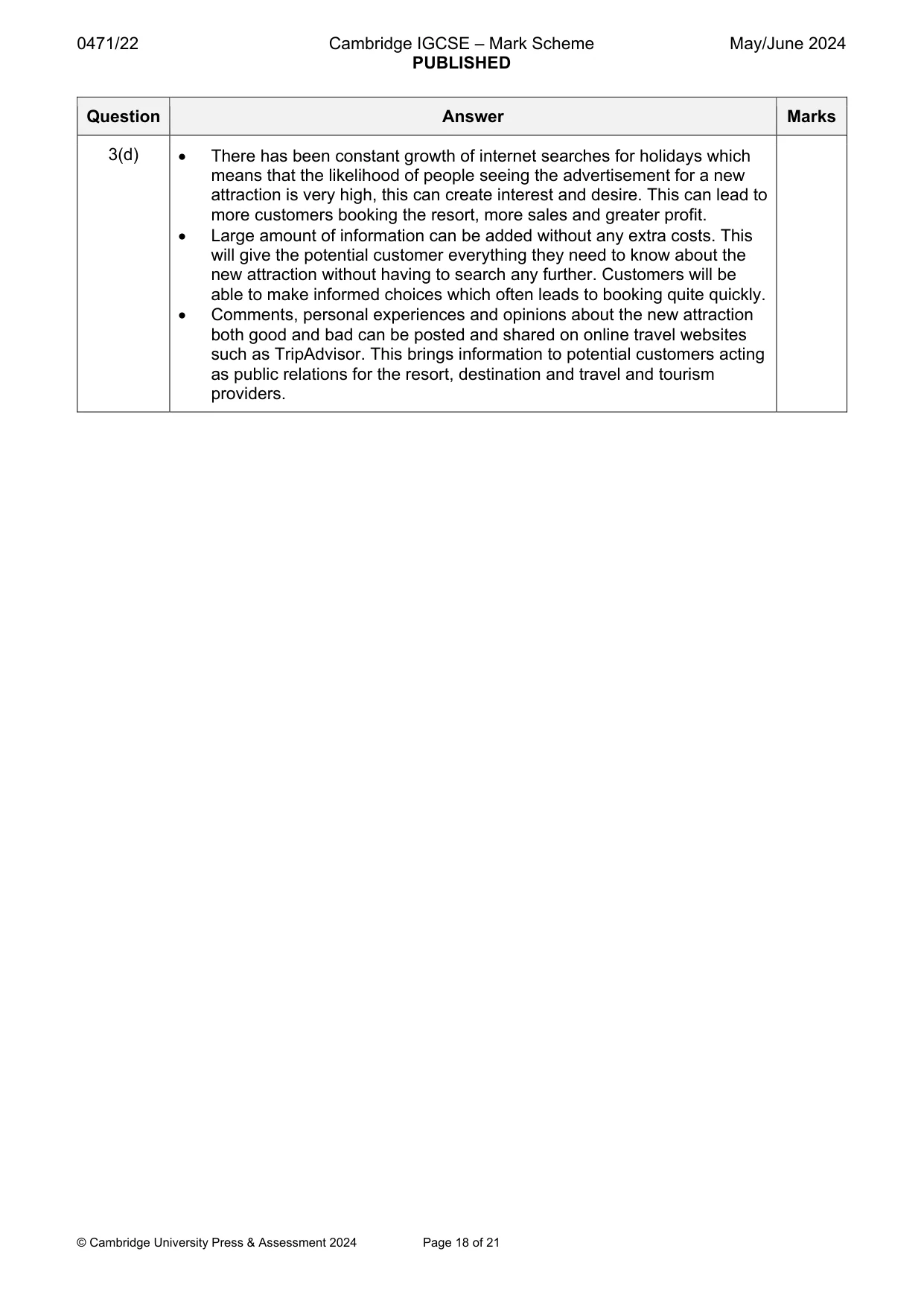
0471/22 Cambridge IGCSE – Mark Scheme PUBLISHED May/June 2024 © Cambridge University Press & Assessment 2024 Page 18 of 21 Question Answer Marks 3(d) There has been constant growth of internet searches for holidays which means that the likelihood of people seeing the advertisement for a new attraction is very high, this can create interest and desire. This can lead to more customers booking the resort, more sales and greater profit. Large amount of information can be added without any extra costs. This will give the potential customer everything they need to know about the new attraction without having to search any further. Customers will be able to make informed choices which often leads to booking quite quickly. Comments, personal experiences and opinions about the new attraction both good and bad can be posted and shared on online travel websites such as TripAdvisor. This brings information to potential customers acting as public relations for the resort, destination and travel and tourism providers.
Mark scheme, page 19
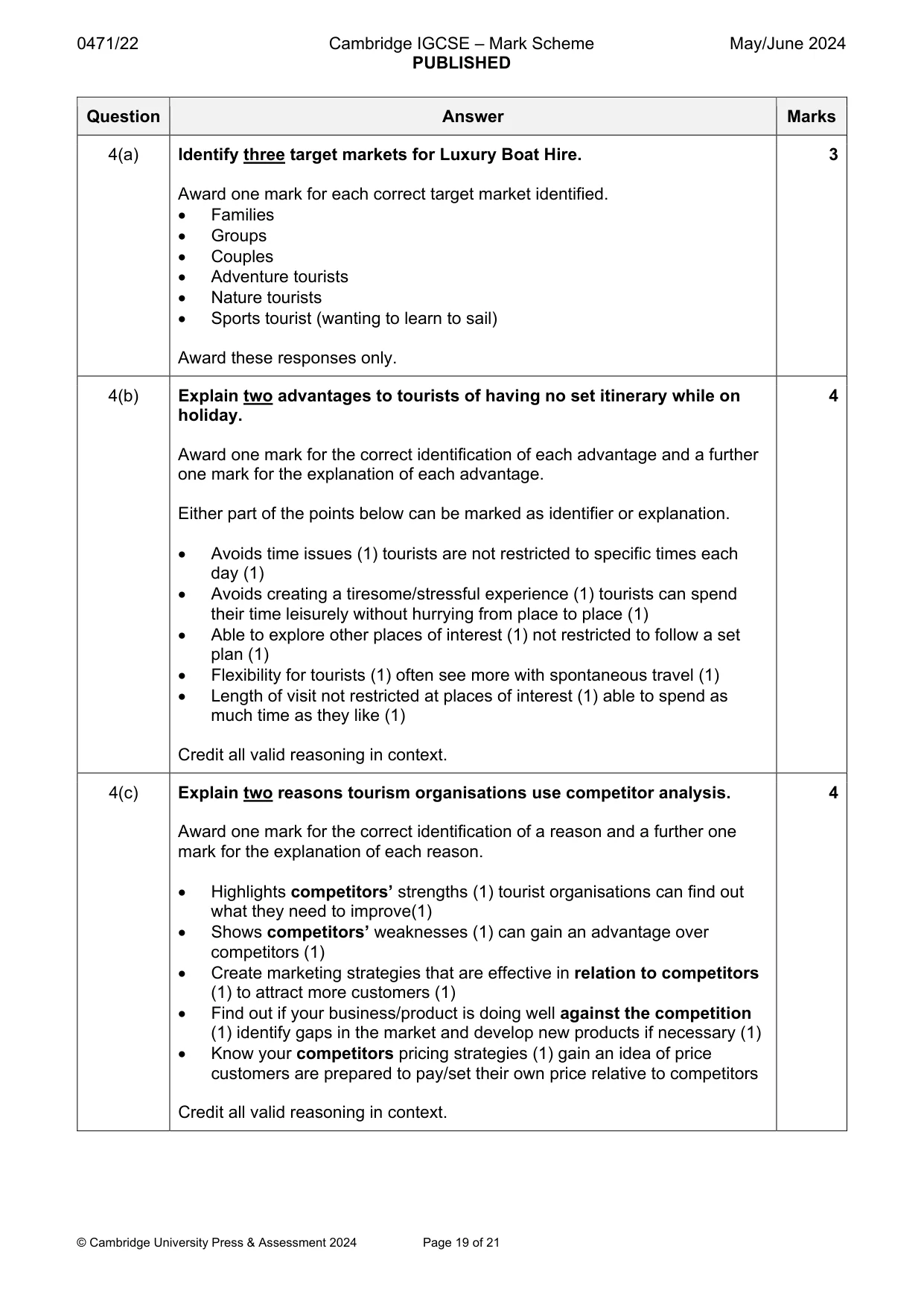
0471/22 Cambridge IGCSE – Mark Scheme PUBLISHED May/June 2024 © Cambridge University Press & Assessment 2024 Page 19 of 21 Question Answer Marks 4(a) Identify three target markets for Luxury Boat Hire. Award one mark for each correct target market identified. Families Groups Couples Adventure tourists Nature tourists Sports tourist (wanting to learn to sail) Award these responses only. 3 4(b) Explain two advantages to tourists of having no set itinerary while on holiday. Award one mark for the correct identification of each advantage and a further one mark for the explanation of each advantage. Either part of the points below can be marked as identifier or explanation. Avoids time issues (1) tourists are not restricted to specific times each day (1) Avoids creating a tiresome/stressful experience (1) tourists can spend their time leisurely without hurrying from place to place (1) Able to explore other places of interest (1) not restricted to follow a set plan (1) Flexibility for tourists (1) often see more with spontaneous travel (1) Length of visit not restricted at places of interest (1) able to spend as much time as they like (1) Credit all valid reasoning in context. 4 4(c) Explain two reasons tourism organisations use competitor analysis. Award one mark for the correct identification of a reason and a further one mark for the explanation of each reason. Highlights competitors’ strengths (1) tourist organisations can find out what they need to improve(1) Shows competitors’ weaknesses (1) can gain an advantage over competitors (1) Create marketing strategies that are effective in relation to competitors (1) to attract more customers (1) Find out if your business/product is doing well against the competition (1) identify gaps in the market and develop new products if necessary (1) Know your competitors pricing strategies (1) gain an idea of price customers are prepared to pay/set their own price relative to competitors Credit all valid reasoning in context. 4
Mark scheme, page 20
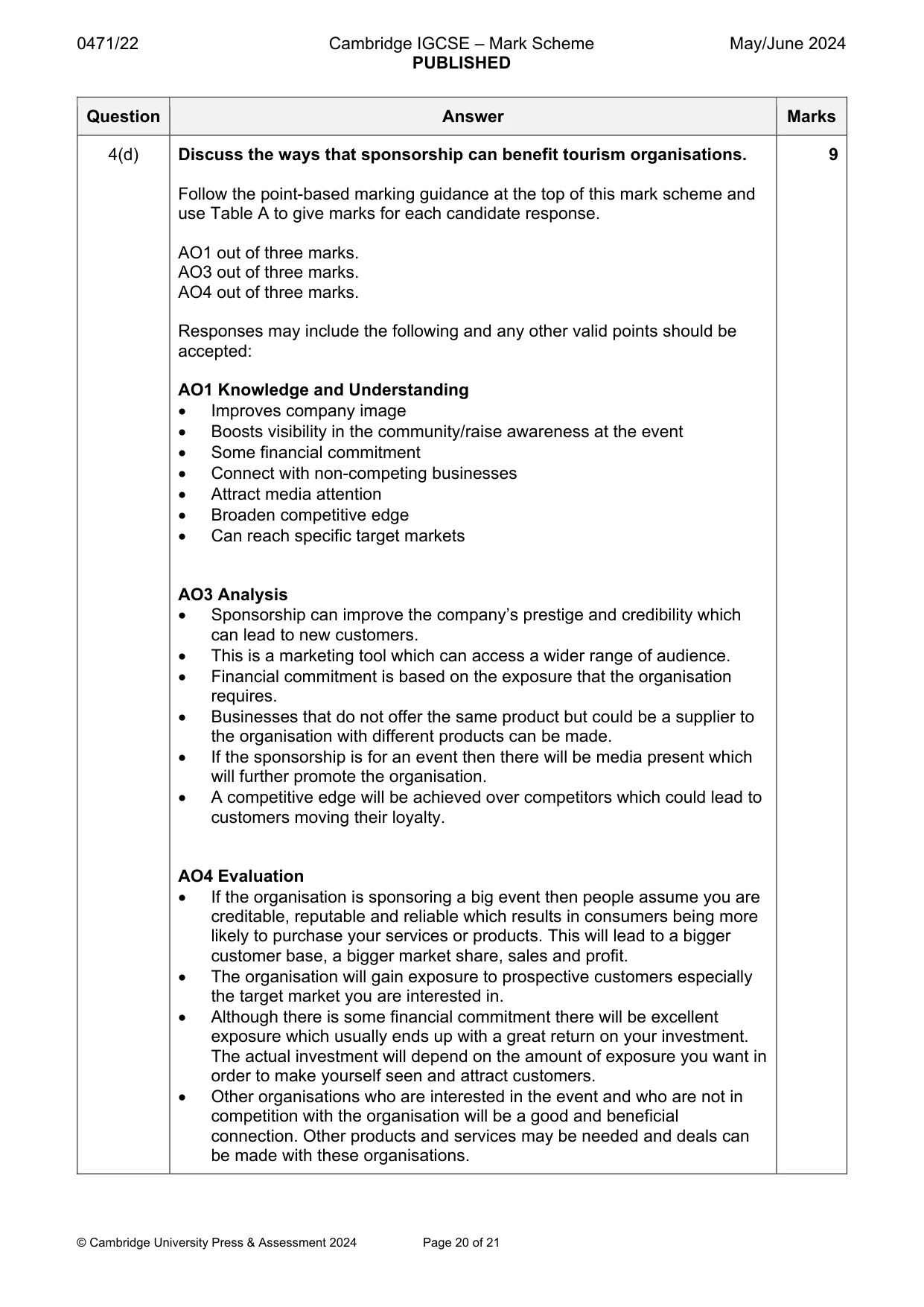
0471/22 Cambridge IGCSE – Mark Scheme PUBLISHED May/June 2024 © Cambridge University Press & Assessment 2024 Page 20 of 21 Question Answer Marks 4(d) Discuss the ways that sponsorship can benefit tourism organisations. Follow the point-based marking guidance at the top of this mark scheme and use Table A to give marks for each candidate response. AO1 out of three marks. AO3 out of three marks. AO4 out of three marks. Responses may include the following and any other valid points should be accepted: AO1 Knowledge and Understanding Improves company image Boosts visibility in the community/raise awareness at the event Some financial commitment Connect with non-competing businesses Attract media attention Broaden competitive edge Can reach specific target markets AO3 Analysis Sponsorship can improve the company’s prestige and credibility which can lead to new customers. This is a marketing tool which can access a wider range of audience. Financial commitment is based on the exposure that the organisation requires. Businesses that do not offer the same product but could be a supplier to the organisation with different products can be made. If the sponsorship is for an event then there will be media present which will further promote the organisation. A competitive edge will be achieved over competitors which could lead to customers moving their loyalty. AO4 Evaluation If the organisation is sponsoring a big event then people assume you are creditable, reputable and reliable which results in consumers being more likely to purchase your services or products. This will lead to a bigger customer base, a bigger market share, sales and profit. The organisation will gain exposure to prospective customers especially the target market you are interested in. Although there is some financial commitment there will be excellent exposure which usually ends up with a great return on your investment. The actual investment will depend on the amount of exposure you want in order to make yourself seen and attract customers. Other organisations who are interested in the event and who are not in competition with the organisation will be a good and beneficial connection. Other products and services may be needed and deals can be made with these organisations. 9
Mark scheme, page 21
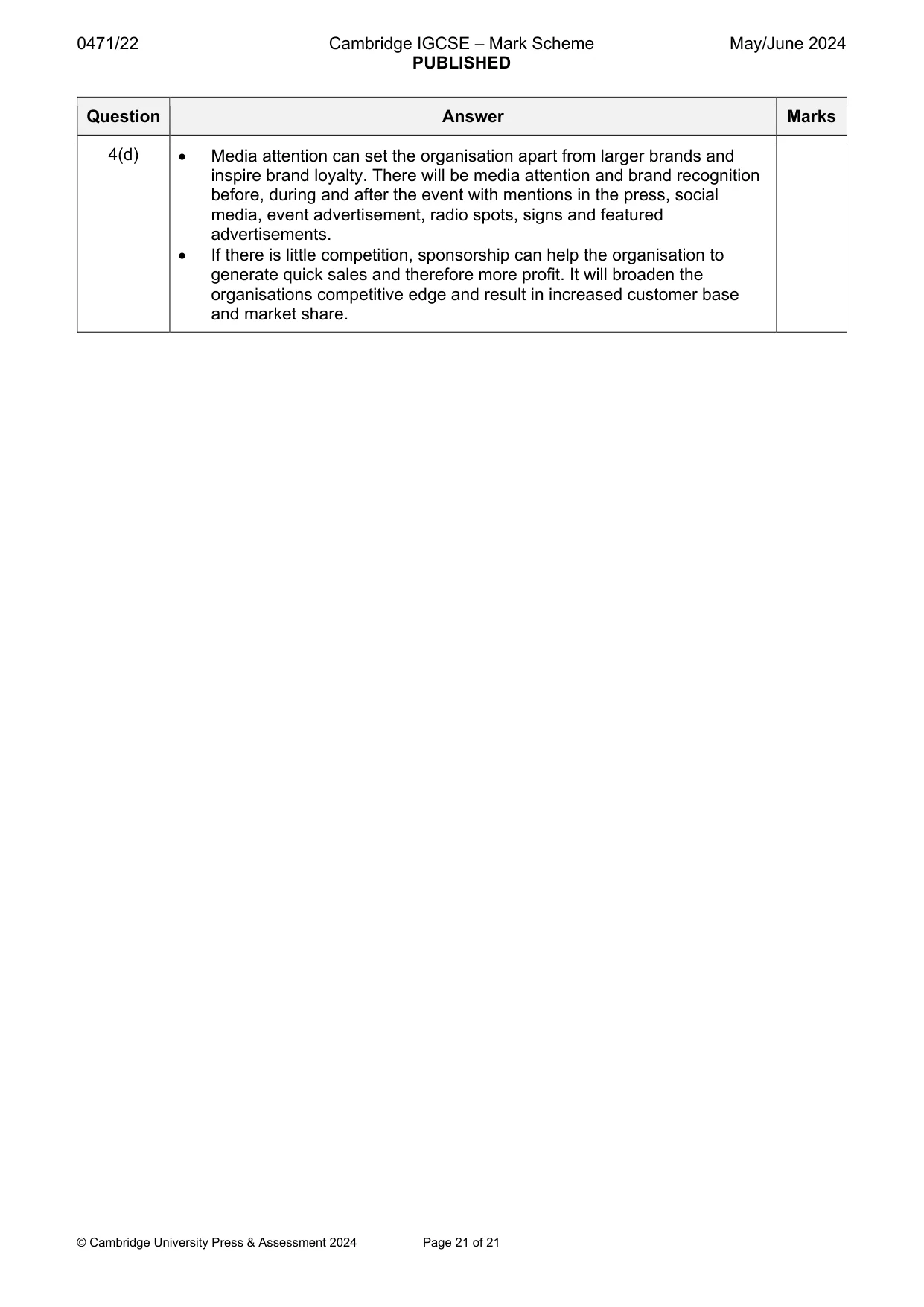
0471/22 Cambridge IGCSE – Mark Scheme PUBLISHED May/June 2024 © Cambridge University Press & Assessment 2024 Page 21 of 21 Question Answer Marks 4(d) Media attention can set the organisation apart from larger brands and inspire brand loyalty. There will be media attention and brand recognition before, during and after the event with mentions in the press, social media, event advertisement, radio spots, signs and featured advertisements. If there is little competition, sponsorship can help the organisation to generate quick sales and therefore more profit. It will broaden the organisations competitive edge and result in increased customer base and market share.
What you needed in this session
Cambridge’s own grade thresholds for 2024 May/June, Paper 2 · Variant 2. A higher threshold means an easier paper — the bar moves with how the cohort did.