Cambridge IGCSE Travel and Tourism 0471 — 2024 May/June Paper 2 · Variant 1
0471/21/M/J/24 · 80 marks · 120 min
The question paper and its mark scheme, free to read here and free to download. This is Cambridge’s own paper, exactly as it was sat.
Question paper12 pages


Mark scheme18 pages
Answers below. Sit the paper first if you are practising.
Paper as text
Question paper, page 1
This document has 12 pages. Any blank pages are indicated. [Turn over Cambridge IGCSE™ TRAVEL & TOURISM 0471/21 Paper 2 Managing and Marketing Destinations May/June 2024 2 hours You must answer on the question paper. You will need: Insert (enclosed) INSTRUCTIONS ● Answer all questions. ● Use a black or dark blue pen. ● Write your name, centre number and candidate number in the boxes at the top of the page. ● Write your answer to each question in the space provided. ● Do not use an erasable pen or correction fluid. ● Do not write on any bar codes. INFORMATION ● The total mark for this paper is 80. ● The number of marks for each question or part question is shown in brackets [ ]. ● The insert contains all the figures referred to in the questions. * 5 3 1 4 1 7 3 4 3 4 * DC (SL) 329875/4 © UCLES 2024
Question paper, page 2
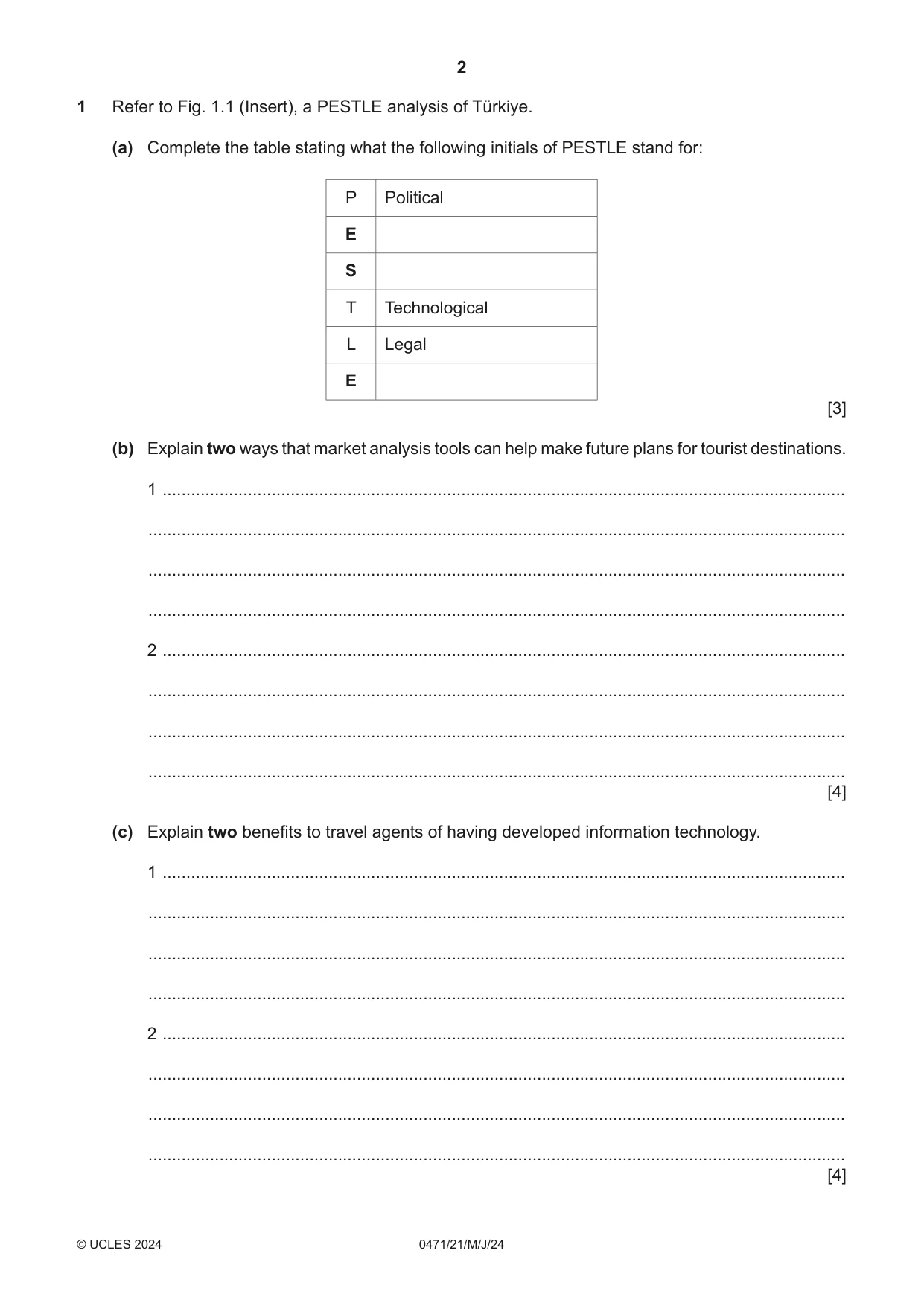
2 0471/21/M/J/24 © UCLES 2024 1 Refer to Fig. 1.1 (Insert), a PESTLE analysis of Türkiye. (a) Complete the table stating what the following initials of PESTLE stand for: P Political E S T Technological L Legal E [3] (b) Explain two ways that market analysis tools can help make future plans for tourist destinations. 1 … … … … 2 … … … … [4] (c) Explain two benefits to travel agents of having developed information technology. 1 … … … … 2 … … … … [4]
Question paper, page 3
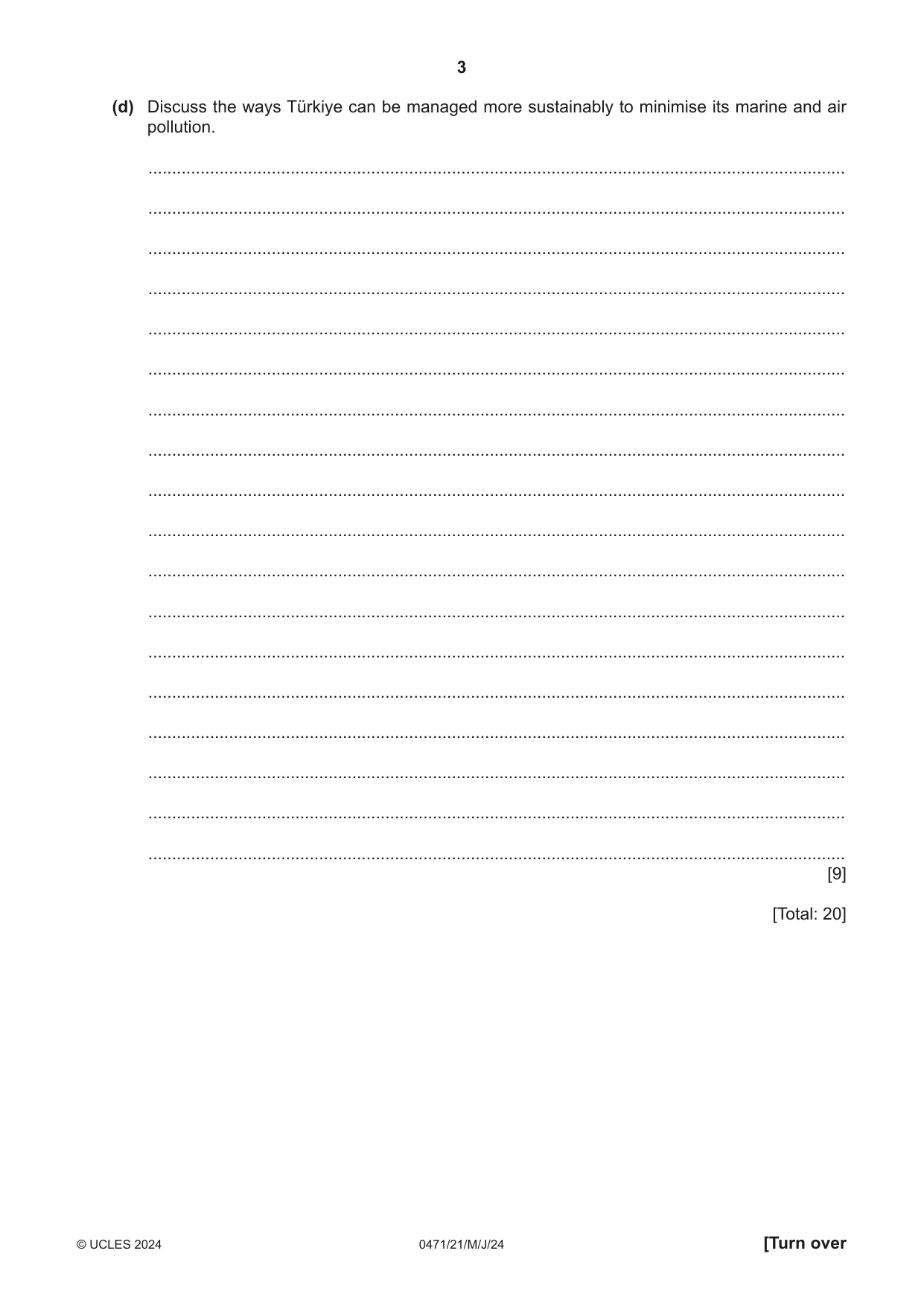
3 0471/21/M/J/24 © UCLES 2024 [Turn over (d) Discuss the ways Türkiye can be managed more sustainably to minimise its marine and air pollution. … … … … … … … … … … … … … … … … … … [9] [Total: 20]
Question paper, page 4
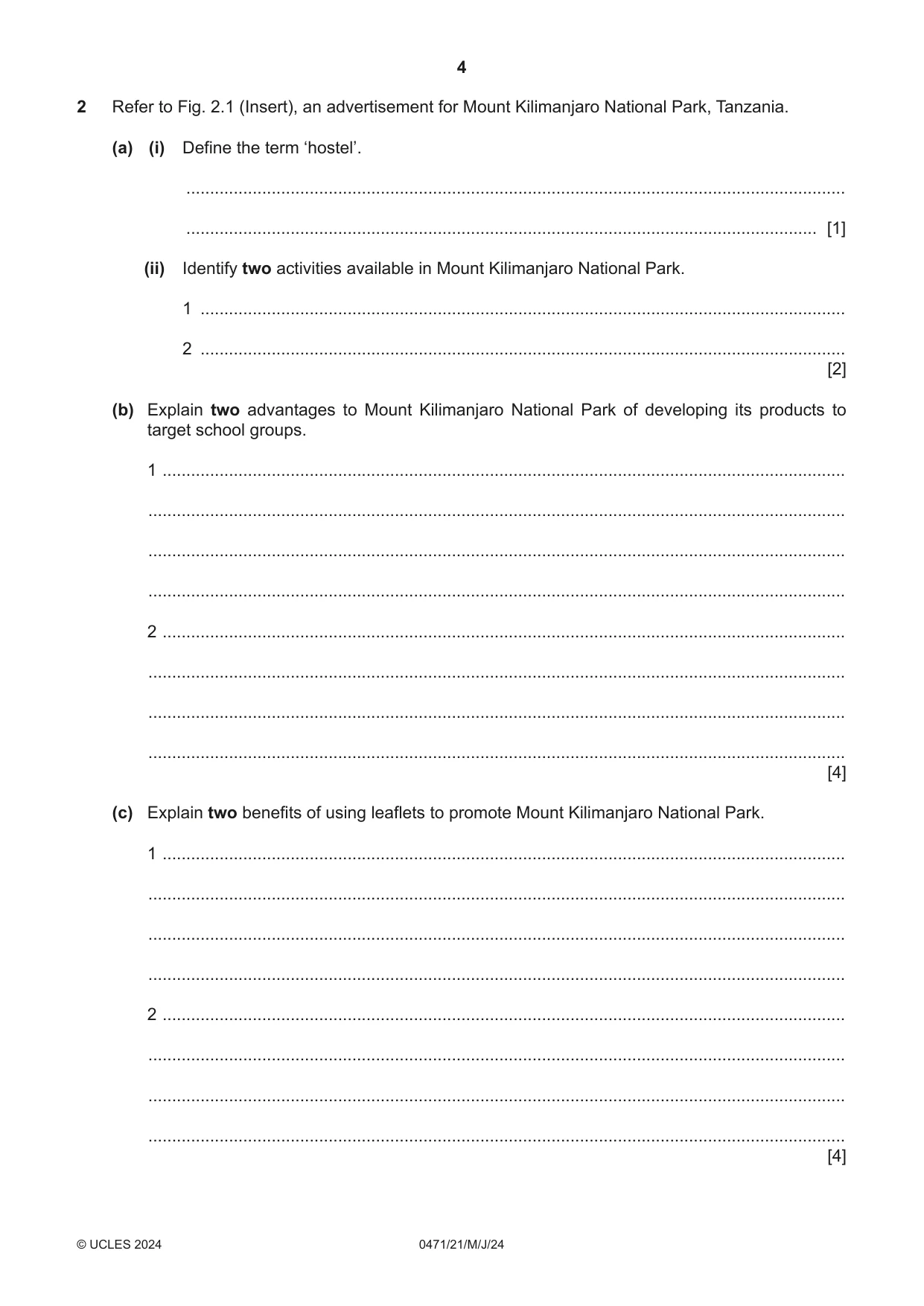
4 0471/21/M/J/24 © UCLES 2024 2 Refer to Fig. 2.1 (Insert), an advertisement for Mount Kilimanjaro National Park, Tanzania. (a) (i) Define the term ‘hostel’. … … [1] (ii) Identify two activities available in Mount Kilimanjaro National Park. 1 … 2 … [2] (b) Explain two advantages to Mount Kilimanjaro National Park of developing its products to target school groups. 1 … … … … 2 … … … … [4] (c) Explain two benefits of using leaflets to promote Mount Kilimanjaro National Park. 1 … … … … 2 … … … … [4]
Question paper, page 5
5 0471/21/M/J/24 © UCLES 2024 [Turn over (d) Evaluate the ways that national parks can support social enterprise development. … … … … … … … … … … … … … … … … … … [9] [Total: 20]
Question paper, page 6
6 0471/21/M/J/24 © UCLES 2024 3 Refer to Fig. 3.1 (Insert), information about tourism in Colombo, Sri Lanka. (a) Identify from Fig. 3.1 three places of interest to tourists. 1 … 2 … 3 … [3] (b) Explain two reasons why destinations, such as Sri Lanka, have a tourism policy. 1 … … … … 2 … … … … [4] (c) Explain two ways local communities could market themselves to attract more tourists. 1 … … … … 2 … … … … [4]
Question paper, page 7
7 0471/21/M/J/24 © UCLES 2024 [Turn over (d) Evaluate the factors that tourism providers must consider when producing effective promotional materials. … … … … … … … … … … … … … … … … … … [9] [Total: 20]
Question paper, page 8
8 0471/21/M/J/24 © UCLES 2024 4 Refer to Fig. 4.1 (Insert), an advertisement for Insightful Independent Travel. (a) (i) Define the term ‘dynamic package’. … … [1] (ii) State two ancillary services offered by Insightful Independent Travel. 1 … 2 … [2] (b) Explain two benefits to tourists of having no set itinerary when visiting a destination. 1 … … … … 2 … … … … [4] (c) Explain two reasons why tourism organisations carry out market research. 1 … … … … 2 … … … … [4]
Question paper, page 9
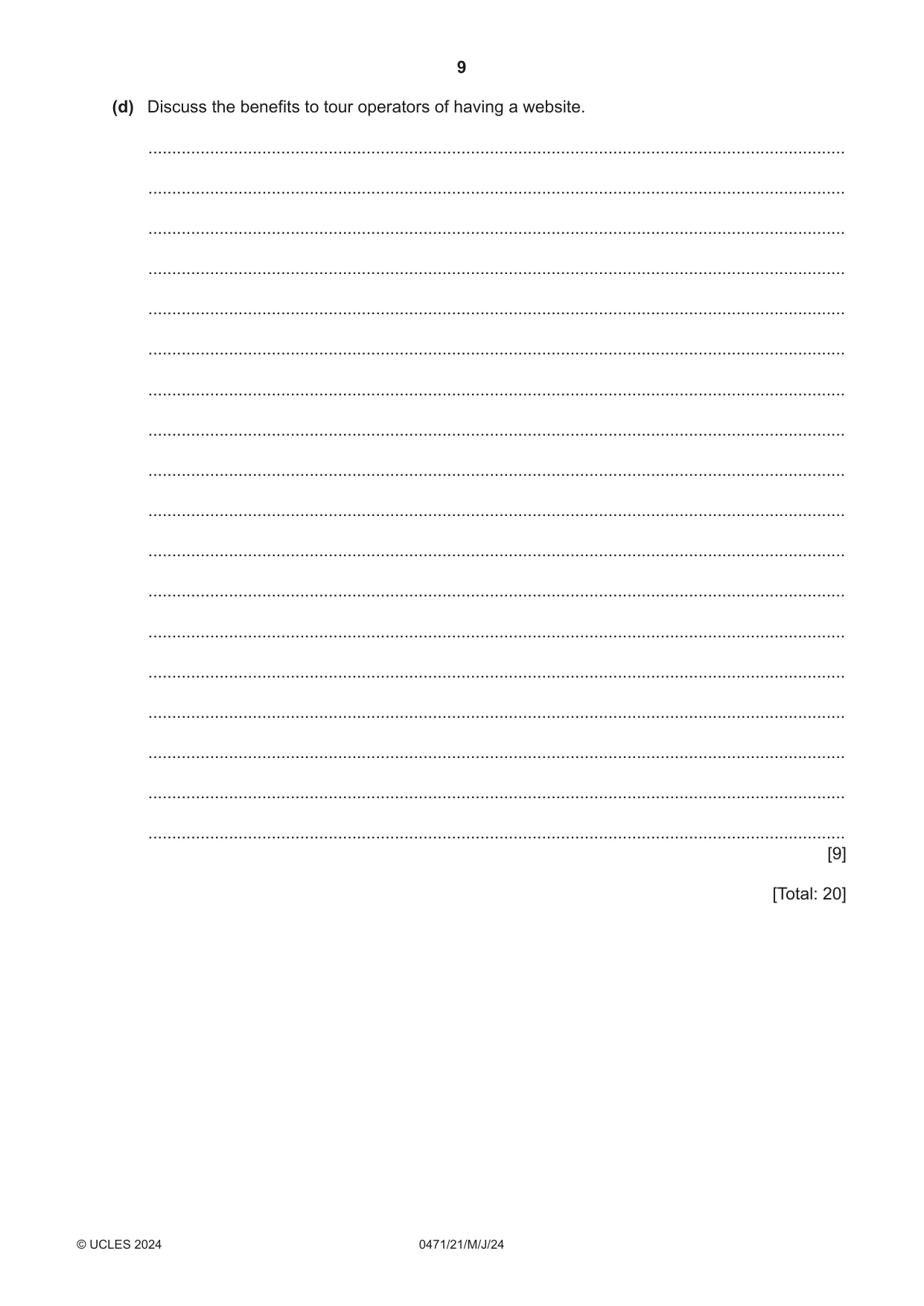
9 0471/21/M/J/24 © UCLES 2024 (d) Discuss the benefits to tour operators of having a website. … … … … … … … … … … … … … … … … … … [9] [Total: 20]
Question paper, page 10
10 0471/21/M/J/24 © UCLES 2024 BLANK PAGE
Question paper, page 11
11 0471/21/M/J/24 © UCLES 2024 BLANK PAGE
Question paper, page 12
12 0471/21/M/J/24 © UCLES 2024 The boundaries and names shown, the designations used and the presentation of material on any maps contained in this question paper/insert do not imply official endorsement or acceptance by Cambridge Assessment International Education concerning the legal status of any country, territory, or area or any of its authorities, or of the delimitation of its frontiers or boundaries. Permission to reproduce items where third-party owned material protected by copyright is included has been sought and cleared where possible. Every reasonable effort has been made by the publisher (UCLES) to trace copyright holders, but if any items requiring clearance have unwittingly been included, the publisher will be pleased to make amends at the earliest possible opportunity. To avoid the issue of disclosure of answer-related information to candidates, all copyright acknowledgements are reproduced online in the Cambridge Assessment International Education Copyright Acknowledgements Booklet. This is produced for each series of examinations and is freely available to download at www.cambridgeinternational.org after the live examination series. Cambridge Assessment International Education is part of Cambridge Assessment. Cambridge Assessment is the brand name of the University of Cambridge Local Examinations Syndicate (UCLES), which is a department of the University of Cambridge. BLANK PAGE
Mark scheme, page 1
This document consists of 18 printed pages. © Cambridge University Press & Assessment 2024 [Turn over Cambridge IGCSE™ TRAVEL & TOURISM 0471/21 Paper 2 Managing and Marketing Destinations May/June 2024 MARK SCHEME Maximum Mark: 100 Published This mark scheme is published as an aid to teachers and candidates, to indicate the requirements of the examination. It shows the basis on which Examiners were instructed to award marks. It does not indicate the details of the discussions that took place at an Examiners’ meeting before marking began, which would have considered the acceptability of alternative answers. Mark schemes should be read in conjunction with the question paper and the Principal Examiner Report for Teachers. Cambridge International will not enter into discussions about these mark schemes. Cambridge International is publishing the mark schemes for the May/June 2024 series for most Cambridge IGCSE, Cambridge International A and AS Level and Cambridge Pre-U components, and some Cambridge O Level components.
Mark scheme, page 2
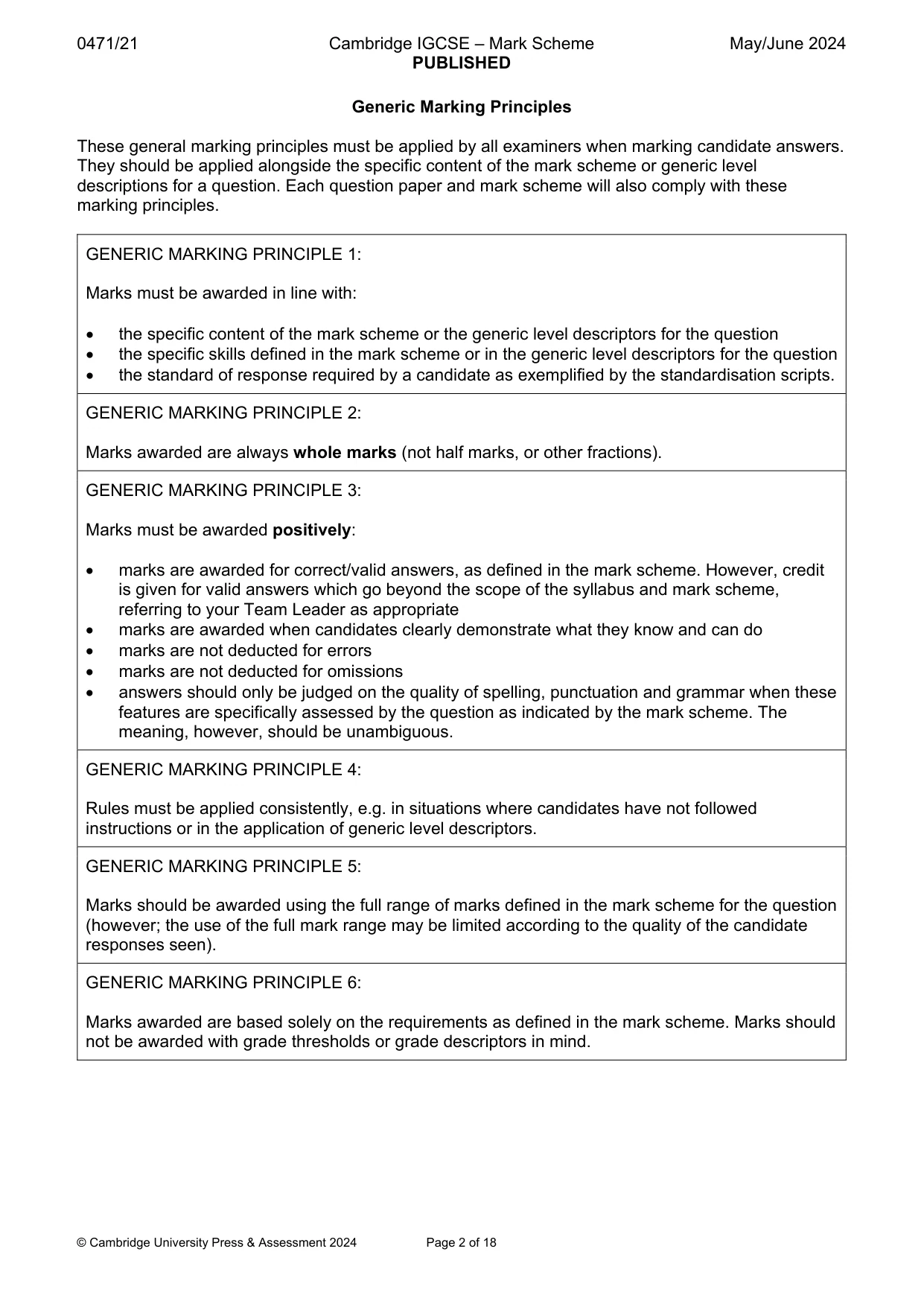
0471/21 Cambridge IGCSE – Mark Scheme PUBLISHED May/June 2024 © Cambridge University Press & Assessment 2024 Page 2 of 18 Generic Marking Principles These general marking principles must be applied by all examiners when marking candidate answers. They should be applied alongside the specific content of the mark scheme or generic level descriptions for a question. Each question paper and mark scheme will also comply with these marking principles. GENERIC MARKING PRINCIPLE 1: Marks must be awarded in line with: the specific content of the mark scheme or the generic level descriptors for the question the specific skills defined in the mark scheme or in the generic level descriptors for the question the standard of response required by a candidate as exemplified by the standardisation scripts. GENERIC MARKING PRINCIPLE 2: Marks awarded are always whole marks (not half marks, or other fractions). GENERIC MARKING PRINCIPLE 3: Marks must be awarded positively: marks are awarded for correct/valid answers, as defined in the mark scheme. However, credit is given for valid answers which go beyond the scope of the syllabus and mark scheme, referring to your Team Leader as appropriate marks are awarded when candidates clearly demonstrate what they know and can do marks are not deducted for errors marks are not deducted for omissions answers should only be judged on the quality of spelling, punctuation and grammar when these features are specifically assessed by the question as indicated by the mark scheme. The meaning, however, should be unambiguous. GENERIC MARKING PRINCIPLE 4: Rules must be applied consistently, e.g. in situations where candidates have not followed instructions or in the application of generic level descriptors. GENERIC MARKING PRINCIPLE 5: Marks should be awarded using the full range of marks defined in the mark scheme for the question (however; the use of the full mark range may be limited according to the quality of the candidate responses seen). GENERIC MARKING PRINCIPLE 6: Marks awarded are based solely on the requirements as defined in the mark scheme. Marks should not be awarded with grade thresholds or grade descriptors in mind.
Mark scheme, page 3
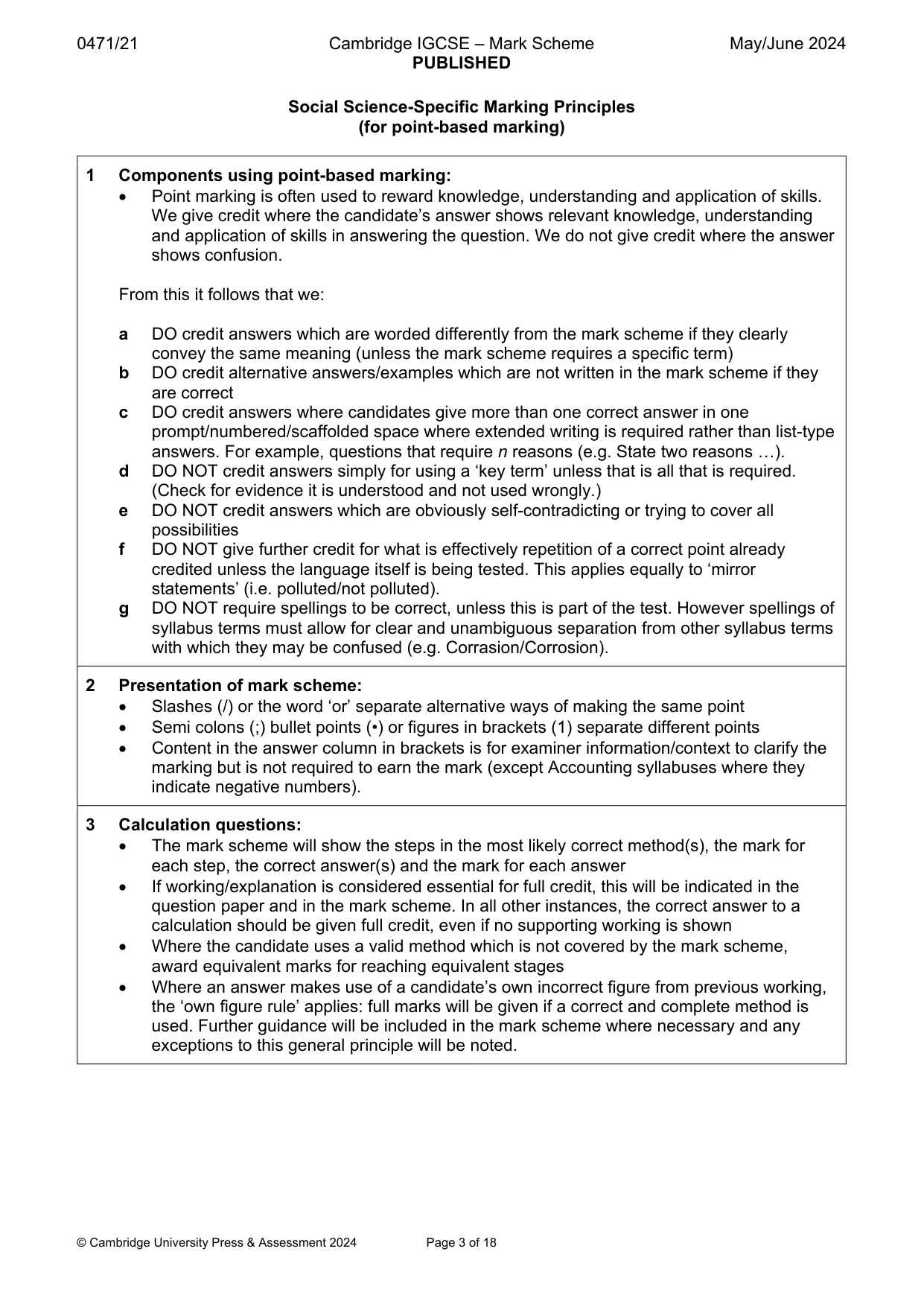
0471/21 Cambridge IGCSE – Mark Scheme PUBLISHED May/June 2024 © Cambridge University Press & Assessment 2024 Page 3 of 18 Social Science-Specific Marking Principles (for point-based marking) 1 Components using point-based marking: Point marking is often used to reward knowledge, understanding and application of skills. We give credit where the candidate’s answer shows relevant knowledge, understanding and application of skills in answering the question. We do not give credit where the answer shows confusion. From this it follows that we: a DO credit answers which are worded differently from the mark scheme if they clearly convey the same meaning (unless the mark scheme requires a specific term) b DO credit alternative answers/examples which are not written in the mark scheme if they are correct c DO credit answers where candidates give more than one correct answer in one prompt/numbered/scaffolded space where extended writing is required rather than list-type answers. For example, questions that require n reasons (e.g. State two reasons …). d DO NOT credit answers simply for using a ‘key term’ unless that is all that is required. (Check for evidence it is understood and not used wrongly.) e DO NOT credit answers which are obviously self-contradicting or trying to cover all possibilities f DO NOT give further credit for what is effectively repetition of a correct point already credited unless the language itself is being tested. This applies equally to ‘mirror statements’ (i.e. polluted/not polluted). g DO NOT require spellings to be correct, unless this is part of the test. However spellings of syllabus terms must allow for clear and unambiguous separation from other syllabus terms with which they may be confused (e.g. Corrasion/Corrosion). 2 Presentation of mark scheme: Slashes (/) or the word ‘or’ separate alternative ways of making the same point Semi colons (;) bullet points (•) or figures in brackets (1) separate different points Content in the answer column in brackets is for examiner information/context to clarify the marking but is not required to earn the mark (except Accounting syllabuses where they indicate negative numbers). 3 Calculation questions: The mark scheme will show the steps in the most likely correct method(s), the mark for each step, the correct answer(s) and the mark for each answer If working/explanation is considered essential for full credit, this will be indicated in the question paper and in the mark scheme. In all other instances, the correct answer to a calculation should be given full credit, even if no supporting working is shown Where the candidate uses a valid method which is not covered by the mark scheme, award equivalent marks for reaching equivalent stages Where an answer makes use of a candidate’s own incorrect figure from previous working, the ‘own figure rule’ applies: full marks will be given if a correct and complete method is used. Further guidance will be included in the mark scheme where necessary and any exceptions to this general principle will be noted.
Mark scheme, page 4
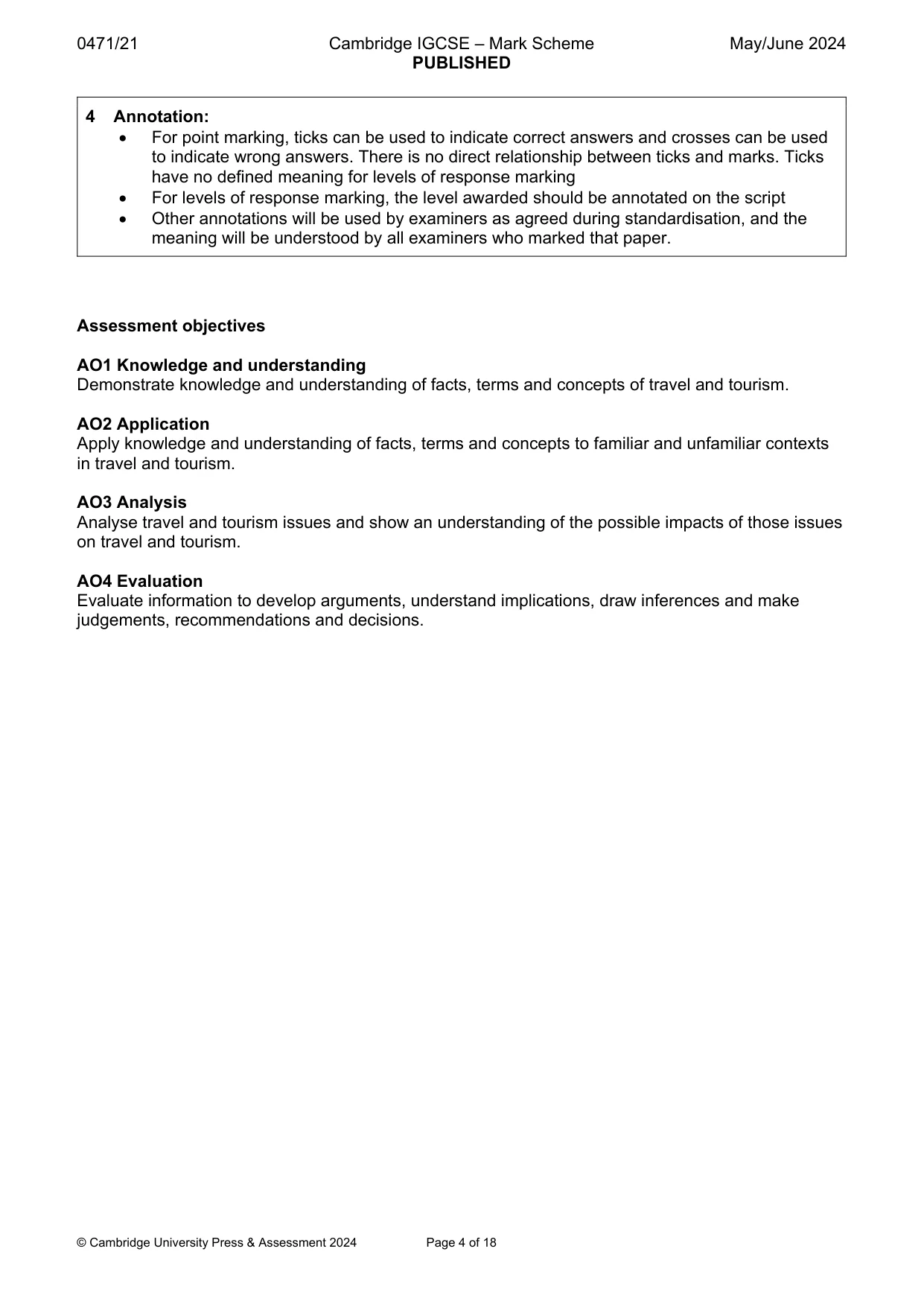
0471/21 Cambridge IGCSE – Mark Scheme PUBLISHED May/June 2024 © Cambridge University Press & Assessment 2024 Page 4 of 18 4 Annotation: For point marking, ticks can be used to indicate correct answers and crosses can be used to indicate wrong answers. There is no direct relationship between ticks and marks. Ticks have no defined meaning for levels of response marking For levels of response marking, the level awarded should be annotated on the script Other annotations will be used by examiners as agreed during standardisation, and the meaning will be understood by all examiners who marked that paper. Assessment objectives AO1 Knowledge and understanding Demonstrate knowledge and understanding of facts, terms and concepts of travel and tourism. AO2 Application Apply knowledge and understanding of facts, terms and concepts to familiar and unfamiliar contexts in travel and tourism. AO3 Analysis Analyse travel and tourism issues and show an understanding of the possible impacts of those issues on travel and tourism. AO4 Evaluation Evaluate information to develop arguments, understand implications, draw inferences and make judgements, recommendations and decisions.
Mark scheme, page 5
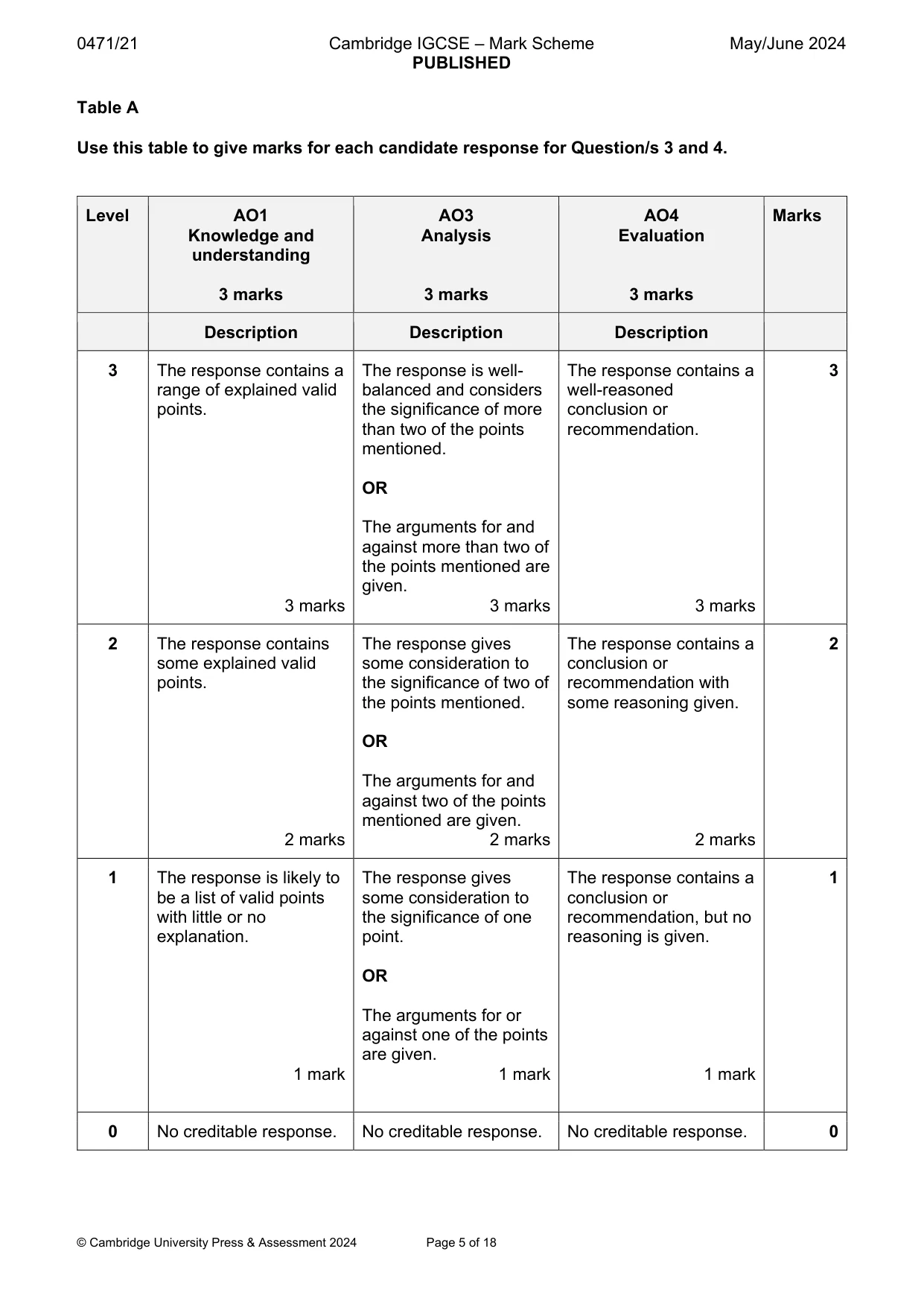
0471/21 Cambridge IGCSE – Mark Scheme PUBLISHED May/June 2024 © Cambridge University Press & Assessment 2024 Page 5 of 18 Table A Use this table to give marks for each candidate response for Question/s 3 and 4. Level AO1 Knowledge and understanding 3 marks AO3 Analysis 3 marks AO4 Evaluation 3 marks Marks Description Description Description 3 The response contains a range of explained valid points. 3 marks The response is well- balanced and considers the significance of more than two of the points mentioned. OR The arguments for and against more than two of the points mentioned are given. 3 marks The response contains a well-reasoned conclusion or recommendation. 3 marks 3 2 The response contains some explained valid points. 2 marks The response gives some consideration to the significance of two of the points mentioned. OR The arguments for and against two of the points mentioned are given. 2 marks The response contains a conclusion or recommendation with some reasoning given. 2 marks 2 1 The response is likely to be a list of valid points with little or no explanation. 1 mark The response gives some consideration to the significance of one point. OR The arguments for or against one of the points are given. 1 mark The response contains a conclusion or recommendation, but no reasoning is given. 1 mark 1 0 No creditable response. No creditable response. No creditable response. 0
Mark scheme, page 6
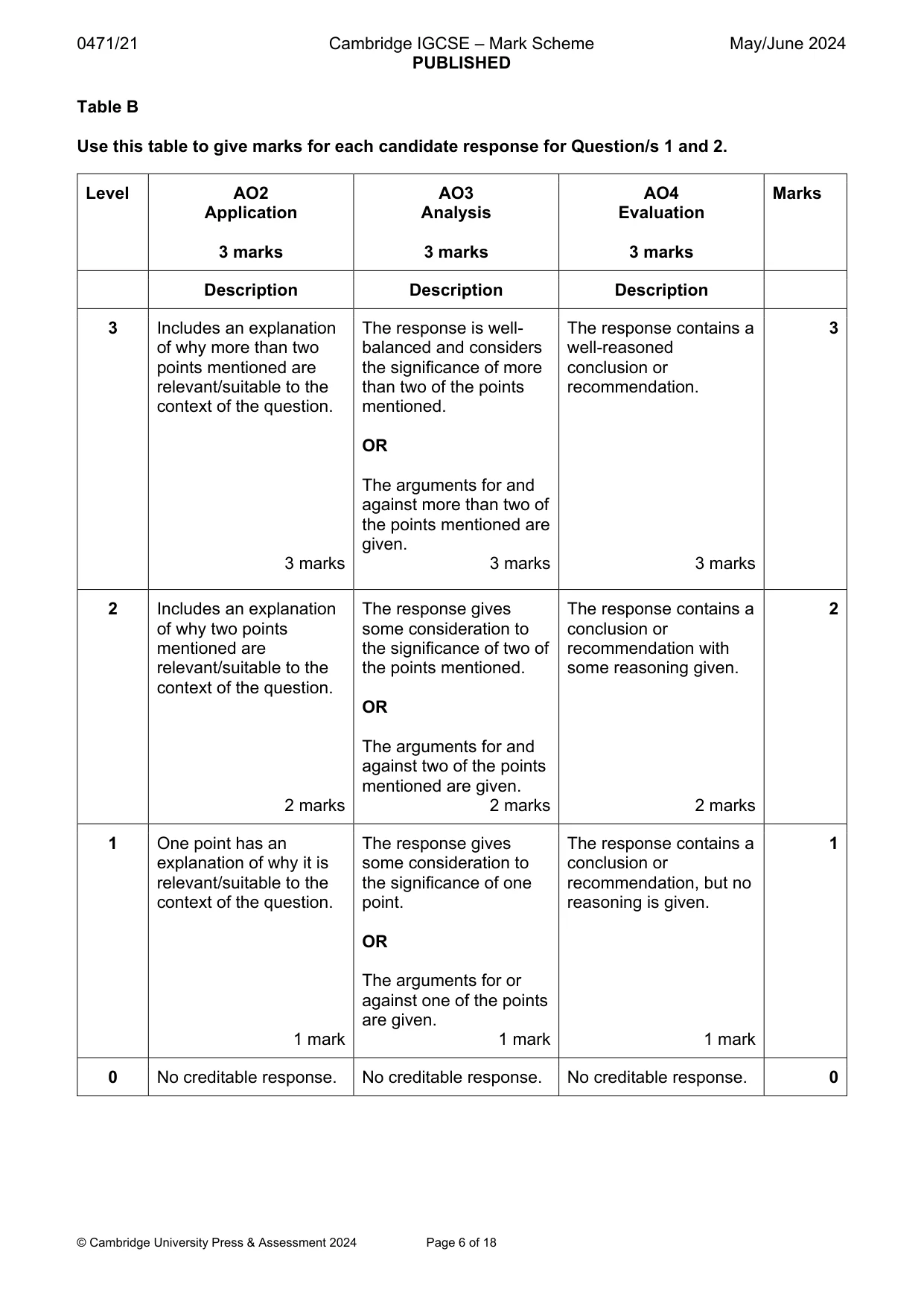
0471/21 Cambridge IGCSE – Mark Scheme PUBLISHED May/June 2024 © Cambridge University Press & Assessment 2024 Page 6 of 18 Table B Use this table to give marks for each candidate response for Question/s 1 and 2. Level AO2 Application 3 marks AO3 Analysis 3 marks AO4 Evaluation 3 marks Marks Description Description Description 3 Includes an explanation of why more than two points mentioned are relevant/suitable to the context of the question. 3 marks The response is well- balanced and considers the significance of more than two of the points mentioned. OR The arguments for and against more than two of the points mentioned are given. 3 marks The response contains a well-reasoned conclusion or recommendation. 3 marks 3 2 Includes an explanation of why two points mentioned are relevant/suitable to the context of the question. 2 marks The response gives some consideration to the significance of two of the points mentioned. OR The arguments for and against two of the points mentioned are given. 2 marks The response contains a conclusion or recommendation with some reasoning given. 2 marks 2 1 One point has an explanation of why it is relevant/suitable to the context of the question. 1 mark The response gives some consideration to the significance of one point. OR The arguments for or against one of the points are given. 1 mark The response contains a conclusion or recommendation, but no reasoning is given. 1 mark 1 0 No creditable response. No creditable response. No creditable response. 0
Mark scheme, page 7
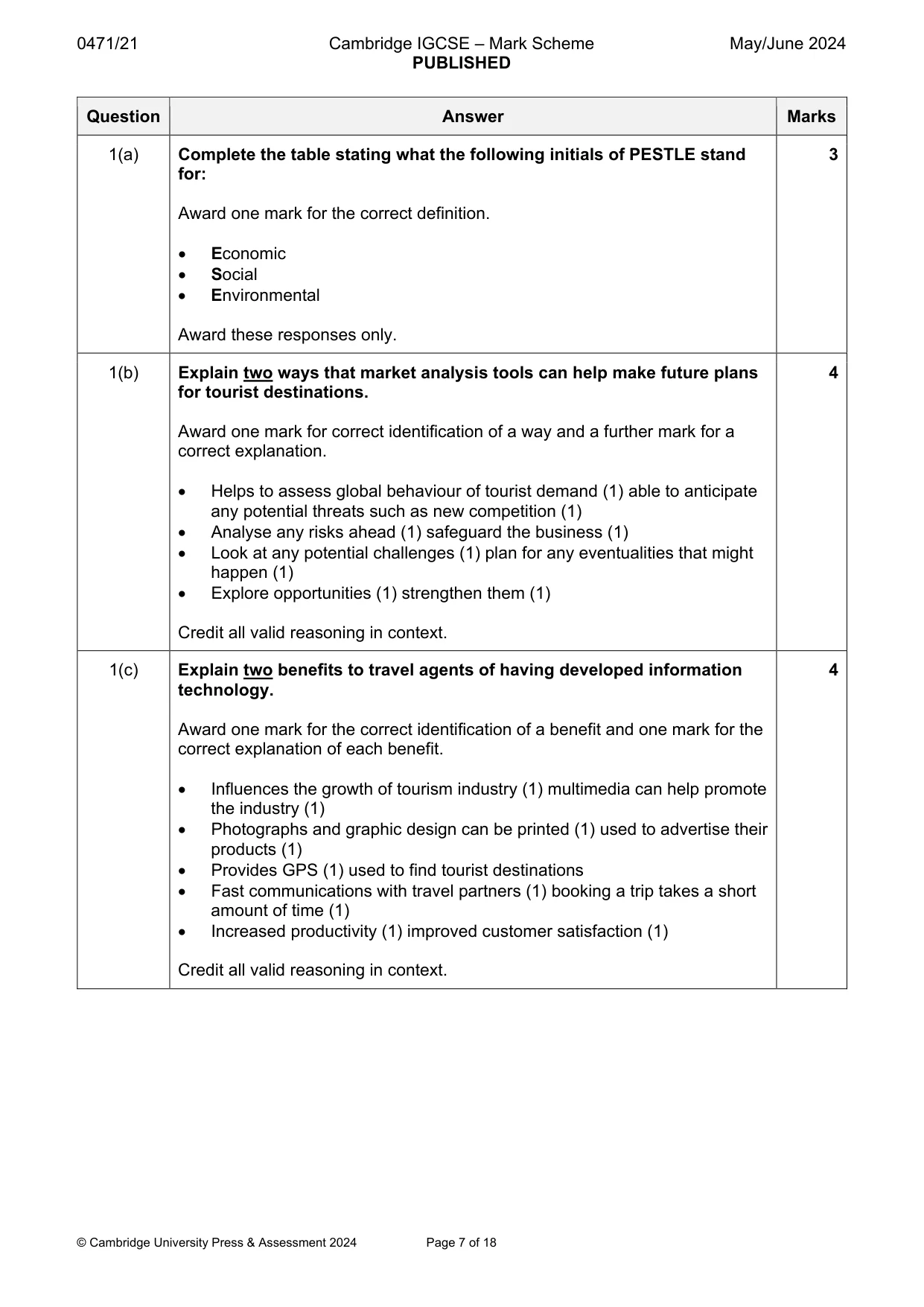
0471/21 Cambridge IGCSE – Mark Scheme PUBLISHED May/June 2024 © Cambridge University Press & Assessment 2024 Page 7 of 18 Question Answer Marks 1(a) Complete the table stating what the following initials of PESTLE stand for: Award one mark for the correct definition. Economic Social Environmental Award these responses only. 3 1(b) Explain two ways that market analysis tools can help make future plans for tourist destinations. Award one mark for correct identification of a way and a further mark for a correct explanation. Helps to assess global behaviour of tourist demand (1) able to anticipate any potential threats such as new competition (1) Analyse any risks ahead (1) safeguard the business (1) Look at any potential challenges (1) plan for any eventualities that might happen (1) Explore opportunities (1) strengthen them (1) Credit all valid reasoning in context. 4 1(c) Explain two benefits to travel agents of having developed information technology. Award one mark for the correct identification of a benefit and one mark for the correct explanation of each benefit. Influences the growth of tourism industry (1) multimedia can help promote the industry (1) Photographs and graphic design can be printed (1) used to advertise their products (1) Provides GPS (1) used to find tourist destinations Fast communications with travel partners (1) booking a trip takes a short amount of time (1) Increased productivity (1) improved customer satisfaction (1) Credit all valid reasoning in context. 4
Mark scheme, page 8
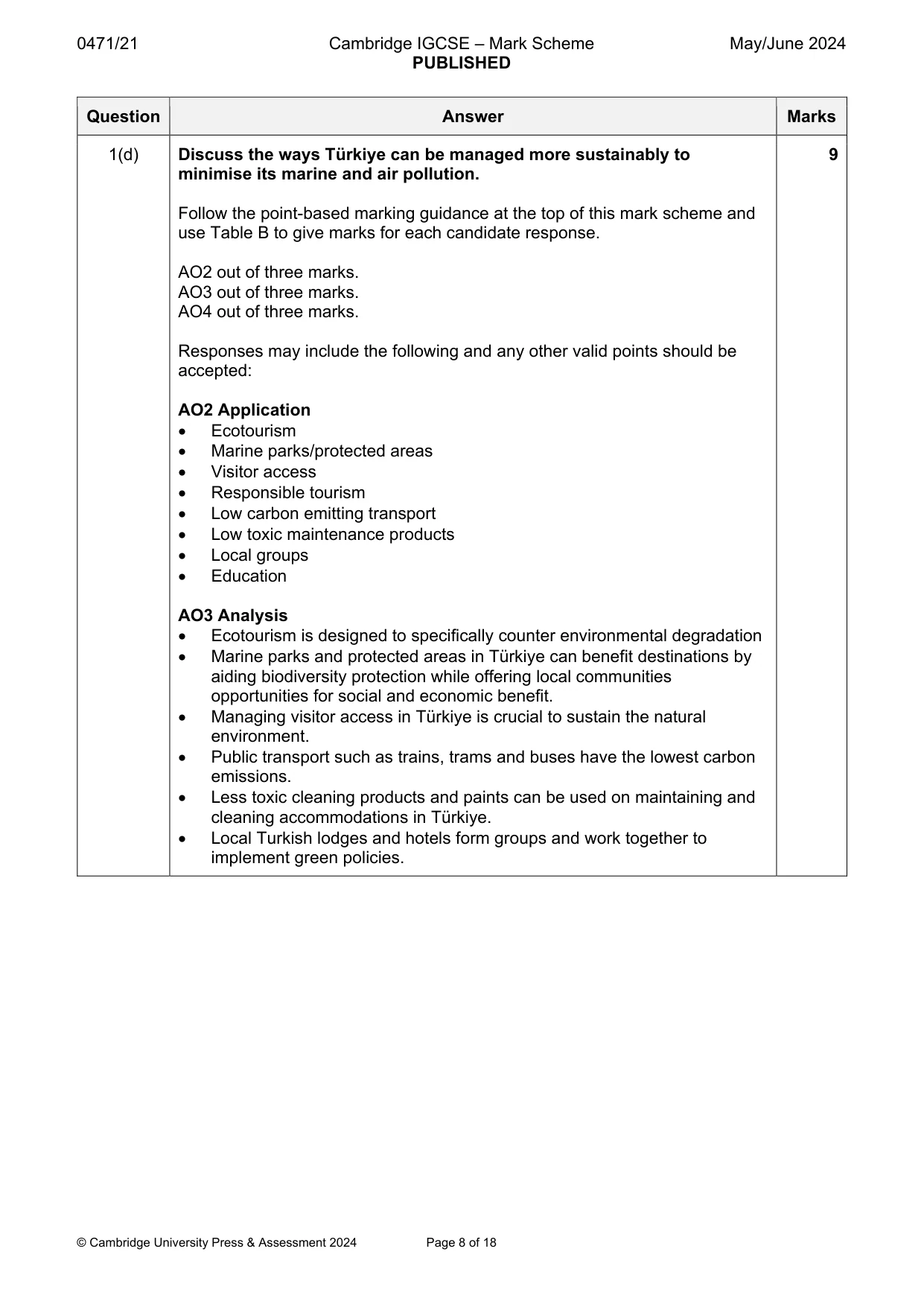
0471/21 Cambridge IGCSE – Mark Scheme PUBLISHED May/June 2024 © Cambridge University Press & Assessment 2024 Page 8 of 18 Question Answer Marks 1(d) Discuss the ways Türkiye can be managed more sustainably to minimise its marine and air pollution. Follow the point-based marking guidance at the top of this mark scheme and use Table B to give marks for each candidate response. AO2 out of three marks. AO3 out of three marks. AO4 out of three marks. Responses may include the following and any other valid points should be accepted: AO2 Application Ecotourism Marine parks/protected areas Visitor access Responsible tourism Low carbon emitting transport Low toxic maintenance products Local groups Education AO3 Analysis Ecotourism is designed to specifically counter environmental degradation Marine parks and protected areas in Türkiye can benefit destinations by aiding biodiversity protection while offering local communities opportunities for social and economic benefit. Managing visitor access in Türkiye is crucial to sustain the natural environment. Public transport such as trains, trams and buses have the lowest carbon emissions. Less toxic cleaning products and paints can be used on maintaining and cleaning accommodations in Türkiye. Local Turkish lodges and hotels form groups and work together to implement green policies. 9
Mark scheme, page 9
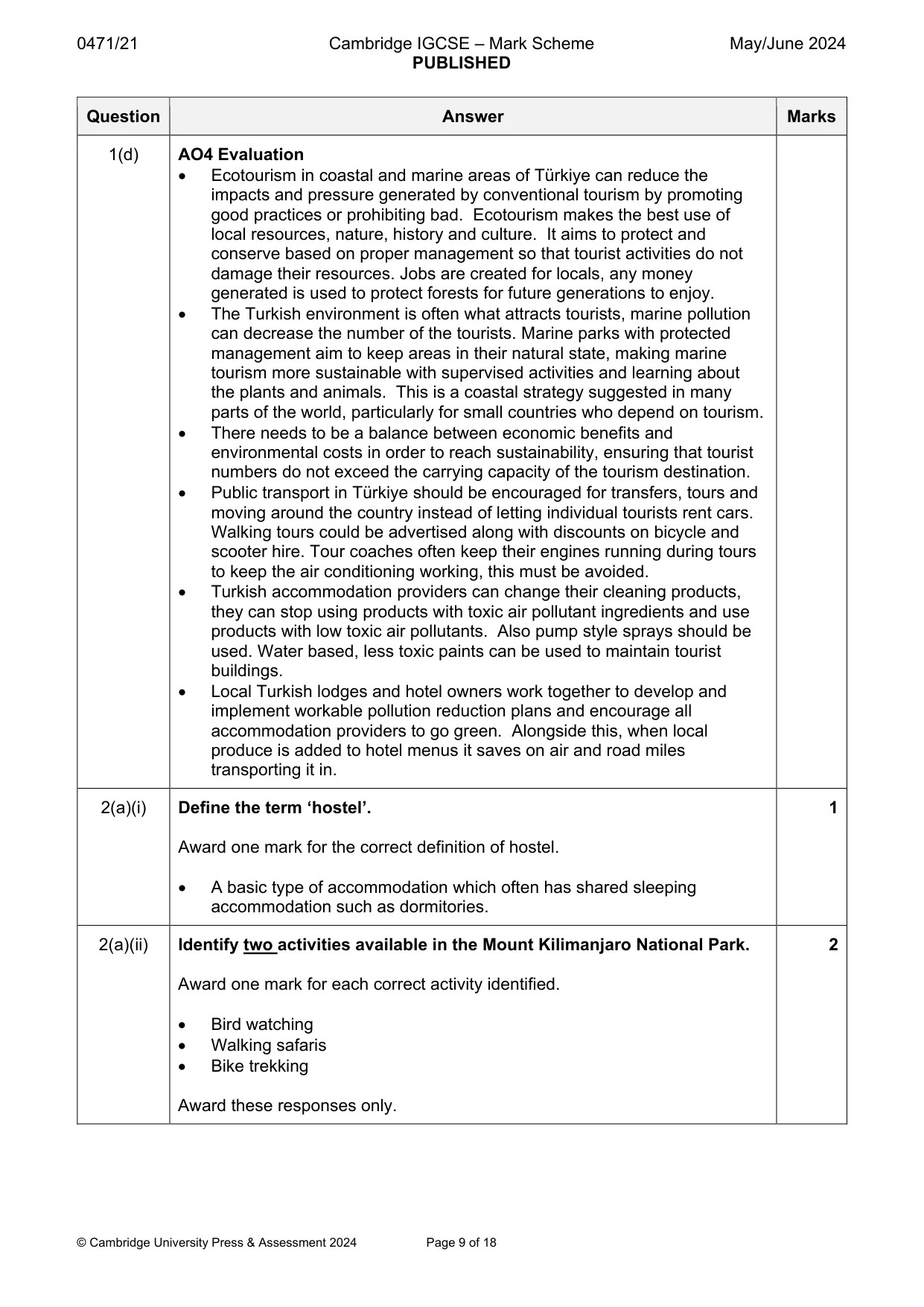
0471/21 Cambridge IGCSE – Mark Scheme PUBLISHED May/June 2024 © Cambridge University Press & Assessment 2024 Page 9 of 18 Question Answer Marks 1(d) AO4 Evaluation Ecotourism in coastal and marine areas of Türkiye can reduce the impacts and pressure generated by conventional tourism by promoting good practices or prohibiting bad. Ecotourism makes the best use of local resources, nature, history and culture. It aims to protect and conserve based on proper management so that tourist activities do not damage their resources. Jobs are created for locals, any money generated is used to protect forests for future generations to enjoy. The Turkish environment is often what attracts tourists, marine pollution can decrease the number of the tourists. Marine parks with protected management aim to keep areas in their natural state, making marine tourism more sustainable with supervised activities and learning about the plants and animals. This is a coastal strategy suggested in many parts of the world, particularly for small countries who depend on tourism. There needs to be a balance between economic benefits and environmental costs in order to reach sustainability, ensuring that tourist numbers do not exceed the carrying capacity of the tourism destination. Public transport in Türkiye should be encouraged for transfers, tours and moving around the country instead of letting individual tourists rent cars. Walking tours could be advertised along with discounts on bicycle and scooter hire. Tour coaches often keep their engines running during tours to keep the air conditioning working, this must be avoided. Turkish accommodation providers can change their cleaning products, they can stop using products with toxic air pollutant ingredients and use products with low toxic air pollutants. Also pump style sprays should be used. Water based, less toxic paints can be used to maintain tourist buildings. Local Turkish lodges and hotel owners work together to develop and implement workable pollution reduction plans and encourage all accommodation providers to go green. Alongside this, when local produce is added to hotel menus it saves on air and road miles transporting it in. 2(a)(i) Define the term ‘hostel’. Award one mark for the correct definition of hostel. A basic type of accommodation which often has shared sleeping accommodation such as dormitories. 1 2(a)(ii) Identify two activities available in the Mount Kilimanjaro National Park. Award one mark for each correct activity identified. Bird watching Walking safaris Bike trekking Award these responses only. 2
Mark scheme, page 10
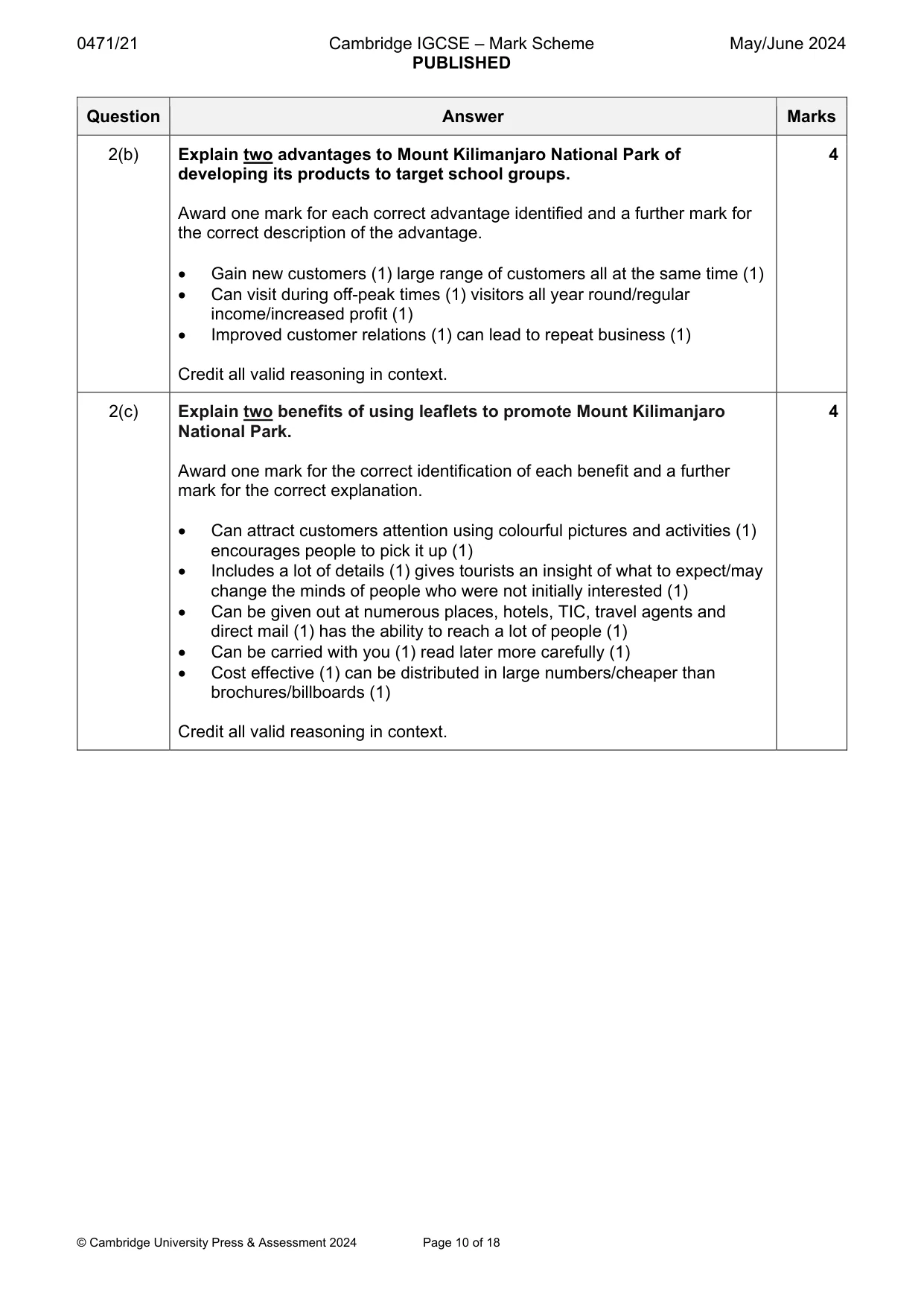
0471/21 Cambridge IGCSE – Mark Scheme PUBLISHED May/June 2024 © Cambridge University Press & Assessment 2024 Page 10 of 18 Question Answer Marks 2(b) Explain two advantages to Mount Kilimanjaro National Park of developing its products to target school groups. Award one mark for each correct advantage identified and a further mark for the correct description of the advantage. Gain new customers (1) large range of customers all at the same time (1) Can visit during off-peak times (1) visitors all year round/regular income/increased profit (1) Improved customer relations (1) can lead to repeat business (1) Credit all valid reasoning in context. 4 2(c) Explain two benefits of using leaflets to promote Mount Kilimanjaro National Park. Award one mark for the correct identification of each benefit and a further mark for the correct explanation. Can attract customers attention using colourful pictures and activities (1) encourages people to pick it up (1) Includes a lot of details (1) gives tourists an insight of what to expect/may change the minds of people who were not initially interested (1) Can be given out at numerous places, hotels, TIC, travel agents and direct mail (1) has the ability to reach a lot of people (1) Can be carried with you (1) read later more carefully (1) Cost effective (1) can be distributed in large numbers/cheaper than brochures/billboards (1) Credit all valid reasoning in context. 4
Mark scheme, page 11
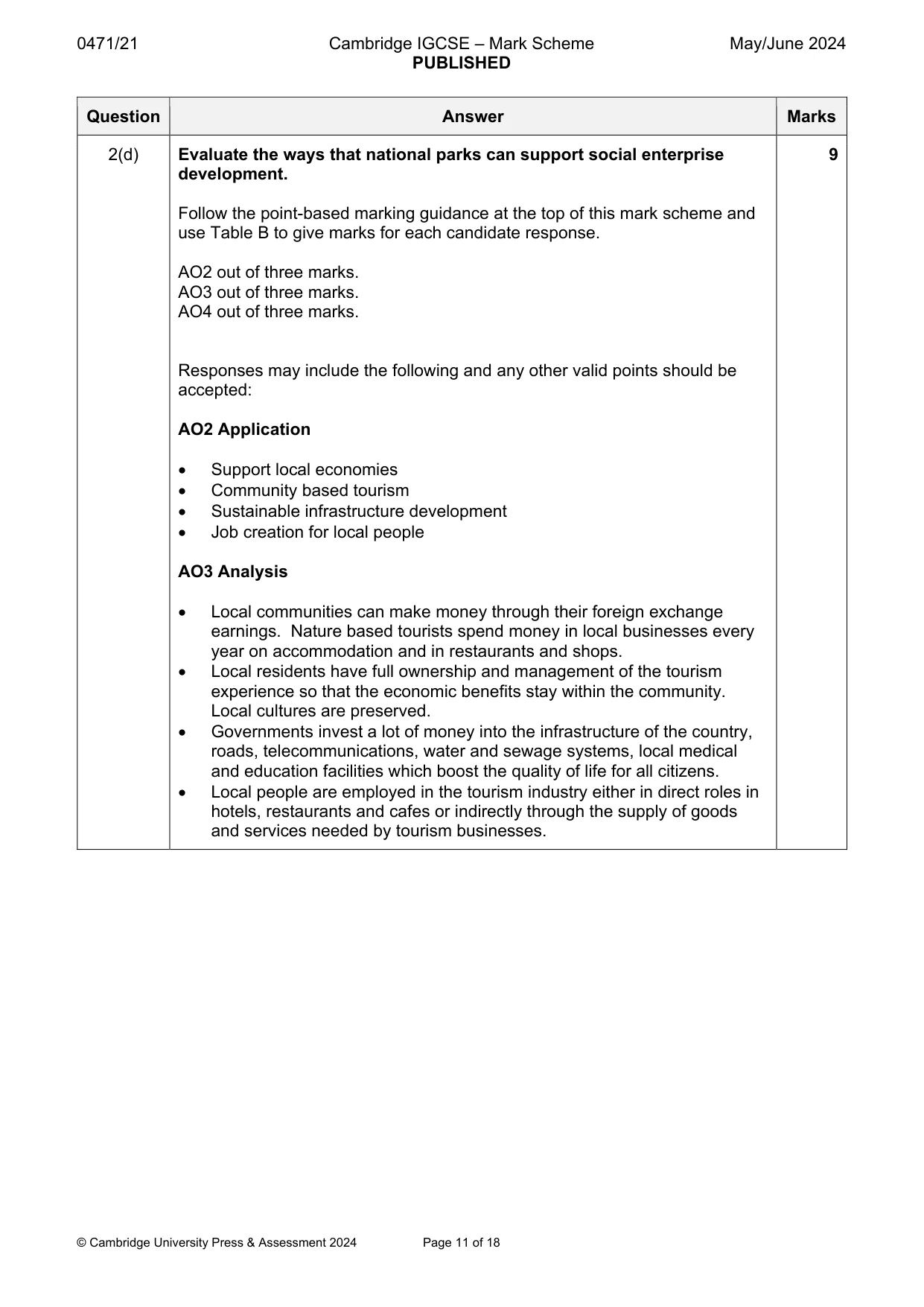
0471/21 Cambridge IGCSE – Mark Scheme PUBLISHED May/June 2024 © Cambridge University Press & Assessment 2024 Page 11 of 18 Question Answer Marks 2(d) Evaluate the ways that national parks can support social enterprise development. Follow the point-based marking guidance at the top of this mark scheme and use Table B to give marks for each candidate response. AO2 out of three marks. AO3 out of three marks. AO4 out of three marks. Responses may include the following and any other valid points should be accepted: AO2 Application Support local economies Community based tourism Sustainable infrastructure development Job creation for local people AO3 Analysis Local communities can make money through their foreign exchange earnings. Nature based tourists spend money in local businesses every year on accommodation and in restaurants and shops. Local residents have full ownership and management of the tourism experience so that the economic benefits stay within the community. Local cultures are preserved. Governments invest a lot of money into the infrastructure of the country, roads, telecommunications, water and sewage systems, local medical and education facilities which boost the quality of life for all citizens. Local people are employed in the tourism industry either in direct roles in hotels, restaurants and cafes or indirectly through the supply of goods and services needed by tourism businesses. 9
Mark scheme, page 12
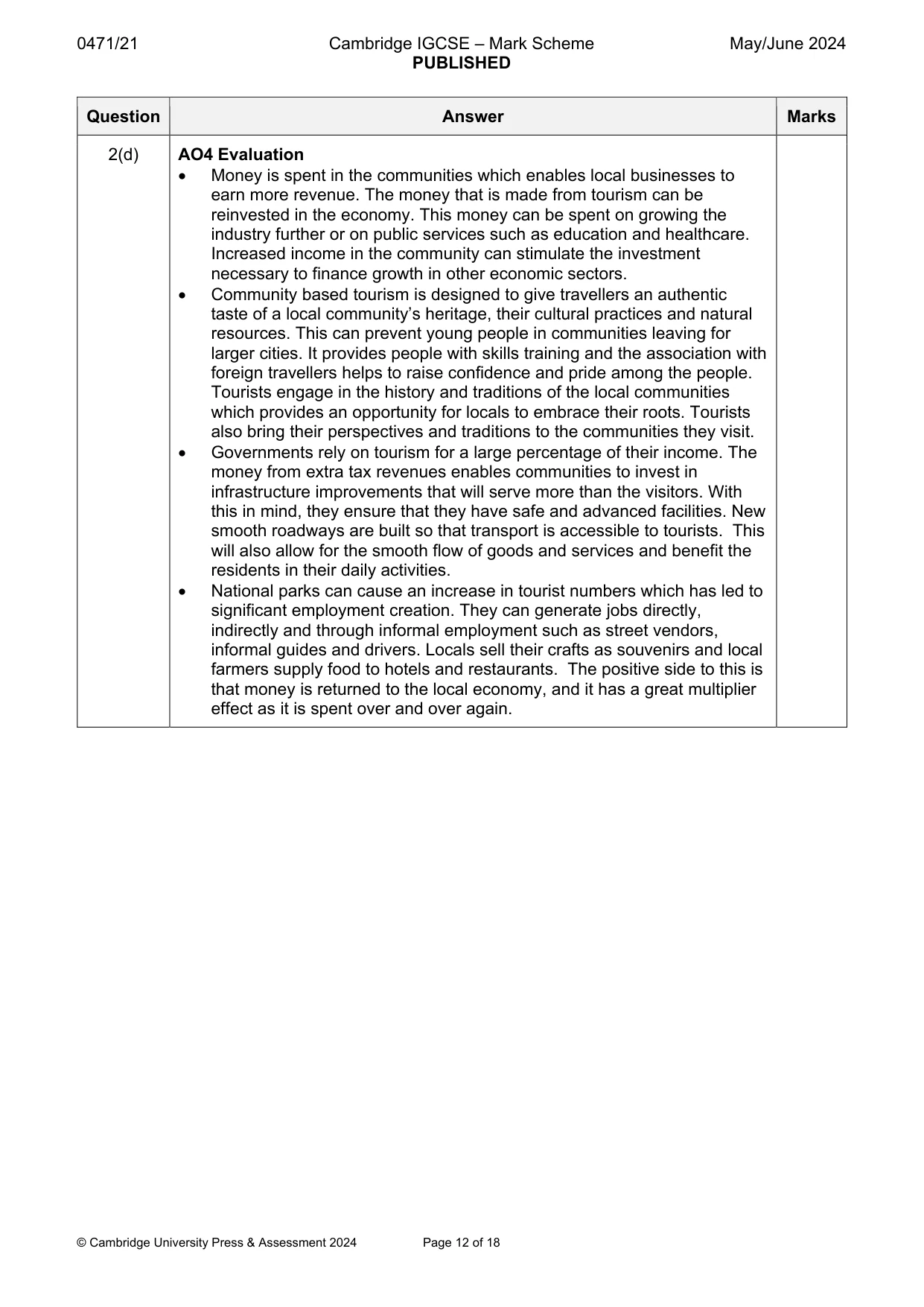
0471/21 Cambridge IGCSE – Mark Scheme PUBLISHED May/June 2024 © Cambridge University Press & Assessment 2024 Page 12 of 18 Question Answer Marks 2(d) AO4 Evaluation Money is spent in the communities which enables local businesses to earn more revenue. The money that is made from tourism can be reinvested in the economy. This money can be spent on growing the industry further or on public services such as education and healthcare. Increased income in the community can stimulate the investment necessary to finance growth in other economic sectors. Community based tourism is designed to give travellers an authentic taste of a local community’s heritage, their cultural practices and natural resources. This can prevent young people in communities leaving for larger cities. It provides people with skills training and the association with foreign travellers helps to raise confidence and pride among the people. Tourists engage in the history and traditions of the local communities which provides an opportunity for locals to embrace their roots. Tourists also bring their perspectives and traditions to the communities they visit. Governments rely on tourism for a large percentage of their income. The money from extra tax revenues enables communities to invest in infrastructure improvements that will serve more than the visitors. With this in mind, they ensure that they have safe and advanced facilities. New smooth roadways are built so that transport is accessible to tourists. This will also allow for the smooth flow of goods and services and benefit the residents in their daily activities. National parks can cause an increase in tourist numbers which has led to significant employment creation. They can generate jobs directly, indirectly and through informal employment such as street vendors, informal guides and drivers. Locals sell their crafts as souvenirs and local farmers supply food to hotels and restaurants. The positive side to this is that money is returned to the local economy, and it has a great multiplier effect as it is spent over and over again.
Mark scheme, page 13
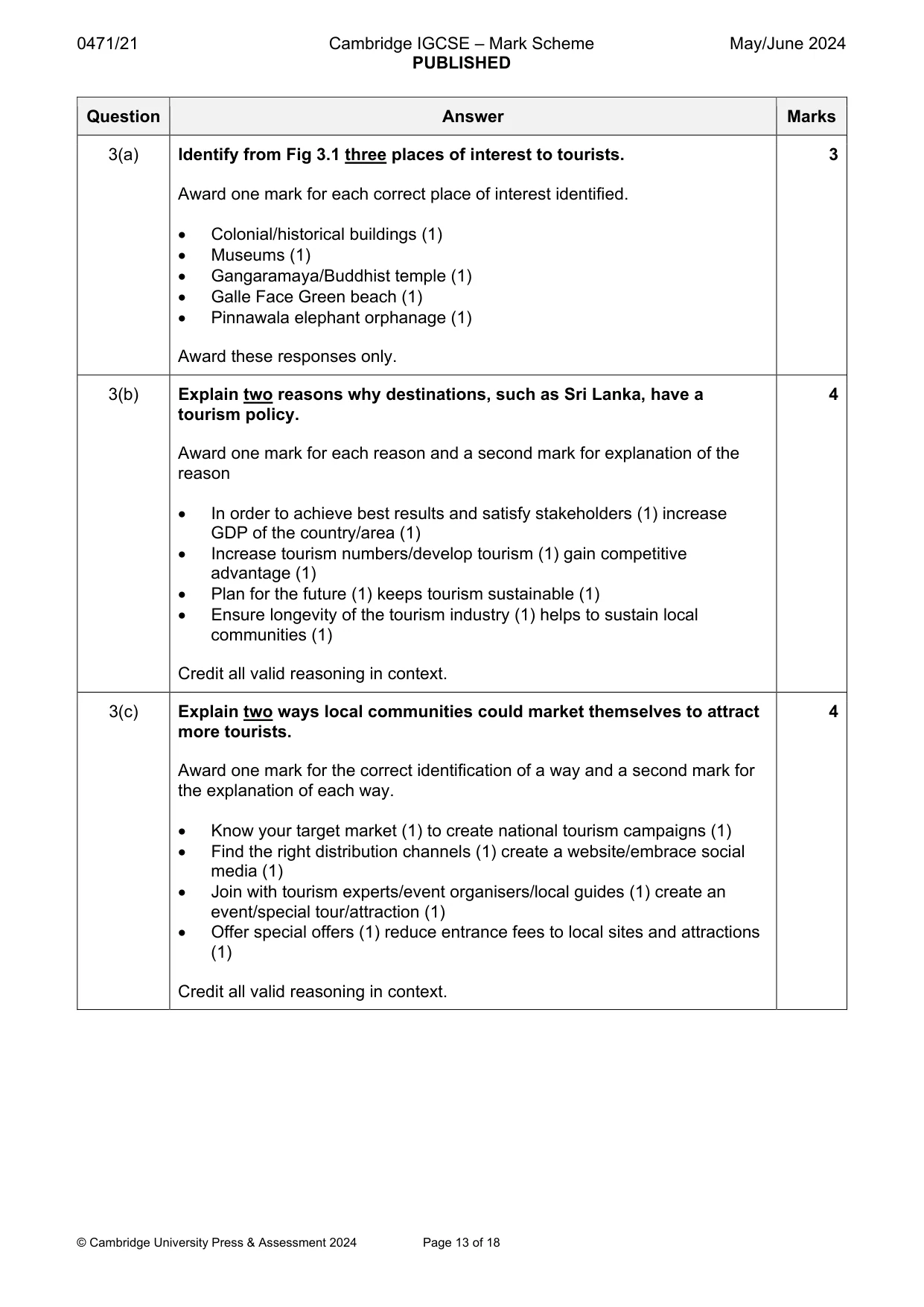
0471/21 Cambridge IGCSE – Mark Scheme PUBLISHED May/June 2024 © Cambridge University Press & Assessment 2024 Page 13 of 18 Question Answer Marks 3(a) Identify from Fig 3.1 three places of interest to tourists. Award one mark for each correct place of interest identified. Colonial/historical buildings (1) Museums (1) Gangaramaya/Buddhist temple (1) Galle Face Green beach (1) Pinnawala elephant orphanage (1) Award these responses only. 3 3(b) Explain two reasons why destinations, such as Sri Lanka, have a tourism policy. Award one mark for each reason and a second mark for explanation of the reason In order to achieve best results and satisfy stakeholders (1) increase GDP of the country/area (1) Increase tourism numbers/develop tourism (1) gain competitive advantage (1) Plan for the future (1) keeps tourism sustainable (1) Ensure longevity of the tourism industry (1) helps to sustain local communities (1) Credit all valid reasoning in context. 4 3(c) Explain two ways local communities could market themselves to attract more tourists. Award one mark for the correct identification of a way and a second mark for the explanation of each way. Know your target market (1) to create national tourism campaigns (1) Find the right distribution channels (1) create a website/embrace social media (1) Join with tourism experts/event organisers/local guides (1) create an event/special tour/attraction (1) Offer special offers (1) reduce entrance fees to local sites and attractions (1) Credit all valid reasoning in context. 4
Mark scheme, page 14
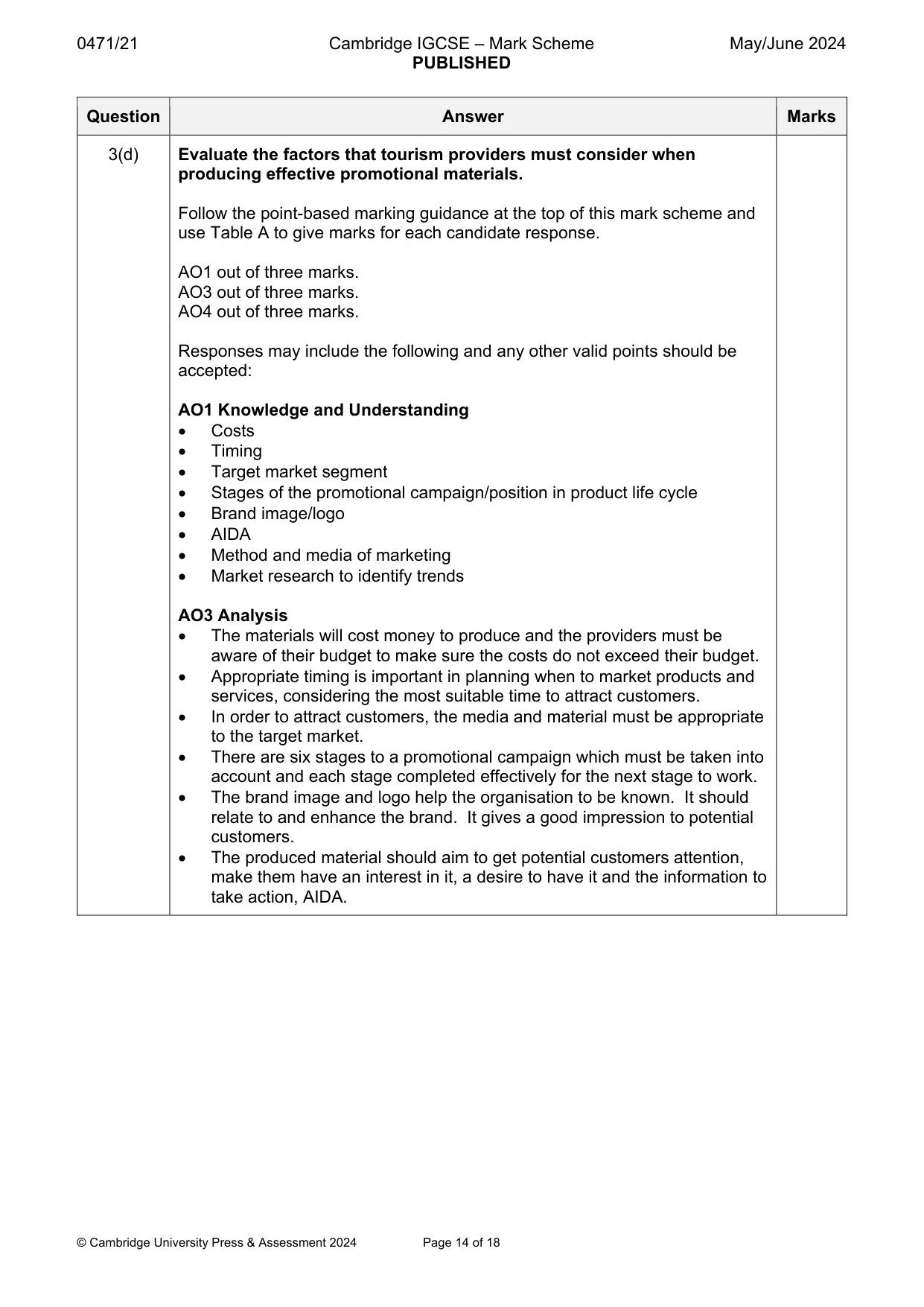
0471/21 Cambridge IGCSE – Mark Scheme PUBLISHED May/June 2024 © Cambridge University Press & Assessment 2024 Page 14 of 18 Question Answer Marks 3(d) Evaluate the factors that tourism providers must consider when producing effective promotional materials. Follow the point-based marking guidance at the top of this mark scheme and use Table A to give marks for each candidate response. AO1 out of three marks. AO3 out of three marks. AO4 out of three marks. Responses may include the following and any other valid points should be accepted: AO1 Knowledge and Understanding Costs Timing Target market segment Stages of the promotional campaign/position in product life cycle Brand image/logo AIDA Method and media of marketing Market research to identify trends AO3 Analysis The materials will cost money to produce and the providers must be aware of their budget to make sure the costs do not exceed their budget. Appropriate timing is important in planning when to market products and services, considering the most suitable time to attract customers. In order to attract customers, the media and material must be appropriate to the target market. There are six stages to a promotional campaign which must be taken into account and each stage completed effectively for the next stage to work. The brand image and logo help the organisation to be known. It should relate to and enhance the brand. It gives a good impression to potential customers. The produced material should aim to get potential customers attention, make them have an interest in it, a desire to have it and the information to take action, AIDA.
Mark scheme, page 15
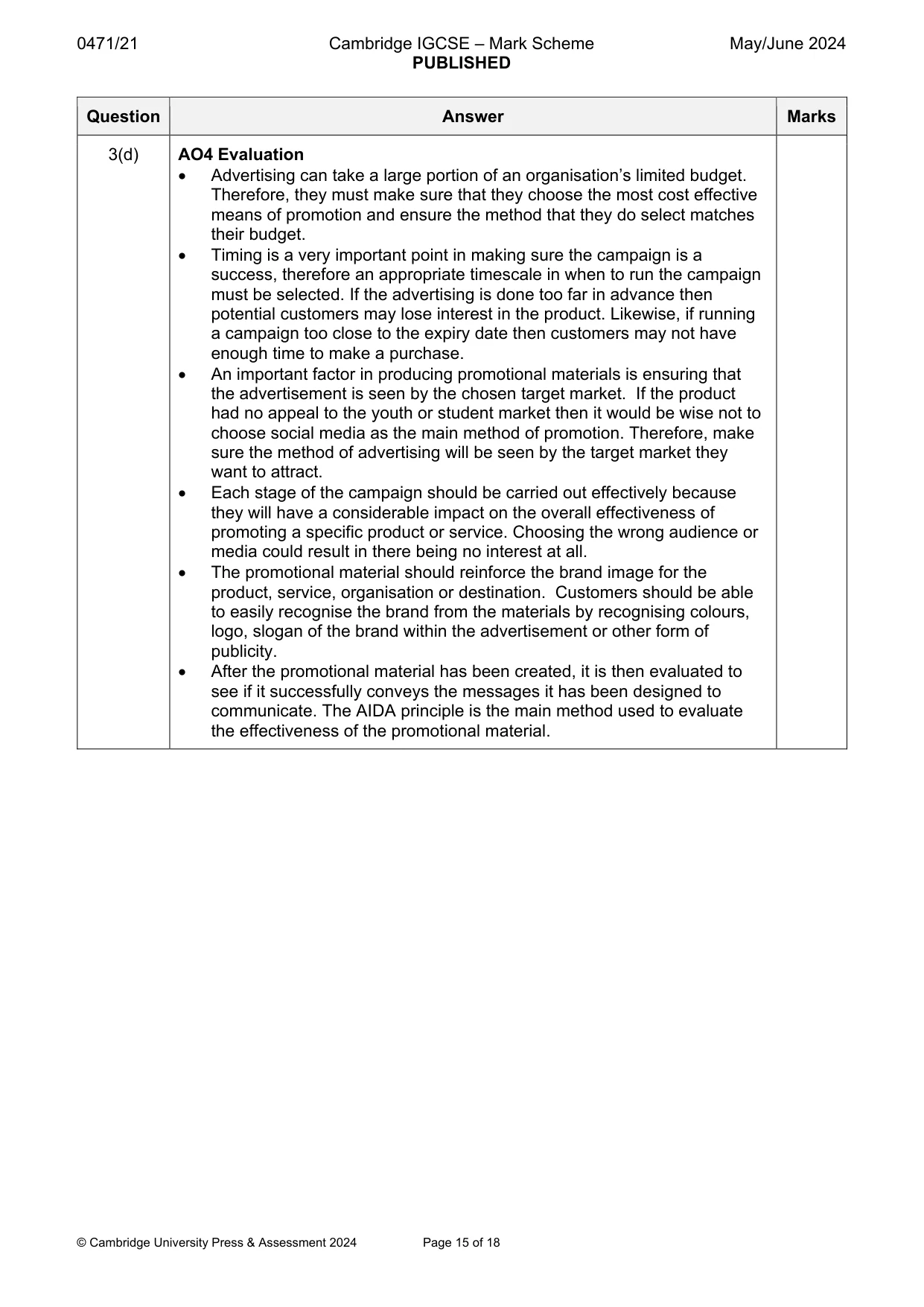
0471/21 Cambridge IGCSE – Mark Scheme PUBLISHED May/June 2024 © Cambridge University Press & Assessment 2024 Page 15 of 18 Question Answer Marks 3(d) AO4 Evaluation Advertising can take a large portion of an organisation’s limited budget. Therefore, they must make sure that they choose the most cost effective means of promotion and ensure the method that they do select matches their budget. Timing is a very important point in making sure the campaign is a success, therefore an appropriate timescale in when to run the campaign must be selected. If the advertising is done too far in advance then potential customers may lose interest in the product. Likewise, if running a campaign too close to the expiry date then customers may not have enough time to make a purchase. An important factor in producing promotional materials is ensuring that the advertisement is seen by the chosen target market. If the product had no appeal to the youth or student market then it would be wise not to choose social media as the main method of promotion. Therefore, make sure the method of advertising will be seen by the target market they want to attract. Each stage of the campaign should be carried out effectively because they will have a considerable impact on the overall effectiveness of promoting a specific product or service. Choosing the wrong audience or media could result in there being no interest at all. The promotional material should reinforce the brand image for the product, service, organisation or destination. Customers should be able to easily recognise the brand from the materials by recognising colours, logo, slogan of the brand within the advertisement or other form of publicity. After the promotional material has been created, it is then evaluated to see if it successfully conveys the messages it has been designed to communicate. The AIDA principle is the main method used to evaluate the effectiveness of the promotional material.
Mark scheme, page 16
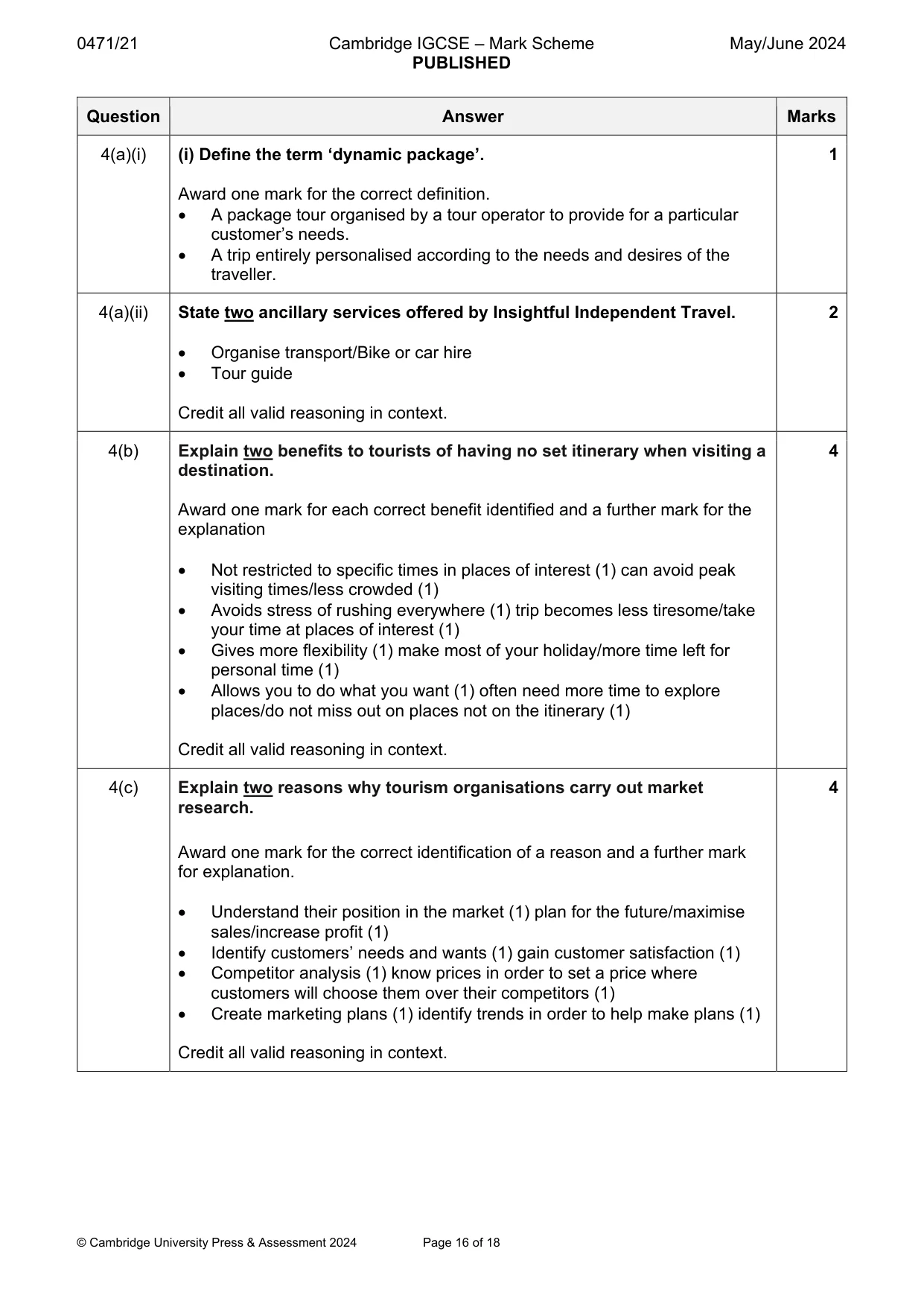
0471/21 Cambridge IGCSE – Mark Scheme PUBLISHED May/June 2024 © Cambridge University Press & Assessment 2024 Page 16 of 18 Question Answer Marks 4(a)(i) (i) Define the term ‘dynamic package’. Award one mark for the correct definition. A package tour organised by a tour operator to provide for a particular customer’s needs. A trip entirely personalised according to the needs and desires of the traveller. 1 4(a)(ii) State two ancillary services offered by Insightful Independent Travel. Organise transport/Bike or car hire Tour guide Credit all valid reasoning in context. 2 4(b) Explain two benefits to tourists of having no set itinerary when visiting a destination. Award one mark for each correct benefit identified and a further mark for the explanation Not restricted to specific times in places of interest (1) can avoid peak visiting times/less crowded (1) Avoids stress of rushing everywhere (1) trip becomes less tiresome/take your time at places of interest (1) Gives more flexibility (1) make most of your holiday/more time left for personal time (1) Allows you to do what you want (1) often need more time to explore places/do not miss out on places not on the itinerary (1) Credit all valid reasoning in context. 4 4(c) Explain two reasons why tourism organisations carry out market research. Award one mark for the correct identification of a reason and a further mark for explanation. Understand their position in the market (1) plan for the future/maximise sales/increase profit (1) Identify customers’ needs and wants (1) gain customer satisfaction (1) Competitor analysis (1) know prices in order to set a price where customers will choose them over their competitors (1) Create marketing plans (1) identify trends in order to help make plans (1) Credit all valid reasoning in context. 4
Mark scheme, page 17
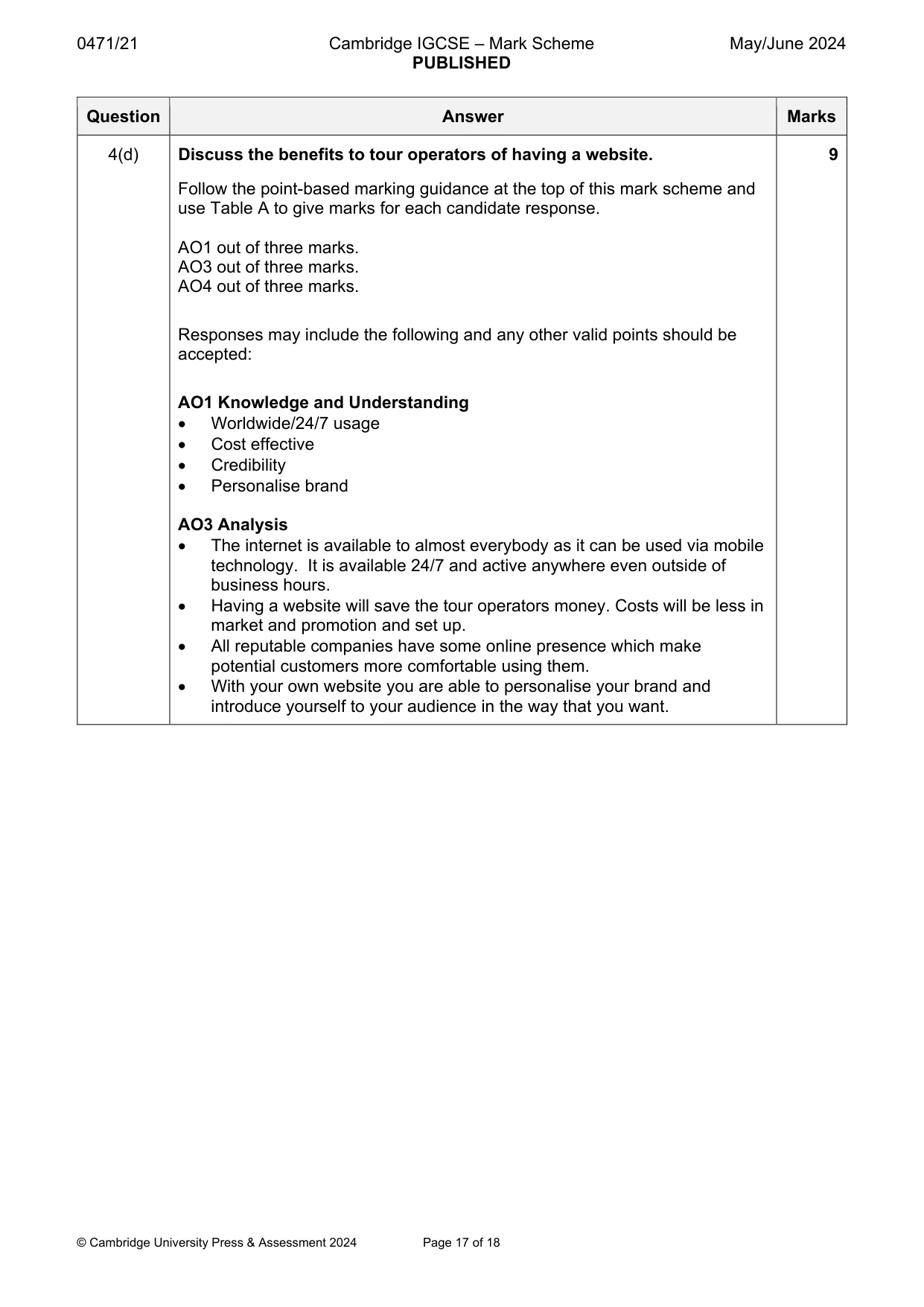
0471/21 Cambridge IGCSE – Mark Scheme PUBLISHED May/June 2024 © Cambridge University Press & Assessment 2024 Page 17 of 18 Question Answer Marks 4(d) Discuss the benefits to tour operators of having a website. Follow the point-based marking guidance at the top of this mark scheme and use Table A to give marks for each candidate response. AO1 out of three marks. AO3 out of three marks. AO4 out of three marks. Responses may include the following and any other valid points should be accepted: AO1 Knowledge and Understanding Worldwide/24/7 usage Cost effective Credibility Personalise brand AO3 Analysis The internet is available to almost everybody as it can be used via mobile technology. It is available 24/7 and active anywhere even outside of business hours. Having a website will save the tour operators money. Costs will be less in market and promotion and set up. All reputable companies have some online presence which make potential customers more comfortable using them. With your own website you are able to personalise your brand and introduce yourself to your audience in the way that you want. 9
Mark scheme, page 18
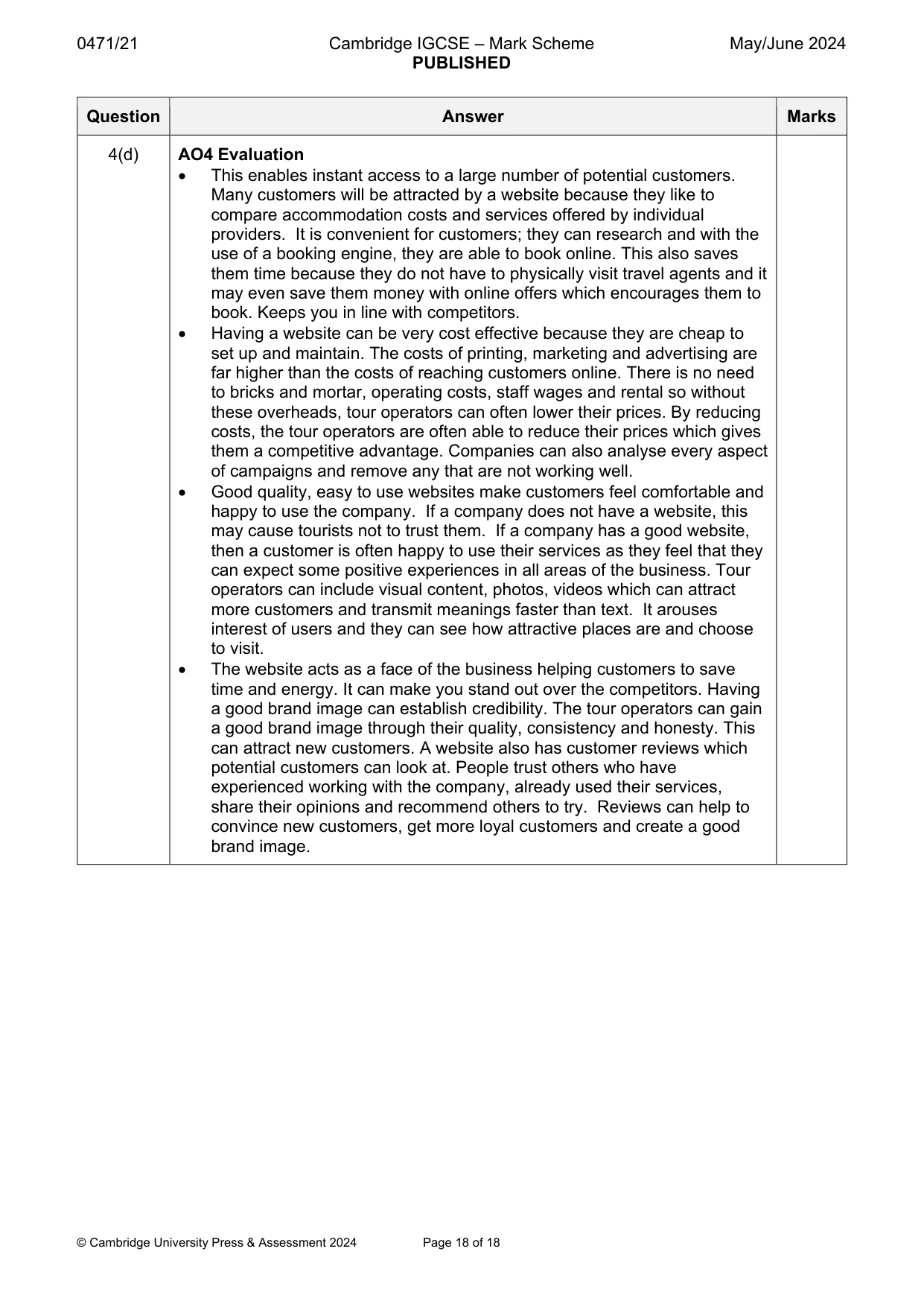
0471/21 Cambridge IGCSE – Mark Scheme PUBLISHED May/June 2024 © Cambridge University Press & Assessment 2024 Page 18 of 18 Question Answer Marks 4(d) AO4 Evaluation This enables instant access to a large number of potential customers. Many customers will be attracted by a website because they like to compare accommodation costs and services offered by individual providers. It is convenient for customers; they can research and with the use of a booking engine, they are able to book online. This also saves them time because they do not have to physically visit travel agents and it may even save them money with online offers which encourages them to book. Keeps you in line with competitors. Having a website can be very cost effective because they are cheap to set up and maintain. The costs of printing, marketing and advertising are far higher than the costs of reaching customers online. There is no need to bricks and mortar, operating costs, staff wages and rental so without these overheads, tour operators can often lower their prices. By reducing costs, the tour operators are often able to reduce their prices which gives them a competitive advantage. Companies can also analyse every aspect of campaigns and remove any that are not working well. Good quality, easy to use websites make customers feel comfortable and happy to use the company. If a company does not have a website, this may cause tourists not to trust them. If a company has a good website, then a customer is often happy to use their services as they feel that they can expect some positive experiences in all areas of the business. Tour operators can include visual content, photos, videos which can attract more customers and transmit meanings faster than text. It arouses interest of users and they can see how attractive places are and choose to visit. The website acts as a face of the business helping customers to save time and energy. It can make you stand out over the competitors. Having a good brand image can establish credibility. The tour operators can gain a good brand image through their quality, consistency and honesty. This can attract new customers. A website also has customer reviews which potential customers can look at. People trust others who have experienced working with the company, already used their services, share their opinions and recommend others to try. Reviews can help to convince new customers, get more loyal customers and create a good brand image.
What you needed in this session
Cambridge’s own grade thresholds for 2024 May/June, Paper 2 · Variant 1. A higher threshold means an easier paper — the bar moves with how the cohort did.