Cambridge IGCSE Travel and Tourism 0471 — 2023 Oct/Nov Paper 2 · Variant 2
0471/22/O/N/23 · 100 marks · ≈113 min
The question paper and its mark scheme, free to read here and free to download. This is Cambridge’s own paper, exactly as it was sat.
Question paper16 pages


Mark scheme11 pages
Answers below. Sit the paper first if you are practising.
Paper as text
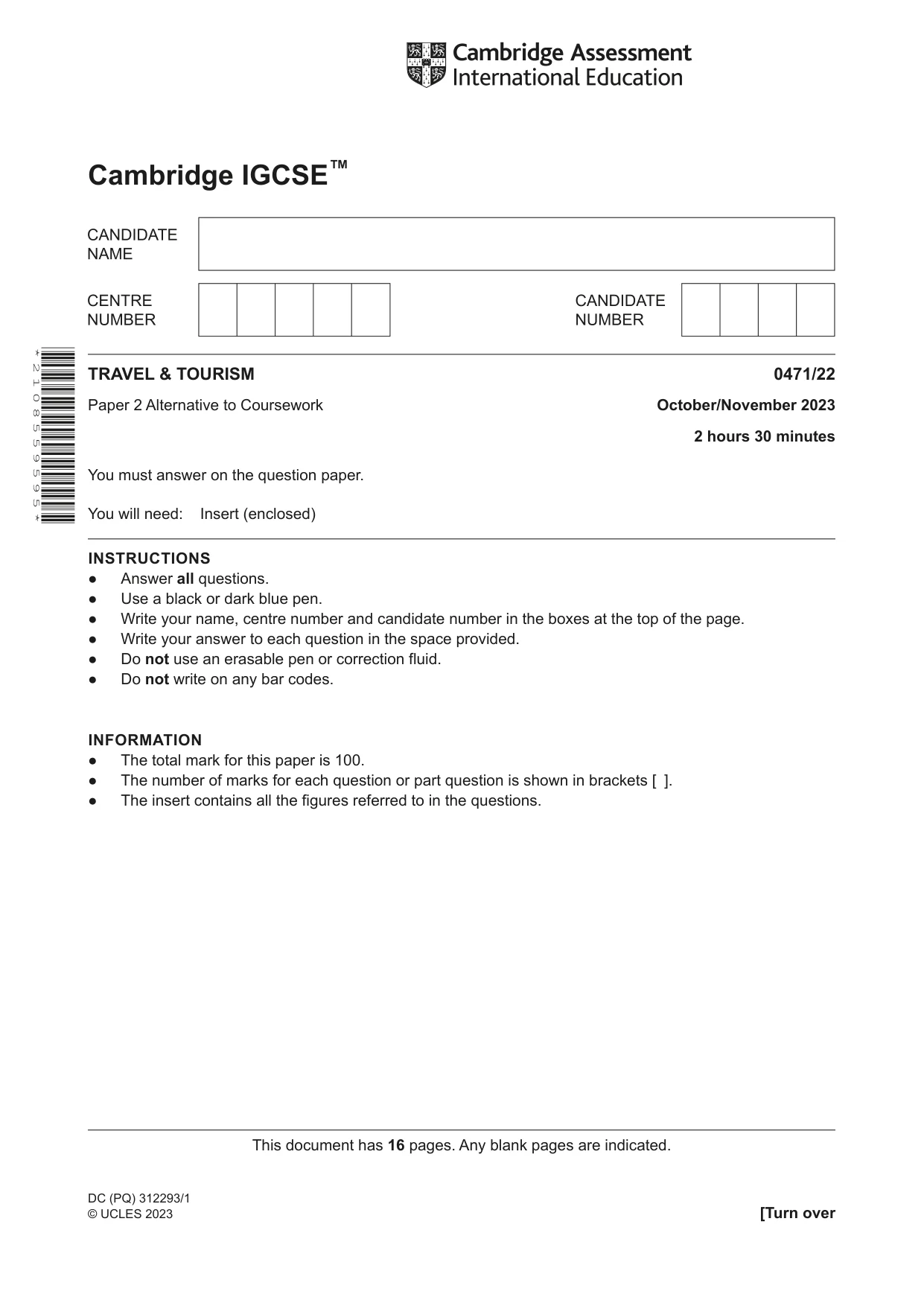
Question paper, page 1
This document has 16 pages. Any blank pages are indicated. [Turn over Cambridge IGCSE™ TRAVEL & TOURISM 0471/22 Paper 2 Alternative to Coursework October/November 2023 2 hours 30 minutes You must answer on the question paper. You will need: Insert (enclosed) INSTRUCTIONS ● Answer all questions. ● Use a black or dark blue pen. ● Write your name, centre number and candidate number in the boxes at the top of the page. ● Write your answer to each question in the space provided. ● Do not use an erasable pen or correction fluid. ● Do not write on any bar codes. INFORMATION ● The total mark for this paper is 100. ● The number of marks for each question or part question is shown in brackets [ ]. ● The insert contains all the figures referred to in the questions. * 2 1 0 8 5 5 9 5 9 5 * DC (PQ) 312293/1 © UCLES 2023
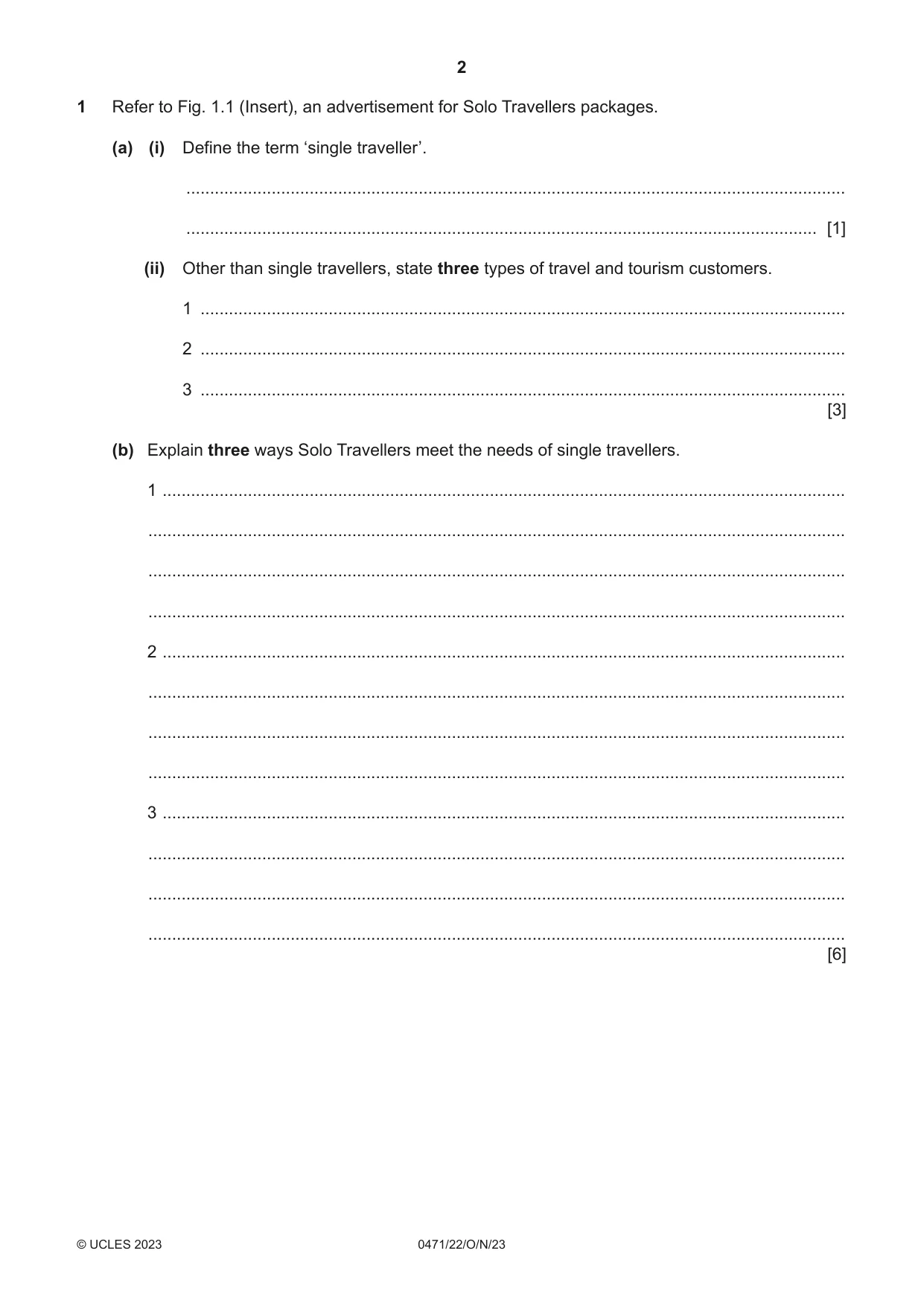
Question paper, page 2
2 0471/22/O/N/23 © UCLES 2023 1 Refer to Fig. 1.1 (Insert), an advertisement for Solo Travellers packages. (a) (i) Define the term ‘single traveller’. … … [1] (ii) Other than single travellers, state three types of travel and tourism customers. 1 … 2 … 3 … [3] (b) Explain three ways Solo Travellers meet the needs of single travellers. 1 … … … … 2 … … … … 3 … … … … [6]
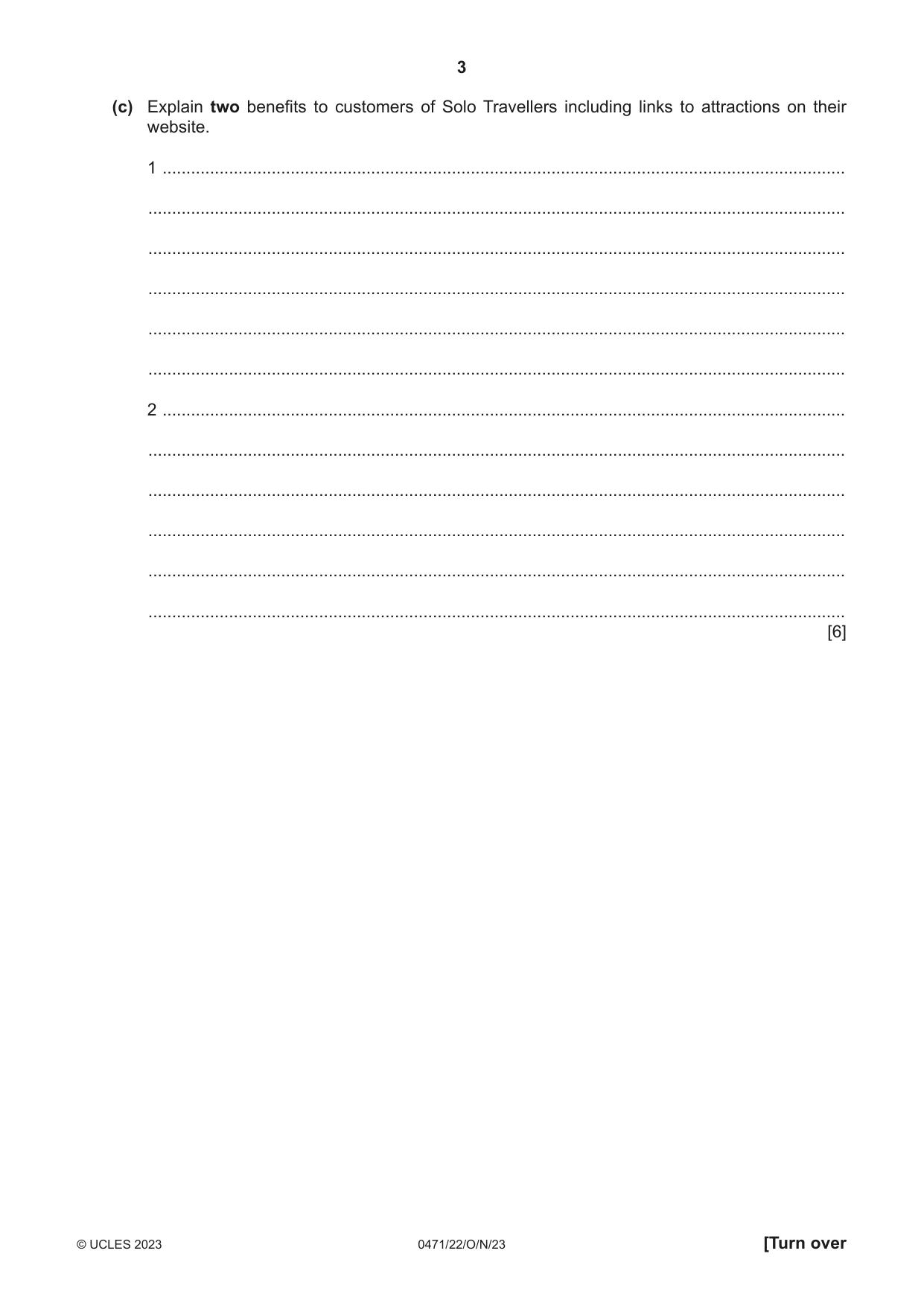
Question paper, page 3
3 0471/22/O/N/23 © UCLES 2023 [Turn over (c) Explain two benefits to customers of Solo Travellers including links to attractions on their website. 1 … … … … … … 2 … … … … … … [6]
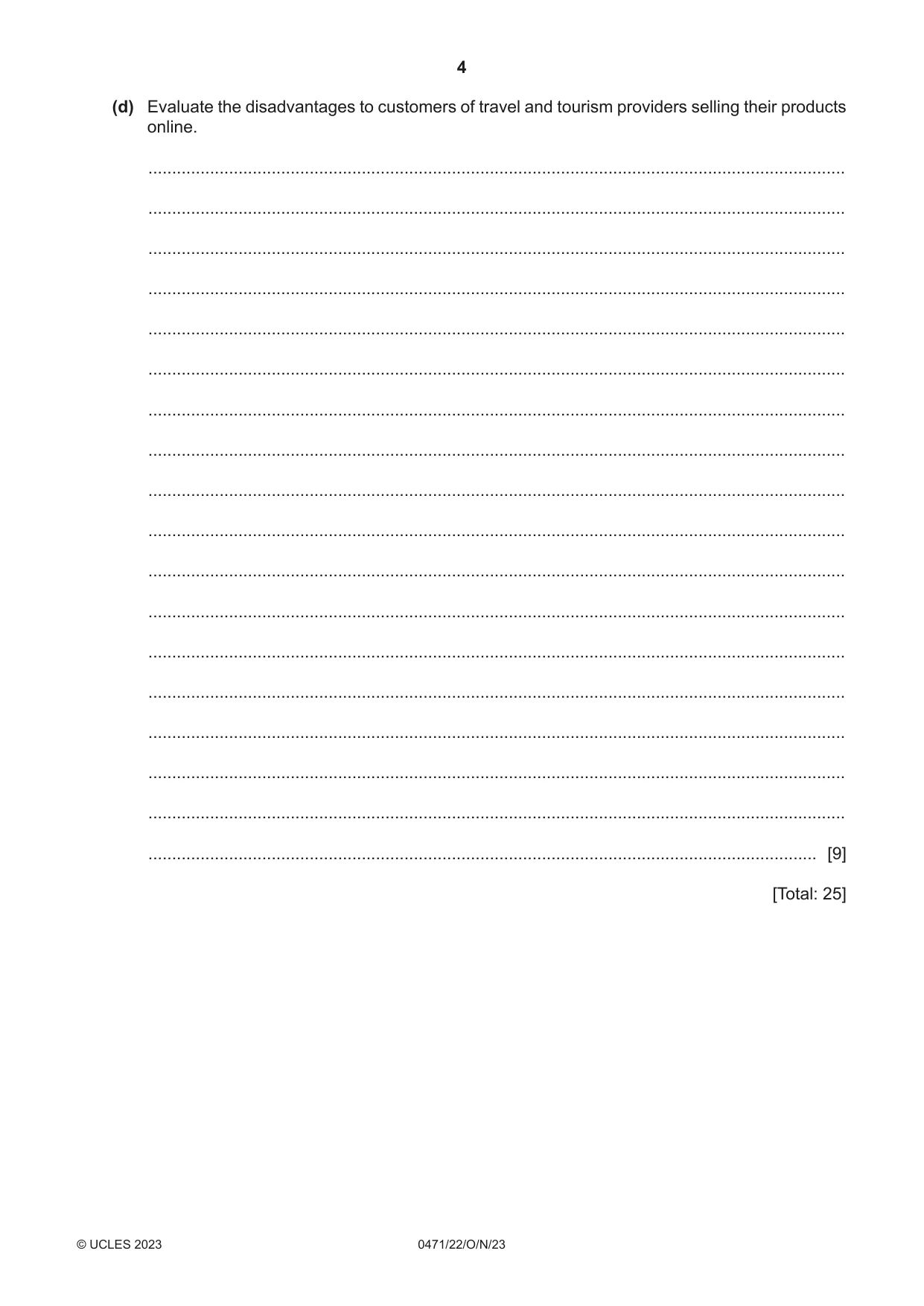
Question paper, page 4
4 0471/22/O/N/23 © UCLES 2023 (d) Evaluate the disadvantages to customers of travel and tourism providers selling their products online. … … … … … … … … … … … … … … … … … … [9] [Total: 25]
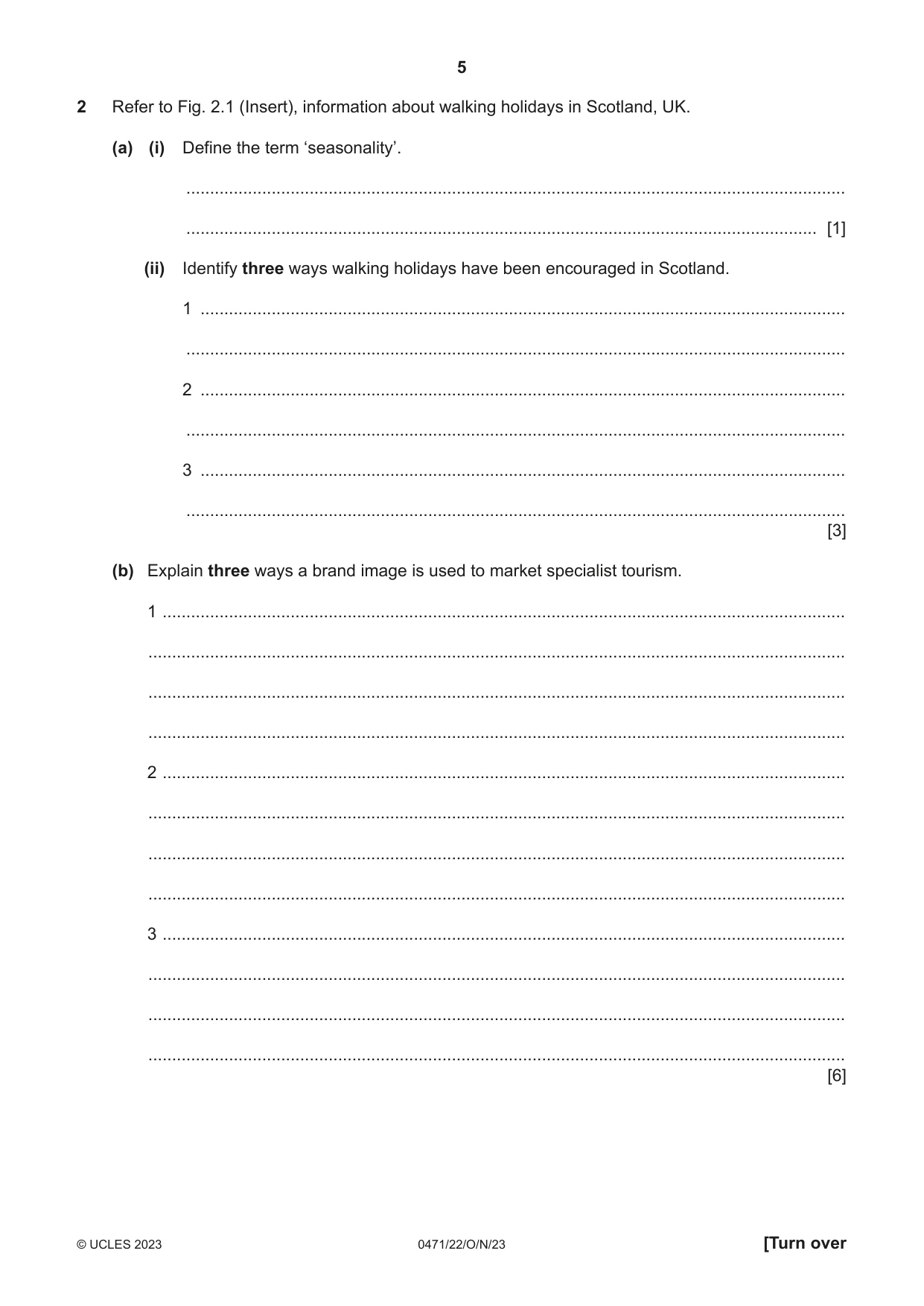
Question paper, page 5
5 0471/22/O/N/23 © UCLES 2023 [Turn over 2 Refer to Fig. 2.1 (Insert), information about walking holidays in Scotland, UK. (a) (i) Define the term ‘seasonality’. … … [1] (ii) Identify three ways walking holidays have been encouraged in Scotland. 1 … … 2 … … 3 … … [3] (b) Explain three ways a brand image is used to market specialist tourism. 1 … … … … 2 … … … … 3 … … … … [6]
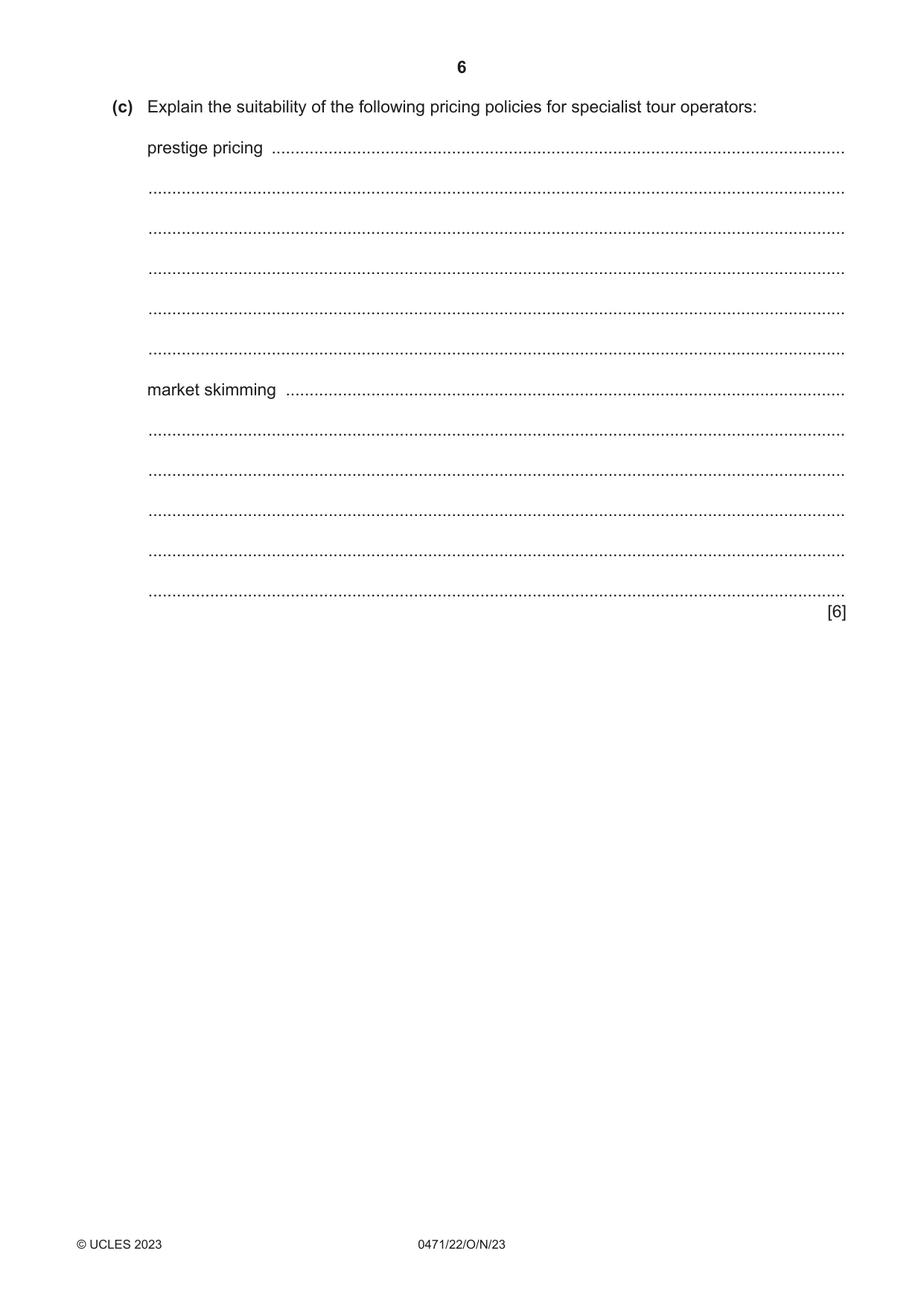
Question paper, page 6
6 0471/22/O/N/23 © UCLES 2023 (c) Explain the suitability of the following pricing policies for specialist tour operators: prestige pricing … … … … … … market skimming … … … … … … [6]
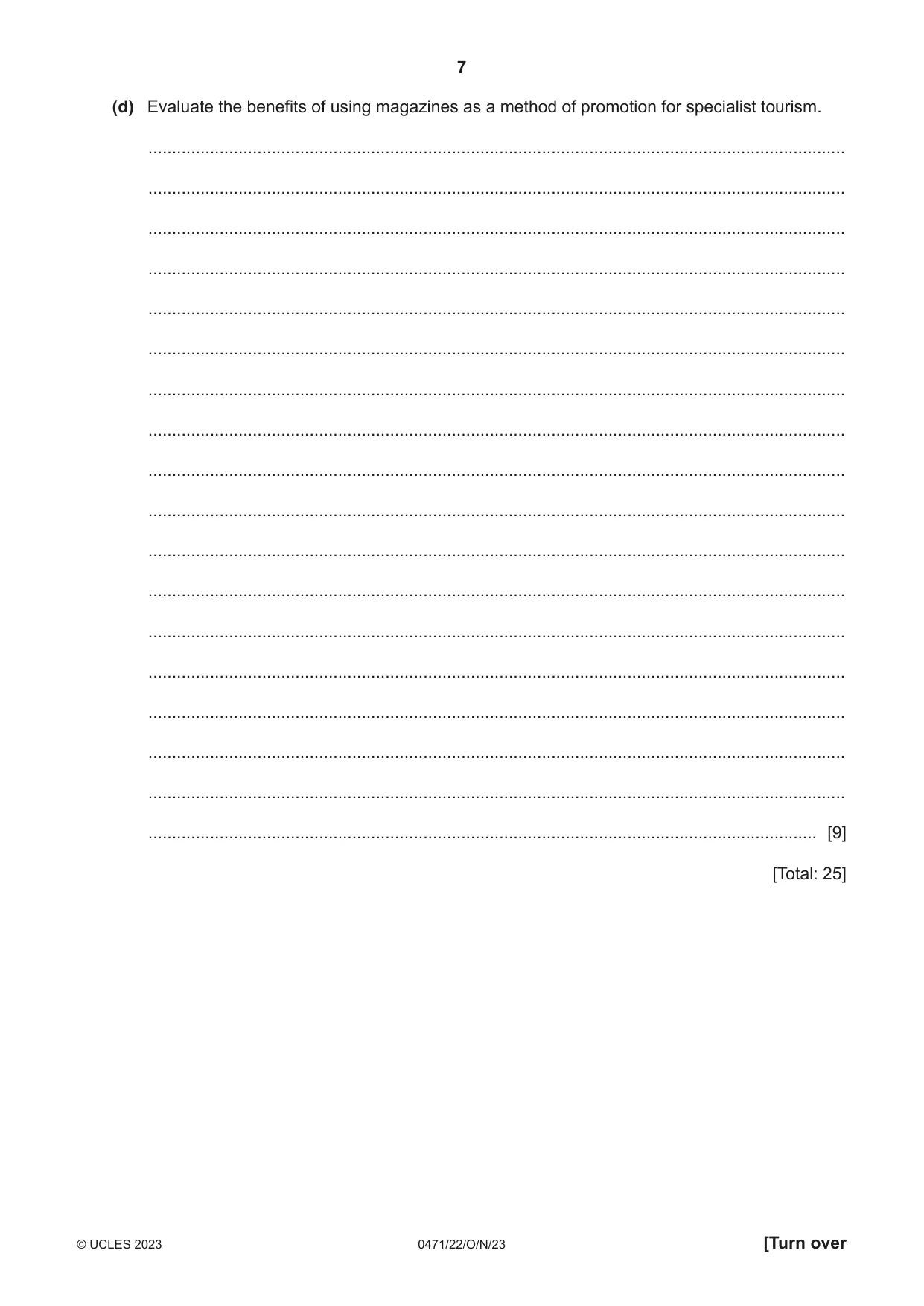
Question paper, page 7
7 0471/22/O/N/23 © UCLES 2023 [Turn over (d) Evaluate the benefits of using magazines as a method of promotion for specialist tourism. … … … … … … … … … … … … … … … … … … [9] [Total: 25]
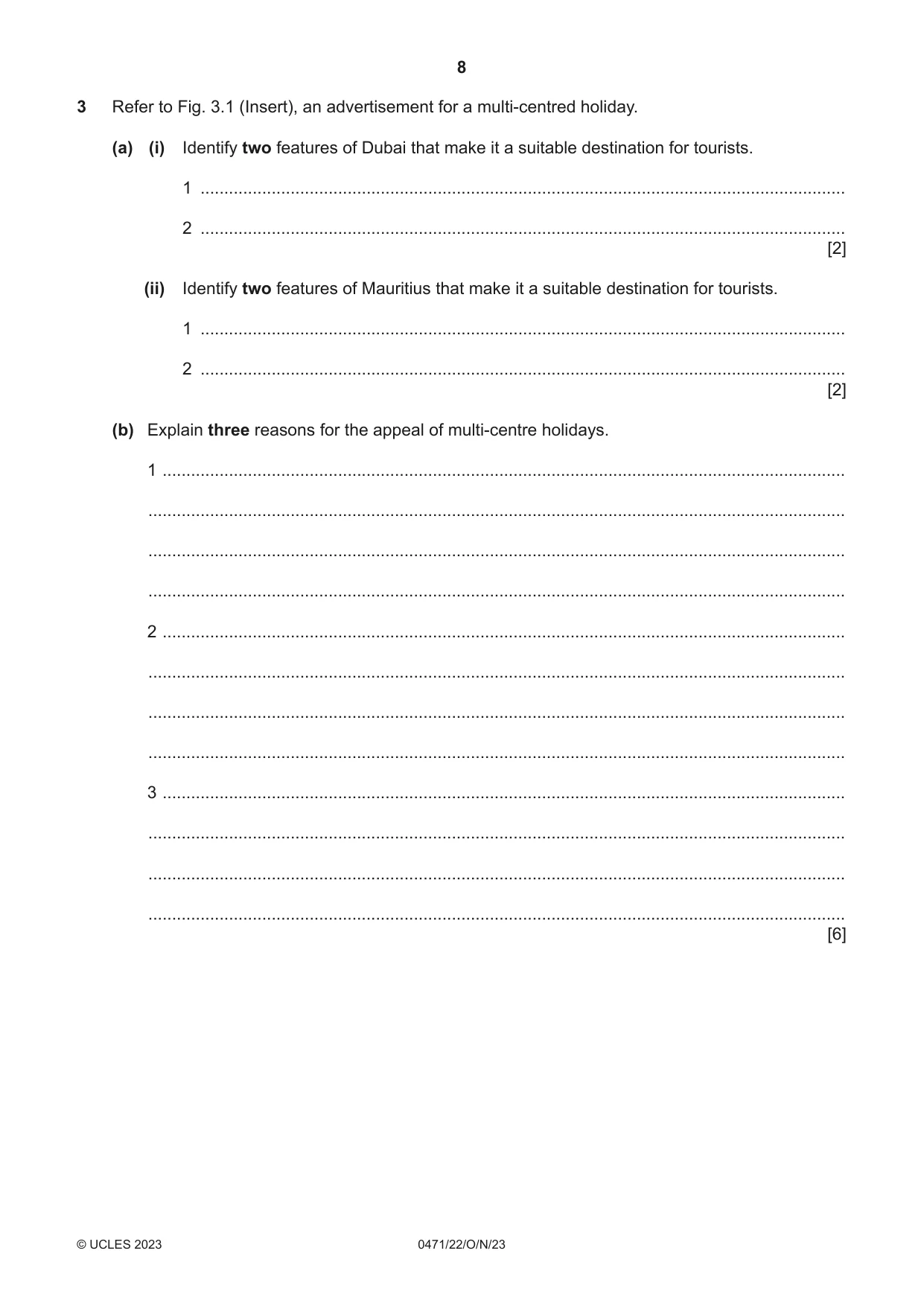
Question paper, page 8
8 0471/22/O/N/23 © UCLES 2023 3 Refer to Fig. 3.1 (Insert), an advertisement for a multi-centred holiday. (a) (i) Identify two features of Dubai that make it a suitable destination for tourists. 1 … 2 … [2] (ii) Identify two features of Mauritius that make it a suitable destination for tourists. 1 … 2 … [2] (b) Explain three reasons for the appeal of multi-centre holidays. 1 … … … … 2 … … … … 3 … … … … [6]
Question paper, page 9
9 0471/22/O/N/23 © UCLES 2023 [Turn over (c) Explain two benefits to tour operators of using discount pricing. 1 … … … … … … 2 … … … … … … [6]
Question paper, page 10
10 0471/22/O/N/23 © UCLES 2023 (d) Discuss the benefits to customers of using online review sites when booking a holiday. … … … … … … … … … … … … … … … … … … [9] [Total: 25]
Question paper, page 11
11 0471/22/O/N/23 © UCLES 2023 [Turn over 4 Refer to Fig. 4.1 (Insert), information about tourism development in Vietnam. (a) State four features of Vietnam that would appeal to adventure tourists. 1 … 2 … 3 … 4 … [4] (b) Tourism in Vietnam is at the growth stage of the product life cycle. Explain three features of this stage. 1 … … … … 2 … … … … 3 … … … … [6]
Question paper, page 12
12 0471/22/O/N/23 © UCLES 2023 (c) Explain two ways tourism providers in Vietnam can use the information in Fig. 4.1 to plan their marketing campaigns. 1 … … … … … … 2 … … … … … … [6]
Question paper, page 13
13 0471/22/O/N/23 © UCLES 2023 (d) Evaluate the benefits to destinations, such as Vietnam, of rebranding. … … … … … … … … … … … … … … … … … … [9] [Total: 25]
Question paper, page 14
14 0471/22/O/N/23 © UCLES 2023 BLANK PAGE
Question paper, page 15
15 0471/22/O/N/23 © UCLES 2023 BLANK PAGE
Question paper, page 16
16 0471/22/O/N/23 © UCLES 2023 The boundaries and names shown, the designations used and the presentation of material on any maps contained in this question paper/insert do not imply official endorsement or acceptance by Cambridge Assessment International Education concerning the legal status of any country, territory, or area or any of its authorities, or of the delimitation of its frontiers or boundaries. Permission to reproduce items where third-party owned material protected by copyright is included has been sought and cleared where possible. Every reasonable effort has been made by the publisher (UCLES) to trace copyright holders, but if any items requiring clearance have unwittingly been included, the publisher will be pleased to make amends at the earliest possible opportunity. To avoid the issue of disclosure of answer-related information to candidates, all copyright acknowledgements are reproduced online in the Cambridge Assessment International Education Copyright Acknowledgements Booklet. This is produced for each series of examinations and is freely available to download at www.cambridgeinternational.org after the live examination series. Cambridge Assessment International Education is part of Cambridge Assessment. Cambridge Assessment is the brand name of the University of Cambridge Local Examinations Syndicate (UCLES), which is a department of the University of Cambridge. BLANK PAGE
Mark scheme, page 1
This document consists of 11 printed pages. © UCLES 2023 [Turn over Cambridge IGCSE™ TRAVEL & TOURISM 0471/22 Paper 2 Alternative to Coursework October/November 2023 MARK SCHEME Maximum Mark: 100 Published This mark scheme is published as an aid to teachers and candidates, to indicate the requirements of the examination. It shows the basis on which Examiners were instructed to award marks. It does not indicate the details of the discussions that took place at an Examiners’ meeting before marking began, which would have considered the acceptability of alternative answers. Mark schemes should be read in conjunction with the question paper and the Principal Examiner Report for Teachers. Cambridge International will not enter into discussions about these mark schemes. Cambridge International is publishing the mark schemes for the October/November 2023 series for most Cambridge IGCSE, Cambridge International A and AS Level components, and some Cambridge O Level components.
Mark scheme, page 2
0471/22 Cambridge IGCSE – Mark Scheme PUBLISHED October/November 2023 © UCLES 2023 Page 2 of 11 Generic Marking Principles These general marking principles must be applied by all examiners when marking candidate answers. They should be applied alongside the specific content of the mark scheme or generic level descriptors for a question. Each question paper and mark scheme will also comply with these marking principles. GENERIC MARKING PRINCIPLE 1: Marks must be awarded in line with: • the specific content of the mark scheme or the generic level descriptors for the question • the specific skills defined in the mark scheme or in the generic level descriptors for the question • the standard of response required by a candidate as exemplified by the standardisation scripts. GENERIC MARKING PRINCIPLE 2: Marks awarded are always whole marks (not half marks, or other fractions). GENERIC MARKING PRINCIPLE 3: Marks must be awarded positively: • marks are awarded for correct/valid answers, as defined in the mark scheme. However, credit is given for valid answers which go beyond the scope of the syllabus and mark scheme, referring to your Team Leader as appropriate • marks are awarded when candidates clearly demonstrate what they know and can do • marks are not deducted for errors • marks are not deducted for omissions • answers should only be judged on the quality of spelling, punctuation and grammar when these features are specifically assessed by the question as indicated by the mark scheme. The meaning, however, should be unambiguous. GENERIC MARKING PRINCIPLE 4: Rules must be applied consistently, e.g. in situations where candidates have not followed instructions or in the application of generic level descriptors. GENERIC MARKING PRINCIPLE 5: Marks should be awarded using the full range of marks defined in the mark scheme for the question (however; the use of the full mark range may be limited according to the quality of the candidate responses seen). GENERIC MARKING PRINCIPLE 6: Marks awarded are based solely on the requirements as defined in the mark scheme. Marks should not be awarded with grade thresholds or grade descriptors in mind.
Mark scheme, page 3
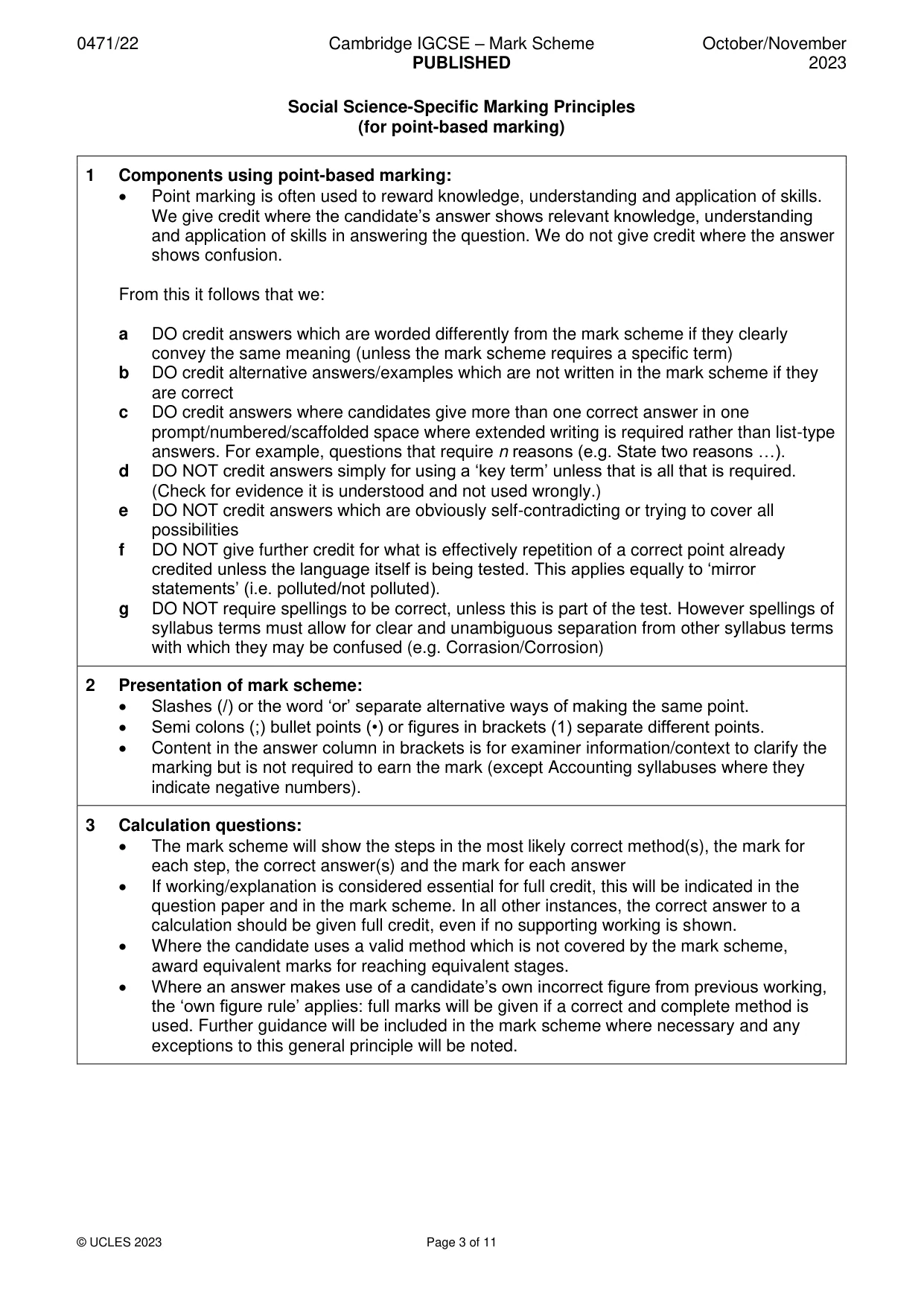
0471/22 Cambridge IGCSE – Mark Scheme PUBLISHED October/November 2023 © UCLES 2023 Page 3 of 11 Social Science-Specific Marking Principles (for point-based marking) 1 Components using point-based marking: • Point marking is often used to reward knowledge, understanding and application of skills. We give credit where the candidate’s answer shows relevant knowledge, understanding and application of skills in answering the question. We do not give credit where the answer shows confusion. From this it follows that we: a DO credit answers which are worded differently from the mark scheme if they clearly convey the same meaning (unless the mark scheme requires a specific term) b DO credit alternative answers/examples which are not written in the mark scheme if they are correct c DO credit answers where candidates give more than one correct answer in one prompt/numbered/scaffolded space where extended writing is required rather than list-type answers. For example, questions that require n reasons (e.g. State two reasons …). d DO NOT credit answers simply for using a ‘key term’ unless that is all that is required. (Check for evidence it is understood and not used wrongly.) e DO NOT credit answers which are obviously self-contradicting or trying to cover all possibilities f DO NOT give further credit for what is effectively repetition of a correct point already credited unless the language itself is being tested. This applies equally to ‘mirror statements’ (i.e. polluted/not polluted). g DO NOT require spellings to be correct, unless this is part of the test. However spellings of syllabus terms must allow for clear and unambiguous separation from other syllabus terms with which they may be confused (e.g. Corrasion/Corrosion) 2 Presentation of mark scheme: • Slashes (/) or the word ‘or’ separate alternative ways of making the same point. • Semi colons (;) bullet points (•) or figures in brackets (1) separate different points. • Content in the answer column in brackets is for examiner information/context to clarify the marking but is not required to earn the mark (except Accounting syllabuses where they indicate negative numbers). 3 Calculation questions: • The mark scheme will show the steps in the most likely correct method(s), the mark for each step, the correct answer(s) and the mark for each answer • If working/explanation is considered essential for full credit, this will be indicated in the question paper and in the mark scheme. In all other instances, the correct answer to a calculation should be given full credit, even if no supporting working is shown. • Where the candidate uses a valid method which is not covered by the mark scheme, award equivalent marks for reaching equivalent stages. • Where an answer makes use of a candidate’s own incorrect figure from previous working, the ‘own figure rule’ applies: full marks will be given if a correct and complete method is used. Further guidance will be included in the mark scheme where necessary and any exceptions to this general principle will be noted.
Mark scheme, page 4
0471/22 Cambridge IGCSE – Mark Scheme PUBLISHED October/November 2023 © UCLES 2023 Page 4 of 11 4 Annotation: • For point marking, ticks can be used to indicate correct answers and crosses can be used to indicate wrong answers. There is no direct relationship between ticks and marks. Ticks have no defined meaning for levels of response marking. • For levels of response marking, the level awarded should be annotated on the script. • Other annotations will be used by examiners as agreed during standardisation, and the meaning will be understood by all examiners who marked that paper.
Mark scheme, page 5
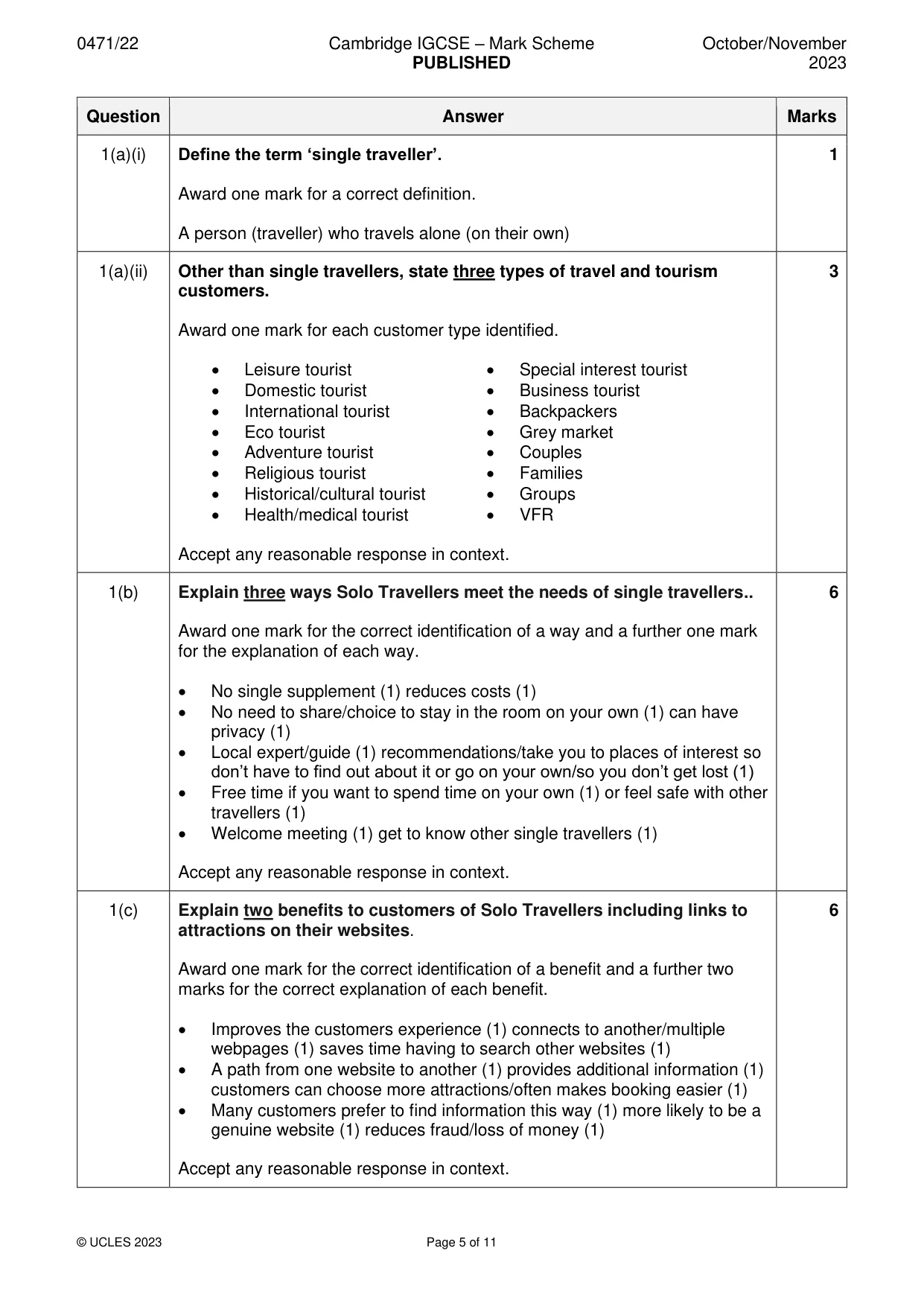
0471/22 Cambridge IGCSE – Mark Scheme PUBLISHED October/November 2023 © UCLES 2023 Page 5 of 11 Question Answer Marks 1(a)(i) Define the term ‘single traveller’. Award one mark for a correct definition. A person (traveller) who travels alone (on their own) 1 1(a)(ii) Other than single travellers, state three types of travel and tourism customers. Award one mark for each customer type identified. Accept any reasonable response in context. • Leisure tourist • Special interest tourist • Domestic tourist • Business tourist • International tourist • Backpackers • Eco tourist • Grey market • Adventure tourist • Couples • Religious tourist • Families • Historical/cultural tourist • Groups • Health/medical tourist • VFR 3 1(b) Explain three ways Solo Travellers meet the needs of single travellers.. Award one mark for the correct identification of a way and a further one mark for the explanation of each way. • No single supplement (1) reduces costs (1) • No need to share/choice to stay in the room on your own (1) can have privacy (1) • Local expert/guide (1) recommendations/take you to places of interest so don’t have to find out about it or go on your own/so you don’t get lost (1) • Free time if you want to spend time on your own (1) or feel safe with other travellers (1) • Welcome meeting (1) get to know other single travellers (1) Accept any reasonable response in context. 6 1(c) Explain two benefits to customers of Solo Travellers including links to attractions on their websites. Award one mark for the correct identification of a benefit and a further two marks for the correct explanation of each benefit. • Improves the customers experience (1) connects to another/multiple webpages (1) saves time having to search other websites (1) • A path from one website to another (1) provides additional information (1) customers can choose more attractions/often makes booking easier (1) • Many customers prefer to find information this way (1) more likely to be a genuine website (1) reduces fraud/loss of money (1) Accept any reasonable response in context. 6
Mark scheme, page 6
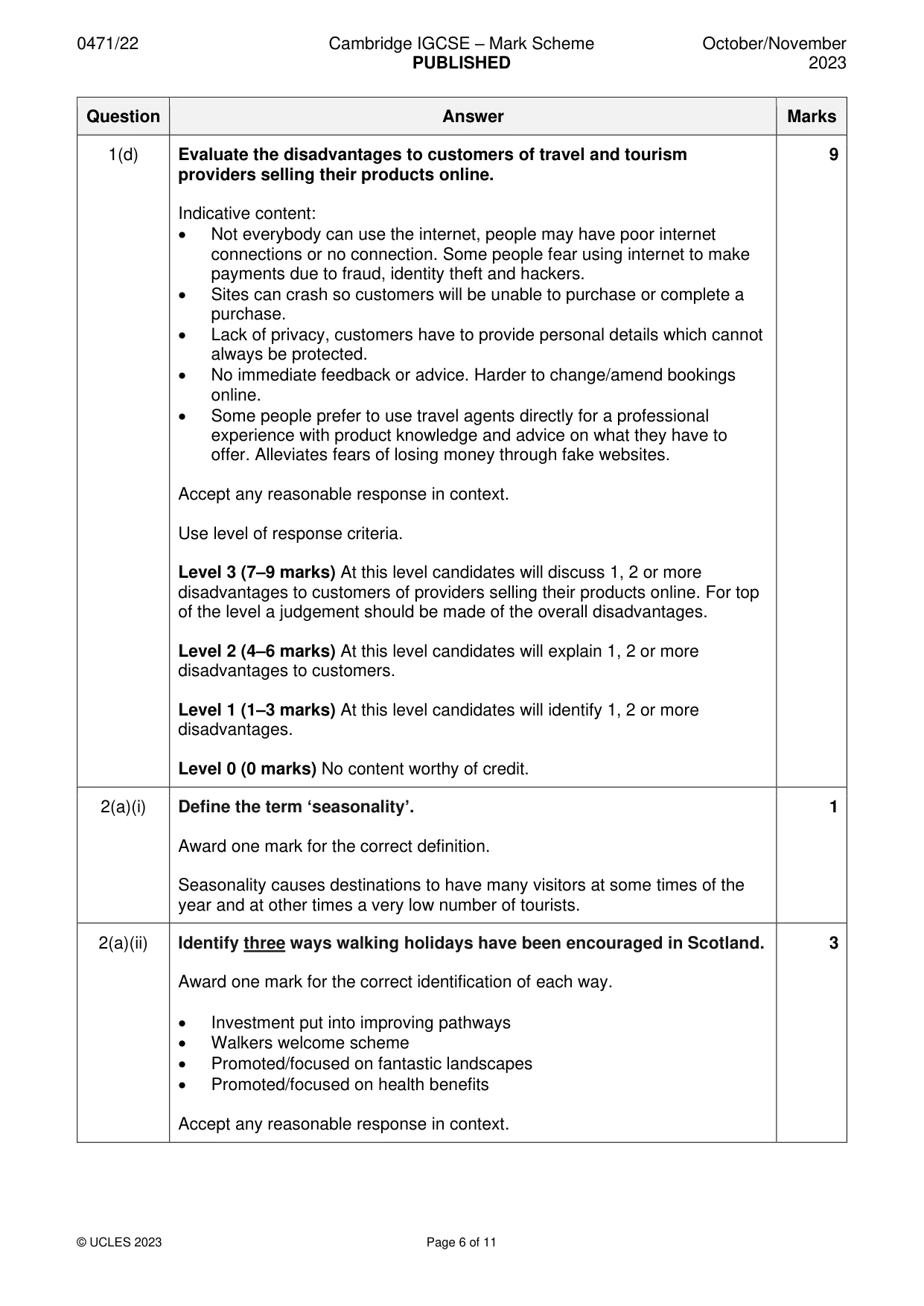
0471/22 Cambridge IGCSE – Mark Scheme PUBLISHED October/November 2023 © UCLES 2023 Page 6 of 11 Question Answer Marks 1(d) Evaluate the disadvantages to customers of travel and tourism providers selling their products online. Indicative content: • Not everybody can use the internet, people may have poor internet connections or no connection. Some people fear using internet to make payments due to fraud, identity theft and hackers. • Sites can crash so customers will be unable to purchase or complete a purchase. • Lack of privacy, customers have to provide personal details which cannot always be protected. • No immediate feedback or advice. Harder to change/amend bookings online. • Some people prefer to use travel agents directly for a professional experience with product knowledge and advice on what they have to offer. Alleviates fears of losing money through fake websites. Accept any reasonable response in context. Use level of response criteria. Level 3 (7–9 marks) At this level candidates will discuss 1, 2 or more disadvantages to customers of providers selling their products online. For top of the level a judgement should be made of the overall disadvantages. Level 2 (4–6 marks) At this level candidates will explain 1, 2 or more disadvantages to customers. Level 1 (1–3 marks) At this level candidates will identify 1, 2 or more disadvantages. Level 0 (0 marks) No content worthy of credit. 9 2(a)(i) Define the term ‘seasonality’. Award one mark for the correct definition. Seasonality causes destinations to have many visitors at some times of the year and at other times a very low number of tourists. 1 2(a)(ii) Identify three ways walking holidays have been encouraged in Scotland. Award one mark for the correct identification of each way. • Investment put into improving pathways • Walkers welcome scheme • Promoted/focused on fantastic landscapes • Promoted/focused on health benefits Accept any reasonable response in context. 3
Mark scheme, page 7
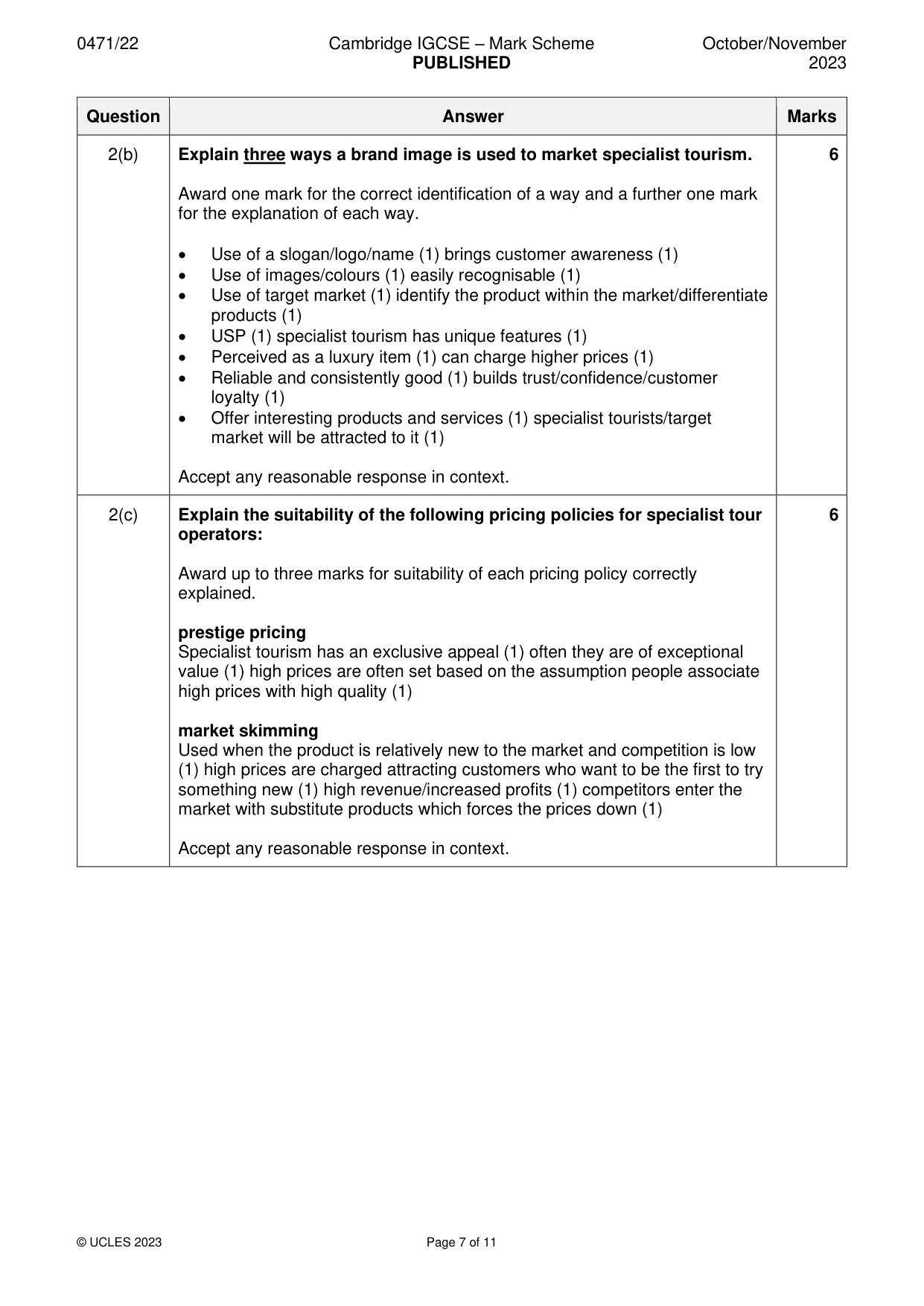
0471/22 Cambridge IGCSE – Mark Scheme PUBLISHED October/November 2023 © UCLES 2023 Page 7 of 11 Question Answer Marks 2(b) Explain three ways a brand image is used to market specialist tourism. Award one mark for the correct identification of a way and a further one mark for the explanation of each way. • Use of a slogan/logo/name (1) brings customer awareness (1) • Use of images/colours (1) easily recognisable (1) • Use of target market (1) identify the product within the market/differentiate products (1) • USP (1) specialist tourism has unique features (1) • Perceived as a luxury item (1) can charge higher prices (1) • Reliable and consistently good (1) builds trust/confidence/customer loyalty (1) • Offer interesting products and services (1) specialist tourists/target market will be attracted to it (1) Accept any reasonable response in context. 6 2(c) Explain the suitability of the following pricing policies for specialist tour operators: Award up to three marks for suitability of each pricing policy correctly explained. prestige pricing Specialist tourism has an exclusive appeal (1) often they are of exceptional value (1) high prices are often set based on the assumption people associate high prices with high quality (1) market skimming Used when the product is relatively new to the market and competition is low (1) high prices are charged attracting customers who want to be the first to try something new (1) high revenue/increased profits (1) competitors enter the market with substitute products which forces the prices down (1) Accept any reasonable response in context. 6
Mark scheme, page 8
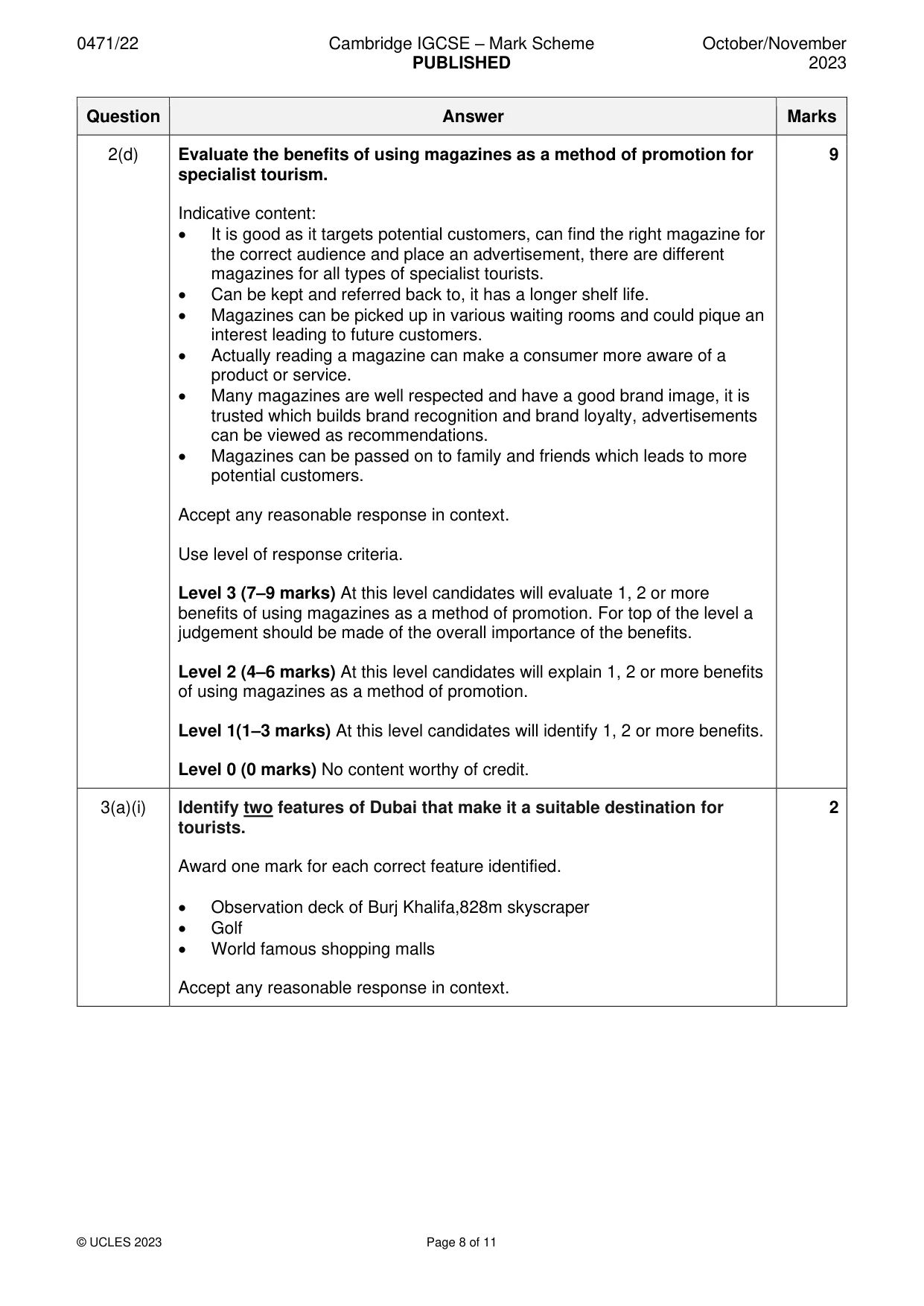
0471/22 Cambridge IGCSE – Mark Scheme PUBLISHED October/November 2023 © UCLES 2023 Page 8 of 11 Question Answer Marks 2(d) Evaluate the benefits of using magazines as a method of promotion for specialist tourism. Indicative content: • It is good as it targets potential customers, can find the right magazine for the correct audience and place an advertisement, there are different magazines for all types of specialist tourists. • Can be kept and referred back to, it has a longer shelf life. • Magazines can be picked up in various waiting rooms and could pique an interest leading to future customers. • Actually reading a magazine can make a consumer more aware of a product or service. • Many magazines are well respected and have a good brand image, it is trusted which builds brand recognition and brand loyalty, advertisements can be viewed as recommendations. • Magazines can be passed on to family and friends which leads to more potential customers. Accept any reasonable response in context. Use level of response criteria. Level 3 (7–9 marks) At this level candidates will evaluate 1, 2 or more benefits of using magazines as a method of promotion. For top of the level a judgement should be made of the overall importance of the benefits. Level 2 (4–6 marks) At this level candidates will explain 1, 2 or more benefits of using magazines as a method of promotion. Level 1(1–3 marks) At this level candidates will identify 1, 2 or more benefits. Level 0 (0 marks) No content worthy of credit. 9 3(a)(i) Identify two features of Dubai that make it a suitable destination for tourists. Award one mark for each correct feature identified. • Observation deck of Burj Khalifa,828m skyscraper • Golf • World famous shopping malls Accept any reasonable response in context. 2
Mark scheme, page 9
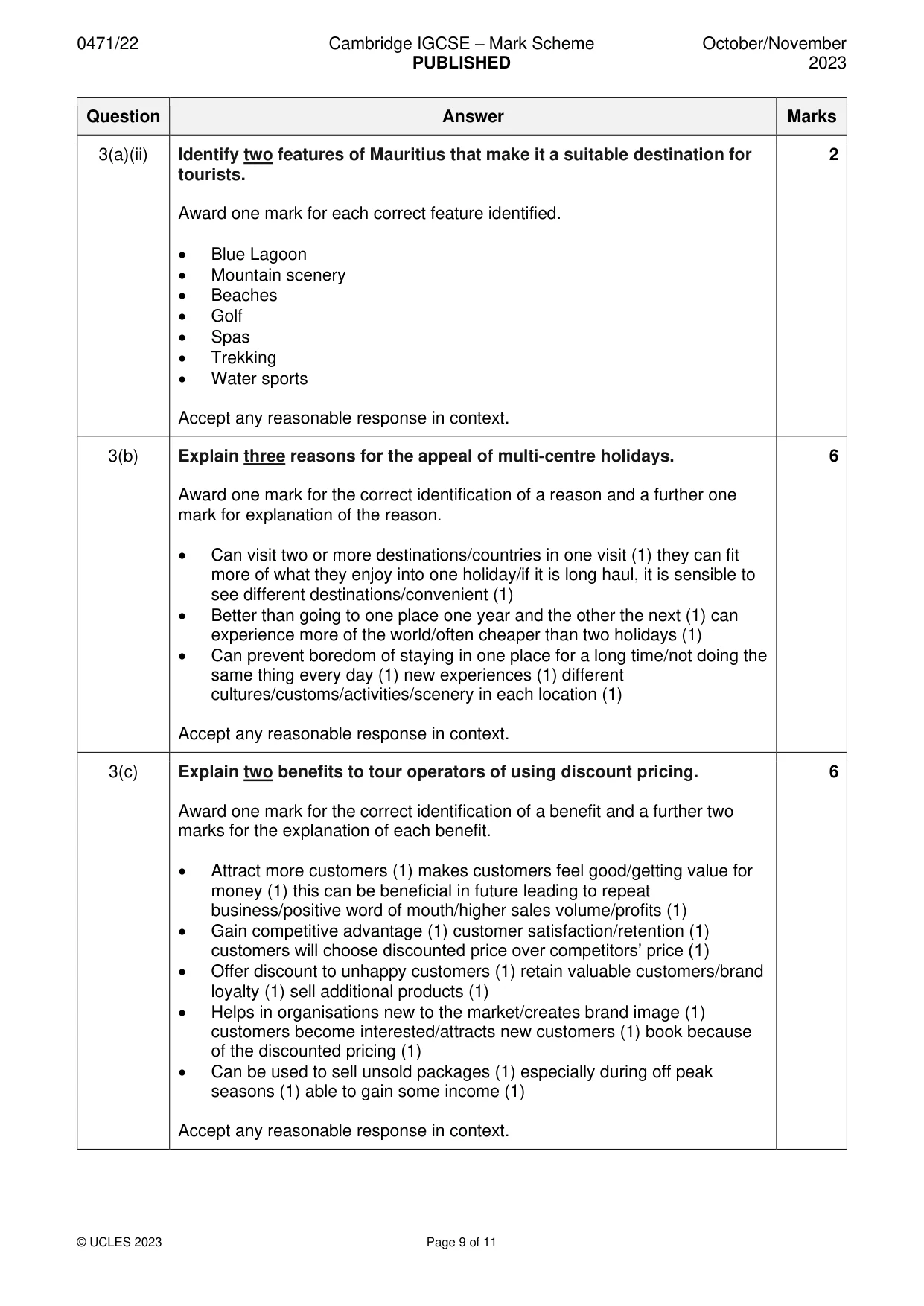
0471/22 Cambridge IGCSE – Mark Scheme PUBLISHED October/November 2023 © UCLES 2023 Page 9 of 11 Question Answer Marks 3(a)(ii) Identify two features of Mauritius that make it a suitable destination for tourists. Award one mark for each correct feature identified. • Blue Lagoon • Mountain scenery • Beaches • Golf • Spas • Trekking • Water sports Accept any reasonable response in context. 2 3(b) Explain three reasons for the appeal of multi-centre holidays. Award one mark for the correct identification of a reason and a further one mark for explanation of the reason. • Can visit two or more destinations/countries in one visit (1) they can fit more of what they enjoy into one holiday/if it is long haul, it is sensible to see different destinations/convenient (1) • Better than going to one place one year and the other the next (1) can experience more of the world/often cheaper than two holidays (1) • Can prevent boredom of staying in one place for a long time/not doing the same thing every day (1) new experiences (1) different cultures/customs/activities/scenery in each location (1) Accept any reasonable response in context. 6 3(c) Explain two benefits to tour operators of using discount pricing. Award one mark for the correct identification of a benefit and a further two marks for the explanation of each benefit. • Attract more customers (1) makes customers feel good/getting value for money (1) this can be beneficial in future leading to repeat business/positive word of mouth/higher sales volume/profits (1) • Gain competitive advantage (1) customer satisfaction/retention (1) customers will choose discounted price over competitors’ price (1) • Offer discount to unhappy customers (1) retain valuable customers/brand loyalty (1) sell additional products (1) • Helps in organisations new to the market/creates brand image (1) customers become interested/attracts new customers (1) book because of the discounted pricing (1) • Can be used to sell unsold packages (1) especially during off peak seasons (1) able to gain some income (1) Accept any reasonable response in context. 6
Mark scheme, page 10
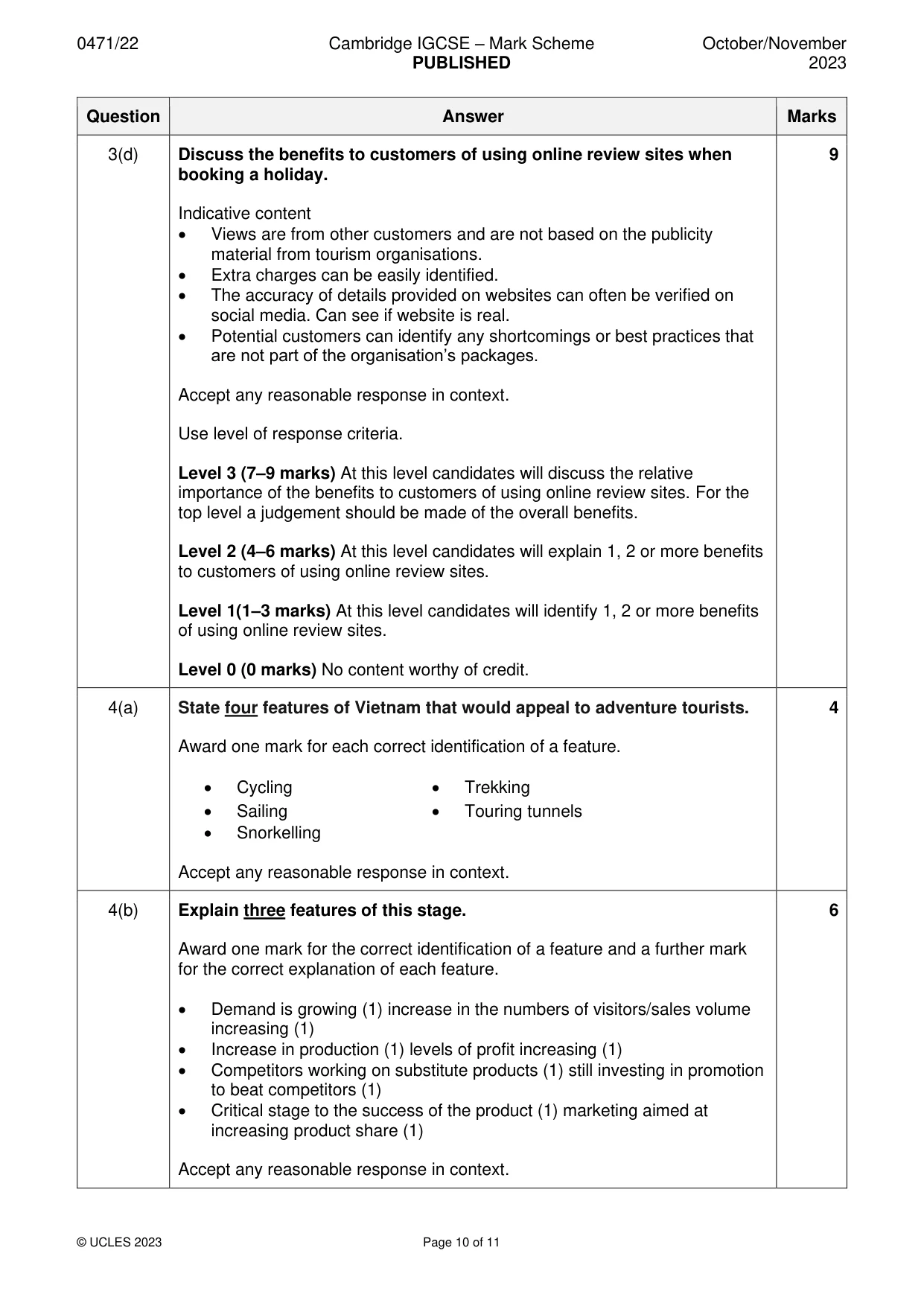
0471/22 Cambridge IGCSE – Mark Scheme PUBLISHED October/November 2023 © UCLES 2023 Page 10 of 11 Question Answer Marks 3(d) Discuss the benefits to customers of using online review sites when booking a holiday. Indicative content • Views are from other customers and are not based on the publicity material from tourism organisations. • Extra charges can be easily identified. • The accuracy of details provided on websites can often be verified on social media. Can see if website is real. • Potential customers can identify any shortcomings or best practices that are not part of the organisation’s packages. Accept any reasonable response in context. Use level of response criteria. Level 3 (7–9 marks) At this level candidates will discuss the relative importance of the benefits to customers of using online review sites. For the top level a judgement should be made of the overall benefits. Level 2 (4–6 marks) At this level candidates will explain 1, 2 or more benefits to customers of using online review sites. Level 1(1–3 marks) At this level candidates will identify 1, 2 or more benefits of using online review sites. Level 0 (0 marks) No content worthy of credit. 9 4(a) State four features of Vietnam that would appeal to adventure tourists. Award one mark for each correct identification of a feature. • Cycling • Trekking • Sailing • Touring tunnels • Snorkelling Accept any reasonable response in context. 4 4(b) Explain three features of this stage. Award one mark for the correct identification of a feature and a further mark for the correct explanation of each feature. • Demand is growing (1) increase in the numbers of visitors/sales volume increasing (1) • Increase in production (1) levels of profit increasing (1) • Competitors working on substitute products (1) still investing in promotion to beat competitors (1) • Critical stage to the success of the product (1) marketing aimed at increasing product share (1) Accept any reasonable response in context. 6
Mark scheme, page 11
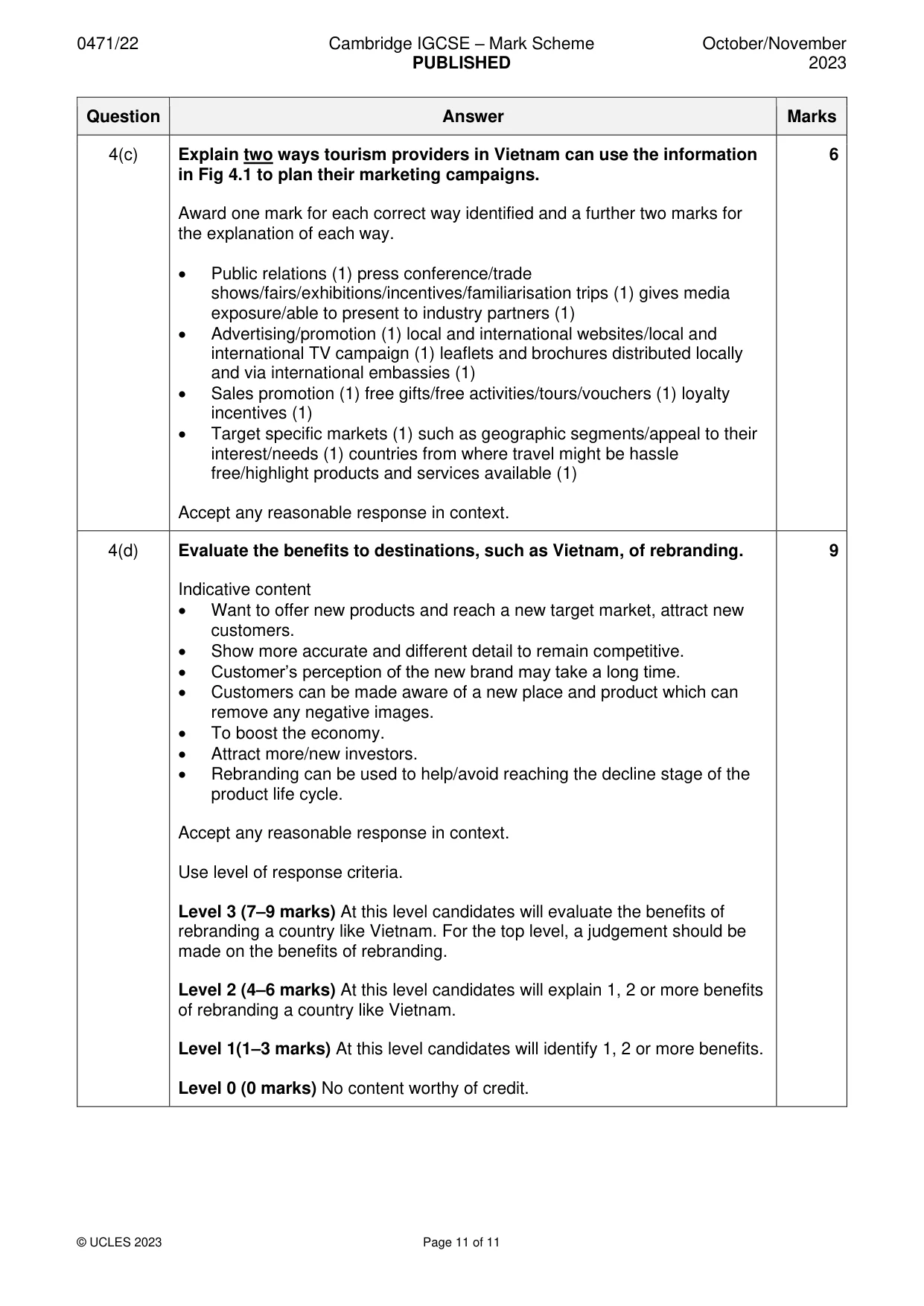
0471/22 Cambridge IGCSE – Mark Scheme PUBLISHED October/November 2023 © UCLES 2023 Page 11 of 11 Question Answer Marks 4(c) Explain two ways tourism providers in Vietnam can use the information in Fig 4.1 to plan their marketing campaigns. Award one mark for each correct way identified and a further two marks for the explanation of each way. • Public relations (1) press conference/trade shows/fairs/exhibitions/incentives/familiarisation trips (1) gives media exposure/able to present to industry partners (1) • Advertising/promotion (1) local and international websites/local and international TV campaign (1) leaflets and brochures distributed locally and via international embassies (1) • Sales promotion (1) free gifts/free activities/tours/vouchers (1) loyalty incentives (1) • Target specific markets (1) such as geographic segments/appeal to their interest/needs (1) countries from where travel might be hassle free/highlight products and services available (1) Accept any reasonable response in context. 6 4(d) Evaluate the benefits to destinations, such as Vietnam, of rebranding. Indicative content • Want to offer new products and reach a new target market, attract new customers. • Show more accurate and different detail to remain competitive. • Customer’s perception of the new brand may take a long time. • Customers can be made aware of a new place and product which can remove any negative images. • To boost the economy. • Attract more/new investors. • Rebranding can be used to help/avoid reaching the decline stage of the product life cycle. Accept any reasonable response in context. Use level of response criteria. Level 3 (7–9 marks) At this level candidates will evaluate the benefits of rebranding a country like Vietnam. For the top level, a judgement should be made on the benefits of rebranding. Level 2 (4–6 marks) At this level candidates will explain 1, 2 or more benefits of rebranding a country like Vietnam. Level 1(1–3 marks) At this level candidates will identify 1, 2 or more benefits. Level 0 (0 marks) No content worthy of credit. 9
What you needed in this session
Cambridge’s own grade thresholds for 2023 Oct/Nov, Paper 2 · Variant 2. A higher threshold means an easier paper — the bar moves with how the cohort did.