Cambridge IGCSE Travel and Tourism 0471 — 2022 May/June Paper 2 · Variant 2
0471/22/M/J/22 · 100 marks · ≈113 min
The question paper and its mark scheme, free to read here and free to download. This is Cambridge’s own paper, exactly as it was sat.
Question paper16 pages
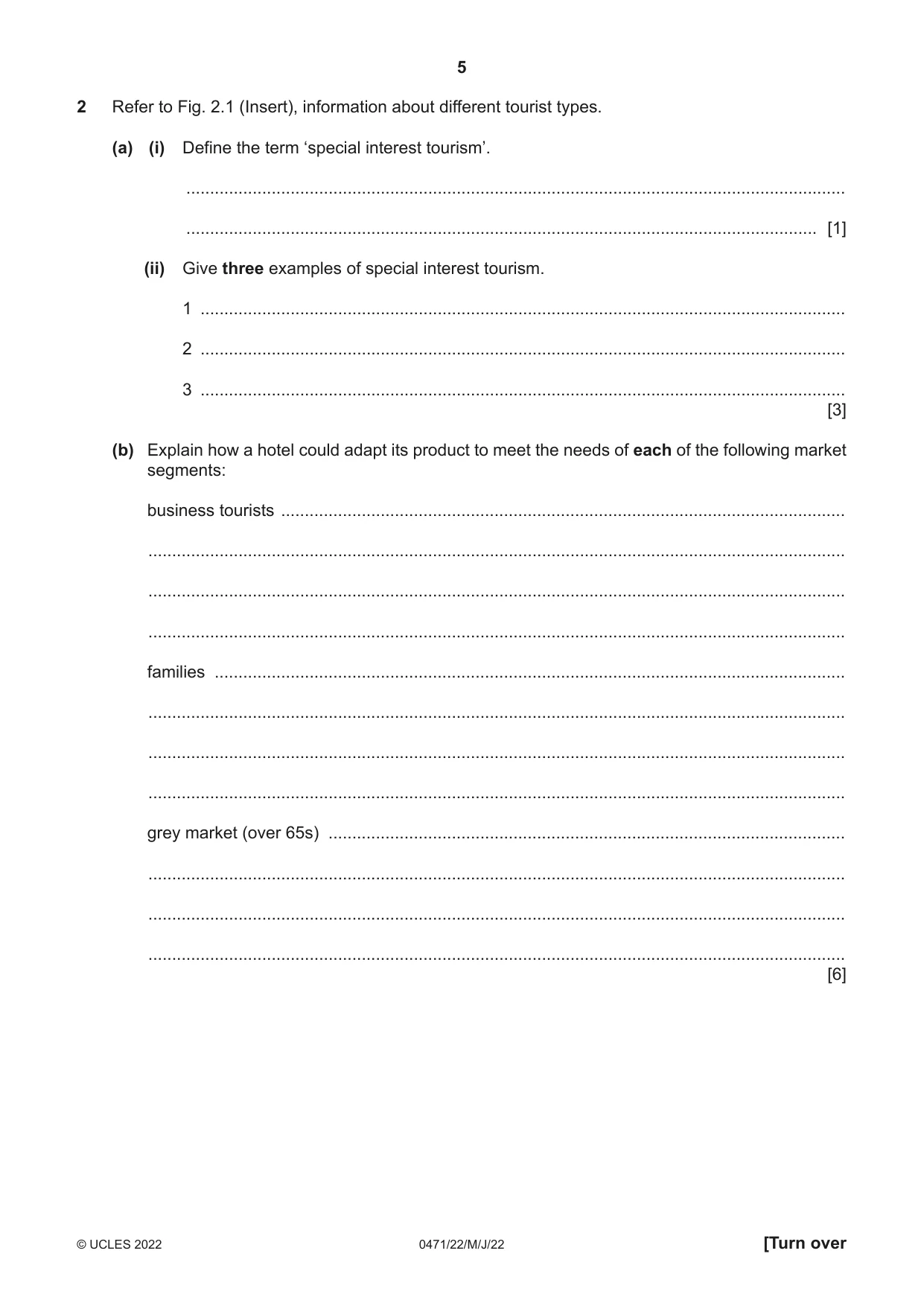
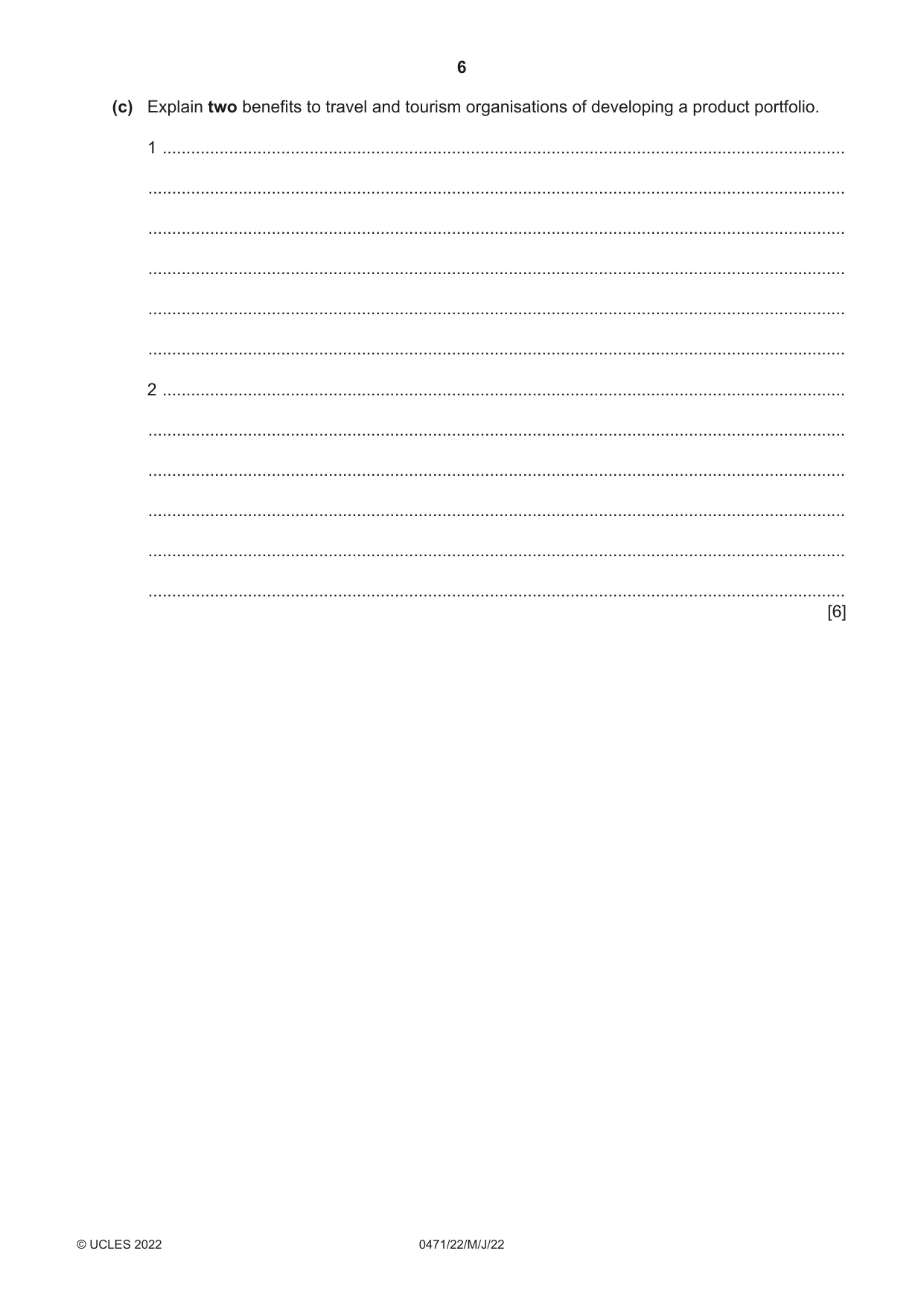
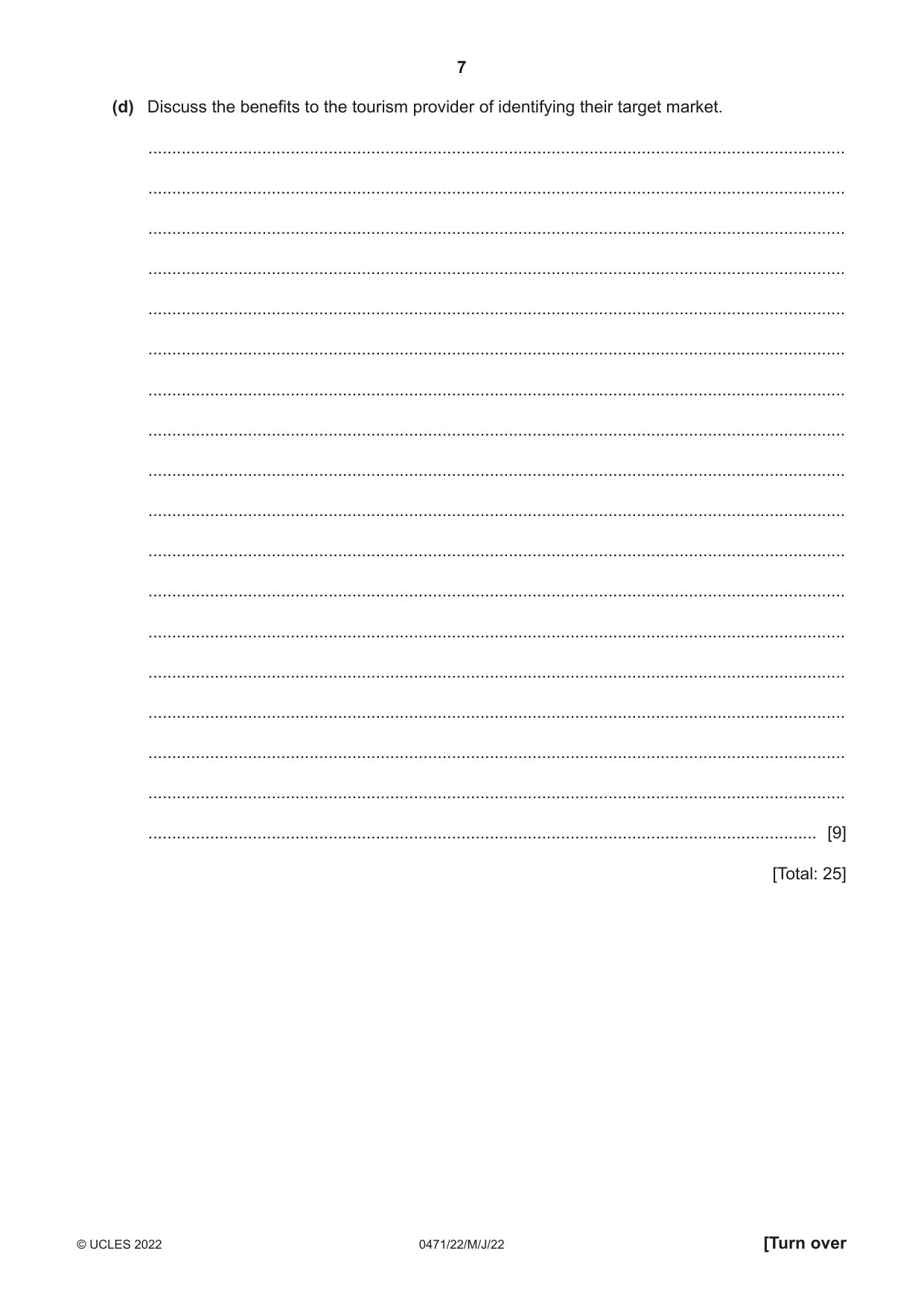
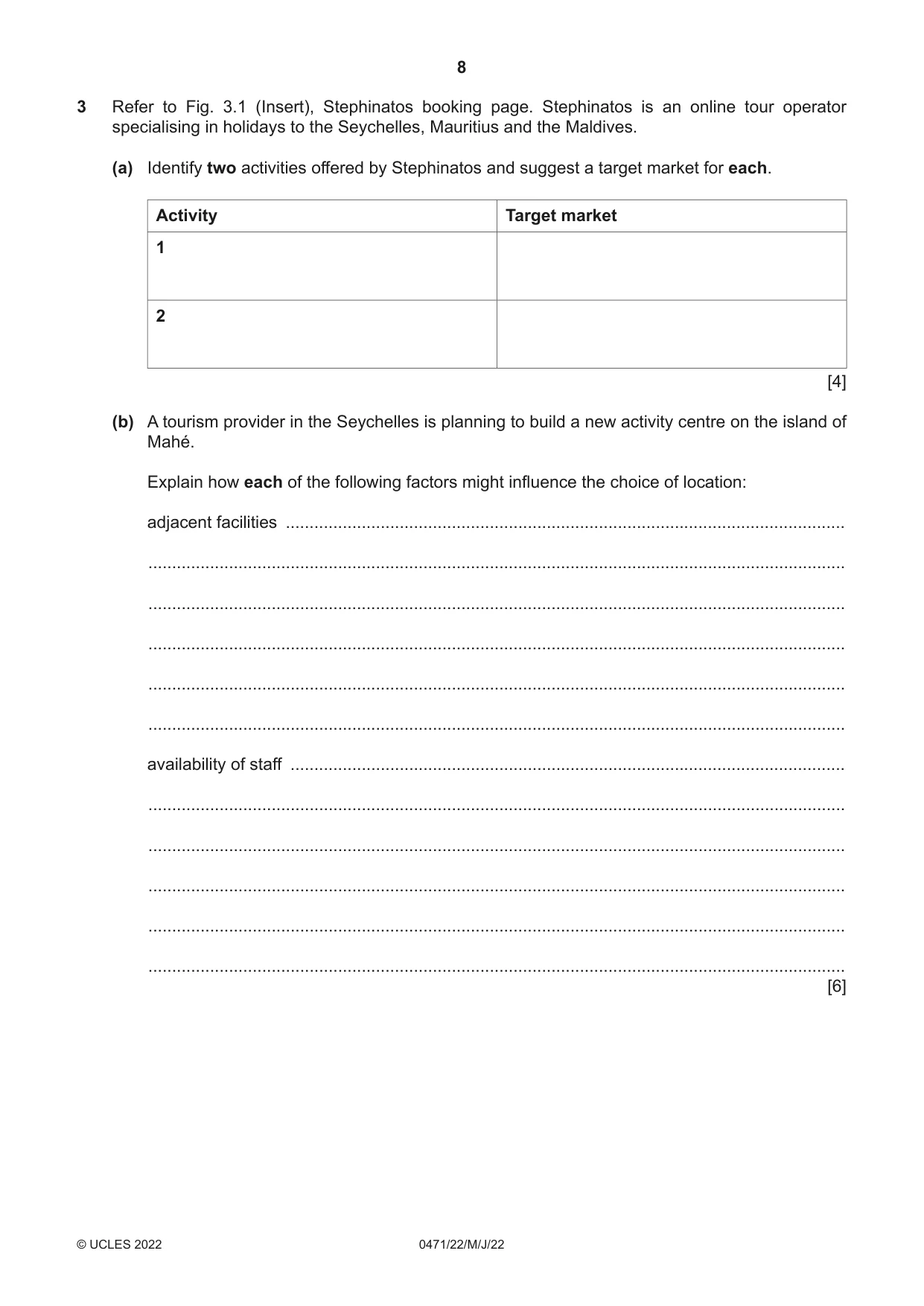



Mark scheme13 pages
Answers below. Sit the paper first if you are practising.

Paper as text
Question paper, page 1
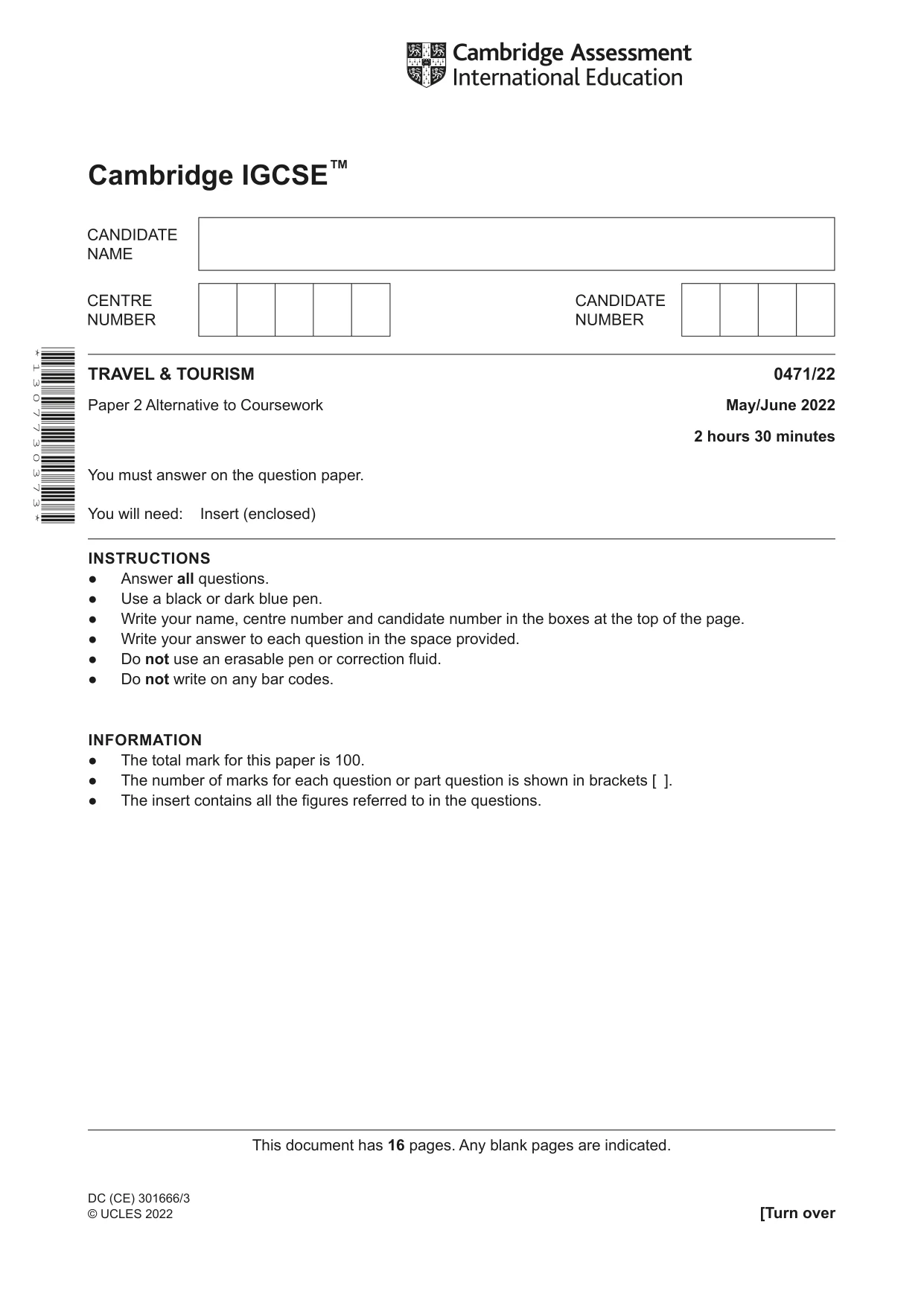
This document has 16 pages. Any blank pages are indicated. [Turn over Cambridge IGCSE™ * 1 3 0 7 7 3 0 3 7 3 * DC (CE) 301666/3 © UCLES 2022 TRAVEL & TOURISM 0471/22 Paper 2 Alternative to Coursework May/June 2022 2 hours 30 minutes You must answer on the question paper. You will need: Insert (enclosed) INSTRUCTIONS ● Answer all questions. ● Use a black or dark blue pen. ● Write your name, centre number and candidate number in the boxes at the top of the page. ● Write your answer to each question in the space provided. ● Do not use an erasable pen or correction fluid. ● Do not write on any bar codes. INFORMATION ● The total mark for this paper is 100. ● The number of marks for each question or part question is shown in brackets [ ]. ● The insert contains all the figures referred to in the questions.
Question paper, page 2
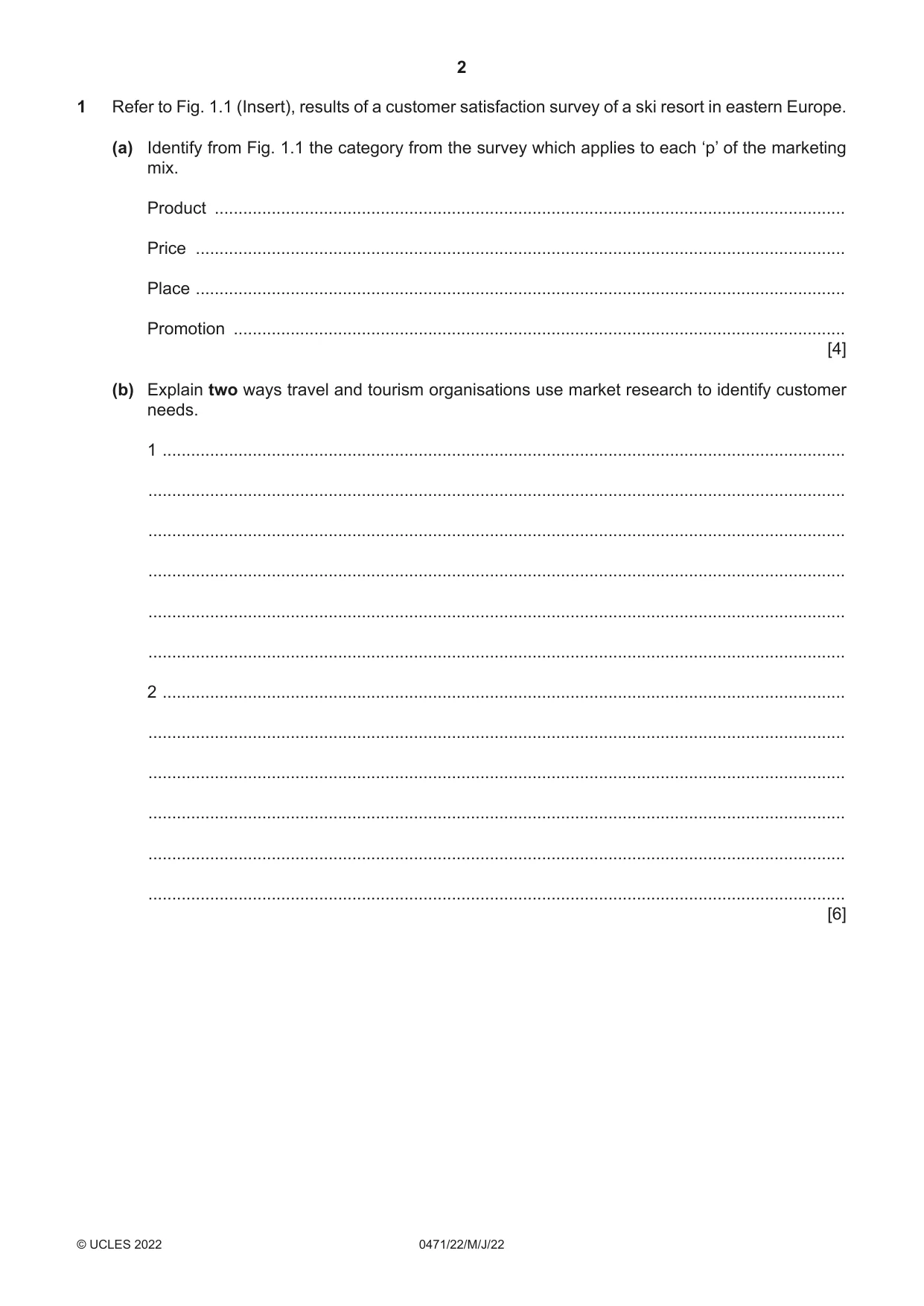
2 0471/22/M/J/22 © UCLES 2022 1 Refer to Fig. 1.1 (Insert), results of a customer satisfaction survey of a ski resort in eastern Europe. (a) Identify from Fig. 1.1 the category from the survey which applies to each ‘p’ of the marketing mix. Product … Price … Place … Promotion … [4] (b) Explain two ways travel and tourism organisations use market research to identify customer needs. 1 … … … … … … 2 … … … … … … [6]
Question paper, page 3
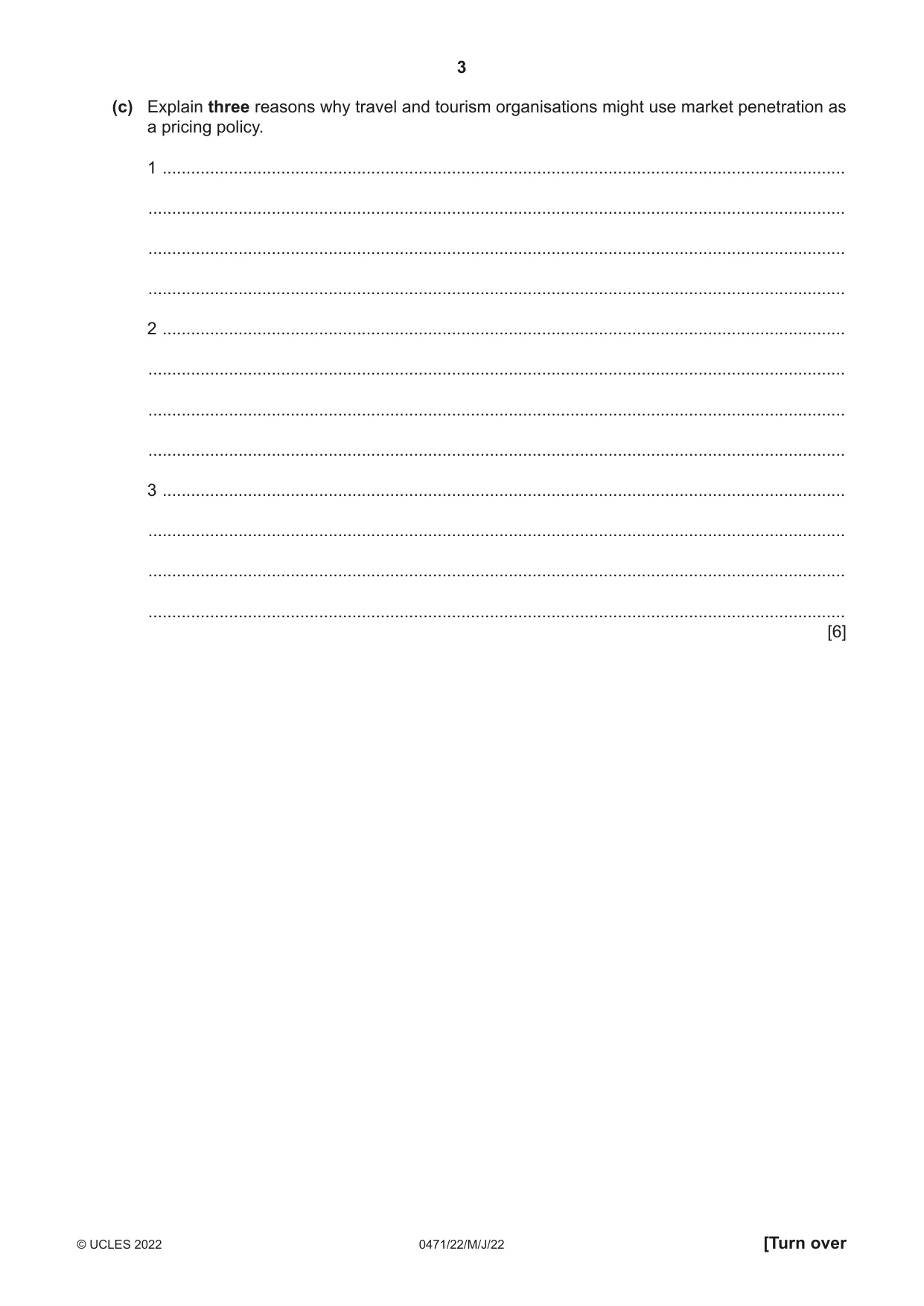
3 0471/22/M/J/22 © UCLES 2022 [Turn over (c) Explain three reasons why travel and tourism organisations might use market penetration as a pricing policy. 1 … … … … 2 … … … … 3 … … … … [6]
Question paper, page 4
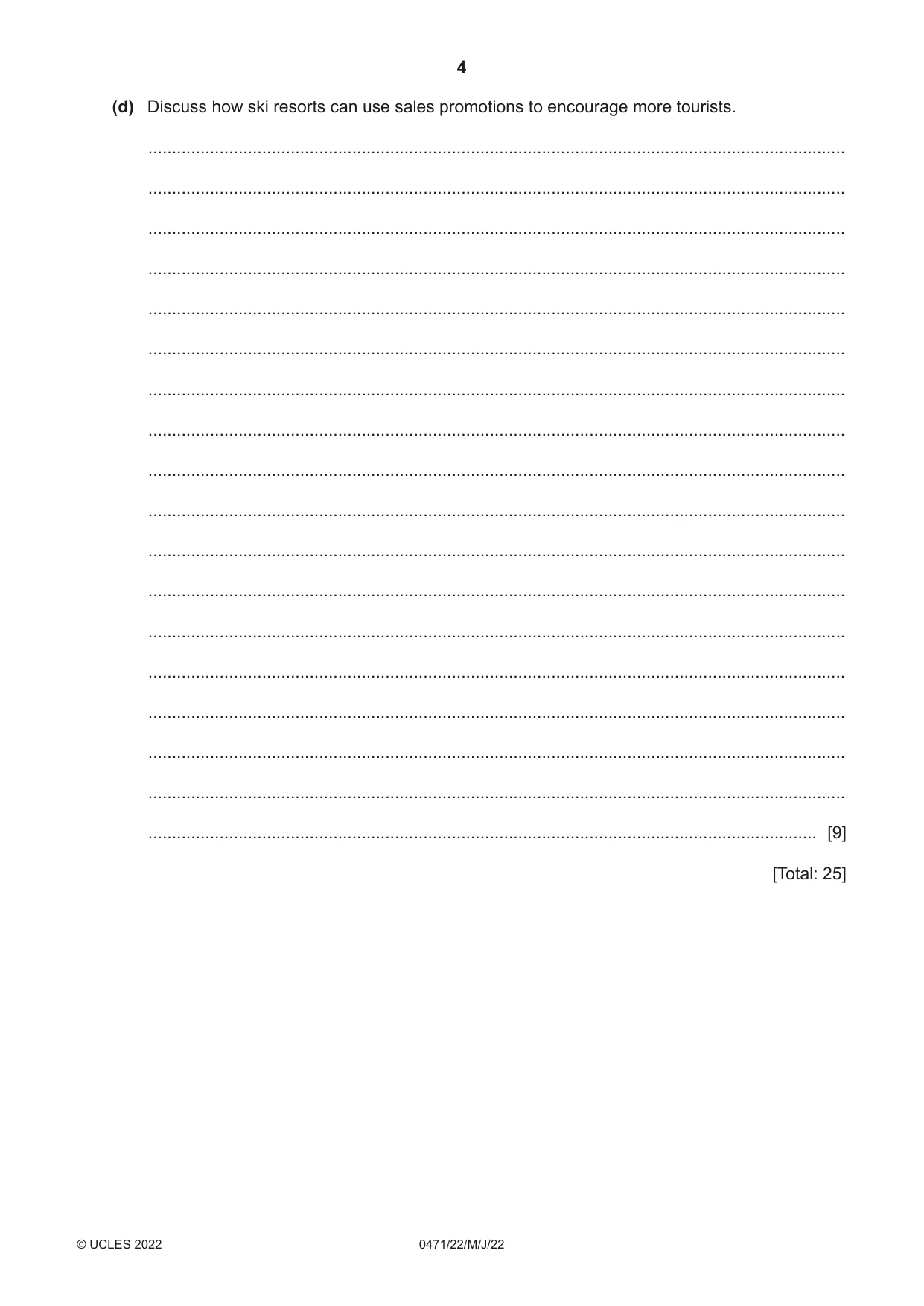
4 0471/22/M/J/22 © UCLES 2022 (d) Discuss how ski resorts can use sales promotions to encourage more tourists. … … … … … … … … … … … … … … … … … … [9] [Total: 25]
Question paper, page 5
5 0471/22/M/J/22 © UCLES 2022 [Turn over 2 Refer to Fig. 2.1 (Insert), information about different tourist types. (a) (i) Define the term ‘special interest tourism’. … … [1] (ii) Give three examples of special interest tourism. 1 … 2 … 3 … [3] (b) Explain how a hotel could adapt its product to meet the needs of each of the following market segments: business tourists … … … … families … … … … grey market (over 65s) … … … … [6]
Question paper, page 6
6 0471/22/M/J/22 © UCLES 2022 (c) Explain two benefits to travel and tourism organisations of developing a product portfolio. 1 … … … … … … 2 … … … … … … [6]
Question paper, page 7
7 0471/22/M/J/22 © UCLES 2022 [Turn over (d) Discuss the benefits to the tourism provider of identifying their target market. … … … … … … … … … … … … … … … … … … [9] [Total: 25]
Question paper, page 8
8 0471/22/M/J/22 © UCLES 2022 3 Refer to Fig. 3.1 (Insert), Stephinatos booking page. Stephinatos is an online tour operator specialising in holidays to the Seychelles, Mauritius and the Maldives. (a) Identify two activities offered by Stephinatos and suggest a target market for each. Activity Target market 1 2 [4] (b) A tourism provider in the Seychelles is planning to build a new activity centre on the island of Mahé. Explain how each of the following factors might influence the choice of location: adjacent facilities … … … … … … availability of staff … … … … … … [6]
Question paper, page 9
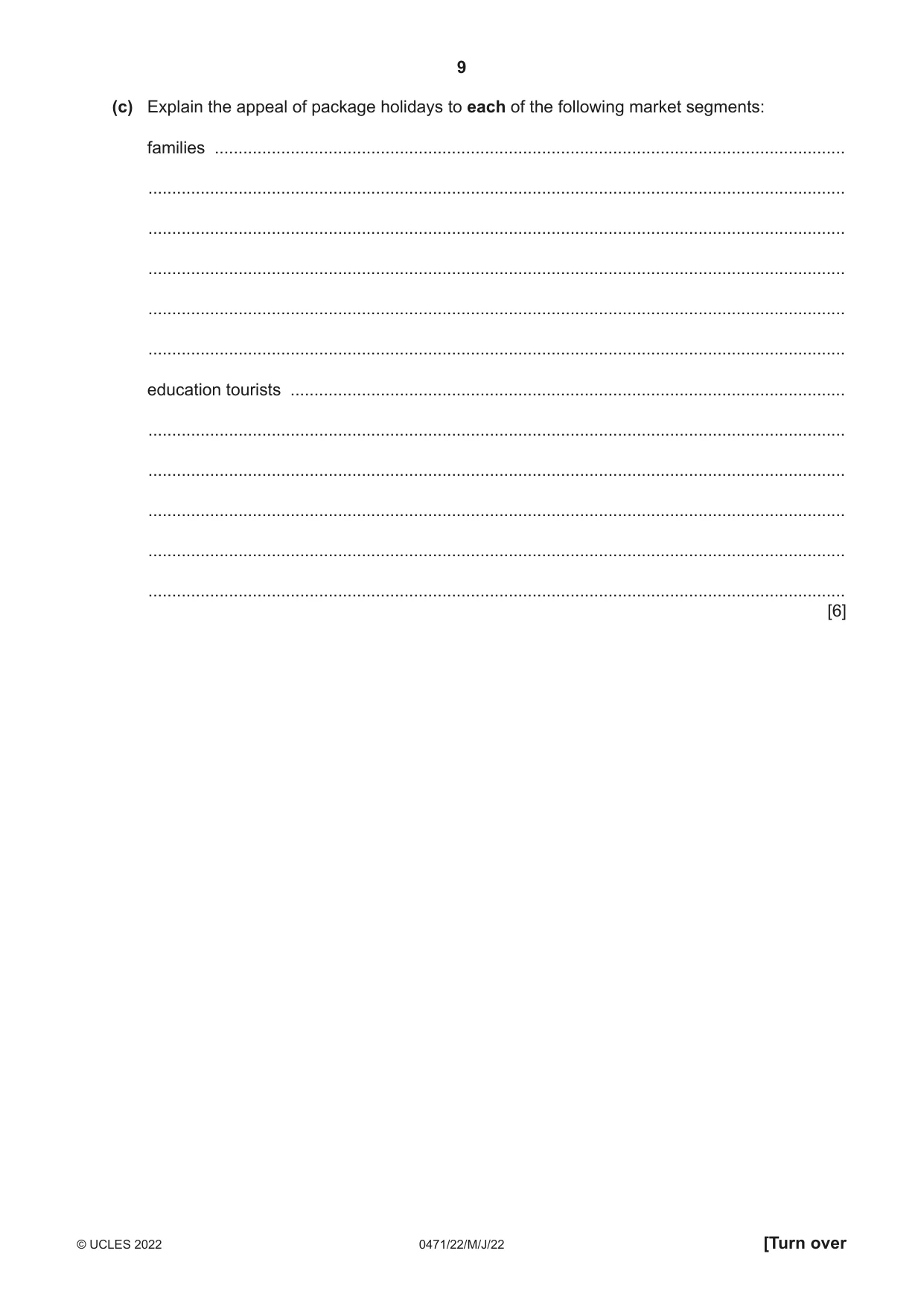
9 0471/22/M/J/22 © UCLES 2022 [Turn over (c) Explain the appeal of package holidays to each of the following market segments: families … … … … … … education tourists … … … … … … [6]
Question paper, page 10
10 0471/22/M/J/22 © UCLES 2022 (d) Discuss the factors that might determine the pricing policy used by Stephinatos. … … … … … … … … … … … … … … … … … … [9] [Total: 25]
Question paper, page 11
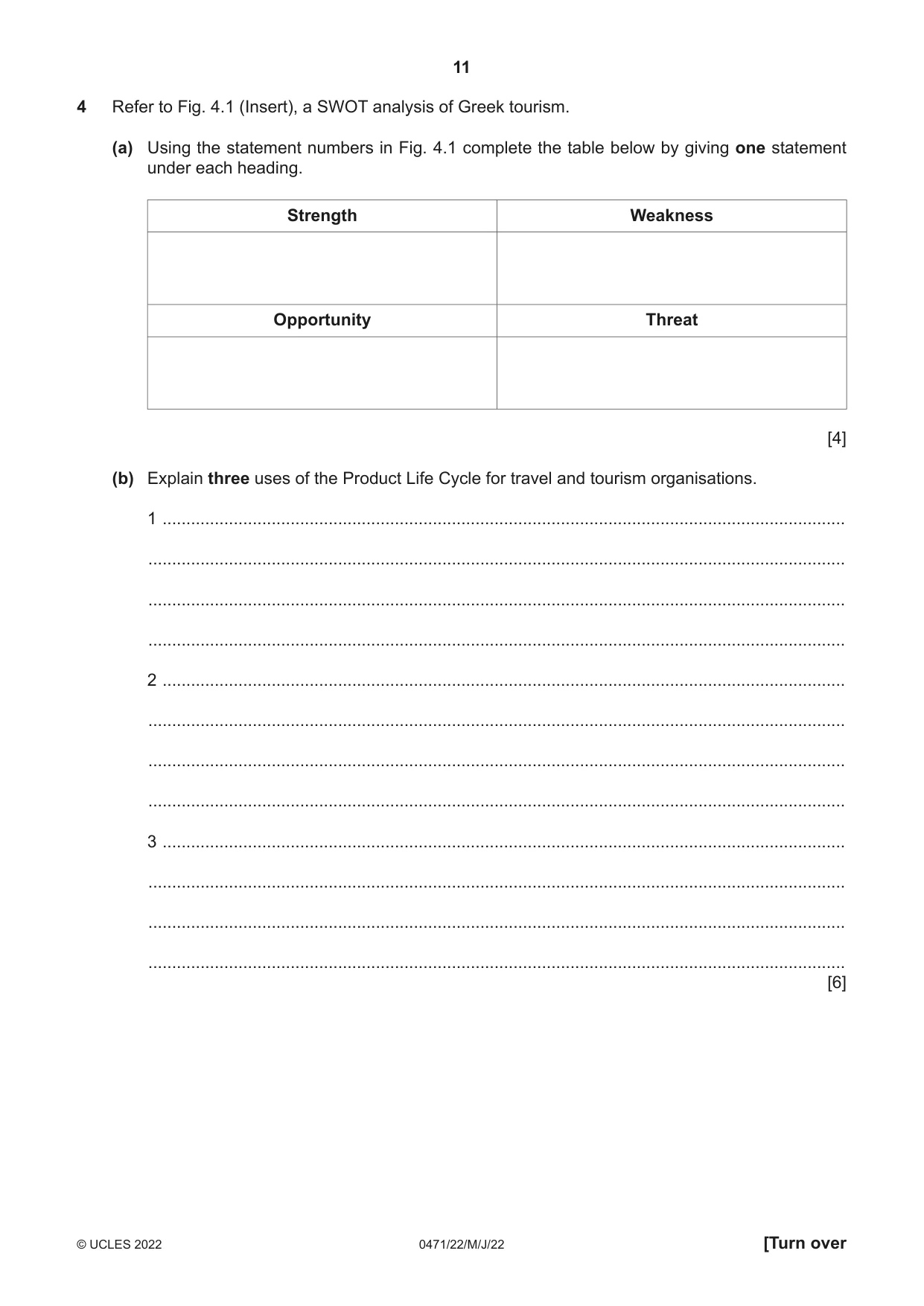
11 0471/22/M/J/22 © UCLES 2022 [Turn over 4 Refer to Fig. 4.1 (Insert), a SWOT analysis of Greek tourism. (a) Using the statement numbers in Fig. 4.1 complete the table below by giving one statement under each heading. Strength Weakness Opportunity Threat [4] (b) Explain three uses of the Product Life Cycle for travel and tourism organisations. 1 … … … … 2 … … … … 3 … … … … [6]
Question paper, page 12
12 0471/22/M/J/22 © UCLES 2022 (c) Give three possible economic factors identified by a PEST analysis and explain their impact on the tourism market. 1 … … … … 2 … … … … 3 … … … … [6]
Question paper, page 13
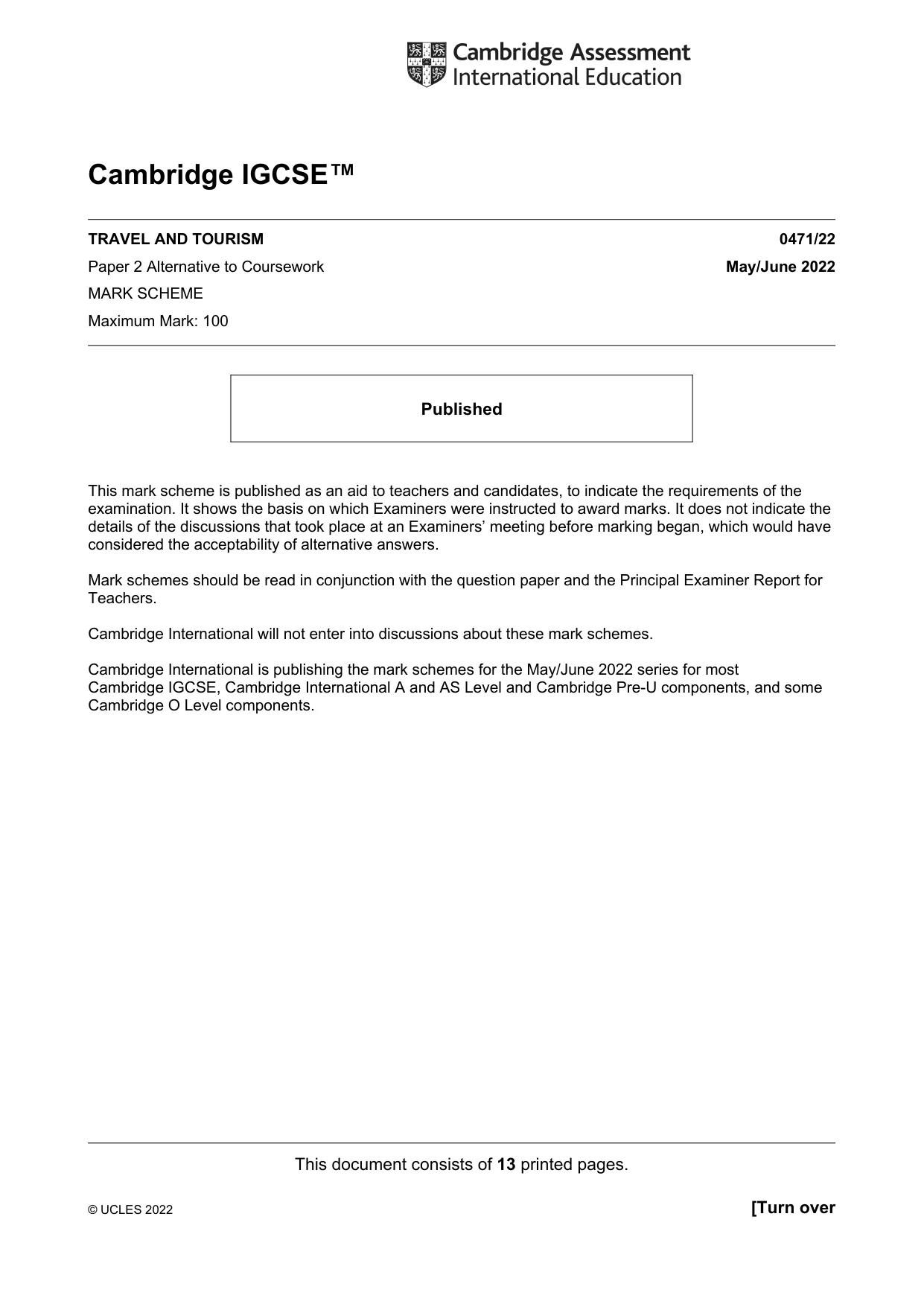
13 0471/22/M/J/22 © UCLES 2022 (d) Discuss the importance of using SWOT analysis as a marketing tool. … … … … … … … … … … … … … … … … … … [9] [Total: 25]
Question paper, page 14
14 0471/22/M/J/22 © UCLES 2022 BLANK PAGE
Question paper, page 15
15 0471/22/M/J/22 © UCLES 2022 BLANK PAGE
Question paper, page 16
16 0471/22/M/J/22 © UCLES 2022 The boundaries and names shown, the designations used and the presentation of material on any maps contained in this question paper/insert do not imply official endorsement or acceptance by Cambridge Assessment International Education concerning the legal status of any country, territory, or area or any of its authorities, or of the delimitation of its frontiers or boundaries. Permission to reproduce items where third-party owned material protected by copyright is included has been sought and cleared where possible. Every reasonable effort has been made by the publisher (UCLES) to trace copyright holders, but if any items requiring clearance have unwittingly been included, the publisher will be pleased to make amends at the earliest possible opportunity. To avoid the issue of disclosure of answer-related information to candidates, all copyright acknowledgements are reproduced online in the Cambridge Assessment International Education Copyright Acknowledgements Booklet. This is produced for each series of examinations and is freely available to download at www.cambridgeinternational.org after the live examination series. Cambridge Assessment International Education is part of Cambridge Assessment. Cambridge Assessment is the brand name of the University of Cambridge Local Examinations Syndicate (UCLES), which is a department of the University of Cambridge. BLANK PAGE
Mark scheme, page 1
This document consists of 13 printed pages. © UCLES 2022 [Turn over Cambridge IGCSE™ TRAVEL AND TOURISM 0471/22 Paper 2 Alternative to Coursework May/June 2022 MARK SCHEME Maximum Mark: 100 Published This mark scheme is published as an aid to teachers and candidates, to indicate the requirements of the examination. It shows the basis on which Examiners were instructed to award marks. It does not indicate the details of the discussions that took place at an Examiners’ meeting before marking began, which would have considered the acceptability of alternative answers. Mark schemes should be read in conjunction with the question paper and the Principal Examiner Report for Teachers. Cambridge International will not enter into discussions about these mark schemes. Cambridge International is publishing the mark schemes for the May/June 2022 series for most Cambridge IGCSE, Cambridge International A and AS Level and Cambridge Pre-U components, and some Cambridge O Level components.
Mark scheme, page 2
0471/22 Cambridge IGCSE – Mark Scheme PUBLISHED May/June 2022 © UCLES 2022 Page 2 of 13 Generic Marking Principles These general marking principles must be applied by all examiners when marking candidate answers. They should be applied alongside the specific content of the mark scheme or generic level descriptors for a question. Each question paper and mark scheme will also comply with these marking principles. GENERIC MARKING PRINCIPLE 1: Marks must be awarded in line with: the specific content of the mark scheme or the generic level descriptors for the question the specific skills defined in the mark scheme or in the generic level descriptors for the question the standard of response required by a candidate as exemplified by the standardisation scripts. GENERIC MARKING PRINCIPLE 2: Marks awarded are always whole marks (not half marks, or other fractions). GENERIC MARKING PRINCIPLE 3: Marks must be awarded positively: marks are awarded for correct/valid answers, as defined in the mark scheme. However, credit is given for valid answers which go beyond the scope of the syllabus and mark scheme, referring to your Team Leader as appropriate marks are awarded when candidates clearly demonstrate what they know and can do marks are not deducted for errors marks are not deducted for omissions answers should only be judged on the quality of spelling, punctuation and grammar when these features are specifically assessed by the question as indicated by the mark scheme. The meaning, however, should be unambiguous. GENERIC MARKING PRINCIPLE 4: Rules must be applied consistently, e.g. in situations where candidates have not followed instructions or in the application of generic level descriptors. GENERIC MARKING PRINCIPLE 5: Marks should be awarded using the full range of marks defined in the mark scheme for the question (however; the use of the full mark range may be limited according to the quality of the candidate responses seen). GENERIC MARKING PRINCIPLE 6: Marks awarded are based solely on the requirements as defined in the mark scheme. Marks should not be awarded with grade thresholds or grade descriptors in mind.
Mark scheme, page 3
0471/22 Cambridge IGCSE – Mark Scheme PUBLISHED May/June 2022 © UCLES 2022 Page 3 of 13 Social Science-Specific Marking Principles (for point-based marking) 1 Components using point-based marking: Point marking is often used to reward knowledge, understanding and application of skills. We give credit where the candidate’s answer shows relevant knowledge, understanding and application of skills in answering the question. We do not give credit where the answer shows confusion. From this it follows that we: a DO credit answers which are worded differently from the mark scheme if they clearly convey the same meaning (unless the mark scheme requires a specific term) b DO credit alternative answers/examples which are not written in the mark scheme if they are correct c DO credit answers where candidates give more than one correct answer in one prompt/numbered/scaffolded space where extended writing is required rather than list-type answers. For example, questions that require n reasons (e.g. State two reasons …). d DO NOT credit answers simply for using a ‘key term’ unless that is all that is required. (Check for evidence it is understood and not used wrongly.) e DO NOT credit answers which are obviously self-contradicting or trying to cover all possibilities f DO NOT give further credit for what is effectively repetition of a correct point already credited unless the language itself is being tested. This applies equally to ‘mirror statements’ (i.e. polluted/not polluted). g DO NOT require spellings to be correct, unless this is part of the test. However spellings of syllabus terms must allow for clear and unambiguous separation from other syllabus terms with which they may be confused (e.g. Corrasion/Corrosion) 2 Presentation of mark scheme: Slashes (/) or the word ‘or’ separate alternative ways of making the same point. Semi colons (;) bullet points (•) or figures in brackets (1) separate different points. Content in the answer column in brackets is for examiner information/context to clarify the marking but is not required to earn the mark (except Accounting syllabuses where they indicate negative numbers). 3 Calculation questions: The mark scheme will show the steps in the most likely correct method(s), the mark for each step, the correct answer(s) and the mark for each answer If working/explanation is considered essential for full credit, this will be indicated in the question paper and in the mark scheme. In all other instances, the correct answer to a calculation should be given full credit, even if no supporting working is shown. Where the candidate uses a valid method which is not covered by the mark scheme, award equivalent marks for reaching equivalent stages. Where an answer makes use of a candidate’s own incorrect figure from previous working, the ‘own figure rule’ applies: full marks will be given if a correct and complete method is used. Further guidance will be included in the mark scheme where necessary and any exceptions to this general principle will be noted.
Mark scheme, page 4
0471/22 Cambridge IGCSE – Mark Scheme PUBLISHED May/June 2022 © UCLES 2022 Page 4 of 13 4 Annotation: For point marking, ticks can be used to indicate correct answers and crosses can be used to indicate wrong answers. There is no direct relationship between ticks and marks. Ticks have no defined meaning for levels of response marking. For levels of response marking, the level awarded should be annotated on the script. Other annotations will be used by examiners as agreed during standardisation, and the meaning will be understood by all examiners who marked that paper.
Mark scheme, page 5
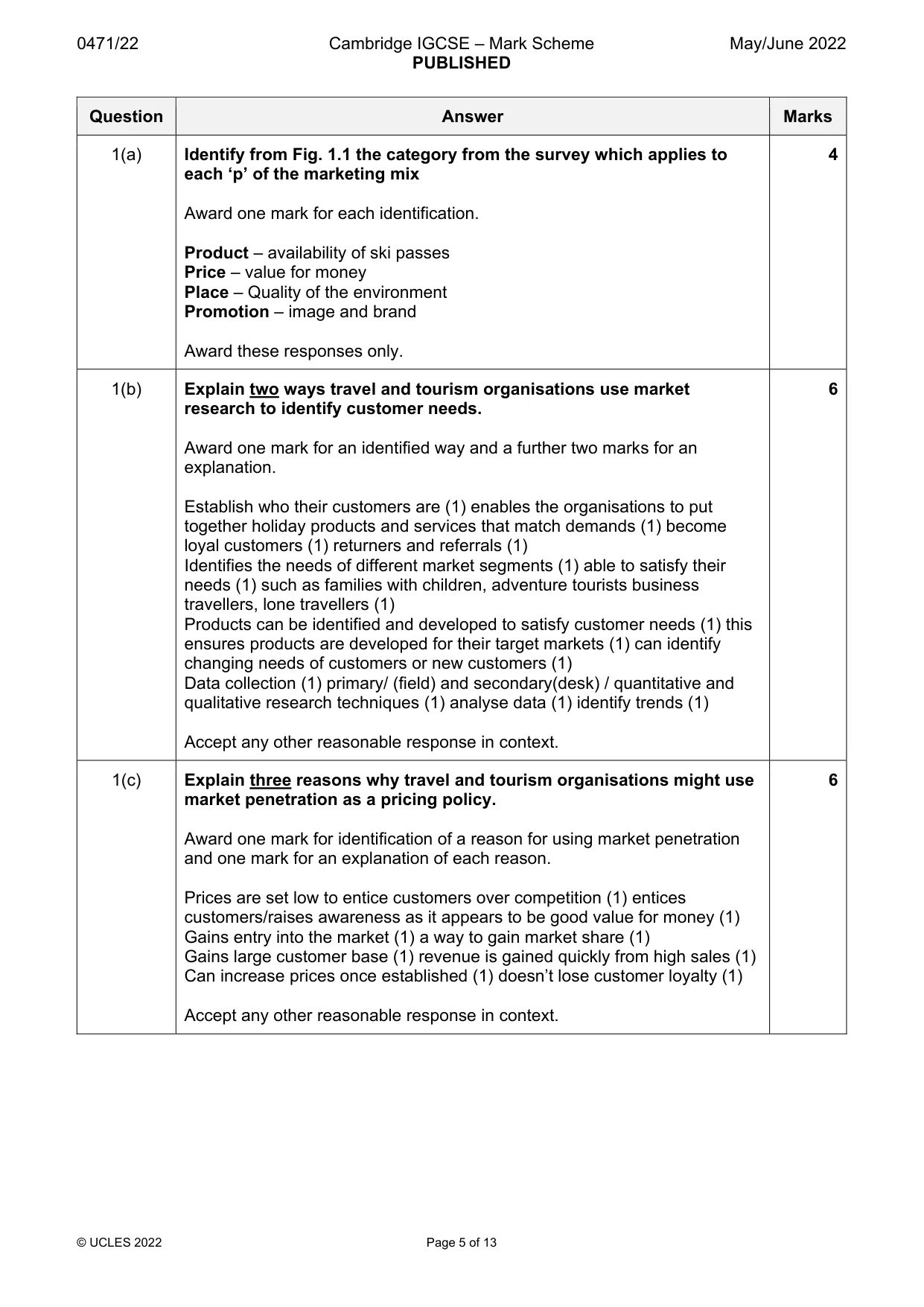
0471/22 Cambridge IGCSE – Mark Scheme PUBLISHED May/June 2022 © UCLES 2022 Page 5 of 13 Question Answer Marks 1(a) Identify from Fig. 1.1 the category from the survey which applies to each ‘p’ of the marketing mix Award one mark for each identification. Product – availability of ski passes Price – value for money Place – Quality of the environment Promotion – image and brand Award these responses only. 4 1(b) Explain two ways travel and tourism organisations use market research to identify customer needs. Award one mark for an identified way and a further two marks for an explanation. Establish who their customers are (1) enables the organisations to put together holiday products and services that match demands (1) become loyal customers (1) returners and referrals (1) Identifies the needs of different market segments (1) able to satisfy their needs (1) such as families with children, adventure tourists business travellers, lone travellers (1) Products can be identified and developed to satisfy customer needs (1) this ensures products are developed for their target markets (1) can identify changing needs of customers or new customers (1) Data collection (1) primary/ (field) and secondary(desk) / quantitative and qualitative research techniques (1) analyse data (1) identify trends (1) Accept any other reasonable response in context. 6 1(c) Explain three reasons why travel and tourism organisations might use market penetration as a pricing policy. Award one mark for identification of a reason for using market penetration and one mark for an explanation of each reason. Prices are set low to entice customers over competition (1) entices customers/raises awareness as it appears to be good value for money (1) Gains entry into the market (1) a way to gain market share (1) Gains large customer base (1) revenue is gained quickly from high sales (1) Can increase prices once established (1) doesn’t lose customer loyalty (1) Accept any other reasonable response in context. 6
Mark scheme, page 6
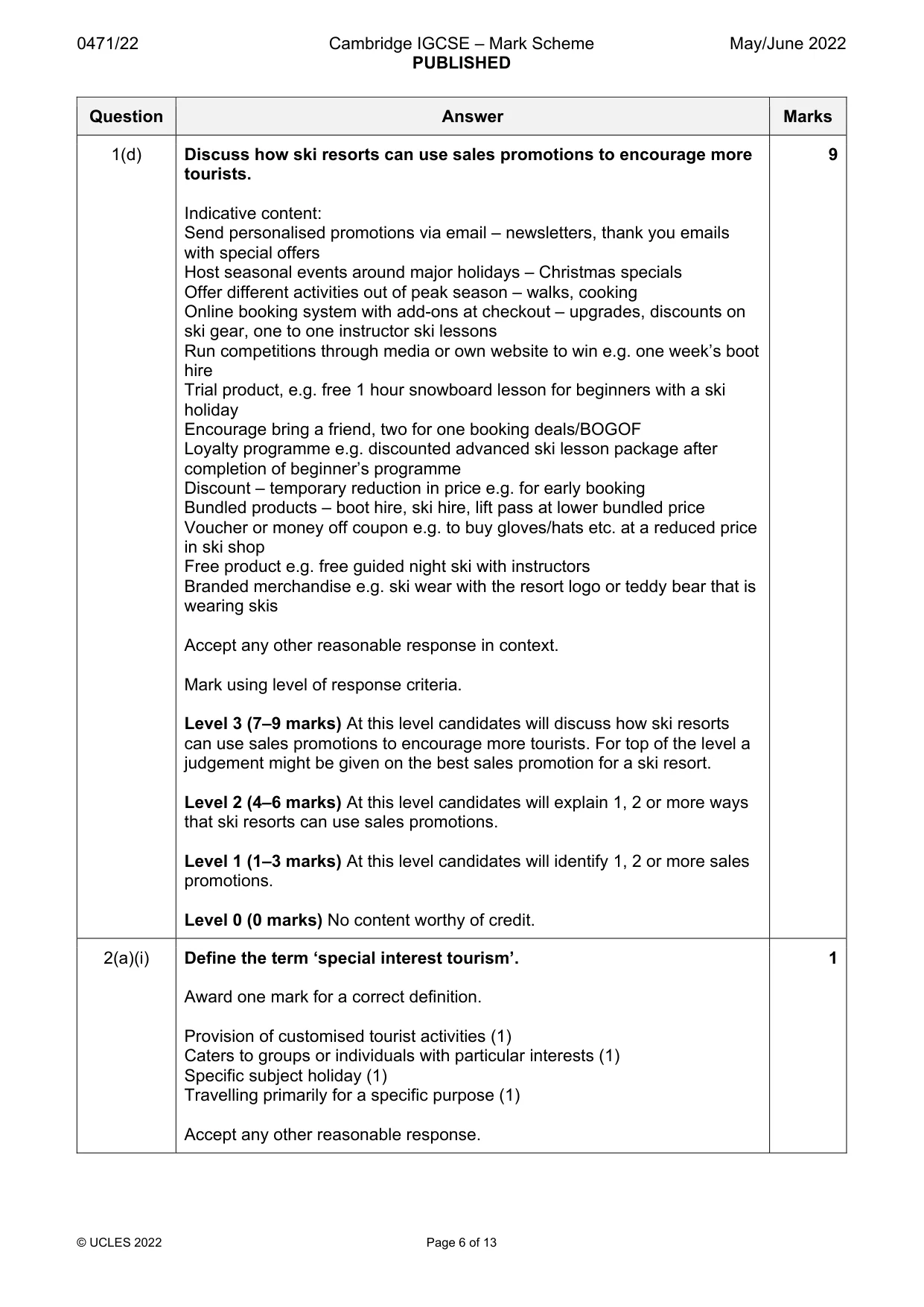
0471/22 Cambridge IGCSE – Mark Scheme PUBLISHED May/June 2022 © UCLES 2022 Page 6 of 13 Question Answer Marks 1(d) Discuss how ski resorts can use sales promotions to encourage more tourists. Indicative content: Send personalised promotions via email – newsletters, thank you emails with special offers Host seasonal events around major holidays – Christmas specials Offer different activities out of peak season – walks, cooking Online booking system with add-ons at checkout – upgrades, discounts on ski gear, one to one instructor ski lessons Run competitions through media or own website to win e.g. one week’s boot hire Trial product, e.g. free 1 hour snowboard lesson for beginners with a ski holiday Encourage bring a friend, two for one booking deals/BOGOF Loyalty programme e.g. discounted advanced ski lesson package after completion of beginner’s programme Discount – temporary reduction in price e.g. for early booking Bundled products – boot hire, ski hire, lift pass at lower bundled price Voucher or money off coupon e.g. to buy gloves/hats etc. at a reduced price in ski shop Free product e.g. free guided night ski with instructors Branded merchandise e.g. ski wear with the resort logo or teddy bear that is wearing skis Accept any other reasonable response in context. Mark using level of response criteria. Level 3 (7–9 marks) At this level candidates will discuss how ski resorts can use sales promotions to encourage more tourists. For top of the level a judgement might be given on the best sales promotion for a ski resort. Level 2 (4–6 marks) At this level candidates will explain 1, 2 or more ways that ski resorts can use sales promotions. Level 1 (1–3 marks) At this level candidates will identify 1, 2 or more sales promotions. Level 0 (0 marks) No content worthy of credit. 9 2(a)(i) Define the term ‘special interest tourism’. Award one mark for a correct definition. Provision of customised tourist activities (1) Caters to groups or individuals with particular interests (1) Specific subject holiday (1) Travelling primarily for a specific purpose (1) Accept any other reasonable response. 1
Mark scheme, page 7
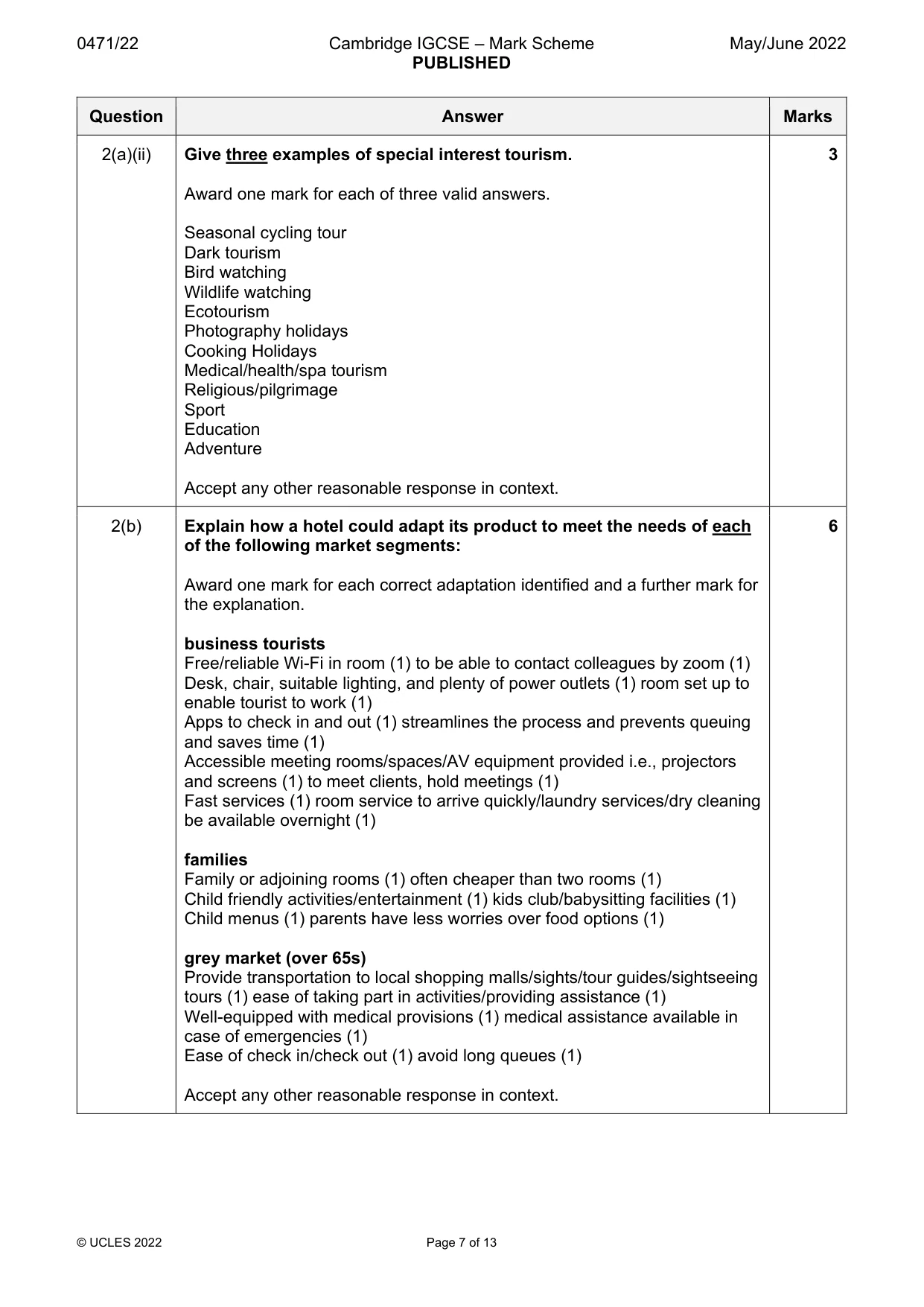
0471/22 Cambridge IGCSE – Mark Scheme PUBLISHED May/June 2022 © UCLES 2022 Page 7 of 13 Question Answer Marks 2(a)(ii) Give three examples of special interest tourism. Award one mark for each of three valid answers. Seasonal cycling tour Dark tourism Bird watching Wildlife watching Ecotourism Photography holidays Cooking Holidays Medical/health/spa tourism Religious/pilgrimage Sport Education Adventure Accept any other reasonable response in context. 3 2(b) Explain how a hotel could adapt its product to meet the needs of each of the following market segments: Award one mark for each correct adaptation identified and a further mark for the explanation. business tourists Free/reliable Wi-Fi in room (1) to be able to contact colleagues by zoom (1) Desk, chair, suitable lighting, and plenty of power outlets (1) room set up to enable tourist to work (1) Apps to check in and out (1) streamlines the process and prevents queuing and saves time (1) Accessible meeting rooms/spaces/AV equipment provided i.e., projectors and screens (1) to meet clients, hold meetings (1) Fast services (1) room service to arrive quickly/laundry services/dry cleaning be available overnight (1) families Family or adjoining rooms (1) often cheaper than two rooms (1) Child friendly activities/entertainment (1) kids club/babysitting facilities (1) Child menus (1) parents have less worries over food options (1) grey market (over 65s) Provide transportation to local shopping malls/sights/tour guides/sightseeing tours (1) ease of taking part in activities/providing assistance (1) Well-equipped with medical provisions (1) medical assistance available in case of emergencies (1) Ease of check in/check out (1) avoid long queues (1) Accept any other reasonable response in context. 6
Mark scheme, page 8
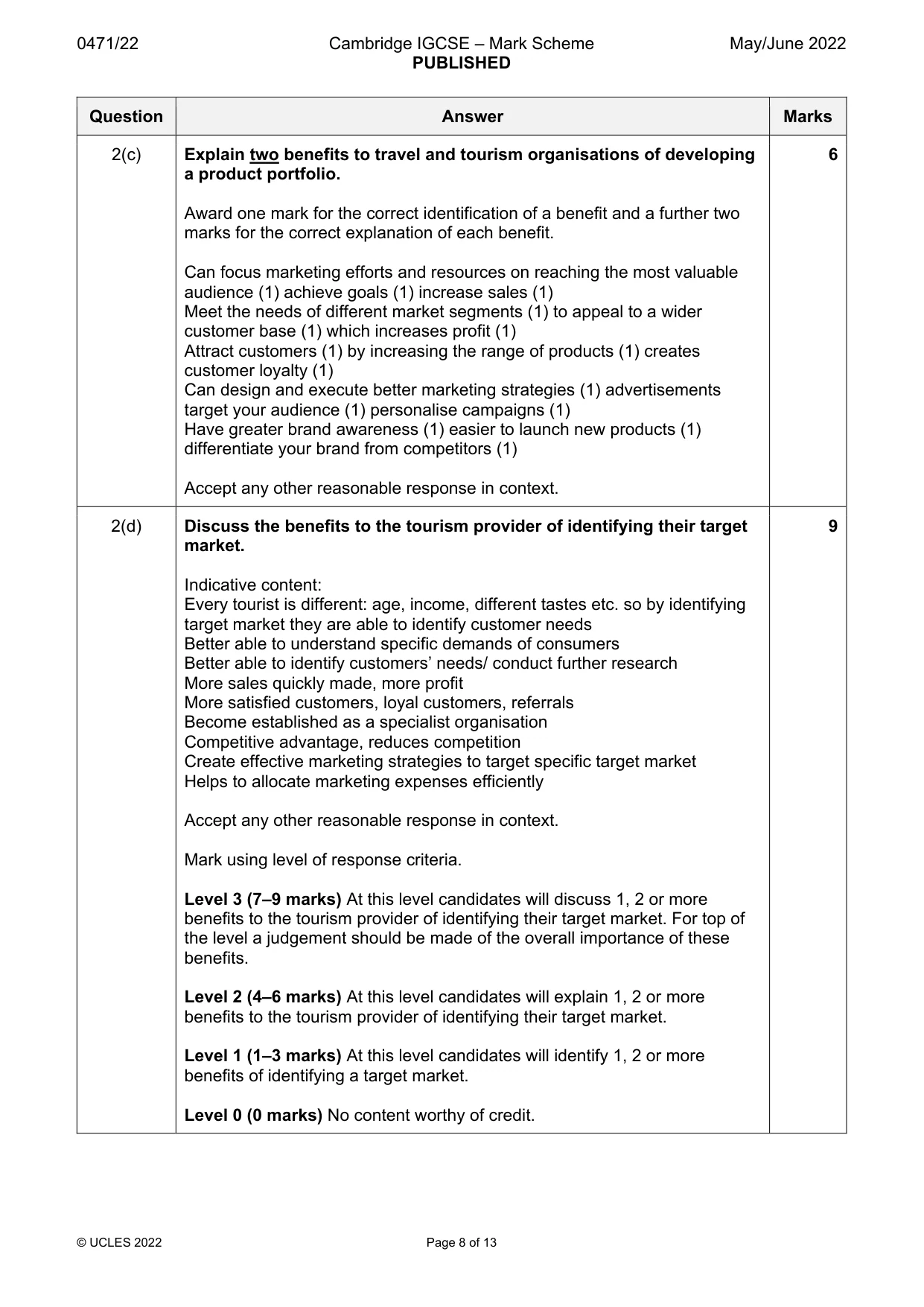
0471/22 Cambridge IGCSE – Mark Scheme PUBLISHED May/June 2022 © UCLES 2022 Page 8 of 13 Question Answer Marks 2(c) Explain two benefits to travel and tourism organisations of developing a product portfolio. Award one mark for the correct identification of a benefit and a further two marks for the correct explanation of each benefit. Can focus marketing efforts and resources on reaching the most valuable audience (1) achieve goals (1) increase sales (1) Meet the needs of different market segments (1) to appeal to a wider customer base (1) which increases profit (1) Attract customers (1) by increasing the range of products (1) creates customer loyalty (1) Can design and execute better marketing strategies (1) advertisements target your audience (1) personalise campaigns (1) Have greater brand awareness (1) easier to launch new products (1) differentiate your brand from competitors (1) Accept any other reasonable response in context. 6 2(d) Discuss the benefits to the tourism provider of identifying their target market. Indicative content: Every tourist is different: age, income, different tastes etc. so by identifying target market they are able to identify customer needs Better able to understand specific demands of consumers Better able to identify customers’ needs/ conduct further research More sales quickly made, more profit More satisfied customers, loyal customers, referrals Become established as a specialist organisation Competitive advantage, reduces competition Create effective marketing strategies to target specific target market Helps to allocate marketing expenses efficiently Accept any other reasonable response in context. Mark using level of response criteria. Level 3 (7–9 marks) At this level candidates will discuss 1, 2 or more benefits to the tourism provider of identifying their target market. For top of the level a judgement should be made of the overall importance of these benefits. Level 2 (4–6 marks) At this level candidates will explain 1, 2 or more benefits to the tourism provider of identifying their target market. Level 1 (1–3 marks) At this level candidates will identify 1, 2 or more benefits of identifying a target market. Level 0 (0 marks) No content worthy of credit. 9
Mark scheme, page 9
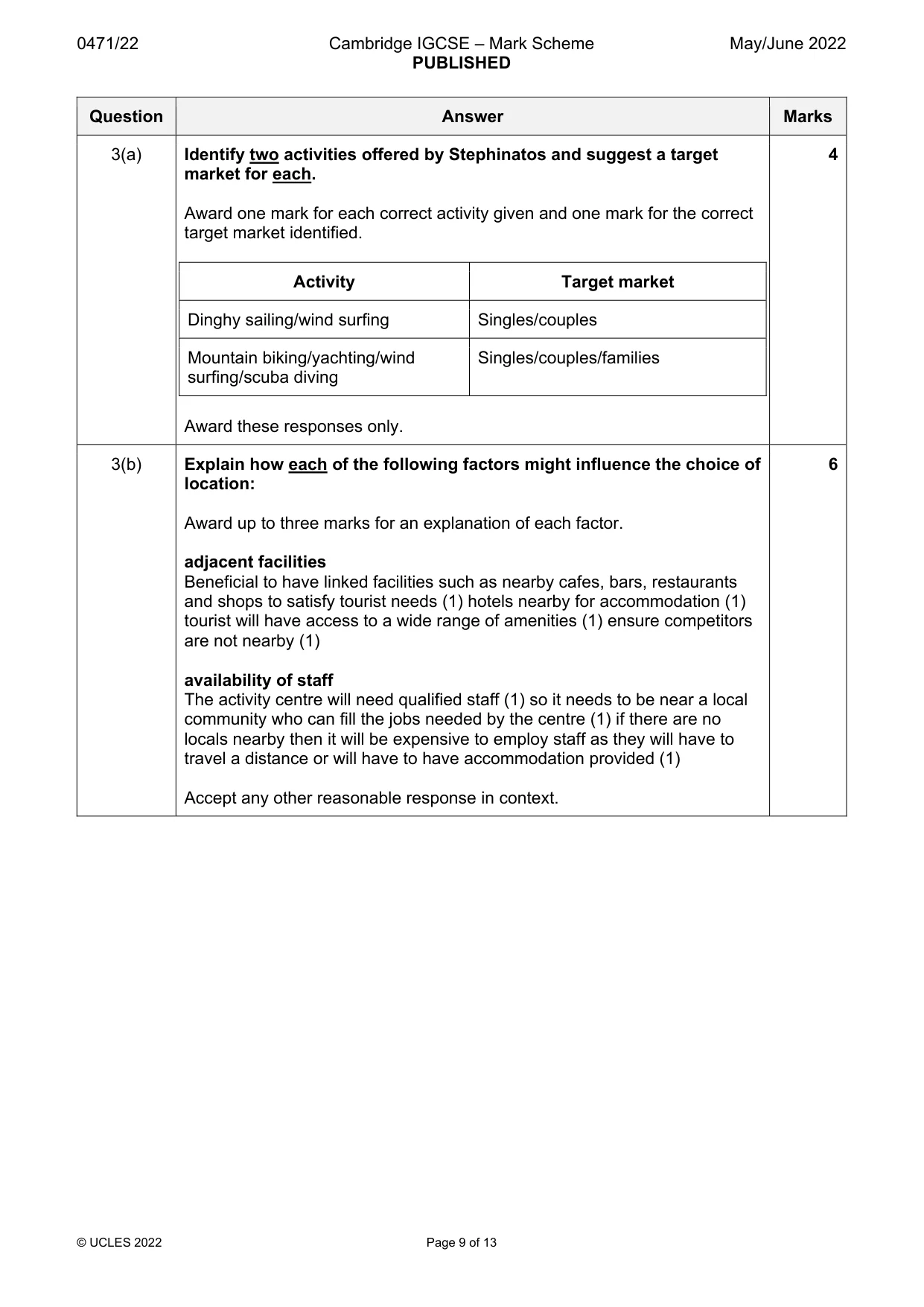
0471/22 Cambridge IGCSE – Mark Scheme PUBLISHED May/June 2022 © UCLES 2022 Page 9 of 13 Question Answer Marks 3(a) Identify two activities offered by Stephinatos and suggest a target market for each. Award one mark for each correct activity given and one mark for the correct target market identified. Activity Target market Dinghy sailing/wind surfing Singles/couples Mountain biking/yachting/wind surfing/scuba diving Singles/couples/families Award these responses only. 4 3(b) Explain how each of the following factors might influence the choice of location: Award up to three marks for an explanation of each factor. adjacent facilities Beneficial to have linked facilities such as nearby cafes, bars, restaurants and shops to satisfy tourist needs (1) hotels nearby for accommodation (1) tourist will have access to a wide range of amenities (1) ensure competitors are not nearby (1) availability of staff The activity centre will need qualified staff (1) so it needs to be near a local community who can fill the jobs needed by the centre (1) if there are no locals nearby then it will be expensive to employ staff as they will have to travel a distance or will have to have accommodation provided (1) Accept any other reasonable response in context. 6
Mark scheme, page 10
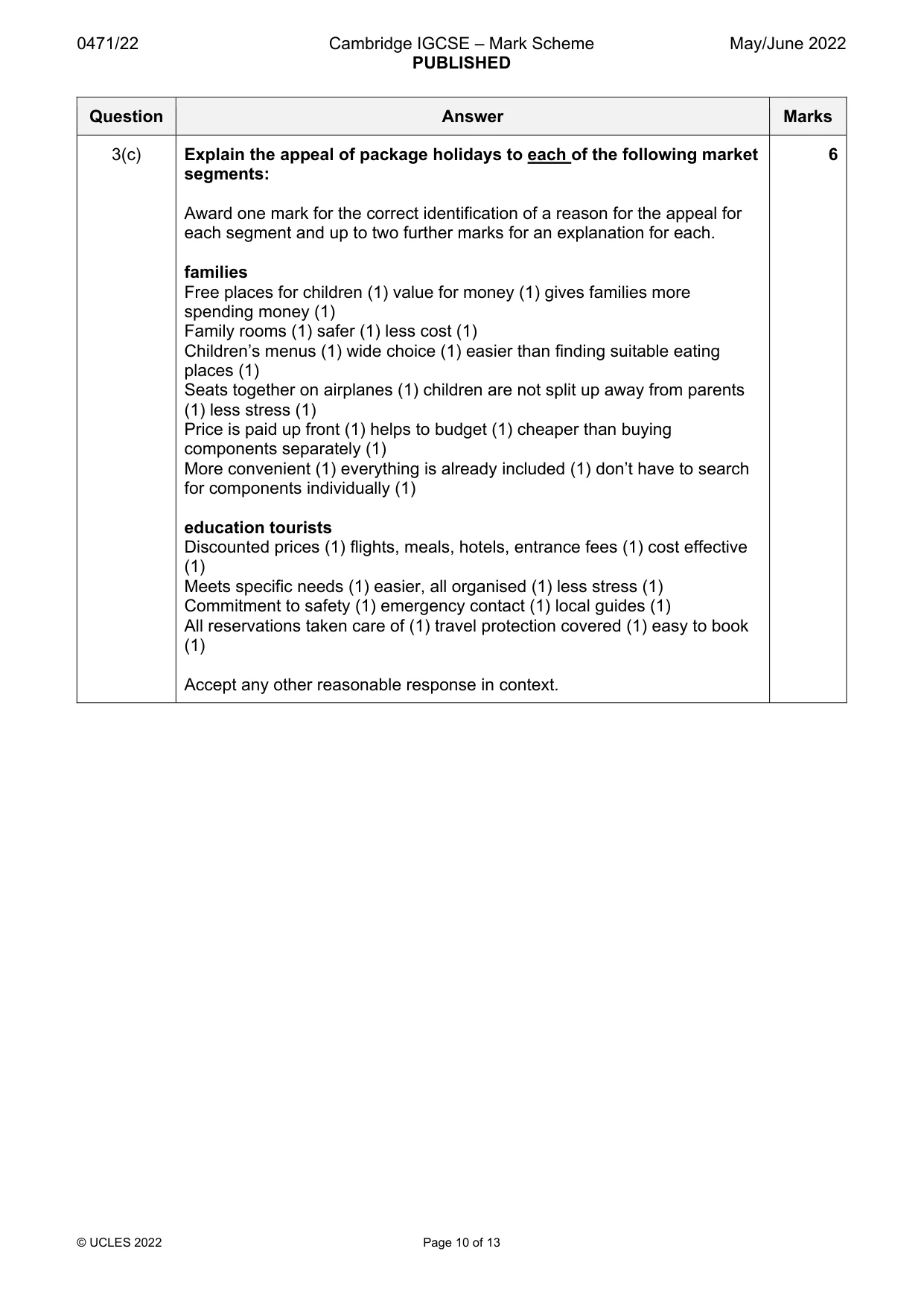
0471/22 Cambridge IGCSE – Mark Scheme PUBLISHED May/June 2022 © UCLES 2022 Page 10 of 13 Question Answer Marks 3(c) Explain the appeal of package holidays to each of the following market segments: Award one mark for the correct identification of a reason for the appeal for each segment and up to two further marks for an explanation for each. families Free places for children (1) value for money (1) gives families more spending money (1) Family rooms (1) safer (1) less cost (1) Children’s menus (1) wide choice (1) easier than finding suitable eating places (1) Seats together on airplanes (1) children are not split up away from parents (1) less stress (1) Price is paid up front (1) helps to budget (1) cheaper than buying components separately (1) More convenient (1) everything is already included (1) don’t have to search for components individually (1) education tourists Discounted prices (1) flights, meals, hotels, entrance fees (1) cost effective (1) Meets specific needs (1) easier, all organised (1) less stress (1) Commitment to safety (1) emergency contact (1) local guides (1) All reservations taken care of (1) travel protection covered (1) easy to book (1) Accept any other reasonable response in context. 6
Mark scheme, page 11
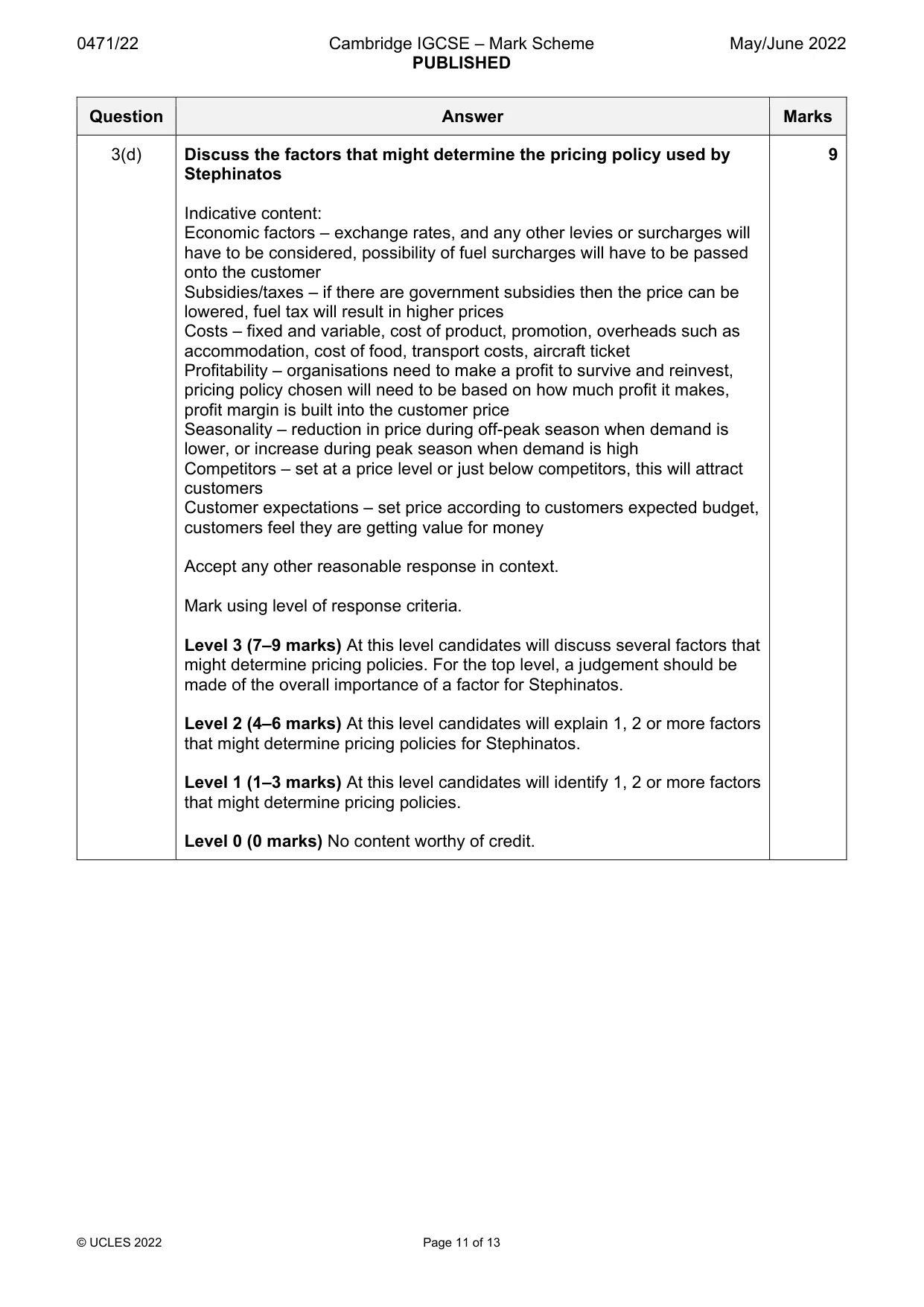
0471/22 Cambridge IGCSE – Mark Scheme PUBLISHED May/June 2022 © UCLES 2022 Page 11 of 13 Question Answer Marks 3(d) Discuss the factors that might determine the pricing policy used by Stephinatos Indicative content: Economic factors – exchange rates, and any other levies or surcharges will have to be considered, possibility of fuel surcharges will have to be passed onto the customer Subsidies/taxes – if there are government subsidies then the price can be lowered, fuel tax will result in higher prices Costs – fixed and variable, cost of product, promotion, overheads such as accommodation, cost of food, transport costs, aircraft ticket Profitability – organisations need to make a profit to survive and reinvest, pricing policy chosen will need to be based on how much profit it makes, profit margin is built into the customer price Seasonality – reduction in price during off-peak season when demand is lower, or increase during peak season when demand is high Competitors – set at a price level or just below competitors, this will attract customers Customer expectations – set price according to customers expected budget, customers feel they are getting value for money Accept any other reasonable response in context. Mark using level of response criteria. Level 3 (7–9 marks) At this level candidates will discuss several factors that might determine pricing policies. For the top level, a judgement should be made of the overall importance of a factor for Stephinatos. Level 2 (4–6 marks) At this level candidates will explain 1, 2 or more factors that might determine pricing policies for Stephinatos. Level 1 (1–3 marks) At this level candidates will identify 1, 2 or more factors that might determine pricing policies. Level 0 (0 marks) No content worthy of credit. 9
Mark scheme, page 12
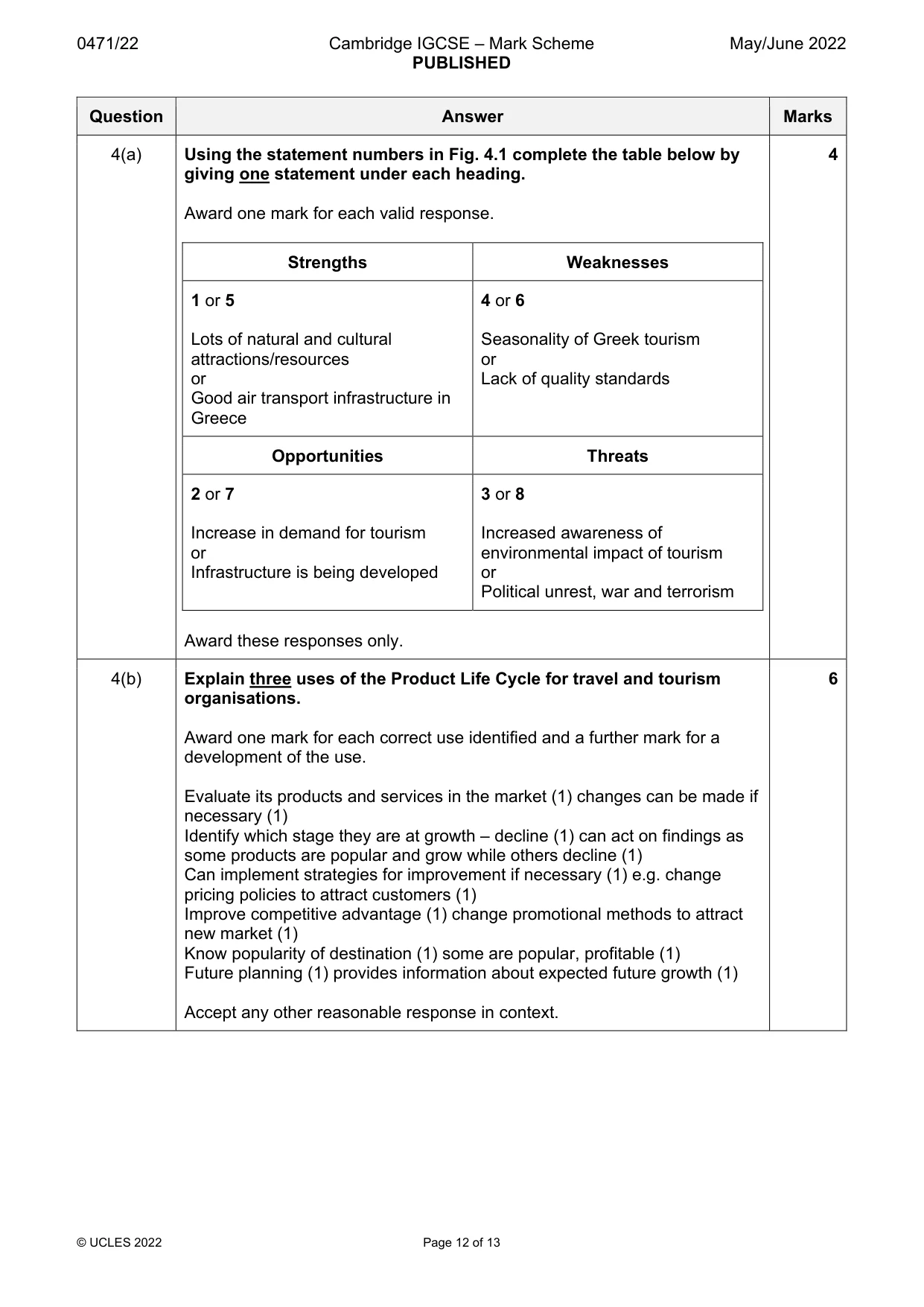
0471/22 Cambridge IGCSE – Mark Scheme PUBLISHED May/June 2022 © UCLES 2022 Page 12 of 13 Question Answer Marks 4(a) Using the statement numbers in Fig. 4.1 complete the table below by giving one statement under each heading. Award one mark for each valid response. Strengths Weaknesses 1 or 5 Lots of natural and cultural attractions/resources or Good air transport infrastructure in Greece 4 or 6 Seasonality of Greek tourism or Lack of quality standards Opportunities Threats 2 or 7 Increase in demand for tourism or Infrastructure is being developed 3 or 8 Increased awareness of environmental impact of tourism or Political unrest, war and terrorism Award these responses only. 4 4(b) Explain three uses of the Product Life Cycle for travel and tourism organisations. Award one mark for each correct use identified and a further mark for a development of the use. Evaluate its products and services in the market (1) changes can be made if necessary (1) Identify which stage they are at growth – decline (1) can act on findings as some products are popular and grow while others decline (1) Can implement strategies for improvement if necessary (1) e.g. change pricing policies to attract customers (1) Improve competitive advantage (1) change promotional methods to attract new market (1) Know popularity of destination (1) some are popular, profitable (1) Future planning (1) provides information about expected future growth (1) Accept any other reasonable response in context. 6
Mark scheme, page 13
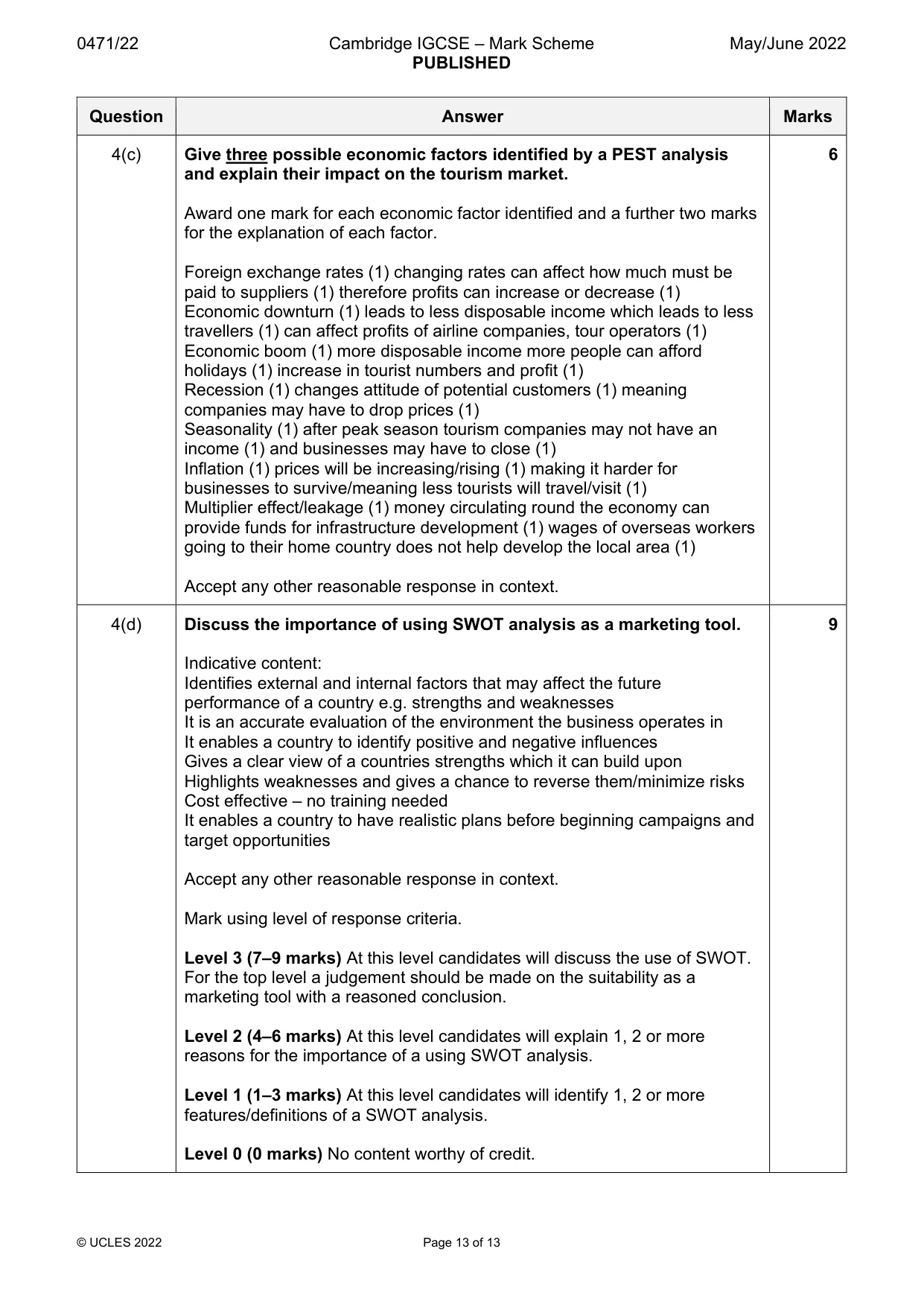
0471/22 Cambridge IGCSE – Mark Scheme PUBLISHED May/June 2022 © UCLES 2022 Page 13 of 13 Question Answer Marks 4(c) Give three possible economic factors identified by a PEST analysis and explain their impact on the tourism market. Award one mark for each economic factor identified and a further two marks for the explanation of each factor. Foreign exchange rates (1) changing rates can affect how much must be paid to suppliers (1) therefore profits can increase or decrease (1) Economic downturn (1) leads to less disposable income which leads to less travellers (1) can affect profits of airline companies, tour operators (1) Economic boom (1) more disposable income more people can afford holidays (1) increase in tourist numbers and profit (1) Recession (1) changes attitude of potential customers (1) meaning companies may have to drop prices (1) Seasonality (1) after peak season tourism companies may not have an income (1) and businesses may have to close (1) Inflation (1) prices will be increasing/rising (1) making it harder for businesses to survive/meaning less tourists will travel/visit (1) Multiplier effect/leakage (1) money circulating round the economy can provide funds for infrastructure development (1) wages of overseas workers going to their home country does not help develop the local area (1) Accept any other reasonable response in context. 6 4(d) Discuss the importance of using SWOT analysis as a marketing tool. Indicative content: Identifies external and internal factors that may affect the future performance of a country e.g. strengths and weaknesses It is an accurate evaluation of the environment the business operates in It enables a country to identify positive and negative influences Gives a clear view of a countries strengths which it can build upon Highlights weaknesses and gives a chance to reverse them/minimize risks Cost effective – no training needed It enables a country to have realistic plans before beginning campaigns and target opportunities Accept any other reasonable response in context. Mark using level of response criteria. Level 3 (7–9 marks) At this level candidates will discuss the use of SWOT. For the top level a judgement should be made on the suitability as a marketing tool with a reasoned conclusion. Level 2 (4–6 marks) At this level candidates will explain 1, 2 or more reasons for the importance of a using SWOT analysis. Level 1 (1–3 marks) At this level candidates will identify 1, 2 or more features/definitions of a SWOT analysis. Level 0 (0 marks) No content worthy of credit. 9
What you needed in this session
Cambridge’s own grade thresholds for 2022 May/June, Paper 2 · Variant 2. A higher threshold means an easier paper — the bar moves with how the cohort did.