Cambridge IGCSE Travel and Tourism 0471 — 2024 May/June Paper 2 · Variant 3
0471/23/M/J/24 · 80 marks · 120 min
The question paper and its mark scheme, free to read here and free to download. This is Cambridge’s own paper, exactly as it was sat.
Question paper12 pages



Mark scheme19 pages
Answers below. Sit the paper first if you are practising.


Paper as text
Question paper, page 1
This document has 12 pages. Any blank pages are indicated. [Turn over Cambridge IGCSE™ TRAVEL & TOURISM 0471/23 Paper 2 Managing and Marketing Destinations May/June 2024 2 hours You must answer on the question paper. You will need: Insert (enclosed) INSTRUCTIONS ● Answer all questions. ● Use a black or dark blue pen. ● Write your name, centre number and candidate number in the boxes at the top of the page. ● Write your answer to each question in the space provided. ● Do not use an erasable pen or correction fluid. ● Do not write on any bar codes. INFORMATION ● The total mark for this paper is 80. ● The number of marks for each question or part question is shown in brackets [ ]. ● The insert contains all the figures referred to in the questions. * 4 5 2 6 3 8 4 6 5 3 * DC (SL) 329883/2 © UCLES 2024
Question paper, page 2
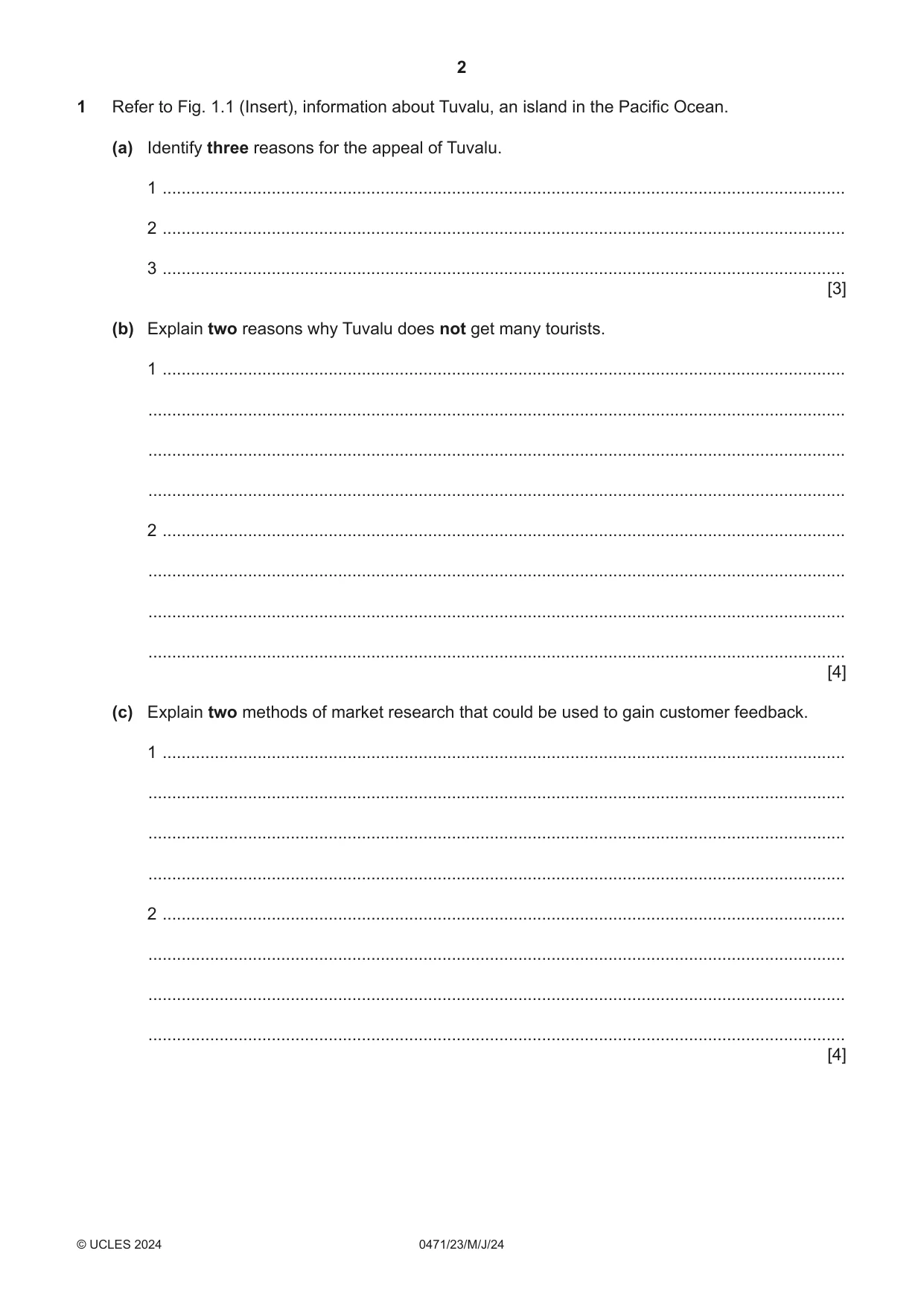
2 0471/23/M/J/24 © UCLES 2024 1 Refer to Fig. 1.1 (Insert), information about Tuvalu, an island in the Pacific Ocean. (a) Identify three reasons for the appeal of Tuvalu. 1 … 2 … 3 … [3] (b) Explain two reasons why Tuvalu does not get many tourists. 1 … … … … 2 … … … … [4] (c) Explain two methods of market research that could be used to gain customer feedback. 1 … … … … 2 … … … … [4]
Question paper, page 3
3 0471/23/M/J/24 © UCLES 2024 [Turn over (d) Analyse the possible impacts of developing tourism in Tuvalu. … … … … … … … … … … … … … … … … … … [9] [Total: 20]
Question paper, page 4
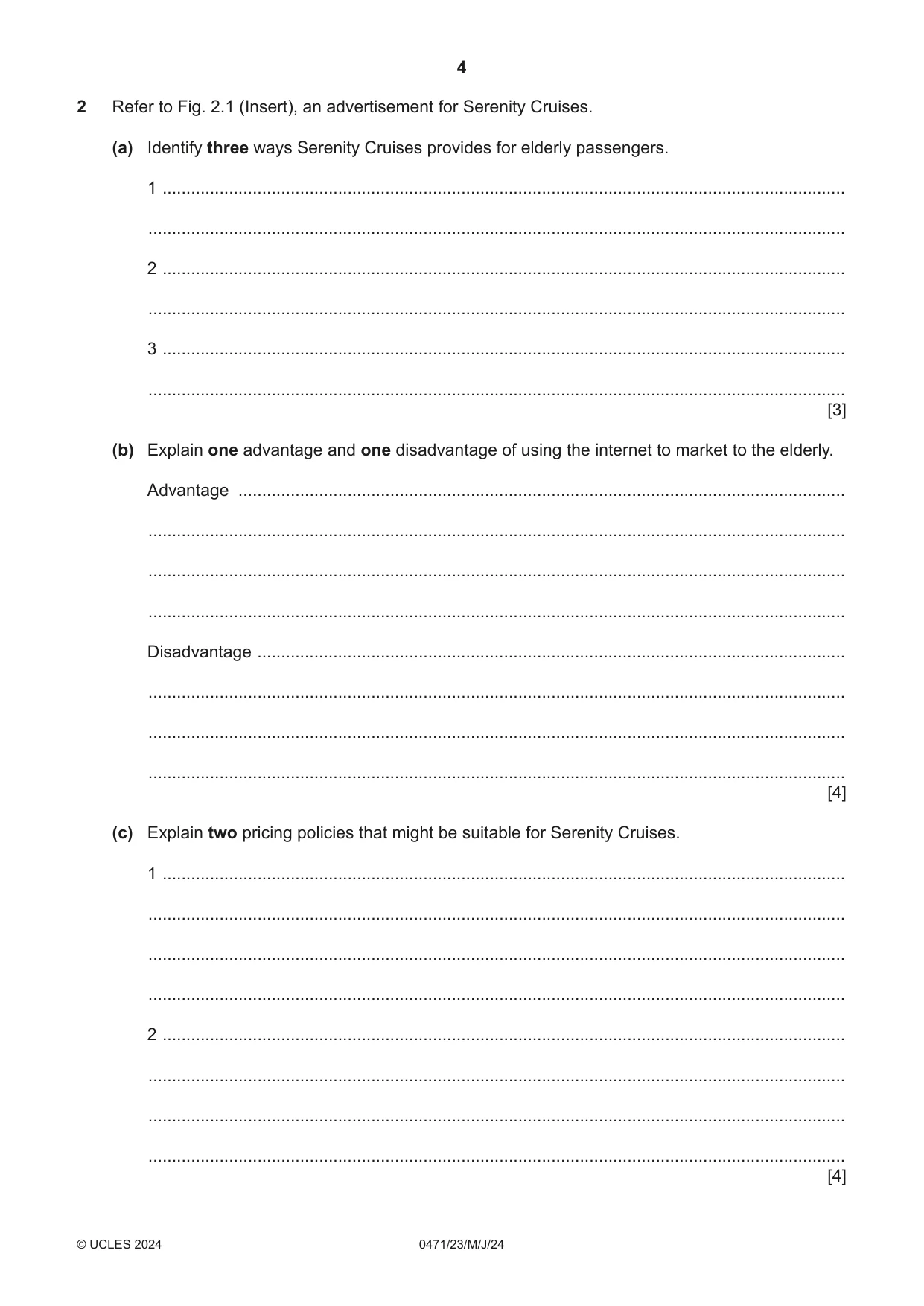
4 0471/23/M/J/24 © UCLES 2024 2 Refer to Fig. 2.1 (Insert), an advertisement for Serenity Cruises. (a) Identify three ways Serenity Cruises provides for elderly passengers. 1 … … 2 … … 3 … … [3] (b) Explain one advantage and one disadvantage of using the internet to market to the elderly. Advantage … … … … Disadvantage … … … … [4] (c) Explain two pricing policies that might be suitable for Serenity Cruises. 1 … … … … 2 … … … … [4]
Question paper, page 5
5 0471/23/M/J/24 © UCLES 2024 [Turn over (d) Discuss the benefits to tourism organisations of having a successful promotional campaign. … … … … … … … … … … … … … … … … … … [9] [Total: 20]
Question paper, page 6
6 0471/23/M/J/24 © UCLES 2024 3 Refer to Fig. 3.1 (Insert), information about agritourism. (a) Identify three tangible products from Fig. 3.1. 1 … 2 … 3 … [3] (b) Describe two ways a destination management company (DMC) can help raise awareness of a tourist location. 1 … … … … 2 … … … … [4] (c) Explain two benefits of having brand loyalty. 1 … … … … 2 … … … … [4]
Question paper, page 7
7 0471/23/M/J/24 © UCLES 2024 [Turn over (d) Discuss the ways agritourism can be managed sustainably. … … … … … … … … … … … … … … … … … … [9] [Total: 20]
Question paper, page 8
8 0471/23/M/J/24 © UCLES 2024 4 Refer to Fig. 4.1 (Insert), an advertisement for the Mandai Wildlife Reserve in Singapore. (a) Suggest three types of tourist likely to visit the Mandai Wildlife Reserve. 1 … 2 … 3 … [3] (b) Explain two benefits to the Mandai Wildlife Reserve of winning the best leisure attraction award. 1 … … … … 2 … … … … [4] (c) Explain two reasons for the importance of marketing to travel and tourism organisations. 1 … … … … 2 … … … … [4]
Question paper, page 9
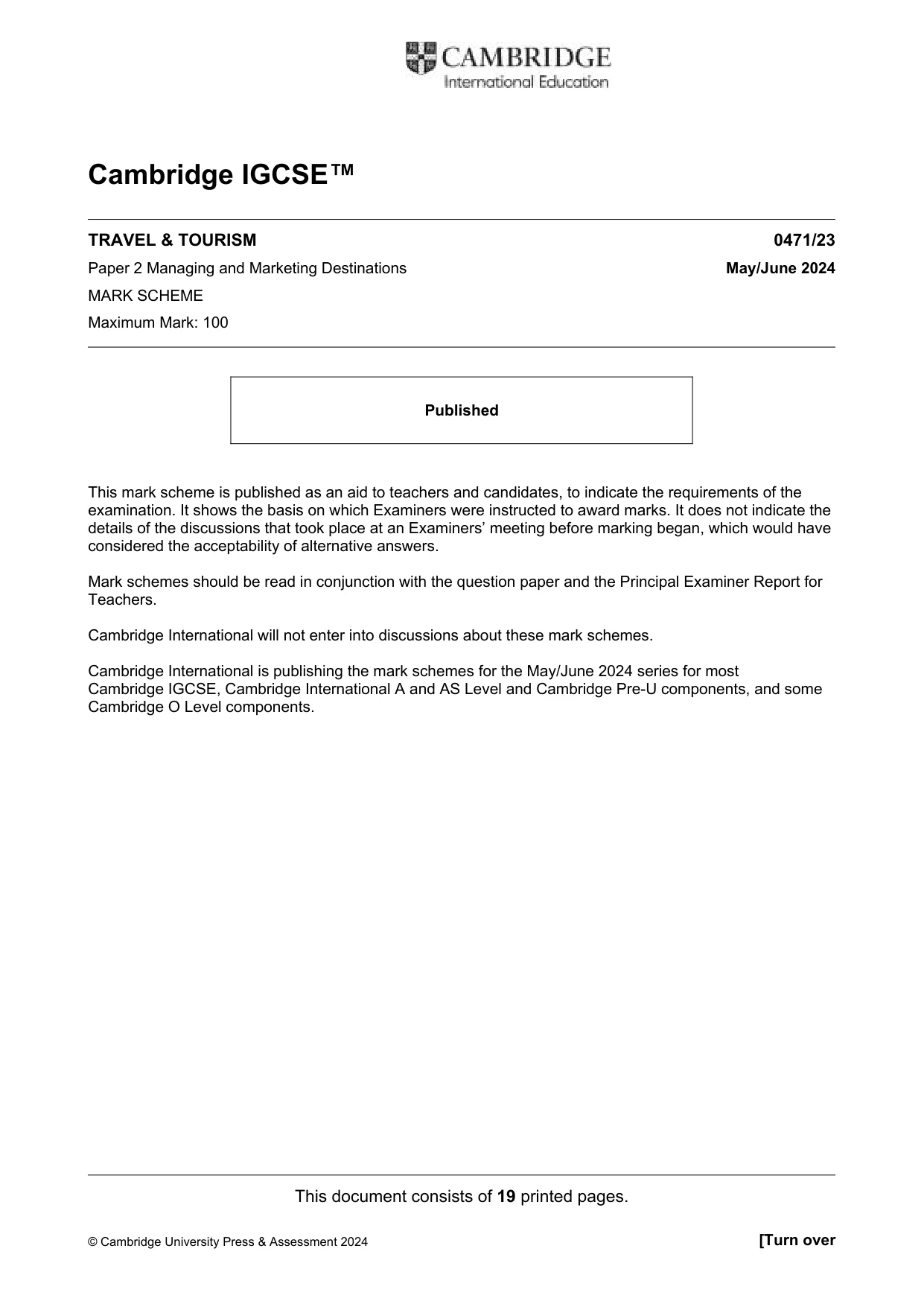
9 0471/23/M/J/24 © UCLES 2024 (d) Familiarisation trips are a form of public relations used by many tourism organisations. Discuss the effectiveness of familiarisation trips in helping to increase tourist numbers. … … … … … … … … … … … … … … … … … … [9] [Total: 20]
Question paper, page 10
10 0471/23/M/J/24 © UCLES 2024 BLANK PAGE
Question paper, page 11
11 0471/23/M/J/24 © UCLES 2024 BLANK PAGE
Question paper, page 12
12 0471/23/M/J/24 © UCLES 2024 The boundaries and names shown, the designations used and the presentation of material on any maps contained in this question paper/insert do not imply official endorsement or acceptance by Cambridge Assessment International Education concerning the legal status of any country, territory, or area or any of its authorities, or of the delimitation of its frontiers or boundaries. Permission to reproduce items where third-party owned material protected by copyright is included has been sought and cleared where possible. Every reasonable effort has been made by the publisher (UCLES) to trace copyright holders, but if any items requiring clearance have unwittingly been included, the publisher will be pleased to make amends at the earliest possible opportunity. To avoid the issue of disclosure of answer-related information to candidates, all copyright acknowledgements are reproduced online in the Cambridge Assessment International Education Copyright Acknowledgements Booklet. This is produced for each series of examinations and is freely available to download at www.cambridgeinternational.org after the live examination series. Cambridge Assessment International Education is part of Cambridge Assessment. Cambridge Assessment is the brand name of the University of Cambridge Local Examinations Syndicate (UCLES), which is a department of the University of Cambridge. BLANK PAGE
Mark scheme, page 1
This document consists of 19 printed pages. © Cambridge University Press & Assessment 2024 [Turn over Cambridge IGCSE™ TRAVEL & TOURISM 0471/23 Paper 2 Managing and Marketing Destinations May/June 2024 MARK SCHEME Maximum Mark: 100 Published This mark scheme is published as an aid to teachers and candidates, to indicate the requirements of the examination. It shows the basis on which Examiners were instructed to award marks. It does not indicate the details of the discussions that took place at an Examiners’ meeting before marking began, which would have considered the acceptability of alternative answers. Mark schemes should be read in conjunction with the question paper and the Principal Examiner Report for Teachers. Cambridge International will not enter into discussions about these mark schemes. Cambridge International is publishing the mark schemes for the May/June 2024 series for most Cambridge IGCSE, Cambridge International A and AS Level and Cambridge Pre-U components, and some Cambridge O Level components.
Mark scheme, page 2
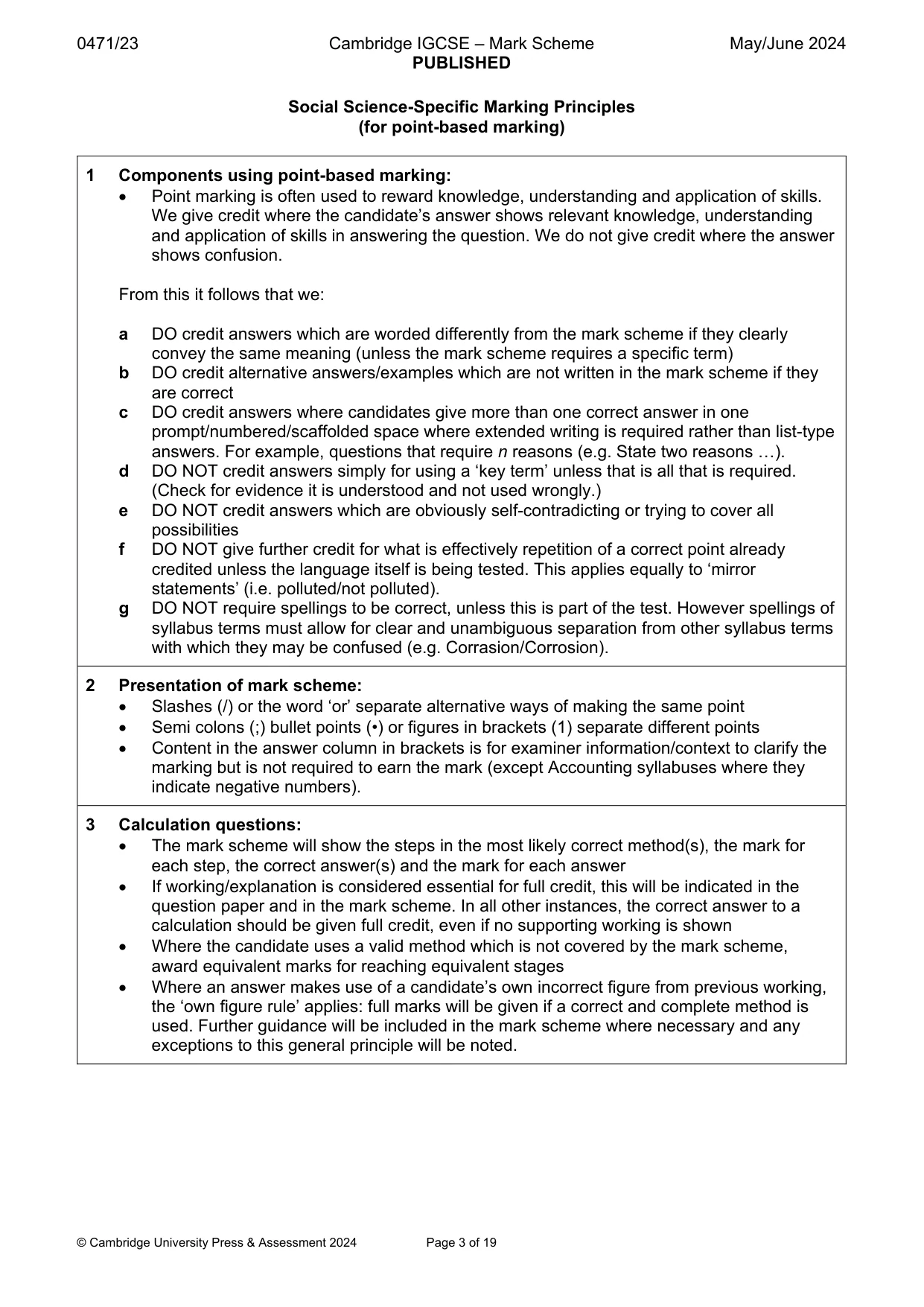
0471/23 Cambridge IGCSE – Mark Scheme PUBLISHED May/June 2024 © Cambridge University Press & Assessment 2024 Page 2 of 19 Generic Marking Principles These general marking principles must be applied by all examiners when marking candidate answers. They should be applied alongside the specific content of the mark scheme or generic level descriptions for a question. Each question paper and mark scheme will also comply with these marking principles. GENERIC MARKING PRINCIPLE 1: Marks must be awarded in line with: the specific content of the mark scheme or the generic level descriptors for the question the specific skills defined in the mark scheme or in the generic level descriptors for the question the standard of response required by a candidate as exemplified by the standardisation scripts. GENERIC MARKING PRINCIPLE 2: Marks awarded are always whole marks (not half marks, or other fractions). GENERIC MARKING PRINCIPLE 3: Marks must be awarded positively: marks are awarded for correct/valid answers, as defined in the mark scheme. However, credit is given for valid answers which go beyond the scope of the syllabus and mark scheme, referring to your Team Leader as appropriate marks are awarded when candidates clearly demonstrate what they know and can do marks are not deducted for errors marks are not deducted for omissions answers should only be judged on the quality of spelling, punctuation and grammar when these features are specifically assessed by the question as indicated by the mark scheme. The meaning, however, should be unambiguous. GENERIC MARKING PRINCIPLE 4: Rules must be applied consistently, e.g. in situations where candidates have not followed instructions or in the application of generic level descriptors. GENERIC MARKING PRINCIPLE 5: Marks should be awarded using the full range of marks defined in the mark scheme for the question (however; the use of the full mark range may be limited according to the quality of the candidate responses seen). GENERIC MARKING PRINCIPLE 6: Marks awarded are based solely on the requirements as defined in the mark scheme. Marks should not be awarded with grade thresholds or grade descriptors in mind.
Mark scheme, page 3
0471/23 Cambridge IGCSE – Mark Scheme PUBLISHED May/June 2024 © Cambridge University Press & Assessment 2024 Page 3 of 19 Social Science-Specific Marking Principles (for point-based marking) 1 Components using point-based marking: Point marking is often used to reward knowledge, understanding and application of skills. We give credit where the candidate’s answer shows relevant knowledge, understanding and application of skills in answering the question. We do not give credit where the answer shows confusion. From this it follows that we: a DO credit answers which are worded differently from the mark scheme if they clearly convey the same meaning (unless the mark scheme requires a specific term) b DO credit alternative answers/examples which are not written in the mark scheme if they are correct c DO credit answers where candidates give more than one correct answer in one prompt/numbered/scaffolded space where extended writing is required rather than list-type answers. For example, questions that require n reasons (e.g. State two reasons …). d DO NOT credit answers simply for using a ‘key term’ unless that is all that is required. (Check for evidence it is understood and not used wrongly.) e DO NOT credit answers which are obviously self-contradicting or trying to cover all possibilities f DO NOT give further credit for what is effectively repetition of a correct point already credited unless the language itself is being tested. This applies equally to ‘mirror statements’ (i.e. polluted/not polluted). g DO NOT require spellings to be correct, unless this is part of the test. However spellings of syllabus terms must allow for clear and unambiguous separation from other syllabus terms with which they may be confused (e.g. Corrasion/Corrosion). 2 Presentation of mark scheme: Slashes (/) or the word ‘or’ separate alternative ways of making the same point Semi colons (;) bullet points (•) or figures in brackets (1) separate different points Content in the answer column in brackets is for examiner information/context to clarify the marking but is not required to earn the mark (except Accounting syllabuses where they indicate negative numbers). 3 Calculation questions: The mark scheme will show the steps in the most likely correct method(s), the mark for each step, the correct answer(s) and the mark for each answer If working/explanation is considered essential for full credit, this will be indicated in the question paper and in the mark scheme. In all other instances, the correct answer to a calculation should be given full credit, even if no supporting working is shown Where the candidate uses a valid method which is not covered by the mark scheme, award equivalent marks for reaching equivalent stages Where an answer makes use of a candidate’s own incorrect figure from previous working, the ‘own figure rule’ applies: full marks will be given if a correct and complete method is used. Further guidance will be included in the mark scheme where necessary and any exceptions to this general principle will be noted.
Mark scheme, page 4
0471/23 Cambridge IGCSE – Mark Scheme PUBLISHED May/June 2024 © Cambridge University Press & Assessment 2024 Page 4 of 19 4 Annotation: For point marking, ticks can be used to indicate correct answers and crosses can be used to indicate wrong answers. There is no direct relationship between ticks and marks. Ticks have no defined meaning for levels of response marking For levels of response marking, the level awarded should be annotated on the script Other annotations will be used by examiners as agreed during standardisation, and the meaning will be understood by all examiners who marked that paper.
Mark scheme, page 5
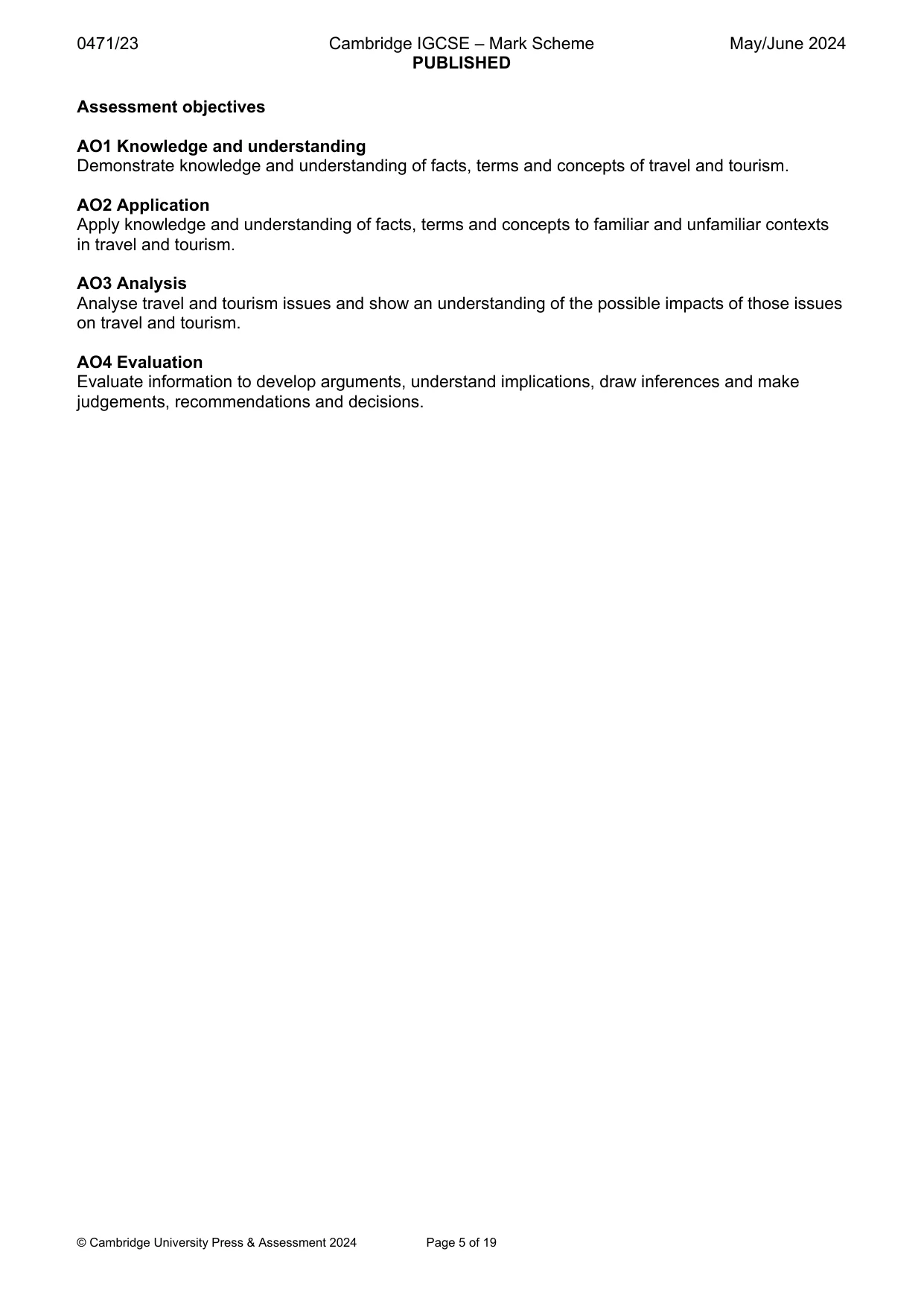
0471/23 Cambridge IGCSE – Mark Scheme PUBLISHED May/June 2024 © Cambridge University Press & Assessment 2024 Page 5 of 19 Assessment objectives AO1 Knowledge and understanding Demonstrate knowledge and understanding of facts, terms and concepts of travel and tourism. AO2 Application Apply knowledge and understanding of facts, terms and concepts to familiar and unfamiliar contexts in travel and tourism. AO3 Analysis Analyse travel and tourism issues and show an understanding of the possible impacts of those issues on travel and tourism. AO4 Evaluation Evaluate information to develop arguments, understand implications, draw inferences and make judgements, recommendations and decisions.
Mark scheme, page 6
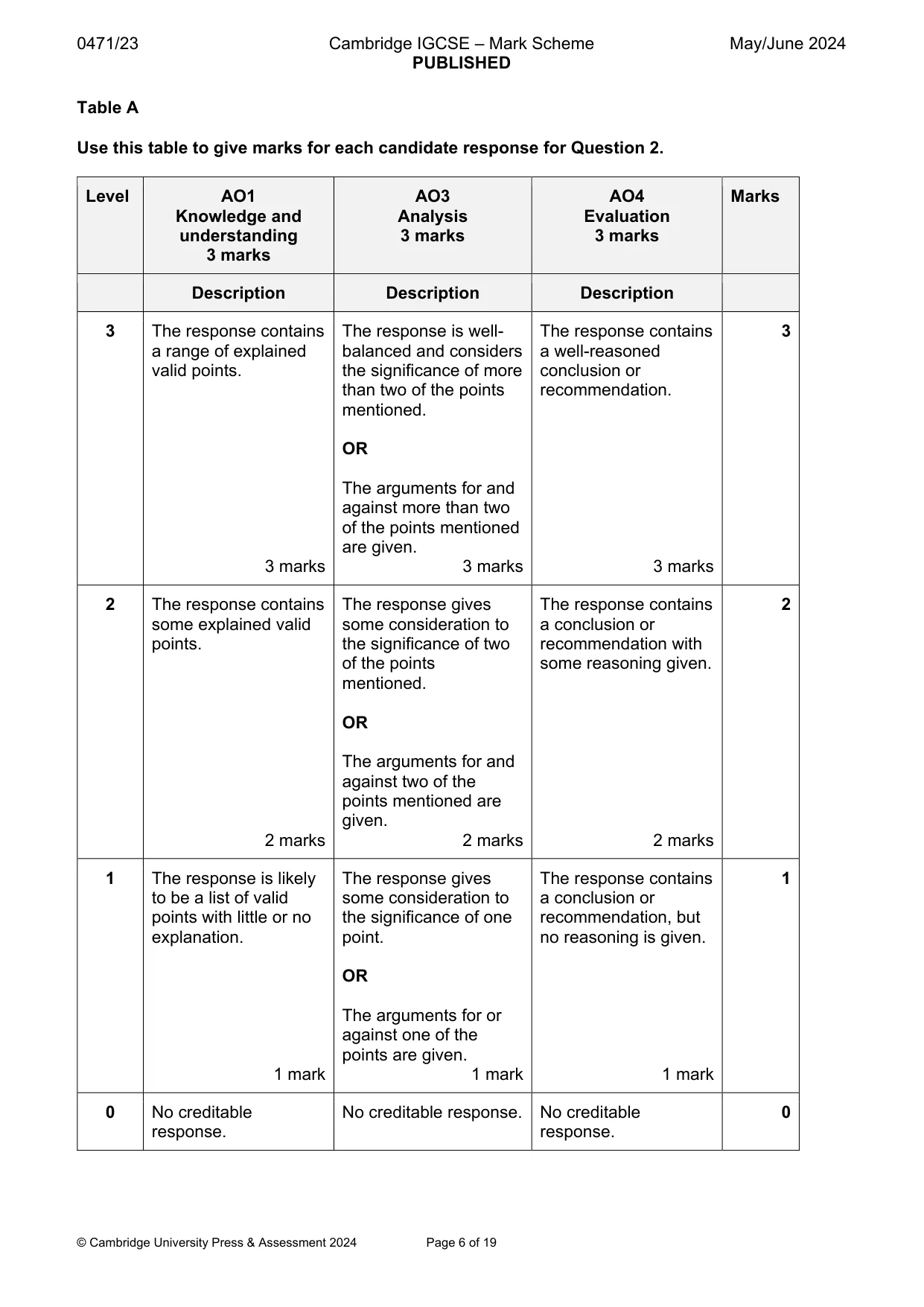
0471/23 Cambridge IGCSE – Mark Scheme PUBLISHED May/June 2024 © Cambridge University Press & Assessment 2024 Page 6 of 19 Table A Use this table to give marks for each candidate response for Question 2. Level AO1 Knowledge and understanding 3 marks AO3 Analysis 3 marks AO4 Evaluation 3 marks Marks Description Description Description 3 The response contains a range of explained valid points. 3 marks The response is well- balanced and considers the significance of more than two of the points mentioned. OR The arguments for and against more than two of the points mentioned are given. 3 marks The response contains a well-reasoned conclusion or recommendation. 3 marks 3 2 The response contains some explained valid points. 2 marks The response gives some consideration to the significance of two of the points mentioned. OR The arguments for and against two of the points mentioned are given. 2 marks The response contains a conclusion or recommendation with some reasoning given. 2 marks 2 1 The response is likely to be a list of valid points with little or no explanation. 1 mark The response gives some consideration to the significance of one point. OR The arguments for or against one of the points are given. 1 mark The response contains a conclusion or recommendation, but no reasoning is given. 1 mark 1 0 No creditable response. No creditable response. No creditable response. 0
Mark scheme, page 7
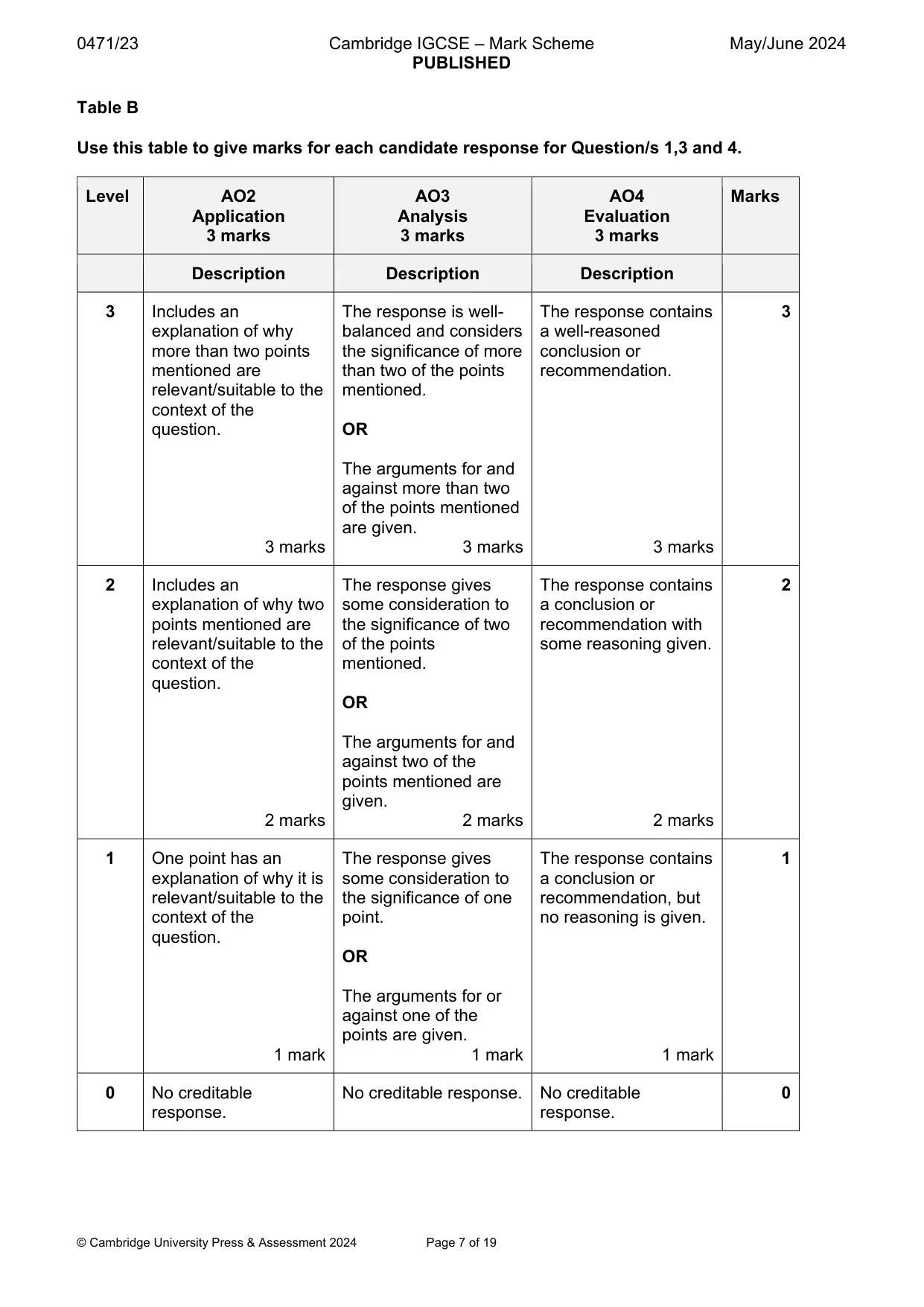
0471/23 Cambridge IGCSE – Mark Scheme PUBLISHED May/June 2024 © Cambridge University Press & Assessment 2024 Page 7 of 19 Table B Use this table to give marks for each candidate response for Question/s 1,3 and 4. Level AO2 Application 3 marks AO3 Analysis 3 marks AO4 Evaluation 3 marks Marks Description Description Description 3 Includes an explanation of why more than two points mentioned are relevant/suitable to the context of the question. 3 marks The response is well- balanced and considers the significance of more than two of the points mentioned. OR The arguments for and against more than two of the points mentioned are given. 3 marks The response contains a well-reasoned conclusion or recommendation. 3 marks 3 2 Includes an explanation of why two points mentioned are relevant/suitable to the context of the question. 2 marks The response gives some consideration to the significance of two of the points mentioned. OR The arguments for and against two of the points mentioned are given. 2 marks The response contains a conclusion or recommendation with some reasoning given. 2 marks 2 1 One point has an explanation of why it is relevant/suitable to the context of the question. 1 mark The response gives some consideration to the significance of one point. OR The arguments for or against one of the points are given. 1 mark The response contains a conclusion or recommendation, but no reasoning is given. 1 mark 1 0 No creditable response. No creditable response. No creditable response. 0
Mark scheme, page 8
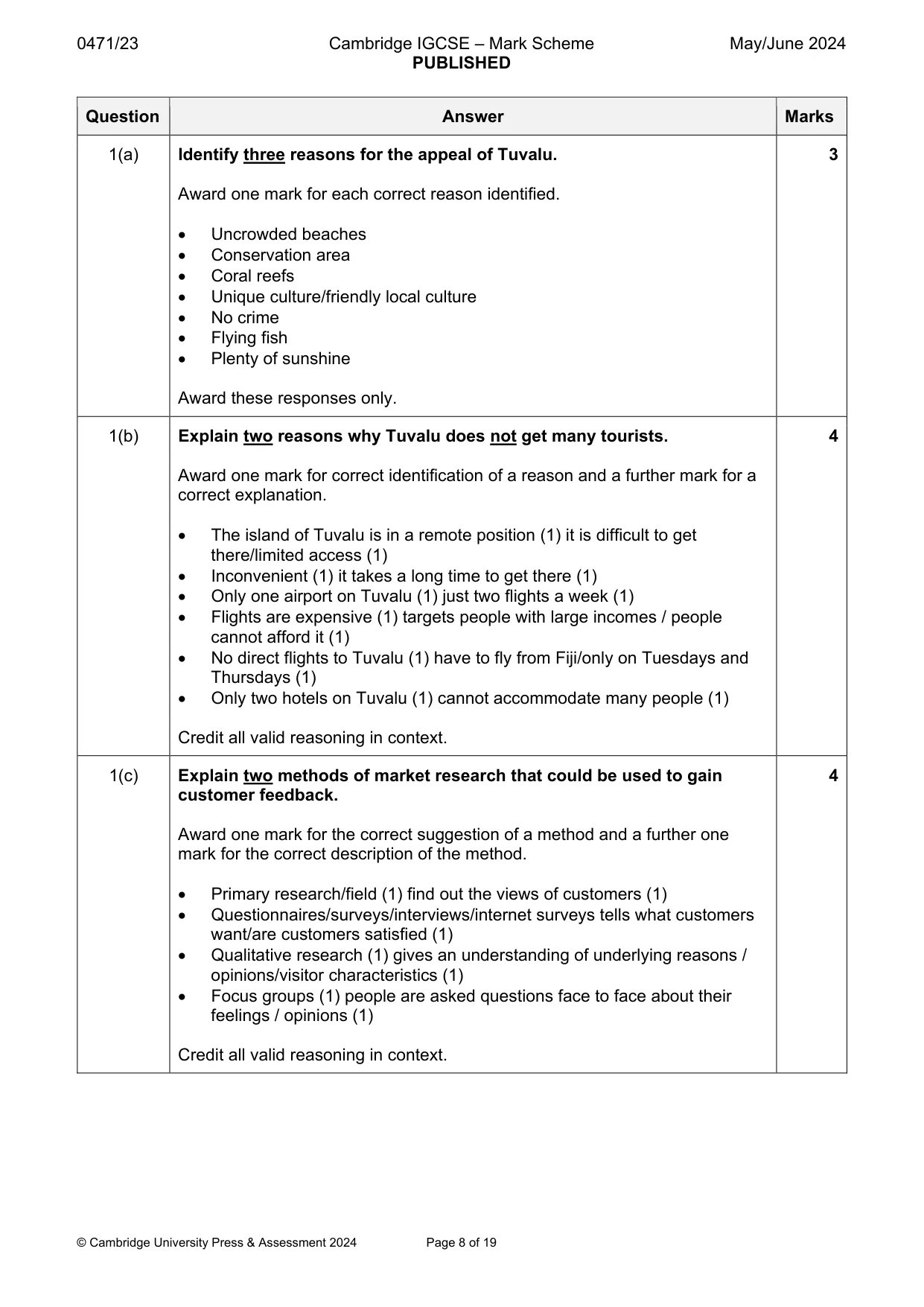
0471/23 Cambridge IGCSE – Mark Scheme PUBLISHED May/June 2024 © Cambridge University Press & Assessment 2024 Page 8 of 19 Question Answer Marks 1(a) Identify three reasons for the appeal of Tuvalu. Award one mark for each correct reason identified. Uncrowded beaches Conservation area Coral reefs Unique culture/friendly local culture No crime Flying fish Plenty of sunshine Award these responses only. 3 1(b) Explain two reasons why Tuvalu does not get many tourists. Award one mark for correct identification of a reason and a further mark for a correct explanation. The island of Tuvalu is in a remote position (1) it is difficult to get there/limited access (1) Inconvenient (1) it takes a long time to get there (1) Only one airport on Tuvalu (1) just two flights a week (1) Flights are expensive (1) targets people with large incomes / people cannot afford it (1) No direct flights to Tuvalu (1) have to fly from Fiji/only on Tuesdays and Thursdays (1) Only two hotels on Tuvalu (1) cannot accommodate many people (1) Credit all valid reasoning in context. 4 1(c) Explain two methods of market research that could be used to gain customer feedback. Award one mark for the correct suggestion of a method and a further one mark for the correct description of the method. Primary research/field (1) find out the views of customers (1) Questionnaires/surveys/interviews/internet surveys tells what customers want/are customers satisfied (1) Qualitative research (1) gives an understanding of underlying reasons / opinions/visitor characteristics (1) Focus groups (1) people are asked questions face to face about their feelings / opinions (1) Credit all valid reasoning in context. 4
Mark scheme, page 9
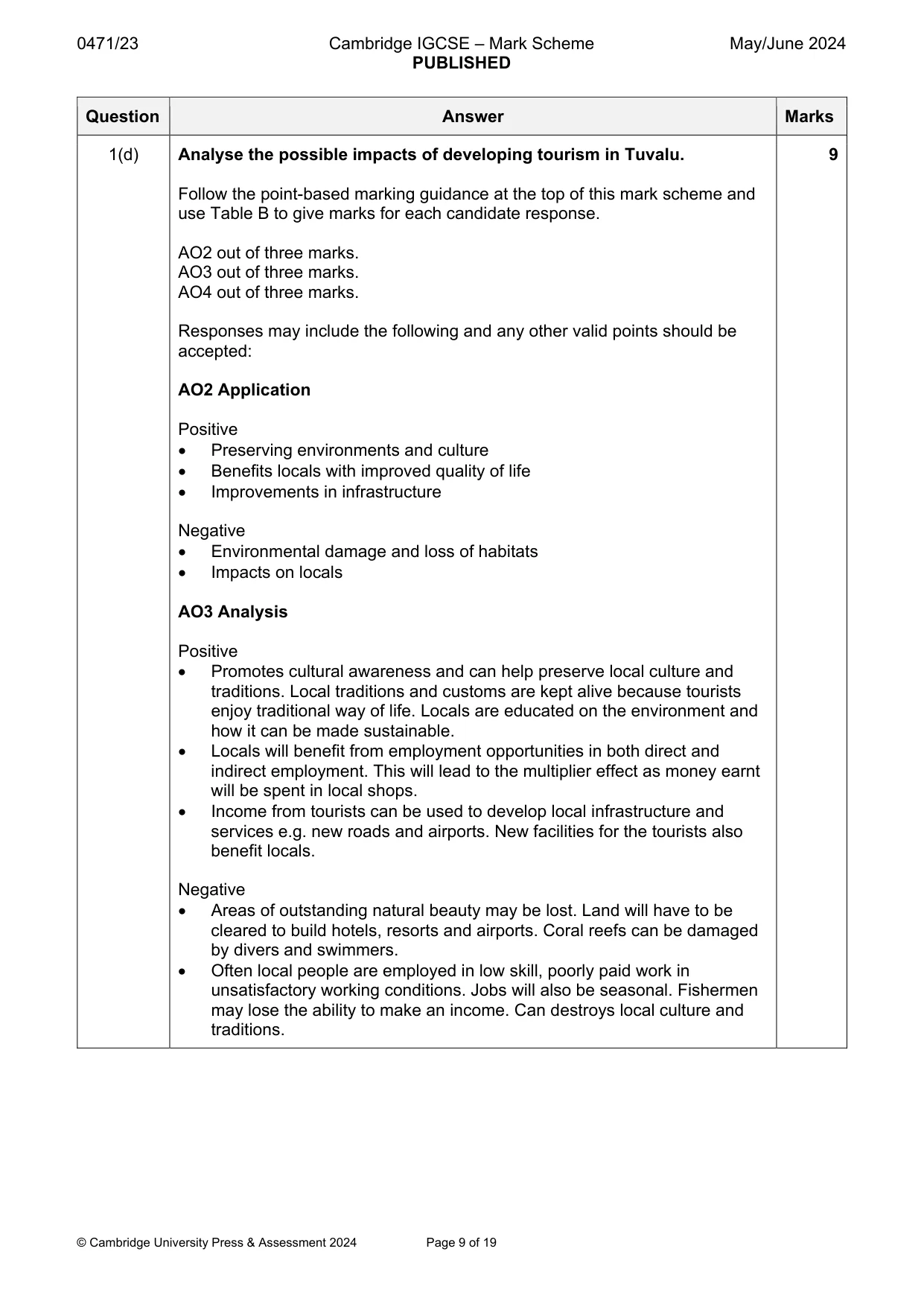
0471/23 Cambridge IGCSE – Mark Scheme PUBLISHED May/June 2024 © Cambridge University Press & Assessment 2024 Page 9 of 19 Question Answer Marks 1(d) Analyse the possible impacts of developing tourism in Tuvalu. Follow the point-based marking guidance at the top of this mark scheme and use Table B to give marks for each candidate response. AO2 out of three marks. AO3 out of three marks. AO4 out of three marks. Responses may include the following and any other valid points should be accepted: AO2 Application Positive Preserving environments and culture Benefits locals with improved quality of life Improvements in infrastructure Negative Environmental damage and loss of habitats Impacts on locals AO3 Analysis Positive Promotes cultural awareness and can help preserve local culture and traditions. Local traditions and customs are kept alive because tourists enjoy traditional way of life. Locals are educated on the environment and how it can be made sustainable. Locals will benefit from employment opportunities in both direct and indirect employment. This will lead to the multiplier effect as money earnt will be spent in local shops. Income from tourists can be used to develop local infrastructure and services e.g. new roads and airports. New facilities for the tourists also benefit locals. Negative Areas of outstanding natural beauty may be lost. Land will have to be cleared to build hotels, resorts and airports. Coral reefs can be damaged by divers and swimmers. Often local people are employed in low skill, poorly paid work in unsatisfactory working conditions. Jobs will also be seasonal. Fishermen may lose the ability to make an income. Can destroys local culture and traditions. 9
Mark scheme, page 10
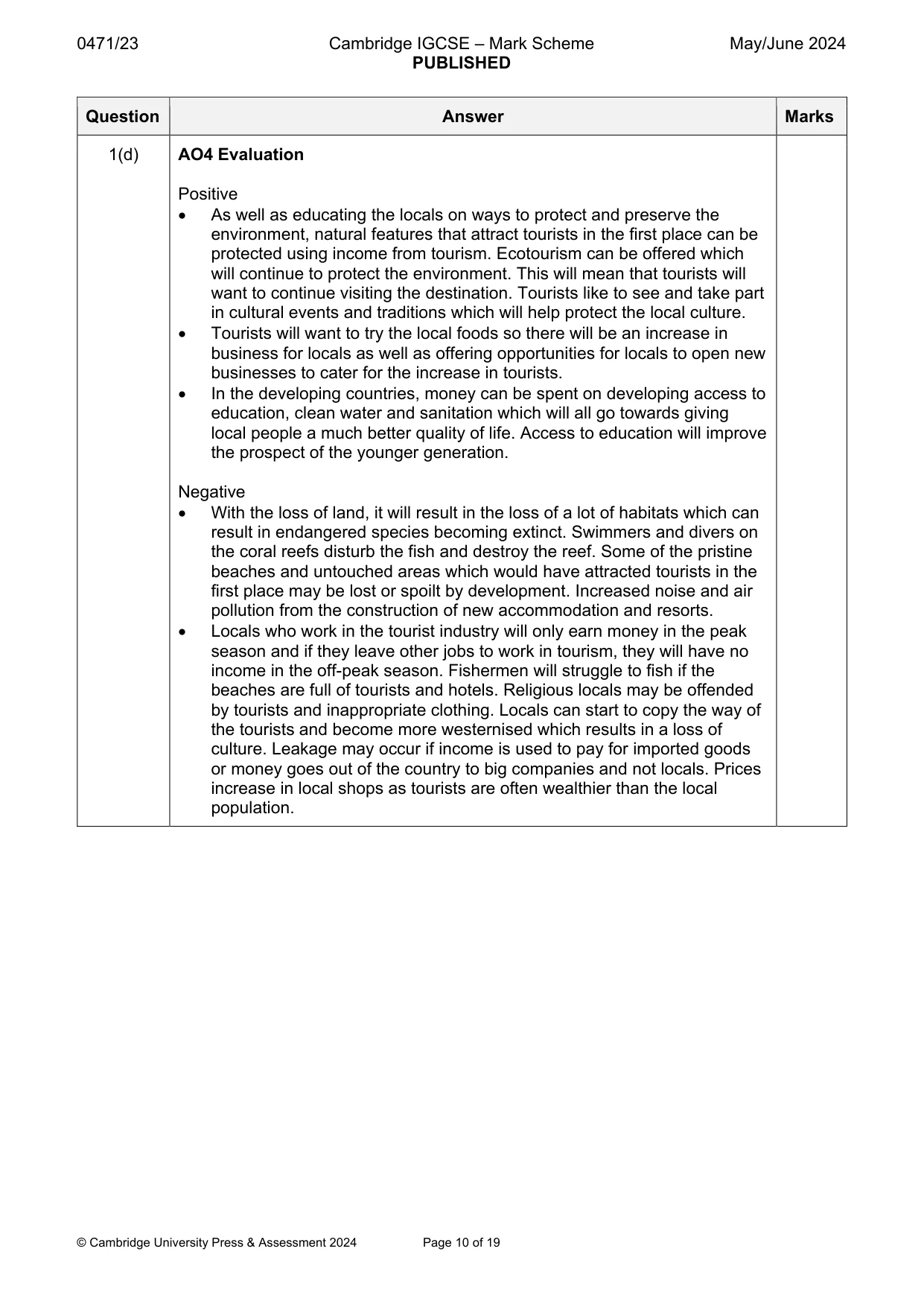
0471/23 Cambridge IGCSE – Mark Scheme PUBLISHED May/June 2024 © Cambridge University Press & Assessment 2024 Page 10 of 19 Question Answer Marks 1(d) AO4 Evaluation Positive As well as educating the locals on ways to protect and preserve the environment, natural features that attract tourists in the first place can be protected using income from tourism. Ecotourism can be offered which will continue to protect the environment. This will mean that tourists will want to continue visiting the destination. Tourists like to see and take part in cultural events and traditions which will help protect the local culture. Tourists will want to try the local foods so there will be an increase in business for locals as well as offering opportunities for locals to open new businesses to cater for the increase in tourists. In the developing countries, money can be spent on developing access to education, clean water and sanitation which will all go towards giving local people a much better quality of life. Access to education will improve the prospect of the younger generation. Negative With the loss of land, it will result in the loss of a lot of habitats which can result in endangered species becoming extinct. Swimmers and divers on the coral reefs disturb the fish and destroy the reef. Some of the pristine beaches and untouched areas which would have attracted tourists in the first place may be lost or spoilt by development. Increased noise and air pollution from the construction of new accommodation and resorts. Locals who work in the tourist industry will only earn money in the peak season and if they leave other jobs to work in tourism, they will have no income in the off-peak season. Fishermen will struggle to fish if the beaches are full of tourists and hotels. Religious locals may be offended by tourists and inappropriate clothing. Locals can start to copy the way of the tourists and become more westernised which results in a loss of culture. Leakage may occur if income is used to pay for imported goods or money goes out of the country to big companies and not locals. Prices increase in local shops as tourists are often wealthier than the local population.
Mark scheme, page 11
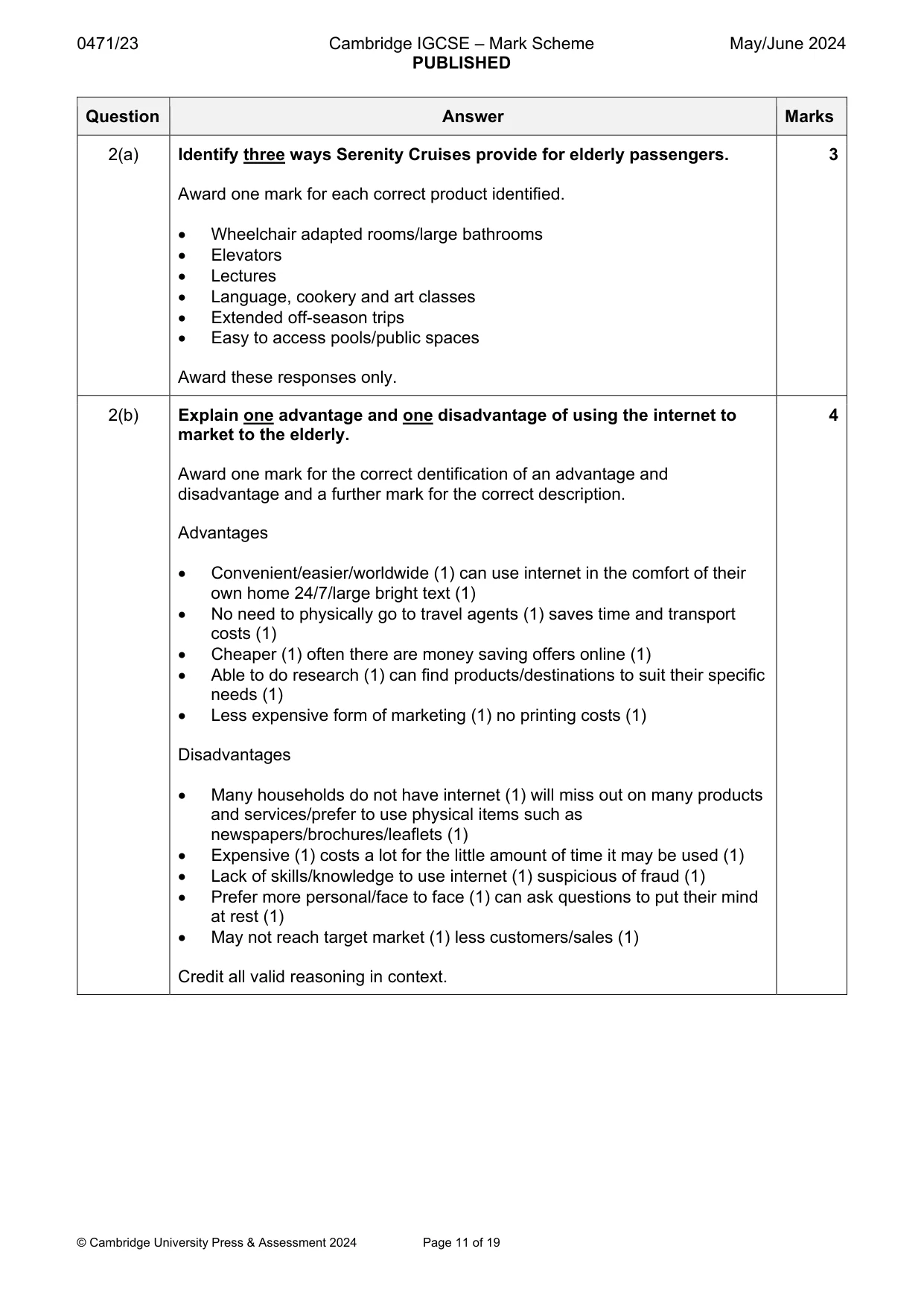
0471/23 Cambridge IGCSE – Mark Scheme PUBLISHED May/June 2024 © Cambridge University Press & Assessment 2024 Page 11 of 19 Question Answer Marks 2(a) Identify three ways Serenity Cruises provide for elderly passengers. Award one mark for each correct product identified. Wheelchair adapted rooms/large bathrooms Elevators Lectures Language, cookery and art classes Extended off-season trips Easy to access pools/public spaces Award these responses only. 3 2(b) Explain one advantage and one disadvantage of using the internet to market to the elderly. Award one mark for the correct dentification of an advantage and disadvantage and a further mark for the correct description. Advantages Convenient/easier/worldwide (1) can use internet in the comfort of their own home 24/7/large bright text (1) No need to physically go to travel agents (1) saves time and transport costs (1) Cheaper (1) often there are money saving offers online (1) Able to do research (1) can find products/destinations to suit their specific needs (1) Less expensive form of marketing (1) no printing costs (1) Disadvantages Many households do not have internet (1) will miss out on many products and services/prefer to use physical items such as newspapers/brochures/leaflets (1) Expensive (1) costs a lot for the little amount of time it may be used (1) Lack of skills/knowledge to use internet (1) suspicious of fraud (1) Prefer more personal/face to face (1) can ask questions to put their mind at rest (1) May not reach target market (1) less customers/sales (1) Credit all valid reasoning in context. 4
Mark scheme, page 12
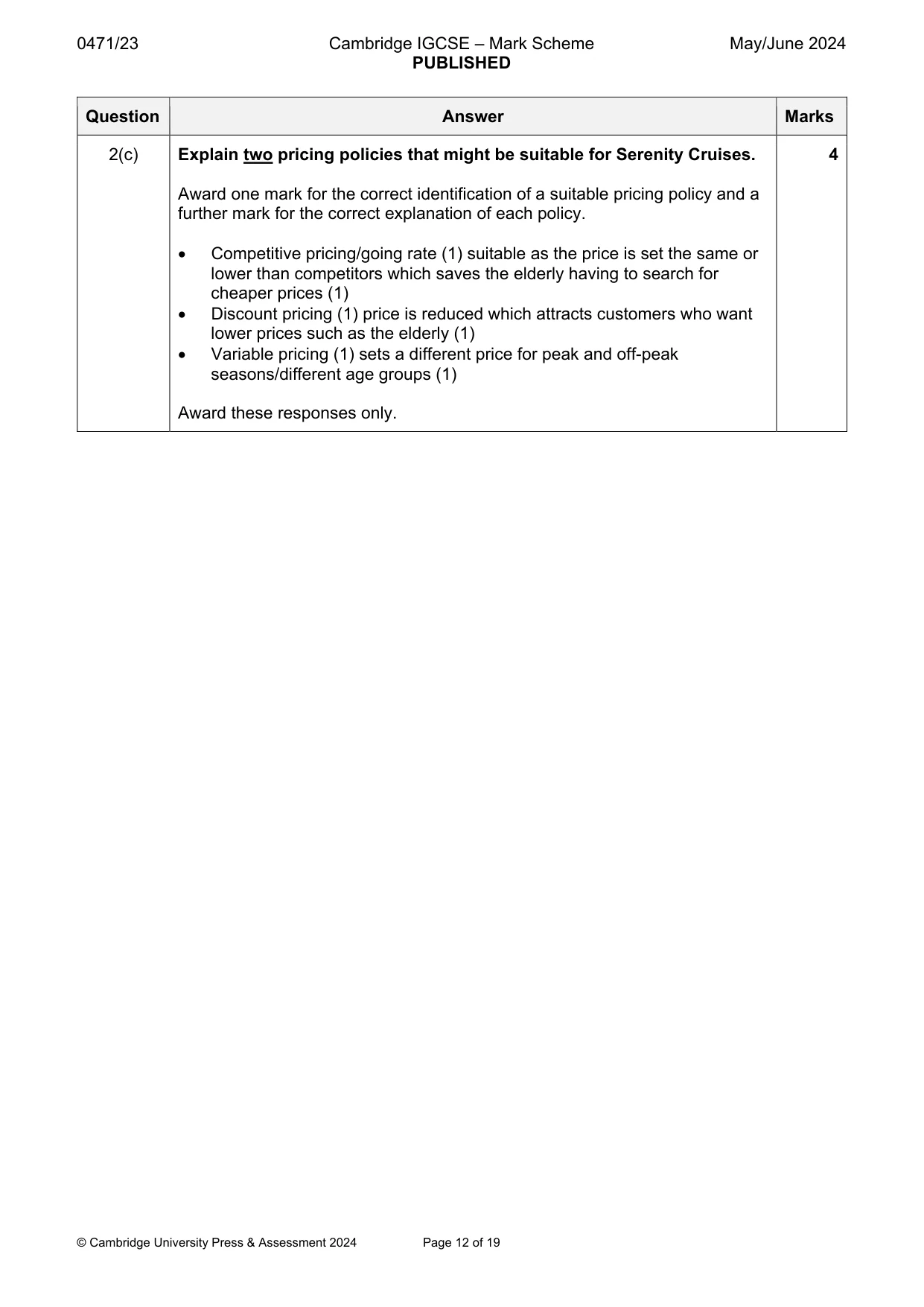
0471/23 Cambridge IGCSE – Mark Scheme PUBLISHED May/June 2024 © Cambridge University Press & Assessment 2024 Page 12 of 19 Question Answer Marks 2(c) Explain two pricing policies that might be suitable for Serenity Cruises. Award one mark for the correct identification of a suitable pricing policy and a further mark for the correct explanation of each policy. Competitive pricing/going rate (1) suitable as the price is set the same or lower than competitors which saves the elderly having to search for cheaper prices (1) Discount pricing (1) price is reduced which attracts customers who want lower prices such as the elderly (1) Variable pricing (1) sets a different price for peak and off-peak seasons/different age groups (1) Award these responses only. 4
Mark scheme, page 13
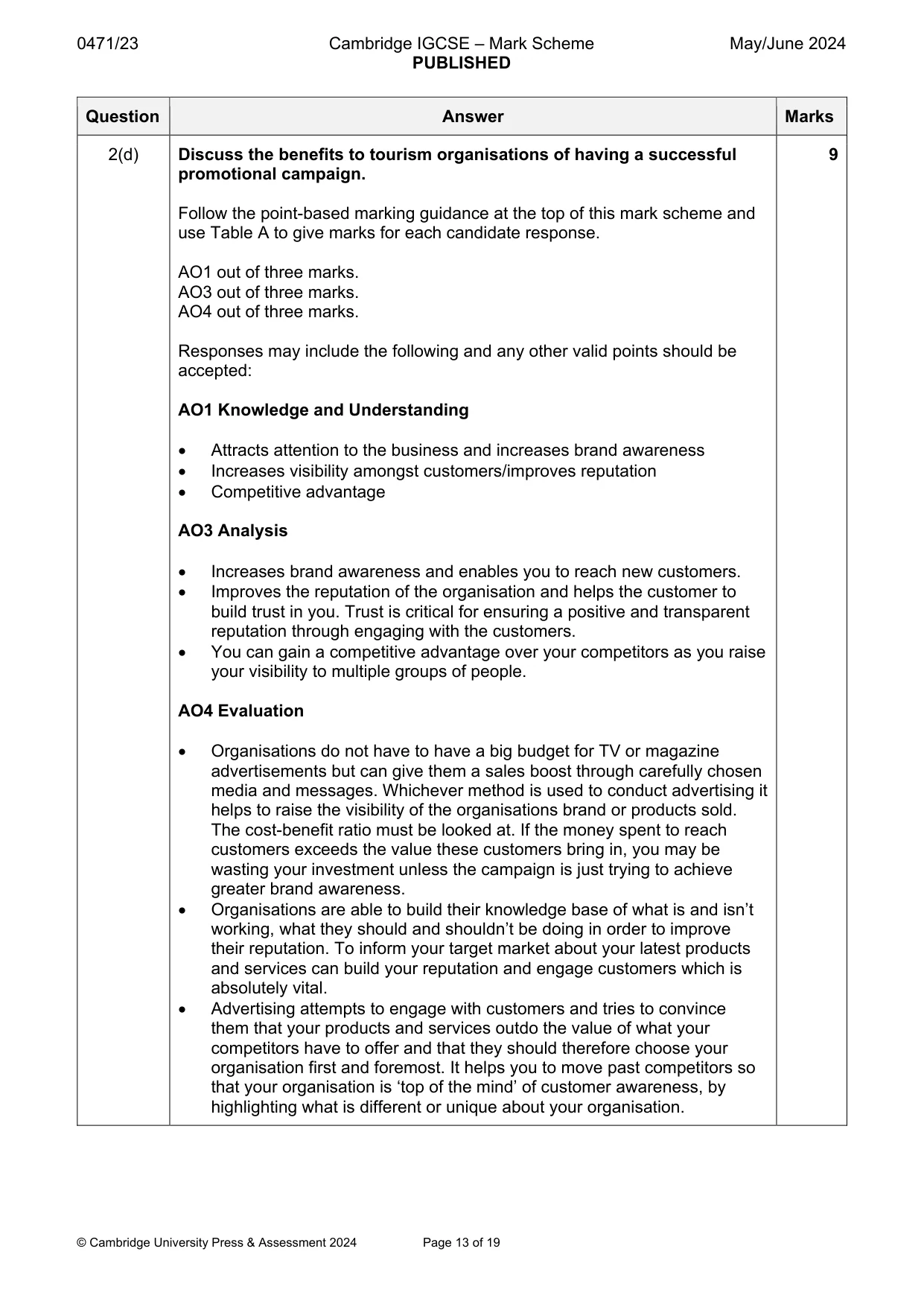
0471/23 Cambridge IGCSE – Mark Scheme PUBLISHED May/June 2024 © Cambridge University Press & Assessment 2024 Page 13 of 19 Question Answer Marks 2(d) Discuss the benefits to tourism organisations of having a successful promotional campaign. Follow the point-based marking guidance at the top of this mark scheme and use Table A to give marks for each candidate response. AO1 out of three marks. AO3 out of three marks. AO4 out of three marks. Responses may include the following and any other valid points should be accepted: AO1 Knowledge and Understanding Attracts attention to the business and increases brand awareness Increases visibility amongst customers/improves reputation Competitive advantage AO3 Analysis Increases brand awareness and enables you to reach new customers. Improves the reputation of the organisation and helps the customer to build trust in you. Trust is critical for ensuring a positive and transparent reputation through engaging with the customers. You can gain a competitive advantage over your competitors as you raise your visibility to multiple groups of people. AO4 Evaluation Organisations do not have to have a big budget for TV or magazine advertisements but can give them a sales boost through carefully chosen media and messages. Whichever method is used to conduct advertising it helps to raise the visibility of the organisations brand or products sold. The cost-benefit ratio must be looked at. If the money spent to reach customers exceeds the value these customers bring in, you may be wasting your investment unless the campaign is just trying to achieve greater brand awareness. Organisations are able to build their knowledge base of what is and isn’t working, what they should and shouldn’t be doing in order to improve their reputation. To inform your target market about your latest products and services can build your reputation and engage customers which is absolutely vital. Advertising attempts to engage with customers and tries to convince them that your products and services outdo the value of what your competitors have to offer and that they should therefore choose your organisation first and foremost. It helps you to move past competitors so that your organisation is ‘top of the mind’ of customer awareness, by highlighting what is different or unique about your organisation. 9
Mark scheme, page 14
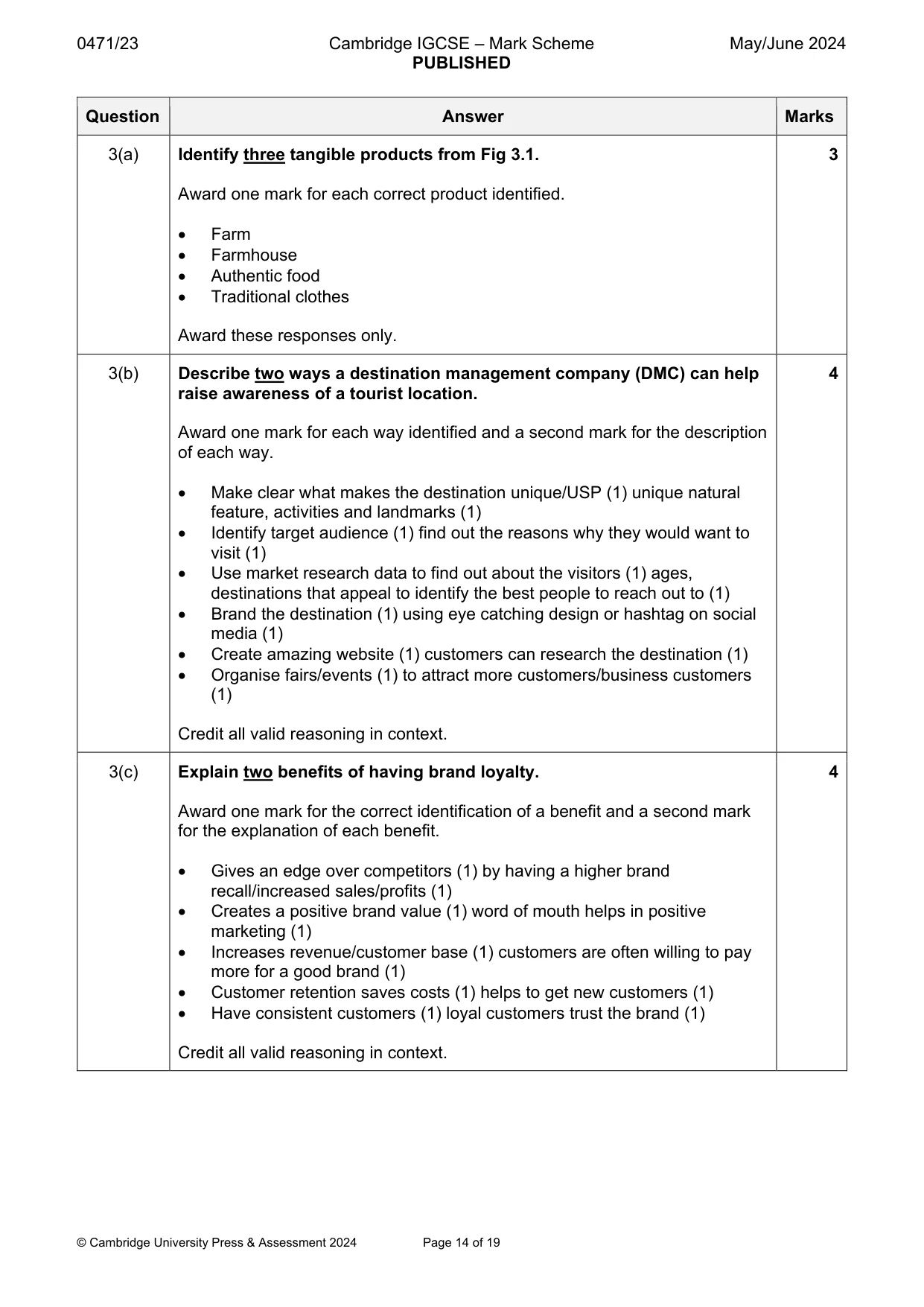
0471/23 Cambridge IGCSE – Mark Scheme PUBLISHED May/June 2024 © Cambridge University Press & Assessment 2024 Page 14 of 19 Question Answer Marks 3(a) Identify three tangible products from Fig 3.1. Award one mark for each correct product identified. Farm Farmhouse Authentic food Traditional clothes Award these responses only. 3 3(b) Describe two ways a destination management company (DMC) can help raise awareness of a tourist location. Award one mark for each way identified and a second mark for the description of each way. Make clear what makes the destination unique/USP (1) unique natural feature, activities and landmarks (1) Identify target audience (1) find out the reasons why they would want to visit (1) Use market research data to find out about the visitors (1) ages, destinations that appeal to identify the best people to reach out to (1) Brand the destination (1) using eye catching design or hashtag on social media (1) Create amazing website (1) customers can research the destination (1) Organise fairs/events (1) to attract more customers/business customers (1) Credit all valid reasoning in context. 4 3(c) Explain two benefits of having brand loyalty. Award one mark for the correct identification of a benefit and a second mark for the explanation of each benefit. Gives an edge over competitors (1) by having a higher brand recall/increased sales/profits (1) Creates a positive brand value (1) word of mouth helps in positive marketing (1) Increases revenue/customer base (1) customers are often willing to pay more for a good brand (1) Customer retention saves costs (1) helps to get new customers (1) Have consistent customers (1) loyal customers trust the brand (1) Credit all valid reasoning in context. 4
Mark scheme, page 15
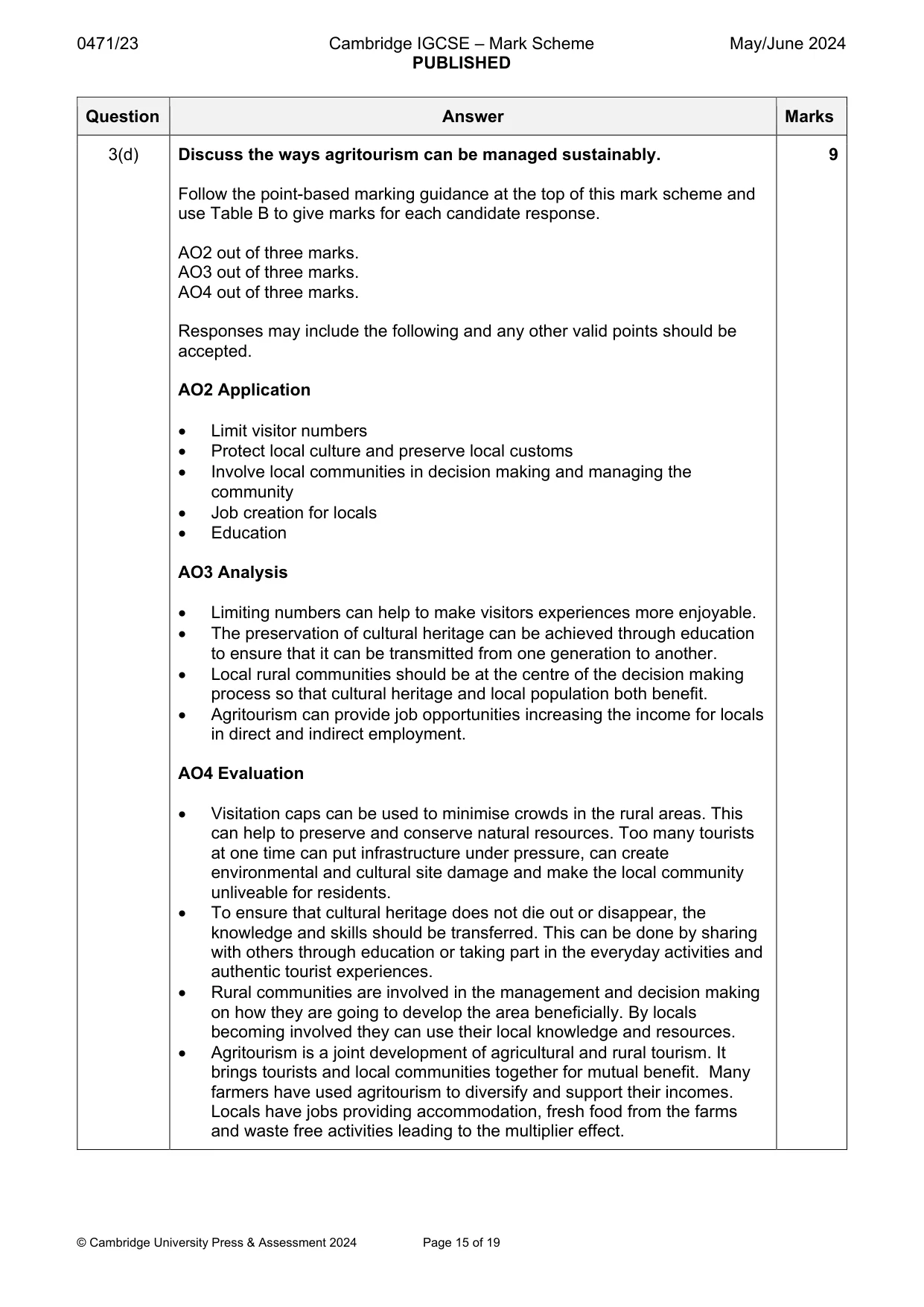
0471/23 Cambridge IGCSE – Mark Scheme PUBLISHED May/June 2024 © Cambridge University Press & Assessment 2024 Page 15 of 19 Question Answer Marks 3(d) Discuss the ways agritourism can be managed sustainably. Follow the point-based marking guidance at the top of this mark scheme and use Table B to give marks for each candidate response. AO2 out of three marks. AO3 out of three marks. AO4 out of three marks. Responses may include the following and any other valid points should be accepted. AO2 Application Limit visitor numbers Protect local culture and preserve local customs Involve local communities in decision making and managing the community Job creation for locals Education AO3 Analysis Limiting numbers can help to make visitors experiences more enjoyable. The preservation of cultural heritage can be achieved through education to ensure that it can be transmitted from one generation to another. Local rural communities should be at the centre of the decision making process so that cultural heritage and local population both benefit. Agritourism can provide job opportunities increasing the income for locals in direct and indirect employment. AO4 Evaluation Visitation caps can be used to minimise crowds in the rural areas. This can help to preserve and conserve natural resources. Too many tourists at one time can put infrastructure under pressure, can create environmental and cultural site damage and make the local community unliveable for residents. To ensure that cultural heritage does not die out or disappear, the knowledge and skills should be transferred. This can be done by sharing with others through education or taking part in the everyday activities and authentic tourist experiences. Rural communities are involved in the management and decision making on how they are going to develop the area beneficially. By locals becoming involved they can use their local knowledge and resources. Agritourism is a joint development of agricultural and rural tourism. It brings tourists and local communities together for mutual benefit. Many farmers have used agritourism to diversify and support their incomes. Locals have jobs providing accommodation, fresh food from the farms and waste free activities leading to the multiplier effect. 9
Mark scheme, page 16
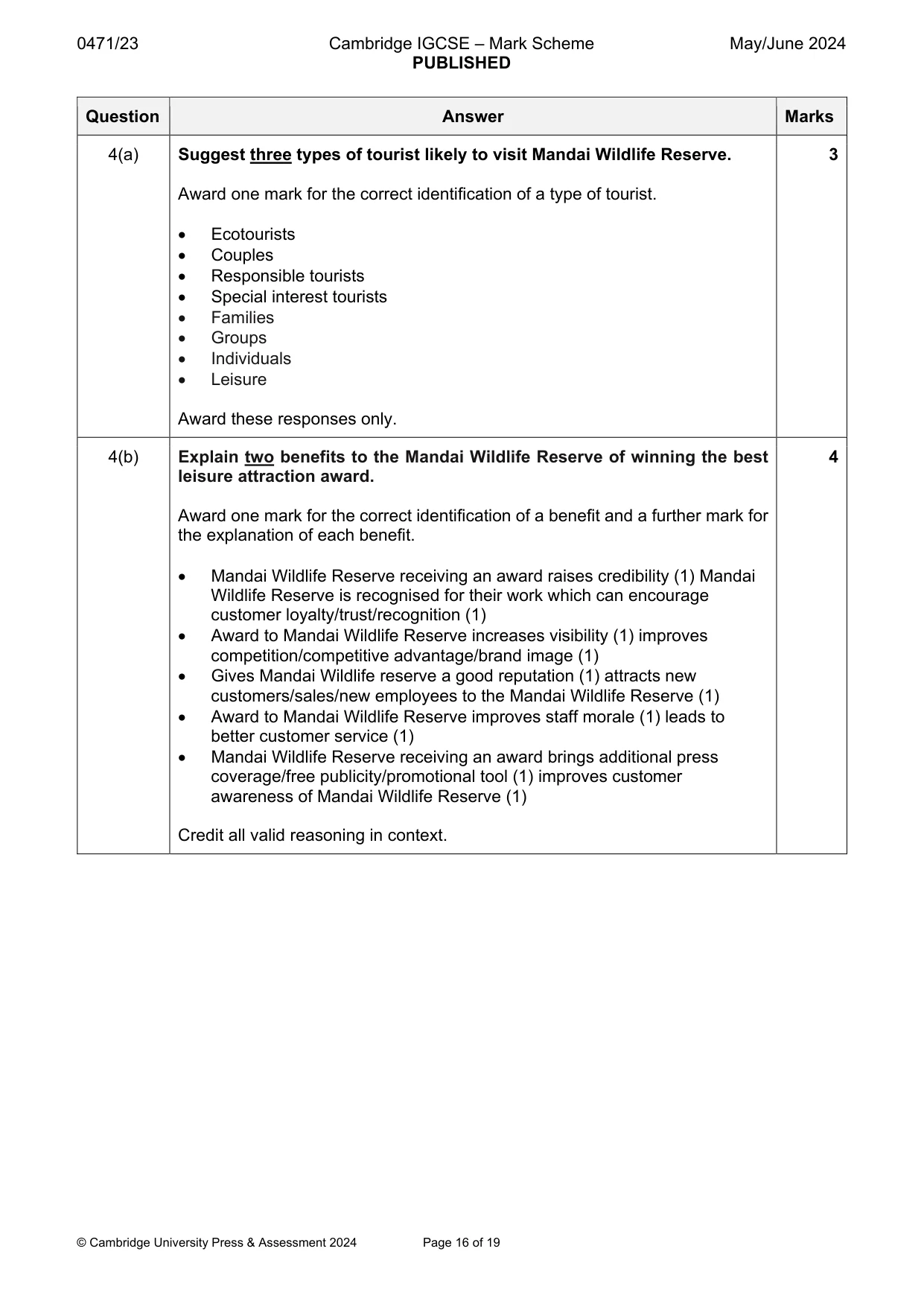
0471/23 Cambridge IGCSE – Mark Scheme PUBLISHED May/June 2024 © Cambridge University Press & Assessment 2024 Page 16 of 19 Question Answer Marks 4(a) Suggest three types of tourist likely to visit Mandai Wildlife Reserve. Award one mark for the correct identification of a type of tourist. Ecotourists Couples Responsible tourists Special interest tourists Families Groups Individuals Leisure Award these responses only. 3 4(b) Explain two benefits to the Mandai Wildlife Reserve of winning the best leisure attraction award. Award one mark for the correct identification of a benefit and a further mark for the explanation of each benefit. Mandai Wildlife Reserve receiving an award raises credibility (1) Mandai Wildlife Reserve is recognised for their work which can encourage customer loyalty/trust/recognition (1) Award to Mandai Wildlife Reserve increases visibility (1) improves competition/competitive advantage/brand image (1) Gives Mandai Wildlife reserve a good reputation (1) attracts new customers/sales/new employees to the Mandai Wildlife Reserve (1) Award to Mandai Wildlife Reserve improves staff morale (1) leads to better customer service (1) Mandai Wildlife Reserve receiving an award brings additional press coverage/free publicity/promotional tool (1) improves customer awareness of Mandai Wildlife Reserve (1) Credit all valid reasoning in context. 4
Mark scheme, page 17
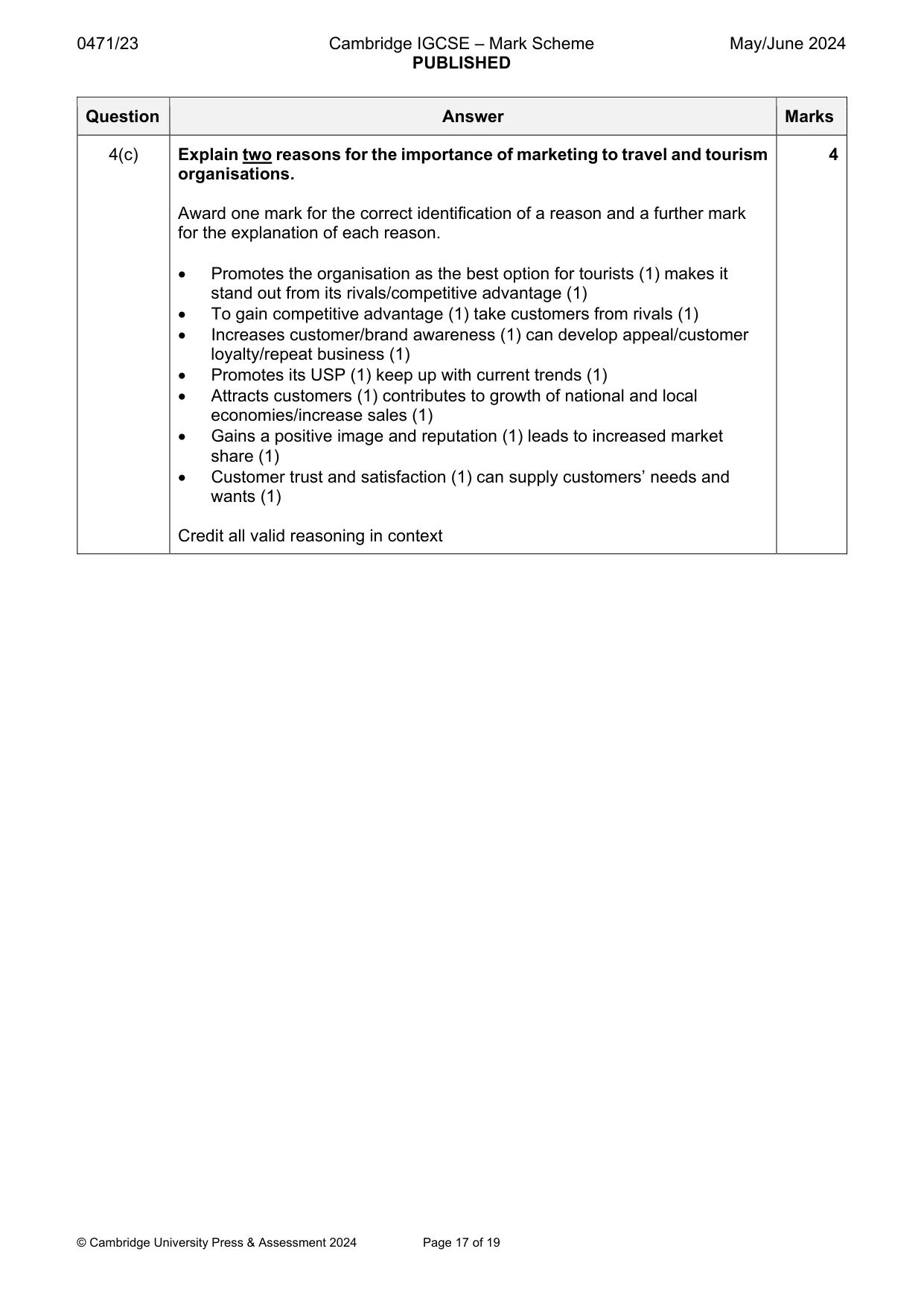
0471/23 Cambridge IGCSE – Mark Scheme PUBLISHED May/June 2024 © Cambridge University Press & Assessment 2024 Page 17 of 19 Question Answer Marks 4(c) Explain two reasons for the importance of marketing to travel and tourism organisations. Award one mark for the correct identification of a reason and a further mark for the explanation of each reason. Promotes the organisation as the best option for tourists (1) makes it stand out from its rivals/competitive advantage (1) To gain competitive advantage (1) take customers from rivals (1) Increases customer/brand awareness (1) can develop appeal/customer loyalty/repeat business (1) Promotes its USP (1) keep up with current trends (1) Attracts customers (1) contributes to growth of national and local economies/increase sales (1) Gains a positive image and reputation (1) leads to increased market share (1) Customer trust and satisfaction (1) can supply customers’ needs and wants (1) Credit all valid reasoning in context 4
Mark scheme, page 18
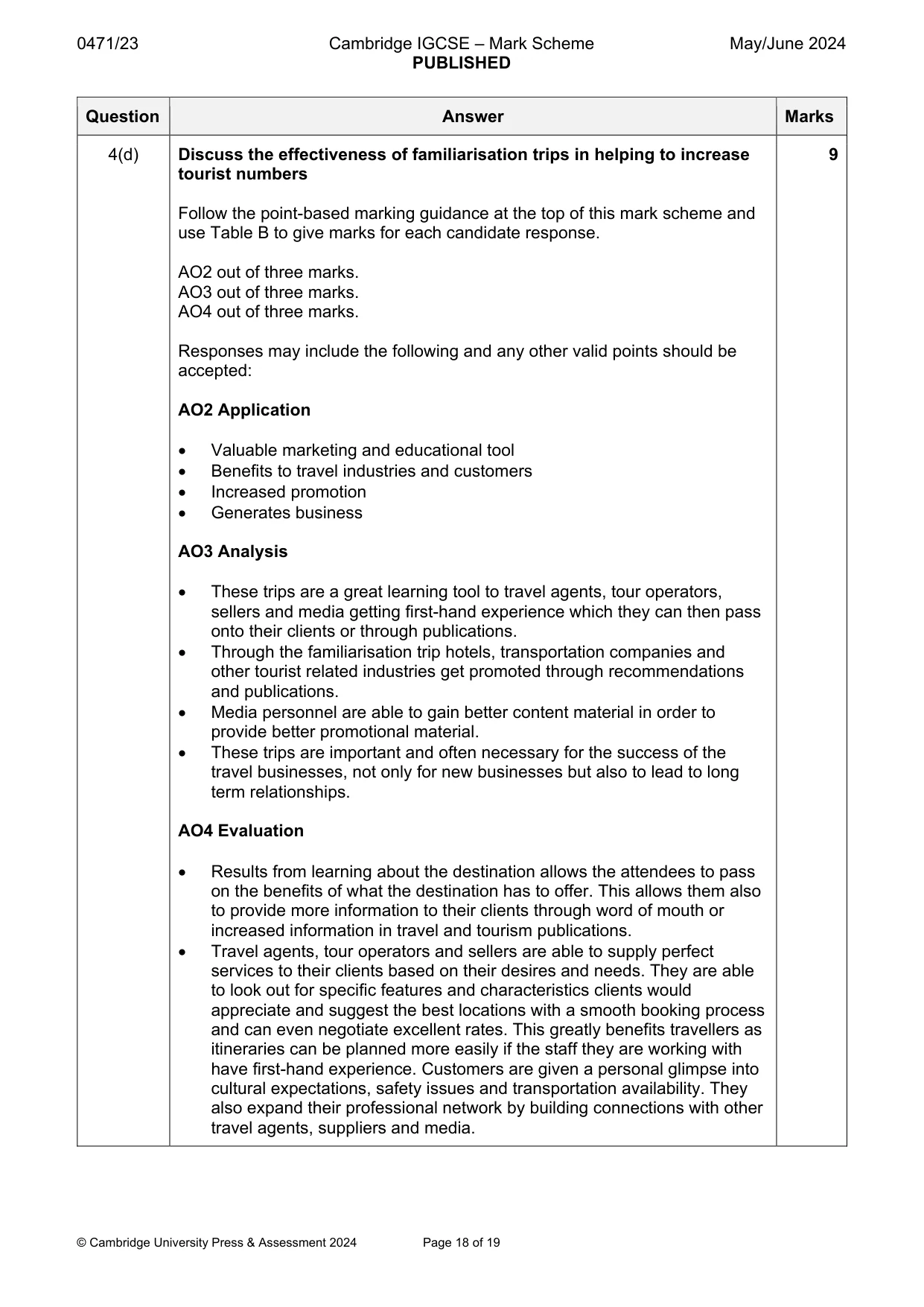
0471/23 Cambridge IGCSE – Mark Scheme PUBLISHED May/June 2024 © Cambridge University Press & Assessment 2024 Page 18 of 19 Question Answer Marks 4(d) Discuss the effectiveness of familiarisation trips in helping to increase tourist numbers Follow the point-based marking guidance at the top of this mark scheme and use Table B to give marks for each candidate response. AO2 out of three marks. AO3 out of three marks. AO4 out of three marks. Responses may include the following and any other valid points should be accepted: AO2 Application Valuable marketing and educational tool Benefits to travel industries and customers Increased promotion Generates business AO3 Analysis These trips are a great learning tool to travel agents, tour operators, sellers and media getting first-hand experience which they can then pass onto their clients or through publications. Through the familiarisation trip hotels, transportation companies and other tourist related industries get promoted through recommendations and publications. Media personnel are able to gain better content material in order to provide better promotional material. These trips are important and often necessary for the success of the travel businesses, not only for new businesses but also to lead to long term relationships. AO4 Evaluation Results from learning about the destination allows the attendees to pass on the benefits of what the destination has to offer. This allows them also to provide more information to their clients through word of mouth or increased information in travel and tourism publications. Travel agents, tour operators and sellers are able to supply perfect services to their clients based on their desires and needs. They are able to look out for specific features and characteristics clients would appreciate and suggest the best locations with a smooth booking process and can even negotiate excellent rates. This greatly benefits travellers as itineraries can be planned more easily if the staff they are working with have first-hand experience. Customers are given a personal glimpse into cultural expectations, safety issues and transportation availability. They also expand their professional network by building connections with other travel agents, suppliers and media. 9
Mark scheme, page 19
0471/23 Cambridge IGCSE – Mark Scheme PUBLISHED May/June 2024 © Cambridge University Press & Assessment 2024 Page 19 of 19 Question Answer Marks 4(d) Media personnel, writers and editors are able to increase the content of their publications along with more specific details and photographs for future publications. They can develop tailored stories. Travel agents, tour operators and suppliers share the benefits of what is being offered and the highlights of the destination which means the tourist businesses can increase their customer numbers and income from first rate reviews and recommendations for the destination.
What you needed in this session
Cambridge’s own grade thresholds for 2024 May/June, Paper 2 · Variant 3. A higher threshold means an easier paper — the bar moves with how the cohort did.