Cambridge IGCSE Travel and Tourism 0471 — 2022 Oct/Nov Paper 1 · Variant 2
0471/12/O/N/22 · 100 marks · ≈113 min
The question paper and its mark scheme, free to read here and free to download. This is Cambridge’s own paper, exactly as it was sat.
Question paper12 pages



Mark scheme14 pages
Answers below. Sit the paper first if you are practising.

Paper as text
Question paper, page 1
This document has 12 pages. Any blank pages are indicated. [Turn over DC (JP) 213730/2 © UCLES 2022 * 6 8 2 8 3 1 7 3 1 3 * TRAVEL & TOURISM 0471/12 Paper 1 Core Paper October/November 2022 2 hours You must answer on the question paper. You will need: Insert (enclosed) INSTRUCTIONS ● Answer all questions. ● Use a black or dark blue pen. ● Write your name, centre number and candidate number in the boxes at the top of the page. ● Write your answer to each question in the space provided. ● Do not use an erasable pen or correction fluid. ● Do not write on any bar codes. INFORMATION ● The total mark for this paper is 100. ● The number of marks for each question or part question is shown in brackets [ ]. ● The insert contains all the figures referred to in the questions. Cambridge IGCSE™
Question paper, page 2
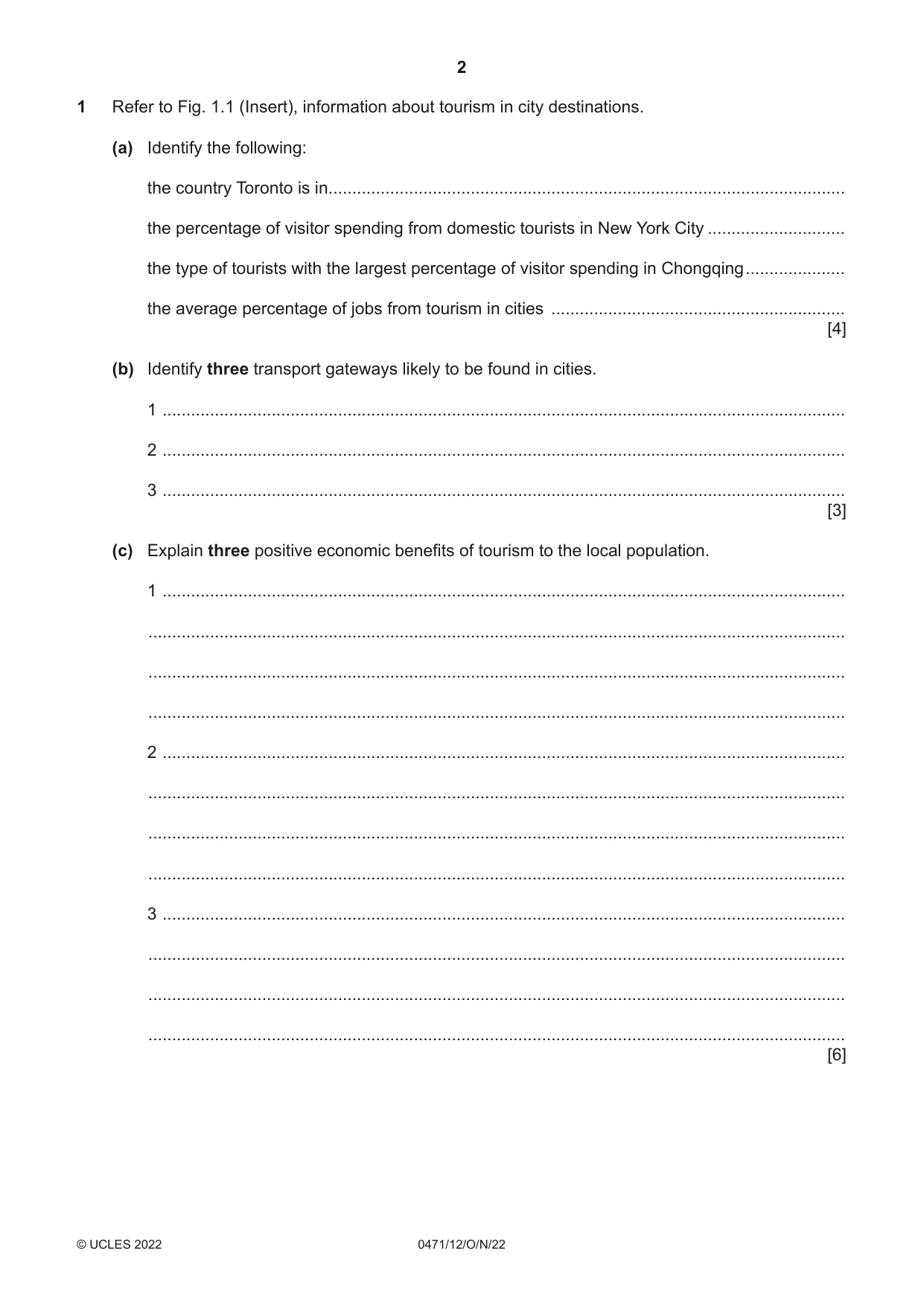
2 0471/12/O/N/22 © UCLES 2022 1 Refer to Fig. 1.1 (Insert), information about tourism in city destinations. (a) Identify the following: the country Toronto is in … the percentage of visitor spending from domestic tourists in New York City … the type of tourists with the largest percentage of visitor spending in Chongqing … the average percentage of jobs from tourism in cities … [4] (b) Identify three transport gateways likely to be found in cities. 1 … 2 … 3 … [3] (c) Explain three positive economic benefits of tourism to the local population. 1 … … … … 2 … … … … 3 … … … … [6]
Question paper, page 3
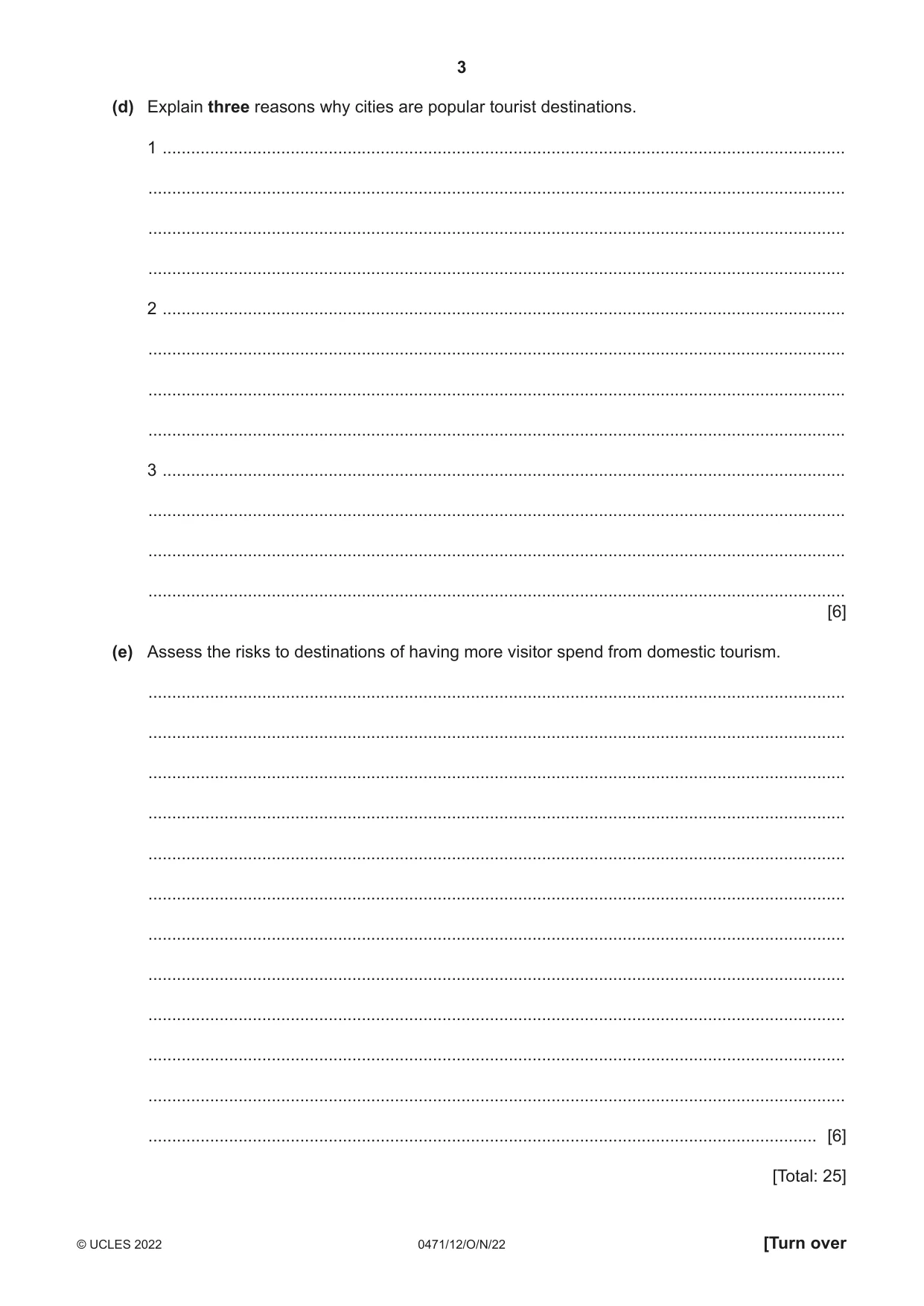
3 0471/12/O/N/22 © UCLES 2022 [Turn over (d) Explain three reasons why cities are popular tourist destinations. 1 … … … … 2 … … … … 3 … … … … [6] (e) Assess the risks to destinations of having more visitor spend from domestic tourism. … … … … … … … … … … … … [6] [Total: 25]
Question paper, page 4
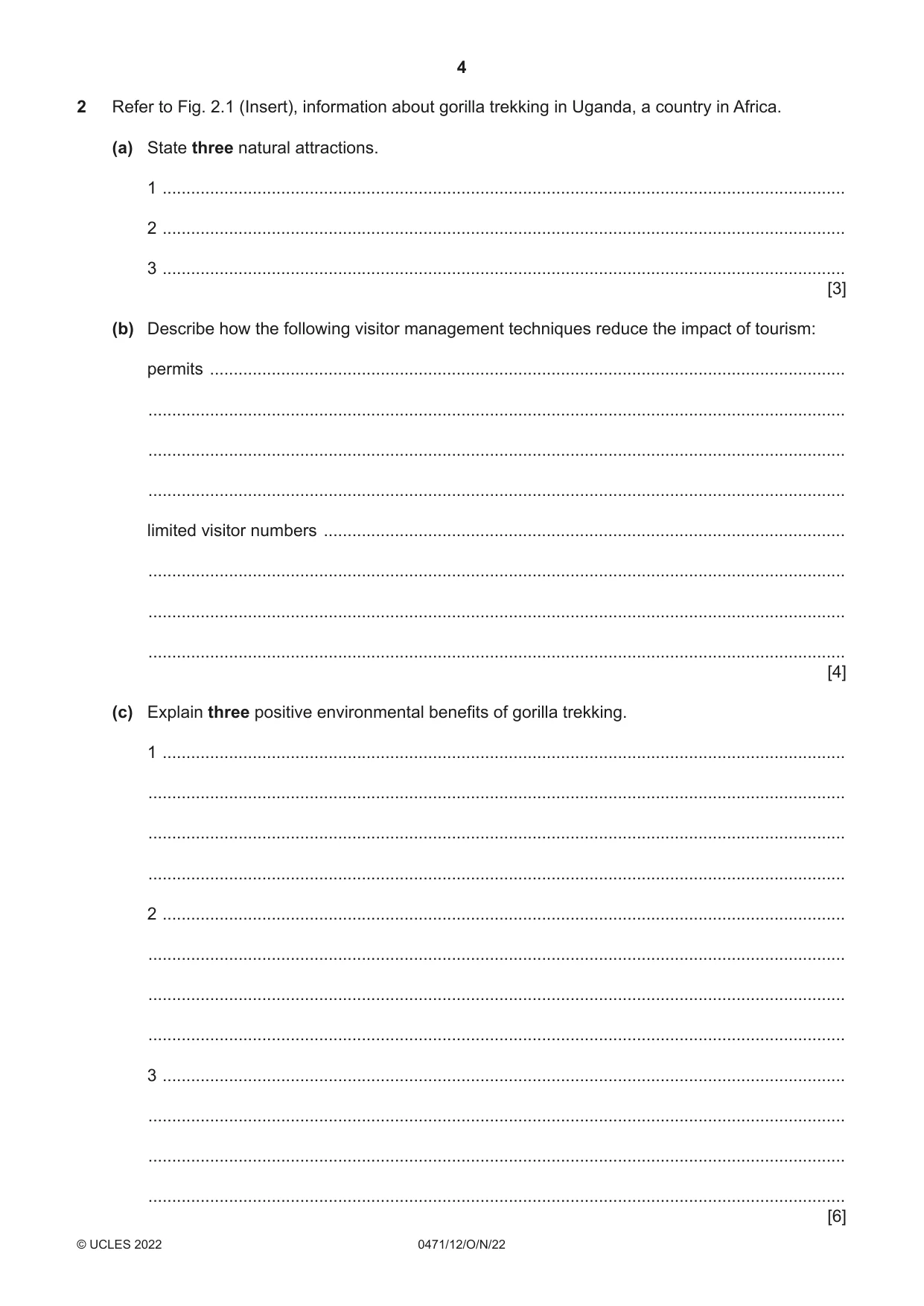
4 0471/12/O/N/22 © UCLES 2022 2 Refer to Fig. 2.1 (Insert), information about gorilla trekking in Uganda, a country in Africa. (a) State three natural attractions. 1 … 2 … 3 … [3] (b) Describe how the following visitor management techniques reduce the impact of tourism: permits … … … … limited visitor numbers … … … … [4] (c) Explain three positive environmental benefits of gorilla trekking. 1 … … … … 2 … … … … 3 … … … … [6]
Question paper, page 5
5 0471/12/O/N/22 © UCLES 2022 [Turn over (d) Explain three likely negative social cultural impacts of hiring local porters. 1 … … … … 2 … … … … 3 … … … … [6] (e) Assess the importance of the environment to tourism. … … … … … … … … … … … … [6] [Total: 25]
Question paper, page 6
6 0471/12/O/N/22 © UCLES 2022 3 Refer to Fig. 3.1 (Insert), a cruise ship floor plan. (a) State three types of passenger water transport. 1 … 2 … 3 … [3] (b) Describe two facilities shown in Fig. 3.1 for passengers with limited mobility. 1 … … … … 2 … … … … [4] (c) Travel agents selling cruise products will tell customers about the unique features of different cruise products. State two features of each of the following cruise products: fly-cruise 1 … 2 … all-inclusive cruise 1 … 2 … river cruise 1 … 2 … [6]
Question paper, page 7
7 0471/12/O/N/22 © UCLES 2022 [Turn over (d) Explain the appeal of each of the following popular cruise circuits: Alaska … … … … Caribbean … … … … South Asia … … … … [6] (e) Discuss the reasons why cruises have become so popular. … … … … … … … … … … … … [6] [Total: 25]
Question paper, page 8
8 0471/12/O/N/22 © UCLES 2022 4 Refer to Fig. 4.1 (Insert), a photograph of a beach information board in Australia. (a) Identify three types of information given to tourists on the beach information board. 1 … 2 … 3 … [3] (b) Australia is located in the Southern Hemisphere, south of the Equator. Other than Australia, state four countries located entirely in the Southern Hemisphere. 1 … 2 … 3 … 4 … [4] (c) Describe three ways tourists can research destinations before they arrive. 1 … … … … 2 … … … … 3 … … … … [6]
Question paper, page 9
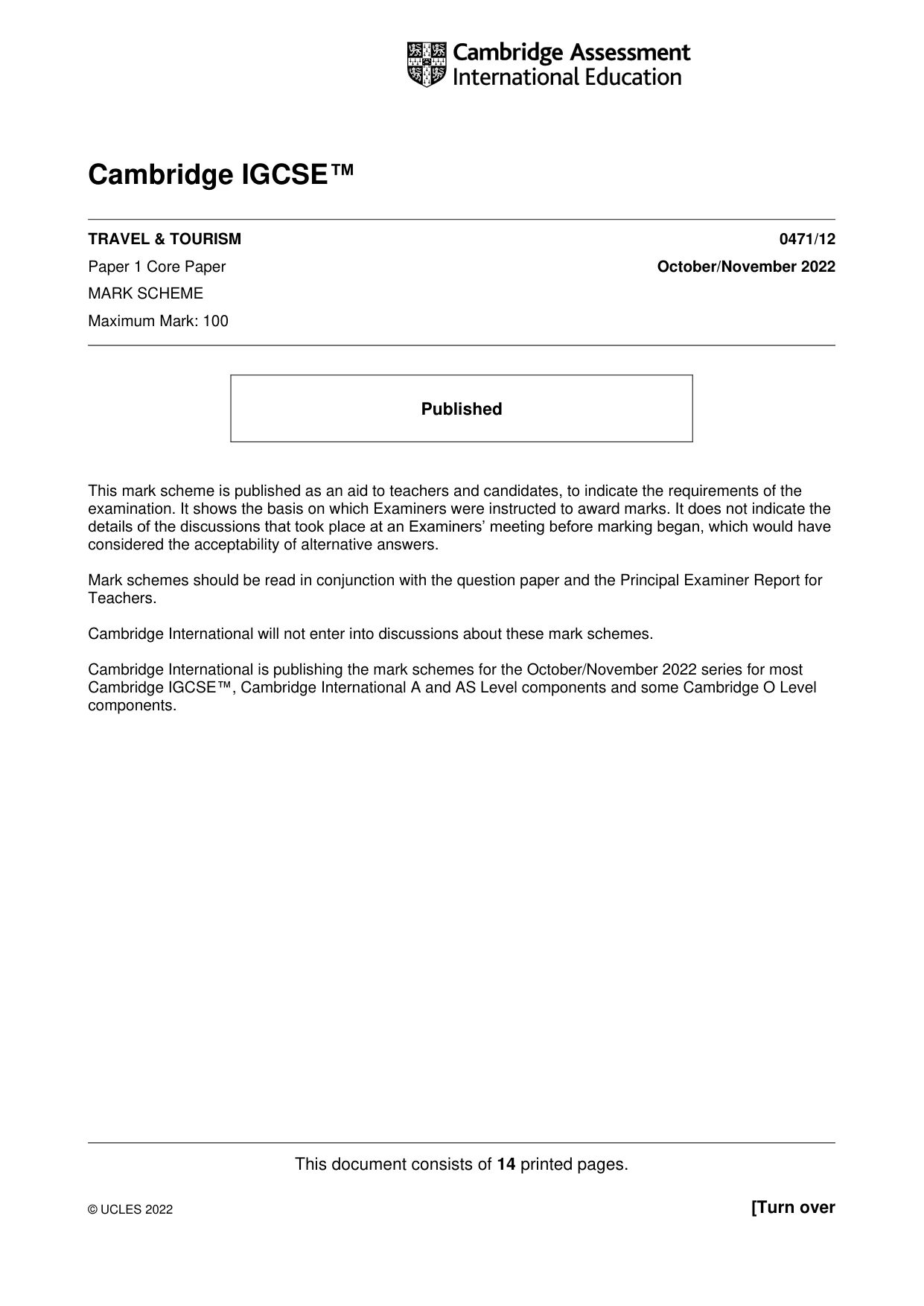
9 0471/12/O/N/22 © UCLES 2022 (d) Explain three advantages to tourists of self-catering accommodation. 1 … … … … 2 … … … … 3 … … … … [6] (e) Discuss the importance of seasonality to tour operators. … … … … … … … … … … … … [6] [Total: 25]
Question paper, page 10
10 0471/12/O/N/22 © UCLES 2022 BLANK PAGE
Question paper, page 11
11 0471/12/O/N/22 © UCLES 2022 BLANK PAGE
Question paper, page 12
12 0471/12/O/N/22 © UCLES 2022 The boundaries and names shown, the designations used and the presentation of material on any maps contained in this question paper/insert do not imply official endorsement or acceptance by Cambridge Assessment International Education concerning the legal status of any country, territory, or area or any of its authorities, or of the delimitation of its frontiers or boundaries. Permission to reproduce items where third-party owned material protected by copyright is included has been sought and cleared where possible. Every reasonable effort has been made by the publisher (UCLES) to trace copyright holders, but if any items requiring clearance have unwittingly been included, the publisher will be pleased to make amends at the earliest possible opportunity. To avoid the issue of disclosure of answer-related information to candidates, all copyright acknowledgements are reproduced online in the Cambridge Assessment International Education Copyright Acknowledgements Booklet. This is produced for each series of examinations and is freely available to download at www.cambridgeinternational.org after the live examination series. Cambridge Assessment International Education is part of Cambridge Assessment. Cambridge Assessment is the brand name of the University of Cambridge Local Examinations Syndicate (UCLES), which is a department of the University of Cambridge. BLANK PAGE
Mark scheme, page 1
This document consists of 14 printed pages. © UCLES 2022 [Turn over Cambridge IGCSE™ TRAVEL & TOURISM 0471/12 Paper 1 Core Paper October/November 2022 MARK SCHEME Maximum Mark: 100 Published This mark scheme is published as an aid to teachers and candidates, to indicate the requirements of the examination. It shows the basis on which Examiners were instructed to award marks. It does not indicate the details of the discussions that took place at an Examiners’ meeting before marking began, which would have considered the acceptability of alternative answers. Mark schemes should be read in conjunction with the question paper and the Principal Examiner Report for Teachers. Cambridge International will not enter into discussions about these mark schemes. Cambridge International is publishing the mark schemes for the October/November 2022 series for most Cambridge IGCSE™, Cambridge International A and AS Level components and some Cambridge O Level components.
Mark scheme, page 2
0471/12 Cambridge IGCSE – Mark Scheme PUBLISHED October/November 2022 © UCLES 2022 Page 2 of 14 Generic Marking Principles These general marking principles must be applied by all examiners when marking candidate answers. They should be applied alongside the specific content of the mark scheme or generic level descriptors for a question. Each question paper and mark scheme will also comply with these marking principles. GENERIC MARKING PRINCIPLE 1: Marks must be awarded in line with: • the specific content of the mark scheme or the generic level descriptors for the question • the specific skills defined in the mark scheme or in the generic level descriptors for the question • the standard of response required by a candidate as exemplified by the standardisation scripts. GENERIC MARKING PRINCIPLE 2: Marks awarded are always whole marks (not half marks, or other fractions). GENERIC MARKING PRINCIPLE 3: Marks must be awarded positively: • marks are awarded for correct/valid answers, as defined in the mark scheme. However, credit is given for valid answers which go beyond the scope of the syllabus and mark scheme, referring to your Team Leader as appropriate • marks are awarded when candidates clearly demonstrate what they know and can do • marks are not deducted for errors • marks are not deducted for omissions • answers should only be judged on the quality of spelling, punctuation and grammar when these features are specifically assessed by the question as indicated by the mark scheme. The meaning, however, should be unambiguous. GENERIC MARKING PRINCIPLE 4: Rules must be applied consistently, e.g. in situations where candidates have not followed instructions or in the application of generic level descriptors. GENERIC MARKING PRINCIPLE 5: Marks should be awarded using the full range of marks defined in the mark scheme for the question (however; the use of the full mark range may be limited according to the quality of the candidate responses seen). GENERIC MARKING PRINCIPLE 6: Marks awarded are based solely on the requirements as defined in the mark scheme. Marks should not be awarded with grade thresholds or grade descriptors in mind.
Mark scheme, page 3
0471/12 Cambridge IGCSE – Mark Scheme PUBLISHED October/November 2022 © UCLES 2022 Page 3 of 14 Social Science-Specific Marking Principles (for point-based marking) 1 Components using point-based marking: • Point marking is often used to reward knowledge, understanding and application of skills. We give credit where the candidate’s answer shows relevant knowledge, understanding and application of skills in answering the question. We do not give credit where the answer shows confusion. From this it follows that we: a DO credit answers which are worded differently from the mark scheme if they clearly convey the same meaning (unless the mark scheme requires a specific term) b DO credit alternative answers/examples which are not written in the mark scheme if they are correct c DO credit answers where candidates give more than one correct answer in one prompt/numbered/scaffolded space where extended writing is required rather than list-type answers. For example, questions that require n reasons (e.g. State two reasons …). d DO NOT credit answers simply for using a ‘key term’ unless that is all that is required. (Check for evidence it is understood and not used wrongly.) e DO NOT credit answers which are obviously self-contradicting or trying to cover all possibilities f DO NOT give further credit for what is effectively repetition of a correct point already credited unless the language itself is being tested. This applies equally to ‘mirror statements’ (i.e. polluted/not polluted). g DO NOT require spellings to be correct, unless this is part of the test. However spellings of syllabus terms must allow for clear and unambiguous separation from other syllabus terms with which they may be confused (e.g. Corrasion/Corrosion) 2 Presentation of mark scheme: • Slashes (/) or the word ‘or’ separate alternative ways of making the same point. • Semi colons (;) bullet points (•) or figures in brackets (1) separate different points. • Content in the answer column in brackets is for examiner information/context to clarify the marking but is not required to earn the mark (except Accounting syllabuses where they indicate negative numbers). 3 Calculation questions: • The mark scheme will show the steps in the most likely correct method(s), the mark for each step, the correct answer(s) and the mark for each answer • If working/explanation is considered essential for full credit, this will be indicated in the question paper and in the mark scheme. In all other instances, the correct answer to a calculation should be given full credit, even if no supporting working is shown. • Where the candidate uses a valid method which is not covered by the mark scheme, award equivalent marks for reaching equivalent stages. • Where an answer makes use of a candidate’s own incorrect figure from previous working, the ‘own figure rule’ applies: full marks will be given if a correct and complete method is used. Further guidance will be included in the mark scheme where necessary and any exceptions to this general principle will be noted.
Mark scheme, page 4
0471/12 Cambridge IGCSE – Mark Scheme PUBLISHED October/November 2022 © UCLES 2022 Page 4 of 14 4 Annotation: • For point marking, ticks can be used to indicate correct answers and crosses can be used to indicate wrong answers. There is no direct relationship between ticks and marks. Ticks have no defined meaning for levels of response marking. • For levels of response marking, the level awarded should be annotated on the script. • Other annotations will be used by examiners as agreed during standardisation, and the meaning will be understood by all examiners who marked that paper.
Mark scheme, page 5
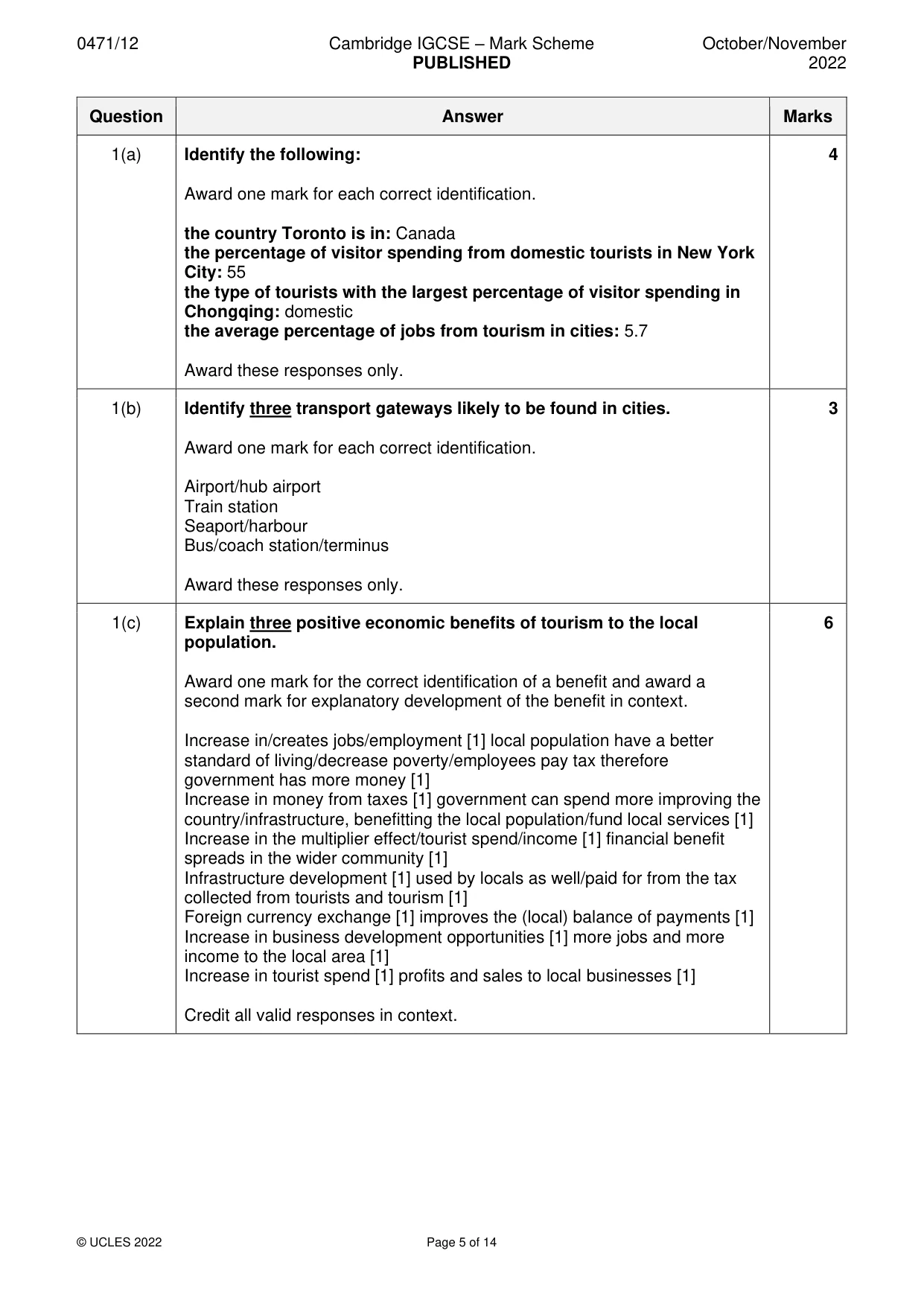
0471/12 Cambridge IGCSE – Mark Scheme PUBLISHED October/November 2022 © UCLES 2022 Page 5 of 14 Question Answer Marks 1(a) Identify the following: Award one mark for each correct identification. the country Toronto is in: Canada the percentage of visitor spending from domestic tourists in New York City: 55 the type of tourists with the largest percentage of visitor spending in Chongqing: domestic the average percentage of jobs from tourism in cities: 5.7 Award these responses only. 4 1(b) Identify three transport gateways likely to be found in cities. Award one mark for each correct identification. Airport/hub airport Train station Seaport/harbour Bus/coach station/terminus Award these responses only. 3 1(c) Explain three positive economic benefits of tourism to the local population. Award one mark for the correct identification of a benefit and award a second mark for explanatory development of the benefit in context. Increase in/creates jobs/employment [1] local population have a better standard of living/decrease poverty/employees pay tax therefore government has more money [1] Increase in money from taxes [1] government can spend more improving the country/infrastructure, benefitting the local population/fund local services [1] Increase in the multiplier effect/tourist spend/income [1] financial benefit spreads in the wider community [1] Infrastructure development [1] used by locals as well/paid for from the tax collected from tourists and tourism [1] Foreign currency exchange [1] improves the (local) balance of payments [1] Increase in business development opportunities [1] more jobs and more income to the local area [1] Increase in tourist spend [1] profits and sales to local businesses [1] Credit all valid responses in context. 6
Mark scheme, page 6
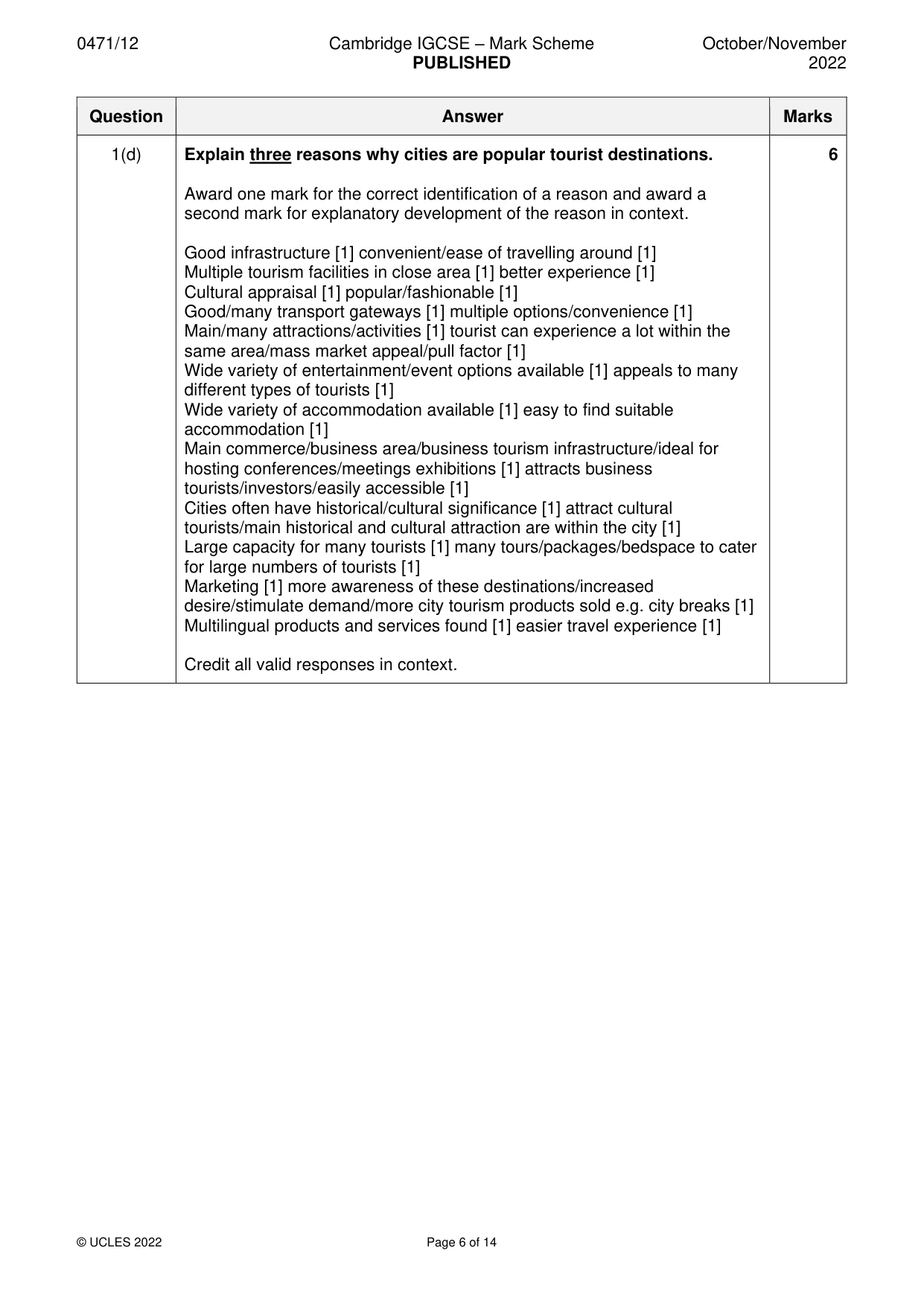
0471/12 Cambridge IGCSE – Mark Scheme PUBLISHED October/November 2022 © UCLES 2022 Page 6 of 14 Question Answer Marks 1(d) Explain three reasons why cities are popular tourist destinations. Award one mark for the correct identification of a reason and award a second mark for explanatory development of the reason in context. Good infrastructure [1] convenient/ease of travelling around [1] Multiple tourism facilities in close area [1] better experience [1] Cultural appraisal [1] popular/fashionable [1] Good/many transport gateways [1] multiple options/convenience [1] Main/many attractions/activities [1] tourist can experience a lot within the same area/mass market appeal/pull factor [1] Wide variety of entertainment/event options available [1] appeals to many different types of tourists [1] Wide variety of accommodation available [1] easy to find suitable accommodation [1] Main commerce/business area/business tourism infrastructure/ideal for hosting conferences/meetings exhibitions [1] attracts business tourists/investors/easily accessible [1] Cities often have historical/cultural significance [1] attract cultural tourists/main historical and cultural attraction are within the city [1] Large capacity for many tourists [1] many tours/packages/bedspace to cater for large numbers of tourists [1] Marketing [1] more awareness of these destinations/increased desire/stimulate demand/more city tourism products sold e.g. city breaks [1] Multilingual products and services found [1] easier travel experience [1] Credit all valid responses in context. 6
Mark scheme, page 7
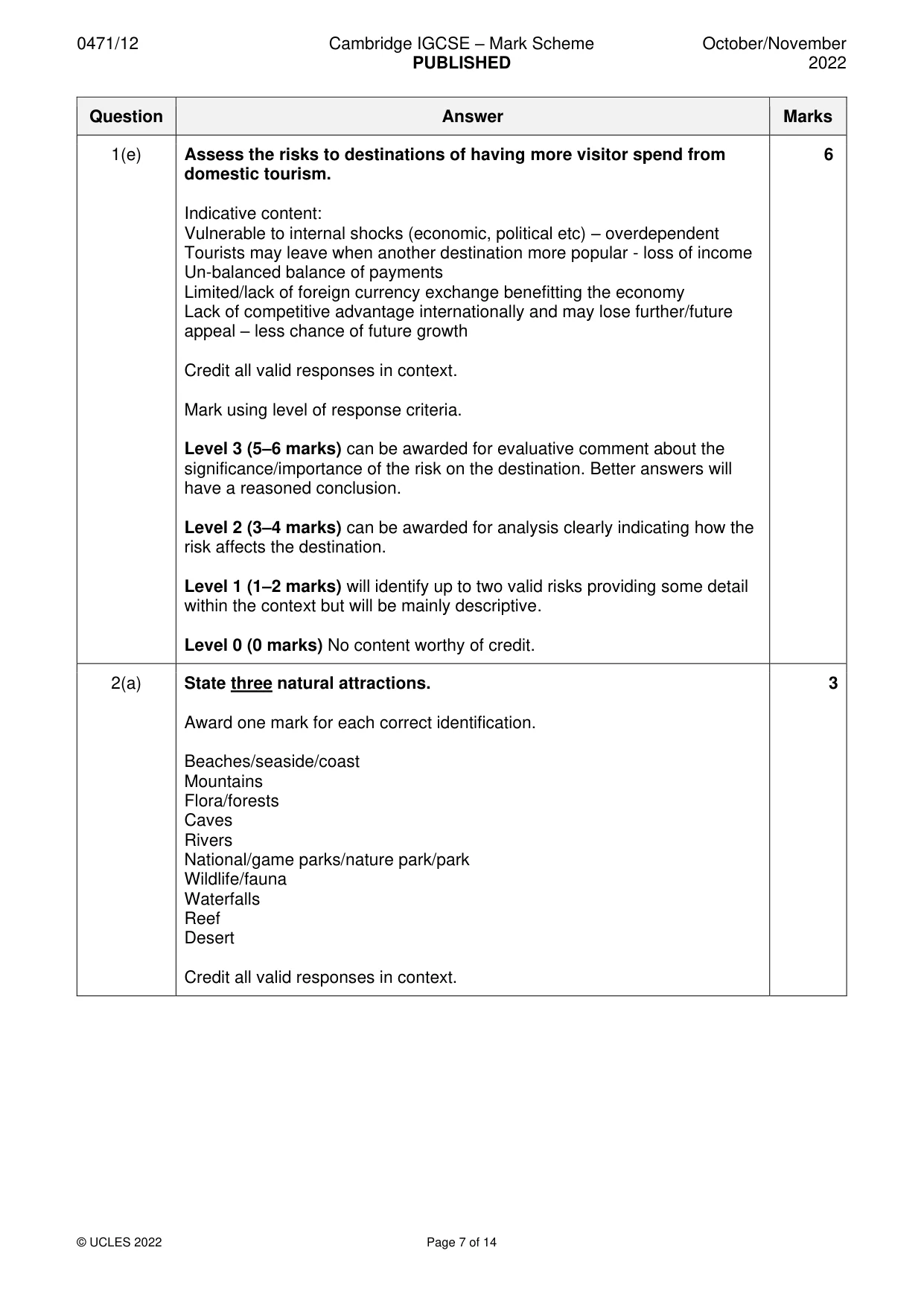
0471/12 Cambridge IGCSE – Mark Scheme PUBLISHED October/November 2022 © UCLES 2022 Page 7 of 14 Question Answer Marks 1(e) Assess the risks to destinations of having more visitor spend from domestic tourism. Indicative content: Vulnerable to internal shocks (economic, political etc) – overdependent Tourists may leave when another destination more popular - loss of income Un-balanced balance of payments Limited/lack of foreign currency exchange benefitting the economy Lack of competitive advantage internationally and may lose further/future appeal – less chance of future growth Credit all valid responses in context. Mark using level of response criteria. Level 3 (5–6 marks) can be awarded for evaluative comment about the significance/importance of the risk on the destination. Better answers will have a reasoned conclusion. Level 2 (3–4 marks) can be awarded for analysis clearly indicating how the risk affects the destination. Level 1 (1–2 marks) will identify up to two valid risks providing some detail within the context but will be mainly descriptive. Level 0 (0 marks) No content worthy of credit. 6 2(a) State three natural attractions. Award one mark for each correct identification. Beaches/seaside/coast Mountains Flora/forests Caves Rivers National/game parks/nature park/park Wildlife/fauna Waterfalls Reef Desert Credit all valid responses in context. 3
Mark scheme, page 8
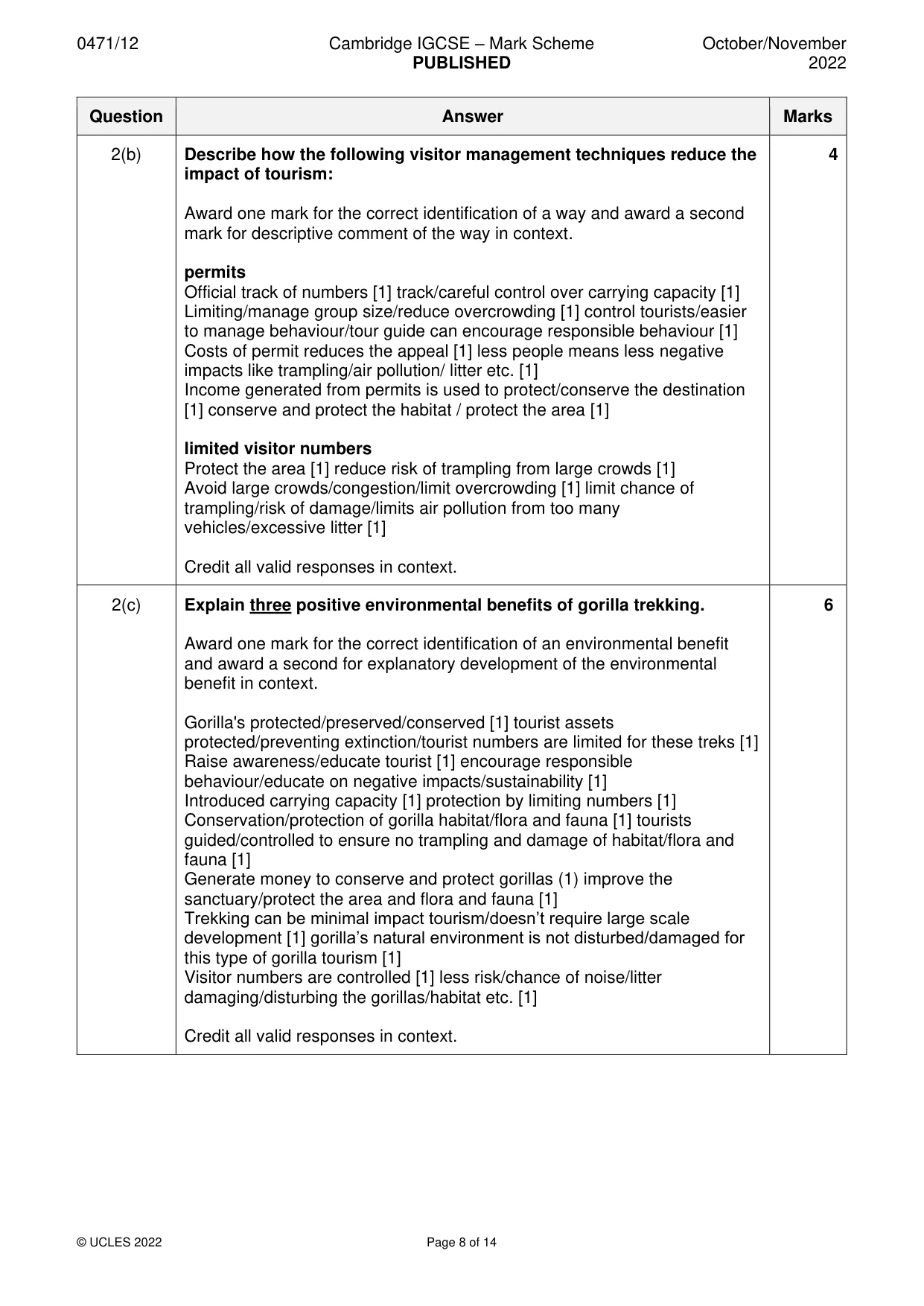
0471/12 Cambridge IGCSE – Mark Scheme PUBLISHED October/November 2022 © UCLES 2022 Page 8 of 14 Question Answer Marks 2(b) Describe how the following visitor management techniques reduce the impact of tourism: Award one mark for the correct identification of a way and award a second mark for descriptive comment of the way in context. permits Official track of numbers [1] track/careful control over carrying capacity [1] Limiting/manage group size/reduce overcrowding [1] control tourists/easier to manage behaviour/tour guide can encourage responsible behaviour [1] Costs of permit reduces the appeal [1] less people means less negative impacts like trampling/air pollution/ litter etc. [1] Income generated from permits is used to protect/conserve the destination [1] conserve and protect the habitat / protect the area [1] limited visitor numbers Protect the area [1] reduce risk of trampling from large crowds [1] Avoid large crowds/congestion/limit overcrowding [1] limit chance of trampling/risk of damage/limits air pollution from too many vehicles/excessive litter [1] Credit all valid responses in context. 4 2(c) Explain three positive environmental benefits of gorilla trekking. Award one mark for the correct identification of an environmental benefit and award a second for explanatory development of the environmental benefit in context. Gorilla's protected/preserved/conserved [1] tourist assets protected/preventing extinction/tourist numbers are limited for these treks [1] Raise awareness/educate tourist [1] encourage responsible behaviour/educate on negative impacts/sustainability [1] Introduced carrying capacity [1] protection by limiting numbers [1] Conservation/protection of gorilla habitat/flora and fauna [1] tourists guided/controlled to ensure no trampling and damage of habitat/flora and fauna [1] Generate money to conserve and protect gorillas (1) improve the sanctuary/protect the area and flora and fauna [1] Trekking can be minimal impact tourism/doesn’t require large scale development [1] gorilla’s natural environment is not disturbed/damaged for this type of gorilla tourism [1] Visitor numbers are controlled [1] less risk/chance of noise/litter damaging/disturbing the gorillas/habitat etc. [1] Credit all valid responses in context. 6
Mark scheme, page 9
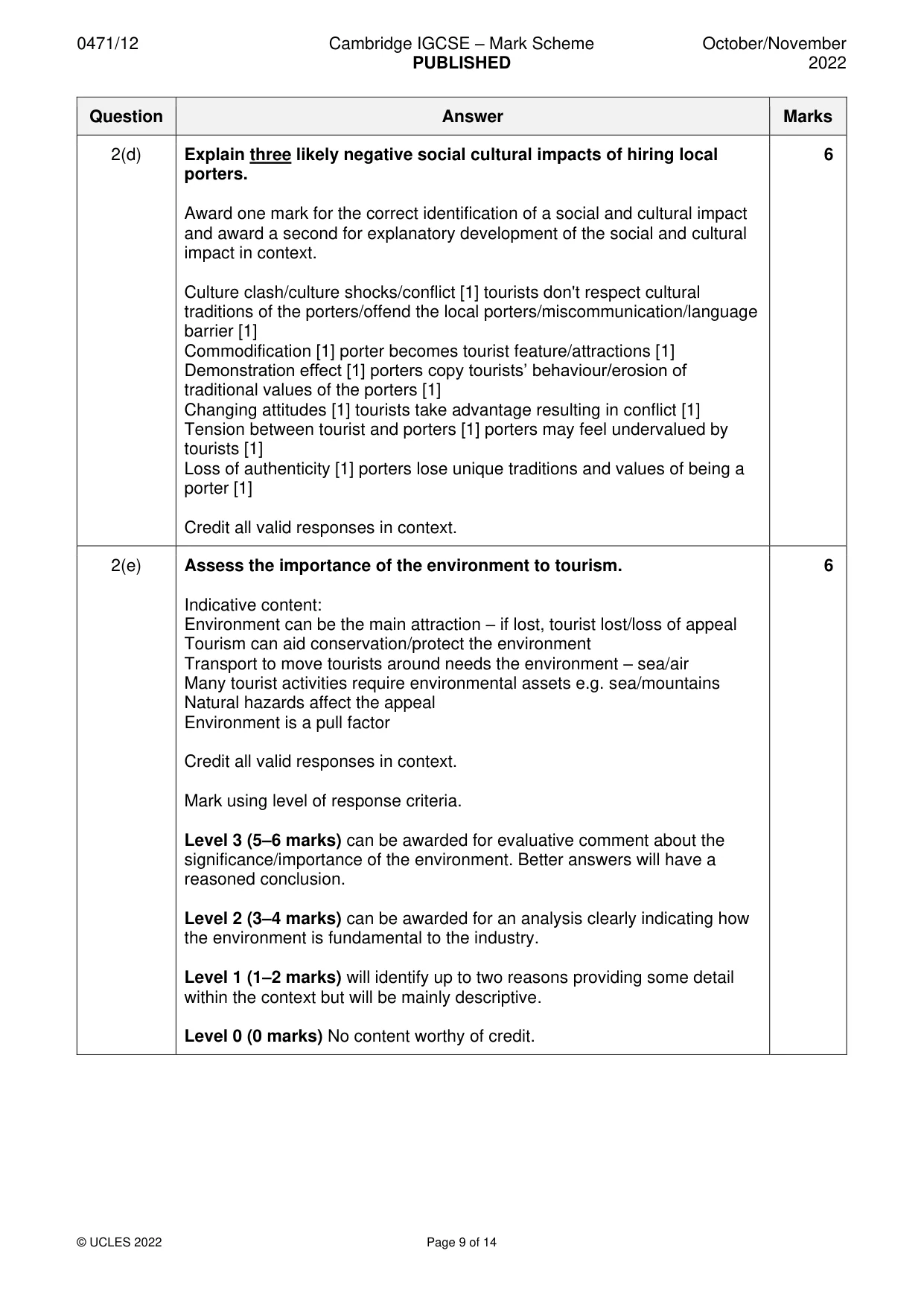
0471/12 Cambridge IGCSE – Mark Scheme PUBLISHED October/November 2022 © UCLES 2022 Page 9 of 14 Question Answer Marks 2(d) Explain three likely negative social cultural impacts of hiring local porters. Award one mark for the correct identification of a social and cultural impact and award a second for explanatory development of the social and cultural impact in context. Culture clash/culture shocks/conflict [1] tourists don't respect cultural traditions of the porters/offend the local porters/miscommunication/language barrier [1] Commodification [1] porter becomes tourist feature/attractions [1] Demonstration effect [1] porters copy tourists’ behaviour/erosion of traditional values of the porters [1] Changing attitudes [1] tourists take advantage resulting in conflict [1] Tension between tourist and porters [1] porters may feel undervalued by tourists [1] Loss of authenticity [1] porters lose unique traditions and values of being a porter [1] Credit all valid responses in context. 6 2(e) Assess the importance of the environment to tourism. Indicative content: Environment can be the main attraction – if lost, tourist lost/loss of appeal Tourism can aid conservation/protect the environment Transport to move tourists around needs the environment – sea/air Many tourist activities require environmental assets e.g. sea/mountains Natural hazards affect the appeal Environment is a pull factor Credit all valid responses in context. Mark using level of response criteria. Level 3 (5–6 marks) can be awarded for evaluative comment about the significance/importance of the environment. Better answers will have a reasoned conclusion. Level 2 (3–4 marks) can be awarded for an analysis clearly indicating how the environment is fundamental to the industry. Level 1 (1–2 marks) will identify up to two reasons providing some detail within the context but will be mainly descriptive. Level 0 (0 marks) No content worthy of credit. 6
Mark scheme, page 10
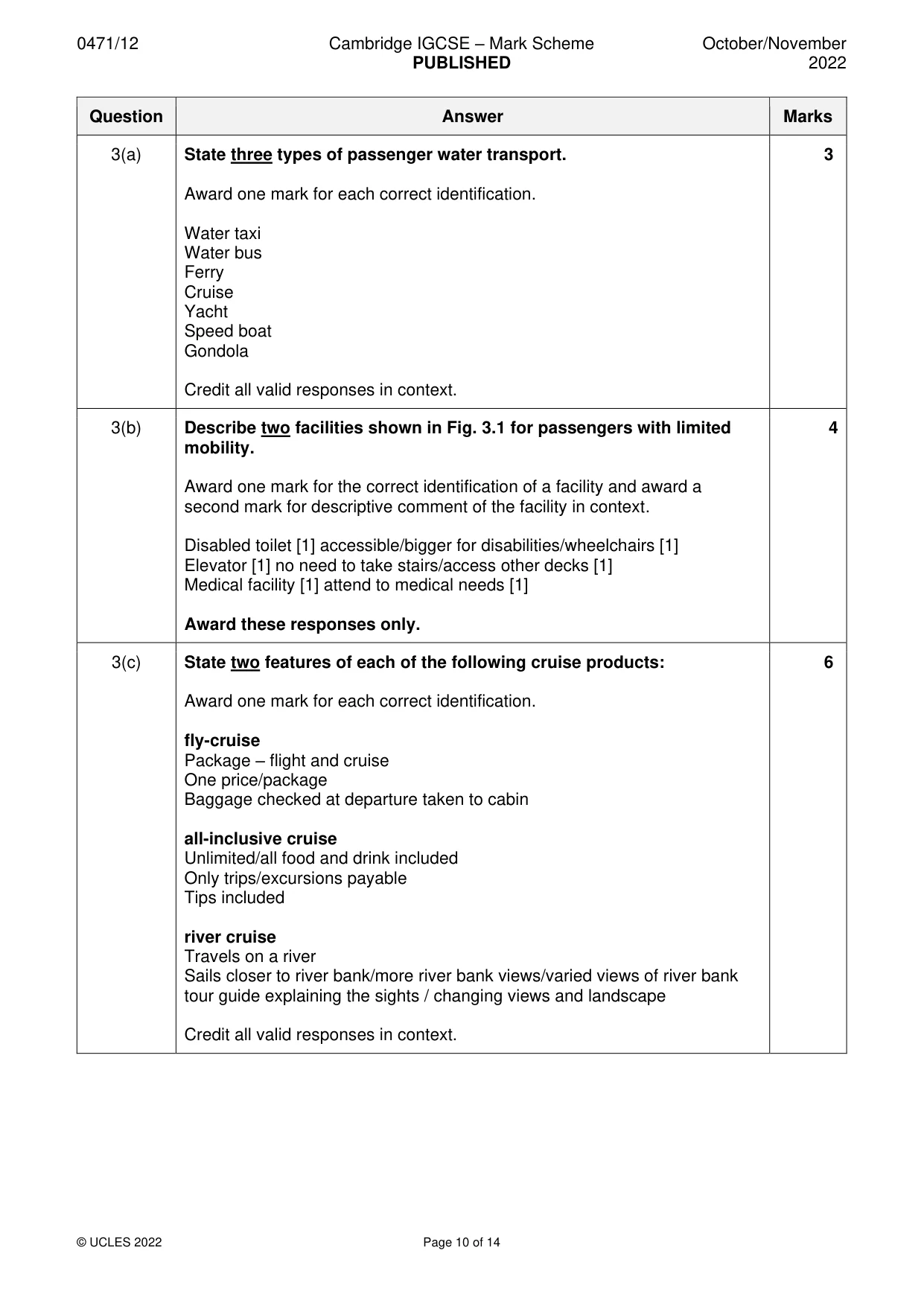
0471/12 Cambridge IGCSE – Mark Scheme PUBLISHED October/November 2022 © UCLES 2022 Page 10 of 14 Question Answer Marks 3(a) State three types of passenger water transport. Award one mark for each correct identification. Water taxi Water bus Ferry Cruise Yacht Speed boat Gondola Credit all valid responses in context. 3 3(b) Describe two facilities shown in Fig. 3.1 for passengers with limited mobility. Award one mark for the correct identification of a facility and award a second mark for descriptive comment of the facility in context. Disabled toilet [1] accessible/bigger for disabilities/wheelchairs [1] Elevator [1] no need to take stairs/access other decks [1] Medical facility [1] attend to medical needs [1] Award these responses only. 4 3(c) State two features of each of the following cruise products: Award one mark for each correct identification. fly-cruise Package – flight and cruise One price/package Baggage checked at departure taken to cabin all-inclusive cruise Unlimited/all food and drink included Only trips/excursions payable Tips included river cruise Travels on a river Sails closer to river bank/more river bank views/varied views of river bank tour guide explaining the sights / changing views and landscape Credit all valid responses in context. 6
Mark scheme, page 11
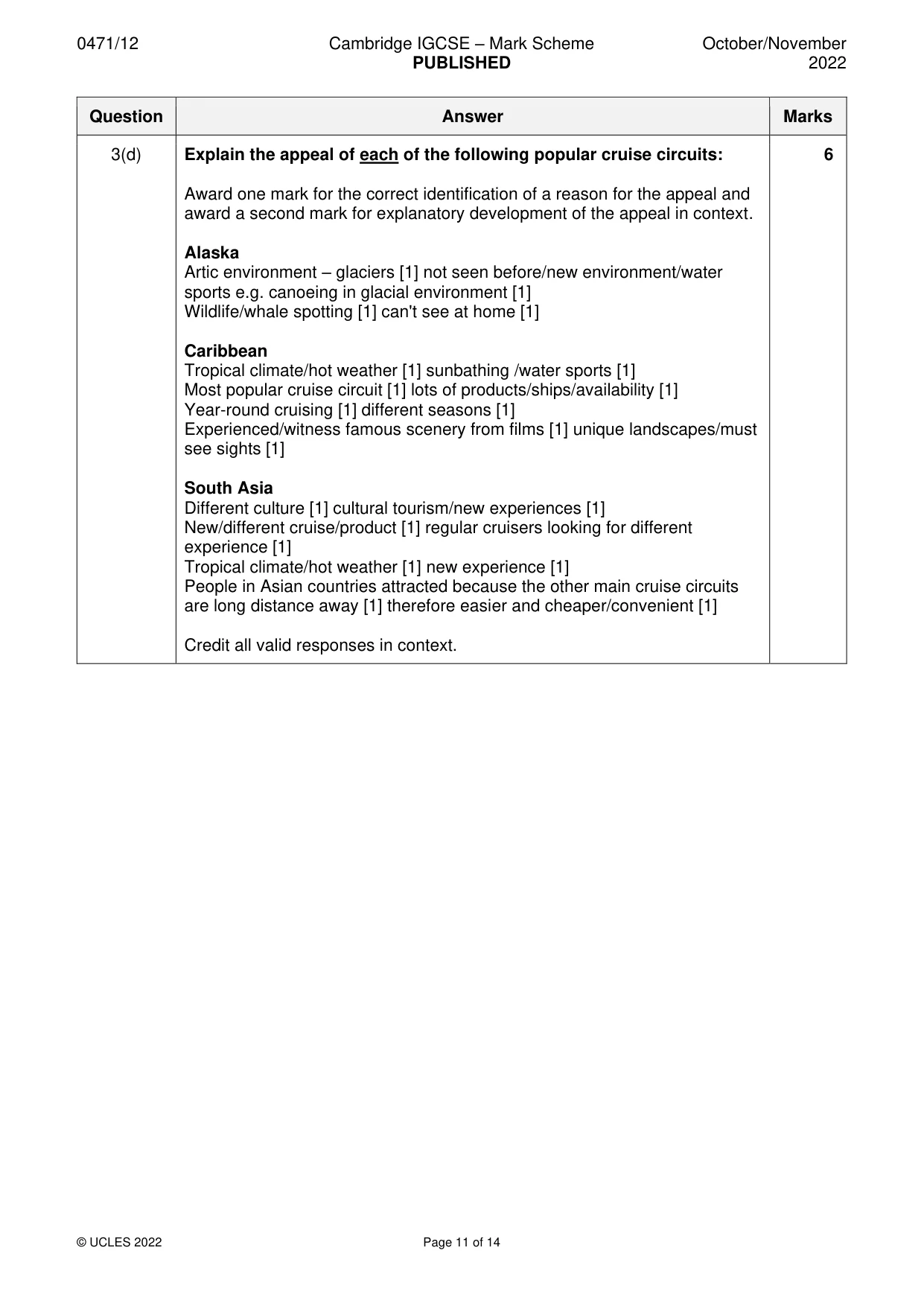
0471/12 Cambridge IGCSE – Mark Scheme PUBLISHED October/November 2022 © UCLES 2022 Page 11 of 14 Question Answer Marks 3(d) Explain the appeal of each of the following popular cruise circuits: Award one mark for the correct identification of a reason for the appeal and award a second mark for explanatory development of the appeal in context. Alaska Artic environment – glaciers [1] not seen before/new environment/water sports e.g. canoeing in glacial environment [1] Wildlife/whale spotting [1] can't see at home [1] Caribbean Tropical climate/hot weather [1] sunbathing /water sports [1] Most popular cruise circuit [1] lots of products/ships/availability [1] Year-round cruising [1] different seasons [1] Experienced/witness famous scenery from films [1] unique landscapes/must see sights [1] South Asia Different culture [1] cultural tourism/new experiences [1] New/different cruise/product [1] regular cruisers looking for different experience [1] Tropical climate/hot weather [1] new experience [1] People in Asian countries attracted because the other main cruise circuits are long distance away [1] therefore easier and cheaper/convenient [1] Credit all valid responses in context. 6
Mark scheme, page 12
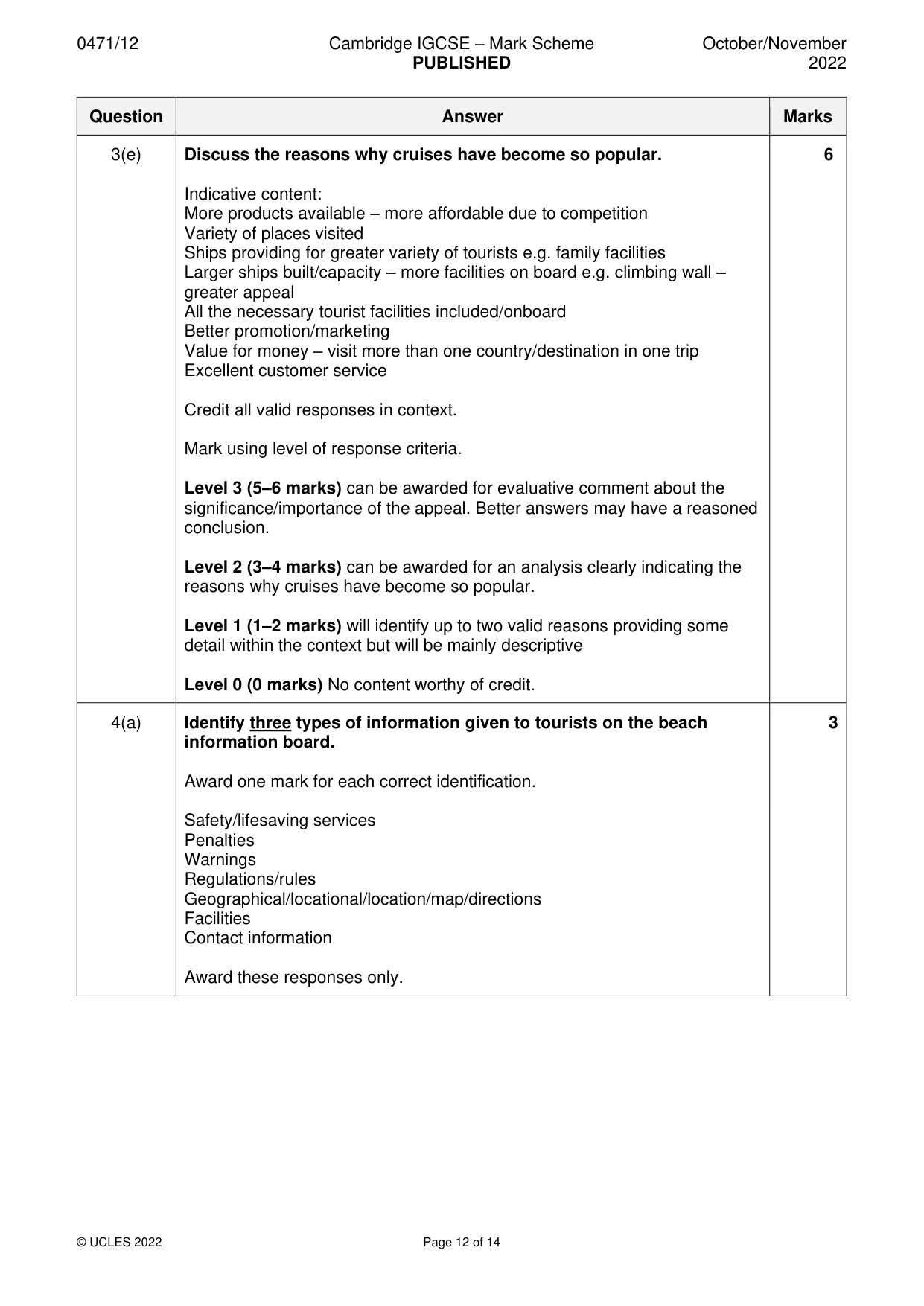
0471/12 Cambridge IGCSE – Mark Scheme PUBLISHED October/November 2022 © UCLES 2022 Page 12 of 14 Question Answer Marks 3(e) Discuss the reasons why cruises have become so popular. Indicative content: More products available – more affordable due to competition Variety of places visited Ships providing for greater variety of tourists e.g. family facilities Larger ships built/capacity – more facilities on board e.g. climbing wall – greater appeal All the necessary tourist facilities included/onboard Better promotion/marketing Value for money – visit more than one country/destination in one trip Excellent customer service Credit all valid responses in context. Mark using level of response criteria. Level 3 (5–6 marks) can be awarded for evaluative comment about the significance/importance of the appeal. Better answers may have a reasoned conclusion. Level 2 (3–4 marks) can be awarded for an analysis clearly indicating the reasons why cruises have become so popular. Level 1 (1–2 marks) will identify up to two valid reasons providing some detail within the context but will be mainly descriptive Level 0 (0 marks) No content worthy of credit. 6 4(a) Identify three types of information given to tourists on the beach information board. Award one mark for each correct identification. Safety/lifesaving services Penalties Warnings Regulations/rules Geographical/locational/location/map/directions Facilities Contact information Award these responses only. 3
Mark scheme, page 13
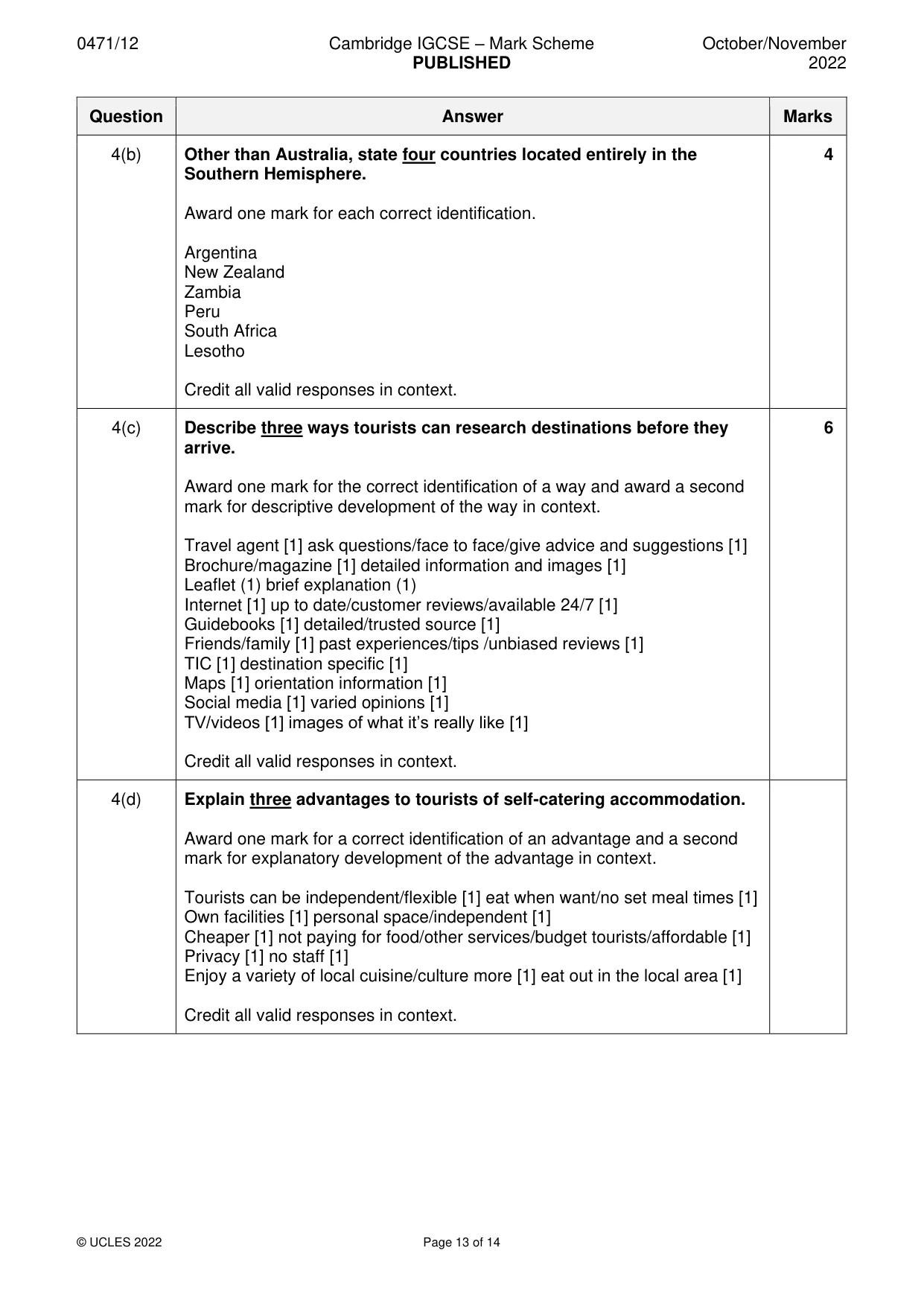
0471/12 Cambridge IGCSE – Mark Scheme PUBLISHED October/November 2022 © UCLES 2022 Page 13 of 14 Question Answer Marks 4(b) Other than Australia, state four countries located entirely in the Southern Hemisphere. Award one mark for each correct identification. Argentina New Zealand Zambia Peru South Africa Lesotho Credit all valid responses in context. 4 4(c) Describe three ways tourists can research destinations before they arrive. Award one mark for the correct identification of a way and award a second mark for descriptive development of the way in context. Travel agent [1] ask questions/face to face/give advice and suggestions [1] Brochure/magazine [1] detailed information and images [1] Leaflet (1) brief explanation (1) Internet [1] up to date/customer reviews/available 24/7 [1] Guidebooks [1] detailed/trusted source [1] Friends/family [1] past experiences/tips /unbiased reviews [1] TIC [1] destination specific [1] Maps [1] orientation information [1] Social media [1] varied opinions [1] TV/videos [1] images of what it’s really like [1] Credit all valid responses in context. 6 4(d) Explain three advantages to tourists of self-catering accommodation. Award one mark for a correct identification of an advantage and a second mark for explanatory development of the advantage in context. Tourists can be independent/flexible [1] eat when want/no set meal times [1] Own facilities [1] personal space/independent [1] Cheaper [1] not paying for food/other services/budget tourists/affordable [1] Privacy [1] no staff [1] Enjoy a variety of local cuisine/culture more [1] eat out in the local area [1] Credit all valid responses in context.
Mark scheme, page 14
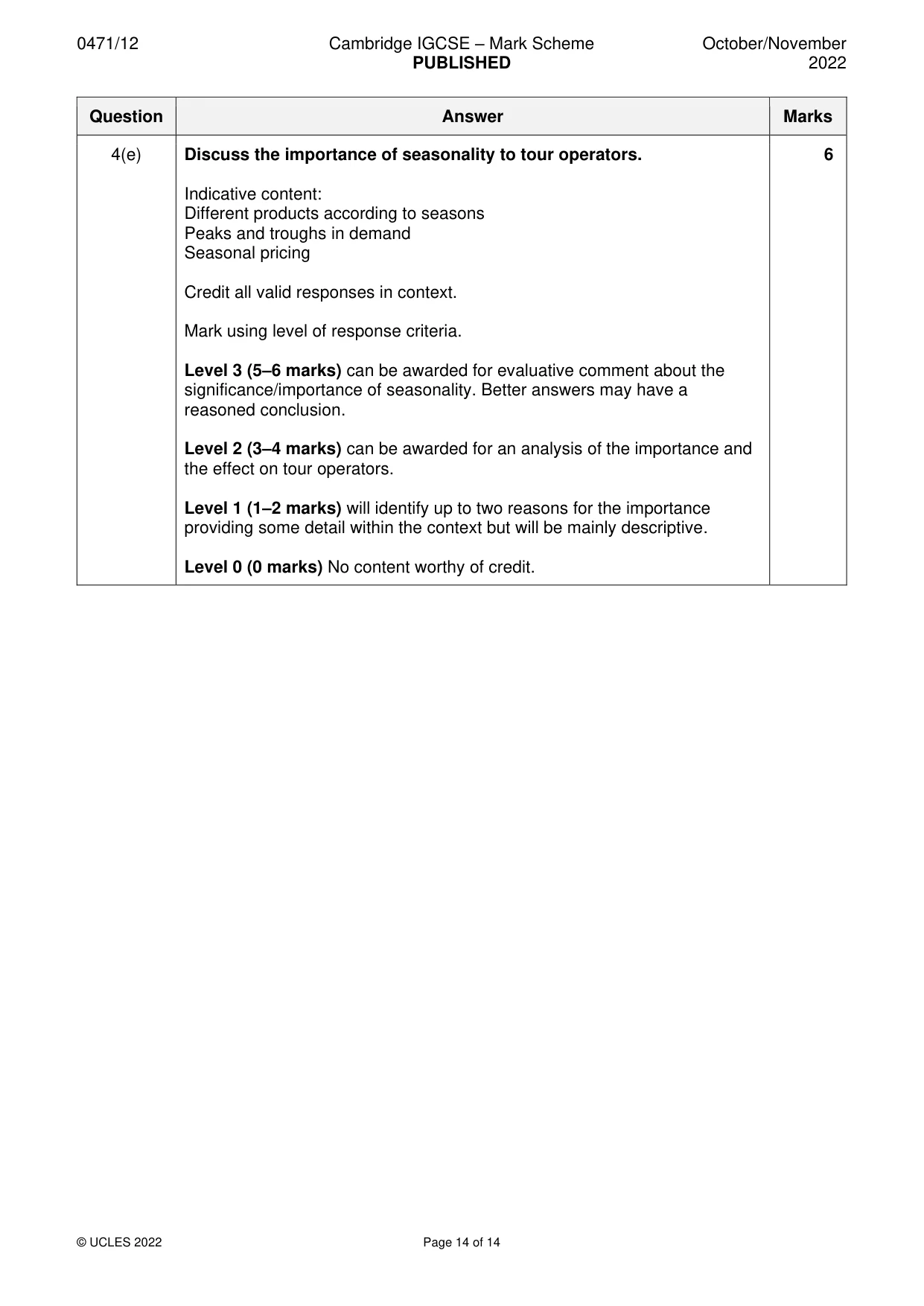
0471/12 Cambridge IGCSE – Mark Scheme PUBLISHED October/November 2022 © UCLES 2022 Page 14 of 14 Question Answer Marks 4(e) Discuss the importance of seasonality to tour operators. Indicative content: Different products according to seasons Peaks and troughs in demand Seasonal pricing Credit all valid responses in context. Mark using level of response criteria. Level 3 (5–6 marks) can be awarded for evaluative comment about the significance/importance of seasonality. Better answers may have a reasoned conclusion. Level 2 (3–4 marks) can be awarded for an analysis of the importance and the effect on tour operators. Level 1 (1–2 marks) will identify up to two reasons for the importance providing some detail within the context but will be mainly descriptive. Level 0 (0 marks) No content worthy of credit. 6
What you needed in this session
Cambridge’s own grade thresholds for 2022 Oct/Nov, Paper 1 · Variant 2. A higher threshold means an easier paper — the bar moves with how the cohort did.